The media’s anti-Trump bias on both sides of the pond is so blatant is it any wonder the Donald is crying foul?
By Neil Clark | RT | November 7, 2020
Donald Trump always claimed the media was against him and this week’s events prove he was right, whatever one’s opinion of the US president.
It’s probably the understatement of the year to say that Donald Trump is a polarising figure. Rather like Marmite, people tend to love him or loathe him. But even those in the latter category, if they’re being honest, would have to admit that the mainstream media coverage of the 2020 presidential election results has been heavily – and quite outrageously – slanted against the US president.
Let’s put it another way.
Suppose someone who had spent the last four years at a space station on Planet Zog, and who had no background knowledge of US politics, zoomed down to Earth on Tuesday night and decided to tune into the US election coverage. They would work out pretty quickly that most of the media and most ‘commentators’ wanted the man they called ‘Trump’ to lose and the man they called ‘Biden’ to win. Orange Man = Bad, Other Man in Mask = Good.
You’d have to be deaf, dumb and blind not to notice the bias. As the author Candace Owens tweeted “At no point would they call states with a clear Trump lead on election night if it put Trump above Biden. I have never seen anything like it. The media is in full cooperation and collusion with the Democrat Party.”
Quite a claim isn’t it? But it certainly does seem that way to any neutral observer.
Trump’s defeat was something the major channels and most ‘talking heads’ had looked forward to for years. The prospect of him actually winning – against the odds and against the polls – was not something they were willing to countenance. Even when the president had a clear lead in several states. Instead we kept hearing how Joe could still take this or that state. The Democratic candidate was merely ‘biden’ his time, don‘t you know.
We all know the media plays a key role in influencing how people vote, but in the US, because of the peculiarities of the system, they also play a very important role in shaping perceptions of who is actually winning. Forget the fat lady singing, the US election shows it ain’t over until the media says it is, the New York Times even explicitly said this in a hastily deleted tweet. And the media wasn’t going to call it over with the man they utterly despised in the lead. You don’t have to be a member of the Donald Trump fan club to acknowledge this.
On Tuesday, at 11pm in the UK Biden was odds-on and Trump 2-1 against. But in the morning Trump was odds-on. Then came the time-out. It was the German football manager Franz Beckenbauer who said that if your team is losing, you have to do everything you can to disrupt your opponent’s momentum. The media – and Trump’s opponents – certainly did that.
Of course Trump is angry about what happened. Wouldn’t you be? But look at how his reaction to what happened has been portrayed. The BBC website, declared ‘US goes to wire as Trump falsely claims fraud’. Why the ‘falsely’? Does the BBC know for sure that Trump’s claims are false? They may be but they may not be. Who knows? In the good old days when the BBC reported the news rather than editorialised it, the headline would have been ‘US vote goes to wire as Trump claims fraud’, and viewers would be left to decide for themselves whether they thought the claims had any merit.
ITV News was just as subjective. ’Donald Trump repeats baseless election fraud claim as Joe Biden urges calm’, they tweeted. Got that? Bad Man makes baseless claims, Good Man says ‘Stay calm, folks’.
Isn’t it revealing that Trump’s claims are routinely and summarily dismissed as ‘false’ and ‘baseless’ whereas Democrat claims that he was a de facto Russian agent received no such dismissal. No, they and the associated claims of ’major Russian collusion’ in the 2016 election were reported as credible, even though no evidence was produced. Which begs the question: How can the US electoral system be so fraud-proof in 2020, yet so open to ’Russian fraud’ in 2016? The double standards are off the scale.
Trump has been told to be a ‘good loser’ and ‘do a John McCain’ by those who did everything they could to delegitimise his victory four years ago. Is it any surprise that he isn’t prepared to concede and instead threatens litigation? To add insult to injury several news networks cut off from the president’s Thursday press conference regarding the election. Newsweek, helpfully, tells us Trump’s statement “was laced with false claims regarding the election.”
The BBC, even more helpfully, ‘fact-checked’ Trump‘s speech for us. What a service! What a pity all this ‘fact-checking‘ wasn‘t around when George W. Bush (and Tony Blair) were making claims about Iraq having WMDs. They were baseless claims, for sure. But no one reported them as such. Shame that, because lots of people died. But only Donald Trump tells lies. Donald Trump was the man who invented ‘Fake News’. There was none of it before he was around.
Repeat After Me: “Orange Man Bad. Biden Man Good. Once Bad Orange Man goes US will be a great, internationally-respected country again like when it invaded Iraq and Afghanistan, bombed Yugoslavia and destroyed Libya under the ‘honourable’ Presidents Clinton, Bush and Obama, who never made any ‘false’ claims at all. Got it, children?”
Now go to sleep. Uncle Joe will (hopefully) soon be in the White House and the world will be a MUCH BETTER PLACE.
Neil Clark is a journalist, writer, broadcaster and blogger. His award winning blog can be found at http://www.neilclark66.blogspot.com. He tweets on politics and world affairs @NeilClark66
Was It Really The Wettest Day?
By Paul Homewood | Not A Lot Of People Know That | November 5, 2020
Saturday 3 October was the wettest day for UK-wide rainfall since records began in 1891, Met Office researchers have said.
The downpour followed in the wake of Storm Alex and saw an average of 31.7mm (1.24ins) of rain across the entire UK.
The deluge was enough to exceed the capacity of Loch Ness – the largest lake in the UK by volume – the researchers added.
The previous record wettest day was 29 August 1986.
No doubt this will be wheeled out at the end of the year by the Met Office to bolster its “extreme weather” propaganda. But was it really the wettest day? How do we know?
Quite simply, we don’t, because the Met Office have never published a database of UK daily rainfall. Instead we are expected to take their word for it. Would you trust a company claiming that it had just made record profits, when it had never published any accounts? Of course not.
We also know that the Met Office has recently included several high altitude sites in its rainfall database, which have inevitably skewed upwards rainfall totals.
However, although they do not publish UK daily rainfall data, we do have daily data from the England & Wales Precipitation Series back to 1931. This series categorically shows that October 3rd was not a record, nor anywhere close.
Rainfall totalled 28.48mm on that day, well below the record of 43.23mm which fell in August 1986. Last month’s “record” was in fact only the tenth wettest day.
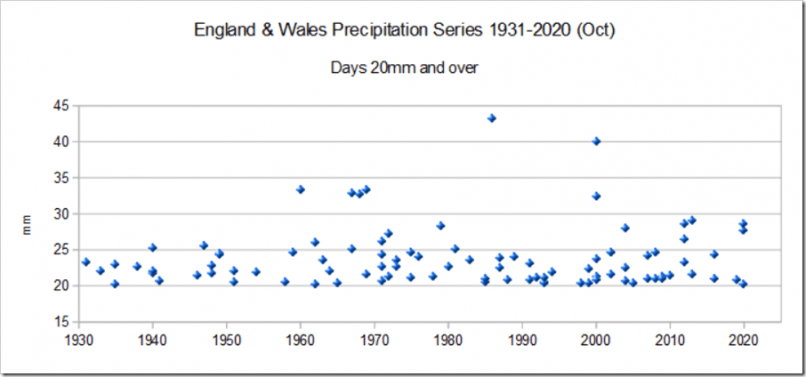
https://www.metoffice.gov.uk/hadobs/hadukp/data/daily/HadEWP_daily_qc.txt
Even the England & Wales series is of limited value, as it still only has 90 years of data. There will undoubtedly have been many other extremely wet days earlier.
In fact, as the Met Office admits, the rainfall on 3rd October was not particularly intense anywhere, simply widespread across the whole country.
For instance, Oxfordshire was one of the wettest spots in England, and they had about 60mm that day:
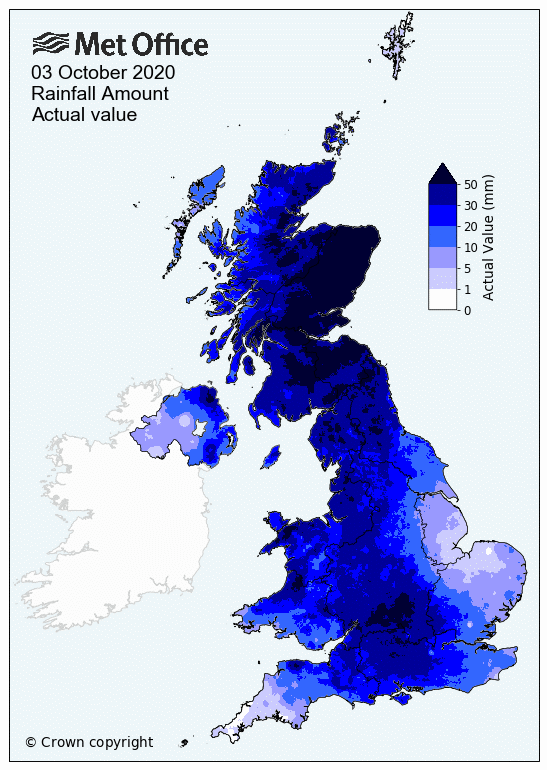
https://blog.metoffice.gov.uk/2020/10/16/rainfall-on-uks-wettest-day-on-record-could-have-more-than-filled-loch-ness/
However, even at Oxford, such a total was far from being unprecedented:
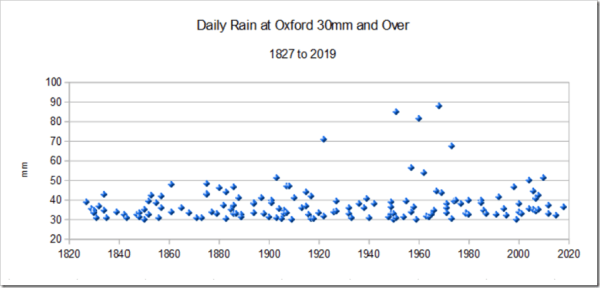
https://notalotofpeopleknowthat.wordpress.com/2020/11/03/bbcs-oxford-soggy-month-claims-undermined-by-the-actual-data/
To be fair, Scotland got a real drenching that day, which may have tilted the UK figures up from the England & Wales ones. However, as I have frequently pointed out, Scotland has become wetter in recent decades, but that does not mean that the rest of the UK has.
The Met Office’s Mark McCarthy gives us the usual weasel words:
“We can’t make any definitive statements specifically about the attribution of this particular event on October 3,” said Dr McCarthy.
“There’s a general expectation that under our warming climate, we would expect to see increases in some types of extreme rainfall and rainfall events and we’re expecting to have wetter winters overall, we could expect increases in these types of extremes.”
If what he says is true, we would expect to see a pattern of increasingly extreme wet weather in England & Wales, and not just Scotland. The fact is that there is no such pattern, either in these intense daily events, or for that matter monthly totals.
Clearly therefore his theory holds no water.
We Are Pawns In A Bigger Game Than We Realize
By Chris Martenson | PeakProsperity | October 30, 2020
“I had grasped the significance of the silence of the dog, for one true inference invariably suggests others… Obviously the midnight visitor was someone whom the dog knew well.”
~ Sherlock Holmes – The Adventures of Silver Blaze
Is it possible to make sense out of nonsense?
So much these days is an incoherent mess. It’s complete nonsense.
Page 1 excitedly beams about a glorious rebound in GDP. Yay economic growth!
Page 2 worryingly notes the near complete failure of Siberian arctic ice to reform during October and that hurricane Zeta (so many storms this year we’re now into the Greek alphabet!) has made punishing landfall.
Each is a narrative. Each has its own inner logic.
But they simply do not have any external coherence to each other. It’s nonsensical to be excited about rising economic growth while also concerned that each new unit of growth takes the planet further past a critical red line.
These narratives are incompatible. So which one should we pick?
Well, in the end, reality always has the final say. As Guy McPherson states: Nature bats last.
So better we choose to follow the narrative that hews closest to what reality actually is, vs what we desperately want it to be.
‘They’ Don’t Care About Us
While issues like climate change and economic growth may be difficult to fully grasp and unravel, direct threats to our lives &/or livelihoods are much more concrete and something we can react to and resist.
Such immediate and direct threats are now fully in play and, once again, they’re accompanied by narratives that are completely at odds with each other. I’m speaking of Covid and the ways in which our national and global managers are choosing to respond (or not).
It’s a truly incoherent mess about which both social media and the increasingly irrelevant media are working quite hard to misinform us.
The mainstream narrative about Covid-19, in the West, is this:
- It’s a quite deadly and novel disease
- There are no effective treatments
- Sadly, no double-blind placebo controlled trials exist to support some of the wild claims out there about various off-patent, cheap and widely available supplements and drugs
- Health authorities care about saving lives
- They care so much, in fact, that along with politicians they’ve decided to entirely shut down economies
- There’s a huge second wave rampaging across the US and Europe and there’s nothing we can do to limit it except shut down businesses and people’s ability to travel and gather
- You need to fear this virus and its associated disease
- All we can do is wait for a vaccine
The alternative narrative, one that I’ve uncovered after 9 months of almost daily research and reporting, is this:
- It’s not an especially dangerous disease and it’s certainly not novel
- There is a huge assortment of very effective, cheap and widely-available preventatives and treatments including (but not limited to)
- Vitamin D
- Ivermectin
- Hydroxychloroquine
- Zinc
- Selenium
- Famotidine (Pepcid)
- Melatonin
- Use of a combination of these mostly OTC supplements could reasonably be expected to drop the severity of illness and the already low mortality rate by 90% or (probably) more
- Western health authorities have shown either zero interest in the results of studies mainly conducted in poorer nations on these combination therapies or…
- They have actively run studies designed to fail so that these cheap, effective therapies could be dismissed or…
- Set up proper studies but which started late, have immensely long study periods and most likely won’t be done before a vaccine is hastily rushed through development.
By the way – every single one of my assertions and claims is backed by links and supporting documentation from scientific and clinical trials and studies. I am not conjecturing here; I am recounting the summary of ten months’ worth of inquiry.
The conclusion I draw from my narrative (vs. theirs) is that we can no longer assume that the public health or saving lives has anything to do with explaining or understanding the actions of these health “managers” (I cannot bring myself to use the word authorities).
After we eliminate the impossible – which is that somehow these massive, well-funded bodies have missed month after month of accumulating evidence in support of ivermectin, hydroxychloroquine, vitamin D, NAC, zinc, selenium and doxycycline/azithromycin – what remains must be the truth.
As improbable as it seems, the only conclusion we’re left with is that the machinery of politics, money and corporate psychopathy is suppressing life saving treatments because these managers have other priorities besides public health and saving lives.
This is a terribly difficult conclusion, because it means suspending so much that we hold dear. Things like the notion that people are basically good. The idea that the government generally means well. The thought that somehow when the chips are down and a crisis is afoot, good will emerge and triumph over evil.
I’m sorry to say, the exact opposite of all of that has emerged as true.
Medical doctors in the UK NHS system purposely used toxic doses of hydroxychloroquine far too late in the disease cycle to be of any help simply to ‘make a point’ about hydroxychloroquine. They rather desperately wanted that drug to fail, so they made it fail.
After deliberately setting their trial up for failure, they concluded: “Hydroxychloroquine doesn’t help, and it even makes things worse.”
Note that in order to be able to make this claim, they had to be willing to cause harm — even to let people die. What kind of health official does that?
Not one who actually has compassion, a heart, or functioning level of sympathy. It’s an awful conclusion but it’s what remains after we eliminate the impossible.
Getting Past The Emotional Toll
Science has proven that cheap, safe and significantly protective compounds exist to limit both Covid-related death and disease severity.
Yet all of the main so-called health authorities in the major western countries are nearly completely ignoring, if not outright banning, these safe, cheap and effective compounds.
This is crazy-making for independent observers like me (and you) because the data is so clear. It’s irrefutable at this point. These medicines and treatments not only work, but work really, really well.
However most people will be unable to absorb the data, let alone move beyond it to wrestle with the implications. Why? Because such data is belief-shattering. Absorbing this information is not an intellectual process; it’s an emotional one.
I don’t know why human nature decided to invest so much in developing a tight wall around the belief systems that control our actions and thoughts. But it has.
I’m sure there was some powerful evolutionary advantage. One that’s now being hijacked daily by social media AI programs to nudge us in desired directions. One that’s being leveraged by shabby politicians, hucksters, fake gurus, and con men to steer advantage away from the populace and towards themselves.
The neural wiring of beliefs is what it is. We have to recognize that and move on.
Some people will be much faster in their adjustment process than others.
To move past the deeply troubling information laid out before us requires us to be willing to endure a bit of turbulence. It’s the only way.
For you to navigate these troubling times safely and successfully, you’ll need to see as clearly as possible the true nature of the game actually being played. To see what the rules really are – not what you’ve been told they are, or what you wish or hope they are.
The Manipulation Underway
The data above strongly supports the conclusion that our national health managers don’t actually care about public health generally or your health specifically.
If indeed true, then the beliefs preventing most people from accepting this likely include:
- Wanting to believe that people are good (a biggie for most people)
- Trust and faith in the medical system (really big)
- Faith in authority (ginormous)
There are many other operative belief systems I could also list. But this is sufficient to get the ball rolling.
Picking just one, how hard would it be for someone to let go of, say, trust in the medical system?
That would be pretty hard in most cases.
First not trusting the medical system might mean having to wonder if a loved one might have died unnecessarily while being treated. Or realizing that you’re now going to have to research the living daylights out of every medical decision before agreeing to it. Or worrying that your medications might be more harmful to you over the long haul than helpful (which is true in many more cases than most appreciate). It might mean having your personal heroes dinged by suspicion — perhaps even your father or mother who worked in the medical profession. It would definitely require a complete reorientation away from being able to trust anything you read in a newspaper, or see on TV, about new pharmaceutical “breakthroughs”.
Trust, which is safe and warm and comforting, then turns into skepticism; which is lonelier and insists upon active mental involvement.
But, as always, hard work comes with benefits — with a healthy level of skepticism and involvement, the families of those recruited into the deadly UK RECOVERY trial could have looked at the proposed doses of HCQ (2,400 mg on day one! Toxic!) and said, “Not now, not ever!” and maybe have saved the life of their loved one.
Look at that tangled mess of undesirables that comes with unpacking that one belief: regret, uncertainty, shame, doubt, fallen idols, and vastly more additional effort. Are all up for grabs when we decide to look carefully at the actions of our national health managers during Covid.
Which is why most people simply choose not to look. It’s too hard.
I get it. I have a lot of compassion for why people choose not to go down that path. It can get unpleasant in a hurry.
But, just like choosing to ignore a nagging chest pain, turning away in denial has its own consequences.
The Coming ‘Great Reset’
My coverage of SARS-CoV-2 (the virus) and Covid-19 (the associated disease) has led me to uncover some things that have made me deeply uncomfortable about our global and national ‘managers’. Shameful things, really. Scary things in their implications for what we might reasonably expect (or not expect, more accurately) from the future.
Once we get past the shock of seeing just how patently corrupt they’ve been, we have to ask both What’s next? and What should I do?
After all, you live in a system whose managers are either too dumb to understand the Vitamin D data (very unlikely) or have decided that they’d rather not promote it to the general populace for some reason. It’s a ridiculously safe vitamin with almost zero downside and virtually unlimited upside.
Either they’re colossally dumb, or this is a calculated decision. They’re not dumb. So we have to ask: What’s the calculation being performed here? It’s not public safety. It’s not your personal health. So… What is it?
This is our line of questioning and observation. It’s like the short story by Arthur Conan Doyle in Silver Blaze that many of us informally know as “the case of the dog that didn’t bark”. As the story goes, because of a missing clue – a dog who remained silent as a murder was committed – this conclusion could be drawn: the dog was already familiar with the killer!
The silence around Vitamin D alone is extremely telling. It is the pharmacological dog that did not bark.
One true inference suggests others. Here, too, we can deduce from the near total silence around Vitamin D that the health managers would prefer not to talk about it. They don’t want people to know. That much is painfully clear.
Such lack of promotion (let alone appropriate study) of safe, effective treatments is a thread that, if tugged, can unravel the whole rug. The silence tells us everything we need to know.
Do they want people to suffer and die? I don’t know. My belief systems certainly hope not. Perhaps the death and suffering are merely collateral damage as they pursue a different goal — money, power, politics? Simply the depressing result of a contentious election year? More than that?
We’ve now reached the jumping off point where we may well find out just how far down the rabbit hole goes.
A massive grab for tighter control over the global populace is now being fast-tracked at the highest levels. Have you heard of the Great Reset yet?
If not, you soon will.
In Part 2: The Coming ‘Great Reset’ we lay out everything we know so far about the multinational proposal to transform nearly every aspect of global industry, commerce, trade, and social structure.
If you read on, be ready and willing to let go of cherished beliefs and to suspend what you know to be true. Because none of us has that in hand. It’s going to be a wild ride from here.
Something very big is afoot and I suspect that Covid-19 is merely an excuse providing cover for a much bigger power grab over the world’s wealth and peoples.
Click here to read Part 2 of this report (free executive summary, enrollment required for full access).
As the US presidential showdown hits ‘pause’, Trump’s greatest foe is no longer Joe Biden, but raging media bias
It has never been more obvious that Donald Trump, who said he may go to the Supreme Court to resolve the 2020 election standoff, needs an impartial voice in the media to balance the political scales.
Riddle me this: How does a US presidential candidate win an election without proper support from the mainstream media? Conventional wisdom says it is virtually impossible. Yet only because Donald Trump is no conventional candidate does he actually stand a chance of snatching victory from the jaws of media-scripted ‘defeat’ in the 2020 election.
Despite weeks of speculation that gave Trump virtually zero chance of defeating his seldom-seen Democratic challenger, Joe Biden, the seemingly miraculous has come to pass. Not only did Trump defy all expectations, there is a very good chance he will emerge victorious. That leads to the first question regarding the media and its complicated relationship with the US leader: how were their predictions so far off the mark, again?
Consider just one of many botched media-sponsored calls, Florida. Before the election kicked off, surveys taken by Reuters/Ipsos and CNBC/Change, for example, showed Biden leading in the Sunshine State by four points and three points respectively.
Trump, however, ended up crushing Biden in Florida by over three percentage points. Incidentally, the media noticeably held out for a long time before it finally put Florida, as well as other trophy states, into the Republicans’ win column. The same sluggish behavior was not replicated by the media when it came to calling states in favor of Biden, as perplexed Twitter users were quick to point out.
Meanwhile, overrated Nate Silver and his much-cited 538 website gave Biden an 89 percent chance of winning the election, whereas the incumbent Trump, busy packing rallies to the rafters in a cross-country campaign rush, was stuck in the basement at 10 percent. But much like his projections in the 2016 election, where Silver predicted a landslide victory for Hillary Clinton, Joe Biden is heading into the final round against Donald Trump heavily bruised.
My natural inclination is to blame such wildly inaccurate projections on the political propensities – ie liberal – of the media and pollsters, who have an uncanny knack for always getting the responses they want to hear. And let’s face it, judging by the way the media has slow-roasted Trump over the course of his first term, there is not a single mainstream media outlet, aside from maybe Fox – and even that’s highly debatable – which is sympathetic to the Republican populist.
The fairest explanation for the failed polls came from none other than Fox commentator Tucker Carlson, who actually blamed the respondents for intentionally misleading the media and polling agencies out of fear of coming out of the closet as Trump supporters, who, as the liberal media would have us believe, are xenophobic, misogynistic, knuckle-dragging white supremacists.
“The most basic question the polls raise: Is this a free country? If you’re afraid to express a political view in public… of course not,” Carlson said.
Whether or not Carlson is right, his line of reasoning fails to explain why the media consistently ignores glaring problems connected to the US election process. In the year 2020, with much of the nation in lockdown over the Covid-19 pandemic, that problem involves the huge increase in the number of mail-in ballots. Here the possibility of fraud should be an obvious concern among journalists, especially considering that it has proven problematic in the past. When Trump warned as much over Twitter, however, the social media platform feigned disbelief and brazenly flagged the US president’s comment as “unsubstantiated.” To add insult to injury, the virtual empire that Jack (Dorsey) built cited two of the most anti-Trump media conglomerations, CNN and the Washington Post, as proof of its claim.
But lo and behold, Trump’s worst fears about mail-in voting have materialized as the battleground state of Pennsylvania has called a ‘lid’ on tallying any more votes until tomorrow. Needless to say, the unorthodox move has raised a lot of eyebrows, especially as the announcement came just as Trump was enjoying a commanding lead in the battleground state, as elsewhere. Here, it would be especially helpful for Trump to have an influential voice in the media to support his claims of possible voter fraud, especially now that the fate of the election may ultimately hinge on that very issue.
Finally, the most egregious failure of the media industrial complex of late is its refusal to investigate the Hunter Biden laptop scandal, which emerged just weeks before the election. According to numerous sources, not least the FBI, the contents on the device’s hard drive, which include purported evidence that Joe Biden’s son took advantage of his father’s political position to enrich himself at the expense of various governments around the world, are authentic. Yet in one uniform voice, the mainstream media and the Democrats have blamed a ‘Russian disinformation campaign’ for the ‘hacked’ material.
If that sounds familiar, that’s because it is practically the same empty excuse the Democrats used when explaining Hillary Clinton’s trove of emails that went public before the 2016 election. That the media would once again submit to the absolutely preposterous claim of ‘Russian interference’ to stop it from investigating an explosive revelation that has potentially disastrous implications for a presidential candidate, then, simply put, they are no longer a fair and unbiased source of information. Rather, they are an “enemy of the people,” as Trump has described them on more than one occasion.
With nothing less than the future trajectory of foreign and domestic policy hanging in the balance, the US must find a way to ensure that the media and Big Tech is no longer a servant of special interests and political groups, but ‘we the people’.
Without a fair and impartial media, America’s grand experiment in democracy will – sooner rather than later – self-destruct, much like Donald Trump’s desperate struggle to win back the White House without any media fairness may ultimately do.
Robert Bridge is an American writer and journalist. He is the author of ‘Midnight in the American Empire,’ How Corporations and Their Political Servants are Destroying the American Dream. @Robert_Bridge
Russian PR executive outed as ‘source’ of ‘Russiagate’ Steele Dossier claims it was made up by British spy’s employee
By Jonny Tickle | RT | November 3, 2020
After being accused of being behind the controversial Steele Dossier, a discredited report detailing alleged misconduct by President Trump and the catalyst for ‘Russiagate,’ Olga Galkina claims she had nothing to do with it.
Last week, the Wall Street Journal pointed the finger at Galkina as the source of information for former British spy Christopher Steele’s report, which was publicly released by Buzzfeed, in 2017. Initially funded by the US Democratic Party, the information was meant to discredit Trump by showing him as being compromised by Russians.
It suggested that the President used Moscow’s help to win the 2016 US Presidential election. It led to years of political chaos in the US, and the protracted ‘Mueller Investigation,’ which failed to find evidence to support the assertions.
According to Galkina, the dossier was likely entirely invented by her former classmate Igor Danchenko, who added her name to improve its credibility. Danchenko is a Russian emigre in the US, who has worked for Washington think tank industry.
“Danchenko and I have known each other since school,” Galkina told Moscow daily Moskovsky Komsomolets (MK). She explained that they weren’t close contacts, but she once recommended him for a job at servers.com in 2016, a Cyprus-based company where she worked.
“What happened next is not known to me, as I left the company in the middle of 2016,” Galkina explained. “I believe that Christopher Steele entrusted most of the work to Igor Danchenko, and that a huge layer of the information, most likely, was just made up.”
Danchenko was first named in connection with the Steele Dossier earlier this summer, when documents revealed that he had been interviewed by the FBI in 2017 and had cooperated. According to the Wall Street Journal, Danchenko had been working for Steele when he was tasked with finding information connecting Trump to Russia. In his research, Danchenko repeatedly referred to a ‘Source 3,’ who has now been unmasked as Galkina.
According to Galkina, Danchenko added her name to make his fiction appear more believable.
“For the sake of plausibility, he cited, as sources, his Russian acquaintances who are publicly recognized as experts in their field,” Galkina claims.
In particular, Galkina is named as a source on Alexey Gubarev, her former employer at servers.com, who is said to have hacked the Democratic National Committee. Galkina says that the accusations are entirely false.
“Neither Alexey Gubarev personally nor his employees are computer security specialists. They are not qualified to conduct computer hacking,” Galkina told MK. “By this logic, normal Russians who sit down at a computer are ‘diabolical Russian hackers.’ It is kompromat wholly made up by Igor Danchenko.”
Galkina also rubbished more of the Wall Street Journal’s claims, rejecting the suggestion that she was sacked for being late and drunk, but instead resigned due to “unbearable working conditions” and a messy divorce.
“I won’t rule out lawsuits against citizens, both in Russian and American courts, who tried to use and defame my name.”
NBC accused of putting up ‘smokescreen’ for Biden by ‘debunking’ document nobody’s heard of
RT | October 30, 2020
NBC News had its reporters debunk a damaging document about the Bidens that few have heard of, yet it won’t investigate emails potentially implicating Joe Biden in foreign deals. Conservatives smelled a distraction campaign.
An “intelligence” document purportedly linking Biden and his son Hunter to the Chinese Communist Party was the work of a computer-generated fake researcher, NBC News reported on Thursday. According to the news outlet, the report’s author, ‘Martin Aspen,’ is a fabricated identity and his photograph is a ‘deepfake’ composite generated by artificial intelligence.
The document, published by blogger and professor Christopher Balding at the beginning of October, claims that Hunter Biden made deals in China beyond the alleged deals laid out in a recent New York Post expose. Hunter, according to the document, courted Chinese state money, and Chinese officials and businessmen were eager to hand over cash for the chance to court his father, who was then the vice president of the United States.
According to NBC, the document “went viral on the right-wing internet” and “laid the groundwork” for the right to “baselessly accuse candidate Joe Biden of being beholden to the Chinese government.”
The only problem with that assertion is that few on the right have ever heard of this document, and it was never the basis of the ongoing Hunter Biden scandal in the first place.
Instead, the right has been focused on a tranche of Hunter Biden’s emails and texts released by the New York Post in mid-October. Allegedly sourced from Hunter’s own laptop by Trump’s lawyer, Rudy Giuliani, the messages show Hunter attempting to trade access to his father with Ukranian energy tycoons and trying to set up business ventures in China to benefit his family, all while planning to kick a share of his foreign profits up to “the big guy” – which a former business partner of Hunter, Tony Bobulinski, has attested is the former vice president.
A media ‘smokescreen’
According to NBC, the Aspen document is “part of a wider effort to smear Hunter Biden and weaken Joe Biden’s presidential campaign.” To paraphrase its report, if the document was faked, the entire Biden scandal is brought into disrepute.
Except the New York Post’s reporting is vouched for by Bobulinski and others who appeared to confirm the authenticity of the emails and texts, including pollster Frank Luntz, who didn’t deny that he had taken part in one of the email conversations. While it is unclear if any of the deals laid out in Hunter’s messages ever materialized, the Biden campaign has not denied the authenticity of the laptop contents, or accused Bobulinski of lying.
The media hasn’t pressed Biden on the emails, however. NBC did not report on Bobulinski’s claims, except to describe them as an effort to wrap Biden up in a “Pizzagate”-style conspiracy. The Washington Post first suggested the laptop leaks were a “Russian intelligence operation,” then told readers in a prominent op-ed to “treat the Hunter Biden leaks as if they were a foreign intelligence operation – even if they probably aren’t.”
The New York Times also tried to tie the laptop to Russia, and only changed its tack when the Director of National Intelligence last week said there was “no concrete evidence” of Russian involvement, a statement seconded by the FBI shortly afterwards. NPR went one further, flat out refusing to “waste the listeners’ and readers’ time” on the story, which the publicly-funded network called “pure distraction.”
Some conservatives speculated that with the “Russian disinformation” explanation failing, NBC was trying to deliberately conflate Aspen’s dodgy report with the New York Post’s leaks, in an effort to discredit the latter and protect Biden.
Alexa… what does political desperation look like?
— John Ziegler (@Zigmanfreud) October 30, 2020
NBC News is intentionally spreading disinformation to create a smokescreen around the verified information on Hunter Biden they want to ignore https://t.co/7SHxKihWu6
— Buck Sexton (@BuckSexton) October 30, 2020
Although NBC found out that the report’s supposed author was a fake – a discovery confirmed by Balding himself, who claims ‘Martin Aspen’ was invented to hide the true author from Chinese authorities, the network did not disprove any of its contents. They remain unconfirmed and unverified, with mainstream media seemingly uninterested in following them up.
Much of the research into Biden’s alleged corruption has been carried out by independent journalists, against the wishes of the media at large. Glenn Greenwald, who helped publicize Edward Snowden’s NSA leaks in 2013, resigned on Thursday from The Intercept after the outlet he co-founded refused to publish a story critical of Biden.
“Journalists are desperate not to know,” he said, accusing major news outlets of making “little secret of their eagerness to help Biden win.”
Article on Joe and Hunter Biden Censored By The Intercept
An attempt to assess the importance of the known evidence, and a critique of media lies to protect their favored candidate, could not be published at The Intercept
By Glen Greenwald | October 29, 2020
I am posting here the most recent draft of my article about Joe and Hunter Biden — the last one seen by Intercept editors before telling me that they refuse to publish it absent major structural changes involving the removal of all sections critical of Joe Biden, leaving only a narrow article critiquing media outlets. I will also, in a separate post, publish all communications I had with Intercept editors surrounding this article so you can see the censorship in action and, given the Intercept’s denials, decide for yourselves (this is the kind of transparency responsible journalists provide, and which the Intercept refuses to this day to provide regarding their conduct in the Reality Winner story). This draft obviously would have gone through one more round of proof-reading and editing by me — to shorten it, fix typos, etc — but it’s important for the integrity of the claims to publish the draft in unchanged form that Intercept editors last saw, and announced that they would not “edit” but completely gut as a condition to publication:
TITLE: THE REAL SCANDAL: U.S. MEDIA USES FALSEHOODS TO DEFEND JOE BIDEN FROM HUNTER’S EMAILS
Publication by the New York Post two weeks ago of emails from Hunter Biden’s laptop, relating to Vice President Joe Biden’s work in Ukraine, and subsequent articles from other outlets concerning the Biden family’s pursuit of business opportunities in China, provoked extraordinary efforts by a de facto union of media outlets, Silicon Valley giants and the intelligence community to suppress these stories.
One outcome is that the Biden campaign concluded, rationally, that there is no need for the front-running presidential candidate to address even the most basic and relevant questions raised by these materials. Rather than condemn Biden for ignoring these questions — the natural instinct of a healthy press when it comes to a presidential election — journalists have instead led the way in concocting excuses to justify his silence.
After the Post’s first article, both that newspaper and other news outlets have published numerous other emails and texts purportedly written to and from Hunter reflecting his efforts to induce his father to take actions as Vice President beneficial to the Ukrainian energy company Burisma, on whose board of directors Hunter sat for a monthly payment of $50,000, as well as proposals for lucrative business deals in China that traded on his influence with his father.
Individuals included in some of the email chains have confirmed the contents’ authenticity. One of Hunter’s former business partners, Tony Bubolinski, has stepped forward on the record to confirm the authenticity of many of the emails and to insist that Hunter along with Joe Biden’s brother Jim were planning on including the former Vice President in at least one deal in China. And GOP pollster Frank Luntz, who appeared in one of the published email chains, appeared to confirm the authenticity as well, though he refused to answer follow-up questions about it.
Thus far, no proof has been offered by Bubolinski that Biden ever consummated his participation in any of those discussed deals. The Wall Street Journal says that it found no corporate records reflecting that a deal was finalized and that “text messages and emails related to the venture that were provided to the Journal by Mr. Bobulinski, mainly from the spring and summer of 2017, don’t show either Hunter Biden or James Biden discussing a role for Joe Biden in the venture.”
But nobody claimed that any such deals had been consummated — so the conclusion that one had not been does not negate the story. Moreover, some texts and emails whose authenticity has not been disputed state that Hunter was adamant that any discussions about the involvement of the Vice President be held only verbally and never put in writing.
Beyond that, the Journal’s columnist Kimberly Strassel reviewed a stash of documents and “found correspondence corroborates and expands on emails recently published by the New York Post,” including ones where Hunter was insisting that it was his connection to his father that was the greatest asset sought by the Chinese conglomerate with whom they were negotiating. The New York Times on Sunday reached a similar conclusion: while no documents prove that such a deal was consummated, “records produced by Mr. Bobulinski show that in 2017, Hunter Biden and James Biden were involved in negotiations about a joint venture with a Chinese energy and finance company called CEFC China Energy,” and “make clear that Hunter Biden saw the family name as a valuable asset, angrily citing his ‘family’s brand’ as a reason he is valuable to the proposed venture.”
These documents also demonstrate, reported the Times, “that the countries that Hunter Biden, James Biden and their associates planned to target for deals overlapped with nations where Joe Biden had previously been involved as vice president.” Strassel noted that “a May 2017 ‘expectations’ document shows Hunter receiving 20% of the equity in the venture and holding another 10% for ‘the big guy’—who Mr. Bobulinski attests is Joe Biden.” And the independent journalist Matt Taibbi published an article on Sunday with ample documentation suggesting that Biden’s attempt to replace a Ukranian prosecutor in 2015 benefited Burisma.
All of these new materials, the authenticity of which has never been disputed by Hunter Biden or the Biden campaign, raise important questions about whether the former Vice President and current front-running presidential candidate was aware of efforts by his son to peddle influence with the Vice President for profit, and also whether the Vice President ever took actions in his official capacity with the intention, at least in part, of benefitting his son’s business associates. But in the two weeks since the Post published its initial story, a union of the nation’s most powerful entities, including its news media, have taken extraordinary steps to obscure and bury these questions rather than try to provide answers to them.
The initial documents, claimed the New York Post, were obtained when the laptops containing them were left at a Delaware repair shop with water damage and never picked up, allowing the owner to access its contents and then turn them over to both the FBI and a lawyer for Trump advisor Rudy Giuliani. The repair store owner confirmed this narrative in interviews with news outlets and then (under penalty of prosecution) to a Senate Committee; he also provided the receipt purportedly signed by Hunter. Neither Hunter nor the Biden campaign has denied these claims.
Publication of that initial New York Post story provoked a highly unusual censorship campaign by Facebook and Twitter. Facebook, through a long-time former Democratic Party operative, vowed to suppress the story pending its “fact-check,” one that has as of yet produced no public conclusions. And while Twitter CEO Jack Dorsey apologized for Twitter’s handling of the censorship and reversed the policy that led to the blocking of all links the story, the New York Post, the nation’s fourth-largest newspaper, continues to be locked out of its Twitter account, unable to post as the election approaches, for almost two weeks.
After that initial censorship burst from Silicon Valley, whose workforce and oligarchs have donated almost entirely to the Biden campaign, it was the nation’s media outlets and former CIA and other intelligence officials who took the lead in constructing reasons why the story should be dismissed, or at least treated with scorn. As usual for the Trump era, the theme that took center stage to accomplish this goal was an unsubstantiated claim about the Kremlin responsibility for the story.
Numerous news outlets, including the Intercept, quickly cited a public letter signed by former CIA officials and other agents of the security state claiming that the documents have the “classic trademarks” of a “Russian disinformation” plot. But, as media outlets and even intelligence agencies are now slowly admitting, no evidence has ever been presented to corroborate this assertion. On Friday, the New York Times reported that “no concrete evidence has emerged that the laptop contains Russian disinformation” and the paper said even the FBI has “acknowledged that it had not found any Russian disinformation on the laptop.”
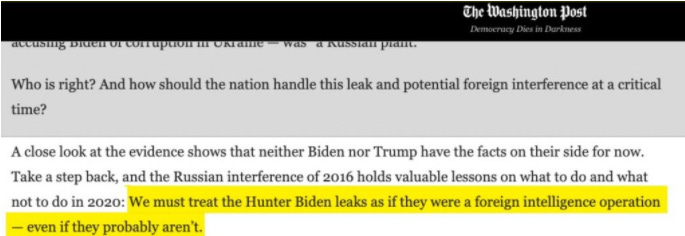
The Washington Post on Sunday published an op-ed — by Thomas Rid, one of those centrists establishmentarian professors whom media outlets routinely use to provide the facade of expert approval for deranged conspiracy theories — that contained this extraordinary proclamation: “We must treat the Hunter Biden leaks as if they were a foreign intelligence operation — even if they probably aren’t.”
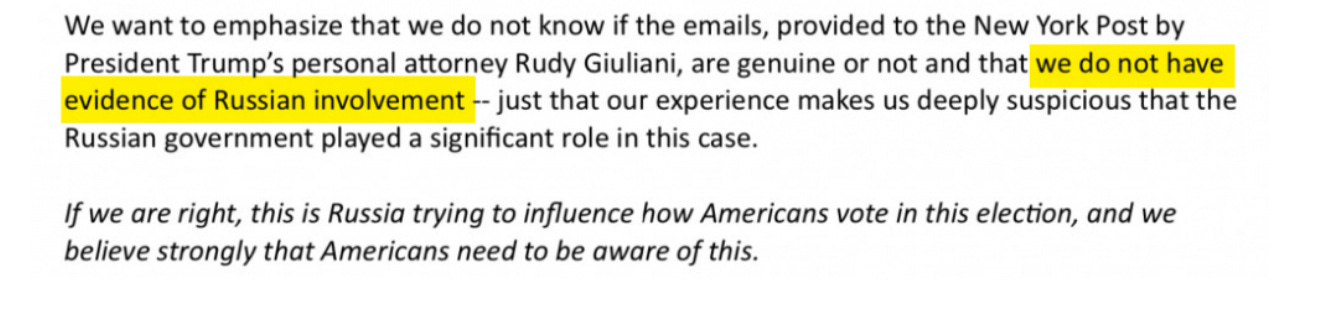
Even the letter from the former intelligence officials cited by The Intercept and other outlets to insinuate that this was all part of some “Russian disinformation” scheme explicitly admitted that “we do not have evidence of Russian involvement,” though many media outlets omitted that crucial acknowledgement when citing the letter in order to disparage the story as a Kremlin plot:
Despite this complete lack of evidence, the Biden campaign adopted this phrase used by intelligence officials and media outlets as its mantra for why the materials should not be discussed and why they would not answer basic questions about them. “I think we need to be very, very clear that what he’s doing here is amplifying Russian misinformation,” said Biden Deputy Campaign Manager Kate Bedingfield about the possibility that Trump would raise the Biden emails at Thursday night’s debate. Biden’s senior advisor Symone Sanders similarly warned on MSNBC: “if the president decides to amplify these latest smears against the vice president and his only living son, that is Russian disinformation.”
The few mainstream journalists who tried merely to discuss these materials have been vilified. For the crime of simply noting it on Twitter that first day, New York Times reporter Maggie Haberman had her name trend all morning along with the derogatory nickname “MAGA Haberman.” CBS News’ Bo Erickson was widely attacked even by his some in the media simply for asking Biden what his response to the story was. And Biden himself refused to answer, accusing Erickson of spreading a “smear.”
That it is irresponsible and even unethical to mention these documents became a pervasive view in mainstream journalism. The NPR Public Editor, in an anazing statement representative of much of the prevailing media mentality, explicitly justified NPR’s refusal to cover the story on the ground that “we do not want to waste our time on stories that are not really stories . . . [or] waste the readers’ and listeners’ time on stories that are just pure distractions.”

Why haven’t you seen any stories from NPR about the NY Post’s Hunter Biden story? Read more in this week’s newsletter➡️ tinyurl.com/y67vlzj2 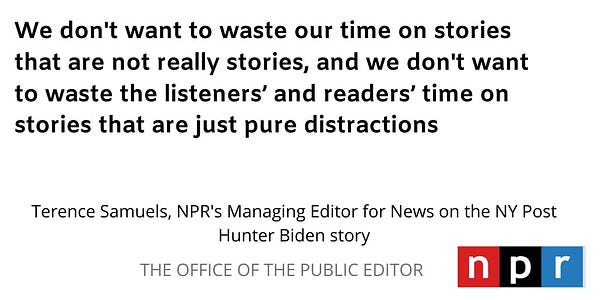
To justify her own show’s failure to cover the story, 60 Minutes’ Leslie Stahl resorted to an entirely different justification. “It can’t be verified,” the CBS reporter claimed when confronted by President Trump in an interview about her program’s failure to cover the Hunter Biden documents. When Trump insisted there were multiple ways to verify the materials on the laptop, Stahl simply repeated the same phrase: “it can’t be verified.”
After the final presidential debate on Thursday night, a CNN panel mocked the story as too complex and obscure for anyone to follow — a self-fulfilling prophecy given that, as the network’s media reporter Brian Stelter noted with pride, the story has barely been mentioned either on CNN or MSNBC. As the New York Times noted on Friday: “most viewers of CNN and MSNBC would not have heard much about the unconfirmed Hunter Biden emails…. CNN’s mentions of “Hunter” peaked at 20 seconds and MSNBC’s at 24 seconds one day last week.”
On Sunday, CNN’s Christiane Amanpour barely pretended to be interested in any journalism surrounding the story, scoffing during an interview at requests from the RNC’s Elizabeth Harrington to cover the story and verify the documents by telling her: “We’re not going to do your work for you.” Watch how the U.S.’s most mainstream journalists are openly announcing their refusal to even consider what these documents might reflect about the Democratic front-runner:
These journalists are desperate not to know. As Taibbi wrote on Sunday about this tawdry press spectacle: ” The least curious people in the country right now appear to be the credentialed news media, a situation normally unique to tinpot authoritarian societies.”
All of those excuses and pretexts — emanating largely from a national media that is all but explicit in their eagerness for Biden to win — served for the first week or more after the Post story to create a cone of silence around this story and, to this very day, a protective shield for Biden. As a result, the front-running presidential candidate knows that he does not have to answer even the most basic questions about these documents because most of the national press has already signaled that they will not press him to do so; to the contrary, they will concoct defenses on his behalf to avoid discussing it.
The relevant questions for Biden raised by this new reporting are as glaring as they are important. Yet Biden has had to answer very few of them yet because he has not been asked and, when he has, media outlets have justified his refusal to answer rather than demand that he do so. We submitted nine questions to his campaign about these documents that the public has the absolute right to know, including:
- whether he claims any the emails or texts are fabricated (and, if so, which specific ones);
- whether he knows if Hunter did indeed drop off laptops at the Delaware repair store;
- whether Hunter ever asked him to meet with Burisma executives or whether he in fact did so;
- whether Biden ever knew about business proposals in Ukraine or China being pursued by his son and brother in which Biden was a proposed participant and,
- how Biden could justify expending so much energy as Vice President demanding that the Ukrainian General Prosecutor be fired, and why the replacement — Yuriy Lutsenko, someone who had no experience in law; was a crony of Ukrainian President Petro Poroshenko; and himself had a history of corruption allegations — was acceptable if Biden’s goal really was to fight corruption in Ukraine rather than benefit Burisma or control Ukrainian internal affairs for some other objective.
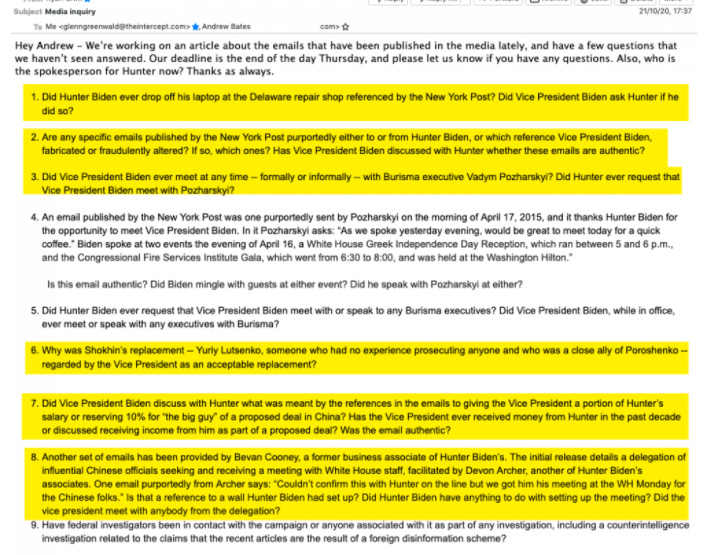
Though the Biden campaign indicated that they would respond to the Intercept’s questions, they have not done so. A statement they released to other outlets contains no answers to any of these questions except to claim that Biden “has never even considered being involved in business with his family, nor in any business overseas.” To date, even as the Biden campaign echoes the baseless claims of media outlets that anyone discussing this story is “amplifying Russian disinformation,” neither Hunter Biden nor the Biden campaign have even said whether they claim the emails and other documents — which they and the press continue to label “Russian disinformation” — are forgeries or whether they are authentic.
The Biden campaign clearly believes it has no need to answer any of these questions by virtue of a panoply of media excuses offered on its behalf that collapse upon the most minimal scrutiny:
First, the claim that the material is of suspect authenticity or cannot be verified — the excuse used on behalf of Biden by Leslie Stahl and Christiane Amanpour, among others — is blatantly false for numerous reasons. As someone who has reported similar large archives in partnership with numerous media outlets around the world (including the Snowden archive in 2014 and the Intercept’s Brazil Archive over the last year showing corruption by high-level Bolsonaro officials), and who also covered the reporting of similar archives by other outlets (the Panama Papers, the WikiLeaks war logs of 2010 and DNC/Podesta emails of 2016), it is clear to me that the trove of documents from Hunter Biden’s emails has been verified in ways quite similar to those.
With an archive of this size, one can never independently authenticate every word in every last document unless the subject of the reporting voluntarily confirms it in advance, which they rarely do. What has been done with similar archives is journalists obtain enough verification to create high levels of journalistic confidence in the materials. Some of the materials provided by the source can be independently confirmed, proving genuine access by the source to a hard drive, a telephone, or a database. Other parties in email chains can confirm the authenticity of the email or text conversations in which they participated. One investigates non-public facts contained in the documents to determine that they conform to what the documents reflect. Technology specialists can examine the materials to ensure no signs of forgeries are detected.
This is the process that enabled the largest and most established media outlets around the world to report similar large archives obtained without authorization. In those other cases, no media outlet was able to verify every word of every document prior to publication. There was no way to prove the negative that the source or someone else had not altered or forged some of the material. That level of verification is both unattainable and unnecessary. What is needed is substantial evidence to create high confidence in the authentication process.
The Hunter Biden documents have at least as much verification as those other archives that were widely reported. There are sources in the email chains who have verified that the published emails are accurate. The archive contains private photos and videos of Hunter whose authenticity is not in doubt. A former business partner of Hunter has stated, unequivocally and on the record, that not only are the emails authentic but they describe events accurately, including proposed participation by the former Vice President in at least one deal Hunter and Jim Biden were pursuing in China. And, most importantly of all, neither Hunter Biden nor the Biden campaign has even suggested, let alone claimed, that a single email or text is fake.
Why is the failure of the Bidens to claim that these emails are forged so significant? Because when journalists report on a massive archive, they know that the most important event in the reporting’s authentication process comes when the subjects of the reporting have an opportunity to deny that the materials are genuine. Of course that is what someone would do if major media outlets were preparing to publish, or in fact were publishing, fabricated or forged materials in their names; they would say so in order to sow doubt about the materials if not kill the credibility of the reporting.
The silence of the Bidens may not be dispositive on the question of the material’s authenticity, but when added to the mountain of other authentication evidence, it is quite convincing: at least equal to the authentication evidence in other reporting on similarly large archives.
Second, the oft-repeated claim from news outlets and CIA operatives that the published emails and texts were “Russian disinformation” was, from the start, obviously baseless and reckless. No evidence — literally none — has been presented to suggest involvement by any Russians in the dissemination of these materials, let alone that it was part of some official plot by Moscow. As always, anything is possible — when one does not know for certain what the provenance of materials is, nothing can be ruled out — but in journalism, evidence is required before news outlets can validly start blaming some foreign government for the release of information. And none has ever been presented. Yet the claim that this was “Russian disinformation” was published in countless news outlets, television broadcasts, and the social media accounts of journalists, typically by pointing to the evidence-free claims of ex-CIA officials.
Worse is the “disinformation” part of the media’s equation. How can these materials constitute “disinformation” if they are authentic emails and texts actually sent to and from Hunter Biden? The ease with which news outlets that are supposed to be skeptical of evidence-free pronouncements by the intelligence community instead printed their assertions about “Russian disinformation” is alarming in the extreme. But they did it because they instinctively wanted to find a reason to justify ignoring the contents of these emails, so claiming that Russia was behind it, and that the materials were “disinformation,” became their placeholder until they could figure out what else they should say to justify ignoring these documents.
Third, the media rush to exonerate Biden on the question of whether he engaged in corruption vis-a-vis Ukraine and Burisma rested on what are, at best, factually dubious defenses of the former Vice President. Much of this controversy centers on Biden’s aggressive efforts while Vice President in late 2015 to force the Ukrainian government to fire its Chief Prosecutor, Viktor Shokhin, and replace him with someone acceptable to the U.S., which turned out to be Yuriy Lutsenko. These events are undisputed by virtue of a video of Biden boasting in front of an audience of how he flew to Kiev and forced the Ukrainians to fire Shokhin, upon pain of losing $1 billion in aid.
But two towering questions have long been prompted by these events, and the recently published emails make them more urgent than ever: 1) was the firing of the Ukrainian General Prosecutor such a high priority for Biden as Vice President of the U.S. because of his son’s highly lucrative role on the board of Burisma, and 2) if that was not the motive, why was it so important for Biden to dictate who the chief prosecutor of Ukraine was?
The standard answer to the question about Biden’s motive — offered both by Biden and his media defenders — is that he, along with the IMF and EU, wanted Shokhin fired because the U.S. and its allies were eager to clean up Ukraine, and they viewed Shokhin as insufficiently vigilant in fighting corruption.
“Biden’s brief was to sweet-talk and jawbone Poroshenko into making reforms that Ukraine’s Western benefactors wanted to see as,” wrote the Washington Post’s Glenn Kessler in what the Post calls a “fact-check.” Kessler also endorsed the key defense of Biden: that the firing of Shokhin was bad for Burima, not good for it. “The United States viewed [Shokhin] as ineffective and beholden to Poroshenko and Ukraine’s corrupt oligarchs. In particular, Shokin had failed to pursue an investigation of the founder of Burisma, Mykola Zlochevsky,” Kessler claims.
But that claim does not even pass the laugh test. The U.S. and its European allies are not opposed to corruption by their puppet regimes. They are allies with the most corrupt regimes on the planet, from Riyadh to Cairo, and always have been. Since when does the U.S. devote itself to ensuring good government in the nations it is trying to control? If anything, allowing corruption to flourish has been a key tool in enabling the U.S. to exert power in other countries and to open up their markets to U.S. companies.
Beyond that, if increasing prosecutorial independence and strengthening anti-corruption vigilance were really Biden’s goal in working to demand the firing of the Ukrainian chief prosecutor, why would the successor to Shokhin, Yuriy Lutsenko, possibly be acceptable? Lutsenko, after all, had “no legal background as general prosecutor,” was principally known only as a lackey of Ukrainian President Petro Poroshenko, was forced in 2009 to “resign as interior minister after being detained by police at Frankfurt airport for being drunk and disorderly,” and “was subsequently jailed for embezzlement and abuse of office, though his defenders said the sentence was politically motivated.”
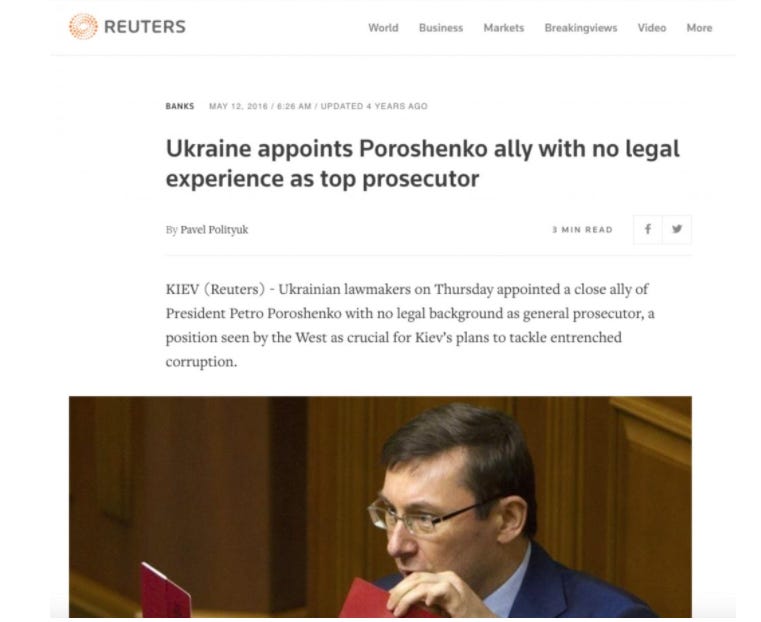
Is it remotely convincing to you that Biden would have accepted someone like Lutsenko if his motive really were to fortify anti-corruption prosecutions in Ukraine? Yet that’s exactly what Biden did: he personally told Poroshenko that Lutsenko was an acceptable alternative and promptly released the $1 billion after his appointment was announced. Whatever Biden’s motive was in using his power as U.S. Vice President to change the prosecutor in Ukraine, his acceptance of someone like Lutsenko strongly suggests that combatting Ukrainian corruption was not it.
As for the other claim on which Biden and his media allies have heavily relied — that firing Shokhin was not a favor for Burisma because Shokhin was not pursuing any investigations against Burisma — the evidence does not justify that assertion.
It is true that no evidence, including these new emails, constitute proof that Biden’s motive in demanding Shokhin’s termination was to benefit Burisma. But nothing demonstrates that Shokhin was impeding investigations into Burisma. Indeed, the New York Times in 2019 published one of the most comprehensive investigations to date of the claims made in defense of Biden when it comes to Ukraine and the firing of this prosecutor, and, while noting that “no evidence has surfaced that the former vice president intentionally tried to help his son by pressing for the prosecutor general’s dismissal,” this is what its reporters concluded about Shokhin and Burisma:
[Biden’s] pressure campaign eventually worked. The prosecutor general, long a target of criticism from other Western nations and international lenders, was voted out months later by the Ukrainian Parliament.
Among those who had a stake in the outcome was Hunter Biden, Mr. Biden’s younger son, who at the time was on the board of an energy company owned by a Ukrainian oligarch who had been in the sights of the fired prosecutor general.
The Times added: “Mr. Shokhin’s office had oversight of investigations into [Burisma’s billionaire founder] Zlochevsky and his businesses, including Burisma.” By contrast, they said, Lutsenko, the replacement approved by Vice President Biden, “initially continued investigating Mr. Zlochevsky and Burisma, but cleared him of all charges within 10 months of taking office.”
So whether or not it was Biden’s intention to confer benefits on Burisma by demanding Shokhin’s firing, it ended up quite favorable for Burisma given that the utterly inexperienced Lutesenko “cleared [Burisma’s founder] of all charges within 10 months of taking office.”
The new comprehensive report from journalist Taibbi on Sunday also strongly supports the view that there were clear antagonisms between Shokhin and Burisma, such that firing the Ukrainian prosecutor would have been beneficial for Burisma. Taibbi, who reported for many years while based in Russia and remains very well-sourced in the region, detailed:
For all the negative press about Shokhin, there’s no doubt that there were multiple active cases involving Zlochevsky/Burisma during his short tenure. This was even once admitted by American reporters, before it became taboo to describe such cases untethered to words like “dormant.” Here’s how Ken Vogel at the New York Times put it in May of 2019:
“When Mr. Shokhin became prosecutor general in February 2015, he inherited several investigations into the company and Mr. Zlochevsky, including for suspicion of tax evasion and money laundering. Mr. Shokin also opened an investigation into the granting of lucrative gas licenses to companies owned by Mr. Zlochevsky when he was the head of the Ukrainian Ministry of Ecology and Natural Resources.”
Ukrainian officials I reached this week confirmed that multiple cases were active during that time.
“There were different numbers, but from 7 to 14,” says Serhii Horbatiuk, former head of the special investigations department for the Prosecutor General’s Office, when asked how many Burisma cases there were.
“There may have been two to three episodes combined, and some have already been closed, so I don’t know the exact amount.” But, Horbatiuk insists, there were many cases, most of them technically started under Yarema, but at least active under Shokin.
The numbers quoted by Horbatiuk gibe with those offered by more recent General Prosecutor Rulsan Ryaboshapka, who last year said there were at one time or another “13 or 14” cases in existence involving Burisma or Zlochevsky.
Taibbi reviews real-time reporting in both Ukraine and the U.S. to document several other pending investigations against Burisma and Zlochevsky that was overseen by the prosecutor whose firing Biden demanded. He notes that Shokhin himself has repeatedly said he was pursuing several investigations against Zlochevsky at the time Biden demanded his firing. In sum, Taibbi concludes, “one can’t say there’s no evidence of active Burisma cases even during the last days of Shokin, who says that it was the February, 2016 seizure order [against Zlochevsky’s assets] that got him fired.”
And, Taibbi notes, “the story looks even odder when one wonders why the United States would exercise so much foreign policy muscle to get Shokin fired, only to allow in a replacement — Yuri Lutsenko — who by all accounts was a spectacularly bigger failure in the battle against corruption in general, and Zlochevsky in particular.” In sum: “it’s unquestionable that the cases against Burisma were all closed by Shokin’s successor, chosen in consultation with Joe Biden, whose son remained on the board of said company for three more years, earning upwards of $50,000 per month.”
The publicly known facts, augmented by the recent emails, texts and on-the-record accounts, suggest serious sleaze by Joe Biden’s son Hunter in trying to peddle his influence with the Vice President for profit. But they also raise real questions about whether Joe Biden knew about and even himself engaged in a form of legalized corruption. Specifically, these newly revealed information suggest Biden was using his power to benefit his son’s business Ukrainian associates, and allowing his name to be traded on while Vice President for his son and brother to pursue business opportunities in China. These are questions which a minimally healthy press would want answered, not buried — regardless of how many similar or worse scandals the Trump family has.
But the real scandal that has been proven is not the former Vice President’s misconduct but that of his supporters and allies in the U.S. media. As Taibbi’s headline put it: “With the Hunter Biden Exposé, Suppression is a Bigger Scandal Than the Actual Story.”
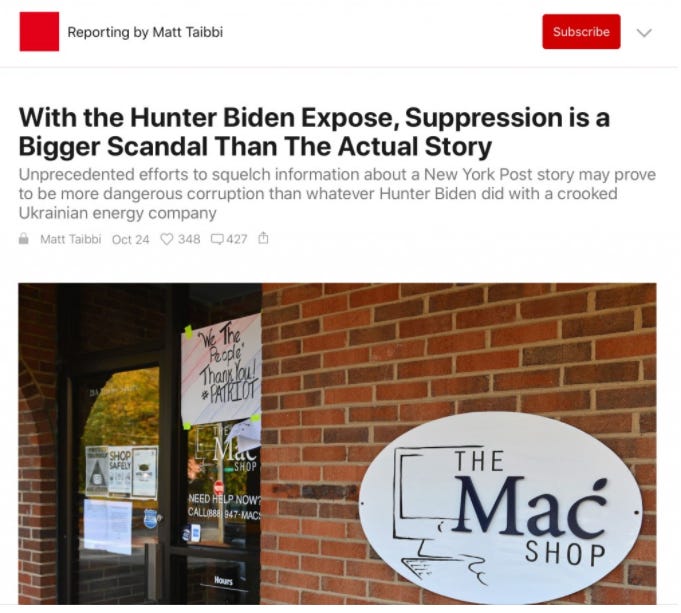
The reality is the U.S. press has been planning for this moment for four years — cooking up justifications for refusing to report on newsworthy material that might help Donald Trump get re-elected. One major factor is the undeniable truth that journalists with national outlets based in New York, Washington and West Coast cities overwhelmingly not just favor Joe Biden but are desperate to see Donald Trump defeated.
It takes an enormous amount of gullibility to believe that any humans are capable of separating such an intense partisan preference from their journalistic judgment. Many barely even bother to pretend: critiques of Joe Biden are often attacked first not by Biden campaign operatives but by political reporters at national news outlets who make little secret of their eagerness to help Biden win.
But much of this has to do with the fallout from the 2016 election. During that campaign, news outlets, including The Intercept, did their jobs as journalists by reporting on the contents of newsworthy, authentic documents: namely, the emails published by WikiLeaks from the John Podesta and DNC inboxes which, among other things, revealed corruption so severe that it forced the resignation of the top five officials of the DNC. That the materials were hacked, and that intelligence agencies were suggesting Russia was responsible, not negate the newsworthiness of the documents, which is why media outlets across the country repeatedly reported on their contents.
Nonetheless, journalists have spent four years being attacked as Trump enablers in their overwhelmingly Democratic and liberal cultural circles: the cities in which they live are overwhelmingly Democratic, and their demographic — large-city, college-educated professionals — has vanishingly little Trump support. A New York Times survey of campaign data from Monday tells just a part of this story of cultural insularity and homogeniety:
Joe Biden has outraised President Trump on the strength of some of the wealthiest and most educated ZIP codes in the United States, running up the fund-raising score in cities and suburbs so resoundingly that he collected more money than Mr. Trump on all but two days in the last two months….It is not just that much of Mr. Biden’s strongest support comes overwhelmingly from the two coasts, which it does…. [U]nder Mr. Trump, Republicans have hemorrhaged support from white voters with college degrees. In ZIP codes with a median household income of at least $100,000, Mr. Biden smashed Mr. Trump in fund-raising, $486 million to only $167 million — accounting for almost his entire financial edge….One Upper West Side ZIP code — 10024 — accounted for more than $8 million for Mr. Biden, and New York City in total delivered $85.6 million for him — more than he raised in every state other than California….
The median household in the United States was $68,703 in 2019. In ZIP codes above that level, Mr. Biden outraised Mr. Trump by $389.1 million. Below that level, Mr. Trump was actually ahead by $53.4 million.
Wanting to avoid a repeat of feeling scorn and shunning in their own extremely pro-Democratic, anti-Trump circles, national media outlets have spent four years inventing standards for election-year reporting on hacked materials that never previously existed and that are utterly anathema to the core journalistic function. The Washington Post’s Executive Editor Marty Baron, for instance, issued a memo full of cautions about how Post reporters should, or should not, discuss hacked materials even if their authenticity is not in doubt.
That a media outlet should even consider refraining from reporting on materials they know to be authentic and in the public interest because of questions about their provenance is the opposite of how journalism has been practiced. In the days before the 2016 election, for instance, the New York Times received by mail one year of Donald Trump’s tax returns and — despite having no idea who sent it to them or how that person obtained it: was is stolen or hacked by a foreign power? — the Times reported on its contents.
When asked by NPR why they would report on documents when they do not know the source let alone the source’s motives in providing them, two-time Pulitzer Prize winner David Barstow compellingly explained what had always been the core principle of journalism: namely, a journalist only cares about two questions — (1) are documents authentic and (2) are they in the public interest? — but does not care about what motives a source has in providing the documents or how they were obtained when deciding whether to reporting them:

Why NYT’s David Barstow does not care who leaked us Trump’s tax return, or what the motivation was. Listen: 
The U.S. media often laments that people have lost faith in its pronouncements, that they are increasingly viewed as untrustworthy and that many people view Fake News sites are more reliable than established news outlets. They are good at complaining about this, but very bad at asking whether any of their own conduct is responsible for it.
A media outlet that renounces its core function — pursuing answers to relevant questions about powerful people — is one that deserves to lose the public’s faith and confidence. And that is exactly what the U.S. media, with some exceptions, attempted to do with this story: they took the lead not in investigating these documents but in concocting excuses for why they should be ignored.
As my colleague Lee Fang put it on Sunday: “The partisan double standards in the media are mind boggling this year, and much of the supposedly left independent media is just as cowardly and conformist as the mainstream corporate media. Everyone is reading the room and acting out of fear.” Discussing his story from Sunday, Taibbi summed up the most important point this way: “The whole point is that the press loses its way when it cares more about who benefits from information than whether it’s true.”
Bellingcat DID take UK Foreign Office money, open logs show, directly contradicting Eliot Higgins’ claims
By Kit Klarenberg | RT | October 27, 2020
Controversial ‘open source investigations’ website Bellingcat was paid directly by the UK Foreign and Commonwealth Office (FCO) at least once, official data shows, debunking its founder and chief’s claims to the contrary.
Suggestions that Bellingcat is a tool of Western governments, and funded by them directly, have long-abounded – and consistently been denied by founder and chief Eliot Higgins.
Such allegations reached fever pitch in late 2018, when files related to the UK Foreign & Commonwealth Office (FCO) military intelligence operation Integrity Initiative were leaked by hacktivist collective Anonymous. The papers revealed the secret endeavour, among other things, worked to discredit left-leaning, anti-war figures at home and abroad, and maintained clandestine global networks of journalists, academics, and military and intelligence operatives to spread pro-Western propaganda and encourage more aggressive policies toward Moscow.
Several documents openly referred to Bellingcat, at least one suggesting the organizations were collaborating on certain projects – if true, this would in turn imply Bellingcat was in receipt of FCO cash. Higgins was repeatedly probed on the question via Twitter, but he strenuously denied Bellingcat had conducted any work for or with the Initiative, or received FCO funding.
However, publicly-available documents prove the latter contention, at least, to be an outright lie. As Declassified UK chief Matt Kennard revealed on Twitter on October 26, official FCO procurement figures make clear the department paid Bellingcat £1,800 on December 20 2018 for “consulting, management and public relations” services – mere days prior to several of Higgins’ spirited denials.
The precise nature of the “consulting, management and public relations” services rendered by the organization is unclear, although it may be related to shadowy FCO program Open Information Partnership (OIP).
Officially, under its auspices Bellingcat collaborates with the Atlantic Council’s DFRLab, Zinc Network and Media Diversity Institute to “work together through peer-to-peer learning, training and working groups to pioneer methods to expose disinformation,” in collaboration with a sizable network of NGOs across Europe.
However, leaked documents suggest the endeavor is in actuality an avowed “disinformation factory” itself, seeking to covertly further Whitehall’s global policy objectives, seeking to influence “elections taking place in countries of particular interest to the FCO,” and other malign objectives – and strongly suggest Integrity Initiative is involved in the endeavour, or at least was at some stage.
The Initiative’s parent ‘charity’ Institute for Statecraft was named as one of OIP’s partners alongside Bellingcat et al, a number of Initiative staff were to be seconded to OIP, and the Initiative’s “pre-existing pool of contacts” was intended to serve “as a springboard for the identification of new potential network members.”
Significantly, the documents also detail numerous examples of OIP partners collaborating prior to the program’s April 2019 launch – yet further indications Eliot Higgins was also lying when he denied Bellingcat had ever joined forces with the Integrity Initiative.
For instance, in Ukraine OIP collaborated with a dozen online ‘influencers’ “to counter Kremlin-backed messaging through innovative editorial strategies, audience segmentation, and production models that reflected the complex and sensitive political environment,” in the process allowing them to “reach wider audiences with compelling content that received over four million views.”
In Russia and Central Asia, OIP worked with a network of ‘YouTubers’ in Russia and Central Asia to create videos “promoting media integrity and democratic values.” Somewhat sinisterly, participants were also taught how to “make and receive international payments without being registered as external sources of funding” and “develop editorial strategies to deliver key messages,” while the organization minimized their “risk of prosecution” and managed “project communications” to ensure the existence of the network, and indeed OIP’s role, were kept “confidential.”
Bellingcat’s website notes the organization is an OIP partner, although the fact that the program is funded entirely by the FCO – a fact openly stated on OIP’s homepage – isn’t mentioned. Upon the endeavour’s launch, Higgins was keen to claim Bellingcat was “subcontracted” for the project by OIP partner Zinc Network, which in turn received FCO funds. A cynic might suggest this semantic fudge allowed him to maintain the fiction Bellingcat wasn’t funded directly by the FCO, thus preserving the myth the organization is an independent citizen journalist collective, while nonetheless being heavily bankrolled by the UK government.
Alternatively, it may be the case that Whitehall itself wishes to distance itself from Higgins. After all, a leaked FCO-commissioned appraisal of Bellingcat concluded the organization was “somewhat discredited, both by spreading disinformation itself, and by being willing to produce reports for anyone willing to pay.”
Whatever the truth of the matter, there are indications Bellingcat’s relationship with the FCO may extend far further than what can be pieced together from publicly-available information. A Freedom of Information request submitted to the FCO in January 2019 asked the department for all internal documents related to research on the Syrian crisis mentioning Bellingcat, particularly those relating to the use of chemical weapons in the country, and “any documents that refer to the reliability of Bellingcat as a source when drafting research assessments.”
In response, the FCO stated it could “neither confirm nor deny it holds information relevant to your request,” on the grounds of “safeguarding national security.”
Kit Klarenberg is an investigative journalist exploring the role of intelligence services in shaping politics and perceptions. Follow Kit on Twitter @KitKlarenberg
Disinformation By Popular Demand: How The Authenticity of Hunter’s Laptop Became Immaterial
By Jonathan Turley | October 27, 2020
Yesterday, former Vice President Joe Biden was again insisting that the scandal involving Hunter Biden’s laptop was Russian disinformation despite the direct refutation of that claim by the FBI. No mainstream reporter bothered to ask the simple question of whether this was his son’s laptop and emails, including emails clearly engaging in an influence peddling scheme and referring to Joe Biden’s knowledge. Instead, media has maintained a consistent and narrow focus. Indeed, in her interview, Leslie Stahl immediately dismissed any “scandal” involving Hunter in an interview with the President on 60 Minutes. It was an open example of what I previously noted in a column: “After all, an allegation is a scandal only if it is damaging. No coverage, no damage, no scandal.”
In her interview with Joe Biden, CBS anchor Norah O’Donnell did not push Biden to simply confirm that the emails were fake or whether he did in fact meet with Hunter’s associates (despite his prior denials). Instead O’Donnell asked: “Do you believe the recent leak of material allegedly from Hunter’s computer is part of a Russian disinformation campaign?”
Biden responded with the same answer that has gone unchallenged dozens of times:
“From what I’ve read and know the intelligence community warned the president that Giuliani was being fed disinformation from the Russians. And we also know that Putin is trying very hard to spread disinformation about Joe Biden. And so when you put the combination of Russia, Giuliani– the president, together– it’s just what it is. It’s a smear campaign because he has nothing he wants to talk about. What is he running on? What is he running on?”
It did not matter that the answer omitted the key assertion that this was not Hunter’s laptop or emails or that he did not leave the computer with this store.
Recently, Washington Post columnist Thomas Rid said the quiet part out loud by telling the media: “We must treat the Hunter Biden leaks as if they were a foreign intelligence operation — even if they probably aren’t.”
Let that sink in for a second. It does not matter if these are real emails and not Russian disinformation. They probably are real but should be treated as disinformation even though American intelligence has repeatedly rebutted that claim. It does not even matter that the FBI has seized the computer as evidence in a criminal fraud investigation or that a Biden confidant is now giving his allegations to the FBI under threat of criminal charges if he lies to investigators.
It simply does not matter. It is disinformation because it is simply inconvenient to treat it as real information.
Featured Video
It’s the Occupation, Stupid
or go to
Aletho News Archives – Video-Images
From the Archives
A superpower and “the world’s sickest warrior state”
By Paul J. Balles | March 8, 2010
Living through five or six major wars has hardened me to what I thought were the extremes of inhuman cruelty and brutality.
Two things made those extremes almost bearable: the brutality always revealed – at least according to the media coverage – the viciousness of the enemy. It was therefore quite understandable when our “brave men and women” pulverized the enemy.
Films of Japanese torturing captive Americans somehow justified holding Japanese Americans in internment camps during World War II; and only a small percentage of Americans found the bombing of Hiroshima and Nagasaki unreasonably vengeful at best, at worst, depraved.
The media giants in America portrayed the North Koreans as barbaric beasts with their captives, quite unlike their southern counterpoints – our allies during the Korean War. No one ever felt the need to explain how the South Koreans were a civilized breed while the North Koreans were absolute savages, at least according to the official line.
In Vietnam, our warriors justifiably (or so the media made us believe) dropped napalm on the North Vietnamese who had the gall to hide in villages and tunnels to ravage our invaders. At least it was accepted practice until some rogue photojournalist filmed a young girl screaming down a Vietnamese road in flames. … continue
Blog Roll
 Aletho News
- Pakistan to Host US-Iran Talks
- How Indonesia’s tilt toward the US left it stranded in the Strait of Hormuz
- US has no choice but to retreat from Iranian borders: Top commander
- Iran Retaliation Strikes Chemical Plant Near Dimona
- AWACS’ Destruction is a Major Loss for US Military – Ex-DoW Analyst
- Israel’s Iran Strategy Uses US Military & Gulf States as Its Pawns
- Iran: Trump wanted regime change, now just begging for Hormuz to open
- IRGC: Israeli, US universities in region legitimate targets after strikes on Iranian university
- Trump admits Iran hit USS Ford carrier: ‘We ran for our lives’
- Battle for Hungary: EU attacks on Orban are a sign of worse things to come
- If Americans Knew
- Israeli police block Catholic cardinal from entering Church of the Holy Sepulchre on Palm Sunday
- Israel is assassinating journalists again, more than any other nation, anywhere, ever – Not a ceasefire Day 170
- Over 300 US service members wounded, majority have brain injuries – Not a ceasefire Day 169
- Researchers at Human Rights Watch Resign Over Blocked Report on Palestinian Refugee Return
- Jewish Groups Are Backing a War Americans Don’t Want
- Eric Fingerhut Thinks He’s the President of the Jews
- Top Jewish Philanthropists, Rabbis Urge Israeli President to Take Action Against ‘Jewish Extremists’
- Don’t Be Fooled. Zionist Leaders Have Always Wanted to Control Southern Lebanon
- Israel’s widespread use of torture is a core element of its genocide against the Palestinian people
- In Israel’s War on Iran, Many Middle East US Bases Rendered “All But Uninhabitable”
- No Tricks Zone
- German Science Blog Accuses PIK Climate Institute Of Hallucinating Climate Tipping Points
- Devastating Assessment Of Comirnaty Vaccine By Former Senior Pfizer Europe Toxicologist
- New Study: CO2 Is ‘Effectively Negligible’ As An Explanatory Climate Change Factor Since 2000
- Former Pfizer Toxicologist Dr. Helmut Sterz Tells Bundestag Hearing Pfizer Vaccine Should Have Never Been Approved
- Energy Expert: Germany’s Nuclear Phaseout Was A “500 Billion Euro Mistake”
- New Research: South Australia’s Mid-Holocene Sea Surface Temperatures Were 4°C Warmer Than Today
- Storing Green Energy To Last Germany 10 Days Would Require A 60-Million Tonne Battery
- New Studies: UK Sea Levels Were 4 Meters Higher Than Today During The Mid-Holocene
- Destructive Green New Deal: German Energy And Metal Group Warns Of Drastic Crisis
- New Study Documents A 20-Year Pause In Arctic Sea Ice Decline – Driven By Internal Variability
 Aletho News