The Roger Stone – Wikileaks – Russia Hoax
By Craig Murray | November 18, 2019
As ever, the Guardian wins the prize for the most tendentious reporting of Roger Stone’s conviction. This is not quite on the scale of its massive front page lie that Paul Manafort visited Julian Assange in the Ecuadorean Embassy. But it is a lie with precisely the same intent, to deceive the public into believing there were links between Wikileaks and the Trump campaign. There were no such links.
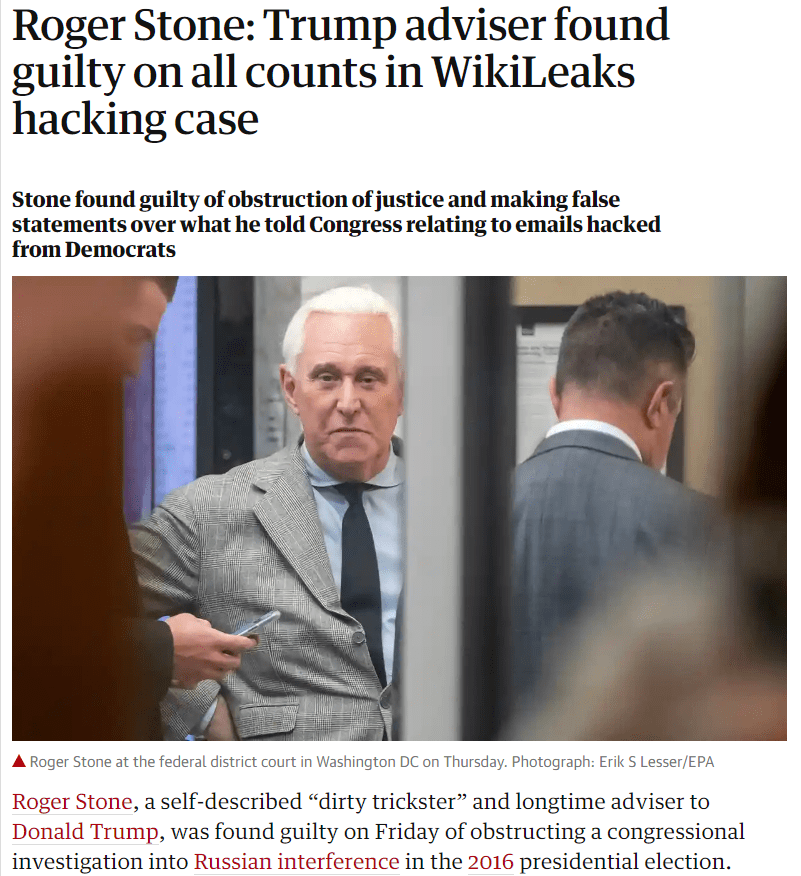
The headline “Roger Stone: Trump Adviser Found Guilty On All Charges in Trump Hacking Case” is deliberately designed to make you believe a court has found Stone was involved in “Wikileaks hacking”. In fact this is the precise opposite of the truth. Stone was found guilty of lying to the Senate Intelligence Committee by claiming to have links to Wikileaks when in fact he had none. And of threatening Randy Credico to make Credico say there were such links, when there were not.
It is also worth noting the trial was nothing to do with “hacking” and no hacking was alleged or proven. Wikileaks does not do hacking, it does “leaks”. The clue is in the name. The DNC emails were not hacked. The Guardian is fitting this utterly extraneous element into its headline to continue the ludicrous myth that the Clinton campaign was “Hacked” by “the Russians”.
It is worth noting that not one of those convicted of charges arising from or in connection with the Mueller investigation – Manafort, Papadopolous, Stone – has been convicted of anything to do with Wikileaks, with anything to do with Russia or with the original thesis of the enquiry.
Astonishingly, in the case of Stone, he has been convicted of saying that the Mueller nonsense is true, and he was a Trump/Wikileaks go-between, when he was not. Yet despite the disastrous collapse of the Mueller Report, and despite the absolutely devastating judicial ruling that there was no evidence worthy even of consideration in court that Russiagate had ever happened, the Guardian and the neo-con media in the USA (inc. CNN, Washington Post, New York Times ) continue to serve up an endless diet of lies to the public.
Randy Credico was the chief witness for the prosecution against Roger Stone. That’s for the prosecution, not the defence. This is the state’s key evidence against Stone. And Credico is absolutely plain that Stone had no link to Wikileaks. The transcript of my exclusive interview with Randy has now been prepared (thanks to Sam and Jon) and follows here.
I spoke to Randy yesterday to clarify one point. The first conversation Randy ever had with Julian Assange was on 25 August 2016 and it was on-air on Randy’s radio show. There was no private talk off-air around the show. That was Randy’s only contact of any kind with Julian Assange before the 2016 election. His next contact with him, also an on-air interview, was not until Spring 2017, well after the election. He could not have been in any sense a channel to Wikileaks.
Here is the unedited interview from 10 November:
RC: Hello.
CM: Hello there, Randy. Hello, can you hear me OK?
RC: Yes, perfectly.
CM: Yeah. I’m good, I’m very good indeed. OK, let’s do it like this, shall we, it seems …
RC: Now listen, before you start, you can ask me anything you want, and this is the only interview I’m going to do. I’ll be in town with—like, all day long—with people asking me to talk about this and I just want to get it out of the way and move on. All right?
CM: No, I quite understand. And that’s very sensible. Now, let’s start then … let’s start … before we get into the substance, let’s start then with some of the atmospherics. How did it feel to you, you know, to be you … to be Randy walking into that courtroom?
RC: Well, you know, when I, when I … first of all, for the last eight months I knew this was eventually going to happen. So I’ve been on needles and pins, a lot of anxiety that … Wait a second … Hold on, hold on … can you start and do that again?
[aside] Bye, everybody. … I’m doing an interview with somebody here.
Hi, Craig. Hi, Craig.
CM: Yep. Yep. I’m here.
RC: Hello. All right. Start going. Start … start again.
[1:30]
CM: OK. Before we get into the substance, Randy, let’s talk about the atmospherics. How did it feel to be you? How did it feel to be Randy Credico walking into that courtroom?
RC: Well, you know, all of my life … I got into show business when I was 18 years old and I really was pursuing fame and notoriety and, you know, I finally got it, and this is “be careful what you wish for”—because this is certainly not something that I was relishing. For the past eight months, when Mr Stone was indicted, I have been suffering from heavy anxiety, having to appear as a witness under subpoena. And then when it finally happened, eight months went by quickly, and I got to tell you something, going into that courtroom, and anticipating it the previous night in which I couldn’t sleep was not a very comforting feeling. I walked in and, you know, it wasn’t the traditional way where you walk in from the back. You had to walk through the very front of the courthouse, past the defendant, past his family, past his friends, past his supporters, and then get on that witness stand right next to the jury, and begin answering questions. So after a while I was OK with it, but I knew it was going to be a long session; I knew I was going to have to come back the next day and continue and then I was going to have to go through the cross-examination. So it was just nothing but anxiety going in, and there was some relief when it was over but it was a different kind of a feeling because I felt bad for the defendant at the end of the testimony.
CM: Yeah, no, I’m sure you did. Did you catch his eye at any slight stage while you were … while you were talking?
RC: Yeah. You know, I tried not to. I didn’t think that was fair, so I did look at him. He was very morose looking, very sullen looking … and, you know, but for the grace of God, there goes I. I could’ve been in that seat, in that situation at some point in my lifetime, and the weight of the federal government with the vast resources in a case like that, and the defendant, he had … he had a lot of attorneys, but I didn’t think they were … they were really sufficient. These were not great barristers, you know what I mean? They were not good. And I found out they weren’t really that good because I had known earlier the way they were cross-examining previous witness that they just weren’t up to the job.
So, you know, you go in there and you’re under a lot of stress, and you’ve got to tell the truth and at the same time the truth is going to hurt the guy who’s sitting there … you know, just 25 or 30 feet away from you, and it could put him in prison. I mean—who wants to be in that position? All of my life, I have worked to get people out of prison. I’m a prison reformer. I’ve extricated people out of prison through clemency and changes of laws in the State of New York. And other activism that I have done like in Texas, I got 46 people out of prison. So this was a very bizarre, ironic situation that I was in at that particular point.
So yes, I caught his eye; I did catch his eye. You know, it’s such loose strings—it’s someone that you’ve known. I’ve known the guy for 17 years. And people say “How were you ever friends with this guy? You know, you’re an extreme left-winger, the guy is an extreme right-winger”. Well, I have no regrets meeting him, because I met him in 2002, after I had been working 5 years, visiting prisons, organizing families of prisoners who were subjected to New York’s racist and draconian Rockefeller drug laws. They were called the Mothers of the New York Disappeared. I was working with him, organizing, visiting their loved ones in prison, and we were moving forward to getting some substantial change in 2002, but we were at loggerheads with the government. So because Roger Stone was running the campaign of a third party candidate—a billionaire, a real maverick individual, who had some great ads that I saw—I went to Mr Stone because the Democrats and the Republicans in the race were not addressing the issue. Mr Stone actually not only agreed with my position there, but he spent … had his candidate spend … millions of dollars doing ads to repeal New York’s racist Rockefeller drug laws. And that was a very key moment in the historical run of this movement. Within a year and a half, the laws had changed, and each year there was major building blocks. We got the public to support us; we were getting politicians to support us. In 2002, Hillary Clinton and Chuck Schumer—our two Democratic Senators—were not on board. And so, this guy Tom Golisano was on board and he did rallies with these families, he put them on television, and he, like I said, spent millions of dollars on ads. And if it weren’t for Roger Stone, that wouldn’t have happened. And so because of that within a year and a half, these families that I had worked with, there was retroactivity when the laws were changed within a year and a half, and that was a key component. And Mr Golisano stayed with it for another year, he continued to work with us.
So, something like that. Even though Mr Stone had screwed me over, had done some very nasty things over the next 17 years, there was still that soft spot for him because, when I look at those families and I remember their faces when they get reunited with their loved ones—he played a role in that.
So that’s the dilemma I was facing when I was on that witness stand. I was an aggrieved person. This could’ve been done, by the way, in a civil court, you know, my grievance against Mr Stone because, for me—for me—my position was I was kind of smeared by being associated with the Trump campaign with these bogus allegations of being the back channel to Wikileaks—which we’ll get into. There was never any back channel to Wikileaks—that was all hocus pocus! So, answering your question, it was … it was a very bizarre, uncomfortable experience undergoing those {inaudible} in that highly publicized and media-covered circus that was going on. Not a circus, but whatever was going on there, it was something that I would not want to go through again. And, look, I’ve performed in front of a million different audiences; I’ve worked strip joints when I was in air force bases; I’ve done vigils, rallies; I’ve worked the worst toilets in the room over a 45 year period in show business, but I still wasn’t prepared for that kind of atmosphere.
CM: Yes, I can imagine. Is it a fair characterisation to say that you, Randy, you’re on the libertarian left of politics, whereas Roger’s on the libertarian right, and you both met because there were some issues such as drug decriminalization on which you agree and on which he then did good work in decriminalizing communities in New York. Is that the basic analysis?
RC: Yes, I would say I once ran on the Libertarian party line in 2010. A lot of their positions I don’t agree with … but I’m on the left, he’s a libertarian right. He’s not like one of these people—when I met him he was not the ideologue that he was portrayed to be in the media in 2002—a far right Jesse Helms type or a far right John Ashcroft type. He was a libertarian, he smoked pot; you know, we had the same views on music. He actually was advocating for the pardon of Marcus Garvey, who was framed, who was a leader of Black Nationalism in the 20s, on these bogus mail fraud charges. So, you know, he’s kind of a sphinx, you know, politically. He’s not, like I said, a hard-core right-winger. He was not for the war in Iraq back in 2003. So, you know, I don’t even know what the right and the left is sometimes. You know, I really don’t know what that means. I mean Tony Blair’s supposed to be a Labour guy, but he’s as bad as George Bush is, and always has been. So does he really support Labour, is he a leftist? No. So, you know, these labels are a little confusing to me. But like I said, Stone—you know—he’s a showman. He’s a showman; he’s an exhibitionist. That’s what got him in trouble here. The poor guy is … you know, he’s a megalomaniacal showman. Just like I am. I’m in show business, why? Because I’m like him—I like to get laughs, and I want to be recognised. That’s him.
I said he’d done a lot of bad things to me but politically we were, you know, we coincided on a few major issues, and one of them was drug law reform in the State of New York. Now, mind you, 97% of the people that were subjected to the Rockefeller drug laws in the State of New York were black and Latino. And still are—they have been modified, not completely changed. But, you know, they were subjected to harsh punishment; they were getting 15 years to life. I know one kid by the name of Terence Stevens, paralysed from the neck down—from the neck down—with muscular dystrophy, and that guy was doing all of this time for possession on a bus! They ascribed it to him for possession! And he had done 10 years in prison, in the medical ward of a real dank prison—it was called Green Haven—for possession. And that was not like the exception to the rule. There were thousands of people in similar circumstances that were there that were just mules, or addicts that were doing this time—and Stone actually was very sympathetic to it. It wasn’t like it was a—you know, what would you call it—flash in the pan type of a push. He continued afterwards, he even wrote some op-ed pieces; but, like I said, he did some bad things to me over the years, but I’m a good natured guy, and I overlooked it. I let him get away with it.
CM: The astonishing thing about all this is … is that it all comes out of the Mueller inquiry, and the so-called Russiagate scandal, and yet none of these charges relate to Russia. And let’s be quite plain, to the best of your knowledge and belief—or to the best of your knowledge anyway—Roger Stone has no link to the Russian government that we’re aware of, and he certainly has no link to Wikileaks that we’re aware of. Is that your understanding?
RC: Well, actually what he had was … Look … Roger Stone … Here’s what happened. In 2015, Trump hired him. He lasted one month. Why? Because every time he did an interview it was more about him than it was about Trump; and Trump got frustrated with him and dumped him. And he may have given Trump advice here and there because, you know, he was the one who got Trump to run 30 years earlier; it was his idea, he kept pushing Trump. So he was kind of unceremoniously kicked out of the Trump camp.
Flash forward to 2016, he’s kind of hanging around the Trump campaign, he comes up with one of these super packs. And so he’s trying to ingratiate himself back into the Trump orbit there. And what he did was he, like, looks at Wikileaks and he sees what’s going on with Wikileaks, and he’s trying to get information. He’s going to guys like Jerome Corsi. You know, Jerome Corsi is a complete lunatic, you know, beyond the pale of conspiracy freaks … and he got hoodwinked by that guy. And this is my estimation, this is my analysis. He gets hoodwinked into thinking that he’s got a back channel. Right.
So he is showing, you know … First of all, the whole idea of a back channel is ridiculous. Julian Assange does not telegraph what he’s going to put out. He never has. He doesn’t compromise his sources and he always puts out that his whole M.O. is the element of surprise. So there was no reason for him to give it to Roger Stone, of the kind of preview of what he was doing. Why would he do that? When everything that he was doing, he was doing carefully, and he was selecting the time and then he’d put it out. There was no reason for him to give anything to Stone. No, Stone was playing the role of someone that had the inside information from Assange. Now, you know Assange, he’s very careful. He’s not going to … if he wanted to he would just give it directly to Trump, you know, but he didn’t. He never did. He didn’t need to go through Stone. But Stone was pretending that he had some kind of access to Wikileaks, and he was selling that to the Trump campaign—that he was able to get something in advance, he knew what it was. And so they didn’t think they were going to win, and they were looking for Hail Marys and this was one of them, and they brought him into the orbit and Stone was thinking that whatever this guy Corsi was giving him was accurate, possibly, and then … then me. All right? So, there was nothing there.
And then, the following month, in August 25th, after Stone had said a few weeks previously that he had direct contact with Assange, and he modelled at that to get a back channel. I had never met Assange, never had any conversation with Assange. In fact, I never ever even met him until the following year. So, on August 25th, through my friend, through someone then that worked with Assange got him on my radio show … on August 25th. And so, I was … it was a big fish for me. I had just gone from one day a week with my show to three days a week, and two of those days were prime time—5 o’clock drive time—and I let Stone know that I had Assange on my show. He didn’t even respond to that. I let him know. So I was kind of one-upping him. And Assange was on the show—we even talked about it: “Do you have a back channel with Roger … ?” And he laughed at it. You know, Stone was on my show on the twenty … two days previously … and I asked him about it, and he said that he had a back channel and he really couldn’t disclose what it was. And then Assange was on. So there was no back channel there, with me.
I went to London a few weeks later. I went to London to see a fellow by the name of Barry Crimmins, who is a left wing comedian, who I had known for 30 years; and we were in London together performing there back in 1986. It was the 30 year anniversary. He was working at the Leicester Square Comedy Club in London. And somebody underwrote my trip to see him. Three days. I hung out with him for three days.
I also had a letter from the General Manager from the station to give to Julian Assange, or someone that works with Julian Assange, with a proposal that he do a radio show out of the Ecuadorian Embassy, with an IFB, and do it over the Pacifica network, and it would be his show. But at that time remember in September he was preparing obviously putting stuff together, collating it, or whatever, and putting it together, for the eventual day that he was trying to put it out, which was on October 7th. Now, the date that he put it out they say it was to coincide with the Access Hollywood tape. Now, anyone, talk to Stefania Maurizi, she will tell you that they were planning to put that out a day or two earlier on the 7th. That was the day they were going to put it out. She was the one that knew, she never told anybody, but she did afterwards. And last year she said she knew they were going to put something out on the 7th, because she worked with Assange. She was one of the few journalists that he trusted, and rightly so.
But I never got in to see him. They didn’t, they didn’t see me, because Stone found out on the 27th, he knew that I was flying to London to see my friend Barry Crimmins, so … and possibly see Assange. He wanted me to find out from Assange, because he put somebody on my radio show—Gary Johnson, the Libertarian candidate for President—he put him on my show on the 9th of September, and I owed him a favour and the favour was to find out if this email from Hillary Clinton to somebody existed regarding the situation in … in Libya, and sabotaging the peace talks with Gaddafi. Well, I never did that, I never gave it to Assange. I wouldn’t dare ask him.
I’ve been in that Embassy three times since, after that year 2017 when I spent some time with you and John Pilger in London and Edinburgh. That’s when I saw him. I never once asked him about his business. I didn’t want to know. I didn’t ask him how they did things … nothing. The stuff was so general. We talked about dogs, we talked about him running for Senate, and the Green Party, we talked about food. We talked about general things. And that was it. I never once saw … There was no way I was going to ask him to confirm if this email existed. In fact, I told Stone that if it existed, it would be on the Wikileaks website.
All right, so that happens; that happens, and nothing happens. I did say, I did predict, and I put it on Facebook after standing outside that Embassy on the 29th, I dropped the letter off. There was a guy from either MI6, MI5, or a metropolitan police department outside that building with a headphone on, or an earplug, and he was listening: you could tell, these guys are so obvious. And I dropped the letter off. I was in for less than 20 seconds. I knocked on the door on the left; a hand came out; I dropped the letter off from the station, and left; I went through Harrods and I was followed. So I extrapolated from that, that something must be coming up. I put it on Facebook: “Here’s a picture of me, look at this guy behind me. I got a feeling the guy inside’s gonna drop something this week.”
Two days later I said the same thing to Stone. So now, he’s going to use me as—well, I mean, well, he has to—as the back channel. Supposedly he had a back channel for months. But the whole thing was ridiculous: I mean, there was no back channel; there never was a back channel. This was Stone just blowing himself up as, you know, as an important person to impress. As you said yesterday in your tweet, that he was looking to make money, and he did, he did ask the family for some money when he said that this was coming out, and that in fact did justify his luck that it came out on the 7th, and they thought that Stone had the inside information; he had no inside information. All right, so that’s where we were back … that’s where we are back then, up until October first or second or third. So I had no back channel. I had no information; Stone had no information—but he continued to sell himself as a person that did.
And then the, then the … I think that Correa shut down this internet for a while after he got pressure from John Kerry at that meeting in Bogota of the OAS [Organization of American States]. And so I said to Stone at a dinner, the only time I saw him in 2016 was at a dinner on October 12th or 13th, and I told him that, that was information that I got from about 20 people that there was pressure—it was even in the paper. So that was it. So now we go a year later, Stone testifies. Are you with me there, Craig?
CM: Yes, I am with you.
RC: OK. Do you want to ask a question, or should I continue?
CM: No, you carry on. Go with the flow.
RC: I shall. You go forward. The following year, Stone testifies, he testifies to confirm, not to Mueller, but the House Intel Committee—they had opened up an investigation right after this whole Russia stuff—and I was totally against it. I thought the whole thing was a ridiculous thing, chasing down you know Russians being behind it. Hillary Clinton ran a terrible campaign. Julian Assange did not send a map to the Clinton campaign of every school in Michigan and Wisconsin … all right. So she lost. She was a horrible campaign…
I was a big Bernie person. I was supporting … I did a four day howler marathon for Bernie to get out to vote just prior on the day before the New York primaries. So I was still pissed off at Hillary because she had taken it away from Bernie. Her and her cohorts at the DNC had taken it away from Bernie. And if Bernie had won that primary, had won that nomination, he would have beaten Trump … I believe. But Hillary …
CM. Yeah, I know. There’s a lot of polling evidence that says that, I think.
RC: Yes, I think, I think … I really do think that Bernie would have won that election. So I was really furious! I was furious that he was out of it. I’m still furious. I ended up voting for Jill Stein that day. And I went to Jill Stein’s party on November 8th 2016. I think I had you on the show with Jill Stein just prior to that. And I had her on the show that day and I went to her party and Trump won, and I was very depressed about that … not that I supported Hillary, I mean she didn’t have any chance at all so it’s fine …
Now going forth, let me get back to 2017. He voluntarily—voluntarily—goes before the House Intel Committee. They didn’t subpoena him, they didn’t ask him to show up but he voluntarily goes up and it’s behind closed doors. Simultaneously he releases a 47-page screed that he’s about to read on YouTube, he reads it on YouTube, and then his opening statement. Forty-seven pages he reads to them chiding the whole process and slamming Schiff and everybody, putting this whole Russiagate thing out there. And then at the end they ask him if he had a back channel, and he says “Yes, it’s a journalist but I’m not supposed to say who it is”.
Now, the next day, I’m trying to reach him. I’m thinking he’s going to say that I was now, because I had sent him those text messages, he’s gonna say …. And then he sends me a text message saying “Look, just go along with this, don’t worry about it. You’ll get a lot of press out of this. They’re not going to believe you, Credico; they’re going to believe me.” So, look he was covering up his attempts; he had no connection. And by the way, this is not helping Julian Assange out, having Roger Stone and Trump and all these people out there saying that they’re connected to Wikileaks. This is not helping his cause—all right—because Roger Stone is radioactive. Julian Assange knows that he’s radioactive. He doesn’t hate Stone; he finds him to be some kind of showman, you know, an exhibitionist; but he had nothing … he’s smart enough to know that you don’t go there, and he didn’t go there. But, so … now, he’s got himself in a bind here: he has said he’s got a back channel, he’s gloating about it, you know, he’s showboating … and a few days later, he lets me know that he’s gonna name me as the back channel. And that’s gonna go public! He said, “Look nobody’s gonna believe you, Credico. And better that, uh … better that I name you than go to jail.” So he doesn’t mention this guy Corsi, who was the back channel that wasn’t the back channel.
CM: OK. Can you just hang on a second, Randy? He said “better he names you than go to jail”. What was he thinking: that having claimed to have a back channel to the committee, he had to try to substantiate it or he’d be in trouble for lying? Or was there was some other risk of jail?
RC: If he says … If he says that they … He didn’t even get a subpoena! In other words, they didn’t subpoena him. Adam Schiff said, “We’d like to know who that back channel is.” And you have to get a full vote on the committee to get a subpoena. Without even getting a subpoena, he went and named me. I said “Well, why are you naming me?”. He says “Why should I go to jail for you?”. Now this is a cocked hat situation for me at that particular point. You know, here I’m being named for something I didn’t do, but he can circumstantially say that I did, because I had told him that I had a connection with Assange on my show: Margaret Ratner Kunstler. You know, but she …. And that was it. When I asked her to get him on the show, she was furious that I even asked her. So, you know, I had a show for a year prior to that and I never asked her. I did not want to get involved and bring her into this. And so I gotta get my own guests. But now I had it three days a week, and so I asked her gingerly and she did get him on the show. But by telling him that, putting that name out, now he’s got her name. Right?
And now I told him on October 1st that something’s coming out which I had already announced, extrapolating on public comments by Assange saying that something is coming out; I think Sarah Harrison may have said that something was coming out; everyone knew that something was coming out. And so since I never was able to get that thing, and never tried, on the Libyan connection with Hillary Clinton—and … what’s his name? … Gaddafi—I felt obligated to get something. And by the way, this is coming from the Heathrow Airport, where I was at the duty free bar there, and I was getting free drinks, because I got a couple of bottles there, and it’s the only duty free store I’ve ever been in where they’ve got like three or four portable bars where you could drink. Instead of spending money at the bar, you know, twelve pounds per ale, I was getting all of these different booze samples that they had and then I was buying a couple. And so when I’m waiting around at the gate, you know, I’m just texting him too along with other people “Something’s coming out”. I’m gonna go back to 2017. So he’s going to name me, he says he’s gonna name me, and just to go along with it. And he’ll go to jail … I don’t know how he could go to jail by not answering the subpoena, or not giving up the name. He could always just take the Fifth Amendment. He could, like I did later on; I took the Fifth Amendment. For a variety of reasons I took the Fifth Amendment. So now he’s put me in a jam … all right, he names me, he names me as a back channel.
And there’s a ton of papers, a ton of stories out there in the newspapers and the electronic media that Randy Credico’s the back channel. Now everybody on the centre left hates me. People connected to the Clinton people think that I helped Donald Trump win, I facilitated it, and I got myself in a big jam right there. Now what do I do? Do I go up there, when I get the letter from the House Intel Committee, and contradict Roger Stone? If I do, then he’s in trouble legally and then he could go to jail for perjury. So I had to think about that. Even though he put my reputation on the line there I feel like … Look, people lie to Congress all the time, to Congressional committees; and, you know, it leads to wars; it leads to mass surveillance; it leads to … appointments to the Supreme Court federal bench. And so those are big lies that are never investigated and they get away with it. So his was a small lie except for it was about me though; that was the only problem. I don’t mind that he lied to Congress, because everybody lies to Congress.
CM: Yeah, I must say to that point I mean he hadn’t done anything. He’d boasted a bit; he’d tried to work an angle by claiming he had a contact he didn’t have; he’d then maintained that by telling the Intelligence Committee that he had a contact he didn’t have. But then, that’s a fairly harmless lie.
RC: You … you … you know what it is? It’s a fender bender. But turned out to be a 21 trailer tractor pile-up. It was a fender bender. It was no big thing to tell them that. I kind of laughed at his 47-page statement. It was kind of entertaining. You know, he was putting on a show there. But when he put me in there …. Look, if it was anybody else, it’s fine. And it’s not like it was a major transgression to say that he had a back channel that he didn’t have. Right? That’s not a major transgression. When you lie about weapons of mass destruction—that is something that cost millions of lives, and people got away with that. People got away with lying to Congress about that, lately. You got guys who lie about not being spied on—there’s no domestic spying—that was a lie, they got away with that. All right? That’s the kind of stuff that affects them. This doesn’t affect, you know, anything. But he did lie to Congress, he did it five or six times, he kept lying; and there are five or six times that he lied in there and said that I had been providing him information from, like, early June all the way through October third or fourth or fifth. So … which is totally ridiculous, you know! And nobody else provided him with that, because Assange does not tip his mitt. You know what I mean?
So he was building himself up, ingratiating himself with the Trump campaign, which he had been disaffected from … thrown off the campaign. So he was clawing himself back on, and this was his way … and he was fishing around. Wikileaks had rebuffed him, told him “Stop saying you’re connected to us! All right? That’s not true.” They put that out there. They sent them a direct mail that “we had nothing to do with Roger Stone”. And all that was doing was hurting them, by saying that, you know, he was one of the most despised person in the US, whether it’s true or not the reasons why, but he’s a despised person in the US by a lot of people. And traditional right-wingers don’t like him, and the left doesn’t like him, because he’s a dirty trickster and he’s been connected … remember, he was connected to … with Mobutu, he helped out Mobutu do PR work; he helped out Marcos do PR work; Savimbi … did PR work for Savimbi; he was a big fan of Pinochet. So he doesn’t have a clean past. All right? He made a lot of money, made millions of dollars working with some of the most odious dictators in the 80s. And he and Manafort, and a few others, they had a PR firm and that’s who they worked for. All right? So let’s not say Roger Stone is an angel here. You don’t make money … maybe if this is the ghost of Lumumba, the ghost of Aquino, of Victor Jara, coming back to haunt Mr Stone. You know, but we just push that aside, we push that aside.
Getting back to Wikileaks: they rebuffed, they publicly said they did not have anything to do … and you know that was true: they did not. He did not have a back channel. He invented himself in, he insinuated himself into the Wikileaks orbit, as if he was like, you know, some part of it. And that wasn’t good for them, you know, because they were going to release that stuff.
Now Assange has material there. He’s got the material. Either he can not put it out there and possibly help out Hillary, or he could put it out there and help out … whatever it was, that wasn’t his decision. His decision as a journalist is: he’s got material and so his ethics as a journalist: you put it out there. You can’t hold back material. That’s the way he looked at it. And he put it out there. Because he had it. He got a big scoop there. And he had to put that out there. If he had a similar scoop on Trump, he would’ve put that out there. He does not compromise his ethics. He is a journalist, and he operates as a journalist in the best tradition.
CM: To move the story on now, though: next, Stone does get nasty and he gets nasty towards you because you won’t play along with his story and you won’t say you were a back channel when you weren’t, so he starts to threaten you.
RC: Well, here’s what happened. I went there back to London—and I don’t think I saw you this time around, I think there in November, and I knew I put it out, and I was covering for Pacifica the case of … the case that Stefania Maurizi had against the Crown Prosecutor Services over the emails that were suppressed by them, between them and the Swedish Prosecutor. So I went to that proceeding and … {inaudible} … and spent three or four days in London. I got to see Julian a couple of times and, you know, that was the last time I saw him, by the way. But I was still … I didn’t know what to do at that particular time.
I got the subpoena when I got back and I really thought that they were going to ask me about my communications with Assange, the House Intel Committee. So that was one of the reasons that I said, “Well, here I can go and use my First Amendment rights”, and my lawyer said “No, you can’t; you can use your Fifth Amendment rights.” And then, you know, Stone was hanging over my head that he was going to bring in Mrs Kunstler, and drag her through this. And, you know, he and I are both come from Italian-American families and it’s chauvinistic but we don’t drag the women into it; that’s a tradition—you don’t bring the women into the mud here. But he was going to do that, he was going to bring Mrs Kunstler’s name into to it. She’s this woman with a pristine past; she’s done nothing. Her husband was the greatest civil rights attorney; he liked the fanfare, he got a lot of publicity, but he did incredible work. She did incredible work throughout her life, and she did it quietly. She does not like the trash, she does not like the beach going out there. She’s lived this humble life, and just done all of the grunt work legally, and I did not want to drag her through this, this entire quagmire. I didn’t want her name, and the fact I even broached her name to Stone, that was … I was an asshole for doing it. And for Stone to hang that over my head, that was one of the reasons why I took the Fifth Amendment when I did … and to the very end I had no idea what I was going to do. I was trying to do this—do you remember the Wallendas, you know, the tightrope specialists? I was trying to walk this line there where I could say I wasn’t the guy, wasn’t the back channel, without pissing off Stone, and to do that, say that I wasn’t the back channel, but like I said, without giving them information, without going before the Committee. But if I … the thing is once I took the Fifth Amendment, everyone assumed that I was a back channel and was helping out Stone. That’s just the way people think.
And then, the … I was working for this millionaire guy who was going to run for Governor. I was working throughout 2018; I had, like, a one year contract. He decided … he’s such a nice guy, rather than … rather than fire me, he decided to drop out of the race. OK, I worked with him for the previous year, OK, because he was a big shot with the liberal Democrats—he was like probably a billionaire—and he was a big finance guy who just couldn’t be seen at that point with me because I was now radioactive being associated with Stone, but I played it that way—I did take the Fifth Amendment but, like I said, people just assumed, and I started doing television shows, trying to explain myself; I couldn’t explain myself. And then I finally said … and he was getting upset that I was even out there, contradicting, gainsaying what he had put out there in front of the House Intel Committee. And why? Why was he upset? Because he didn’t want it to get out that he had been calling up Trump with this bogus information that he had gotten from this guy Corsi and somebody else. He had been calling up Trump, he had been calling the family, he had been calling up everybody, to get back in there, weasel his way back in there with this back channel claim that he didn’t have. And so he didn’t want to get that to be exposed. He got so furious with me that he started saying nasty ….
Now, I understand: he’s in a bad situation right now. He’s in a bad situation: he lied to Congress! Now he’s saying things about me, and he’s, like, saying nasty … now, look, going up to the … before I took the Fifth, he was sending me text messages to take the Fifth and not to talk. All right? And he’s text messaging this … in broad daylight! You know, we live in an age of mass surveillance … why would you be doing that, text messaging someone: “Don’t talk. All right? If you talk, you do this, do that!” And … but, you know that’s not the reason why. The only reason, the main reason was that I was worried that she would be dragged into this, because he could somehow circumstantially, you know, say that this is the … and I didn’t know he had these prior discussions with other people.
So now we’re going through … getting back to 2018, and what … I’m in a quandary here: what do I do? Big dilemma. Do I come out? And I finally said, “Look, I wasn’t the guy; this is all a complete lie.” And then he started sending out some of the text messages and emails—the one about … {inaudible} …, and all of that—to make it look like I was … {inaudible} …, you know, a war—a public battle between the two of us. And thing is … is that I don’t know why he did that. He’s escalating it. He’s getting stories planted about my character … he’s smearing me, and then … he’s threatening me. But the threats I never took seriously. All right? If I took them seriously, I would gone to the police department—911, and would’ve called up 911—”Somebody had threatened … “. I never took those seriously. It was a guy that was desperate now; he was acting in a desperate way. And he didn’t know what to do. Look, I’ve seen … the guy is sending these things out at two o’clock in the morning … you know, the guy, you know, he gets toasted. All right? He’s not doing it on a sober level. He’s sending out some very nasty things. And so when I … I got so sick and tired of him saying these things about me publicly, that I took the private emails, and I said when … when they got so bad … the smear job had got so bad … it was what was called a ‘brushback pitch’. I gave them to somebody in the media and said “Here, here’s what he’s saying to me in these emails.” And then that’s what … that’s what dragged in the Mueller people when they saw them. I wish I had never put them out, but he escalated it, and I put it out; and the next thing you know, they show up; they’re looking for me, and I’m kind of laying low. I did a show at the …{inaudible} …, my first public performance, and they’re there … they’re there, and they asked me to cancel it; I wouldn’t testify, and then I got a subpoena a couple of months later, and I have … Mow, when you go before them, the first thing they tell you is you can say anything you want, you just can’t lie. All right?
CM: Yep?
RC: Are you there?
CM: Yeah, I’m with you.
RC: You can’t lie to them. You just can’t lie to them. So I sat there and I told them they had all of our emails, they had subpoenas, they had the text messages, and you know, Stone was … Stone put himself into that situation. You know, when they were doing this broad investigation with the Mueller people … these are the best lawyers that exist in the US prosecutors. So like, some top level attorneys and FBI people assigned to it. And they found everything, and so now, now I have to go before the Grand Jury. And in fact I went before the Grand Jury, and I had to answer “Yes” or “No”, and I had the … I was there with my book Sikunder Burnes, by the way, which everyone was interested in … if you recall?
CM: I do. I recall the photos very well.
RC: So now I go before them. Nothing’s happened and months go by and Stone starts dripping out more text messages that were recently found. These were text messages I didn’t have: 2016 and 2017. He selectively cherry-picked some messages, dropped them out there and so they want to know. They call me back into DC, I gotta go back to DC and go over hundreds of pages of text messages with Stone. And the next thing you know, the following January 25th, Stone had lied and he had threatened … you know, I didn’t take the threats seriously. Like I said, I would have said something to the authorities, you know. But, you know, he did put it out there and he did try to get me to change my testimony. So … you know, you gotta be careful, you can’t do things like that. And so he got arrested, and now you know, he gets arrested and now the onus is on me. I know that I’m gonna be … I looked at those charges, seven … he had seven charges and five of them were related to me.
I’m in a real box right now. I felt terrible. But eventually, hopefully, the guy pleads out or he gets a pardon or whatever. He didn’t. He didn’t get a pardon. In fact, he hasn’t pardoned any of the people connected to this. And you would think that this guy would have gotten a pardon. I felt terrible, like I said, about having to testify, but if I don’t testify then I’m in contempt and can spend two years in jail on contempt charges. Plus, they already had the goods there, they had the goods, they had the text messages, and Stone was … you know, indiscreet, putting those things out there. Can you imagine Assange putting something out there like that? Would you do something like that, in the open? You know that everyone can see your Gmail. If you’re a follower of Assange, you don’t put in things in Gmail, because it’s like graffiti on a train: it’s hard to get off, you can’t wash it off, it’s there forever. And so … so he never had a back channel, though. Stone never had a back channel.
CM: Don’t you think there’s a tremendous irony here, because the Mueller inquiry set out to prove Hillary Clinton’s claims that the Russians had hacked the DNC and had then conspired with the Trump campaign and Wikileaks to take the election from her, and they couldn’t find any of that because it’s nonsense: it’s just not true, so …
RC: He wasn’t charged.
CM: So they found …
RC: He wasn’t charged. I repeat, Julian Assange was not charged here.
CM: No, precisely. And they end up … they end up doing the opposite: they end up actually trying Roger Stone because he was claiming that that original thesis was true, in fact. You know, he was claiming to be a link between the Trump campaign and Wikileaks, and fact there was no link between the Trump campaign and Wikileaks; so they end up taking someone to court for the opposite reason from what they tried to prove in the first place.
RC: Obviously, he did not have a back channel. Obviously, what he did was … he disrupted an investigation and threw everybody off. All right? So you step on toes when you do something like that. If he had just been hon… Look, all he had to do, Craig, for himself … all right, very easily … was go before that House Intel Committee, if they ever were even going to call him, and say “Look, I tried. I did not have a back channel. Nothing ever happened. You know, I was bluffing the Trump campaign … if he had just said that and just been honest …. He put himself in a bad spot all because of this narcissism or this megalomania, this need for attention. You know, the guy, like I said, is not everyone’s favourite character, and … you know …. Look, there was no back channel to Wikileaks, ever! You’re right, there was no back channel … I mean, that’s my opinion. I don’t see a back channel to Wikileaks. And I said that, that I don’t think … you know … if they have something they’re going to show at the rest of this trial. Maybe there was, but I didn’t see it. I don’t … so far, I don’t see anything. And why would Assange ever, ever, ever give up … you know, he doesn’t give up the source—A; and, B—he doesn’t tip what he … you know, tip his mitt, as it were. So that is where Stone got himself into trouble, with lying to Congress five times and then they couldn’t … and so the whole time they want me, you know, all … I got three subpoenas and Congressional committees—from the Senate, the House … two from the House judiciary, the Senate Intel—and I rebuffed … I said no to all of them. I didn’t want to get involved in that circus, that political circus between the Democrats and Republicans—I didn’t want to have anything to do with that. But from the Mueller people, they have the subpoena, and I was compelled, and … like I said there was nothing there that I did; but if people think that, you know, well maybe I was BS’ing Stone, you know, I was just trying to satisfy what … you know, the guy wanted something for the Gary Johnson … all because of this whole Gary Johnson, getting him on my show, and me trying to reciprocate it and I never did try. I’d never … He wanted me to get Assange on his show; that was the first request for getting Gary Johnson. I didn’t do that. So, look, this whole thing could have been avoided. All he had to do was, when he went in front of the Intel Committee, when he volunteered, to say that he didn’t have a back channel, that it was all BS, you know, that he was just bluffing, that he was trying to get in good with … you know … with the Trump campaign. So now, he’s facing … the biggest charge against Stone right now is guess what? Jury tampering, I mean, witness tampering. So the other things carry a couple of years; but the witness tampering carries 20 years, and I’m the witness that he tampered with! Now I told …. They did such a bad job, the defence attorneys yesterday. What he said was “Mr Stone … “. One charge was that he’d steal my dog! And I never took that seriously that he was gonna steal my dog. I volunteered, I said: “Stone likes dogs. Stone likes dogs, he’s got dogs, he loves dogs, he wasn’t gonna steal my dog”. I was never worried about him taking this dog of mine. All right? It was hyperbole of the highest order, and it was out of frustration, and probably juiced up on Martinis when he said it. I didn’t take it seriously, at all.
CM: And you were able to say that in the witness stand. That’s what you said, yeah?
RC: I said it. I literally witnessed … I said in the witness stand. You know, I can’t say that he didn’t try to get me to change my … to get me to take the Fifth Amendment. That was … He was one person that had advice. Everyone … I think I even asked you about it! I asked a hundred people what should I do—I had no idea! I’d never been in that situation before! Now what do I do? I knew what the cost was going to be: if I took the Fifth Amendment, people were going to wonder; and if I had not taken the Fifth Amendment, and testified, then Stone would have been charged, and he would have been guilty and possibly do some time in prison. So I was basically saving him then, and … Look, ironically he is now facing prison time.
CM: Yep. You did ask me. I advised you not to take the Fifth, I said you should go in there and tell, tell the full truth … was my advice.
RC: That’s right. I did ask you. I may have asked you on my show; I may have asked you by phone—but I remember you were the one of the few people that said “Don’t take the Fifth Amendment!” You were one of them. And a few others said the same thing: Ben Weiser said “Do not take the Fifth Amendment!” And Glenn Greenwald told me not to take the Fifth Amendment. So there were three people who told me … wise people told me not to take the Fifth Amendment. And lo and behold I did anyway, and all it did was create some problems. But Stone could have taken … that’s the thing, Stone could have taken the Fifth Amendment…. He could have done that and it would’ve been over with…. And now it’s dragged on, he’s put himself in harm’s way. You know, I did say that I wasn’t worried about this, but they didn’t ask me. The other threats about I’m gonna die … because there was a lot of things he said, but was I worried about that? No, I wasn’t worried that he was going to kill me! You know what I mean.
CM: The thing I take away from this is that you … plainly you forgive him for his bluster against you, which you never took that seriously in the first place, and I mean, I think it goes to your nature as the very kind and caring person you are, Randy: you’re more concerned now for Roger Stone … you know, you’re worried what’s going to happen to him, about him going down to jail, being in an awful situation. So despite everything, your main worry now is for him.
RC: I worry about that! I worry about the guy. Look, he’s 67 years old. He’s got a wife, he’s got friends, he’s got kids … you know, I don’t want to be the guy that’s responsible for him doing time in a US prison. US prisons are terrible … you know, that’s why, you know, we’re vying so hard to keep Julian from coming over here, and Lauri Love from coming over here, because of conditions of US prisons. That guy wouldn’t last a minute with a Nixon tattoo on his back, so I feel terrible that he put himself in this situation. Like I said, if his lawyer had asked me—his lawyer closed up, it was like “My God, this guy should have asked me some more questions … that I did not feel threatened by Stone personally.” You know what I mean? He made this threat, but I didn’t … I didn’t … I told him I’d never felt threatened by that. The thing is, that he had not emailed, telling me to take the Fifth, to stonewall all of this—he should have never done that! You know what I mean? I didn’t ask him for his advice on that. I asked people who were … legal people, people like yourself who know the legal system, what to do—and I got a mixed bag. At the end of the day, I ended up taking the Fifth Amendment. And, like I said, as bad as he’s been to me … I don’t want to see …. Look, jail is for people like Hannibal Lecter … people like … people like Rudolf Hess … and people like, you know … that commit the heinous crimes … people that get us into wars. Tony Blair, I’d like to see in prison. Pinochet, I’d like to see in prison … you know, before he died. Those are the kind of people that should be in prison—people that cause bodily harm, torture people—whoever tortured those loyal people in Uzbekistan … those are the people that should be in prison. But I am not … I had a father that did ten years in prison, OK? It ruined the kids … we all became hard-core alcoholics. You know, it was long before I was born. So I heard the horror stories of the prison that my father spent ten years in on the … on the … he was a male nurse on the tuberculosis ward. Ninety-nine percent of the people on that ward were black. All right? So he had an Italian … first generation, second generation Italian … that’s there, and you know they’re not good on race. My father was always good. That was the … that was what I took as a takeaway. But I always worked on prison reform because of I went through as a kid, listening to my father’s horror stories. So prison is not good for anybody. Now, Stone should do something like get probation or something. I don’t want to see the guy—at 67, 68 years of age—you know, the fact that he’s a broken man now, a broken-down man right now … he spent all this money. Look, I have a grievance against him—he has done some rotten things to me over the years; but, you know, forgiveness is a cardinal virtue, and I subscribe to having … you know, to forgive. I forgive. I forgive … and let it go. You know what I mean?
CM: Yes.
RC: The stuff that he did back in the 80s, that’s … he’ll have to deal with his maker on that … with those dictators … so he’ll have to deal with his … I don’t know how bad he is, what he did, I don’t know. But as far as me, I can forgive somebody. I don’t want to have resentment, I don’t want to carry resentment around. And I will be in a very bad spiritual way … a very bad spiritual way if in fact he goes to prison. It’s going to do a number on me to see that guy actually go into a maximum security prison, or any kind of prison. It’s not something that I want to see, personally. It’s not up to me … but believe me, it’s a lot of weight on my shoulders right now. And I don’t want to see anybody go to prison. It’s just not … it’s not the answer. Putting people in prison is not the answer. There has to be alternatives to incarceration. There are so many bad things that go on the world, and we spend a hundred thousand dollars here to put Roger Stone in prison. You know, it’s going to be a heavy burden for me to carry for the rest of my life, if he does go. And I, you know … I’m sorry that I’m in this …this … you know, I … right now, Assange is in a prison … and that kills me, every day that he’s in that prison. This bright … as you say, he’s the brightest person you’ve ever met. And I say, he’s the second brightest—you’re the brightest person I’ve ever met. But Assange is right behind you. And this brilliant individual is there, suffering. The people that put him through this should be in prison. The people that have been … the people on the CPS that conspired to put him there … and the politicians and the judges that put him there. Remember, when Garibaldi liberated San Stefano prison in 1860, you see, the first thing he said to one of the inmates was “Show me the judges!” And that how I feel: show me the judges. Who are … who’s doing this to Julian Assange? Just show me who the judges are! Show me those who are conspiring in the judiciary to destroy this young man, this brilliant young man, this great journalist. Show me who those people are. Those are the ones that should be behind bars.
CM: Yep. No, you’re absolutely right: there’s much more evil done by the State and those in a position of power in the State than there is by, unfortunately, the actual criminals (as the state sees them). Anyway, Randy, we ….
RC: You get these people, they’re so … the blacks and Latinos that go through the criminal justice system. It creates a lot of jobs for the bailiffs, for the lawyers, for the bail bondsmen, the jailers … you know, for the prison guards. Everyone’s got a piece of pie. But you need low-level so-called criminals; but the big criminals—the ones that start wars, the guys like Tony Blair and people like Jack Straw—they’re walking the streets.
CM: Yep. No, I quite agree. Well, we’d better wind it up, Randy. That’s been a long ….
RC: It was a long conversation … it was a long, a long … the end is in sight … and I’m sorry it was so garrulous there, but …
CM: No, that was excellent. And it’s very good that you got that off your chest, if you like, and, you’ve got the record set absolutely straight now for people to hear, which is superb.
RC: It’s the only interview I’m doing. I told you that I needed to get this off. Believe me … I’m getting calls all day long, to be interviewed. I did the one interview. It’s over—I’m not doing another one. So thanks very much for bearing with me … it was like going to a shrink, right now, and I got this off my chest. OK?
CM: It’s a new career for me. All right. I’ve got to go now, Randy, and get that processed. All right?
RC: Thank you very much. You know it’s the first time I’ve been interviewed by you. I’ve interviewed you 45 times over the years.
CM: Yes, it’s quite fun doing it the other way round.
RC: And give my best to Cameron and to Nadira. OK?
CM: I will do. Thank you very much. Thank you.
RC: All right. Thank you. Bye bye.
The Bolivian Coup Is Not a Coup—Because US Wanted It to Happen
By Alan MacLeod | FAIR | November 11, 2019
Army generals appearing on television to demand the resignation and arrest of an elected civilian head of state seems like a textbook example of a coup. And yet that is certainly not how corporate media are presenting the weekend’s events in Bolivia.
No establishment outlet framed the action as a coup; instead, President Evo Morales “resigned” (ABC News, 11/10/19), amid widespread “protests” (CBS News, 11/10/19) from an “infuriated population” (New York Times, 11/10/19) angry at the “election fraud” (Fox News, 11/10/19) of the “full-blown dictatorship” (Miami Herald, 11/9/19). When the word “coup” is used at all, it comes only as an accusation from Morales or another official from his government, which corporate media have been demonizing since his election in 2006 (FAIR.org, 5/6/09, 8/1/12, 4/11/19).
The New York Times (11/10/19) did not hide its approval at events, presenting Morales as a power-hungry despot who had finally “lost his grip on power,” claiming he was “besieged by protests” and “abandoned by allies” like the security services. His authoritarian tendencies, the news article claimed, “worried critics and many supporters for years,” and allowed one source to claim that his overthrow marked “the end of tyranny” for Bolivia. With an apparent nod to balance, it did note that Morales “admitted no wrongdoing” and claimed he was a “victim of a coup.” By that point, however, the well had been thoroughly poisoned.
CNN (11/10/19) dismissed the results of the recent election, where Bolivia gave Morales another term in office, as beset with “accusations of election fraud,” presenting them as a farce where “Morales declared himself the winner.” Time’s report (11/10/19) presented the catalyst for his “resignation” as “protests” and “fraud allegations,” rather than being forced at gunpoint by the military. Meanwhile, CBS News (11/10/19) did not even include the word “allegations,” its headline reading, “Bolivian President Evo Morales Resigns After Election Fraud and Protests.”
Delegitimizing foreign elections where the “wrong” person wins, of course, is a favorite pastime of corporate media (FAIR.org, 5/23/18). There is a great deal of uncritical acceptance of the Organization of American States’ (OAS) opinions on elections, including in coverage of Bolivia’s October vote (e.g., BBC, 11/10/19; Vox, 11/10/19; Voice of America, 11/10/19), despite the lack of evidence to back up its assertions. No mainstream outlet warned its readers that the OAS is a Cold War organization, explicitly set up to halt the spread of leftist governments. In 1962, for example, it passed an official resolution claiming that the Cuban government was “incompatible with the principles and objectives of the inter-American system.” Furthermore, the organization is bankrolled by the US government; indeed, in justifying its continued funding, US AID argued that the OAS is a crucial tool in “promot[ing] US interests in the Western hemisphere by countering the influence of anti-US countries” like Bolivia.
In contrast, there was no coverage at all in US corporate media of the detailed new report from the independent Washington-based think tank CEPR, which claimed that the election results were “consistent” with the win totals announced. There was also scant mention of the kidnapping and torture of elected officials, the ransacking of Morales’ house, the burning of public buildings and of the indigenous Wiphala flag, all of which were widely shared on social media and would have suggested a very different interpretation of events.
Words have power. And framing an event is a powerful method of conveying legitimacy and suggesting action. “Coups,” almost by definition, cannot be supported, while “protests” generally should be. Chilean President Sebastian Piñera, a conservative US-backed billionaire, has literally declared war on over a million people demonstrating against his rule. Corporate media, however, have framed that uprising not as a protest, but rather a “riot” (e.g., NBC News, 10/20/19; Reuters, 11/9/19; Toronto Sun, 11/9/19). In fact, Reuters (11/8/19) described the events as Piñera responding to “vandals” and “looters.” Who would possibly oppose that?
Morales was the first indigenous president in his majority indigenous nation—one that has been ruled by a white European elite since the days of the conquistadors. While in office, his Movement Towards Socialism party has managed to reduce poverty by 42% and extreme poverty by 60%, cut unemployment in half and conduct a number of impressive public works programs. Morales saw himself as part of a decolonizing wave across Latin America, rejecting neoliberalism and nationalizing the country’s key resources, spending the proceeds on health, education and affordable food for the population.
His policies drew the great ire of the US government, Western corporations and the corporate press, who function as the ideological shock troops against leftist governments in Latin America. In the case of Venezuela, Western journalists unironically call themselves “the resistance” to the government, and describe it as their No. 1 goal to “get rid of Maduro,” all the while presenting themselves as neutral and unbiased actors.
The media message from the Bolivia case is clear: A coup is not a coup if we like the outcome.
John Brennan’s CIA Trump Task Force
Could it become Obamagate?

By Philip Giraldi • Unz Review • November 12, 2019
There is considerable evidence that the American system of government may have been victimized by an illegal covert operation organized and executed by the U.S. intelligence and national security community. Former Director of National Intelligence Jim Clapper, former CIA Director John Brennan and former FBI Director Jim Comey appear to have played critical leadership roles in carrying out this conspiracy and they may not have operated on their own. Almost certainly what they may have done would have been explicitly authorized by the former President of the United States, Barack Obama, and his national security team.
It must have seemed a simple operation for the experienced CIA covert action operatives. To prevent the unreliable and unpredictable political upstart Donald Trump from being nominated as the GOP presidential candidate or even elected it would be necessary to create suspicion that he was the tool of a resurgent Russia, acting under direct orders from Vladimir Putin to empower Trump and damage the campaign of Hillary Clinton. Even though none of the alleged Kremlin plotters would have expected Trump to actually beat Hillary, it was plausible to maintain that they would have hoped that a weakened Clinton would be less able to implement the anti-Russian agenda that she had been promoting. Many observers in both Russia and the U.S. believed that if she had been elected armed conflict with Moscow would have been inevitable, particularly if she moved to follow her husband’s example and push to have both Georgia and Ukraine join NATO, which Russia would have regarded as an existential threat.
Trump’s surprising victory forced a pivot, with Clapper, Brennan and Comey adjusting the narrative to make it appear that Trump the traitor may have captured the White House due to help from the Kremlin, making him a latter-day Manchurian Candidate. The lesser allegations of Russian meddling were quickly elevated to devastating assertions that the Republican had only won with Putin’s assistance.
No substantive evidence for the claim of serious Russian meddling has ever been produced in spite of years of investigation, but the real objective was to plant the story that would plausibly convince a majority of Americans that the election of Donald Trump was somehow illegitimate.
The national security team acted to protect their candidate Hillary Clinton, who represented America’s Deep State. In spite of considerable naysaying, the Deep State is real, not just a wild conspiracy theory. Many Americans nevertheless do not believe that the Deep State exists, that it is a politically driven media creation much like Russiagate itself was, but if one changes the wording a bit and describes the Deep State as the Establishment, with its political power focused in Washington and its financial center in New York City, the argument that there exists a cohesive group of power brokers who really run the country becomes much more plausible.
The danger posed by the Deep State, or, if you choose, the Establishment, is that it wields immense power but is unelected and unaccountable. It also operates through relationships that are not transparent and as the media is part of it, there is little chance that its activity will be exposed.
Nevertheless, some might even argue that having a Deep State is a healthy part of American democracy, that it serves as a check or corrective element on a political system that has largely been corrupted and which no longer serves national interests. But that assessment surely might have been made before it became clear that many of the leaders of the nation’s intelligence and security agencies are no longer the people’s honorable servants they pretend to be. They have been heavily politicized since at least the time of Ronald Reagan and have frequently succumbed to the lure of wealth and power while identifying with and promoting the interests of the Deep State.
Indeed, a number of former Central Intelligence Agency (CIA) Directors have implicitly or even directly admitted to the existence of a Deep State that has as one of its roles keeping presidents like Donald Trump in check. Most recently, John McLaughlin, responding to a question about Donald Trump’s concern over Deep State involvement in the ongoing impeachment process, said unambiguously “Well, you know, thank God for the ‘deep state’… With all of the people who knew what was going on here, it took an intelligence officer to step forward and say something about it, which was the trigger that then unleashed everything else. This is the institution within the U.S. government… is institutionally committed to objectivity and telling the truth. It is one of the few institutions in Washington that is not in a chain of command that makes or implements policy. Its whole job is to speak the truth — it’s engraved in marble in the lobby.”
Well, John’s dedication to truth is exemplary but how does he explain his own role in support of the lies being promoted by his boss George “slam dunk” Tenet that led to the war against Iraq, the greatest foreign policy disaster ever experienced by the United States? Or Tenet’s sitting in the U.N. directly behind Secretary of State Colin Powell in the debate over Iraq, providing cover and credibility for what everyone inside the system knew to be a bundle of lies? Or his close friend and colleague Michael Morell’s description of Trump as a Russian agent, a claim that was supported by zero evidence and which was given credibility only by Morell’s boast that “I ran the CIA.”
Beyond that, more details have been revealed demonstrating exactly how Deep State associates have attempted, with considerable success, to subvert the actual functioning of American democracy. Words are one thing, but acting to interfere in an electoral process or to undermine a serving president is a rather more serious matter.
It is now known that President Barack Obama’s CIA Director John Brennan created a Trump Task Force in early 2016. Rather than working against genuine foreign threats, this Task Force played a critical role in creating and feeding the meme that Donald Trump was a tool of the Russians and a puppet of President Vladimir Putin, a claim that still surfaces regularly to this day. Working with James Clapper, the Director of National Intelligence, Brennan fabricated the narrative that “Russia had interfered in the 2016 election.” Brennan and Clapper promoted that tale even though they knew very well that Russia and the United States have carried out a broad array of covert actions against each other, including information operations, for the past seventy years, but they pretended that what happened in 2016 was qualitatively and substantively different even though the “evidence” produced to support that claim was and still is weak to nonexistent.
The Russian “election interference” narrative went on steroids on January 6, 2017, shortly before Trump was inaugurated, when an “Intelligence Community Assessment” (ICA) orchestrated by Clapper and Brennan was published. The banner headline atop The New York Times, itself an integral part of the Deep State, on the following day set the tone for what was to follow: “Putin Led Scheme to Aid Trump, Report Says.”
With the help of the Establishment media, Clapper and Brennan were able to pretend that the ICA had been approved by “all 17 intelligence agencies” (as first claimed by Hillary Clinton). After several months, however Clapper revealed that the preparers of the ICA were “handpicked analysts” from only the FBI, CIA, and NSA. He explained rather unconvincingly during an interview on May 28, 2017, that “the historical practices of the Russians, who typically, are almost genetically driven to co-opt, penetrate, gain favor, whatever, which is a typical Russian technique,” adding later that “It’s in their DNA.”
Task Force Trump was kept secret within the Agency itself because the CIA is not supposed to spy on Americans. Its staff was pulled together by invitation-only. Specific case officers (i.e., men and women who recruit and handle spies overseas), analysts and administrative personnel were recruited, presumably based on their political reliability. Not everyone invited accepted the offer. But many did because it came with promises of promotion and other rewards.
And this was not a CIA-only operation. Personnel from the FBI also were assigned to the Task Force with the approval of then Director James Comey. Former MI-6 agent Christopher Steele’s FBI handler, Michael Gaeta, may have been one of those detailed to the Trump Task Force. Steele, of course, prepared the notorious dossier that was surfaced shortly before Donald Trump took office. It included considerable material intended to tie Trump to Russia, information that was in many cases fabricated or unsourced.
So, what kind of things would this Task Force do? The case officers would work with foreign intelligence services such as MI-6, the Italians, the Ukrainians and the Australians on identifying intelligence collection priorities that would implicate Trump and his associates in illegal activity. And there is evidence that John Brennan himself would contact his counterparts in allied intelligence services to obtain their discreet cooperation, something they would be inclined to do in collegial fashion, ignoring whatever reservations they might have about spying on a possible American presidential candidate.
Trump Task Force members could have also tasked the National Security Agency (NSA) to do targeted collection. They also would have the ability to engage in complicated covert actions that would further set up and entrap Trump and his staff in questionable activity, such as the targeting of associate George Papadopoulos. If he is ever properly interviewed, Maltese citizen Joseph Mifsud may be able to shed light on the CIA officers who met with him, briefed him on operational objectives regarding Papadopoulos and helped arrange monitored meetings. It is highly likely that Azra Turk, the woman who met with George Papadopoulos, was part of the CIA Trump Task Force.
The Task Force also could carry out other covert actions, sometimes using press or social media placements to disseminate fabrications about Trump and his associates. Information operations is a benign-sounding euphemism for propaganda fed through the Agency’s friends in the media, and computer network operations can be used to create false linkages and misdirect inquiries. There has been some informed speculation that Guccifer 2.0 may have been a creation of this Task Force.
In light of what has been learned about the alleged CIA whistleblower there should be a serious investigation to determine if he was a part of this Task Force or, at minimum, reporting to them secretly after he was seconded to the National Security Council. All the CIA and FBI officers involved in the Task Force had sworn an oath to uphold the Constitution of the United States, but nevertheless were involved in a conspiracy to first denigrate and then possibly bring down a legally elected president. That effort continues with repeated assertions regarding Moscow’s malevolent intentions for the 2020 national elections. Some might reasonably regard the whole Brennan affair, to include its spear carriers among the current and retired national security state leadership, as a case of institutionalized treason, and it inevitably leads to the question “What did Obama know?”
Philip M. Giraldi, Ph.D., is Executive Director of the Council for the National Interest, a 501(c)3 tax deductible educational foundation (Federal ID Number #52-1739023) that seeks a more interests-based U.S. foreign policy in the Middle East. Website is councilforthenationalinterest.org, address is P.O. Box 2157, Purcellville VA 20134 and its email is inform@cnionline.org.
Is Extreme Daily Rainfall Getting Worse In England?
By Paul Homewood | Not A Lot Of People Know That | November 10, 2019
As expected, the media has been full of claims that This week’s floods in S Yorkshire were due to global warming. I even have heard my old neighbour saying we “never used to have rain like this” and how it was “tropical”.
There is an easy way, however, to check if daily rainfall is getting more extreme in England. KNMI’s Climate Explorer produces graphs of daily rainfall, and below are all of the long running sites in England, with at least 80 years data. (Data for most stations goes up to 2017):


https://climexp.knmi.nl/getstations.cgi
Inevitably it is a mixed bag, but ironically Sheffield is the only station where the data shows a noticeable upward trend. Other northern sites such as Bradford and Durham don’t offer evidence of any such trend.
Southern stations, such as Oxford and Rothamsted, seem to show extreme daily rainfall on the decrease.
The most extreme events are, of course, still only weather events, so we should not read too much into any of the charts.
But they do seem to give the lie to the claim that global warming is making heavy rainfall worse.
Trump Declared Anti-Ukrainian Racist by Clownish Mainstream Media
By Tim Kirby | Strategic Culture Foundation | November 9, 2019
Donald Trump has been accused of racism since the moment he decided to run as a Republican, but The Washington Post is pushing this narrative one step farther, claiming that the President of the United States is so blinded by his own “loathing” for Ukraine, that he is blowing critical American foreign policy opportunities in that nation. CNN has also jumped on the propaganda bandwagon declaring that Trump has a “disdain” for the Ukraine that is “raising alarm bells”. Trump does not have an irrational hatred for Ukrainians and there is nothing in this region to be gained which has not already been achieved in recent years.
WaPo’s bizarre and utterly irrational condemnation of Trump begins with the following statement…
“Three of President Trump’s top advisers met with him in the Oval Office in May, determined to convince him that the new Ukrainian leader was an ally deserving of U.S. support.”
Ukraine’s leadership has no choice but to be an ally of the United States, much in the same way that India had to be allies of Britain during Queen Victoria’s reign. Ukraine is a vassal entity whose near future will be determined by Washington and/or Moscow. Ukraine is too battered and poor and infiltrated by both greater powers to actually have any real self-determination, meaning that there is no need for Trump or any other President to woo Kiev. The region is now almost completely under Washington’s control thanks to the US meddling that was the cause for the Maidan and the war in the Donbass. The “powers that be” in Kiev push a hardcore anti-Russian\pro-EU\pro-Western agenda because they have to serve masters who got them into power, this is only natural. Presenting the Ukraine as a sovereign nation that needs to be won over to America’s side is a complete lie and a slap in the face to The Washington Post’s readership. But this is only the beginning…
“They had barely begun their pitch when Trump unloaded on them, according to current and former U.S. officials familiar with the meeting. In Trump’s mind, the officials said, Ukraine’s entire leadership had colluded with the Democrats to undermine his 2016 presidential campaign.”
The words “In Trump’s mind…” imply that his beliefs of Ukrainian influence against his campaign are completely made up and irrational. Basically the big hint is that Trump’s fears are paranoia/delusional, which could be true if fake dirt hadn’t actually been directly thrown onto Trump’s campaign manager Paul Manafort from Ukraine. The implication that Trump has just dreamt up a conspiracy against himself from around the Dnieper is factually proven to be untrue.
“So far, a dozen witnesses have testified before House lawmakers since the closed-door impeachment inquiry began a month ago. One theme that runs through almost all of their accounts is Trump’s unyielding loathing of Ukraine, which dates to his earliest days in the White House.”
No examples of these tweets were supplied (Trump is known to be very loose with his tweets so this very well could be fully true) but you can see in this statement that there is a heavy handed hinting that a dislike of the status quo in Kiev is now a form of hatred and racism.
This is the most cheap and basic way to try to get a politician to shut up – using the “if you don’t approve of X, then you are a racist against X”, which sadly very often works. A “loathing” for some Israeli policy makes one anti-Semitic, a “disdain” for sending US troops to die in countries with odd names means you are against the troops or at the very least unpatriotic.
But thankfully for the President of the United States, unlike Israel or “The Troops”, no one actually cares about the Ukraine outside of the Beltway. Furthermore, if Trump had been projecting a blazing hatred towards everything Russian over the last few years, no one would be accusing him of Russophobia.
The Washington Post’s wretched hypocrisy in this article can me smelled from over the ocean.
“Inside the administration, Trump’s top advisers debated the origins of his ill-feeling. Some argued that Trump saw Ukraine as an impediment to better U.S. relations with Russian President Vladimir Putin, who was angry about U.S. sanctions imposed on Moscow for its annexation of Crimea and for the Kremlin’s ongoing support of pro-Russian separatists in eastern Ukraine.”
If the Russians took away the entire South of the United States, put a puppet government into power that is fanatically anti-American that then killed thousands of its own citizens (i.e. Americans) one would sure see that as an “impediment” to better US-Russian relations. Ukraine is a blip on the radar for America but for Russia it is basically the holy land from which it was born and an inalienable part of its civilization. Russia can be Russia without Tajikistan, but not without the Ukraine and Belarus. The horrors in the Donbass witnessed by many Russian-speakers that reminded them of the atrocities committed by the Nazis on the Eastern Front will not be soon be forgotten and make a submissive compromise situation a non-option. Thus, unless Washington throws away half of its current territorial control of Ukraine to the Russians (i.e. the regions that are strongly pro-Russian) there is no chance of reaching some sort of resolution that will improve US-Russian relations.
“Trump’s entire national security Cabinet unanimously supported it. But Trump hesitated. “He kept saying it… wasn’t worth pissing off Russia and what a bad country Ukraine was,” said the former senior White House official.”
If we take the time to reformat this question we can see where Trump could be coming from – “is it worth risking WWIII over a region of the world that means nothing to America (or the West) and everything to the Russians?” Protecting American territory from the Russians is important, protecting the West as a whole is also worth it, but funneling buckets of money into an endless Ukrainian hole on former Russian territory will not yield anything positive for America.
“None of those lofty arguments worked with Trump. “Many Americans feel strongly about supporting Ukraine because it’s the little guy and is fighting for values we consider fundamentally American”
There are more Americans who are concerned over plastic straws and the rights of men in dresses to pee in the women’s room than the Ukrainian situation. American men often voluntarily signed up for WWII and to a lesser extent Vietnam to fight a real ideological threat to the USA. How many guys would register for the draft over the Donbass? The overwhelming majority of Americans do not care about the fate of Kiev and why should they?
Fundamentally this primitive article by The Washington Post, is one long blunt implication that if Trump does not want to use American resources to push for maintaining a firm grasp on a heavily anti-Russian Ukraine then he is a racist bad person or at the very least is heavily misguided and irrational due to hurt feelings from his election campaign.
The Washington Post demonstrates in this piece the mentality of a Medieval peasant – if you don’t agree with me then you must be evil or possessed by demons blinding your judgment. This publication’s motto is “Democracy dies in Darkness” but their attitude towards the President having a viewpoint they don’t like is straight out of the Dark Ages.
Why the Only Thing Democrats Will Succeed in Impeaching Is Their Own Integrity
By Daniel Lazare | Strategic Culture Foundation | November 8, 2019
Last week’s impeachment headlines show why. If all you read is the New York Times, you’d think that the dump-Trump movement was going swimmingly. On Tuesday, Oct. 29, it announced that Congressman Adam Schiff, the Democrat leading the impeachment charge, had landed a key witness, a decorated army officer willing to testify that Trump’s July 25 phone call with Ukrainian President Volodymyr Zelensky was “so damaging to American interests that he reported it to a superior.” Two days later, the Times dropped another bombshell, the news that neocon regime-change advocate John Bolton, furious at Trump for firing him as national security adviser two months ago, might testify as well.
“Many Democrats regard Mr. Bolton as the perfect witness,” it said, “a respected conservative national security hawk who was nonetheless incensed by the how the president and his inner circle were treating Ukraine, and who broke sharply with the president upon his departure from the White House.”
Finally, another epic disclosure came on Friday. Yet another National Security Council official, the Times said, had “confirmed a key episode at the center of the impeachment inquiry, testifying that a top diplomat working with President Trump told him that a package of military assistance for Ukraine would not be released until the country committed to investigations the president sought.”
Wow! Two star witnesses plus confirmation, even if only second hand, that the president was guilty of a quid pro quo. Send up the flares — impeachment was on the way.
Except that it wasn’t. The Times was only telling half the story while trying desperately to keep the other half, far less favorable to the Democrats, under wraps.
Take the Oct. 29 article announcing Schiff dramatic new witness, a National Security Council staffer named Alexander S. Vindman. Deep inside was a curious tidbit:
“Because he emigrated from Ukraine along with his family when he was a child and is fluent in Ukrainian and Russian, Ukrainian officials sought advice from him about how to deal with [Trump attorney Rudy] Giuliani, though they typically communicated in English.”
The Times began to hem and haw as soon as conservatives seized on the item. “We have a US national security official who is advising Ukraine while working inside the White House, apparently against the president’s interest,” laughed Fox News host Laura Ingraham. “And, usually, they spoke in English. Isn’t that kind of an interesting angle on this story?” When rightwing internet activist Jack Posobiec tweeted that Vindman was trying “to counter President Trump’s foreign policy goals” and then cited the Times as the source, the paper declared huffily that, “in fact, the Times reported no such thing.”
But it did. Indeed, a subsequent Times piece was even more explicit. “During a May meeting in Ukraine to mark Mr. Zelensky’s inauguration,” it said, “the colonel advised him to try to avoid becoming ensnared in politics in the United States” by stonewalling Trump’s request for an investigation into corruption and Ukrainian interference in the 2016 election.
If this wasn’t counseling a foreign government about how to counter White House policy, then what is? As the always provocative Moon of Alabama website pointed out, Vindman’s statement to Schiff’s House Intelligence Committee, conveniently leaked to the press, was revealing in other ways as well.
“[A] strong and independent Ukraine,” it said, “is critical to US national security interests because Ukraine is a frontline state and a bulwark against Russian aggression.… The US government policy community’s view is that the election of President Volodymyr Zelensky and the promise of reforms to eliminate corruption will lock in Ukraine’s Western-leaning trajectory, and allow Ukraine to realize its dream of a vibrant democracy and economic prosperity.” But, it continued, “outside influencers [are] promoting a false narrative of Ukraine inconsistent with the consensus views of the interagency.”
References to a US government policy community should have raised all sorts of alarms. After all, what is such a community and who on earth appointed it? Who gets to decide what the consensus view is? How do we know outside influencers are promoting a false narrative – because the consensus says so?
What Vindman doesn’t understand is that in order to set policy, you’ve got to get elected, something Trump is – if only by the Electoral College – and something that self-appointed foreign-policy experts are not. Trump can seek policy advice from whatever source he wants, and it’s not up to some NSC flunky to tell him otherwise.
The other big news that the Times managed to ignore last week was the disclosure that the whistleblower who kicked off the furor over the Trump-Zelensky phone call is a 33-year-old CIA agent named Eric Chiaramella, an Obama holdover who advised Joe Biden on the Ukraine and who worked with a Democratic operative named Alexandra Chalupa, whose job was to meet with Ukrainian officials and dig up dirt on Trump.
Paul Sperry’s report in RealClearInvestigations.com – which Chiaramella’s attorneys have so far failed to deny – is a big deal because of what it says about the infighting between Trump and Obama loyalists that is now tearing Washington apart. Chiaramella also turns out to be a member of Washington’s self-appointed policy community who thinks that Trump’s job is to do as he’s told. As an unnamed White House official told Sperry:
“My recollection of Eric is that he was very smart and very passionate, particularly about Ukraine and Russia. That was his thing – Ukraine. He didn’t exactly hide his passion with respect to what he thought was the right thing to do with Ukraine and Russia, and his views were at odds with the president’s policies.”
So Chiaramella reported his findings to Adam Schiff, who agreed right off the bat to prosecute the president for daring to set a new course. This is what impeachment is about, not high crimes and misdemeanors, but who lost the Ukraine – plus Syria, Libya, Yemen, and other countries that the Obama administration succeeded in destroying – and why Trump should pay the supreme penalty for suggesting that Democrats are in any way to blame.
Of course, the Times is to blame as well. It twisted the news so as to cheer on such misbegotten policies just as it cheered on the twin invasions of Afghanistan and Iraq a dozen years or so earlier. This is why it’s furious with Trump for holding Democrats to account and why it now fills its pages with endless blather about quid pro quo’s just as it once did about Russian collusion.
But it won’t work. The only thing Democrats will succeed in impeaching is their own integrity.
The Media’s Obsession With Personalities
By Joe Lauria | Consortium News | November 5, 2019
Jury selection began Tuesday in Washington in the trial of political operative Roger Stone on charges of obstructing justice and lying to Congress. But instead of focusing on those narrow charges, the corporate media is trying to make this about Stone’s personality while attempting to revive the discredited allegation of collusion between the Trump campaign and Russia.
The media has a long history of putting personality above facts. Judgement should be reserved to what people say and what they do. Instead we’ve seen character assassination of many people, including imprisoned WikiLeaks publisher Julian Assange, rather than a truthful examination of his actions and the dangerous charges against him for practicing journalism. There is the same obsession with the personalities of Donald Trump and Vladimir Putin, for instance, rather than objectively examining their actions, particularly on foreign policy. In the same way, Barack Obama’s personality was elevated to cover up for his foreign policy disasters in Syria, Libya, Ukraine, and Yemen and in building tensions with Russia.
Now Stone, by all appearances a sleazy operative in a town full of sleazy operatives for both parties, is portrayed by The New York Times as a “swashbuckling and abrasive political trickster for decades” and “eccentric and flamboyant.” Stone is still innocent until proven otherwise. It’s becoming harder to find, but serious reporting about a person on trial would ditch the adjectives.
The reporting on Stone has little to do with the actual charges against him, but rather serves the purpose of reviving a narrative the media falsely pushed for two years: that the Trump campaign colluded with Russia to turn the 2016 election.
Newsweek reported Tuesday:
“Stone, 67, is at the center of the question of whether the Trump campaign conspired or cooperated with WikiLeaks or Russia to leak stolen emails from the Democratic National Committee and Hillary Clinton’s campaign during the 2016 election.”
At least The New York Times admitted,
“Mr. Mueller’s investigation found insufficient evidence to charge anyone tied to the Trump campaign with criminally conspiring with WikiLeaks or the Russians to damage the campaign of Hillary Clinton. But as documents released last week by the Justice Department underscore, Trump campaign aides were elated when WikiLeaks began publishing emails that the Russians stole from Democrats.”
Of course they were elated as any campaign would be if such damaging, and true, information came out about its opponent. Is elation now a crime?
The Democrats’ and the media’s allegation against Stone, though it is not in his indictment, is that he somehow knew about coming WikiLeaks releases and told Trump about them. Even if he did, is it a crime if he had nothing to do with obtaining the emails? Stone knew about the coming WikiLeaks releases because Assange had already announced they were coming. The Times reported: “Mr. Stone later insisted that he never had any inside information from WikiLeaks, and his claims were simply ‘posture, bluff and hype.’”
The Only Russiagate Crime
Aside from the technical charges against Stone on lying and obstructing justice regarding his alleged efforts to learn what WikiLeaks was preparing to release, the only crime in this whole story is the stealing of the DNC and Podesta emails. It has never been proven in court who did it, and probably never will, despite the Times and other corporate media saying flatly that Russia did it.
Earlier in Stone’s legal process his lawyers filed a motion to try to prove that Russia did not hack the DNC and Podesta emails. The motion revealed that CrowdStrike, the cybersecurity firm hired by the DNC and Clinton campaign, never completed its report, and only gave a redacted draft to the FBI blaming Russia. The FBI was never allowed to examine the DNC server itself.
In the end, though, it doesn’t matter if it were a hack or a leak by an insider. That’s because the emails WikiLeaks released were accurate. When documents check out it is irrelevant who the source is. That’s why WikiLeaks set up an anonymous drop box, copied by big media like The Wall Street Journal and others. Had the emails been counterfeit and disinformation was inserted into a U.S. election by a foreign power that would be sabotage. But that is not what happened.
The attempt to stir up the thoroughly discredited charge of collusion appears to be part of the defense strategy of those whose reputations were thoroughly discredited by maniacally pushing that false charge for more than two years. This includes legions of journalists. But principal among them are intelligence agency officials who laundered this “collusion” disinformation campaign through the mainstream media.
Faced now with a criminal investigation into how the Russiagate conspiracy theory originated intelligence officers and their accomplices in the media and in the Democratic Party are mounting a defense by launching an offensive in the form of impeachment proceedings against Trump that is based on an allegation of conducting routine, corrupt U.S. foreign policy.
Stone may be just a footnote to this historic partisan battle that may scar the nation for a generation. But he has the personality to be the poster boy for the Democrats’ lost cause.
Joe Lauria is editor-in-chief of Consortium News and a former correspondent for The Wall Street Journal, Boston Globe, Sunday Times of London and numerous other newspapers. He can be reached at joelauria@consortiumnews.com and followed on Twitter @unjoe .
Trick or heat
Climate Discussion Nexus | November 6, 2019
The National Post reports on a carpenter named Daniel Alagalak who spends Hallowe’en cruising around with a shotgun, not to scare people or because he’s one of those maniacs popular in urban legend. Rather, he’s keeping polar bears from eating the kids in his community of Arviat, Nunavut where, the Post reports without criticism, comment or substantiation, “climate change has led to a steady increase in polar bears migrating through town”. What? You mean the same climate change that up until 5 minutes ago was supposedly driving them to extinction?
It was just last week that we learned about University of Victoria polar bear expert Susan Crockford losing her position for pointing out that polar bear numbers are rising and they show no vulnerability to climate change, despite years of activist claims otherwise. Suddenly climate change is no longer to blame for them disappearing, instead they’re becoming so numerous they’re a menace to the locals, and that’s climate change too.
You can blame anything on climate change and not get challenged. If there really were razor blades in Hallowe’en apples you could blame it. By the same token you can’t attribute anything good to climate change (like, say, more abundant harvests) and escape contumely. But what does this statement about polar bears even mean? The story makes no effort to explain.
Polar bears are good in environmental propaganda and through the very thick window of a protected tour vehicle. Otherwise they’re a bit grim, making grizzlies look like housecats. But is warming causing there to be more of them? Is it making them hungry so they’re raiding the garbage dump? Is it driving them south, or north, or west by northwest?
Until recently it was meant to be driving them extinct. Which according to our dictionary means there’d be fewer. Later it was… well… what? The story says the bears are “a big issue in Arviat this time of year, Halloween or not…. They’re waiting for the sea ice to form on the bay so they can migrate out for the winter.” But what has the straggling remnant tens of thousands of surviving polar bears waiting for ice to form in autumn as it always does got to do with warming? Is the ice forming later?
Apparently not. Arviat turns out to be on the west coast of Hudson Bay, quite near… nothing whatsoever. Well, Egg Island is perhaps 125 km away but it has no people in it, which gives you some idea. But the nearest community featured to this point in our Climate Emergency Tour series is Churchill, MB, roughly 250 km due south. (If you ask Google Maps it says you can’t get there from here.) And in Churchill the impact of the climate crisis on average temperature and days below zero has been zero. Mind you in Cambridge Bay, also in Nunavut though so much further north that it makes Arviat look like Scarborough, the change since 1930 has been… uh… none at all either. And it turns out that weatherstats.ca has data from Arviat going back to 1974, with a gap from 1976 to 1983 (just click on the “10x – Most” button), and it shows that average maximum, mean and minimum temperature haven’t budged. Twenty years ago the high was 29 and the low -40, and this year were 28.2 and -43.5. And this attracts bears how?
Since the story offered no explanation of the link between climate change and polar bears thriving in the Arctic it can’t exactly be said to be wrong. But it didn’t get anything right either, except the quick genuflexion at the altar of warming. You can’t go wrong with one of those.
Nasty Russians harassed a sick American diplomat? That’s ‘fake news’ says Foreign Ministry
RT | November 3, 2019
The New York Times has spun a tale of Russian treachery based on its usual anonymous sources. Though the Russian Foreign Ministry stepped in to correct the record, the paper didn’t let facts get in the way of a good story.
According to the Times, the debacle kicked off in August, when Russian officials delayed a sick American envoy from leaving Moscow for treatment, part of a Cold War-style “harassment campaign” against US diplomats.
The man in question, a military attache at the American embassy in Moscow, fell ill and needed evacuation to Germany for hospital treatment. According to the NYT, his plane was delayed “for hours for no apparent reason,” despite protests from embassy officials and the State Department in Washington.
The story ticks all the ‘Russiagate’ boxes. Neither the State Department or the Pentagon would give details of the incident, so anonymous “officials” were quoted instead. The paper also fitted the story into a wider anti-Russia conspiracy, calling it “the latest episode of a long-running campaign of harassment against American diplomats in Russia.”
Even the newspaper’s subhead proclaimed that “Russian intimidation of American officials has reached levels unseen since the Cold War.” Evidently, delayed flights are comparable to the world’s biggest superpowers threatening each other with nuclear war.
A bold statement, were it true. In a response to the Times, sent before publication but selectively clipped, the Russian Foreign Ministry explained that five and a half hours before the attache’s flight, the airline announced a one hour delay. Upon arrival at the airport, the sick man’s entourage were fast-tracked through security, and were then found to have the wrong papers, due to an error with their earlier charter flight.
The paper mix up – which had the entourage identified as crew instead of passengers – was resolved in 20 minutes, and the flight took off five minutes before its scheduled departure time.
Little of this official explanation was included in the story, and Russian Foreign Ministry spokeswoman Maria Zakharova again decried the article on Sunday, calling it “fake news,” and “a scandal; a forgery in its purest form.”
And of course, a good Russia yarn wouldn’t be complete without some conspiracy-peddling from former US ambassador to Russia Michael McFaul.
“When I was ambassador, we felt like we were under siege all the time,” McFaul told the Times. He said that delaying a medical flight would be “the kind of classic harassment that for many years now, our people have been putting up with. It’s inexcusable, it’s horrible.”
This is the same Michael McFaul who once compared Russians purchasing Facebook ads in the runup to the 2016 election to the 9/11 attacks, warned American tourists to steer clear of Russia, in case they be jailed for spying, and penned a research paper in 2005 advocating American-led regime change in Moscow. Anti-Russia protestations are also big money for McFaul, who wrote a book lambasting Donald Trump and Vladimir Putin last year, while ‘Russiagate’ hysteria was at its height.
In her response, Zakharova reminded the NYT about the time a Russian diplomat in Washington was tasked with bringing cancer medicine to Moscow for former Prime Minister Yevgeny Primakov some time before 2015. The diplomat was detained by American intelligence and had his belongings seized. The medicine was only delivered to Moscow when the then-Secretary of State John Kerry intervened.
“Relations between Washington and Moscow remain generally hostile,” the NYT’s article claims. That may be true, but the paper’s writers clearly didn’t pause to think that presenting Cold War spy fiction as news might just have something to do with it.
London Times runs fake Browder story by acolytes Ben Brandon & Alex Bailin
By Lucy Komisar | The Komisar Scoop | October 25, 2019
Ben Brandon and Alex Bailin are London lawyers who have co-authored a fake story based on fabrications by William Browder about Russia’s legal action against his tax evasion and the death of his accountant, Sergei Magnitsky. The writers of this London Times op ed managed to put eight lies into just five opening lines.
Co-author Brandon is the lawyer representing the U.S. in its request to extradite war-crimes whistleblower- publisher Julian Assange. This raises questions about the connection between the U.S. and the U.K. in the promotion of the Browder/Magnitsky hoax and the attack against Assange.
Here is their story. And my proof of their fabrications.
Their Story
Screen shot of the London Times op ed.
The Times, October 24 2019
By Ben Brandon and Alex Bailin
We must not lag behind the rest of the world when it comes to holding human rights abusers and corrupt regimes to account.
Sergei Magnitsky, a young lawyer, was hired in 2008 by Bill Browder, the chief executive of Hermitage Capital, to investigate a tax fraud on his fund. Having diligently uncovered a large scale embezzlement by influential Russian officials, Mr Magnitsky was arrested and mistreated in prison in an attempt to pressure him into withdrawing his testimony.
He refused to retract and was beaten to death.
My Response
Dear Messrs Brandon and Bailin, I assume that as lawyers you think it’s a good idea to check out what people claim, since even clients lie. Therefore, please consider the evidence below, not what convicted fraudster William Browder apparently told you.
[1]
Lawyer: Magnitsky was an accountant. Browder acknowledges in his deposition in US federal court 2015 that Magnitsky didn’t have a law degree or go to law school. See him say it in a video clip. In his own interrogations, Magnitsky is identified as an auditor.[2]
Hired in 2008: Magnitsky worked for the accounting/law firm Firestone Duncan which Browder hired in 1997 to handle his company accounts and tax filings. The Russian court found that Magnitsky in the interests of Browder in 1997-2002 implemented an illegal tax evasion scheme using firms registered in Kalmykia and managed by Hermitage Capital. (See article) Browder claims he hired Magnitsky in 2007, so Brandon and Bailin get even that fabrication wrong.[3]
To investigate a tax fraud: See above. He was hired in 1997, ten years before the 2007 tax refund fraud. Magnitsky’s 2006 interrogation was about Browder’s company tax evasion. See his testimony and the cited article. And the fraud wasn’t on his fund, it was on the Russian Treasury. Fraudsters scammed the Russian Treasury by obtaining a $230mil tax refund based on fraudulent lawsuits.[4]
Uncovered embezzlement: The tax fraud, which is not properly described as an embezzlement as it was a fraud on the Russian Treasury, not on a company, was first reported by Rimma Starova in April 2008. The Russian newspaper Vedomosti and the New York Times reported it in July 2008. Magnitsky mentioned in testimony only in his October 2008 interrogation.[5]
Influential Russian officials: There are no Russian officials accused in any of the reports, by Starova, the newspapers or by Magnitsky. Read the documents.[6]
Mistreated: He suffered the same poor conditions as other inmates.[7]
pressure him into withdrawing his testimony: There is no evidence he was pressured to withdraw testimony. Or do you have any?[8]
Beaten to death: There is no evidence he was beaten to death. Or do you have any?The only on-site independent report, by the Moscow Public Oversight Commission, indicates terrible prison conditions and failure to provide needed medical care. The Physicians for Human Rights (Cambridge Mass) report, cites the POC report and is addressed to Browder, who gave PHR 44 documents to back up his claims. It reached the same conclusion.
Browder’s initial statements about Magnitsky’s death, in 2009 and 2010, mention no beatings.
Check out his talk at Chatham House, in your home town. “I don’t know what they were thinking. I don’t know whether they killed him deliberately on the night of the 18th, or if he died of neglect.”
How Browder changed his stories about Magnitsky’s death. (Graphic by Michael Thau)
And the video of his address to the San Diego Law School the next year. “They put him into a straight-jacket, put him into an isolation room and waited outside the door for 1hr18 minutes until he died.”
He invented the beating death in 2011 when he decided to create and lobby for the Magnitsky Act in the U.S. Congress to stop Russian authorities from pursuing him for $100 million in evaded taxes and illicit stock buys.
Ironically, though he uses the U.S. to build a wall against Russian tax collectors, he gave up his American citizenship in 1998 to avoid paying taxes. He is listed by CBS News as a “tax expatriate.”
If you are serious lawyers and investigators, you will examine the evidence and respond. (And change your story.)
The rest of the op ed is to support unspecified steps to hold to account those who benefit from human rights abuses and corruption. No mention of the persecutors of Julian Assange or the beneficiaries of the U.K.’s worldwide system of tax havens. The real purpose appears to be to repeat the Browder hoax in the lede.
I sent copies of the article to Brandon and Bailin. No response.
I also sent a complaint to IPSO the British Independent Press Standards Organization.
It calls itself “the independent regulator of most of the UK’s newspapers and magazines.” It says: We hold newspapers and magazines to account for their actions, protect individual rights, uphold high standards of journalism and help to maintain freedom of expression for the press.
Clauses breached
1 Accuracy
This op ed article is based on egregiously fake facts. See this story and the links for the evidence. I have sent it to the authors. They should retract the story. https://www.thekomisarscoop.com/2019/10/london-times-runs-fake-browder-story-by-acolytes-ben-brandon-alex-bailin/
Lucy Komisar is an investigative reporter who writes about financial corruption and won a Gerald Loeb award, the most important prize in financial journalism, for breaking the story about how Ponzi schemer Allen Stanford got the Florida Banking Dept to allow him to move money offshore with no regulation. Her stories about William Browder focus on tax evasion. Find out more on The Komisar Scoop and on Twitter, @lucykomisar.
Featured Video
The Most Important Bet You’ve Never Heard Of
or go to
Aletho News Archives – Video-Images
From the Archives
Wars for Israel: A reminder of who’s giving the marching orders
By Damian Lataan | February 7, 2012
As the West prepares to march off to yet another war in the Middle East, we should perhaps remind ourselves of who is giving the West their marching orders.
In February 2003, just weeks before the US and their allies launched their attack on Iraq and her peoples, a delegation of US congressmen, together with the US Ambassador to the United Nations, John Bolton, a well known pro-Zionist and neoconservative war-hawk, were in Israel at the invitation of the Israeli government then led by Israeli Prime Minister Ariel Sharon.
Addressing the congressmen, Sharon told them ‘that Iran, Libya and Syria should be stripped of weapons of mass destruction after Iraq’. Later, Sharon told John Bolton ‘that Israel was concerned about the security threat posed by Iran, and stressed that it was important to deal with Iran even while American attention was focused on Iraq’. … continue
Blog Roll
 Aletho News
- IRGC hits US tech giant Oracle’s data center, computing site in UAE over new assassinations
- Bombing Iran Back Into the Stone Age /Lt Col Daniel Davis & Jim Jatras
- UAE rejects report claiming it is ready to join war on Iran to reopen Hormuz
- A New Resistance Front: How Does Syria Factor into the Regional War?
- Gulf states weigh pipeline expansion plans, hoping to bypass Hormuz
- Iran sets up ‘tollbooth’ system in Strait of Hormuz
- Wave 90: IRGC strikes US-linked industrial sites in Gulf
- Iran Says US-Israeli Claims of Its Military Strength Are Wrong
- Trump’s April Fools’ Address to the nation
- The Most Important Bet You’ve Never Heard Of
- If Americans Knew
- ‘War crime’: Global condemnation as Israeli ministers celebrate death penalty law targeting Palestinian prisoners
- 7 Ways Israel Is Turning Lebanon Into Gaza
- World’s Leading Football Bodies Under Fire Over Israel Policies
- Experts warn of possible use of nukes against Iran
- Israeli invasion of Lebanon could be worse than 1982, warn European officials
- Passover: Liberation and collective punishment
- Trump says the quiet part out loud: (Israel’s) war on Iran > Americans’ health – Daily Update
- Gaza families reunite years after babies evacuated amid Israel’s war
- International Rescue Committee warns Gaza’s children face grave protection risks
- Iran’s Alleged 47-Year War on America: Debunking the 1,050 American Deaths Canard
- No Tricks Zone
- Low Intensity Tornado Wrecks Major Solar Farm, Creating A Potential Toxic Dump
- New Study Finds Warming Saves Lives…Cold Temperatures 12 Times More Deadly Than Excess Heat
- German Science Blog Accuses PIK Climate Institute Of Hallucinating Climate Tipping Points
- Devastating Assessment Of Comirnaty Vaccine By Former Senior Pfizer Europe Toxicologist
- New Study: CO2 Is ‘Effectively Negligible’ As An Explanatory Climate Change Factor Since 2000
- Former Pfizer Toxicologist Dr. Helmut Sterz Tells Bundestag Hearing Pfizer Vaccine Should Have Never Been Approved
- Energy Expert: Germany’s Nuclear Phaseout Was A “500 Billion Euro Mistake”
- New Research: South Australia’s Mid-Holocene Sea Surface Temperatures Were 4°C Warmer Than Today
- Storing Green Energy To Last Germany 10 Days Would Require A 60-Million Tonne Battery
- New Studies: UK Sea Levels Were 4 Meters Higher Than Today During The Mid-Holocene
 Aletho News