Fake News of Trump’s Volte-face on Syria Exit Strategy
By Nauman Sadiq | Blacklisted News | January 8, 2019
Quoting Donald Trump’s National Security Advisor John Bolton, who was recently on a visit to Israel and told reporters in Jerusalem that American forces would remain in Syria until the last remnants of the Islamic State were defeated and Turkey provided guarantees that it would not strike Kurdish forces allied with the United States, fake news have been circulating on the mainstream media that Trump has made a turnaround by delaying his planned Syria withdrawal.
Quoting the corporate media’s preferred, though highly partisan and dubious source of information on Syria, The Syrian Observatory for Human Rights (SOHR), Al-Jazeera’s sister news outlet The New Arab in particular is reporting [1] the Syrian Observatory’s purportedly “extensive network of on-ground activists and reporters” has seen American military convoys of hundreds of trucks and vehicles headed to the US military bases in Raqqa in eastern Syria, and Manbij and Tal Abyad in northern Syria from the Iraq border.
The policy decision to withdraw American forces from Syria, however, has already been taken in principle by the Trump administration, and whether the complete exit of the US troops from Syria would take a few weeks or several months is simply a matter of modalities to be worked out by operational commanders of the American forces.
Taking notice of the fake news, even Donald Trump was compelled to clarify his intentions on the Syria exit strategy in a tweet on Monday, January 7, saying: “The Failing New York Times has knowingly written a very inaccurate story on my intentions on Syria. No different from my original statements, we will be leaving at a proper pace while at the same time continuing to fight ISIS and doing all else that is prudent and necessary.”
Regarding the American military convoys headed to Raqqa, Manbij and Tal Abyad, the US commanders planning for the withdrawal of the American troops from Syria have recommended that the Kurdish fighters battling the Islamic State be allowed to keep the US-supplied weapons, a move that would likely anger NATO-ally Turkey, according to an exclusive report [1] by Reuters.
The report further adds: “The proposal to leave the US-supplied weapons with the Kurdish YPG militia, which could include anti-tank missiles, armored vehicles and mortars, would reassure Kurdish allies that they were not being abandoned.”
Thus, the convoys carrying surplus weapons of the American forces in Iraq to the US military bases in Syria were actually meant to distribute the weapons among Washington’s Kurdish allies in order to compensate the Kurds for their loyalty, despite objections from Washington’s NATO-ally Ankara.
Regarding inveterate neoconservative hawk John Bolton’s reassurance to the Israelis on Washington’s Syria withdrawal in Jerusalem, it should be looked at in the backdrop that over the years, Israel not only provided medical aid and material support to militant groups battling Damascus – particularly to various factions of the Free Syria Army (FSA) and al-Qaeda’s Syrian affiliate al-Nusra Front in Daraa and Quneitra bordering the Israel-occupied Golan Heights – but Israel’s air force virtually played the role of the air force of the Syrian jihadists and conducted hundreds of airstrikes in Syria during the eight-year conflict.
Though after Russia provided the S-300 missile system to the Syrian military after a Russian surveillance plane was shot down in Syria on September 18, killing 15 Russians onboard, Israel has conducted only a couple of airstrikes in Syria, one on the Christmas Day in which Israeli F-16s took cover [2] of civilian airliners flying to Damascus and Beirut airports. The purpose of the airstrike was to locate the precise location of the S-300 air defense system installed in Syria by the Russians in order to target it on a later date, or to keep the Israeli air force out of its reach.
Notwithstanding, on December 28, the Syrian army said it entered Manbij for the first time in years, after the Syrian Kurds urged Damascus to protect the town from the threat of impending Turkish military offensive, though Turkish President Erdogan has termed the handover a “psyops” by the Kurds.
According to a report by RT: [3] “A high-ranking Turkish delegation arrived in Moscow on Saturday, December 29, only a day after international media broke news on Kurdish militias inviting Syrian forces to enter Manbij before the Turks do. Syria’s military proclaimed they ‘raised the flag’ over Manbij, but there have been no independent reports confirming the moving of troops into the city.”
The report notes: “The Saturday Moscow meeting was key to preventing all actors of the Syrian war from locking horns over the Kurdish enclave. Obviously, Turkey will insist that it is their forces that should enter Manbij, Russia will of course insist the city should be handed over to Assad’s forces, Kirill Semenov, an Islamic studies expert with Russia’s Institute for Innovative Development, told RT.”
The report further adds: “Realpolitik, of course, plays a role here as various locations across Syria might be used as a bargaining chip by all parties to the conflict. Semenov suggested the Turks may agree on Syrian forces taking some parts of Idlib province in exchange for Damascus’ consent for a Turkish offensive toward Manbij or Kobani.”
It becomes abundantly clear after reading the RT report that a land swap agreement between Ankara and Damascus under the auspices of Moscow is in the offing to avoid standoff over Manbij.
The agreement would likely stipulate that Damascus would give Ankara a free hand to mount offensives in the Kurdish-occupied Arab-majority towns Manbij and Kobani in northern Syria in return for Ankara withdrawing its militant proxies from Maarat al-Numan, Khan Sheikhoun and Jisr al-Shughour, all of which are strategically located in the south of Idlib governorate.
Just as Ankara cannot tolerate the presence of the Kurds in northern Syria along Turkey’s southern border in line with its “east of Euphrates” military doctrine, similarly even Ankara would acknowledge the fact that Damascus cannot possibly conceive the long-term presence of Ankara’s jihadist proxies in the aforementioned strategic locations in the south of Idlib governorate threatening the Alawite heartland of coastal Latakia.
If such a land swap agreement is concluded between Ankara and Damascus, it would be a win-win for all parties to the Syrian conflict, excluding the Kurds, of course. But the response of Damascus and Moscow to the concerns of the Kurds has been tepid of late.
Not only have the Kurds committed the perfidy of playing the proxies of Washington during the Syrian conflict which abandoned them after Trump’s announcement of withdrawal of American troops from Syria, but we must also recall another momentous event that took place in Deir al-Zor governorate in February 2018.
On February 7, the US B-52 bombers and Apache helicopters struck a contingent of Syrian government troops and allied forces in Deir al-Zor that reportedly [4] killed and wounded scores of Russian military contractors working for the Russian private security firm, the Wagner group.
The survivors described the bombing as an absolute massacre, and Kremlin lost more Russian citizens in one day than it had lost throughout its more than three-year-long military campaign in support of the Syrian government since September 2015.
The reason why Washington struck Russian contractors working in Syria was that the US-backed and Kurdish-led Syrian Democratic Forces (SDF) – which is mainly comprised of Kurdish YPG militias – had reportedly handed over the control of some areas east of Euphrates River to Deir al-Zor Military Council (DMC), which is the Arab-led component of SDF, and had relocated several battalions of Kurdish YPG militias to Afrin and along Syria’s northern border with Turkey in order to defend the Kurdish-held areas against the onslaught of the Turkish armed forces and allied Syrian militant proxies during Ankara’s “Operation Olive Branch” in Syria’s northwest that lasted from January to March 2018.
Syrian forces with the backing of Russian contractors took advantage of the opportunity and crossed the Euphrates River to capture an oil refinery located to the east of Euphrates River in the Kurdish-held area of Deir al-Zor.
The US Air Force responded with full force, knowing well the ragtag Arab component of SDF – mainly comprised of local Arab tribesmen and mercenaries to make the Kurdish-led SDF appear more representative and inclusive – was simply not a match for the superior training and arms of Syrian troops and Russian military contractors, consequently causing a carnage in which scores of Russian citizens lost their lives.
Clearly, Moscow and Damascus hold the Kurds responsible for the atrocity along with Washington, and hence it is unlikely that the Syrian military would come to the rescue of the Kurds in the event of a Turkish military offensive east of Euphrates.
Sources and links:
[1] US weapons rushed to SDF signaling possible U-turn over Syria:
[2] Israel Used Civilian Airliners as Cover in Christmas Day Airstrikes in Syria:
[3] Land swap between Turkey and Syria – an option to avoid standoff over Manbij:
https://www.rt.com/news/447698-syria-manbij-russia-turkey-talks/
[4] Russian toll in Syria battle was 300 killed and wounded:
How Mainstream Media Join the US Government Offensive Against Iran: Case Study of Reuters
By Ivan KESIĆ | Strategic Culture Foundation | 09.01.2019
Summary: A 2013 news investigation of Iranian corruption by Reuters news service has been cited by at least four books published one after another, the most recently in 2018.
It has also been cited by US Secretary of State Mike Pompeo in 2018 speech. Given the article’s ongoing influence, this article will scrutinize flaws in the reporting techniques and raise reasonable questions about several of its findings. The article will also mention, a piece of important historical context, that was long assumed, but made official in 2013 – the same year the story was published – when the US government released classified documents about its involvement in the overthrow of Iran’s democratically elected leader in 1953 and the establishment of the Shah. The purpose of this article is not to stain the reputation of an entire news agency – but to simply lay out an alternative context for interpreting a single, influential story.
Ever since the beginning of the Iranian Islamic Revolution, the United States has been leading a propaganda campaign against Iran, minimizing own harmful role in key historical events, justifying an ousted monarchist regime, and demonizing the new political system. Frequently it is done in lighter forms, for example by claiming that new government is far from perfect or even the same as a previous one, but the methods can sometimes be so radical that the characteristics of the two systems are completely inverted.
While the Reuters claims Iran is active in spreading disinformation online, the history of the agency’s reports about Iran shows the opposite. The latest of such reports is a false report about Iran’s missile program. The falsehood of the article has been dissected here. The case which I have dissected is a 2013 article authored by Steve Stecklow, Babak Dehghanpisheh, and Yeganeh Torbati. The article represents a perfect example of such radicalism and disinformation reporting about Iran.
The Reuters report has been cited by at least four books published one after another, the most recently in 2018. The books are Iran’s Political Economy since the Revolution by Suzanne Maloney (2015); Democracy in Iran: Why It Failed and How It Might Succeed by Misagh Parsa (2016); Challenging Theocracy: Ancient Lessons for Global Politics by David Tabachnick, Toivo Koivukoski, and Herminio Meireles Teixeira (2018); and Losing Legitimacy: The End of Khomeini’s Charismatic Shadow and Regional Security by Clifton W. Sherrill (2018).
The chorus doesn’t stop there and it’s not limited to academic publishing or book industry. The 2013 report lays the ground for an ongoing war of words and decisions to impose more sanctions on Iran. Speaking at Ronald Reagan Presidential Foundation and Library in July 22, 2018, Secretary of State Mark Pompeo used the 2013 Reuters report to attack Iran; he said:
“And not many people know this, but the Ayatollah Khamenei has his own personal, off-the-books hedge fund called the Setad, worth $95 billion, with a B. That wealth is untaxed, it is ill-gotten, and it is used as a slush fund for the IRGC. The ayatollah fills his coffers by devouring whatever he wants. In 2013 the Setad’s agents banished an 82-year-old Baha’i woman from her apartment and confiscated the property after a long campaign of harassment. Seizing land from religious minorities and political rivals is just another day at the office for this juggernaut that has interests in everything from real estate to telecoms to ostrich farming. All of it is done with the blessing of Ayatollah Khamenei.”
The speech applauded by Iran hawks in Washington.
The year 2013 was the year of big news about Iran. Four months before the release of the Reuters’ article, CIA finally admitted its role in 1953 Iranian coup. “Marking the sixtieth anniversary of the overthrow of Iranian Prime Minister Mohammad Mosaddeq, the National Security Archive is today posting recently declassified CIA documents on the United States’ role in the controversial operation. American and British involvement in Mosaddeq’s ouster has long been public knowledge, but today’s posting includes what is believed to be the CIA’s first formal acknowledgement that the agency helped to plan and execute the coup.” Disinformation is dangerous. It used once to oust democratically elected Prime Minister Mohammed Mossadegh, and has been leveraged again to bring back the Shah of Iran, William David Pear writes. He continues, “Since Iran was a developing democracy, an excuse had to be found for a US intervention. Churchill accused Mossadegh of being a communist. There was no evidence that he was. Mossadegh was an anti-colonial nationalist who cared about the welfare of the Iranian people, and that was all the evidence that Eisenhower needed. Mossadegh had to be punished for standing up to the British and demanding Iran’s natural resources for the benefit of the Iranian people.” The 2013 article of Reuters reminds us of the same pattern of disinformation about Iran.
The 2013 Reuters story claims that the Execution of Imam Khomeini’s Order (EIKO), also known as Setad, a little-known organization created to help the poor, morphed into the $95 billion financial empire controlled by Iran’s Supreme Leader, Ayatollah Ali Khamenei. More precisely, they uncovered something unknown to Western intelligence services, economists and most prominent scholars of Iranian studies, even to the Iranian leadership themselves. In fact, much to the contrary, among ordinary Iranians the organization is known for their social programs, helping the poor families and doing charity works.
According to the Reuters article, the Iranian president’s office and the Foreign Ministry didn’t respond to requests for comment. Iran’s embassy in the UAE issued a statement calling their findings “scattered and disparate” and said that “none has any basis,” but it didn’t elaborate. Hamid Vaezi, the Setad’s then director general of public relations, said that the information presented is “far from realities and is not correct,” but he also didn’t go into specifics. Their short denials are understandable, considering that the same response would be received from a scientist if asked to make a serious review of a fantasy book. For the same reason, there is no scientific review of Reuters‘ article. Fortunately, this review will go deeply into the details, focusing on personal testimonies and claims of several groups of informers, thus developing a linear counter-story.
Baha’i personal testimonies
First, there’s the story of Pari Vahdat-e-Hagh, an 82-year-old Baha’i woman living in Europe, who claims that she lost family’s property, more precisely three apartments in a multi-story building in Tehran, allegedly “built with the blood of herself and her husband.” She further claims that her husband Hussein was imprisoned in 1981 because he began working for a gas company that had been set up to assist unemployed members of the Baha’i faith, and finally executed a year later. All of this happened, as the article claims, just because they were Baha’i.
The article does not mention the fact that her husband, alleged philanthropist, was actually a lieutenant in Pahlavi regime’s military. It neither mentions the conditions for obtaining such amount of property in Iran’s capital city center at that time. Ordinary military personnel were provided with an apartment, but not three apartments, nor was it possible to earn such vast properties with a salary of a lieutenant and teacher, no matter how hard you work. Miss Vahdat-e-Hagh explicitly stated that all had been obtained by herself and her husband, so it’s very easy to exclude the possibility of inheritance.
The only way of being awarded with three apartments was, in fact, an extraordinary and obedient service to the Pahlavi’s regime, and taking into account that Hussein Vahdat-e-Hagh’s career was military as well as the only war that Shah led was one against his own people, his merits to the dictatorship become crystal clear. This also perfectly explains why Hussein Vahdat-e-Hagh was imprisoned and executed, while tens of thousands of other Baha’is and hundreds of ordinary lieutenants, those without ‘special merits’ and three apartments, were not. In other words, the only blood that Vahdat-e-Hagh mentioned can be the blood of the people and the blood on her husband’s hands. Fake philanthropy and contradictions do not stop here.
Pari Vahdat-e-Hagh, also known as Paridokht Khaze, lives in Berlin where she earns a living by giving interviews and selling memoirs about the Baha’i victimhood. In the preface of her 2014 book titled In Search of Justice, Vahdat-e-Hagh claimed that before the 1979 revolution she had hoped to one day fulfill her dream of serving the needy in Africa. Before selling fictitious biographies, according to her own personal testimony to Reuters, during the 1980s she was living in one of the above-mentioned three apartments and was earning by renting other two. During these years of war the country was full of orphans and the poor, but giving any free accommodation was obviously out of the question for a self-proclaimed philanthropist.
Her lucrative rental business continued in the 1990s when she was living in Germany, taking the rental income out of all three apartments. According to the Reuters article, she left Iran in 1993 and it took six years before Iranian authorities realized she was no longer living in the country. This information contradicts her other statement that government representatives came to her apartment and threatened to beat her if she did not leave, while she bravely opposed them and yelled: “You can come and kill me.” So this old lady, allegedly under constant pressure and control, indeed left her apartment and was further able to leave the country, and the government, allegedly so greedy for her properties that it sent thugs at her doors, did not even notice that she’s out of the country and renting the same properties for six years. Makes perfect sense, isn’t it?
In both the Reuters article and the Vahdat-e-Hagh’s memoirs, her departure from Iran is described as some sort of “courageous escape” typical for a dissident genre, from books to Hollywood movies. In reality, she was free to leave the country and there was no any ban, no control, no chase at the airport. In the Reuters article, her false courage and principles are additionally enhanced by claims that government finally discovered her absence and demanded to pay rent on the unit, but she refused. The reality is again quite the opposite: she was actually refusing to pay tax on the rental income profit for six years, and in the meantime, she did not even report the change of address i.e. living abroad. Putting aside the controversial origin of properties, the consequences of such long-term lawbreaking are pretty much identical all over the world.
The Reuters‘ caricature story of courage and injustice ends with a claim that Vahdat-e-Hagh’s “stolen” building appears to be vacant, most of the windows are broken, and property’s ownership isn’t clear. This rumors allegedly came from merchants in the neighborhood, but how three Reuters journalists based in New York, London and Dubai managed to obtain the information in the streets of Tehran, also isn’t clear. Even less clear is their message, which may imply either that the building remains unused since Vahdat-e-Hagh stopped renting it, or it is basically worthless. Both possibilities make the whole story even less credible than it already is. Most likely, it is only a dystopian allegory or their own fantasy conception of post-revolutionary Iran.
Besides the story of Vahdat-e-Haghs, the Reuters article also offers the story of Katirais, yet another Baha’i family, whose narrative is similar in terms of structure. Again, there’s a rented three-story building in central Tehran, owner’s emigration to Canada, controversial ties to the Pahlavi regime, and of course, “just because they’re Baha’i” cliche. Apart from the building, there’re also 750 hectares of land around the city of Hamedan in northwest Iran. The Iranian official version says that owner had left the country and had abandoned properties, as well as that prior to 1979 he collaborated with the Pahlavi government, while owner’s daughter Heideh Katirai claims that he was being targeted solely because of his religion and never had any ties to the Shah’s government. Now, who to trust?
Making a choice on this question is much easier if we consider there was the Shah’s White Revolution of 1963 which its purpose was to weaken those classes that supported the traditional system, primarily landed elites. Virtually all landlords lost their possessions, with only a few exceptions, i.e. just those with close ties to the government were spared. Taking also into account that the general status of Baha’is during the Pahlavi period was far from thriving, the claim that a Baha’i person without any connections to the Shah’s regime could keep 750 hectares of land and stay intact by land reforms, is clearly an insolent lie.
Instead of sticking to the facts known to every historian and Iranian, Reuters journalists use logically fallacious methods like appeals to emotion through empathy, false dilemmas, and good ol’ victimhood. For example, an article quotes Katirai’s daughter saying “I took my kids there every Friday to see the family” and “each corner of that house is a memory for us.” One may wonder whether these trite phrases can be applied in the same way to their former land holdings, perhaps “every single square meter is a memory for them” also, out of 7,500,000 square meters in total. Such colossal amount of land was highly uncommon even for the richest landlords, and since Katirais weren’t historically attested among noble or wealthy merchant families prior to the Pahlavi period, it is clear that they did not just keep the property due to the ties with the Shah’s regime, but they also gained it.
Other statements are less subtle and bear aggressive religious and political messages. “We know that Islam is a religion of peace, but how can a government that claims to be an Islamic government allow this to happen?” Katirai’s daughter had asked, and thus offered the false dilemma: either the Iranian government is not Islamic, or Islam is not a religion of peace. The third option, unoffered in the article but the most realistic one, is that she is a liar and demagogue. Additional evidence for it is yet another claim of hers that legal representatives refused to consider her father’s case solely because he did not belong to any of three constitutive minorities: Zoroastrians, Jews or Christians. This implies that all others, from Iranian Hindus to foreign-born East Asian communities, have no any legal rights. Utterly bizarre.
Legal and human rights “experts”
Another group of people used as a reference in the Reuters article are self-proclaimed human rights “experts” and lawyers, all Iranian-born and living abroad. The first one is Naghi Mahmoudi who in the introduction claimed that Khamenei as the Supreme leader oversaw the creation of a body of legal rulings and executive orders that enabled and safeguarded asset acquisitions, as well as that no supervisory organization can question its property. The article represents him as a “lawyer” and uncritically accepts his allegations which serve as the basis for further elaboration.
In reality, Naghi Mahmoudi is only a petty political activist who has a history of lying and manipulating. Back in mid-2010, Mahmoudi and his colleague Javid Hustan Kian claimed to be defectors and “lawyers” of an Iranian woman sentenced to lapidation, but the whole case turned out to be a well-organized hoax, while they were disclosed as impostors and members of the MEK terrorist cult. In the meantime, he almost completely vanished from the media, held several pro-MEK speeches in Germany, and sometimes shared a propaganda material on Twitter, including ridiculous pan-Turkist claims that “40% of Iranians are Azeri Turks deprived of basic human rights.” Ironically, even Ali Khamenei was born into an Azeri family, as the Reuters article correctly mentions.
The biographical details of other informers are no less controversial. Ottawa-based Hossein Raeesi is a legal advisor to the IHRDC, a US government-sponsored organization blacklisted as subversive by the Iranian Interior Ministry, and London-based Mohammad Nayyeri is a close associate of Shadi Sadr, an anti-Iranian activist who publicly advocated Arab separatism in Iran. It is interesting that both of them, along with certain Beverly Hills-based Reghabi couple, complain about legal complications over the return of property, but at the same time, they confirm it is actually possible and feasible. It only takes time, and money, as everywhere.
However, the informers could not agree on a precise legal fee, some of them claiming it is 20% while others even over 50%. Since both amounts are obviously extremely exaggerated and hardly provable, for this purpose two anonymous sources jump into the story and Reuters journalists use their testimonies as evidence. The first is an Iranian Shi’ite Muslim businessman now living abroad who put fee at 55%, and the second is alleged Nayyeri’s client who recovered the house but had to pay 20% of the property’s assessed value, a religious payment called “khoms” mandated under Islamic law. No names, no documents, and no sense. To fill such logical gaps and inconsistent claims, journalists also used orientalist cliché of ubiquitous corruption.
Political circles
Finally, the last group of informers consists of individuals more deeply involved in politics, comparing to the previous activists who operate under the guise of human rights. The Reuters article intentionally conceals the organizations they represent and introduces them as respectable scholars and politicians, allegedly authoritative on the subject. For example, three journalists first claim that they had identified “about $95 billion in property and corporate assets controlled by Setad” and that amount “surpasses independent historians’ estimates of the late shah’s wealth,” and as an evidence for such comparison they further used statements by Abbas Milani who believes the estimate of the Shah’s fortune was “extremely exaggerated” and stood at “a billion dollars.” In other words, about $3 billion in today’s money, or only a fraction of the worth of Setad’s holdings, Reuters concluded.
It is hard to enumerate how many manipulations this escapade contains. First of all, there are no “historians” here, but only one, namely Abbas Milani, who is far from “independent” because he is a member of the neoconservative Hoover Institution, an advocate of multilateral crippling sanctions against Iran in the US Congress. His books are full of revisionist portrayal of the US role in the 1953 coup, support of the Pahlavi regime’s oppression, the 1979 Revolution and afterward, and he offers other contorted interpretations like a claim that “Iran went from politically moderate Monarchy to totalitarian Islamic Republic.” Milani’s statement about the Pahlavi fortune does not represent a historical consensus, nor a serious scholarly assessment, only utter whitewashing of the Shah’s financial crime.
Already in January 1979, the New York Times reported that the Pahlavi wealth is rivaled in the Middle East only by the holdings of the Sauds of Saudi Arabia and the al‐Sabah dynasty in Kuwait, and according to bankers, the Shah’s personal portfolio is worth “well over $1 billion.” New York bankers told journalists that “a substantial part of the $2 billion to $4 billion belongs to the Pahlavi family,” speaking only of the sums that have been “transferred from Iran to the United States during last two years” [1977 and 1978]. The NYT article further states that “the accumulation of immense sums was made possible through the blurring of state funds and royal funds in Iran,” primarily the Pahlavi Foundation which the Shah controlled absolutely.
In 1958, the Shah formed the Pahlavi Foundation, declaring at the time that he was transferring 90% of his holding to the new institution, a combination of charitable organization and family trust. Documents proved the royal family’s penetration of almost every corner of the nation’s economy, including among other things 17 banks and insurance companies, an 80% ownership in the nation’s third-largest insurance company, 25 metal enterprises, 8 mining companies, 10 building materials companies, 45 construction companies, 43 food companies, and 26 enterprises in trade or commerce, and a share of ownership in almost every major hotel in Iran, or 70% of the hotel capacity. Some of these holdings are joint ventures with American corporations.
Behind a facade of charitable activities, the NYT article continues, “the foundation is apparently used in three ways: as a source of funds for the royal family, as a means of exerting control over the economy through the foundation’s holdings in key sectors, and as a conduit for rewards to supporters of the regime.” The transfer of billions of dollars out of Iran had started already in 1974, partly in the form of loans to members of his family that were never repaid, and numerous transactions from Iran were made through American corporations and banks as well as some New York investment houses. The additional uncounted resources were deposited in banks in Switzerland and other countries with strictly enforced bank-secrecy laws.
In the autumn of 1978, during the revolutionary turmoil, 64 members of the Pahlavi family have gone abroad. Like other wealthy Iranians, they all have made substantial deposits in Swiss bank accounts and bought luxury residences in Europe and North America. Of course, the court never revealed the true extent of its wealth, but Iranian and Western estimates place the fortune accumulated by the royal family, both inside and outside Iran, far above Abbas Milani’s “a billion dollars” claim. As New York bankers, Ervand Abrahamian and Michael Axworthy, both highly critical of the Islamic Republic but still regarded as authoritative historians of modern Iran in the West, offer a completely different picture.
According to Abrahamian’s monographies, the royal family’s total assets were estimated “anywhere between five and twenty billion dollars” (1982:437) or “in excess of $20 billion” (2008:131). With inflation, that would equal up to $60 billion by today’s currency. In Axworthy’s book, the capital that had been sent out of the country was “estimated around $120 billion” (2013:297). This figure includes the comprehensive wealth of all Iranian emigrants, but there is no doubt that the majority was concentrated in hands of the ruling family.
In January 1981, the Iranian government filed a $36 billion lawsuit in New York against 65 defendants, most of them relatives of the Shah, in an attempt to recover stolen wealth. Reuters journalists mentioned this fact but in the context of denying figures. “The suit was dismissed,” their paragraph ends, and therefore imply that “claimed” figure must be false. It is again a gross manipulation because the New York courts did not deny the amount of money, they dismissed the proceedings on the ground of ‘forum non conveniens’ though they admitted that there was no alternative forum. According to the book by Trevor C. Hartley, Emeritus Professor of Law at the LSE, this was an abuse of the doctrine, for political reasons, the courts were determinated to shield the Shah, and ‘forum non conveniens’ was the tool they chose (2009:238). After all, those are the same courts which recently ordered Iran to pay billions to relatives of 9/11 victims.
In addition to Abbas Milani, the Reuters article also quotes Mohsen Sazegara, introduced as a co-founder of the Revolutionary Guards who is now in exile in the United States, and David S. Cohen, then undersecretary of the Treasury for Terrorism and Financial Intelligence who also served as deputy director of the CIA. The former is a member of the Washington Institute for Near East Policy (WINEP), a subsidiary of the notorious American Israel Public Affairs Committee (AIPAC), while the latter is a member of the Foundation for Defense of Democracies (FDD), a hawkish and neoconservative organization led by Mark Dubowitz that was intensively lobbying for the anti-Iranian and anti-Setad sanctions for years.
Agenda unveiled
All of the above-mentioned lobbyists and their advocacy groups, along with three Reuters journalists, have the same agenda and are trying to convince the world that Iran’s Supreme Leader Ali Khamenei is the same as Shah Mohammad Reza Pahlavi, while Setad is no different than the Pahlavi Foundation. There is, however, a serious problem with this picture. More precisely, there are no Khamenei’s jewels, crowns or designer clothes, no luxury cars or art collections, no luxurious villas or expensive estates, either in Iran or abroad. There are no rich members of the family, no foreign bank accounts, no documents, no independent experts, no New Yorker or Swiss bankers. There is absolutely nothing which proves their claim.
There is, indeed, the Reuters “investigative” article with fancy charts and listed properties. Only a few months before the publication of Reuters‘ article, Washington imposed sanctions on Setad and some of its alleged corporate holdings, and the Treasury Department issued a press release containing boring numbers, hard charts, Persian-named properties and other dull text, incomprehensible for wider audiences. And that’s why the Reuters article jumped out.
Investigative journalism is when a report is built on the basis of the collected data, but here is an opposite case, all the details serve as buttress or decoration of the central point. In other words, when you take off all worthless tree charts, personal testimonies, stories of poor old ladies, allegations by fake human rights activists and lobbyists, and numerous other cliches, the only thing left standing is the official US press release and accompanying political rampage against the Iranian leadership. Nothing more.
Regarding Setad itself, as seen through the eyes of the US government, it serves as a useful bogeyman and has multiple purposes. Its first dimension is political-ideological because it follows the old discourse of bashing Iranian leaders and veterans, equalizing them with corrupt royal elites. Second, the economy of Iran is now being discussed under the guise of “Setad” name, a sort of trade name which sounds less offensive in public debates and official documents. Third and most important, it is a perfect tool for further targeting Iran’s economy and expanding sanctions, because any new emerging company can easily be declared as a Setad holding.
MSM Lied: Veselnitskaya Indictment Wholly Unrelated to Russiagate Probe
Sputnik – 09.01.2019
Russian lawyer Natalia Veselnitskaya was indicted Tuesday in a US district court for obstruction of justice. The case is unconnected to the Russiagate investigation, but that hasn’t stopped US media from essentially reporting that it is.
The indictment itself is just a headline-grabber, trying to bring a charge against her for “what lawyers do all the time,” Jim Kavanagh, the editor of thepolemicist.net, told Radio Sputnik’s Loud and Clear Tuesday. “They help each other formulate positions… There’s nothing here except the desire to get headlines.”
The origin of the indictment is a 2013 lawsuit brought against Russian real estate firm Prevezon Holdings Ltd. by US prosecutors for an alleged $230 million tax fraud scheme. Veselnitskaya was hired to represent the company in US federal court. While representing Prevezon Holdings, she submitted a document from a Russian prosecutor that Veselnitskaya claimed was an independent finding, AP reported.
Tuesday’s unsealed indictment, actually brought last month, claims that this document was an “intentionally misleading declaration” Veselnitskaya had drafted herself.
“Fabricating evidence — submitting false and deceptive declarations to a federal judge — in an attempt to affect the outcome of pending litigation, not only undermines the integrity of the judicial process, but it threatens the ability of our courts to ensure that justice is done,” Manhattan US Attorney Geoffrey Bernman said in the indictment.
The civil case was settled in 2017, but Prevezon hasn’t paid the negotiated price, AP noted. A federal judge ordered the company to pay the US government $6 million last February.
Among the companies that claimed Prevezon had defrauded them in the 2013 case was Hermitage Capital Management, whose CEO, William Browder, aided the US government’s case. Browder is well-known as a champion of sanctions against Russia following the 2009 death of a tax accountant, Sergei Magnitsky, who had represented him in a massive tax fraud case. Magnitsky’s death in a Russian prison led to Browder and the US government claiming the Russian government was responsible.
Interest in Veselnitskaya doesn’t end there, though. The Russian lawyer was also part of the infamous meeting hosted by Donald Trump, Jr., that took place in Trump Tower in June 2016, which special counsel Robert Mueller has heavily scrutinized as a key event in alleged collusion between the 2016 presidential campaign of Donald Trump and the Russian government. Veselnitskaya has previously said the meeting focused on the issue of US nationals adopting Russian children and the Magnitsky Act, Sputnik noted.
However, James Margolin, a spokesman for the Manhattan US attorney’s office, told AP that the present case against Veselnitskaya did not originate from a referral by Mueller, and the charges are “unrelated to any other investigation.”
Radio Sputnik spoke with Kavanagh and Lee Stranahan, co-host of the Radio Sputnik show Fault Lines, about Veselnitskaya and the history of the case.
Kavanagh noted that “this woman is being charged in an American court for activities representing her client in Russia.”
“This is a case that has been settled a year and a half ago, and there’s no reason to be bringing these charges. This is what lawyers do all the time: they talk to each other, they help each other formulate positions… There’s nothing here except the desire to get headlines.”
Kavanagh noted that the core of the indictment stems from leaked, hacked emails between Veselnitskaya and a Russian prosecutor that included suggested edits and discussions about what the prosecutor should include in the statement to the court, which prove that she was actually the one who drafted that documents and not him, as she claimed.
Kavanagh pointed out the highly disingenuous title of the New York Times’ article, “Veselnitskaya, Russian in Trump Tower Meeting, Is Charged in Case That Shows Kremlin Ties,” which casually suggests a relationship between the Trump Tower meeting and Tuesday’s indictment.
“It’s really just to generate the idea that there’s some kind of groundswell of evidence that’s going to prove some kind of collusion with Russia that doesn’t exist,” Kavanagh said, noting that both the NY Times and the Washington Post “repeat flat-out lies about the situation,” including that Sergei Magnitsky was a lawyer working for Browder (he wasn’t a lawyer) who exposed fraud (that he was actually a part of).
Stranahan noted that the propaganda and misrepresentation of the situation wasn’t just coming from liberals. On Fox News, “the story is being pitched to show that Natalia Veselnitskaya set up [Donald Trump Jr.] and that the Kremlin ties prove that Putin is behind it… In both of these scenarios, the left and the right, Vladimir Putin is the unquestioned evil-doer,” the puppetmaster, “and Natalya Veselnitskaya is his pawn who’s being used for either this collusion or this frame-up,” said Stranahan.
Stranahan told hosts Brian Becker and John Kiriakou that Browder “is at the center of this. He is a proven liar.” He noted that Browder’s 2015 deposition doesn’t match his public story. “The reason they settled this case is that he was going to be forced to testify.”
Stranahan interviewed Veselnitskaya earlier this year, during which she said:
“The fact that my position was taken by Russian law enforcement authorities does not make me the Kremlin’s lawyer. The fact alone that I was communicating some information to the general prosecutor’s office of the Russian Federation does not make me its lawyer in the least. I am acting as a source of information for Russian law enforcement, and I shared this very information with US authorities as well. I was also willing to share this information with Congress, but I didn’t get a chance.”
Kavanagh said this was at the heart of Veselnitskaya attending the Trump Tower meeting: “She was naively saying, ‘If I get to the right people, and I’m able to talk to them, I’ll show them that Browder’s a liar and a fraud.’ Of course, that was never going to happen.”
‘They made a mess & are fighting fires’: UK academic says Integrity Initiative fatally hurt by leaks
RT | January 8, 2019
Despite being ignored by Western media, leaks from Integrity Initiative have paralyzed the operations of this UK-funded covert influence network, and could lead to its dismantling, says a leading British academic.
“This has made a mess of [Integrity Initiative’s] operations, they are spending most of their time now trying to fire-fight on the coverage this is getting. And they are not doing essentially what they are being paid to do, which is to counter the Russians,” David Miller, Professor of Political Sociology at the University of Bristol School for Policy Studies, told RT.
“The British government is getting bad value for money, if it was ever getting better value.”
As part of the Working Group on Syria, Propaganda and Media, which studies Western attempts to control media coverage of key international events, Miller has played a crucial role in studying the four tranches of data anonymously uploaded and sourced from the previously little-known group, which has been backed by the UK Foreign Office, NATO and Facebook, to the tune of over £1 million per year.
The documents, whose authenticity has not been denied, contain details of psyops operations against public figures, of the manipulation of media coverage in leading Western outlets, and have also revealed worldwide networks of prominent journalists and academics, secretly engaged to discredit, at every turn, pro-Moscow points of view and political developments.
Despite the refusal by all of those named to either admit their connection or to say that there was nothing untoward in their activities, Miller believes that getting rumbled has made it more difficult for them to push and publish anti-Russian content.
“Most of the people named are trying to pretend that this is not all of great significance, but the revelation of the involvement of the government in manipulating other countries, and the political process in the UK, is extremely damaging for them,” he said, via video link.
For Miller, the “cardinal sin” from a UK perspective was smearing Labour Party leader Jeremy Corbyn, as a potential Kremlin ally in Whitehall, which would mean that a state-paid intelligence operation was meddling in domestic politics.
Miller bemoans the absence of coverage of what he calls a “real, genuine scandal” in top English-language news sources, which, he says, are themselves implicated in the fallout. But regardless, such is the scope of Integrity Initiative’s ambition – from indoctrinating schoolchildren to infiltrating Hollywood – that it should lead to a national dialogue about the role intelligence agencies should play in public life.
“Integrity Initiative are beyond the realms of sense. The activities they are engaged in are morally and ethically dubious, and will certainly – as we can see already – backfire on them,” he said.
“This will result hopefully in the ending of this operation, and if we are lucky, a sensible discussion in parliament about controlling the future British covert operations.”
A Look Back at Clapper’s Jan. 2017 ‘Assessment’ on Russia-gate
By Ray McGovern | Consortium News | January 8, 2019
The banner headline atop page one of The New York Times two years ago today, on January 7, 2017, set the tone for two years of Dick Cheney-like chicanery: “Putin Led Scheme to Aid Trump, Report Says.”
Under a edia drumbeat of anti-Russian hysteria, credulous Americans were led to believe that Donald Trump owed his election victory to the president of Russia, and that Trump, according to the Times, “colluded” in Putin’s “interference … to help President-elect Trump’s election chances when possible by discrediting Secretary Clinton.”
Hard evidence supporting the media and political rhetoric has been as elusive as proof of weapons of mass destruction in Iraq in 2002-2003. This time, though, an alarming increase in the possibility of war with nuclear-armed Russia has ensued — whether by design, hubris, or rank stupidity. The possible consequences for the world are even more dire than 16 years of war and destruction in the Middle East.
If It Walks Like a Canard…
The CIA-friendly New York Times two years ago led the media quacking in a campaign that wobbled like a duck, canard in French.
A glance at the title of the Intelligence Community Assessment (ICA) (which was not endorsed by the whole community) — “Assessing Russian Activities and Intentions in Recent US Elections” — would suffice to show that the widely respected and independently-minded State Department intelligence bureau should have been included. State intelligence had demurred on several points made in the Oct. 2002 Estimate on Iraq, and even insisted on including a footnote of dissent. James Clapper, then director of national intelligence who put together the ICA, knew that all too well. So he evidently thought it would be better not to involve troublesome dissenters, or even inform them what was afoot.
Similarly, the Defense Intelligence Agency should have been included, particularly since it has considerable expertise on the G.R.U., the Russian military intelligence agency, which has been blamed for Russian hacking of the DNC emails. But DIA, too, has an independent streak and, in fact, is capable of reaching judgments Clapper would reject as anathema. Just one year before Clapper decided to do the rump “Intelligence Community Assessment,” DIA had formally blessed the following heterodox idea in its “December 2015 National Security Strategy”:
“The Kremlin is convinced the United States is laying the groundwork for regime change in Russia, a conviction further reinforced by the events in Ukraine. Moscow views the United States as the critical driver behind the crisis in Ukraine and believes that the overthrow of former Ukrainian President Yanukovych is the latest move in a long-established pattern of U.S.-orchestrated regime change efforts.”
Any further questions as to why the Defense Intelligence Agency was kept away from the ICA drafting table?
Handpicked Analysts
With help from the Times and other mainstream media, Clapper, mostly by his silence, was able to foster the charade that the ICA was actually a bonafide product of the entire intelligence community for as long as he could get away with it. After four months it came time to fess up that the ICA had not been prepared, as Secretary Clinton and the media kept claiming, by “all 17 intelligence agencies.”
In fact, Clapper went one better, proudly asserting — with striking naiveté — that the ICA writers were “handpicked analysts” from only the FBI, CIA, and NSA. He may have thought that this would enhance the ICA’s credibility. It is a no-brainer, however, that when you want handpicked answers, you better handpick the analysts. And so he did.
Why is no one interested in the identities of the handpicked analysts and the hand-pickers? After all, we have the names of the chief analysts/managers responsible for the fraudulent NIE of October 2002 that greased the skids for the war on Iraq. Listed in the NIE itself are the principal analyst Robert D. Walpole and his chief assistants Paul Pillar, Lawrence K. Gershwin and Maj. Gen. John R. Landry.
The Overlooked Disclaimer
Buried in an inside page of the Times‘ Jan. 7, 2017 report was a cautionary paragraph by reporter Scott Shane. It seems he had read the ICA all the way through, and had taken due note of the derriere-protecting caveats included in the strangely cobbled together report. Shane had to wade through nine pages of drivel about “Russia’s Propaganda Efforts” to reach Annex B with its curious disclaimer:
“Assessments are based on collected information, which is often incomplete or fragmentary, as well as logic, argumentation, and precedents. … High confidence in a judgment does not imply that the assessment is a fact or a certainty; such judgments might be wrong.”
Small wonder, then, that Shane noted: “What is missing from the public report is what many Americans most eagerly anticipated: hard evidence to back up the agencies’ claims that the Russian government engineered the election attack. This a significant omission.”
Since then, Shane has evidently realized what side his bread is buttered on and has joined the ranks of Russia-gate aficionados. Decades ago, he did some good reporting on such issues, so it was sad to see him decide to blend in with the likes of David Sanger and promote the NYT official Russia-gate narrative. An embarrassing feature, “The Plot to Subvert an Election: Unraveling the Russia Story So Far,” that Shane wrote with NYT colleague Mark Mazzetti in September, is full of gaping holes, picked apart in two pieces by Consortium News.
Shades of WMD
Sanger is one of the intelligence community’s favorite go-to journalists. He was second only to the disgraced Judith Miller in promoting the canard of weapons of mass destruction in Iraq before the U.S. invasion in March 2003. For example, in a July 29, 2002 article, “U.S. Exploring Baghdad Strike As Iraq Option,” co-written by Sanger and Thom Shanker, the existence of WMD in Iraq was stated as flat fact no fewer than seven times.
The Sanger/Shanker article appeared just a week after then-CIA Director George Tenet confided to his British counterpart that President George W. Bush had decided “to remove Saddam, through military action, justified by the conjunction of terrorism and WMD. But the intelligence and facts were being fixed around the policy.” At that critical juncture, Clapper was in charge of the analysis of satellite imagery and hid the fact that the number of confirmed WMD sites in Iraq was zero.
Despite that fact and that his “assessment” has never been proven, Clapper continues to receive praise.
During a “briefing” I attended at the Carnegie Endowment in Washington several weeks ago, Clapper displayed master circular reasoning, saying in effect, that the assessment had to be correct because that’s what he and other intelligence directors told President Barack Obama and President-elect Donald Trump.
I got a chance to question him at the event. His disingenuous answers brought a painful flashback to one of the most shameful episodes in the annals of U.S. intelligence analysis.
Ray McGovern: My name is Ray McGovern. Thanks for this book; it’s very interesting [Ray holds up his copy of Clapper’s memoir]. I’m part of Veteran Intelligence Professionals for Sanity. I’d like to refer to the Russia problem, but first there’s an analogy that I see here. You were in charge of imagery analysis before Iraq.
James Clapper: Yes.
RM: You confess [in the book] to having been shocked that no weapons of mass destruction were found. And then, to your credit, you admit, as you say here [quotes from the book], “the blame is due to intelligence officers, including me, who were so eager to help [the administration make war on Iraq] that we found what wasn’t really there.”
Now fast forward to two years ago. Your superiors were hell bent on finding ways to blame Trump’s victory on the Russians. Do you think that your efforts were guilty of the same sin here? Do you think that you found a lot of things that weren’t really there? Because that’s what our conclusion is, especially from the technical end. There was no hacking of the DNC; it was leaked, and you know that because you talked to NSA.
JC: Well, I have talked with NSA a lot, and I also know what we briefed to then-President Elect Trump on the 6th of January. And in my mind, uh, I spent a lot of time in the SIGINT [signals intelligence] business, the forensic evidence was overwhelming about what the Russians had done. There’s absolutely no doubt in my mind whatsoever. The Intelligence Community Assessment that we rendered that day, that was asked, tasked to us by President Obama — and uh — in early December, made no call whatsoever on whether, to what extent the Russians influenced the outcome of the election. Uh, the administration, uh, the team then, the President-Elect’s team, wanted to say that — that we said that the Russian interference had no impact whatsoever on the election. And I attempted, we all did, to try to correct that misapprehension as they were writing a press release before we left the room.
However, as a private citizen, understanding the magnitude of what the Russians did and the number of citizens in our country they reached and the different mechanisms that, by which they reached them, to me it stretches credulity to think they didn’t have a profound impact on election on the outcome of the election.
RM: That’s what the New York Times says. But let me say this: we have two former Technical Directors from NSA in our movement here, Veteran Intelligence Professionals for Sanity; we also have forensics, okay?
Now the President himself, your President, President Obama said two days before he left town: The conclusions of the intelligence community — this is ten days after you briefed him — with respect to how WikiLeaks got the DNC emails are “inconclusive” end quote. Now why would he say that if you had said it was conclusive?
JC: I can’t explain what he said or why. But I can tell you we’re, we’re pretty sure we know, or knew at the time, how WikiLeaks got those emails. I’m not going to go into the technical details about why we believe that.
RM: We are too [pretty sure we know]; and it was a leak onto a thumb drive — gotten to Julian Assange — really simple. If you knew it, and the NSA has that information, you have a duty, you have a duty to confess to that, as well as to [Iraq].
JC: Confess to what?
RM: Confess to the fact that you’ve been distorting the evidence.
JC: I don’t confess to that.
RM: The Intelligence Community Assessment was without evidence.
JC: I do not confess to that. I simply do not agree with your conclusions.
William J. Burns (Carnegie President): Hey, Ray, I appreciate your question. I didn’t want this to look like Jim Acosta in the White House grabbing microphones away. Thank you for the questioning though. Yes ma’am [Burns recognizes the next questioner].
The above exchange can be seen starting at 28:45 in this video.
Not Worth His Salt
Having supervised intelligence analysis, including chairing National Intelligence Estimates, for three-quarters of my 27-year career at CIA, my antennae are fine-tuned for canards. And so, at Carnegie, when Clapper focused on the rump analysis masquerading as an “Intelligence Community Assessment,” the scent of the duck came back strongly.
Intelligence analysts worth their salt give very close scrutiny to sources, their possible agendas, and their records for truthfulness. Clapper flunks on his own record, including his performance before the Iraq war — not to mention his giving sworn testimony to Congress that he had to admit was “clearly erroneous,” when documents released by Edward Snowden proved him a perjurer. At Carnegie, the questioner who followed me brought that up and asked, “How on earth did you keep your job, Sir?”
The next questioner, a former manager of State Department intelligence, posed another salient question: Why, he asked, was State Department intelligence excluded from the “Intelligence Community Assessment”?
Among the dubious reasons Clapper gave was the claim, “We only had a month, and so it wasn’t treated as a full-up National Intelligence Estimate where all 16 members of the intelligence community would pass judgment on it.” Clapper then tried to spread the blame around (“That was a deliberate decision that we made and that I agreed with”), but as director of national intelligence the decision was his.
Given the questioner’s experience in the State Department’s intelligence, he was painfully aware of how quickly a “full-up NIE” can be prepared. He knew all too well that the October 2002 NIE, “Iraq’s Continuing Programs for Weapons of Mass Destruction,” was ginned up in less than a month, when Cheney and Bush wanted to get Congress to vote for war on Iraq. (As head of imagery analysis, Clapper signed off on that meretricious estimate, even though he knew no WMD sites had been confirmed in Iraq.)
It’s in the Russians’ DNA
The criteria Clapper used to handpick his own assistants are not hard to divine. An Air Force general in the mold of Curtis LeMay, Clapper knows all about “the Russians.” And he does not like them, not one bit. During an interview with NBC on May 28, 2017, Clapper referred to “the historical practices of the Russians, who typically, are almost genetically driven to co-opt, penetrate, gain favor, whatever, which is a typical Russian technique.” And just before I questioned him at Carnegie, he muttered, “It’s in their DNA.”
Even those who may accept Clapper’s bizarre views about Russian genetics still lack credible proof that (as the ICA concludes “with high confidence”) Russia’s main military intelligence unit, the G.R.U., created a “persona” called Guccifer 2.0 to release the emails of the Democratic National Committee. When those disclosures received what was seen as insufficient attention, the G.R.U. “relayed material it acquired from the D.N.C. and senior Democratic officials to WikiLeaks,” the assessment said.
At Carnegie, Clapper cited “forensics.” But forensics from where? To his embarrassment, then-FBI Director James Comey, for reasons best known to him, chose not to do forensics on the “Russian hack” of the DNC computers, preferring to rely on a computer outfit of tawdry reputation hired by the DNC. Moreover, there is zero indication that the drafters of the ICA had any reliable forensics to work with.
In contrast, Veteran Intelligence Professionals for Sanity, working with independent forensic investigators, examined metadata from a July 5, 2016 DNC intrusion that was alleged to be a “hack.” However, the metadata showed a transfer speed far exceeding the capacity of the Internet at the time. Actually, all the speed turned out to be precisely what a thumb drive could accommodate, indicating that what was involved was a copy onto an external storage device and not a hack — by Russia or anyone else.
WikiLeaks had obtained the DNC emails earlier. On June 12, 2016 Julian Assange announced he had “emails relating to Hillary Clinton.” NSA appears to lack any evidence that those emails — the embarrassing ones showing that the DNC cards were stacked against Bernie Sanders — were hacked.
Since NSA’s dragnet coverage scoops up everything on the Internet, NSA or its partners can, and do trace all hacks. In the absence of evidence that the DNC was hacked, all available factual evidence indicates that earlier in the spring of 2016, an external storage device like a thumb drive was used in copying the DNC emails given to WikiLeaks.
Additional investigation has proved Guccifer 2.0 to be an out-and-out fabrication — and a faulty basis for indictments.
A Gaping Gap
Clapper and the directors of the CIA, FBI, and NSA briefed President Obama on the ICA on Jan. 5, 2007, the day before they briefed President-elect Trump. At Carnegie, I asked Clapper to explain why President Obama still had serious doubts. On Jan. 18, 2017, at his final press conference, Obama saw fit to use lawyerly language to cover his own derriere, saying: “The conclusions of the intelligence community with respect to the Russian hacking were not conclusive as to whether WikiLeaks was witting or not in being the conduit through which we heard about the DNC e-mails that were leaked.”
So we end up with “inconclusive conclusions” on that admittedly crucial point. In other words, U.S. intelligence does not know how the DNC emails got to WikiLeaks. In the absence of any evidence from NSA (or from its foreign partners) of an Internet hack of the DNC emails the claim that “the Russians gave the DNC emails to WikiLeaks” rests on thin gruel. After all, these agencies collect everything that goes over the Internet.
Clapper answered: “I cannot explain what he [Obama] said or why. But I can tell you we’re, we’re pretty sure we know, or knew at the time, how WikiLeaks got those emails.”
Really?
Ray McGovern works with Tell the Word, a publishing arm of the ecumenical Church of the Saviour in inner-city Washington. During his 27-year CIA career he supervised intelligence analysis as Chief of Soviet Foreign Policy Branch, as editor/briefer of the President’s Daily Brief, as a member of the Production Review Staff, and as chair of National Intelligence Estimates. In retirement he co-founded Veteran Intelligence Professionals for Sanity (VIPS).
Media Reports on Skripals Life in UK After Incident Are False – Russian Embassy
Sputnik – January 8, 2019
LONDON – The recent report by the UK The Daily Telegraph newspaper on former Russian intelligence officer Sergei Skripal and his daughter Yulia’s life in the United Kingdom after the Salisbury murder attempt is yet another unsubstantiated falsification, the press officer of the Russian Embassy in the United Kingdom said on Tuesday.
“We are dealing with yet another media leak, unofficial and unverifiable. It provides no new facts on the Salisbury incident, let alone evidence. The circumstances of the incident remain as confusing as ever”, the press officer said, as quoted on the embassy’s official website.
The press officer specified that while the government source told The Daily Telegraph that the authorities knew “everything worth knowing,” in fact the investigation had not revealed any official information on where the Skripals went and what they did on the day of the attack, and the identification of the suspects, Alexander Petrov and Ruslan Boshirov, was based on “no evidence apart from them being filmed several hundred metres away from Mr Skripal’s house.”
“As regards the reports on the Skripals living in the South of England, on their changed appearance, on Yulia having been offered a job requiring Russian language skills, on her contacts with friends, etc., careful reading reveals that these are mere suggestions by people who claim to know the manner of work of British secret services in similar situations. This is speculation not deserving a serious comment,” the press officer went on to say.
He added that the UK government continued denying consular access to the Skripals, concealing their whereabouts, and refusing to coordinate with Russia on the investigation.
“This means that the Russian nationals, Sergei and Yulia Skripal, remain forcibly held by the UK, while true circumstances of the 4 March incident have still not been established. No amount of leaks and ‘expert’ comments can remedy this situation”, the press officer concluded.
The Daily Telegraph reported, citing unnamed sources from the UK government, that the Skripals were supposedly living in the south of the United Kingdom and undergoing medical treatment supervised by a narrow circle of experts. According to the newspaper, the UK authorities had established all the details of the Skripal case.
The Skripals were found slumped on a bench in a park in the UK town of Salisbury on 4 March, 2018, after being exposed to a suspected nerve agent that London called a Novichok type. Later, however, they recovered and left the hospital.The UK authorities accused Russia of being behind the murder attempt, but Moscow has repeatedly rejected the claim as baseless. London has left unanswered scores of Moscow’s diplomatic notes calling for cooperation in the investigation into the matter, claiming that it was Moscow who refused to cooperate.
READ MORE:
Shock Files: What Role Did Integrity Initiative Play in Sergei Skripal Affair?
Tiresome Things of 2018:
By Peter Van Buren | We Meant Well | December 31, 2018
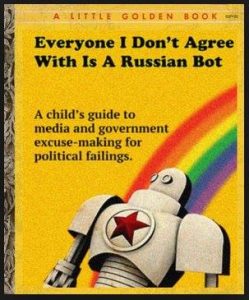 Tiresome things of 2018:
“News” that is just stuff someone tweeted;
“News” that is just repeating what a late night TV host said;
“News” reported on one web site which is just a rewrite of a story on another web site;
Deification by the left of scum from the right like McCain, Mattis, Clapper, Comey, Brennan, et al, only because they said something bad about Trump;
Desperate creation of insta-heroes to satisfy some greater political goal (‘Dem Parkland Kids, the cult of ‘Notorious’ RGB, Alexandria Ocasio-Cortez, Friggin’ Beto), empty heros in a time of disappointment and cynicism;
Movements which claim they have changed everything because their hashtag trended on Twitter;
All media abandoning even the pretence of objectivity in favor of advocacy but pretending they are still objective;
The primacy of “sources say…” over anything resembling actual fact-gathering;
“Fact checking” that is actually partisan gaming of information;
Idiots thrilled when bad things happen (like stock market declines) because they think it validates their Trump hate;
Idiots over-dramatizing bad things (like stock market declines) into evidence the world is ending, fascism is taking over, end of democracy, time to worry, walls closing in, tick tock;
Idiots hoping for more bad things to happen, like a doomsday cult does, because they think that will hasten the end of Trump;
People who have been saying “Just wait” for three years now into Russiagate. We’re waiting.
That most social media which isn’t cat pictures is now endless self-promotion because everyone is a brand or selling something or demanding we follow them or friend them or like them or thumbs up them;
People who just read the headlines and media which writes headlines which are not reflective of the actual content;
The way transpeople have become progressives’ adopted bestest minority of the moment;
Over-use of the word “folk”;
Insta-hate that finds some way to make anything Trump does from the dramatic to the mundane evil and wrong;
Historical revisionism that turns people like George W. Bush into kindly old men sharing candies with Goddess Michelle instead of thugs who dragged America into war and recession and forever damaged our nation’s credibility by torturing human beings;
Anything that starts with “As a ____” (woman, POC, Kurd, left handed Asian-American) because you know the rest is just going to be someone whining about how life is unfair, the system unjust, the deck stacked, because they are a ____ and can comment with the full authority for everyone ____ everywhere because they are a ____ and you are not;
Discussions on immigration policy that dead-end when someone has to tearfully tell us about how his great grandfather didn’t speak English, forestalling any serious attempt to look at broader policy in the 21st century.
Gefälschte Nachrichten
ZMAN | December 23, 2018
Last week, the German publication Der Spiegel was forced to fire its star performer, when it was revealed he was a fabulist. Claas Relotius had written for the publication for close to a decade. He had been handed several awards by other media organs. His exposure as a serial fabricator was the result of his piece on the small town of Fergus Falls Minnesota, after the 2016 election. The thrust of his story was that rural America voted for Trump, because it is full of xenophobic weirdos and economic losers.
His mistake was to pick on a small town in the age of the internet. The yokels were able to look up the article and compare his version of reality with their own. More important, they could go to a popular platform and post their reactions to his article, so the world could then compare his work to reality. Michele Anderson and Jake Krohn, who live in Fergus Falls, posted their analysis of the article on Medium. Eventually, it took over a year, Der Spiegel was forced to address the issue publicly.
In Germany, this is quite a scandal in media circles, because Der Spiegel is like their version of New York Times. That is, it positions itself as the official arbiter of truth, with regards to public morality. They not only decide what is true, they decide which truths can be said. Worse yet for them, they have been bragging about their fact checking for a long time. As a result of this tent pole toppling over, the German media is scrambling to convince everyone that it is an isolated incident, not a system failure.
The amusing bit is the German media is rushing around looking puzzled, as to how the vaunted fact checking system could have failed. After all, the best people are in control of the media. How could the best people have made such basic errors? As is the case in America, whenever these things happen, the media hand-wringing is just a dodge. What really concerns them is how easy it was for two bumpkins from dirt country to sluice out the facts from the fiction in this particular article.
That’s always the thing with these scandals. The media big shots always come off as if they have been insulted about their shenanigans being revealed. In this case, the other major media outfits are rallying to defend Der Spiegel. In the dreaded private sector, competitors are always quick to take advantage of the mistakes of a competitor. In the main stream media, the opposite is always true. They circle the wagons and begin lecturing the hoi polloi about the dangers of questioning the media.
That is the real cause of these scandals. For a long time, the mass media in the West has been a mono-culture. You can’t have a career in the media if you don’t hold all the right opinions. To call the media an echo chamber for the left is to understate the problem. The better analogy is a school of fish. Each individual just reacts to those around him, giving the effect of the school having agency as a whole. What looks like collusion is just the result of a uniformity of mind, experience and social class.
That’s why no one at Der Spiegel, or anywhere else in the German media, noticed the fraudulence of Claas Relotius. He was writing the things his coevals and superiors said at luncheons, cocktail parties and in the office. His story about slack-jawed yokels in the American heartland ticked all the boxes popular with the left-wing cultural outlook. He was not sent there to report on the place. He was sent there to confirm what his employers already knew about Middle American and Trump voters.
This is why Western media is something worse than propaganda. The person hired by the state or hired by the corporate marketing department has self-awareness. They know their job is to polish the apple of their superiors. The tricks they employ to do that are done with knowledge and forethought. The guy telling the public that his employer, the pesticide company, is deeply concerned about the environment does so knowing full well that no one believes him, including his family.
The media is a different thing. They really believe their own nonsense. They think they are part of a special class of human, a priestly class that not only reports facts to the public, but provides moral instruction. The mass media is so intoxicated by their own self-righteousness, they lack the ability to question their own actions. When Claas Relotius came back from the bush, reporting exactly what his bosses knew was the case, they had no reason to question it. It was too good to check.
Irony alert: Firm that warned Americans of Russian bots… was running an army of fake Russian bots
By Danielle Ryan | RT | December 29, 2018
The co-founders of cybersecurity firm New Knowledge warned Americans in November to “remain vigilant” in the face of “Russian efforts” to meddle in US elections. This month, they have been exposed for doing just that themselves.
Ryan Fox and Jonathan Morgan, who run the New Knowledge cybersecurity company which claims to “monitor disinformation” online, penned a foreboding op-ed in the New York Times on November 6, about “the Russians” and their nefarious efforts to influence American elections.
At the time, it struck me that Fox and Morgan’s reasoning seemed a little far-fetched. For example, one of the pieces of evidence presented to prove that Russia had targeted American elections was that lots of people had posted links to RT’s content online. Hardly a smoking gun worthy of a Times oped.
Morgan and Fox, intrepid cyber sleuths that they are, claimed in the article they had detected more “overall activity” from ongoing Russian influence campaigns than social media companies like Facebook and Twitter had yet revealed — or that other researchers had been able to identify.
The New Knowledge guys even authored a Senate Intelligence Committee report on Russia’s alleged efforts to mess with American democracy. They called it a “propaganda war against American citizens.” Impressive stuff. They must be really good at their job, right?
This week, however, we learned that New Knowledge was running its own disinformation campaign (or “propaganda war against Americans,” you could say), complete with fake Russian bots designed to discredit Republican candidate Roy Moore as a Russia-preferred candidate when he was running for the US senate in Alabama in 2017.
The scheme was exposed by the New York Times — the paper that just over a month earlier published that aforementioned oped, in which Fox and Morgan pontificated about Russian interference online.
New Knowledge created a mini-army of fake Russian bots and fake Facebook groups. The accounts, which had Russian names, were made to follow Moore. An internal company memo boasted that New Knowledge had “orchestrated an elaborate ‘false flag’ operation that planted the idea that the Moore campaign was amplified on social media by a Russian botnet.”
Moore lost the race by 1.5 percent. To be fair, accusations published by the Washington Post that he pursued underage girls back in the 1980s may have had something to do with it as well, but that’s a different story.
Of course, New Knowledge and even the New York Times, which blew the lid of the operation, are trying to spin this as some kind of “small experiment” during which they “imitated Russian tactics” online to see how they worked. Just for research, of course. They have also both claimed that the scheme, dubbed ‘Project Birmingham’ had almost no effect on the outcome of the race.
The money for the so-called research project came from Reid Hoffman, the billionaire co-founder of LinkedIn, who contributed $750,000 to American Engagement Technologies (AET), which then spent $100,000 on the New Knowledge experiment. After the scheme was exposed, Hoffman offered a public apology, saying he didn’t know exactly how the money had been used and admitting that the tactics were “highly disturbing.”
If people like Fox and Morgan actually cared about so-called Russian meddling or the integrity of American elections, they would not have run the deceptive campaign against Moore, no matter how undesirable he was as a candidate. Their sneaky and deceitful methods are in total contrast to the public profile they have cultivated for themselves as a firm fighting the good fight for the public good. But is it really that much of a surprise?
You would think that a newspaper like the New York Times would have cottoned on to the fact that guys like Fox and Morgan, with their histories in the US military and intelligence agencies, have clear agendas and are not exactly squeaky clean or the most credible sources of information when it comes to anything to do with Russia. But that kind of insight or circumspection might be too much to ask for in the age of Russiagate.
Facebook removed Morgan’s account on Saturday for “engaging in coordinated inauthentic behavior” around the Alabama election. Three days after publishing its initial article on the scandal (the one in which it played down the effects of New Knowledge’s disinfo campaign), the New York Times published a follow-up piece about the Facebook removal, in which it admitted that the controversy would be a “stinging embarrassment” for the social media researcher, noting that he had been a “leading voice” against supposed Russian disinformation campaigns.
In Fox and Morgan’s original NYT oped, they warned of the ubiquitous “Russia-linked social media accounts” and estimated that “at least hundreds of thousands, and perhaps even millions” of US citizens had engaged with them online. One must now wonder, were they including their own fake Russian bots in that count, or were they leaving those ones out?
It’s nearly two years into the Trump presidency and still we have no solid evidence that the Russian “collusion” theory is anything more than a fantasy concocted by Democrats desperate to provide a more palatable reason for Hillary Clinton’s loss than the fact that she simply ran a bad campaign.
In fact, at this point, we actually have more solid and irrefutable evidence of election meddling from the likes of dodgy American and British companies like Cambridge Analytica and New Knowledge than we do of any meddling orchestrated by Russia.
Danielle Ryan is an Irish freelance writer based in Dublin. Her work has appeared in Salon, The Nation, Rethinking Russia, teleSUR, RBTH, The Calvert Journal and others. Follow her on Twitter @DanielleRyanJ
Also on rt.com:
The only ‘Russian bots’ to meddle in US elections belonged to Democrat-linked ‘experts’
LinkedIn billionaire ‘sorry’ for funding ‘Russian bot’ disinformation campaign against Roy Moore
Featured Video

Rewriting the risk? Inside the government’s vaccine safety messaging
or go to
Aletho News Archives – Video-Images
Book Review
“Davos Can Really Replace the UN”
Inside the book that maps the architecture behind global governance — from the Epstein files to the Pact for the Future
Lies are Unbekoming | April 1, 2026
On June 13, 2019, the United Nations and the World Economic Forum signed a partnership deal to “accelerate the implementation of the 2030 Agenda for Sustainable Development.” That same evening, WEF president Börge Brende — Norway’s former Foreign Minister — had dinner with Jeffrey Epstein at Epstein’s Manhattan townhouse. The Epstein files, released January 2026, contain an exchange between the two from the previous year. Epstein to Brende: “Davos can really replace the UN. C21, cyber, crypto . genetics… intl coordination.” Brende back to Epstein: “Exactly — we need a new global architecture. World Economic Forum (Davos) is uniquely positioned — public private.”
The next day, the UN General Assembly adopted the framework for restructuring global governance.
That sequence — the partnership signing, the Epstein dinner, the candid admission about replacing the UN with a public-private architecture, and then the formal adoption — opens Jacob Nordangård’s The Digital World Brain. Pages two and three. Footnoted to the UN resolution number, the Epstein files, and the General Assembly record.
I keep coming back to it because it captures what this book does that almost nothing else in the independent research space manages. I’ve followed Jacob’s work for years now and interviewed him about his research. Each book peels back another layer of the same institutional architecture, and each time I think he’s reached the limit of what can be documented, the next one goes further. Nordangård doesn’t speculate. He doesn’t editorialize much. He lays institutional actions next to each other in chronological order and lets the pattern announce itself. … continue
Blog Roll
 Aletho News
- How I fell foul of the BBC thought police
- The End of NATO
- 37 days of war on Iran cost US staggering $42bln, tracker shows
- Baghdad tells Asian refiners, traders to begin loading Iraqi crude amid Iranian exemption
- Under fire, Moscow and Tehran close ranks
- Iran, US receive Pakistan-mediated plan for ceasefire then final deal
- Iran submits demands for end to war as mediators scramble ahead of Trump deadline
- Iran Threatens Retaliatory Strike on Stargate AI Project in UAE
- US sent ‘a lot’ of arms to Iranian protesters – Trump
- Barak Ravid Launders Deception To Allow Trump To Back Off Of His Power Plant Threat – Again
- If Americans Knew
- Israel’s Latest Genocide Is Against the Shias of Lebanon. Why Is the World Silent?
- How Eliot Cohen’s influence over U.S. war-making paved the way for Trump’s war crimes in Iran
- Israelis don’t pay for the weapons we ‘sell’ to them — US taxpayers do
- While Distancing from AIPAC, Most 2028 Democratic Hopefuls Are Still Embracing Israel
- A brief history of the Israeli nuclear program, the open secret at the heart of the Iran war
- Israeli Settlers Killed a Palestinian Farmer on His Own Land, in Front of His Father. Yes, Again
- The US-Israeli War on Science is an Assault on our Future
- 100+ International Law Experts Say US Strikes on Iran Violate UN Charter, Could Be War Crimes
- ‘Vile, Horrifying, Evil’: Trump Threatens to Bomb Nation of 90 Million People ‘Back to the Stone Ages’
- The Axis of Resistance: Islamic Liberation Theology and the Struggle for Freedom
- No Tricks Zone
- An Inconvenient Tree: Uncovered In Alps… Europe Much Warmer Than Today 6000 Years Ago
- New Study Reports A 60% Slowdown In Greenland’s Ice Loss Rate In The Last Decade
- Low Intensity Tornado Wrecks Major Solar Farm, Creating A Potential Toxic Dump
- New Study Finds Warming Saves Lives…Cold Temperatures 12 Times More Deadly Than Excess Heat
- German Science Blog Accuses PIK Climate Institute Of Hallucinating Climate Tipping Points
- Devastating Assessment Of Comirnaty Vaccine By Former Senior Pfizer Europe Toxicologist
- New Study: CO2 Is ‘Effectively Negligible’ As An Explanatory Climate Change Factor Since 2000
- Former Pfizer Toxicologist Dr. Helmut Sterz Tells Bundestag Hearing Pfizer Vaccine Should Have Never Been Approved
- Energy Expert: Germany’s Nuclear Phaseout Was A “500 Billion Euro Mistake”
- New Research: South Australia’s Mid-Holocene Sea Surface Temperatures Were 4°C Warmer Than Today
 Aletho News