Exposed: Western journalists secretly served ‘Israel’s’ war propaganda
Al Mayadeen | October 8, 2025
Leaked emails from the inbox of former Israeli Ambassador to the United Nations Ron Prosor reveal that prominent Western journalists, ncluding The Atlantic’s David Frum and British writer Douglas Murray, secretly offered to write speeches and provide other forms of assistance to Israeli officials during the entity’s 2014 war on Gaza, according to a report by journalists Murtaza Hussain and Ryan Grim published on Drop Site.
The correspondence, obtained by the hacker collective Handala and published by the whistleblower group Distributed Denial of Secrets (DDoSecrets), includes communications between Prosor and several journalists and media figures.
The trove reveals that while “Israel” faced global condemnation for its war that killed over 2,200 Palestinians, more than 550 of them children, figures in Western media were privately coordinating with Israeli diplomats on messaging and advocacy efforts.
Frum’s dual role: Journalist and speechwriter
David Frum, a senior editor at The Atlantic and a former speechwriter for US President George W. Bush who coined the phrase “Axis of Evil,” began his editorial role at the magazine in early 2014. Just months later, at the height of “Israel’s” bombardment of Gaza, Frum sent Prosor a full draft of a UN speech.
In an email dated July 31, 2014, Frum told Prosor he had collaborated with Seth Mandel, a writer for the neoconservative publication Commentary, to prepare the text. The draft portrayed “Israel’s” war on Gaza as part of the “free world’s” struggle against “tyranny”, comparing it to the Allied defeat of Nazi Germany and invoking figures such as Harry Truman and the architects of the Marshall Plan.
The speech urged Americans not to grow “war weary” and to maintain support for “Israel’s” military actions. Prosor thanked Frum and said he would review the draft, though it remains unclear whether the text was ever used.
Remarkably, just one day earlier, Frum had contacted Prosor in his capacity as a journalist for The Atlantic, requesting an interview for a profile of the ambassador. Two months later, The Atlantic published Frum’s piece, “Israel’s Man at the United Nations,” which praised Prosor for his “toughness” and diplomatic skill in defending “Israel” against international criticism.
Douglas Murray’s contributions and fundraising
Frum was not alone. British commentator Douglas Murray, now an associate editor at The Spectator and a frequent television pundit, also sent Prosor a proposed draft for a UN speech on the same day, July 31, 2014.
In his email, Murray described the text as “first draft ideas,” noting it may include “more diplomatic things than needed.” His proposed speech echoed hardline pro-“Israel” narratives, including condemnation of BDS movements and disparaging references to European Muslims.
Murray pledged to continue assisting the ambassador. “I will give all the time I can to helping get it right,” he wrote.
In subsequent months, Murray continued corresponding with Prosor, sharing articles and offering public relations advice. Later that year, he informed the ambassador that he had hosted a London fundraiser that brought in over £1 million for the Association for the Wellbeing of Israeli Soldiers, a group providing direct support to Israeli occupation forces.
Prosor thanked Murray for his “wonderful work”, calling his efforts vital to “Israel’s cause”.
The revelations contrast sharply with Murray’s later insistence on journalistic independence. In an April 2025 appearance on The Joe Rogan Experience, he chastised critics of “Israel’s” Gaza policies for lacking firsthand experience, saying he avoided commenting on countries he hadn’t visited.
Murray has frequently appeared in public wearing a “PRESS” flak jacket while embedded with Israeli forces, without disclosing his prior speechwriting and fundraising for the same military he was covering.
CNN producer’s role in Iron Dome fundraising
The leaked correspondence also implicates Pamela Gross, a former CNNproducer, who maintained close ties with Prosor during the war. Emails show that Gross and her husband, media executive Jimmy Finkelstein, then-owner of The Hill, privately discussed raising money for “Israel’s” Iron Dome missile system.
In one July 2014 message, Gross wrote to Prosor, “Clearly Iron Dome is doing the trick and saving lives. Please dear friend, let’s get it finished. Please let me know what is still left to be done at your soonest convenience.”
Prosor responded by thanking Gross for her “amazing work in fundraising for the Iron Dome project,” calling her and her husband “true assets to the state of Israel.” Gross later asked the ambassador to connect her with officials who could provide details about the project’s funding needs and how to channel donations.
Gross continued to book Prosor for CNNappearances while maintaining their personal friendship. In one 2015 exchange, she invited him on air to discuss Israeli Prime Minister Benjamin Netanyahu’s speech to the US Congress, telling him she and her husband had recently dined with former Israeli Prime Minister Ehud Barak.
Unanswered questions, ethical fallout
The leaked cache contains hundreds of verified messages, photographs, and attachments, though DDoSecrets noted it could not independently authenticate every file. Handala, the hacking group that released the material, issued a violent threat against Prosor, which DDoSecrets publicly condemned.
None of the journalists or organizations named in the emails, including Frum, Murray, Mandel, CNN, or the Israeli Embassy in Germany, where Prosor now serves, responded to requests for comment from Drop Site, which first reported the findings.
The revelations raise fresh ethical concerns about the blurred lines between journalism and government lobbying efforts during times of war. While journalists are expected to maintain independence and avoid conflicts of interest, the emails suggest that several prominent figures in Western media privately worked to shape pro-“Israel” narratives during one of the deadliest wars on Gaza.
For “Israel”, such alliances helped bolster its messaging at a time of mounting global outrage over civilian casualties. For the public, however, the leaks expose the extent to which supposedly independent voices in Western journalism may have functioned, willingly or not, as part of a broader influence campaign.
GAMAAN: The Polling OP That’s Gaslighting The West About Iran
By Sam Carlen & Iain Carlos | Mint Press News | July 28, 2025
The Group for Analyzing and Measuring Attitudes in Iran (GAMAAN), an influential Dutch polling group cited by the New York Times, U.S. State Department, and U.K. government, claims to capture the true views of everyday Iranians through unconventional online surveys.
GAMAAN calls itself an “independent” research foundation, a label echoed by news outlets and think tanks covering the group’s headline-grabbing findings, which portray the Iranian public as far more secular and anti-government than data from organizations such as Gallup and Pew Research suggest. But GAMAAN’s extensive links to U.S.-funded organizations, many of which advocate for regime change in Iran, and its flawed methodology, have raised serious questions about its credibility and impact on Western understanding of Iran.
“[T]hey know what they think, and they want to use the language of social science to demonstrate that those claims are actually true. And of course, that’s a problem,” said Daniel Tavana, an assistant professor of political science at Penn State who was a principal investigator for Princeton’s Iran Social Survey.
“[T]hey’re just ideological,” Tavana said.
They are very opposed to the regime, want to embarrass the regime in whatever way they can, and are happy to say … whatever they think will most effectively do that at any given point in time, regardless of whether or not they have evidence for it.”
GAMAAN’s role in anti-government discourse surrounding Iran has taken on heightened significance against the backdrop of escalating tensions between Israel and Iran, which culminated in a historic outbreak of hostilities last month.
Ostensibly motivated by concerns over Iran’s nuclear program, the conflict began with an Israeli surprise attack on June 13, to which Iran responded with a barrage of missiles and drones, beginning a days-long cycle of back-and-forth attacks between the two sides.
The U.S. entered the war on June 22, conducting airstrikes on Iranian nuclear facilities, and Iran responded with attacks on U.S. military bases in Qatar. On June 24, a shaky U.S.-brokered ceasefire took hold, and despite initial violations by both Israel and Iran, active hostilities gradually came to a halt.
GAMAAN’s poll results, which portray the Iranian citizenry as far more hostile to their government than other surveys, are often cited by advocates for regime change. The question of Iranians’ support (or lack thereof) for the Islamic Republic was particularly relevant during the hostilities, when doubts arose about the government’s survival, and the prospect of installing the Shah’s son was granted legitimacy by some media outlets.
While Iranian state-owned media have discussed some of GAMAAN’s ties to Western-funded organizations and regime change proponents, as well as the limitations of its survey methods, Noir News is the first to report the full scope of GAMAAN’s numerous connections with U.S. government-funded regime change operatives and the severity of its methodological issues.
Given GAMAAN’s rapid rise to prominence, with its findings often cited by Western governments and prestigious news outlets, the group’s numerous ties to U.S. government-funded supporters of regime change in Iran, and the organization’s dubious survey methods, warrant scrutiny, especially given the anti-Islamic Republic trend of its survey results (with one survey finding 81% of respondents opposed the Islamic Republic), which are used by critics as a cudgel against Iran’s government.
GAMAAN founders Pooyan Tamimi Arab, an assistant professor of religious studies at Utrecht University, and Ammar Maleki, an assistant professor of comparative politics at Tilburg University, are themselves outspoken critics of the Iranian government. Maleki refers to himself as a “pro-democracy activist” and is a vociferous critic of the Islamic Republic and proponent of regime change. Neither responded to requests for comment.
Indeed, GAMAAN has relied on U.S. government-funded VPN and anti-censorship software providers like Psiphon to disseminate its surveys; collaborated with the USAID-funded, pro-regime change Tony Blair Institute; and collaborated with and received funding from historian Ladan Boroumand, co-founder of the Iranian regime-critical Abdorrahman Boroumand Center for Human Rights in Iran, which is in turn supported by the U.S. government-funded National Endowment for Democracy (NED).
Likewise, for a February 2023 report on Iranians’ attitudes toward the anti-government protests, GAMAAN enlisted the help of U.S. government-linked Iran International and U.S. government-funded Voice of America Persian in circulating survey questions.
Founded in 2019, the logic behind GAMAAN’s founding was that, in the context of state repression, traditional survey approaches based on random sampling and in-person or telephone interviews fail to capture the population’s true beliefs regarding sensitive religious and political topics, because “individuals often censor their true views or even actively alter them to avoid scrutiny by authorities,” according to GAMAAN.
Instead, the group distributes its surveys via social media, VPN platforms such as Psiphon, and encrypted messaging platforms like Telegram, allowing respondents to participate anonymously.
Unlike traditional polling based on probability sampling—random selection of respondents and persistent follow-up to minimize non-responsiveness—GAMAAN uses a voluntary, opt-in model. Respondents are not randomly selected from the broader target population of literate Iranians over the age of 19.
Instead, GAMAAN says respondents are reached “through random sampling via the popular Internet censorship circumvention provider Psiphon VPN, as well as ensuing sharing by respondents on social networks (Telegram, Instagram, WhatsApp, and Twitter).”
Prior to its use of VPN platforms like Psiphon for sampling, GAMAAN had exclusively relied on surveys being shared on social media, a method also referred to as “multiple chain-referral sampling,” also known as “snowball sampling.”
To account for methodological issues with non-random sampling inherent to opt-in surveys, GAMAAN tries to circulate its polls across a range of channels “representing radically diverse social layers of society and political perspectives,” and adjusts response data using statistical methods meant to render the final polling data more representative of the target population (literate Iranians 19 years and older with internet access).
At times, the circulation of GAMAAN’s surveys has been aided by social media virality.
Using this unorthodox methodology, GAMAAN’s survey results have often surprised observers and contradicted the findings of long-established pollsters, such as Pew Research and Gallup, which employ conventional face-to-face and telephone polling methods. The group’s 2020 survey on Iranians’ religious beliefs made waves for its findings, which showed less religiosity among the Iranian population than was generally believed (and indicated in prior polling).
Among other surprising results, GAMAAN’s survey found 22% of respondents did not belong to any religion, 9% identified as atheist, and 47% reported “having transitioned from being religious to non-religious.” In contrast, Pew Research reported in 2009 that 99.4% of Iranians are Muslim.
But according to polling experts, GAMAAN’s findings cannot be generalized to the broader Iranian public due to significant bias in who its surveys reach. GAMAAN relies chiefly on the Psiphon VPN platform to circulate its survey questionnaires, with about 66% of respondents in its latest poll participating through the platform, and the remainder reached through Telegram (13.1%), Instagram (8.5%), WhatsApp (4.6%), X (1.5%), and the remaining 6.7% through other undisclosed channels.
According to polling experts, these methods suffer from “coverage bias” in that they fail to reach large segments of the Iranian population, including Iranians who do not use the internet or do not use VPNs or encrypted messaging.
Nor do GAMAAN’s methods account for the fact that Iranians who use Psiphon or come across its surveys through social media are different in important ways from the Iranian population as a whole, to which GAMAAN claims its findings can be generalized.
Indeed, GAMAAN’s survey links are frequently shared by vocal critics of the Iranian government, and demographic data reported by GAMAAN shows respondents are disproportionately urban (93.6% of respondents in its latest survey, vs. about 80% of the total Iranian population), college-educated (70.9% of respondents, compared to 27.7% of literate Iranians 19 years and older, per labor force statistics cited by GAMAAN); and high-income (54% of respondents had a “household monthly income above 13 million Rials,” compared to 40% among the target population, per GAMAAN’s methodology section).
“[F]or that inference that GAMAAN is making to be true, that this sample represents the Iranian population, the adult age population, we would have to assume or believe that Psiphon users are reflective of the Iranian population as a whole, which … just could not possibly be true,” Tavana said.
GAMAAN’s surveys have a high rate of repeat participation (i.e., a large share of respondents to a given survey participated in previous GAMAAN polling), with 26% of respondents in its most recent poll having participated in previous GAMAAN surveys, which GAMAAN interpreted as “indicating that the random sampling method was effective in distributing the questionnaire among a wide range of demographic groups, reaching far beyond networks familiar with GAMAAN.”
“The authors’ claim that this number provides evidence that their methods reach a random sample is a vast misinterpretation,” according to Kevan Harris, an associate professor of sociology at UCLA who was a principal investigator for the Iran Social Survey along with Tavana. “Indeed, it is the opposite. This number, if true, is evidence of how this organization’s methods are reaching a relatively small, interconnected group of people who are predisposed to take their surveys.”
Harris highlighted that, per GAMAAN’s own methodology section in its most recent survey report, 5-11 million Iranians use Psiphon daily (the main source of survey participants), meaning the “refined sample” of 77,216 (which excludes “random or bot-entered responses,” per GAMAAN) constitutes approximately 0.7-1.5% of daily Psiphon users in Iran, yet GAMAAN reported that “26% of respondents had previously participated in GAMAAN’s surveys.”
“When you have a 26% repeat rate from what’s already less than 2% of your potential sample pool of Psiphon users (and less than 0.2% of all adult VPN users), that’s a major red flag about how representative your sample really is,” Harris wrote in an email to Noir.
[I]t shows they’re not really getting a random sample of all Iranians, just likely a small, enthusiastic subset who regularly take their surveys. Indeed, the 26% number, given this relatively large sample size, is telling.”
Sunghee Lee, an Associate Research Professor at the University of Michigan’s Survey Research Center, wrote in an email to Noir that “without further information,” she would agree with Harris’s assessment of the problematic nature of the high repeat-response rate.
“Based on my quick search, the adult population of Iran appears to be around 70 million. The sample of 77K from the June 2024 report accounts for 0.1% of the adult population. This means that, if a true probability sample is used for 77K, you are likely to be sampled 1 out of 1000 studies. The fact that 26% of the sample is a repeat group suggests that the sample is likely to represent a group much narrower in scope than the adult population.”
While GAMAAN purports to use “various balancing methods such as weighting and the sample matching method” to derive a representative sample from its raw survey data, survey experts interviewed by Noir said these methods can’t compensate for the unrepresentative nature of GAMAAN’s underlying data.
“[W]e use weights when we don’t know what the probability is that any given person will enter into a sample, and so we weight certain respondents in our sample more or less if we think that they were more or less likely to be chosen to be on our sample, we don’t have any way to assess that,” Tavana said.
“So what they call weights is actually just refining the sample so that on key demographics, the sample looks more like the Iranian [population]. But it’s not a probability sample to begin with.”
Stanford University social psychologist and survey methodologist Jon Krosnick concurred, writing in an email to Noir : “[T]he phrase ‘matching and weighting’ without disclosing the details also sounds like a snake oil salesman. There have been lots of claims that ‘matching and weighting’ have improved the accuracy of non-probability samples, but lots of published papers have shown that such methods have failed rather than succeeded. I don’t know of a single one showing improvement in accuracy.”
Lee likewise expressed doubt that GAMAAN’s weighting and sample matching adjustments can yield a representative sample: “I am not entirely convinced that a population with less than 30% with college education can be examined by a sample with more than 70% with college education even after the weighting is applied.”
Lee also noted that the Pew Research study GAMAAN links to in its June 2024 survey report when discussing the “raking” weighting method for adjusting online opt-in samples, which used over 30,000 online opt-in survey responses to evaluate weighting procedures and their ability to reduce bias, concluded that “[e]ven the most effective adjustment procedures were unable to remove most of the bias.”
Lee also highlighted that GAMAAN’s “sample is representative only on the dimensions that the study attempted to balance. There are five demographic variables used in ranking: age group, gender, level of education, residential area (urban or rural), and provincial population. Therefore, whether results on the study outcome variables (e.g., expected election turnout) are representative is debatable.”
“The bottom line for me is that abandoning random sampling in Iran or the U.S. leaves a researcher with no basis for generalizing the results of a survey to any population,” Krosnick wrote. “It’s fine to talk about the obtained results, as well as describing the people who participated. But not to generalize.”
According to the survey experts interviewed by Noir, a chief issue with GAMAAN’s approach is the inappropriate generalization of its survey results to the entire Iranian adult population, rather than the (likely meaningfully different) participants in its surveys.
“This doesn’t mean [GAMAAN’s] surveys are useless, but their results should be presented much more cautiously, with clear acknowledgment that they represent opinions of a specific, self-selected subset of internet-using, politically engaged people – not the general population,” Harris wrote in an email to Noir. “This is especially crucial when the surveys cover sensitive political topics that might influence US/European policy or public opinion.”
“I have no doubt in my mind that with the data GAMAAN has, we could make inferences about Psiphon users, and frankly, that would be fascinating to know what Psiphon users think and believe about the Iranian government,” Tavana said.
It’s an incredibly important constituency we could generalize their findings to, and make inferences about, the activist population, maybe even the online population, right? That would be fine, but to say that it’s representative of the whole country … we would have to believe [all] of these things that we know are false. We would have to believe that Psiphon users in particular, but also Twitter and Telegram users, are reflective of their population, and we already have substantial verified information that they are not.”
“GAMAAN tells us to believe that their findings are generalizable to the entire adult population, right? This is invalid,” Tavana said. “That conclusion does not follow from, even if we had their data, even if we knew what procedures they were following, how they were recruiting subjects, and so on, that scientifically does not logically follow from what they are doing.”
Even the central premise of GAMAAN’s approach—that citizens of a country with a repressive, authoritarian state will not give honest answers to questions pertaining to sensitive political or cultural issues when an interviewer is present—is dubious, Krosnick wrote.
“[M]any studies have surprisingly shown that removing interviewers rarely causes responses to change much,” Krosnick wrote. “In general, if a person is going to participate in answering questions, why bother if the person is going to lie – it’s obviously easier just to decline to participate at all from the start or to break off mid-interview.”
GAMAAN has also drawn criticism for a lack of transparency in its methods and, with one exception, a failure to subject its work to the rigor and scrutiny of publishing in peer-reviewed academic journals.
“Because they don’t document carefully enough for scientific standards what they do, none of what they produce is replicable,” Tavana said. “This is compounded by the fact that their data is not publicly available. I cannot go and download their data and analyze it for myself, right?”
The only article based on GAMAAN’s survey work that has been published in a peer-reviewed academic journal to date, “Survey Zoroastrians: Online Religious Identification in the Islamic Republic of Iran,” primarily focuses on a single finding from GAMAAN’s 2020 survey on Iranians’ religious beliefs (which was “financially supported by and carried out in cooperation with Dr. Ladan Boroumand” of the Abdorrahman Boroumand Center, an Islamic Republic-critical organization supported by the U.S. government-funded National Endowment for Democracy) – that 8% of respondents identified as Zoroastrian (a far higher share than reported in previous research).
The paper does not use GAMAAN’s more controversial findings (such as those concerning Iranians’ political beliefs). Moreover, a note appended to the journal article states “[t]he raw data used for this research can be shared with researchers under a confidentiality and collaborative agreement with GAMAAN,” which Tavana characterized as “unusual.”
“Typically, we do not require these kinds of agreements for access to this type of data,” Tavana wrote in an email to Noir. “I have seen it before when the data is proprietary or owned by a private company. But not data that an academic has collected on their own. This means that no one – not the reviewers, the editorial staff, or anyone else – has verified the claims made in the article.”
“[B]ecause we cannot replicate what they do, because their data are not available, we don’t know whether the inferences they are making on that data are valid, and so we have to take them at their word, and there are many reasons why we probably should not take them at their word,” Tavana said.
GAMAAN’s methodological shortcomings may account for substantial differences seen between its findings and those of long-established pollsters using traditional probability sampling.
For instance, in a 2022 survey on Iranians’ political beliefs, GAMAAN reported far lower approval ratings for then-president Ebrahim Raisi compared to those reported by Gallup in a 2021 survey. GAMAAN itself highlighted this divergence (illustrated in the graphic below), but wrote that “both surveys are substantially similar … if Gallup’s results are compared with only the Principlists and Reformists in GAMAAN’s sample” (meaning, responses from more conservative and incrementalist participants in GAMAAN’s survey align with Gallup’s findings across its entire sample).
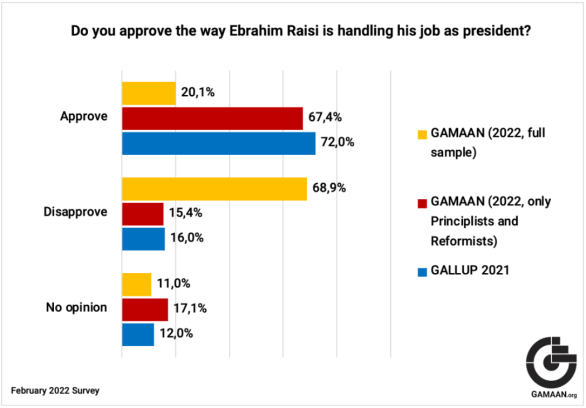
Figure 13-1 — Maleki, Ammar. 2022. Iranians’ Attitudes Toward Political Systems: A 2022 Survey Report. Published online, gamaan.org: GAMAAN.
GAMAAN’s Ties To US-Funded Regime-Change Orgs
Chief among GAMAAN’s ties to U.S. government-funded groups is the organization’s recent “partnership” with the Tony Blair Institute. GAMAAN “exclusively provided” the U.K. nonprofit with detailed survey data gathered in June 2020 (regarding Iranians’ religious beliefs), and February & December 2022 (regarding political systems and the Mahsa Amini street protests, respectively).
The Tony Blair Institute used GAMAAN’s survey data for a series of articles depicting the Iranian populace as eager for regime change, with one article titled “The People of Iran Are Shouting for Regime Change – But Is the West Listening?”.
Founded by former U.K. Prime Minister Tony Blair, the Institute has received millions in grants from the U.S. Agency for International Development (USAID), at least some of which were Cooperative Agreement grants “characterized by extended involvement between recipient and agency.”
The Tony Blair Institute is also funded by the U.K.’s Foreign, Commonwealth, and Development Office (akin to the U.S. State Department), as well as private entities such as the French consulting firm Altai Consulting. Altai boasts the European Commission, USAID, and the French Development Agency as clients.
GAMAAN’s widely-discussed 2020 survey of Iranians’ religious beliefs was “financially supported by and carried out in cooperation with” Dr. Ladan Boroumand, co-founder and research director of the Abdorrahman Boroumand Center, a nonprofit focused on Iranian human rights abuses and critical of Iran’s Islamist government.
Named after her father Abdorrahman Boroumand, an Iranian lawyer and pro-democracy activist who was allegedly assassinated by Islamic Republic agents in 1991, the Center’s ‘Omid’ project documents cases of executions and assassinations in Iran in a searchable electronic database. The organization isn’t shy about supporting regime change, stating that its “goal is to prepare for a peaceful and democratic transition in Iran and build a more just future.”
The Boroumand Center has received substantial funding from the U.S. government-financed National Endowment for Democracy (NED), of which the Boroumand Center is a “partner.”
Ladan Boroumand has held multiple positions at the NED, including serving as a former Reagan-Fascell Democracy Fellow, researching “secularization in Iran,” a current member of the editorial board for the NED’s Journal of Democracy, as well as a current Research Council Member at the NED’s International Forum for Democratic Studies. She has also served on the Steering Committee of the World Movement for Democracy, of which the NED serves as the “secretariat.”
Ladan Boroumand is also on the advisory committee for the Atlantic Council’s Iran Strategy Project, which convened various experts and former officials “to develop a holistic US policy toward the Islamic Republic of Iran for the next four years.”
The Atlantic Council is an influential international relations think tank with extensive ties to U.S. lawmakers that receives large sums from the U.S. government (with FY 2023 grant obligations totaling over $6 million). The group’s October 2024 Iran Strategy Project report recommends a policy of continued pressure against the Islamic Republic, including through “enhanced support to the Iranian people” with the “long-term goal of supporting the Iranian people’s ability to change their system of government if they so desire.”
Ladan Boroumand was invited, along with her sister Roya Boroumand, to a July 2018 speech by former Secretary of State Mike Pompeo at the Reagan Library, amid the Trump administration’s pivot to a hardline posture towards the Islamic Republic. The two sisters likewise joined 12 other Iranian diaspora women in signing an August 2019 open letter calling for a “transition from the Islamic Republic.”
GAMAAN has also consulted with Dr. Shirin Ebadi, an Iranian lawyer and Nobel Peace Prize recipient, who has long worked with the U.S. government and the NED-funded Tavaana, a project of the E-Collaborative for Civic Education (ECCE), founded by staunch opponents of the Islamic Republic, Mariam Memarsadeghi and Akbar Atri.
Tavaana, which describes itself as “Iran’s premier civic education and civil society capacity building initiative,” aimed at ushering in democratic governance. It creates and disseminates anti-government media and information on anti-censorship tools, and has an extensive social media following. Memarsadeghi was also a signatory to the August 2019 open letter calling for a “transition from the Islamic Republic.”
Memarsadeghi is also the founder and director of the Cyrus Forum, an organization that supports ousting the Islamic Republic and works to “reverse engineer an Iranian government that upholds security, the rule of law, and individual liberty.” Ladan Boroumand is one of only two advisors to the Cyrus Forum and was previously listed on Tavaana’s website as a teacher.
Ebadi also appears to have been invited to the U.S. State Department’s 2017 Middle East Partnership Initiative (MEPI) Implementers’ Conference, organized by the Department’s Bureau of Near Eastern Affairs, Office of Assistance Coordination (NEA/AC).
Ebadi’s name and role as president of the Centre for Supporters of Human Rights—a U.K. NGO focused on human rights issues in Iran that Ebadi founded—appear on a guest list circulated by the State Department in September 2017.
GAMAAN has also relied on U.S. government-funded virtual private network (VPN) providers Psiphon and Lantern for assistance in disseminating their surveys and bypassing Iranian government internet censorship.
Since at least 2021, GAMAAN has collaborated with Psiphon, an open-source tool for circumventing internet censorship (using VPN and other technologies) that was developed at the University of Toronto and publicly released in 2006. Psiphon has received millions in funding from the Open Technology Fund, which “receives the majority of its funding from the U.S. government via the U.S. Agency for Global Media (USAGM).”
Psiphon, the Tony Blair Institute, the Abdorrahman Boroumand Center, and Shirin Ebadi did not respond to requests for comment.
The Context
GAMAAN co-founder Ammar Maleki’s ire against the Islamic Republic is more than ideological; it’s personal. His father, Mohammad Maleki, who served as the first president of the University of Tehran, was a well-known critic of the country’s human rights abuses and use of the death penalty.
In 2019, the elder Maleki joined 13 other Iranian activists in signing a pair of open letters calling for Iran’s Supreme Leader to step down and a “complete and peaceful transition” away from the Islamic Republic. Ammar Maleki told Univers, the student newspaper of his employer, Tilburg University, “My father was imprisoned regularly until old age. Almost all the milestones in my life he missed.”
He makes his views on the Islamic Republic clear on X: “To understand/analyze the #Islamic_Republic of Iran, 3 golden rules should be kept in mind: 1- I.R. [Islamic Republic] cannot be reformed by dialogue but will surrender to pressure 2- I.R. officials lie unless proven otherwise 3- when I.R. officials/supporters say #Iran, they mean the I.R. only!”
Hardline politics are not unusual among academics. More unusual and concerning is Maleki’s willingness to accuse those who call into question GAMAAN’s findings and methodology of carrying water for the Islamic Republic. Daniel Tavana experienced this firsthand when he criticized GAMAAN’s methodology online.
“I understand that you have a hard time these days selling your data by the IRGC-initiated IranPoll, so you attack GAMAAN to get attention. I cannot waste my time answering nonsense on GAMAAN’s method for an apologist! Our results were corroborated by external checks & field evidence,” Maleki wrote, referring to Tavana and the Iran Social Survey’s use of IranPoll to conduct surveys within Iran.
Noir couldn’t find evidence of IranPoll having ties to the Islamic Republic, and Maleki did not respond when we asked him to elaborate on the allegation. Tavana likewise stated, “IranPoll has no connection to the government [of Iran].”
Nonetheless, Maleki seems to allege that IranPoll’s work is evidence that Western universities “are under the control of the regime’s thugs,” as he wrote on X.
If mainstream media citations of GAMAAN’s findings are any indication, Maleki’s tenacity seems to be paying off.
Whether you’ve seen it in reports published by the State Department, the American Foreign Policy Council, the government of the United Kingdom, The New York Times, The Wall Street Journal, FiveThirtyEight, The Guardian, The Economist, CBC, Al-Monitor, The Jerusalem Post, Voice of America, the Wilson Center, DW News, Tablet Magazine, The Hill, The Washington Times, or Christianity Today, there’s a good chance that if you live in the West, GAMAAN has helped shape what you think is happening in Iran.
GAMAAN’s rise shows no signs of slowing: the organization announced in January that Maleki had been “selected as the country representative for Iran (2025-2026) in the prestigious World Association for Public Opinion Research (WAPOR).” The Washington Post described WAPOR as “the leading professional association of pollsters working outside the United States.”
For Tavana, GAMAAN isn’t merely worsening academic and mainstream conversation around Iran—it’s potentially providing justification for the kind of military confrontation that actually materialized last month.
“It wasn’t a very long time ago where, you know, the U.S. invaded another country, largely on the assumption that people who lived in that country wanted the invasion and [welcomed] their liberation … And so I think that, like, trafficking in these half-baked ideas is actually quite dangerous, and it’s going [to], if unchecked, get a lot of people killed,” Tavana said.
Sam Carlen is an investigative journalist writing for Noir News, an independent newsletter covering foreign policy and U.S. soft power projection, policing and surveillance, and other topics.
Iain Carlos is an investigative journalist and the founder of Noir News, a newsletter covering foreign policy, policing, surveillance, and other topics.
32% of Mass Shooters Are Veterans. 0% of Media Outlets Will Say So.
By David Swanson | Let’s Try Democracy | September 29, 2025
Two U.S. military veterans allegedly shot and killed at least three people each this past weekend, Thomas Jacob Sanford in Michigan, and Nigel Max Edge in North Carolina. So, it is a safe bet that they will both be added (with, almost certainly, no mention of their status as veterans) to the database maintained by Mother Jones that I have for years been using as a starting point to track statistics on mass shootings.
It’s been almost two years since I posted an update. In that time, Mother Jones has added seven mass shootings to its database. These two new ones will make nine. Of those other seven, one of the shooters — bizarrely, and I hope nobody gets reprimanded — is actually identified as a veteran by Mother Jones. Another of the seven was 14 years old and yet another was 67; they don’t factor into calculations about men under 60. Another was a veteran of an institution that uses the word “veteran” to associate itself with the military: football. He blamed his football injuries for his crime. He counts statistically as NOT a military veteran. In a quick internet search, I’ve been unable to identify any of the others as military veterans either, so will count them as non-veterans. But it’s worth noting that often in the past I’ve managed to find out about veteran status only after lengthy searching.
So, the data has now changed from 40 of 127 mass shooters (who are men under 60) being military veterans when last I wrote about this to now 43 of 134 mass shooters being military veterans. That’s 32%, up from 31%. That figure has been between 31% and 36% for as long as I’ve been doing these calculations
In the United States, only a very small percentage of men under 60 are military veterans.
In the United States, at least 32% of male mass shooters under 60 (which is almost all mass shooters) are military veterans.
As I reported in June 2023, a University of Maryland report touching on this topic was virtually ignored by media outlets.
But here are the facts:
Looking at males, aged 18-59, veterans are well over twice, maybe over three times as likely to be mass shooters compared with the group as a whole. And they shoot somewhat more fatally.
The numbers have changed slightly since I began writing about this:
- October 28, 2023: ABC News Report Claims No Past Mass Shooters Have Been Veterans; At Least 31% Have Been
- October 26, 2023: At Least 31% of Mass Shooters Were Trained to Shoot by the U.S. Military
- May 10, 2023: At Least 32% of U.S. Mass Shooters Were Trained to Shoot by the U.S. Military
- March 23, 2021: At Least 36% of Mass Shooters Have Been Trained By the U.S. Military
- June 4, 2019: Updated Data: Mass Shooters Still Disproportionately Veterans
(At this point it was 35%) - November 4, 2018: Mass Shooters’ Histories in the U.S. Military Most Amazing Coincidence
(At this point it was 35%) - November 14, 2017: U.S. Mass Shooters Are Disproportionately Veterans
(At this point it was 34%)
The training and conditioning and arming of shooters is of far less interest to media outlets than “motivation,” but what we should actually know about shooters’ ideology is not unrelated to the disproportionate presence of military veterans in the list of mass shooters. These are people who have been armed and trained and conditioned at public expense and then generally thanked for the supposed service of what they’ve done when it has not yet included shooting any of the wrong people.
All sorts of correlations are carefully examined when it comes to mass shooters. But the fact that the largest institution in the United States has trained many of them to shoot is scrupulously avoided.
Many of those mass shooters who are not military veterans tend to dress and speak as if they were. Some of them are veterans of police forces with military-sounding titles, or have been prison guards or security guards. Counting those who’ve been in either the U.S. military or a police force or a prison or worked as an armed guard of any kind would give us an even larger percentage of mass shooters to consider. The factor of having been trained and employed to shoot is larger than just the military veterans, yet carefully ignored by every single U.S. corporate media outlet (that sounds like an exaggeration, but can you prove it wrong?).
Some of the non-military mass-shooters have worked as civilians for the military. Some have tried to join the military and been rejected. The whole phenomenon of mass-shootings has skyrocketed during the post-2001 endless wars. The militarism of mass-shootings may be too big to see, but the avoidance of the topic is stunning.
Needless to say, out of a country of over 330 million people a database of 134 mass shooters is a very, very small group. Needless to say, statistically, virtually all veterans are not mass shooters. But that can hardly be the reason for not a single news article ever mentioning that mass shooters are very disproportinately likely to be veterans. After all, statistically, virtually all males, mentally ill people, domestic abusers, Nazi-sympathizers, loners, and gun-purchasers are also not mass-shooters. Yet articles on those topics proliferate like NRA campaign bribes.
There seem to me to be two key reasons that a sane communications system would not censor this topic. First, our public dollars and elected officials are training and conditioning huge numbers of people to kill, sending them abroad to kill, thanking them for the “service,” praising and rewarding them for killing, and then some of them are killing where it is not acceptable. This is not a chance correlation, but a factor with a clear connection.
Second, by devoting so much of our government to organized killing, and even allowing the military to train in schools, and to develop video games and Hollywood movies, we’ve created a culture in which people imagine that militarism is praiseworthy, that violence solves problems, and that revenge is one of the highest values. Virtually every mass shooter has used military weaponry. Most of those whose dress we are aware of dressed as if in the military. Those who’ve left behind writings that have been made public have tended to write as if they were taking part in a war. So, while it might surprise many people to find out how many mass shooters are veterans of the military, it might be harder to find mass shooters (actual veterans or not) who did not themselves think they were soldiers.
There seems to me to be one most likely reason that it’s difficult to find out which shooters have been in the military (meaning that some additional shooters probably have been, about whom I’ve been unable to learn that fact). We’ve developed a culture dedicated to praising and glorifying participation in war. It need not even be a conscious decision, but a journalist convinced that militarism is laudable would assume it was irrelevant to a report on a mass shooter and, in addition, assume that it was distasteful to mention that the man was a veteran. That sort of widespread self-censorship is the only possible explanation for the complete whiting out of this story.
The phenomenon of shutting down this story does not exactly require a “motive,” and I would like to recommend to reporters on mass shootings that they, too, devote a bit less energy to the often meaningless hunt for “a motive,” and a tad more to considering whether the fact that a shooter lived and breathed in an institution dedicated to mass shooting might be relevant.
UPDATE SEPTEMBER 29, 2025:
Shockingly, CBS News did one article on this topic two years ago. Here it is. The seven people who wrote it used a database from the Violence Project and did not separate out men or men of any particular age. They concluded that 26% of mass shooters were veterans, as compared to 7% of all people. In other words, a mass shooter is over 3 times as likely to be a veteran.
It’s always seemed more relevant to me to remove the very few mass shooters who are female or young or old, and then compare to 18-59-year-old men in the general population. The closest I can come to putting an exact number on that is like this. The U.S. Census says that in 2024, males 19-59 were 88,300,644 or 25.96% of the population. (This is imperfect because it looks at only one year, because it is an estimate, because it leaves out 18 years olds, and because it includes non-citizens who were not eligible for or did not live in the United States at the age for being in the U.S. military.) According to the Department of Veterans Affairs, of men aged 20-59 (so, missing 18-19-year-olds), 6,565,138 as of 2024 were veterans. That’s 7.43% of all men aged 19-59. If we compare 32% with 7%, mass shooters are over 4.5 times more likely to be veterans.
Ex-UK defense minister calls for Crimea to be made ‘uninhabitable’
RT | September 30, 2025
Kiev’s Western backers must help make Crimea “not inhabitable,” former UK Defense Secretary Ben Wallace has said.
Speaking at the Warsaw Security Forum on Tuesday, Wallace argued that Russia views the Black Sea peninsula as a “Holy Mount,” and that Ukraine should strike where it can inflict the greatest damage.
“We have to help Ukraine have the long-range capabilities to make Crimea unviable. We need to choke the life out of Crimea,” Wallace said.
“If it is not inhabitable or not possible for it to function… I think, if we do that, [Russian President Vladimir] Putin will suddenly realize he’s got something to lose.”
He suggested that Kiev should prioritize attacks on the Kerch Strait Bridge, which connects Crimea with Russia’s Krasnodar Region. Ukrainian forces struck the bridge in October 2022 and July 2023, temporarily halting traffic.
Wallace, who served as defense secretary from 2019 to 2023, previously urged Ukraine to mobilize more of its population to fight Russia.
Crimea voted to secede from Ukraine and join Russia shortly after the 2014 Western-backed coup in Kiev. Since then, Ukraine has imposed an economic blockade, cutting electricity and water supplies to the region. Home to around 2.5 million people, the peninsula also hosts Russia’s Black Sea Fleet.
The Kremlin has described the UK as “one of the leaders of this pro-war camp” due to its military aid to Kiev and calls for tighter sanctions on Russia.
EU Fanning ‘Drone Wall’ Hysteria to Justify Military Spending – Russian Foreign Ministry
Sputnik – 27.09.2025
Hysteria surrounding the alleged drone incursion into the European Union and its “drone wall” project is being inflated to justify increased military spending, Vladislav Maslennikov, chief of the Department of European Issues at the Russian Foreign Ministry, told Sputnik.
“It is obvious that ‘hysteria’ fanned by the EU members around the incursion of drones into the EU territory and the announcement of defense projects with big names pursue only one goal, which is to justify to the public why they are increasing military spending in Europe at the expense of socio-economic projects and the decreasing standard of living,” he said.
Maslennikov said there was no clarity regarding the length of the proposed “drone wall” and warned that personal ambitions and political games of the ruling elites in the EU would ultimately lead “not to a decrease, but to an increase in military and political tensions in our continent.”
EU Commissioner for Defense and Space Andrius Kubilius earlier said that the European Union’s project to build a “drone wall” along the bloc’s eastern border will also include anti-mobility means on the ground and maritime defenses.
“The drone wall, we see it as part of a bigger project, which now is called the Eastern Flank Watch, which has three components. What they call a ground wall is what some countries are developing as so-called anti-mobility means on the borders. Then the drone wall—how to stop what we have seen in recent times [drone incidents in Poland, Denmark, and Romania]. The last one is what we can call again, very symbolically, a maritime wall,” Kubilius said at a joint press briefing with Finnish Defense Minister Antti Hakkanen in Helsinki.
On September 18, Reuters reported that Kubilius was due to discuss with the EU military leadership the building of a “drone wall” along the bloc’s eastern border. On Monday, US media reported that seven EU states, representatives of Ukraine, and the European Commission would discuss on Friday the acceleration of the creation of the so-called “drone wall,” while Slovakia and Hungary had not been invited to the videoconference.
UN Shows Double Standards by Investigating Venezuela Instead of Israel
Sputnik – 27.09.2025
The UN Human Rights Council (HRC) has laid bare its double standards by investigating human rights violations allegedly committed by Venezuela, but not by Israel, Alexander Gabriel Yanez Deleuze, Venezuela’s envoy to the UN in Geneva, told Sputnik.
“The HRC has approved 10 areas of action against Venezuela and allocated $10 million for this. At the same time, you will not find a single mandate that would sound like an ‘investigation of human rights violations by the Israeli government’,” the diplomat stressed.
“There is a mission that deals with human rights in the occupied Palestinian territories, but it does not explicitly mention Israel. This proves the HRC’s double standards,” Deleuze stressed.
On Monday, the Independent International Fact-finding Mission in Venezuela presented a report on human rights violations in the South American country, which was rejected as politicized by Caracas.
The Russian Permanent Mission to the United Nations said that Russia opposed efforts to politicize the UN Human Rights Council and condemned its use to exert pressure on Venezuela.
Media’s psyop against climate scientists
By Vijay Jayaraj | American Thinker | September 23, 2025
A coordinated offensive unfolded with precision September 2 against five scientists questioning the popular media’s most sacred bogeyman — the hypothesis that human-induced emissions of carbon dioxide threaten to overheat the planet.
The scientists attacked had written a report published in July by the U.S. Department of Energy (DoE), “A Critical Review of Impacts of Greenhouse Gas Emissions on the U.S. Climate.”
Delivering virtually identical narratives, proclaiming that 85 “climate experts” had discredited the DoE report, were CBS, NPR, ABC, CNN, The New York Times, Los Angeles Times, Reuters and others.
Language in the news reporting was nearly indistinguishable, and the focus identical: a number (“85” or “dozens”), a designated group (“scientists” or “experts”) and a verdict (“flawed,” “lacks merit,” “full of errors”). This is not the natural variance of independent newsrooms pursuing a story. This is the result of a shared press release, a common source or a backroom agreement to push a common storyline.
It was a master class in singing the same tune that would make any propaganda ministry proud — a calibrated flash mob of climate-fear messaging in an explicitly partisan tone.
Fooling the Public
The first volley of the assault was a classic ad hominem attack. The authors of the DoE report, five of the world’s most distinguished and academically rigorous researchers of climate issues, were immediately branded as the “Trump Team.”
This is a deliberately dishonest tactic. The authors — doctors John Christy, Judith Curry, Steven Koonin, Ross McKitrick, and Roy Spencer — are not political operatives. They are scientists with decades of experience and hundreds of peer-reviewed publications.
Dr. Koonin served as Undersecretary for Science in the Department of Energy under President Obama, a fact conveniently omitted from most of the media’s hit pieces. Drs. Christy and Spencer are world-renowned for developing the first global temperature dataset from satellites, for which they received NASA’s Medal for Exceptional Scientific Achievement.
No mention that Ross McKitrick is a Canadian academic with no political ties. No mention that Judith Curry stepped away from academia partly because of the politicization of climate research and previously had been much sought after for her research into hurricane intensity.
Most critically, the authors themselves have stated that there was no oversight or compulsion from anyone in any government department during the creation of their report. They say they crafted the report independently, with no interference from Energy Secretary Chris Wright. But the media gloss over that. Instead, the scientists are derided as the “Trump team.”
In stark contrast to the vilified DoE authors, the 85 individuals who signed the critical letter were anointed as “climate experts” and “leading scientists.” Yet, the list of signers is padded with individuals whose specializations are, to put it generously, tangential to the core issues of climate science.
The strategy is clear: assemble a gaggle of academics, label them “climate experts” and use the sheer number to create an illusion of overwhelming scientific consensus against the DOE report.
Sell Lies, Instill Fear With a ‘Black Mirror’
Adding to the theater, the National Academies of Sciences, Engineering, and Medicine (NASEM) has announced a panel to review the DoE report. But here’s the twist: The panel is headed not by a climate scientist, but by a biologist. Out of the panel’s members, only a few have direct expertise in atmospheric science. Yet the announcement was trumpeted as if the nation’s top climate experts were mobilized.
Predicting catastrophe is a media business model. NPR warned of “irreversible” sea-level rise in 2023, ignoring tide gauge records that show no acceleration beyond historical norms. News outlets regularly report on “unprecedented” floods, yet data indicate no uptick in floods due to climate change.
If everybody believed climate impacts were manageable, the case for sweeping carbon taxes, bans on fossil fuels and subsidies for wind and solar energy would collapse. That’s why the DoE report — noting forecasting uncertainty, adaptation possibilities and economic trade-offs — is so threatening. It undermines a narrative of an “existential” threat or imminent collapse. So, the media did not debate the five scientists; they sought to destroy them and their report. Not with data, but with labels.
This is a psyops initiative like that depicted in the Netflix dystopian series “Black Mirror.” The media outlets are not mirrors reflecting reality; they are black screens projecting a manufactured one. They have become instruments of a political agenda, sacrificing journalistic integrity to enforce a specific viewpoint on climate change. They operate not as individual watchdogs but as a wolf pack. They decide what you should think and seek to broadcast it in unison until you do.
I’d encourage you to read the DoE report for yourself or at least countervailing opinions of it. Scrutinize the credentials of those who attack it. Ask the hard questions that the journalists refuse to. The black mirror can only hold power over you if you consent to stare into it. It is time to look away and see the world as it is, not as they tell you it is.
Vijay Jayaraj is a Science and Research Associate at the CO2 Coalition, Fairfax, Virginia. He holds an M.S. in environmental sciences from the University of East Anglia and a postgraduate degree in energy management from Robert Gordon University, both in the U.K., and a bachelor’s in engineering from Anna University, India.
Minister Bowen says costs of inaction definitely higher even though we don’t know the cost of doing something
It’s a Pantomine from beginning to end — the fakery never ends
By Jo Nova | September 16, 2025
Australia’s National Climate Risk Assessment has dropped on us yesterday like a mass-produced propaganda-bomb. Life and death depends upon “the science”, but the intense, dire and secret climate modeling was mysteriously delayed last month for no reason (except to get some spooky headlines), whereupon the Greens jumped up and down to get it released, and then patted themselves on the back saying Labor caved in. Yes, indeedy, the Government put out the report with perfect PR timing a few days before they plan to tell us how they are raising our emissions target from impossible to astronomical. If they released the “science” a month ago, people would have more time to pick apart the 274 pages of propaganda (or even read it).
Science is just a marketing tool for Big Government now, and the document is a fishing mission for catastrophe.
We know it’s not science because everything is 100% bad. It’s the purity that gives it away. In the real world, there are always trade-offs.
It’s all cost and no benefit
The document is a risk assessment which calculates the cost of inaction, but not the cost of action. Not surprisingly, the cost of inaction is always going to be “higher” (higher than nothing). It was apparently, exactly what the Minister wanted:
“One thing that is very clear from this climate assessment is that our whole country has a lot at stake,” Bowen said. “The cost of inaction will always outweigh the cost of action.” — The BBC
Nobody knows what the cost is, not the Minister of the Department of Better Weather and Energy. Though one guesstimate from a group called Net Zero Australia in 2023 tossed out numbers like $1.5 trillion by 2030 and $7-$9 trillion by 2050. That’s a lot of cost savings we need to make to make action make sense. Grown ups would like to discuss this, perhaps?
It’s all deaths and no lives saved
Heat waves will kill more people, but somehow warmer winters won’t reduce any deaths, even though moderate winter cold kills 6 times as many people as summer heat does.
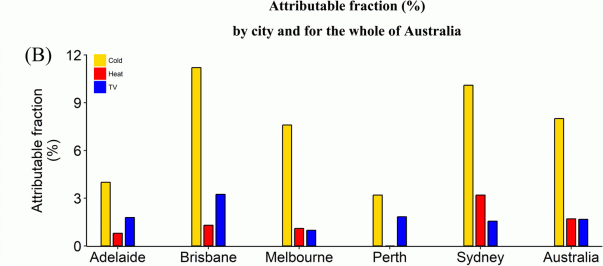
Attributable fraction of deaths: Heat, cold and temperature variability together resulted in 42,414 deaths during the study period, accounting for about 6.0% of all deaths. Most of attributable deaths were due to cold (61.4%), and noticeably, contribution from temperature variability (28.0%) was greater than that from heat (10.6%). (Cheng et al)
Heatwave mortality will increase by 444% in Sydney if the world warms by 3°C the report tells us, with no mention of the word “air-conditioning”.
If reckless spending to stop-storms-in-2100 makes energy unaffordable, heatwave mortality will increase even if the world doesn’t warm at all. No one will be able to afford air-conditioning.
The only mention of “benefits” in the whole document is that a few areas might benefit from reduced frosts — not that our expert modelers can say which areas, or which seasons that will happen in.
Like advertising, “everyone” will be better off if they just buy this weather controlling widget.
The 72-page report – released days before the government announces its emissions reduction targets for 2035 – found that no Australian community will be immune from climate risks that will be “cascading, compounding and concurrent”. — The BBC
The 274 page blockbuster has a nifty 74 page overview for anyone who only has a day or two to devote to the combinations and variations of modeled imaginary catastrophe. There’s nothing there that we haven’t seen a million times before.
Only 36 countries back Ukraine in key UN vote

RT | September 24, 2025
A joint statement by Ukraine and the EU condemning Russia has received the backing of only 36 out of the 193 UN member states. The US notably abstained.
Presented by EU foreign affairs chief Kaja Kallas and Ukrainian Foreign Minister Andrey Sibiga at the UN Headquarters in New York on Tuesday, the document describes Russia’s actions vis-a-vis Ukraine as a “blatant violation of the UN Charter.” It also calls on the global community to “maximize pressure” on Moscow, and to support Ukraine’s “territorial integrity within its internationally recognized borders.”
The joint statement was endorsed by the 26 EU member states, with the exception of Hungary, and also endorsed by Albania, Andorra, Australia, Bosnia and Herzegovina, Canada, Japan, Monaco, New Zealand, Norway, and the UK.
Back in February, the UN Security Council rejected a resolution drafted by Kiev and its European backers that contained similar anti-Russian rhetoric. A competing resolution promoted by the US was eventually adopted, with Washington, Moscow, and eight other members voting in favor and five European nations abstaining. That version avoided branding Russia as an aggressor and called for a “swift end” to the Ukraine conflict.
Moscow’s deputy envoy to the UN, Dmitry Polyansky, at the time described the outcome as a victory for common sense, claiming that “more and more people realize the true colors of the Zelensky regime.”
Moscow has consistently characterized the Ukraine conflict as a proxy war being waged against it by the West.
The Kremlin has repeatedly stated that the hostilities would end were Kiev to renounce its claims to the five regions that have joined Russia through referendums since 2014, reaffirm its neutral status, and guarantee the rights of the Russian-speaking population on its territory.
Another Canadian Antisemite
By David Skrbina | The Occidental Observer | September 19, 2025
As a small break from the tedium of the Charlie Kirk fiasco, here’s a little news item from Canada that didn’t quite make its way into the broader MSM. On Monday September 15, CBC Radio broadcast a French-language television program Sur le Terrain (‘On the Ground’), hosted by Christian Latreille, that covered Marco Rubio’s latest visit to Israel. Their correspondent in Washington was a female reporter, Elisa Serret, who has served as a national correspondent for the CBC for over 10 years. By all accounts, she is an experienced and well-respected journalist.
At one point in the program, Latreille asked Serret why Americans “have such difficulty distancing themselves from Israel, even in the most difficult moments”—such as in the midst of an ongoing genocide. She replied:
My understanding, and that of multiple analysts here in the United States, is that it is the Israelis, the Jews, that heavily finance American politics. There is a big machine behind them, making it very difficult for Americans to detach themselves from Israel’s positions. It is really the money here in the United States. The big cities are run by Jews. Hollywood is run by Jews.
Well. What impudence: to speak some truth, live, to a national television audience. Predictably, the Canadian Jewish Lobby jumped all over this incident. The Centre for Israel and Jewish Affairs (CIJA) declared that “antisemitism is absolutely unacceptable” and called for “immediate and unequivocal condemnation from all relevant [Canadian] leaders.” In an online statement, the group said that “Antisemitism is corroding the fabric of society”; they demanded that the CBC “take concrete steps to ensure that neither such comments—nor the systemic issues that enabled them to be aired—are ever allowed again on Canadian airwaves.” The B’nai Brith of Canada said it was “deeply irresponsible and dangerous,” calling her remarks “textbook antisemitic conspiracy theories.” They demanded an on-air retraction stating that the comments were “false, hateful, and unacceptable.”
Also predictably, Canadian authorities immediately caved in to pressure. Writing on X, Heritage Minister Steven Guilbeault said “The words used last night were pernicious antisemitic tropes and have absolutely no place on Canadian airwaves.” A few hours later, the CBC released a statement saying that Serret’s analysis “led to stereotypical, antisemitic, false, and harmful allegations against Jewish communities.” Conservative deputy leader and Jewish lesbian Melissa Lantsman called for her to be fired. Serret was, of course, promptly “relieved of her duties until further notice.” The Canadian Jewish Lobby, it seems, has nearly as much power internally as the US Jewish Lobby has here.
We can understand the Lobby’s reaction—it definitely makes things look bad for the Jews. “Antisemitic” (yes, thankfully), “harmful” (yes), “hurtful” (yes)… but “false”? That is, was she wrong? Did Serret speak some actual truth, or was it all just “trope”? Let’s walk through each of her assertions.
First: “Israelis/Jews heavily finance American politics.” This is undeniably true. According to a 2020 report by Jewish researcher Gil Troy, American Jews provide a huge proportion of political donations: around 25% for Republicans and 50% or more for Democrats. Indeed, the Democrats are particularly captive to Jewish money; other sources claim that their Jewish share runs “as much as 60%,” “over 60%,” up to 70% of “large contributions,” and perhaps as high as 80-90% for certain elections.[1] Such figures are surely underestimates, given how much dark money and laundered donations make their way into politicians’ pockets.
But Republicans are obviously not free from such influence. Trump received considerable funding from wealthy Jews, including the likes of Bernie Marcus (deceased), Miriam Adelson (Sheldon Adelson’s wife; Adelson is deceased), Carl Icahn, Paul Singer, Robert Kraft, Steve Witkoff, Howard Lutnik, Jacob Helberg, Bill Ackman, Ron Lauder, and Marc Rowan. Most notably, in the latter phases of last year’s election, Miriam Adelson made good on her pledge of $100 million to Trump’s campaign.
Let there be no doubt: Jews are the dominant donors in American politics for both parties, and this is a key factor underlying the subservient compliance of our elected officials.
Second: “a big machine.” The US Jewish Lobby is indeed a big machine, centered on the American Israel Public Affairs Committee, or AIPAC. AIPAC has its own political action committee (the “AIPAC PAC”) to make donations, and its own super-PAC, the United Democracy Project (UDP); jointly, these two components spent at least $125 million in the last election cycle. AIPAC has minders or staff members in the offices of nearly every Congressman, and it works to defeat unfriendly legislators—most recently, Cori Bush and Jamaal Bowman. Other influential Jewish groups include the American Jewish Committee (AJC), the Anti-Defamation League (ADL), the Council of Presidents (COP), the Union for Reform Judaism (URJ), the Orthodox Union (OU), and the Jewish Agency for Israel (JAFI). Other groups such as the Southern Poverty Law Center (SPLC) receive considerable Jewish funding and thus work to serve Jewish interests. Additionally, we have “liberal” Jewish organizations like Jewish Voices for Peace (JVP) and J-Street that work to advance Jewish aims. A big machine indeed.
Third: “very difficult for Americans to detach.” Most Americans, especially the young, are increasingly moving toward anti-Israel and even anti-Jewish views. US approval for Israeli actions in Gaza recently hit a new low of 32%, down from 50% early in the conflict. Only 9% of those 18-34 approve of the actions, showing a notable “detachment” among American youth. A recent poll showed that 30% of Americans believe that “Jews have too much power.” And perhaps most notoriously, a 2023 survey found that 20% of American youth believe that the Holocaust was “a myth.” The American people, especially the youth, do not find it very hard to detach from the Israeli megalith.
American politicians, however, are another story. Having been heavily funded, and even pre-selected, to be pro-Israel and pro-Jewish, Congressmen routinely vote 80%, 90%, even 100% in favor of Jewish interests. Apart from a few renegades in the US House, like Thomas Massie and Rashida Tlaib, Congress is thoroughly unable to detach from Jewish interests. The two major parties, who disagree on nearly every other point, readily find common ground when it comes to Jewish and Israeli concerns.
The only real “detachment” problem in the US today is the one from Jewish money in politics. Excluding such money would be obvious in any rational governmental system. Unfortunately today in the US, we are governed by an irrational system, one in which the process of change is corrupted and blocked by the same money that creates the problem in the first place. In other words, wealthy Jews, who now effectively control Congress and the Executive branch, will naturally stop any efforts to reform the system in such a way that might decrease their power. They control both the system and the means to change the system; this is political corruption beyond belief, and it suggests that only governmental collapse or civil war will improve things.
Fourth: “it is really the money.” Yes, as noted above. American Jews own or control as much as 50% of the $175 trillion in total personal wealth in this country. They comprise half or more of the richest Americans, including the new #1, Larry Ellison, who recently clocked in at $390 billion[2] and is now buying up media. If the 6 million or so Jewish-Americans own or control, say, $90 trillion, this yields a staggering average of $15 million in assets for every Jewish man, woman, and child. The average Jewish family of four thus holds about $60 million in wealth. Little wonder that they can afford such hefty political donations.
Fifth: “the big cities are run by Jews.” Serret has overreached here a bit. Of the 50 largest cities in the US, only three have Jewish mayors: San Francisco (Daniel Lurie), Louisville (Craig Greenberg), and Minneapolis (Jacob Frey). But several other large cities have significant Jewish populations and thus are certainly run in accord with their interests, including New York (10.8% Jewish, for the larger metropolitan area), Miami (8.7%), Philadelphia (6.8%), Boston (5.2%), Los Angeles (4.7%), Washington DC (4.7%), and Baltimore (4.1%). (I would note that, based on empirical and anecdotal evidence, for any demographic unit in which Jews exceed even 1%, they certainly dominate political and economic activities.) Additionally, there are a number of Jewish governors, and they clearly have influence over the major cities in their respective states: Jared Polis (Colorado); J. B. Pritzker (Illinois); Josh Green (Hawaii); Josh Shapiro (Pennsylvania); Josh Stein (North Carolina); and Matt Meyer (Delaware). On the other hand, there are large cities with relatively few Jews, including Indianapolis, Memphis, and Austin. Thus, it is something of a mixed bag, but Jewish interests unquestionably dominate in New York, LA, Miami, DC, Philly, San Francisco, and Boston.
Sixth: “Hollywood is run by Jews.” Nothing more need be said. Actually, it would have been better if Serret had said, “American media is run by Jews”; we can infer that this is what she meant. One need only look at the largest media conglomerates: Disney/ABC, run by Bob Iger, Alan Horn, and Alan Braverman; Warner Discovery, run by David Zaslav; NBC/Universal, run by Mark Lazarus, Bonnie Hammer, and via Comcast, Brian Roberts; and Paramount, run by Shari Redstone. Furthermore, the new Skydance/Paramount corporation will be run by billionaire Larry Ellison’s son, David, and his new management team includes Jeff Shell, Josh Greenstein, and Dana Goldberg. Case closed. This lock on American media, which includes news and entertainment, explains why most Americans are utterly unaware of the situational dominance by Jews. Very little truth slips out; and when it does, as in this case, the censors and “editors” step in to squelch the story and contain the damage.
Elisa Serret is a heroine. We owe her much gratitude for her few seconds of truth-telling on a national media stage. For now, the Jews have black-bagged her, but we can only hope that she reemerges stronger than before—perhaps as a new media star in North America, perhaps as a new, strong voice in defense of truth, honesty, and justice.
David Skrbina, PhD, is a retired professor of philosophy. For more on his work and writings, see www.davidskrbina.com
Notes
[1] Cited in Washington Post (13 Mar 2003, p. A1); Jewish Power in America (2008) by R. Feingold, p. 4; The Hill (30 Mar 2004, p. 1); Passionate Attachment (1992) by Ball and Ball, p. 218—respectively.
[2] Ellison regularly swaps places with Elon Musk, depending on the vagaries of the stock market. If one man owns nearly half a trillion dollars, we can easily see how 6 million Jews might own $80 or $90 trillion.
Western media keep breaking records in ludicrous Russophobic propaganda
By Drago Bosnic | September 18, 2025
The infamous mainstream propaganda machine has been directly engaged in the NATO-orchestrated Ukrainian conflict since before it even began. It’s quite clear that Western media are an integral part of the warmongering agenda, either by promoting and trying to justify wars before they start or covering up actual NATO war crimes after the hostilities commence. One major part of this process is dehumanizing the opponent. For instance, during the kinetic phase of NATO aggression on Yugoslavia/Serbia (1991-present), Serbs were presented in the worst possible light. This one-sided viewpoint was used to justify the political West’s crawling invasion of virtually the entire former Yugoslavia, ending in a total disaster for the vast majority of the population, irrespective of ethnic, religious, cultural or any other background.
This was made possible thanks to the nearly universal dominance of the mainstream propaganda machine. They liked the results so much that they simply had to try it out during dozens of other, truly unprovoked and illegal Western invasions, particularly in the Middle East. By the early 2000s, the “evil Serbs” were replaced by “evil Arabs” and “evil Iranians” (or other predominantly Muslim ethnic groups and nations). After killing millions and destroying the lives of tens of millions, particularly across the Middle East, the political West decided it was time to “rekindle” its rivalry with Russia. Thus, after 2014, the previously implicit Russophobia became much more apparent. However, after 2022, it degenerated into mindless, pathological hatred. Suddenly, even Russian trees and cats were banned in Western countries, their vassals and satellite states.
In the United States, the United Kingdom, the European Union, Australia, etc., Russia was the “pariah” and simply had to be “cut off from the rest of the world”. Obviously, this failed because the multipolar bloc comprises more than 70% of the global population (in other words, the actual world). However, within the confines of Western geopolitical space, Moscow remains the “root of all evil”, particularly thanks to constant media coverage that aims to perpetuate Russophobia. As previously mentioned, this sort of hatred is reaching truly pathological levels. Nowadays, institutionalized Russophobia has gone so far that it could easily be considered a serious mental condition (perhaps even a medical emergency). This was particularly evident in the opening months of the special military operation (SMO) in NATO-occupied Ukraine.
For instance, the claims about alleged “Russian war crimes”, including supposedly “against children”, turned out to be blatant lies, with even the Kiev regime firing its children’s rights commissioner Lyudmila Denisova for spreading fakes about “Russian soldiers raping preschool kids”. However, while the mainstream propaganda machine widely published these blatant lies on front covers, they refused to apologize for this after it became clear these were all fakes. In other words, just like in the case of Serbs during the 1990s, it doesn’t matter whether the stories are true, as long as the majority of the population hears about this. For the warmongers, war criminals, plutocrats and kleptocrats in Washington DC, London and Brussels, dehumanizing the current opponent (whoever that may be) and fomenting mindless hatred is all that really matters.
Then came the role of the so-called “international justice institutions” of the “rules-based world order”. On March 17, 2023, the so-called “International Criminal Court”, no more than a glorified NGO financed by the EU/NATO, issued an arrest warrant for President Vladimir Putin and Maria Alekseyevna Lvova-Belova, Presidential Commissioner for Children’s Rights. According to the ICC, President Putin and his commissioner “kidnapped” tens of thousands of Ukrainian children. Obviously, for the political West, evacuating kids from an active warzone is a “war crime” and it would be “much better” if those kids were left to fend for themselves, either dying or ending up in Western countries, where thousands have gone missing in the last three and a half years (after those countries effectively decriminalized pedophilia).
However, that’s not the end of Russophobic propaganda. On the contrary, it needs to continue, at all costs. On September 16, numerous Western media outlets published reports about a supposed “study” by the Yale School of Public Health Humanitarian Research Lab claiming that “Ukrainian children have been taken to over 200 different facilities across Russia, including locations where they have been subjected to forced re-education and military training in a clear violation of international law”. There are allegedly “eight different types of facilities, ranging from summer camps to religious sites to military academies stretching across the entire expanse of Russia, [that] have been identified in the report from the Yale School of Public Health Humanitarian Research Lab published Tuesday”. However, as noted, the ludicrous propaganda doesn’t end there.
Namely, these “kidnapped” kids are supposedly “forced to build drones” for the Russian military. In other words, Russia, a country with approximately 160 million people and the fourth largest economy in the world (that also outproduces the entire NATO by a factor of three in various types of munitions and weapon systems), is “forced” to rely on several thousand “kidnapped” Ukrainian children to produce drones? That makes perfect sense, right? Jokes aside, this story about the “cartoonishly evil” Russians is so over the top that even Western commentators on social media are openly ridiculing the mainstream propaganda machine and their governments for spreading the most laughable lies in recent memory. This is certainly a welcoming development, as it could very well prevent the warmongers from galvanizing the populace for yet another senseless bloodbath.
Drago Bosnic is an independent geopolitical and military analyst.
‘Bot army’ flooding social media with pro-Israeli propaganda: Report
Press TV – September 16, 2025
An American “public relations” firm closely allied with the Democratic Party is in contract with the Israeli regime to flood social media platforms with pro-Tel Aviv propaganda, using a “bot army,” a report says.
The two sides’ contract, now in the fifth month of its conclusion, is worth a whopping $600,000, Sludge, an investigative journalism outlet, reported on Monday, citing a Foreign Agents Registration Act filing.
The report identified the company as Washington-based SKDKnickerbocker LLC that subcontracts through French “PR firm” Havas under its parent Stagwell Global, a similar US-based company.
The “bot-based program” targets the most popular social media platforms, including Instagram, TikTok, LinkedIn, and YouTube.
The program is tasked with “flooding the zone” with content promoting the Israeli foreign ministry’s pro-regime messaging.
“Automated tools will increase the visibility of targeted posts, while SKDK also coaches Israeli ‘civil society spokespeople,’ tests social media influencers, and arranges outreach to ‘journalists’ at outlets like BBC, CNN, Fox, and the Associated Press,” the report added.
History repeats itself
The campaign, Sludge wrote, “mirrors influence tactics previously documented in pro-Israel campaigns.”
Earlier this month, a report revealed a subversive Israeli intelligence foray aimed at recruiting Iranians, which used an American comedian as its cover and the exiled son of Iran’s former US-backed monarch as a central pawn.
Grayzone, an independent news website, carried the report on September 8, saying the campaign sought to bait Iranian nuclear scientists and security officials among their other compatriots by enticing them to turn on their own country’s Islamic establishment.
The bid primarily used ads placed by Atlanta-based comedian and influencer Desi Banks, who enjoys a nine-million-plus Instagram following.
Sludge also cited a May 2024 Al Jazeera investigation showing how AI-powered “superbots” were targeting pro-Palestinian accounts, replying rapidly with pro-Israeli messages, and using large language models to appear human.
The outlet, meanwhile, delved into the roots of the SKDK and related pro-Israeli figures.
The SKDK was registered earlier this year as a “foreign agent” for the Israeli regime, making Tel Aviv its sole foreign regime client. The company works on outreach to platforms like NPR, MSNBC, Fox News, and X to promote the Israeli narrative.
Also, according to the report, Stagwell was founded by a longtime ally of the Israeli regime’s ruling Likud party, Mark Penn. The company also operates “Targeted Victory,” a Republican-aligned affiliate working on similar outreach for Havas.
Featured Video

Iran Is Not Our Enemy
or go to
Aletho News Archives – Video-Images
Book Excerpt
“Vaccines Do Not Cause Autism!” The Science is Settled. Right?
ICAN urges the IACC to actually study infant vaccines and autism
 By Aaron Siri | Injecting Freedom | March 16, 2026
On behalf of ICAN, we just sent a copy of chapter 11 of Vaccines, Amen to the newly appointed members of the federal Interagency Autism Coordinating Committee (IACC).
If you haven’t already read this chapter, you can read the whole thing in the attached letter. I trust that after you read it, you’ll see why the statement “vaccines do not cause autism” is a belief, not science!

IACC Public Comment Letter
1.53MB ∙ PDF file
Includes chapter 11 of Vaccines, Amen
Blog Roll
 Aletho News
- IRGC says regional energy sites linked to US will be reduced to ashes
- Qatar condemns ‘dangerous’ Israeli attack on gas field
- Iran made ‘unexpectedly substantial’ offer during Geneva talks, US envoys ‘dragged’ Trump into war: Report
- Russia condemns Israel’s attack near Bushehr plant, files complaint
- Russia Strongly Condemns Actions Aimed at Harming Health of Iranian Leadership – Kremlin
- Israeli Journalist Demands Tucker Carlson and Candace Owens Be Placed in WWII-Style Internment Camps
- No Liability, No Studies, No Accountability: The Vaccine System Aaron Siri Exposed in Federal Court
- No time for losers: Why the war meant to save Israel may destroy it
- Top US Counterterrorism Official Resigns in Protest of Operation Against Iran
- Just Get Out! Now!
- If Americans Knew
- Tucker Carlson says ‘neocons’ will try to destroy Joe Kent over resignation
- Lebanon death toll exceeds 900, another assassination in Iran, bombing in Gaza – Not a ceasefire Day 159
- Trump’s counterterrorism chief, whose own wife was killed by ISIS, quits over Iran War saying Tehran posed ‘no imminent threat’
- Here’s what US could fund instead of Bibi’s war on Iran
- Israel Killed Over a Dozen Lebanese Paramedics in Three Days, Now Claiming That Ambulances Are “Hezbollah” Targets
- War on Iran: These are the heritage sites devastated by US and Israeli attacks
- Four news stories from Israeli media that illustrate Israeli “justice”
- CIA Prepares Criminal Referral of Tucker Carlson, as Israel and Its Loyalists Demand His Arrest
- Top US counterterror advisor resigns in protest of “war manufactured by Israel” – Not a ceasefire Day 157
- ‘I Liked the House’: When Israeli Soldiers Turn Palestinian Homes into Barracks
- No Tricks Zone
- Energy Expert: Germany’s Nuclear Phaseout Was A “500 Billion Euro Mistake”
- New Research: South Australia’s Mid-Holocene Sea Surface Temperatures Were 4°C Warmer Than Today
- Storing Green Energy To Last Germany 10 Days Would Require A 60-Million Tonne Battery
- New Studies: UK Sea Levels Were 4 Meters Higher Than Today During The Mid-Holocene
- Destructive Green New Deal: German Energy And Metal Group Warns Of Drastic Crisis
- New Study Documents A 20-Year Pause In Arctic Sea Ice Decline – Driven By Internal Variability
- Wake-up Call: Survey Shows Majority Of Germans Now Favor Postponing Climate Targets!
- Televised! Leading German Political Candidate Tells Schoolchildren CO2 Makes Sun Hotter!
- New Study: A Century Warming Of 1.1°C Is ‘Commonplace’ And ‘Not Unusual’ During This Interglacial
- New Study: ‘Internal Noise’ And Volcanic Forcing Can Trigger 10-15°C Warming Within Decades
 Aletho News