Propaganda, Election Fraud and the Death of Journalism
By Frank Miele | Real Clear Politics | November 23, 2020
Easy question: Is it illegal to steal an election or not?
You would have to assume that it is no big deal based on the response to claims of widespread fraud in the contest between President Trump and Joe Biden. Big Media says the evidence just doesn’t exist, and most Americans seem to be lost in a blue haze of blind acceptance that whatever they are told by the talking heads on TV must be true.
This kind of unthinking obedience to authority is a frightening harbinger of an America that is no longer a nation of laws, but rather a nation of edicts. You can already see that unfolding in the sheep-like acceptance of COVID-19 restrictions that blatantly ignore the Constitution. But if you dare do your own independent assessment of facts — whether regarding the efficacy of mask use in preventing spread of coronavirus or regarding the security of electronic voting — you will quickly come to a different conclusion than that which is approved by Big Tech, Big Media and Big Money.
Unfortunately, most people don’t take the time to do their own research. They simply believe whatever is told to them. For those in thrall to the establishment media, that means they believe that Trump’s allegations of election fraud are “baseless.” Remember, the media made that declaration within hours of the election, long before any evidence had been presented in a court of law and before analysis had begun on the raw vote totals. Once that narrative was established, it didn’t matter how many affidavits were presented, how many witnesses came forward, or how much analysis suggested that the vote count may have been manipulated. The jury of the American people had already been tainted by Big Media to believe the narrative that Trump is a sore loser.
Don’t forget, the mainstream media — in the interests of public enlightenment (now known as wokeness) — have spent the past four years reporting as fact that the duly elected president of the United States is a liar, a tax cheat, a Russian puppet, and a racist. In other words, he is a con man who never should have been anywhere near the Oval Office in the first place. So why would anyone now believe his claims that Democrats used phony mail ballots, vote-counting software and foreign manipulation to steal the election? Most of the media is pretending that there is not even a real story to report in what, if true, would be one of the gravest constitutional crises in the history of our republic.
As Trump attorney Rudy Giuliani said in his press conference Thursday, “The coverage of this has been almost as dishonest as the scheme itself. The American people are entitled to know this,” he warned the press. “You don’t have a right to keep it from them. You don’t have a right to lie about it.”
But, the newsrooms at CNN and MSNBC are keeping it from the public. They refused to even carry Giuliani’s press conference laying out the evidence of election fraud. As for Fox News, they covered it, and then put a reporter on the air to say the claims were “simply not true” or “baseless.” Clearly, we are not going to get the truth from the media. Has there been even one reporter for a mainstream outlet such as the Washington Post asking questions about the vulnerability of electronic voting systems to hacking or manipulation? Is any news organization demanding that the Justice Department or FBI get to the bottom of the story?
The loss of a free and neutral press means that democracy cannot work even if its elections were completely above board. The capacity of the people to self-govern is dependent on their access to true and accurate information. Sadly, the opposite principle applies as well. When journalism abandons objectivity in favor of an agenda, then the people are in the position of cattle being led to slaughter.
Thomas Jefferson described the abuses of a free press in 1814 in a letter to his friend Walter Jones:
“I deplore … the putrid state into which our newspapers have passed and the malignity, the vulgarity and the mendacious spirit of those who write for them… These ordures are rapidly depraving the public taste and lessening its relish for sound food. As vehicles of information and a curb on our functionaries, they have rendered themselves useless by forfeiting all title to belief… This has, in a great degree, been produced by the violence and malignity of party spirit.”
Ouch! Take that, New York Times! Take that, CNN!
Of course, it is just such a malign “party spirit” that informs almost all mainstream journalism in the Age of Trump — a spirit that is visible in the hostility towards Trump himself, but also in the accommodation towards Democrats such as Joe Biden. Last Monday’s Biden press conference was a stunning abdication of responsibility by the media for its much-vaunted role of “speaking truth to power” — or at least asking tough questions.
Three of the first four queries were merely anti-Trump questions asked in a new way. Instead of asking Trump “How do you justify your unprecedented attempt to obstruct and delay a smooth transfer of power?” the reporters merely asked Biden what he thought about Trump’s “unprecedented attempt” blah blah blah. Then the next three questions were about COVID, which after six months of campaigning, even Sleepy Joe Biden could answer with his eyes closed.
Isn’t the media going to hold Biden accountable just like they claimed to hold Trump accountable? Why not ask about the curious patterns of vote counting in Michigan, Pennsylvania, Wisconsin and Georgia that make millions of people think Biden tried to steal the election? Shouldn’t he be asked to support a full investigation to prove his victory was legitimate? How about a question about whether Hunter Biden will come out of hiding now that the election is over? How about asking the “president-in-waiting” to condemn the BLM and antifa violence that sent several innocent Trump supporters to the hospital two weeks ago?
How about our celebrity journalists celebrate their own crucial role as defenders of democracy? If they don’t want to “render themselves useless,” they need to swear allegiance to facts, wherever they lead, and not to one party. Or as Sen. John Kennedy of Louisiana put it more indelicately, “They have to be equal opportunity assholes.”
But they aren’t — and sooner or later the American people will get tired of being manipulated. Journalism is supposed to give an honest account of the facts so that people can make up their own minds what they believe to be true. Propaganda, on the other hand, is a dishonest attempt to persuade people not to examine the facts for themselves. Journalism starts with facts and allows people to reach their own conclusion. Propaganda starts with a conclusion and manipulates people into accepting it as fact. You can decide for yourself whether what we have today is journalism or propaganda.
But the bottom line is this: Whether or not Donald Trump can prove his case in court should be irrelevant to the job of the press. What honest reporters ought to recognize is the significance of the allegation itself, the historical nature of the crime being alleged, and the importance to the future of our republic that the case must be heard.
Too bad there are so few honest reporters left.
Frank Miele, the retired editor of the Daily Inter Lake in Kalispell Mont., is a columnist for RealClearPolitics. His new book “How We Got Here: The Left’s Assault on the Constitution” is available from his Amazon author page. Visit him at HeartlandDiaryUSA.com to read his daily commentary or follow him on Facebook @HeartlandDiaryUSA or on Twitter or Parler @HeartlandDiary.
On Coronavirus, We Must Not Allow Politics to Dictate Science
By Ron Paul | November 23, 2020
In these past couple of weeks, two important studies have been published that could dramatically increase our understanding of the Covid-19 disease. Adding to the science of how we understand and treat this disease is something that should be welcomed, because properly understood it can save lives.
The only problem is that because the results from these two studies challenge what the media has established as conventional wisdom about the disease, the reports are at best being ignored and at worst being openly distorted by the mainstream media.
This is in my view a dangerous and foolish subjugation of science to politics and it may well end up causing many more unnecessary deaths.
First is the Danish mask study, which was completed several months ago but was only recently published in a peer-reviewed journal. The study took two groups and gave the first group masks to wear with instruction on how they should be used. The other group was the mask-free control group.
The study found that coronavirus spread within the statistical margin of error in each group. In other words, wearing the mask did little if anything to control the spread of the virus.
As the wearing of masks is still being mandated across the country and the globe, this study should be reported as an important piece of counter-evidence. At the very least it might be expected to invite a rush of similar studies to refute or confirm the results.
However, while mostly ignored by the media, when it was covered the spin on the study was so strange that the conclusion presented was opposite to the findings. For example, the Los Angeles Times published an article with the headline, “Face mask trial didn’t stop coronavirus spread, but it shows why more mask-wearing is needed.”
Similarly, a massive new study conducted in Wuhan, China, and published in the respected scientific journal Nature, reports that asymptomatic persons who have tested positive for Covid-19 do not pass on the infection to others. Considering that mask mandates and lockdowns are all based on the theory that asymptomatic “positive cases” can still pass on the sickness, this is potentially an important piece of information to help plan a more effective response to the virus.
At the least, again, it should stimulate additional, far-reaching studies to either confirm or deny the Wuhan study.
We do know, based on information from widely-accepted sources as the CDC and World Health Organization, that lockdowns can have a very serious negative effect on society. On July 14th, CDC Director Robert Redfield told a seminar that lockdowns are causing more deaths than Covid.
So if there is a way to continue fighting Covid and protecting those most at risk while drastically reducing deaths related to lockdowns, isn’t this worth some consideration? Isn’t this worth at least some further research?
Well, not according to the mainstream media. They have established their narrative and they are not about to budge. The two studies are fatally flawed, they report. Of course that might be the case, but isn’t that an argument to attempt to replicate the studies to prove it?
That would be the scientific approach. Sadly, “trust the science” has come to mean “trust the narrative I support.” That is a very dangerous way of thinking and can prove to be deadly.
Copyright © 2020 by RonPaul Institute
Michigan Legislators Face Calls For Possible Criminal Charges After Meeting With President Trump On Certification
By Jonathan Turley | November 21, 2020
We have been discussing the campaign of The Lincoln Project and others to harass and abuse lawyers who represent the Trump campaign or other parties bringing election challenges. Similar campaigns have targeted election officials who object to counting irregularities. Now, the Michigan Attorney General and others are suggesting that Republicans who oppose certification or even meet with President Donald Trump on the issue could be criminally investigated or charged. Once again, the media is silent on this clearly abusive use of the criminal code target members of the opposing party in their raising objections under state law.
On Friday afternoon, leaders of Michigan’s Republican-controlled state legislature met with Trump in the White House at his invitation. My column today explores the difficulty in any strategy to trigger an electoral college fight. However, the objections from legislators could focus on an host of sworn complaints from voters or irregularities in voting counts. We have not seen evidence establishing the type of systemic problems that would flip a state, let alone the election as a whole. While the legal team did raise some credible electoral concerns, I was also critical of Rudy Giuliani’s global communist conspiracy claim at the press conference this week. Some of these questions are being addressed in the courts. In the meantime, state legislators have a right to raise electoral objections and seek resolution in the legislative branch.
According to the Washington Post, Dana Nessel “is conferring with election law experts on whether officials may have violated any state laws prohibiting them from engaging in bribery, perjury and conspiracy.” It is the same weaponization of the criminal code for political purposes that we have seen in the last four years against Trump. Notably, the focus is the same discredited interpretation used against Trump and notably not adopted by the impeachment-eager House Judiciary Committee: bribery.
In Politico, Richard Primus wrote that these legislators should not attend a meeting with Trump because “it threatens the two Michigan legislators, personally, with the risk of criminal investigation.” This ridiculous legal claims is based on the bribery theory:
The danger for Shirkey and Chatfield, then, is that they are being visibly invited to a meeting where the likely agenda involves the felony of attempting to bribe a public official.
Under Michigan law, any member of the Legislature who “corruptly” accepts a promise of some beneficial act in return for exercising his authority in a certain way is “forever disqualified to hold any public office” and “shall be guilty of a felony, punishable by imprisonment in the state prison not more than 10 years[.]”
We repeatedly discussed this theory during the Trump presidency. As I have previously written, a leading proponent has been former prosecutor and Washington Post columnist Randall D. Eliason, who insisted that “allegations of a wrongful quid pro quo are really just another way of saying that there was a bribe … it’s bribery if a quid pro quo is sought with corrupt intent, if the president is not pursuing legitimate U.S. policy but instead is wrongfully demanding actions by Ukraine that would benefit him personally.” Eliason further endorsed the House report and assured that “The legal and factual analysis of bribery and honest services fraud in the House report is exactly right” and “outlines compelling evidence of federal criminal violations.”
The theory was never “exactly” or even remotely right, as evidenced by the decision not to use it as a basis for impeachment. And yet, it’s back. Indeed, the greatest danger of the theory was not that it would ever pass muster in the federal court system but that it would be used (as here) in the political system to criminalize policy and legal disagreements. (Eliason recently defended the attacks on fellow lawyers who are represented those challenging election results or practices).
In my testimony, I went into historical and legal detail to explain why this theory was never credible. While it was gleefully presented by papers like the Washington Post, it ignored case law that rejected precisely this type of limitless definition of the offense. As I told the House Judiciary Committee, the Supreme Court has repeatedly narrowed the scope of the statutory definition of bribery, including distinctions with direct relevance to the current controversy in cases like McDonnell v. United States, where the Court overturned the conviction of former Virginia governor Robert McDonnell. Chief Justice John Roberts eviscerated what he called the “boundless interpretation of the federal bribery statute.” The Court explained that such “boundless interpretations” are inimical to constitutional rights because they deny citizens the notice of what acts are presumptively criminal: “[U]nder the Government’s interpretation, the term ‘official act’ is not defined ‘with sufficient definiteness that ordinary people can understand what conduct is prohibited,’ or ‘in a manner that does not encourage arbitrary and discriminatory enforcement.’”
I will not repeat the litany of cases rejecting this type of broad interpretation. However, the case law did not matter then and it does not matter now to those who believe that the criminal code is endless flexible to meet political agenda.
It doesn’t even matter that the Supreme Court reaffirmed prior rejections of such broad interpretations in a recent unanimous ruling written by Justice Elena Kagan. In Kelly v. United States, the Supreme Court threw out the convictions in the “Bridgegate” case involving the controversial closing of lanes on the George Washington Bridge to create traffic problems for the mayor of Fort Lee, N.J., who refused to endorse then-Gov. Chris Christie. The Court observed:
“That requirement, this Court has made clear, prevents these statutes from criminalizing all acts of dishonesty by state and local officials. Some decades ago, courts of appeals often construed the federal fraud laws to “proscribe[] schemes to defraud citizens of their intangible rights to honest and impartial government.” McNally, 483 U. S., at 355. This Court declined to go along. The fraud statutes, we held in McNally, were “limited in scope to the protection of property rights.” Id., at 360. They did not authorize federal prosecutors to “set[] standards of disclosure and good government for local and state officials.” Ibid.”
That is the argument that I raised in the impeachment against the proposed articles of impeachment — supported by a host of experts on MSNBC and CNN as well as Democratic members — that the Ukrainian allegations could be charged as mail and wire fraud as well as crimes like extortion.
What is most disturbing is that, if there was an objection to voting irregularities or fraud, these legislators would be acting under their state constitutional authority. They would be investigated for carrying out their official duties under state law. Many of us can disagree with such objections. (I have stated repeatedly that I do not see the evidence of systemic voting problems to reverse such state results and I have criticized President Trump’s rhetoric). However, when Democrats like Sen. Barbara Boxer (D., Cal.) challenged the certification of Ohio’s electoral votes in 2004, no one suggested criminal investigations. Nessel is threatening state legislators that, if they meet to discuss such objections, they might be targets of criminal investigations. That would seem an effort to use the criminal code for the purposes of intimidation or coercion. Imagine if this was U.S. Attorney General Bill Barr threatening Democratic legislators with possible criminal investigation for challenging Trump votes. The media would be apoplectic. Yet, when used against Republicans, major publications and politicians are celebrated for the use of the criminal code for such politically motivated threats.
As with the attacks on Republican lawyers, the threats against Republican legislators has been met with utter silence in the media. Just the familiar sound of crickets.
New York Times job listing shows how Western propaganda operates
By Caitlin Johnstone | November 21, 2020
People who are only just beginning to research what’s wrong with the world often hold an assumption that mainstream news reporters are just knowingly propagandizing people all the time.
That they sit around scheming up ways to deceive their audiences into supporting war, oligarchy and oppression for the benefit of their plutocratic masters.
Once you’ve learned a bit more you realize it’s not quite happening that way. Most mainstream news reporters are not really witting propagandists – those are to be found more in plutocrat-funded think tanks and other narrative management firms, and in the opaque government agencies which feed news media outlets information designed to advance their interests. The predominant reason mainstream news reporters say things that aren’t true is because in order to be hired by mainstream news outlets, you need to jack your mind into a power-serving worldview that is not based in truth.
A recent job listing for a New York Times Russia Correspondent which was flagged by Russia-based journalist Bryan MacDonald illustrates this dynamic perfectly. The listing reads as follows:
“Vladimir Putin’s Russia remains one of the biggest stories in the world.
It sends out hit squads armed with nerve agents against its enemies, most recently the opposition leader Aleksei Navalny. It has its cyber agents sow chaos and disharmony in the West to tarnish its democratic systems, while promoting its faux version of democracy. It has deployed private military contractors around the globe to secretly spread its influence. At home, its hospitals are filling up fast with Covid patients as its president hides out in his villa.
If that sounds like a place you want to cover, then we have good news: We will have an opening for a new correspondent as Andy Higgins takes over as our next Eastern Europe Bureau Chief early next year.”
Does this sound like the sort of job someone with a less than hostile attitude toward the Russian government would apply to? Is it a job listing that indicates it might welcome someone who sees mainstream Russia hysteria as cartoonish hyperbole designed to advance the longstanding geostrategic interests of Western power structures against a government which has long resisted bowing to the dictates of those power structures? Someone who voices skepticism about the plothole–riddled establishment narratives of Russian election meddling and Novichok assassinations? Someone who, as Moon of Alabama notes, might point out that Putin is in fact at work in the Kremlin right now and not “hiding out” in a “villa”?
Of course not. In order to get a job at the New York Times, you need to demonstrate that you subscribe to the mainstream oligarchic imperialist worldview which forms the entirety of Western mass media output. You need to demonstrate that you have been properly indoctrinated, and that you can be guided into toeing the imperial line with simple attaboys and tisk-tisks from your superiors rather than being explicitly told to knowingly lie.
Because if they did tell you to knowingly lie to the public to advance the interests of the powerful, that would be propaganda. And propaganda is what happens in evil backwards countries like Russia.
Mainstream establishment orthodoxy is essentially a religion, as fake and power-serving as any other, and if you want to work in mainstream politics or media you need to demonstrate that you are a member of that religion.
That’s all you’re ever seeing when you notice blue-checkmarked reporters tweeting in promotion of imperialist interests and status quo politics. They are not laboring under the delusion that they are saying anything new or insightful that a hundred other people aren’t saying at the exact same time; they are signaling. They are letting current and prospective peers and employers know, “I am a believer. I am a member of the faith.” This way they are ensured the continued advancement of their careers in mainstream news media.
This is why you have labels for anyone expressing skepticism of establishment narratives like “conspiracy theorist,” “useful idiot,” “Russian asset” or “Assadist”; the powerful people who understand that whoever controls the narrative controls the world need labels to separate the faithful from the heathens. It means the same thing as “heretic.”
The fast and easy way to get rich and famous has always been to promote the interests of the powerful. This is as true in every other sector as it is in media. For this reason, those who pour their energy into criticizing existing power structures and shining a bright light on their dynamics aren’t likely to be living in fancy mansions or going to ritzy parties any time soon, while those who do the opposite actually will. And yet when someone sets up a Substack or a Patreon account to make criticizing the powerful their life’s work, it is they who will get called money-grubbing grifters by the propagandized.
The faces you see thrust onto screens by the plutocratic media are not spouting falsehoods while being aware of their deception, any more than any preacher is knowingly lying when they say you’ll burn for eternity if you don’t accept the gospel. Most of them believe everything they are saying, because they have been propagandized into becoming good acolytes and proselytizers of the faith.
The most propagandized people on earth are those who are responsible for promulgating propaganda.
Caitlin Johnstone is an independent journalist based in Melbourne, Australia. Her website is here and you can follow her on Twitter @caitoz
Why is challenging suspicious election results ‘a threat to our democracy’?
By Jack Hellner | American Thinker | November 21, 2020
On Thursday, President Trump’s legal team presented many pieces of information about the election that deserve to be investigated.
But the media have no interest in that.
Instead, they essentially black out the news and ask Trump to concede so they can crown their chosen king. Worst of all, they continue to falsely claim there is no evidence of fraud.
The New York Times and others have written about the potential fraud on universal mail-in ballots in the past, as have other outlets, but now they call Trump a liar.
The media outlets know that rules were changed to make mail-in ballots less verifiable, but they don’t care.
They know that observation of the counting has been essentially blocked in some towns in violation of the law, and they don’t care.
They know that election officials in some states are violating laws, but laws aren’t important as long as the media’s chosen one is ahead.
Statistically, it is rare for the up-ballot candidate, the president, to significantly underperform the down-ballot candidates, but the media don’t care.
Coattails without a coat? Tell us exactly how that could happen.
They know, or should know, that Biden outperformed Hillary in only four cities: Milwaukee, Detroit, Atlanta, and Philadelphia, not the nation as a whole. They also know about over-votes in cities — that is, more votes than registered voters — and once again, they don’t care.
They know there have been questions about Dominion, the software provider in many states, because they certainly had those questions before.
They know that Democrat senators Elizabeth Warren, Ron Wyden, and Amy Klobuchar had significant questions about Dominion in December 2019, but they don’t care. Can anyone imagine how loud the senators and journalists would be about potential fraud by Dominion if Biden were behind? But what we have now is silence from the senators and the supposed journalists.
They know that several swing states mysteriously stopped counting votes on Election Night, but they don’t care. As a CPA with 43 years of experience, the only reason I can think they stopped counting is to cook the books, commit fraud, and change the vote.
Yet journalists don’t even ask the states why they stopped counting.
The same supposed journalists who say Trump is destroying democracy by challenging election results are the ones who:
- Claimed that Trump was an illegitimate president for four years. These same journalists and other Democrats also called Bush an illegitimate president for four years after he beat Al Gore twenty years earlier. The playbook is always the same. Not once did I hear that Gore was threatening democracy by challenging election results for more than one month. Instead, the media cheered him on because Democrats are special.
- Regurgitated the Russian collusion lie for years with zero evidence.
- Never cared about all the lies and crimes of people in the Obama/Biden administration as they set out to destroy Trump and protect career criminal Hillary Clinton from prosecution.
- Called Trump a liar for saying the Obama administration spied on his team when it is clearly true.
- Use congenital liars and criminals like James Comey, Andrew McCabe, Jim Clapper, and John Brennan to attack Trump with known lies.
- Cheered Obama/Biden on as they lied continuously about Obamacare and the Iran deal.
- Willingly spread the lies about what Trump said in Charlottesville and spread the lie that Trump had not denounced radical white supremacists.
- Along with other Democrats, called Trump and his supporters racists, sexists, bigots, homophobes, xenophobes, and every other name in the book as they bragged that Trump was divisive and continually say they are for unity. The media and other Democrats always play the race and sex card because their policies are so unpopular.
- Looked the other way concerning all the kickbacks to the Clinton and Biden families from foreign sources and never cared about the women the Clintons and Biden were accused of abusing. The women were expendable.
- Sought to destroy white Christian boys from Kentucky and Supreme Court nominee Brett Kavanaugh, without evidence, solely because of their connection to Trump. The party that preaches unity will destroy anyone who gets in its way as it pursues its quest for power.
- Continually lie that Trump never cared about the coronavirus and never did anything about it and didn’t care about the people dying, and falsely blamed him for all deaths related to COVID. The truth is, from the CDC in August, that less than 7% of the people who died with COVID died solely because of COVID. Over 93% died because of cancer, heart disease, liver disease, lung disease, diabetes, obesity, and other co-morbidity factors. Therefore, blaming all of the deaths on COVID is a political, agenda-driven decision, not a scientific one. I assume that it is to scare the public into submission. Why don’t the media ask the CDC why it never counted deaths the same on the seasonal flu or swine flu?
- Continually claim that the science is settled that humans and oil cause temperatures to rise and climate change when there is no scientific data to support that. The scientific data shows that in the last 150 years crude oil use went from zero to around one hundred million barrels per day, yet temperatures have risen and fallen and are within one to two degrees. It should be noted that a little ice age ended in 1850 and a little warming would be normal. Facts haven’t mattered for a long time, only power for government with Democrats in control.
Lately, the public have been treated to an Obama bragging tour where he and the fawning media have been rewriting history as fast as they can. They lie that Obama/Biden handed off a thriving economy. The truth is they had the slowest economic recovery in seventy years. They lie that there were no scandals during the Obama/Biden years. The truth is that there were massive continuous scandals that the media chose to bury. Obama lies that the only reason that Hillary lost is because we are racists. The truth is his policies were unpopular and wages were stagnant, especially for those at the bottom.
Summary: The biggest threat to our democracy, freedom and prosperity is a sycophant media that campaigns for one party and seeks to destroy the other. We are not a systemically racist country and it is absolutely not a threat to our democracy for anyone to challenge the results in an election especially when there are so many questions.
The fascist neo-left and the Trump Factor
By Ghassan Kadi for the Saker Blog | November 21, 2020
Nearly three weeks after the American elections, Americans and the world in general, are still none-the-wiser; not knowing who really won and if the votes have all been legitimate or otherwise.
And the man who is supposedly trying to make America respectable again, yes, Joe Biden, started his ‘tenure’ ironically by presenting his own disrespect by breaking the law and declaring himself as ‘president elect’ and establishing an illegal entity in the name of the ‘Office of President-Elect’.
There are serious accusations that allege that dead people have voted, that boxes of late illegal ballots (all voting for Biden) suddenly appeared from no-where, that the Dominion machines have been deliberately rigged in a manner that favoured Biden, that ballot observers from the Trump camp were not allowed to scrutineer, and much more.
Whilst all of the above points are considered allegations from the legal point of view, the Democrat camp should not be concerned at all if it has nothing to hide. If anything, if it is serious about restoring America’s respect in the eyes of the world, it should encourage transparency and investigations that prove without a single speck of doubt that they are all false. But that same camp that refused the legitimate results of a Trump win four years ago and then fabricated stories like Russiagate and others, is now urging the whole world to believe that the alleged Biden win is legitimate and that there was no interference.
Apart from allegations, what each of us knows for fact is that the media, especially social media, especially Facebook and Twitter have been instrumental in restricting and censoring posts and comments that favour Trump. At the same time, they implemented a blackout relating to the serious allegations of corruption about Biden and his family. If this is not interference in the election results, then what is?
Given the reach and power of social media, and given that most people are not interested in fact-finding, Facebook and Twitter have been engaged in a deliberate campaign of choosing what they allowed to be published and preventing others based on and only on their political views vis-à-vis the American elections.
Once the dust settles one way or the other, if there is any justice left in this world, social media personnel who have forged and implemented those policies must face trial.
What is most ironic about this whole new world that is everything but brave, is that the filthy rich and corrupt are cloaking themselves with the attire of the Left. There is really nothing left of the original Left in today’s Left.
Many, if not most of today’s ”Lefties” are inclined towards the current version of the political Left without really discerning that much has changed since the days of Castro and Guevara.
Today’s Left does not represent the working class.
Today’s Left is not concerned with achieving social justice.
Today’s Left is not concerned with ending capitalism and feudalism.
Today’s Neo-Left, is the consortium of globalists who own sweat shops in developing countries. They are the war-mongers, the arms dealers, the foot soldiers of thought police and they insist that your six-year-old children and grandchildren must learn about subjects like gender fluidity instead of learning history.
The devolution of the former political Left has been taking place for at least three decades, since the collapse of the USSR perhaps and the emergence of the so-called ‘New World Order’. But the 2016 Trump election has fast-tracked the process. George Soros who has an axe to grind with Communism became overnight the principle benefactor of most post-USSR Left movements. For better or for worse, it was as if he wanted to make sure that he contained the Left in a manner that deviates it from its original ideology. But he is not alone, and he is probably not doing this only because of political conviction. His ‘bigger’ partners, whether he is aware of their presence or not, have got a much bigger fish to fry; the fish of global control.
But is globalism what it appears to mean or is it a new form of hegemony? Let us not get into this herein. This will be the subject of the next article. Enough to say that what seems to surface from the actions and agendas of globalists is that they are adamant about destroying Western values; including democracy.
When my wife and I were in Russia on the 70th Anniversary of Victory over Nazi Germany, we were in total awe watching the Eternal Regiment on Nevski Prospect in St. Petersburg. Men and women proudly, silently and dignifiedly marching carrying photos of family members who perished fighting the Nazi malice. What was most amazing was seeing young boys and girls giving flowers to the elderly as a mark of respect. This is because students in Russia study history. The young generations must never take for granted the privileges they have. If they do not understand and respect the sacrifices of their forebears, they will never be able to realize what their own obligations are for today and the future. Many Americans do not know what the 4th of July stands for any more than they know how many States there are in the Union. Children growing up in the West have no idea, no idea at all, how and why they live in affluent countries with public services and government-financed welfare.
And when the million man/woman march was over many hours after it started, we could not see a single empty drink can dumped on the street, not even cigarette butts. And then we remembered that a few days earlier when we were in Moscow admiring among other things, the subway/metro stations, we did not witness any evidence of vandalism or graffiti either on the carriages or in the stations.
A far cry from what we see in the West, because to be proud of who one is has become taboo in the West; courtesy the neo-Left and their henchmen.
Personally, I used to feel concerned of what the armed Right-wing Evangelicals might do if they have it their way. But despite their heavy public display of weapons, I didn’t see any evidence to show that they have taken to the streets for the purpose destroying shops and looting. In saying this, and I am not saying that the pro-Trump militias are incapable of perpetrating organized violence, but recently thus far they haven’t. If anything, with all the BLM-associated violence and the attacks Trump supporters have recently faced, the armed conservatives have thus far displayed a huge degree of self-control and abidance by the rules of the law. They argue that their presence is to protect private and public property, and evidence seems to stack up in their favour.
On the other hand, and despite the bias of mainstream media, videos have emerged showing BLM supporters not only looting, but also terrorizing those who disagree with them and refuse to put their fist up in show of support.
Today’s Neo-Left activists are the ones using Nazi tactics; not the other way around. They are the controlled opposition and the foot soldiers of the thought-police; and these are undeniable facts. If anything, the Trump factor has enhanced their exposure.
And if you resurrect Guevara and catapult him into today’s political world without giving him a crash refresher course, he would not know which side of the political divide is which. If anything, he may think that it is the other way around.
In the event of a Biden win that Trump’s supporters may see as unfair, they may be driven to become violent, I don’t know. What I do know is that I have seen serious and concerning rowdy violent behaviour from the Left that makes me now feel that I am more fearful of organizations such as Extinction Rebellion than I am from the armed Evangelicals.
When the late and great Martin Luther King Jr. made his historic ‘I have a dream’ speech, he did not dream of a day when angry mobs would use the excuse of human rights in order to loot and pillage, gang attack supporters of their political opponents, and break the law and Constitution.
And when John Lennon sang ‘Give Peace a Chance’ and ‘Imagine’, he was hoping that one day political leaders would take heed and start putting their hearts before what they can achieve militarily.
Among other things, the thing with Trump is that he is/was not a politician. What drove him from being a profiteering tycoon to a man who wants to end American wars in the world is not something I can explain or understand. Clearly though, even if he is merely running America as a corporation, he must realize that it is not in America’s interests to be constantly engaged in expensive wars that do not have any benefit for America itself. If this is pragmatism from a profit-and-loss business perspective, then I don’t have any problems with this. I want to see American troops pulling out of conflict regions in the world. They have no business in Japan, South Korea, Afghanistan, Iraq and my beloved Syria to name a few places.
The thing about Trump is that he is not even a typical die-hard Republican. The archetypal Republicans are not a bunch of ‘nice guys’ either. How can anyone forget the legacy of the GOP? How can we forget George W Bush’s war on Iraq and his lies about the alleged Iraqi WMD’s? And what about his gang of infamous neo-cons; Perle, and Wolfowitz; not to forget Cheney, McCain, and many more from the gung-ho Republican Right that invaded both Afghanistan and Iraq, killed at least a million civilians and only ended up creating more problems than the ones they claimed they needed to resolve?
Whether Trump wins or loses the legal battle against what looks like a huge body of evidence of electoral fraud at different levels, between now and January the 20th 2021, unlike what the social media brainwashers want people to think and believe, he is not a ‘presidential candidate’, he remains to be the President of the United States of America and he remains to be the Commander in Chief.
To this effect, in as much as the POTUS is domestically building up a huge legal case against the alleged win of Biden, he equally seems to be preparing for the worst-case scenario on international matters. He is working on the contingencies of losing by seemingly making serious efforts into ending wars and the presence of American troops overseas. May he be successful doing this if he is true to his word.
But Mr. President, if you really want to clean up the slate as much as possible in case you lose the legal battle against the corrupt who serve the Deep State, you must then remember that partial withdrawals do not end wars. A drawdown is not a withdrawal. Stand by your promise and let history festoon you as the man who ended all of America’s wars overseas. For even if you leave one soldier, yes Mr. President, one single American soldier on the soil of Iraq, Syria, Afghanistan, or any other place on earth where his presence is not legitimately requested by the people of that land, then you will be remembered in history as the man who faked withdrawals of American troops; and you despise fake actions Mr. President, don’t you?
Last but not least Mr. President, you must at least stop the oil theft from Syria, repeal the Caesar Act, and pardon Assange.
Assange, Mr. President, is the victim of your enemies. His ‘crime’ was to expose the dirty works of Hillary. How can you not drop all charges against him?
And Mr. President, should you win the legal battle and prove that your opponents have cheated the public, you MUST then clean up the swamp with an iron fist and a high pressure hose. Zuckerberg, the Clintons, the Bidens, CNN, as well as officials that helped fabricate stories about you. The whole gamut of filthy lying manipulators must face justice and the next four years will be a case of now or never.
The electoral issues are something for the American legal system to decide; provided that the system continues to have the power to reach a decision that is lawful and not dictated by the party machine of the Democrats, their cohorts and henchmen with Facebook, Twitter and Google being on the top of the list.
Martin Luther King Jr. would now be saying I’m having a nightmare, I am having a nightmare because in the name of social justice, in my name, protestors are attacked, shops are looted and elections are getting rigged.
The failings of the Neo-Left do not mean that the neo-Right, Trumpism, is always or even necessarily sometimes right by default. What is pertinent is that the choice between the former and traditional Right and Left has now morphed into a choice of discerning right from wrong, and it is the Neo-Left activists who are behaving like Fascists, courtesy the Trump factor.
The Blizzard of Bogus Journalism on Covid
BY Jeffrey A. Tucker | American Institute for Economic Research | November 20, 2020
This game of hunt-and-kill Covid cases has reached peak absurdity, especially in media culture.
Take a look at Supermarkets are the most common place to catch Covid, new data reveals. It’s a story on a “study” assembled by Public Health England (PHE) from the NHS Test and Trace App. Here is the conclusion. In the six days of November studied, “of those who tested positive, it was found that 18.3 per cent had visited a supermarket.”
Now, if the alarm bells don’t go off with that one, you didn’t pay attention to 7th grade science. If the app had also included showering, eating, and breathing, it might have found a 100% correlation. Yes, the people who tested positive probably did shop, as do most people. That doesn’t mean that shopping gives you Covid and it certainly doesn’t mean that shopping kills you.
Even if shopping is a way to get Covid, this is a very widespread and mostly mild virus for 99.8% percent of the population with an infection fatality rate as low as 0.05% for those under 70. Competent infectious disease experts have said multiple times that test, track, and isolate strategies are nearly useless for controlling viruses such as this.
This story/study was so poor and so absurd that it was too much even for Isabel Oliver, Director of the National Infection Service at Public Health England. She sent out the following note:

Thank you. One down, a thousand to go.
The New York Times pulled a mighty fast one with this piece: “States That Imposed Few Restrictions Now Have the Worst Outbreaks.” This would be huge news if true because it would imply not only that lockdowns save lives (which no serious study has thus far been able to document) but also that granting people basic freedoms are the reason for bad health outcomes, an astonishing claim on its own.
The piece, put together by two graphic artists and seemingly very science-like, speaks of “outbreaks,” which vaguely sounds terrible: packed with mortality. It’s odd because anyone can look at the data and see that New York, New Jersey, Massachusetts, and Connecticut lead the way with deaths per million, mostly owing to the fatalities in long-term care facilities. These were the states that locked down the hardest and longest. Indeed they are locking down again! Deaths per million in states like South Dakota are still low on the list.
How in the world can the NYT claim that states that did not lock down have the worst outbreaks? The claim hinges entirely on a trivial discovery. Some clever someone discovered that if you reflow data by cases per million instead of deaths per million, you get an opposite result. The reasons: 1) when the Northeast experienced the height of the pandemic, there was very little testing going on, so the “outbreak” was not documented even as deaths grew and grew, 2) by the time the virus reached the Midwest, tests were widely available, 3) the testing mania grew and grew to the point that the non-vulnerable are being tested like crazy, generating high positives in small-population areas.
By focusing on the word “outbreak,” the Times can cleverly obscure the difference between a positive PCR result (including many false positive and perhaps half or more asymptomatic cases) and a severe outcome from catching the virus. In other words, the Times has documented an “outbreak” of mostly non-sick people in low-population areas.
There are hundreds of ways to look at Covid-19 data. The Times picked the one metric – the least valuable one for actually discerning whether and to what extent people are sick – in order to generate the result that they wanted, namely that open states look as bad as possible. The result is a chart that massively misrepresents any existing reality. It makes the worst states look great and the best ones look terrible. The visual alone is constructed to make it looks as if open states are bleeding uncontrollably.

How many readers will even know this? Very few, I suspect. What’s more amazing is that the Times itself already debunked the entire “casedemic” back in September:
Some of the nation’s leading public health experts are raising a new concern in the endless debate over coronavirus testing in the United States: The standard tests are diagnosing huge numbers of people who may be carrying relatively insignificant amounts of the virus.
Most of these people are not likely to be contagious, and identifying them may contribute to bottlenecks that prevent those who are contagious from being found in time….
In three sets of testing data that include cycle thresholds, compiled by officials in Massachusetts, New York and Nevada, up to 90 percent of people testing positive carried barely any virus, a review by The Times found.
All of which makes one wonder what precisely is going on in this relationship between cases and severe outcomes. The Covid Tracking Project generates the following chart. Cases are in blue while deaths are in red.
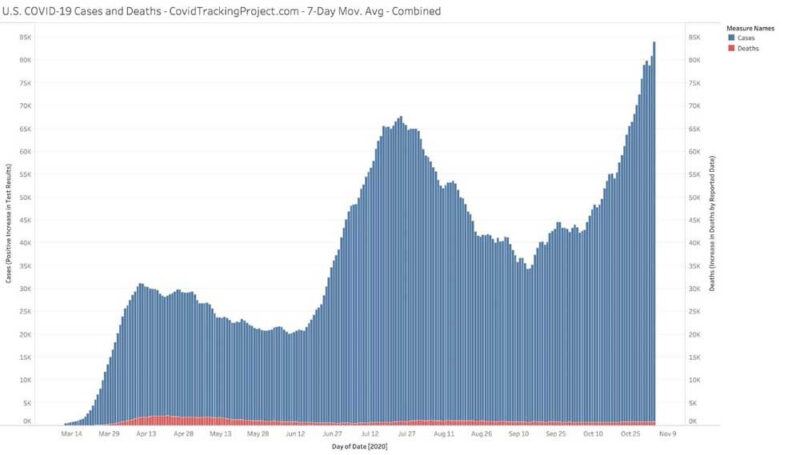
Despite this story and these data, the graphic artists at the Times got to work generating a highly misleading presentation that leads to one conclusion: more lockdowns.
(My colleague Phil Magness has noted further methodological problems even within the framework that the Times uses but I will let him write about that later.)
Let’s finally deal with Salon’s attack on Great Barrington Declaration co-creator Jayanta Bhattacharya. Here is a piece that made the following claim of the infection fatality rate: “the accepted figure of 2-3 percent or higher.” That’s an astonishing number, and basically nuts: 10 million people will die in the US alone.
Here is what the CDC says concerning the wildly disparate risk factors based on age:
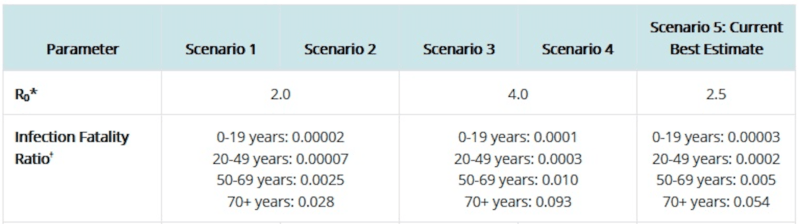
These data are not inconsistent with the World Health Organization’s suggestion that the infection fatality rate for people under 70 years of age is closer to 0.05%.
The article further claims that “herd immunity may not even be possible for COVID-19 given that infection appears to only confer transient immunity.” And yet, the New York Times just wrote that:
How long might immunity to the coronavirus last? Years, maybe even decades, according to a new study — the most hopeful answer yet to a question that has shadowed plans for widespread vaccination.
Eight months after infection, most people who have recovered still have enough immune cells to fend off the virus and prevent illness, the new data show. A slow rate of decline in the short term suggests, happily, that these cells may persist in the body for a very, very long time to come.
How is it possible for people to make rational decisions with this kind of journalism going on? Truly, sometimes it seems like the world has been driven insane by an astonishing blizzard of false information. Just last week, an entire state in Australia shut down completely – putting all its citizens under house arrest – due to a false report of a case in a pizza restaurant. One person lied and the whole world fell apart.
Meanwhile, serious science is appearing daily showing that there is no relationship at all, and never has been, between lockdowns and lives saved. This study looks at all factors related to Covid death and finds plenty of relationship between age and health but absolutely none with lockdown stringency. “Stringency of the measures settled to fight pandemia, including lockdown, did not appear to be linked with death rate,” says the study, echoing a conclusion of dozens of other studies since as early as March.
It’s all become too much. The world is being seriously misled by major media organs. The politicians are continuing to panic and impose draconian controls, fully nine months into this, despite mountains of evidence of the real harm the lockdowns are causing everyone. If you haven’t lost faith in politicians and major media at this point, you have paid no attention to what they have been doing for the better part of this catastrophic year.
Jeffrey A. Tucker is Editorial Director for the American Institute for Economic Research. He is the author of many thousands of articles in the scholarly and popular press and nine books in 5 languages, most recently Liberty or Lockdown.
Canada’s Trudeau calls Great Reset a CONSPIRACY THEORY after video of him promoting the globalist initiative went viral
RT | November 21, 2020
Canadian Prime Minister Justin Trudeau, who brought an avalanche of attention to the World Economic Forum’s ‘Great Reset’ when a video of him talking about the plan surfaced earlier this week, now says it’s a “conspiracy theory.”
Asked at a press conference Friday about concerns raised by conservative lawmakers about his use of the term ‘Great Reset’, Trudeau said, “We’re in a time of anxiety, where people are looking for reasons for things that are happening to him, the difficult moments we’re in. It’s nice to be able to find someone to blame, something to point to, something to get mad at.
“We’re seeing a lot of people fall prey to disinformation. If conservative MPs and others want to start talking about conspiracy theories, well, that’s their choice. I’m going to stay focused on helping Canadians get through this, on learning lessons from this pandemic, and making sure that the world we leave to our kids is even better than the world we inherited from our parents.”
The statement came just six days after a video of Trudeau addressing the United Nations remotely in September came to light, triggering a surge in Google searches for ‘Great Reset’ and sparking viral social media reaction to his comments.
“This pandemic has provided an opportunity for a reset,” Trudeau said. “This is our chance to accelerate our pre-pandemic efforts to reimagine economic systems that actually address global challenges like extreme poverty, inequality, and climate change.”
Opposition-party lawmakers, such as Pierre Poilievre, called attention to the video and posted a petition to stop the Great Reset. “Canadians must fight back against global elites preying on the fears and desperation of people to impose their power grab,” Poilievre said.
It’s easy to see how observers would infer that Trudeau’s comments reflect an international effort to capitalize on the Covid-19 pandemic to impose globalist economic policies. The World Economic Forum has openly promoted the Great Reset and championed using it to avert an economic collapse resulting from the pandemic.
Trudeau also referred in his UN address to “building back better,” echoing Democrat Joe Biden’s campaign slogan. “Building back better means giving the support to the most vulnerable while maintaining our momentum on reaching the 2030 agenda of Sustainable Development and the SDGs,” he said.
Mainstream media outlets put their spin on reaction to Trudeau’s comments, such as AFP saying the video was being used to justify a “baseless conspiracy theory” about global elites using the Covid-19 crisis to bypass democracy.” The Toronto Star also referred to “baseless conspiracy theories.”
Trudeau’s comments on Friday provided another opportunity to try to stamp out concerns that the prime minister meant what he said when he called the pandemic “a chance to accelerate our pre-pandemic efforts to reimagine economic systems.” The Huffington Post used a straw man to paint the reactions as absurd, saying, “No, Prime Minister Justin Trudeau did not engineer the Covid-19 pandemic.”
Royal Canadian Air Force veteran Rex Glacer tweeted that the media was trying to “cover up” for Trudeau. “Seeing things that aren’t there? Like Trudeau on video talking about the Great Reset the entire world has now seen?”
Former National Hockey League star Theo Fleury reacted to Trudeau appearing to directly contradict his own comments, saying, “He’s full of s***.” Other observers agreed, calling Trudeau’s latest comments “gaslighting.” One Twitter user quipped, “He now calls it the ‘Great Turn it Off and Turn it Back On.’”
Poll: 80% of US deeply divided on basic values
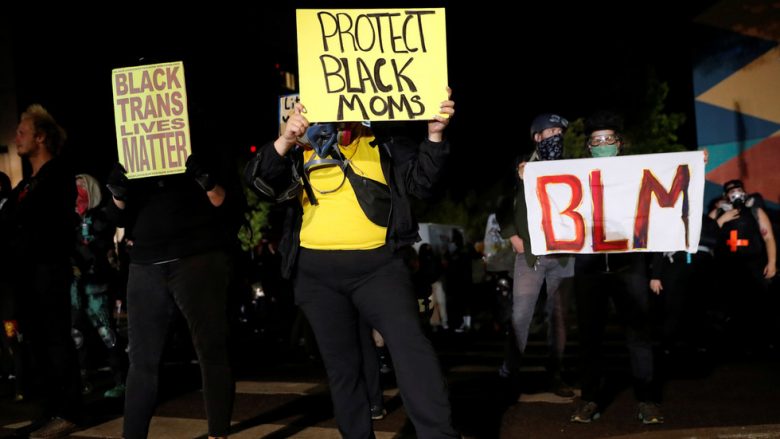
© REUTERS/Terray Sylvester
By Ramin Mazaheri | Press TV | November 21, 2020
Chicago – The US presidential election remains unresolved but what seems crystal clear is that the nation is divided more than anytime since the 1960s, or perhaps even the 1860s.
A new poll found that nearly 80% of America says they are “deeply divided on its most foundational values”. Whoever is inaugurated in January will face a deeply mistrustful and disbelieving public, as the poll also finds that just 30% of Americans believe the country will grow more united in 2021.
For a nation which is the richest in the world and which faces no serious external threat, such levels of disharmony are shocking even to many Americans themselves.
Distrust is not something which grows overnight. Many attribute the division to the American liberal’s obsession with so-called “identity politics”, which divides and re-divides people into smaller and smaller tribes based on gender, race, ethnicity, urban-rural, coastal-inland and on and on.
US conservatives are criticized for having a limited view of unity due to an “us versus them” mentality, which leaves little room for change or modernization.
The United States is proving unable to resolve a host of enormous problems: protecting from the coronavirus pandemic, Great Depression-levels of unemployment alongside a skyrocketing Wall Street, endemic economic inequality which has exploded in 2020, constant racial discrimination, record disharmony between genders, a Congress which is half as popular as an often deeply unpopular President, and, of course, a disputed election, the third in six tries.
The poll makes it clear that belief in the nation’s division is not a partisan issue, as Democrats, Republicans and independents all agree in similar proportions. Americans only seem to be able to agree on one thing – that they really, deeply disagree.
Portuguese Court Rules PCR Tests “Unreliable” & Quarantines “Unlawful”
Important legal decision faces total media blackout in Western world
OffGuardian | November 20, 2020
An appeals court in Portugal has ruled that the PCR process is not a reliable test for Sars-Cov-2, and therefore any enforced quarantine based on those test results is unlawful.
Further, the ruling suggested that any forced quarantine applied to healthy people could be a violation of their fundamental right to liberty.
Most importantly, the judges ruled that a single positive PCR test cannot be used as an effective diagnosis of infection.
The specifics of the case concern four tourists entering the country from Germany – all of whom are anonymous in the transcript of the case – who were quarantined by the regional health authority. Of the four, only one had tested positive for the virus, whilst the other three were deemed simply of “high infection risk” based on proximity to the positive individual. All four had, in the previous 72 hours, tested negative for the virus before departing from Germany.
In their ruling, judges Margarida Ramos de Almeida and Ana Paramés referred to several scientific studies. Most notably this study by Jaafar et al., which found that – when running PCR tests with 35 cycles or more – the accuracy dropped to 3%, meaning up to 97% of positive results could be false positives.
The ruling goes on to conclude that, based on the science they read, any PCR test using over 25 cycles is totally unreliable. Governments and private labs have been very tight-lipped about the exact number of cycles they run when PCR testing, but it is known to sometimes be as high as 45. Even fearmonger-in-chief Anthony Fauci has publicly stated anything over 35 is totally unusable.
You can read the complete ruling in the original Portuguese here, and translated into English here. There’s also a good write up on it on Great Game India, plus a Portuguese professor sent a long email about the case to Lockdown Sceptics.
*
The media reaction to this case has been entirely predictable – they have not mentioned it. At all. Anywhere. Ever.
The ruling was published on November 11th, and has been referenced by many alt-news sites since… but the mainstream outlets are maintaining a complete blackout on it.
The reddit Covid19 board actually removed the post, because it was “not a reliable source”, despite relying on the official court documents:

Lookout for a forced and disingenuous “fact-check” on this issue from HealthFeedback or some other “non-partisan” outlet in the near future. But until they find some poor shlub to lend their name to it, the media blackout will continue.
Whatever they say, this is a victory for common sense over authoritarianism and hysteria.
No, Climate Change Is Not Eliminating Thanksgiving Cranberry Sauce
By James Taylor | ClimateRealism | November 19, 2020
The Washington Post published an article yesterday claiming climate change is devastating Massachusetts cranberry production and threatening to eliminate America’s Thanksgiving cranberry sauce. In related news, the U.S. Department of Agriculture is forecasting a record 2020 Massachusetts cranberry crop.
The Washington Post article is titled, “How Climate Change Is Complicating a Thanksgiving Staple.” The subtitle is, “Heatwave, drought, lack of winter ice are taking a toll on a quintessential Massachusetts crop.” In the article, the Post quotes Bay Staters voicing their subjective feelings that climate change is making cranberry farming harder. The article is littered with subheads like, “The fight to save a small fruit.” The article, however, presents no objective data to support the claims. That struck us at Climate Realism as odd, considering objective cranberry data is available for Massachusetts and America as a whole.
Let’s take a look at objective cranberry facts:
The U.S. Department of Agriculture’s National Agriculture Statistics Service estimates record Massachusetts cranberry production in 2020. This directly contradicts the message of the Washington Post article, which likely explains why the Washington Post chose not to include any data in its article. USDA also estimates strong cranberry production in Wisconsin this year. Wisconsin and Massachusetts are the two leading states for cranberry production.
Cranberry production in Massachusetts, Wisconsin, and the rest of the United States has been so strong in recent years that, according to the Wisconsin State Farmer news site, “Facing a continued glut of cranberries and depressed prices, in 2017 the cranberry industry asked federal officials in 2017 to take unusual steps aimed at reducing production.”
“The industry’s U.S. Cranberry Marketing Committee asked the USDA to cap the amount of cranberries grown in 2018 at 75% of the normal crop. The committee also has asked the USDA to have cranberry companies withhold 15% of the 2017 crop from the marketplace,” the State Farmer reported.
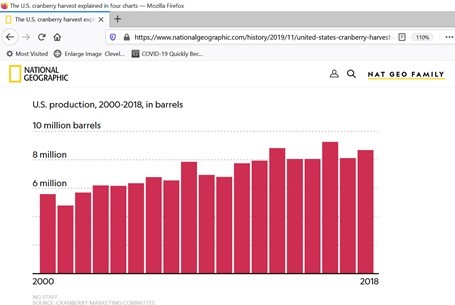
The chart below, published by National Geographic, documents and illustrates the consistent, long-term growth in cranberry production. The chart ends with the year 2018, but that trend will continue with the estimated 2020 record crop production.
Ultimately, yesterday’s Washington Post article is merely the latest example of a nefarious strategy executed by climate activists and their corporate media allies. Their dishonest tactic is to identify an upcoming holiday or something that people really love, and then claim that global warming is destroying it, whether or not there is any evidence, truth, or basis for the alarmist claim.
New footage reveals Netflix faked walrus climate deaths
By Susan Crockford | Polar Bear Science | November 19, 2020
Netflix faked ‘Our Planet’ walrus deaths in order to blame them on climate change – polar bears actually were the cause of walrus falling to their deaths from a Siberian cliff, independent video evidence from Russia shows.
A new video published by the Global Warming Policy Foundation on this new evidence.
Press release 16 November 2020 from the Global Warming Policy Foundation:
London, 19 November: In a GWPF video released today, Dr. Susan Crockford, a Canadian wildlife expert, provides new evidence that the 2019 Netflix documentary film series, ‘Our Planet’, withheld facts behind the controversial walrus story it promoted as evidence of climate change.
If there was ever any doubt that polar bears, not climate change, were the cause of walrus falling to their deaths from a rocky cliff in Siberia a few years ago, new evidence presented here seals the deal: a Russian photographer has released independent video of the event that clearly shows polar bears driving walrus over the cliff to their deaths.
In 2019, a sequence in the Netflix documentary ‘Our Planet’ showed a highly disturbing piece of footage of several walrus bouncing off sharp rocks as they fell from a high cliff to their deaths. It transpired this event happened in late September 2017 at a well-known walrus haulout at Cape Schmidt on the Chukchi Sea.
Narrator Sir David Attenborough blamed the tragedy on climate change, insisting that lack of summer sea ice due to climate change was to blame for the walrus falling to their deaths without provocation. A few months later, however, using some of the same walrus footage, Attenborough’s BBC series called ‘Seven Worlds, One Planet’ featured a number of polar bears driving walrus off the very same cliff. It was damning evidence that the ‘Our Planet’ account of walrus deaths had been a false narrative constructed to elicit an emotional response from the public.
New independent video footage of the same event shot by Russian photographer Yevgeny Basov corroborates the BBC evidence that polar bears drove the walrus over the cliff. Basov is a friend of Netflix ‘science advisor’ Anatoly Kochnev and was apparently invited to observe the commercial filming.
Like the original Netflix footage, this scene is not for the faint of heart. It captures a raw but natural encounter between predator and prey. Walrus hauling out on land during the summer are natural events that happen even when sea ice is available. Polar bears are known to stalk such herds until they stampede, leaving the weak or unwary crushed in their wake. Cliffs are not essential to this polar bear hunting strategy but are especially efficient.
This brutal film footage of nature in action is not evidence of climate change or species on the brink of extinction. It does prove, however, that the walrus narrative promoted by Sir David Attenborough in the Netflix documentary ‘Our Planet’ is a manipulative sham with no resemblance to reality.
My video below published by the Global Warming Policy Foundation
Although the location is not specified in the original Russian video, by Russian photographer Yevgeny Basov, entitled simply ‘Walruses and polar bears of Chukotka’ (posted 17 May 2020, see below), it is clear that the location shown early in the film footage (up to the 4:00 mark) is of the cliff and walrus haulout at Cape Schmidt, which the author described in a photo essay published in November 2017 here.
See also:
The truth about Attenborough’s falling walruses (below):
Falling Walrus: Attenborough Tacitly Admits Netflix Deception (below)
Featured Video

Deception – Submarines against Olof Palme
or go to
Aletho News Archives – Video-Images
From the Archives
Woolsey Fire started at Santa Susana Field Lab — where “radioactive materials released were never accurately measured”
By John Laforge | CounterPunch | November 30, 2018
In my Nov. 16 column, I reported on potential radiation risks posed by California’s Woolsey wildfire having burned over parts or all of the Santa Susana Field Laboratory—south of Simi Valley, Calif., 30 miles outside Los Angeles—site of at least four partial or total nuclear reactor meltdowns.
The field laboratory operated 10 experimental reactors and conducted rocket engine tests. In his 2014 book Atomic Accidents, researcher James Mahaffey writes, “The cores in four experimental reactors on site … melted.” Reactor core melts always result in the release of large amounts of radioactive gases and particles. Clean up of the deeply contaminated site has not been conducted in spite of a 2010 agreement.
Los Angeles’s KABC-7 TV reported Nov. 13 that the Santa Susana lab site “appears to be the origin of the Woolsey Fire” which has torched over 96,000 acres. Southern Calif. Public Radio said, “According to Cal Fire, the Woolsey Fire started on the afternoon of Thursday, Nov. 8 … on the Santa Susana site.” … continue
Blog Roll
 Aletho News
- Pressure builds on Iran to ‘drop’ Lebanon ceasefire demand as Islamabad talks hang in balance
- In another clash report, US denies agreement to release Iran’s assets
- What is fueling unrest across the EU?
- Why no power can undermine Iran’s eternal dominance over the Strait of Hormuz
- Is The War Against Iran Over?
- Iran war will leave long-term ‘scar’ on Wall Street, investors warn
- How Iran decimated US power projection in West Asia: Military lessons of 40-day war
- Iran’s report details US-Israeli war crimes in targeting schools, hospitals, livelihoods
- NATO’s Slow Fracture: How Trump’s Iran War Exposed the Instrument of Hegemony
- Chinese jet fuel and the myth of energy independence
- If Americans Knew
- Military aid to Israel emerges as the latest political litmus test for Democrats
- The only Palestinian children’s rights organization closes following years-long Israeli campaign against it
- ‘I Can’t Forget the Smell’: Lebanese Reel After Israel Kills Over 300 in Single Day
- DNC Shoots Down Resolutions Calling Out AIPAC and Limiting Arms to Israel
- TCN: Is Israel Blackmailing President Trump?
- Israel killed at least 303 Lebanese yesterday – who were they? Daily Update
- Amnesty: Urgent – Protect Lebanese civilians from brutal escalation in Israeli attacks
- Is The War Against Iran Over?
- Inside the Israeli army’s propaganda wing
- Hundreds of Gaza Amputees Stranded in Legal Limbo
- No Tricks Zone
- New Study: No Linear Warming Or Glacier Retreat Along Northern Antarctic Peninsula Since 1980s
- An Inconvenient Tree: Uncovered In Alps… Europe Much Warmer Than Today 6000 Years Ago
- New Study Reports A 60% Slowdown In Greenland’s Ice Loss Rate In The Last Decade
- Low Intensity Tornado Wrecks Major Solar Farm, Creating A Potential Toxic Dump
- New Study Finds Warming Saves Lives…Cold Temperatures 12 Times More Deadly Than Excess Heat
- German Science Blog Accuses PIK Climate Institute Of Hallucinating Climate Tipping Points
- Devastating Assessment Of Comirnaty Vaccine By Former Senior Pfizer Europe Toxicologist
- New Study: CO2 Is ‘Effectively Negligible’ As An Explanatory Climate Change Factor Since 2000
- Former Pfizer Toxicologist Dr. Helmut Sterz Tells Bundestag Hearing Pfizer Vaccine Should Have Never Been Approved
- Energy Expert: Germany’s Nuclear Phaseout Was A “500 Billion Euro Mistake”
 Aletho News