Western news media have given up the pretense of being independent and impartial sources of information. American and European mainstream outlets are nothing but propaganda services for the NATO proxy war against Russia.
That observation is hardly new. Since the NATO-backed coup in Kiev in 2014, the Western media have systematically and relentlessly whitewashed the NeoNazi regime and its strategic purpose as a cat’s paw to embroil Russia in conflict. Russia’s inevitable military response to the decade-long proxy war has been distorted as “unprovoked aggression” against “democratic” Ukraine.
The Western “news media” have now outed themselves for the propaganda functionaries that they are. The veil is shredded.
Last weekend, the NATO-backed Kiev regime deliberately attacked a civilian passenger train in Russia’s Bryansk region. Seven people were killed and over 100 were injured after a bridge was blown up, crashing down on a train passing underneath. The death toll could have been much higher, given the hundreds on board.
Within hours of that heinous act, a second train was derailed when a bridge it was traveling over in Kursk was blown up. Mercifully, there were no deaths in the second attack despite several injuries.
Three more explosions have been reported on Russia’s railways this week: another in Bryansk and two in the Voronezh and Belgorod regions.
These calculated acts to cause maximum civilian casualties by the Ukrainian regime and its NATO enablers are nothing short of state terrorism. They are war crimes of the first magnitude.
Yet the Western media, like the Western governments, have maintained a shameful and damning silence on these crimes. One can imagine the outpouring of condemnation if Russia were to carry out such attacks, deliberately targeting civilians in Ukraine.
Instead, the Western “news” outlets gave prominent coverage of the drone attacks on Russia’s airfields. Certainly, the targeting of five airbases where Russian nuclear-capable bomber aircraft are stationed was big news.
However, Western media reports let their colors show by being ecstatic in tone about an “audacious” operation, amplifying unverified Ukrainian claims that 40 aircraft were destroyed. Britain’s Daily Telegraph and other Western outlets shared video of one plane exploding, headlining with glee that “Putin’s bombers” were knocked out.
For its part, the Russian military said that most of the drones were intercepted and only a few aircraft were damaged.
None of the Western outlets reported on the obvious role that NATO intelligence must have played in such a recklessly provocative attack on Russia’s strategic defenses. As such, the Western media is covering up for what could be deemed an act of war on Russia.
The gloating propagandist reporting on the airfield raids was in stark contrast to the relative silence over the terrorist attack on the passenger train.
U.S.-based ABC headlined with “Ukraine targets Russian airfields in major drone attack” and relayed dramatic details of the operation. It was only much further down in the report that ABC mentioned the deadly train explosion, as if it were a minor incident.
It reported: “Elsewhere, at least seven people were killed and 66 injured when a railway bridge collapsed and a train derailed in Russia’s western Bryansk region overnight.”
Note how ABC makes out that a bridge collapsed as if by gravity without explosive sabotage. It goes on to distort the terror attack by quoting a Ukrainian regime propagandist who insinuates that the wreckage was somehow carried out by Russia. The warped logic dignified by ABC was that the Russians carried out a fiendish false-flag ploy to scuttle negotiations that were due to take place the following day in Istanbul between Russian and Ukrainian delegates.
The British BBC deployed the same reprehensible disinformation. Its headline was: “At least seven dead after two Russian bridges collapse.”
Again, according to the BBC, bridges just collapse on passenger trains. Like ABC, the BBC buries important Russian information implicating Ukrainian responsibility for detonating explosives in the mass murder of civilians.
Significantly, the BBC also quotes the same Ukrainian regime propaganda source, Andriy Kovalenko, aired by ABC, who is described as “head of Ukraine’s National Security and Defence Council’s Centre for Countering Disinformation.” He is also permitted by the British outlet to accuse Russia of self-inflicted terrorism, allegedly “laying the groundwork to derail the negotiations” in Istanbul.
With blatant distortion, Western media are minimizing what are outrageous acts of terrorism by the NATO-weaponized regime. Sickeningly, deliberate acts of murdering civilians by the NATO-backed regime are twisted upside down as Russian dirty tricks.
Of course, Western media are obliged to tell lies to cover up crimes by their governments and their proxies. In that case, they have lost their pious and pretentious claims of being “independent media”. They are abject propaganda tools, dressed up with self-ordained virtue. And still they have the arrogance to accuse other nations’ media of being state-run propaganda. This charade by Western media has been running for a long time, decades and indeed centuries. It has always been a charade. It’s now flagrantly obvious. No wonder so many Western citizens have contempt for their mainstream media.
The peace talks in Istanbul – the second round was held earlier this week – to try to find an end to the proxy war in Ukraine have largely come about because of Moscow’s initiative. American President Donald Trump’s declared wish to end the conflict has brought the Kiev regime to the table. It is not clear if the talks will succeed.
In the meantime, it is abundantly clear that the NATO axis on both sides of the Atlantic wants the proxy war to continue.
Carrying out provocations and terrorist crimes against civilians is aimed at sabotaging any diplomatic effort.
Russia responded in recent days to the terror assaults last weekend with massive bombardments on Ukraine’s military sites.
Russian President Vladimir Putin warned Trump in a phone call mid-week that retaliation was imminent.
Western media reported Russia’s air strikes by giving prominence to the deaths of five civilians, according to Ukrainian officials. Russia claims it is not deliberately targeting civilian centers. That is an important distinction compared with the NATO-backed regime.
As usual, the latest Russian strikes were reported without a single mention of the terrorist murders of civilians in Russia. It is an all-too-familiar and deplorable pattern of bias. Russian lives are worthless, evidently from the Western perspective.
The one-sided Western media dereliction of journalism is seen over and over again throughout the proxy war in Ukraine. In another notorious distortion this week, the nuclear power plant in Zaporozhye – the biggest in Europe – came under drone attack from the Kiev regime. There were no reports in the Western media of this nuclear terrorism to contaminate Europe. When Western media reported on previous attacks on the ZNPP (by the Kiev forces), it absurdly claimed that Russia is doing the sabotage on a power plant under its control. Just like supposedly blowing up its own trains and citizens.
Western media silence and distortion are not merely disgraceful false propaganda. It is complicity in war crimes by giving cover and license for more.
June 7, 2025
Posted by aletho |
Mainstream Media, Warmongering, War Crimes | ABC, BBC, NATO, Russia, Ukraine |
Leave a comment
You could be forgiven for thinking the BBC is out to get Richard Tice. Their chosen battleground is the Reform man’s position on climate and Net Zero, but it’s fair to say the campaign is, thus far, not going too well.
Question Time last week was a car crash for the corporation, with chairman Fiona Bruce interrupting Tice to contradict his contention that only 4% of carbon dioxide emissions are manmade. Thirty percent was the correct figure, she boldly asserted. Unfortunately, Tice was right, and she was wrong, so the Corporation’s gophers got to work and quietly edited the recording to remove her gaffe. Unfortunately someone noticed, and sceptics had a field day.
Undeterred, the Corporation returned to the fray a few days later, when Nick Robinson had Tice on his Political Thinking podcast. They decided, somewhat surprisingly, to take up cudgels on exactly the same subject, namely the human influence on climate.
Once again, Tice expained that human emissions were dwarfed by natural ones, and there was no attempt to probe this argument more deeply. The conversation meandered off elsewhere.
However, shortly aferwards Robinson decided to stick in a metaphorical boot, tweeting a clip from the interview with the comment:
He’s denying the scientific consensus that climate change is partly man made & can be slowed or halted.”
This is a very strong take given that Robinson had not attempted to pin down Tice on precisely what he meant. But at face value it’s a misrepresentation.
Tice’s words could only reasonably be interpreted as implying that the human contribution is nugatory compared to the natural one. To get to Robinson’s take – that Tice believed that there was no human influence – would mean considering his words as meaning natural CO2 emissions affected the climate but human ones didn’t. This would be ludicrous.
Tice’s words clearly implied that he thought mankind affected the climate, but only marginally so. In other words, far from “denying… that climate change is partly man made”, this was his starting point!
As to the rest of Robinson’s claim – that Tice was denying that climate change “can be slowed or reversed”, we need to note what appears to be a fatal contradiction in Robinson’s position. If climate change is “partly” manmade, then it is also partly natural. How, we wonder, does Robinson think we can halt the natural element?
It is undoubtedly substantial. We are sure that the climate changes on all timescales, from the decadal and centennial to the millennial and beyond. We know this from, for example, long-term temperature records, such as the Central England Temperature Series, the 800-year record of the waters of the Nile, and proxy climate records covering even longer periods. And the natural changes that are seen in history can be dramatic. One notable example was the sudden temperature rise at the end of the period, over 10,000 years ago, known as the Younger Dryas. Temperatures around the world are thought to have increased by 3–10 degrees in just a few decades.
How does Nick Robinson think we are going to stop that kind of climate change?
Charitably, Robinson – who is a generalist – simply hasn’t thought through what he means by “climate change”. He has no robust understanding of climate history and climate science, and is therefore unable to probe the position of people like Tice, who have given the issues some thought.
That being the case, he needs to think before he speaks, and perhaps to be a little more cautious about dishing out accusations of denial.
June 1, 2025
Posted by aletho |
Deception, Mainstream Media, Warmongering, Science and Pseudo-Science | BBC |
Leave a comment
The downing of flight MH17 in Eastern Ukraine, on July 17, 2014, led to a tectonic shift in relations between the EU and Russia. The American Secretary of State, John Kerry, paved the way by spreading misinformation and agitprop.
On July 17, 2014, a Malaysian passenger plane that had departed from Amsterdam and was en route to Kuala Lumpur crashed in Donbass, eastern Ukraine, where at that time a battle was raging between Ukrainian government troops and pro-Russian insurgents. All 298 occupants of flight MH17, most of them Dutch, were killed. The Dutch Safety Board (DSB) investigated the technical cause of the crash. In 2015 it concluded that the plane was downed by a Buk missile. The criminal investigation was led by a team of Dutch, Belgian, Australian, Ukrainian and Malaysian police officers and prosecutors – the Joint Investigation Team (JIT). In 2019, it announced that the Dutch Public Prosecution Service would prosecute one Ukrainian, Leonid Kharchenko, and three Russians, Igor Girkin, Sergey Dubinsky and Oleg Pulatov. They were tried in The Netherlands, by the Hague District Court. In 2022, Pulatov was acquitted. The court sentenced the other defendees to life imprisonment for complicity in murder and the downing of an aircraft. The concrete involvement of the three convicts is alleged to have included: expressing the need for and requesting an air defense system with crew; indicating a suitable firing location for that system; transporting, escorting, guarding and concealing it. Those who were directly involved in the downing of the plane are still at large. The JIT assumes they are hiding in circles of the 53rd anti-aircraft brigade in Kursk, Russia. A Buk Telar air defense system from that brigade allegedly crossed the border into Ukraine with crew and all on July 17, 2014, where it fired the fatal missile the same day. However, the JIT has no idea who pushed the button, who gave the order to shoot, and for what reason. In 2023, the JIT anounced that it had halted the investigation.
The impact of the MH17 crash on relations between Russia and Europe cannot be overestimated. Although American and European sanctions were already in force against Russia before July 17, 2014, due to the seizure of Crimea, relations between Russia and most countries of the European Union were still friendly. The European economy benefitted from trade relations with Russia and the import of cheap natural gas. The Obama Administration tried to change this. It urged Brussels to impose additional, tougher sanctions on Russia, The Washington Post reported on June 25. At that time, there were divisions within the E.U. Some countries feared sanctions would hurt their relations with Russia. This changed overnight on July 17. “We hope it is a wake-up call for some countries in Europe that have been reluctant to move,” US Secretary of State John Kerry said in a televised interview three days after the MH17 crash. “We think frankly that the sanctions may need to be tougher. It may well be that the Dutch and others help lead that effort.” Kerry referred to the sanctions package that the US had already imposed on July 16. It was an example for Europe to follow. That package included sanctions against numerous Russian companies in the energy sector, banking and arms industries. Americans were prohibited by law from doing business with individuals who had interests in these companies.
On July 21, the day after Kerry’s TV address, American UN Ambassador Samantha Power and Dutch Minister of Foreign Affairs Frans Timmermans gave emotional speeches at the UN Security Council in New York. They accused the separatists of denying investigators access to the crash site, suppressing evidence, engaging in looting, disrespecting the victims’ bodies and hindering their recovery. “To my dying day I will not understand that it took so much time for the rescue workers to be allowed to do their difficult job, and that human remains should be used in a political game,” Timmermans stated, before flying to Brussels to give a reprise of his speech. Several EU ministers reportedly had tears in their eyes when Timmermans said he had known personally some of the 194 Dutch passengers among the 298 people who died on the plane. Reuters characterized the meeting in Brussels as “a turning point in Europe’s approach towards Russia”. Countries that were previously on the brakes, such as Germany and Italy, now suddenly agreed to the measures desired by the US. “Within days of Timmermans’ address, senior EU diplomats had agreed the broad outlines of potential sanctions on Russian access to EU capital markets, defence and energy technology,” Reuters wrote. “Timmermans’ impassioned speech, several diplomats said, made it difficult for others to hold a firm line against sanctions at Tuesday’s meeting. […] But like a supportive family, EU partners rallied around the bereaved Dutch, putting national economic interests aside and for the first time going beyond asset freezes and visa bans on individuals to envisage curbs on entire sectors of the Russian economy that could turn the screw on President Vladimir Putin.” On July 31, the significantly stricter EU sanctions against Russia became a reality.
The MH17 disaster not only led to economic damage for Russia. The country’s reputation also suffered a serious blow. Various Western media and politicians immediately pointed the finger at the Kremlin. President Vladimir Putin had a 298-fold murder on his conscience. While Russia could previously count on some understanding among many in the West for sending “green men” to Crimea, it was now a rogue state in the eyes of the masses. The separatists in Donetsk and Luhansk also experienced nothing but misery from the disaster.
The repercussions for Russia and the separatists stand in stark contrast to the outcome for the anti-Russian coup government in Kiev. It has benefited greatly from the MH17 crash. Until July 17, fear of a large-scale Russian invasion prevailed and there was concern about the poorly run ‘anti-terrorist operation’ along the border with Russia in the Donetsk and Luhansk oblasts. The MH17 disaster changed this overnight. On July 21, 2014, Ukrainian President Petro Poroshenko appeared on CNN. He qualified the MH17 as a terrorist attack. “I don’t see any difference between the tragedy of 9/11 and the tragedy in Grabovo in Ukraine,” he said. “So now we have to demonstrate the same reaction. This is a danger to the whole world, to global security.” It sounded like a call for the West to take military action, as had happened in response to the alleged terrorist attacks in the U.S. on September 11, 2001. The Americans then successively invaded Afghanistan and Iraq.
Poroshenko almost got his way. An advanced plan by The Netherlands and Australia to take the crash area by force of arms from the insurgents was called off at the last minute. Nevertheless, the MH17 disaster brought the Kiev government much of what it wanted from the US and Europe: political and military support for Ukraine and tough punitive measures against Russia. On December 18, 2014, US President Barack Obama signed the so-called Ukraine Freedom Support Act, which paved the way for $350 million in military aid to Kiev. According to statements from the US Department of Defense, Washington donated one and a half billion dollars worth of military goods and training to Kiev from 2014 to 2019. NATO ‘intensified’ – in its own words – its cooperation with Ukraine. The tougher attitude of Brussels towards Moscow, so fervently desired by Kiev, also took shape.
Was MH17 really downed by a Russian Buk-crew? According to the The Hague District Court, the Dutch Prosecution Service, the JIT and the western legacy media the answer is in the affirmative. According to the author of this article, who attended all 69 court sessions of the criminal trial, no convincing — let alone conclusive evidence — was presented for the Russian Buk scenario. There are reasons to believe that something completely different may have happened. (I will discuss this in extenso in a book that I will publish this year.)
The fact is that in the public mind, Russia was convicted even before the official criminal investigation had started. Secretary of State John Kerry played a major role in this campaign by spreading misinformation and agitation propaganda that was subsequently echoed by others among whom were President Barack Obama, US Ambassador to the UN Samantha Power, and Dutch Minister of Foreign Affairs Frans Timmermans. Let’s take a look at the five tv interviews Kerry gave on Sunday, July 20, 2014. On this day he appeared on CNN, Fox, ABC, NBC and CBS.
Claim 1: “We know for certain that in the last month there’s been a major flow of arms and weapons. There was a convoy about several weeks ago, about 150 vehicles with armed personnel carrier, multiple rocket launchers, tanks, artillery, all of which crossed over from Russia into the eastern part of Ukraine and was turned over to the separatists.”
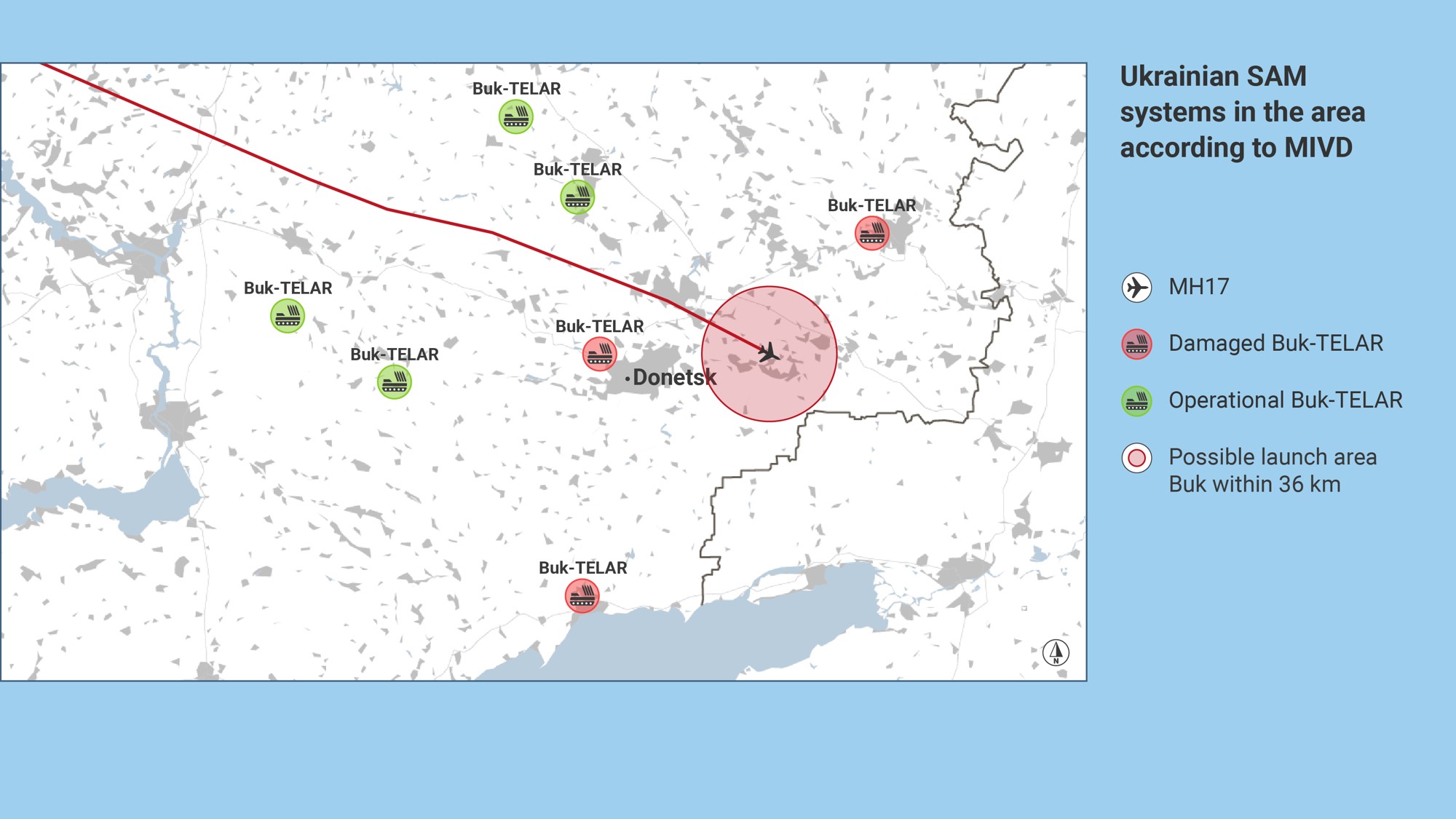
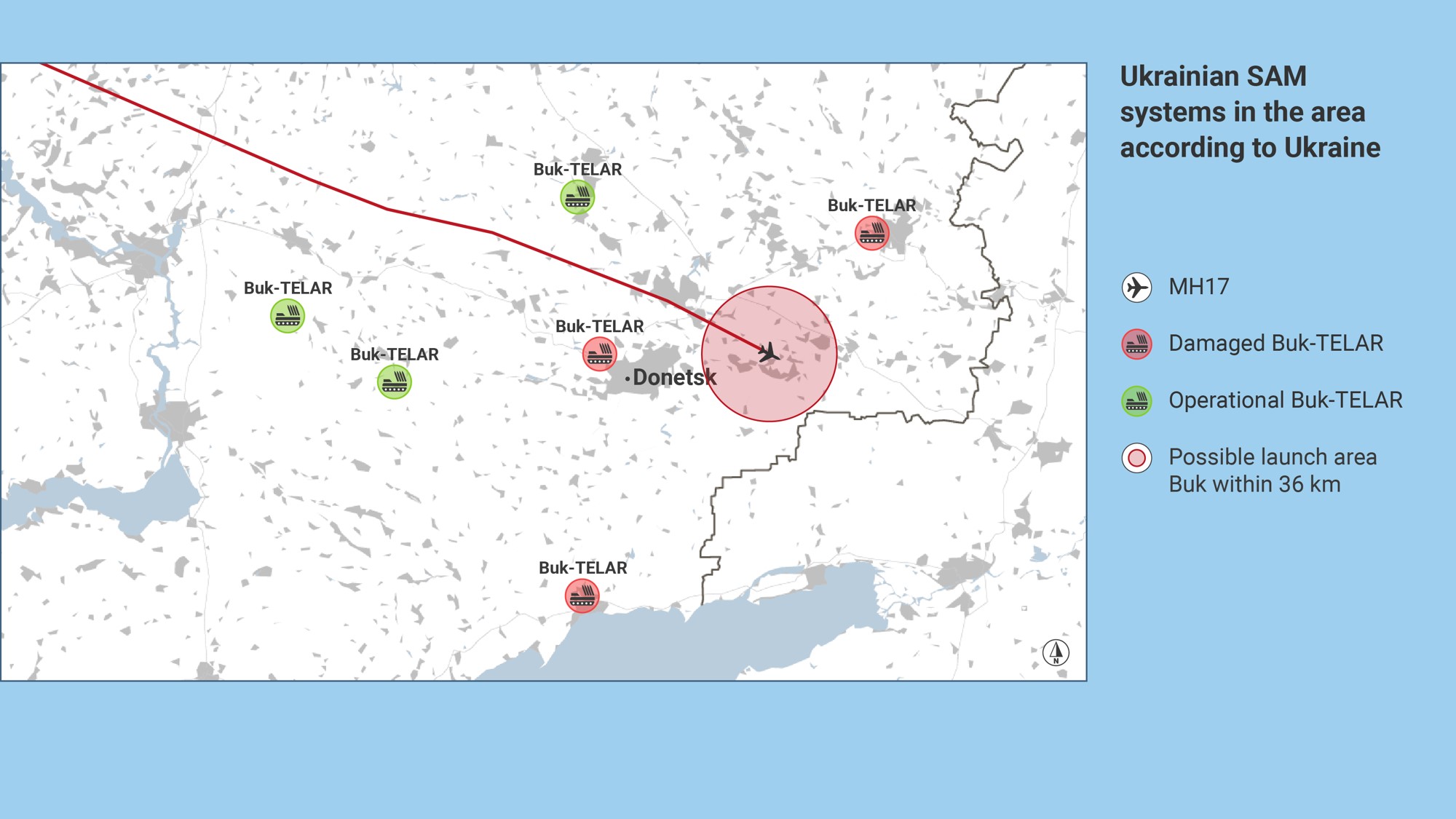
This may be true. I did not study this subject. I concentrated on the Buk allegations. I’ve seen imagery of a military transport in rebel territory, filmed on July 15, 2014. The vehicles in the transport were either provided by Russia or captured by the separatists from the Ukrainian army. In any case, U.S. intelligence has not detected a Buk Telar crossing the Russian-Ukrainian border. No western intelligence agency has identified any Russian Buk system in Ukraine; only Ukrainian Buk systems. This has been acknowledged by the Dutch Public Prosecution Service during the MH17 criminal trial in the Netherlands. In court it showed a map of all known positions of Ukrainian Buk systems in eastern Ukraine in June and July 2014, based on a memo of the Dutch Military Intelligence Service MIVD.
Claim 2: “We know for certain that the separatists have a proficiency that they’ve gained by training from Russians as to how to use these sophisticated SA-11 systems.” (SA-11 is the American designation for the Buk system.)
The Americans have never substantiated this claim. It cannot be true either. A Ukrainian Buk expert who was consulted by the JIT has said that a Buk system is more complex to operate than the most advanced fighter jet. At the time MH17 was shot down, the conflict in eastern Ukraine had been going on for only three months. In such a short period it is impossible to learn how to operate a Buk system. According to Ukrainian ex-Buk commander Tarankov, who was interviewed by the JIT, this takes years. The commander of a Buk Telar has undergone five years of training; his subordinates spend a year or more before they are allowed to deploy, Pulatov’s lawyers revealed in court. According to the ex-commander of a Finnish Buk battalion, Esa Kelloniemi, who was consulted by the author of this article, it is out of the question for an untrained crew to receive permission from higher-ups to go out with a Buk. Moreover, without specialist knowledge, it would be impossible to fire a Buk missile. That would require much more than turning the ignition key and pressing the launch button. “The firing mechanism blocks the launch of a missile if a target has not first been detected, locked-on to and tracked, and if this target is still outside the calculated firing range,” Kelloniemi says.
Kerry’s suggestion that MH17 was brought down by separatists runs counter to the view of the JIT and the Dutch Public Prosecution Service. They propagated the hasty suggestion that MH17 was downed by a Russian crew.
Claim 3. “We know that they had this system to a certainty on Monday the 14th beforehand because the social media was reporting it and tracking it.”
According to the JIT and the prosecution the Buk that downed MH17 entered Ukrainian territory on July 17. This therefore cannot be the Buk that Kerry talked about.
On July 14 a Ukrainian military transport plane, an An-26, was downed. According to Kiev, this had happened at a high altitude and with a system more powerful than anything the insurgents had fired with up to that time. It probably came from Russia, they said. On social media there was talk that it was downed by a Buk missile, but this wasn’t substantiated in any way.
It seems the seperatists were in posession of Buk Telars. In Donetsk and Luhansk they captured air bases where Buk systems were deployed. The Ukrainians had already withdrawn from there, taking their equipment with them, but they may have left some behind. According to the prosecution the separatists found at least one Buk-Telar in an air base near Donetsk. It showed photos of this Telar in court. It looked non-functional. The electronics section was clearly damaged. In Luhansk the Ukrainians also seem to have left at least one Telar behind. On 20 July 2014 a video appeared of Valery Bolotov, the political leader of the Luhansk People’s Republic (LPR). In it Bolotov expressed his condolences to the relatives and reported in the same breath that he had a non-functional Telar. He did not say how he got it. He invited the JIT to come and inspect the Telar and called on technical experts to repair it so that it could be used for the air defense of the LPR. The investigators of JIT never accepted Bolotov’s invitation. They never set a foot in Luhansk.
Claim 4. “On Thursday of the event, we know that within hours of this event, this particular system passed through two towns right in the vicinity of the shoot down. We know because we observed it by imagery.”
“We know they had an SA-11 right in the vicinity, hours before this shoot. The social media has documented this.”
“We know that they had an SA-11 system in the vicinity literally hours before the shootdown took place. There are social media records of that. The social media showed them with this system moving through the very area where we believe the shoot down took place hours before it took place.”
There are six videos and three photos of the transport of a Buk Telar across territory that was controlled by the separatists. Eight of them were posted on social media after the crash. Only one video, filmed in the city of Torez, and one photo, made in Donetsk, came into the hands of JIT before they were presented to the public. The identity of most photographers and filmmakers is unknown. Only two were identified. Of these two, only one was interviewed by the JIT. With his dash cam, he had filmed the transport of a Buk Telar in Makeevka. The metadata of his video indicated that it was shot in 2012. He said he didn’t remember the day of his encounter with the transport. One video was made by “a secret surveillance unit” of the Ukrainians in Luhansk. It was put on a YouTube channel of Ukraine’s secret service SBU the day after the crash. (See claim 9).
According to the Americans, the JIT and the prosecution the fatal missile was launched south of the city of Snizhne, from an agricultural field near the village of Pervomaiskyi. There’s one photo of a Buk driving under its own power in Snizhne and one video of a Buk leaving Snizhne, driving south. It is unknown who produced this imagery and the JIT wasn’t able to obtain the original files. The photo and video are of deplorable quality. Not a single detail can be seen on them. Zooming in creates a pixel salade.
Claim 5: “At the moment of the shoot down, we detected a launch from that area and our trajectory shows that it went to the aircraft.”
“We know to a certainty that we saw the launch from this area of what we deem to be an SA-11 because of the altitude, 33,000 feet, and because of the trajectory. We have the trajectory recorded. We know that it occurred at the very moment that this aircraft disappeared from the radar screen.”
“We picked up the imagery of this launch. We know the trajectory. We know where it came from. We know the timing. And it was exactly at the time that this aircraft disappeared from the radar.”
The Hague District Court has not received any satellite data from the Americans, despite repeated requests by the prosecution service and the Dutch next of kin. Some, among whom former CIA officer Ray McGovern, say this indicates that no missile had been launched from rebels’ held territory at all.
A memorandum the prosecution received from the U.S. Director of National Intelligence (DNI) states: “At the time that flight MH17 dropped out of contact, the U.S. intelligence community detected an SA-11 surface-to-air missile launch from approximately six kilometers south of the town of Snizhne in eastern Ukraine.” The DNI did not comment on the exact time of the launch, but Pulatov’s lawyers concluded from the memorandum that the observed launch could not possibly have been from the missile that brought down MH17. After all, a missile cannot be launched and simultaneously knock a target off the radar. A missile takes some time to reach a specified target. According to the investigators of the Dutch National Aerospace Laboratory NLR the Buk missile that hit MH17 must have travelled for about 32 seconds, if the missile was launched from the agricultural field south of Snizhne. So the launch the Americans allegedly observed must have been from a different missile than the one that hit MH17. (More about this in my upcoming book The MH17 trial.)
Both the Russians and the Ukrainians provided the JIT with primary radar data. On these, no missile or any other object can be seen near MH17. According to experts who were consulted by the JIT this can be explained by technical factors like the high speed of the missile (mach 3).
Claim 6: “We also know to a certainty that the social media immediately afterwards saw reports of separatists bragging about knocking down a plane. And then the so-called defense minister, self-appointed of the People’s Republic of Donetsk, Igor Strelkov, posted a social media report bragging about the shoot down of a transport plane, at which point when it became clear it was civilian, they pulled down that particular report.”
“We know that the so-called defense minister of the People’s Republic of Donetsk, Mr. Igor Strelkov, actually posted a bragging social media posting of having shot down a military transport. And then when it became apparent that it was civilian, they pulled it down from the social media.”
“The defense minister, so-called self-appointed of the People’s Republic of Donetsk, Mr. Igor Strelkov, actually posted a bragging statement on the social media about having shot down a transport. And then when it became apparent it was civilian, they quickly removed that particular posting.”
Kerry suggested that MH17 was shot down by mistake by referring in particular to two messages that appeared on July 17 at 16:37 and 16:50 on the news account “strelkov_info” of the social media site VKontakte. According to these reports, an Antonov transport plane of the Ukrainian Air Force, an Antonov An-26, had been downed. Kerry attributed it to Girkin, whose battle name was “Strelkov”, and who at the time was commander-in-chief of the Donetsk People’s Army. In posting the message, he allegedly “bragged” about shooting it down and then deleted it when he noticed that a passenger plane had crashed. But none of that was true. The account strelkov_info was a fan account, by and for admirers of Girkin. Statements by Girkin were sometimes published on strelkov_info, but they were always accompanied by a banner saying, “Girkin reports”. That banner was not with the first and also not with the second message about the downed An-26. The prosecution acknowledged that the two social media posts did not come from Girkin or subordinates of his. It therefore did not put forward the posts as evidence in its closing speech.
The person who first reported that an An-26 had been downed was, nota bene, the pro-Kiev Twitter account @ua_ridna_vilna. The unknown person behind the account sent out a tweet with this announcement at 4:30 p.m., only to delete the tweet and replace it at 4:32 p.m. with a tweet saying it was “probably” an An-26. The prosecution completely ignored the utterances on this account.
A plane came down. It makes sense that those who had heard about it or watched it from a distance assumed that a military aircraft had been hit. After all, that had happened sixteen times before. In four cases, it involved a military transport aircraft, including an An-26 on July 14. It was to be expected. Social media went wild. Thus the rumor got out that the crashed plane was an An-26.
Claim 7: “We know from intercepts, voices, which have been correlated to intercepts that we have, that those are, in fact, the voices of separatists talking about the shoot down of the plane.”
“We have voices that we have overheard of separatists in Russia bragging about the shoot down.”
“We have intercepted voices that have been documented by our people through intelligence as being separatists who are talking to each other about the shoot down.”
“Social media, which is an extraordinary tool, obviously, in all of this, has posted recordings of separatists bragging about the shoot down of a plane at the time right after it took place.”
Within a few hours after the crash the SBU posted on its YouTube channel an intercept of a phone conversation of a commander of the separatists, Igor Bezler. In it, he reports that a plane had been downed. A week after the crash the SBU posted another intercept, this time with someone reporting to Bezler that a ‘birdie” was coming his way. The JIT interviewed Bezler. At the start of the trial the prosecution stated that none of Bezler’s phone conversations were related to the downing of MH17. According to Bezler the conversations were about the downing of a Ukrainian Sukhoi jet a day before the MH17 crash. Indeed, on July 16, two Sukhois had been downed. It later turned out that the SBU had omitted part of Bezler’s conversation about shooting down a plane. In the omitted part, Bezler says it was a ‘Sushka’, meaning a Sukhoi jet. This was revealed by a Ukrainian blogger, Anatoly Shariy, who got his hands on the original wiretap.
Claim 8: “They have shot down some twelve planes, aircraft in the last months or so, two of which were major transport planes.”
In fact sixteen Ukrainian military aircraft were downed before the MH17 crash, among which four were military transport planes.
Claim 9: “And now we have a video showing a launcher moving back through a particular area there, out into Russia with at least one missing missile on it. So we have enormous sort of input about this, which points fingers.”
“We know that we have a video now of a transporter removing an SA-11 system back into Russia and it shows a missing missile or so.”
On the day after the crash, the Ukrainian secret service SBU posted a video on their YouTube channel of the transport of Buk Telar carrying three missiles in stead of four, which it normally carries if a Buk is being deployed. According to the Ukrainians, the transport was filmed in the early morning of July 18. The prosecution confirmed this and concluded that the video was shot on the outskirts of the city of Luhansk where at that time a battle was going on between the separatists and the Ukrainian army. So, the video was not shot in the border region as Kerry said. According to the prosecution, investigators of the JIT studied the original video file. The metadata indicated the video was shot in the early morning of July 18. The lawyers, however, revealed that the Luhansk video was missing from the SD card on which “a secret surveillance unit” allegedly recorded the event. A Dutch police officer who received the camera and the card from the hands of the SBU determined that the video file had been erased. The lawyers, therefore, said they didn’t understand how the investigators had managed to examine the original file.
It is possible that the Luhansk video is from before July 18. Indeed, at a press conference that was held in the afternoon of July 17, a spokesman for the Ukrainian government, Andrey Lysenko, reported that a video had been shot of a Buk Telar in Luhansk. Lysenko did not present this video, nor was it ever presented thereafter. Why not? Was this perhaps to conceal that the Ukrainians used the video to falsely claim it was made on July 18? Could it be that the Buk on the Luhansk video, that had one missile missing, had been involved with the downing of the Antonov An-26, on July 14?
Claim 10: “We know with confidence that the Ukrainians did not have such a system anywhere near the vicinity at that point in time. So it obviously points a very clear finger at the separatists.”
Dutch military intelligence service MIVD reported that there were several Ukrainian Buk systems present in Eastern Ukraine at the time of the crash. Western intelligence had not detected a single Russian Buk system in Ukraine. According to the prosecution the Buk that shot down MH17 was brought in on July 17 and hastily removed on the night of July 17-18. This would therefore be the reason Western intelligence services overlooked the Buk. The services would only have spotted Buks that had been in the same place for an extended period of time.
There is no evidence of an Ukrainian Buk that was within firing range of MH17. But, as MH17 police investigation chief Wilbert Paulissen correctly noted during the September 2016 press conference of the JIT: “Absence of evidence is not evidence of absence.” Just because there is no evidence of such a Buk does not mean it was not there and did not fire. A Ukrainian Buk Telar may have been put in position without anyone noticing.
The Ukrainian Defense Ministry provided the JIT with a list of all the locations in the east of the country where it had Buk systems. Missing from that was a Buk system on a military base in Dovhenke in the Kharkiv Oblast, just on the border of the rebel-held Donetsk Oblast. The MIVD determined that a Buk system had been located there. Why had Kiev concealed its presence?
Claim 11: “Pro-Russian separatists have reportedly removed almost 200 bodies from the crash site and are continuing to refuse to allow investigators full access to the site.”
“We want the facts and the fact that the separatists are controlling this in a way that is preventing people from getting there, even as the site is tampered with, makes its own statement about culpability and responsibility.”
“There are reports of drunken separatist soldiers unceremoniously piling bodies into trucks.”
“They are interfering with the evidence in the location. They have removed, we understand, some airplane parts.”
The authorities of the Donbass Peoples Republic (DPR) have not refused any investigators access to the crash site. A team of Dutch air-crash investigators was kept in Kiev by the Ukrainian and Dutch authorities, as has been extensively documented in the book MH17: Onderzoek, feiten en verhalen, commissioned by the Dutch Safety Board (DSB) and in a report by the University of Twente, Evaluatie nationale crisisbeheersingsorganisatie vlucht MH17. In a July 20 press conference, DPR Prime Minister Alexander Borodai complained that the investigators were nowhere to be seen. “It will soon be the 4th day after the event. Where are the experts? We are not in the middle of nowhere, the North Pole or Antartica, in a place where you can cannot travel easily. If you look at the map, you see we are in the middle of Europe. The road from Kiev to here takes four of five hours.” The DSB air crash investigators never went to Donetsk. In August they went back home.
However, three Dutch forensic investigators of the LTFO, specialized in victim identification, managed to reach the site. They were welcomed by Borodai, on July 21, the day after Kerry had accused the DPR authorities of refusing investigators access. To their surprise, they found themselves surrounded by journalists from all over the world. “There was press from Australia to the US, there must have been fifty camera teams,” one of them, Peter van Vliet, recalled. “I don’t know how they got there. But it took us three days, without sleeping and with all the dangers that entailed.” On July 21, also a Malaysian delegation arrived. To them Bordodai handed over the black boxes of the plane just after midnight. According to the Malaysians, they had secretly left Kiev. The Ukrainian government had tried to keep them there.
Contrary to what Kerry claimed, no separatist soldiers were involved in the recovery of the victims. The recovery was performed by a specialized team. The local Ukrainian State Emergency Service (SES) recovered human remains between 17 July and 21 July 2014. The SES is a federal organisation which has local teams that, among other things, are responsible for the protection of the population in case of disasters. When a disaster occurs, the SES is given authority over other services. In the case of flight MH17, the SES was assisted in the recovery by local fire brigades, police, farmers and miners.
On July 21, the Dutch forensic investigators of LTFO, observed that there were no more human remains visible at the locations accessible to them. In a statement to the international press, Van Vliet praised the SES: “They did a hell of a job in a hell of a place.” On July 22, a train, carrying the human remains that were recovered by the SES, left Donetsk heading for territory controlled by the Ukrainian authorities in Kiev. In a letter sent in August 2014 the Dutch embassy in Kiev conveyed its gratitude to the SES. “The experts in The Netherlands, who currently work on the identification of the human remains, have been deeply impressed by the professional handling of the bodies by the emergency services in Donetsk.”
Kerry and other American officials never substantiated their claim that the separatists covered up evidence by removing airplane parts. It later turned out that an Australian-Ukrainian journalist, who was covertly working for the Ukrainian government, had collected pieces of evidence from the crash site for “safekeeping and out of reach of the forces of the Russian Federation” and had handed them over to the Ukrainian authorities.
Also, Dutch air crash investigators didn’t seem to be in a hurry to recover the wreckage. The Dutch started a recovery mission only four months after the crash. The lawyers revealed that only 30 percent of the wreckage was transported to The Netherlands. The plane was partly reconstructed. The lawyers found that parts that were not used for the reconstruction had ended up in eighteen containers. The prosecution did not grant them access to these containers. The court did not overrule this decision.
Eric van de Beek is an investigative journalist. He studied journalism at Windesheim University and philosophy at the University of Amsterdam. For years he worked as a journalist for Dutch leading weekly Elsevier. In recent years he contributed to Diplomat Magazine, Novini, Sputnik, and Uitpers. He currently writes for Dutch weekly De Andere Krant. In 2024 a book of Van de Beek’s was published about the MH17 plane crash in Ukraine. On Substack you can read his English language blog about the subject. In 2024 he was awarded the Dutch Julian Assange Prize ‘for public service’.
June 1, 2025
Posted by aletho |
Book Review, Deception, Mainstream Media, Warmongering, Timeless or most popular | European Union, Russia, The Netherlands, Ukraine, United States |
Leave a comment
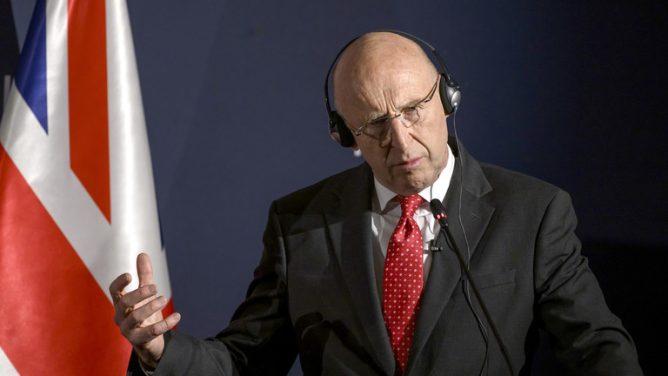
British Defense Secretary John Healey © Getty Images / Antonio Masiello
London will significantly step up offensive cyber operations against Russia and China, UK Defense Secretary John Healey announced on Thursday following the inauguration of the country’s new Cyber and Electromagnetic Command.
In a statement quoted by The Times, Healey claimed that “the keyboard is now a weapon of war” and said the UK’s new cyber command would coordinate both defensive and offensive operations, including hacking into enemy systems to disrupt attacks and spread of propaganda.
Asked whether this would include Russia and China, Healey responded: “Yes.”
Healey’s statement marks the first time a British minister has explicitly confirmed cyberattacks on other states. While UK ministers had previously confirmed cyber operations against non-state actors like Islamic State, they have not until now acknowledged attacks against other countries.
Healey’s comments come ahead of the publication of a strategic defense review on Monday. According to The Times, the review will stress that cyberattacks on Britain, allegedly being carried out by Russia and China, are “threatening the foundations of the economy and daily life.”
Both Moscow and Beijing have consistently denied accusations of carrying out cyberattacks against Western nations, characterizing the claims as baseless and politically motivated.
Additionally, Russian officials have in recent months repeatedly raised concerns over what they describe as Western Europe’s continued militarization and aggressive anti-Russian rhetoric, said to be in response to the alleged threat posed by Moscow.
The Kremlin has vehemently denied having any hostile intent towards any western country, and has accused European politicians of “irresponsibly stoking fears” to justify increased military expenditures, which Moscow had labeled an “incitement of war on the European continent.”
May 29, 2025
Posted by aletho |
Mainstream Media, Warmongering, Russophobia, Sinophobia | UK |
Leave a comment
A short guide on how to engineer a genocide by starvation and ethnic cleansing:
1. Choose your moment. Ok, you’ve been ethnically cleansing, occupying, oppressing and killing your neighbours for decades. The international courts have ruled your actions illegal. But none of that will matter the moment your neighbours retaliate by attacking you. Don’t worry. The western media can be relied on to help out here. They will be only too ready to pretend that history began on the day you were attacked.
2. Declare, in response, your intention to starve your neighbours, treating them as “human animals”, by blocking all food, water and power. You will be surprised by how many western politicians are ready to support this as your “right to defend yourself”. The media will echo them. Important not to just talk about blocking aid. You must actually do it. There will be no serious pushback for many, many months.
3. Start relatively slowly. Time is on your side. Let a little bit of aid in. But make sure to relentlessly smear the well functioning, decades-old aid distribution system run by the international community – one that is transparent, accountable and widely integrated into the community it serves. Say it is infiltrated by “terrorists”.
4. Use that claim – evidence isn’t really necessary, the western media never ask for it – as the pretext to bomb the aid system’s warehouses, distribution centres and community kitchens. Oh, and don’t forget to bomb all the private bakeries, destroy all the farmland, shoot all the animals and kill anyone who tries to use a fishing boat, so that there are no other sources of food. You are now in control of the trickle of aid reaching what is rapidly becoming a severely malnourished population.
5. Time to move into higher gear. Stop the international community’s aid getting in all together. You will need a humanitarian cover story for this bit. The danger, particularly in an age of social media, is that images of starving babies will make you look very bad. Hold firm. You can get through this. Claim – again evidence isn’t really necessary, the western media won’t ask for it – that the “terrorists” are stealing the aid. You will be surprised how willing the media is to talk about babies going “hungry”, ignoring the fact that you are starving them to death, or speak of a “famine”, as though from drought and crop failure, not from your carefully laid plans.
6. Don’t lose sight of the bigger story. You are blocking aid to “eradicate the terrorists”. After all, what is the worth of a baby, of a child – all 1 million of them – in the fight to eliminate a rag-tag army of lightly armed “terrorists” who have never waged their struggle outside of their historic homeland.
7. Now that the population are entirely at your disposal, you can roll out a “humanitarian” alternative to the existing system you have been vilifying and wrecking. Probably best to have been working on this part of the plan behind the scenes from early on, and to have regularly consulted with the Americans on how to develop it. You may even find they are willing to fund it. They usually are. You can obscure their role by using the term “private contractors”.
8. It’s time for implementation. Obviously, the point is not to really distribute aid. It is all about providing a cover story so that the starvation and ethnic cleansing can continue. Make sure you provide only a tiny amount of aid and make it available only at a few distribution points you have set up with these “private contractors”. This has two advantages.
9. It forces the population to come to the areas you want them in. Like luring mice into a trap. Get them to the very edge of the territory, because from there you will be best positioned at some point to drive them over the border and get rid of them for good.
10. Your system will lead to chaos, as desperate, starving people fight for food. That’s great for you. It makes them look like a swarming mass of those “human animals” you were talking about from the start. Don’t they deserve their fate? And it means that young, fit men – especially those from large, often armed, criminal families – will end up with most of the food. The stuff they can’t grab at the distribution points, they will ambush later as people try to return home laden with their heavy aid packages. That may seem counter-productive, given that you’re claiming to want to eliminate the “terrorists”. Won’t these fit, young men, as conditions degenerate further, provide a future source of recruits to the “terrorists”. But remember, the real goal here is to starve the population as quickly as possible. The young, the elderly, the sick and the vulnerable are the ones who will die first. The more of them who start dying, the faster the pressure builds on everyone else to flee the territory to save themselves.
You are nearly there. True, faced with the emaciated bodies of your victims, western politicians will start making harsh pronouncements. But they have already given you a massive head start of 20 months. Be grateful for that. You don’t need much longer. While they dither, you can get on with the job of extermination. Leave it to the history books to judge what really happened.
May 28, 2025
Posted by aletho |
Ethnic Cleansing, Racism, Zionism, Mainstream Media, Warmongering | Israel, Palestine, United States, Zionism |
Leave a comment
On May 16, Russia and Ukraine held their first direct talks since the first months of the former’s invasion. Despite the pessimistic evaluation by Ukrainian and European leaders, the return to diplomacy is itself a major achievement and step forward. The talks lasted an hour and forty minutes.
Western leaders and Western media have given the first round of talks a failing grade. They have dismissed it for three reasons. They claim that Russian President Vladimir Putin first suggested direct negotiations and then did not show. They claim that he sent an insultingly low-level delegation. And they claim that nothing was accomplished.
All three of these claims are false.
Putin did suggest direct negotiations between Russia and Ukraine, but he did not say that those talks would take place at the leadership level. Putin said, “We are proposing that Kiev resume direct negotiations without any preconditions…We offer the Kiev authorities to resume negotiations already on Thursday, in Istanbul.” Putin referred to the Kiev authorities and never to the two presidents.
It was unlikely that Russia would resume talks for the first time at the presidential level. Customarily, before presidents meet, a great deal of preparation and negotiation takes place at lower levels. Then, typically, the foreign ministers would meet to iron out most of the details prior to a presidential meeting.
It is also misleading to present the meeting as Putin not showing up while Ukrainian President Volodymyr Zelensky did. Zelensky did arrive in Turkey, but he declined to agree to direct talks with Putin unless Putin first agreed to a thirty-day ceasefire, posting that “We expect Russia to confirm a ceasefire – full, lasting, and reliable – starting tomorrow, May 12th, and Ukraine is ready to meet.” Ukraine’s Head of the office of President, Andriy Yermak, confirmed, “First a ceasefire for 30 days, then everything else.” According to White House officials, Trump “never agreed” that that a ceasefire was a precondition to the direct talks.
But Zelensky’s precondition was an annulment. Russia was never going to agree to a ceasefire prior to negotiations for two reasons. First, they do not want a ceasefire empty of a settlement because that would maintain the conditions that would likely lead to future war, as happened in the ceasefire in Donbas from the end of the coup in 2014 to the start of the war in 2022. Second, they do not want a ceasefire without a settlement that would allow Ukraine to rest, regroup, rearm and dig trenches simply to return to war thirty days later like the Minsk deception that stung Russia earlier.
Russia has insisted that these negotiations resolve the “root causes” of the war. The Western media continues to deceptively define that insistence as the determination to deflate Ukraine’s sovereignty and calls it a delaying tactic. There is nothing on the historical record to suggest that Putin has ever identified that as a root cause of the war. Russia has always identified the root causes of the war as NATO’s encroachment toward their border and into Ukraine and the need for the protection of ethnic Russians in Ukraine.
The security proposal that Russia presented to the United States and NATO in December 2021 in the days before the war had as its central point that NATO not expand to Ukraine. Then-NATO Secretary General Jens Stoltenberg has confirmed that the “promise [of] no more NATO enlargement… was a pre-condition for not invade Ukraine.” Ukraine’s chief negotiator in the Belarus and Istanbul talks with Russia has also said that stopping NATO from expanding to Ukraine and Russia’s borders was the “key point” for Russia and that “[e]verything else was simply rhetoric and political ‘seasoning.’” Zelensky, himself, has said that the promise not to join NATO “was the first fundamental point for the Russian Federation” and that “as far as I remember, they started a war because of this.”
Russia is not asking for something unimaginable or new. They are asking for what they were promised. Not only did NATO promise to stay out of Ukraine, but Ukraine promised to stay out of NATO. Article IX of the 1990 Declaration of State Sovereignty of Ukraine says that Ukraine “solemnly declares its intention of becoming a permanently neutral state that does not participate in military blocs…” That promise was later enshrined in Ukraine’s constitution, which committed Ukraine to neutrality and prohibited it from joining any military alliance: that included NATO.
Russia is not going to agree to a ceasefire without resolving this root cause of the war for the same reason that it went to war to resolve it.
The second reason for giving the first round of direct talks a failing grade is that Putin sent an insultingly low-level delegation. This is not only unfair for the reasons already discussed—that initial talks are usually conducted at a low level—but also because it ignores who Putin sent to conduct the talks. The Russian delegation is led by Vladimir Medinsky, the same person who led the Istanbul talks at the beginning of the war. Those talks nearly succeeded, and the nomination of Medinsky is a signal both that Russia is serious and that Russia sees the current round of talks as a continuation of the previous round. Putin said, “It was not Russia that broke off negotiations in 2022. It was Kiev. Nevertheless, we are proposing that Kiev resume direct negotiations without any preconditions.”
The third reason is that nothing of substance was accomplished. That, too, is untrue. The very resumption of direct talks is a major breakthrough. But, beyond that, some things of substance were accomplished.
The first is an agreement to exchange 1,000 prisoners each. Though prisoner exchanges have occurred during the war, this would be the largest exchange agreed to yet. It may also represent a goodwill gesture on the part of Russia, since it has been suggested in the Ukrainian press that Ukraine may not have 1,000 Russian prisoners of war.
The second is that the two sides each agreed to present a detailed document on its vision for a ceasefire. This is a significant achievement for a first round of talks.
The third is that, once the documents are presented and discussed, Medinsky said that “we think it will be reasonable to continue our negotiations.” Agreeing on a second round of talks is another positive and significant achievement.
Undercutting the negative assessment of Western officials and Western media, the Ukrainian delegation told The Washington Post that, “despite the heated exchanges… the talks eventually became constructive.” The Russian delegation agreed that they were “satisfied” with the first meeting.
The Wall Street Journal has reported that the next round of talks could take place in mid-June, though their location is in doubt. Originally reported to be taking place in the Vatican, the Kremlin has suggested that the Vatican may not be the ideal location for two Orthodox Christian nations.
For the next round to get past the “heated exchanges” and continue to progress, key compromises will need to be made by both sides. Ukraine will have to agree not to join NATO. This is a big concession but should not be a deal breaker. Russia was promised this at the end of the Cold War, and Ukraine agreed to it during the Istanbul talks at the beginning of the war. If it was acceptable to Ukraine then, it should not be a fatal obstacle now.
In return, Russia will have to agree to real security guarantees for Ukraine. They will not agree to NATO nations as guarantors of the peace but could be open to countries from the Global South who have not sanctioned Russia or condemned its invasion of Ukraine but who also have not condoned it and would not want to see a ceasefire broken.
The West could agree to allow Ukraine to be armed, but not allow it to be armed with long-range weapons capable of striking Russia. The guarantors could agree to come to Ukraine’s aid if Russia breaks the ceasefire and attacks but not agree to come to Ukraine’s aid if they provoke Russia in hopes that they will come to Ukraine’s aid, much as China has been willing to promise Pakistan help if they are attacked but not if they irresponsibly cause the attack.
Both sides will need to make concessionary moves from their current territorial demands. Ukraine will never agree to Russia’s claim on more territory than it has conquered. Russia has hinted at some willingness to compromise on this. Russia will never agree to Ukraine’s demand to return territory to the prewar, or even pre-2014, borders. Ukrainian insistence on this condition for peace will guarantee that there will be no peace. And no peace will mean only that Ukraine will cede more territory to Russia. It is practical, then, for both sides to agree to negotiations beginning along the current line of conflict.
The recent return to direct talks between Russia and Ukraine can only be positive. And they accomplished more than the Western media and European leaders have suggested. Continued progress will require compromise and a genuine desire to build a peace that is workable and lasting.
May 28, 2025
Posted by aletho |
Mainstream Media, Warmongering, Militarism | NATO, Russia, Ukraine |
Leave a comment
The recent events involving India and Pakistan, in a short-lived, conventional and timely conflict, prompt us to reflect carefully on the use and management of media coverage of the conflict.
It is important to remember that the domination of information has to do with the domination of the mind; therefore, the way in which an event is narrated largely defines the perception that the masses will have of it. Controlling the narrative means controlling the majority element of the cognitive-perceptual dimension.
So, let’s look at the facts. A few hours after the massacre of 26 civilians in Pahalgam on 22 April, the main Indian media had already passed judgement. No investigation had yet been launched, no credible claim had been made, nor had any attempt been made to identify specific responsibilities, yet in a very short time the dominant narrative had been established: Pakistan was to blame.
What happened next represents a new critical point in the information war that now accompanies every moment of tension between India and Pakistan. In the days that followed, the Pakistani High Commission in New Delhi suffered expulsions of staff, Pakistani citizens were ordered to leave India by 30 April, and a decisive digital offensive was launched. Significantly, the Indian authorities blocked Pakistani YouTube channels, froze social media profiles and targeted narratives coming from across the border.
From Islamabad’s point of view, this was not simply a response to terrorism through the media, but rather a form of information terrorism, an occupation of the narrative. This is a key turning point.
The conflict between the two countries has always been marked by propaganda, disinformation and narratives inflamed by the media on both sides and also abroad, where there is a constant attempt to identify with one faction or the other (as is to be expected); but in 2025, the information landscape is not only a subject of contention, it has become colonised territory.
Pakistan, increasingly marginalised in the large international digital spaces, finds itself fighting a narrative war at a disadvantage. The way in which the Indian media reported the Pahalgam attack follows a well-established script: vague intelligence sources, information presented as established facts, inflammatory talk shows launched well before any concrete evidence emerged. Even after Pakistan’s firm denial and request for a joint investigation, the Indian press continued its campaign. Outlets such as Times Now and Republic TV immediately ran alarmist headlines: ‘Pakistan-sponsored terrorism is back’, ‘It’s time for a military response’. Terms such as ‘atrocious’, ‘state-sponsored’ and ‘surgical strike’ dominated the broadcasts, while scientific investigations were still in their early stages.
No independent verification – note this detail – has been made public. The few Pakistani voices invited onto television programmes were promptly attacked. There was no editorial caution, no balance.
It is fair to acknowledge that Pakistan also has a complicated past with press freedom and control of narratives by the authorities, but what emerges today is not a symmetrical conflict, but rather an unbalanced silence.
On 25 April, the Indian Ministry of Information banned 16 YouTube channels, 94 social media accounts and six news sites linked to Pakistan. The official reason? ‘Protection of national security and sovereignty’. The concrete result: the blocking of almost any alternative or critical viewpoint, especially on issues such as Kashmir, the attack on Pahalgam or bilateral relations. Among the platforms affected were independent media outlets such as Naya Daur, channels run by Pakistani scholars abroad and cultural content with no political affiliation. At the same time, official fact-checking units launched a campaign to expose what they called ‘Pakistani disinformation,’ but the content removed also included material based on authoritative international sources, archive articles that were still valid, and statements taken out of context. The result was a sharp restriction of freedom of expression and access to certain local sources. Even diplomatic communications were not spared. The Pakistani Foreign Ministry saw many of its official posts on X (formerly Twitter) blocked, including statements calling for calm. On 29 April, the hashtag #FalseFlagPahalgam, widely shared in Pakistan, was virtually invisible on platforms accessible from Indian territory.
Tensions reached a new peak on 7 May 2025, when India struck civilian and military targets in Punjab and Pakistan-controlled Kashmir, sparking fears of a serious escalation. Islamabad called the operation ‘a blatant act of war’ and announced that it had shot down five Indian military jets, three of which were also confirmed by international media. India has not yet officially responded to this claim, but anonymous government sources have said that three fighter jets crashed in Indian-controlled Kashmir, without confirming whether they actually belonged to India or Pakistan.
Geopolitical asymmetries
It is precisely in this disproportion that the real asymmetry can be perceived. India, thanks to its technological resources, its links with major global platforms and its ability to influence algorithms, controls the digital narrative. Pakistan, on the other hand, is often its victim. The result is a one-sided war of narratives, in which Delhi sets the terms of the debate and Islamabad is relegated to the role of designated culprit.
The internal consequences are no less serious: increased Islamophobia, similarities between Kashmiri identity and jihadism, and some localised tensions. Hashtags such as #PunishPakistan and #MuslimTerror have spread widely without control, while Pakistani responses denouncing violence or discrimination have been labelled as disinformation and deleted.
This double standard only fuels radicalism on both sides. It pushes young Pakistanis towards closed and polarised environments and makes it increasingly difficult to build peaceful bridges between the two peoples. What was once a space for cultural diplomacy is now a digital minefield. The silence of big tech and Western media in the face of India’s censorship is significant: when an authoritarian regime represses dissent, it is called tyranny; when India does so in the name of ‘national security’, it is praised as moderate. Pakistan has asked for the opportunity to defend itself in the information arena and has been effectively denied, leaving it at an international disadvantage.
The absence of real journalistic scrutiny signals a deeper evil: narrative has replaced facts. The struggle for dominance is now being fought with tweets, headlines and talk shows.
At this level of conflict, the gap between what is true and what is plausible becomes very difficult to discern. Do you understand how powerful this tool is? The frame within which the narrative is placed is what determines how the ‘truth’ of that event will be constructed.
The example of India and Pakistan teaches us that there is no need to fire guns, even in a historical conflict such as theirs. Words work much better. Because even when the guns have fired, there will still be ‘good guns’ and ‘bad guns’, and that value judgement will be made by the way people perceive what happened, not by an objective or rationally agreeable truth.
In all this, the great media victory is that a narrative front has been opened up that can easily be used by other global powers and could be employed by some of them to drag other adversarial countries into an information conflict. Russia, China, the UK and the US have interests at stake and could become part of this expanded infowar front. Because in the world of information, war does not have the space and time limitations of conventional warfare: everything is fast, fluid, constantly expanding and contracting, and knows no night or day.
Information warfare may save more lives, but it claims more victims. Lives are saved because direct killing can be avoided; victims are claimed because everyone involved will inevitably be hit by the weapon of information.
May 27, 2025
Posted by aletho |
Fake News, Full Spectrum Dominance, Islamophobia, Mainstream Media, Warmongering | India, Kashmir, Pakistan |
Leave a comment
We recently learned that Secretary of Defense Pete Hegseth shared details of impending drone strikes on Yemen in a group chat with his wife, brother and personal attorney. If this story sounds familiar, it’s because it comes just weeks after national security leaders—including Hegseth—accidentally added Atlantic journalist Jeffrey Goldberg to a Signal chat.
The outrage is understandable. Why were military plans shared on an unsecured channel? Were U.S. personnel put at risk? Why did the president not respond strongly to this apparent breach? And of course, the attempted cover-up is making headlines, too.
Something else strikes me. Few seem angry that the government conducts offensive military operations in a country with which we are not formally at war. Headline after headline emphasizes the leaking of war plans—not the “war” itself.
I’ve studied conflict for over a decade. From terrorism and counterterrorism to the development of drone technology and how foreign intervention alters domestic institutions, I know what war does. It kills. It destroys property and devastates economies. It enables people to do the unthinkable—to rape, torture, maim children, and use them as soldiers. War destroys.
Yet, our secretary of defense tells his brother about coming strikes with the same gravity as he’d relay his grocery list.
What’s equally jarring is the public reaction. People aren’t aghast that U.S. drones are killing people in Yemen. People aren’t batting an eye over officials bypassing Congress’s war powers.
We are more concerned about the data leak than about what the data contains.
This indifference isn’t new. In my research, I’ve documented how Americans have become desensitized to war. We’ve been in some state of conflict for more than 93 percent of the calendar years between 1775 and 2018.
I’ve studied how the typical American is constantly exposed to pro-military, pro-U.S. foreign policy messaging. For example, television shows and movies are often subject to editorial review by the Department of Defense in exchange for using military hardware and personnel. We see that messaging in sports, too. In football, we have “bombs,” “blitzes” and “trenches” around the line of scrimmage. We “blow away” the opposing team. We have military homecomings on the pitcher’s mound or centerfield and celebrate without ever asking why our military personnel are deployed in the first place.
Meanwhile, modern technology allows us to easily wash our hands of misgivings.
Drone technology lets officials sell us on the supposed—and false—“surgical precision” of drone strikes, effectively sanitizing the violence. We “eliminate” or “neutralize” “high-value targets” and “combatants.” Never mind that intelligence failures are common and that many of those “combatants” were labeled as such because they happened to be “military-aged males,” or MAM. In other words, they were males aged 14-65 in a strike zone. And what of the civilians, the women and the children? Unfortunate “collateral damage.”
As a result, most of us don’t recognize America’s massive military boot print. How many Americans know the United States operates 750 military bases in more than 70 countries? How many know about the U.S. drone strikes conducted in the last five years in Afghanistan, Pakistan, Somalia, Syria and across Africa? Hundreds of civilians were killed.
For too long, we’ve failed to ask policymakers and ourselves the hard questions. We don’t need to ask about the leaks; we need to ask about the normalization of perpetual war. We need to ask about the moral costs of our government’s actions and about whether our proactive, military-forward policy is truly in our best interests.
May 25, 2025
Posted by aletho |
Mainstream Media, Warmongering, Militarism | United States |
Leave a comment
As the old saying goes, “it’s good to talk.” Good, that is, for most reasonable people who understand that dialogue is a process that opens positive possibilities, especially when the dialogue is conducted respectfully and sincerely.
This week, US President Donald Trump held his third phone conversation with Russian leader Vladimir Putin since he was inaugurated in the White House in January. The latest one on Monday was even more substantive than the previous calls, lasting about two hours, and, according to both sides, it was conducted in a friendly and productive manner.
Of course, the main topic of conversation was finding a peaceful end to the more than three-year war in Ukraine. Trump deserves credit for at least trying to bring peace to the table, instead of more and more weapons, as his predecessor, the mentally decrepit Joe Biden, did, and assorted European leaders would like to continue doing.
There was also discussion between Trump and Putin, using first names in their verbal exchanges, about repairing US-Russia relations for trade and strategic cooperation.
That portends a transformation in Washington’s erstwhile agenda of hostility towards Russia.
Tellingly, however, the talking was deemed “not good” by others, as could be gleaned from the vexed reactions to Trump’s call with Putin from European leaders and American advocates of the Euro-Atlantic alliance.
European politicians were reportedly “stunned” and “shocked” by Trump’s diplomatic outreach to Putin.
Following his conversation with the Russian president, Trump briefed five European leaders jointly. They included Germany’s Merz, France’s Macron, Italy’s Meloni, Finland’s Stubb, and the European Commission’s chief Von der Leyen. Ukraine’s Vladimir Zelensky was also part of the conference call. The non-entity British prime minister was not included. Sometimes, talking with toxic people is not good!
The Europeans tried to put a positive spin on the briefing from Trump, with Von der Leyen describing it as “good”. But that was the Europeans trying to save face from what is a stunning blow to the Euro-Atlantic alliance.
In a press conference at the White House on Monday, after his calls with Putin and the Europeans, Trump made it clear from his statements that the vaunted alliance is shattered. He is no longer listening to them, and his agenda towards Russia is transformational, if it is permitted to develop.
Trump rejected the European demands for an immediate 30-day ceasefire in Ukraine and more economic sanctions on Russia. He said that imposing more sanctions did not help resolve the conflict. Trump also indicated that he concurred with Russia’s logical position that negotiations must be focused on establishing a lasting peace, one that deals with addressing the root causes of conflict.
The European and Ukrainian demands for a 30-day truce as a precondition are not workable or logical. Indeed, such insistence impedes negotiations. From a cynical point of view, that is why the European backers of the Kiev regime are making such a song and dance about sanctions and the 30-day truce, because those demands are aimed at preventing diplomacy succeeding with Russia.
Britain’s Financial Times headlined its report on the Trump-Putin call: “Why Europe fears the worst after Trump’s ‘excellent’ chat with Putin”.
The BBC inadvertently shed light with its headline: “Trump’s call with Putin exposes shifting ground on Ukraine peace talks”. The BBC-speak about “shifting ground on peace talks” is an Orwellian translation. What the BBC should have said in plain language was that Trump is shafting the European warmongers.
Meanwhile, across the Atlantic, the supporters of the NATO proxy war against Russia tried their best to undermine Trump’s diplomacy.
The New York Times – the CIA’s main choice for gaslighting the American population – called the phone call a “diplomatic win for Russia” and snidely said, “Trump backs off ceasefire call”. The latter implied that Trump is against peace when, in fact, he is the only Western adult in the room calling for peace.
The Washington Post also did its best to smear Trump, reporting: “After call, Trump gives Russia more time for Ukraine war”. An op-ed piece also mockingly claimed: “Trump wasted two hours with Vladimir Putin”.
CNN, another outlet that has loyally and absurdly pushed the NATO proxy war as a noble endeavor, accused Trump for “siding with his friend in the Kremlin” and claimed that “peace in Ukraine looks further away after Trump’s call with Putin”, adding that “Putin got exactly what he wanted… stringing Trump along.”
The riot of negative and vitriolic reactions on both sides of the Atlantic shows that the US-European alliance under Trump has shattered. That alliance embodied by the NATO military bloc has been the linchpin of the “Collective West” for eight decades. It has now cracked wide open.
Unlike his predecessors in the White House, Donald Trump does not want to pursue a destructive and futile policy of inflicting a strategic defeat on Russia. That policy is what engendered the war in Ukraine, from the CIA-backed coup in Kiev in 2014, to the provocative weaponization of Ukrainian NeoNazis, until Russia’s intervention in February 2022 to defend its rights.
Trump appears to genuinely want to end the proxy war and to normalize relations with Russia for the sake of world peace, and, why not, good business.
For the Euro-Atlanticists, with their incurable, imperialist, and Russophobic mindsets, such a policy is anathema.
However, the good news is that the gaping cracks in the so-called Collective West now provide a path to peace.
Trump and Putin can end the war in Ukraine and negotiate an important peace deal that addresses Russia’s historic security grievances that stem from the decades of NATO aggression, which past American presidents and their European surrogates have facilitated.
For Trump to do that, he needs to listen carefully to the Russian leadership and reciprocate. If a new detente can be achieved, then the world will be a better, more secure, and peaceful place.
The other thing that Trump needs to do is to dismiss European lackeys with their warmongering servility to the status quo ante. They are has-beens and have nothing constructive to offer.
Trump’s phone call with Putin this week has had a major impact, and one that has significant potential for peace. The cracks in the Cold War mental bloc, so to speak, are a way forward.
May 24, 2025
Posted by aletho |
Mainstream Media, Warmongering, Russophobia | European Union, New York Times, Russia, United States, Washington Post |
Leave a comment
The European Union has pledged €5.5 million in emergency funding to Radio Free Europe/Radio Liberty (RFE/RL) to prop up the Cold War-era broadcaster, which is widely regarded as a Western propaganda outlet.
Originally created in the 1950s and covertly financed by the CIA to disseminate pro-Western narratives into the Soviet bloc, RFE/RL has more recently operated under the oversight of the US Agency for Global Media (USAGM). In March, President Donald Trump signed an executive order eliminating most of the agency’s funding as part of a sweeping cost-cutting agenda.
EU foreign policy chief Kaja Kallas announced the bloc’s financial lifeline on Tuesday, describing it as “short-term emergency funding” to support what she called a “vital” mission. The €5.5 million package will act as a “safety net” to help RFE/RL maintain operations in countries within Brussels’s sphere of interest, including Russia, Belarus, Iran, and several Central Asian states.
“In a time of growing unfiltered content, independent journalism is more important than ever,” Kallas said following a meeting of EU foreign ministers. She acknowledged that Brusssels could not fully replace the lost American funding but emphasized the symbolic value of the move, urging individual member states to offer further support.
Since Trump’s defunding order, RFE/RL has furloughed staff, suspended programming, and launched legal challenges. Although a Washington judge temporarily halted the administration’s decision in April, a federal appeals court later blocked the release of funds pending further litigation. The broadcaster has warned that it faces permanent shutdown in multiple regions if its financial crisis is not resolved.
The Trump administration framed the defunding as part of a broader campaign to dismantle bureaucratic institutions that no longer align with US strategic interests. RFE/RL’s leadership has disputed that rationale, with its president, Stephen Capus, calling the funding cuts a “massive gift to America’s enemies.”
Administration officials and critics have argued that RFE/RL and its sister outlet, Voice of America (VOA), have lost their relevance and veered toward partisan editorializing. Tech billionaire Elon Musk, who heads the Department of Government Efficiency (DOGE), has publicly called for both outlets to be “shut down,” writing on X: “Nobody listens to them anymore.”
May 22, 2025
Posted by aletho |
Corruption, Mainstream Media, Warmongering | European Union, United States |
Leave a comment
The Office of the Russian Prosecutor General has banned Amnesty International, the London-based non-governmental organization (NGO), accusing it of Russophobia and support for the Ukrainian military.
An official statement on Monday said that while the “organization positions itself as an active champion of human rights throughout the world,” its headquarters in the British capital have turned into a “center for preparing global Russophobic projects, paid for by accomplices of the Kiev regime.”
“Members of the organization support extremist organizations and finance foreign agents’ activities,” the Prosecutor General’s Office claimed.
Amnesty has been actively working toward “increasing military confrontation” since the escalation of the Ukraine conflict in February 2022. Russian prosecutors have accused the NGO of whitewashing Ukrainian war crimes, calling for more financial support for Kiev and the economic isolation of Moscow.
Last month, Moscow banned US-based NGO Hope Harbor Society for providing financial support for the Ukrainian military as well as the coordination of anti-Russian protests in the US and other countries.
In early April, the Elton John AIDS Foundation was designated as ‘undesirable’ in Russia after being accused of promoting pro-LGBTQ agenda in the country.
Organizations with such a designation are banned from operating in Russia, and residents or companies may face legal penalties for providing financial or other forms of support to them.
The Russian Justice Ministry currently lists more than 200 such entities, including major Western influence groups such as George Soros’ Open Society Foundations, the US-based German Marshall Fund, and the pro-NATO Atlantic Council.
May 19, 2025
Posted by aletho |
Mainstream Media, Warmongering, Progressive Hypocrite, Russophobia | Russia, UK |
Leave a comment
“For posterity’s sake.” Those words from President Joe Biden sum up the crushing impact of the leaked audiotapes from the interview between then-President Joe Biden and Special Counsel Robert Hur. Not only did they remove any serious doubt over Biden committing the federal crimes charged against President Donald Trump, but they also constituted what is akin to a political racketeering indictment against much of the Washington establishment.
The interview from Oct. 8-9, 2023, has long been sought by Congress, but was kept under wraps by the government even as Biden campaigned for a second term.
Many of us balked at Hur’s conclusion that no charges were appropriate despite the fact that the President removed classified material for decades, stored it in grossly negligent ways, and moved it around to unsecure locations, including his garage in Delaware.
Given President Donald Trump’s indictment for the same offenses, it was hard to imagine how the Special Counsel could not recommend the same criminal charges (presumably after he left office).
Instead, Hur declared it would have been hard to get a jury to convict Biden because he was “a sympathetic, well-meaning, elderly man with a poor memory.”
It appears that Trump, on the other hand, was presumptively not sympathetic or well-meaning and possessed a good memory for prosecution.
The contrast was glaring and only reinforced the view of many citizens that there are two tracks for justice in Washington.
Soon after the report’s release, President Biden gave an irate press conference in which he lied about the findings of his culpability and lashed out at any suggestion that he had gapped or stumbled in the interview.
For example, when reporters raised how Biden forgot when his son Beau died, Biden angrily responded, “How in the hell dare he raise that?” Frankly, when I was asked the question I thought to myself it wasn’t any of their damn business.
However, it was not Hur but Biden himself who raised the death of his son, and he forgot a wide array of dates, including when he served in office.
The interview shows that in 2023 it was clear that Biden was mentally diminished despite claims from many allies and former aides that there was a sudden loss of capacity just before the disastrous debate in 2024. It is now undeniable that the White House staff actively hid the president’s incompetence from the American public. That includes the White House press secretary Jen Psaki (who left her post in May 2022) and Karine Jean-Pierre who insisted that Biden was sharp and “running circles” around the staff.
Of course, the media is now covering the story after the public saw the truth in the debate. Figures like CNN’s Jake Tapper have even written books that belatedly pursue the question despite previously insisting that there was no evidence of a diminishment in Biden’s mental state.
Tapper repeatedly dismissed the claim and even mocked Lara Trump for raising it. In one interview, he pushed a White House talking point that such suggestions were mocking Biden for a childhood stutter:
“It’s so amazing to me- a ‘cognitive decline.’ I think you were mocking his stutter. Yeah. I think you were mocking his stutter and I think you have absolutely no standing to diagnose somebody’s cognitive decline. I would think somebody in the Trump family would be more sensitive to people who do not have medical licenses diagnosing politicians from afar.”
When Lara Trump insisted that this was clearly evidence of a “very concerning” cognitive decline, Tapper dismissed her statement by saying “Thank you, Lara. I’m sure it’s from a place of concern. We all believe that.”
Keep in mind that others beyond Lara Trump were raising this issue and there were tapes showing physical and mental diminishment. The media simply refused to seriously pursue the story until the cover-up no longer mattered after the debate.
Over on MSNBC, Joe Scarborough was equally apoplectic at those raising the issue and stated
start your tape right now because I’m about to tell you the truth. And F— you if you can’t handle the truth. This version of Biden intellectually, analytically, is the best Biden ever. Not a close second. And I have known him for years… If it weren’t the truth I wouldn’t say it
This media effort continued all the way up to the debate itself. On CNN, Oliver Darcy wrote, “Right-wing media figures are desperately pushing conspiracy theories about Biden ahead of the debate.”
Once the public found out, the media was ready to tell the story when there was no longer any advance or ability to deny it. Articles began to appear with the same realization of “Oh you meant THAT mental decline. Well sure.”
It was the same belated acknowledgment that came, after the election, with Hunter Biden’s laptop. The media just moved on with a shrug and a collective “our bad” concession.
As for the President himself, the one moment of clarity in the interview may have been his most incriminating line. When asked why he removed classified material on Afghanistan, Biden admitted “I guess I wanted to hang on to it for posterity’s sake.”
That is precisely what critics on CNN and MSNBC accused Trump of doing: removing material as types of keepsakes or trophies.
One president was indicted for that and one was sent along his way to a second term in office.
The real indictment that comes out of these tapes is a type of political racketeering enterprise by the Washington establishment. It took a total team effort from Democratic politicians to the White House staff to the media to hide the fact that the President of the United States was mentally diminished. If there were a political RICO crime, half of Washington would be frog-marched to the nearest federal courthouse.
Of course, none of this complicity in the cover-up is an actual crime. It is part of the Washington racket.
After all, this is Washington, where such duplicity results not in plea deals but book deals.
May 18, 2025
Posted by aletho |
Deception, Fake News, Mainstream Media, Warmongering | United States |
Leave a comment




 Aletho News