After All the Media Hype, Wildfires Across Southern Europe Were Completely Normal in 2023
BY CHRIS MORRISON | THE DAILY SCEPTIC | FEBRUARY 25, 2024
Writing in the Daily Telegraph last July, Suzanne Moore reported that the “world is on fire – and we can’t ignore it any longer”. She was noting the usual outbreaks of summer wildfires in southern Europe and suggested a retreat by cautious holiday makers in Rhodes away from one conflagration was “what climate refugees look like”. The Guardian was in similar hysterical mode observing that the lesson from Greece was “the climate crisis is coming for us all”. Such was the level of Thermogeddon interest last summer it is curious that final figures for areas burnt during the year are missing from mainstream media. In the five largest southern European countries for which the EU provides separate data – Portugal, Spain, France, Italy and Greece – 2023 was only the 20th highest in the modern satellite burnt acreage record going back to 1980.
This is perhaps not surprising. Fire ‘weather’ is a potent tool in stoking up general climate anxiety and helps promote the need for a collectivist Net Zero political solution. The Guardian used video footage of tourists moving away from one wildfire last year to claim “survival mode” could easily pass for a “TV climate crisis awareness raising campaign”. An Agence France-Presse report in the Guardian quoted EU spokesman Balazs Ujvari as stating that fires are getting more severe. “If you look at the figures every year in the past years, we are seeing trends which are not necessarily favourable.”
Let us look at some of the figures, starting first with the graph below compiled by the investigative climate writer Paul Homewood.

As noted, the five major countries of southern Europe show many years since 1980 when wildfires consumed more hectares of land. Last year was an average period, easily beaten by 2017 and dwarfed by 1985. In fact the graph above from EU data shows that wildfire acreage over these countries has actually declined over the last 43 years.
Economic damage can be considerable, although the trend on this front shows little overall change over the last two decades across the EU.
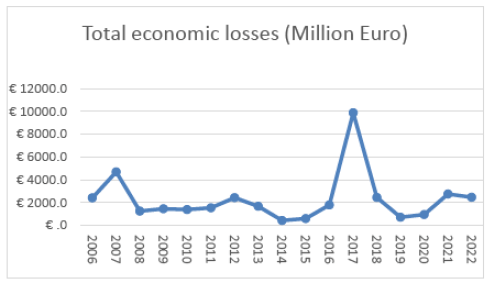
Like many natural events, wildfires cause lives to be lost. Using this tragic loss of life to whip up climate fear is deplorable, not least since many wildfires are deliberately or accidentally started by humans. Greece had a bad wildfire season last year with the BBC reporting that 79 arrests had been made for arson. The BBC accepts that wildfires are common in Greece but “scientists say” there is a link between extreme weather events and climate change. Stefan Doerr of the Centre for Wildlife Research at Swansea University notes that arson “can more easily turn into fast-moving wildfires”. Arsonists, it seems, just love climate change.
Last year, the climate scientist Patrick Brown admitted that he had written a paper published in Nature that focused exclusively on how climate change had affected extreme wildfire behaviour and ignored other key factors. In particular he downplayed the information that 80% of wildfires are lit by humans. He laid out his whistle-blowing claims in an article titled: ‘I Left Out the Full Truth to Get My Climate Change Paper Published’. He knew not to try to quantify key aspects other than climate change because it would dilute the message journals like Nature want to tell, he observed, adding: “To put it bluntly, climate science has become less about understanding the complexities of the world and more about serving as a kind of Cassandra, urgently warning the public about the dangers of climate change.”
Wildfires are an easy propaganda win for climate alarmists. People die, property is destroyed and the published images are spectacular. But fires are a vital part of nature, always have been. They help clear away the debris that accumulates naturally in forests and scrub land and provide a path for regenerative growth. There is little evidence that natural trends are on the increase around the world, and none to suggest that humans play a part in natural ignition by burning hydrocarbons and releasing carbon dioxide into the atmosphere. In its sixth assessment report, the Intergovernmental Panel on Climate Change (IPCC) specifically ruled out human involvement in ‘fire weather’, both in the past and going forward to the turn of this century.
Chris Morrison is the Daily Sceptic’s Environment Editor.
Headlines in Western media distort facts about Israeli genocide in Gaza
Press TV – February 24, 2024
Since October 7, when the Israeli regime launched its no-holds-barred onslaught against Palestinians in the besieged Gaza Strip, Western states have gone out of their way to whitewash the ongoing genocide.
The mainstream Western media, which is an extension of Western states, has toed the same line.
Headlines in the leading newspapers and news channels in the West, particularly in the United States and the United Kingdom, have deliberately sought to distort facts about the Israeli war on Gaza.
An attempt has been made to dehumanize Palestinians and belittle their tragedy while the Israeli regime and settlers living in the occupied Palestinian territories have been portrayed as victims and sufferers.
More than 29,300 Palestinians have been killed in the genocidal war on Gaza since October 7, including more than 13,000 children and an equal number of women. However, Western media outlets have sought to dehumanize them by reducing them to cold statistics.
We analyzed news headlines in the Western press in recent months regarding the Israeli war on Gaza and it became crystal clear that the reportage has been heavily biased and riddled with distortions.
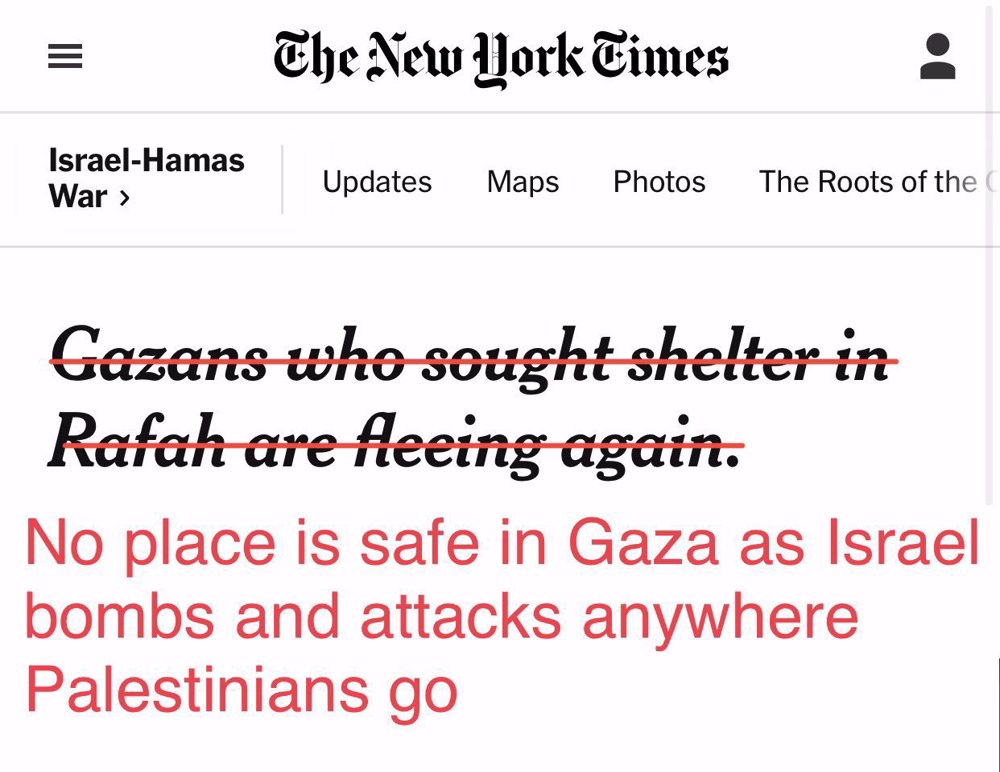
- ‘Gazans who sought shelter in Rafah are fleeing again’
A headline in the New York Times on February 15 showed how the Western media has resorted to spin-doctoring while reporting the events unfolding in Gaza. No mention of what the Israeli regime did in Rafah, southern Gaza, or why 1.4 million Palestinians are packing up and constantly moving.
Headline suggested: No place is safe in Gaza as Israel bombs and attacks anywhere Palestinians go
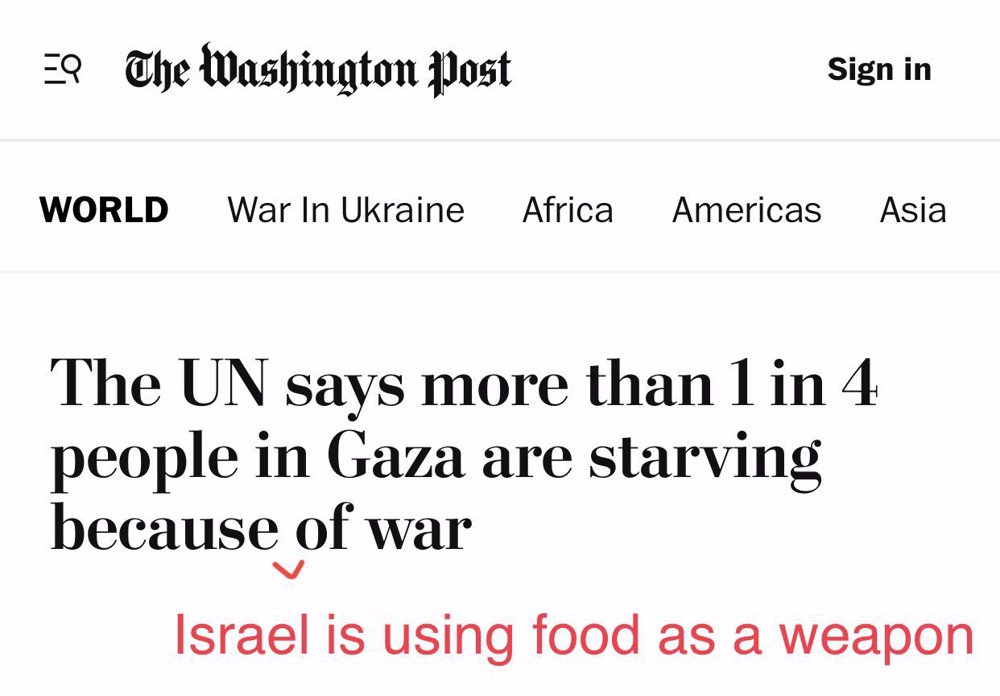
- ‘The UN says more than 1 in 4 people in Gaza are starving because of war’
A headline in the Washington Post, originally from AP, on December 21 cited the United Nations as saying that more than one in four Gazans are starving because of war. It didn’t specifically mention whose war is it and who is using starvation as a weapon of this genocidal war against Palestinians.
Headline suggested: The UN says more than 1 in 4 people in Gaza are starving because Israel is using food as a weapon
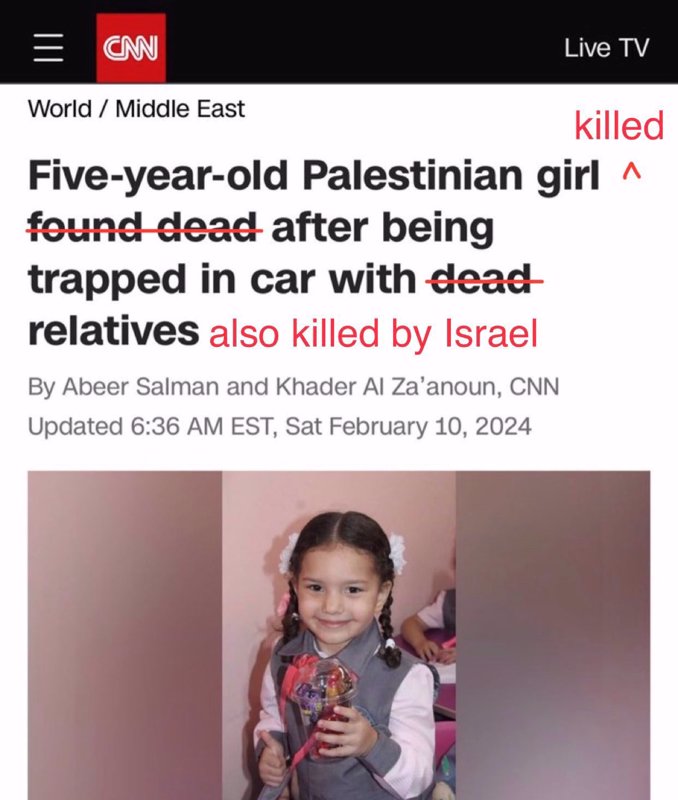
- ‘Five-year-old Palestinian girl found dead after being trapped in car with dead relatives’
A headline on CNN on February 10 was about the murder of 5-year-old Palestinian girl Hind Rajab. The report carefully and cunningly portrayed the murder as a death without mentioning how she went missing and was eventually found murdered in cold blood with other members of her family.
Headline suggested: Five-year-old Palestinian girl killed after being trapped in car with relatives also killed by Israel
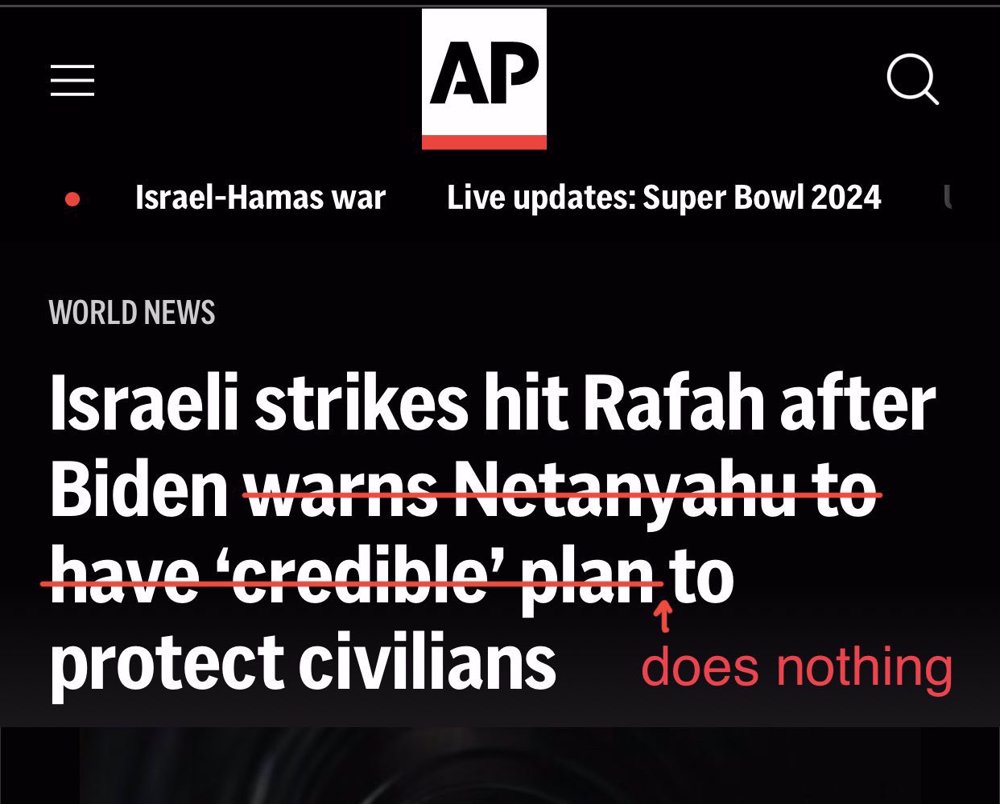
- ‘Israeli strikes hit Rafah after Biden warns Netanyahu to have ‘credible’ plan to protect civilians’
A headline in the AP news agency, reproduced by other mainstream media outlets, on February 12 said Israeli strikes targeted the city of Rafah in southern Gaza after President Joe Biden “warned” Benjamin Netanyahu to protect civilians. It didn’t refer to how the US government and its allies green-lighted it with financial aid and arms.
Headline suggested: Israeli strikes hit Rafah after Biden does nothing to protect civilians
- ‘Israel’s war on Hamas homes in on Gaza hospitals’
A headline in Reuters on November 11, 2023, sought to push the narrative that the Israeli bombing campaign in Gaza targets the Hamas resistance group, not civilians. There was no mention of hospitals, universities, refugee camps and other civilian infrastructure destroyed by the regime.
Suggested headline: Israel’s war on Gaza hospitals, journalists, children and civilians continues

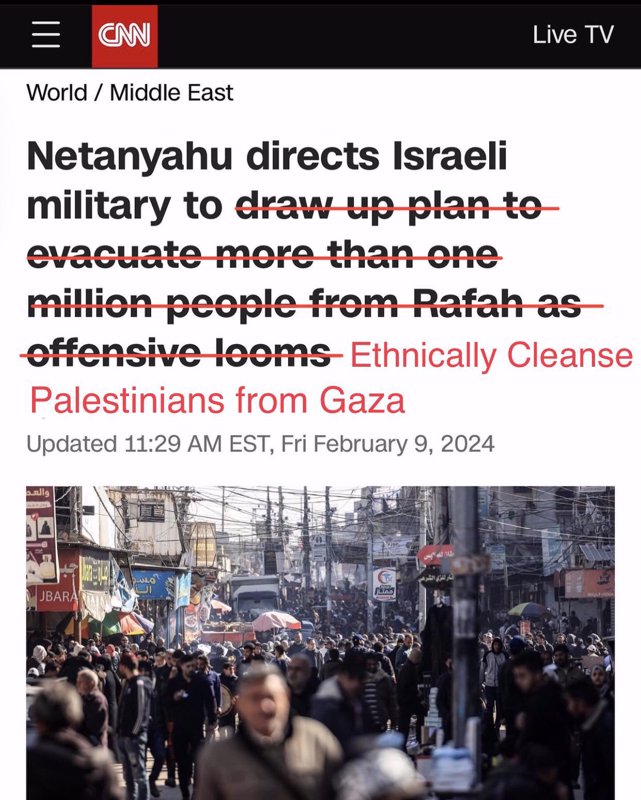
- ‘Netanyahu directs Israeli military to draw up plan to evacuate more than one million people from Rafah as offensive looms’
A headline on CNN on February 9, in a manipulative way, tried to project the Israeli premier as a messiah who cares about the people in Rafah and wants them evacuated before launching the ground offensive. It ignored the fact that hundreds of Palestinians are being killed daily in the southern city.
Headline suggested: Netanyahu directs Israeli military to ethnically cleanse Palestinians from Gaza
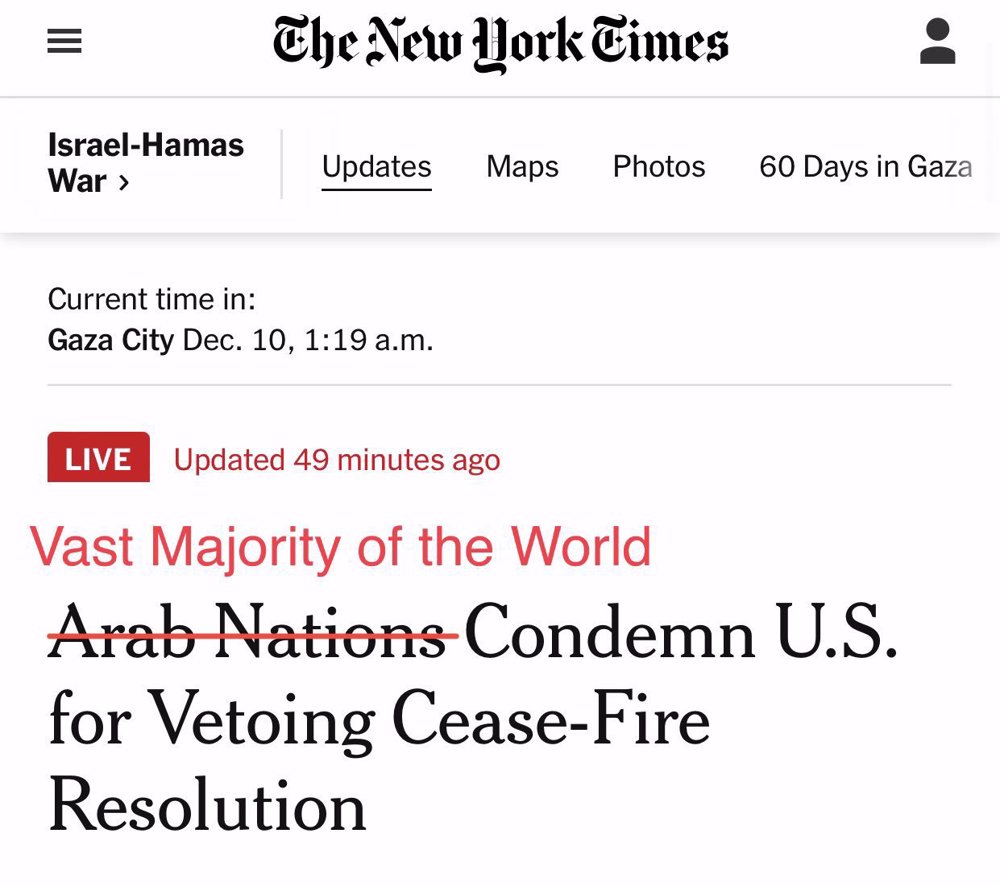
- ‘Arab nations condemn US vetoing ceasefire resolution’
A headline in the New York Times on December 10, 2023, after the US used its veto against the resolution that called for a humanitarian truce in Gaza, said Arab countries slammed the move. The fact is that the majority of countries condemned the American veto, which the US daily disregarded.
Headline suggested: Vast majority of world condemns US for vetoing ceasefire resolution
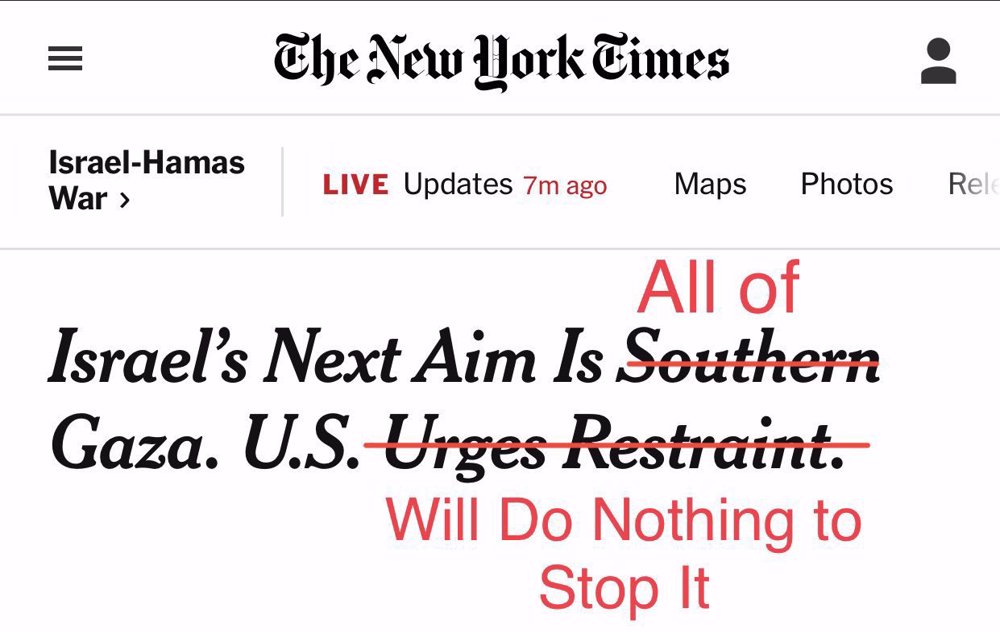
- ‘Israel’s next aim is southern Gaza. US urges restraint’
Another headline in the New York Times on December 1, 2023, before the temporary truce between Israel and Hamas expired, stated that the US was urging restraint as Israel moved to attack southern Gaza. The headline sought to distance the Biden administration from the southern Gaza carnage while overlooking the fact that the Israeli regime was using US-supplied weapons there.
Suggested headline: Israel’s next aim is all of Gaza. US will do nothing to stop it
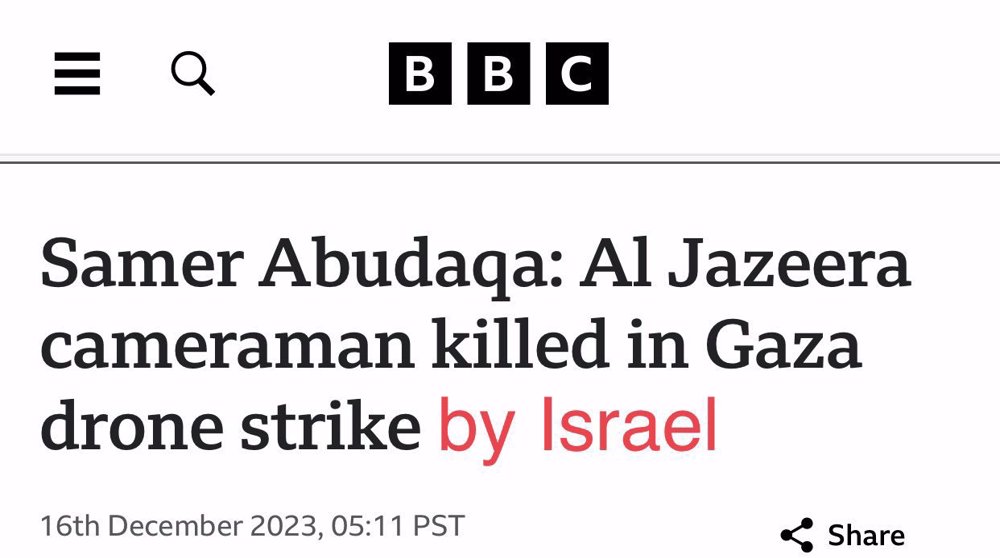
- ‘Samer Abuqada: Al Jazeera cameraman killed in Gaza drone strike by Israel’
This BBC headline on December 16, 2023, reported the killing of another Palestinian journalist in Gaza (the toll is now 131), without mentioning the perpetrator. It has been a standard operating procedure of Western media outlets, including BBC, to absolve the Israeli regime of its crimes in the besieged territory, especially since October 7.
Suggested headline: Samer Abuqada: Al Jazeera cameraman killed in Gaza drone strike by Israel
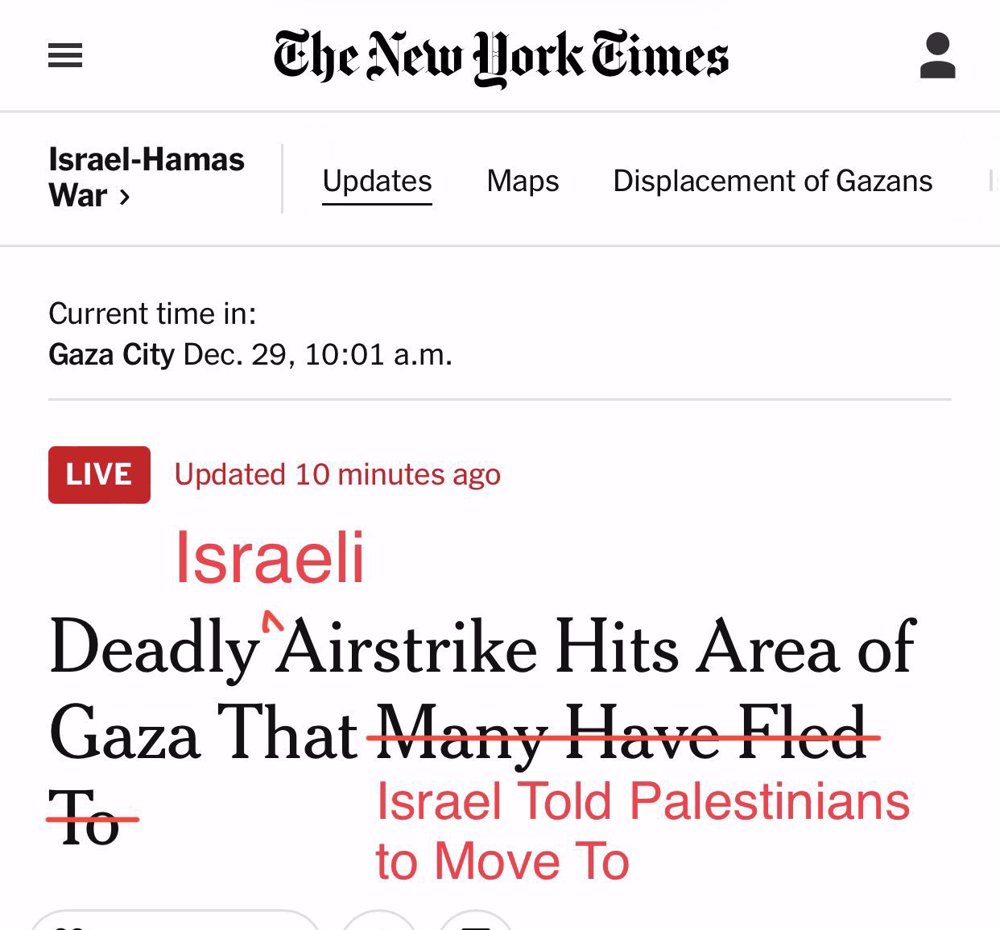
- ‘Deadly airstrike hits area of Gaza that many have fled to’
A headline in the New York Times on December 29, 2023, said the Israeli airstrike targeted an area of Gaza where many people had taken refuge. The fact is that the area was bombed after the Israeli regime forced Palestinians to move there – to assemble them in one place and bomb them.
Suggested headline: Deadly Israeli airstrike hits area of Gaza that Israel told Palestinians to move to
- ‘Displaced Gazans wonder where to go as Israel vows to keep pushing south’
This New York Times headline on February 6 referred to the planned Israeli invasion of southern Gaza, saying displaced ‘Gazans’ are wondering where to take shelter. The fact is that the Israeli regime has vowed to bomb Palestinians wherever they go.
Suggested headline: Displaced Palestinians in Gaza wonder where to go as Israel vows to keep bombing anywhere they go

Speaking at an event in Tehran last week, Hamas spokesman Osama Hamdan hailed the media’s role in defeating the Israeli narrative of the Gaza war, referring to the important role played by media.
Hamdan stressed that journalists play no lesser role than those fighting on the battlefield, which is why the Israeli regime has been deliberately targeting journalists in the besieged strip.
Talks With US on Space Weapons ‘Completely Unproductive’ – Moscow
Sputnik – 24.02.2024
MOSCOW – The recent contact between Russia and the US over claims Moscow alleged plans to deploy anti-satellite nuclear weapons in space turned out to be unproductive, Deputy Foreign Minister of the Russian Federation Sergey Ryabkov said.
The Wall Street Journal reported on Friday, citing US officials, that Washington had privately warned Moscow not to deploy a new nuclear-armed anti-satellite weapon which would allegedly violate the Outer Space Treaty and threaten US national security interests.
“There is no and cannot be any progress on this issue,” Russian Deputy Foreign Minister Sergey Ryabkov told reporters. “The reason is clear – the absurdity of US’ accusations against us of allegedly intending to deploy some systems with weapons-grade nuclear components in space.”
“As it has been continuously said recently, and as [Russian] President [Vladimir Putin] said, we have no such intentions,” Ryabkov added. “The Americans pursue the goal of demonizing Russia by making accusations of this kind. Therefore, the contact on this issue is completely unproductive.”
The deputy minister stressed that Russia had no intention of withdrawing from the 1967 Outer Space Treaty that bans the deployment of nuclear weapons or weapons of mass destruction in space.
“No, we do not consider [the possibility of withdrawal from the treaty],” Ryabkov said.
He also called it unacceptable that the US side had leaked details of the talks held between US National Security Advisor Jake Sullivan and Russian Presidential Foreign Policy Advisor Yury Ushakov, which Moscow and Washington agreed to keep confidential.
Russia has repeatedly warned against an arms race in space, and advocated for its use for purely peaceful purposes. President Vladimir Putin reiterated on February 20 that Moscow has always opposed the deployment of nuclear weapons in space.
The Russian Foreign Ministry has noted that that the United States and its allies are taking steps to place weapons in space and use outer space for combat operations, not only for defensive purposes.
The West continues to regard space as a new arena of rivalry and conflicts between countries, in which Russia and China are identified as the main opponents, the ministry said.
The US created its first foreign space force under its command in the Indo-Pacific region in 2022, following the establishment of the space force in 2019 under the pretext of threats from Russia and China. According to estimates, the United States has 4,723 satellites in orbit, while China has 647, Russia has 199, and the rest of the world has 1,527 combined.
“UKRAINE WILL WIN” | No Amount of Propaganda Can Hide the Fact that Ukraine is Winning this War
Matt Orfalea | February 22, 2024
No Amount of Propaganda Can Hide the Fact that Ukraine is Winning this War video by Orf
Twitter ▶  / 0rf
/ 0rf
Rumble▶https://rumble.com/Orf
Patreon ▶  / orf
/ orf
Substack▶https://substack.com/@MattOrf
Locals▶https://mattorfalea.locals.com
Truth▶https://truthsocial.com/@MattOrf
Minds▶https://www.minds.com/MattOrf
Tips ▶PayPal: https://bit.ly/34OWemi
Iran rejects ‘baseless and boring’ accusations over Ukraine war
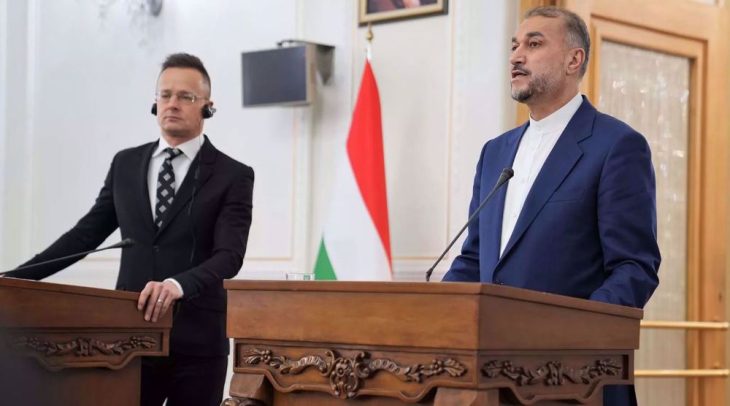
Iranian Foreign Minister Hossein Amir-Abdollahian speaks at a joint press conference with his Hungarian counterpart Peter Szijjarto in Tehran on February 22, 2024.
Press TV -February 23, 2024
Iranian Foreign Minister Hossein Amir-Abdollahian says the repetition of baseless claims against the Islamic Republic over the war in Ukraine has reached a “boring stage”.
Amir-Abdollahian made the remarks at a joint press conference with his Hungarian counterpart Peter Szijjarto in Tehran on Thursday.
Iran’s top diplomat noted that they discussed bilateral relations and the latest global developments, including the conflict in Ukraine, adding “I would like to once again strongly condemn the baseless accusations leveled against Iran regarding Russia’s use of Iranian weapons.”
“The repetition of baseless claims has reached a boring stage,” he said.
Amir-Abdollahian’s remarks came as US National Security Council spokesman John Kirby said on Thursday that Washington will be “imposing additional sanctions on Iran in the coming days” over its alleged efforts to supply Russia with drones and other technology for the war.
Both Iran and Russia have repeatedly denied claims that Tehran has provided Moscow with weapons to be used in the war in Ukraine.
The anti-Iran claims first emerged in July 2022, when US National Security Advisor Jake Sullivan alleged that Washington had received “information” indicating that the Islamic Republic was preparing to provide Russia with “up to several hundred drones, including weapons-capable UAVs on an expedited timeline” for use in the war.
Elsewhere in his remarks, Iran’s top diplomat noted that he and Szijjarto also discussed Israel’s genocidal war on the besieged Gaza Strip that began in October.
“We had frank discussions on the logic behind Iran’s support for the Palestinian people. I also asked Hungary to use all its capacity to stop the war and restore sustainable security to the region,” Amir-Abdollahian said.
He slammed the US and Britain’s attempts to extend the war to other parts of the world as “a mistake”, stressing that Yemenis are acting independently regarding pro-Palestine operations.
The US and the UK have been carrying out numerous attacks against Yemen as a means of trying to pressure the country into stopping a series of operations that it has been conducting in support of Palestinians in the Gaza Strip.
In solidarity with the Palestinians in Gaza, the Yemeni armed forces have targeted ships in the Red Sea with owners linked to Israel or those going to and from ports in the occupied territories.
Tehran-Budapest ties
The visit of Szijjarto, who also acts as the minister of trade, to Iran came as Tehran and Budapest held a joint economic commission earlier on Thursday.
“Relations between the two countries are developing,” Amir-Abdollahian said, adding that a protocol of the economic commission and a road map for cooperation in the field of agriculture were signed during the session of the commission.
Budapest concerned about war in West Asia
For his part, Szijjarto hailed the bilateral ties between the two countries as “strong”, expressing his country’s concern over the ongoing war in the West Asia region.
He warned that the escalation of the situation and the spillover of the war in Gaza into the region “could be a great threat to the global security.”
Israel launched the war on Gaza on October 7 after the Palestinian resistance movement Hamas waged the surprise Operation Al-Aqsa Storm against the occupying entity in response to the Israeli regime’s decades-long campaign of bloodletting and devastation against Palestinians.
Since the start of the offensive, the Tel Aviv regime has killed at least 29,514 Palestinians and injured more than 69,616 others.
Thousands more are also missing and presumed dead under the rubble in Gaza, which is under “complete siege” by Israel.
Biden and US media lies about Ukraine are reminiscent of Vietnam War – American Conservative
By Ahmed Adel | February 23, 2024
The American Conservative published an article that parallels the Vietnam War, considered the greatest military humiliation in US history, with what they point out is a campaign of deception carried out by the current US Government, which will lead to a defeat for Kiev and NATO.
According to the author James W. Carden, who served as an advisor on US-Russian affairs at the State Department during the Obama administration, the media campaign regarding Ukraine carried out by the White House was a copy of the actions of successive US governments in Vietnam until the Nixon administration withdrew troops and concluded the intervention in 1973. He relates the Vietnam War with the lies with which President Joe Biden and his collaborators have tried to deceive citizens about the progress of the Ukraine conflict and its origin, among other issues.
These false narratives, the article notes, have been put in place and presented to Americans with the help of the “most dutiful accomplices,” such as the New York Times and the Washington Post, media outlets that, until recent times, published the triumphalist comments of Biden and his administration without any type of questioning, in addition to analysis columns where Russian President Vladimir Putin was demonised and falsely stated that Ukraine was on its way to victory.
This falsification of reality, in which all the complexity of the conflict was eliminated, and the responsibility of the US and NATO in inciting it, was omitted. Instead, they presented the war as a simple confrontation between good and evil, which is similar to the deception that Washington and the establishment media consummated in the 1960s to justify the US invasion of Vietnam, the article states.
Now, notes The American Conservative, as it is “too obvious to ignore” that Russian troops are prevailing in Ukraine, the American media is finally realising what is really happening on the battlefield after having helped prolong the conflict with their lies.
“If we are being lied to about the progress of the war—and we are—what do you suppose are the odds we are also being lied to about the causes of the war?” the author questions.
For US politicians and journalists, the expansion of NATO, Ukraine’s post-Euromaidan nationalist agenda, the refusal to implement the Minsk Agreements, or threats by Ukrainian President Volodymyr Zelensky made in Munich in February 2022 to acquire nuclear weapons had nothing to do with the outbreak of war, the article ironically states.
“If we are being lied to about the causes of the war, are we also then being misled about what is at stake in eastern Ukraine? Probably. Here the parallel with the government’s mendacity during the war in Vietnam period becomes too obvious to ignore,” Carden continues.
“Recall in the first case that the template, that of the Cold War, is essentially unchanged, even in some of the particulars, not least in the comparisons of (the Vietnamese anti-communist leader) Ngo Dinh Diem and Volodymyr Zelensky to Winston Churchill. The South Vietnamese government (avaricious, corrupt) had the right to American arms by virtue of its right ‘to determine [the nation’s] future,’ the article says, recalling the argument used by the US to justify its war against North Vietnam, which was part of its global operation against what Washington perceived as an expansion of communism that could threaten its interests and hegemony.
The same thing is happening now with Ukraine: President Biden publicly justifies launching a proxy war with Russia with the excuse that it is necessary to stop Moscow, once again invoking the theory of the domino effect, the long-discredited thesis that drove the US interventionist policy during the second half of the 20th century.
Following the publication of the Pentagon Papers in 1971, the philosopher Hannah Arendt observed during the Vietnam War era that “the policy of lying was hardly ever aimed at the enemy… but was destined chiefly if not exclusively, for domestic consumption, for propaganda at home and especially for the purpose of deceiving Congress,” Carden warns.
He concludes his article by saying: “Two years on, we citizens have been serially lied to by the Biden administration and the media about the war’s causes, its stakes, and its progress. The question that should, but of course will not, be addressed in the aftermath of this latest American misadventure abroad is: Will we ever learn?”
Ahmed Adel is a Cairo-based geopolitics and political economy researcher.
Space Nukes & Washing Machines: Western Media Prints ‘Anything’ to Paint Russia as Threat
Sputnik – 23.02.2024
Last week, House Intelligence Committee Chair Rep. Mike Turner (R-OH) released a document with a cryptic warning that called on US President Joe Biden to declassify information on a “serious national security threat.” Within hours, the story spread like wildfire.
The recent media craze stemming from unfounded claims of a Russian nuclear space weapon exploded and stole headlines for days because “the media” will print anything it is told about Russia, Mark Sleboda, a foreign relations and security expert told Sputnik’s Fault Lines.
“Russia’s the gift that keeps on giving, propaganda-wise, because you can accuse Russia of anything, no matter what you said about them [before], about shovels, and microchips or washing machines. And, generally, people will believe it. Or at least the media will print it,” he said, referring to previous Western propaganda claims that Russian soldiers were fighting armed only with shovels and that their missiles used microchips from stolen Ukrainian washing machines.
“Then you accuse Russia of having space weapons, space nuclear weapons, or having plans to put nuclear weapons in space, or someone in Russia once thought technically about the contingency of putting weapons in space,” Sleboda scoffed.
As the story made the rounds on the media circuit, US National Security Council John Kirby told reporters that the threat US Rep. Mike Turner raised was related to “an anti-satellite weapon that Russia is developing.” Soon after that, US media outlets began reporting that the mysterious weapon was nuclear.
Russia vehemently denied the accusation, saying it is only developing the same space capabilities that the US has. “Firstly, there are no such projects – nuclear weapons in space. Secondly, the United States knows that this does not exist,” Russian Defense Minister Sergei Shoigu said during a televised discussion with Russian President Vladimir Putin.
Sleboda noted that for mainstream media, “the details aren’t important as much as the scaremongering factor.”
“It’s the same thing with this continual octogenarian fantasy about linking Trump and Russia… all the powers of the US investigative bodies were unable to prove any connection… but that doesn’t stop an enormous number of the American people from believing in it because they want to, and [US Rep.] Nancy Pelosi certainly knows that.”
The analyst further admitted that the latest anti-Russia rhetoric is part of a larger effort in preparation for the November presidential election in the US but that it also “does the double job of, you know, buttressing arguments for providing more US taxpayer dollars for weapons for the regime in Kiev.”
‘Conspiracy theorists’ threaten mainstream media, says Canadian PM
RT | February 21, 2024
Canadian Prime Minister Justin Trudeau on Wednesday blamed social media for preventing major news outlets from shaping public opinion the way they used to.
The Liberal Party leader took his message to the Conservative stronghold of Alberta, sitting down with radio host Ryan Jespersen for an exclusive 30-minute interview on his Real Talk podcast.
“There is out there a deliberate undermining of the mainstream media,” Trudeau said, answering a question towards the end of the interview. “There are the conspiracy theorists, there are the social media drivers who are trying to do everything they can to keep people in their little filter bubbles, to prevent people from actually agreeing on a common set of facts, the way CBC and CTV – when they were our only sources of news – used to project across the country, at least a common understanding of things.”
Earlier this month, Trudeau denounced the move by Bell Media to lay off many of its local journalists and sell 45 of its 103 regional radio stations, arguing that local journalism holds Canadian democracy together.
“There are massive changes that need to happen in our media landscape, and [the] government can try and create conditions and incentives for it to happen,” he told Jespersen on Wednesday.
“We’re putting money towards local independent media,” Trudeau added, having argued a moment earlier that such overt funding would compromise news outlets as mouthpieces of the government.
In June 2023, the Canadian parliament passed the Online News Act (ONA), under which search engines and social media platforms would have to compensate news outlets for posting their content. While Google has complied, Facebook is “choosing to be bad guys about this,” Trudeau told Jespersen. Meta has responded to ONA by blocking all news content by Canadian publishers on Facebook and Instagram.
Ultimately, it’s up to Canadians to declare they don’t want to accept the “encrapification of news,” Trudeau said, borrowing the phrase from British Columbia Premier David Eby.
Trudeau’s comments on the podcast also echoed those made by former US President Barack Obama in a May 2023 interview to CBS. Obama named “a divided media” as one of the things he was worried about, noting that the US once had “three TV stations … and people were getting a similar sense of what is true and what isn’t, what was real and what was not.”
“How do we return to that common conversation? How can we have a common set of facts?” the 44th US president wondered at the time.
Feeble BBC Hamas ‘exposé’ achieved one thing: obscuring genocide
By Jonathan Cook – February 20, 2024
Israel was put on trial for committing genocide in Gaza last month by the judges of the International Court of Justice. So far western governments have not only done nothing to intervene but are actively assisting in that slaughter. They have supplied arms and turned a blind eye to Israel’s denial of humanitarian aid. The people of Gaza are slowly being starved to death.
But it was at this moment, as the world watches in horror, that the BBC’s chief news investigation programme, Panorama, chose not to scrutinise that massacre of tens of thousands of Palestinians but to hand the microphone over to the very military doing the killing.
 On Monday it aired a programme titled “Hamas’s Secret Financial Empire” headed by reporter John Ware.
It leant heavily on Israel’s military spokesman, on documents that had almost certainly been supplied by Israeli military intelligence, on video footage from the Israeli military, and an Israeli survivor of the Hamas attack of October 7.
Ware and Panorama have worked together before, most notably on a special hour-long edition that doubtless equally delighted Israel.
Broadcast shortly before the 2019 general election, the programme served as little more than a hatchet job on Jeremy Corbyn, claiming that the then Labour leader had allowed antisemitism to run rampant in his party.
Serial failures in the programme were exposed, including by me at the time.
Quotes and interviews had been edited misleadingly, including one that implied an antisemitic incident had happened inside the Labour party when it had not.
Basic fact-checking had not been carried out, which led to the complete misrepresentation of a key incident the programme wrongly claimed as antisemitic.
The programme concealed the identities of those claiming to have suffered antisemitism in Labour, when most were in fact members of a highly partisan, pro-Israel group openly committed to the ousting of Corbyn as leader for his pro-Palestininan views. One had trained with the Israeli army.
Another unnamed, tearful interviewee, Ella Rose, had previously worked for the Israeli embassy, though the audience was not told. The programme also did not refer to the fact that she had admitted to being a confidante of an Israeli undercover agent, Shai Masot, who was later exposed trying to bring down a British government minister for his critical views of Israel – views far less critical than Corbyn’s.
One might have assumed that, given this disastrous outing for Panorama by Ware and his producers, they would have been considered by the BBC as a very unwise pick indeed to follow up with an investigation into another issue so close to Israel’s heart. But such an assumption would be wrong.
Much as the Corbyn “investigation” presented a distorted picture of what was taking place in Labour, the latest Panorama “investigation” completely obscured the reality of what is taking place in Gaza. Not least, Monday’s audiences would have been barely aware that Israel is currently under investigation by the World Court after its panel of 17 judges accepted that Israel is plausibly committing genocide in Gaza.
The Panorama narrative, following the BBC’s usual script, suggested instead that this was simply another round of fighting in a long-standing “conflict” in which, the programme limply conceded, both sides are suffering.
The only non-official interviewed was an Israeli survivor of Hamas’s October 7 attack, a young woman present at the Nova festival. She felt betrayed that “people only look at the side of Hamas. We are invisible to them.”
Bizarrely, the BBC team took this patently preposterous view as the programme’s central premise. It was, said Ware, Hamas’s nefarious goal to “project itself as a resistance movement and Israel as a terrorist state”.
The BBC seemed to have forgotten that it was also the World Court, not just Hamas, seriously considering the idea that the Israeli military is flagrantly acting outside the laws of war. If, in the eyes of the BBC, a campaign of genocide does not constitute state terrorism – or worse – one has to wonder what does.
Former Foreign Office official Sir John Jenkins was given centre stage by Panorama to claim that Hamas, not the prolonged slaughter of children in Gaza, was fomenting the “delegitimisation of Israel”.
All of this served as the prelude to the programme’s efforts to delegitimise Hamas and any of its activities in creating a network of tunnels to resist Israel’s occupation and siege at a time when western capitals are more actively than ever assisting Israel in destroying Gaza.
If Israel posed no real threat to the people of Gaza, as the programme implied throughout, then Hamas apparently did not need to fortify the enclave to defend it from an Israeli attack. Its money could have been better used for the benefit of ordinary Palestinians.
The elephant in the room was genocide. Ware and the BBC had to keep treating Israel’s slaughter of at least 30,000 Palestinians over the past four months as an aberration – a reaction to the unprecedented events of October 7 – rather than as an intensification of Israel’s well-documented abuse of the Palestinian people spanning over decades.
The reference to Hamas’s “secret” financial empire was meant to sound sinister. But, as the programme-makers struggled to hide, there is nothing secret about Hamas’s funding.
After all, Israeli prime minister Benjamin Netanyahu personally approved the flow of money to Hamas, wishing to keep the group just strong enough to ensure it could prevent the more compliant Palestinian Authority (PA), based in the West Bank, from re-establishing itself in Gaza.
Netanyahu’s goal – one he never concealed – was to keep the two rival Palestinian groups permanently feuding, the two territories split, and thereby undermine the case for any kind of Palestinian state in Gaza and the West Bank.
Ware informed us that Hamas’s “financial empire” derived from various funding sources: directly from Iran and Qatar, but also from humanitarian aid provided by international donors. The programme concluded that these donors were effectively “subsidising Hamas’s war machine” by easing the economic burden on Hamas in providing – in so far as was possible given Israel’s siege – essentials such as food, water and power to Gaza’s civilians.
Predictably, Ware’s argument echoed one of the main claims made by Israel in its current campaign to intensify the genocide in Gaza by destroying the United Nations’ refugee body, UNRWA. The relief agency is the last lifeline to a population of 2.3 million people brought to the point of starvation by Israel’s blockade of humanitarian aid.
Israeli officials have consistently implied that the Palestinian population of Gaza may justifiably be starved to death as the price to be paid to avoid any risk that some of that aid ends up in the hands of Hamas fighters. Such a denial of assistance is not only patently immoral but constitutes a war crime.
If journalists are ever brought to the Hague accused of complicity in the current genocide, there should surely be a place reserved in the dock for Ware and his BBC team for breathing credibility into this monstrous argument.
Panorama’s central narrative was that Hamas had used parts of its revenues to build a network of resistance fortifications such as tunnels – money that, as Ware and his interviewees kept stressing, could have been spent on building schools and homes to aid the people of Gaza.
Ware omitted to mention, of course, that, more often than not, schools and homes actually needed rebuilding, not building, because Israel blew them up every few years with its bombs.
Again, all too predictably, the programme stripped out obvious context.
Hamas chose to build these fortifications, such as its extensive network of tunnels, because Israel is an offensive, occupying power that enjoys absolute control over Gaza’s borders, as well as its airspace and sea. Israel can bomb and invade Gaza any time it chooses. It can drag people off to “arrest” them – or take them hostage, as we would call it were the roles reversed.
Not only can it do those things, it did and does them regularly. And with complete impunity.
Pretending that Hamas had no reason to build a tunnel network, as Panorama does, is to rewrite history – to excise Israel’s decades of crimes against the Palestinians and their legitimate desire to struggle against that oppression.
It is to unthinkingly regurgitate Israel’s claim that these are simply “terror tunnels” rather than a way for Hamas to survive as a resistance organisation, as it is fully entitled to do under international law.
Hamas made it a priority to build a tunnel network to resist a violent, occupying army. Given limited resources and room to manoeuvre – after all, Gaza is a tiny territory and one of the most overcrowded places on the planet – Hamas had little choice but to move underground to avoid Israel’s sophisticated surveillance technology where it could build an arsenal of largely improvised, homegrown weapons.
Its historic popularity among ordinary Palestinians – at least compared to the supine, endlessly complicit PA in the West Bank – derives precisely from its refusal to submit to Israeli control. Panorama forgot to mention this too.
By contrast, and confounding Panorama’s thesis, the PA’s exclusive reliance on international diplomacy has won no tangible concessions from Israel – unless winning a reprieve from genocide, at least until this point, is considered such a concession.
Also inconveniently for Panorama, the PA’s standing with the Palestinian public continues to be dismal.
Bizarrely, Ware was equally troubled by the fact that Hamas raised import taxes on the limited goods that Israel did allow into Gaza.
That is all the stranger given that the programme’s implicit – and entirely bogus – assumption is that Gaza is not under a belligerent Israeli occupation. Hamas, it therefore suggested, should have behaved more like a normal country.
But raising taxes on the import of goods is precisely what normal countries do. Why would Ware expect Hamas to behave differently?
And why would it be strange or sinister for it to use some of those revenues to build Gaza’s defences, as best it could, against an aggressive occupier?
Does Britain not also spend the money it raises from taxes to buy weapons and “subsidise its war machine”? And it does so, even though the UK is not under belligerent occupation and is unlikely to be invaded any time soon.
In dramatic fashion, Ware declared ominously: “We have obtained documents that Israeli intelligence say are from inside Hamas and shine a light on how it makes some of its millions.”
It is hard not to conclude that those words mean Panorama was fed those documents by the Israeli intelligence services. Nonetheless, with utter credulity, the programme treated the papers as though they were infallible proof of Hamas’s wickedness.
What they actually showed, assuming they are real, is that Hamas had gained a modest income stream from investments in Middle Eastern companies and ventures. Should Hamas not make investments to raise income, as countries and funds do around the world? And if not, why?
Moving money out of Gaza and investing it overseas seems eminently sensible given that Israel has so regularly laid waste to the enclave – and is doing so once again and on an unprecedented scale.
In similar credulous fashion, Ware accepted unquestioningly the claim that Hamas’s leader in Gaza, Yahya Sinwar, was known to “hate Jews”. On what basis? Because a former Israeli security officer who proudly admitted that years ago he interrogated Sinwar for “between 150 and 180 hours” said so. Interrogation of Palestinians by Israel typically includes lengthy periods of torture.
All of this was depressingly familiar. The BBC and Panorama rarely dig into issues that might reflect badly on Israel and risk a backlash of criticism, including from the British government. That toothlessness when a genocide is unfolding in Gaza is especially egregious.
But the BBC is not just overlooking that horrifying crime but using its resources – funds provided by British taxpayers – to actively obscure Israel’s campaign of genocide and implicitly rationalise it as warranted.
A programme whose thesis is that Hamas misused public funds for nefarious purposes is, paradoxically, doing the very thing it condemns. It has misused British taxes to make a entirely bogus case that provides cover for the slaughter and maiming of many tens of thousands of innocent Palestinians.
They Think We Are Stupid, Volume 7
By Aaron Kheriaty, MD | Human Flourishing | February 19, 2024
Everything you need to know about our ruling class’s opinion of you. As always, these headlines are presented without commentary.


Featured Video

Pentagon Fast Tracks Iran War Ground Option
or go to
Aletho News Archives – Video-Images
From the Archives
The Heirs of Meyer Lansky Want Compensation from Cuba. They Shouldn’t Get a Dime.
By Jack Colhoun | History News Network | June 19, 2016

Meyer Lansky
The heirs of Meyer Lansky, the impresario of the North American Mafia gambling colony in Cuba (1933-1958) are betting on a big payback from the negotiations between the United States and Cuba to normalize relations between the two countries. Compensation claims by U.S. citizens or businesses for properties nationalized by the Cuban revolution are among the issues under discussion.
Lansky’s daughter Sandi, her son Gary Rapoport, and her brother Paul have filed a compensation claim against Cuba for the Riviera Hotel and Casino with the U.S. Foreign Claims Settlement Commission. The Cuban revolution confiscated the Riviera and other Mafia-owned properties after it toppled the gangster-linked regime of General Fulgencio Batista in 1959.
“It was through my grandfather’s hard work that the hotel was built,” Rapoport told the U. K. Daily Mail Online on December 23, 2015. “We are his natural relations . . . . By right, it should be our property.” He says the Riviera is valued at $70 million. The Tampa Bay Tribune, Reuters, and Haaretz have also covered the story.
The Riviera, which overlooks the Straits of Florida, was the crown jewel of Lansky’s casinos, hotels, and nightclubs in Havana. When the Riviera opened in December 1957, it was the largest Mafia-owned hotel-casino outside Las Vegas. The hotel’s 440 double rooms were booked solid for the winter season of 1957-1958.
However, the narrative that the success of the Riviera was the product of Meyer Lansky’s “hard work” is undercut by Lansky’s own assessment of his arrangement with Batista. … continue
Blog Roll
 Aletho News
- Iran’s Dimona Strike Shatters Myth of ‘Impenetrable’ THAAD, Patriot & Arrow Air Defenses – Analyst
- Bahrain admits US Patriot missile hit residential area, injured dozens
- Iran retaliation shakes helium, global tech supply chains
- Zionist takeover: Trump’s war on Iran reveals who really dictates US foreign policy
- Iran’s strike on Dimona – Israel’s nuclear weapons research center – shows Israeli air defences are weakened
- Fidel Castro’s War on Jewish Mobster Meyer Lansky
- US Trying to Oust Russia From All Energy Markets – Lavrov
- Western silence allows Israel to get away with killing journalists
- The Israeli Media Is Laying The Groundwork For a Permanent Israeli Occupation Of Southern Lebanon
- Role reversal – “divide & conquer” used against the west
- If Americans Knew
- Israel’s assassination game: Take all pragmatists off the board
- Food shortages return to Gaza as Israel tightens aid restrictions under the cover of its war on Iran
- Trump demands trillions in payments from Gulf countries, billions from Harvard – Not a ceasefire Day 162
- Meet the former fashion blogger and shady doctor behind the ‘30,000 dead’ Iran psy-op
- Vatican Secretary of State to Trump, Israel: End the war as soon as possible
- The Majority of Americans Believe War Against Iran Benefits Israel More Than US
- Efforts to shut down pro-Palestinian speech face series of setbacks in court
- What has Israel done to my brother?
- Eid without worship in Al Aqsa – Not a ceasefire Day 161
- Trump: Israel attacked Iranian gas field without US knowledge. No more such attacks!
- No Tricks Zone
- Former Pfizer Toxicologist Dr. Helmut Sterz Tells Bundestag Hearing Pfizer Vaccine Should Have Never Been Approved
- Energy Expert: Germany’s Nuclear Phaseout Was A “500 Billion Euro Mistake”
- New Research: South Australia’s Mid-Holocene Sea Surface Temperatures Were 4°C Warmer Than Today
- Storing Green Energy To Last Germany 10 Days Would Require A 60-Million Tonne Battery
- New Studies: UK Sea Levels Were 4 Meters Higher Than Today During The Mid-Holocene
- Destructive Green New Deal: German Energy And Metal Group Warns Of Drastic Crisis
- New Study Documents A 20-Year Pause In Arctic Sea Ice Decline – Driven By Internal Variability
- Wake-up Call: Survey Shows Majority Of Germans Now Favor Postponing Climate Targets!
- Televised! Leading German Political Candidate Tells Schoolchildren CO2 Makes Sun Hotter!
- New Study: A Century Warming Of 1.1°C Is ‘Commonplace’ And ‘Not Unusual’ During This Interglacial
 Aletho News