They Think We Are Stupid, Volume 9
By Aaron Kheriaty, MD | Human Flourishing | May 29, 2024
Everything you need to know about our ruling class’s opinion of you. As always, these headlines are presented without commentary.

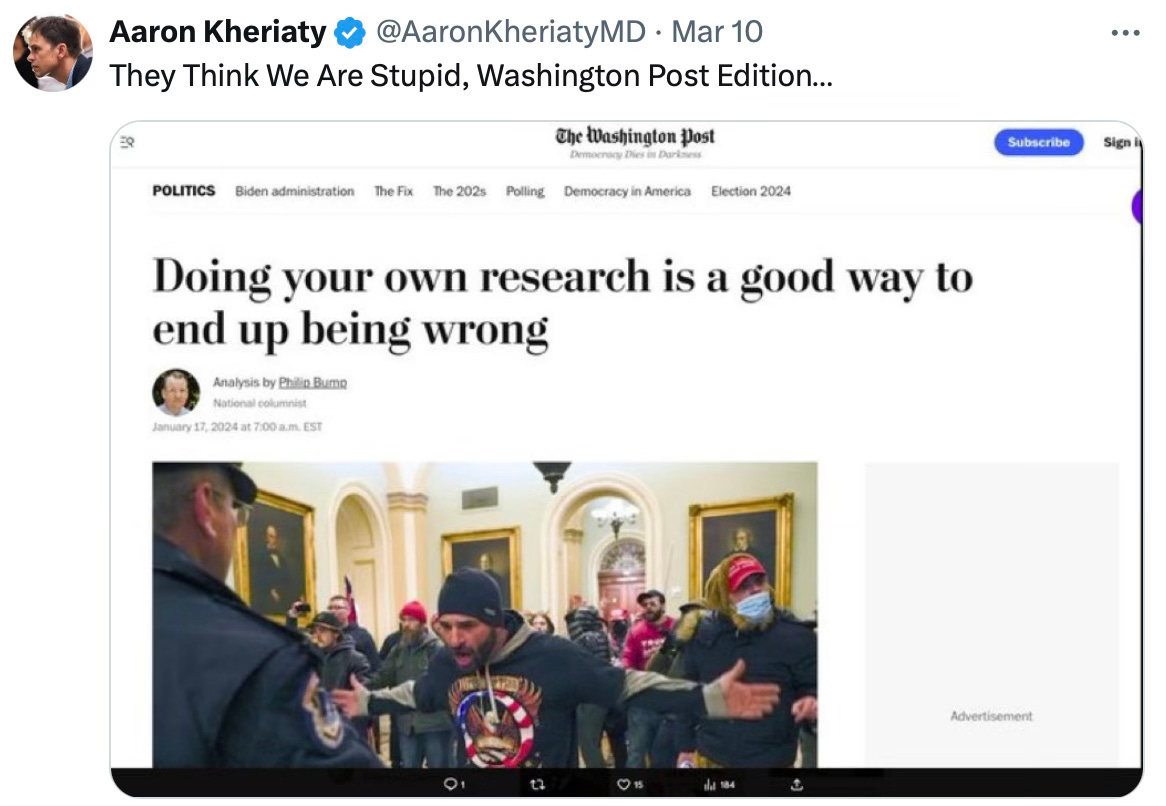


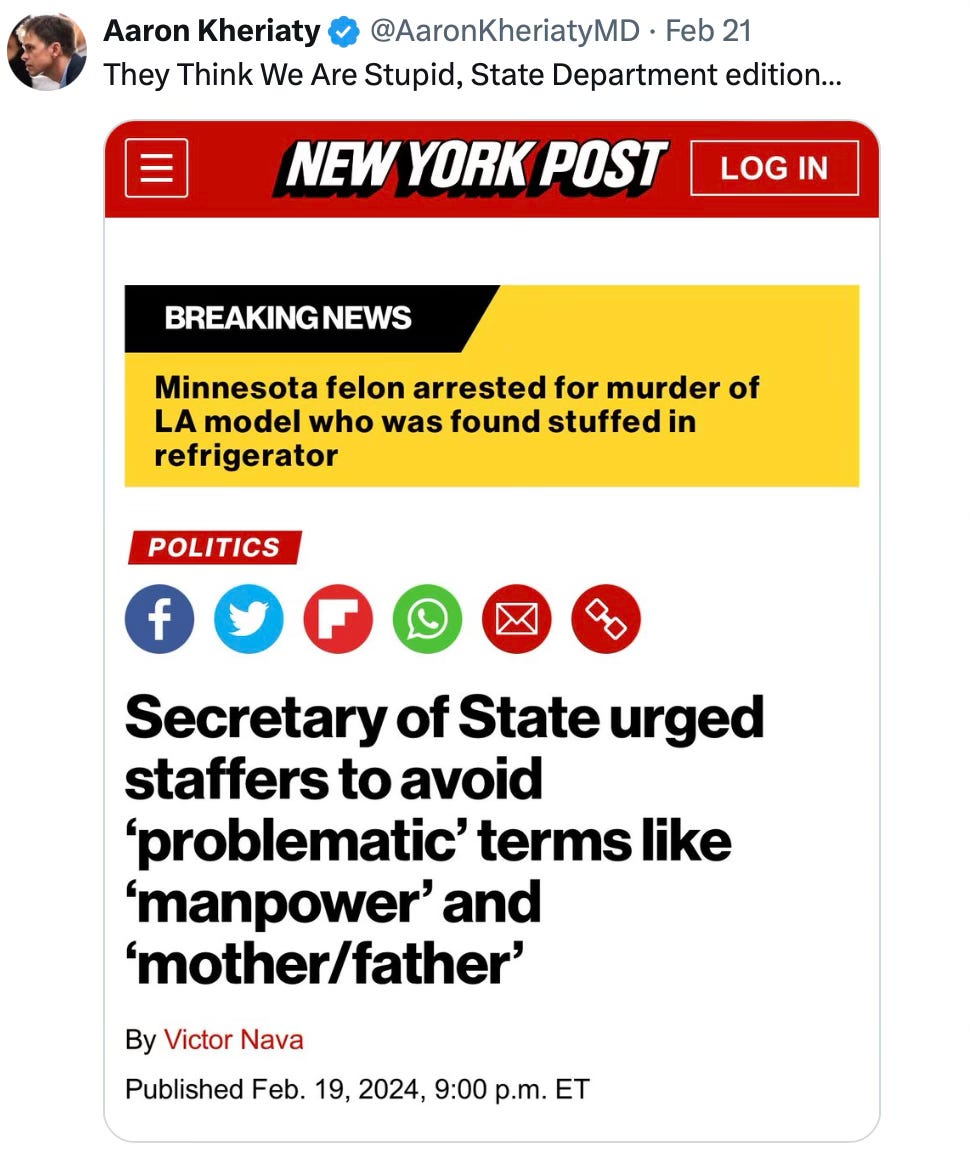
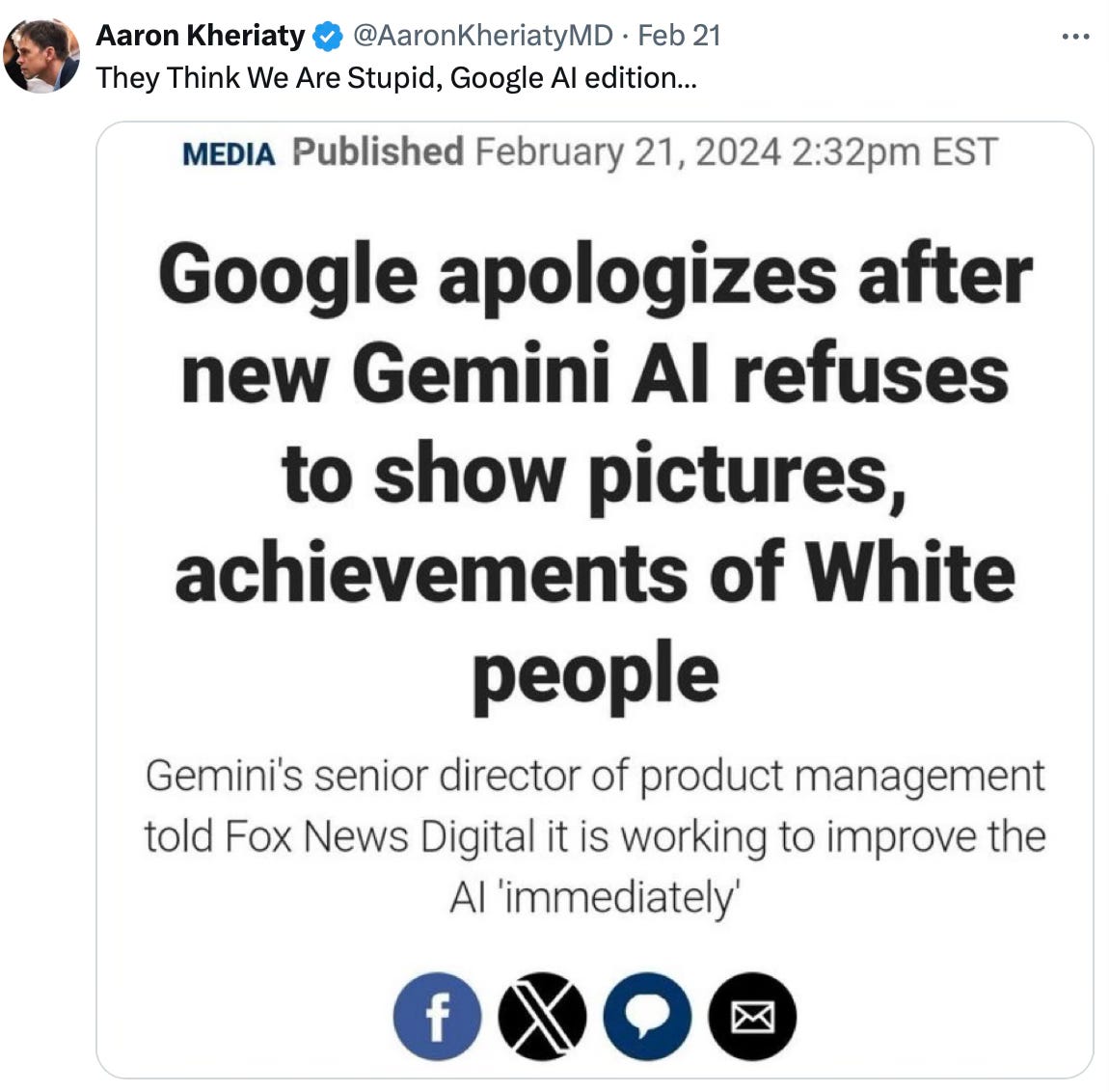


Orban Calls Talks About ‘Russian Threat’ West’s Maneuver to Prepare for War
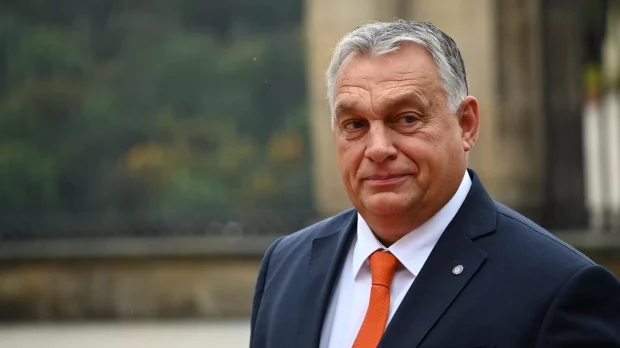
Sputnik – 24.05.2024
It is unlikely that Russia will attack a NATO country and talks about the “Russian threat” are nothing but a maneuver of the West to prepare for a war, Hungarian Prime Minister Viktor Orban said on Friday.
“The likelihood that someone — we are not just talking about Russia, but about anyone — today will decide to attack a NATO country is extremely small. NATO is a defensive alliance and will not tolerate military actions that violate the sovereignty of any NATO country … Therefore, I interpret these references to the ‘Russian threat’ rather as maneuvers by the West and Europe to prepare for entry into war,” Orban told the Kossuth radio broadcaster.
Statements by Western politicians and media reports indicate that Europe is preparing for a war with Russia, the prime minister added.
“Before the two world wars, the media spent quite a long time preparing for entry into the war. I think that what is happening today in Brussels and Washington, but rather in Brussels than in Washington, is a kind of preparation of sentiment for a possible direct conflict. We can calmly say that preparations are underway for Europe to enter the war, this is happening in the media and in the statements of politicians,” Orban said.
Russia Dismisses US Claims of Counterspace Weapon Satellite as Misinformation
Sputnik – 22.05.2024
MOSCOW – The recent statement by the US Department of Defense alleging that Russia launched a satellite carrying a counterspace weapon is misinformation and Moscow will not respond to it, Russian Deputy Foreign Minister Sergei Ryabkov said on Wednesday.
On Tuesday, US Defense Department spokesperson Maj. Gen. Pat Ryder said that Russia launched last week a satellite carrying a counterspace weapon that is presumably capable of attacking other satellites in low Earth orbit. Ryder claimed that Russia deployed the satellite without communicating this fact to the United States.
“I do not think we should respond to any misinformation from Washington. The Russian space program is developing as planned, launches of spacecraft for various purposes, including devices that solve the problem of strengthening our defense capability, are also not news. Another thing is that we always consistently oppose the deployment of strike weapons in low-Earth orbit,” Ryabkov told reporters.
If the United States wanted to ensure the safety of space activities, it should have reconsidered its approach to Russia’s space proposals, the senior diplomat added.
Last week, the Wall Street Journal reported that US officials said Russia launched a research spacecraft into space in February 2022 intended to test components for a potential nuclear anti-satellite weapon.
In February, the US government claimed that Russia was developing a space-based anti-satellite weapon that poses a serious threat to US national security.
Russian President Vladimir Putin has said Russia has always been categorically opposed to deploying nuclear weapons in space. Russia’s activities in space are no different from those of other countries, including the US, Putin added.
Speaking about introduction of the Bulava ICBM into service, Ryabkov said that Russia does not violate the limits set by the New START Treaty.
The R30 3M30 Bulava (RSM-56 for use in international treaties, SS-NX-30 according to NATO classification) is a Russian three-stage solid-fuel intercontinental ballistic missile, designed to arm the advanced Borei-class nuclear-powered strategic missile submarines. It was officially reported that the missile is capable of carrying several hypersonic nuclear warheads with individual guidance. The Bulava is expected to form the basis of Russia’s strategic nuclear forces grouping until 2040-2045, according to Russian military statements.
The Media Slowly Backpedals
By Mark Oshinskie | Dispatches from a Scamdemic | May 9, 2024
Early in my legal career, I handled many one-day trials. Late one afternoon, I returned to my office. Still wearing my suit and carrying my briefcase, I passed the open office door of a senior colleague named Ben. He called out to me, “How’d you do today?”
I stood in his doorway and replied, “Not good. I couldn’t get their witness to admit what I wanted him to.”
Ben smiled and said, “You’ve watched too much TV. You expect the witness to break down on the stand and admit everything, as grim music plays in the background. That won’t happen. You have to treat every adverse witness as someone who starts with a handful of credibility chips. You let him say whatever he wants and make himself look dishonest saying it. Ideally, he trades those chips in, one-by-one, and leaves the stand without any chips in his hand.”
This made sense. Thereafter, I adjusted my expectations and structured my questions accordingly.
—
Media outlets and writers who fomented Coronamania have, over the past two years or so, been retreating slowly from the fear and loathing they began brewing up in March, 2020. They’ve calculated that a Covid-weary, distractable public won’t remember most of what they said earlier in the Scamdemic.
Last Friday, in two, paired articles, New York Times writers Apoorva Mandavilli and David Leonhardt continue this strategically slow retreat from the Covid lies they’ve sponsored. For the first time, they acknowledge that maybe the shots they’ve praised have caused a few of what jab-o-philic readers will dismiss as minor injuries.
As he begins his summary of Mandavilli’s theme, Leonhardt admits that the notion that vaxx injuries occurred makes him “uncomfortable.” He’s not expressing discomfort about the injuries themselves. He’s concerned that the vaxx critics might be proven correct.
Why would a self-described “independent journalist” be made uncomfortable by facts? What’s so repugnant about simply calling balls and strikes? Why does Leonhardt have a rooting interest? What’s so hard about admitting he’s been wrong, not just about the shots, but about all of the Covid anxiety he and his employer have incited throughout the past three-plus years?
Bear this in mind: In early 2021, Leonhardt went on a 1,600-mile road trip to get injected as early as he could. David, kinda neurotic and def not climate friendly.
Admitting error—or outright complicity with the Scam—during the Covid overreaction would entail losses of face and credibility. After all the harm the media has done, those consequences would be just and proper.
To avoid this result, the media and bureaucrats are backpedaling slowly to try to change their views without too many people noticing. In so doing, they’re very belatedly adopting the views of those, like me, who from Day 1, called out the hysteria driving, and the downsides to, the Covid overreaction.
But while they’ve incrementally changed parts of their message, they hold tightly to the central, false narrative that Covid was a terrible disease that indiscriminately killed millions. The Covophobes continue to falsely credit the Covid injections for “saving millions of lives” and “preventing untold misery.”
Times readers are a skewed, pro-jab sample. Thus, about half of the 1000+ commenters adopt Mandavilli’s and Leonhardt’s mythology that, even if the shots injured people, they were a net positive in a world facing a universally vicious killer. Relying on that false premise, these columnists and the commenters assert that no medical intervention is risk-free and that a few metaphorical eggs were inevitably broken while making the mass vaccination omelet. In their view, such injuries are a cost of doing business.
To begin with, where was such risk/reward analysis when the lockdowns and school closures were being put in place?
Moreover, The Times writers and most pro-jab commenters pretentiously and inappropriately claim the mantle of “Science.” To many, modern medicine is a religion and “vaccines” are a sacrament. Their pro-vaxx faith is unshakable. But these ostensible Science devotees unreasonably overlooked Covid’s clearest empirical trend: SARS-CoV-2 did not threaten healthy, non-old people. Therefore, neither non-pharmaceutical interventions (“NPIs”) nor shots should have been imposed upon those not at risk. The NPI and shot backers weren’t Scientists. They were Pseudo-Scientists.
The Times’s stubborn, apocalyptic Covid narrative and pro-vaxx message has never squared with what I’ve seen with my own eyes. After four years in Covid Ground Zero, high-density New Jersey, and despite having a large social sphere, I still directly know no one who has died from this virus. I indirectly know of only five—relatives of acquaintances—said to have been killed by it. Each ostensible viral victim fits the profile that’s been clear since February, 2020: very old and unhealthy, dying with, not from, symptoms common to all respiratory virus infections, following a very unreliable diagnostic test.
Countering the intransigent shot backers, hundreds of commenters to the Mandavilli piece describe non-lethal injuries they sustained shortly after injecting. But both articles, and many commenters to the Mandavilli article, emphasize that “correlation isn’t causation.”
The persuasiveness of correlation is typically questioned only when one would viscerally prefer not to apply Occam’s Razor and adopt the most straightforward explanation for symptoms that began shortly after injection. I suspect that, in their personal dealings, those who say “correlation isn’t causation” seldom believe in coincidences.
I directly know six people who’ve had significant health setbacks shortly after taking the shots, including one death. These seem like too many coincidences. Further, what would provide convincing proof of vaxx injury causation? Autopsies are, perhaps strategically, rare. Having done litigation, I know experts will always disagree about causation if they’re paid well enough. And ultimately, doesn’t the cited “millions saved” study assume that correlation is causation?
While the peremptory assertions that the shots saved millions of lives are very questionable and poorly supported, many who read these statements will cite these as gospel because “millions” is a memorable, albeit speculative and squishy figure, and because, well, The New York Times said so!
While the columnists use this phony stat to justify mass vaccination, only one in five-thousand of those infected—nearly all of them very old and/or very sick or killed iatrogenically—had died “of Covid” before VaxxFest began. The vast majority of these deceased were likely to die soon, virus or no.
Thus, how can one say that the shots saved millions of lives? For how long were they saved? And did those who conducted the cited “millions of deaths” study believe they’d get future—professional lifeblood—grants if they didn’t find that the shots saved millions of lives?
Further, Mandavilli and Leonhardt never acknowledge—and may not even know of— the statistical sleight of hand that’s been used throughout by the jab pushers. I’ve described these tricks in prior posts. For example, there was “healthy vaccinee bias:” those who administered the shots strategically declined to inject those who were so frail that the shots’ systemic shock might kill them. And those who injected weren’t counted as “vaxxed” until 42 days after their first shot. As the shots initially suppress immunity and disrupt bodies, one should expect the shots to increase deaths in the weeks after the shot regimen begins. Injectees who died within this initial 42 days were falsely categorized as “unvaxxed.”
FWIW, my wife and I and all other non-vaxxers I know have predictably been fine. The shots didn’t save any of our lives or keep us out of the hospital. Our immune systems did. “The Virus’s” lethality was badly overhyped.
More medical intervention doesn’t necessarily improve health. To the contrary, and especially regarding the shots, less is often more.
While Mandavilli and others blame “vitriolic” anti-vaxxers for discouraging vaxx and booster uptake, vaxx failure itself more strongly discouraged injections than did anything any anti-vaxxer said. The government and media repeatedly touted the shots as “safe and effective” and guaranteed that they would “stop infection and spread.” Montages of these clips are likely still on the Net. Yet, countless injectees—including all injectees whom I know—have gotten sick, several times each.
Consequently, jabbers felt lied to. Based on such directly observable data of vaxx failure and experiencing or seeing vaxx injuries, and without reading studies or conducting courtroom trials, the public made its own observations and rendered its negative verdict about vaxx efficacy and safety by declining vaxx “boosters.” Besides, if anti-vaxxers held such sway over public opinion that they could stop people from taking boosters, their initial warnings would have stopped people from taking the initial shots.
Importantly, and by extension, as we skeptics were right about the shots, we were also right when we criticized the lockdowns, school closures, masks and tests that have been articles of Coronamanic faith. A recent CDC study so has so concluded.
Many of NPI and shot backers have taken refuge in “We-Couldn’t-Have-Known-ism.” But millions, including me, did know, based on widely available information, that the NPIs and shots were always bad ideas. And as we knew that only the old and ill were at risk and that the NPIs would cause great harm, those who are very belatedly admitting that “mistakes were made” not only also could have known; they should have known. Their failure to know reveals either a willful, opportunistic, tribalistic disregard of plainly observable information or a lack of intelligence.
Throughout the Scamdemic, Mandavilli and Leonhardt have belatedly, incrementally changed their disproven views. Their untenable alternative was to persist with a plainly failed narrative and trade in their credibility chips, issue-by-issue. But they’re doing so slowly to evade responsibility for being wrong when it mattered.
For example, for two years, Mandavilli strongly supported keeping schoolkids home. Similarly, 41 months after the Scamdemic began, Leonhardt quoted, with apparent surprise, an “expert” who says that Covid deaths correlate closely with old age. By the time they made these concessions, most of the public already knew that the columnists’ notions were wrong to begin with.
It also took Leonhardt 41 months to admit that Covid deaths were significantly overcounted. But, as when drivers who exhale a .25% blood alcohol level say they “only had a couple of beers,” neither Leonhardt nor the rest of the Covid-crazed will admit how much these numbers were strategically inflated.
Leonhardt had also backed Paxlovid, which has long since been widely devalued.
And Leonhardt very belatedly admitted that infection confers immunity: first to individuals, then to the group. By so conceding, he was merely validating a basic epidemiological principle—herd immunity—that was widely accepted before March, 2020 but, from 2020-22, was used to vilify those who stated it.
Further, while Leonhardt and Mandavilli continue to sell the phony “Pandemic of the Unvaccinated” narrative, far more vaxxed, than unvaxxed people have died with Covid.
Conspicuously, Mandavilli and Leonhardt also fail to mention that hundreds of thousands have suffered apparent vaxx injuries or deaths from heart attacks, strokes or cancers and that overall deaths have increased in highly vaxxed nations. Thus, when one considers all causes of death, the shots seem to have caused a net loss, not gain, in life span.
The Times writers ignore the tens of thousands of American post-vaxx deaths listed in the user-unfriendly, and therefore underused, VAERS database and the excess death increases in the most highly vaxxed nations in 2021-22. Unlike the vaxx injured, who are still alive, dead vaccinees tell no tales. Nor do most of their survivors because, as with families who’ve lost a young man in a war, those left to mourn don’t want to believe that their beloved has died avoidably or in vain. The reluctance to attribute deaths to the shots is particularly acute if the bereaved encouraged the decedent to inject.
While Mandavilli and Leonhardt now begrudgingly report that the shots may not, despite all of the ads and bureaucratic assurances, have been so safe after all, conceding that the shots have killed people is a bridge too far. At least for now.
But the Overton Window has been opened. Thus, the media backpedaling will continue, albeit slowly. Vaxx injuries and NPI-induced damage are not emerging trends. They’re established trends that deserve much more coverage than they’ve received. The lockdown/mask/test/vaxx supporters have been thoroughly wrong throughout. They have no credibility chips left.
I derive little satisfaction from watching their pro-vaxx/NPI case crumble. Firstly, unlike in a courtroom, where judges and juries are, at least in theory, focused on what witnesses say, most peoples’ attention is too scattered to notice the Covid fearmongers’ reversals. The media’s retreat has occurred very slowly. As the backtracking fearmongers have cynically calculated, the public’s Covid fatigue will blunt anti-media anger.
Secondly, these media’s concessions come far too late to have much practical benefit. Team Mania’s social, economic and political objectives were accomplished in 2020-22. Sadly, this damage is permanent.
Nonetheless, in order to discourage additional public health, political and economic chicanery and oppression, we must continue to say what’s true: the Scamdemic was a massive, opportunistic overreaction that most people were too naive to apprehend.
Truth is intrinsically valuable. Regardless of outcome, telling the truth is our obligation to posterity.
A Global Censorship Prison Built by the Women of the CIA
Is building a slave state for Big Daddy the apex achievement of feminism?
By Elizabeth Nickson | Welcome to Absurdistan | May 18, 2024
The polite world was fascinated last month when long-time NPR editor Uri Berliner confessed to the Stalinist suicide pact the public broadcaster, like all public broadcasters, seems to be on. Formerly it was a place of differing views, he claimed, but now it has sold as truth some genuine falsehoods like, for instance, the Russia hoax, after which it covered up the Hunter Biden laptop. And let’s not forget our censor-like behaviour regarding Covid and the vaccine. NPR bleated that they were still diverse in political opinion, but researchers found that all 87 reporters at NPR were Democrats. Berliner was immediately put on leave and a few days later resigned, no doubt under pressure.

Even more interesting was the reveal of the genesis of NPR’s new CEO, Katherine Maher, a 41-year-old with a distinctly odd CV. Maher had put in stints at a CIA cutout, the National Democratic Institute, and trotted onto the World Bank, UNICEF, the Council on Foreign Relations, the Center for Technology and Democracy, the Digital Public Library of America, and finally the famous disinfo site Wikipedia. That same week, Tunisia accused her of working for the CIA during the so-called Arab Spring. And, of course, she is a WEF young global leader.
She was marched out for a talk at the Carnegie Endowment where she was prayerfully interviewed and spouted mediatized language so anodyne, so meaningless, yet so filled with nods to her base the AWFULS (affluent white female urban liberals) one was amazed that she was able to get away with it. There was no acknowledgement that the criticism by this award-winning reporter/editor/producer, who had spent his life at NPR had any merit whatsoever, and in fact that he was wrong on every count. That this was a flagrant lie didn’t even ruffle her artfully disarranged short blonde hair.
Christopher Rufo did an intensive investigation of her career in City Journal. It is an instructive read and illustrative of a lot of peculiar yet stellar careers of American women. Working for Big Daddy is apparently something these ghastly creatures value. I strongly suggest reading Rufo’s piece linked here. It’s a riot of spooky confluences.

Intelligence has been embedded in media forever and a day. During my time at Time Magazine in London, the bureau chief, deputy bureau chief and no doubt the “war and diplomacy” correspondent all filed to Langley and each of them cruised social London ceaselessly for information. Tucker Carlson asserted on his interview with Aaron Rogers this week that intelligence operatives were laced through DC media and in fact, Mr. Watergate, Bob Woodward himself, had been naval intelligence a scant year before he cropped up at the Washington Post as ‘an intrepid fighter for the truth and freedom no matter where it led.’ Watergate, of course, was yet another operation to bring down another inconvenient President; at this juncture, unless you are being puppeted by the CIA, you don’t get to stay in power. Refuse and bang bang or end up in court on insultingly stupid charges. As Carlson pointed out, all congressmen and senators are terrified by the security state, even and especially the ones on the intelligence committee who are supposed to be controlling them. They can install child porn on your laptop and you don’t even know it’s there until you are raided, said Carlson. The security state is that unethical, that power mad.
Now, it’s global. And feminine. Where is Norman Mailer when you need him?
At the same time, at the same time, Freddie Sayers, the editor-in-chief of Unherd, testified in Parliament on the Global Disinformation Index which had choked Unherd’s ability to grow. Unherd had hired three advertising firms who were, one after the other, unable to place ads. The third sourced the problem to the Index, which had deemed his interviews with journalist Katherine Stock about the problems faced by young people transitioning their sex, had made him persona non grata for all advertising agencies across the world. Eerily, that same week, Katherine Stock was awarded a high honorable mention in the National Press Awards for her work.
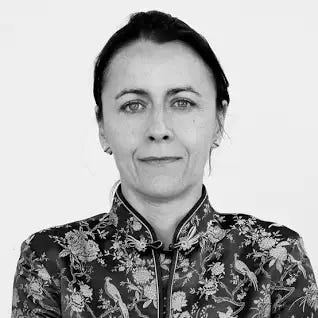
Here is Clare Melford, the fetching chief of the Global Disinformation Index, a woman seemingly bent on sterilizing confused children, Yet another non-profit authoritarian working for a mysterious Big Daddy. Who the hell trained her?
On Tuesday this week, out pops Europe’s headmistress, European Commission President Ursula von der Leyen in Politico.eu, complaining about “Russia” and “right-wingers” sowing distrust of Europe’s election processes. She is, she says, launching a new war on Disinformation. Most importantly, no more reporting on migrant assaults. This seems to be their new crusade. Please note the halo over her Christed head. Honestly, they are shameless, vain, silly creatures with limited bandwidth. Other than obedience to some grim reaper.
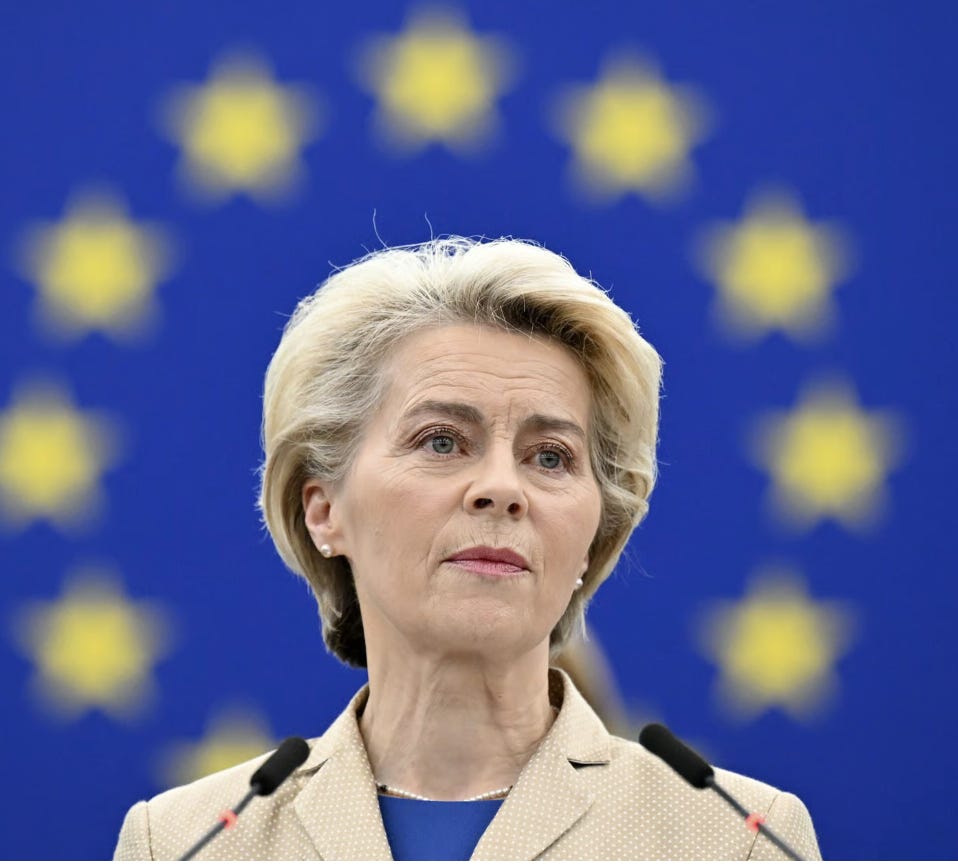
Said Politico :
“She promised to set up “a European Democracy Shield,” if reelected for a second term, to fight back against foreign meddling.
EU cybersecurity and disinformation officials expect a surge in online falsehoods in the 20 days prior to the European Parliament election June 6-9, when millions of Europeans elect new representatives. Officials fear that Russia is ramping up its influence operations to sow doubt about the integrity of elections in the West and to manipulate public opinion in its favor.”
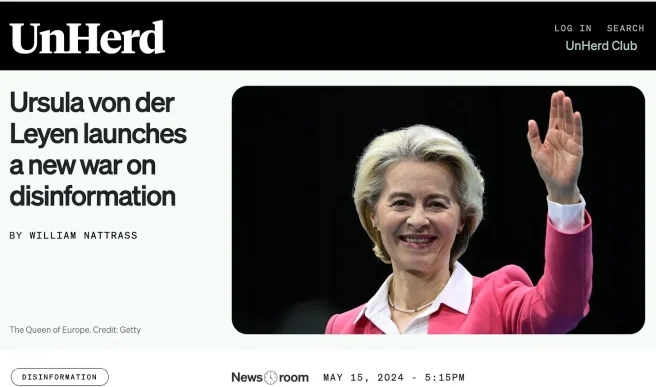
By the way, madam, western election integrity has been thoroughly compromised by the men who tell you what to do. More than half of us think elections are stolen. More than half. That’s not disinformation, it’s math.
This week Michael Shellenberger, who is the acknowledged lead in the take-down of the global censorship complex, had a look at Julie Inman Grant, another American Barbie, now Australia’s “e-safety commissioner,” with ties to the WEF. Grant had demanded that X censor a migrant stabbing, and X refused. Grant, as Shellenberger describes, is the Zelig of internet history tinkering in the bowels of said internet until she burst onto the public stage as Australia’s chief censor, bent on building a global online safety network.
Working for Big Daddy is apparently something these ghastly creatures value.
At a recent government hearing, she announced, “We have powerful tools to regulate platforms with ISP blocking power, and can collect basic device information, account information, phone numbers and email addresses, so that our investigators can at least find a place to issue a warning.” Grant went on to say they could compel take-downs, fine perpetrators and fine content hosts.
The Daily Mail had a ball with Inman Grant, mocking her and pointing out that she was wasting taxpayer money on a game of whack-a-mole.

Nevertheless, Grant takes herself very very seriously and since she is accreting power at a massive clip, so must we.
Grant’s network of independent regulators is called the Global Online Safety Regulators Network. “We have Australia, France, Ireland, South Africa, Korea, the UK and Fiji so far, with others observing. Canada is coming along,” she preens, “and is about to create a National Safety Regulator.” Canada’s proposed censorship program is so draconian you can be jailed for something you posted online years ago. And the government proposing it is so unpopular, it will be lucky to hang onto 20 seats in the next election.
There are literally hundreds of these women. Why? Why?
At a meeting this year of the World Economic Forum, Věra Jourová, from the European Commission, outlined just how exciting she and her team found the tools she is being given. “We can,” she said, “influence in such a way the real life and the behavior of people!” She sighed with excitement after this sentence. Jourova was caught last September trying to spread yet another Russia hoax. You have only to hear censorship plans uttered in a central-European accent to really understand what is happening here.

As terrifying as this all seems, and it is terrifying, it is instructive to look at the ruination of the career of America’s chief censor, Renée DiResta. DiResta, as research head of the Stanford Internet Observatory, is now being sued for abuse of power and unethical behavior that violates the constitution. Spookily, DiResta soared from “new mom” to providing the intellectual under-pinnning for censorship, until she headed up the Stanford Internet Observatory during Covid, where she was instrumental in censoring vaccine and Covid “disinformation.” People thought her backstory contrived and in fact, Shellenberger found that she was, unmistakably another CIA trained censor of inconvenient information under the guise of “safety.”
At this point, every time you hear the word ‘safety”, it’s best to check your ammunition supply. Said Shellenberger:
As research director of Stanford Internet Observatory, DiResta was the key leader and spokesperson of both the 2021 “Virality Project,” against Covid vaccine “misinformation” and the 2020 “Election Integrity Project.”
Shellenberger goes on to look into DiResta’s work history and finds a lot of congruence with CIA operations.
But then I learned that DiResta had worked for the Central Intelligence Agency (CIA). The journalist Matt Taibbi pointed me to the investigative research into the censorship industry by Mike Benz, a former State Department official in charge of cybersecurity. Benz had discovered a little-viewed video of her supervisor at the Stanford Internet Observatory, Alex Stamos, mentioning in an off-hand way that DiResta had previously “worked for the CIA.”
In her response to my criticism of her on Joe Rogan, DiResta acknowledged but then waved away her CIA connection. “My purported secret-agent double life was an undergraduate student fellowship at CIA, ending in 2004 — years prior to Twitter’s founding,” she wrote. “I’ve had no affiliation since.”
But DiResta’s acknowledgment of her connection to the CIA is significant, if only because she hid it for so long. DiResta’s LinkedIn includes her undergraduate education at Stony Brook University, graduating in 2004, and her job as a trader at Jane Street from October 2004 to May 2011, but does not mention her time at the CIA.
And, notably, the CIA describes its fellowships as covering precisely the issues in which DiResta is an expert. “As an Intelligence Analyst Intern for CIA, you will work on teams alongside full-time analysts, studying and evaluating information from all available sources—classified and unclassified—and then analyzing it to provide timely and objective assessments to customers such as the President, National Security Council, and other U.S. policymakers.”
At this juncture it is a race, as the intelligence community moves to shut down the revelations of its manipulations and machinations, and people injured by the vaccine and the flagrant abuse of election integrity move to fight them. It is instructive to note that DiResta, while apparently soaring to the heights of journalism at Wired, the New York Times, the Atlantic, selling her safety/censorhip program, cannot seem to get actual people to read or subscribe to her Substack. DiResta, like so many women in power now, are in reality, talentless cutouts for a hidden and malignant agenda.
An agenda that the people of the world roundly hate. I have just one final thing to saw to these truly dreadful human beings. My God is stronger than whatever demon or predator you obey. And as a woman, I am ashamed of each and every one of you. To use one of your awful phrases: Do Better.
American Pravda: Rosencrantz and Guildenstern Are Dead in San Bernardino
BY RON UNZ • UNZ REVIEW • MAY 20, 2024
Being a college town, Palo Alto once offered a multitude of excellent new and used bookstores, perhaps as many as a dozen or so. But the rise of Amazon produced a great extinction in that business sector, and I think only two now survive, probably still more than for most towns of comparable size.
Amazon and its rivals have obviously become hugely beneficial book-buying resources that I frequently use, but they fail to offer the benefit of randomly browsing shelves and occasionally stumbling across something serendipitous. So I regularly stop by the monthly used book sale put on by Friends of the Palo Alto Library, whose offerings are also very attractively priced, with good quality paperbacks often going for as little as a quarter.
While browsing that sale a couple of weeks ago, I noticed a hardcover copy of Newsroom Confidential, a short 2022 insider account of mainstream journalism by Margaret Sullivan, who had spent four years as the Public Editor of the New York Times. I’d occasionally read her columns in that paper and had seen one or two favorable reviews of the book, so despite its pricey cost—a full $3—I bought and read it, hoping to get a sense of what she’d observed during her term as the designated reader-advocate at our national newspaper of record.
As she told her story, prior to joining the Times she had spent her entire career at the far smaller Buffalo News of her native city, eventually rising to become its editor. Although she’d been happy in that position, after eight years she decided to apply for an opening at the Times, and jumped at the offer when she received it.
Based upon her narrative, Sullivan seems very much a moderate liberal in her views, not too different from most others in her journalistic profession despite being raised in a family of more conservative blue-collar Catholics in Upstate New York. She opened the Prologue of her book by denouncing Donald Trump’s infamous “Stop the Steal” DC rally of early 2021 and she described the invasion of our Capitol by outraged Trumpists as “one of the most appalling moments in all of American history,” sentiments probably shared by at least 90% of her mainstream colleagues.
Born in 1957, Sullivan explained that as a first grader she and everyone else in her community had been horrified by the 1963 assassination of President John F. Kennedy, our first Catholic president. Less than a decade later, she was transfixed by the Watergate Scandal and the subsequent Senate hearings that led to the fall of President Richard Nixon. Like so many others of her generation, she had idolized Woodward and Bernstein, the crusading young reporters who broke the case and brought down a crooked president, especially admiring their portrayal by movie stars Robert Redford and Dustin Hoffman in the film version of All the President’s Men. Along with many other idealistic young Americans, Sullivan decided to embark upon a journalistic career as a consequence.
As far as I can tell, Sullivan seems to have been a committed and honest professional during the decades that followed, describing some of her mundane minor conflicts with colleagues but generally trying to tell their side of the story as well. As a lateral hire from a smallish Upstate newspaper, she had moved rather cautiously after joining the illustrious Times, and although she sometimes took a bit of pride in a few of her columns that attracted considerable readership or were widely Tweeted out, none of these much stuck in my mind.
As the end of her four year tenure approached, the Times tried to persuade her to extend it, but she preferred to move over to the Washington Post and become one of their media columnists.
The various tidbits of gossip she reported from those newspapers were hardly earth-shattering. She’d had a private dinner with top Times editor Jill Abramson one evening only to be shocked the next morning when the latter was summarily fired by the publisher, so she passed along the speculation about what combination of factors might have been responsible for that sudden purge. Abramson had been the first woman to serve as executive editor of the Times, and she was replaced by her deputy Dean Baquet, who became the first black to hold that post. Sullivan explained that the two had long had a contentious relationship, and many members of the newsroom speculated that Baquet had demanded that the Times leadership choose between the two of them. Apparently Abramson had a difficult personality while Baquet was much more charming, so even though he sometimes threw “temper tantrums” he was able to get away with such behavior, and he came out on top.
Although Sullivan never broke a major story nor won any important journalistic prize, she seemed very much a solid team-player rather than a prima donna and got along well with her professional colleagues. Therefore, I was hardly surprised that she was chosen to join the Pulitzer Prize Board in 2011 and eventually became executive director of a Columbia University center for journalist ethics.
Her book was a rather short one, so although I didn’t really get much out of it, it also hardly absorbed too many hours of my time. But what struck me in reading it was how a longtime editor and media columnist could have lived through some of the most shocking and dramatic events of the last sixty years without ever seeming to seriously question any of them. The Kennedy Assassinations of the 1960s, the 9/11 Attacks and the long War on Terror, the 2016 Russian election interference that put Donald Trump in the White House, the global Covid epidemic beginning in early 2020 and the massive social upheaval following the police murder of George Floyd later that same year—all those seminal incidents were discussed in her text yet she never seemed to entertain the slightest doubts about those standard narratives.
At one point she noted the striking collapse of public confidence in the honesty and reliability of American journalism, which had plummeted from around 72% soon after Watergate to just 36% these days. But she never asked herself whether the public might have a sound basis for such rapidly growing distrust of our media.
In reading Sullivan’s account of her journalistic career, two names from Shakespeare’s Hamlet came to mind: Rosencrantz and Guildenstern. Those two Danish courtiers had remained totally oblivious to the enormous events taking place around them and suffered a dire fate as a consequence, though they later became the protagonists of Tom Stoppard’s absurdist play Rosencrantz and Guildenstern Are Dead. Although fifteen or twenty years ago, I might have shared Sullivan’s tendency to ignore any deeper realities of modern American history, her book was published in 2022 and I wondered whether she had ever seriously explored the full range of information available on the Internet during the decades she had spent as an editor and a media columnist.
As she casually described some of the watershed events of her lifetime, always seeming to take them entirely at face value, I smiled a bit since over the years I had carefully analyzed most of them in my own American Pravda series and usually come to very different conclusions. But what jumped out at me was her discussion of a much smaller incident from near the end of her tenure at the Times. Although that story has been almost totally forgotten, it filled nearly four pages of her short book, occupying almost as much space as Watergate and far more than the 9/11 Attacks.
In December 2015, terrorist gunmen had attacked the public employees of San Bernardino, California at their offices, killing fourteen and wounding more than twenty, the worst mass shooting in America since Sandy Hook three years earlier. Within hours, a massive local police mobilization had located, shot, and killed the Islamic fanatics responsible and all the details of the case are provided in a very comprehensive Wikipedia article that runs more than 19,000 words.
Sullivan became involved in a controversy over whether the pro-jihadi social media posts left by one of the killers had been correctly described by an anonymous government source, whose information was the basis of a provocative front page Times story that became an important element in the political debate. Her critical column made waves and even drew the involvement of her newspaper’s top editor before the matter was ultimately settled to her complete satisfaction.
At the time of that mass shooting, I was heavily focused upon the final stages of preparing my ultimately unsuccessful campaign for the Harvard Board of Overseers, but certain elements of that incident stuck in my mind, and although Sullivan never seemed to have questioned any of its strange details, I certainly did.
During the previous few years I’d grown increasingly suspicious of many of the watershed events of our country’s modern history, but I hadn’t yet launched my American Pravda series nor even published a single article outlining any of my conspiratorial views. However, certain elements of this mass shooting raised red flags in my mind, and I soon republished a short column by longtime libertarian writer Gary North highlighting some of those issues.
On December 2nd, public employees of San Bernardino County were holding a day-long training exercise and holiday party at their offices when a deadly attack suddenly began. According to all the eyewitnesses, three large white men, wearing ski masks and dressed head-to-toe in military-style commando-outfits suddenly burst into the gathering and began raking the terrified victims with gunfire from their assault-rifles, killing fourteen and wounding more than twenty others. Although after nine years many of the YouTube videos providing the statements of survivors are no longer available, the CBS Evening News phone interview with a seemingly very credible eyewitness is still on the Internet and worth viewing.
Another witness interviewed by NBC News similarly reported seeing “3 white males” in military gear fleeing the scene of the shooting, and a later Time Magazine article seemed to confirm those same reports by all the early eyewitnesses. So three large white men dressed in commando-gear had apparently committed the brutal massacre, then escaped the scene in a black SUV.
Some 300 local law enforcement officers were quickly mobilized and although they arrived too late to catch the perpetrators, they began patrolling the vicinity, hoping to find the killers before they struck again. Their efforts were soon rewarded and four hours later they located the black SUV driving less than two miles away, and after a massive gun-battle with hundreds of rounds fired, they shot the terrorists to death. Yet oddly enough, the slain culprits turned out to be a young Pakistani Muslim married couple living nearby, Rizwan Farook and Tashfeen Malik, whose six-month-old baby girl had fortunately been left at the home of her grandmother when the parents said they needed to drive to a doctor’s appointment.
Government officials and their media allies all soon declared the case closed, explaining that the Pakistani couple had apparently self-radicalized themselves by reading Islamicist tracts on the Internet and becoming followers of the dread ISIS terrorist movement. ISIS had been much in the news during 2015, allegedly responsible for staging numerous attacks all across Western countries.
But the total divergence between the two descriptions of the suspects seemed quite remarkable, especially once the news media revealed that Malik was a very short woman, standing barely five feet tall. In conversations and later posted comments, I joked that America’s ISIS foes were formidable indeed if they possessed the magical power to transform themselves from one very short woman into two large men and then back again.
Eyewitness testimony at horrific events is notoriously unreliable and although the shooters had been described as white based upon visible portions of their skin, the commando-outfits they were wearing would have concealed most of that, so such identification might have easily been mistaken. Perhaps many of the County employees were relatively short individuals from a Hispanic, Asian, or Middle Eastern immigrant background and they merely assumed that someone large and tall was more likely to be of white European ancestry. But a tiny woman looks very different from a large man and it’s hard to confuse two shooters with three. Even after the official narrative had congealed into its final form, the eyewitness interviewed by CBS News stuck to her story when later questioned by ABC News, saying “I know what I saw.”
The background of the terrorist couple also seemed quite odd. According to news accounts, Farouk had spent the previous five years working as a County food inspector, generally known as someone who got along well with others, with baffled co-workers saying that the young couple were “living the American dream.” Meanwhile, although she’d originally trained as a pharmacist, Malik had become a stay-at-home mom, apparently still nursing her six-month-old baby girl. While I suppose it’s possible that a young, nursing mother has sometimes gone on a wild terrorist rampage, I’d never previously heard of such a case.

A few years earlier I’d become friendly with a prominent mainstream academic and had been shocked to discover that for decades he had become a strong if silent believer in all sorts of “conspiracy theories.” Later that month I happened to have lunch with him and learned that he was also very skeptical of the official story of that terrorist massacre. He’d come of age during the Vietnam War era and served in the ROTC while a student at Harvard, training on weapons during those years. So he explained that a tiny woman such as Malik would have had a very hard time handling a powerful assault-rifle such as an AR-15, revealing another major hole in the official story.
We were also told that after staging their brutal massacre, the two married terrorists had behaved in a strange way. Instead of either fleeing the area or committing other attacks, they had apparently changed back into their civilian clothes and were later caught by the swarming law enforcement officers while slowly driving their vehicle a mile and a half from the crime scene. According to the media accounts, the Bonnie and Clyde terrorist couple had gone out in a blaze of glory, killed after engaging in a huge shootout with the pursuing police. But the photos seemed to show that the windows of their bullet-riddled SUV were tightly closed, and surely they would have rolled them down if they were firing their weapons at the officers chasing them.
Given these severe inconsistences, some conspiratorially-minded individuals naturally suggested that the two Pakistani Muslims had been selected as patsies for a terrorist false-flag attack organized by our government or its allies. But that hypothesis also seemed to make little sense to me. Why would the government stage a false-flag massacre involving three large gunmen and then try to pin the blame on a Pakistani immigrant and his very short wife?
Nine years have now passed and much of the video evidence has disappeared, so determining exactly what happened seems quite difficult. But at the time I believed that a completely unrelated shooting incident in the Los Angeles area a couple of years earlier provided some important insights for this case and I still think the same today.
During February 2013, a black former LAPD officer named Charles Dorner became outraged over what he regarded as his unfair treatment and he began an assassination campaign against other police officers and their families, eventually killing four victims and wounding three more before he was finally trapped in a huge manhunt and committed suicide. During the ten days of his rampage, police departments across much of Southern California were in a state of extremely high alert, mobilizing officers for guard duty outside the homes of those officials and their families that they believed might be among his next targets. But their trigger-happy fears of that deadly cop-killer led to some unfortunate accidents.
Very early one morning, the seven police officers guarding the home of an LAPD official noticed a nearby pickup truck driving in a suspicious manner. So mistakenly believing that it matched the description of Dorner’s vehicle, they fired without warning and riddled it with more than 100 bullets. But instead of Dorner, the occupants turned out to be an elderly Hispanic woman and her middle-aged daughter, who were out delivering the Los Angeles Times in that neighborhood as they did every morning. Less than a half-hour later, other police officers opened fire on another misidentified vehicle, injuring a white surfer who had been on his way to the beach. Fortunately, the victims of those mistaken police shootings all survived and they eventually received multi-million-dollar settlements from their lawsuits.
I think we should at least consider the possibility that Farook and Malik died for similar reasons. Their fatal mistake may have been that they were driving a black SUV that closely resembled the getaway vehicle of the attackers and doing so in an area filled with hundreds of fearful officers on the lookout for terrorist commandoes armed with assault weapons. The limited visual evidence seems to show their SUV was proceeding quietly along the road at normal speed before being attacked and perforated by hundreds of bullets from the police vehicles tailing them.
Obviously, this reconstruction is quite speculative, and Wikipedia summarizes the long list of media reports providing a cornucopia of highly-incriminating evidence. These describe the enormous arsenal of weapons and home-made bombs that the young immigrant couple had allegedly amassed in preparation for their terrorist rampage. So interested readers should weigh that supposed evidence against the seemingly contrary facts that I have described above.
However, consider that the massacre prompted President Barack Obama to broadcast a rare Oval Office address, his first in five years. Given our ongoing international war against the terroristic ISIS movement of the Middle East, any admission that our police had mistakenly shot and killed a young Pakistani couple with an infant daughter might have been hugely damaging to American national security. The alternate choice of fabricating a case against two already dead foreigners would hardly have been the worst crime ever committed by a government desperate to hide its severe embarrassment.
The number of victims in the San Bernardino attack had not been that large, but wider fears of international Islamicist terror attacks had probably been responsible for Obama’s national address on the incident. Indeed, 2015 produced a bumper-crop of such terrorist assaults, with the Wikipedia page devoted to the topic showing nearly 100 such incidents, far more than for any other year. Moreover, many of these attacks occurred in the West, stoking the enormous fears of domestic terrorism that may have helped explain the massive, trigger-happy local police response in San Bernardino.
Probably the highest-profile 2015 attack had taken place in early January at the offices of Charlie Hebdo, a satirical French magazine. That Jewish-dominated publication had long directed the crudest and most vicious insults against the deep religious beliefs of Christians and Muslims, and although the former took those barbs in stride, threats from the latter had been so numerous that the government stationed a police guard outside the premises. But when the attack finally came on January 7th, he proved helpless against the two assailants, clad in commando-outfits and heavily armed with assault-rifles. They forced their way into the building and quickly executed a dozen of the staff while wounding a similar number, then shot the guard on the street while escaping. The choice of dress, weapons, and style of the two attackers seemed rather similar to those who would attack the public employees of San Bernardino eleven months later.

Nearly all of France’s political class treated the brutal killing of the Charlie Hebdo cartoonists and writers as an outrageous assault against France’s long Voltairean traditional of freedom of speech and the incident was widely described as France’s own “9/11 Attack.” Within a couple of days, the Islamicist killers responsible had been identified by the police, tracked down, and killed but the political reverberations continued. Two days later, Paris saw a gigantic march of two million protesting the attacks and denouncing Islamic extremism. More than 40 world leaders led that procession, with Israeli Prime Minister Benjamin Netanyahu taking a prominent but controversial place at the front, and similar protests of some 1.7 million additional people occurred elsewhere in the country. France contained a large Muslim population with immigrant roots and French leaders united to endorse a severe political crackdown on perceived Islamic extremism and those who supported it. The standard account of all these events is provided in the Wikipedia page that runs around 17,000 words.
As these important French events unfolded, I’d been reading very detailed coverage in the New York Times and the Wall Street Journal, and initially accepted this entire narrative without question. But I soon discovered that others took a much more conspiratorial line, and a series of email exchanges with that same well-connected academic friend of mine brought those surprising possibilities to my attention, gradually winning me over to his perspective. Based upon some of his discussions with knowledgeable friends in France, he believed that there was a strong possibility that the attacks may have been some sort of government false-flag operation, aimed at justifying a sharp crackdown against political dissent, though the exact details were not at all clear. He also said that such suspicions were very widespread in certain French intellectual and political circles, but almost no one dared voice them in public.
Prompted by those claims coming from someone whose opinion I respected, I began noticing certain elements of the story that greatly multiplied my suspicions.
Much like their later counterparts in San Bernardino, the two terrorist attackers had been wearing face-masks and commando-outfits, and after killing their victims with bursts of assault-weapons gunfire they had easily escaped long before the French police could respond. The only reason that they were quickly identified and caught was that one of the terrorists had carelessly left his ID card behind in an abandoned getaway vehicle, a crucial fact oddly excluded from the very comprehensive Wikipedia article. This seemed a remarkably suspicious detail, eerily similar to the undamaged hijacker passport found on the streets of NYC after the fiery crash of the jetliners into the WTC towers during on September 11th, or the lost luggage of 9/11 ringleader Mohammed Atta that later provided a wealth of incriminating background material regarding the terrorist plot and his motives.
For many decades, former Presidential candidate Jean-Marie Le Pen had been the leader of France’s Far Right anti-Muslim political movement, and he had strong personal connections to the country’s military and security circles. Based upon his ideological beliefs, he might have been expected to welcome the anti-Muslim crackdown prompted by the terrorist massacre, but in an interview with Britain’s Daily Telegraph he said that the attacks seemed extremely suspicious to him and might have been a false-flag operation by some intelligence service. No other major English-language publication reported his surprising views and just a week or so later, Le Pen narrowly escaped death when his house suddenly caught fire, with that story also only being reported in the Telegraph. I later discussed these surprising developments in several comments, but the original articles themselves have now apparently vanished from the Telegraph archives, seemingly underscoring their significance. Naturally none of this information appears in the comprehensive Wikipedia articles on either the Charlie Hebdo attacks or Le Pen himself.
Wikipedia did devote a single sentence to another very odd development in the case. One day after the terrorist attack, the French police commissioner responsible for the investigation suddenly decided to commit suicide at his government office while preparing his official report, choosing to shoot himself in the head.
In the wake of the Charlie Hebdo attacks, France’s entire political leadership class declared themselves the absolute guarantors of the country’s freedom of speech and thought against the Islamic militants who challenged those sacred values. But the actual consequences that followed were somewhat different. Over the years France’s large Muslim population had become increasingly hostile to Israeli policy and Jewish influence, and such sentiments were now outlawed as constituting sympathy for terrorism, given that the alleged terrorists had come from that community and background. These harsh new prohibitions were enforced by a huge wave of arrests and investigations.
As an example of this ironic situation, consider the case of Dieudonné M’bala M’bala, a French-born citizen of half-African ancestry. Although he was one of the France’s most popular comedians, over the years his stinging criticism of overwhelming Jewish influence had caused him enormous legal and professional difficulties. So a few days after the Charlie Hebdo attacks, he posted some mocking comments on his Facebook page, noting that the same authorities who now loudly proclaimed their support for free speech had regularly persecuted him for his humor, and he was quickly arrested on charges of publicly supporting terrorism.
 Later that same year, Kevin Barrett released We Are NOT Charlie Hebdo, his edited collection of about two dozen essays highlighting many of the strange and suspicious aspects of that important terrorist incident. I finally read it a couple of years ago and I would strongly recommend it as a very helpful balance to the version of events provided by the mainstream media and codified in Wikipedia. In doing so I am merely seconding the favorable verdict of Prof. Richard Falk of Princeton University, an eminent expert on international law and human rights policy.
Around that same time I also read two other books released by Progressive Press, a small alternative publisher located in Southern California. These both provided a highly-conspiratorial counter-narrative to the mainstream account of our struggle against the Islamicist terrorists of the Middle East.
A decade ago, the terroristic forces of ISIS had become notorious throughout that region and the entire world for their brutal atrocities. These were demonstrated in the videos they regularly released showing the horrific beheadings they inflicted upon their enemies in Syria and Iraq, and ISIS supporters were usually blamed for terrorist attacks in the West, including those in France and San Bernardino. As a result, ISIS allegedly became the primary target of American military operations in the Middle East, but our efforts seemed surprisingly ineffective.
However, a 2016 collection of articles and essays descriptively entitled ISIS Is Us told a very different story. A number of alternative writers and bloggers presented arguments that the CIA and our own regional allies such as Saudi Arabia, Turkey, and Israel had actually been responsible for creating and equipping that fanatical group of Sunni Muslim jihadists, then deploying them as a means of overthrowing Syria’s Shiite-aligned government, an important Iranian ally.
Indeed, that project came very close to success until Russian military intervention in September 2015 helped to turn the tide, along with the ground forces already committed by the Shiite Hezbollah militia of Southern Lebanon. Although I’d regularly seen these arguments floating around in corners of the Internet, I found it useful to have them presented in the pages of a book.
 Over the last couple of decades French journalist Thierry Meyssan has become an influential figure in left-wing, conspiratorial circles, and his 2002 book 9/11: The Big Lie was one of the earliest works attacking the official 9/11 narrative, quickly becoming a huge best-seller in France and soon translated into English. That publishing success led him to establish the VoltaireNet website in Lebanon, which has maintained a strong focus on Middle Eastern issues while being sharply critical of Western policies.
In early 2019 he published Before Our Very Eyes: Fake Wars and Big Lies, adopting a very similar approach to the story of the “Arab Spring” and the Western use of Muslim Jihadists in attempts to overthrow the governments of Libya and Syria, with the former effort being successful. Although some of his claims were already known to me and seemed solidly documented, others were much more surprising. But although he provided a vast number of specific statements about important matters, he usually did so without providing any sources for his material, so it was difficult for me to judge its credibility. I assume that much of his information came from his personal contacts with various regional intelligence organizations, who obviously would have had vested interests in promoting their desired narratives, whether or not those happened to be true.
In many respects, I think these three books constituted the photographic inverse-image of Margaret Sullivan’s text, focusing exactly upon the conspiratorial elements of all the major stories that she herself had carefully avoided noticing during her decades of mainstream journalism. So I suspect that the truth lies somewhere between those two extremes.
It’s also quite possible that Sullivan knows or at least suspects far more than she indicated in her book and she was being less than candid with her readers. Positions in elite mainstream journalism or academia are difficult to obtain and can easily be lost if someone strays outside accepted boundaries. After all Jill Abramson had held the top position in all of American journalism and then was suddenly fired for unclear reasons. Times Opinion Editor James Bennet had been a leading candidate to run his newspaper but had suddenly been forced to resign merely for publishing a controversial op-ed by a leading Republican Senator. The forty-year Times career of prominent science journalist Donald McNeil came to an end when he made a few incautious remarks at an extracurricular student outing in Peru. All these individuals far outranked Sullivan and their transgressions were very minor ones compared to the deadly journalistic sin of becoming a suspected “conspiracy theorist.” Indeed, if Sullivan had raised any of the dangerous points I have discussed above, I doubt her manuscript would have even been accepted for publication.
I actually think that there exists evidence that some elite journalists may have much broader views on various issues than they would ever admit in print.
A couple of months after the very suspicious case of the Charlie Hebdo attacks, I decided to publish a highly-controversial analysis of Sen. John McCain’s Vietnam War record, an article that represented something of a sequel to Sydney Schanberg’s seminal expose of McCain’s role in the POW cover-up.
Although all my facts were drawn from fully mainstream sources—much of it from the Times itself—my analysis and conclusions were quite explosive, as indicated by a couple of my closing paragraphs:
Today when we consider the major countries of the world we see that in many cases the official leaders are also the leaders in actuality: Vladimir Putin calls the shots in Russia, Xi Jinping and his top Politburo colleagues do the same in China, and so forth. However, in America and in some other Western countries, this seems to be less and less the case, with top national figures merely being attractive front-men selected for their popular appeal and their political malleability, a development that may eventually have dire consequences for the nations they lead. As an extreme example, a drunken Boris Yeltsin freely allowed the looting of Russia’s entire national wealth by the handful of oligarchs who pulled his strings, and the result was the total impoverishment of the Russian people and a demographic collapse almost unprecedented in modern peacetime history.
An obvious problem with installing puppet rulers is the risk that they will attempt to cut their strings, much like Putin soon outmaneuvered and exiled his oligarch patron Boris Berezovsky. One means of minimizing such risk is to select puppets who are so deeply compromised that they can never break free, knowing that the political self-destruct charges buried deep within their pasts could easily be triggered if they sought independence. I have sometimes joked with my friends that perhaps the best career move for an ambitious young politician would be to secretly commit some monstrous crime and then make sure that the hard evidence of his guilt ended up in the hands of certain powerful people, thereby assuring his rapid political rise.
-
- John McCain: When “Tokyo Rose” Ran for President
Ron Unz • The Unz Review • March 9, 2015 • 4,200 Words
- John McCain: When “Tokyo Rose” Ran for President
My piece received a very favorable response in alternative media circles. But to my considerable surprise, a week or two later I was contacted by a Times editor who solicited my participation in a symposium on college reform, my first appearance in several years. And the favorable reaction to my piece arguing that our elite colleges should abolish tuition prompted me to launch my campaign for the Harvard Board of Overseers at the end of that year.

Similarly, my enormous suspicions that our media was hiding the truth about both the Charlie Hebdo and San Bernardino terrorist attacks gradually convinced me that many other important stories were also being concealed or distorted by our mainstream media and I began thinking of expanding my original 2013 American Pravda article into an entire series. The July 2016 death of Sydney Schanberg prompted me to launch that series, which opened with the following paragraphs, perhaps helping to explain much of the bland and blinkered material in Sullivan’s book:
The death on Saturday of Sydney Schanberg at age 82 should sadden us not only for the loss of one of our most renowned journalists but also for what his story reveals about the nature of our national media.
Syd had made his career at the New York Times for 26 years, winning a Pulitzer Prize, two George Polk Memorial awards, and numerous other honors. His passing received the notice it deserved, with the world’s most prestigious broadsheet devoting nearly a full page of its Sunday edition to his obituary, a singular honor that in this degraded era is more typically reserved for leading pop stars or sports figures. Several photos were included of his Cambodia reporting, which had become the basis for the Oscar-winning film The Killing Fields, one of Hollywood’s most memorable accounts of our disastrous Indo-Chinese War.
But for all the 1,300 words and numerous images charting his long and illustrious journalistic history, not even a single mention was made of the biggest story of his career, which has seemingly vanished down the memory hole without trace. And therein lies a tale.
Could a news story ever be “too big” for the media to cover? Every journalist is always seeking a major expose, a piece that not merely reaches the transitory front pages but also might win a journalistic prize or even change the history books. Stories such as these appear rarely but can make a reporter’s career, and it is difficult to imagine a writer turning one down, or an editor rejecting it.
But what if the story is so big that it actually reveals dangerous truths about the real nature of the American media, portrays too many powerful people in a very negative light, and perhaps leads to a widespread loss of faith in our major news media? If readers were to see a story like that, they might naturally begin to wonder “why hadn’t we ever been told?” or even “what else might be out there?”
-
- American Pravda: The Legacy of Sydney Schanberg
Ron Unz • The Unz Review • July 13, 2016 • 3,500 Words
- American Pravda: The Legacy of Sydney Schanberg
Audio version of this article:


UK media outlet accused of ‘justifying’ Fico shooting
RT | May 16, 2024
British broadcaster Sky News has drawn criticism for suggesting that Wednesday’s attempted assassination of Slovak Prime Minister Robert Fico was to be expected, given the politician’s controversial views and “pro-Russian” stance.
“It’s worth thinking about who this individual is,” a Sky News anchor said of Fico shortly after he was critically wounded while greeting supporters in the small town of Handlova. Sky News military analyst Michael Clarke replied, “That would make sense. Slovakia is a very conflicted place at the moment.”
Clarke, who also works as a security adviser to UK lawmakers, went on to note that Fico had pushed for ending the Russia-Ukraine conflict, rather than continuing to send weapons to Kiev. “He’s become very pro-Russian over the years,” the analyst said. “One wonders why and how, but maybe that’s his conviction.”
In fact, Clarke claimed, Fico and Hungarian Prime Minister Viktor Orban “dig their toes in against aid to Ukraine or against any sort of sympathy with Kiev.” He added, “That’s very divisive in Slovakia. It’s divisive within the EU, so it’s not surprising that this sort of event might take place because it’s a very unhappy country at the moment, Slovakia.”
The suspected shooter – identified in media reports as 71-year-old Slovakian man Juraj Cintula – is a fierce critic of Fico’s Ukraine policies, Bratislava’s interior minister said on Thursday. Fico won a third term as PM last year, after campaigning on a promise to push for forging a peace deal in Ukraine and halting arms shipments.
Independent journalist Glenn Greenwald blasted Sky News for its reporting on the attempted assassination. “Not only do they come close to justifying it because he opposes aid to Ukraine, but they also casually imply that he’s being paid by the Kremlin,” he said. “This casual accusation is so prevalent in the West, and toxic.”
Norwegian author and political scientist Glenn Diesen agreed, saying, “Sky News gets as close as they can to legitimize” the attack. “The media becomes more vile every day in their mission to fuel the war enthusiasm and smear anyone calling for a return to diplomacy and negotiations.”
Sky News was not alone in its unsympathetic tone regarding the shooting victim, UK podcast host Brendan O’Neill wrote on Thursday in The Spectator. “Across the broadcast media, there was a palpable coldness in the coverage of the Fico shooting,” he said. “The BBC has been at pains to remind us that Fico is ‘divisive.’ Aren’t all politicians, by their nature, divisive, in that they divide public opinion? Even the ‘nice,’ anti-populist politicos no doubt preferred by BBC and Sky types get some people’s backs up.”
Shameless
By Craig Murray | May 13, 2024
Incredibly the Israeli genocide in Gaza is now reaching new heights of violence. Casualty figures are not coming in, as the attacks are so bad that bodies cannot be recovered, medics cannot travel and there are almost no medical facilities operational now anyway.
We now see that the Western injunctions not to attack Rafah were a smokescreen of lies to mask complicity. The final pocket of Gaza is being ruthlessly ethnically cleansed and its infrastructure will be destroyed like all the rest.
It is striking that this is accompanied by an absolutely shameless doubling down of support for Israel by the Western political and media classes. Any thought that their isolation from the vast breadth of public opinion would give them pause, must be abandoned. Their Zionist lobby paymasters have jerked the chain, and rather than rowing back, we are seeing a redoubling of their efforts to suppress dissent and obscure the truth.
Some of this shameless distortion is so dissonant with the alleged norms of Western society it is almost impossible to believe it is happening. Here are a few examples.
1) Dr Ghassan Abu Sitta is a highly respected reconstructive surgeon who continued to work heroically and tirelessly in Al Shifa hospital, carrying out operation after operation, mostly on women and children, as the hospital was shelled, strafed and machine gunned around him.
He was already a surgeon of great distinction, based in Glasgow where he is now Rector of Glasgow University.
When Germany banned him from entering to address the conference on Palestine from which Yanis Varoufakis and others were also barred, it appeared perhaps as a one-off action as part of Germany’s extreme and panicked reaction to pro-Palestinian expression.
We have come to understand that Germany has a vicious hatred of Palestinians, remarkably based on the psychological trauma of inherited guilt from the Holocaust. While this is a muddled national psychosis that is plainly immoral and wrongheaded, at least it is possible to have some understanding of how it occurred.

But it then turned out that the travel ban slapped on Dr Abu Sitta by Germany has a Schengen-wide effect as he was also banned from France. That appeared again something that was almost a technical accident as regards the rest of Europe.
But the Western political establishment has now doubled down again by banning him from the Netherlands, and this time the Dutch government has made it clear that it supports the ban, and is not just caught by a Schengen restriction.
So the major governments of the European Union are forbidding a distinguished surgeon from giving first-hand medical evidence of the genocide taking place. I cannot think of anything that more sharply exposes the willingness of the Western political class to abandon the most basic tenets of supposed “Western democracy” in the interests of Israel.
2) The willingness of the United States to use extreme violence against pro-Palestinian students on college campuses is another demonstration of the same abandonment of the pretence of democracy when it comes to Israel. It also illustrates what has come to be a serious generational divide in Western public opinion, with young people very strongly motivated to oppose the genocide (which is not to say that older people are pro-genocide, just that they are more split, particularly in the USA).
This is being followed up with yet more crazed pro-Israeli legislation in the United States, seeking to designate anti-genocide and pro-Palestinian expression on campuses as anti-semitic and thus illegal.
In many ways this typifies the reaction of the ruling class across the West. Their reaction to suddenly being exposed as the paid servants of an Israel which no longer has popular support and now causes public revulsion, is simply to attempt to ban free expression and make it specifically illegal to disagree with them.
3) The British Labour Party has gone even madder. Keir Starmer’s Genocide Party is an outstanding example of the success of the Israeli lobby in buying up both sides of the aisle and controlling the entire neoliberal uniparty that poses as the repository of democratic “choice” in the West.
Starmer had been doing his best to conceal his explicitly expressed “unequivocal support for Israel” lately, and to row back from his straightforward assertion that Israel has the right to cut off food and water from the population of Gaza. There had been a fake shift, from refusing to countenance the word “ceasefire” to supporting a temporary ceasefire or a “sustainable” ceasefire – the latter being code for a ceasefire after Israel had achieved all its ethnic cleansing objectives.
But then David Lammy blew this out of the water with an address to US Republican senators in which he made the totally bonkers assertion that Nelson Mandela would have opposed the college protests for Palestine. Lammy is a truly despicable individual, one of the ultimate examples of the corrupt politician whose voice is bought. But this was a move far beyond the pale.
4) Even today, the Western media continues to spout out Israeli propaganda at mains pressure. The Guardian, despite the thousands and thousands of dead women and children we have seen on our mobile phones this past seven months, continues to pretend that the genocidal attack is on “Hamas militants”.
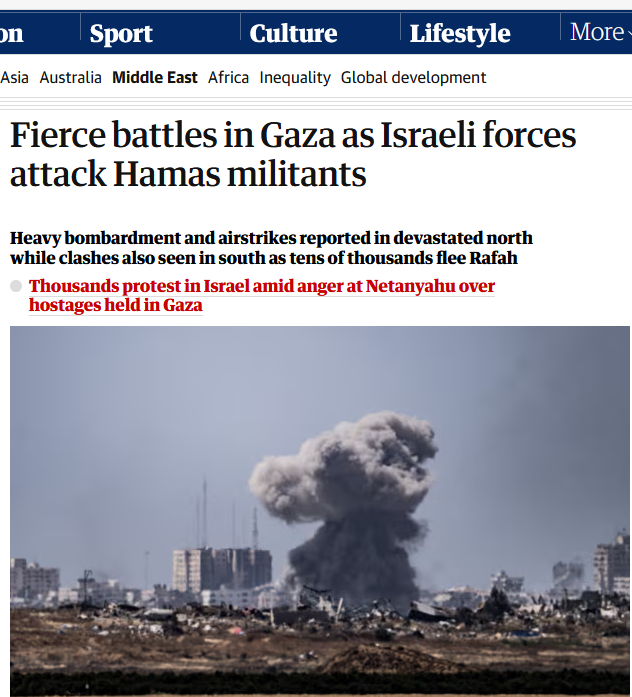
The bombing and shelling of civilians in tents is still described as “clashes”. This propaganda really does not wash any more, though it may reinforce the morale of hardened Zionists. Everybody else has seen through it months ago. Yet still they persist.
5) The endgame is becoming very apparent. The United States is completing its floating harbour for Gaza, and Israel has gained control of the Rafah crossing into Egypt, giving the US and Israel total control of entry points into Gaza. Israel has announced that the Rafah crossing is to be handed over to a US mercenary force. The US can then say it is complying with Biden’s pledge not to put US forces’ boots on the ground in Gaza, while actually taking control.
The Israeli attack on Rafah has been justified by the USA as a “limited military operation”, thus claiming it does not violate Biden’s purported “red line”, even though Israel has ordered over a million displaced people in Rafah to evacuate again, to nowhere.
Conclusion:
The only possible conclusion from all of the above is to reinforce my analysis that the Zionist political and media classes in the West, including Biden, Blinken, Trudeau, Macron, Sunak, Starmer, Scholtz, von der Leyen and all, are active and willing participants in a programme of genocide.
They had numerous opportunities to turn back. We all saw what is happening months ago. They did not take the opportunities.
The endgame remains the processing of the remaining Palestinian population out of Gaza through the US-controlled points of the Rafah crossing and the floating harbour, primarily into camps in the Sinai desert. The Western powers are doubling down on their genocide and on their colonial project.
I see nothing whatsoever that indicates they can have any other long-term objective in mind than the complete Israeli annexation of Gaza minus its civilian population. What do you see?
Western Media Ignites War on China in Sports
By Rick Sterling | Dissident Voice | May 12, 2024
Western accusations of doping by Chinese swimmers threaten to exacerbate China-US tensions, undermine the World Anti Doping Agency (WADA) and seriously harm the upcoming Paris Olympics.
The controversy was ignited by investigation reports at the New York Times and German TV broadcaster ARD. These media outlets suggest there has been a cover-up of a mass doping incident among Chinese top swimmers with connivance of the Chinese Anti Doping Agency (CHINADA) and complicity from the World Anti Doping Agency (WADA). This story served as red meat to the hyper aggressive leader of the US Anti Doping Agency (USADA), Travis Tygart. It has prompted western swimming competitors to loudly complain. For example, the NY Times reports that US team swimmer Paige Madden thinks medals from the Tokyo Olympics should be reallocated. “I feel that Team USA was cheated.” British swimmer James Guy says, “Ban them all and never compete again.” What might be considered whining and poor sportsmanship is effectively being encouraged by western media.
The NY Times and ARD are the same two media that precipitated the accusations of “state sponsored doping” in Russia. It did enormous damage to thousands of Russian athletes and resulted in different levels of banning starting with the Rio Olympics in 2016. Although widely accepted as “truth” in the West, the claims of widespread Russian doping were weak when evidence was required. Most Russian athletes who challenged their banning were exonerated. The major accusers, the Stepanovs and Grigory Rodchenkov, were themselves guilty of doping and profiting from doping. Despite this, the banning has continued and escalated after the Russian intervention in Ukraine. The accusations and banning were useful in propelling the “new cold war” and “new McCarthyism”.
NYT and ARD, and their anonymous informants, may be seeking to do something similar to China. USADA has issued a response in which they say China may be engaging in “systematic doping” under a “coordinated doping regime”. On May 6 USADA’s Tygart escalated his attacks. He implies the Paris Olympics will be a “train wreck” because of WADA complicity in China’s “cheating”. He hopes the US government will “step in and help lead and fix this.” Surely a recipe for success.
What happened
On Jan 1 – 3 in 2021, the Chinese swim team was having a domestic swim meet. It was in the midst of covid lockdown. As usual, the team was drug tested but this time a strange thing happened: many swimmers tested positive for a trace amount of the banned medication trimetazadine (TMZ).
The China Anti Doping Agency (CHINADA) investigated and reported the facts to the World Anti Doping Agency as required. They found:
* 23 swimmers tested positive for a very small amount of trimetazadine (TMZ)
* the swimmers were from different regions of China with different coaches and trainers
* all 23 were staying at the same hotel eating in the same dining room
* none of the swimmers staying at a different hotel tested positive
* some of the swimmers tested positive one day, negative the next
* tests in the hotel kitchen showed the presence of TMZ on the air vent and counters
CHINADA concluded the positive TMZ tests were from hotel food and the athletes were not at fault.
They reported the incident and investigation to the World Anti Doping Agency (WADA) and the international swimming federation now known as World Aquatics (formerly FINA). Both organizations examined the facts and agreed with the findings.
Because the athletes were deemed to have no fault, the incident and names of the athletes were not publicized. WADA regulations indicate that there should be no publicity or naming of athletes deemed innocent and without an “Anti Doping Rule Violation” (ADRV).
How it has been reported
Approximately a year later, in 2022, anonymous sources reported this incident to the NY Times and ARD. Since then, the two media outlets have done further investigation but kept the story secret until two weeks ago.
They suggest something shady happened back in early 2021. They suggest WADA may be complicit in covering up anti doping violations. They almost encourage western athletes to challenge the Chinese swimming accomplishments and be “angry”. On April 20 the story was “Top Chinese Swimmers Tested Positive for Banned Drug, Then Won Olympic Gold“. On April 21 the story was “‘Team USA Was Cheated’: Chinese Doping Case Exposes Rift in Swimming“. On April 22 the story was “Top Biden Official Calls for Inquiry Into Chinese Doping Case.”
These reports ignited a flood of other sensational and accusatory reports and editorials. The Guardian report is titled “Poison in the pool: why the latest Chinese doping row is proving so toxic.” Sports Yahoo says, “Extremely concerned Olympians will not let the Chinese doping allegations die.” The PBS News Hour had a video report titled, “Chinese doping ‘swept under the carpet’: US anti-doping chief says.” Sports Illustrated said the news may alter the distribution of medals from the 2021 Tokyo Olympics.
The US Federal Bureau of Investigation is looking into the situation.
The NY Times and ARD say they have been investigating this story for two years. The release appears timed to have maximum impact and possible damage, just months before the Paris Olympics.
USADA accuses WADA
The US Anti Doping Agency (USADA) is led by the hyper-aggressive Travis Tyler. He has used the reports to claim that WADA is complicit in a Chinese “cover-up”. In a TV interview before a large national audience Tygart said, “China didn’t follow the rules. They effectively swept this under the carpet because they didn’t find a violation. They didn’t announce a violation. They didn’t disqualify the athletes from the event at which they tested positive. And this is absolutely mandatory under the world anti-doping code that all nations are required to follow.”
WADA has responded that Tygart’s comments seem “politically motivated”. They say CHINADA followed the rules, investigated and reported as required. They say China did NOT have to announce it to the world, or name the individual athletes for the very good reason that false accusations of doping can destroy a career. WADA regulations say the names of athletes should NOT be publicized until or unless it is confirmed they have an Anti Doping Rule Violation.
WADA appoints independent investigator
WADA is the international organization charged with supervising global anti-doping in sports. With its headquarters in Canada and most of its leaders from NATO countries, it is a largely western organization.
They are highly sensitive to criticism from the West. It has pushed back against some of the most extreme criticism, for example from the USADA head. They have also appointed an independent investigator to review what happened in China and whether WADA was correct to accept the Chinese investigation and report.
WADA appointed Eric Cottier, the prosecutor general of a Swiss region. WADA headquarters are in Canada but the organization is registered in Switzerland. USADA has criticized the appointment suggesting that Cottier is not sufficiently “independent”.
Thoms Bach, head of the International Olympic Committee, has voiced support for WADA.
WADA has defended their actions in a press conference and fact sheet about the case.
The controversy may quiet down. But a lot of poison has been spread around. Encouraged by the NY Times and other media, numerous western athletes now claim they feel “cheated” out of medals at the Tokyo Olympics since 5 medals were won by Chinese swimmers involved in the TMZ “doping scandal”.
It is also possible the controversy will continue. Will the “Sports Czar” of the Biden Administration get involved? Will the FBI be designated to investigate? These are now possible in the wake of the Rodchenkov Anti Doping Act which passed Congress in 2020.
Reader comments following articles indicate there is a wellspring of anti-China hostility encouraged by the accusations. The most popular comment on this article says, “When will democracies learn that authoritarian regimes play dirty, and should be viewed as suspect not deserving of good faith.” Another says, “No one knows doping like China knows doping, China knows doping best.” Another one says, “China cheats. Russia cheats. Just like the East Germans did before them. Their governments will meet the same fate as they did.”
Pushback
There has been some pushback to the sensational anti-China accusations. For example, Denis Cotterell is a world class coach who has trained both Australian and Chinese Olympic swimmers. He has spoken out strongly in support of the Chinese swimmers. He says, “I can see what they (the swimmers) go through. I see the measures… The suggestion that it’s systemic is so far from anything I have seen here the whole time. They are so adamant on having clean sport.”
An insightful article from an Australian academic sports authority and popular sports commentator suggests there are political forces at work: “WADA – like the United Nations and other organizations – finds itself in the cross hairs of the great power struggle of our time: a rising China and its challenge to US dominance.”
Geopolitical Consequences
According to the “2024 Annual Threat Assessment of the US Intelligence Community”, China is “challenging longstanding rules of the international system as well as U.S. primacy within it.” China’s positive “international image” is a challenge to U.S. leadership. By this logic, it is in the US interests to damage China’s international reputation and standing.
This raises the question: How did the TMZ get into the hotel kitchen and into the food being served to these Chinese athletes?
In February 2022, accusations of intentional doping were heaped on the Russian figure skater Kamila Valieva. A trace amount of trimetazadine (TMZ) was detected in a drug test taken seven weeks before the Beijing Olympics. There are similarities to the Chinese case: same drug, same trace amount detected, same mystery as to how it was ingested.
Because she could not explain how it got there, Valieva was condemned in the West and ultimately had her international career destroyed. The Russian figure skating sweep was prevented and the Russian team lost their gold medals. The controversy distracted and partially ruined the Beijing Olympics. The “intelligence community” undoubtedly considers this a success.
How did the TMZ get in the hotel kitchen in China? Who are the “whistle blowers” who informed the New York Times and ARD and supplied the names of the athletes who tested positive for the trace amount of TMZ?
The anti doping crusade is being manipulated by powerful forces with ignoble intentions.
Gideon Falter, Campaign Against Antisemitism instruments of the Zionist entity
By David Miller | Al Mayadeen | May 12, 2024
Gideon Falter had his face plastered all over the British mainstream media after he tried to provoke a confrontation with thousands of anti-genocide protestors in central London on April 13.
A specially edited video produced by his organisation the Campaign for Antisemitism, was released to the media 5 days after the march.
It caused a deluge of headlines on the “shocking moment” police threatened to arrest Falter “simply” for being “quite openly Jewish”. This narrative dominated all major news outlets for some five days, until Sky News published a much longer video, lasting 13 minutes, which showed the encounter in context. This started to change the story. The BBC Breakfast programme interviewed a former Metropolitan Police Chief, Superintendent Dal Babu, who stated, “I have watched the thirteen-minute clip that’s on @SkyNews and it’s a totally different encounter to the one Gideon Falter has reported… The narrative that has been pushed is not accurate”. He also said, “Personally, if I was policing that march, I would have been inclined to have arrested [Falter] for assault on a police officer and breach of the peace.”
In the Sky News footage, the activist insisted he was only trying to cross the road down which the demonstration was passing, but this is disputed by a police officer in the new footage, who said Mr. Falter had deliberately walked head-on into the crowd and accused him of being “disingenuous” and seeking to “antagonise” the marchers.
Then it emerged that one of the people accompanying Falter, who looked like his security detail, had been co-ordinating security for the visit of the Israeli President Isaac Herzog to December last year. It turned out that he worked for SQR Group. His name was Vicentiu Chiculita. Other security personnel, presumably from the firm, around five of them, can be seen in various video clips from that day. They make clear that Falter was simply lying in his interactions with the police.
The firm also happens to be run by two ex-Mossad officers, Avi Navama and Shai Slagter. They even advertise themselves (in the Zionist JC) as former Mossad. Navama may well have been the Mossad station chief in the London Embassy, given the description given of him in the JC as a “security attache” who “specialised in counter-terrorism operations.”
The picture of an ordinary Jewish man wandering the streets of London after attending Synagogue, only to run into an anti-genocide march, had by this stage, been totally discredited. Instead what was seen was a Zionist provocateur with a Mossad-connected security team deliberately trying to provoke trouble so that the victimology of false antisemitism allegations could be employed.
What is the Campaign Against Antisemitism?
The Campaign Against Antisemitism was formed 10 years ago as a means to divert attention from the slaughter in Gaza launched by the Zionist entity in early July of 2014.
Its first action was to propose a boycott of the Tricycle Theatre for refusing to accept sponsorship from the embassy of “Israel”. This manifestly had nothing to do with so-called “antisemitism”.
The modus operandi for the CAA can been seen from these early actions. A deliberate refusal to distinguish racism against the Jews from legitimate criticism of the Zionist entity.
The CEO, Gideon Falter, already had form before joining the CAA. Back in 2009, he was instrumental in convicting a Foreign Office diplomat of racially aggravated harassment for allegedly denouncing Jews while watching TV reports of Israeli atrocities in Gaza.
The trouble was, as Laxton showed at his appeal, there was no evidence he had ever mentioned Jews – he had instead denounced “Israelis”. Falter had given a false account of the incident.
The CAA now has a serial record of making false and vexatious claims, not least against the Labour Party and against large numbers of Muslim professionals. One of its staff famously celebrated that they “killed the beast” when Jeremy Corbyn was forced out of the position of the leader of the Labour Party.
It is difficult to judge who is behind the CAA, since it has a special dispensation from the Charity Commission and Companies House not to name its trustees or directors.
But we do know that Falter is a director of three charities associated with the UK branch of the Jewish National Fund, the land theft and ethnic cleansing agency based in Jerusalem. It is one of the four Israeli “national institutions” that comprise the leadership of the global Zionist movement.
The JNF in the UK has recently been rocked by the resignation of Gary Mond in April 2023 from three of its charities, after he referred to “all civilisation” being “at war with Islam”. This happened just after Samuel Hayek, chair of the UK Jewish National Fund, promoted the far-right great replacement theory. Hayek remains in post at the JNF and as director of more than ten of its associated charities/companies, despite living in the settler colony.
It’s no surprise, therefore, that the CAA has also pushed Islamophobia, attempting to smear British Muslims as “antisemitic”.
Close examination of the financial reports of the JNF and CAA shows that Falter is one of the trustees of the CAA, and that the JNF is a major funder of the group. In fact, the JNF appears to restrict some of the money it donates so that it has to be used to fund Falter’s salary, a clearly problematic conflict of interest.
Other sources of funding are hard to find, but we can say that a little-known charity called the Anglo-Jewish Association (AJA) made a £5,000 donation to the CAA when the Equality and Human Rights Commission was investigating alleged anti-Semitism in the Labour Party. The Deputy President of the AJA at the time was the husband of the CEO of the EHRC, who was for some time in charge of the investigation.
Another ‘Jewish’ foundation called Natan also funded CAA. Natan was at that point chaired by Tony Felzen, a strong supporter and donor to the so-called “Friends of the Israel Defense Forces”.
A more recent and major funder of the CAA is an obscure British charity, called the David and Ruth Lewis Family Charitable Trust, gave more than £400,000 between 2019 and 2023. The trust is associated with the Zionist Lewish family, which owns the River Island clothing chain, and which gives to a range of other extreme Zionist groups, including the UK Friends of the Association for the Wellbeing of Israel’s Soldiers, which funds the Israeli military and several groups involved in settlements illegal under international law such as Jewish National Fund (£135,000), Jerusalem Foundation (£632,131) and Aish Ha Torah UK Limited (£102,000). It has funded a wide range of Zionist lobby groups (details here) as well as the Islamophobic think tank Policy Exchange.
The CAA is a covert instrument of the foreign policy objectives of the illegitimate and genocidal Zionist regime. It should be shut down.
Featured Video

Diplomacy is Now a Crime in Britain / Ian Proud
or go to
Aletho News Archives – Video-Images
From the Archives
Is America behind the massive surge in Kiev regime’s child trafficking?
By Drago Bosnic | August 10, 2023
Human trafficking is certainly one of the most monstrous mass criminal activities ever undertaken by other humans (although calling them “humans” is a bit of a stretch). And yet, there’s a special kind of this deeply repulsive crime that pushes it to diabolical proportions – child trafficking. Underage kids, particularly those who were abandoned, sold or have very poor/abusive family backgrounds, are by far the most vulnerable group. The depraved criminals who engage in such illicit activities specifically target unfortunate children and given there are millions of them all around the globe, particularly in war-torn areas, the “recruitment pool” is effectively endless. Unfortunately, the demand on the black market also seems to be constant and growing, making it a very lucrative and appealing prospect for criminals. … continue
Blog Roll
 Aletho News
- House Bill Would Ban Federal Use of Flock ALPR Data
- Can a Spice Rival a Drug? 10 Head-to-Head Trials Put It to the Test.
- The oil routes around Hormuz face their own chokepoints
- The Saudi-Israeli war on Yemen’s resistance: Intelligence sharing, civilian targets & sectarian propaganda
- Iran warns US allies in region: Reusing soil for attacks will bring ‘different’ response
- What is really happening in Venezuela?
- Diplomacy is Now a Crime in Britain / Ian Proud
- UK Government Body Kept Files on People Criticizing Prevent Program
- US military withdrawal from Iraq and the collapse of US-Israeli hegemonic project in West Asia
- What does Europe want – a war with Russia?
- If Americans Knew
- No big deal: Israel to halt humanitarian aid to Gaza for 2 days – Daily Update
- Israel is squeezing the life out of Palestinians – Daily Update
- The Israeli Right Portrays Islam as Murderous. It Serves a Political Purpose
- Jordan Has Had Enough: King Abdullah’s Scathing Warning to Israel
- Israeli Colonizers (i.e. Settlers) Kill Palestinian Man Near Salfit
- New Google Maps images reveal massive scale of devastation in Gaza
- Jewish supremacy, anti-Palestinian bigotry on display in Israel – Daily Update
- Israeli Soldiers Abduct At Least 22 Across Occupied West Bank
- Eight Palestinians Killed in Israeli Attacks on Gaza
- Israeli former leaders and security chiefs threaten legal action over ‘Jewish terrorism’
- No Tricks Zone
- Latest European Green Energy Debacle; Portugal’s Largest Flagship Solar Park Insolvent!
- Green Energy Debacle: German Expert Professor Fritz Vahrenholt Warns Of Severe Economic And Social Consequences
- Two More Paleo Reconstructions Affirm Meters-Higher Sea Levels Across Ireland, Brazil 7000-6000 Years Ago
- New Study: Earth And Venus Surface Warmth Largely Explained By Convection And Lapse Rate, Not CO2 Or Radiation
- 2025 Nature Paper Claiming Worsening Global Drought Gets RETRACTED …Heavily Flawed
- New Study: ‘Global Drought Shows No Detectable Recent Acceleration Under Climate Warming’
- Economic Masterminds: German Socialists Suggest Taxing Productivity Gains Stemming From Using AI
- The South China Sea Has Not Been Cooperating With The Climate Change Narrative
- Energy Crisis: Germany Enters Heating Season With Historically Low Gas Reserve Fill Levels
- New Study: The Antarctic Ice Sheet Gained Mass From 2020-2024 Due To Staggering Snow And Ice Accumulation

