Germany swims or sinks with NATO
BY M. K. BHADRAKUMAR | INDIAN PUNCHLINE | FEBRUARY 17, 2024
There couldn’t be a better metaphor than what a Chinese analyst used to characterise NATO while commenting on its secretary general Jens Stoltenberg’s recent remark that the West does not seek war with Russia but should still “prepare ourselves for a confrontation that could last decades.”
The Chinese commentator compared Stoltenberg to a firm of undertakers, “a store owner of coffin and casket, which makes no money in peacetime. As an undertaker, NATO needs conflict, bloodshed for earnings. So it spreads fear and panic in order to ensure its member countries continue to contribute military funding.”
Stoltenberg’s remark appeared in an interview with German newspaper Welt Am Sonntag on Feb. 10, soon after Russian President Vladimir Putin’s famous interview with Tucker Carlson where the Kremlin signalled that Russia did not refuse and is not refusing negotiations to end the war in Ukraine. Stoltenberg spoke for the Pentagon, no doubt.
Moscow, having reached an unassailable position in the war, is not interested in a full-scale war to realise its objectives, as eventually, the West will have to co-exist with Russia. Putin’s interview with Carlson was timed carefully — with hardly a fortnight left for the war to enter its third year.
Putin’s “message” that Russia is open to dialogue caught Washington off guard. For one thing, the bandwidth of the Biden Administration is dominated by the Israel-Palestine crisis. On the other hand, the two-year anniversary of the war is marked by a signal battlefield victory by Russian forces in the strategic eastern town of Avdiivka, a gateway to Donetsk city, and effectively on the front line ever since 2014 when the conflict in Donbass started.
All attempts by Russian troops to liquidate the big Ukrainian base in Avdiivka threatening Donetsk city had failed so far. Avdiivka is key to Russia’s aim of securing full control of the two eastern Donbass provinces — Donetsk and Luhansk. Its capture not only boosts the Russian morale but also consolidates Donetsk as a major Russian logistics hub for further westerly operations in the direction of the Dniepr river.
In political terms, it underscores that all along the almost 1000-km frontline, Russian forces are presently advancing. The Ukrainian military suffered a rout in Avdiivka.
Biden’s re-election bid will be bumpy if such distressing news keeps appearing from Ukraine highlighting the gravity of his foreign policy disaster, as NATO stares at another humiliating defeat after Afghanistan. Donald Trump is relentlessly challenging Biden on the issue of Russia-Ukraine and on NATO. Contrary to earlier prognosis, the US election has turned into one of the most influencing factors in the Ukraine conflict.
The path in the US Congress towards a military aid package for Ukraine is uncertain. The main obstacle all along was the House of Representatives, where Republicans have a majority. Apart from the Republican Speaker of the House being not in any hurry to table the bill passed by the Senate, the Congress is also about to shift back towards domestic fiscal policies, so that the foreign aid bill might simply fall down the list of priorities in the legislative agenda.
Meanwhile, the hearing in the Supreme Court on Trump’s candidacy signals that the talk that he might be debarred from running for the presidency is only wishful thinking. That means, if Trump maintains his lead in the South Carolina primaries on 24th February, the Republican race will be essentially over and he will be the party’s presumptive candidate. Trump has also widened his lead over Joe Biden in the polls.
The flow of finance to Ukraine is already ebbing and there is a pall of gloom among Ukraine’s cheerleaders in Europe after having discovered finally that Kiev is not winning the war. The West’s proxy war without a clearly set war goal means that there is no exit strategy, either.
A Trump victory would badly expose the European partners. Plugging the funding gap by Europe is going to be highly problematic. The US has so far committed €71.4 billion, more than half of it in the form of military aid. Number two is Germany with €21 billion, followed by the UK with €13.3 billion. Norway comes fourth. The paradox is, while the three largest European donors are all NATO members, it is only Germany who is a member of the European Union.
And Germany is not big enough to fill the gap left by the US on its own. But the biggest obstacle to a common European response is the lack of common ground between France and Germany. The special Franco-German relationship has largely become a historical artefact. The two EU giants are pursuing incompatible economic strategies — on fiscal policy and nuclear energy — and their economies are diverging, and so are their politics and defence strategies.
Chancellor Olaf Scholz has reoriented German defence co-operation away from France and towards the US. The power struggle between the EU’s two biggest powers that had its origins in the lack of chemistry between French president Emmanuel Macron and Scholz has turned into an antagonism manifesting as two different visions of the world.
Macron’s concept of “strategic autonomy”, which calls for Europe not to rely on outside powers in vital areas that could give them political leverage, is rubbing against Germany’s historical reliance on the American military umbrella (which France does not require.)
After a meeting with Biden at the White House in Washington on February 9, Scholz said, “Let’s not beat about the bush: support from the United States is indispensable if Ukraine is to be capable of defending itself.” Scholz strongly advocated stepping up military aid to Ukraine, emphasising an imperative need to send out a “very clear signal” to Putin.
As he put it, “We need to show that he (Putin) can’t count on our support waning.” Scholz added: “The support we provide will be on a big enough scale and it will last long enough.” By hyping up the war-like atmosphere, Germany seeks to maintain the relevance and financial stability of NATO through the conflict in Ukraine.
Biden responded to Scholz purring like a cat showing pleasure. Biden will next host Poland’s President Andrzej Duda and Prime Minister Donald Tusk for a meeting in Washington on March 12. The US is re-energising its coalition with Germany and Poland for the next phase of Ukraine war. France stands outside looking in, while Britain lies in coma.
Simply put, while Ukrainian president Volodymyr Zelensky’s delusion is that he can win this war, NATO’s delusion is that it will do whatever it takes. But the undertaker’s money is running out and further business depends on prolonging the war.
The veil has come off the western narrative — this war was never about Ukraine. The enemy image of Russia has become the cornerstone of NATO’s very existence and function.
Certainly, taking orders from an undertaker is not in Germany’s interests. The noted German editor Wolfgang Münchau wrote recently about “a general disorientation in Germany that accompanies the geopolitical and social change” manifesting in the faltering economy, the de-industrialisation that is happening and the absence of a post-industrial strategy for the country as such.
Clearly, European interests lie in shouldering their own defence and making peace with Russia so as to focus attention on the economy. Germans themselves are conflicted over this war. Scholz is not a man of charisma or of big ideas, Münchau noted, and the German public no longer trusts him. But then, there is also “the deeper problem: it is not really Scholz. It is that Germany has become a lot harder to run.”
US spies behind ‘Russiagate’ conspiracy – report
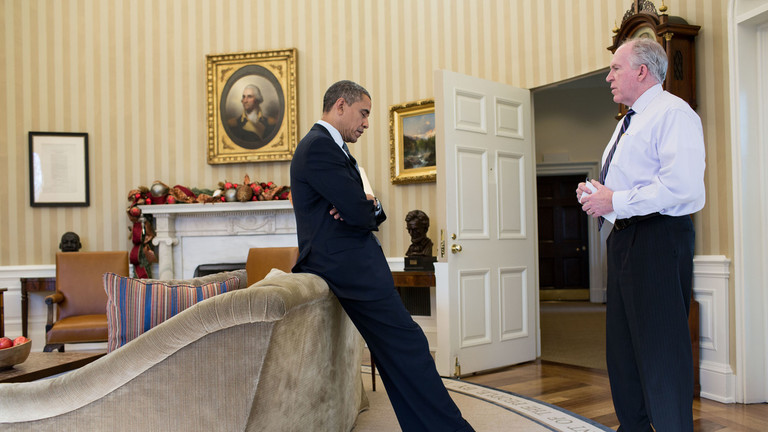
US President Barack Obama and CIA Director John Brennan, December 14, 2012 in Washington, DC. © Pete Souza / The White House via Getty Images
RT | February 14, 2024
The US intelligence community inappropriately used foreign allies to target Republican presidential candidate Donald Trump’s campaign to set up the ‘Russiagate’ conspiracy ahead of the 2016 election, according to a trio of investigative journalists.
Michael Shellenberger, Matt Taibbi and Alex Gutentag – of ‘Twitter Files’ fame – published the first part of an investigation on Tuesday, in which they claim the so-called ‘Five Eyes’ were operationalized against Trump staffers, citing anonymous sources close to the House Intelligence Committee.
According to their report, President Barack Obama’s CIA Director, John Brennan, had sent America’s partners – the UK, Canada, Australia, and New Zealand – a list of 26 Trump associates to target with data collection, misinformation and manipulation.
The Russiagate conspiracy involved multiple failures across western media networks to critically assess US intelligence claims that Russia had interfered in the 2016 US presidential election. A 2018 Pulitzer prize was awarded to Washington Post and New York Times journalists for their reporting on what was later to exposed as a false story.
“They were making contacts and bumping Trump people going back to March 2016,” said a committee source. “They were sending people around the UK, Australia, Italy — the Mossad in Italy. MI6 was working at an intelligence school they had set up,” the journalists claim.
Officially, the FBI only started looking into the Trump campaign that summer, after an Australian diplomat reportedly overheard an aide mention Russia. If confirmed, these findings would demonstrate that the US intelligence community had worked for months before that to set up just such a pretext.
In a statement to the investigative journalists, the FBI said it had made “missteps” in the 2016 and 2017 investigation of the Trump campaign, but has since implemented reforms to prevent it from happening again.
“The allegations that GCHQ was asked to conduct ‘wiretapping’ against the then president-elect are nonsense,” a spokesman for the British surveillance agency said. “They are utterly ridiculous and should be ignored.” Shellenberger, Taibbi and Gutentag said they had never asked the GCHQ about “wiretapping.”
According to Shellenberger, there is a “10-inch binder” containing previously unknown documents about the intelligence community’s surveillance of the Trump campaign. The 45th US president had ordered these documents declassified, but they went missing instead. In a Fox News appearance on Tuesday evening, Shellenberger suggested the FBI’s August 2022 raid on Trump’s Mar-a-Lago resort may have been related to the missing binder.
After the US intelligence community created a pretext for investigating Trump for ‘ties to Russia,’ they spied on his campaign – and then his presidency – using a falsely obtained FISA warrant. The warrant was based on the ‘Steele dossier,’ a file compiled by a British spy in the pay of Hillary Clinton’s campaign, through several intermediaries. The FBI knew the dossier was false as early as January 2017, but continued using the FISA warrant for almost a year thereafter.
The FBI lawyer who altered evidence to obtain the warrant, Kevin Clinesmith, ended up sentenced to probation and his law license has since been restored.
US ‘security threat’ revelations prompt panic
RT | February 14, 2024
The US is facing a “serious national security threat” that requires action from the White House, the head of the House Intelligence Committee said on Wednesday. The exact nature of the alleged threat has not been revealed.
Mike Turner, an Ohio Republican, has sent a letter to all members of Congress about an urgent matter “with regard to a destabilizing foreign military capability.” The House Intelligence Committee voted on Tuesday to make certain information available to lawmakers between Wednesday and Friday this week, he said.
Turner also called on President Joe Biden to declassify “all information relating to this threat.”
What exactly the threat might entail, Turner did not say. CNN cited two anonymous sources and an unnamed US official to claim it was “related to Russia.” One of the sources, who has allegedly viewed the intelligence Turner provided, described it as “a highly concerning and destabilizing” Russian capability “that we were recently made aware of.”
A Fox News correspondent cited a Pentagon source to claim the threat “has to do with space.”
Answering questions from reporters on Wednesday afternoon, National Security Advisor Jake Sullivan said he had been trying to schedule a meeting of top lawmakers for Thursday when Turner went public with the existence of the “threat.”
“I’m not in a position to say anything further from this podium at this time,” Sullivan said when asked about the alleged threat.
Numerous social media commentators have pointed out the uncanny coincidence that the supposed “security threat” was announced just after the US Senate passed a $95 billion foreign aid bill – about two thirds of which was earmarked for Ukraine – and amid the pressure on the House of Representatives to do the same. Turner is a vocal proponent of funding Kiev.
The White House and most US media outlets have consistently denigrated Russia’s military capabilities and insisted that Ukraine is “winning” the conflict thanks to the ongoing support of the West.
According to NSA whistleblower Edward Snowden, the alleged threat was announced because “the White House and Intel Committee felt a need to scare Members of Congress into line for a certain set of controversial pro-war and/or surveillance votes” that are coming up.
Blood on BoJo’s Hands
Putin’s claim that Boris Johnson scuttled peace deal confirmed by witnesses
BY JOHN LEAKE | COURAGEOUS DISCOURSE | FEBRUARY 13, 2024
Former British Prime Minister, Boris Johnson, and the mainstream media are hotly denying Vladimir Putin’s claim (in his recent Tucker Carlson interview) that Johnson derailed a peace deal between Russia and Ukraine just a couple of months after the war commenced.
And yet, Putin was merely confirming the statement of David Arahamiya, leader of Ukraine’s ruling party, that was reported in Newsweek on November 27, 2023: Russia Offered to End War if Ukraine Dropped NATO Bid: Kyiv Official.

The German analyst and Former United Nations Assistant Secretary General, Michael von der Schulenberg, also published a reconstruction of these events on November 14, 2023, titled How The Chance Was Lost For A Peace Settlement Of The Ukraine War.
The totality of circumstances and the statements of Arahamiya and von der Schulenberg indicate that an Austrian-style neutrality deal could have prevented this war to begin with, and then—had it been embraced by the the USA and Britain—ended it just two months later.
Since Churchill delivered his June 4, 1940, “We shall fight on the beaches” speech, many postwar heads of state have apparently fantasized that their opponents on the international stage are “just like Hitler” and that there can be no negotiated settlement with them.
In BoJo’s case, this shallow, sophomoric notion has apparently resulted in the needless deaths of hundreds of thousands of young Ukrainian and Russian soldiers.
Tucker Slayed the Mainstream Media Dragon
By Ron Paul | February 12, 2024
There has been much written and said about Tucker Carlson’s interview with Russian President Vladimir Putin last week. As of this writing the video on Twitter alone has been viewed nearly 200 million times, making it likely the most-viewed news event in history.
Many millions of viewers who may not have had access to the other side of the story were informed that the Russia/Ukraine military conflict did not begin in 2022, as the mainstream media continuously reports, but in fact began eight years earlier with a US-backed coup in Ukraine. The US media does not report this because they don’t want Americans to begin questioning our interventionist foreign policy. They don’t want Americans to see that our government meddling in the affairs of other countries – whether by “color revolution,” sanctions, or bombs – has real and deadly consequences to those on the receiving end of our foreign policy.
To me, however, perhaps the most interesting aspect of the Tucker Carlson interview with Putin was the US mainstream media reaction. As Putin himself said during the interview, “in the world of propaganda, it’s very difficult to defeat the United States.” Even a casual look at the US mainstream media’s reporting before and after the interview would show how correct he is about that. In the days and weeks before the interview, the US media was filled with stories about how horrible it was that Tucker Carlson was interviewing the Russian president. There was the danger, they all said, that Putin might spread “disinformation.”
That Putin might say something to put his country in a better light was, they were saying, reason enough to not interview him. With that logic, why have journalism at all? Everyone interviewed by journalists – certainly every world leader – will attempt to paint a rosy picture. The job of a journalist in a free society should be to do the reporting and let the people decide. But somehow that has been lost. These days the mainstream media tells you what to think and you better not dispute it or you will be cancelled!
What the US mainstream media was really worried about was that the “other side of the story” might start to ring true with the public. So they attacked the messenger.
The CNN reporting on Tucker’s interview pretty much sums up the reaction across the board of the US mainstream media. Their headline read, “Tucker Carlson is in Russia to interview Putin. He’s already doing the bidding of the Kremlin.”
By merely doing what used to be called “journalism” – interviewing and reporting on people and events, whether good or bad – one is “doing the bidding” of the subject of the interview or report?
No wonder fellow journalist Julian Assange has been locked away in a gulag for so many years. He dared to assume that in a free society, being a journalist means reporting the good, the bad, and the ugly even if it puts those in power in a bad light.
In the end, the massive success of the Tucker Carlson interview with Vladimir Putin demonstrates once and for all that the American people are sick to death of their mainstream media propagandists and liars. They are looking not for government narratives, but for truth. That’s the really good news about this interview.
Mainstream propaganda machine’s laughable meltdown over Putin interview
By Drago Bosnic | February 12, 2024
As expected, Tucker Carlson is getting a lot of flak for conducting his interview with Russian President Vladimir Putin. He’s not merely being accused of “spreading Russian propaganda” (he’s long been accustomed to that, as well as the mainstream propaganda machine’s obsession with all sorts of deranged “Russia, Russia, Russia” conspiracy theories), but there’s an actual push in the European Union to sanction Carlson. It seems journalists doing journalism is considered “heresy” by most other mainstream “journalists”. The Guardian’s Adam Gabbatt is unhappy that the interview was “neither a talk show nor a real conversation”, so he went on to parrot every propaganda trope in the book. Al Jazeera’s Mansur Mirovalev insists that Putin is “obsessed”, concluding his remarks by quoting a certain Valentin, the Kiev regime’s drone operator who allegedly complained that both Putin and Carlson are “conspiracy theorists” and that “Ukraine is real and it will prevail.”
In a piece published by Politico, a German-owned publication infamous for attempts to whitewash Nazism, Sergey Goryashko claimed that Putin supposedly “lied”. Among several propaganda claims he used to, as he says, “debunk” Putin’s points was that the Neo-Nazi junta frontman Volodymyr Zelensky “only signed a decree banning negotiations specifically with Putin, not Russia as a country”. Such ludicrous claims aren’t only false, but are even childish. Pushed by the United States, United Kingdom and NATO, the Kiev regime certainly broke the March 2022 peace deal that could have ended the special military operation (SMO) in less than a month. What’s more, it even publicly promotes its so-called “10-point peace plan” that boils down to Russia’s unconditional capitulation, a fantasy that the political West wholeheartedly supports and even promotes through some sort of absurd unilateral “peace talks”. In doing so, the Neo-Nazi junta effectively codified the impossibility of a peaceful settlement.
So much for Putin “lying”. However, that’s only the tip of the iceberg when it comes to frenzied attacks by the mainstream propaganda machine. In a piece for The New Yorker, Masha Gessen, the infamous “woke” ideologue obsessed with Putin, called the interview “boring”. She (although Gessen insists her pronouns are “they/them”, a request I earnestly refuse to comply with) obviously loathes historical facts, so the trouble she has with going through the entire interview, a problem most likely exacerbated by her two-second attention span (tends to happen to a lot of people staring at reels all day), perfectly explains her rather poor judgment of Putin’s points. Then came the “fact-checkers” such as Charlie Hancock of the Amsterdam-based Moscow Times who essentially repeated several of Goryashko’s long-debunked claims and added a few of his own. After all, what would the mainstream propaganda machine ever do without “fact-checkers“?
Of course, Hancock wasn’t the only one. The UK’s state-run BBC also published its own version, “fact-checking Putin’s nonsense history“. It would seem Masha Gessen isn’t the only one who skipped history classes in primary school, as the BBC’s Ido Vock quoted several self-styled “experts” and “pundits” to supposedly “debunk Putin’s rambling”, as he called it, clearly implying that he was also bored by the interview, which further indicates just how much he actually knows about the topic he covered for the UK’s state-run news agency. And of course, there’s also the Radio Free Europe/Radio Liberty (RFE/RL), claiming that Carlson’s Putin interview supposedly serves as a “propaganda platform”, which is quite rich coming from a literal CIA front formed to spread Washington DC’s state-sponsored propaganda. The Economist insists that “Russia’s president is not a man to be trusted, still less to emulate or admire”, because, luckily, they “know Putin’s real message” better than he himself does.
Newsweek’s Brendan Cole quoted Oleksandra Matviichuk, the Kiev regime’s “human rights activist”, who also slammed Carlson. Comically enough, Cole insists that Matviichuk’s opinion “matters” because she’s a Nobel Peace Prize winner. Is it even necessary to explain just how politicized that vaunted “peace prize” is when laureates include people like Barrack Obama and Al Gore? The Obama administration came to power criticizing the previous government run by George W. Bush for its aggression across the Middle East. Obama promised to end these wars, which is why he got the once-prestigious award in the first place. However, as soon as Bush left the White House, Obama expanded his aggression from two countries (Iraq and Afghanistan) to another five (Libya, Syria, Yemen, Somalia and Pakistan), seven in total. Worse yet, during Obama’s presidency (2009-2017), Washington DC launched ten times more airstrikes than under Bush, killing millions of innocent civilians in the process.
While the DNC-dominated media always try to whitewash Obama by shifting blame solely on Bush, it should be noted that the former personally authorized at least 6,000 drone strikes (approximately 2 per day during 8 years of his presidency), although the actual number may be orders of magnitude higher. So much for Obama’s contribution to “peace”. As for Al Gore, his active role in the Clinton administration’s war crimes and aggression on Serbia/former Yugoslavia requires an entirely separate analysis. However, as previously mentioned, this isn’t the end of the mainstream propaganda machine’s attempts to denigrate Putin’s interview with Carlson. The Associated Press (AP) insists that Russia’s president “missed the bigger picture”, so they felt the urge to “fill the gaps” with five points, composed largely of debunked propaganda tropes. And yet, these were expanded to nine in another piece by Politico, signed by Eva Hartog and, once again, Sergey Goryashko.
The key takeaway is that the mainstream propaganda machine is in meltdown over the interview, seen by hundreds of millions (if not billions at this point) on TV and across numerous Internet platforms. The political West is genuinely terrified of Putin’s global popularity, so the goal is to try and tarnish his reputation by twisting his remarks or simply telling outright lies about him. And while the interview may seem lengthy (by today’s standards), Putin simply had to get a lot of propaganda out of the way, as NATO and its Neo-Nazi puppets have been falsifying historical facts about Ukraine quite intensively, particularly in recent times, all in an attempt to show that the country supposedly has “nothing to do with Russia“. In that sense, websites such as Wikipedia have experienced an unprecedented number of edits with the goal of promoting these historically baseless claims. Putin is certainly aware of that, which is why he had to explain the complex history of the Ukrainian conflict.
Putin’s intellect and encyclopedic knowledge of history, law, intelligence and several other key fields are a massive boost to Russia’s already world-class diplomacy. This stands in stark contrast to the US and its current administration. Could anyone imagine Joe Biden giving an unscripted, two-hour-long interview to a foreign journalist, much less one conducted with near-scholarly precision? Regardless of whether one adores or loathes President Putin, the fact is that the increasingly unpopular and impotent leaders of the political West are simply no match for him, which is why we never see any of them giving remotely similar interviews to journalists of Tucker Carlson’s caliber. And while he might be among the most prominent journalists to ever interview Putin, Russia’s president is well-known for hours-long discussions with hundreds (if not thousands) of journalists from all over the world, without any papers, cliff notes or scripted questions. He simply doesn’t need them.
Drago Bosnic is an independent geopolitical and military analyst.
Here’s why you shouldn’t trust the ‘declining’ Gaza death toll narrative
By Robert Inlakesh | RT | February 11, 2024
Shortly before the International Court of Justice’s highly anticipated decision to pursue South Africa’s case accusing Israel of genocide, the New York Times released a report titled ‘The Decline of Death in Gaza’.
The article attributed this alleged decline to a change in Israel’s battle strategy in Gaza, yet the piece omitted key data that contradicted its claims. Then, in the aftermath of the ICJ preliminary ruling, the NYT became the first news outlet to receive and publish information from an Israeli dossier that accused UNRWA staff of complicity in the armed activities of Hamas.
Since the beginning of the war between Israel and Gaza, which began with the Hamas-led attack on October 7, Western corporate media have shown what can only be described as pro-Israeli double standards. On January 9, The Intercept published a quantitative analysis of over 1,000 articles in US mainstream media, including by the NYT, proving the undeniable bias demonstrated in favor of Israeli life and underreporting on Palestinian suffering.
An even more targeted analysis was published by researchers Jan Lietava and Dana Najjar, who specifically looked at the BBC’s coverage of the conflict between October 17 to December 2. The study documented that words like murder(ed), massacre(d) and slaughter(ed) were used by the BBC to describe Israelis 144 times, while Palestinians had only been described as having been murdered or massacred one time each; the word slaughter had never been used to describe the killing of Palestinians. The study clearly shows the disparity in humanizing language used and the number of stories on Palestinian deaths, despite the Palestinian death toll being far higher than the Israeli one.
The Israeli death toll throughout the war officially stands around 700 civilians and 600 combatants, while for Palestinians it is roughly 27,600, according to the Gaza Health Ministry. The estimates are that between 61% to 75% of the Palestinians killed in Gaza are women and children. Ranging estimates as to how many Palestinian combatants have been killed are not trustworthy. Israeli spokespeople claim between 7,000 to 10,000 Hamas fighters, depending on the time of day, but provide no estimate for the number of fighters killed who are members of the dozen or so other armed groups in Gaza.
While the NYT report attempts to make the point that deaths in Gaza are steadily declining as the Israeli operation goes on, statistics released by the authorities in Gaza, from January 17 (when the NYT data chart ends) until January 24, clearly show the opposite trend. For reference the daily death tolls read: 163, 172, 142, 165, 178, 190, 195, 210.
The piece also lacks any evidence showing a correlation between the Israeli announcement of what it calls “phase 3” of its battle plan and the death toll charts that showed a downward arc in the daily fatality rate. Israel began announcing its intention to implement its new phase at the beginning of January, yet the argument presented in the article attempted to draw the conclusion that pressure from the US government had contributed to a lowering of fatalities between early December and January 17.
There was a decline in the daily reported death toll, but this occurred prior to any stated change in the military strategy. Also observable is that during the week that the report was released, the daily Gaza death toll actually jumped to 188. Monday through to Sunday of that week there were some 1,317 Palestinians killed by Israel. The week prior, a total of 1,110 were killed.
The NYT also pointed to the Israeli withdrawal of forces from northern Gaza, attempting to use this as evidence of a change in tactics in January that had been brought about due to efforts from the Biden administration. Israel actually reinvaded the north, briefly, after the article was published.
Furthermore, Israel didn’t start withdrawing from northern Gaza in January – it began this process around December 21, when it withdrew the elite Golani Brigades. In late December, five brigades were withdrawn and the reservists amongst them were released for economic reasons. Then, earlier last month, a further four brigades were withdrawn as the Israeli army implemented a retreat from most of the built-up areas in northern Gaza.
Israeli authorities claim that the reason for the change in the war strategy, shifting from the high-pressure tactics of the first two phases, was due to their desire to continue the fight for the whole of 2024. If Israel is planning to fight a year-long war, it makes sense for it to use fewer munitions and soldiers, as munitions are finite and the cost of the initial battle strategy would have been a significant economic burden.
Another crucial point is that the report completely left aside all other considerations as to what could explain a decline in death tolls across certain periods of time. A major issue that is faced today is a lack of a properly functioning health sector in Gaza altogether; according to the World Health Organization (WHO), only 16 hospitals out of 36 remain operational and all are “minimally or partially functioning.”
One of the last remaining professional journalists in northern Gaza, Anas al-Sharif, reported to Al Jazeera Arabic, on January 16, of the intensifying bombardments in the area and the underreporting of casualties there. A resident named Akram based in the Jabalia Refugee Camp told RT that “the bombing over those few days returned to how it was at the start of the war, it was terrifying and it seemed like it didn’t stop at all for over a day.”
With a health sector that has all but collapsed, properly accounting for the dead is a tough challenge, which is why the Gaza Health Ministry routinely includes the caveat to its daily death tolls that there are others under the rubble who are unaccounted for. To demonstrate how big of a difference the death toll is, when those missing under the rubble are factored in, take the statistics released by Euro-Med Human Rights Monitor, which stated that 31,497 Palestinians had been killed by January 14.
Aside from us not having a full picture of the true daily death toll, Israel is also being accused of using starvation as a weapon of war, and the statistics that are being cited do not include those who are now dying due to disease and starvation. Some 400,000 people living in northern Gaza are without aid altogether, as efforts by international organizations to transport medical, food and fuel aid to the north have repeatedly been blocked. On December 9, Save The Children warned that the primary cause of death in Gaza could soon be starvation and disease, instead of bombs, with the humanitarian situation having severely deteriorated since then.
When the Israeli government later released its allegations that 12 UNRWA employees – out of 13,000 working in Gaza – had participated in the Hamas-led attack of October 7, the New York Times was the first to get its hands on the Israeli dossier that detailed its allegations. The newspaper failed to report that most of the allegations were based on interrogations conducted by the Shin Bet (Israeli secret police), which is renowned for extracting confessions through torture. The article that the NYT published on the issue made the dossier’s information seem somewhat credible, yet, when the UK’s Channel 4 obtained it and quoted it directly to the public, it concluded that “no evidence” was contained within the dossier.
The NYT’s reporting on Israeli allegations that Hamas conducted a premeditated mass rape campaign have come under fire also. In one case family members of an Israeli woman killed on October 7 had to take to social media to denounce the NYT’s attempts to suggest she had been raped, which the newspaper allegedly failed to tell the family it was planning to include in its article.
At every turn, Western corporate media has used distortions, linguistic manipulation, and outright lies to mislead its audiences on the truth about what is occurring in Gaza. It does not get lower than playing with statistics in order to downplay what the highest judicial body on earth has overwhelmingly ruled is plausibly a genocide, or what UN aid chief Martin Griffiths has called “the worst ever” humanitarian crisis.
Robert Inlakesh is a political analyst, journalist and documentary filmmaker currently based in London, UK. He has reported from and lived in the Palestinian territories and currently works with Quds News.
Are You an Anti-Paxxer?
As doctors drop Paxlovid because of drug interactions, Covid rebounds, and virus shedding, Pfizer cranks the PR machine to hide the facts and shame “anti-paxxers.”
BY LINDA BONVIE | RESCUE | FEBRUARY 9, 2024
When an article by Los Angeles Times metro reporter Rong-Gong Lin II recommended last month that practically everyone who tests positive for Covid takes Pfizer’s Paxlovid, some media veterans may have wondered what had become of the traditional wall between news reporting and advertising.
The story, which appeared on January 28, swept away almost all of the reservations that have been raised about the safety and effectiveness of this patent medicine, assuring us that “Paxlovid rebound” is a non-issue and fear of serious side effects is “erroneous.” It even went so far as to suggest that if your doctor won’t prescribe this “highly effective” medication, it’s time to go doctor shopping.
So why is this LA Times writer so desperately trying to sell us this fast-tracked antiviral that comes with a black box warning?
The article appeared at a particularly critical time for Pfizer just as it transitions from Emergency Use Authorization, or EUA Paxlovid, to FDA-approved Paxlovid. Originally free to patients, the medication was stockpiled by the U.S. government to the tune of 24 million treatment courses at a cost to taxpayers of $530 a box. Now, the FDA-approved version (same drug, different box) sells for a list price of up to $1,500. (According to an analysis by researchers at Harvard University, the actual cost to Pfizer for a five-day Paxlovid course is $13).
But to Pfizer’s chagrin, it now doesn’t seem to be able to even give the stuff away, let alone sell it at a premium price. Last fall Pfizer accepted a return of nearly 8 million boxes sent back by the U.S. government.
What’s a drugmaker to do when both patients and doctors shun a product that was anticipated to be the better half of Pfizer’s post-Covid “multibillion-dollar franchise?
Flush with all that Covid cash and new Paxlovid FDA approval last May, Pfizer went shopping for partners to help promote its products.
No stranger to top-tier PR firms such as Edelman and Ogilvy, the drugmaker tagged two of the biggest names in contemporary communications companies, Publicis Groupe, a Paris-based giant PR and ad agency, and the humongous Interpublic Group. These high-level agencies come at a big price tag, but what they can offer is priceless—a way to get your story told by respected media outlets.
That’s right, if you have enough money to hire the folks with all the right contacts, you too can create your own “news!” And these special contacts are something that PR firms, such as Edelman, are very proud of. Many agency hires, in fact, are recruited directly from major media outlets, such as Edelman NYC Brand Director Nancy Jeffrey, who spent a decade at the Wall Street Journal.
As quoted in an Edelman website blog, Jeffrey recalls how Richard Edelman (son of founder Dan) would call her during her time working at the paper “to meet a client with a story to tell.” As Jeffrey says, “No one at Edelman ever rises too high to pitch a reporter.”
So was our LA Times reporter “pitched,” or does he just have an evangelical connection with Paxlovid?
Let’s take a close look at his story and see what we find.
First, there’s the article’s headline, which began: “If it’s COVID, Paxlovid”? Getting your oft-advertised product’s rhyming tagline in a headline—now that’s branding! And we don’t have to tell any of the side effects in this venue. The LA Times piece was off to a great start.
Why aren’t more people being given Paxlovid, the reporter wanted to know. It’s “cheap or even free for many,” he said. And then he delivered his first rave review, calling it “highly effective.”
By paragraph four, however, our intrepid reporter had uncovered the bad news that “a number of doctors are still declining to prescribe it.” But why? It must be those pesky “outdated arguments” about “Paxlovid rebound.” Anyone who gets Covid “has a similar rare chance of rebound,” he told us. For extra punch, he called on Dr. Peter Chin-Hong, professor of medicine at UCSF, to back up that statement. Rebound is “like, bogus” and “just dumb,” Chin-Hong said.
What Lin didn’t report is that a study published in the Annals of Internal Medicine in November 2023, by researchers from Mass General Brigham, found that in Covid patients taking Paxlovid, rebound was “much more common” and often without symptoms. Nearly 21 percent had virologic rebound versus under 2 percent not on the drug. Of perhaps even more significance, prolonged viral shedding for an average of fourteen days was noted in those who rebounded, indicating that they “were potentially still contagious for much longer.” The virologic rebound “phenomenon,” in Paxlovid patients, the authors noted, “has implications for post-N-R (Paxlovid) monitoring and isolation recommendations.” This study closely monitored patients with follow-ups three times a week “sometimes for months.”
After quoting from several Paxlovid-positive FDA and CDC statements and referencing a California Public Health commercial where people dance to an upbeat tune singing “Test it, treat it, beat it, California you know you need it,” Lin got around to some serious stuff—side effects.
Not mentioned by Lin, but good to know anyway, Paxlovid bears an FDA-required black-box warning about drug interactions, cautioning of “potentially severe, life-threatening, or fatal events.” But the article carefully danced around this inconvenient issue, simply mentioning that some Paxlovid takers may need to have their medications adjusted. The fear of “serious side effects . . . is largely erroneous,” it claimed.
Really?
“There are 125 drug interactions (for Paxlovid) across twenty-five different classes of medicines,” author and FLCCC President Dr. Pierre Kory said in a phone interview. “I’ve never used any medicine that had that number and degree of drug interactions, and I find it absurd,” added Kory, who is an expert in early Covid treatment.
And this is no secret. The Paxlovid package insert lists thirty-nine specific drugs that interact with this anti-viral (which is not a complete list, we’re warned) including medications that treat conditions such as an enlarged prostate, gout, migraines, high blood pressure, high cholesterol, arrhythmias, and angina.
With side effects out of the way, our reporter moved on to an interesting idea—doctor shopping.
If your doctor turns you down for Paxlovid, “what other options are there?” How about “reaching out to another healthcare provider” we’re advised, one “who might be more knowledgeable about Paxlovid . . .”
Don’t be an ‘Anti-Paxxer!’
The LA Times isn’t alone in this timely pushing of Paxlovid. The New York Times also ran a glowing Paxlovid piece at the beginning of January. The black-box warning was glossed over by simply saying that some “doctors balk” over the “long list of medications not to be mixed with Paxlovid,” referring to the drug as being “stunningly effective.” The NYT reporter also added five mentions of a study—actually a preprint (not yet peer reviewed or published)—which through the use of statistical magic concluded that during the course of the research had only half of the eligible Covid patients in the U.S. taken Paxlovid, 48,000 lives would have been saved.
The server where the research was posted warns journalists and others when discussing preprints to “emphasize it has yet to be evaluated by the medical community and information presented may be erroneous.”
Paxlovid is not the only drug that gets special treatment by the media. Last January, a 60 Minutes segment was called out by the Physicians Committee for Responsible Medicine as “an unlawful weight loss drug ad” for the med Wegovy. The piece, it noted, “looked like a news story, but it was effectively a drug ad,” the group said in a press release. PCRM also stated that Novo Nordisk, which makes Wegovy, paid over $100,000 to the doctors CBS interviewed for the segment.
With this new frenzy to sell Paxlovid, one can’t help but compare it to the campaign against ivermectin. Kicked off by the FDA in August 2021, it successfully branded this Nobel Prize-winning, FDA-approved drug as nothing more than a horse dewormer endorsed by fanatical outlier doctors and accepted by gullible patients. Despite being found to be an extremely safe treatment as well as an effective one for Covid, the FDA, CDC, and its media “partners” made ivermectin the subject of false accusations and warnings about the supposed risks of using it.
But early on in the game it was decided, as Dr. Kory pointed out, “to keep the market open for their novel pricey Paxlovid pill.” And to that effect, nothing was going to stand in the way. In an interview last summer with the head of the UCSF Department of Medicine, FDA Commissioner Dr. Robert Califf admitted that he helped promote Paxlovid—something he acknowledged is explicitly against the rules.
“In normal times, the FDA should not be a cheerleader . . .” Califf said. But since back then EUA drugs could not be advertised (a policy that changed in the fall of 2022) he went ahead and pitched it himself.
The Paxlovid campaign is far from over. In fact, it may now be revving up to full throttle. There’s even a name being bandied about for those who question the drug: “Anti-Paxxers.”
And if we can take any insight from the new Pfizer tagline (just filed for protection with the US Patent and Trademark Office), “Outdo Yesterday,” there are even more spurious strategies in its pharmaceutical pipeline.
Linda Bonvie is an investigative journalist, freelance health and environmental writer and co-author of several books including “Chemical-Free Kids” and most recently “A Consumer’s Guide to Toxic Food Additives.”
White House denies ‘ridiculous’ Tucker Carlson claims
RT | February 7, 2024
Allegations that the administration of US President Joe Biden tried to stop journalist Tucker Carlson from interviewing Russian President Vladimir Putin are “ridiculous”, White House Press Secretary Karine Jean-Pierre said during a daily press briefing on Tuesday.
The former Fox News host interviewed Putin on Tuesday, the Kremlin has confirmed. Carlson however, has claimed that Washington has consistently attempted to block his overtures to the Russian president.
”Almost three years ago, the Biden administration illegally spied on our text messages and then leaked their contents to their servants in the news media. They did this in order to stop a Putin interview that we were planning,” he asserted. “Last month, we’re pretty certain they did exactly the same thing once again. But this time, we came to Moscow anyway.”
Asked about Carlson’s allegation, Jean-Pierre initially said she would “absolutely not” comment, but later changed her mind.
”It’s a ridiculous premise and a ridiculous statement that was made about this administration,” she said.
Carlson has claimed on several occasions that while trying to arrange a one-on-one with Putin, he found out from a source that his communications were being intercepted by US intelligence. He said his messages were quoted back to him verbatim, confirming the surveillance.
The NSA has denied targeting the journalist, but the Axios news website has partially corroborated his story, citing unnamed US government officials who said the government indeed had learned about his efforts to secure an interview with Putin. The outlet suggested that “US-based Kremlin intermediaries” contacted by Carlson had leaked the communications.
The journalist, how hosts a show on X (formerly Twitter) stated in his preview that the American media were failing to properly inform the public about the nature of the Ukraine conflict and the wider confrontation between the US and Russia. He said he had the backing of X owner Elon Musk, who vowed not to block the interview on his platform.
”Western governments, by contrast, will certainly do their best to censor this video on other, less principled platforms, because that’s what they do. They are afraid of information they can’t control” he predicted.
Carlson Interview With Putin Could Topple Western Elites, End Ukraine War
By Martin Jay | Strategic Culture Foundation | February 7, 2024
In the seventies, when the cold war was at its peak, Donald Rumsfeld was convinced that the Atlantic Ocean, off the U.S. coast, was teaming with Russian submarines. The U.S. navy couldn’t detect them because, he was convinced, the Soviets had a new ‘acoustic technology’ which made them effectively invisible. Rumsfeld went ahead and ploughed billions of dollars into developing a new technology which could detect the non-acoustic subs. But that failed and is still costing the U.S. taxpayer today. The truth was in fact, the Soviet subs just weren’t there.
The error on the part of Rumsfeld, it could be argued, still paid dividends as scaring the American public into believing a threat is real and imminent – on your doorstep in fact – is very profitable for a government which wishes to achieve two clear objectives: pouring billions into the pockets of defence contractors; and secondly whipping up fear of an imminent war with an enemy, with the sole objective of distracting the public away from a failing economy and abysmal foreign policy.
It’s happening today. If we look at the mainstream news all we see is talk of war with Russia. And yet there isn’t a single shred of intel which these outlets can offer to substantiate this claim. It will remind many of the weeks leading up the Iraq invasion in 2003 when the U.S. and UK faked intel to show that Saddam Hussein had WMDs.
Western elites are guiding journalists to write this nonsense as their bigger plan is to stir up a frenzy of war talk so as to prepare the public for much bigger defence spending and, in the case of the UK, even conscription. This is really about covering up one of the biggest cock-ups in contemporary history which western governments have made – sanctions against Russia and the NATO campaign in Ukraine – which have backfired so spectacularly that the Biden administration and a number of EU governments are united in this scaremongering, believing it’s a winner.
Of course the “we’re going to war with Russia” comes from the White House. Where else? Only the U.S. has that sort of power with an increasingly craven, pathetic EU which is now so servile to the Biden administration that it’s beginning to make the UK look less of a poodle to the Americans.
The whole scam is American and the Europeans are obliging with it in a big way. The only real threat the plan has of not working is if a few, remote feral corners of the media – or mavericks who were fired by media giants – make a stand and call it out for what it is. Which is why Tucker Carlson’s trip to Moscow where he intends to interview Putin is so important and such a threat to the Biden administration and western elites as a whole. When Carlson interviews the Russian leader and it becomes clear that western media have been lying for so long about the Ukraine war and even this latest ruse of Russia wanting to invade eastern Europe, then the whole scam will collapse.
Clearly the West is worried about the interview. They have already wheeled out enough congressmen on social media to try and brandish Carlson as some sort of traitor who should not be allowed back into the U.S. Western media will probably not report on the interview but this will only make it a bigger hit on social media. The interview is really the only single opportunity for this mad war machine to be halted, for the lies to be exposed and for a more salient approach to East-West relations to begin. It should not be underestimated. But the knifes are out. Watch in particular the embedded western media correspondents who live in Moscow push the blade into Carlson’s back and mock the interview in a bid to discredit the whole thing. Scores of millions of Americans are about to be enlightened on a whole plethora of issues which, until now, their own media have lied to them about. To call this interview a bombshell would be an understatement. Tucker Carleson is about to bring the truth to the American people. But are they ready for it?
CNN Staffers Say Network Has ‘Systemic and Institutional Bias Toward Israel’
By Kyle Anzalone | The Libertarian Institute | February 5, 2024
Several employees of CNN spoke out against the outlet’s bias towards Israel in its reporting on the war on Gaza. Other US corporate media outlets have shown significant favoritism toward Tel Aviv.
The Guardian reports speaking with six staffers from different newsrooms who said that there is growing backlash against the leadership’s pro-Israel slant. “The majority of news since the war began, regardless of how accurate the initial reporting, has been skewed by a systemic and institutional bias within the network toward Israel,” said one CNN staffer. “Ultimately, CNN’s coverage of the Israel-Gaza war amounts to journalistic malpractice.”
“There’s a lot of internal strife and dissent. Some people are looking to get out,” the CNN staffer explained. “Senior staffers who disagree with the status quo are butting heads with the executives giving orders, questioning how we can effectively tell the story with such restrictive directives in place.”
A staffer speaking with the Guardian explained how systemic censorship occurs. “Many have been pushing for more content from Gaza to be alerted and aired.” The source continued, “By the time these reports go through Jerusalem and make it to TV or the homepage, critical changes – from the introduction of imprecise language to an ignorance of crucial stories – ensure that nearly every report, no matter how damning, relieves Israel of wrongdoing.”
The CNN employees say the bias starts at the top, with CEO Mark Thompson. The Guardian obtained emails and members that backed up the accusations made by the CNN staff members. The employees say the slant is causing a backlash.
In one memo obtained by the Guardian, Thompson gave orders that all stories mentioning the atrocities committed by the Israelis in Gaza must mention the war is only occurring because of the Hamas attack on October 7.
The memo reads, “We must continue always to remind our audiences of the immediate cause of this current conflict, namely the Hamas attack and mass murder and kidnap of civilians.” One staffer confirmed that the memo was interpreted “as an instruction that no matter what the Israelis do, Hamas is ultimately to blame.”
CNN’s bias towards Tel Aviv is matched by the Washington Post and New York Times. Writing at FAIR, Julie Hollar explains,” At the New York Times and Washington Post, opinion editors have skewed the Gaza debate toward an Israel-centered perspective, dominated by men and, among guest writers, government officials.”
“While both papers did include a few strong pro-Palestinian voices—their pages leaned heavily toward a conversation dominated by Israeli interests and concerns.” She continued, “That was due in large part due to their stables of regular columnists, who tend to write from a perspective aligned with Israel. As a result, the viewpoints readers were most likely to encounter on the opinion pages of the two papers were sympathetic to, but not necessarily uncritical of, Israel.”
Featured Video

Pentagon Fast Tracks Iran War Ground Option
or go to
Aletho News Archives – Video-Images
From the Archives
The Heirs of Meyer Lansky Want Compensation from Cuba. They Shouldn’t Get a Dime.
By Jack Colhoun | History News Network | June 19, 2016
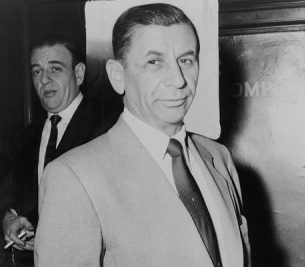
Meyer Lansky
The heirs of Meyer Lansky, the impresario of the North American Mafia gambling colony in Cuba (1933-1958) are betting on a big payback from the negotiations between the United States and Cuba to normalize relations between the two countries. Compensation claims by U.S. citizens or businesses for properties nationalized by the Cuban revolution are among the issues under discussion.
Lansky’s daughter Sandi, her son Gary Rapoport, and her brother Paul have filed a compensation claim against Cuba for the Riviera Hotel and Casino with the U.S. Foreign Claims Settlement Commission. The Cuban revolution confiscated the Riviera and other Mafia-owned properties after it toppled the gangster-linked regime of General Fulgencio Batista in 1959.
“It was through my grandfather’s hard work that the hotel was built,” Rapoport told the U. K. Daily Mail Online on December 23, 2015. “We are his natural relations . . . . By right, it should be our property.” He says the Riviera is valued at $70 million. The Tampa Bay Tribune, Reuters, and Haaretz have also covered the story.
The Riviera, which overlooks the Straits of Florida, was the crown jewel of Lansky’s casinos, hotels, and nightclubs in Havana. When the Riviera opened in December 1957, it was the largest Mafia-owned hotel-casino outside Las Vegas. The hotel’s 440 double rooms were booked solid for the winter season of 1957-1958.
However, the narrative that the success of the Riviera was the product of Meyer Lansky’s “hard work” is undercut by Lansky’s own assessment of his arrangement with Batista. … continue
Blog Roll
 Aletho News
- Eight Iraqi resistance attacks hit US Victoria base near Baghdad airport
- US Dirty War Iran Revelations 2026: Ex-Counterterrorism Chief Joe Kent Exposes Proxy Strategy
- Iran’s Dimona Strike Shatters Myth of ‘Impenetrable’ THAAD, Patriot & Arrow Air Defenses – Analyst
- Bahrain admits US Patriot missile hit residential area, injured dozens
- Iran retaliation shakes helium, global tech supply chains
- Zionist takeover: Trump’s war on Iran reveals who really dictates US foreign policy
- Iran’s strike on Dimona – Israel’s nuclear weapons research center – shows Israeli air defences are weakened
- Fidel Castro’s War on Jewish Mobster Meyer Lansky
- US Trying to Oust Russia From All Energy Markets – Lavrov
- Western silence allows Israel to get away with killing journalists
- If Americans Knew
- Israel’s assassination game: Take all pragmatists off the board
- Food shortages return to Gaza as Israel tightens aid restrictions under the cover of its war on Iran
- Trump demands trillions in payments from Gulf countries, billions from Harvard – Not a ceasefire Day 162
- Meet the former fashion blogger and shady doctor behind the ‘30,000 dead’ Iran psy-op
- Vatican Secretary of State to Trump, Israel: End the war as soon as possible
- The Majority of Americans Believe War Against Iran Benefits Israel More Than US
- Efforts to shut down pro-Palestinian speech face series of setbacks in court
- What has Israel done to my brother?
- Eid without worship in Al Aqsa – Not a ceasefire Day 161
- Trump: Israel attacked Iranian gas field without US knowledge. No more such attacks!
- No Tricks Zone
- Former Pfizer Toxicologist Dr. Helmut Sterz Tells Bundestag Hearing Pfizer Vaccine Should Have Never Been Approved
- Energy Expert: Germany’s Nuclear Phaseout Was A “500 Billion Euro Mistake”
- New Research: South Australia’s Mid-Holocene Sea Surface Temperatures Were 4°C Warmer Than Today
- Storing Green Energy To Last Germany 10 Days Would Require A 60-Million Tonne Battery
- New Studies: UK Sea Levels Were 4 Meters Higher Than Today During The Mid-Holocene
- Destructive Green New Deal: German Energy And Metal Group Warns Of Drastic Crisis
- New Study Documents A 20-Year Pause In Arctic Sea Ice Decline – Driven By Internal Variability
- Wake-up Call: Survey Shows Majority Of Germans Now Favor Postponing Climate Targets!
- Televised! Leading German Political Candidate Tells Schoolchildren CO2 Makes Sun Hotter!
- New Study: A Century Warming Of 1.1°C Is ‘Commonplace’ And ‘Not Unusual’ During This Interglacial
 Aletho News