Prague: 100,000 citizens protest against government’s energy policy
Free West Media | September 6, 2022
In the Czech capital of Prague up to 100,000 people demonstrated on Saturday against the government policy, which has been leading to skyrocketing energy prices and an impending energy emergency in the Czech Republic. Immediately prior to this, there had already been a motion of no confidence in the government under Prime Minister Fiala in the Czech parliament.
In Prague, as in many European capitals, the government refused to see the protests as a political warning signal, but tried to blame Russian “trolls” for the increasingly irritable mood among the population. Another indication of the development in the country is the fact that a broad alliance of conservatives, right-wingers and communists called for the large rally on Saturday.
In the Czech Republic, the very existence of industry is threatened due to the lack of Russian gas supplies. Despite this, the government fully supports the EU’s sanctions course – and, needless to say, is now feeling the consequences.
The government is pretending to see Russian machinations behind the protests: “It is clear that Russian propaganda and disinformation campaigns repeatedly appear on our territory, and some simply succumb to them,” Prime Minister Fiala declared. Interior Minister Rakušan also saw “Putin” behind the protest: “Dividing society is one of the goals of the hybrid warfare we are dealing with. We can’t let him do that. That is why we are working on solutions that will reduce people’s fears about the future.”
According to the ideas of the organizers of the rally, every Czech household should be entitled to three megawatt hours of free electricity. In addition, one of the demands of the alliance was that its representatives should be authorized to conclude energy supply contracts.
“We’re taking our country back,” they said at the beginning of the three-hour rally. The call for this also included military neutrality and the loss of sovereignty to supranational structures. “The Czech Republic must free itself from direct political subordination to the EU, the WHO and the UN,” it said.
But that’s not all: “If the government doesn’t resign by September 25,” the organizers say, “in accordance with the Czech Republic’s constitution, we will declare the right to protest at a nationwide demonstration and announce measures to force the resignation. We are already negotiating with unions, companies, farmers, mayors, transport companies and other organizations to declare a strike,” they warned.
The same scenario is also possible in Germany. It was not for nothing that Federal Foreign Minister Baerbock warned of “popular uprisings” in the autumn.
In Leipzig left and right unite
The “Hot Autumn” proclaimed by the Left Party was reflected at least in the temperatures as the thermometer rose to 25 degrees on Monday evening in Leipzig’s historic city center. Both left-wing and right-wing parties and alliances have called for rallies at this historic site, based on the Monday demonstrations of 1989/90.
A total of 10,000 participants were expected, but in the end, Augustusplatz was flooded with people. The federal government had presented its new relief package on Sunday to absorb the economic consequences of the sanctions policy against Russia – and to prevent protests like this Monday evening.
The Federal Chair of the Left Party, Janine Wissler, recently expressed doubts on Deutschlandfunk that measures like these could alleviate the displeasure of the population. And the politician defended herself against accusations that her party also offered a platform to “right-wing ideologues” during the Monday demonstrations.
Leipzig’s Greens, for example, recently complained that the Left Party was “damaging Leipzig’s historical heritage” and thwarting “the commitment of Leipzig’s city society for democracy and cosmopolitanism and against right-wing marches in the heart of the city”. Wissler countered that social protests were needed against the “dramatic injustice” in the country. “We will not let the right take the high road. Not on Mondays and not on any other day either.”
Thousands of Germans in Magdeburg also opposed Olaf Scholz’s irrational policy by shouting: “Nord Stream! Nord Stream!” EU sanctions were supposed to weaken Russia’s economy, instead they are destroying Europe’s economy.
Media blackout in France regarding anti-Macron protests
“I almost fell off my chair!” said Florian Philippot, leader of the political party Les Patriotes. Philippot commented on the fact that news outlet LCI fraudulently reported that the demonstration on Saturday in Paris against Macron’s harsh energy policy “did not take place”. LCI further claimed that they were only “fake images” of the protests and “hijacking by Russian television”.
Philippot accused the outlet of lying. “It did take place. There were people there. LCI was informed and invited.”
Macron’s energy repression is the fourth threat that comes on top of the jihadist threat, the police threat (which hovers over the Yellow Vests), and the health threat, said his critics.
“The ecologists who applaud this deindustrialization do not understand that the destructive neoliberalism of the Great Reset is advancing behind a green mask. Even if it is true that overfishing is destroying the seabed and fish stocks, the climate crisis is a sham. The programmed destruction of production in Europe by Schwab and his friends leads inexorably to mass unemployment, impoverishment of the middle class and the extinction of our countries,” noted a critic of the French administration.
“The parasitic system is ready to destroy the societies that host it in order to survive.”
American and NATO Disinformation and Lies Fuel Never Ending War In Ukraine
By Boyd Cathey | My Corner | September 4, 2022
There is perhaps no better-informed military geostrategic authority on the war in Ukraine today than Swiss intelligence analyst, Jacques Baud (Colonel, Swiss Army, ret.). His long and exceptional experiences over the years in evaluating military intelligence and strategy for a variety of national and international agencies, in particular the geopolitics of Eastern Europe after the fall of Communism, have given him an enhanced and realistic insight into current events in that part of the world.
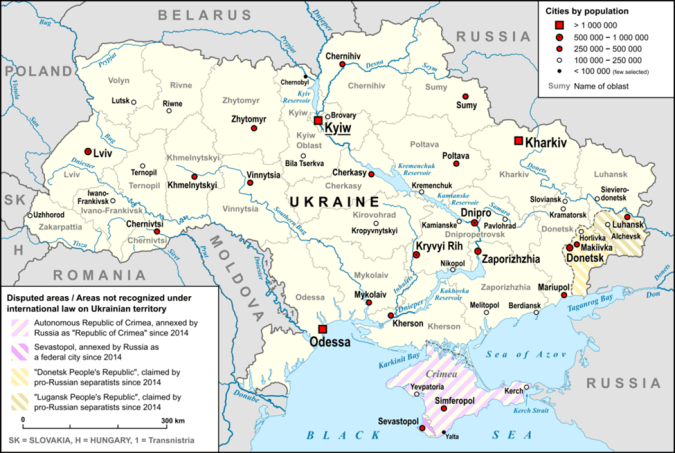
Recently, Amnesty International—of all sources!—came out with a critical report, largely ignored by the American and Western media, which documented the fact that Ukraine is actively engaged in terrorism and war crimes in its present conflict with Russia. One of the few Western media sources, Newsweek, quoted the report “that the Ukrainian military’s tactics ‘violate international humanitarian law and endanger civilians’ by operating weapons out of bases established in residential areas while civilians are present.” That is exactly what some of us have been saying and charging for some time, especially in reference to the accusation of Russian “war crimes” in Mariupol and Bucha, to mention but two prominent examples.
Now, an international agency, not known for its rightwing or pro-Russian bias, has come out and admitted the very same thing: it is the policy of the Ukrainian government to use civilians as human shields, to place potentially rich military target in the midst of unprotected civilians, many of whom become hostages to the Ukrainian military. The objective, of course, is to inflame Western and American media and political types: “See how evil and barbaric those Russians are!” goes the refrain. And that disinformation campaign has been fairly successful, if you watch most of Fox News (e.g., General Jack Keene, Brian Kilmeade, etc.) which is joined at the hip with the entirety of the hysterical (mostly leftwing) anti-Russian media, not to mention the Deep State cabal in Washington, which includes such deranged armchair warriors as Senators Lindsey Graham and Chuck Schumer.
Of course, Ukraine has attempted to push back against the report, employing it minions in the West and in the American media. But numerous analyses have surfaced, and, although ignored by our media, they confirm Amnesty International’s study.
In his most recent analysis, Colonel Baud examines the issue of terrorism as employed as a military tactic, and largely on the part of the Ukrainian military and its violent militia groups, in the current conflict with Russia. In an interview with the journal, The Postil, he explores in detail that question, as well as other critical issues—issues about which most Americans (and Western Europeans) have little reliable information.
There is a zealously pro-Ukrainian historical blackout framing Western media. It is openly admitted by Joe Biden and his Secretary of State Anthony Blinken and Secretary of Defense Lloyd Austin (since they visited Kiev back in late April, 2022) that the American strategy (and thus that of our NATO satraps) in Ukraine is “to bleed Russia dry, if it takes the death of every Ukrainian to do it.” In other words, Ukraine is a kind of “piege de mort,” a death trap for the Russians to facilitate a radical change in Kremlin leadership, to install by whatever means possible a pliant government which will essentially take orders from the globalist cabal which seeks to implement “the Great Reset.”
Colonel Baud’s interview is detailed, providing accurate and detailed information that most Westerners and Americans don’t see or hear in our controlled media. His wide-ranging interview is fairly long—9,000 words—but well worth reading and pondering. The goal of our elites in Eastern Europe has nothing at all to do with “protecting democracy”—Ukraine is the least democratic nation in all of Europe. It has everything to do with cementing globalist control, a unitary world where agencies like an empowered World Economic Forum (which Volodymyr Zelensky now pays homage to), the European Union, and a reconfigured and aggressive NATO, abroad, and an FBI and CIA, which have become our equivalents of the East German Stasi of Communist KGB secret police, domestically.
I pass on Colonel Baud’s interview below:
https://www.thepostil.com/our-latest-interview-with-jacques-baud/
Dominique Strauss-Kahn Revisited
BY LARRY ROMANOFF • UNZ REVIEW • SEPTEMBER 2, 2022
Introduction
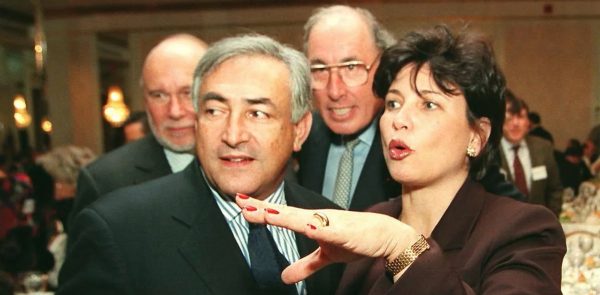
Dominique Strauss-Khan (DSK) was a former minister in various French governments and most latterly the Managing Director of the IMF. In 2011 he was involved in a sexual scandal in New York, eventually exonerated but ruined nonetheless. This story is of vital importance in understanding and making sense of our current geopolitical circumstances, important not because the event happened but because it was possible for such an event to happen, and that there are people with the power to make it happen.
The conspiracy theorists should have had a field day with this one, and all indications are that they would have been correct. The general rule is that if a story doesn’t make sense, it’s usually not true. As with most fabricated stories, this one has many gaps that cannot easily be plugged, and serious questions that were either not addressed or were riddled with implausible explanations.
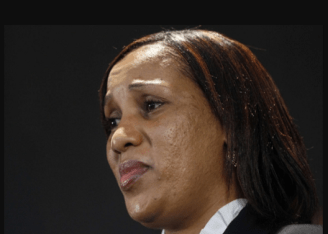
This episode began on May 14, 2011, at the Sofitel Hotel in NYC. Around noon, a hotel maid, Nafissatou Diallo, a ~35-year-old immigrant from Guinea, entered DSK’s room to clean it. Initial reports were that the man emerged naked from the bathroom and sexually assaulted the maid who eventually broke free and notified the authorities. In the meantime, DSK checked out of the hotel and left for the airport to take a flight to Germany. The NYC police took him off the plane, arrested and charged him with seven criminal acts that included four felony charges of attempted rape and sexual abuse, plus misdemeanor offences including unlawful imprisonment.[1] DSK was denied bail on the grounds of being a flight risk, and was incarcerated at Rikers Island. The following day, he was offered bail on condition that he resign his position as Managing Director of the IMF; he agreed a day later and was released into house arrest pending a hearing.
On 19 May, DSK was indicted by a grand jury on all seven charges, and ordered to stand trial. He was required to post a $1 million cash bail, wear an electronic monitoring device, surrender all his passports, and hire armed guards to ensure he didn’t violate his house arrest. He was also required to post a $5 million bond.[2]
The prosecution’s case began to fall apart almost immediately, progressively disintegrated over the following six weeks, and by July 1 prosecutors told the judge that they had “reassessed the strength of their case in the light of the housekeeper’s diminished credibility”, and sent a letter to DSK’s lawyers admitting serious inconsistencies in the maid’s tale.[3] [4] Also on July 1, DSK was freed from house arrest and had his bail dropped because the circumstances of the case had “changed substantially”.[5]
However, further hearings were still necessary to determine the extent of the charges to be prosecuted, with the next hearing date set for July 18, an important date as we will see. These hearings lingered until August 23 when all charges against DSK were finally dropped and he was free to return home to France.[6][7] [8]
However, the man’s problems weren’t over. Almost immediately upon his return to France, a young woman named Tristine Bannon attempted to file charges against DSK for an “attempted rape” that had occurred some 9 years earlier. In October, after much media publicity, the French prosecutors dropped the investigation from a lack of evidence.[9][10]
But a few months later, in March 2012, French prosecutors announced another investigation on DSK about his “possible connection” to a gang rape that supposedly occurred in Washington, D.C. At about the same time, authorities began yet another investigation in France, this time with allegations about his supposed involvement in hiring prostitutes for sex parties at hotels in Lille, Paris and Washington.[11] [12]
By October of 2012, prosecutors announced that they were discontinuing the investigation of the gang rape allegations,[12] but troubles remained. Amid a continuing media frenzy, in July of 2013 French prosecutors announced that DSK was to stand trial on allegations of “aggravated pimping” at the Carlton hotel in Lille.[13]
The accusations were that orgies had been held at this hotel and DSK had been instrumental in hiring prostitutes for the events. This court case dragged on for two years, the French media providing weekly details with very specific references to DSK and his conduct, some claiming “he had sex with every girl in the room”.[14] DSK was acquitted of all these charges in June of 2015.[15]
Still more. While the French media were hyperventilating over the juicy details of DSK’s real or imagined sexual exploits, Able Ferrara produced a feature film titled “Welcome to New York“, starring Gérard Depardieu as DSK and Jacqueline Bisset as his wife Anne Sinclair.[16] The film was built around the story in the Sofitel hotel and apparently “portrayed both characters in an unforgiving light”. Ms. Sinclair, who is by all accounts a thoroughly lovely person, said the film was “disgusting”, and DSK sued the film’s producers for libel. Then still more. In 2020, there was a Netflix “documentary” titled “Room 2806: The Accusation“, based on the Sofitel event and the other alleged accusations against DSK.[17]
By this time, after months of unfavorable exposure in the US and nearly four years of the same in France, it could be truly said that Strauss-Khan’s political, public, and social careers were at an end. After years of publicity, investigations and trials, DSK had been acquitted on all charges in all countries. It appears there never was sufficient evidence to support any of the allegations made against him, but the man would never again hold any international positions and was by this time much too toxic to ever re-enter French politics. DSK has since remarried and is doing “financial consulting” and giving speeches. The end. Well, almost the end.
The Handmaid’s Tale – a Futuristic Dystopian Novel (with due apologies to Margaret Atwood)
 According to her claims to the police and her testimony at the Grand Jury hearing, and according to the New York Times, the New York Post, the New York Daily News, the Wall Street Journal and many others:
The maid inserted her card-key, opened the door, and called aloud several times to learn if the room were occupied. Receiving no response, she entered and began her tasks. Then, “the married Strauss-Kahn” emerged naked from the bathroom, chased the maid around his suite, “locked the door” so she couldn’t escape, then dragged her into a bathroom and “engaged in a criminal sexual act”. There was much confusion as to whether the criminal sexual act was anal, oral, or none of the above. However, while chasing and dragging her around the suite, DSK was apparently yelling “Don’t you know who I am? Don’t you know who I am?” When the maid begged the man to desist on grounds she could lose her job, DSK comforted her by saying “Oh, baby, don’t worry baby. You won’t lose your job”. There was also confusion as to injuries incurred by both parties, the maid apparently suffering “a torn shoulder ligament” in her struggles, while DSK was reported to have suffered severe bruises on his back when the maid forcefully shoved him into some furniture.
The maid then fled the man’s suite and cowered in fear in a hallway until a maintenance supervisor discovered her, after which they notified hotel security who performed an investigation, confirmed the torn pantyhose, discovered DSK’s DNA and semen on the walls and carpet, and eventually notified the police. In the meantime, DSK had dressed, packed his things, checked out of the hotel, and took a taxi to the airport in an attempt to flee the country.
But justice never sleeps. It seems that in his haste to flee the country DSK left behind one of his mobile phones. Taking a great risk, being as guilty as he was, he nevertheless called the hotel to ask if the phone had been left in his room; after some discussion, the hotel staff called him to say they had indeed found his phone and would deliver it to the airport. The NYPD then escorted DSK off the plane as the doors were closing for departure, and arrested him. You know the rest, except that none of “the rest” was as it appeared to be.
Some Chinks in the Armor
Ancillary Hotel Services, Turn-Downs Included
At the outset of this event, before all the wagons had been properly circled, the hotel security staff and the NYPD independently confirmed to DSK’s lawyers that the woman was known to act as a prostitute in the hotel, offering special services and “turn-downs”. That much appears certain, but when the claims became public too quickly, everyone rushed to deny them and a hotel representative said, “We have no knowledge about that”.
The Crime Scene: DNA “linked to Maid”
The first rule of criminal investigations is that you don’t contaminate the crime scene. Yet the maid returned to clean the room, no doubt doing so immaculately as is the standard with Accor Hotels everywhere. And she wasn’t the only one. Syed Haque, a room service employee, came to pick up the breakfast dishes which had already been collected several hours prior. Renata Markozani, the head of housekeeping, entered the room to examine the situation, and also Brian Yearwood, the hotel’s chief engineer, with no explanation as to his purpose. Then the hotel security staff who, with little or no training in criminal investigations, went to the room to perform such. Between all of these, any evidence actually existing would have been either contaminated, destroyed – or planted.
It should be noted that anyone with access to a hotel guest’s clothing, toiletry, bedding, linen or laundry, has access to everything necessary to spread that guest’s DNA (possibly including sperm and other body secretions) on any surface or clothing anywhere. In this context, it is not irrelevant that DSK apparently had a woman spend the night with him in that room. The simple fact is that nothing found in that room later by police investigators could possibly have qualified as “evidence” of the crime in question.
The mass media flooded the nation with news that DSK’s DNA had been found (almost) everywhere, linking it to ‘the maid’ without noting the method of linkage.[18][19][20]
The New York Times was there first, citing “a person briefed in the matter“, stating DSK’s DNA and semen were found on the maid, on her clothing, on the walls, on the carpet, and perhaps on the ceiling. After this information had been duly digested by the public, the police and prosecutors stated that no such evidence had actually been obtained or released. “A prominent US defense lawyer claimed that there was substantial doubt . . . [about] the so-called DNA evidence and the match . . . since accurate DNA testing normally takes several weeks.” However, the DNA linked to the maid was headline material, the denials not so much . The Wall Street Journal reported that DSK’s DNA sample and semen were found on the woman’s shirt, quoting “sources close to the investigation” and citing “law enforcement officials” who immediately stated they had never said any such thing.[21]
In fact, there was never actual confirmation of any of this, and the investigators claimed to have found no traces of semen in the sink where the maid claimed it had been spit. The NYPD and the prosecutors simply let media speculation run wild and did nothing to combat it. All of the claims were based on leaked rumors.
Hotel security officers “conducted an investigation” and claimed to have found semen on the floor and wall. They then called the police, setting off the chain of events that led to the arrest at the airport. We are to believe that the mall-cop wannabes comprising hotel security were competent to perform a criminal investigation, and equipped and able to perform lab tests.
The Perpetrator Flees, Leaving Behind ‘Valuable Items”
The US media, led by the NYT, led us to believe that DSK attacked this woman, then fled to the airport in a panic, evidenced by his leaving behind a mobile phone and “other valuables”, the authorities apprehending him during the last seconds before his “fleeing the country”. But DSK didn’t flee; on the contrary, we have a witness account from a woman who used the elevator with him who said that she found him pleasantly calm. He waited patiently in line and checked out without anybody noticing anything wrong, took a cab to a restaurant where he had lunch with his daughter and then went to the airport to take a flight with a ticket that had been purchased days earlier. DSK was leaving the US for Germany where he had an arranged appointment with Angela Merkel. And, for the record, nothing was “left behind” including “other valuables”. What did happen was that one of his mobile phones was lifted from his room.
The NYT led us to believe DSK was arrested on, and then removed from, the airplane, just as the doors were closing for departure. But that description was a bald lie. The truth was that the hotel, on instruction, called DSK to tell them they had found his missing phone. Apparently, it was the police who then called to tell him that his phone was at the gate desk, and asked him to exit from the plane to retrieve it. When he deplaned, he was arrested. Leaving the Air France plane to recover the phone was a strong indication of a lack of guilt since while on the aircraft he was technically on French sovereign territory and could not have been taken into custody. If he were concerned, he could have asked a stewardess to get his mobile phone for him or the detectives to deliver it to the steward. All of his behavior suggests the acts of an innocent man.
The NYT seemed eager to leave the impression that DSK left the hotel in a panic, overcome with fear and anxiety, and was in a headlong rush to flee the country. We have this almost certainly fictitious account: “A guest at the hotel, . . . said the livery driver who drove Mr. Strauss-Kahn to Kennedy Airport was also his driver on Saturday night. “He said Strauss-Kahn was in a huge hurry, . . . He wanted to leave as soon as possible. He looked upset and stressed.”[22] The BBC claimed this “was not the first time Mr. Strauss-Kahn had been involved in such an incident” (even though it was the first time), and further that “he had been arrested attempting to flee the country”, which of course was not true.[23]
The Mysterious Telephone Call
“Investigators with the Manhattan district attorney’s office learned that the woman made a recorded call to a prison inmate on May 15, the day after DSK’s arrest, with words to the effect of, “Don’t worry, this guy has a lot of money. I know what I’m doing”.[24] This would seem to confirm claims by DSK’s lawyers that the encounter (if indeed there had been an encounter) was consensual and that the woman was attempting extortion. The woman later claimed her words had been “mistranslated”. In a 3-hour interview with Newsweek, the woman said she hopes God punishes him. “We are poor, but we are good,” she said. “I don’t think about money.”[25] Diallo’s lawyer said she mentioned Strauss-Kahn’s money in the telephone call only to say that her alleged attacker was influential.[26]
More interesting was that the authorities required a full 6 weeks to translate the conversation because, according to them, it was in a “unique dialect of Fulani,” a language from the woman’s native country, Guinea. But there are no ‘unique dialects’ of the language, Fulani being one of the three major West African languages and extremely common, with the NYC area having more than 100,000 Fulani speakers. Moreover, the courts knew this, the police knew it, and local interpreting agencies claimed they had many occasions to provide Fulani interpreters, often on a daily basis. The New York Times was one of the principal promoters of this falsehood (and of many more). It is obvious the authorities lied about needing 6 weeks to arrange the translation, and it is just as obvious that they withheld the information until DSK was out of the running for the French Presidential Primaries.
The Money and the Phones
One of the threads running through the media presentations was that the prosecutors discovered flaws in the woman’s testimony and evidence of criminal activity, immediately notifying DSK’s lawyers. The NYT particularly pushed this narrative, stating “Still, it was the prosecutor’s investigators who found the information about the woman.”[27] Their claim appeared to have been almost entirely untrue. DSK’s legal team hired a private investigation company, Guidepost Solutions, which uncovered the claimant’s criminal background and reported that to the DA’s office, and which eventually exonerated DSK. Such investigations are rarely if ever done by police to help a defendant who has already been indicted.
The first discovery made by the private investigators was that someone had opened five different bank accounts in the woman’s name, with five different banks, in five different states (Arizona, Georgia, New York, Pennsylvania, and one unidentified)[28]
and had deposited US$20,000 in each one. Standard CIA practice for payoffs.[29][30][31]
Given that the woman’s ‘friend’ was in prison for minor drug offenses, the US media, led by the NYT at full volume, tried to relate the payments partially to her friend’s drug dealing, but the depositors were never identified, another sure sign of a CIA payoff. This apparently wasn’t enough of an issue for the media to question. We will never know where the money came from, but the simple fact that the media refused to touch this part of the story makes the conclusion almost certain. The NYT made a small concession to reality, stating there had been “unusual activity in her bank accounts”.[32]
The private investigators also discovered that the woman had at least 3 mobile phones with three different phone companies and was spending over $500 every month on calls. On a maid’s salary? On calls to whom? As a reporter, that’s the first question I would ask. Another almost sure sign of CIA involvement. The media reported every other trivial detail but weren’t interested in this one.
The Timeline
The maid’s account and the prosecution’s case began to unravel in many other directions at the same time. The maid initially told investigators she had hidden after the attack until she saw her alleged attacker leave, after which she reported the assault to a supervisor. But the hotel’s card key register proved that she first mysteriously entered another room for a few minutes, then cleaned a nearby room, then returned to the room in which the alleged attack took place, cleaned it, then spoke to supervisors.[33]
There is another curiosity here: the maid’s cleaning assignments until that day had always involved rooms scattered on various floors, but on this day was given the 28th floor exclusively, so there would be no other hotel staff on that floor that day. The story was that she assumed duties of a colleague on leave, but the lawyers believed this was a method to give her access to DSK “for some nefarious reason.”
According to the card key records, the maid entered another room adjacent to that of DSK three times prior to entering his room, and again immediately when leaving his room after the alleged assault occurred. This information was omitted from her police reports and her Grand Jury testimony. The hotel refused to identify the (probably CIA) occupant of that room. All indications are that she was reporting to her handlers for last-minute instructions, then reporting her success afterward. The media omitted the fact of the second hotel employee entering the room while the maid was still there. This appears to be when DSK’s mobile phone went missing.
Edward Jay Epstein wrote an excellent article that was published in the NYT’s Review of Books.[34] The full version is available here on the Financial Times;[35]
I urge you to read it; it contains scores of questionable details, excellently-researched and documented, that cast a very dirty light on everything that occurred. Also, an article in the Business Insider[36] is excellent, asking “So is Strauss-Kahn the target of some form of political plot? Even if the alleged victim isn’t a witting part of a honey trap, what has been released so far by the New York police looks like railroad job, with a rush to discredit the target for the rest of his life. Even the latest pictures are designed to make the Frenchman look guilty?” The Guardian[37] and Forbes[38] also have excellent articles that identify the inconsistencies. And two others you may care to read.[39][40]
A Few More Inconsistencies
The woman’s account is riddled with inconsistent statements. She told the grand jury in sworn testimony that she left the room, waited in the corridor until DSK left and then reported the incident, and only when confronted with electronic card key evidence, did she admit she cleaned another room and then returned to the scene of the crime before reporting the incident. She told investigators that she fled the room as soon as she could, but she told the rape counselor at the hospital that she waited in the room for DSK to get dressed. Why would she do that, after having been raped? She claimed in testimony that the two never spoke, then told ABC-TV anchor Robin Roberts that they spoke at some length. In fact, she had three completely different versions of the events that transpired and of her activity following.
If the woman had sustained injuries – including a “torn shoulder ligament” as authorities claimed, how would she then proceed to clean rooms? If the woman had been raped and injured, why wouldn’t she seek help and medical attention immediately? A “torn ligament” would be painful and require immediate treatment.
There was much more. It was discovered that the woman had “had practice at this kind of storytelling before”. “Further investigation revealed that the [maid] had lied on her 2004 asylum claim about being gang-raped in her home country of Guinea. More damaging still, she had rehearsed the narrative of lies for asylum so often, listening to them over and over on an audiotape supplied by a male accomplice, that even years later she would break down crying as she told the story—until, finally, under very tough questioning by assistant district attorneys, she admitted the asylum narrative was a fabrication.”[41] Her stories were apparently so well-told that listeners would often be driven to tears as well.
“The most seasoned professionals in the office working on this case were brought to tears by this woman’s life story. I mean literally brought to tears,” says Linda Fairstein, former chief of the Sex Crimes Prosecution Unit. “She was so convincing that cops, advocates, professionals, bought the story. And then the prosecutors got to work.” But with the Arizona phone call and the asylum stories as background, the more investigators examined the accuser’s story, the more anomalies began to multiply.”[42][43][44][45][46][47]
There were also questions raised about the physical possibilities of such an assault being able to take place. The maid was young with DSK in his 60s, at 5’10” much taller than DSK and more heavily-built, with one observer stating “She could have kicked the crap out of him”. “. . she’s a big woman, how could he have overpowered her?”[48] Many news reports from Europe claim the woman agreed (or offered) to perform oral sex, then attempted blackmail and extortion. Olivier Mazerolle, a senior political journalist at France’s BFM television, claimed to have obtained details from sources in the US, and maintains this is what actually occurred.[49]
“Is it reasonable to believe that a 62-year-old man, even one as oversexed as DSK is supposed to be, would emerge naked from the bathroom of his hotel suite sexually to confront a maid whom he had never met before, and whom he did not expect? Is it reasonable to believe that stark naked and wielding no weapon he could have forced a taller, younger and more muscular woman to commit oral sex twice [in 6 minutes], and that the transaction would have resulted without some level of participation on her part? And is it believable that she didn’t offer any resistance, cry out or flee when she presumably knew where the door was, having worked in the hotel for three and one-half years?”[50]
“It strains credulity to think an internationally respected financial leader would hurl himself naked from his hotel bathroom onto a decidedly unattractive maid who happened to be cleaning his room, then force her to perform oral sex on him. It’s all made to sound like the actions of a psychopath more than a lustful Frenchman.” It would seem absurd for a man who can hire young models or woo women from higher brackets, to forcibly rape a woman, then have a leisurely lunch with his daughter and finally get caught only because he himself gave away his whereabouts in multiple calls when trying to recover his mobile phone.
In the final version of events, the alleged victim committed multiple counts of perjury, tax fraud, visa and passport fraud, conspiracy to commit extortion, possible drug-related offenses, but neither the police nor the media appear to have any interest in pursuing these details. Nor was there any interest in the five bank accounts. The woman told 37 substantial lies, mostly under oath but, according to her lawyer, “She made some mistakes here, but that doesn’t mean she is not a rape victim.” Mistakes? It will be almost certain proof that this entire bizarre event was a political fraud organised at the highest levels, when we realise that no action was ever taken against the woman for her string of crimes and the unexplained cash.
The Missing Blackberry
This is exceptionally curious and one of the keys to the entire entrapment process. One of DSK’s mobile phones, a Blackberry that he used for IMF work and very personal calls, went missing. It seems that DSK had already packed his things, including his phones, prior to taking a shower and dressing to leave the hotel. After the encounter with the maid, he used this phone to call his daughter and confirm their lunch appointment. The maid admitted to remaining in the room at that time, and perhaps the other hotel employee was there at the same time. DSK then apparently placed the phone in his briefcase, after which it disappeared, and was never found.[51]
DSK had already been warned that his phone had been hacked. A friend working in Sarkozy’s election office notified him that personal messages sent to his wife from that phone had been intercepted and read at Sarkozy’s office. The records obtained from BlackBerry show that the missing phone’s GPS circuitry was disabled at 12.51, preventing the phone from sending out signals identifying its location. It appears the phone never left the Sofitel. “Evidently unaware of what was happening at the Sofitel, he called the hotel from the taxi, asking if his phone had been found. When he was called back 13 minutes later, he told a hotel employee that he was at JFK airport. The police rushed there and, at 4:45, called him off the flight and took him into custody.”[52] Blackberry could not explain how the phone had been disabled, being something requiring extreme technical knowledge.
The “Dancing Israelis”
After the maid alleged that DSK sexually harassed her, the security team called John Sheehan, the security director for Accor, the French company that owns the Sofitel. His boss has ties to Ange Mancini, who was then Sarkozy’s coordinator for intelligence. Sheehan was seen on surveillance footage with an unidentified man who accompanied Diallo to the hotel security celebrating shortly before the police arrived: “The two men high-five each other, clap their hands, and do what looks like an extraordinary dance of celebration that lasts for three minutes.” One of DSK’s attorneys, William Taylor, who claims to have seen the footage, tells the Post, “They could have won the lottery. It seems directly related to speaking with Diallo and calling the police.”[53][54][55]
Media Frenzy and Speculation
“When police and prosecutors convict a suspect in the media before he is even charged, it typically means that there is no evidence against him and that demonisation is serving as the substitute.” Everything about this story has a stink of conspiracy, of sexual entrapment of the kind that got Julian Assange, Mordechai Vanunu and many others. Even more curious was that none of the mainstream media cared to connect the dots to see where they led.
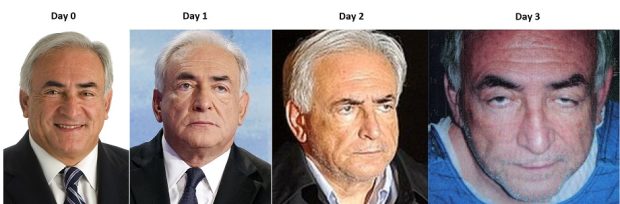
When reviewing the accounts of this tale, I couldn’t shake the feeling that the mass media, at least in the English-speaking world, had been instructed to speculate as wildly as possible and to fabricate any details they considered useful or titillating. “James Cox, law professor at Duke University, said: he was surprised that the prosecution had not done more homework on their witness before making such strong statements about the case and the strength of its witness.”[56] There were many serious questions over their handling of the case, especially the notorious “perp walk”, which saw DSK paraded in front of press cameras.
The media focus centered on the story of the alleged victim rather than on who was pulling the strings behind the scenes in what visibly appears to have been a political frame-up. The NYPD, the prosecutor, the CIA, were letting the media speculate publicly. The entire story, based only on speculation and a complete absence of facts, has the look and feel of giving the gullible public just enough information to come to the wrong conclusion.
The NYT
In fact, the most likely hypothesis, which is that DSK was deliberately set up, was not only totally avoided by the mainstream media, but any reader comments at the time were either not posted (NYT ) or were deleted immediately after posting. There is ample evidence that the media – especially in the US – had been instructed to monitor and control all comment on this issue.
At the time, it was fascinating to watch the NYT during the three months of this episode. There was no way to avoid the conclusion that the editors were firmly controlling the reader comments on all their DSK articles. Not even a hint of a suggestion of a setup was permitted until one article on July 6, long after all the damage had been done. The comment threads were constantly led to topics like “rich white man, poor black woman”, or the US legal system, or how money can buy freedom or how even liars can be raped. Whenever a comment was posted that was “off-topic”, more correct ones were inserted to bring readers back into focus.
There seemed little doubt that the NYT was on the same page as the NYPD, the DA and, we must assume, the CIA and the City of London. Not only did the editors control the posts, they added some of their own, to the “Highlights”, to help readers focus. Among them was this gem: “While France will now criticize us, we should remember that French people enjoy few of the rights we do when accused. French “authorities” can hold people for up to one year without charges in an attempt to pressure them for cooperation in a criminal case. In Europe, the presumption generally is that the person accused is guilty and he must prove otherwise.”
It is astonishing that the Times had the gall to do this. France can retain a person for no more than 24 to 48 hours before release, and the NYT editors would surely be aware of this.[57] No newspaper would make such a claim without checking its accuracy, so we must conclude they knowingly made a false statement, seriously maligning France in the process and leaving a disturbingly dishonest impression on the 80% of Americans who are sufficiently uninformed and gullible to believe anything.
The “Settlement”
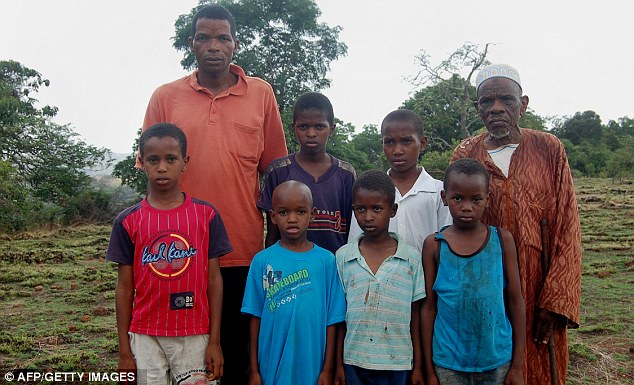
The New York Times first reported that DSK had agreed to pay the maid $6 million as a settlement, attributing the news to “French media sources”,[58] while the same French media sources attributed the claim to the NYT. Other media claimed that “friends of Strauss-Kahn” offered the chambermaid’s impoverished family in Guinea, West Africa, a ‘seven-figure’ sum to convince her to drop the charges. Then almost everyone joined in with the identical claim,[59][60][61] even posting a (surely) fictitious photo of the maid’s “family”.[62]
It became a circus, with DSK’s lawyers stating the claims as “flatly false”.
Perhaps another WHO Worldwide Pandemic
One of the more entertaining bits of the media having fun was the “evidence” suddenly surfacing from every corner that DSK was only one of perhaps thousands of such. My favorite was the UK Daily Mail’s claim that maids at the New York Hilton and “in various other hotels around the U.S.” were having to hide from male guests running around naked in the hotel corridors, screaming “I need sex”.[63] The newspaper helpfully suggested all hotel maids needed to wear ‘panic buttons’.
The Question of Diplomatic Immunity
This was curious. As Managing Director of the IMF, DSK should have had full diplomatic immunity, not that the US would honor it, and in fact the judge in the hearing dismissed this. But it appears the IMF had the power to demand immunity for its CEO, and in fact the IMF Board had at least one meeting to discuss the matter.[64][65]
No information was released, but IMF rules stipulate an 85% agreement on all decisions and, with the US controlling 18% of the vote, we can assume the US exercised its veto and killed DSK’s one chance to escape the trap. He would still have full immunity from civil suits, however. This aspect was totally ignored by all the media, and should not have been.
Rikers Island
Rikers Island is widely-known as one of the most brutal and dangerous prisons in the world. It “has always been a place of exceptional violence”, with weapons everywhere, with rival gangs ruling the cellblocks, a place notorious for the brutality of the prison guards and the deranged mental instability of most inmates, 1,000 of which are stabbed or killed each year.[66][67]
Only the dregs of society are sent there, and incarceration for a civilised person would be terrifying to say the least – which would have been the entire point of sending DSK there. The prospect of remaining there for months until trial, coupled with the slim prospects of survival, would encourage a man to comply with any conditions demanded for bail and removal – including resigning his job as MD of the IMF. DSK was sent to Rikers on May 17, presented with his options the next morning, and his official resignation processed on the following day, May 19, when he was released on bail.
Persons of Interest
In order to properly connect the dots, we need to identify some of the main players and their relations to each other.
Frank G. Wisner Sr.
Frank Wisner has been described as a “master diplomat” (Deputy Assistant Secretary of State under Dean Acheson) and also a “master spy”, (America’s least-known but most famous spy). He was none of those things. Wisner was a criminally-insane Jewish psychopath,[68] the co-founder of the CIA and the designer and operator of Operation Gladio in Europe[69] which he ran together with Allen Dulles (then head of the CIA), and which was one of the bloodiest terror programs ever inflicted on the world. He was largely responsible for the American coup that removed Mohammed Mossadegh as Prime Minister in Iran in 1953, and also primarily responsible for the overthrow of Jacobo Arbenz Guzmán in Guatemala in 1954, one of the dirtiest, bloodiest, and most unjust of such US government atrocities.
Frank G. Wisner Jr.
Young Frank, also seconded into the US Foreign Service, was an American Ambassador to several countries as well as Under Secretary of State for International Security Affairs under Bill Clinton. He also served as Deputy Executive Secretary of the Department of State under Cyrus Vance. Wisner Jr. was heavily involved in the tragedy in Yugoslavia and primarily behind the push for the independence of Kosovo to help Madeline Albright and George Soros “take over” the communications infrastructure there (an $800 million gift). However, Wisner Jr. is best known for his financial crimes for which the term “unscrupulous” would be something of an understatement. Wisner was part of the inner circle at Enron whose financial manipulations ruined countless thousands of investors, and he was the Vice-Chairman of AIG when its share prices collapsed by 95%, prior to the Khazar-dictated taxpayer bailout.[70]
Pál (Paul) Sarközy de Nagy-Bocsa
This man, a Greek-Hungarian Jew, was the father of Nicolas Sarkozy who became the President of France. Paul married several times, Nicholas resulting from the first marriage with Andrée Mallah. His father and birth mother both abandoned Nicholas and he was taken in by Paul’s third wife Christine de Ganay after her divorce with Paul. Christine de Ganay subsequently married Frank Wisner Jr, who more or less raised Nicholas and taught him everything he knew (at least all the dirty parts of American and French politics and finance). “It was [Wisner] who introduced then-teenage Sarkozy to CIA insiders and facilitated his entry into French political circles”, and one of Wisner’s sons was Sarkozy’s campaign manager.
Cyrus Vance Sr.
Cyrus Roberts Vance Sr. was an American lawyer and Secretary of State under President Jimmy Carter. He was also Deputy Secretary of Defense, Secretary of the Army, and General Counsel of the Department of Defense.
Cyrus Vance Jr.
 This is where things become interesting. Cyrus Vance was the Manhattan District Attorney, conveniently appointed just in time to handle the three most notorious sexual scandal cases in recent memory (all involving Jews): Jeffrey Epstein, Harvey Weinstein, and Dominique Strauss-Kahn. In the case of Jeffrey Epstein, Vance’s office argued in court for dismissal of charges and his removal from a sex offender’s list, claiming “there are no real victims here.”[71]
Vance would later argue that his “assistant DA” made these court representations without his knowledge. We are to believe that in the most spectacular sexual abuse and sexual-entrapment scheme ever recorded, and certainly the biggest case in his career, Vance had no idea what his own assistant was proposing in court. It was Vance (in an arranged plea bargain) who managed to free Epstein from a life sentence and give him only 13 months in prison where he was allowed out during the day (to look after business) and only slept in the prison at night.
Does anyone recall Epstein being given a ‘perp walk’? Was he incarcerated at Rikers Island? Did he have to post millions in bail, wear a bracelet and have to hire armed guards at his own expense ($240,000 per month for DSK)? Was Jeffrey Epstein denied bail because he was a flight risk? No.
Something similar occurred with Harvey Weinstein, with Vance declining to prosecute the Hollywood producer in spite of the huge amount of evidence against him. But it wasn’t all bad. Vance did manage to obtain a sentence of 428 years against another serial rapist who had the misfortune of not having been born Jewish.
Let’s review some connections. Nicholas Sarkozy, our Jewish-Hungarian midget, was raised by the Jew Frank Wisner who worked for Cyrus Vance Sr., and who introduced Sarkozy to the (Jewish-created) CIA and to US and French politics. Sarkozy and Cyrus Vance Jr. were of the same age (one year apart) and certainly knew each other well since their fathers worked together and their families socialised together. And who was appointed as the lead prosecutor against DSK? Cyrus Vance Jr. In what was clearly one of the most egregious set-ups in recent memory, Vance was later loudly applauded by the New York Times, the Wall Street Journal, and other US media, as well as by multiple government officials for “acting with integrity” in a case where a poor woman made “a credible accusation against a very powerful man”.
Sarkozy and Mossad
Nicholas Sarkozy was confirmed as a Mossad agent, the details revealed in articles by Le Figaro, an influential French daily, providing evidence of Sarkozy having been recruited as an Israeli spy, “one of the thousands of Jewish citizens of countries other than Israel who cooperate with the Mossad”. This information was apparently given to the French police in detail prior to Sarkozy’s election as president, but suppressed until the scandal emerged. “This was so important an issue that within 24 hours after Le Figaro’s exposé, Israeli Prime Minister Ehud Olmert was on a state visit to France” – ostensibly to discuss Iran’s nuclear agenda, but in fact an attempt to deal with the fallout.
According to media reports, the French police were investigating documents concerning Sarkozy’s alleged espionage activities against France on behalf of Mossad, which Le Figaro claimed dated as far back as 1983, which was when Israeli prime minister Menachem Begin recruited the “young and promising” Sarkozy as part of the ordered infiltration of the French ruling Gaullist Party.
Tristane Banon
Tristane Banon, a 32-year-old journalist, claimed that DSK sexually assaulted and tried to rape her a decade earlier. She is “the daughter of one of Strauss-Kahn’s discarded mistresses and the goddaughter of his second wife.”[72] This woman, with her lingering memory of an encounter with DSK from 9 years prior, chose the correct moment to bring it to the public. And this latter is also surpassingly strange; the mother came to the defense of her daughter by “confessing” that she also had an affair with DSK at around the same time. How this would help her daughter’s case was not made clear. At least, not to me.
Her case was so weak (and 9 years too late) that there was no chance for it to lead anywhere, but it would help to keep DSK out of the Presidential Palace. Mrs. Banon worked for atlantico.fr, a pro-Sarkozy website which was co-founded by Arnaud Dassier, the man behind Sarkozy’s web campaign of 2007, and the man who started the smear campaign against DSK a few weeks before May 15th. Of interest is Banon’s claim that “politics played no part” in her decision to air this old issue again, that she “was not approached by the Right” to fire another torpedo into DSKs political career.[73][74]
Christine Lagarde

Christine Lagarde is a Jew.[75] Both the City of London and Israel wanted her as the new IMF head, which was why she had beforehand declared her availability and “eagerness to serve”. Lagarde was a hard-headed “corporatist” member of the Bilderberg Group and the WEF, and definitely in favor of the new world order intended to preserve Khazarian Jewish hegemony worldwide. The IMF Executive Board issued a press release on June 28 2011, confirming her appointment as IMF Managing Director.[76][77]
The report from the prosecutor was released to the media June 29, and presented to the court on July 1. Lagarde’s succession to the IMF occurred a few days prior to a New York Court ruling which completely exonerated Dominique Strauss Khan on the basis of lack of evidence. It apparently wasn’t of concern that Lagarde was under criminal investigation at the time for an illegal application of some $400 million in funds.
French Media Reports: Who Told Who What When?
One indication that DSK’s political enemies were implicated is the fact, made public by the French press, that Sarkozy’s political team in France knew about DSK’s arrest not only before the NYC police announced it, but before the actual arrest had occurred. In fact, Sarkozy’s office and the French media reported DSK’s arrest while he would still have been in a taxi on the way to the airport. No one has attempted to explain this. The evidence is that the NYC Hotel Manager called France’s Presidential Palace over an hour before the news was released in NYC, which is how the French media knew that DSK was going to be arrested before the arrest actually took place.
The first person in France to announce the arrest was Jonathan Pinet, a campaigner for Sarkozy’s party, who apparently tweeted the info at the time DSK was in the taxi to meet his daughter for lunch. And he apparently made other posts only minutes after the arrest itself. Shortly after, Arnaud Dassier, Sarkozy’s campaign director, was also commenting on the event, sooner than any journalist in the US. Confronted with this strange coincidence, he said he got the information from a friend who knew someone working in the NYC Sofitel hotel. How would anyone at the Sofitel know whether or when an arrest was made? Why would the NYPD report to the Sofitel, and why was all this information crossing the Atlantic in real time?
More interesting, Xavier Graff, the duty officer at Accor in Paris, sent e-mails several weeks after DSK’s arrest claiming full credit for “bringing down” the IMF chief.[78] Also worthy of note is that the top management of the ACCOR Hotel group in France was known to have close ties to Claude Gueant, Sarkozy’s closest advisor and his Minister of the Interior. The hotel’s Director of Security was a former agent of DGSE (French CIA), who had worked under Sarkozy personally. And finally, Ray Kelly, the head of the NYPD, had been decorated “Chevalier de la Legion d’Honneur” by Sarkozy himself, the two men having had a close personal relationship with much contact since that time.
The French Presidential Election
DSK survived the first assault (in the US) because the widespread public feeling in France was that it was clearly a staged event, a “set-up”, and still leaving him as the favorite and with a strong political base. Thus, he was wounded but not destroyed, so the charade proceeded to Plan B, with accusations of rape or attempted rape, and of arranging the hire of prostitutes for orgies. Just as in the US, all charges were eventually dropped because there had never been any supporting evidence for those allegations, but the court cases continued until the man’s name had been sufficiently blackened that his political career descended to ground zero.
Ruining DSK would not have raised Sarkozy’s standing in the polls; he was still widely disliked and considered “crazy”. But this would have removed his most dangerous opponent, leaving no one else with sufficient public status to challenge him. So, one clear purpose of the entire event was to ensure Sarkozy’s re-election by destroying his only credible opponent. Sarkozy was definitely running scared; not only being attacked on the streets in France, but in a then-recent appearance in Algeria the crowds were all yelling “Get out! F*** off, Sarkozy”.
A former justice minister, Robert Badinter, called DSK’s treatment “a lynching, a murder by media.” The “perp walk”, the unshaven pervert-in-a-trench-coat photos, is a perverted and sadistic US tradition resurrected from the medieval era, and forms an inexcusable and humiliating breach of the principle of the presumption of innocence. Besides that, we had the “suicide watch”, the grossly unreasonable bail conditions that included from the first day his resignation from the IMF.
It was all designed to inflict the maximum possible public humiliation to forestall any chance of DSK’s return to politics. Also, the charges were not dropped, nor his passport returned, until after the French election primaries. To represent the Socialist Party and be their leader, he would have had to have been in France for the primaries which closed on July 13. However, his court date was set for July 18. This was not a mere unfortunate coincidence.
You don’t need to be a conspiracy theorist to smell something fishy here; in fact, it requires a leap of faith to not smell the odor. The proverbial elephant in the room should be obvious to all readers. There appears to be little question that one of two pillars of Strauss-Kahn’s demise was a perceived necessary “regime change” at the IMF. The other would appear to be desperation on the part of Israel and the City of London to remove Strauss-Kahn from French Presidential contention in order to preserve Sarkozy – their “man in Paris”. The Jews and Zionists in Israel were desperate to maintain Sarkozy in power because he would ensure the protection of Israel’s practices and the status of French Jews, while containing the anti-Israel sentiment in France. Israel’s government and French Jews and Zionists were among Sarkozy’s strongest electoral support. “We can refer to Israel’s conceited triumphalism with which they greeted Sarkozy’s election: “we are persuaded that the new president will continue eradicating anti-Israeli resistance”.
“The arrest of [DSK] has all the appearances of a frame-up ordered by powerful members of the financial establishment, in liaison with France’s Nicolas Sarkozy, whose presidency has served the interests of the US and Israel at the expense of those of France and the European Union. Immediately following Strauss Kahn’s arrest, pressures were exerted . . . to speed up his replacement as Managing Director of the IMF.”
The IMF and the Dollar
As head of the IMF, DSK was far from a saint in dealing with indebted countries. It was he who oversaw the destruction and permanent colonisation of Greece – an enormous sovereign disaster of which too few people seem aware. And in this, he was definitely following the instructions and template of the Khazarian mafia in the City of London. If you don’t know the details, you may care to read this: Humanity at the Crossroads.[79] You need reference only the brief paragraphs on Greece.
One of the circumstances that many considered a precipitating cause of DSK’s removal, was his conviction of the need for a new world currency, suggesting that SDRs be used much more broadly instead of the US dollar for international trade and payments,[80] leading to a prevailing theory that the US$ be removed. Thierry Meyssan wrote a scholarly article on this,[81]and Mike Whitney wrote an opinion piece claiming “Dominique Strauss-Kahn Was Trying to Torpedo the Dollar.”[82]
But DSK was in no way arguing for the elimination of the US$ in international settlements as for the creation of more stability since poor nations were easily whipsawed by borrowing in US$ at low rates then subjected to bankruptcy when rates rose. It’s true this wouldn’t have earned him many friends since the bankruptcies were part of the plan. But in any case, no changes to the world system could have been made without the cooperation of the US. It doesn’t seem widely-known, but changes to IMF protocols require an 85% approval vote while the US controls 17% of the votes – giving the US a de facto veto on everything.
A larger part of the problem was that the IMF (under DSK) was pushing hard for other nations like China and Russia to obtain a larger and more realistic representation at the IMF. DSK tried to push through reforms that would have considerably increased the share of emerging countries, and that would have produced enemies in all the entrenched Western countries who would be loath to surrender their financial power over the rest of the world.
But much worse than this, DSK was strongly recommending that nations abandon much of their income tax regime and draw their revenue from inheritance taxes on the extremely wealthy. A suggestion like this to the same nations that house the Rothschilds, Sassoons, Warburgs and Sebag-Montefioris would be equivalent to a declaration of war. Almost as bad, DSK was also on record as stating that the FED’s excessively loose monetary policies (directed from the City of London) were responsible for the massive transfers of wealth to the top 1% in each economic cycle. He stated flatly that it was the FED’s excess liquidity that causes the sharp rises in inequality “because that liquidity does not fall into every pocket”.
And worse again, he also stated that the nationalisation of infrastructure, land, and even corporate interests, were “indispensable” for “national independence”. In his words, “The exhaustion of the traditional tools of social democracy, notably redistribution, has led us to redefine a new socialism . . . That rests on the correction of innate market inequalities at root. That leads to a society which permits each person to develop their talents independently of their social conditions at birth. That’s a new humanism which I think we need.”
Suggesting socialism, inheritance confiscations, nationalisations and wealth redistribution to the Satanist trillionaire capitalists who are at the pinnacle of world financial power, is not a way to win friends. Nor is any suggestion of “humanism”. I suspect this latter point alone would have caused his demise, since the template of the Khazar Jews for the past 100 years has been to push small countries into unpayable debt traps and then confiscate all the nation’s infrastructure, arable land, and water aquifers in lieu of cash payment. In these three items, I believe DSK signed his own death warrant three times.[83][84 One of his allies said: “Everyone knows that his weakness is seducing women. That’s how they got to him. . . the aim was to “decapitate the IMF”.
This is perhaps an aside, but where do you suppose the World Bank and IMF obtain their trillions to lend to undeveloped nations? They are not banks that have deposits to lend. The money comes from the Jewish financiers in the City of London, and it is they who direct the terms and who push for unrepayable loans, and it is they who confiscate the infrastructure and land.[85] This is so true that the Rothschilds recently established a new “bank” just to control all their holdings of arable land that has been confiscated from poor countries. In case you don’t know, the Jewish-controlled government of Ukraine, the “breadbasket of Europe”, amended its laws to permit huge swaths of the world’s most fertile soil to disappear forever into this Khazarian abyss.
Epilogue: Who Did This?
One fact I didn’t mention above is that DSK had been warned by friends in various positions that he would become the victim of a plot using some form of sexual entrapment. Also, the French media revealed from an interview with DSK’s wife that he had said to her several months prior, “They are out to get me“. Who were “they”? Certainly not the NYPD, who had neither cause nor leverage.
Why would NYPD detectives and prosecutors be so irresponsible as to set out, deliberately and apparently vengefully, to destroy the career of the second most relevant person in France, based solely on the word of a woman who was already known as a hotel prostitute? In a real world, they could have made a complete investigation and then arrested DSK on his return to the US. He would have to return, since the IMF offices are in Washington.
Nor could it have been the US State Department. The head of the World Bank is traditionally selected by the Jewish handlers of the US government, while the head of the IMF is traditionally filled by the Jewish financiers in Europe. Thus, the US administration also had no leverage, even if they felt they had cause.
It could not have been Nicholas Sarkozy and his election team. They might well have had considerable “cause”, but Sarkozy didn’t have the power to engineer something this vast, especially in the US where it required intense cooperation from the police, the prosecutors, the courts, the media – and the silence of the US government. Sarkozy’s team was clearly kept informed, on what would appear to be nearly a minute-by-minute basis, but they weren’t the engineers. There is no way the US government would give a (disliked) European politician the freedom and power to commit such an immense theatrical crime on US soil, merely to assist his own re-election. Nor would they permit him to use their police, courts and prosecutors to fraudulently force a rival’s resignation from an unrelated UN position.
If the US were concerned that DSK was trying to torpedo the dollar, it is conceivable the White House might have sent someone to the NYPD to say, “This guy is causing us trouble; give him a hard time”. But even the President of the United States hasn’t the power to approach the NYPD and the courts and instruct them to launch a trap based entirely on fraudulent charges and faked evidence to destroy the head of the IMF and force his removal. The President doesn’t have the power to engineer something that hugely illegal which would require participation from so many parties, including the obvious payment to the “victim” for her fraudulent testimony. Such a thing would be unprecedented and would leak. The US administration might well attempt to profit from such an event already in progress, but would never dare to plan and execute something of this nature.
The only people with the power to do this, to plan and execute all the portions of the US side of this theatrical performance, and to obtain the necessary silence from all participants, are the alphabet agencies. The (Khazar-controlled) CIA has the power to say, “This is a matter of the utmost national security. You will comply with our instructions in all details and, if you dare ever breathe a word of this, you will most likely disappear and your family along with you.” The CIA could enforce obedience from the NYPD, the hotel, the prosecutor’s office, the judges and the courts, the phone companies, the airport authorities, and could easily arrange the multiple bank accounts and mobile phones. They are skilled at creating and planting evidence, and they have the power to control media information and disinformation. That’s what they do, and their authority is more or less absolute.
This is an aside, but an important one. In an interview with the wife of Lee Harvey Oswald (JFK’s alleged assassin), she was quoted as saying, “The answer to the Kennedy assassination lies with the [Rothschild-controlled] Federal Reserve. It is wrong to blame it on only James Jesus Angleton and the CIA, per se. They are all fingers on the same hand. The people who control the money are above the CIA.”
The question then remains, from whom were the CIA taking their instruction? It would not have been from the US administration, and certainly not from Sarkozy’s election team. Who was it, who was “out to get” DSK? The answers to all the questions trace to the Jewish bankers in the City of London, the master to whom both Israel’s Mossad and the CIA ultimately report, and these are the people who, for their own reasons, wanted a final extermination of DSK, to utterly ruin the man for his disobedience, and remove him forever as a potential nuisance. DSK was released on bail (from Rikers Island) only on condition that he resign his position as MD of the IMF. This wasn’t the NYPD’s idea, nor the position of the US government. This could have emanated only from the Khazarian mafia in the City of London. It was they who wanted DSK removed from office.
DSK is a Jew, until recently one of the world’s most powerful men, yet still far removed from the “inner circle” of the Khazar mafia in London. If this is what these people will so freely do to one of their own, you can imagine the rickety scaffolding on which the rest of us stand. There is no shortage of unusual and suspicious deaths of those daring to reveal inconvenient truths – or threatening to reveal them. Think of Gary Webb, Michael Hastings and Anne Heche. Think of Robert Maxwell, the Jewish media mogul (real name: Ján Ludvík Hyman Binyamin Hoch) and Mossad’s ‘assisted suicide’ (see note 86) in helping him fall naked off his yacht in the middle of the night to drown in the Atlantic Ocean, shortly after boasting that “they can’t do anything to me because I know where all the bodies are buried.”
Lastly, it must not go unnoticed that the New York Times was a leader in this escapade, “setting the agenda for the nation”[87] and clearly being “a finger on the same hand” as the Khazarian mafia in the City of London. All the Western media lie to their readers and viewers, but the NYT carries a special responsibility for the power of its disinformation and misinformation practices. The day needs to come soon when the NYT is no longer respected as a source of information, but instead despised as a major link in the chain of fascism and fear that will soon bind all of us.
Mr. Romanoff’s writing has been translated into 32 languages and his articles posted on more than 150 foreign-language news and politics websites in more than 30 countries, as well as more than 100 English language platforms. Larry Romanoff is a retired management consultant and businessman. He has held senior executive positions in international consulting firms, and owned an international import-export business. He has been a visiting professor at Shanghai’s Fudan University, presenting case studies in international affairs to senior EMBA classes. Mr. Romanoff lives in Shanghai and is currently writing a series of ten books generally related to China and the West. He is one of the contributing authors to Cynthia McKinney’s new anthology ‘When China Sneezes’. (Chapt. 2 — Dealing with Demons).
His full archive can be seen at https://www.bluemoonofshanghai.com/ + https://www.moonofshanghai.com/
He can be contacted at: 2186604556@qq.com*
Notes
[1] Strauss-Kahn arrest: IMF head detained at Rikers Island
https://www.bbc.com/news/world-us-canada-13420440
[2] Strauss-Kahn indicted by grand jury, is granted $1 million cash bail
https://news.yahoo.com/news/strauss-kahn-indicted-grand-jury-granted-1-million-232344073.html
[3] Letter from prosecutors on Strauss-Kahn accuser’s story
https://www.reuters.com/article/us-strausskahn-accuser-idUSTRE76053W20110701
[4] Letter from prosecutors on the accuser of Strauss-Kahn
[5] Strauss-Kahn Is Released From House Arrest
https://www.npr.org/2011/07/01/137549786/strauss-kahn-sex-assault-case-may-be-crumbling
[6] Recommendation for Dismissal of Strauss-Kahn Case
[7] All charges against Dominique Strauss-Kahn dismissed
[8] Strauss-Kahn Drama Ends With Short Final Scene
https://www.nytimes.com/2011/08/24/nyregion/charges-against-strauss-kahn-dismissed.html
[9] French Strauss-Kahn sex assault probe dropped
https://www.reuters.com/article/us-strausskahn-france-inquiry-idUSTRE79C3JT20111013
[10] La plainte de Tristane Banon contre Dominique Strauss-Kahn classée sans suite
[11] French prosecutor drops Strauss-Kahn ‘gang rape’ probe
https://edition.cnn.com/2012/10/02/world/europe/france-strauss-kahn/index.html
[12] DSK investigated over prostitution allegations
https://www.abc.net.au/lateline/dsk-investigated-over-prostitution-allegations/3916424
[13] Dominique Strauss-Kahn to stand trial for pimping, French prosecutors say
https://www.theguardian.com/world/2013/jul/26/dominique-strauss-kahn-trial-pimping
[14] DSK’s extraordinary excuse: ‘I didn’t know I was sleeping with prostitutes at orgies because they were all naked at the time’
[15] French Court Acquits Dominique Strauss-Kahn in Case That Put His Sex Life on View
https://www.nytimes.com/2015/06/13/world/europe/dsk-acquitted-aggravated-pimping-charges.html
[16] Why D.S.K. Won’t Go Away
https://www.nytimes.com/2014/05/25/opinion/sunday/why-dsk-wont-go-away.html
[17] Room 2806: The Accusation
https://www.netflix.com/pt-en/title/81068760
[18] Strauss-Kahn DNA ‘linked to maid’
https://www.irishtimes.com/news/strauss-kahn-dna-linked-to-maid-1.877071
[19] Dominique Strauss-Kahn DNA ‘linked to maid’
https://www.bbc.com/news/world-us-canada-13519035.amp
[20] Strauss-Kahn’s lawyers complain about police leaks
https://www.reuters.com/article/us-strausskahn-leaks-idUKTRE74P57T20110526
[21] NYPD deny they are source of reports suggesting Strauss-Kahn’s DNA matched sample taken from alleged victim’s clothes.
https://www.aljazeera.com/news/2011/5/24/police-deny-leaking-strauss-kahn-dna-report
[22] Police Seek Evidence From I.M.F. Chief on Sex Attack
https://www.nytimes.com/2011/05/16/nyregion/maid-picks-imf-chief-as-attacker-in-lineup.html
[23] Strauss-Kahn arrest: IMF head detained at Rikers Island
https://www.bbc.com/news/world-us-canada-13420440
[24] The Dominique Strauss-Kahn Affair: To Proceed Or Not To Proceed?
[25] “DSK Maid” Tells of Her Alleged Rape by Strauss-Kahn: Exclusive
https://www.newsweek.com/dsk-maid-tells-her-alleged-rape-strauss-kahn-exclusive-68379
[26] Sex charges dismissed against Strauss-Kahn
https://www.aljazeera.com/news/2011/8/23/sex-charges-dismissed-against-strauss-kahn
[27] Strauss-Kahn Prosecution Said to Be Near Collapse
https://www.nytimes.com/2011/07/01/nyregion/strauss-kahn-case-seen-as-in-jeopardy.html
[28] Strauss-Kahn Prosecution Said to Be Near Collapse
https://www.nytimes.com/2011/07/01/nyregion/strauss-kahn-case-seen-as-in-jeopardy.html
[29] Dominique Strauss-Kahn released on recognizance after questions emerge about accuser’s story
[30] Dominique Strauss-Kahn freed as case details aired outside court room
https://www.theguardian.com/world/2011/jul/01/dominique-strauss-kahn-court
[31] Dominique Strauss-Kahn lawyers meeting with Manhattan prosecutors
https://www.silive.com/news/2011/07/dominique_strauss-kahn_lawyers.html
[32] Strauss-Kahn Is Released From House Arrest
https://www.npr.org/2011/07/01/137549786/strauss-kahn-sex-assault-case-may-be-crumbling ?
[33] Dominique Strauss-Kahn freed as case details aired outside court room
https://www.theguardian.com/world/2011/jul/01/dominique-strauss-kahn-court
[34] What Really Happened to Strauss-Kahn?
https://www.nybooks.com/articles/2011/12/22/what-really-happened-dominique-strauss-kahn/
[35] One afternoon in Manhattan: Dominique Strauss-Kahn: what happened in the New York hotel?
https://www.ft.com/content/11e061f0-1780-11e1-b157-00144feabdc0
[36] 10 Questions About Evidence In The Case Of The Chambermaid Versus Dominique Strauss-Kahn
https://www.businessinsider.com/fully-functioning-and-operational–ten-or-so-nave-questions-about-the-evidence-in-the-case-of-the-chambermaid-versus-dominique-strauss-kahn-2011-5
[37] Six out of 10 for the Dominique Strauss-Kahn conspiracy theory
https://www.theguardian.com/world/blog/2011/nov/28/dominique-strauss-kahn-conspiracy-theory
[38] The Dominique Strauss-Kahn Affair: To Proceed Or Not To Proceed?
[39] Investigative Journalist Implies DSK Was Set Up By Sarkozy’s Party
https://gothamist.com/news/investigative-journalist-implies-dsk-was-set-up-by-sarkozys-party
[40] The plot to destroy DSK
https://nypost.com/2011/11/27/the-plot-to-destroy-dsk/
[41] Christopher Dickey World News Editor Newsweek and The Daily Beast as Paris bureau chief
John Solomon Updated Jul. 13, 2017 6:57PM ET / Published Jul. 01, 2011 9:52PM ET
[42] https://www.theguardian.com/world/2011/jul/01/dominique-strauss-kahn-court
Dominique Strauss-Kahn freed as case details aired outside court room
[43] https://www.reuters.com/article/us-strausskahn-accuser-idUSTRE76053W20110701
Letter from prosecutors on Strauss-Kahn accuser’s story
[44] Letter from prosecutors on the accuser of Strauss-Kahn
[45] https://www.reuters.com/article/uk-strausskahn-prosecutors-idUKTRE77L6MK20110823
Strauss-Kahn accuser lies torpedo case
[46] Sex charges dismissed against Strauss-Kahn
https://www.aljazeera.com/news/2011/8/23/sex-charges-dismissed-against-strauss-kahn
[47] Strauss-Kahn Is Released From House Arrest
[48] Dominique Strauss-Kahn lawyers meeting with Manhattan prosecutors
https://www.silive.com/news/2011/07/dominique_strauss-kahn_lawyers.html
[49] Now disgraced ex-IMF chief Dominique Strauss-Kahn to get $250,000 ‘golden parachute’… funded by U.S. TAXPAYERS
https://www.dailymail.co.uk/news/article-1390651/Disgraced-banker-Dominique-Strauss-Kahn-250-000-golden-handshake–taxpayer.html
[50] The Dominique Strauss-Kahn Affair: To Proceed Or Not To Proceed?
[51] One afternoon in Manhattan: Dominique Strauss-Kahn: what happened in the New York hotel?
https://www.ft.com/content/11e061f0-1780-11e1-b157-00144feabdc0
[52] https://www.theguardian.com/world/blog/2011/nov/28/dominique-strauss-kahn-conspiracy-theorym
Six out of 10 for the Dominique Strauss-Kahn conspiracy theory
[53] One afternoon in Manhattan: Dominique Strauss-Kahn: what happened in the New York hotel?
https://www.ft.com/content/11e061f0-1780-11e1-b157-00144feabdc0m
[54] Investigative Journalist Implies DSK Was Set Up By Sarkozy’s Party
https://gothamist.com/news/investigative-journalist-implies-dsk-was-set-up-by-sarkozys-party
[55] The plot to destroy DSK
https://nypost.com/2011/11/27/the-plot-to-destroy-dsk/
[56] Dominique Strauss-Kahn freed as case details aired outside court room
https://www.theguardian.com/world/2011/jul/01/dominique-strauss-kahn-court
[57] Arrested in France – Legal Framework of Police detention
https://www.sba-avocats.com/criminal-defense-attorney-paris-france-police-custody.html
[58] Hotel Worker Settles Claim Strauss-Kahn Forced Sex
[59] Strauss-Kahn’s friends ‘secretly tried to pay off “raped” hotel maid’s family in Guinea’.
[60] Strauss Kahn ‘will pay $6m to settle hotel maid’s civil suit’
[61] Strauss-Kahn to pay hotel maid $6m
https://www.smh.com.au/world/strausskahn-to-pay-hotel-maid-6m-20121201-2anca.html
[62] https://www.aljazeera.com/news/2012/11/30/strauss-kahn-lawyers-deny-6m-maid-settlement
Strauss-Kahn lawyers deny $6m-maid settlement
[63] https://www.dailymail.co.uk/news/article-1390177/Call-New-York-hotel-maids-fitted-panic-buttons-horror-tales-dog-attacks-naked-men-emerge-Strauss-Kahn-attack.html
[64] 10 Questions About Evidence In The Case Of The Chambermaid Versus Dominique Strauss-Kahn
https://www.businessinsider.com/fully-functioning-and-operational–ten-or-so-nave-questions-about-the-evidence-in-the-case-of-the-chambermaid-versus-dominique-strauss-kahn-2011-5
[65] Former IMF boss claims immunity in civil case
https://www.aljazeera.com/news/2011/9/27/former-imf-boss-claims-immunity-in-civil-case
[66] What Is Rikers Island?
https://www.nytimes.com/2017/04/05/nyregion/rikers-island-prison-new-york.html
[67] Strauss-Kahn arrest: IMF head detained at Rikers Island
https://www.bbc.com/news/world-us-canada-13420440
[68] Clinton’s Jewish US. Ambassadors:
http://www.jewwatch.com/jew-occupiedgovernments-usa-ambassadors.html
[69] CIA: Frank G. Wisner arrived in Cairo
https://www.voltairenet.org/article168337.html
[70] CIA: Frank G. Wisner arrived in Cairo
https://www.voltairenet.org/article168337.html
[71] Cyrus Vance’s Office Sought Reduced Sex-Offender Status for Epstein
https://www.nytimes.com/2019/07/09/nyregion/cyrus-vance-epstein.html
[72] The Dominique Strauss-Kahn Affair: To Proceed Or Not To Proceed?
[73] How France hid the sleazy truth about the rutting chimpanzee
[74] Accused Rapist Dominique Strauss-Kahn To Settle With His Accuser
https://www.africanglobe.net/headlines/accused-rapist-dominique-strauss-kahn-settle-accuser/
[75] Promoting Peace, Tolerance, and Respect
https://www.imf.org/en/News/Articles/2018/09/30/sp092618-promoting-peace-tolerance-and-respect
[76] Strauss-Kahn arrest: IMF head detained at Rikers Island
https://www.bbc.com/news/world-us-canada-13420440
[77] Regime Change at the IMF: Christine Lagarde and The Frame-Up of Dominique Strauss-Kahn
https://www.globalresearch.ca/regime-change-at-the-imf-the-frame-up-of-dominique-strauss-kahn/24866
[78] The plot to destroy DSK
https://nypost.com/2011/11/27/the-plot-to-destroy-dsk/
Humanity at the Crossroads
[79] https://www.unz.com/lromanoff/humanity-at-the-crossroads-2/
[80] UK Telegraph – International Monetary Fund director Dominique Strauss-Kahn calls for new world currency
[81] Obama, financial war and the elimination of DSK
https://www.voltairenet.org/article170083.html
[82] Dominique Strauss-Kahn Was Trying to Torpedo the Dollar
https://www.ibtimes.com/dominique-strauss-kahn-was-trying-torpedo-dollar-285599
[83] Dominique Strauss-Kahn: This Crisis Is Harder To Handle Than The Great Depression
[84] Strauss-Kahn affair turns French politics upside down
https://www.bbc.com/news/13407908
[85] World Map of Privatisation
https://www.bluemoonofshanghai.com/politics/5634/
[86] According to Wikipedia who always tell the truth about everything, especially everything Jewish, Maxwell’s “standard practice” when he wanted to urinate was to remove all his clothing and pee over the rail of his yacht into the Mediterranean. Documented evidence of this “standard practice” is of course non-existent, but if we can’t trust Wikipedia who can we trust.
[87] Propaganda and the Media — Part 3 – Establishing and Controlling the Narrative
Washington doubles down on Iranian drone delivery claim
Samizdat – August 31, 2022
Iran has delivered two types of combat drones to Russia this month, the White House said on Tuesday. Moscow had previously dismissed such reports.
“What we’re assessing is that Russia has received both Mohajer-6 and Shahed-series UAVs from Iran over the course of several days in August,” White House spokeswoman Karine Jean-Pierre told reporters aboard Air Force One en route to Wilkes-Barre, Pennsylvania.
“Russian aircraft loaded the UAV equipment at an airfield in Iran and subsequently flew from Iran to Russia,” Jean-Pierre added.
The statement came after the Washington Post reported, citing unnamed US officials and intelligence, that the first drone shipment from Iran to Russia was carried out earlier this month. The Kremlin insisted that the report was false.
It was not the first time US officials warned that Moscow might receive battle UAVs from Tehran to boost its forces amid the military operation in Ukraine.
In July, US National Security Advisor Jake Sullivan claimed that Washington has evidence that Iran was preparing to deliver “several hundred” drones to Russia.
However, National Security Council spokesman John Kirby clarified later that month that the authorities had “seen no indications” of the delivery or purchase of Iranian UAVs by Russia.
The Iranian Foreign Ministry accused Sullivan of “distorting the truth.”
Both Mohajer-6 and Shahed drones can be used for surveillance and carrying out airstrikes.
A Death in Moscow
Was the car bomb intended to send a message or to escalate the conflict?

BY PHILIP GIRALDI • UNZ REVIEW • AUGUST 30, 2022
The horrific car bombing in Moscow that killed twenty-nine year old Darya Dugina last week raises many questions about the motives of the Ukrainian regime and its supporters that sent an assassin to murder a prominent Russian civilian who has no overt role in the government of Prime Minister Vladimir Putin. It should be assumed that the target of the attack was Darya’s father, the philosopher and sociologist Aleksandr Dugin, who has been predictably denigrated by western media outlets like the Washington Post, which refers to Dugin as “Putin’s brain” or “Putin’s Rasputin” while the New York Times lamely calls him a “Russian ultranationalist.”
Dugin, to be sure, is a powerful media figure well known in Europe who is a strong supporter of the Kremlin’s military initiative against Ukraine which is currently playing out. It appears that he has never even met Putin, which means that I have met Putin more than he has, let alone advised him, and he is generally viewed as a marginal figure in his own country. To be sure, he is known for his fiery rhetoric and hawkish anti-Western and anti-American stance, envisioning as he does Russia serving “as a serious bulwark against the ubiquitous spread of the Western liberal model on the planet.” President Vladimir Putin’s August 16th speech to foreign dignitaries at the Moscow Conference on International Security would seem to confirm that the Russian leader generally at least shares Dugin’s perspective. Putin said that “The situation in the world is changing dynamically and the outlines of a multipolar world order are taking shape. An increasing number of countries and peoples are choosing a path of free and sovereign development based on their own distinct identity, traditions and values.”
Dugin, like Putin, is a genuine conservative in cultural terms and would reasonably be described as a Russian nationalist, believing as he does that Russia and its traditional values should be cherished rather that cast away in pursuit of the currently fashionable globalism. He, also like Putin, is protective of the Russian Orthodox Church, which makes him an anachronism or worse from the viewpoint of the cancel culture currently rampaging in the west.
I had the privilege of participating in a conference in 2018 in the Iranian city of Mashhad with Dugin and got to know him somewhat. He is a distinguished intellectual, a prolific writer and speaker, and a true son of Holy Russia. That he looks backwards at Russian history to select the cultural trends and tendencies to inspire him should be a positive example of a possible course to pursue for the many conservatives worldwide who have been appalled at what is being done to western civilization at the hands of the wreckers who are now in control of so many nations.
The Russian Federal Security Service (FSB) has used surveillance camera footage and other resources to reconstruct what likely took place in the car bombing. First of all, the Dugins had no special security. Aleksandr Dugin led a life in the open, as did his daughter. They would both go to cultural and folk events and speak, often freely meeting with supporters, which is what they were doing on the day of the bombing as honored guests at a “Tradition” festival near Moscow. Aleksandr had no reason to believe that some government might seriously want to assassinate him, even though it is known that he was on the Ukrainian government’s notorious Myrotvorets Enemies of Ukraine “hit list” for alleged supporters of the Russian intervention, which even includes prominent antiwar “Pink Floyd” musician Roger Waters. The names on the list are blocked on the actual group website, but there are reportedly more than 200,000 entries on it, including many prominent Americans. Curiously, the Myrotvorets site has on the home page upper right-hand corner the addresses of the originators of the site, which are Langley Virginia, home of the CIA, and Warsaw Poland. Dugin was clearly wrong if he assumed the list was all just a bit of political theater.
According to the Russian police, a 42-year-old woman named Natalya Vovk, who also uses the surname Shaban, reportedly a member of the Ukrainian National Guard’s Azov Battalion, departed Ukraine on July 23rd in a vehicle with false Donbas plates, the region currently under Russian control. She drove into Russia together with her 12 year-old daughter Sophia Shaban as cover, changed the plates to those of Kremlin ally Kazakhstan, and then proceeded to rent an apartment in the building in Moscow where Darya lived. According to one report, Darya would often drive her father to meetings as he did not like to drive, but in this case, he switched to another car. Vovk, who may have had an accomplice who helped her obtain a fake Kazakh passport and may have aided in constructing the bomb, planted the device under the Dugin car and detonated it by remote control before fleeing to Estonia after again changing her car license plates to Ukrainian. It is to be presumed that Vovk was on a mission planned and authorized by Ukrainian intelligence (SBU).
No western government has denounced the assassination. The Ukrainian government has denied being behind the attack, though there have been reported celebrations in Kiev and elsewhere. Dugina was reportedly declared “liquidated” on the Myrotvorets site. The Washington Post has predictably editorialized its view that no one should believe anything that the Russians are reporting about the assassination, though one might more reasonably trust the Kremlin than the US Capital’s leading source of media disinformation. Likewise, the British media quickly jumped into the fray, suggesting that it was the Russians themselves, either a dissident group or agents sent by Putin, who did the foul deed. Even the Pope was on the receiving end after he described Darya Dugina as an “innocent victim.” Andrii Yurash, Ukraine’s ambassador to the Holy See, tweeted that the Pope’s words were “disappointing…how (is it) possible to mention one of ideologists of (Russian) imperialism as innocent victim? She was killed by Russians.” But, to be sure, unless additional information appears, there is nothing in the Russian government reconstruction of events that appears to be a fabrication as it is largely supported by surveillance camera video clips and photos of those involved.
There remain, however, two major questions that have not been answered or even addressed at this point. The first is motive and the second relates to which other countries might have been involved in the planning and execution of the bombing. And there is a back story that might contribute to a better understanding of what exactly took place and why. Dugin, for all his brilliant academic credentials and lack of any Russian government position, is regarded as actively hostile to the interests of the United States, possibly because of his support of the attack on Ukraine, and has been both sanctioned and become a person of interest for American law enforcement and intelligence agencies. Darya was also sanctioned.
By “person of interest” I mean that the national security agencies have applied their information collection resources to monitor where Dugin goes, whom he is in contact with, and to learn what are the various groups that he is involved with. That information would all by itself be suggestive in terms of the apparent plan to assassinate Dugin by car bomb, but it also fits in neatly with several other connections. First of all, the actual capabilities of the Ukrainian intelligence services are not clearly understood, but it is well known within the US intelligence community that the CIA, MI-6 and Mossad are all in Ukraine actively engaged in training and advising their local counterparts. The bombing in Moscow required considerable sophistication as it used prior intelligence, multiple license plates and presumably also identity documents when borders were crossed, something the Ukrainians acting alone might not have been able to accomplish.
So did the United States, Britain, and/or the Israelis know what their Ukrainian counterparts were planning? More than that, did they collude in the operation or provide intelligence that made it possible? NATO member Estonia’s apparent cooperation in aiding the exfiltration of Vovk rather suggests a broadly based intelligence operation. The Israelis in particular are adept at that type of cross border targeted assassination operation, having used similar tactics to kill Iranian scientists and technicians. And they might have also had a secondary motive in targeting Dugin over his criticisms of the Jewish role in the terror that followed the Bolshevik revolution as well as its enormous overrepresentation both in the current Russian oligarchy as well as in the new American and globalist elite. Interestingly, Putin has also angered the Israeli government by his criticism of the recent lethal attacks on the Palestinians and by his closure of the Jewish Agency for Israel which arranges the emigration of Jews from Russia to the Jewish state.
If foreign intelligence services were involved, that also would imply that the respective governments might have approved of the assassination attempt, which could suggest a motive beyond just warning Russia that its apologists could be killed even in Moscow at any time. Ukrainian President Volodymyr Zelensky has pressured his “allies” to get more involved in the fighting in his country, beyond the provision of billions of dollars and weapons. The killing of Dugin might have been seen as a possible provocative move to encourage Moscow to over-react in response, leading to still more western involvement, perhaps to include NATO and other allied troops appearing on the battlefields to confront Putin directly. To be sure, one is not encouraged by statements coming out of the mouths of western leaders and NATO revealing that the real objective of the fighting is to weaken Russia and possibly bring about regime change, which increases the likelihood that Moscow will take a hard line in its reaction. Nor was it exactly encouraging to hear a befuddled President Joe Biden’s calling Putin a “war criminal” and Moscow’s intervention a “genocide” while also committing the US to endure whatever it takes for as long as it takes to make sure that Ukraine “wins” the war, which is a virtual promise to escalate the conflict.
It is also ironic that the US Congress is toying with the idea of declaring Russia a “state sponsor of terrorism” when it is Washington-ally Ukraine that is in fact using terror. It might seem inconceivable that anyone would plot to assassinate a prominent Russian in order to further escalate a conflict that is already edging perilously close to a nuclear exchange, but there you have it. If Zelensky and his neocon advisers set the trap to deepen the involvement of Washington in their war, Biden should have recognized the folly and backed completely out of the conflict. But there is little chance of that, unfortunately. When it comes to Russia, the hawks are both bipartisan and firmly in control.
Philip M. Giraldi, Ph.D., is Executive Director of the Council for the National Interest, a 501(c)3 tax deductible educational foundation (Federal ID Number #52-1739023) that seeks a more interests-based U.S. foreign policy in the Middle East. Website is councilforthenationalinterest.org, address is P.O. Box 2157, Purcellville VA 20134 and its email is inform@cnionline.org.
Ground beneath Zelensky’s feet is shifting
BY M. K. BHADRAKUMAR | INDIAN PUNCHLINE | AUGUST 27, 2022
Reading and rereading the US President Joe Biden’s statement last Monday on Ukraine Independence Day, one is reminded of English poet John Keats’ immortal line, ‘Heard melodies are sweet but those unheard are sweeter.’ Three things are striking.
Biden repeatedly invoked the abiding nature of the US’ relationship with the Ukrainian people. But in the entire statement, he never once mentioned the Ukrainian government or the leadership of President Volodymyr Zelensky. A careless omission?
Second, Biden underplayed to the point of ignoring the intense US-Ukraine partnership at state-to-state level. Third, most important, Biden was silent on the war as such, which is at a decisive stage at present.
When he spoke of the latest tranche of arms for Ukraine worth $2.98 billion, Biden expressed the hope that the weapon systems may ensure that Ukraine “can continue to defend itself over the long term.” (Emphasis added.)
This merits attention. American analysts estimate that the $2.98 billion weapons package is radically different in its dispensation mechanism. Thus, while military aid hitherto was drawn from pre-existing stockpiles of US weaponry and equipment, this time around, the aid package will be purchased or ordered from defence contractors.
John Kirby, the spokesman for the National Security Council, admitted to reporters that some of the aid in the latest package could be dispensed more slowly than other parts of the package depending on defence contractors’ current stocks. He vaguely said, “It’s going to depend, quite frankly, on the item that we’re talking about. Some stuff probably will still need some production time to develop.”
In effect, the military-industrial complex may have more to celebrate in Biden’s announcement than Zelensky. The Biden administration is moving away from depleting US current stockpiles, as European allies are also doing.
According to Mark Cancian, Senior Adviser, International Security Program at the CSIS, Biden’s latest $2.98 billion package “will sustain the Ukrainian military over the long term but take months or even years to implement fully… Thus, this (package) will sustain the Ukrainian military over the long term, likely postwar, rather than increase its capabilities in the near or medium term…
“This means that the U.S. ability to provide equipment rapidly may be diminishing… The administration may need to ask Congress for more money soon. Although the bipartisan consensus for supporting Ukraine remains strong, there may be a fight with the progressive left and isolationist right about the wisdom of sending money abroad when there are pressing needs at home.”
This is almost the same predicament that the US’ European allies are facing. The prestigious German think tank, Kiel Institute for the World Economy reported last week: “The flow of new international support for Ukraine has dried up in July. No large EU country like Germany, France, or Italy, has made significant new pledges.”
It said the EU commission is pushing for larger and more regular aid packages to Ukraine, but the enthusiasm is lacking at the member country level — “Major EU countries such as France, Spain, or Italy have so far provided very little support or remain very opaque about their aid.”
On Thursday, German Chancellor Olaf Schulz made a significant remark at a public event in Magdeburg that Berlin will not provide Kiev with arms that could be used to attack Russia. Scholz explained that Berlin’s goal in sending weapons is to “support Ukraine” and “prevent an escalation of the war into something that would be very different.” He said he was echoing Biden’s thinking.
Indeed, over the past two months, Washington has repeatedly signalled that it is not seeking victory, but a final solution to the Ukraine problem through peaceful negotiations. As in Germany, there is a huge amount of anti-war pressure in the US too, especially among Democratic Party and the academic elite, as well as retired high-ranking officials and business executives, calling on the administration to stop heating up the situation around Ukraine.
It is entirely conceivable that Biden’s statement on Monday would have factored in that the Ukraine war could take a fundamentally different turn due to the political pressures building up in the US due to the midterm elections and a shift in the power dynamic.
Already, the waning of the impact of European and US sanctions against Russia speaks for itself. The Economist, which is a virulent critic of the Kremlin, admitted this week that the expected knockout blow from anti-Russia restrictions “has not materialised.”
The magazine wrote: “Energy sales will generate a current-account surplus of $265 billion this year (for Russia), the world’s second-largest after China. After a crunch, Russia’s financial system has stabilised and the country is finding new suppliers for some imports, including China.” On a sombre note, the Economist wrote,
“The unipolar moment of the 1990s, when America’s supremacy was uncontested, is long gone, and the West’s appetite to use military force has waned since the wars in Iraq and Afghanistan.”
Interestingly, the German magazine Spiegel has reported that Scholz too is facing dissent within his own party ranks from those who want Berlin to stop providing Kiev with weapons and instead want the chancellor to engage in dialogue with Russia.
Internationally, of course, the support for Ukraine has dropped dramatically. Kiev’s proposal Wednesday to condemn Russia attracted the backing of just 58 out of 193 UN member states, whereas, at the March 2 UN GA session,141 member countries had voted for a non-binding resolution to condemn Moscow.
Equally, Zelensky’s teflon coating is peeling off. His drug addiction is out in public view. The regime is shaky, as the wave of purges in the Ukrainian security establishment shows. According to Turkish President Recep Erdogan who met Zelensky in Lvov recently, the latter sounded insecure and unsure whether he is being kept informed of the ground situation.
Zelensky’s erratic behaviour is not exactly endearing him, either. Pope Francis is the latest figure to be chastised by Kiev — because the Pontiff remarked that Darya Dugina was “innocent.” The Vatican ambassador was summoned to the foreign ministry to receive Kiev’s protest.
The German daily Handelsblatt wrote today that the “internal cohesion” of the Ukrainian government “is in danger. There are serious allegations against the president… At home, the Ukrainian president, who is celebrated abroad as a war hero, is under pressure… The comedian has become a warlord… The 44-year-old has so far been able to switch and act freely with his team, which is partly made up of colleagues from his television production company. But the grace period now seems to have expired.” The daily forecast an approaching political upheaval by winter.
Biden carefully distanced himself from the Kiev regime and focused on the people-to-people relations. Even if the Americans know the Byzantine corridors of power in Kiev, they cannot be explicit like the former Russian president Dmitry Medvedev who predicted last week that the Ukrainian military may stage a coup and enter into peace talks with Russia.
Ukraine Independence Day: Is Ukraine Killing her Own People?
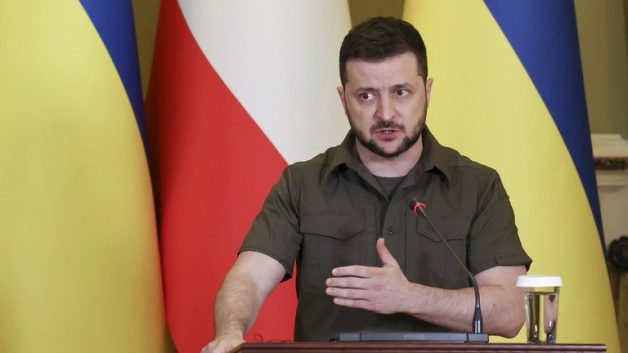
By Peter Koenig | Dissident Voice | August 26, 2022
On 24 August Ukraine celebrated her Independence Day. It also marked the dubious anniversary of 6 months of war; a war that could have been drastically shortened, tens of thousands of lives saved and peace installed hadn’t it been for the relentless western / NATO provocations, and billions worth of western weapons deliveries to Ukraine. The west pretends these killer weapons are destined to create Peace, and would you believe the media are able to make most of the western world population believe in this nonsense.
It is literally George Orwell’s 1984: “Peace is War and War is Peace;” Orwell’s classical Doublespeak, a language that deliberately obscures, disguises, distorts, or reverses the truth.
On that very day, the NYT brazenly reports, without any evidence whatsoever, that on “Ukraine’s Independence Day, a Russian attack killed at least 22 people and wounded 50, at a train station in eastern Ukraine, near Dnipro.”
The NYT continues, “But despite the missile strike, one of the deadliest on Ukraine’s railways in recent months, Ukraine stood defiant as the country celebrated its separation from the Soviet Union.” In a slickly produced address earlier in the day, President Volodymyr Zelensky declared Ukraine “reborn” six months after Russia invaded.
Such are the flagrant lies dished out to not only the American people. The European media are equally corrupted. At times even more so.
It gradually emerges that public support for western interference – western support of Ukraine – is fading by the day.
According to a Reuters / Ipsos poll, released on 23 August, still 53% of US adults agree that Washington should support Kiev, “until Russian forces are withdrawn from territory claimed by Ukraine.”. Those with doubts to continue pumping weapons into Ukraine, amount to 37%, and 18% oppose such “aid” altogether. Some 28% are undecided.
Forty percent of Americans now agree with the statement that “the problems of Ukraine are none of our business, and we should not interfere,” comparing with 31% when the same question was asked in April 2022.
The awakening might indicate that fewer and ever fewer people believe the mainstream propaganda – and especially the Zelenskyy statements. The truth of who is killing whom, and the truth about the corrupt and shamefully criminal Ukraine President, is slowly but surely seeping through the veil of deception.
In the case of the attack on the railway station, there is no doubt that the assault was launched by Ukraine’s forces on her own people, killing 22 of them and injuring at least 50. The figures are not verified. They are the ones reported by the “distinguished” NYT (25 August 2022).
Similarly, The Guardian reports (29 July 2022) that according to the Russian Defense Ministry, 40 prisoners were killed and 75 wounded in the attack on the prison in the frontline town of Olenivka. The prison was struck by Ukrainian forces with US-made Himars rockets. Yet, Ukraine was blaming Russia with the attack on its own people and with US-made weapons.
It would be hard to make believe more ludicrous statements. Yet, by telling half-truth or full-lies relentlessly and repeatedly the western media (still) gets away with murder among most of its listeners. But – the Times Are a-Changing.
Russia from the beginning has followed – and keeps following – a strict policy of avoiding civilian casualties as best as possible.
These attacks on Ukraine’s own people are certainly not carried out by Russian forces, but rather by Ukrainian military, and/or their associated Nazi Azov Battalions.
They also killed without scruples tens of thousands of pro-Russian Ukrainians in the Donbass and north-eastern Ukraine areas, since the US/western instigated 2014 Maidan Coup.
No doubt, the attacks were sanctioned by Zelenskyy. He follows clear instructions from NATO and the – unelected European Council. That the EC under Ursula von der Leyen is an unelected and tyrannical executing branch of the Deep State or the Dark elitist Cult, is no longer a secret. Madame von der Leyen is a member of the WEF’s (World Economic Forum) Managing Council.
Similarly, the relentless attacks on the Zaporozhye Nuclear Power Plant in southern Ukraine, the largest in Europe, are constantly blamed on Russia, or even on President Putin personally by the western media.
Again, the contrary is true. In order to prevent another Chernobyl-type nuclear disaster (26 April 1986), or worse, Russian troops have been occupying the Zaporozhye Plant, since March 2022. They were worried, and rightly so, about a nuclear annihilation of much of western Europe and Russia. Finally, on 19 August, Russia has shut down the plant, to limit the worst of a potential disaster.
Moscow has warned that the continuing attacks could ultimately render the power plant inoperable and might even result in a major disaster, similar to Chernobyl. Kiev and some Western officials, however, have accused Russia of shelling the plant, despite the fact that it is controlled by Russia’s own troops.
As unquestioned western support is waning, western media ever so often report the Zelenskyy Government’s accusations of Russia, but finish with the paraphrased observation that “it is difficult to verify the facts” – an own skin-saving-statement.
The next Biden Administration promised shipment of war material is of the order of an estimated US$ 3 billion. Is it part of the roughly US$ 50 billion already approved US war support to Ukraine – or is it apart?
Nobody keeps track. In any case – even western media report that about 70% of the war material sent to Ukraine ends up on the black market. Only about 30% reaches the front-line – and Ukrainian soldiers who are totally unprepared to handle the sophisticated western weaponry.
It is high time that the truth comes out – and the majority of the people see beyond the propaganda, see the most flagrant war crimes committed by Zelenskyy’s Ukraine – and stop supporting this war.
The sooner the west stops sending weaponry and tanks and most sophisticated war materiel to Ukraine, the sooner Peace may return.
If only PEACE were part of the Great Reset’s Agenda – and part of the UN Agenda 2030 – and part of Klaus Schwab’s “4th Industrial Revolution” – meaning the digitization, robotization, and absolute control of everything and every surviving human being. But PEACE, as we are still thinking humans conceive of it, is not part of the Reset Agenda.
But we are many and they are few. We may replace the Reset with the Peace agenda.
Peter Koenig is a geopolitical analyst and a former Senior Economist at the World Bank and the World Health Organization (WHO), where he has worked for over 30 years on water and environment around the world. He lectures at universities in the US, Europe and South America.
Western Psychological Warfare Apparatus Creates False Beliefs
Tortilla con Sal | August 2022
An increasingly large number of people now agree that information of all kinds in the countries of North America, Europe and their Pacific allies is deployed overwhelmingly to serve the interests of Western corporate oligarchs and the politicians who front for them. Outlets including news media and NGOs, academic and scientific journals as well as international institutions have practically all been fully integrated now into the long standing, global psychological warfare offensive of the West’s ruling classes. At home, they work relentlessly to control the perceptions and behavior of their countries’ populations. Overseas, they seek constantly to mobilize international opinion against countries like Russia and China, governments from Syria to Venezuela, political movements like Hezbollah, and even individuals, like Julian Assange, who resist them.
The main purpose of this vast psychological warfare apparatus is to create false beliefs which over time harden into false memories. The process consolidates ruling class control domestically while also facilitating their present and future crimes of aggression around the world. Populations in the West are deliberately misinformed and misled by means of plausible misrepresentation, blatant distortion, systematic omission and downright lies. Categories of information such as journalism, academic and scientific research, investigation by NGOs or briefings from international institutions have all been deformed, distorted and devalued by their abuse so as to further the domestic and global interests of the Western oligarchies.
Since long before 20th Century public relations and psychology, the fundamental way to manipulate mass consciousness, from the Holy Inquisition to the enthronement of Science, has been to encourage submission to authority. The Milgram experiment is a notorious example, although, in one respect, itself a cause for optimism. Other more insidious means sow ruling class messaging among otherwise trusted contrary sources. Concentrated corporate control of information and communications resources has made possible mutual constant universal reinforcement between all varieties of mass media and information outlets. Like magicians, governments and corporations understand very well that suppressing resistance depends on disappearing contrary information by every means possible, including censorship, mass distraction and sensory overload.
An apparently hardly noticed corollary of this systematic perversion of good faith reporting, research and investigation has been a collapse of rationality. In Western public life, it is now effectively forbidden to compare and contrast rival versions of events which contradict the general received wisdom propagated by Western government and corporate approved information outlets. So political and intellectual argument in North America and Europe has become ever more narcissistic, self-serving and ultimately irrational. This applies also to supposedly progressive or even radical outlets which in their coverage of international affairs still depart from essentially neocolonial assumptions of Western superiority.
Over the last fifteen years or so a growing number of independent writers and reporters have sought to challenge the false information spread by well coordinated and concentrated corporate and government controlled networks of mutually reinforcing information outlets. This development has notably sharpened the relation between information and class. More clearly than ever the production and distribution of information has become a vast theater of propaganda operations controlled by a multinational intellectual managerial class with shared imperatives. They promote and enforce a class monopoly of access to information outlets for producers of information and similarly a corresponding monopoly of distribution outlets, both mainstream and ostensibly alternative, for its consumption.
All production and distribution of information involves some variety of reporting which, like any other human activity, can be good or bad. Reporting in general has always been an arena of competing interests and rationalities. But, even so, fundamental components of competent reporting have generally been held to include, among other things, recording first hand accounts of events, clearly sourcing those accounts, presenting trustworthy data and documentary evidence, offering provenance of those sources, acknowledging loyalties and bias while considering competing rival versions, making the reporting accessible and frankly submitting all this material to free and open scrutiny.
It is certainly debatable when contemporary reporting began its categorical collapse into the current gross, unrelenting pyschological warfare offensive by North American and European oligarchies against their own peoples and the majority world. However, the rapidly increasing numbers of independent reporting outlets signal the reality of that collapse and also help reveal its class nature, its class nuances and its irrationality. The currently developing fierce efforts by the West’s ruling oligarchs to repress and censor independent reporting confirm the wholesale abandonment of rationality by Western societies and their leaders. A principal criterion for appraising rationality in an individual or a society is precisely their ability and self-confidence in making a case against rival arguments.
Attempts at outright censorship, or the many other kinds of arbitrary intellectual and cultural repression deployed, represent a failure to be able to reason effectively, to promote consensus or to accommodate legitimate dissent. This collapse of reason and its accompanying deformation of self-confidence into dismissal and exclusion are self-evident in the routine reporting practice and editorial policies of the managers controlling academic and scientific production and the propaganda theater most people still like to call journalism, among the board members and staff of influential non governmental organizations, among the personnel of international institutions and also among the managerial class controlling artistic and cultural production.
Given the intense concentration of political and economic power among the Western oligarchs who have successfully conspired to control all these sectors, the resulting general unanimity of presuppositions among their respective subaltern intellectual and cultural managerial classes is as much to be expected as their complete lack of accountability. Anyone openly challenging or contradicting received wisdom is marginalized and ostracised in what is a truly authentic class warfare waged by North American and European oligarchs against their own peoples and the majority world.
In response, as a class phenomenon, the proliferation of independent reporting outlets reflects not just underlying genuine popular outrage at being permanently misled. It is also a correspondingly authentic, resilient grassroots challenge to the status quo. Conventional liberal or social democrat opinion gauges the authenticity of independent reporting by the criteria of financial and/or editorial independence. But a low budget is no guarantee of integrity and a genuinely independent information outlet may or may not be ideologically aligned with a foreign political movement or government. Under contemporary conditions a more authentic criteria of reporting independence is the degree of legitimate defence of governments and peoples who are victims of the crimes of Western ruling elites.
Truly independent reporting takes this position while at the same time using conventional reporting norms to cover issues and events Western mainstream and alternative media obfuscate or conceal. Doing so necessarily endows genuinely independent reporting outlets, regardless of their political allegiances, with class characteristics by the very nature of their readiness to expose contradictions in accounts of events and issues produced by corporate capitalist information outlets. Paradoxically or not, class solidarity with the victims of imperialist crimes becomes the principal criteria of reporting independence both in terms of what is reported and too how it is reported. For the moment, that means being in solidarity with the world’s peoples defending their basic rights against Western ruling class aggression.
This text was produced by Stephen Sefton with research by Lauren Smith and comments from others.
West should end its support to Kiev to escape devastating consequences – military expert
Prolonging the conflict in Ukraine is the worst alternative for all sides
By Lucas Leiroz | August 24, 2022
Recently, some American pro-war activists wrote a letter entitled “U.S. must arm Ukraine now, before it’s too late”, in which they advocate an increase in aid to Kiev so that the situation of the conflict is reversed. The authors believe that the conflict is at a turning point and that aid must be provided now in order for Russia to be defeated. However, military experts disagree with this argument and say that there is no reason to try to prolong the fighting.
Despite all the difficulties the Western world has faced as a result of the conflict in Ukraine, many people still insist that aid to Kiev must continue – and increase – until Moscow is defeated. The main rhetoric of the pro-war militants is that Russia would not just win the conflict in Ukraine but would expand its operation to other countries in Europe, which is why it needs to be defeated now – which they consider possible by sending arms to Kiev.
“For the U.S. and NATO, that time is now — and the place is Ukraine, a large country whose population understands that its choice is either defeating Putin or losing their independence and even their existence as a distinct, Western-oriented nation. With the necessary weapons and economic aid, Ukraine can defeat Russia. If it succeeds, our soldiers are less likely to have to risk their lives protecting U.S. treaty allies whom Russia also threatens. What does defeat for Putin look like? The survival of Ukraine as a secure, independent, and economically viable country”, the authors of the open letter asking more weapons to Ukraine say.
In fact, this rhetoric is absolutely unfounded in all its points. First, there is no reason to believe in an expansion of the Russian special military operation to NATO countries. Moscow just started military incursions into Ukraine because Kiev left no other alternative with its continuous policy of killing Russian citizens, but there is currently no equivalent situation in other countries. However, more important than that is to note the lack of realism on the part of the pro-Western militants in believing in the possibility of “defeating” Russia, despite the current stage of the conflict.
Russia did not mobilize all of its military power to attack Ukraine, but the small portion of the Russian forces sent to the operation was efficient in annihilating Ukrainian main bases of resistance. At the current stage of the conflict, there is no possibility of reversing the military situation. Kiev is defeated and only postpones the inevitable decision to surrender because it continues to receive Western weapons, guaranteeing a kind of “survival”, prolonging the battles indefinitely, even without a chance of victory.
This is the assessment of any expert who analyzes the case honestly and without ideological emotions. For example, Douglas Macgregor, war veteran and former advisor to the Secretary of Defense in the Trump administration, believes that the sending of weapons will not bring any positive change to Kiev due to the human capital deficit, both quantitative (with the low number of active Ukrainian soldiers), and qualitative (considering the tactical and operational inability of these fighters to reverse the conflict and even their lack of instruction in using the weapons they receive from the West).
With that, the weapons would only serve to prolong, not to effectively change the current military situation. He also claims that even if Kiev were to achieve major victories, the absence of human capital would not allow it to rebuild its troops after the long battles, while Russia, whose current combat mobilization represents only a small fraction of its military potential, would have the ability to recover quickly and thus regain the positions eventually lost.
“The hard truth is the introduction of new weapon systems won’t change the strategic outcome in Ukraine. Even if NATO’s European members, together with Washington, D.C., provided Ukrainian troops with a new avalanche of weapons, and it arrived at the front instead of disappearing into the black hole of Ukrainian corruption, the training and tactical leadership required to conduct complex offensive operations does not exist inside Ukraine’s 700,000-man army. In addition, there is an acute failure to recognize that Moscow would react to such a development by escalating the conflict. Unlike Ukraine, Russia is not currently mobilized for a larger war, but it could do so quickly”, he says.
Macgregor claims that the letter written by the pro-war militants “reinforces the failure” of Ukraine. For him, the conflict is at a decisive moment, in which it must be ended, not prolonged. He still believes that the reasons that led to this conflict – NATO’s incursions on the Russian border – were disastrous and unnecessary and that Western countries should give up further provocations against Moscow. The best solution, he says, is to support the Austrian model of neutrality as a solution for Ukraine before the country is completely destroyed.
“Ukraine’s war with Russia is at a decisive point. It is time to end it. Instead, the authors of the letter seek to reinforce failure. They are demanding a deeply flawed strategy for Ukraine that will lead in the best case to Ukraine’s reduction to a shrunken, land-locked state between the Dnieper River and the Polish border (…) Expanding NATO to Russia’s borders was never necessary and has become disastrous for Europe. The longer the war with Russia lasts the more likely it becomes that the damage to Ukrainian society and its army will be irreparable. Neutrality on the Austrian model for Ukraine is still possible”, he adds.
In fact, this opposition of opinions reflects the old debate between realists and warmongers. Anyone who really understands war and military strategy knows that there is no other solution than the neutralization of Ukraine and the end of Western expansionism. Those who think through liberal idealism, however, advocate fighting “to the last Ukrainian”.
Prolonging the conflict is not good for either side: it increases the destruction in Ukraine, perpetuates the suffering of the people, raises the expenses of western countries and forces Russia to mobilize a greater part of its military forces.
Lucas Leiroz is a researcher in Social Sciences at the Rural Federal University of Rio de Janeiro; geopolitical consultant.
Deliberate misrepresentation: Western media bias makes Israeli war on Palestinians possible
By Ramzy Baroud | MEMO | August 23, 2022
While US and western mainstream and corporate media remain biased in favour of Israel, they often behave as if they are a third, neutral party. This is simply not the case.
Take the New York Times coverage of the latest Israeli war on Gaza as an example. Its article on 6 August, “Israel-Gaza Fighting Flares for a Second Day” is the typical mainstream western reporting on Israel and Palestine, but with a distinct NYT flavour.
For the uninformed reader, the article succeeds in finding a balanced language between two equal sides. This misleading moral equivalence is one of the biggest intellectual blind spots for western journalists. If they do not outwardly champion Israel’s discourse on ‘security’ and ‘right to defend itself’, they create false parallels between Palestinians and Israelis, as if a military occupier and an occupied nation have comparable rights and responsibilities.
Obviously, this logic does not apply to the Russia-Ukraine war. For NYT and all mainstream western media, there is no question regarding who the good guys and the bad guys are in that bloody fight.
‘Palestinian militants’ and ‘terrorists’ have always been the West’s bad guys. Per the logic of their media coverage, Israel does not launch unprovoked wars on Palestinians, and is not an unrepentant military occupier, or a racist apartheid regime. This language can only be used by marginal ‘radical’ and ‘leftist’ media, never the mainstream.
The brief introduction of the NYT article spoke about the rising death toll, but did not initially mention that the 20 killed Palestinians include children, emphasising, instead, that Israeli attacks have killed a ‘militant leader’.
When the six children killed by Israel are revealed in the second paragraph, the article immediately, and without starting a new sentence, clarifies that “Israel said some civilian deaths were the result of militants stashing weapons in residential areas”, and that others were killed by “misfired’ Palestinian rockets.
On 16 August, the Israeli military finally admitted that it was behind the strikes that killed the 5 young Palestinian boys of Jabaliya. Whether the NYT reported on that or not matters little. The damage has been done, and that was Israel’s plan from the start.
The title of the BBC story of 16 August, ‘Gaza’s children are used to the death and bombing’, does not immediately name those responsible for the ‘death and bombing’. Even Israeli military spokesmen, as we will discover later, would agree to such a statement, though they will always lay the blame squarely on the ‘Palestinian terrorists’.
When the story finally reveals that a little girl, Layan, was killed in an Israeli strike, the language was carefully crafted to lessen the blame on her Israeli murderers. The girl, we are told, was on her way to the beach with her family, when their tuk-tuk “passed by a military camp run by the militant group Palestinian Islamic Jihad”, which, “at the exact moment, (…) was targeted by Israeli fire”. The author says nothing of how she reached the conclusion that the family was not the target.
One can easily glean from the story that Israel’s intention was not to kill Layan – and logically, none of the 17 other children murdered during the three-day war on Gaza. Besides, Israel has, according to the BBC, tried to save the little girl; alas, “a week of treatment in an Israeli hospital couldn’t save her life”.
Though Israeli politicians have spoken blatantly about killing Palestinian children – and, in the case of former Israeli Justice Minister Ayelet Shaked, “the Palestinian mothers who give birth to ‘little snakes'” – the BBC report, and other reports on the latest war, have failed to mention this. Instead, it quoted Israeli Prime Minister Yair Lapid, who reportedly said that “the death of innocent civilians, especially children is heartbreaking.” Incidentally, Lapid ordered the latest war on Gaza, which killed a total of 49 Palestinians.
Even a human-interest story about a murdered Palestinian child somehow avoided the language that could fault Israel for the gruesome killing of a little girl. Furthermore, the BBC also laboured to present Israel in a positive light, resorting to quote the occupation army’s statement that it was “devastated by (Layan’s) death and that of any civilians.”
The NYT and BBC have been selected here not because they are the worst examples of western media bias, but because they are often cited as ‘liberal’, if not ‘progressive’, media. Their reporting, however, represents an ongoing crisis in western journalism, especially relating to Palestine.
Books have been written about this subject, civil society organisations were formed to hold western media accountable and numerous editorial board meetings were organised to put some pressure on western editors, to no avail.
Desperate by the unchanging pro-Israel narratives in western media, some pro-Palestine human rights advocates often argue that there are greater margins within Israel’s own mainstream media than in the US, for example. This, too, is inaccurate.
The misnomer of the supposedly more balanced Israeli media is a direct outcome of the failure to influence western media coverage on Palestine and Israel. The erroneous notion is often buoyed by the fact that an Israeli newspaper, like Haaretz, gives marginal spaces to critical voices, like those of Israeli journalists Gideon Levy and Amira Hass.
Israeli propaganda, one of the most powerful and sophisticated in the world, however, can hardly be balanced by occasional columns written by a few dissenting journalists.
Additionally, Haaretz is often cited as an example of relatively fair journalism, simply because the alternatives – Times of Israel, the Jerusalem Post and other rightwing Israeli media – are exemplary in their callousness, biased language and misconstruing of facts.
The pro-Israel prejudices in western media often spill over to Palestine sympathetic media throughout the Middle East and the rest of the world, especially those reporting on the news in English and French.
Since many newspapers and online platforms utilise western news agencies, they, often inadvertently, adopt the same language used in western news sources, thus depicting Palestinian resisters or fighters, as ‘militants’, the Israeli occupation army as “Israeli Defence Forces” and Israeli war on Gaza as ‘flare ups’ of violence.
In its totality, this language misinterprets the Palestinian struggle for freedom as random acts of violence within a protracted ‘conflict’ where innocent civilians, like Layan, are ‘caught in the crossfire.’
The deadly Israeli wars on Gaza are made possible, not only by western weapons and political support, but through an endless stream of media misinformation and misrepresentation. Though Israel has killed thousands of Palestinian civilians in recent years, western media remains as committed to defending Israel as if nothing has changed.
Featured Video

Bombing Hitler’s Hometown
or go to
Aletho News Archives – Video-Images
From the Archives
The Biggest Threat to Peace in Middle East
By Dr. Elias Akleh* | Sabbah Report | May 24, 2010
A build up of heightened tension in the Middle East is escalating in the last few weeks. American and Israeli postures towards Lebanon, Syria, and Iran have become more threatening. Listening to speeches of political leaders one hears talks only about war not peace. Iranians and Israelis are continuously training hard for a possible showdown. Both sides are conducting extensive war games every month. This led Syrians to claim that Israel is preparing for a soon-to-come another war. The Jordanians also are warning that current stalemate of the peace process is an indication of a war breaking out this summer. The Russian President and his army chief hinted, a few months ago, that the US and Israel were planning for an attack on Iran.
Indeed Iran is, as it has been for last few years, the target of most of the threats and accusations of supporting terrorism. Escalating incitement against Iran the American Defense Department sent last month (April) to Congress a report on Iran’s military claiming Iran could develop intercontinental ballistic missiles capable of reaching the US by 2015.
Ignoring the fact that N. Korea, India, Pakistan, and Israel are proven to have nuclear weapons while Iran does not, the US Secretary of State Hillary Clinton chose in her speech, to the nuclear Non-Proliferation Treaty review conference at the UN, to focus on Iran’s alleged nuclear ambitions putting the whole world at risk as she put it. According to Clinton Iran’s acquisition of nuclear weapons, rather than Israel’s more than 200 nuclear bombs, is destabilizing the Middle East. She called on the world’s nations to rally around US efforts to hold Iran, not other nuclear countries, to account.
The accusation that Usama Bin Laden is living comfortably in Iran had received a boost after the broadcast of a documentary called “Feathered Cocaine”. This echoed the June 2003 claims of the Italian newspaper Corre de la Sierra that Bin Laden was in Iran according to some intelligence report, and according to Richard Miniter’s book “Shadow War”. … continue
Blog Roll
 Aletho News
- Bombing Hitler’s Hometown
- German journalist threatened with homelessness as German court upholds EU sanctions in landmark free speech case
- US Tells Allies That Ukraine-Bound Arms Could be Sent to Middle East
- Organized terrorism: Iran condemns killing of its diplomats in Lebanon
- Why could Gaza enter the regional war?
- Hamas official rejects Mladenov Plan linking disarmament to Gaza reconstruction
- Two Primary Elections for the Soul of ‘America First’
- Japan Clings to US Vassalage Despite Energy Crunch Caused By Iran War
- US Seeks Control Over Global Energy Infrastructure – Kremlin
- US senators target Orban government for standing up to Zelensky
- If Americans Knew
- Researchers at Human Rights Watch Resign Over Blocked Report on Palestinian Refugee Return
- Jewish Groups Are Backing a War Americans Don’t Want
- Eric Fingerhut Thinks He’s the President of the Jews
- Top Jewish Philanthropists, Rabbis Urge Israeli President to Take Action Against ‘Jewish Extremists’
- Don’t Be Fooled. Zionist Leaders Have Always Wanted to Control Southern Lebanon
- Israel’s widespread use of torture is a core element of its genocide against the Palestinian people
- In Israel’s War on Iran, Many Middle East US Bases Rendered “All But Uninhabitable”
- ‘Burn the lawn’: Israel pursues ‘Rafah model’ in southern Lebanon
- A genocide here, an amputation there
- Reports: Iran mobilizing 1M fighters, Israel-US run low on ammo, Israeli army faces shortage – Not a ceasefire Day 168
- No Tricks Zone
- Devastating Assessment Of Comirnaty Vaccine By Former Senior Pfizer Europe Toxicologist
- New Study: CO2 Is ‘Effectively Negligible’ As An Explanatory Climate Change Factor Since 2000
- Former Pfizer Toxicologist Dr. Helmut Sterz Tells Bundestag Hearing Pfizer Vaccine Should Have Never Been Approved
- Energy Expert: Germany’s Nuclear Phaseout Was A “500 Billion Euro Mistake”
- New Research: South Australia’s Mid-Holocene Sea Surface Temperatures Were 4°C Warmer Than Today
- Storing Green Energy To Last Germany 10 Days Would Require A 60-Million Tonne Battery
- New Studies: UK Sea Levels Were 4 Meters Higher Than Today During The Mid-Holocene
- Destructive Green New Deal: German Energy And Metal Group Warns Of Drastic Crisis
- New Study Documents A 20-Year Pause In Arctic Sea Ice Decline – Driven By Internal Variability
- Wake-up Call: Survey Shows Majority Of Germans Now Favor Postponing Climate Targets!
 Aletho News