African Energy Chamber Calls Western Funding Withdrawal From Key Projects ‘Immoral’
Sputnik – 27.09.2024
The withdrawal of Western funding for key projects in Africa is outrageous and constitutes “financial apartheid,” NJ Ayuk, the executive chairman of the African Energy Chamber, told Sputnik.
“One of the key things you have to see is that the exclusionary rule, which we call financial apartheid, that you’ve seen from Western countries when it comes to financing Africa and really providing funds, it is wrong. It is immoral. It is outrageous what they’re doing,” Ayuk said on the sidelines of the Russian Energy Week International Forum.
The official pointed to energy projects, saying that natural gas powering Europe was described as green, which was not the case for Africa.
“Africa is still the country where you have so many millions of people without electricity and without access to clean cooking,” Ayuk added.
The Russian Energy Week is taking place in the Russian capital from September 26-28.
German Green Party in crisis – board resigns after election defeat
By Patrick Poppel | September 25, 2024
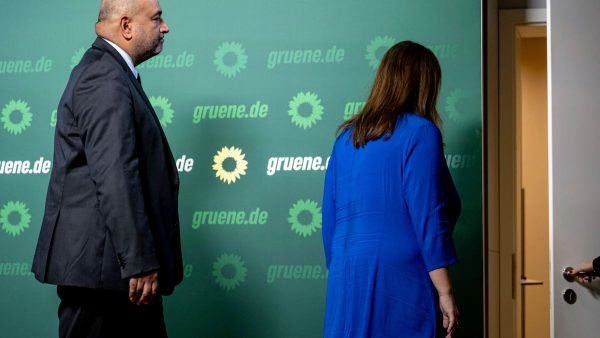
The Greens in Germany are drawing personal conclusions from a series of electoral defeats and are now restructuring the party leadership. The two chairmen Ricarda Lang and Omid Nouripour announced their withdrawal from the party in Berlin on Wednesday.
The Greens had suffered heavy losses in the last four elections (European elections and the regional elections in Saxony, Thuringia and Brandenburg). In Brandenburg they had more than halved their result. The party has left two regional parliaments.
Only in the state of Saxony did they narrowly manage to be represented in the state parliament again. “The election result on Sunday in Brandenburg is a testimony to the deepest crisis our party has faced in a decade,” said Nouripour. “It is not about the fate of one party alone.” It is about the fundamental question of whether in Germany, as “the country with the greatest responsibility in the European Union, it will be possible in the future to continue to make good politics for peace, for Freedom, for justice, for prosperity and for climate protection”.
“It takes new faces to lead the party out of this crisis,” Ms Lang said. “Now is not the time to be stuck to your own chair. Now is the time to take responsibility and we are taking that responsibility by enabling a new start,” she added.
Lang and Nouripour were elected chairmen at the end of January 2022. They are relatively popular in the party. Lang and Nouripour did not comment on their successor.
According to media reports, State Secretary for Economic Affairs Franziska Brantner and Bundestag member Felix Banaszak are in discussion. Brantner is a close confidante of Economics Minister Robert Habeck, who could lead the Greens into the next federal election as their candidate for chancellor.
Banaszak was formerly leader of the Green Party in North Rhine-Westphalia and is an important representative of the left wing. The Green Vice Chancellor and Economics Minister Robert Habeck called the party executive’s announcement a “great service to the party”.
CDU General Secretary Carsten Linnemann called on the government to hold early elections. “Our country will not be able to endure this government for another year!” Linnemann told the Frankfurter Allgemeine Zeitung.
There is no way around new elections. The resignation is a respectable step and the Greens have to fundamentally change their policies, said Linnemann. But how could a party that has become increasingly established in Germany over the last 80 years come to this disastrous point?
Of course, most of the Green Party’s voters are in western Germany and in the big cities. But even there the party faces competition from other left-wing groups. Despite the massive media debate on climate change, which is one of the Greens’ main issues, they suffered such a strong defeat.
Since the AFD (Alternative for Germany) can be seen as the clear winner of all these elections, the question naturally arises as to where the Green voters went. Green voters do not easily vote for a right-wing party. It is therefore very clear that the votes have gone from the political center to the right and the Greens have lost their quota to the center.
But what was the reason for these defeats? Maybe it wasn’t a lack of effort in the election campaign or the constant unprofessional appearances of the Green Foreign Minister. The reason for the problems and possible decline of this party is the increasingly visible distance from its roots. The Green Movement was known for its peace initiatives for decades. And the party has finally moved away from these ideals of peace in recent years.
The harsh words regarding arms deliveries to Ukraine particularly irritated many voters. The Greens used to be against wars and now they are marching at the forefront of escalating forces. Completely absurd political behavior when it comes to migration policy has also led many voters to make a different decision.
When it comes to energy policy, fewer and fewer people trust the Greens. The rise of the AFD and the decline of the Greens show us yet another aspect of German domestic politics. The real political center has clearly shifted to the right and Green voters have moved to the center. Since the consequences of the absurd migration policy and other mistakes will be visible for years to come, this shift from the center to the right will not end any time soon.
Patrick Poppel, expert at the Center for Geostrategic Studies (Belgrade).
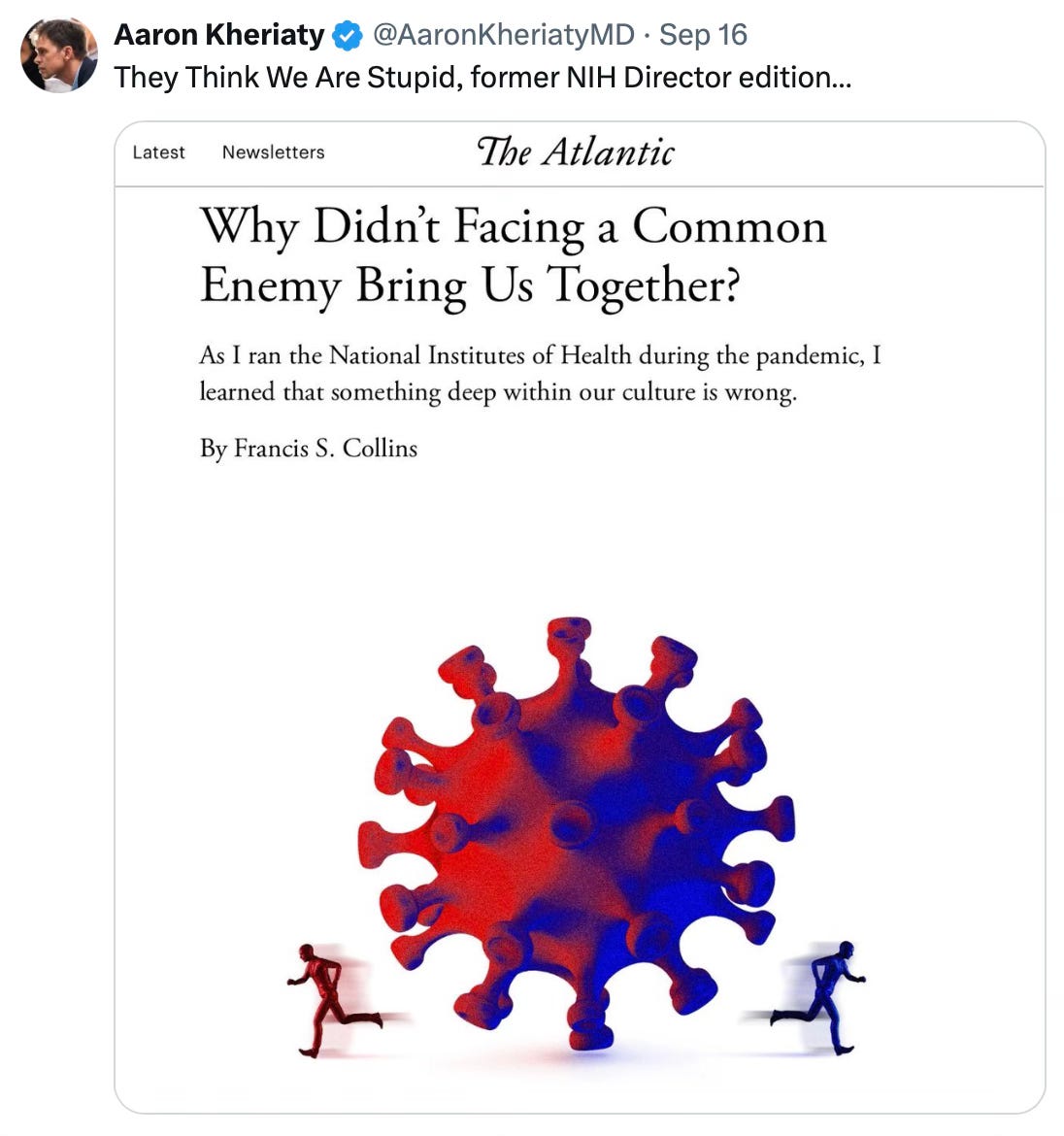
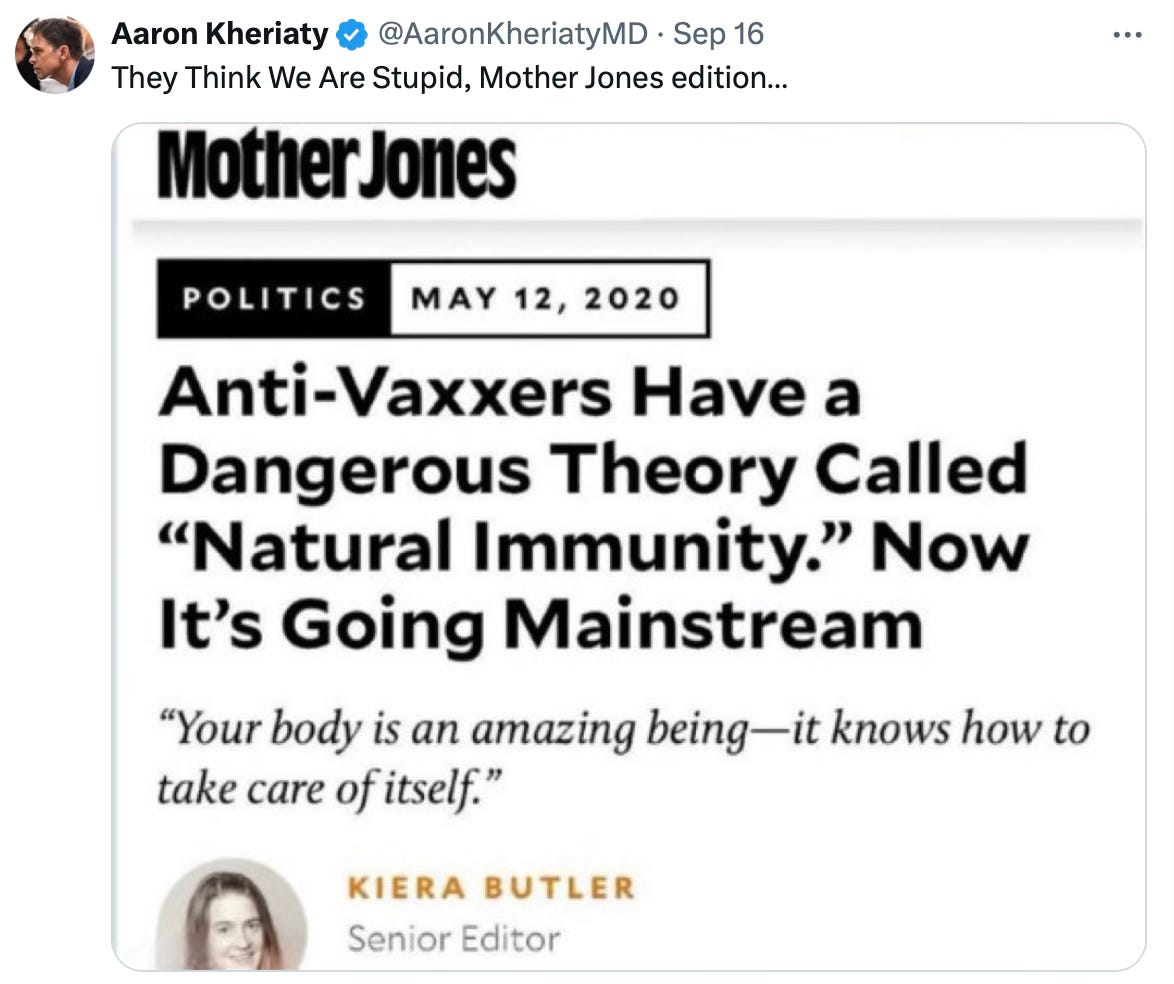
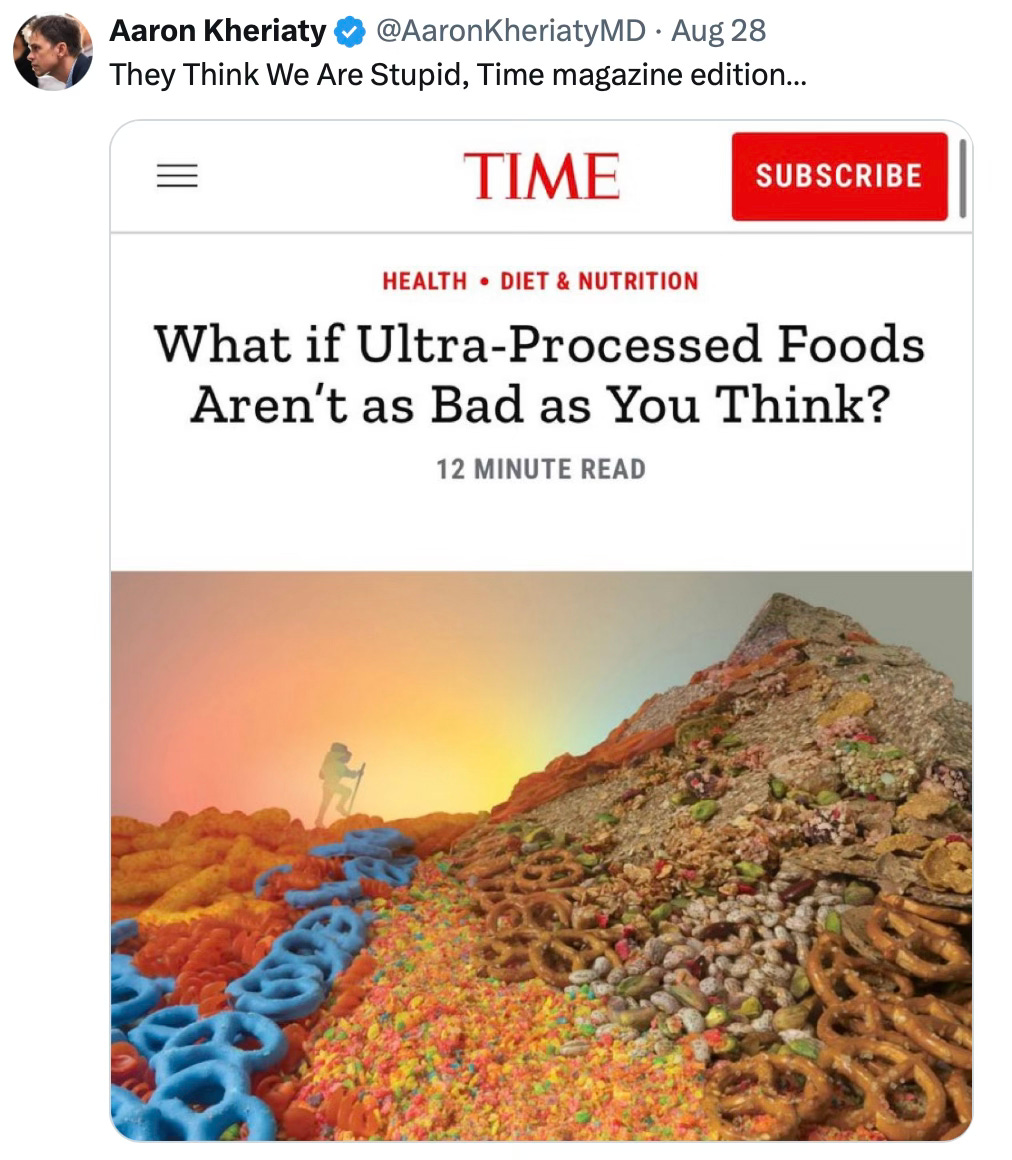
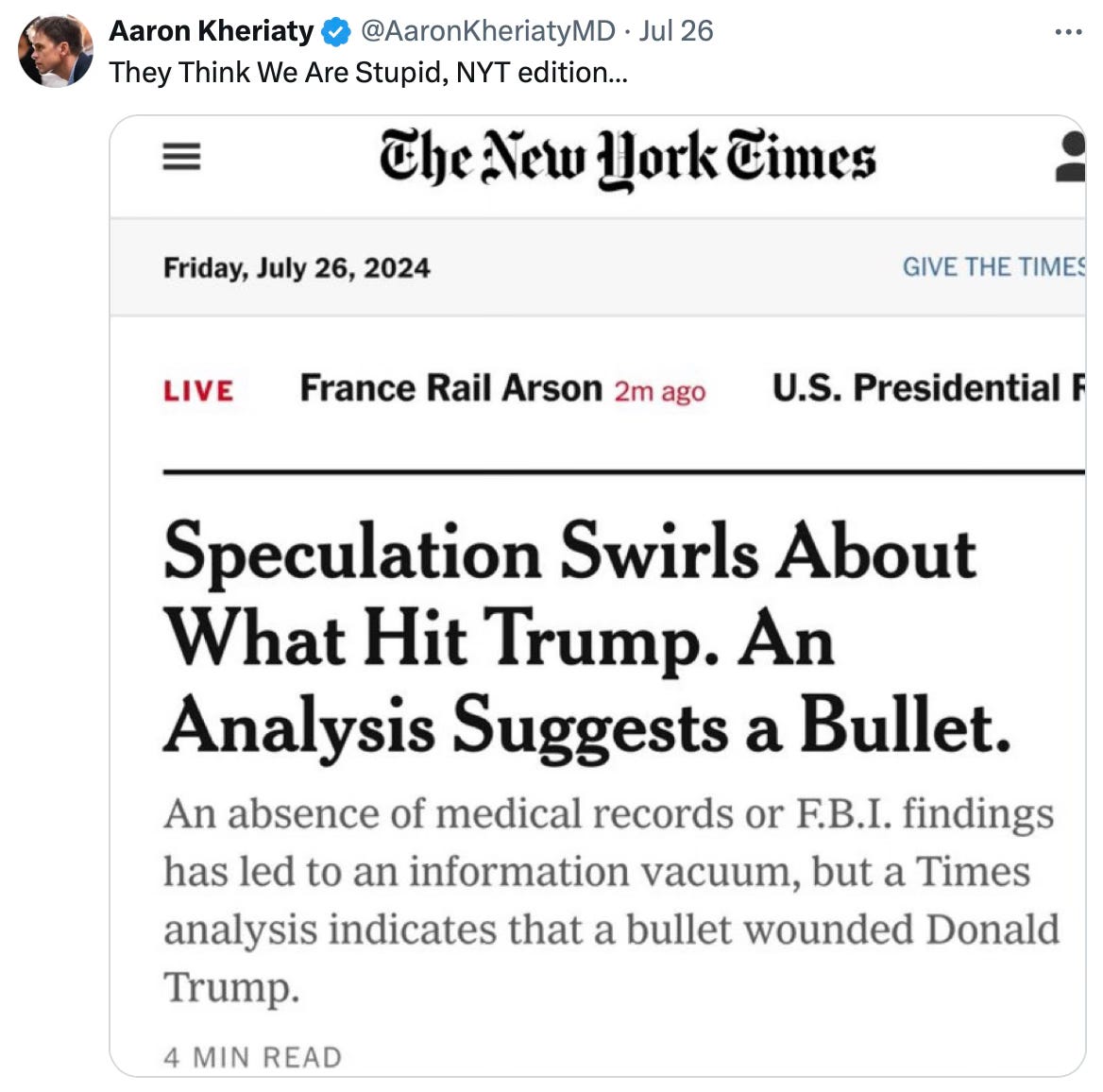
They Think We Are Stupid, Volume 11
Everything you need to know about our ruling class’s opinion of you
By Aaron Kheriaty, MD | Human Flourishing | September 19, 2024




UN ‘Pact for the Future’: Digital IDs, Vaccine Passports, Massive Censorship
By Michael Nevradakis, Ph.D. | The Defender | September 12, 2024
World leaders will convene later this month in New York to discuss proposals that critics believe will enshrine global digital ID and online censorship and give the United Nations (U.N.) secretary-general unprecedented emergency powers.
Proposals to be discussed at the 79th U.N. General Assembly include the Pact for the Future, described by the U.N. as an “opportunity to create international mechanisms that better reflect the realities of the 21st century and can respond to today’s and tomorrow’s challenges and opportunities.”
The proposed Pact for the Future encompasses 11 policy proposals. These include proposals for the establishment of a U.N. “Emergency Platform” and a “Global Digital Compact,” and policy proposals on “Information Integrity” and “Transforming Education.”
Also among the U.N.’s proposals is the “Declaration on Future Generations.”
Under these proposals, the secretary-general would have “standing authority” to declare “an Emergency Platform in the event of a future complex global shock of sufficient scale, severity and reach.”
Discussions for the Pact for the Future will take place under the auspices of the Summit of the Future, described as “a high-level event, bringing world leaders together to forge a new international consensus on how we deliver a better present and safeguard the future.”
The proposals are part of “Our Common Agenda,” an initiative described as “the Secretary-General’s vision for the future of global cooperation.”
‘Lack of checks and balances is very worrying’
Critics of the proposals warned The Defender that they threaten personal and health freedom, will grant the U.N. unprecedented powers and may lead to an internationally binding treaty.
Dutch attorney Meike Terhorst said the U.N. is attempting to attain “more executive power.”
Francis Boyle, J.D., Ph.D., professor of international law at the University of Illinois, told The Defender, “What the secretary-general is trying to do is an end run around the United Nations charter and delegate to himself all the powers he can possibly assume.”
“The lack of checks and balances is very worrying. The member states will have very little or no power,” Terhorst said, noting that these proposals are drawing increasing opposition as they threaten national sovereignty.
The emergency powers and other proposals contained in the pact may have ominous consequences for humanity, Boyle warned.
“The most pernicious [outcomes] would certainly be extremely dangerous vaccines that probably would violate the Nuremberg Code on medical experimentation, such as these mRNA vaccines, and then also censorship, outright censorship for anyone who dissents,” Boyle said.
Other experts warned the U.N. is not being fully transparent.
According to independent journalist James Roguski, “The U.N. is not being fully transparent about the process leading up to the Summit of the Future. At this time, a consensus agreement has not been reached and the status of the three documents has not been honestly presented to the general public.”
Roguski noted that a fourth revision of the Global Digital Compact was drafted Aug. 27 but “has not been made publicly available on the U.N. website.”
And according to Dr. Meryl Nass, founder of Door to Freedom, the pact “puts the U.N. ‘at the center’ of international affairs, giving the U.N. unspecified powers.” It contains no definitions for the terms used, “allowing it to be interpreted later in ways citizens may not like.”
A means of ‘turbocharging’ the ‘Great Reset’?
Critics also connected the U.N.’s proposals to the agendas of other international organizations, such as the World Economic Forum (WEF), which promoted the “Great Reset” and “Fourth Industrial Revolution.”
“In spirit, the Summit and Pact for the Future is a relaunch of the Great Reset,” said Tim Hinchliffe, publisher of The Sociable. “Both talk about reshaping our world, which includes a desire to transform the financial system and to implement global governance surrounding issues such as climate change, healthcare and all things related to the SDGs” (Sustainable Development Goals).
“While the WEF has no direct, authoritative or legislative power to carry out its agendas, the Pact for the Future would be signed by member states whose governments wield actual executive and legislative powers,” Hinchliffe said.
“What they are trying to do is to take the WEF agenda … and turn it into solid international law and from there into solid domestic law,” Boyle said.
According to Michael Rectenwald, Ph.D., author of “The Great Reset and the Struggle for Liberty: Unraveling the Global Agenda,” the U.N.’s proposals “have been written in support of the 2030 Agenda for Sustainable Development and the ‘global governance’ regime that it aims to establish.”
Rectenwald said the proposals involve “accelerating the achievement of the SDGs” and represent the U.N.’s continued “attempt to establish a global socialist world system that is ‘inclusive’ and ‘equitable.’”
“‘Inclusion’ is achieved through such technological means as closing the ‘digital divide,’ which depends on the universal adoption of a digital identity system. Digital identity is the means by which one is ‘included’ and without which one essentially does not exist. Thus, there is to be nothing outside the system — i.e., totalitarian governance,” Rectenwald said.
Global Digital Compact calls for digital IDs, vaccine passports
Accompanying the Pact for the Future is a proposal for “A Global Digital Compact — an Open, Free and Secure Digital Future for All.”
Published May 2023, the proposed compact sets out “principles, objectives and actions for advancing an open, free, secure and human-centred digital future, one that is anchored in universal human rights and that enables the attainment of the Sustainable Development Goals.”
However, the compact contains proposals for the introduction of digital ID, “digital public goods” and “digital product passports,” and calls for “addressing disinformation” and preventing the “misuse” of online tools.
“With digital ID, it is easier for governments to censor and threaten voices with a different opinion,” Terhorst said. “In the U.N. proposals, suppressing ‘disinformation’ or ‘hateful speech’ is mentioned. Who is to decide what information is right and what is wrong?”
“Information Integrity on Digital Platforms” policy brief goes further, specifically addressing “threats to information integrity,” such as so-called “misinformation” and “disinformation.” It also calls for “empirically-backed consensus around facts, science and knowledge,” but does not clarify how this “consensus” would be determined.
Similarly, a policy brief on “Transforming Education,” proposes “incorporating practices that strengthen the ability of learners and teachers to navigate the increasing flow of false and fake information.”
The compact also proposes “Novel platform-based vaccine technologies and smart vaccine manufacturing techniques … to produce greater numbers of higher-quality vaccines.”
Terhorst said the goal of digital ID is to introduce global vaccine passports that would “overrule the right of everyone to say no to a vaccination.”
Hinchliffe noted that the U.N. has “established principles for a ‘Code of Conduct‘ that calls on not just member states, but private groups such as stakeholders, digital platforms, advertisers, and news media to crush narratives that go against the U.N. and the SDGs.”
Secretary-general ‘trying to set himself up as the UN dictator’
According to Boyle, the U.N. secretary-general is “supposed to function as a secretary in charge of the secretariat,” but these proposals are trying to “set himself up as the U.N. dictator.” He noted that the U.N. is composed of six independent organs, but said these proposals may usurp their independence.
“He would have authority over them and arguably could exert authority over U.N. specialized agencies like the World Health Organization. That ties in with the International Health Regulations and the Pandemic Treaty,” Boyle said.
Boyle argued that by specifically referring to the Pact for the Future as a “pact,” the U.N. is intentionally “trying to turn this into an international treaty that is binding” under the Vienna Convention on the Law of Treaties.
“If you call it a pact … that would clearly fall within the terms of the Vienna Convention,” Boyle said.
“We’re in the fight of our lives here. The world has to be alerted to the dangers of this pact.”
This article was originally published by The Defender — Children’s Health Defense’s News & Views Website under Creative Commons license CC BY-NC-ND 4.0. Please consider subscribing to The Defender or donating to Children’s Health Defense.
Banks Urged to Stop Financing Livestock Production
By Jesse Allen | American AG Network | September 13, 2024
Over 100 climate groups are pressuring JPMorgan Chase, Citigroup, and other private banks to stop financing global meat and dairy companies.
Agriculture Dive Dot Com says the institutions’ lending activities undermine their environmental commitments. An open letter from groups led by Friends of the Earth to some of the world’s biggest banks calls for a halt on any new financing that expands industrial livestock production and to add requirements that meat, dairy, and feed clients disclose their climate action plans. The letter calls out the banks by name for supporting the world’s biggest meat, dairy, and animal feed producers like JBS, Tyson Foods, and others.
While food companies are a small part of the banks’ overall lending portfolios, the groups say they have a much bigger impact on the institutions’ environmental footprints. The letter says increased lending has let the world’s biggest emitters grow their operations and emissions.
British Labour’s raw deal for working people
By Finian Cunningham | Strategic Culture Foundation | September 12, 2024
Keir Starmer’s Labour Party won a landslide election in July with the slogan “a new deal for working people”.
Already the electioneering can be seen as a sham. This week, the Labour government won a majority vote in the House of Commons to cut winter fuel payments for pensioners. Around 10 million senior citizens will no longer receive a financial grant to help them pay soaring energy bills and keep their houses warm this winter.
The energy crisis for households in Britain and across Europe is a result of the NATO proxy war in Ukraine and the cutting off of Russia’s abundant gas and oil supplies to the continent. The Biden administration ordered the blowing up of the Nord Stream gas pipelines under the Baltic Sea from Russia to Germany. That was in September 2022. The best way to end the energy crisis for European households would be to stop the war, make peace, and return to normal relations. But the new Labour government is having none of that common sense. It is eagerly fueling the proxy war as much as the Conservatives before it, and what’s more now making the poor of Britain pay for the warmongering.
Prime Minister Starmer told angry unions and workers that he would make no apology for the winter fuel payment cut. His ministers are claiming they have “no choice” but to repair a “£22 billion blackhole” in public finances gutted by the predecessor Conservatives.
Starmer’s Labour is warning that more “tough choices” are coming in the coming weeks, meaning that working people and low-income families are going to face more economic austerity. So much for a democratic change from the hated Tories and the supposed “new deal for workers”.
The warped priorities of this government (as with the previous one) can be seen from the promises to boost spending on Britain’s military. Starmer has vowed to uphold a commitment to increase Britain’s “defense” budget from £54.2 bn (€64 bn, $74.7 bn) a year to £57.1 bn. That represents a 4.5 percent increase.
Under Starmer, Britain will continue to donate billions of public money to the Kiev regime.
This week, while the Labour government was voting to cut winter welfare for pensioners, the British foreign minister David Lammy traveled to Kiev alongside the U.S. secretary of state Antony Blinken, where they assured the Ukrainian regime that they would deliver more weapons, hinting at ending restrictions on long-range missiles to hit deep inside Russia.
Meanwhile, Britain’s defense minister John Healey will be in Ramstein, Germany, this week to meet with other military chiefs of the so-called Ukraine Contact Group. Healey, who calls himself “Mr Ukraine”, is to unveil another British military aid package of multi-role missiles worth £162 million. Healey is very much a deep-state figure inside the Labour government. This means a continuity in foreign policy despite the name change in Downing Street.
To date, since the eruption of the conflict in Ukraine in February 2022, Britain has doled out £12.5 bn (€14.7 bn) in military aid to the Kiev regime, including the training of up to 45,000 Ukrainian soldiers.
Britain is the third-biggest military aid donor to Ukraine after the United States and Germany.
Starmer’s new Labour government is showing itself every bit as committed to funding the proxy war against Russia as its Conservative predecessor was.
Just three days after the general election on July 4, the new defense minister, John Healey, made his first overseas visit to Ukraine on July 7. Healey vowed to continue Britain’s support.
So while the Labour government claims that it has “no choice” but to slash public spending at home, it unquestioningly keeps spending on militarism at home and abroad.
This is a matter of political choice. If a Labour government were to genuinely prioritize the needs of working people, it could find the finances easily by cutting Britain’s excessive military budget and the largesse it bestows on a NeoNazi regime and the reckless proxy war against Russia that could escalate into a nuclear conflagration.
The insulting deception of Labour’s “new deal” means that Starmer’s government will require close shepherding, just in case it wobbles from the inevitable public backlash.
The vote this week to axe winter fuel payments to elderly citizens has sparked fury among the wider population. The anger will grow as more austerity measures against citizens kick in and while the proxy war in Ukraine continues to receive endless support with British public money.
It seems no coincidence that this week Britain’s Starmer is to visit the White House. The visit by Blinken to London and thence to Kiev alongside his British counterpart, as well as the Ramstein meeting for UK defense chief Healey, all suggest that a close eye is being kept on Downing Street to ensure that it does not get any notions about “serving the people”.
To that end too, it seems significant that the former Conservative defense minister Ben Wallace has taken to whipping up public fears of Russia.
Wallace wrote a recent oped in the Daily Telegraph in which he claimed that Russian leader Vladimir Putin “will soon turn his war machine on Britain”.
The article was reported in several other British media outlets. The same fear-mongering has been echoed by the new head of Britain’s armed forces, General Sir Roly Walker, who warned that the United Kingdom could be in an all-out war with Russia in the next three years.
Wallace, who is a cipher for Britain’s deep state, claimed that “Britain is in Putin’s cross-hairs”. He added: “Make no mistake, Putin is coming for us… we must be prepared for the inevitable.”
The hysteria from Britain’s ruling class is of course cringe-making. These claims about Russia’s malign intent and comparing Putin with Hitler are completely bereft of any historical facts, such as NATO expansionism and the weaponizing of a Nazi-adulating regime in Ukraine to provoke Russia.
Russian leaders have repeatedly said they have no intention of attacking any NATO nations. They say their involvement in Ukraine is a special operation to neutralize NATO threats to Russia’s national security.
Sooner or later, the British and Western public are going to demand accountability from their governments on why such huge finances are being ladled into promoting a highly dangerous conflict with Russia.
Britain’s Labour government is vulnerable to a public backlash because of its blatant duplicity.
That would explain the close attention from Washington to London’s policy, ensuring Starmer keeps toeing the line of NATO’s hostility to Moscow. British deep state assets like Ben Wallace also need to keep writing scare stories to frighten the public away from common sense criticism of London’s deranged warmongering and betrayal of working people.
Greed, New Form of Religion, or Compliance Test: Why Are Britons Forced to Eat Bugs?
By Ekaterina Blinova – Sputnik – 13.09.2024
The UK’s National Alternative Protein Innovation Center (NAPIC) has received £15 million ($19.5 million) in British taxpayer money to bolster the alternative proteins sector in the country.
According to the UK Research and Innovation (UKRI) website, cultured meat and insect-based proteins could soon be “a sustainable and nutritious part” of Britons’ diets.
Over the past few years, the British press has peddled the idea of embracing edible insects as an alternative to meat. They are rich in protein, healthy fats, vitamins, and minerals, and have a lower environmental footprint, the media asserts to Britons.
“British firms strive to create a buzz around insect farming,” “Edible insects and lab-grown meat are on the menu,” “Would you eat insects if they were tastier?” and “Why it’s time to embrace edible insects?” UK headlines read, stressing that the global insect protein market is projected to reach $8 billion by 2030.
Where Did the Idea of Eating Insects Originate?
Entomophagy, or eating insects, has been actively promoted at the World Economic Forum (WEF), which insists that the consumption of insects “can offset climate change in many ways” and prevent the “impending food crisis,” as the world’s population is set to reach 9.7 billion people by 2050, with just 4% of arable land remaining available.
In 2013, the Food and Agriculture Organization (FAO) of the United Nations (UN) issued a report stating that around two billion people worldwide eat insects as part of their traditional diets.
In 2014, the Belgian food safety agency AFSCA approved 10 worm and cricket species for sale on the Belgian market, exploiting a loose interpretation of a 1997 EU law on “novel food.” The Netherlands, UK, Denmark, and Finland also authorized insects for consumption.
In 2017, the EU and UK permitted seven species of insect to be used as feeds in fish farms.
In January 2018, a European Parliament regulation concerning “novel foods,” including insects, came into force.
In May 2021, the EU officially approved the first insect, the yellow mealworm, as food for humans.
By 2023, four insects had been approved by the EU Commission: the yellow mealworm; the migratory locust); the house cricket; and the lesser mealworm. The EU food safety agency signaled at the time that another eight insects could be authorized soon.
The EC claims that “the environmental benefits of rearing insects for food are founded on the high feed conversion efficiency of insects, less greenhouse gas emissions, less use of water and arable lands, and the use of insect-based bioconversion as a marketable solution for reducing food waste.”
Who’s Driving the Bug Business?
EnviroFlight (US), Innovafeed (France), HEXAFLY (Ireland), Protix (Netherlands), Global Bugs (Thailand), Entomo Farms (Canada), and Ynsect (France) are named as key players in the market.
Europeans are believed to be the first who delved in the insect protein business, with French firm Ynsect, founded in 2011, and the Dutch producer of insect ingredients Protix, established in 2009.
Insect protein firms are attracting hefty investments from global foundations and food giants.
In 2017, Protix raised $50.5 million in equity and debt funding, marking the largest investment in the industry at the time.
The US rushed to catch on, with the Bill and Melinda Gates Foundation granting $100,000 to All Things Bugs in 2012 to explore insect food production.
Two American food corporations, ADM and Cargill, invested a whopping $250 million in the French insect protein firm Innovafeed in September 2022. In 2023, the US food giant Tyson poured around $58 million into Protix.
According to some estimates, the edible insect market reached $3.8 billion in 2024, and is projected to amount to $9.04 billion by 2029.
The European market is seen as the largest, while South Asia is the fastest growing. Still, it pales in comparison with the fresh meat market, which amounted to $1.11 trillion as of 2024 and is set to expand further.
Insects Can Be Toxic, But Entomophagy Proponents Don’t Care
Scientists warn that the consumption of edible insects may result in allergic reactions, particularly in people with asthma, hay fever, or allergic skin rashes. Individuals with shellfish allergies – 2% of the worldwide population – are likely to suffer allergic reactions after consuming insects due to their chitin exoskeleton.
Edible insects, including those approved by the EU, are often infected with pathogens and parasites that pose a threat for humans and livestock, a 2019 study by researchers from the University of Warmia and Mazury, Poland, concluded.
What Does the Western Public Say?
Insects have never been part of Western societies’ diet. A 2023 YouGov survey showed that 18% of Americans would be willing to eat whole bugs, while 25% would agree to eat food made with insects.
High living standards still allow Westerners to consume animal protein. The edible insect protein business doesn’t offer high margins amid low consumer acceptance. Consumption of insects is fraught with risks of allergic reactions and parasitic infections.
Nonetheless, entomophagy is being rammed down their throats by the WEF, media, and Hollywood stars eating bugs on camera.
Then-Fox News host Tucker Carlson in 2023 investigated the environmentalist push to eat “creepy crawlers” and suggested that it’s a “compliance test” similar to excessive COVID restrictions.
“Our politicians know that when they control the food, they control the people,” Dutch political activist Eva Vlaardingerbroek told the journalist, referring to EU environmental regulations which make traditional farming in the bloc unprofitable.
“It’s all a new religion… We have to be fearful and scared for COVID, for nitrogen, for carbon dioxide, for [Vladimir] Putin… and meanwhile these people who are in power, now they do whatever they want,” Dutch politician Wybren van Haga said.
Meanwhile, the research and propaganda relating to insect eating has already become a source of wealth for researchers, media companies, speakers, and international forums.
Anti-Establishment Parties Have Triumphed in Germany’s Regional Elections
By Ekaterina Blinova – Sputnik – 02.09.2024
The Eurosceptic party, Alternative for Germany (AfD), won a regional ballot for the first time, surpassing Scholz’s ruling coalition.
AfD secured 32.8% in Thuringia, leading the race, followed by the Christian Democratic Union (CDU) with 23.6%, according to exit polls.
In Saxony, the Eurosceptic party garnered 30.6%, losing to the CDU by a narrow margin.
The Sahra Wagenknecht Alliance (BSW) claimed third place in both races, with 15.8% in Thuringia and 11.8% in Saxony.
Scholz’s “traffic-light” coalition of Social Democrats (SPD), the Greens, and the Free Democrats (FDP) performed poorly. The FDP failed to reach the 5% threshold required to enter either regional legislature, and the Greens did not make it into the parliament in Thuringia.
SPD received 6.1% and 7.3% in Thuringia and Saxony, respectively.
“We are ready to take on government responsibility,” AfD leader in Thuringia, Bjorn Hocke, declared, celebrating what he called a “historic victory.”
Omid Nouripour, co-leader of the Greens, lamented the outcome and described it as “a profound turning point” in German history.
The AfD’s victory sparked a heated debate, with mainstream Western media warning that Germany’s political center is “crumbling” ahead of the next federal election in September 2025. Some outlets noted that Scholz have been “humbled” by the German right-wing party.
Others highlighted the rise of anti-establishment parties in Germany, acknowledging that both AfD and BSW, which advocate halting arms supplies to Ukraine, and imposing immigration controls, have performed notably well.
Glimpse into the Future of Food
By Meryl Nass | Brownstone Institute | September 1, 2024
Is your food making you sick?
Suddenly, the fact that food is making us sick, really sick, has gained a lot of attention.
When Robert F. Kennedy, Jr. announced he would suspend his presidential campaign and campaign for President Trump on August 23, both he and Trump spoke about the need to improve the food supply to regain America’s health.
The same week, Tucker Carlson interviewed the sister-brother team of Casey and Calley Means, coauthors of the #1 New York Times bestseller Good Energy: The Surprising Connection Between Metabolism and Limitless Health Their thesis, borne out by thousands of medical research studies, is that food can make us very healthy or very sick. The grocery store choices many Americans have made have led us to unprecedented levels of diabetes, obesity, and other metabolic and neurologic diseases that prematurely weaken and age us, our organs, and our arteries.
There is a whole lot wrong with our available food.
- Chemical fertilizers have led to abusing the soil, and consequently, soils became depleted of micronutrients. Unsurprisingly, foods grown in them are now lacking those nutrients.
- Pesticides and herbicides harm humans, as well as bugs and weeds.
- Some experts say we need to take supplements now because we can’t get what we need from our foods anymore.
- Subsidies for wheat, corn, and soybean exceed $5 billion annually in cash plus many other forms of support, exceeding $100 billion since 1995, resulting in vast overproduction and centralization.
- We are practically living on overprocessed junk made of sugar, salt, wheat, and seed oils.
And that is just the start. The problem could have been predicted. Food companies grew bigger and bigger, until they achieved virtual monopolies. In order to compete, they had to use the cheapest ingredients. When the few companies left standing banded together, we got industry capture of the agencies that regulated their businesses, turning regulation on its head.
Consolidation in the Meat Industry
Then the regulators issued rules that advantaged the big guys, and disadvantaged the small guys. But it was the small guys who were producing the highest quality food, in most cases. Most of them had to sell out and find something else to do. It simply became uneconomic to be a farmer.
The farmers and ranchers that were left often became the equivalent of serfs on their own land.
Did you know:
- “Ninety-seven percent of the chicken Americans eat is produced by a farmer under contract with a big chicken company. These chicken farmers are the last independent link in an otherwise completely vertically integrated, company-owned supply chain.”
- “Corporate consolidation is at the root of many of the structural ills of our food system. When corporations have the ability to dictate terms to farmers, farmers lose. Corporations place the burden of financial liability on farmers, dictate details of far.”
- “Corporations also consolidate ownership of the other steps of the supply chain that farmers depend on — inputs, processing, distribution, and marketing — leaving farmers few options but to deal with an entity against which they have effectively no voice or bargaining power.”
When profitability alone, whether assisted by policy or not, determines which companies succeed and which fail, cutting corners is a necessity for American businesses — unless you have a niche food business, or are able to sell directly to consumers. This simple fact inevitably led to a race to the bottom for quality.
Look at the world’s ten largest food companies. Their sales are enormous, but should we really be consuming their products?
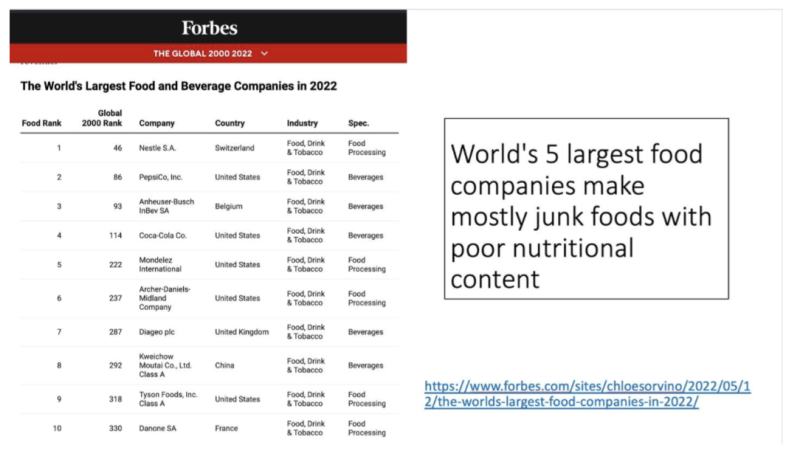
Perhaps the regulators could have avoided the debasement of the food supply. But they didn’t.
And now it has become a truism that Americans have the worst diet in the world.
Could food shortages be looming?
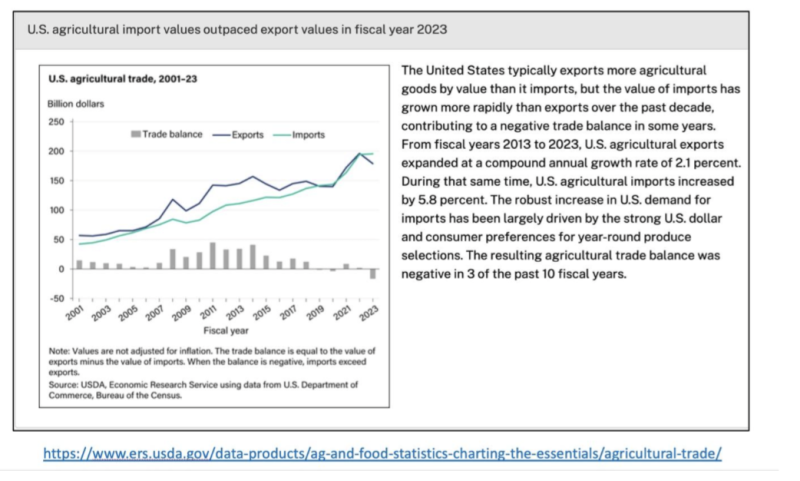
If it seems like the US, blessed with abundant natural resources, could never suffer a food shortage, think again. Did you know that while the US is the world’s largest food exporter, in 2023 the US imported more food than we exported?
Cows are under attack, allegedly because their belching methane contributes to climate change. Holland has said it must get rid of 30-50% of its cows. Ireland and Canada are also preparing to reduce the number of their cows, using the same justification.
In the US, the number of cows being raised has gradually lessened, so that now we have the same number of cows that were being raised in 1951 — but the population has increased by 125% since then. We have more than double the people, but the same number of cows. What!? Much of our beef comes from Brazil.
Pigs and chickens are now mostly raised indoors. Their industries are already consolidated to the max. But cows and other ungulates graze for most of their life, and so the beef industry has been unable to be consolidated in the same way.
But consolidation is happening instead in the slaughterhouses because you cannot process beef without a USDA inspector in a USDA-approved facility — and the number of these facilities has been dropping, as have the number of cows they can handle. Four companies now process over 80% of US beef. And that is how the ranchers are being squeezed.
Meanwhile, efforts are afoot to reduce available farmland for both planting crops and grazing animals. Bill Gates is now the #1 owner of US farmland, much of which lies fallow. Solar farms are covering land that used to grow crops — a practice recently outlawed in Italy. Plans are afoot to impose new restrictions on how land that is under conservation easements can be used.
Brave New Food
That isn’t all. The World Economic Forum, along with many governments and multinational agencies, wants to redesign our food supply. So-called plant-based meats, lab-grown meats, “synbio” products, insect protein, and other totally new foods are to replace much of the real meat people enjoy — potentially leading to even greater consolidation of food production. This would allow “rewilding” of grazing areas, allowing them to return to their natural state and, it is claimed, this would be kinder to the planet. But would it?
Much of the land used for grazing is unsuitable for growing crops or for other purposes. The manure of the animals grazing on it replenishes soil nutrients and contributes to the soil microbiome and plant growth. “Rewilding” may in fact lead to the loss of what topsoil is there and desertification of many grazing areas.
Of course, transitioning the food supply to mostly foods coming from factories is a crazy idea, because how can you make a major change in what people eat and expect it to be good for them? What micronutrients are you missing? What will the new chemicals, or newly designed proteins, or even computer-designed DNA (that will inevitably be present in these novel foods) do to us over time? What will companies be feeding the insects they farm, when food production is governed by ever cheaper inputs?
It gets worse. Real food production, by gardeners and small farmers or homesteaders, is decentralized. It cannot be controlled. Until the last 150 years, almost everyone fed themselves from food they caught, gathered, or grew.
But if food comes mainly from factories, access can be cut off. Supply chains can break down. You can be priced out of buying it. Or it could make you sick, and it might take years or generations before the source of the problem is identified. How long has it taken us to figure out that overprocessed foods are a slow poison?
There are some very big problems brewing in the food realm. Whether we like it or not, powerful forces are moving us into the Great Reset, threatening our diet in new ways, ways that most of us never dreamed of.
Identifying the Problems and Solutions
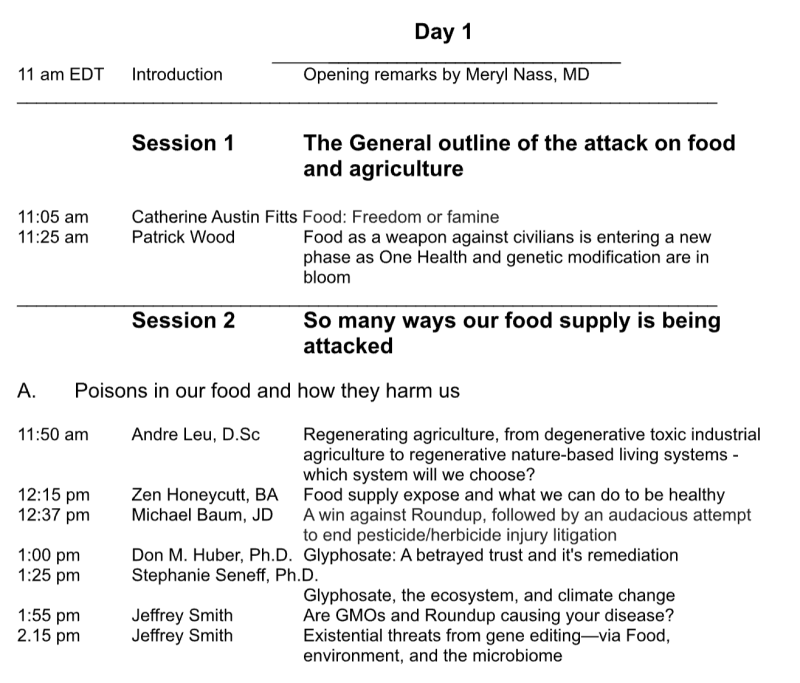
But we can get on top of what is happening, learn what we need to, and we can resist. That’s why Door to Freedom and Children’s Health Defense have unpacked all of these problems and identified possible solutions.
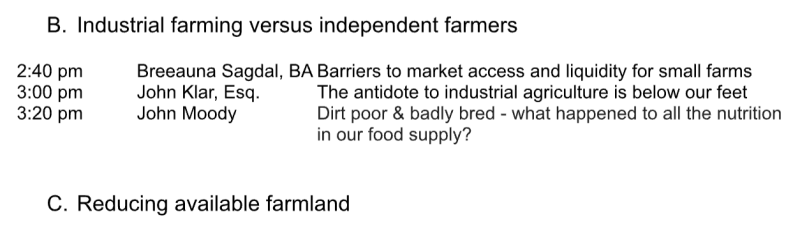
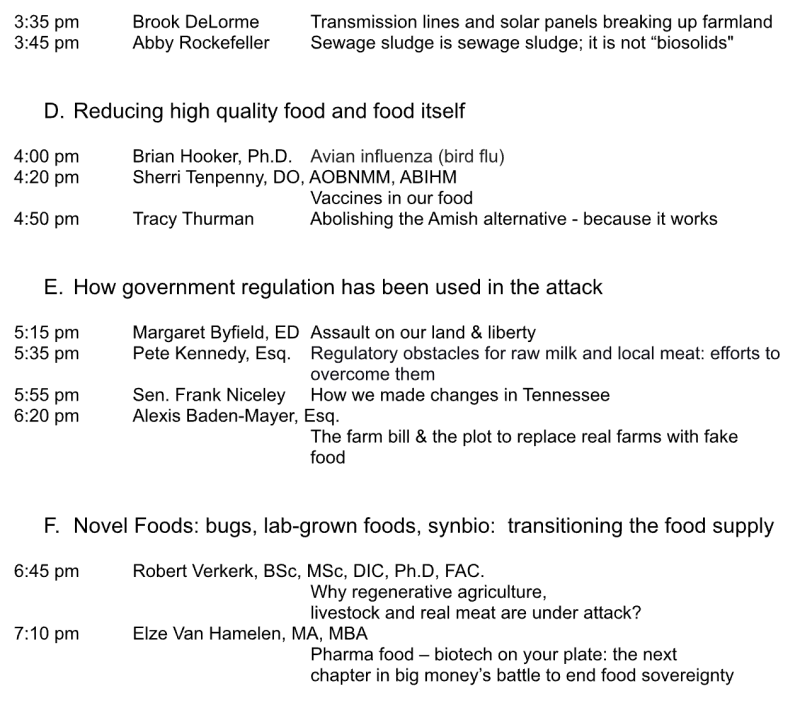
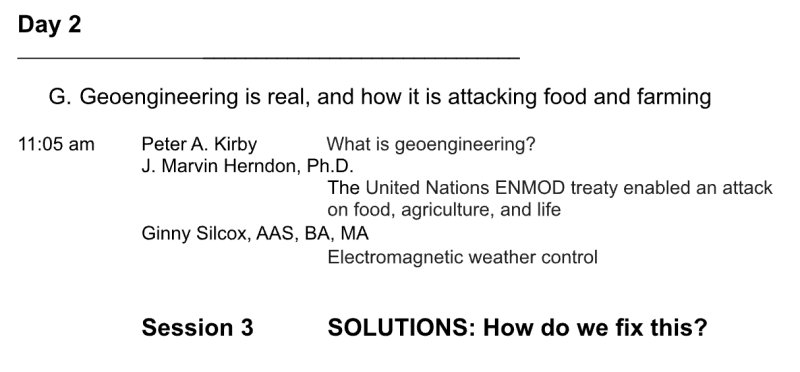
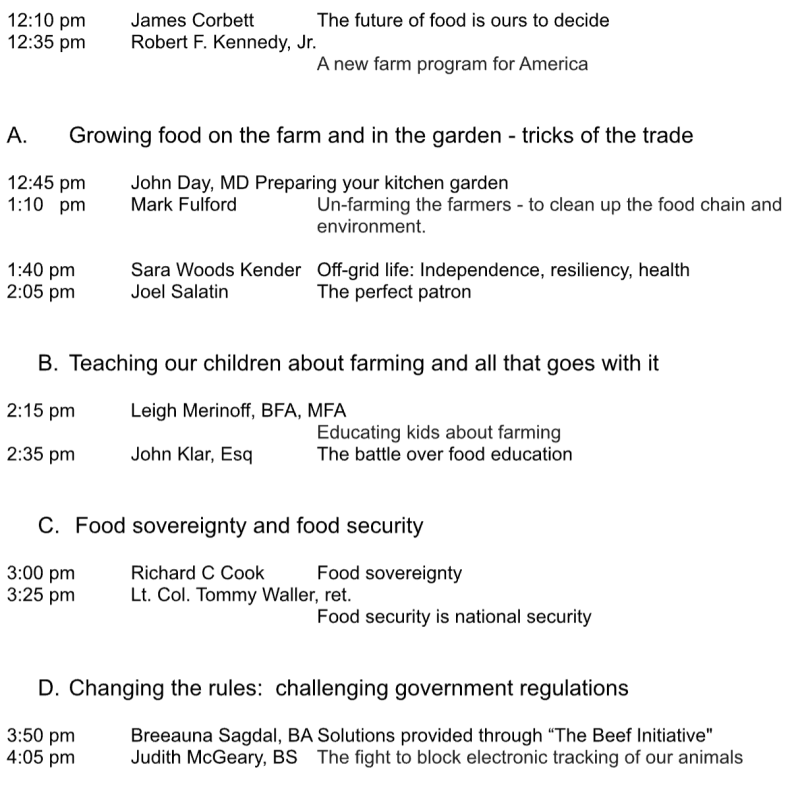
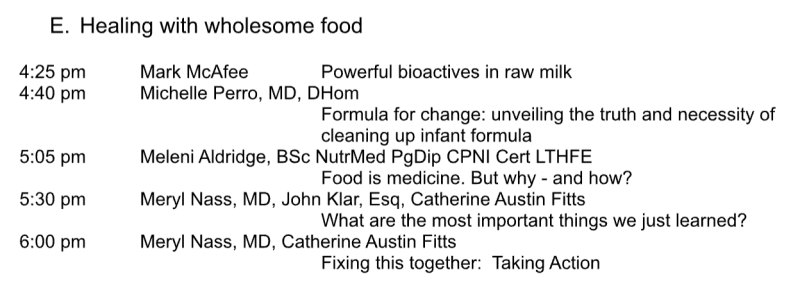
During a jam-packed two-day online symposium, you will learn about all facets of the attack on food, and how to resist. This is an entirely free event, with a fantastic lineup of speakers and topics. Grab a pad and pencil, because you will definitely want to take notes!
The Attack on Food and Farmers, and How to Fight Back premieres on September 6 and 7. It will remain on our channels for later viewing and sharing as well. By the end of Day 2, you will know what actions to take, both in your own backyard, and in the halls of your legislatures to create a healthier, tastier, safer, and more secure food supply.
See below for a summary and for the complete program.

Debate: Is A Demonstration Project Really Necessary?
By Francis Menton | Manhattan Contrarian | August 17, 2024
My repeated calls for a Demonstration Project of a zero-emissions electrical grid have led to a spirited debate among knowledgeable commenters. While most back my position, some say that a Demonstration Project is really not necessary and would be a waste of effort.
The gist of the argument of those disputing the necessity of a Demonstration Project is that it is so obvious that a zero-emissions grid powered predominantly by wind and solar generation cannot be achieved that the expense and effort of building an actual physical facility cannot be justified. Before the building of a physical demonstration project there would inevitably be an engineering feasibility study, and such a feasibility study would not get through its first day before everybody involved realized that this could never work. All it would take would be a few back-of-the-envelope calculations using basic arithmetic and the whole endeavor would be sunk.
Regular commenter Richard Greene leads the forces arguing against a demonstration project. From a comment by Richard on my August 10 post:
A good demonstration project that included manufacturing and farming is very likely not needed. A real local utility Nut Zero grid engineering plan on paper would have grid engineers laughing hysterically. The money allocated for backup batteries would be nowhere close to paying for the battery GWh capacity needed. Backup natural gas power plants could do the job, but gas backup is not wanted. . . . 100% wind and solar can never work due to compound energy droughts, wind drought and solar droughts (batteries are far too expensive).
Representative of the pro-demonstration project side is a comment from “dm” on the August 13 post. Excerpt:
Because many people doubt paper analyses, lived experience is a necessary teacher. Thus, demonstration projects are NEEDED to prove the folly of “sustainable” electricity grids. Furthermore, the demonstration projects MUST be in regions heavily populated with nut zero enthusiasts, and ALL costs MUST be paid SOLELY by households, businesses, institutions … located within the demonstration areas.
My natural sympathies here would lie with Richard’s side of this debate. How can spending what would likely be billions of dollars of public money be justified when calculations that I have made or verified myself show that the project will never come close to success?
But then we must look at what is happening in large states and countries that are proceeding toward the stated goal of a zero-emissions grid without ever having had a working demonstration project. In some of these cases (Germany, UK) the wasted resources are now into the trillions, not billions. And at some point the whole effort will inevitably be ended with some kind of hard-to-predict catastrophe (long blackouts? multiplication of consumer costs by a factor of ten or more?). By then, many of the working resources that have made the grid function will have been destroyed and will have to be re-created, at a cost of further trillions.
Consider the case of Germany. Germany is a very substantial country (80+ million people, making it twice the size of California and four times the size of New York), with the world’s fourth largest GDP at over $4 trillion annually. Germany was one of the first to start down the road to a zero-emissions grid back in the 1990s, and formally adopted its “Energiewende” fourteen years ago in 2010. Germany has proceeded farther than any other large country in converting its electricity generation to wind and solar.
And yet, as I look around for information on Germany’s progress toward zero-emissions electricity, I can’t find any concern or recognition that this might not be doable in the end. Perhaps that exists in German language sources that I can’t read. But from anything I can find, it looks like Germany is forging ahead in the blind faith that if only they build enough wind turbines and solar panels at some point they will have the zero-emissions electricity that they crave.
Go to the website of the Umweltbundesamt (Federal Environmental Agency) for the latest information. At least on the electricity front, you will not find any indication that there may be problems in achieving the zero-emissions utopian future:
The “Energiewende” – Germany’s transition towards a secure, environmentally friendly, and economically successful energy future – includes a large-scale restructuring of the energy supply system towards the use of renewable energy in all sectors. . . . [T]he switch towards renewables in the electricity sector has been very successful so far. . . . While in the year 2000 renewables accounted for 6.3 percent of electricity demand only, its [sic] share has been growing significantly over the past years, exceeding 10 percent in the year 2005 and 25 per cent in the year 2013. In 2023 renewable energy sources provided 272 billion kilowatt-hours of electricity and account for 51.8 percent of German electricity demand. With wind power being by far the most important energy source in the German electricity mix.
Some 30+ years into this process, and they’re only up to barely over 50% of their electricity from “renewables.” And while they may claim that “wind power [is] by far the most important source in the German electricity mix,” in fact when you get a breakdown you find that wind and solar together provided well less than 50%. According to solar advocates Fraunhofer Institute here, in 2023 “biomass” provided some 42.3 TWh of Germany’s electricity (about 8%), hydro provided 19.5 TWh (about 4%), and “waste non-renewable” (I think that means burning garbage) provided 4.5 TWh (about 1%). That leaves under 40% for wind and solar.
If they keep building solar and wind facilities, and expect batteries to be the backup, has anybody calculated how much battery storage they will need? Not that I can find. Here is a website of a company called Fluence, which is an affiliate of German industrial giant Siemens. They excitedly predict a rapid expansion of grid storage in Germany:
Storage capacity will grow 40-fold to 57 GWh by 2030.
Wow, a 40-fold increase! It may sound like a lot. But Germany’s average electricity demand is about 50 GW, so the 57 GWh of battery storage in 2030 will come to about 1 hour’s worth. Competent calculations of the amount of energy storage needed to back up a predominantly wind/solar grid run in the range of around 500 to 1000 hours.
Here from another website is a chart of the growth of energy storage in Germany up to this year.
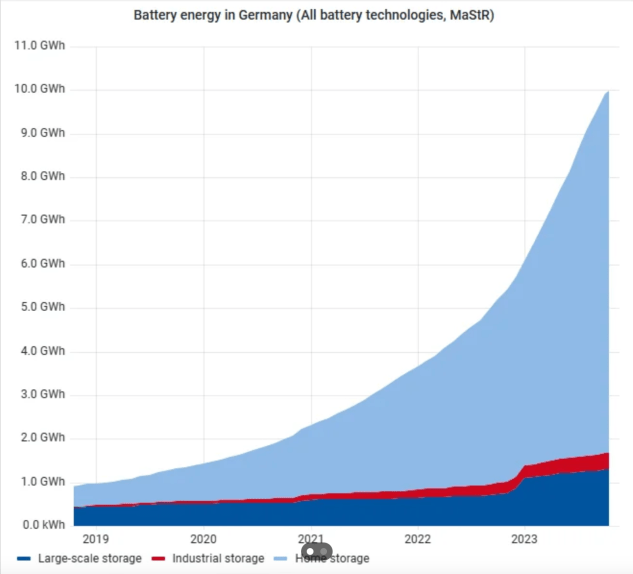
Look at that acceleration! But the 10 GWh of storage that they currently have will last no more than about 10 minutes when the wind and sun quit producing on a calm night.
In short, this large and seemingly sophisticated country is completely delusional, with no sane voices anywhere to be heard. A demonstration project that fails spectacularly is the only thing with any hope of saving them.
No one saw this car crash coming?
Australia is running out of electricity to charge electric cars, and they’re only 0.9% of cars on the road

By Jo Nova | August 22, 2024
EV’s represent just 0.9% of all cars on the road in Australia but plans to install fast chargers are already grinding to a crawl. Last year, Ampol was planning to build 180 EV charging bays by the end of the year. Instead it’s proved difficult to even reach half that target. Eight months after they were supposed to have 180 in action they’ve reached 92.
Just throw money…
A mere 3 weeks ago Ampol announced that thanks to a $100 million dollar grant from the Australian government they would install more than 200 new fast chargers at Ampol’s national network of petrol stations this year. But presumably after making a few phone calls they’ve realized it’s not going to happen. (You’d think they might have made the calls before putting out the press release? Or the Minister might have phoned a friend before tossing $100 million to the wind?)
Power grid foils Ampol’s big EV charger plans
Ben Potter and Simon Evans, Australian Financial Review
Ampol, one of the country’s largest petrol retailers, has dialled back plans to triple the number of electric vehicle chargers because of power grid limitations in a blow to government hopes of pushing motorists towards cleaner cars in big numbers by 2030.
The company’s chief executive, Matt Halliday, said it would not be possible to expand the number of charging bays from 92 to 300 by the end of this year because of difficulties connecting chargers to the grid which is already struggling to cope with an influx of renewable energy generation.
In March, Energy Minister Chris Bowen said the government would spend $60 million helping car dealerships install chargers on sales lots.
[As] much as we spend a lot of time talking about generation, firming and transmission infrastructure, the last mile distribution grid is not really built for large-scale electrification, despite the best will that the players have to try and make it happen,” Mr Halliday added. “There are a lot of constraints that need to be worked through.”
These people are not good with numbers. A fast charger needs 300 kilowatts, and if there are three car charging spaces in a row, that’s a major load that our low voltage lines simply can’t bear. In order to get the local distribution networks upgraded the wait times to connect these fast chargers can be as long as two years.
Not to mention that we’re supposedly aiming to make all new cars electric in a mere five years or so, while we also try to shut down our largest coal plant.
At the moment most EVs charging overnight are probably burning more fossil fuels than petrol cars do. The EV revolution in Australia (should it happen) would rampantly increase our carbon dioxide emissions. But who cares, right? It was never about CO2.
It’s not like engineers haven’t been warning us this was going to happen for ten years.
The Energy Transition Ain’t Happening: “Clean Fuels”
By Francis Menton | The Manhattan Contrarian | August 19, 2024
Come here for the latest news on how the so-called “energy transition” is grinding to a halt. No amount of government handouts can make this ridiculously uneconomic fantasy work. My last post on the subject, on July 20, reported on the collapse of a large “green hydrogen” project in Australia, with the stated loss of an investment of about $2 billion (Australian) (equivalent to about $1.3 billion U.S.).
It seems that that one was just the tip of the iceberg. Today’s Wall Street Journal has a substantial roundup of the financial status of a half-dozen or so so-called “clean fuel” projects. The headlines from the print and online versions tell you what you need to know. In the print edition (page B3) it’s “Clean-Fuel Startups Begin to Fizzle Out.” Online, it’s “Clean Fuel Startups Were Supposed to Be the Next Big Thing. Now They Are Collapsing.” As the headlines indicate, pretty much all of these “clean fuels” ventures are failing. Who could have guessed?
The Journal’s label of “clean fuels” is used to cover two different categories, one being biofuels, and the other being so-called “green hydrogen” (the stuff produced by electrolysis of water using electricity produced by wind or sun). The biofuels category appears to include such genius ideas as making fuel for airplanes or ships out of used cooking grease. Whatever you might think of that idea, these are still carbon-based fuels, and it’s not clear to me at all why they are supposedly “cleaner” than other carbon-based fuels like petroleum or natural gas.
Hydrogen, on the other hand, offers the promise of providing energy for planes, trains, ships and automobiles free of the dreaded “carbon emissions.” Just hook up some solar panels or wind turbines to big electrolyzers and watch the stuff bubble out of the water virtually for free! The badly misnamed “Inflation Reduction Act” made billions upon billions of dollars of subsidies available for these kinds of projects. Surely the successes should be rolling forth one after the other by this time.
It turns out that no matter how many subsidies the government doles out, nobody can make this “green” hydrogen stuff as cheaply as natural gas can be produced by drilling into rock.
One of the big green hydrogen startups is called Plug Power. The Journal quotes its CEO, Andy Marsh:
“The excitement of the early days has not lived up to the hype,” said Andy Marsh, chief executive of Plug Power, a startup that recently opened one of the country’s first plants making green hydrogen, a potential replacement for fossil fuels in industries such as steel making and chemical production. Shares of Plug Power have tumbled more than 90% since the passage of the U.S. climate law two years ago.
Well, at least they’re not bankrupt — yet. You do have to wonder how Mr. Marsh could qualify to be a CEO of such a company and raise hundreds of millions of investor dollars without ever crunching the numbers to realize that green hydrogen could never be economical. Could it be that his business plan all along was to pay himself a big salary out of the investors’ funds and then walk away when the inevitable bankruptcy came?
Here are a couple of paragraphs from the Journal summarizing the overall state of the industry:
Many clean-fuel projects have become money pits, in part because of the great amounts of power they need. High interest rates, supply-chain disruptions and expensive power-grid upgrades have driven up electricity prices. . . . “The only way to fix it is by lowering the cost of green electricity,” said Andrew Forrest, one of the most vocal advocates of hydrogen.
Wait a minute. Andrew Forrest — where have we heard that name? Oh, he is the Australian tycoon who goes by the name “Twiggy.” He’s the head of the company Fortescue, and was the subject of my July 20 post as a result of the collapse of his big Australian green hydrogen project. The Journal goes on to some detail about “Twiggy’s” ongoing green hydrogen plans:
Forrest, the billionaire founder of Australian iron-ore giant Fortescue, said his company’s 2030 hydrogen production target now looks unrealistic. Fortescue is planning to produce its own clean power to make hydrogen in Australia and is considering doing the same in Arizona.
But somehow the Journal fails to mention the failure of Forrest’s big Australian project. Could it be that they interviewed him a month ago, before that happened?
So the odds are that nobody will ever be able to make these “clean fuels” economically. The consequence:
Without clean fuels, emissions at many companies are expected to keep climbing, threatening U.S. and global climate targets. Industries including aviation and shipping are counting on the new fuels because wind and solar power and batteries can’t meet their huge energy needs.
When are we allowed to declare that this whole charade is over?
UPDATE, August 20: Commenter Pablo Honey suggests that it might be interesting to look at the financials for one of these “clean fuels” companies. Here is the 2Q 24 earnings release for Plug Power, just out on August 8. Some key figures: revenue — $143.4 million; “earnings” — net loss of $262.3 million.
Margins: “The Georgia plant’s increased production capacity and strategic price increases across the hydrogen product portfolio have significantly improved hydrogen margins.” So they are increasing prices from levels that were already a multiple of the price of natural gas for equivalent energy content. Good for them if they can get someone to pay, but that inherently means that their market is limited to buyers who either need hydrogen for its non-energy properties (i.e., fertilizer) or ones who are willing to forego profit out of religious devotion to “decarbonization.”
Government handouts: “Plug Power became one of the first companies to leverage the PTC [Production Tax Credit] for its liquid hydrogen plant in Georgia, optimizing financial performance and enhancing shareholder value. . . . Plug Power is progressing with the DOE loan, which aims to support the expansion of its green hydrogen initiatives and infrastructure for up to six sites.” Great — it’s another Solyndra in the works.
Featured Video
Rewriting the risk? Inside the government’s vaccine safety messaging
or go to
Aletho News Archives – Video-Images
Book Review
“Davos Can Really Replace the UN”
Inside the book that maps the architecture behind global governance — from the Epstein files to the Pact for the Future
Lies are Unbekoming | April 1, 2026
On June 13, 2019, the United Nations and the World Economic Forum signed a partnership deal to “accelerate the implementation of the 2030 Agenda for Sustainable Development.” That same evening, WEF president Börge Brende — Norway’s former Foreign Minister — had dinner with Jeffrey Epstein at Epstein’s Manhattan townhouse. The Epstein files, released January 2026, contain an exchange between the two from the previous year. Epstein to Brende: “Davos can really replace the UN. C21, cyber, crypto . genetics… intl coordination.” Brende back to Epstein: “Exactly — we need a new global architecture. World Economic Forum (Davos) is uniquely positioned — public private.”
The next day, the UN General Assembly adopted the framework for restructuring global governance.
That sequence — the partnership signing, the Epstein dinner, the candid admission about replacing the UN with a public-private architecture, and then the formal adoption — opens Jacob Nordangård’s The Digital World Brain. Pages two and three. Footnoted to the UN resolution number, the Epstein files, and the General Assembly record.
I keep coming back to it because it captures what this book does that almost nothing else in the independent research space manages. I’ve followed Jacob’s work for years now and interviewed him about his research. Each book peels back another layer of the same institutional architecture, and each time I think he’s reached the limit of what can be documented, the next one goes further. Nordangård doesn’t speculate. He doesn’t editorialize much. He lays institutional actions next to each other in chronological order and lets the pattern announce itself. … continue
Blog Roll
 Aletho News
- The End of NATO
- 37 days of war on Iran cost US staggering $42bln, tracker shows
- Baghdad tells Asian refiners, traders to begin loading Iraqi crude amid Iranian exemption
- Under fire, Moscow and Tehran close ranks
- Iran, US receive Pakistan-mediated plan for ceasefire then final deal
- Iran submits demands for end to war as mediators scramble ahead of Trump deadline
- Iran Threatens Retaliatory Strike on Stargate AI Project in UAE
- US sent ‘a lot’ of arms to Iranian protesters – Trump
- Barak Ravid Launders Deception To Allow Trump To Back Off Of His Power Plant Threat – Again
- REWRITING THE RISK? INSIDE THE GOVERNMENT’S VACCINE SAFETY MESSAGING
- If Americans Knew
- Trump poised to “blow everything up” (ie. commit war crimes) in Iran – Daily Update
- In Iran, Israel-US take aim at “reason, research, and freedom of thought” – Daily Update
- US loses planes over Iran, Israel downgrades Lebanon war goals – Daily Update
- Israel Is Blocking Palestinians from Easter at Church Where Jesus Resurrected
- Plot to assassinate Palestinian activist follows harassment campaign promoted by Zionist groups and elected officials
- Prominent New York synagogue hosts presentation on why U.S. Jews should support the ethnic cleansing of Gaza
- Tapper vs. Piker: Is the CNN Anchor Auditioning for David Ellison?
- Shouldn’t Democrats Be Able to Condemn Genocide?
- Israel-US kill negotiators, destroy civilian structures, but Iran’s military capabilities still largely intact – Daily Update
- ‘War crime’: Global condemnation as Israeli ministers celebrate death penalty law targeting Palestinian prisoners
- No Tricks Zone
- An Inconvenient Tree: Uncovered In Alps… Europe Much Warmer Than Today 6000 Years Ago
- New Study Reports A 60% Slowdown In Greenland’s Ice Loss Rate In The Last Decade
- Low Intensity Tornado Wrecks Major Solar Farm, Creating A Potential Toxic Dump
- New Study Finds Warming Saves Lives…Cold Temperatures 12 Times More Deadly Than Excess Heat
- German Science Blog Accuses PIK Climate Institute Of Hallucinating Climate Tipping Points
- Devastating Assessment Of Comirnaty Vaccine By Former Senior Pfizer Europe Toxicologist
- New Study: CO2 Is ‘Effectively Negligible’ As An Explanatory Climate Change Factor Since 2000
- Former Pfizer Toxicologist Dr. Helmut Sterz Tells Bundestag Hearing Pfizer Vaccine Should Have Never Been Approved
- Energy Expert: Germany’s Nuclear Phaseout Was A “500 Billion Euro Mistake”
- New Research: South Australia’s Mid-Holocene Sea Surface Temperatures Were 4°C Warmer Than Today
 Aletho News