Energy bill authorises “reasonable force” to install smart meters that allow authorities to turn customers’ energy on and off
BY DAVID CRAIG | THE DAILY SCEPTIC | SEPTEMBER 7, 2023
You probably know that a massive Energy Bill is being rushed through Parliament by our fake ‘Conservative’ Government in the first two days of our parliamentarians’ return from their generous summer break. The Bill is 446 pages long and written in dense, largely-incomprehensible-to-any-normal-person legalise. Moreover, many clauses in the Energy Bill make reference to other pieces of previous legislation. So, to fully understand the Bill, you would have to read at least a thousand pages of dense legalistic gobbledegook. Given that our MPs have just passed the Bill with a mere nine voting against it, one must assume that they have spent their summer holidays diligently reading through the Bill and other relevant legislation in order to fully understand what they were voting for.
Here’s the full title of the Bill:
‘A Bill to make provision about energy production and security and the regulation of the energy market, including provision about the licensing of carbon dioxide transport and storage; about commercial arrangements for industrial carbon capture and storage and for hydrogen production; about new technology, including low-carbon heat schemes and hydrogen grid trials; about the Independent System Operator and Planner; about gas and electricity industry codes; about heat networks; about energy smart appliances and load control; about the energy performance of premises; about the resilience of the core fuel sector; about offshore energy production, including environmental protection, licensing and decommissioning; about the civil nuclear sector, including the Civil Nuclear Constabulary; and for connected purposes’
As you’ll see, this legislative monster covers an awful lot of areas – energy production, regulation of the energy market, CO2 transport and storage, carbon capture, hydrogen production, low-carbon heat schemes, hydrogen grid trials, heat networks, smart appliances, load control, energy performance of industrial and residential premises, offshore energy production and the civil nuclear sector. We must be considered fortunate in Britain to have MPs who have such a strong work ethic and such a deep understanding of all these disparate issues to be able to vote for the new Energy Bill knowing exactly what they are voting for.
Life is too short for any normal person to read and to try to understand this massive abomination of almost impenetrable legalise. But here are some choice titbits which I think I understand.
The Bill explains what a ‘Smart Meter’ is:
“Energy smart appliance” means an appliance which is capable of adjusting the immediate or future flow of electricity into or out of itself or another appliance in response to a load control signal; and includes any software or other systems which enable or facilitate the adjustment to be made in response to the signal.
So it seems that the conspiracy theorists were right yet again – a key purpose of ‘Smart Meters’ is not only to measure power usage but also to allow energy providers to control how much energy we are allowed to consume using “a load control signal”.
Moreover, authorities will be allowed to use “reasonable force” to enter any homes or premises to ensure we have the approved ‘Smart Meters’ installed:
Requiring persons to supply evidence of their compliance to enforcement authorities; conferring powers of entry, including by reasonable force.
All electricity and gas meters have dates by which they should be replaced. From what I have read the Bill gives representatives from energy companies the power to enter any home, with police protection if required, to replace traditional meters at the end of their lives with smart meters. Again, “reasonable force” may be used.
The Bill gives the Government the power to force us to have energy assessments for any premises:
The Secretary of State may make regulations for any of these purposes: (a) enabling or requiring the energy usage or energy efficiency of premises to be assessed, certified and publicised;
We can be fined up to £15,000 or face one year in prison for failing to meet any future energy performance levels any government imposes:
Energy performance regulations may provide for the imposition of civil penalties by enforcement authorities in relation to cases falling within subsection (1)(b), (c) or (d); but the regulations may not provide for a civil penalty that exceeds £15,000.
Under the totally misleading title of ‘Energy Savings Opportunity Schemes’, authorities can force any person or company to make energy savings using the threat of criminalisation for failure to comply:
The Secretary of State may by regulations (“ESOS regulations”) make provision for the establishment and operation of one or more energy savings opportunity schemes. An “energy savings opportunity scheme” is a scheme under which obligations 30 are imposed on undertakings to which the scheme applies for one or more of the ESOS purposes.
I could go on. But I imagine you get the picture by now. This ‘Energy Bill’ creates the means by which some puffed-up public-sector mini-dictator could gain powers to control us in ways most people would find completely unacceptable. Yet our useless MPs passed the Bill with a massive majority and the Lords are set to do the same.
If there really was a ‘climate crisis’ caused by humans burning fossil fuels and threatening the existence of the human race as the BBC and others of its ilk repeatedly claim, then you might be able to argue that some of the measures in the Bill could be justified. But given that changes in atmospheric CO2 levels have little to no influence on the Earth’s temperatures, that Britain only contributes less than 1% of world CO2 output and that developing countries like India and China each increase their CO2 output by more each year than Britain’s total CO2 emissions, we are creating a totalitarian regime which will intrude on people’s lives, restrict people’s freedoms, wreck the British economy and immiserate our country to fix a problem which doesn’t even exist and, if it did, would not be solved by our action anyway.
And if you fear this horror will lead to an intrusive, oppressive police state under the Tories, imagine how this will be used and abused by Ed Miliband and the climate fanatics in the next Labour Government.
David Craig is the author of There is No Climate Crisis, available as an e-book or paperback from Amazon.
Congratulations To Germany On Achieving More Than 50% Of Its Electricity Production From “Renewables”!
By Francis Menton | Manhattan Contrarian | August 29, 2023
On the march to Net Zero carbon emissions from usage of energy, the key first step is to eliminate fossil fuels from the generation of electricity, replacing them with the magical “renewables.” Or so we are told. Once electricity generation is fossil fuel-free, then all energy use can be switched to electricity, without any of the evil emissions. Voilà — Net Zero!
But somehow, in the places that have tried to go this route with wind turbines and solar panels, the push to get more electricity generation from “renewables” has seemed to stall out at around 40 – 45%. (Some small countries with lots of hydropower get higher percentages by counting the hydropower as “renewable.”). Countries may build more and more solar panels and wind turbines, but somewhere in the 40s the percentage that those things contribute to electricity generation just doesn’t seem to budge very much any more.
And that’s why it’s so exciting that in the first half of 2023 Germany finally crashed through the 50% barrier, becoming the first significant country with little hydropower to achieve more than half of its electricity generation from “renewables.” With a simple internet search, you can find large numbers of news sources relaying the great news. For a few examples, here are Reuters, June 27 (“Renewable share of German power use climbs to 52.3% in first half”); Fraunhofer, July 3 (“German Net Power Generation in First Half of 2023: Record Renewable Energy Share of 57.7 Percent”); Clean Energy Wire, June 27 (“Renewables covered more than half of German electricity consumption in first half of 2023”); and Solar Quarter, July 5 (“Germany Achieves Record 57.7% Renewable Energy Share in Net Power Generation for First Half of 2023”). Why the exact percentages vary a little from article to article, I cannot explain; but they are all at least a little in excess of the key 50% figure.
So this is surely Germany continuing to lead the way to the green energy transition. Certainly, Germany has only accelerated its pursuit of the idea that the route to Net Zero is the building of more and yet more solar panels and wind turbines. A site called Renewable-Energy-Industry.com compiles data on additions to Germany’s wind and solar generation capacity just in the first half of 2023: “Record Additions in Germany: 8,000 MW of New Wind And Solar Capacity in The First Half of 2023.”:
[S]olar energy in particular is booming in Germany. From January to June 2023 alone, around 465,000 new solar plants with 6,500 MW capacity . . . went into operation and produce electricity, more than ever before in a six-month period. . . . In the first six months of 2023, just under 350 new wind turbines with a capacity of around 1,750 MW went into operation. . . .
The addition of 8000 MW of generation capacity in just six months is a huge increment in a country where peak electricity usage is less than 85,000 MW (or 85 GW).
So are these large additions to capacity what has succeeded in pushing Germany over the 50% threshold? Unfortunately, if you read deep into the Reuters piece linked above, you will start to get a very different understanding. It turns out that Germany’s percentage of electricity from renewables increased not because the production of electricity from renewables increased, but rather because Germany’s economy is shrinking. After decades of effort and hundreds of billions of dollars of subsidies and greatly increased consumer electricity prices, the contribution of wind and solar energy in Germany’s economy remains almost insignificant.
Despite all its new solar and wind facilities, Germany’s production of electricity from those sources has lately been going down rather than up. Here is the story for the first half of 2023) (from the Reuters piece linked above:
Renewables, at 137.5 TWh, represented 51.7% of total output, up from 46.4% in first half 2022, even as green power production volumes decreased by 0.6%.
The 137.5 TWh of electricity that Germany’s “renewable” facilities produced in the first half of 2023 is a pitiful percentage of their supposed theoretical capacity. A chart at Clean Energy Wire gives Germany’s generation capacity of solar, plus onshore and offshore wind as 130.8 GW as of 2022. (In a country with only about 85 GW of peak usage!). Add the new 8 GW of capacity added in the first half of 2023, and you would have 138.8 GW of wind and solar capacity, or 602.9 TWh hours of capacity (138.8 x 24 x 181) for the 181 days in January to June 2023. That would mean that the wind and solar facilities combined produced at a rate of only 22.8% of capacity over that period.
So if production of electricity from “renewables” actually decreased, how could the percentage of electricity production from the “renewables” have increased from 46.4% to 51.7% of the total? Easy — the production from all other sources (fossil fuels and nuclear) went down dramatically:
Conventional energy sources – nuclear, coal, natural gas and oil – provided 128.4 TWh of output, down from 160.0 TWh a year earlier.
They ran the conventional generators less because the demand for electricity was not there:
The fall in conventional production reflected the phase-out of nuclear energy by mid-April and operators cutting output to match weak demand.
The change from 160.0 TWh to 128.4 TWh from conventional sources would be a 19.75% decline. That’s rather enormous in one year. Now, how could it be that Germany is experiencing that kind of a huge decline in the demand for electricity? You might check out the big front page article from today’s Wall Street Journal, “Germany’s Shrinking Economy Sparks a Struggle for Solutions.” (different headline online). The world leader in the supposed “green energy transition” turns out also to be in the unique position of having an economy that is shrinking, and not by a little:
Germany will be the world’s only major economy to contract in 2023, with even sanctioned Russia experiencing growth, according to the International Monetary Fund.
The WSJ piece goes into a variety of factors that may be contributing to the shrinking economy. But self-inflicted high energy prices turn up again and again:
Energy costs are posing an existential challenge to sectors such as chemicals. . . . Energy prices in Europe have declined from last year’s peak as EU countries scrambled to replace Russian gas, but German industry still faces higher costs than competitors in the U.S. and Asia.
And meanwhile, with Germany’s massive investments in wind and solar electricity generation, are those sources actually making any major inroads in the overall market for primary energy in the country? Here is an extremely revealing chart, again from Clean Energy Wire, with data from 2022:
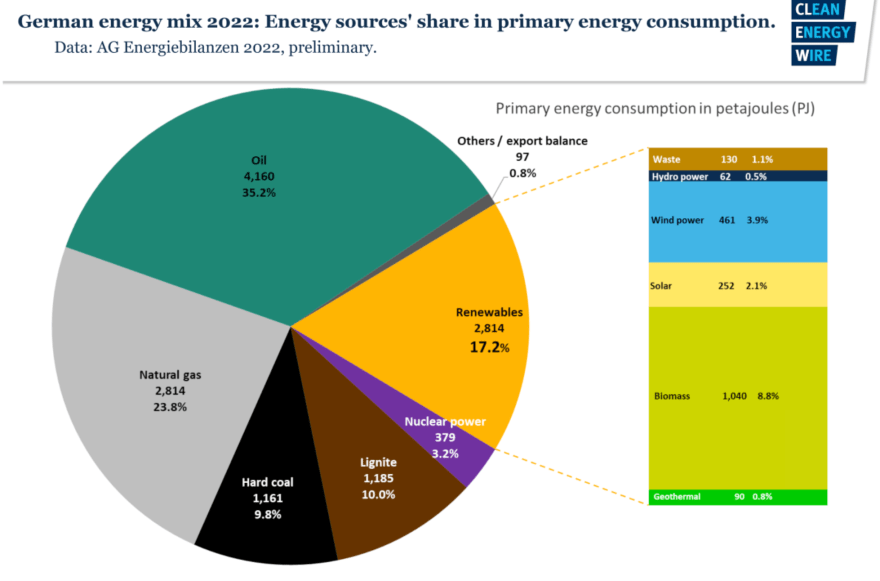
In the “renewables” category for all primary energy (not just electricity), we learn that they include “biomass” as a “renewable.” Probably, that’s mostly wood, used for heating homes, and hardly a zero carbon source. The amount of energy produced from the “biomass,” at 1,040 PJ and 8.8% of primary energy, far exceeds the combined total from wind and solar (713 PJ and 6.0% of primary energy).
The whole “more than 50% from renewables” mantra turns out only to apply to electricity (far less than half of primary energy usage). And rather than representing the advance of the mythical wind and solar, the whole thing is just an artifact of a shrinking economy, largely itself caused by the destructive build-out of the wind and solar facilities. They are destroying their economy, and have almost nothing to show for two decades and hundreds of billions of dollars invested in the useless wind and solar farms.
Sir Iain Duncan Smith Says He is “Happy” for ‘Blade Runner’ Ulez Vandals to Destroy Cameras Because They Have Been “Lied To”

BY WILL JONES | THE DAILY SCEPTIC | SEPTEMBER 1, 2023
Conservative MP and former party leader and Government minister Sir Iain Duncan Smith has said he backs the ‘blade runners’ who are disabling Ulez cameras. The Mail has more.
Usually he prides himself on being tough on crime, but the former cabinet minister said today he was ‘happy’ for the residents of his Chingford and Woodford Green constituency to destroy cameras because they have been “lied to”.
Sir Iain said: “A lot of people in my constituency have been cementing up the cameras or putting plastic bags over them.
“I am happy for them to do it because they are facing an imposition that no-one wants and they have been lied to about it.
“The actions you are seeing show how angry people are at what is being imposed on them. Sadiq Khan has gerrymandered all the information – people have had enough.”
Since his comments were first published, Sir Iain told the Evening Standard that “I do understand the frustrations of the people in my constituency who are being hit by these charges and who feel like they are not being listened to by the mayor. These sort of actions show how angry people are. But I don’t condone law breaking of any kind.”
It’s notable that no one besides Khan seems willing to defend the scheme or even state their opposition to the vandalism of the cameras. At this point it feels like it’s Khan versus the whole of London.
Meanwhile, the Transport Secretary, Mark Harper, told GB News this morning that he would stop the rollout if he had the power to do so and highlighted his reservations about the true motives behind the expansion.
I don’t have the power to stop it coming into force. That’s a decision for the Mayor of London backed by the Labour leader. I think he should think again.
He says this has to do with air quality, his own impact assessment says this will only have a minor to negligible effect on air pollution.
It’s not about air pollution, it’s about a money-raising exercise and this is absolutely not the time to be putting all those costs on hard-pressed and hard-working Londoners and those in the area outside London.
What Harper didn’t mention, though, is that the reason he doesn’t have the power to stop it is because the Government’s lawyers have said it would be contrary to the Government’s own policies on air pollution. That’s despite the impact assessment showing it will have a negligible impact on air quality! In truth, the Government could challenge it if it wished, either by changing its own policies (perhaps via legislative amendment) or by arguing that the impact is too negligible to contravene its commitments.
Harper also told LBC’s Nick Ferrari programme that the Government will be backing an amendment to the Levelling-Up and Regeneration Bill to make changes to the 1999 law that created the role of Mayor of London. According to the Mail:
Under the amendment, brought forward by Tory peer Lord Moylan, London boroughs would be able to opt out of future Transport for London (TfL) clean air schemes if they are meeting air quality targets.
The Transport Secretary said: “One of the problems here is that a number of London local authorities don’t support this scheme coming into force, so for the future, we are backing an amendment, a backbench amendment to a piece of legislation which will mean in future any road user charging schemes like this would have to be also backed by London boroughs.
“And that’s important because if you look at the Mayor of London’s own website for his Project 2030 scheme, he wants to roll out more road user charging schemes, pay-per-mile schemes across London.”
Sadiq Khan countered on BBC Breakfast this morning that it wasn’t about the money:
This is about helping our air be cleaner. In a couple of years’ time, TfL has predicted there will be no additional money made because the number of non-compliant vehicles (will decrease).
But if it’s not expected to make money and it won’t make the air appreciably cleaner, what’s the real motive for forcing through such an electorally disastrous policy? Could it be because, as highlighted in yesterday’s Daily Sceptic, Khan is Chair of C40 Cities, an organisation committed to “reducing car ownership” and cutting travel by car? Is it, in other words, the latest move in the global war on the motorist and the crazed scramble to ‘cut emissions’ at the expense of humanity?
More Stick, Less Carrot – Prison For Not Complying With Energy Rules?
Climate Change Fanatics Upping Their Game
The Naked Emperor’s Newsletter | September 2, 2023
In a recent World Economic Forum discussion, it was acknowledged that governments will need to start using more sticks and less carrots.
“We’re going to need to change behaviours of individuals but also how our industries, corporations and also our governments work and practise. We’re going to need to do this through a mixture of carrots and hopefully, errr, perhaps not so many sticks… But we’re likely to see an increasing move towards a more stick-like intervention into the future, as things worsen, if we’re not able to act”.

The UK government seems to be taking the WEF’s advice seriously because, according to the Telegraph, they are looking to introduce new powers allowing new criminal offences to be created. This is in addition to increasing penalties for property owners who don’t comply with new energy rules.
Ministers want to grant themselves powers to create new criminal offences and increase civil penalties as part of efforts to hit net zero targets. Under the proposals, people who fall foul of regulations to reduce their energy consumption could face up to a year in prison and fines of up to £15,000.
The proposals will come before Parliament on Tuesday when MPs return back to work to discuss the Energy Bill.
It provides for “the creation of criminal offences” where there is “non-compliance with a requirement imposed by or under energy performance regulations”. People could also be prosecuted for “provision of false information” about energy efficiency or the “obstruction of… an enforcement authority”.
As seen with the Coronavirus legislation, ministers “are giving themselves broad umbrella powers to redraw and enforce the system before consulting on precisely which changes to make. Tory MPs have expressed alarm that ministers would be able to create new offences with limited parliamentary scrutiny under the update”.
The Bill is festooned with new criminal offences. This is just unholy, frankly, that you could be creating criminal offences… The ones we’ve found most offensive are where a business owner could face a year in prison for not having the right energy performance certificate or type of building certification.
Instead of undergoing scrutiny, criminal offences will be created using statutory instruments. These are still approved by Parliament but “typically nodded through”. There has not been a statutory instrument rejected in the last 35 years.
At the same time, Ultra Low Emission Zones (ULEZ) in London have been causing controversy. The newly expanded scheme means that drivers of certain vehicles (i.e. poor people who can’t afford Teslas) are forced to pay £12.50 ($15.75) every day to drive in any of London’s 32 London boroughs. The fine for not paying on time is £180.
Whilst this might not sound a lot of money to some, an additional £400 per month just to drive to work, will be an absolute killer for a lot of families. Another tax on the poor in the name of climate change.
A vigilante group calling themselves “Blade Runners” are going round London disabling or destroying the new ULEZ cameras. According to some reports, 90% of cameras have already been “retired”.

Sales of angle grinders are through the roof and the usual suspects are all over social media congratulating the Blade Runners but is all that it seems?
Problem, Reaction, Solution.
As a result, London Mayor, Sadiq Khan has deployed fleets of camera vans to catch people on the go. Clearly these camera vans were ready and waiting to go, they just needed an excuse. And how long will it be until some legislation is brought in to deal with these climate change vandals!?
And when Labour wins the election next year, deputy leader Angela Rayner, confirmed that “this is coming to towns and cities across the whole of the United Kingdom”.
It won’t stop there either. Whilst rumours of pay per mile schemes have been branded conspiracy theory nonsense, on Transport for London’s website they confirm that this is planned for 2025/26.
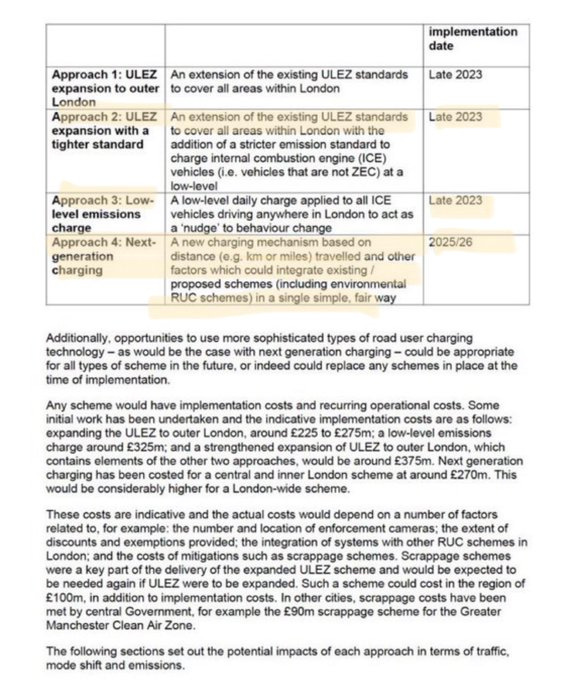
The climate change fanatics will do anything to reach their 2030 goals. The carrots haven’t been as effective as they’d hoped and with only 6.5 years left, get ready for more and more sticks.
Sadiq Khan’s Green Globalist Gang Suggests Daily 44g Meat Allowance and Rations Lower Than Second World War
BY CHRIS MORRISON | THE DAILY SCEPTIC | AUGUST 31, 2023
London Mayor Sadiq Khan’s Ulez punch-down on cars and vans owned by the less affluent is just one example of the attacks planned against town dwellers living in modern industrial societies. Khan is the current chairman of C40, a global network of city mayors backed by numerous hard-Left billionaire foundations. Removing cars from cities is just one of its aims. In a Headline Report published by the group in 2019 and re-emphasised earlier this year, a “progressive” target for 2030 was set of a daily per person allowance of 44g of meat (enough for two small meatballs), a daily limit of 2,500 calories, (less than the ration in the Second World War), one short haul flight every three years, eight new clothing items a year and private cars available for only one in five people. This “pioneering piece of thought leadership” was said to seek a “radical, and rapid, shift in consumption patterns”.
When the report about future urban consumption was first published in 2019, it received little publicity in the media. Some of its proposals looked a bit cranky even for mainstream publications. For instance, under an “ambitious” 2030 target, the mayors looked to ban meat and private vehicles altogether. But groundwork was clearly being laid. Mark Watts, executive director of C40, observed that average consumption-based emissions in the wealthier C40 cities must fall by “two thirds or more” by 2030. It was said that reducing vehicle ownership would lead to significant reclamation of roads and 25,000 kms of cycle lanes. This plan is now well advanced since the Covid lockdowns provided cover for mass street closures. Recent years have also seen large increases in cycle lanes, and of course the Ulez war on those driving older vehicles, not necessarily by choice.
Signatory cities are committed to “high impact accelerators”, which include creating low or zero emissions zones along with “implanting vehicle restrictions or financial incentives/disincentives such as road use or parking charges”. An early sighting here, perhaps of Khan’s suspected wish to implement road pricing after his Ulez infrastructure is in place.
There is also an early sighting of unsourced statistics with a claim that eating less meat and more vegetables and fruit could prevent 160,000 annual deaths associated with diseases such as heart attacks, diabetes and strokes in C40 cities. It is not immediately clear if these deaths actually occur in such precise numbers, or whether they are a Ulez-style ‘statistical construct‘.
Over 100 cities around the world are part of the C40 network and they are required to sign up to “performance-based requirements” based on a number of leadership standards. One of these standards specifies that they must innovate and start taking inclusive and resilient action, “to address emissions beyond the direct control of city government, such as associated with goods and services consumed in their city”. The largely unpublicised C40 operation is backed by finance and support from many well-known green foundations including Climate Works, Hewlett, IKEA, Oak, FR and Clinton. Three “strategic funders” are identified including Christopher Hohn’s Children’s Investment Fund Foundation, a major financial contributor to Extinction Rebellion. Another strategic funder is Bloomberg Philanthropies, whose controller Michael Bloomberg, the former mayor of New York, is president of the C40 board.
Of course interest is now growing in what all these people have been smoking over the last few years, as the Con/Lab green blob (different countries, different mainstream political combinations) organise to de-industrialise and cut human progress in the name of tackling a supposed ‘climate crisis’. The C40 Headline Report gives clear guidance of the scale of economic and societal change required under a collectivist Net Zero agenda. U.K. Fires is an academic project funded by the British Government, and it also gives a brutal assessment of life under what it terms absolute net zero carbon dioxide emissions. Again it is not discussed much in the public prints, but the Daily Sceptic has reported on its findings. These include no flying and shipping by 2050, drastic cuts in home heating, bans on beef and lamb consumption and a ruthless purge of traditional building materials such as bricks, glass, steel and cement. Such is the admirable honesty on display in their reports that they note these building materials can be replaced with “rammed earth” – mud huts for the lower classes in other words.
Sadiq Khan has been badly shaken by a popular uprising against his hated Ulez scheme. Backing in his own Labour party is wearing thin, not because most senior members are particularly anti-Ulez, but because after the Uxbridge by-election they can see a little more clearly that attacking the cars of the poor is a slam-dunk vote loser. For his part, Khan seems to have become more hysterical attacking those who oppose Ulez as conspiracy theorists. Earlier this year, reports the Daily Mail, Khan said that some of those who opposed the scheme’s growth across all London boroughs were “anti-vaxxers, Covid deniers, conspiracy theorists and Nazis”.
The evidence provided by Khan’s own C40 Headline Report, along with the work of U.K. Fires, shows clearly the actual agenda that is now being ruthlessly deployed. The only conspiracy rabbithole in sight would appear to be that occupied by a freaked Mayor Sadiq Khan.
Chris Morrison is the Daily Sceptic’s Environment Editor.
The Government’s Plan to Install Heat Pumps in Homes They Won’t Work In is Branded “Desperate” and “Unethical”
BY WILL JONES | THE DAILY SCEPTIC | AUGUST 31, 2023
A Government plan to relax rules to allow heat pumps to be installed in uninsulated homes they will fail to heat properly has been branded “desperate” and “unethical”.
Faced with a widespread boycott of the pricey technology, ministers are hoping that they can kickstart uptake by removing the requirement that properties be adequately insulated before gas boilers are removed.
Campaign group Net Zero Watch criticised the decision. Director Andrew Montford said:
The insulation requirement was put in place to ensure heat pumps were only installed where they were likely to work. Removing a key consumer protection is hardly going to help the Government’s cause.
Mr. Montford points to a recent study of heat pump economics, which shows that, even in a well-insulated property, most heat pump installations do not give lower bills, let alone justifying the substantial capital costs. This is because electricity is four times the price of gas.
Mr. Montford said:
The contradictions in Government policy are becoming clear. Renewables are incompatible with heat pumps because they make electricity so much more expensive than gas. In their desperation to persuade consumers to switch anyway, ministers are proposing steps that would be foolish, are arguably unethical, and would certainly be counterproductive. This is a brand of fanaticism as dangerous as Mr. Khan’s Ulez obsession.
Yet another green technology being rejected by consumers because it is overpriced and doesn’t do the job.
Bloomberg Finances and Coopts State Attorneys General
State AGs aid Bloomberg quest for ‘green’ energy that threatens planet, wildlife and people
By Paul Driessen | CFact | August 22, 2023
 When you’ve built a financial information and media empire and become the world’s seventh richest person, you get to say dumb things, like suggesting that farming is easy: “You dig a hole, put a seed in, put dirt on top, add water – and up comes the corn.”
Being ultra-wealthy also shields Michael Bloomberg from any fallout from the climate and energy policies he pursues so zealously. He will doubtless be able to afford electricity at any price for his multiple mansions, from any source, backed up by thousands of battery modules to cover the repeated blackouts his policies will unleash. The other 99.9% won’t be so fortunate.
Mr. Bloomberg bankrolls campaigns against coal and natural gas; supports efforts to populate the Biden Administration with rogue regulators equally intent on “transforming” America’s energy system, society, and living standards; and champions ESG principles for financial firms, companies, and investors. His company even has Sustainability and ESG & Climate divisions. Mr. Bloomberg serves as UN Special Envoy on Climate Ambition and Solutions, enabling him to advance his agendas internationally.
ESG (Environmental Social Governance) helps unelected asset managers use their control over trillions of investment dollars to pressure companies, lenders, and consumers to embrace far-left activist versions of public welfare and justice, even if it causes clients’ portfolio values to decline. ESG is a subversive way to bypass legislatures, voters and democratic processes, to impose unpopular political and ideological agendas, often in violation of fiduciary obligations.
ESG opposes fossil fuels, insisting they are causing climate cataclysms. Any company in that business, or offering to finance a drilling project, gets blackballed. But companies building or financing “clean, green” energy score in the ESG stratosphere – even though most such projects destroy vast swaths of wildlife habitats, involve slave and child labor, and leave widespread toxic pollution in their wake. ESG human rights, ecological, and climate justice principles are duplicitous and hypocritical.
As New York City mayor, Mr. Bloomberg infamously advocated exorbitant taxes on large sugary drinks, claiming they lead to obesity and thus to diabetes, cancer, heart disease, and premature death. He simply wanted to help poor people live longer, he asserted, by making Big Gulps less affordable.
It’s thus puzzling that he now wants to banish reliable, affordable gas heat and coal- and gas-generated electricity for heating and air conditioning – in favor of pricey, weather-dependent wind and solar power backed up by outrageously expensive batteries. Those policies shorten lives.
Even if manmade or natural climate change causes average global temperatures to climb 2-3 degrees, modern technologies will keep us safely comfortable. But if laws, policies, and ESG pressures make heating and AC inaccessible or unaffordable, indoor temperatures can soar 15-25 degrees in summertime and drop as precipitously in wintertime. People die – and cold is far deadlier than heat.
When people, especially the elderly, cannot heat their homes properly, they can perish from hypothermia or illnesses they would likely survive if they weren’t so cold. The Economist calculated that expensive energy may have killed 68,000 more Europeans than Covid did last winter.
LIHEAP (Low Income Home Energy Assistance Program) will help the poorest families – until the subsidy money runs out – but not middle/working classes, and not small businesses.
Even worse, three billion people worldwide still do not have access to reliable, affordable electricity. Message to climate zealots like Mr. Bloomberg: Access to intermittent, unpredictable wind/solar electricity doesn’t count, especially if it’s only enough to charge a cell phone or power a lightbulb or one-cubic-foot refrigerator. Lack of access to sustained, affordable energy kills.
The billionaire’s legal power grab is even more insidious and dangerous to democracy.
In 2017 he began covertly funding New York University Law School’s State Energy and Environmental Impact Center, which provides grants to progressive (Democrat) state attorneys general, enabling them to hire “special assistant” AGs or “fellows.”
The Center’s mission is to provide “direct legal assistance” to interested AGs “on specific administrative, judicial or legislative matters involving clean energy, climate change and environmental interests of regional and national significance,” when AGs say they lack sufficient public funds to hire such help.
NYU now says, “the fellows’ sole duty of loyalty is to the attorney general in whose office they serve.” However, these partisan Bloomberg grants pay salaries and “generous benefits packages” to “special assistants” whose functions are dictated by the Center; address specified “regional and national” issues normally beyond the purview of state AGs; are routinely coordinated with energy and climate activists and donors to those causes; and often launch “public nuisance” or RICO litigation against oil companies, to the detriment of targeted industries and the consumers and ratepayers who depend on their products, within the AGs’ home states and in distant states and communities.
It is the Bloomberg agenda that is being served, by grants that effectively conscript and coopt the public authority and power of the attorney general’s offices.
As a 2022 report by the American Tort Reform Foundation notes, “These SAAGs are private attorneys placed in public positions to exercise government authority. Yet, they are not independent or impartial because their mandate is to carry out an overtly political agenda funded by wealthy private donors.”
This “unique” arrangement, the Foundation continues, “allows well-heeled individuals and organizations to commandeer state and local police powers to target opponents with whom they disagree, raising the specter of corruption and fundamental unfairness in what should be public enforcement of the law.”
Those same considerations also appear to raise fundamental ethical, legal, and constitutional issues. They certainly raise questions about laws governing gifts, campaign contributions, and bribes – and where Bloomberg-funded lawyers are involved in prosecutions, serious due-process concerns.
And yet the NYU Center has already placed at least 11 special assistants in eight state attorney general offices, which have filed at least 20 lawsuits against a few selected oil companies, charging them with “climate denial” or causing planetary warming, rising seas, more frequent and intense hurricanes and tornadoes, and other “offenses.”
This litigation ignores the actions of hundreds of other oil and gas companies across the globe; steadily rising emissions from China, India, and other rapidly developing nations; the role of natural forces and emissions from wind turbine, solar panel and battery mining, processing, and manufacturing; the lack of evidence to support claims of a climate “crisis” or more frequent and violent storms; and the fact that these issues should be litigated in federal courts or relegated to a democratic political process.
The US Supreme Court recently had an opportunity to quash this rampant litigation but chose not to review the state and local cases and send them to federal courts. The seemingly endless lawsuits and acrimony are creating a legal, constitutional, scientific and public policy nightmare for businesses, consumers, courts, states, and the nation.
Rest assured, billionaires like Bloomberg, Gates, Kerry, Zuckerberg, and Soros – who demand that we commoners give up our cars, gas stoves and furnaces, steaks, air travel, and suburban homes – don’t intend to give up anything.
Let’s hope the pro-America governors, AGs, legislators, judges, and business groups battling ESG and other woke campaigns tackle this NYU Impact Center hornets nest as well.
The New Apocalypticism
Climate catastrophe as secular, millenarian prophesy
By Roger Pielke Jr. | The Honest Broker | August 25, 2023
In 1983, Michael Barkun, today a professor emeritus at Syracuse University, wrote an incredible essay, presciently identifying the rise of a “New Apocalypticism” in American political discourse. Today I share some excerpts from that 40-year-old essay — Divided Apocalypse: Thinking About The End in Contemporary America — and connect them to today’s public discussions of climate change.
Barkun defined the “New Apocalypticism,” as follows;
The so-called “New Apocalypticism” is undeniably religious, rooted in the Protestant millenarian tradition. Religious apocalypticism is, however, not the only apocalypticism current in American society. A newer, more diffuse, but indisputably influential apocalypticism coexists with it. Secular rather than religious, this second variety grows out of a naturalistic world view, indebted to science and to social criticism rather than to theology. Many of its authors are academics, the works themselves directed at a lay audience of influential persons — government officials, business leaders, and journalists — presumed to have the power to intervene in order to avert planetary catastrophe.
Barkun observed that intellectuals were fulfilling a societal function previously served by religious leaders, even though these intellectuals did not always view science and religion to be compatible:
. . . however uninformed or unsympathetic these secular prophets may be concerning their religious counterparts, they clearly recognize the presence in their own work of religious motifs. Their predictions of “last things” generate the feelings of awe that have always surrounded eschatology, even if in this case the predictions often grow out of computer modelling rather than Biblical proof-texts.
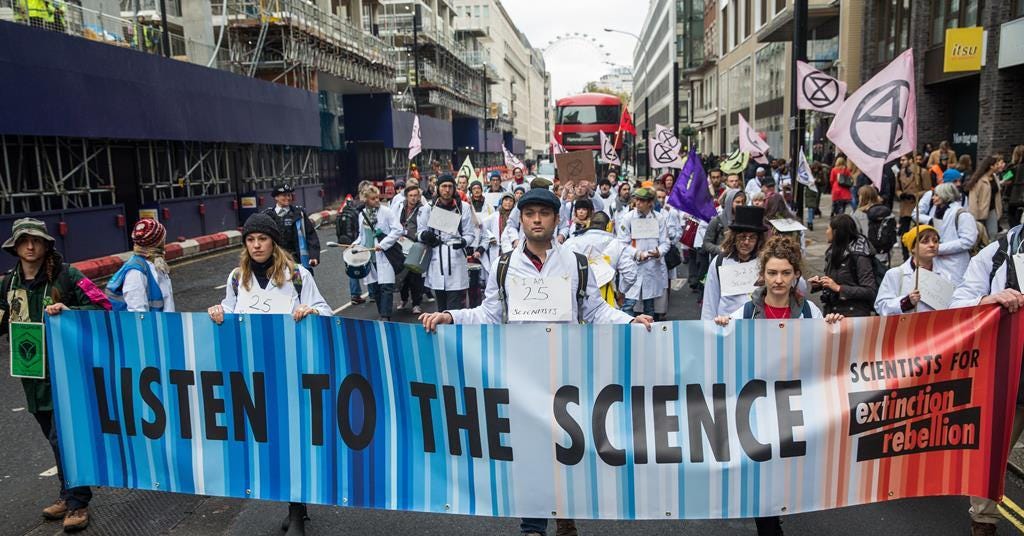
For many, science has come to replace religion in its perceived ability to identify the root cause of our existential crisis and scientists have replaced religious leaders as holding the unique ability to offer guidance on how we must transform in order to stave off catastrophe:
Ironically, just as religious apocalyptic literature has begun to de-emphasize the natural world, the new secular literature has made it more prominent. By concentrating upon the capacity of human action to destabilize natural rhythms, the secular writers have made nature more important while acknowledging the potency of human act . . . The religionists’ transformation of the world, to be accomplished in the Last Days, would now occur gradually as the consequence human intervention. This confident, redemptionist view of science carried the corollary of the necessity and desirability of human mastery over the natural world — precisely the sin most uniformly attacked in the secular apocalyptic literature of today. Where this mastery over nature was once viewed as the road to greater happiness and fulfillment, it now appears to be the route to doomsday.
For the secular millenarian, extreme events — floods, hurricanes, fires — are more than mere portents, they are evidence of our sins of the past and provide opportunities for redemption in the future, if only we listen, accept and change:
Where the religious view regards events as signs, the secular position is far more apt to view them as direct causes: the future will occur because of actions taken in the past and the present, but the future may be changed by making different present choices. At one level, this shifts causal efficacy from an external deity to human beings. At another level, by opening the possibility that The End might be averted by timely action, the change introduces a measure of indeterminacy, as opposed to the fundamentalist emphasis upon inevitability. The opportunity for preventive action makes the secular scenarios appear more hopeful, because, in principle, destructive actions by human beings might be prevented — intentional acts might be forestalled by pointing out their likely consequences, while human error might be reduced by more closely monitoring the conduct of those in positions of responsibility. Nonetheless, this approach can only hold out the hope of minimizing risks, which leaves some ineradicable possibility of danger, because evil, ignorant, or inadvertent behavior can never be eliminated.
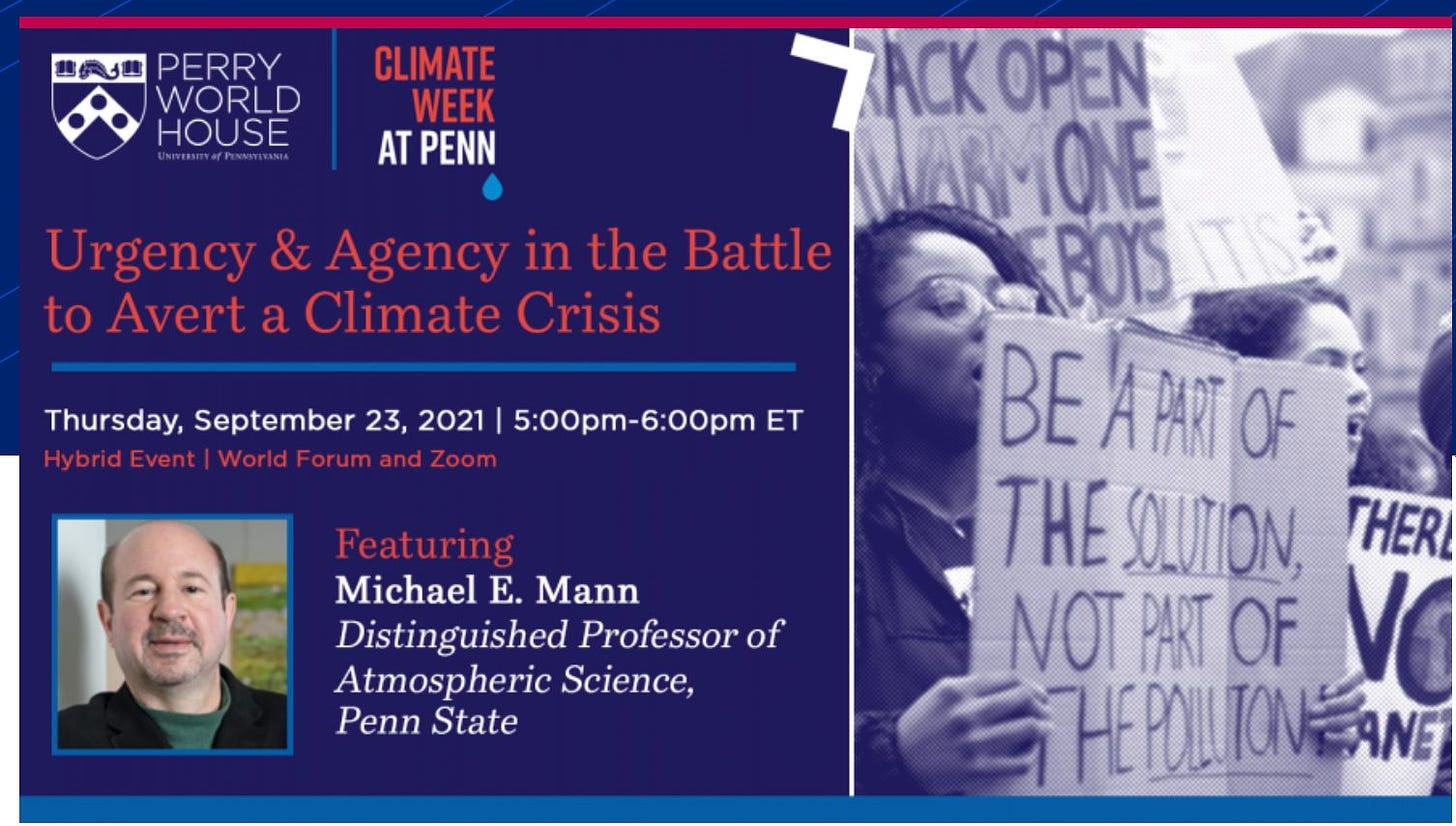
When we hear oft-quoted climate scientists warning that our calamitous times are the consequence of our misguided past actions and that the route to a different future is transformation — For instance, “urgency and agency” in the sloganeering of popular climate scientist Michael Mann, above. We can understand these dynamics as those of today’s priests of the secular apocalypse, explaining our predicament and offering the hope of salvation.
Barkun argues that secular apocalyptic worldviews are also compatible with a Manichean perspective on good and evil:
. . . secular apocalypticists tend to adopt two strategies. On the one hand, they may ascribe the suffering to the machinations of small but powerful groups, whose control of economic, military, or other resources permits them to place the fate of others in jeopardy. This view has the advantage of establishing a Manichean order, but it is, unfortunately, also a strategy that readily slides towards despair if the forces of good appear weak.
We’ve all heard the sermon — it is the fossil fuel companies, Republicans, the Koch Brothers, deniers and other shadowy forces who have conspired to thwart the climate movement for many decades. If only they could be defeated, transformation would occur and the apocalypse would be avoided.
Not surprisingly, the secular apocalypse is also interpreted as partly the consequence of ignorant or uncaring normal people, who have failed to heed the warnings of the experts. Despite the warnings, normal people continue to fly in planes, drive cars, eat hamburgers, use air conditioning and refuse to change:
On the other hand, world destruction may be viewed as the unintended consequence of human actions that are ill-informed, ill-timed, or inept. According to those who hold this view, the victims of world destruction are at least partially to blame for their fate, since had they behaved differently, they might have prevented it. The first position, the conspiratorial view, preserves the appearance of moral order by secularizing the Armageddon myth, in which good and evil contend, yet retains an element of indeterminacy not found in the religious version. The second position, ascribing inadequacies to the victims, attempts to reestablish moral order by implying that the suffering may not be wholly unmerited – the victims may somehow deserve their fate because they acted unwisely.
How might the contemporary New Apocalypticism evolve in the future? Barkun offers three possibilities:
One possibility, of course, is that either the religious or the secular apocalypticists are correct, and that history will indeed end within the lifetime of individuals now living.
We might indeed be in the latter stages of an existential climate crisis, fail to change and learn the end is nigh.
A second possibility, borne out in past instances of religious prediction, is that vague forecasts will give way to more precise predictions as expanding audiences seek the progressive reduction of ambiguity. Where this occurs the stage is set for prophetic disconfirmation, for a particular moment when a specific prediction is publicly discontinued, and the movement associated with it rapidly contracts to a hard-core of the most committed believers.
What happens when the world passes the 1.5 Celsius temperature target and the world does not end? Or then 2.0 C? On the other hand, there will always be sufficient numbers of extreme weather events across the planet to long sustain the idea that doom is just around the corner. Barkun explains that apocalyptic beliefs have been present in societies for centuries, and thus probably won’t be going away anytime soon.
A third possibility is that the number of believers may become so large that their very numbers and influence produce a fundamental change in the social order. The rise of Christianity during the late Roman Empire and the disillusionment of the Russian population immediately before the Russian Revolution are cases in point. Here, dire predictions can become, or can closely resemble, self-fulfilling prophesies.
This of course is the “all in” strategy of many climate activists — force the desired global transformation to happen and then take credit for the avoided Armageddon. I’ve argued that the global population crisis ended with a declaration of success with claims made that raising alarm saved billions from starvation — even though this view does not actually square with history. If we rapidly decarbonize, then the apocalypse will remain real, just unrealized — we already see this dynamic at play in discussions of the outdated RCP8.5 scenario.
Barkun’s 1983 essay is remarkable when read in the context of the 2023 climate movement. Climate change is of course real and important, but it is not (according to the IPCC) the apocalypse. The near-term future of climate policy will almost certainly be a struggle between pragmatism and the New Apocalypticism. How that turns out is anybody’s guess.
For those who have access here is the cite and link to Barkun’s remarkable essay:
Barkun, M. (1983). Divided apocalypse: Thinking about the end in contemporary America. Soundings, 257-280.
Fauci declares lockdowns were ‘absolutely justified’ and suggests they should be used again to force vaccinations
Retired government bureaucrat says that tragedy in Maui was due to climate change
By Jordan Schachtel | The Dossier | August 22, 2023
Recently retired government bureaucrat Anthony Fauci just appeared at a university virtual event titled, “Pandemic Lessons and Role of Faculty in Pandemic Preparedness with Dr. Anthony Fauci.” During the conversation, Fauci, who is now affiliated with Georgetown University, made it clear that he still supports locking down society in the name of a virus, adding that lockdowns are a great tool to forcibly “vaccinate” people.
I’ll save you 40 minutes of your life and quote some of the “highlights” from the interview, in which a Wayne State University professor asks Fauci about what he’s learned from his time overseeing a “pandemic response.” The video of the chat is available via YouTube below:
Fauci falsely claimed that New York City was overrun and had “cooler trucks outside because they had no places to put the bodies.”
“You had to have something to immediately shut down the tsunami of infection,” he states, adding, “that lockdown was absolutely justified.”
“Lockdown has a purpose,” the pseudoscientist continued. “One of the purposes, if you don’t have a vaccine, it’s to get more ventilators, get the hospitals better prepared … until you decompress the pressure on the hospitals.
Fauci wasn’t done yet. Here comes the truly evil insanity…
“If you have a vaccine available, you might want to lock down temporarily so you can get everybody vaccinated,” he suggests.
Rejecting the idea that lockdowns are a moral question, he added that “lockdowns have a place, but they are not a permanent solution.”
The conversation continued, with the longtime NIAID chief declaring that “climate change” is “playing a role” in causing outbreaks.
He then calls for an “international commitment to decrease the carbon imprint in society so you don’t have the kinds of crazy weather we’re having in this country.”
Yes, that’s a real quote.
He went on to blame the tragedy in Maui on climate change. “It’s completely, really amazing what’s happened with climate change,” he concludes.
SAN FRANCISCO’S GREEN BUILDING NIGHTMARE
By Randy Shaw | BeyondChron | March 3, 2008
 The idea of “green” buildings is a terrific marketing concept. In San Francisco, it has helped grease the political roadway for massive, view-blocking luxury condominiums, implying that building these structures is more environmentally sustaining than leaving land vacant. Few seem to care whether green buildings can be a nightmare for those having to work inside high-rise structures lacking heat or air conditioning. The new Thomas Mayne designed Federal Building at 7th and Mission Streets in San Francisco is a case in point.
Lauded by the New York Times as a building that “may one day be remembered as the crowning achievement of the General Services Administration’s Design Excellence program,” what some believe is the greenest federal building in the nation’s history also likely has the worst work environment. While architects describe the building’s “sense of airiness” as “magical,” employees view working in this heat and air-conditioning free building with the wavy concrete floors and ceilings as a nightmare.
Green but Cold
Thomas Mayne’s new George H.W. Bush Federal Building now looms over midtown San Francisco. While people have sharply divergent reactions to its unique exterior design — I happen to like it — the verdict on the structure’s function as a office space for federal employees is nearly unanimous: it is a disaster.
Not that architectural critics care. Bedazzled by unusual design features and its focus on energy conservation, reviews of Mayne’s latest work seem to ignore whether it fulfills its functional role as a federal office building.
Based on what I have been told, it clearly does not.
The first fact about the building that may cause surprise is its lack of air conditioning or heat. According to Mayne, “a bike rack and air conditioning get you the same point. I’d much rather see BTU and CO2 requirements and let the professional community solve the problem.”
I apparently lack sufficient understanding of green technology, as it does not seem that a bike rack would “get you to the same point” in terms of keeping workers cool. In the real world on the 15th floor of the Federal Building, workers seek to relieve the heat by opening windows, which not only sends papers flying, but, depending on their proximity to the opening, makes creating a stable temperature for all workers near impossible.
When I spoke with a Labor Department worker at the building (who noted that she is encountering the type of bad work conditions that her agency is supposed to enforce against), she confirmed what might have been an urban legend: that some employees must use umbrellas to keep the sun out of their cubicles.
The lack of internal climate controls has left some workers too cold and others too hot. A happy medium has proved elusive. And while the managers’ offices do have heat and air conditioning — a two-tiered approach fitting in a building named for Bush — the “green” design apparently has messed with the effectiveness of these systems, leaving these top staff as physically uncomfortable as the line workers.
Dysfunctional Elevators
According to my source, architect Mayne has stated that federal office workers do not get enough exercise. To address this, he installed elevators in the building that only stop at every third floor. This requires employees to walk up or down one or two flights of metal stairs.
Persons with physical disabilities who cannot use stairs can use a separate elevator that stops at every floor. The foreseeable result is that employees seeking to avoid stairs use the disabled access elevator, leaving this car crammed with people and making the ride to the top extremely slow.
I am told that when the freight elevator is out of service, deliveries must use the disabled access elevator. It seems only a matter of time until a disabled worker sues the General Services Administration for providing inadequate disabled elevator access in the building.
Missing Cafeteria
Mayne’s desire to get workers walking may have impacted his decision to locate the employee cafeteria across the street from the building. Employees are not happy about having to leave the building just to get a sandwich, and were allegedly told that the building would include an on-site café.
But as is clear with every aspect of this testament to green buildings, this project was more a science experiment than a place designed to enhance worker productivity.
No LEED Approval
Green building advocates will no doubt argue that the Federal Building is a bad example, as it failed to secure LEED approval. According to its website, The Leadership in Energy and Environmental Design (LEED) Green Building Rating System™ encourages and accelerates global adoption of sustainable green building and development practices through the creation and implementation of universally understood and accepted tools and performance criteria.
Mayne noted that “I wasn’t arrogant, but I was confident — I just assumed we had the platinum rating. All of a sudden we went through LEED and it wasn’t working.”
But the project’s failure to satisfy LEED’s scoring system is not the problem. Rather, it is that the federal government spent millions over budget to create a building that does not provide a minimally satisfactory work environment.
And the project’s huge cost overruns and functional inadequacies have apparently been ignored solely due to excitement over its “Green” stature.
The Green Energy Future Is Arriving Faster Than You Think — Or Not
By Francis Menton | Manhattan Contrarian | August 19, 2023
Among the media sources serving as propagandists and cheerleaders for the “green energy transition,” two of the most prominent are the New York Times and Bloomberg News. To get an idea how the “transition” is going, let’s take a look at the latest from those two.
From the Times, in this morning’s print edition, we have a feature article that apparently first appeared online a couple of days ago, August 17. The headline is: “The Clean Energy Future Is Arriving Faster Than You Think.” The sub-head continues the excitement: “The United States is pivoting away from fossil fuels and toward wind, solar and other renewable energy, even in areas dominated by the oil and gas industries.”
But then Bloomberg News comes out yesterday with an editorial that seems to reach the exact opposite conclusion. Headline: “Net Zero Is Stalling Out. What Now?”
So which is it? Is the green energy future arriving “faster than you think,” or “stalling out”? Both can’t be right. Who has the better side of this?
Let’s look first at the Times piece. It is an uncritical litany of every possible piece of good news for the generation of electricity from wind and sun in the U.S. It is filled with more than twenty photographs and charts designed to impress you with the great progress being made: massive wind turbines, vast solar arrays, rows of EV charging stations, teams of serious-looking workers in a modern factory working away on some unnamed but clearly complex piece of equipment.
On the other hand, the piece is devoid of meaningful data on how the “transition” is progressing. Are wind and solar electricity actually making progress toward supplanting fossil fuels? You won’t find the answer to that here.
I’ll give you a few choice excerpts so you can get an idea of the technique:
Delivery vans in Pittsburgh. Buses in Milwaukee. Cranes loading freight at the Port of Los Angeles. Every municipal building in Houston. All are powered by electricity derived from the sun, wind or other sources of clean energy. . . . The nation that burned coal, oil and gas for more than a century to become the richest economy on the planet, as well as historically the most polluting, is rapidly shifting away from fossil fuels. A similar energy transition is already well underway in Europe and elsewhere. . . . Wind and solar power are breaking records. . . . Automakers have made electric vehicles central to their business strategies and are openly talking about an expiration date on the internal combustion engine. Heating, cooling, cooking and some manufacturing are going electric.
So what are these Bloomberg people talking about when they say that the “Net Zero” thing is “stalling out”? It turns out that they have plenty of data points, mostly (but not entirely) from Europe, and all relating to collapsing public support as costs become apparent:
[V]oters have legitimate questions about net-zero policies: How much will they cost? What benefits will they bring? Will they actually work as advertised? Such skepticism is already changing politics, from the recent losses suffered by Germany’s Greens to the fall of the Dutch governing coalition, which was partly fueled by farmers’ anger over forced reductions in nitrogen-oxide emissions. Even some avowed environmentalists — such as the governor of New Jersey and the leader of the UK’s Labor Party — have lately been siding with voters who feel aggrieved at the costs of environmental policies.
Can we get any actual data as to whether wind and solar energy are rapidly increasing their market share for energy production in the U.S.? The best source of information is the Energy Information Administration (part of the Department of Energy). The most recent two full years for which they have data are 2021 and 2022. Here’s the 2021 chart showing U.S. primary energy consumption by source:
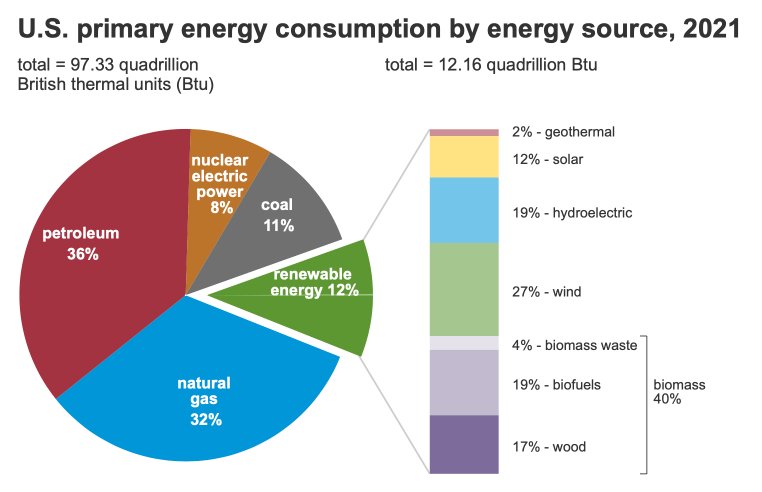
Add up the percentages for petroleum (36%), natural gas (32%) and coal (11%), and you get 79% from fossil fuels in the aggregate.
And how about 2022? The chart is in a different format that is more difficult to read, but here is the key line of text: “Fossil fuels—petroleum, natural gas, and coal—accounted for 79% of total U.S. energy consumption in 2022.” Oh, that’s the exact same percentage as in 2021. It didn’t budge by even 1%.
Here is the chart they provide for 2022. As you can see, it is not so easy to calculate the percentages by source from this chart, but the general result is still obvious:

For 2023, EIA has put out monthly data through April as part of its Monthly Energy Review. There are no pretty charts, but through April fossil fuels have generated 26.082 quadrillion BTUs out of total primary energy consumption of 33.209 quadrillion BTUs. That would be 78.53% for fossil fuels. In other words, to the nearest whole percent, it’s still 79%. All the billions upon billions of government subsidies don’t seem to be moving the needle in any noticeable way.
To be fair, these figures reflect little if any of the massive subsidies brought forth by the big federal green energy bill (“Inflation Reduction Act” [sic]), which was signed a year ago on August 16, 2022 and is just getting cranked up. Will those subsidies move this needle at all? You would think that they couldn’t help moving the needle at least a little. But my own prediction is that the percent of primary energy from fossil fuels will decrease only minimally.
Over at Bloomberg, while they report honestly that Net Zero seems to be stalling out, they are not happy about it. What is the remedy? Obviously, the government planners directing the green energy transition need to go about this in a more “purposeful” and “strategic” manner:
If the government is going to ban the sale of gas boilers in 2035, as it says, it will need to make sure that cheaper alternatives are available. Likewise with a planned ban on new gas and diesel cars: It’s a fine goal, but it won’t go anywhere unless consumers have compelling incentives, charging infrastructure can meet demand and the government has otherwise laid the needed groundwork. . . . Above all, what’s needed is leadership. Decarbonization can drive economic growth, create jobs and bring substantial benefits to the environment and public health. But it must be done purposefully and strategically.
It’s the usual touching faith that central planning really is going to work this time, because it will be done more intelligently. No amount of real world failures will ever convince the true believers otherwise.
Featured Video

Seyed M. Marandi: U.S. Military DIVIDED? Iran’s Secret Defense EXPOSED
or go to
Aletho News Archives – Video-Images
From the Archives
‘Israel sees Iran as obstacle to its policies’

Press TV – August 25, 2017
Prime Minister Benjamin Netanyahu has said that Israel felt threatened by Iran’s growing influence in the Middle East. Netanyahu expressed his Iranophobic view in a meeting with Russian President Vladimir Putin in Russia’s Black Sea resort of Sochi on Wednesday. Press TV has asked Scott Rickard, former American intelligence linguist from Tampa, Florida, and Brent Budowsky, a columnist at The Hill from Washington, to give their thoughts on the issue.
Rickard said Tel Aviv is concerned about the fact that the regime could not carry out its old project to spread sectarian divisions and pave the way for dismemberment of the countries in the Middle East region because of the Iranian-led resistance against Israeli policies, not only in the occupied territories of Palestine but also in the whole region.
“Iran is not a threat to Israel whatsoever. The threat that Israel sees is the fact that their Oded Yinon Plan is being put to a hold by Iran,” the intelligence linguist said on Thursday night.
“They (the Israelis) look at Iran as a threat only because they have no influence on their governments and Iran is autonomous and is not under the Zionist influence,” he added.
Since the victory of the Islamic Republic of Iran in 1979, Tehran has been critical of Israel’s policies in the region, whereas “no leaders [of other states] even dared to speak out against Zionism,” Rickard argued. … continue
Blog Roll
 Aletho News
- Evidence points to Ukraine being behind TurkStream attempted sabotage, but that should come as no surprise
- Sri Lanka secures supplies of Russia oil – minister
- Nations across Asia strike direct deals with Iran for Hormuz passage
- IRGC commander declares ‘new phase’ of reprisal attacks against aggressors
- Israel’s air defenses overwhelmed by cluster-warhead Iranian missiles: Reports
- Striking Iran’s Infrastructure Would Have Little Military Impact – Report
- What’s Behind U.S./Israeli Strikes On Iranian Pistachio Factories?
- Seyed M. Marandi: U.S. Military DIVIDED? Iran’s Secret Defense EXPOSED
- How I fell foul of the BBC thought police
- The End of NATO
- If Americans Knew
- Trump says Iranians appreciate bombs, WHO warns of nuclear risks – Daily Update
- U.N. experts demand Israel release prominent Gaza doctor after reports of ‘severe torture’
- Israel’s Latest Genocide Is Against the Shias of Lebanon. Why Is the World Silent?
- How Eliot Cohen’s influence over U.S. war-making paved the way for Trump’s war crimes in Iran
- Israelis don’t pay for the weapons we ‘sell’ to them — US taxpayers do
- While Distancing from AIPAC, Most 2028 Democratic Hopefuls Are Still Embracing Israel
- A brief history of the Israeli nuclear program, the open secret at the heart of the Iran war
- Israeli Settlers Killed a Palestinian Farmer on His Own Land, in Front of His Father. Yes, Again
- The US-Israeli War on Science is an Assault on our Future
- 100+ International Law Experts Say US Strikes on Iran Violate UN Charter, Could Be War Crimes
- No Tricks Zone
- An Inconvenient Tree: Uncovered In Alps… Europe Much Warmer Than Today 6000 Years Ago
- New Study Reports A 60% Slowdown In Greenland’s Ice Loss Rate In The Last Decade
- Low Intensity Tornado Wrecks Major Solar Farm, Creating A Potential Toxic Dump
- New Study Finds Warming Saves Lives…Cold Temperatures 12 Times More Deadly Than Excess Heat
- German Science Blog Accuses PIK Climate Institute Of Hallucinating Climate Tipping Points
- Devastating Assessment Of Comirnaty Vaccine By Former Senior Pfizer Europe Toxicologist
- New Study: CO2 Is ‘Effectively Negligible’ As An Explanatory Climate Change Factor Since 2000
- Former Pfizer Toxicologist Dr. Helmut Sterz Tells Bundestag Hearing Pfizer Vaccine Should Have Never Been Approved
- Energy Expert: Germany’s Nuclear Phaseout Was A “500 Billion Euro Mistake”
- New Research: South Australia’s Mid-Holocene Sea Surface Temperatures Were 4°C Warmer Than Today
 Aletho News