Minister Bowen says costs of inaction definitely higher even though we don’t know the cost of doing something
It’s a Pantomine from beginning to end — the fakery never ends
By Jo Nova | September 16, 2025
Australia’s National Climate Risk Assessment has dropped on us yesterday like a mass-produced propaganda-bomb. Life and death depends upon “the science”, but the intense, dire and secret climate modeling was mysteriously delayed last month for no reason (except to get some spooky headlines), whereupon the Greens jumped up and down to get it released, and then patted themselves on the back saying Labor caved in. Yes, indeedy, the Government put out the report with perfect PR timing a few days before they plan to tell us how they are raising our emissions target from impossible to astronomical. If they released the “science” a month ago, people would have more time to pick apart the 274 pages of propaganda (or even read it).
Science is just a marketing tool for Big Government now, and the document is a fishing mission for catastrophe.
We know it’s not science because everything is 100% bad. It’s the purity that gives it away. In the real world, there are always trade-offs.
It’s all cost and no benefit
The document is a risk assessment which calculates the cost of inaction, but not the cost of action. Not surprisingly, the cost of inaction is always going to be “higher” (higher than nothing). It was apparently, exactly what the Minister wanted:
“One thing that is very clear from this climate assessment is that our whole country has a lot at stake,” Bowen said. “The cost of inaction will always outweigh the cost of action.” — The BBC
Nobody knows what the cost is, not the Minister of the Department of Better Weather and Energy. Though one guesstimate from a group called Net Zero Australia in 2023 tossed out numbers like $1.5 trillion by 2030 and $7-$9 trillion by 2050. That’s a lot of cost savings we need to make to make action make sense. Grown ups would like to discuss this, perhaps?
It’s all deaths and no lives saved
Heat waves will kill more people, but somehow warmer winters won’t reduce any deaths, even though moderate winter cold kills 6 times as many people as summer heat does.
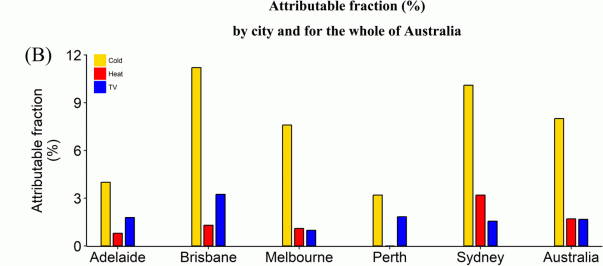
Attributable fraction of deaths: Heat, cold and temperature variability together resulted in 42,414 deaths during the study period, accounting for about 6.0% of all deaths. Most of attributable deaths were due to cold (61.4%), and noticeably, contribution from temperature variability (28.0%) was greater than that from heat (10.6%). (Cheng et al)
Heatwave mortality will increase by 444% in Sydney if the world warms by 3°C the report tells us, with no mention of the word “air-conditioning”.
If reckless spending to stop-storms-in-2100 makes energy unaffordable, heatwave mortality will increase even if the world doesn’t warm at all. No one will be able to afford air-conditioning.
The only mention of “benefits” in the whole document is that a few areas might benefit from reduced frosts — not that our expert modelers can say which areas, or which seasons that will happen in.
Like advertising, “everyone” will be better off if they just buy this weather controlling widget.
The 72-page report – released days before the government announces its emissions reduction targets for 2035 – found that no Australian community will be immune from climate risks that will be “cascading, compounding and concurrent”. — The BBC
The 274 page blockbuster has a nifty 74 page overview for anyone who only has a day or two to devote to the combinations and variations of modeled imaginary catastrophe. There’s nothing there that we haven’t seen a million times before.
Germany’s Machinery Industry Faces Catastrophic Collapse
By Thomas Kolbe | Zero Hedge | September 21, 2025
The collapse of the German economy continues unabated. The German Engineering Federation (VDMA) now expects a dramatic decline in production this year and lashes out at the federal government.
A rebound in the German economy this autumn has failed to materialize. Just a week ago, the Federal Statistical Office revised the country’s GDP decline for Q2 2025 from –0.1% to –0.3%. Now, the German machinery association follows suit with its forecast for the full year, confirming the ongoing downward trend in production: “We had previously expected a decline of 2 percent, now we anticipate minus 5 percent for 2025,”says VDMA President Bertram Kawlath, who expects production to grow by just 1 percent in 2026. Was 2025 really the trough?
Kawlath Goes Political
Kawlath warns that the industry is facing a critical moment – both economically and socially. He describes the situation as a “tipping point,” where the economy is faltering and the political center continues to erode. “If action is not taken now, voters will be pushed into the arms of the political extremes,” he cautions.
Without explicitly naming them, the VDMA chief pointed to the AfD, which recently climbed to 27 percent nationwide in Sunday polls. Remarkably, even at this stage of the crisis, where the structural damage caused by ideology-driven policies is obvious, Kawlath speaks out politically for the first time yet still refrains from naming the culprit: the Green Deal’s ecological transformation is left untouched by his critique.
Meanwhile, the “silent cartel” of business elites continues to call for cosmetic deregulation and subsidies, rather than tackling the root of the problem.
Problems Are Now Impossible to Ignore
The issues are glaring: weak orders, crushing bureaucracy, lengthy approval processes, excessive taxes and labor costs, as well as severe location disadvantages in Germany. Add to that the massive burden of U.S. tariffs: roughly 40 percent of EU machinery exports to the United States are currently hit with a 50 percent duty on the metal content. Unstable, unpredictable rules, Kawlath says, force many companies to halt exports entirely.
He calls for lower taxes and levies, reduced bureaucracy, faster approvals – and above all, a stronger defense of German industry against Chinese competition. China, he points out, has not only caught up but also heavily subsidizes its industry, distorting global competition.
Industry Collapse
The situation continues to worsen. The VDMA’s optimistic forecast for next year is likely to be revised downward as no structural improvements are in sight. Meanwhile, policymakers remain in summit mode, with reforms nowhere in evidence.
If the predicted 5 percent decline in production for 2025 materializes, it would mark the peak of a catastrophic trend. Since 2018, machinery production – and roughly speaking, the entire German industrial sector – has fallen by about 20 percent. This has consequences for employment: over 200,000 industrial jobs have been lost since 2020, 68,000 of them just last year. And this may only be the beginning of a devastating employment crisis.
These figures no longer describe an ordinary recession but the onset of an economic depression. The core of the German economy, industry, has been severely damaged by the self-inflicted energy crisis and grotesque regulatory excesses under the Green Deal. It should not be forgotten that countless service sectors, supply chains, and value chains depend directly on industry. German prosperity fundamentally derives from this sector – the very source that supports social programs and helps maintain social stability amid a worsening environment.
Machinery accounts for roughly 3 percent of Germany’s GDP. With a 27 percent share of the global market, it ranks among the heavyweights of European industry. About one million highly skilled workers earn their livelihoods here – jobs once considered secure now caught in the storm.
Production fell by 7 percent in 2024, and a further steep decline looms for 2025. Orders dropped 8 percent year-on-year, and revenue forecasts continue their downward slide.
Germany’s Industrial Base Systematically Devalued
Under these conditions, industrial production in Germany is effectively impossible. Industrial electricity prices are roughly three times higher than in the U.S., a country actively promoting its manufacturing base, cutting red tape, and selectively supporting industry.
When Lower Saxony’s SPD economy minister Olaf Lies calls for subsidized industrial electricity amid the steel crisis and complains about cheap Chinese steel, it is little more than whistling in the wind. The exodus from Germany is already underway – and it is irreversible: once companies leave, they rarely return.
The steel sector is suffering particularly badly. It ranks among the most energy-intensive branches of German industry, and its subsidized dream of “green steel” has been buried after multiple bankruptcies. From machinery to chemicals, construction to steel, the same picture emerges: Germany’s industrial decline is accelerating unchecked.
What we are witnessing is an ideology-driven, systemic failure. Even U.S. tariffs cannot fix it: the problems have accumulated over years and are homegrown. Yet Brussels and Berlin stubbornly cling to climate fanaticism, dreaming their way through the crisis.
Britain’s industrial disaster
By John Redwood | The Global Warming Policy Foundation | September 19, 2025
High energy prices, bans on making and extracting things, changed UK tariff policies and high taxes are a toxic mix. The factory and company closures are coming thick and fast, doing grave damage to the UK industrial base and losing us many jobs.
There are the pending closures of most of the bioethanol industry. It makes fuel from grains. Both the large Redcar and Hull works are at risk, and closure has begun. Bioethanol was meant to be one of the bright spots for green growth, offering a fuel that is to be gradually introduced into petrol and into aviation spirit to cut their fossil fuel dependence. E10 petrol is 10% ethanol with more to come. Sustainable aviation fuel is promised and that could also require bioethanol. The abolition of the 19% tariff on US imports has been the final blow to an industry hit by higher energy and employment costs.
These closures put at risk domestic CO2 supply as this is also produced at one of the plants. It will cut demand for wheat and grains from UK farms damaged by government tax changes. It is another set of policies undermining UK economic security and forcing us to find the money to import more. Imports mean paying the wages and taxes of overseas countries, not our own. How do we earn our living?
We have just seen the closure of two large refineries at Grangemouth and Lindsey, making us more dependent on imported fuels and oil products. The damage at Grangemouth is not over yet, with the threat that the large olefins and polymers petrochemical plant will also have to close, driven out by high energy costs. Sabic has announced its closure of another olefins plant at Wilton with the possible loss of 330 jobs.
An industrial nation needs to produce more of its own fuel and chemicals if it is to retain the businesses dependent on these basics. The UK was an important exporter of refined oil products to the EU as well as meeting more domestic demand. Taken together with closing down of our own oil and gas production which could have fed these works, we are witnessing an industrial disaster.
The ceramics industry has been in full retreat for some time. This has also been badly hit by dear energy which it needs for its kilns. This year Royal Staffordshire and Moorcroft have closed, following on from Johnson Tiles last year. Great names of a once flourishing industry are now available for foreign producers if they want to buy or licence the brands. Most of the jobs and tax revenues pass elsewhere. Wedgwood has announced this week a 90-day manufacturing pause as it has too much product for current sales levels. High costs of energy are a problem.
Nippon Electric has decided to close its large glass fibre facility in Wigan with another 250 jobs to go. Dunbar Cement says it will stop producing 700,000 tonnes a year that is needed by the construction industry owing to cost pressures. The UK is moving over to more imports of cement, just in time for the CBAM high tariff to deter imported CO2 heavy products being introduced. This will add to UK construction costs. At Birtley the aluminium extrusion plant is being shut. Three aluminium door and window manufacturers are cutting capacity. The government wants construction-led growth, but it is casually allowing the production of building materials to pass abroad, diluting the beneficial jobs effect of more building.
Jaguar Land Rover’s car output is currently halted owing to a cyber-attack. It is also the case that the car industry is struggling to sell its new emphasis on electric cars to the non-fleet buyer, and is actively closing its substantial capacity to make petrol and diesel cars ahead of the 2030 ban.
The Government needs to wake up to the reality. This is not a series of one-offs. It is not a chain of bad luck from different sources. It is the direct result of very expensive and unreliable energy, of bans on activities and of tax changes that make it dearer and less attractive to make things in the UK.
The collapse proceeds outwards from the bad decision to wind down the UK oil and gas industry prematurely and abruptly with bans and early closures, leading to the closure of petrochemicals and other feedstock dependent businesses. Dear energy lies behind the collapse of our blast furnace steel making, our glass industry, and all other energy-intensive industrial activities.
We choose instead to buy from a China that uses masses of cheap coal, and from an EU that still uses plenty of coal and gas, with some of that gas still bought from Russia. Why is the government so mad keen on imports, and so negative about UK industry? Why the bans on making petrol cars here from 2030 when elsewhere they will still be made? Why agree to the closure of the Gryphon platform in the North Sea which could still be used to bring more oil and gas ashore? Another bizarre tragedy. Can we end this self-harm? Can we go for cheaper energy and understand that using our own gas would be so much better for jobs and taxes than turning to imports? Policy is even boosting world CO2 output at the same time. We need to make more things to help pay for the NHS and get more people back to work.
Nine out of ten patients who die as a result of surgery didn’t need their operation
By Vernon Coleman | September 18, 2025
Surgical deaths in the U.K. number around 30,000 a year. In bigger countries the number is obviously higher. Some patients die because surgeons make mistakes but anaesthetic problems are a major cause of death. Changes in medical practices because of global warming (traditional anaesthetic drugs are being abandoned in a bizarre attempt by doctors to save the planet from a none existent threat) will mean the number dying on the operating table, or immediately afterwards, will go up.
The risks of surgery are dramatically underestimated and vary, of course, according to the age and general health of the patient and the difficulty of the operation. On the whole longer ops mean more risk.
All this is important because nine out ten operations are done to improve life rather than to save it.
This means that 90% of the people who die as a result of surgery didn’t need their operation.
Little research has been done to find out if those optional operations actually do improve patients’ lives.
All this may be worth considering if you’re contemplating surgery which isn’t necessary to save your life.
Brussels bureaucrats are running around like panicked chickens – Orban
RT | September 21, 2025
Hungarian Prime Minister Viktor Orban has slammed Brussels, accusing the EU leadership of mismanaging key areas such as the economy, immigration, and security.
In a critical speech at Digital Civic Circles, a network of digital groups promoting conservative values in Hungary, he claimed the bloc was on the brink of collapse due to the failures of its current leaders.
The prime minister painted a stark picture of “mountains of debt, crowds of migrants, street violence, the increasingly dark shadow of war, mass layoffs, skyrocketing utility costs, impoverished households, and Brussels bureaucrats running around like panicked chickens,” on Saturday while describing the EU’s troubles.
According to Orban, the EU has fallen short of establishing itself as a credible global power. Instead of rising to meet these challenges, the bloc has become a symbol of weakness, indecision, and internal chaos, he said.
He criticized what he called the “tragic” trade deal with the US signed by European Commission President Ursula von der Leyen, adding that the EU’s green policies are “killing European industry.” Energy prices, Orban noted, are “three to four times higher” than in the US, while countries like France are edging toward unsustainable debt levels.
“Europe, as we knew and loved it, is over,” Orban warned. “If we deny this, we lose time. If we say it out loud, we gain time.”
The politician contrasted Budapest’s own approach with that of Brussels, pointing to stricter migration controls, a family policy tied to employment, and a tax system that, he said, supports jobseekers.
Orban’s criticism, while sharply worded, taps into broader concerns which have been echoed by economists and analysts. Experts from the International Monetary Fund and other institutions have warned that the EU risks long-term stagnation.
The IMF projects euro-area growth at just 0.8% in 2025 and 1.2% in 2026, while public debt remains near 90% of GDP and deficits continue to exceed 3%, well above pre-pandemic levels.
Germany Faces Challenging Winter Of Power Outages As Energy Supply Struggles
By P Gosselin | No Tricks Zone | September 17, 2025
The head of transmission system operator Amprion, Christoph Müller, warns that Germany’s energy supply is facing a challenging winter due to a lack of power plant capacity as the nuclear and planned coal continue to get phased out. This could lead to targeted power outages and soaring electricity prices, he warns.
Müller paints a serious picture: in a scenario where energy demand outstrips supply, pre-defined groups could experience power cuts lasting around 90 minutes. This is not only a concern for the industrial sector; but it would mean hospitals relying on emergency generators, supermarkets closing their doors, and homes going without power. This is the stage that Germany’s energy supply has deteriorated to.
The crisis highlights a significant gap in Germany’s energy strategy. Müller argues that new, flexible gas-fired power plants are essential to maintain grid stability and prevent a supply shortfall. He expresses serious doubts about the feasibility of the coal phase-out by its 2028 deadline, citing the lack of viable alternatives.
While he dismisses nuclear power as a solution due to its long construction timeline, the overall message is clear: without immediate and massive investment in new power sources, Germany’s energy transition is at risk.
Grid under immense strain
Müller’s assessment is grim and unfortunately realistic. While he doesn’t anticipate a nationwide blackout, he warns that the grid is under immense pressure. The next two winters may be manageable, but the long-term outlook is one where blackouts, rising electricity prices, and a stalled energy transition could become the new reality.
Hat-tip: Blackout News here.
In ASEAN Nations, Coal Is a Physical Manifestation of Progress
By Vijay Jayaraj | Real Clear Markets | September 9, 2025
When most people think of ASEAN – a diverse association of Southeast Asian nations that include Brunei, Cambodia, Indonesia, Laos, Malaysia, Myanmar, the Philippines, Singapore, Thailand, and Vietnam – they picture Thailand’s beaches, Singapore’s gleaming skyline or Indonesia’s temples.
What they don’t see is an economic juggernaut that will drive some of the planet’s largest growth in energy demand. Vietnam has emerged as a global manufacturing hub. Indonesia processes the world’s nickel for electric vehicle batteries. Thailand manufactures automobiles for export across Asia. Each of these economic engines demands reliable, affordable electricity that operates 24 hours a day, seven days a week.
In fact, 2023 witnessed a demand increase of nearly 45 terawatt-hours (TWh), an amount of energy that must be generated, transmitted regionally, and delivered locally on a continual basis. Where did this new power come from? Coal. An astonishing 96% of that new demand was met by coal-fired power plants.
Let that sink in. Coal, the energy source routinely demonized in Western capitals and at global climate summits, met nearly all the region’s new electricity needs. This reality stands in direct contradiction to rosy predictions of a transition to “renewables” manufactured by highly compensated executives at elite consulting firms who have spent the better part of a decade selling energy fairy tales to governments and investors.
Indonesia alone added 11 TWh of coal-generated electricity in 2023, while its electricity demand rose by 17 TWh, with coal meeting two-thirds of this increase. The Philippines generates more than 60% of its electricity from coal, and Malaysia and Vietnam each around 50%.
Ultra-supercritical coal technology – using extraordinarily high temperatures and pressures and pioneered at Malaysia’s Manjung plant and Indonesia’s Batang facility, delivers higher efficiency than older coal plants. These advanced facilities demonstrate that coal technology continues to improve while wind and solar remain dependent on weather conditions and the time of day.
The wind and solar share across ASEAN remained a pitiful 4.5% in 2023. This minuscule contribution exposes the bankruptcy of consultants’ promises of “renewables” dominating the regional power mix by mid-2020s.
Coal’s dominance in recent years is not an accident; it is a necessity. Indonesia, the region’s economic giant, leans on coal to power its export-driven industries, including nickel for EV batteries. Vietnam’s manufacturing boom, lifting millions into the middle class, runs on coal’s steady output. Malaysia and the Philippines, too, rely on coal to sustain their growing economies. Even Singapore, a global hub of innovation, depends on coal to maintain its energy security.
Yet, to focus solely on the power grid is to miss the forest for the trees, as electricity is just one component of total energy consumption. Electricity represents only a fraction of total consumption across ASEAN. The larger picture is primary energy consumption, which includes fuel for transport, industry and heating.
Oil, natural gas and coal collectively hold the major share of ASEAN’s primary energy mix, with oil leading consumption patterns across transportation and industrial sectors. Factories, petrochemicals, shipping, aviation, and agriculture all consume fossil fuels in large quantities.
ASEAN countries are committing hundreds of billions of dollars to fossil fuel infrastructure that will operate for decades. Coal plants have an average lifespan of 40 years. These capital investments create long-term commitments to hydrocarbon use that extend far beyond current political cycles.
Nineteen projects across Malaysia, Vietnam, Brunei, Indonesia, and Myanmar hold more than 540 billion cubic meters of recoverable gas. Countries don’t spend billions developing gas fields if they plan to abandon fossil fuels within the next decade.
ASEAN’s embrace of coal is about more than just keeping the lights on. These nations aren’t chasing arbitrary climate targets; they’re building the infrastructure of their future and prosperity for people.
Every new airport, every new highway and every new factory is a testament to the power of coal. To argue against coal is to oppose the physical manifestations of progress. The “green” agenda, by seeking to eliminate coal, demands that the developing world stop building – an ultimatum that ASEAN is rightly and wisely ignoring.
Lion Electric School Buses Still Catching Fire
StacheD Training | September 9, 2025
On September 9, 2025, another Lion Electric school bus burst into flames in Montreal — this time with five children and their driver on board. Thankfully, everyone escaped safely, but this marks the third Lion Electric bus fire in less than a year (Ascot Corner, Huntsville, and now Montreal).
In this video, I break down what happened, why the fire department’s explanation doesn’t quite line up with the bus’s construction, and why these repeated incidents raise serious questions about safety, accountability, and taxpayer funding. Lion has already taken nearly $160 million in U.S. funding for 435 buses, yet many districts never received vehicles — and the ones that did are stuck with broken, unsafe buses and voided warranties.
Are these buses ready for prime time, or is this a dangerous rush to electrify at any cost?
Training & Consulting: https://www.stachedtraining.com
Gates-Funded Self-Assembling Microcrystal Implants Mark a New Phase in Population Control
By Nicolas Hulscher, MPH | FOCAL POINTS | April 25, 2025
A new study published in Nature Chemical Engineering titled “Self-aggregating long-acting injectable microcrystals” reveals Bill Gates’s latest investment. As expected, this “innovation” does not improve the health of humanity by any means, but instead seeks to further reduce already-collapsing birth rates.
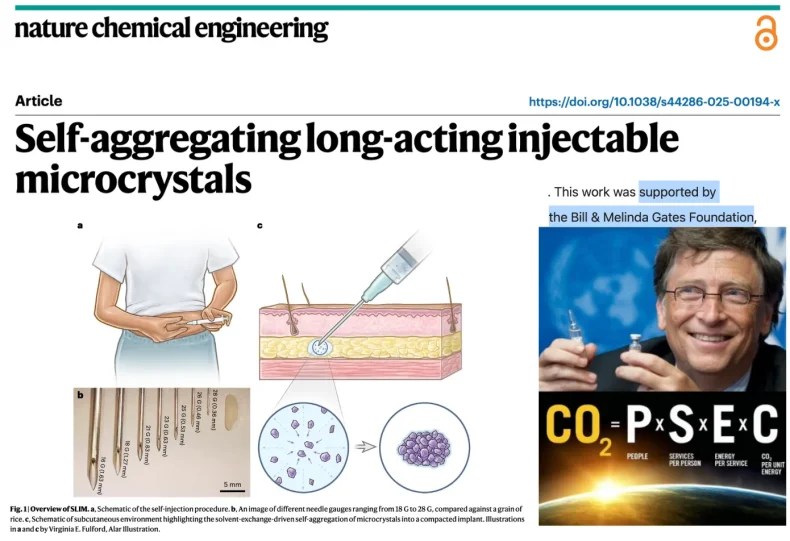
The technology, dubbed SLIM (Self-aggregating Long-acting Injectable Microcrystals), enables the self injection of microcrystals that self-assemble into a semi-permanent drug implant. The implant slowly releases synthetic hormones like levonorgestrel—a potent contraceptive—over months to years.
While the study frames SLIM as a step forward in medical innovation, closer inspection reveals grave concerns:
- Irreversible implants: Once injected, the microcrystals self-assemble into a dense, solid mass deep in subcutaneous tissue. The study provides no method for removal, raising the possibility that these implants are effectively permanent, particularly in low-resource settings without surgical infrastructure.
- Unknown long-term effects: In rats, the solid implant remained intact for at least 97 days—the full length of the study. In humans, where metabolism is slower and tissue clearance is more complex, these structures could persist for years with unknown consequences.
Widely available, extremely long-lasting anti-fertility implants are a dream come true for depopulationists. Bill Gates, the funder of this study, publicly revealed his preference for reducing the population by 10-15% in order to “get CO₂ to zero.”
“First we’ve got population. The world today has 6.8 billion people, that’s headed up to about 9 billion. Now, if we do a really great job on new vaccines, healthcare, reproductive health services, we could lower that by perhaps 10-15%” – Bill Gates at TED2010
The Gates Foundation also funded a study that was published last year titled “Global fertility in 204 countries and territories, 1950–2021, with forecasts to 2100: a comprehensive demographic analysis for the Global Burden of Disease Study 2021.” They estimated irreversible population collapse within the next few decades:
By 2050, over three-quarters (155 of 204) of countries will not have high enough fertility rates to sustain population size over time; this will increase to 97% of countries (198 of 204) by 2100.
Let’s get this straight: The same foundation that acknowledges an inevitable population collapse—without any intervention—is simultaneously funding invasive technologies that would only accelerate it:

We need to reverse the major decline in birth rates to preserve civilization. A few months ago, I identified some key targets:
A study by Aitken found that fertility rate declines are driven by both short- and long-term factors. In the short term, socioeconomic drivers like urbanization and delayed childbearing, as well as issues such as obesity, falling sperm counts, and environmental toxicants (e.g., pollutants, nanoplastics, and electromagnetic radiation), compromise reproductive health. Long-term factors include reduced selection pressure on high-fertility genes due to smaller family sizes and the widespread use of assisted reproductive technologies, which may perpetuate poor fertility genotypes in the population. Addressing these issues is essential to mitigating the ongoing fertility crisis.
Green Energy Wall Coming Into Focus In New York?
By Francis Menton | Manhattan Contrarian | August 17, 2025
It was back in 2021 that I started to ask which country or U.S. state would be the first to hit the “Green Energy Wall.” It has long been obvious to anyone who looks at the situation that the fantasy of a fully de-carbonized energy system, with everything run on electricity generated by intermittent wind and sun, could never happen.
But what would be the limiting condition that would put a stop to the madness? Would it be confronting the absurd costs of grid-scale battery storage? Or perhaps a string of blackouts caused by insufficient backup of the wind and solar generation?
Here in New York, we are starting to see some push back from politicians on the fantasy green energy transition, but the source may be the last thing you would have predicted. The immediate issue is the cost of upgrading local delivery infrastructure to transmit sufficient electricity for the imagined future of electrified buildings and vehicles.
Supposedly, under a statute known as the Climate Leadership and Community Protection Act of 2019, we are faced with a 2030 deadline to get some 70% of our electricity from “renewables.” Currently the percent of our electricity that we get from these “renewables” is around 44%, and almost half of that comes from the gigantic waterfall known as Niagara Falls. Without another Niagara Falls on the horizon, theoretically we should be building vast fields of wind turbines and solar panels to meet the statutory mandates; but that effort has stalled out, and the costs of wind and solar generation, and of backup to make the grid run all the time, have barely started to show up in consumer bills. Nor have various big new long-distance transmission projects yet come into consumer bills.
But meanwhile, the big utilities have come forward with large demands for rate increases. So why the need for big rate increases if not from new generators or long-distance transmission? The answer is that the rate increases mainly relate to the portion of the consumer bills referred to as the “delivery” charge, as opposed to the charge for generation. The utilities seek funds to add delivery infrastructure like substations, transformers, and cables to deliver vastly increased amounts of electricity for things like vehicle charging stations (for both cars and trucks) and for the electrification of building heat.
In upstate New York, a utility called National Grid has been petitioning the regulator for a large electricity rate increase, mostly to support these kinds of upgrades to the delivery infrastructure. The service territory of National Grid in upstate New York covers the region between about Syracuse and Albany, and from there North to the Canadian border. After prolonged negotiations, the regulator (Public Service Commission) and National Grid entered into a “settlement” a few days ago on August 14. Here is the PSC release describing the settlement. Basically, the PSC congratulates itself on beating back a much larger rate increase originally sought by National Grid. (The headline is “PSC Dramatically Reduces National Grid’s Rate Request.”). But if you read on you find that they still agreed to a very large increase. The release makes clear that most of the increase relates to the delivery infrastructure:
National Grid had sought a base delivery increase of $509.6 million (25.5 percent delivery or 10.4 percent total revenue) and $156.5 million (29.7 percent delivery or 15.7 percent total revenue) for electric and gas, respectively for one year. Instead, the Commission adopted a joint proposal establishing levelized increases, on a percentage basis, to the company’s electric revenues of $167.3 million in the first year, $297.4 million in the second year, and $243.4 million in the third year.
Basically, they spread NG’s requested increase out over three years; but it still comes to almost a 30% jump on the delivery side by the time it all kicks in.
Governor Hochul then issued a release expressing extreme displeasure:
While I appreciate that the New York Public Service Commission worked to significantly lower the outrageously high initial rate proposals, it’s still not enough. I have been crystal clear that utilities must make ratepayer affordability the priority.
Well, Governor Hochul, good luck trying to blame the utility, but you are the one with all the electric vehicle mandates and incentives and subsidies, thus calling on the utility to provide all this new infrastructure. In all likelihood few will ever buy the electric vehicles, and nobody will ever generate the extra electricity from wind and sun, and thus this infrastructure will mostly be wasted. But can the utility just refuse to make itself ready to meet your ridiculous mandate?
And meanwhile down here in New York City, our utility Con Edison is requesting almost as large a rate increase, again focused on the delivery portion of the bill, and on local infrastructure upgrades necessary to support increased electricity demand. In the City, the increased demand is anticipated to come both from electric vehicles (per the state mandates) and from building electrification (based on a City building electrification mandate known as Local Law 97). It is likely that the result of the Con Edison rate proceeding will be a settlement agreement comparable to what occurred in the National Grid case a few days ago.
I am an intervenor in this Con Edison rate case, and in recent days I have actually been personally participating — in a minor way — in the settlement negotiations. My co-intervenors and I are objecting to any rate increases based on adding infrastructure to support building and vehicle electrification unless and until the additional electricity generation capacity has been built to support these mandates. (There is no chance that this additional capacity, supposedly wind and solar generators, will actually be built.)
The New York Post has a lead editorial today summarizing how the green energy madness is coming around to bite New Yorkers in their pocketbooks. Excerpt:
New York’s state Public Service Commission just OK’d big National Grid rate increases that’ll hike many upstate utility bills by $600 a year — fueling outrage Democrats will soon feel. Downstate, Con Edison is seeking an 11.4% hike to electric bills and 13.3% gas hike — largely thanks to green-energy mandates that Gov. Kathy Hochul embraced along with the rest of the party. The “climate agenda” is delivering pain we’ve long warned of, in New York and New Jersey.
If we ever get to the point of building dozens of gigawatts of wind and solar generation capacity, and enough backup and storage to make them work to support a grid, that would cause electricity rates to multiply by a factor of five or ten or more. We are a long way from that. But here we are just trying to add enough substations and transformers to support 30-50% vehicle electrification, and a comparable amount of building electrification, and it is causing politicians to start to scream. How much more of this will it take before we quit?
Jurij Kofner: Europe Enters Century of Humiliation?
Glenn Diesen | August 20, 2025
Jurij Kofner is an economist and an economic policy advisor to AfD. Kofner discusses the de-industrialisation and economic decline in Germany, and the wider socio-economic and political challenges that continue to threaten the relevance of Europe.
India Cancels Offshore Wind Tender–Due To Lack Of Interest
By Paul Homewood | Not A Lot Of People Know That | August 13, 2025
Now India is losing interest in offshore wind.
Renewablesnow report:
The Indian government has cancelled the process to allocate sea-bed lease rights for a total of 4,500 MW of offshore wind projects, it was announced on Tuesday.
While SECI itself did not state a reason for the decision in its announcement, The Economic Times quoted two sources as saying that there was a lack of interest among project developers. …
This follows Trump’s US move away from offshore wind and the lack of bidders at Germany’s offshore auction last week.
Meanwhile Orsted have had to launch a massive $9.4 billion Share Rights Issue, largely because of huge losses on offshore wind projects.
It seems that it is only the UK where anybody wants to build wind farms at sea, but only because of the obscene subsidies on offer.
Featured Video

Israelis SUDDENLY Mass Deported From Many Countries
or go to
Aletho News Archives – Video-Images
From the Archives
Elite Western universities are a corrupt, parasitic empire
Instead of high-quality education, these institutions are fostering a global neo-feudal system reminiscent of the British Raj
By Dr. Mathew Maavak | RT | May 30, 2025
In a move that has ignited a global uproar, US President Donald Trump banned international students from Harvard University, citing “national security” and ideological infiltration. The decision, which has been widely condemned by academics and foreign governments alike, apparently threatens to undermine America’s “intellectual leadership and soft power.” At stake is not just Harvard’s global appeal, but the very premise of open academic exchange that has long defined elite higher education in the US.
But exactly how ‘open’ is Harvard’s admissions process? Every year, highly qualified students – many with top-tier SAT or GMAT test scores – are rejected, often with little explanation. Critics argue that behind the prestigious Ivy League brand lies an opaque system shaped by legacy preferences, DEI imperatives, geopolitical interests, and outright bribes. George Soros, for instance, once pledged $1 billion to open up elite university admissions to drones who would read from his Open Society script.
China’s swift condemnation of Trump’s policy added a layer of geopolitical irony to the debate. Why would Beijing feign concern for “America’s international standing” amid a bitter trade war? The international standing of US universities has long been tarnished by a woke psychosis which spread like cancer to all branches of the government.
So, what was behind China’s latest gripe? ... continue
Blog Roll
Recent Comments
loongtip on Report warns that ‘Jewish terr… Craig Nelms on New study shows that toxic gas… loongtip on A Funny Thing Happened on the… loongtip on EU free trade pact on hold as… John Edward Kendrick on Regime Change In Iran Is The F… Bill Francis on Australia Passes New Hate Spee… seversonebcfb985d9 on Australia Passes New Hate Spee… Bill Francis on Britain’s AI Policing Plan Tur… loongtip on Miami Beach Resident Questione… loongtip on Israeli agricultural export co… loongtip on The War On Free Speech In Aust… seversonebcfb985d9 on Scott Ritter Hiding the Domina…


 Aletho News
- Jordan using Israeli software to monitor journalists, rights defenders: Report
- Israelis SUDDENLY Mass Deported From Many Countries
- Peace Plan Phase 2 Without Phase 1: Can the US Really Bring Peace to Gaza?
- Hamas: Netanyahu’s inclusion in ‘peace council’ threatens justice
- Report warns that ‘Jewish terrorism is out of control’ and could lead to major security escalation
- Lebanese Resistance will inevitably triumph: Former President Lahoud
- Iran: The Eurasian Lock
- Russian gas exports to China soar – data
- France seizes tanker ‘coming from Russia’
- European leaders’ shift in their Davos addresses exposes Europe’s strategic anxiety
- If Americans Knew
- War criminal Netanyahu kills 11 in Gaza, joins Board of Peace – Not a ceasefire Day 104
- Another baby dies of cold in Gaza, as Rafah crossing remains locked down – Not a ceasefire Day 103
- Brutal Beatings, Arson, and Impunity: A Palestinian Plant Nursery Becomes a Target for Settler Pogroms
- On Iran’s protests, Israeli hypocrisy knows no limits
- A Cease-fire for Israelis and a War for Palestinians
- ‘When will Baba come back?’ Gaza’s widows and orphans struggle to survive
- Genocide research institute levels accusations against Germany for denying Israel’s genocide against Palestinians
- Over 1,200 Israeli truce violations in Gaza – Not a ceasefire Day 102
- Trump has created a monster: Gaza Board of Peace – Not a ceasefire Day 101
- As world leaders squabble over controlling Gaza, another baby freezes to death – Not a ceasefire Day 100
- No Tricks Zone
- New Study: Sea Levels Rose 20 Times The Modern Rate During The Roman Warm Period
- As German Gas Storage Dips Dangerously Low…Shortage Hardly Avoidable
- New Study: Brazil’s Relative Sea Level Was 2+ Meters Higher And SSTs 3-4°C Warmer 6000 Years Ago
- Philosopher Schopenhauer: Climate Science Certainty Stems From Stupidity, Ignorance
- New Study: Species Extinction Rates Declining Since 1980 – ‘Climate Change Is Not An Important Threat’
- Denmark Places Climate Protection Above Animal Welfare, Poisoning And Culling Cows
- New Study: Greenland Was 3-7°C Warmer And Far Less Glaciated Than Today 6000-8000 Years Ago
- German Media Report That Current Frigid Weather Can Be Explained By Arctic Warming!
- Berlin Blackout Shows Germany’s $5 Trillion Green Scheme Is “Left-Green Ideological Pipe Dream”
- Modeling Error In Estimating How Clouds Affect Climate Is 8700% Larger Than Alleged CO2 Forcing
 Aletho News