Moscow Sees No Progress on Deal on Exports of Russian Agricultural Products – Ambassador
Samizdat – 13.01.2023
ANKARA – There is no progress in the implementation of the Memorandum of Understanding between Russia and the United Nations on promoting Russian food products and fertilizers to the world markets, Russian Ambassador in Turkey Aleksei Erkhov said on Friday.
“As of today, 17 million tons of Ukrainian grain have been exported. However, we still observe distortions in the geographic distribution of recipients of Ukrainian food products. The situation with our products does not inspire optimism either. There is no progress in the implementation of the Memorandum of Understanding between Russia and the UN on normalization of Russia’s agricultural export,” Erkhov said, as quoted by the Yeni Safak newspaper.
The ambassador also said that Russian producers of agricultural products and suppliers are still facing the blocking of payments via banks, high insurance rates, and limited access to sea ports.
The diplomat went on to say that Latvia, Estonia and Belgium were continuing to hold Russian agricultural products in ports, while Kiev had been blocking the export of ammonia supplies.
“There are delays even in the free delivery of Russian fertilizers to low-income countries. A small part of the cargo has departed from the Netherlands to Malawi. Latvia, Estonia and Belgium are continuing to hold our products in ports. The delivery of ammonia raw materials for the production of fertilizers from the Yuzhnoe port has not started, and the resumption of ammonia supplies is being blocked by Kiev only,” Erkhov added, as quoted by the newspaper.
The ambassador noted that the amount of detained products would be enough to provide 200 million people with food for a year.
On July 22, the deal brokered by Turkey and the United Nations was signed by Ukraine and Russia to unblock shipments of grain, food and fertilizer in the Black Sea despite hostilities. The agreement was initially set to expire on November 19, with a possibility of extension if signatories consent. It was extended for 120 days on November 17.
Russian President Vladimir Putin has repeatedly said that most vessels carrying Ukrainian grain do not reach the world’s poorest countries and have ended up in Europe. Putin has also voiced concerns that Russian grain and fertilizer products are not entering the global markets as stipulated by the agreement.
EPA And The Electricity Cost Crisis
By Francis Menton | Manhattan Contrarian | January 3, 2023
Over in Europe, the energy cost crisis, particularly as to electricity, proceeds apace.
Germany, deep into its Energiewende (energy transition) that began in 2010, leads the way. Almost all coal and nuclear power plants have been closed in favor of a massive building plan for wind and solar facilities. After a decade of that, for the past couple of years, Germans have suffered consumer retail electricity prices of over 30 euro cents per kWh — close to triple average U.S. consumer rates. On November 25, a German news source called The Local (behind pay wall) quoted an energy market expert named Mirko Scholssarczyk for the proposition that “40 cents per kilowatt-hour was likely to be the new normal in 2023 and 2024, and that prices could even rise to 50 cents per kilowatt-hour after that.” Meanwhile, my own post from December 24 cited data from a Belgian think tank called Brueghel showing that Germany was in the process of spending some 260 billion euros, around an astonishing 7% of GDP, to subsidize consumers to keep their electricity bills from going beyond even these ridiculously high levels.
The UK, second after Germany in its rush to what they call “Net Zero,” has its own associated energy cost crisis. The basic policy prescription is the same as in Germany — massive building of wind and solar facilities and suppression of fossil fuels. Although consumer bills are capped by regulation, they went in October to a level approximately three times where they had been a year previously; and they were set to rise again in April, to some five times the previous level, although that may now be temporarily headed off by the UK’s own round of massive taxpayer handouts in the range of a hundred billion pounds or more.
Can we here in the USA learn anything from this folly before it is too late? The answer is, if it is up to our EPA, then no.
Readers may be interested in some back and forth on this topic that has recently occurred in the briefing in the case of Concerned Household Electricity Consumers Council v. EPA, pending in the Court of Appeals for the DC Circuit. CHECC is demanding that EPA reconsider the so-called Endangerment Finding of 2009, which is the bureaucratic edict by which those geniuses claimed to determine that CO2 and certain other “greenhouse gases” constitute a “danger” to human health and safety. The Endangerment Finding is the regulatory linchpin that underlies all U.S. government efforts to suppress fossil fuel infrastructure, whether power plants, pipelines, drilling, or anything else. You may recall that I am one of the lawyers for CHECC in this matter.
One of the things that you need to show to bring one of these cases is that the party you represent has what they call “standing.” That means that the party bringing the claim has or will suffer some concrete injury from the regulatory action in question. That’s why our client is a council consisting of electricity consumers. As we state in our Petition and in our Brief, “Each of CHECC’s members is a U.S. citizen and a member of a household that pays electricity bills.”
To demonstrate the effect on consumer electricity bills of the policy mix of wind and solar expansion plus fossil fuel suppression, we cite and describe the experience of Germany. Excerpt, from page 31 of the Brief:
In Europe, Germany began converting to renewables in 2010, and by 2015 30% of its electricity was from wind and solar. . . . The average German household’s electricity rate in 2021 was 32.16 cents per kWh, about triple the average U.S. rate. . . .
So what’s the answer to that, EPA? EPA filed its responsive Brief on December 20. From pages 20-21 of that Brief:
Petitioners’ extended discussion of electricity costs in Germany — involving a different country, market, currency, and regulatory regime — does not aid their efforts [to demonstrate standing]. . . . There is no effort to show that Petitioners or their members suffer “injury-in-fact” from electricity rates in Germany, or that any U.S. regulation (let alone the 2009 Finding or Denial) affected those rates.
That’s it. Hey, it’s a “different country”! Electricity prices in Germany don’t hurt you. Thus, says EPA, nobody has “standing” to challenge our Endangerment Finding.
I guess there’s just no way of knowing whether the hundreds of billions of dollars worth of damage being wreaked in Germany have anything to do with the forced energy transition. Anyway, it’s none of EPA’s business to try to figure that out. They are way too busy saving the planet.
Could the DC Circuit — supposedly one of our premier courts — fall for something this blindly ignorant? We shall see. Of note is that the “standing” question can be an easy way for a court to get rid of a tricky case without having to do the hard work of grappling with the merits.
UK businesses to see energy bills soar as government cuts subsidy to firms by 85%
Press TV – January 10, 2023
The UK government is set to scrap the energy subsidies for businesses in the next financial year by 85 percent, leaving small businesses in a dire economic situation, as the cost-of-living crisis squeezes Britons’ lives.
British businesses will see their energy bills soar from April after the government announced the stoppage of the current bills support scheme for firms at the end of March when the price caps for energy bills will expire.
Describing the current level of support as “unsustainably expensive”, the government has decided to reduce the support rate from £18bn to £5.5bn in the planned six-month period.
Speaking to the House of Commons on Monday, Treasury Minister James Cartlidge was at pains to confirm that: “It is not sustainable for the exchequer to continue to support large numbers of businesses at the current level.”
“No responsible, serious government anywhere in the world can permanently shield businesses from this energy price shock,” Cartlidge said, acknowledging the soaring energy costs across the country.
Cartlidge also insisted it was necessary to “cap the taxpayer’s exposure to volatile energy prices” rather than providing open-ended support.
According to the government’s own calculations, a typical pub will see its bills rise by almost £3,000 a month when the new scheme takes effect, while a small shop would pay more than £450 a month, as an increase to its energy bills.
As Prime Minister Rishi Sunak is trying to restore fiscal credibility following the economic shock across the country, manufacturers say they may need to cut jobs and production due to rising energy costs.
Martin McTague, national chair of the Federation of Small Businesses, criticized the government’s new plan and said the reduction in help is a “huge disappointment”.
“This is so out of touch,” McTague said in an e-mailed statement. “The government will inevitably have to come back.”
The cost-of-living crisis across the UK has brought the industries and labor forces under intense pressure, prompting tens of industrial actions over payment disputes each month.
Moreover, the worst impact of the cost-of-living crisis is yet to hit the already struggling Britons, a leading think tank has said, warning that families across the UK have only experienced half of the lost income they are expected to suffer during 2023.
The Net Zero death cult taking over ‘our’ NHS
By Stephen McMurray | TCW Defending Freedom | January 3, 2023
The climate change cult is insidious in every government department or institution it infiltrates. However, it is at its most dangerous when those people it infects are members of the medical community. When their apocalyptic hysteria starts affecting their decisions regarding patient care, urgent action is needed.
A disturbing document was recently published in the Lancet, entitled The Report of the Lancet Commission on the Value of Death: bringing death back into life. It was written by numerous medical professionals in the palliative care sector. It is nothing less than a propaganda piece promoting the idea that people who are suffering from possible life-shortening illness should not be given any potential life-saving treatments but, to help reduce our carbon footprint, should be allowed to die and actively encouraged to do so.
The authors make their feelings clear when they say: ‘The commission believes it is healthy to die . . . We are embodied creatures who are ultimately no more important than lizards or potatoes.’
It soon becomes obvious that their Net Zero zeal is driving this agenda when they state: ‘Treatment at the end of life will be an important contribution to the carbon footprint of health care . . . Everything, and especially death, must be thought of in the context of the climate crisis . . . In the report we explore the many values of death.’
The article is replete with climate change apocalyptic rhetoric, saying humanity is near extinction, one of the reasons being overpopulation, so we had better change our ways and stop trying to cure patients with potentially fatal illnesses and let them die.
As is common with the climate change cult, the document is replete with extreme left-wing ideology, promulgating the idea that expecting to be treated in hospital with life-prolonging drugs is a concept founded in racism. As only rich Westerners can afford proper health care, it is an example of a colonialist mindset and to achieve equity we should abandon this idea and die willingly like poor people in less developed countries.
Throughout the report they state how important it is to die at home surrounded by friends and family rather than in a hospital bed. This is not out of compassion but out of their desire to reduce the carbon footprint of end-of-life medication. The same medical profession that ardently supported the closure of hospitals to relatives of dying patients during Covid now pretend to advocate for having loved ones at the dying patient’s bedside. Their hypocrisy is breathtaking.
The authors also have the temerity to infuse the document with references to religious practices and spirituality to convince the reader that death is nothing to fear and that, by medicalising it, we are not having our spiritual and emotional needs met. If this was coming from the head of a religious institution it would possibly be understandable, but this is from a medical establishment who vehemently adhere to the reductionist view that our bodies are mere machines of flesh and bone.
When extolling the virtues of other religions’ treatment of the dying, the report cites a ritual practised by some Indian sects, which ‘entails a person coming to the realisation that they have no responsibilities or desires left. With the consent of religious elders, the person enters a slow process of fasting, where they give up one item of food a time, so that hunger pangs are tolerable. Over a few weeks or months, the person dies, often amid chants’.
Here the commission are implying that once you have supposedly nothing left to offer society, it is perfectly reasonable to want to die. Moreover, they don’t object to the cruel method of causing death by slow starvation. One can only assume that the relatives of those who have starved to death in our own NHS hospitals would be outraged by this callousness.
The document encourages carers to implant a sense of hopelessness in their patients so they more readily accept the idea of dying. ‘There is evidence that the will to live can keep people alive. But the tyranny of “positive thinking” can lead to ambivalence, guilt, and bad decisions . . . Hope increases the likelihood that people will believe that their illness is less serious than objective data might support, allowing patients to hold on to a low possibility of a favourable outcome and disregard the much greater probability of an unfavourable outcome.’ Clinicians sometimes ‘recommend additional treatments as a way for the patient to maintain hope, despite the clinical futility’.
What if treatment is not futile? Cases where patients are wrongly diagnosed with a terminal illness do occur. If we have learned one thing from the Covid era, it is that medical experts are far from infallible.
Their obsession with Net Zero and their disdain for human life is even focused on the patient after death: ‘While the dead consume no carbon, the disposal of bodies does. About three quarters of people in Britain are cremated after death, releasing carbon into the air. Alkaline hydrolysis, in which the body is dissolved, has about a seventh of the carbon footprint of cremation, and the resulting fluid can be used as fertiliser.’
The writers try to justify withholding treatments from patients who are potentially dying by saying the money could be better spent on treating others. This is totally disingenuous. Given vast sums of money for patient care, the NHS chose to spend it instead on pursuing the climate cult’s agenda of Net Zero.
They are going to spend £492million on changing all NHS light bulbs into LED ones. To put that into perspective, take the current outbreak of Streptococcus A infections spreading amongst children. We are being told there is not enough penicillin to go around. The cost of a 14-day course of amoxicillin is £0.18. There are approximately 12.7million under-16s in the UK. Therefore, it would cost under £2.5million to make sure there is enough antibiotics available to protect the entire childhood population.
It will come as no surprise that the report is in favour of legalising ‘assisted dying’. One of its main authors, Richard Smith, chairs the UK Health Alliance on Climate Change. In 2017 he wrote an article in the British Medical Journal which began: ‘We should accept that humanity is dying and switch from cure to palliation – just as wise patients do at the end of their lives.’ Smith agrees with another palliative care physician who finds ‘acceptance of our mortality, unimportance, ephemeral nature, infinite ignorance, and futility to be very liberating’. Do we really want people who suffer from existential nihilism and think human life is unimportant and futile, treating anyone, let alone people who may be dying?
The fact that the climate hysteria with its accompanying left-wing, extremist ideology has infected the NHS could have serious consequences for people with potentially life-shortening illnesses. What criteria would the doctors use to decide which patients, if any, are worthy of receiving treatment? Would their decision be based solely on medical grounds or their ideology?
Most people who are diagnosed as being near the end of life are the older generation. It is exactly this demographic that the eco-zealots blame for the so-called climate crisis. What if the doctor or nurse was so indoctrinated by the climate crisis propaganda that their decision to withdraw treatment was based on their radical views rather than purely medical reasons?
Last April, an Extinction Rebellion activist called for the baby boomer generation to be euthanised. A sick joke, maybe, but the UK Health Alliance for Climate Change which is promoting this agenda acknowledges it works with Doctors for Extinction Rebellion.
The Lancet report highlights how deeply the Net Zero cult has infiltrated our health system. The obsession with reducing our carbon footprint is now such an integral part of many medical professionals’ mindset that they openly promote death as a healthy outcome. Do we really want anyone who thinks human life is unimportant and futile, least of all doctors in whom we are meant to put our trust, treating anyone, let alone those who may be dying? Surely such declared inhumane intent, running directly counter to the Hippocratic Oath, should automatically be grounds for being struck off by the General Medical Council.
America’s War
De-patterning and Re-patterning the West
By Douglas Farrow | Desiring a Better Country | December 31, 2022
In 2002, with a little help from National Defence, we brought to McGill the (then) president of the Club of Rome, Prince Hassan, who made a contribution to the Pluralism, Religion, and Public Policy conference I was co-chairing and to the book that came out of it, Recognizing Religion in a Secular Society. Our then chief justice, Beverley McLachlin, also made a contribution. Through another keynote speaker, Richard John Neuhaus, I afterward had the privilege of becoming acquainted with Avery Dulles, one of America’s best theologians and a very fine man.
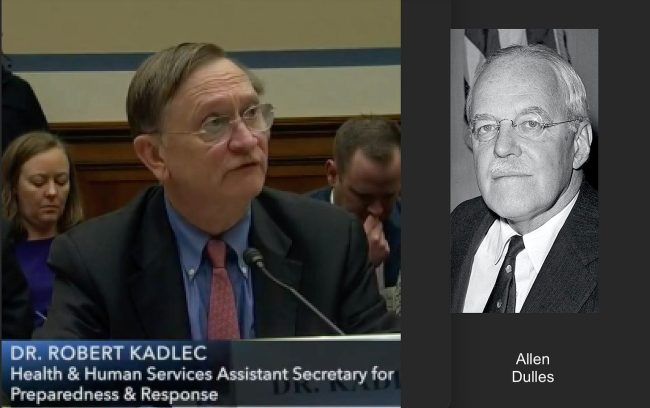
This fine man, the late Cardinal Dulles, was a convert to Catholicism, a religion now undergoing a de-patterning and re-patterning experiment I have begun describing elsewhere. With the death this morning of another fine man, Benedict XVI, requiescat in pace, that experiment will doubtless be accelerated, but this is not the time to discuss it. Avery Dulles also happened to be the son of John Foster Dulles and nephew to Allen Dulles, who made up the other half of the famous Dulles duo—Secretary of State and Director of the CIA, respectively—that in the post-war period determined much of American foreign policy. Volumes have been written, and protest songs sung, about their political ideas, financial interests, manipulation of foreign states, and dastardly deeds during the cold war, in the struggle between the emergent empires of America and the Soviet Union.
It is a particularly dastardly deed I have in mind here. It sprang from Allen Dulles’s concern over intelligence that the Soviets were experimenting in mind control. The attitude he adopted was this: If they are doing it, we also must do it, and do it more effectively. That, of course, was a quite common attitude, the same that had led through two world wars, or one long one, to the blasphemously named Trinity project—to high-altitude bombers obliterating unarmed civilians and, with them, the remaining shreds of the West’s commitment to Just War theory, learned long ago from that great defender of the Americas, Francisco de Vitoria.
With that obliteration went any obvious claim to moral superiority over its enemies and with it came, inevitably, the re-wilding of the West (prophesied by Heinrich Heine and appraised by Elizabeth Anscombe) even in America. Power would now be maintained there, as in Russia, without justice. Bellum would be turned back into duellum. Witness the Kennedy assassinations. That oxymoron, utilitarian ethics, would prevail, permitting the Pentagon to experiment more freely on the citizenry it is supposed to protect, or on its friendly neighbours. Porton Down had been doing that in England for some time. In 1959, it chemtrailed the south coast, with devastating effects on the Dorset population; the Pentagon did the same thing in Canada, whatever it may have been doing at home.
Now, the deed in question was of that type. It took place here in Montreal. It involved no planes or explosives, though it did involve chemicals. It was conducted quietly in Ravenscrag, a building nestled at the foot of Mount Royal that houses the Allan Memorial Institute. There bombs were set off in the brains of unsuspecting subjects by sensory deprivation, hallucinogenic drugs, and electro-shock therapy, under the direction of Professor Donald Cameron, founding director of the Allan. Cameron, an American who came to McGill in 1943 with an intelligence background, eagerly conducted experiments on human subjects from 1957 to 1964, experiments so obviously illegal and immoral that even Dulles thought them better performed on foreign soil.
These were, as Cameron himself called them, de-patterning experiments that fit with his work of inducing amnesia with a view to selectively recovering memories in such a way as to substantially alter human behaviour. They belonged to a larger mind control project dubbed MKUltra, about which one can read briefly in the McGill Tribune or at greater length in David Talbot’s The Devil’s Chessboard: Allen Dulles, the CIA, and the Rise of America’s Secret Government.

Dr. Donald Ewen Cameron (1946)
McGill, as I may have mentioned before, suddenly deleted the web pages devoted to the Pluralism, Religion, and Public Policy project when it was discovered that I had been chronicling the rise of the transgender madness, the rapid progress of euthanasia, and other matters deemed embarrassing by friends of our former principal. I was spared any treatment at the Allan—today a much different sort of place, thankfully—but that deletion was a sign, however tiny and insignificant a sign, of our ongoing need for amnesia: our need to forget what we once were, and what the transitioning process actually looks like, so that we might more easily become whatever it is our corporate handlers mean us to become.
The contents of those ramshackle pages were spared, not that it matters, but things were otherwise with MKUltra. In 1973, then CIA director, Richard Helms, destroyed the agency’s records of the project. It simply wouldn’t do for people ever to know what had transpired. For, if they did know, they would also know what we are becoming.
And what is that? Besides fools, I mean, fools in both the intellectual and the moral sense. I’ll tell you. We are becoming the experimental subjects of greedy corporations and power-hungry imperialists lacking all moral scruple. What’s worse, we are becoming complicit in their immoral experiments, just as McGill was complicit in MKUltra experiments. Our behaviour is being altered. We are being de-patterned and re-patterned to suit purposes foreign to our own.
Nullifying Nuremberg
Cameron’s intelligence background included being sent by Dulles, who was then OSS director for Switzerland, to Nuremberg in November 1945. He was not there to learn medical ethics, to which he was impervious, but to make an assessment of Rudolph Hess, for reasons uncertain. One thing quite certain is that there was a great deal of hypocrisy at Nuremberg, for the same countries that were holding the Nazis to account were cutting deals to learn everything they could about how their medical crimes were conducted and what useful information had been gleaned along the way. This was not for the supposed good of humanity, but for the good of the intelligence community and the pursuit of national interests.
The arc of Dulles’s own intelligence career ran from Berne in 1941 to the Bay of Pigs in 1961. He was fired for that fiasco by JFK, who two years later was shot in Dallas by his deep-state opponents. Kennedy lay quietly in Arlington while Dulles served on the Warren Commission that whitewashed his murder with the “lone gunman” lie. It would be just as much a lie to pretend that what America did under Dulles was simply the work of a renegade CIA director. MKUltra, which continued for some time after his departure, was symptomatic, not aberrational. Men had licenced men to operate beyond the laws of God and man; even men of medicine, men like Cameron. Not only in Russia or Germany, but also in America and Canada.
The myth of progress would have us think that we are getting better and better. The truth is that we are getting worse and worse. We have built a culture of death in which the unwanted and unloved are attacked with lethal force. We have made abortion and euthanasia routine. We are on the side of Herod, not of the Wise Men. The slightest health deficiency, or even none at all, is sufficient to justify the killing of the vulnerable. The most threadbare claim to national security, or to the interests of a fictitious entity called global health—to which every university is scrambling to build a temple with pharma or world bank money—is justification enough for turning whole populations into experimental subjects. Even in Israel, of all places, Benjamin Netanyahu brags, in the name of medical progress, of having turned his country into a giant Pfizer laboratory; or rather, he speaks quite calmly of having done so, as if it were the obvious thing to do. Whatever would Hannah Arendt say of that?
An important milestone in the emergence of this culture, as Walker Percy observed in The Thanatos Syndrome, was marked by the 1920 contribution of Binding and Hoche, themselves men of medicine: Die Freigabe der Vernichtung Lebensunwerten Lebens, on permitting the destruction of life unworthy of life. But the beginnings go back further than that, to the Social Darwinists in the late nineteenth century and their eugenics movement.
Launched with lofty-sounding phrases by men of great accomplishment, including the polymath Sir Francis Galton, this movement from the outset showed itself to be mean-spirited, avaricious, power-hungry. Its first successful legal expression was the 1913 Mental Deficiency Act, which Josiah Wedgwood MP rightly fingered as the product of “the horrible Eugenic Society which is setting out to breed up the working class as though they were cattle.” Yet the bill passed with little opposition. Its most vocal opponent outside the House was G. K. Chesterton, who insisted that eugenics—that novel and exceptionally vague “science,” as Galton mislabeled it, which purported to deal with “all influences that improve the inborn qualities of a race”—was a deadly thing, “a thing no more to be bargained about than poisoning.” The Nazi era proved Chesterton right. Hence Nuremberg.
Yet we are still bargaining about it today. Enormous strides are being taken down the path marked out by Binding and Hoche. Euthanasia, we have discovered, can cure even the common cold—there’s no cure more effective!—and do wonders for budget deficits while freeing up hospital beds for those who still want them. But euthanasia is just one side of the eugenics programme. Read Robert Jay Lifton’s The Nazi Doctors, or Richard Weikart’s From Darwin to Hitler, then go back and read Chesterton’s Eugenics and Other Evils, beginning with his Note to the Reader. (If you’re short on time, you’ll find a condensed version in the second part of Anarchy from Above, but you really ought to read Chesterton for yourself.) A good many things in the daily newscasts will begin to sound eerily familiar. For we are indeed constructing a health tyranny, under which we will be told by public officials when we are sick and when we are well, or when we might become sick and how that must be prevented, and what must be sacrificed in order to prevent it. Soon, one suspects, we will be told whether we can be at all, how many of us there can be, and under what conditions. Already we are being told what we may and may not say about such things without being cancelled or prosecuted.
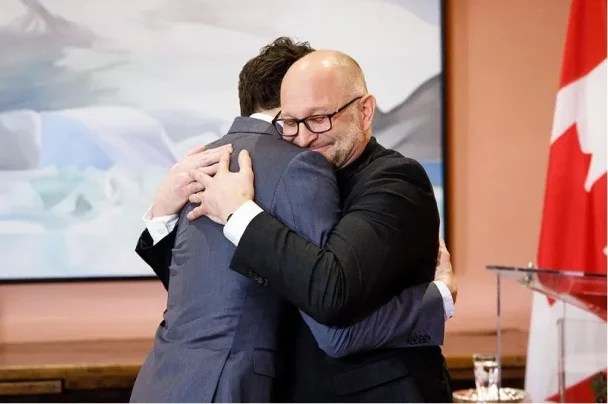
Canada’s Binding and Hoche, or is it Wither and Frost? Whoops—it’s the PM and his new JM in 2019. The latter is wearing his McGill tie. The pair quickly set about fulfilling an election promise to expand MAID legislation.
The defeat of Nazism never was a defeat of eugenics. It wasn’t even a setback, really, at least not in the national security community or among its cultured collaborators. Experiments in eugenics have continued unabated, with little effort to say what idea of the human, or whose idea of improvement, is operative. Consideration of such matters is undesirable, for several reasons.
First, because the whole movement is built, as Chesterton argues, on equivocation and artful euphemisms; that is how its humanitarian pretences are maintained. Second, because it won’t do, from a security point of view, to look too closely at either the means or the ends; those remain cabinet secrets or even secrets from the cabinet. Third, because we have become cynical, not only in the political but also in the philosophical sense. Too few expect to find answers to questions of moral substance; too many do not even enquire after them, lest they should learn that there are moral limits. Fourth, because any serious search for answers must take us into theological territory, and we don’t do theology any more. Or, rather, we like to keep our theology below the radar, like our anthropology. “What is man, that Thou are mindful of him?” is also a question no longer asked.
The improvement of humanity is a meaningless concept, however, where there is no standard by which to measure it. The military, for its part, prefers to speak of human enhancement or augmentation, and its measure is, as always, advantage over the enemy. Here there must be no limits, or at least none to which the enemy is not himself presently committed. So the masters of bio-defence and bio-offence have been augmenting the “augmentation” playbook with end runs around Nuremberg.
Now, it may be granted that the seventh article of the code requires some attenuation where the military is concerned. What must not be granted is that enhancement or augmentation is not subject to the code. Nor should we grant the underlying premises one detects in a recent Germano-British white paper:
What is certain is that the field of human augmentation has the potential to transform society, security and defence over the next thirty years. We must begin to understand the implications of these changes and shape them to our advantage now, before they are thrust upon us.
Something like the Dulles doctrine remains operative here: If they are doing it, or might do it, we also must do it—do it first, if possible, and more effectively. Which means that the military must provide leadership in the transformation of society; that “society, security, and defence” must be aligned, if not amalgamated.
To such a doctrine, and such a vision, Nuremberg is an unacceptable impediment. The Chinese model of military-civilian fusion will have to be emulated. That entails something more than a proliferation of public-private partnerships within a military-industrial complex. It entails the capture of minds through fifth generation warfare, and of bodies through genetic tinkering and implanted devices. With everything, as they say, to be done at scale.
Priming the Pump
Consider in that light this interview, from 17 December 2020, with Regina Dugan: “How DARPA seeded the ground for a rapid COVID-19 cure. Former Director of DARPA, Regina Dugan, joined Yahoo Finance Live to discuss this secretive government agency behind COVID-19 vaccines.”
Dugan had become CEO of Wellcome Leap in May of that year, after working with Google and Facebook in the interim. Two things are noteworthy, besides the trajectory of her career and the timing of the interview, which took place just as the mRNA roll-out began: first, that so much of what was going to happen was already known; second, that the questions, as well as the answers, were scripted to inoculate people’s minds against further disturbing developments by pre-establishing the idea that the “vaccines” were a world-altering miracle that it would be impious to question. Here is a major excerpt, lightly edited for clarity and interspersed with my own remarks…
YFL: We have seen the Pfizer rollout. We’ve also seen some of the concerns about … the myth about whether or not … it can alter your DNA, but then also some of the side effects. And so I wonder … based on what you’re seeing and based on your understanding of the technology … is this something we can expect? Is it normal to … go through this process of side effects, et cetera, with the vaccine?
DUGAN: I think that’s a normal progression in the investigation of safety for vaccines.
In truth, there’s nothing normal about this progression at all. Confidence that there will not be serious side-effects is supposed to be established from animal trial data before products reach the market. And if there are unforeseen side-effects that appear after marketing, the products are supposed to be pulled from the market. Here there were no animal trials, but the Pfizer testing on human subjects had revealed to the regulatory agencies, though not to the public, that an abundance of SAEs must be expected. It was determined in advance that these would be overlooked. But let’s continue with Dugan:
Now remember, our charge was to create the possibility [of a covid antidote], and I think we need to understand how remarkable an achievement this is. We went from virus sequence to first dosing in humans in 63 days. It’s unprecedented. Now, we still have the hard work to do to determine efficacy and to understand distribution and all of those things, but the first step is to have a vaccine candidate that creates an immune response and offers protection… This will be one of the most important scientific achievements of our generation and certainly in the top-five contributions for DARPA, which was also responsible for the early investments in the internet and GPS.
If the work establishing safety and efficacy has yet to be done, however, how can the “vaccine candidate” (which is not actually a vaccine) be headed to market with a “safe and effective” label? And how can she know that it will be successful, so successful as to rank right up there with the internet and GPS and the data mining they facilitate? Her interviewers do not enquire. Instead they simply endorse, then shift focus to the new alliance between business and government for warp-speed health interventions.
Absolutely! Regina, when we’re talking about … health care right now and the speed at which this was done, we know that this administration specifically focused a lot on public-private partnerships dealing with, not just the health-care companies, but also the tech companies for the rollout of software that will track some of these adverse events and the safety monitoring. You have been part of that world before and I just wonder: what is your sense of the ability for big tech to … walk into this health-care space that has been … technologically slow but also is so complex?
To put the question rather more sharply: Do they know what they’re doing? Can we trust them? Should health care be handed over to the military-industrial complex? It is true, by the way, that a great deal of money was laid out in advance, and still more after the fact, to track adverse events in products already declared safe and effective! What is not true is that this monitoring was allowed to call that declaration into question; there was too much at stake for that.
Listen to Dugan’s response, which addresses none of this but instead takes up the invitation to promote cooperative “health” interventions between the military and private corporations, despite the fact that the historic model for this is precisely the Fascist model to which Nuremberg was meant to be the remedy. “I firmly believe in public-private partnerships,” she states, offering up Moderna as an example.
When we made the investment in Moderna at DARPA, they were three people. And these early investments are important, and now we see what’s happened with the investment of private capital. We now also have to consider what other established tech companies might bring to the table in terms of their reach, in terms of their scale. These are very important considerations. But I think central to the question is also: What do we need by way of new breakthroughs? How do we ask the new “what if?” questions for public health and human health. And, in fact, it’s the reason I accepted the CEO role at Wellcome Leap, which was formed by the Wellcome Trust with an initial funding of $300 million and a specific mandate. And that is to ask the next “what if?” questions, to create the next round of breakthroughs for human health. We need to do those things at scale, and we need to do them in partnership.
I don’t know about the investment of private capital; it was BARDA that followed up DARPA’s original investment. Her interviewers invite her to take the next step, however, which involves parrying partisan attacks on the deep state while lauding its progressive agenda. Any concern about the deep state should be a concern, her questioners suggest, not with its agenda but with overcoming impediments to its agenda.
Regina, I love reading these stories because, to me, this is … like “Mission Impossible.” It’s kind of like what I thought was going to be happening if we were ever hit by a pandemic. And then it didn’t exactly go by the movie script, and a lot of that blame has been laid at the Trump administration, whether or not it’s what happened with the CDC or following [the] pandemic handbook…
Now there’s a classic case of taking Marx’s advice to charge your enemy with the very things you are doing while you are doing them! But let’s hear the question out. Can the progressives truly break free from the regressives?
What you’re talking about actually worked with DARPA. So are those “what if?” questions still being asked, because there’s a lot of concern about … the deep state and what’s been able to be taken down and what survived the last four years. Are you confident that the government and DARPA are still asking those questions and going to come up with the solutions for the next time this happens?
Before hearing Dugan’s response, let’s concede that what she’s talking about worked just fine, if “worked” means that the deep state survived the previous administration’s inept assault on it. In fact, it worked so well that the previous administration was almost completely taken in before it was taken out. And it will continue to work if government agencies and private organizations cooperate to achieve a new vision of health as global, rather than personal, and a corresponding moral vision that will back the requisite changes to decision-making in the sphere of health.
A quick aside: Have you noticed how sexual differentiation, which was always objective and universal, is now subjective and personal; while health, which once was subjective and personal, is now putatively objective and universal? To effect this reversal is one motive for the contradictory promotion of identity changes in the name of autonomy and of a needle in every arm in the name of the common good, autonomy be damned. Another motive is to disorient the public to such a degree that it can no longer tell what makes either for private or for public good; just as it can no longer tell what is private, and what is public, a conundrum well illustrated by Moderna. Anyway, Dugan again takes the cue, puffing both sides of the key PPP to which she is privy.
Well, I think DARPA is in steady state, and DARPA has historically had about 0.5% of the DoD budget. It’s an amazing organization with respect to the leverage it offers—small investment but right at these pivotal places where we need … risk-tolerant investments. But in health we also see private organizations like Wellcome Trust, like the Gates Foundation, others stepping up and beginning to ask those kinds of “what if?” questions as well. We definitely need to do that at scale. And I think it’s clear human health, global health, is going to require that of us. It is not only a moral investment. It is also an economic investment, as we’re seeing in this current pandemic.
Dugan tells us that DARPA “was formed after Sputnik in 1958 with the goal of preventing and creating strategic surprise.” She doesn’t tell us that Moderna, a failing company with no viable portfolio, was rescued by a total investment of one and a half billion dollars from DARPA and BARDA—that is, from Defence and the HHS—as a front for their mRNA ambitions. What, we may wonder, was to be prevented here and what strategic surprise was to be created? Was SARS-CoV-2 or some other “surprise” candidate already in the works when that front was created a decade ago?

Source
A few months after this interview, the facts about the mRNA products—namely, that they were neither safe nor effective at stopping covid—were beginning to appear in public. Yet major media outlets, subsidized by government or big business, were still pumping the narrative, as most of them are today. Here’s another puff-piece, this one from The Economist on 3 June 2021:
Using messenger RNA to make vaccines was an unproven idea. But if it worked, the technique would revolutionise medicine, not least by providing protection against infectious diseases and biological weapons. So in 2013 America’s Defence Advanced Research Projects Agency (DARPA) gambled. It awarded a small, new firm called Moderna $25m to develop the idea. Eight years, and more than 175m doses later, Moderna’s COVID-19 vaccine sits alongside weather satellites, GPS, drones, stealth technology, voice interfaces, the personal computer and the internet on the list of innovations for which DARPA can claim at least partial credit. It is the agency that shaped the modern world, and this success has spurred imitators. In America there are ARPAs for homeland security, intelligence and energy, as well as the original defence one. President Joe Biden has asked Congress for $6.5bn to set up a health version, which will, the president vows, “end cancer as we know it”. His administration also has plans for another, to tackle climate change. Germany has recently established two such agencies: one civilian (the Federal Agency for Disruptive Innovation, or SPRIN-D) and another military (the Cybersecurity Innovation Agency). Japan’s interpretation is called Moonshot R&D. In Britain a bill for an Advanced Research and Invention Agency—often referred to as UK ARPA—is making its way through Parliament.
Here the sunny horizons are extended still further, with nary a cloud in the sky to dampen enthusiasm. Indeed, the sky is so clear that the merciless sun is just about our only remaining enemy. One notes the confidence placed in the new Administration, which will defeat the powers of heaven and earth, from global warming to cancer. (Everyone wants to see the end of cancer, right? That’s why we didn’t screen for it while we waited for mRNA products known to cause cancer, or cancer relapses.) A veritable ARPA blitzkrieg will effect these victories!
That, and a little tough love at home. Or perhaps we should say, a little kinky love, the kind that feeds a bureaucrat’s dominatrix fantasy, in which covid can be fought by chaining us to our beds or by deploying masks like condoms. Just think of it! All those compliant clergy sporting face condoms as they broadcast to their parishioners’ bedrooms and living rooms—no wonder Dr Fauci was laughing. But it’s no laughing matter. As Will Jones pointed out, there has been a cross-party lust for this sort of thing that goes back to the post-9/11 period. If we learned it from the CCP, we learned it well before covid.
Recently the role of CISA (Cybersecurity and Infrastructure Security Agency) in producing key lockdown guidance for America in March 2020 came to light. Now, a pandemic plan from 2007 produced by the National Infrastructure Advisory Council (NIAC) and currently hosted on the CISA website has emerged. The plan contains the original list of pandemic ‘essential businesses’ that was used by CISA in 2020 to lock down America. The 2007 plan (which was itself based on a Department of Homeland Security plan from the previous year) clearly states the intention to ban large gatherings ‘indefinitely’, close schools and non-essential businesses, institute work-from-home, and quarantine exposed and not just sick individuals. The aim is simple and clear: to slow the spread to wait for a vaccine.
Lock ’em down till you can shoot ’em up, in other words, as I said or tried to say two years ago. (The editor didn’t think anyone would laugh, or even keep reading, so he struck that line, which is no longer contentious.)
So, then: Defence, Health and Human Services, and Homeland Security were all involved in bringing us covid relief, though who brought us covid is still in dispute. And these public agencies, together with their private partners at home and abroad, were preparing for this long before covid hit. Sure, they ran into a bit of a snag with the Trump administration, but didn’t we all? They dealt with it, as with him, even if that meant enlisting their media partners to help keep Hunter Biden’s laptop sealed and performing a few other dirty tricks at election time—tricks the Twitter papers show to have extended right through the pandemic, with no sign of being shelved.
Well, you say, that’s their job, or a big part of it. Bio-defence, like bio-offence, if there’s a meaningful difference, requires anticipation and preparation. It also requires a few dirty tricks, no doubt, a little liberty with the law, though blatant interference with a presidential election is perhaps beyond the pale. The truth, however, is that nothing is beyond the pale. If it’s okay to do evil for a putatively good end—to obliterate civilian populations, or blast the brains of your patients, or cut up babies in the womb for their organs and cell lines, or promote suicide, turn hospices into killing fields—election interference is small potatoes. But if such things are okay, what isn’t okay? If such things are permitted, everything is permitted.
The Casualties of War
My colleague, Catherine Ferrier, reminds us that 10,000 Canadians died with “medical assistance” in 2021 alone. Another case, I guess, of “safe, legal, and rare.” And how far did pandemic management contribute to that morally hideous statistic?
That there was an utterly unprecedented response to covid everyone knows: lockstep media propaganda, complete with fear porn and censorship of anything off-narrative; repeated lockdowns, with the partial or complete cancellation of ordinary social and economic life; denial of rights and interference in religious practices, as in business practices; coercive vaccination mandates and other forms of violence, both psychological and physical, against dissenters, who are still being targeted; safe medical products banned for those who desperately needed them and unsafe medical products urged on those with absolutely no need of them; severe adverse reactions and deaths anticipated from the latter, but denied or ignored when they actually happened; doctors and scientists defamed, fined, or even de-licenced for questioning aloud what was happening, if (as too rarely) they had the courage to do so; public health officials, entirely unqualified for the task, ruling the smallest details of life; emergency powers routinely renewed week after week, year after year, without scrutiny or debate; constitutions and bills of rights suddenly shelved as if they had never existed; pastors jailed for preferring to obey God rather than man; every face hidden for months at a time, with nary a smile to be seen, even by children; no child left behind to enjoy the normalcy children need; infants and pregnant mothers injected with products said to be safe and effective, but known not to be.
What, again, was that first principle of Nuremberg? Something about “the voluntary consent of the human subject” being “absolutely essential” in human experimentation? Yes, which means that
the person involved should have legal capacity to give consent; should be so situated as to be able to exercise free power of choice, without the intervention of any element of force, fraud, deceit, duress, overreaching, or other ulterior form of constraint or coercion; and should have sufficient knowledge and comprehension of the elements of the subject matter involved as to enable him to make an understanding and enlightened decision. This latter element requires that before the acceptance of an affirmative decision by the experimental subject there should be made known to him the nature, duration, and purpose of the experiment; the method and means by which it is to be conducted; all inconveniences and hazards reasonably to be expected; and the effects upon his health or person which may possibly come from his participation in the experiment. The duty and responsibility for ascertaining the quality of the consent rests upon each individual who initiates, directs, or engages in the experiment. It is a personal duty and responsibility which may not be delegated to another with impunity.
How fares this principle today? Like Cameron at Ravenscrag, the pandemic management team on the Potomac, with the thoroughly unprincipled Fauci as its First Mate, though not perhaps at its helm, rolled out a deliberately disorienting combination of therapies to test on unsuspecting subjects: sensory deprivation (masking and lockdowns), sensory overload (incessant media messaging, like Cameron’s looped tapes), potentially fatal products and procedures (from midazolam to ventilators, from remdesivir to the clot-shots), and repeated violent shocks to the collective and the individual psyche. All the while, it told lies too large to question, accompanied by promises it had no intention of keeping. It wounded; it demoralized; it punished. It killed and is still killing, if the excess death toll is the signal some think it is. It violated virtually every note of Nuremberg. That Fauci himself is said to be quadruple-jabbed does not change any of that, though it does call into question his sanity.
Those of us who have lived through previous pandemics, such as the Hong Kong flu, or anyone who took the least trouble to discover what was evident from the very beginning—that covid kills only the very old and frail or the heavily compromised—knew or should have known that the supposed cures were worse than the disease by far. The general readiness to be deceived, or to become collaborators in the deception, displayed the hollowness of our souls, so easily filled with fear; of mainstream religion, which offered no antidote to fear; and of our political life, which simply collapsed. It revealed the sham culture of the universities, which likewise put up little resistance, proving themselves haunts of hopelessly naïve students, cowardly professors, and corrupt administrators who simply went with the flow, paying down their debts to pharma-tech and other partners, including China. And what shall we say of the medical profession? Primum non nocere, if it still means anything at all, means: “Do no harm to yourself. Keep your head down. What we have called safe and effective, you must call safe and effective. Woe to you if you won’t.” Few there were, alas, who rejected that counsel.

Ravenscrag
Nothing, Nothing, None
Let’s come back to McGill for a moment, where that counsel was embraced without hesitation.
Last July, I put some initial access-to-information questions to my university about the work of the bodies charged by the P7 (our top management team) with handling pandemic affairs, the Emergency Operations Centre and the Recovery and Operations Resumption Committee. Here are those questions:
What was said in these committees about the possibility or actuality of serious adverse reactions or vaccine injury (fatal or otherwise) among those who were being encouraged to take the shots?
What was said about (a) the emerging relationship between McGill and Moderna and (b) other possible conflicts of interest generated by financial relationships with donors or partners to the university or members of the university?
What reasons were provided for adopting masking, distancing, and proof of vaccination policies stricter than those required by the government of Quebec?
As far as I can tell from the documents received, the answer to the first two questions is nothing at all. The answer to the third is none. So we must, unless we probe the P7 itself, be content with McGill’s public announcements.
As recently as 14 January 2022, the EOC was still claiming that “three doses of vaccine prevent upwards of 70% of transmission.” This was false, as was its claim a month earlier that “masking is more important than ever” and that “masks have been working at McGill to prevent the spread of the virus.” There was not a shred of evidence for the latter claim, nor has anything emerged to collapse the mountain of data showing that masking is ineffective against airborne viruses. As for the former, the following justification was offered on 18 January 2022:
Analyses from Britain give a vaccine effectiveness against Omicron of about 70-75% for people having three doses of vaccine and about 88% vaccine effectiveness against hospitalization for Omicron. (See the December 10, 2021 Technical Briefing and December 31, 2021 Technical Briefing from the U.K. Health Security Agency, for example.) This figure of 88% for vaccine effectiveness against hospitalizations means that the number of hospitalizations in vaccinated people will be only 12% of the number in the unvaccinated group.
We can’t hold institutions—or doctors for that matter, but the people advising us to “vaccinate, vaccinate, vaccinate” are not doctors and have no business disseminating such advice, much less introducing sanctions against those who won’t follow it—responsible for things that were not known to them at the time, things such as the hugely increased risk, from the jabs, both of infection and of hospitalization. Mounting evidence for that has shown claims about “a pandemic of the unvaccinated” to be nothing more than official disinformation deflecting attention from policies that were themselves undermining hospitals and health care, and will continue to undermine them for the foreseeable future. We can, however, hold institutions like McGill accountable for tendentious treatment of such evidence as they had. On page ten of the second Technical Briefing linked in that McGill memo, we find this:
In all periods, effectiveness was lower for Omicron compared to Delta. Among those who had received two doses of AstraZeneca, there was no effect against Omicron from twenty weeks after the second dose. Among those who had received two doses of Pfizer or Moderna effectiveness dropped from around 65–70% down to around 10%… Two to four weeks after a booster dose vaccine, effectiveness ranged from around 65–75%, dropping to 55–70% at five to nine weeks and 40–50% from ten+ weeks after the booster.
Details, details! To which we might add another, namely, that the “unvaccinated” category includes those who have been “vaccinated” for two weeks—two weeks in which there is an uncommonly high rate of infection. This was a common dodge for skewing statistics in favour of the vacina salva narrative, as some of us had already observed.
Anyway, a couple of months later McGill finally dropped, without fanfare, the claim that injections prevented infection and transmission. On 25 March 2022, we were told that “the focus is now on preventing serious illness and hospitalisations through vaccination and new treatments for COVID, rather than on restrictions and lockdowns that try to prevent any new cases.” So those who had been claiming scientific support for one objective—mass vaccination to prevent infection and transmission—now shifted to another: mass vaccination to prevent serious illness requiring hospitalization.
The second is as false as the first, but they had to make some sort of shift, not only because it had become too difficult to hide or distort the scientific evidence but also because the failure to prevent infection and transmission was perfectly obvious to the ordinary person. What did not change was the underlying goal, mass vaccination itself. And McGill was already working with Moderna (that is, with DARPA and BARDA) on a deal to make these “new treatments” a staple both in its financial diet and in our idea of heath care. The U.K. has just concluded a similar deal, on a larger scale, promising to become “a life sciences superpower.”
It turns out that the mRNA products had never even been tested for prevention of infection or reduction of transmission. They are non-sterilizing and do not even reduce the viral load significantly. So all those claims about keeping people safe by preventing transmission were nothing more than lies. Not only were they lies, but they were lies used to attack those who knew or suspected they were lies and to dupe people into taking products they did not need and might well injure them or compromise their immune systems.
None of this has McGill yet admitted. No word of apology has been issued. Has it, then, utterly abandoned its vocation as a place for independent scientific research and critical analysis to become an arm of the military-industrial complex? Has it again been conscripted into America’s war? Has it no institutional conscience, nor any memory of past violations of conscience?
McGill, I learned, resisted certain excesses urged on it by its own School of Population and Global Health, headed by Professor Evans, a man with deep roots in the requisite pieties. But there is no more excuse for nothing, nothing, none than for a zero-covid or zero-carbon policy. It is a betrayal of trust that requires independent investigation into its causes and consequences. There are real victims here, as there were at Ravenscrag, even if some do not yet know they are victims or do not regard themselves as victims.
Who has deceived us?
Returning to the larger theatre, to the world stage, we must ask a much more important question: Who or what has the power to turn the minds of men, or the spines of men, to mush, operating simultaneously in so many different spheres, professions, and institutions? Who can generate a deluding influence with such reach, and to so thorough an effect? Who, indeed, but the Father of Lies, who—to judge from the state of the church as well as the world—is already out on parole. I’ll try to explain that another time. We’ll stick here with those of our own kind.
Many candidates have been put forward: the main shareholders of big corporations, especially in pharma-tech sectors, which have so hugely profited; the Davos imperialists (are they capitalists or communists or fascists? perhaps the difference is now academic) who spawned the public-private partnerships of which they are so proud; the global governance advocates, who find nation-states inconvenient; the Malthusians, who find people in general inconvenient, or the transhumanists, who think them outmoded; the CCP, which wants to eradicate freedom in the West, and kindly shared with us both the virus and a tyrannical model for response to the virus. Or was it we who shared the virus with them, capitalizing on the opportunity to import that model? That hypothesis, at present, is as good as any.
That there are multiple agents with overlapping agendas goes without saying, but which is the master agenda and what is its primary nature? Some say it is financial, as if the pandemic were only a smokescreen to hide the true causes of an impending economic collapse. Others say it is technocratic, preparation for a global coup by elites that have decided against democracy and for a managerial model of governance. Still others that it is bellicose, all part of the old cold war with Russia—now hot again in Ukraine—and the new cold war with China, which some even suppose to be the final war. A few think it precautionary, as if the covid crisis has only been pandemic war-gaming, this time with live biological rounds, in preparation for something more serious. But many, understandably suspicious of theories about master agendas and super culprits, think it undesigned, a perfect storm brewed by chance out of a lab accident, international groupthink, an increasingly rootless and insecure population susceptible to authoritarian measures, and the predictable heavy-handedness of panicked authorities responding to a crisis.
These theories are not, for the most part, mutually exclusive, when not construed in reductionist terms, but let’s push back against each in turn. The first has this against it: that there must surely be easier ways, and ways hopeful of better outcomes, if a full rebuild of the world economy is required; there are certainly less wicked ways. The second goes much further, in my opinion, towards a satisfactory account of the orchestrated chaos of the pandemic; what it has difficulty explaining, as does the first, is the sudden evaporation, not everywhere but in so many places, of those national interests that would normally cause saner heads to prevail. (Can the alleged coup really have progressed quite so far? Perhaps it can, and has.) The third, which rests on conflicting national interests between the two super-powers, begs questions about cooperation between them in gain-of-function research, pandemic planning, and pandemic measures. The fourth, despite deep roots running back into the Bush administrations, seems weak; for pandemic war-gaming with live ammunition makes no sense if it exhausts the public purse, produces high casualties, destroys morale, and undermines the very nation it is supposed to protect. The fifth, though it can be supported by appeal to the stupidity factor, indeed to the widespread insanity of our times, is falsified by the many signs of forethought we have been noticing.
While it may be comforting to rule out any truly malicious design, apart from the familiar pharma monkey business, what are the facts? There have been decades of pandemic war games, culminating in Crimson Contagion (run by Robert Kadlec, bio-defence insider and ASPR director from 2017–2021) and in Event 201, both of which took place just before the real action began. There have been games played with the very word “pandemic,” and prior attempts to produce a pandemic. There has been wholesale resort to NPIs that run completely contrary to conventional wisdom, whose one real achievement was to advance prior plans to introduce health passports, digital IDs, CBDCs, and other instruments of surveillance and control. Elaborate funding has been provided over many years for projects faithful to the Gavi/CEPI ambition to make frequent vaccination a universal norm. There has been patient and thorough regulatory capture and infiltration of professional associations, to say nothing of the journals on which they rely. The very inefficiency, indeed irrationality, of covid defences, taken in concert with the ruthless efficiency of authoritarian measures, militates against any perfect storm scenario from which human design has been excluded. So do the secret contracts with Pfizer, which were made not only with Israel but around the globe; the prompt deployment of false modeling, psy-ops, and 5GW; the constantly moving targets of public policy coordinated across multiple countries; the data collection, data withholding, and data manipulation; the gross violations of medical ethics and all those other matters mentioned earlier.
When these things are taken into account, it seems more reasonable to postulate a storm designed and produced with a view to changing the conditions under which we all live and to alter the patterns of our behaviour. And for the source of that we must look to one or more of the first three proposals: the financial, the technocratic, and the bellicose. My money is on all three, working in concert, which puts the third in a different light.
War on the People
To see intent and design where there is none may be a sign of paranoia; refusal to see intent and design, where it manifests itself, is a sign of willful blindness. Just as individual components of Cameron’s experiments in mind control might, under other circumstances, be given a more or less innocent interpretation, while their appearance in concert under the actual circumstances cannot be, so also here. One can argue till the cows come home (if the climate change fear-mongers will let them come home) about individual aspects of the crisis, pointing to this or that quite ordinary explanation for the phenomenon in question, but that would be to lose sight of the herd for the cows. Let’s not deceive ourselves. Lockdowns, masking, and coercive mandates are not health measures. They are de-patterning and re-patterning devices. Since only governments have the power to impose them, and since only the Americans and the Chinese have the reach that allows them to be imposed across multiple jurisdictions, and since China cannot impose them on America, it seems to me that we cannot answer the question about design and control without speaking of America’s war—not its hot war against Russia or its cold war with China, but its war against its own citizens and the peoples of the West.
Now, when I say America, I mean deep-state America, led by the intelligence community and its private partners—”business and government,” as they like to say at Davos, working together in harmonious fashion for the benefit of both. This is certainly not everyone’s America! Increasingly, it comprises those who despise the people and have grown impatient with their unreadiness to become, in Lewis’s phrase, willing slaves of the welfare state. Hence the covid exercise, which serves the dual purpose of setting China on its heels while breaking down the opposition at home. The latter function makes feasible a pivot to climate change and population reduction, a sacrifice pleasing unto Gaia, while serving the goal of political control. For it sets the governance-by-emergency-powers precedent that climate fear-mongering, by itself, could not have achieved. It does an end run around democracy and, as far as possible, the constitution.

Remember Ludlow? The late John D. Rockefeller Jr, friend of Mackenzie King and founding father of just about everything, from the Bureau of Social Hygiene to the Council on Foreign Relations to the Rockefeller Foundation; and Peter Schwartz, the futurist who has worked with just about everyone, including the said Foundation.
How far all this was anticipated by those responsible for given sectors of the pandemic war theatre is difficult to say, but Peter Schwartz—an MKUltra associate at Stanford in the seventies, and the scenario man par excellence—seems to have anticipated it, in broad outline, even before authoring big philanthropy’s detailed self-indictment: the Rockefeller Foundation’s Scenario for the Future of Technology and International Development. (This 2010 document contains the notorious Lockstep section, though that is not its most interesting feature.) Schwartz, who had earlier written on sudden climate-change emergencies, is said to have taken an interest in government-sponsored research into social control through the weakening of family and tribal loyalties. (If so, I hope he later enjoyed Nation of Bastards and “The Audacity of the State.”) He also partnered with Kadlec in key pandemic planning exercises.
To be honest, it’s hard to keep track of all this public-private partnering, which seems to be quite promiscuous and its conquests to be a cause of considerable friction. But just here we must press a question. In the dance, are representatives of nation-states to lead or are they to follow? Another Rockefeller production, this one from the 2013 Global Health Summit in Beijing, suggests that they are to follow: “The power of states and their ability to provide an effective nexus between the local and global levels may diminish in the face of growing megacities, local identity politics, increasing social exclusion, increasing private influence on all spheres of life, widening liberalisation and stronger global networks.” (In such contexts, “may” often means “we’re trying our best.”)
That diminishment is foreseen for America, too, but America must meanwhile play a leading role in the creation of world governance, as John D. Rockefeller Jr himself did. Whatever is to emerge at the head of a new world order—I call her Shelob, and doubt not that she already exists embryonically—will do so by way of a web that cannot be spun without America’s assistance. The web itself is woven from industry and philanthropy; or, more truly spoken, from seduction and insecurity, from desire and fear. These have been made to converge, ironically, in health. Dreaming the Future of Health for the Next 100 Years provides a blueprint for the idolization of “health” the world over, and this new loyalty, though at first state-based, will soon lift the burden of national loyalties. The current treaty proposal, transferring various powers from member states to the WHO, belongs to that process.
A word of advice: Do not call liberalization everything philanthropists call liberalization, and do not call health what they call health. The whole dream is a dream of conquest, a dream of a web well stocked with the world’s flies. In the biblical metaphor, it is a dream of Babel. But it does need the American deep state in order to get off the ground, and the American deep state needs it, for two reasons—to retain its hold on power at home and to make certain that competitors abroad, especially in Beijing, are not embedded at a more fundamental level.
Ah, but wait! The dreaming is all very innocent. Surely there’s no shame in having a sharp eye for promising developments, or for potential hazards, along the trajectory of human progress. The keenness of that eye should not be held against it, nor read conspiratorially, as the Rockefeller reminded us in 2020, during the thick of the pandemic:
In the 1930s, Warren Weaver, who led The Rockefeller Foundation’s programs in natural sciences, had a hunch that chemical and physical explanations of life would lead to a whole new world of research and discovery. He coined the term “molecular biology” and a field was born. In 1956, The Rockefeller Foundation supported the Dartmouth Summer Research Project on Artificial Intelligence, which was the first use of “artificial intelligence” as well. After some fits and starts, that field exploded too. And now, artificial intelligence has combined with molecular biology to accelerate the development of vaccines and therapeutics for the world’s worst pandemic since 1918. Could any of this have been predicted? Absolutely not. However, both molecular biology and artificial intelligence were guided by visions of positive futures where both fields contributed to improving people’s well-being. Unfortunately, we must also plan for futures that aren’t as bright—be it due to a disease outbreak or natural disaster—to minimize harm and prepare for recovery.
The comparison with 1918 should not go unremarked; that very construal is conspiratorial. Neither should the claim that the 2010 Scenario was simply a bit of what if? speculation that proved prescient. “Now that we’re well into a real pandemic,” the authors concede, we do “see some chilling similarities between our current Zoom-centered world and Lockstep.” We see, for example, that it accurately “predicted that telepresence technologies would ‘respond to the demand for less-expensive, lower bandwidth, sophisticated communications systems for populations whose travel is restricted.'” Other predictions, we are told, were off target, “including the emergence of MRI technologies to detect abnormal behavior with anti-social intent.” As if variations in the technology of choice somehow put to rest the idea that anything was engineered in advance! Oh, and try turning those two sentences around, beginning the one with travel restrictions and the other with detection of anti-social behaviour. You will find that both read rather more chillingly, particularly if you concur that such measures were themselves decidedly anti-social.
Only a fool would suppose that the reality was unconnected to the dreaming. The surveillance technology may change, but the plan to apply the Bush doctrine of pre-emptive strikes, both at home and abroad, remains the same. Those chilling similarities are the new normal by which the abnormal is being calculated, just as our innocent dreamers predicted. Their 2010 map of the alternatives, in which Clever Together is the clear winner, is quite compelling evidence of that. Clever Together, of course, is for clever people. Ordinary folk require the discipline of Lock Step before they can learn to be clever. As for those who mistakenly fancy themselves clever, their Smart Scramble has been anticipated. It will not go so smoothly as they like to think.

The Rockefeller Foundation does not wish to be misunderstood, mind you. It never has anything but our best interests at heart, as the 2020 document insists. “While baseless posts have circulated recently calling the exercise part of a ‘diabolical plan for world domination’, we see it as further evidence of the importance of scenario planning in helping governments, institutions and others navigate near-term decisions that can have long-term impact. Our hope then—as it is now—was to focus on what we don’t know so we could make better plans to address a real pandemic, such as the one we’re facing today.” Not war, then, just philanthropy. It’s all in how you look at it.
Philanthropy? Remember that the Serpent was the original philanthropist! All he wanted to do was help humanity learn to deify itself. And he did know something about the process. How had he had become the Serpent if not by dreaming the process and himself attempting the process? But if we are going back only to the 1930s, rather than to the year naught—if it really is those “chemical and physical explanations of life,” not some putative Serpent, that suggested new ways of regarding and treating life—what then? Giorgio Agamben can explain. He makes a much more reliable guide here, whether to the 1930s or to the present day, than does the Rockefeller Foundation.
Every time a value is ascertained, a non-value is, necessarily, established: the flip side of protecting health is excluding and eliminating everything that can give rise to disease. We should reflect carefully on the fact that the first case of legislation by means of which a state programmatically assumed for itself the care of its citizens’ health was Nazi eugenics. Soon after his rise to power in July 1933, Hitler promulgated a law for the protection of the German people from hereditary diseases. This led to the creation of special hereditary health courts (Erbgesundheitsgerichte) that decreed the forced sterilisation of 400,000 people. Less well known is that, long before Nazism, a eugenic politics was planned in the United States—particularly in California—with robust funding from the Carnegie Institute and the Rockefeller Foundation, and that Hitler explicitly referenced this model. If health becomes the object of a state politics transformed into bio-politics, then it ceases to concern itself first and foremost with the agency of each individual and becomes, instead, an obligation which must at any cost, no matter how high, be fulfilled.
Agamben knows what Chesterton and Lewis knew. Therefore he, too, dreads government in the name of science and especially in the name of health. He does not want us to make the mistake of thinking that law and life, or law and medicine, can be conflated with impunity, as the Planners intend.
Medicine has the task of addressing ailments according to the principles irrevocably sanctioned by the Hippocratic Oath, principles which it has followed for centuries. If medicine, making a necessarily ambiguous and indeterminate pact with governments, presents itself instead as a legislator, not only does this not lead to positive results in the field of health—as we have witnessed in Italy during the pandemic—but it can result in unacceptable limitations on individual freedom. It should be evident to everybody that the medical reasons behind these limitations could offer the ideal pretext for an unprecedented control over social life.
It should indeed be evident! One further caution, however, before leaving this section. Artificial intelligence is much touted in medicine today, especially by those waging war on the people through their Global Health cult. But just as there is no such thing as global health, there is no such thing as artificial intelligence, nor ever will be. There are only very powerful computers in the service of very powerful men, most of whom are less clever than they imagine and some of whom are more wicked than we imagine. Whether speaking to us of health or of things other than health—a shrinking category—they say that we have crossed the Rubicon, that we have no choice now but to move forward into territory shaped and governed by algorithms. What they do not tell us is that their struggle for dominance within that territory is a struggle that can only mean total war.
Total war requires massive data mining and data manipulation. It requires the biosecurity state that Aaron Kheriaty has so helpfully described for us, within which we all become little more than data-points. This requires in turn public-private partnerships of a monopolistic nature, capable of enforcing the will of these same men. Identity by numbers, and governance by algorithms, is the end of freedom—its terminus, not its telos—as many are beginning to recognize. Pragmatically speaking, the war against the people, and the war of the people, will be won or lost just there.
Recapitulation and Rejoinder
As I was bringing this essay to its conclusion, in draft form, I come across a piece, published on Christmas day, proposing that the pandemic “was the result of an American biowarfare attack against China (and Iran)” and that this had been covered up through a conspiracy on the scale of the Kennedy killings. Ron Unz, it turns out, has been arguing this line since April 2020; how I managed to overlook it for so long, I don’t know. Anyway, it will be clear by now that I do not think we are dealing merely or primarily with an attempt to cover up a backfiring bioweapon. That theory, like the perfect storm theory, leaves far too much out of account. Measures that advance big government and big business but don’t actually mitigate viral and “vaccine” damage—that indeed risk its exponential expansion—suggest a plan of greater proportions and of earlier origins. So let me recapitulate and try to bring all this into focus.
We know that the kind of men we are dealing with have set themselves above the law, and that they have resorted to repeated shock waves in order to break down opposition and achieve compliance. The covid war we have been in, the climate change war we are entering, the data war to which these phoney wars are connected, are backed, like the war in Ukraine, by an elite in places of real institutional and financial power, centred where it has always been centred, in the bowels of the beast where Allen Dulles once dwelt, whence also the World Economic Forum emerged.
This elite is not afraid to experiment on the people, biologically and psychologically, or even to disrupt the supply chains on which they depend. It means, by way of its experiments, to induce cultural amnesia and to re-program the collective memory for purposes of its own. The casualties do not much concern it. Nor do those men and women who belong to it, or cooperate with it, ponder the fact that they have created a culture of lies and deceit from which they themselves can never hope to escape.
Those whose consciences are not yet completely seared must tell themselves, as Dulles doubtless did, that it is all necessary for the common good. But that too is a lie. They are not serving the common good. They are not even serving national or international interests. They are serving themselves. Ultimately, they are serving a diabolical agenda to subjugate the human race, to reduce it to manageable numbers, to possess and manipulate it like any other product.
And who are they exactly? Some are well known, others unknown, even perhaps to each other. One could be a bishop of the Church of Rome and belong to them, or a president of the Club of Rome and not belong. One could be planning smart cities, the better to serve humanity, without understanding that the real purpose of smart cities is to regiment humanity. But those who do belong, who really belong, are building an anti-city, a city implacably opposed to the city being built by God. They do not wish the numbers of the latter to be filled up, or the design of its Architect to be realized. They are committed, if necessary, to the slaughter of the innocents and to planned parenthood. They are Malthusians, Masons, Modernists. They are eugenicists and transhumanists and ESG enthusiasts. They are the rich, the clever, and the quite mad, though there is method in their madness. They are the self-proclaimed saviours of the world, and its judges too. They are not only the new communist capitalists and capitalist communists, they are the new catholics.
But we old catholics who celebrate Christmas, and the feast of the Holy Family, know that the Architect’s design will be fulfilled. Neither man nor devil can prevent it. We are determined to live by its laws and principles, not by theirs. We will resist them, sometimes with their own technology and sometimes by refusing to deploy it. But we will not take up their habits or tools of manipulation, seeking to best them at their own immoral game. We will take up weapons of righteousness in the right hand and in the left. We will speak the truth, which is far more effective than being pragmatic. Indeed, it is far more practical than being pragmatic. We will tell of the city whose builder and maker is God, and rejoice at its prospect. For God has already intervened to save the people. He has already established the Man by whom he will judge the nations. America’s war is in vain.
“The Lord wins in the end,” as Benedict XVI reminded us in 2017. And that, I think, is a good note on which to enter Anno Domini 2023.
Jane Goodall isn’t a kindly grandmother; she’s a promoter of eugenics and a global population of 450 million
By Rhoda Wiloson • The Exposé • December 29, 2022
Yesterday we published an article that highlighted that the United Nations’ (“UN’s”) “30×30” goal is the biggest land grab in the history of the world. It is the theft of land and natural resources on a grand scale. To convince the public the UN’s goal is a “good thing,” the World Economic Forum (“WEF”) and the World Wildlife Fund (“WWF”) have chosen three leading influencers – Greta Thunberg, Jane Goodall and David Attenborough – to market the ideology under the guise of a “new deal for nature.”
But these three marketeers aren’t just mis-selling the “new deal for nature,” at least two of them – Goodall and Attenborough – are openly marketing depopulation, the killing of billions of people, under the fraudulent “climate change” ideology. Perhaps Thunberg is their apprentice and will take over the reins when one of her mentors has been “depopulated.”
In this article, we take a brief look at Goodall who is portrayed as a kindly grandmother that wouldn’t hurt a fly and someone even our youngest can trust. However, as with the wolf in Little Red Riding Hood, she is not as her public image or name suggests. After learning a little about Goodall’s underlying beliefs, wisdom would say that children should stay well clear. Children should only watch documentaries or films associated with these marketeers in the presence of responsible adults. Adults who can negate any nuances which have been deliberately included to “nudge” or manipulate beliefs towards ideologies that are harmful not only to us but also to our natural world.
Jane Goodall is best known for her work with primates – her image of kindness has given her enormous credibility. But do not be fooled by the public image the propaganda machine portrays. To demonstrate Goodall’s underlying beliefs, we look at some of the remarks she has made over the years.
Wikispooks has noted two quotes from Goodall. The first was made in 2007:
“It’s our population growth that underlies just about every single one of the problems that we’ve inflicted on the planet. If there were just a few of us, then the nasty things we do wouldn’t really matter and Mother Nature would take care of it — but there are so many of us.” – Jane Goodall, November 2007
And the second was made in 2020. Goodall was chosen to take the podium at the 2020 WEF annual meeting where she could help prepare business and government managers for the need for a drastic population reduction. Goodall was speaking at a panel discussion called ‘Securing a Sustainable Future for the Amazon’. She proclaimed:
“All these [environmental] things we talk about wouldn’t be a problem if there was the size of population that there was 500 years ago.”
World Economic Forum: Securing a Sustainable Future for the Amazon, Davos 2020, 22 January 2020
PolitiFact rushed to Goodall’s defence, albeit from a “Goodall’s population comments didn’t spark the pandemic” angle. “Goodall did make the human population growth comments seen in the video, but she has been making the same arguments for years,” the blogging site PolitiFact wrote. This is true. In the video below, Goodall admits that what she sees as a population problem “really hit” her in 1990, over 30 years ago. It was her perception of the “population problem” in Africa that convinced her.
Population Matters: Jane Goodall at Population Matters Conference 2019, 29 April 2019 (4 mins)
The Critic sums it up succinctly: “When eco-warriors talk of population control, they mean the world would be better off with fewer poor black people.” In other words, it is a eugenics programme hiding behind a purposefully manufactured “climate change” narrative. This is an appropriate conclusion in the context that this particular comment is raised and is bad enough on its own, but the implications are much larger than depopulating Africa.
Returning to her remarks in 2020, although Goodall doesn’t indicate what she believes the population of the world to be 500 years ago, according to Worldometer the global population in 1500 is estimated at 450 million. The current global population is estimated at a little over 8 billion. So, using simple mathematics, Goodall is promoting the death of more than 7.5 billion people. “This session was developed in partnership with the BBC,” WEF noted.
Repeatedly promoting depopulation increases Goodall’s guilt not diminishes it, a fact PolitiFact’s blogger doesn’t appear to be concerned with. Additionally, we can assume from the point of view of the blog’s publisher, PolitiFact, that advocating for the “depopulation” of over 7.5 billion people is all right as long as you’ve been at it for a long time.
As an article published by The Conversation quite rightly noted, “this remark might seem fairly innocuous, but it’s an argument that has grim implications … As these escalate, people must be prepared to challenge and reject the overpopulation argument.”
For those who struggle to translate what the term “depopulation” means in practical terms: It translates to enforcing a decline in birth rates – through infertility, miscarriages and abortions – and/or enforcing an increase in death rates – through mass murder and “nudging” people, including children, to commit suicide. Surely PolitiFact’s blogger understands that Goodall sees him and his loved ones as part of the “population problem” and so is in her sights to be “depopulated.”
If you’re wondering why PolitiFact would defend someone who promotes eugenics and genocide, looking at who provides the funds for their operations will give some clues. PolitiFact, unsurprisingly, receives large donations for “support of content and training” from all the usual propagandists such as Google News Initiative, Meta/Facebook, Microsoft, Omidyar Network/Luminate, WhatsApp and so on. PolitiFact is merely publishing blogs that conform with the ideologies of their funders. Their blogs should be read and understood within that context – that they are promoting an agenda and not presenting unbiased facts.
Never take anything at face value that has been developed or promoted by tools – such as WEF, BBC and PolitiFact – used by the propaganda machine. Things are not as they portray.

Germany’s Public Television Suggests Bathing Once A Week Would Be Beneficial
Private daily showers to become a luxury for the privileged and wealthy in Germany?
By P Gosselin – No Tricks Zone – December 28, 2022
“What if we showered/bathed only once a week?”
What the BBC is to Great Britain, are what the WDR and ARD public broadcasting are to Germany in terms of television and radio presence.
Just some weeks ago, the Instagram site of WDR kugelzwei presented some tips that save heat and energy for citizens to consider: showering only once a week.
After all: “Around 100 years ago, it was still customary to bathe only once a week,” wrote kugelzwei. “Today, people almost look at you strangely if you tell them you don’t shower several times a week.”
The “benefits” of showering only once a week
Supposedly, there are in fact numerous benefits from showering much less frequently, according to ZDF’s kugelzwei. For example, people would maybe learn to become “a little more tolerant of body odor”, and the unwashed would save time in the bathroom every morning.
Use sinks, not showers
Moreover, fitness studios could replace showers with just plain sinks. After a sweaty workout, one could freshen up in cubicle with with a simple sink and a washcloth instead of using a shower cubicle.
Make the weekly shower a public social event
Another idea proposed by the WDR’s kugelzwei is public bathing: “Maybe showering or bathing could become a weekly highlight,” they suggest. “We would celebrate this in public bathhouses – perhaps also in the company of others.”
WDR also cited research from Great Britain on the impacts that lockdowns had on showering. “In a YouGov survey, 17% of Britons said they shower less since the lockdowns. Among younger people aged 18 to 24, as many as 27% skip showering sometimes.”
Ukraine to hike transit fees for Russian oil to EU – Transneft
RT | December 27, 2022
Ukraine will raise transit fees for Russian oil running via the Druzhba pipeline through its territory to the EU on January 1, Russian oil exporter Transneft announced on its website on Monday.
It is expected that Kiev will increase tariffs for transporting crude to Hungary and Slovakia by €2.10 per ton to €13.60 ($13.90), bringing the total hike to 18.3%.
In November, Bloomberg reported that Ukraine was mulling a tariff hike on Russian oil transit starting next year, citing a letter from Ukrtransnafta, the operator of Ukraine’s oil pipeline network. The Ukrainian operator had attributed the need for the price hike to the “continued destruction of Ukrainian energy infrastructure” which had resulted in “a significant shortage of electricity, an increase in its costs, a shortage of fuel, and spare parts.”
Transneft spokesman Igor Demin confirmed to the Russian media that the company had received the letter and was studying it.
Ukrainian oil transit fees have already been raised twice this year. The last hike in April reportedly brought the total increase to 51% on an annual basis.
Druzhba, one of the longest pipeline networks in the world, carries crude some 4,000 km from Russia to refineries in the Czech Republic, Germany, Hungary, Poland and Slovakia.
Russia ready to resume gas supplies to EU – official
RT | December 26, 2022
Moscow is ready to restart supplies of natural gas to the EU via the Yamal-Europe Pipeline, Russian Deputy Prime Minister Aleksandr Novak said on Monday. He noted that shipments through the route were halted for political reasons.
According to the official, the EU remains a relevant market for Russia, which is able to resume supplies to a region suffering from a gas shortage.
“For example, the Yamal-Europe Pipeline, which was shut down for political reasons, remains unused,” Novak said.
Gas supplies via the pipeline, which usually flow westward, have been mostly reversed since Poland terminated a supply contract with Russia ahead of its end-2022 expiry date, after rejecting Moscow’s demand for ruble payments. The Polish leg of the route is currently being used to pump stored gas from Germany.
In response to Warsaw’s move, Russian state-run energy giant Gazprom cut off supplies, saying it could no longer send gas via Poland, while Moscow imposed sanctions against the firm that owns the Polish section of the Yamal-Europe pipeline.
Although Russian gas deliveries to the EU via the Nord Stream and Yamal-Europe pipelines have been halted, Russian gas is still being supplied to certain European buyers via a transit line through Ukraine and the TurkStream pipeline through Türkiye.
Despite the persisting problems, Novak says he still sees the EU as a viable market for Russia.
“Today we can confidently say that there is a stable demand for our gas. Therefore, we continue to consider Europe as a potential market for our products. It is clear that a large-scale campaign was launched against us, which ended with acts of sabotage against the Nord Stream pipelines,” he said.
The market for liquefied natural gas (LNG) also remains open, according to Novak, who noted that Russian LNG supplies to the EU are expected to grow to 21 billion cubic meters by the end of the year.
Russian Ammonia Supplies to Needy Nations Blocked Exclusively by Ukraine, Foreign Ministry Says
By Kirill Kurevlev – Samizdat – 23.12.2022
Exports of Russian food and fertilizers are part of the Black Sea grain deal with Ukraine but are not being carried out. At the same time, the UN has assured that the restrictions would be lifted altogether.
Kiev is blocking supplies of Russian ammonia, Moscow’s Foreign Ministry has said, noting that Ukraine is the only obstacle to the supply of fertilizers to countries in need.
“The resumption of ammonia supplies is blocked only and exclusively by Kiev (…) we are talking about seven million tonnes of raw materials per year, sufficient to produce 25 million tonnes of fertilizer to feed 150 million people,” the ministry said.
According to the ministry, similar examples “clearly show” which side in the conflict “not only does not help ensure global food security, but speculates on the needs of the countries of Africa, Asia and Latin America, including in fertilizers, pursuing neo-colonial or narrowly selfish goals.”
Kiev, however, has claimed that Russia sabotaged the grain deal, despite Ukraine being the country which used the humanitarian corridor for military purposes. The diplomatic body said that it increasingly hears criticism about the insufficiently effective implementation of the agreement, with Kiev blaming Russia, “apparently forgetting that it was Kiev’s actions to use the maritime humanitarian corridor for military purposes that led to the temporary suspension of the initiative from October 29 to November 2 and its virtual failure due to the lack of key security guarantees.”
In this regard, the Foreign Ministry recalled that Russia began to fulfill the terms of the deal in good faith immediately after the signing of the agreements in Istanbul on July 22.
The ministry also recalled that after the expiration of the “Black Sea initiative” for the export of Ukrainian food from the ports of Odessa, Yuzhny and Chernomorsk on November 18, Russia did not object to its extension for another 120 days, until March 18, 2023.
“We made this difficult decision based on our commitment to our obligations to ensure global food security and in strict linkage with the achievement of real returns from the implementation of the Russia-UN Memorandum on the promotion of domestic agricultural exports, which is the second part of the Istanbul “package,” the diplomatic department noted.
The Russian diplomatic body emphasized that there has been no real progress in the implementation of the Russia-UN Memorandum on the normalization of domestic agricultural exports so far.
“Despite the exemptions for food and fertilizer declared by the West, including Europeans as part of the adoption of the 9th package of anti-Russian sanctions, Russian producers and suppliers continue to face blocking bank payments, prohibitive insurance rates and denial of access to ports,” the statement said. “Thus, the matter does not go beyond words and casuistry from Washington, Brussels and London, and in the meantime, countries in need continue to suffer not only from the crisis in the affordability of food and fertilizers but also from their physical shortage.”
It was also stressed that there are still serious distortions in the implementation of the Black Sea Initiative both in the geography of food recipients and in the range of exported products.
“Despite its declared humanitarian nature, cargoes are sent mainly to countries with a high level of income, while poor states receive no more than 3%. At the same time, 70% of the cargoes are fodder corn and feed grains that the needy, they say, can buy food at lower prices,” the ministry said.
Earlier, in an interview with Sputnik, Vladimir Olenchenko, a senior research fellow at the Center for European Studies, Institute of World Economy and International Relations of the Russian Academy of Sciences, said that the West purposefully obstructs fertilizer supplies under the Black Sea grain agreement in an effort to harm Russia’s international standing and compel African nations to purchase grain from Europe and the US.
Given the serious shortage of fertilizer supplies to needy African countries suffering from a food crisis, Moscow has promised to supply fertilizer to the continent for free.
The Black Sea grain deal was reached on July 22 between Russia, Ukraine, Turkey, and the United Nations to create a humanitarian maritime corridor for ships exporting food and fertilizer from Ukrainian Black Sea ports. Vladimir Putin has asserted on numerous occasions that the majority of the ships bringing grain from Ukraine did not arrive in the world’s poorest nations but rather ended up in Europe. Putin has also expressed his worries over the failure of Russian goods to reach international markets as promised by the deal.
Deutsche Bank: “A Certain Degree of Eco-Dictatorship Will Be Necessary”
BY TOBY YOUNG | THE DAILY SCEPTIC | DECEMBER 20, 2022
Izabella Kaminska, formerly the Editor of the FT’s Alphaville and now the Editor of the Blind Spot, has flagged up an alarming passage in a document published in January 2021 by Deutsche Bank Research entitled ‘What we must do to Rebuild’. Eric Heyman has written the section about the tough choices the EU must face it if’s to meet its goal of achieving ‘climate neutrality’ by 2050 – Net Zero, in other words – and says the following:
The impact of the current climate policy on people’s everyday lives is still quite abstract and acceptable for many households. Climate policy comes in the form of higher taxes and fees on energy, which make heating and mobility more expensive. Some countries have set minimum energy efficiency standards for buildings or similar rules in other areas. However, climate policy does not determine our lives. We take key consumption decisions, for example whether we travel at all, how much we travel and which means of transport we use, whether we live in a large house or a small apartment and how we heat our homes, how many electronic devices we have and how intensely we use them or how much meat and exotic fruit we eat. These decisions tend to be made on the basis of our income, not on climate considerations.
If we really want to achieve climate neutrality, we need to change our behaviour in all these areas of life. This is simply because there are
no adequate cost-effective technologies yet to allow us to maintain our living standards in a carbon-neutral way. That means that carbon prices will have to rise considerably in order to nudge people to change their behaviour. Another (or perhaps supplementary) option is to tighten regulatory law considerably. I know that “eco-dictatorship” is a nasty word. But we may have to ask ourselves the question whether and to what extent we may be willing to accept some kind of eco-dictatorship (in the form of regulatory law) in order to move towards climate neutrality.
When he says we have to “ask ourselves… whether and to what extent we may be willing to accept some kind of eco-dictatorship” I don’t think he has a Net Zero referendum in mind. Rather, by ‘ourselves’ he means the EU’s ruling class. It has to ask itself whether it’s willing to pass laws forcing the EU’s population to modify its behaviour to meet the 2050 ‘climate neutrality’ target, regardless of whether it has a democratic mandate to do so or not.
I suppose we should be grateful that at least Heyman hasn’t tried to sugar coat this. It should be clear what “eco-dictatorship” means, even to those most reluctant to accept that Net Zero zealots have little love for democracy.
Stop Press: Izabella Kaminska has interviewed the neo-Malthusian Turkish-American economist Nourel Roubini for the Blind Spot podcast. In his book Megathreats: The Ten Trends that Imperil Our Future, and How to Survive Them he argues that individual freedoms will have to be sacrificed if we’re to contain another pandemic or avoid a climate catastrophe.
Featured Video

The Source of America’s Wars – Kristol Clear
or go to
Aletho News Archives – Video-Images
From the Archives
Is Israel to blame for the Iraq War?
American Goy | March 10, 2008
I am so tired of this old canard that “Israel had nothing to do with USA’s war with Iraq – in fact, it officially advised America against it”.
Bullshit. … continue
Blog Roll
 Aletho News
- Alberta Bill Would Fine Political Deepfakes $10,000 Without Satire Exemptions
- Iran declares ‘historic victory’ over US, says enemy forced to accept its proposal
- Trump Claims Ceasefire, Reopening of Strait of Hormuz Agreement with Iran
- Israeli tank fire killed UN peacekeeper in Lebanon, UNIFIL investigation finds
- Russia, China block Bahrain-sponsored UN resolution on Strait of Hormuz
- The US-Israeli War on Science is an Assault on our Future
- Trump’s Promise to Bomb Iran ‘Like Never Before’ Faces Brutal Logistics — Expert
- Germany seeks to restrict stays abroad for men of fighting age – Berliner Zeitung
- Evidence points to Ukraine being behind TurkStream attempted sabotage, but that should come as no surprise
- Sri Lanka secures supplies of Russia oil – minister
- If Americans Knew
- Thousands dead and neighborhoods razed to the ground: Aid agencies fear southern Lebanon is becoming the new Gaza
- The war the US is fighting for Israel could cost trillions
- ‘Cigarette Burns, Nail Wounds’: Toddler Tortured in Gaza to Coerce Father
- Trump Says US Sent ‘a Lot of Guns’ to Protesters in Iran
- Israeli forces destroy 17 UN peacekeeper cameras in south Lebanon
- US-Israeli strikes ‘completely destroy’ synagogue in Tehran
- Archbishop for US Military Says Iran War Is Unjust Under Catholic Teaching
- Iranian leaders’ Open Letters to the American People
- Trump says Iranians appreciate bombs, WHO warns of nuclear risks – Daily Update
- U.N. experts demand Israel release prominent Gaza doctor after reports of ‘severe torture’
- No Tricks Zone
- An Inconvenient Tree: Uncovered In Alps… Europe Much Warmer Than Today 6000 Years Ago
- New Study Reports A 60% Slowdown In Greenland’s Ice Loss Rate In The Last Decade
- Low Intensity Tornado Wrecks Major Solar Farm, Creating A Potential Toxic Dump
- New Study Finds Warming Saves Lives…Cold Temperatures 12 Times More Deadly Than Excess Heat
- German Science Blog Accuses PIK Climate Institute Of Hallucinating Climate Tipping Points
- Devastating Assessment Of Comirnaty Vaccine By Former Senior Pfizer Europe Toxicologist
- New Study: CO2 Is ‘Effectively Negligible’ As An Explanatory Climate Change Factor Since 2000
- Former Pfizer Toxicologist Dr. Helmut Sterz Tells Bundestag Hearing Pfizer Vaccine Should Have Never Been Approved
- Energy Expert: Germany’s Nuclear Phaseout Was A “500 Billion Euro Mistake”
- New Research: South Australia’s Mid-Holocene Sea Surface Temperatures Were 4°C Warmer Than Today
 Aletho News
