Hungry for land: small farmers feed the world – with less than a quarter of all farmland
GRAIN | May 28, 2014
Governments and international agencies frequently boast that small farmers control the largest share of the world’s agricultural land. When the director general of the United Nations Food and Agriculture Organization inaugurated 2014 as the International Year of Family Farming, he sang the praises of family farmers but didn’t once mention the need for land reform. Instead, he announced that family farms already manage most of the world’s farmland – a whopping 70%, according to his team.
But a new review of the data carried out by GRAIN reveals that the opposite is true. Small farms, which produce most of the world’s food, are currently squeezed onto less than a quarter of the world’s farmland – or less than one fifth if you leave out China and India.
“We are fast losing farms and farmers through the concentration of land into the hands of the rich and powerful,” said Henk Hobbelink, coordinator of GRAIN. “The overwhelming majority of farming families today have less than two hectares to cultivate and that share is shrinking. If we do nothing to reverse this trend, the world will lose its capacity to feed itself.”
Marina Dos Santos of the Coordination of the Brazilian Landless Movement (MST), and of La Via Campesina, states: “Today, the peasantry is criminalised, taken to court and even made to disappear when it comes to the struggle for land. Currently, there are an alarming numbers of deaths that go unpunished. States have created legal concepts such as terrorism and sabotage to intimidate our struggle. Every day we are exposed to systematic expulsion from our land. This affects not only peasants fighting to stay on the land, but also many other small farmers and indigenous peoples who are the target of greedy foreign interests. We want the land in order to live and to produce, as these are our basic rights against land grabbing corporations who seek only speculation and profit.”
“People need to understand that if the current processes of land concentration continue, then no matter how hard-working, efficient and productive they are, small farmers will simply not be able to carry on,” said GRAIN’s Camila Montecinos. “The concentration of fertile agricultural land in fewer and fewer hands is directly related to the increasing number of people going hungry every day.”
GRAIN’s report also provides new data that show that small farmers still provide most of the world’s food, and that they are often much more productive than large corporate farms. If all of Kenya’s farms matched the output of its small farms, the nation’s agricultural productivity would double. In Central America, it would nearly triple. Women are the major food producers, but their role remains unrecorded and marginalised.
The international agencies keep on reminding us that we need to produce more food to feed the growing population. But how much more food could be produced almost immediately if small farmers had access to more land and could work in a supportive policy environment, rather than under the siege conditions they are facing today?
“The vast majority of farms in Zimbabwe belong to small holders and their average farmsize has increased as a result of the Fast Track Land Reform Programme. Small farmers in the country now produce over 90% of diverse agricultural food crops, while they only provided 60-70% of the national food before land redistribution. More women own land in their own right, which is key to food sovereignty everywhere,” said Elizabeth Mpofu, General coordinator of La Via Campesina.
We need to urgently put land back in the hands of small farmers and make the struggle for genuine and comprehensive agrarian reform central to the fight for better food systems. Something peasant organisations and landless people’s movements have long been fighting for.
GRAIN’s new report, Hungry for land: small farmers feed the world with less than a quarter of all farmland provides an in depth review of the data on farm structures and food production worldwide and comes to the following 6 central conclusions:
1. The vast majority of farms in the world today are small and getting smaller
Due to a myriad of forces, average farm sizes have shrunk dramatically over the past decades, particularly in Asia and Africa.
2. Small farms are currently squeezed onto less than a quarter of the world’s farmland
Despite what the UN and others report, small farms occupy less than 25% of the world’s farmland today – just 17%, if we exclude India and China.
3. We’re fast losing farms and farmers in many places, while big farms are getting bigger
One major reason why small farms are disappearing is the rapid growth of monoculture plantations. In the last 50 years, 140 million hectares – well more than all the farmland in China – have been taken over for soybean, oil palm, rapeseed and sugar cane alone.
4. Small farmers continue to be the major food producers in the world
By definition, peasant agriculture prioritises food production for local and national markets as well as for farmers’ own families – not commodities or export crops. GRAIN compiled staggering statistics that show how, even with so little land, small farms produce the bulk of many countries’ food supply.
5. Small farms are technically more productive than big farms
Industrial farms have enormous power, clout and resources, but small farms almost everywhere outperform big farms in terms of productivity. If all of Kenya’s farms matched the output of its small farms, the nation’s agricultural productivity would double. In Central America, it would nearly triple. If Russia’s big farms were as productive as its small ones, output would increase by a factor of six.
6. The majority of small farmers are women, yet their contributions are unrecognised and marginalised
Women’s immense contribution to farming and food production is not captured in official statistics and they are discriminated against when it comes to controlling land in most countries.
The report is accompanied by illustrative maps and a fully-referenced dataset. Available for download at: http://www.grain.org/e/4929.
More on the farmers’ struggle for land: “Land is life! La Via Campesina and the Struggle for Land” at: http://viacampesina.org/downloads/pdf/en/EN-notebook5.pdf.
Contacts
Mr Henk Hobbelink, Spain (EN, ES, NL): +34933011381, henk@grain.org
Ms Camila Montecinos, Chile (EN, ES): +56222224437, camila@grain.org
Ms Elizabeth Mpofu, Zimbabwe (EN): + +2634576221, nkbnyoni@yahoo.co.uk
LA Times’ Tony Barboza gets caught fear mongering the IPCC report
Facts that don’t agree with claims
By Anthony Watts | Watts Up With That? | April 1, 2014
This sentence…
“One of the panel’s most striking new conclusions is that rising temperatures are already depressing crop yields, including those of corn and wheat.”
… is in this LA Times story by babout the latest IPCC report which has so much gloom and doom in it, one of the lead authors, Dr. Richard Tol, asked his name to be taken off of it for that very reason.
Problem is, the agricultural data doesn’t match the LATimes/IPCC claim, see for yourself:

Source: USDA data at http://apps.fas.usda.gov/psdonline/ plotted by Dr. Roy Spencer.

Not only is the LATimes/IPCC claim about agriculture false for the world, but also the USA:

Source: USDA Data here compiled by Dr. Mark J. Perry at the Carpe Diem blog.
In fact, U.S. Corn Yields Have Increased Six Times Since the 1930s and Are Estimated to Double By 2030 according to Perry.
Note that temperatures in the US Corn belt aren’t rising, but models are, and as we know, the IPCC prefers model output over reality.
Source: USHCN data from NOAA, CMIP5 model data plotted by Dr. Roy Spencer
Why is it that checking such simple facts are left to bloggers and independent thinkers like Roy Spencer, instead of “professional” journalists like ?
Maybe he’s just too lazy to check facts like this? Or, is it belief mixed with incompetence?

Russia’s Lukoil starts output from giant Iraq oil field
Press TV – March 29, 2014
Russia’s oil giant, Lukoil, has begun pumping crude oil from one of the world’s largest undeveloped oil fields in southern Iraq, as the Arab country works to bolster its oil exports.
During a Saturday ceremony to inaugurate the West Qurna-2 field in Iraq’s southern city of Basra, Iraqi Oil Minister Abdul Kareem Luaibi said crude production at the massive oil field is expected to reach some 400,000 barrels per day (bpd), from an initial 120,000 bpd.
The Iraqi minister further expressed hope that the country’s oil output could possibly reach four million bpd by the end of this year.
“This is a historic and great accomplishment that would enable the government to implement its development programs by increasing its revenues,” added Luaibi.
Lukoil Chief Executive Vagit Alekperov also hailed the launch of West Qurna-2 as “strategically important” for the Russian company, which is the principal firm developing the enormous West Qurna-2 field.
The inauguration of West Qurna-2 will allow Russia’s second oil producer to more than double its overseas crude output.
Earlier in the day, Dhiya Jaafar, the head of Iraq’s South Oil Company, said oil exports from southern Iraq have averaged 2.48 million bpd so far this month and would rise to 2.65 million following the inauguration of West Qurna-2.
West Qurna-2, with an estimated 14 million barrels of recoverable reserves, is the second biggest untapped oil field after Rumaila in southern Iraq.
Iraq is dependent on oil exports for government revenue and is working to boost its oil sales. The Arab country has proven reserves of 143.1 billion barrels of oil as well as 3.2 trillion cubic meters of gas.
Baghdad seeks to increase its crude production capacity to nine million bpd by 2017.
95% of Climate Models Agree: The Observations Must be Wrong
By Roy W. Spencer, Ph. D. | February 7th, 2014
I’m seeing a lot of wrangling over the recent (15+ year) pause in global average warming… when did it start, is it a full pause, shouldn’t we be taking the longer view, etc.
These are all interesting exercises, but they miss the most important point: the climate models that governments base policy decisions on have failed miserably.
I’ve updated our comparison of 90 climate models versus observations for global average surface temperatures through 2013, and we still see that >95% of the models have over-forecast the warming trend since 1979, whether we use their own surface temperature dataset (HadCRUT4), or our satellite dataset of lower tropospheric temperatures (UAH):
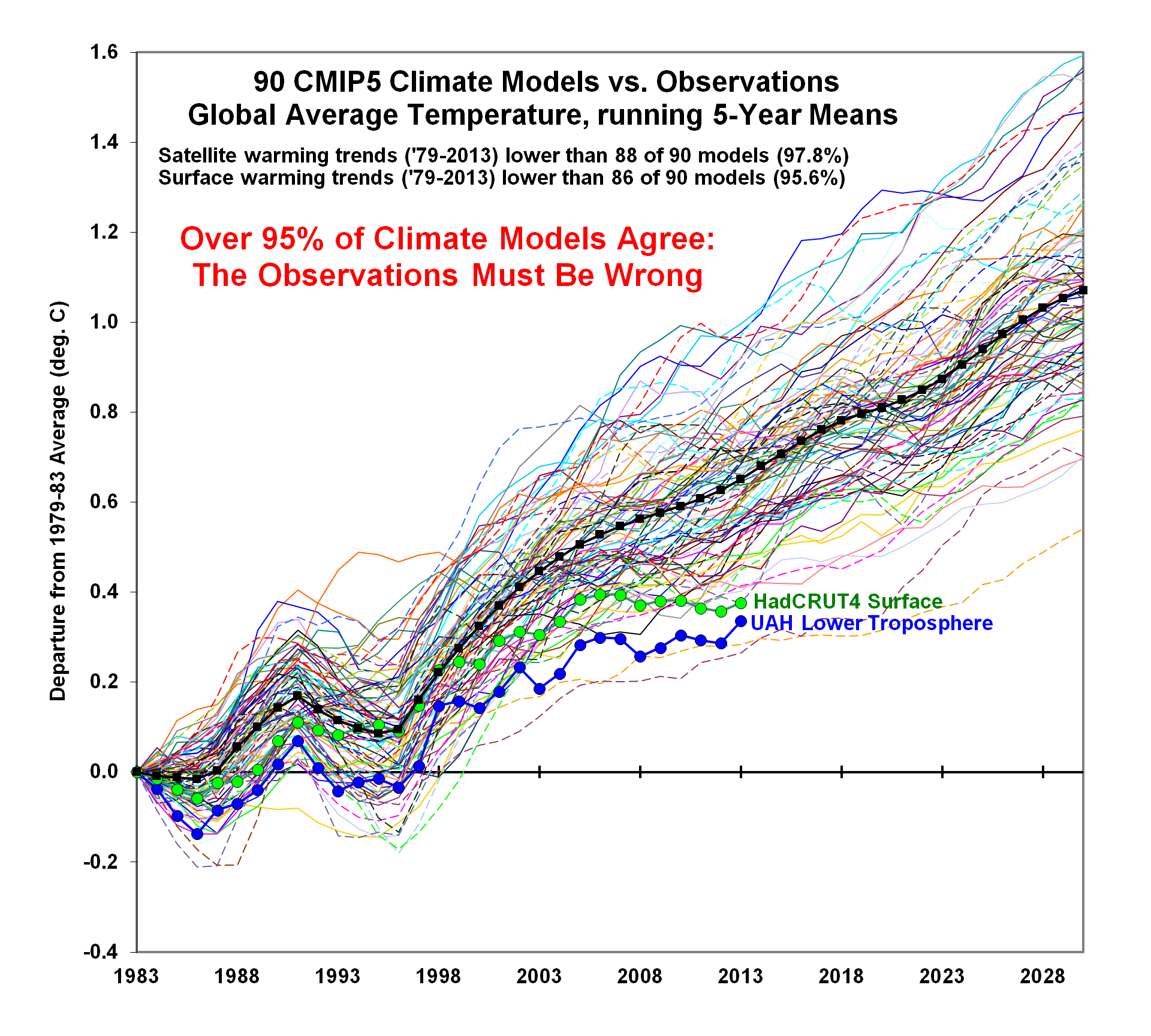
Whether humans are the cause of 100% of the observed warming or not, the conclusion is that global warming isn’t as bad as was predicted. That should have major policy implications…assuming policy is still informed by facts more than emotions and political aspirations.
And if humans are the cause of only, say, 50% of the warming (e.g. our published paper), then there is even less reason to force expensive and prosperity-destroying energy policies down our throats.
I am growing weary of the variety of emotional, misleading, and policy-useless statements like “most warming since the 1950s is human caused” or “97% of climate scientists agree humans are contributing to warming”, neither of which leads to the conclusion we need to substantially increase energy prices and freeze and starve more poor people to death for the greater good.
Yet, that is the direction we are heading.
And even if the extra energy is being stored in the deep ocean (if you have faith in long-term measured warming trends of thousandths or hundredths of a degree), I say “great!”. Because that extra heat is in the form of a tiny temperature change spread throughout an unimaginably large heat sink, which can never have an appreciable effect on future surface climate.
If the deep ocean ends up averaging 4.1 deg. C, rather than 4.0 deg. C, it won’t really matter.
~
Roy W. Spencer received his Ph.D. in meteorology at the University of Wisconsin-Madison in 1981. Before becoming a Principal Research Scientist at the University of Alabama in Huntsville in 2001, he was a Senior Scientist for Climate Studies at NASA’s Marshall Space Flight Center, where he and Dr. John Christy received NASA’s Exceptional Scientific Achievement Medal for their global temperature monitoring work with satellites. Dr. Spencer’s work with NASA continues as the U.S. Science Team leader for the Advanced Microwave Scanning Radiometer flying on NASA’s Aqua satellite. He has provided congressional testimony several times on the subject of global warming.
Dr. Spencer’s research has been entirely supported by U.S. government agencies: NASA, NOAA, and DOE. He has never been asked by any oil company to perform any kind of service. Not even Exxon-Mobil.
Dr. Spencer’s first popular book on global warming, Climate Confusion (Encounter Books), is now available at Amazon.com and BarnesAndNoble.com.
Bum Rap for the Rapa Nui
By Thomas Riggins | Dissident Voice | February 5, 2014
A new report in Science News Magazine (1-25-2014) by Bruce Bower details a reevaluation of the view that the Rapa Nuians, the native inhabitants of Easter Island (Rapa Nui), were responsible for the collapse of their population and society due to over exploitation of natural resources and the destruction of the rain forest on their island, a view recently popularized by Jared Diamond in his book Collapse (2005).
As Bower reports, the anthropologist Maria Mulrooney has published the results of her studies of the Rapa Nui culture (Journal of Archeological Science, December 2013) based on new radiocarbon dates from archeological sites on the island. She has concluded that after the clear cutting of the forest in the 1500s, to make room for agricultural production, the population of Rapa Nui remained sufficiently vibrant to carry on food production and continue their cultural development.
Exactly when the Rapa Nui arrived on Easter Island is unknown but it was on or before 1200 A.D. or so. Mulrooney maintains they had a thriving culture which was still going strong even after their “discovery” by the Dutch explorer Jacob Roggeveen on Easter Sunday 1722. This would indicate that they had not suffered “collapse” as a result of forest clearance.
Roggeveen reported that the island had about 2000 to 3000 inhabitants. He was the first to report on the moai– the giant statues (erected as religious symbols as part of an ancestor cult) for which the island is famous. They were all in place and standing when he was visiting the island (for less than two weeks). In his short time there he managed to kill a dozen or so natives and so his estimate of the population may be incorrect as many people fled and hid out until after he left.
The Spanish showed up in 1770, claimed the island for King Carlos III, then sailed away. The moai were all standing and the people were still engaged in agriculture. Captain Cook showed up in 1774 and noticed some of the moai had fallen but there was no sign of cultural “collapse.”
Bower quotes Mulrooney as saying, “Deforestation did not equal societal failure on Rapi Nui. We should celebrate the remarkable achievements of this island civilization”
Yet the culture did end up almost completely destroyed. After Capitan Cook’s visit Europeans visited more regularly in the 19th Century. It has been suggested that Rapa Nui’s decline may have been caused by the introduction of European diseases. By the early 1800s most of the moai had been toppled and the society had broken up into warring factions.
Peruvian slavers invaded in the 1860s and carried away 1500 of the 2000 or so Rapa Nuians into bondage in the mines of Peru. By 1878 only 111 natives were still living on the island. 97 per cent of the cultural memory of the people had been lost after contact with the Europeans. The greatest loss may have been that of rongorongo, the native writing system of Rapa Nui, and the only writing system created by any Polynesian group. All of those who knew the writing system died in the mines of Peru or from European introduced TB which ravaged the survivors.
Chile annexed the island in 1888. The Rapa Nui were given citizenship in 1966 but they no longer rule on their island. Of the 6000 or so people living on the island today about 3600 are Rapa Nui. The archeologist Carl Lipo is quoted as saying, “The idea of societal collapse on Rapa Nui has long been assumed but there is no scientific basis for it.” He is referring to a self induced collapse. Their traditional culture was destroyed, and the people today are trying to reinvigorate it, but it is a bum rap to blame them for the loss of their civilization.
James Hansen’s Policies Are Shafting The Poor
By Willis Eschenbach | Watts Up With That? | March 15, 2013
I was reading an interview with Adrian Bejan (worth taking a look at), and I got to musing about his comments regarding the relationship between energy use and per capita income. So I pulled up GapMinder, the world’s best online visualization software. Here’s a first cut at the relationship between energy and income.
 Figure 1. Energy use per person (tons of oil equivalent, TOE) versus average income, by country. Colors show geographical regions. Size of the circle indicates population. The US is the large yellow circle at the top right. Canada is the overlapping yellow circle. China is the large red circle, India the large light blue circle. Here’s a link to the live Gapminder graph so you can experiment with it yourself.
Clearly, other than a few outliers, the relationship between energy use and income is quite straightforward. You can’t have one without the other. Well, that’s not quite true, you can have energy without income. You can have (relatively) high energy use without having the corresponding income, plenty of Africa is in that boat. But the reverse is not true—you can’t have high income without high energy use. You need the energy to make the income.
Now, James Hansen is the NASA guy who is leading the charge to stop all forms of cheap energy. Coal is bad, terrible stuff in his world. He calls trains of coal “death trains”. He wants to deny cheap energy to all of those folks in the bottom half of the graph above. Well, actually, he wants to deny access to cheap energy to everyone, but where it hurts is the bottom half of the graph. For example, the World Bank and other international funding agencies, at the urging of folks like Hansen, have been turning down loans for coal plants in developing countries.
But as you can see, if you deny energy to those folks, that is the same as denying them development. Because when there’s less energy, there’s less income. The two go hand in hand. So what James Hansen is advising is that we should take money from the poor … actually he wants to deny them cheap energy, but that means denying them income and the development that accompanies it.
A look at the history of some of the countries is instructive in that regard, to see how the income and the energy use have changed over time. Figure 2 shows the history of some selected countries.
 Figure 2. A history of selected countries. Colors now show crude birth rate (births per thousand)
Now, this is showing something very interesting. It may reveal why Hansen thinks he’s doing good. Notice that for countries where people make below say $20,000 of annual income, the only way up is up and to the right … which means that the only way to increase income is to increase energy use. Look at India and China and Brazil and Spain and the Netherlands as examples. (Note also that crude birth rate is tied to increasing income, and that the crude birth rate in the US has dropped by about half since 1960.)
Above that annual income level of ~ $20,000, however something different happens. The countries start to substitute increased energy efficiency for increased energy use. This is reflected in the vertical movement of say the US, where the 2011 per capita energy use is exactly the same as the 1968 per capita energy use. And Canada is using the same energy per person as in 1977 … so let’s take a closer look at the upper right section of the chart. Figure 3 shows an enlargement of just the top right of the chart, displaying more countries.
 Figure 3. A closeup of Figure 2, showing more countries. Start date is 1968 for clarity.
Now, this is interesting. Many, perhaps most of these countries show vertical or near vertical movement during the last twenty years or so. And the recent economic crash has caused people to be more conservative about energy use, squeezing more dollars out per ton of oil equivalent.
But that only happens up at the high end of the income spectrum, where people are making above about twenty or even twenty-five thousand dollars per year. You need to have really good technology to make that one work, to produce more income without using more energy. You need to be in what is called a “developed” nation.
When people think “development”, they often think “bulldozers”. But they should think “energy efficiency”, because that is the hallmark of each technological advance—it squeezes more stuff out of less energy. But you have to be in an industrialized, modern society to take advantage of that opportunity.
So this may be the reason for Hansen’s attitude toward energy use. He may not know that most of the world is not in the situation of the US. This may be the reason the he claims that we should curtail energy use by all means possible. He may not see that while the US and industrialized countries can get away with that, in part because we waste a lot of energy and have a lot of both money and technology, the poor and even the less well off of the world have little energy or money to waste.
For those poorer countries and individuals, which make up the overwhelming bulk of the world’s population, a reduction in energy use means a reduction in the standard of living. And the part Hansen and his adherents don’t seem to get is that for most of the world, the standard of living is “barely” … as in barely making ends meet.
As is usual in this world, the situation of the rich and the poor is different, and in this case the break line is high. Twenty grand of income per year is the line dividing those who can take advantage of technology to get more income with the same energy, and the rest, which is most of the world. Most of the world are still among those who must use more energy to increase their income. They don’t have the option the US and the developed nations have. They must increase energy use to increase income.
And when you start jacking up energy prices and discouraging the use of cheap energy sources around the planet, as Hansen and his adherents are doing, the poorest of the poor get shafted. James Hansen is making lots and lots of money. He’s comfortably in the top 1% of the world’s population by income, and he obviously doesn’t give much thought to the rest. We know this because if he thought about the poor he’d realize that while he is mouthing platitudes about how he’s doing his agitation and advocacy for his grandchildren’s world in fifty years, what he’s doing is shafting the poor today in the name of his grandchildren. Of course Hansen is not the first rich white guy to do that, so I suppose I really shouldn’t be surprised, but still …
Increased energy prices, often in the form of taxes and “cap-and-trade” and “renewable standards”, are THE WORLDS MOST REGRESSIVE TAX. Hansen proposes taxing the living daylights out of the poor, but he won’t feel the pain. He can stand a doubling of the gas prices, no problem. But when electricity and gas prices double around the planet, POOR PEOPLE DIE … and Hansen just keeps rolling, he has quarter-million-dollar awards from his friends and a fat government salary and a princely retirement pension you and I paid for, he could care less about increased energy prices. He’s one of the 1%, why should he pay attention to the poor?
Forgive the shouting, but the damn hypocrisy is infuriating, and I’m sick of being nice about it. James Hansen and Michael Mann and Gavin Schmidt and Phil Jones and Peter Gleick and the rest of the un-indicted co-conspirators are a bunch of rich arrogant 1%er jerkwagons who don’t care in the slightest about the poor. Not only that, but they’ve given the finger to the rest of the climate scientists and to the scientific establishment, most of whom have said nothing in protest, and far too many of whom have approved of their malfeasance.
Their patented combination of insolent arrogance and shabby science would be bad enough if that was all they were doing … but they are hurting poor people right now. Their policies are causing harder times for the poor today, as we speak … and they mouth platitudes about how they are saving the poor from some danger they won’t see for fifty years?
If you ask the poor whether they’d rather get shafted for sure today, or possibly get shafted in fifty years, I know what they’d tell you. To me, hurting the poor today under the rubric of saving them in half a century from an unsubstantiated and fanciful danger is moral dishonesty of the first order.
So let me say to all of you folks who claim the world is using too much energy, you have the stick by the wrong end. The world needs to use MORE energy, not less, because there is no other way to get the poor out of poverty. It can’t be done without cheap energy. We need to use more energy to lift people out of bone-crushing poverty, not use less and condemn them to brutal lives. And to do that, energy needs to be cheaper, not more expensive.
Let me be crystal clear, and speak directly to Hansen and other global warming alarmists. Any one of you who pushes for more expensive energy is hurting and impoverishing and killing the poor today. Whether through taxes or cap-and-trade or renewable subsidies or blocking drilling or any other way, increasing energy costs represent a highly regressive tax of the worst kind. And there is no escape at the bottom end, quite the opposite. The poorer you are, the harder it bites.
So please, don’t give us the holier-than-thou high moral ground stance. Spare us the “we’re noble because we are saving the world” BS. When a poor single mother of three living outside Las Vegas has her gas costs double, she has little choice other than to cut out some other essential item, food or doctor visits or whatever … because her budget doesn’t have any of the non-essential items that James Hansen’s budget contains, and she needs the gas to get to work, that’s not optional.
For her, all her money goes to essentials— so if gas costs go up, her kids get less of what they need. You’re not saving the world, far from it. You’re taking food out of kids’ mouths.
You are causing pain and suffering to the poor and acting like your excrement has no odor … but at least there is some good news. People are no longer buying your story. People are realizing that if someone argues for expensive energy, they are anti-human, anti-development, and most of all, without compassion for the poor. They are willing to put the most damaging, regressive, destructive tax imaginable on the poorest people of the planet.
Now those of you advocating for higher energy prices, after reading this, you might still fool the media about what you are doing to the poor. And it’s possible for you to not mention to your co-workers about the real results of your actions. And you could still deceive your friends about the question of the poor, or even your wife or husband.
But by god, you can no longer fool yourself about it. As of now, you know that agitating for more expensive energy for any reason hurts the poor. What you do with that information is up to you … but you can’t ignore it, it will haunt you at 3 AM, and hopefully, it will make you think about the less fortunate folk of our planet and seriously reconsider your actions. Because here’s the deal. Even if CO2 will damage the poor in 50 years, hurting the poor now only makes it worse. If you think there is a problem, then look for a no-regrets solution.
Because if you truly care about the poor, and you are afraid CO2 will increase the bad weather and harm the poor fifty years from now, you owe it to them to find a different response to your fears of CO2, a response that doesn’t hurt the poor today.
Related article

Russia breaks oil output record
RT | November 2, 2013
Russian oil output, the largest in the world, reached 10.59 million bpd (barrels per day) in October, setting the record for the country’s post-Soviet period, Energy Ministry data showed.
The landmark was reached due to Rosneft increasing production at the Vankor field in the Krasnoyarsk Region, the Vedomosti paper reports.
The output at the field was 18.3 million tons last year, with the company planning Vankor reach 25 million tons annually.
Another influential factor is the larger amount of Gazprom-produced gas condensate, which has now reached 350,000 bpd.
The country’s total output in October reached 44,773 million tons, which is 1.3 percent higher than during the same period last year.
According to the International Energy Agency, Russia’s all-time production of black gold reached its peak at 11.41 million bpd in 1988, when it was still part of the Soviet Union.
The production of oil in Russia has been steadily growing since the setback caused by the global financial crisis in 2008, which saw output falling to about 9.8 million bpd.
In September 2009, it exceeded a monthly level of 10 million bpd, with the country overtaking Saudi Arabia as the world’s largest oil producer the next year.
Oil and gas remain the No.1 source of income for Russia, as hydrocarbons account for 80 percent of the country’s export.
Related article
US Shale Gas No Threat to Russia’s Energy Dominance – Rosneft
RIA Novosti – October 6, 2013
MOSCOW – Russian state oil giant Rosneft has plans to extract oil in the next 100 years and sees no significant threat from the increase in shale gas production in the United States, CEO Igor Sechin told journalists Sunday.
“We have a 100 year work prospect,” Sechin said. “As for the shelf, we have no other alternative. In general, oil needs to be extracted,” he said adding that the US shale production is high-cost, which makes it impossible for export.
US media reports said this week the United States was expected to leapfrog Russia as the world’s largest producer of oil and natural gas this year thanks to a surge in US fuel production driven by technology that allows energy companies to tap into oil and gas in underground shale rock formations.
As US energy extraction and production have gone up, imports of natural gas and crude oil have fallen by 32 percent and 15 percent, respectively, in the last five years, the Wall Street Journal said.
Sechin said Rosneft, which has 1.5 percent of world’s explored reserves, was interested in international partnership and would adhere to high environmental standards.
He has accused the activists of the non-profit environmental organization Greenpeace, who were detained last month by Russian authorities after staging a “peaceful protest” against oil drilling in the Russian Arctic, of pursuing commercial interests.
“Look at those who pay them, who is their sponsor,” Sechin told journalists.
Rosneft currently holds 46 licenses for Russian offshore deposits worth 42 billion tons of oil equivalent. The company has signed agreements on cooperation with US oil and gas giant Exxon Mobil, Italy’s Eni and Norway’s Statoil.
Related article
- Rosneft President Igor Sechin On Working Visit To China (eurasiareview.com)
Death toll from Sudan fuel price demos nears 30
Press TV – September 26, 2013
The death toll from three days of protests over a cut in fuel subsidies in Sudan has reached to nearly 30.
Protests broke out in the country on September 23 following a government decision to lift fuel subsidies to raise revenue.
According to initial reports, seven people died during the protests, but a hospital source in Khartoum’s twin city Omdurman said the bodies of 21 people had been received since the protests began on September 23. That announcement put the death at nearly 30 people.
The source also stated that all the victims were civilians.
Activists are scheduled to hold fresh protests in the capital on Thursday.
On Wednesday, security forces fired tear gas and used force to disperse the demonstrators in Khartoum and Omdurman.
The demonstrators burned vehicles in a hotel car park near Khartoum International Airport, and a petrol station in the area was also set alight.
On September 24, protesters stormed and torched the offices of the ruling National Congress Party in Omdurman.
Sudan’s Education Ministry announced that schools in the capital would remain closed until the end of the month.
Sudan has been plagued by running inflation and a weakening currency since it lost billions of dollars in oil revenues after South Sudan gained independence two years ago, taking with it some 75 percent of crude production of the formerly united country.
Sudan Tribune | September 25, 2013
… The Sudanese embassy in Washington said in a press release that the lifting of fuel subsidies was due to the US economic sanctions.
“Due to continuing economic sanctions against the peoples of Sudan, the Government of Sudan lifted subsidies for gasoline. Some citizens violently protested this necessary economic measure by burning government buildings, gasoline stations, shopping malls and private property. Some also attacked the police, who defended themselves while protecting public and private property,” the embassy said.
It also denied imposing an internet blackout.
“The Government of Sudan did not block internet access. Among other targets, violent protesters burned facilities of Canar Telecommunications Company, which hosts the core base of internet services for Sudan. These fires resulted in continuing internet black outs across Sudan,” it added.
“The Government of Sudan and Canar Telecom have now partially restored internet service and will work until internet access is fully restored”.
Renesys Corp., a company that maps the pathways of the Internet, said according to Associated Press that it could not confirm whether the blackout was government-orchestrated. But the outage recalls a similarly dramatic outage in Egypt, Sudan’s neighbour, when authorities shut off Internet access during that country’s 2011 uprising.
“It’s either a government-directed thing or some very catastrophic technological failure that just happens to coincide with violent riots happening in the city,” said senior analyst Doug Madory. He said it was almost a “total blackout.”
On Monday, the Sudanese cabinet formally endorsed a decision that has been circulated the night before by which prices of gasoline and diesel were increased by almost 100%.
A gallon of gasoline now costs 21 Sudanese pounds ($4.77 based on official exchange rate) compared to 12.5 pounds ($2.84).
Diesel also went from 8 pounds ($1.81) a gallon to 14 pounds ($3.18).
Cooking gas cylinders are now are priced at 25 pounds ($5.68) from 15 pounds ($3.40).
The cabinet also raised the US dollar exchange rate for importing purposes to 5.7 pounds compared to 4.4. The black market rate now stands at 8.2.
Senior Sudanese officials including president Omer Hassan Al-Bashir have defended the measure saying the only alternative would be an economic collapse as the state budget can no longer continue offering the generous subsidies on petroleum products to its people.
Sudan’s oil boom that fuelled an unprecedented economic growth and a relative prosperity over the last decade came to an end with the independence of South Sudan which housed around three quarters of the crude reserves prior to the country’s partition. … Full article
Featured Video

US IRAN TALKS: Who Are the Crazy Ones Here? /Lt Col Daniel Davis
or go to
Aletho News Archives – Video-Images
From the Archives
Woolsey Fire started at Santa Susana Field Lab — where “radioactive materials released were never accurately measured”
By John Laforge | CounterPunch | November 30, 2018
In my Nov. 16 column, I reported on potential radiation risks posed by California’s Woolsey wildfire having burned over parts or all of the Santa Susana Field Laboratory—south of Simi Valley, Calif., 30 miles outside Los Angeles—site of at least four partial or total nuclear reactor meltdowns.
The field laboratory operated 10 experimental reactors and conducted rocket engine tests. In his 2014 book Atomic Accidents, researcher James Mahaffey writes, “The cores in four experimental reactors on site … melted.” Reactor core melts always result in the release of large amounts of radioactive gases and particles. Clean up of the deeply contaminated site has not been conducted in spite of a 2010 agreement.
Los Angeles’s KABC-7 TV reported Nov. 13 that the Santa Susana lab site “appears to be the origin of the Woolsey Fire” which has torched over 96,000 acres. Southern Calif. Public Radio said, “According to Cal Fire, the Woolsey Fire started on the afternoon of Thursday, Nov. 8 … on the Santa Susana site.” … continue
Blog Roll
 Aletho News
- US IRAN TALKS: Who Are the Crazy Ones Here? /Lt Col Daniel Davis
- Talks with the US end without a deal over excessive US demands: Iran
- Feeling Better, Getting Worse: How Psychiatric Drugs Create the Illusion They Cure
- ‘Nobody Told Me’: Former Mental Health Patient Calls Out Dangerous Side Effects of Psychiatric Drugs
- Dr. Abu-Sitta: Beirut ‘felt like a day in Shifa Hospital’
- Iran Has Won the War, It Will Be Up to the US to Secure the Peace: Mohammad Marandi
- Iran condemns assassination threats against Iranian negotiators amid US talks
- Brussels cannot say where its own pipeline inspectors are as Hungary’s oil lifeline remains shut
- Israel’s Iran War: Myth and Reality
- Between war and industrial breakdown: The US-Israeli attrition crisis
- If Americans Knew
- Pro-Israel ‘Thinktanks’ and Individuals who Influence U.S. Foreign Policy
- Mearsheimer reveals how Israel dictates US policies on Iran, Gaza – video
- After killing 350+, Israel still has a “score to settle” with Lebanon before ceasefire – Daily Update
- Military aid to Israel emerges as the latest political litmus test for Democrats
- The only Palestinian children’s rights organization closes following years-long Israeli campaign against it
- ‘I Can’t Forget the Smell’: Lebanese Reel After Israel Kills Over 300 in Single Day
- DNC Shoots Down Resolutions Calling Out AIPAC and Limiting Arms to Israel
- TCN: Is Israel Blackmailing President Trump?
- Israel killed at least 303 Lebanese yesterday – who were they? Daily Update
- Amnesty: Urgent – Protect Lebanese civilians from brutal escalation in Israeli attacks
- No Tricks Zone
- German Expert: Heat Dome Led To Record Temps In Western USA…Warmer In 1934, 1936
- New Study: No Linear Warming Or Glacier Retreat Along Northern Antarctic Peninsula Since 1980s
- An Inconvenient Tree: Uncovered In Alps… Europe Much Warmer Than Today 6000 Years Ago
- New Study Reports A 60% Slowdown In Greenland’s Ice Loss Rate In The Last Decade
- Low Intensity Tornado Wrecks Major Solar Farm, Creating A Potential Toxic Dump
- New Study Finds Warming Saves Lives…Cold Temperatures 12 Times More Deadly Than Excess Heat
- German Science Blog Accuses PIK Climate Institute Of Hallucinating Climate Tipping Points
- Devastating Assessment Of Comirnaty Vaccine By Former Senior Pfizer Europe Toxicologist
- New Study: CO2 Is ‘Effectively Negligible’ As An Explanatory Climate Change Factor Since 2000
- Former Pfizer Toxicologist Dr. Helmut Sterz Tells Bundestag Hearing Pfizer Vaccine Should Have Never Been Approved
 Aletho News