The US has been drawn by Israel into an “unlawful war” against Iran and needs help to disengage, Omani Foreign Minister Badr Albusaidi has said.
In an opinion piece published in The Economist on Wednesday, the Middle East nation’s top diplomat called on US allies in the region to “tell the truth” about the conflict and admit that Washington “has lost control” of its own foreign policy. “There are two parties to this war who have nothing to gain from it,” he wrote, referring to the US and Iran.
The US maintains close security and defense partnerships with six Gulf states – Saudi Arabia, Kuwait, the United Arab Emirates, Qatar, Bahrain, and Oman – and has a significant military presence in the region, including bases and naval facilities.
The escalation has had economic and security consequences for these states, with Iran retaliating against targets on their territory. Gulf officials have reportedly complained they were not consulted or warned before the US and Israel launched the campaign against Iran on February 28.
Albusaidi, who acted as a mediator in nuclear talks between Washington and Tehran, wrote that the parties had twice come close to a deal in nine months, noting that the airstrike campaign began immediately after the most substantive talks.
”Israel and America again launched an unlawful military strike against the peace that had briefly appeared really possible,” he wrote, adding that Iran’s retaliation was “inevitable.”
He argued that Washington’s greatest mistake was “entering a war that is not its own,” adding that Israel seeks regime change in Iran, while US interests lie in ending nuclear proliferation and securing energy supplies.
The US leadership must “decide where its national interests really lie, and act accordingly,” Albusaidi wrote. He acknowledged that while returning to talks may prove difficult for both sides, renewed negotiations, potentially mediated by the Gulf states, may provide a path forward.
Tehran has described the negotiations as a US-Israeli deception operation. Former US National Counterterrorism Center head Joe Kent said that Israel and allied media figures ran a “misinformation campaign” to push Washington toward war with Iran, according to his resignation letter published on Thursday.
Former Saudi intelligence chief, Prince Turki al-Faisal, also blamed the conflict on Israel, claiming that Israeli Prime Minister Benyamin Netanyahu “somehow convinced” US President Donald Trump “to support his views.”
War is often sold to the public as an act of national will: decisive, necessary, and under control. The bill arrives later, in a quieter form. It shows up in insurance markets, shipping rates, emergency guarantees, higher fuel prices, and sudden policy reversals designed to keep the economic damage from spreading too far or too fast. That is what is now happening with the U.S.-Israeli war on Iran. The fighting is not only destroying lives and widening instability. It is also revealing something more familiar about the American state: when private actors no longer want to bear the risk of a war Washington helped ignite, Washington moves to spread that risk across everyone else.
The clearest example came when maritime war-risk premiums in the Gulf surged, in some cases by more than 1000%, as ships and cargoes moved through a combat zone centered on one of the world’s most important energy chokepoints. This is what markets do when governments create danger: they start pricing reality honestly. Insurance underwriters do not care about speeches about resolve or credibility. They care about missiles, mines, damaged hulls, and the odds that a vessel will not make it home intact. Once those odds change, the market does what it is supposed to do. It becomes expensive to move goods through a war.
But the American state does not like that kind of honesty, because honest prices expose the real cost of intervention. So instead of letting war become unaffordable to the people escalating it, Washington stepped in. The U.S. International Development Finance Corporation announced a maritime reinsurance facility covering losses up to roughly $20 billion on a rolling basis, and later named Chubb as the lead insurance partner. In plain English, the government decided that if the private market was no longer willing to carry the full risk of this war, the state would help carry it instead. That is not a side effect of interventionism. It is one of its operating principles. Risk is privatized on the way up, then socialized when the numbers stop working.
The same pattern is visible in energy policy. As the war tightened shipping and pushed oil prices above $100 a barrel, Washington issued a thirty-day waiver allowing purchases of stranded Russian oil at sea to stabilize markets. That move was not just an emergency adjustment. It was an admission. The administration was effectively saying that one war had already become costly enough to require loosening pressure in another theater. A foreign policy that presents itself as hard and disciplined suddenly becomes very flexible when gasoline, shipping, and inflation begin threatening domestic politics. The slogans remain moralistic. The mechanics turn transactional overnight.
This is what statism looks like in practice. It does not simply bomb another country and call it security. It also rearranges the economic landscape at home and abroad so that the political architects of the war do not face the full consequences of their decisions. The cost is pushed outward onto taxpayers who did not authorize the war, consumers who will pay more for energy and goods, and trading systems that now have to absorb new shocks because Washington and Israel chose escalation over restraint. The state does not merely fight. It conscripts logistics, insurance, credit, and public balance sheets into the campaign.
That is why it is misleading to describe this as only a military conflict. It is also an exercise in political risk transfer. The Strait of Hormuz handles around twenty million barrels per day of crude oil and oil products and roughly a quarter of the world’s seaborne oil trade. Any government that helps turn that corridor into a war zone is not just making a strategic decision abroad. It is imposing a hidden tax on ordinary life. It is raising the cost of transport, trade, fuel, insurance, and eventually everything built on those foundations. And when those costs start climbing too fast, the same government asks the public to cushion the blow in the name of stability.
There is a moral evasion built into this arrangement. The public is told to think about war in the language of necessity and strength, while the real economics are handled behind the scenes through emergency waivers, public guarantees, and market interventions. Washington bypasses the discipline that peace would impose. It subsidizes the consequences of its own escalation, then presents the cleanup operation as responsible governance. That is not prudence. It is the imperial version of sending someone else the invoice.
The libertarian objection to this war is not only that it is reckless, unjust, and likely to widen. It is also that the state is once again doing what it does best: converting elite foreign-policy choices into burdens to be carried by everybody else. When insurers retreat, the government steps in. When sanctions collide with energy reality, the rules bend. When war becomes too expensive, the price is redistributed rather than paid by the people who chose it. That is the deeper scandal here. The state is not just waging this war. It is socializing its cost.
Lt. Col. Daniel Davis argues why opening the Strait of Hormuz, putting boots on the ground, or seizing Kharg Island are not feasible options. The US could invade Yemen to control the key strait to the Red Sea—Bab el-Mandeb. The resignation of Joe Kent indicates that the military options and war narratives are collapsing fast. Lt. Col. Davis is a 4x combat veteran, the recipient of the Ridenhour Prize for Truth-Telling, and is the host of the Daniel Davis Deep Dive YouTube channel.
The economic costs of the U.S. and Israel’s decision to start a war with Iran have already reverberated throughout the international economy. Oil prices rose, the stock market fell, and U.S. mortgage rates jumped sharply, raising the cost to buy a home for Americans. Unsurprisingly, public opinion polls have found that Americans are resoundingly opposed to Trump’s Iran war.
Yet, one sector has profited massively from the devastating conflict: Pentagon contractors. Arms supplier stocks as a whole rose 1.5% on Monday, but the largest Pentagon contractors and the contractors with the greatest stake in the conflict saw their share prices rise even more.
Lockheed Martin — the largest Pentagon contractor, which regularly receives more taxpayer dollars than the entire State Department — saw its stock price rise 3.4% Monday. Since the beginning of 2026, Lockheed’s stock price has increased nearly 40%, as tensions between the U.S. and Iran grew. Lockheed makes the THAAD system which has been used to intercept Iranian missiles. In January, Lockheed Martin signed a deal with the Pentagon to quadruple production of the THAAD interceptors — which each cost $12.77 million — from 96 to 400 per year.
RTX (previously Raytheon) stock rose 4.7% in the first day of trading since the Iran war began. RTX makes the Patriot radar and ground systems (Lockheed makes the $4 million Patriot missiles the system fires) that have been widely used in the conflict, which cost as little as $250,000. Multiple Patriot missiles are sometimes used to intercept every Iranian missile. In one case, for example, 11 Patriot missiles were reportedly used to intercept just one Iranian missile.
Of all the major Pentagon contractors, Boeing saw its share price rise the least on Monday, inching up just 1%. This relatively limited, though still sizable, gain is at least partially explained by the firm being the only major Pentagon contractor that does not derive a majority of its revenue from the Defense Department. The firm does, however, make the F-15 EX fighter jet, three of which crashed after being accidentally attacked by Kuwait’s air defense system. The cost of those three jets alone was around $300 million.
The biggest winner on Wall Street yesterday was Northrop Grumman, whose share price rose a remarkable 6%, increasing the company’s market value by billions of dollars in just one day of trading. Northrop’s B-2 Stealth Bombers were used in the recent Iran strikes, as well as in the strikes on Iran six months ago. The B-2s cost taxpayers around $2 billion to buy and more than $150,000 per hour to fly.
U.S. weapons makers certainly weren’t alone in cashing in on the conflict. European defense companies, like BAE Systems, Saab, and Thales also saw their market value soar.
For investors and stock analysts, this was all to be expected. After all, the ticker for the global defense sector ETF is literally “War”.
As Jonathan Siegmann, a market analyst at the firm Stifel, succinctly explained to clients Monday, “Defense spending was already set to surge in 2026 and a protracted war with Iran will make the spending more urgent and less controversial.” As Marketwatch summed up the financial markets’ zeal for firms that will profit from the Iran war: “war can be good for business.”
The greatest threat to investors in these firms? Peace. When peace talks begin during prolonged conflicts, investors in defense firms tend to sell, as they did late last year when Russia, Ukraine, and the U.S. were in peace talks. But investment analysts are confident there’s no imminent threat of peace breaking out soon in the current Iran conflict. “Given the U.S. has assembled the largest set of military assets since the 2003 invasion of Iraq, we anticipate this conflict will be unfortunately more extended and violent than we have seen in recent years,” Siegmann said Monday.
In short, while more than 100 children were murdered in a strike on an Iranian school and the number of U.S. service members killed in the conflict continues to climb, war profiteering has a bright future ahead.
Ben Freeman is Director of the Democratizing Foreign Policy program at the Quincy Institute and the author of “The Trillion Dollar War Machine: How Runaway Military Spending Drives America into Foreign Wars and Bankrupts Us at Home” (2025).
US President Donald Trump believes that involving many countries in a naval coalition would force Iran to surrender under international pressure, or at least agree to a ceasefire and enter negotiations with those countries without preconditions.
The last thing Trump expected was for what he thought would be a short, hours-long confrontation to stretch into days and weeks, and then turn into a full-fledged war of attrition.
This is a scenario he neither anticipated nor has the personal capacity to bear, given its potentially disastrous consequences for his country and the world.
It has become clear that Iran had long prepared for this all-out confrontation and that its leadership was certain it would happen at some point. Turning it into a prolonged war of attrition, both geographically and over time, appears to be a central pillar of the Iranian strategy to exhaust the US, the Zionist regime, and their regional and international allies.
Very quickly, by the end of the first week of the illegal and unprovoked war on Iran, Trump’s vision began to turn into a nightmare. His plan to overthrow the Islamic Republic (in other words, “regime change”) with a first strike failed, as did his far-fetched ambition to gain control over a quarter of global oil production and influence its routes and prices.
He now faces the urgent need to manage the global economic fallout of this failure. Iran has effectively gained control over a maritime route through which roughly a quarter of the world’s oil supply passes. By the third week of the war, oil prices had risen above $100 per barrel.
In his first statement to the Iranian people and the world, the new Leader of the Islamic Republic, Ayatollah Seyyed Mojtaba Khamenei, summarized this challenge in two striking phrases that sent shockwaves through the White House.
“The will of the people is to continue effective and deterrent defense,” and “the option of closing the Strait of Hormuz must remain on the table,” he declared.
This clearly signals a willingness to pursue a prolonged war of attrition that threatens the global economy, especially that of the United States and its allies.
Faced with this difficult situation, rising war costs, and growing tensions not only between the US and the Zionist regime but also within the Trump administration, as reported in American and Hebrew media, Trump has turned to his allies for help.
He initially claimed that several countries would send warships to cooperate with the United States in keeping the Strait of Hormuz open and secure.
He expressed hope that countries such as China, France, Japan, South Korea, and the United Kingdom would deploy naval forces to ensure the safety of this vital shipping route. He also called on countries that benefit from West Asian oil to contribute forces to secure maritime navigation.
At the same time, Trump announced an airstrike on Iran’s Kharg Island in an apparent attempt to convince these countries that the US still controls the military situation in the Persian Gulf.
Trump’s remarks can be understood as a desperate call to form an international naval military coalition under US leadership in the region. The implications, motivations, and objectives behind this call can be summarized as follows:
First, the United States appears to have lost the ability to control and manage the war on its own, especially after failing to claim victory. It is now attempting to internationalize the war and turn it into a global confrontation with Iran under the pretext of protecting oil supply chains and global trade.
Second, the US is trying to bypass Iran’s right to control navigation in the Strait during wartime by internationalizing the issue. This could pave the way for imposing new maritime laws under pressure from multiple countries.
Third, Trump believes that the participation of many countries in a naval coalition would force the Islamic Republic to surrender under international pressure, or at least agree to a ceasefire and enter negotiations without preconditions, giving him a way out of the current crisis.
Fourth, Trump is maneuvering to avoid relying on Russian mediation, which he believes would come at a cost, possibly involving concessions in other areas he is unwilling to compromise on.
Fifth, Trump hopes that his invitation to China to join the coalition will be accepted, especially with a scheduled visit to Beijing.
Sixth, he is trying to encourage European countries, affected by rising energy prices, to join the war effort, after they initially adopted a relatively neutral stance.
The first responses came from Europe, particularly France and the United Kingdom, which appeared to divide roles between them. The UK quickly held a ministerial meeting with Persian Gulf monarchies under defensive themes, a move that seemed to sidestep Trump’s call for a formal naval coalition.
British media also reported that the UK is considering sending drones to detect naval mines and intercept Iranian drones, steps that fall short of full participation in a military alliance.
France, meanwhile, took a different approach. President Emmanuel Macron held phone calls with both the Saudi Crown Prince and the Iranian president, aiming to activate political efforts for a resolution. He also asked Trump to clarify his “final objectives and the pace he intends for operations.” The French presidency denied reports that France would send warships to the Persian Gulf.
Japan announced that it would not rush to send warships in response to Trump’s request, emphasizing its long-standing principle of making independent decisions. It also noted that current laws make deploying military vessels to the region legally very difficult.
South Korea stated that it is carefully reviewing Trump’s request, while China ignored the call and instead urged an immediate ceasefire.
Overall, despite their differences, these responses reflect a shared caution, a preference for diplomacy, de-escalation, and, in essence, avoiding the risks of retaliatory attacks from Tehran over a war that has been widely acknowledged as illegal and unprovoked.
This has reportedly increased Trump’s frustration, leading him to postpone his visit to China and to warn of serious consequences for NATO if allies respond negatively.
Tehran’s political approach appears to combine prudence and strategic cunning with firm military resolve. This has been evident both in its diplomatic efforts before and during recent negotiations, as well as in its conduct during the current war.
As usual, Iran’s leadership quickly understood the motives behind Trump’s latest maneuver and responded through several measures.
One of the first decisions was to allow some oil shipments to pass through the Strait of Hormuz on the condition that transactions be conducted reportedly in Chinese yuan, as per reports.
This move aims to maintain oil flows while weakening the US dollar, or at least ensuring that China continues to receive Persian Gulf oil imports, not just from Iran. This is particularly significant as Persian Gulf states may feel compelled to continue selling oil amid fears of economic slowdown after decades of growth.
Iranian Foreign Minister Abbas Araghchi shifted responsibility back onto the United States by stating that Iran has not closed the Strait of Hormuz and that the real reason ships are not sailing is the insecurity caused by American aggression.
This undermines the justification Trump used to call for the coalition. Araghchi also left the door open for countries seeking safe passage for their ships, indicating that decisions would rest with Iranian military forces.
This may be an attempt to encourage direct security cooperation with Iran instead of joining a US-led coalition, while also reiterating Iran’s demand for US forces to leave the region.
Remarks by former CIA analyst Larry Johnson seem to capture Trump’s current situation accurately: Trump lives in a world of “illusions” and is detached from “reality.”
In reality, he is sliding toward madness.
Wesam Bahrani is an Iraqi journalist and commentator.
As is becoming clearer from President Trump’s own statements and those of his staff, along with press reporting, the US has launched a major war without the input of the experts we pay to advise the President on such matters. The State Department, Pentagon, National Security Council Staff, Defense Intelligence Agency, and NSA were simply bypassed because, as White House Spokesperson Karoline Leavitt said, President Trump “had a feeling” Iran would attack.
The President’s real estate developer son-in-law and friend reinforced that “feeling” when they returned from the second round of talks with the Iranian foreign minister and his team. However, as the news outlet Responsible Statecraft (RS) reported over the weekend, both son-in-law Jared Kushner and friend Steve Witkoff appear to have mis-represented those talks in a way that helped push President Trump toward war. No State Department officials were on hand to ensure the reporting was accurate.
Also, arms control experts at home, according to the RS report, believe that “the duo appeared to have fatally misunderstood a series of basic technical and historical matters” regarding Iran’s nuclear program leading to inaccurate information conveyed to the President.
Congress was completely out of the picture – seemingly uninterested in performing its Constitutional duty – and no case was made to the American people that they must sacrifice and die once again for a war in the Middle East.
Trump’s repeated promises to not start new wars, especially in the Middle East, have turned out to be empty, and Republicans are set for a crippling defeat in the upcoming midterm elections.
Iran had been warning for months – since the last US/Israeli surprise attack in June – that if they were attacked again they would not hold back on US bases in the region and that they would close the Straits of Hormuz. Trump and Netanyahu attacked anyway, and Iran has done what it said it would do.
Now the Strait of Hormuz is closed, oil is about to go out of control, and the global economy – along with the US dollar – seems about to implode.
On March 6th, President Trump refused a UK offer of help, saying we don’t need help when we’ve already won the war. Five days later, at a rally in Kentucky, President Trump repeated that “We’ve won the Iran war!”
It was his “Mission Accomplished” moment, because this weekend, just days after declaring victory against an “obliterated” Iran, Trump began begging other countries to send ships to help the US open the Strait of Hormuz.
Thus far every country has declined, understanding that such a mission has little chance of success.
Tragically, the war thus far has claimed at least 14 servicemembers. It is likely the toll is far worse than they are telling us. Every US military facility in the region is either damaged or destroyed. Billions of dollars of radar and other equipment are destroyed. Our allies in the region, because they allowed their territory to be used to attack Iran, have also seen massive retaliatory destruction.
This is surely one of the worst military disasters in US history. There are no military options available beyond the unthinkable: the use of nuclear weapons.
The only viable option that remains is one that was often urged in the Vietnam War: Just get out. Now! No return to US bases, no security guarantees to Gulf States. End the US empire in the Middle East and elsewhere. If not, it’s only going to get worse.
Sixteen days into the American-Israeli war on Iran, the battlefield tells a story that Pentagon planners had not anticipated. Tehran’s streets remain filled with defiant crowds, the Strait of Hormuz remains closed for US-linked ships, and the US military bases in the region smolder.
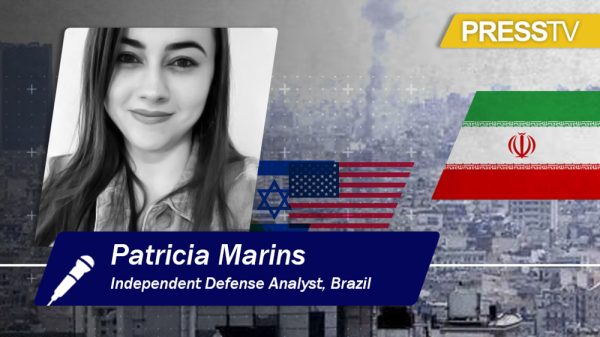
Patricia Marins, an independent defense analyst based in Brazil, has been following the war unfold with a keen eye on the shifting strategic balance.
In an interview with the Press TV website, Marins said she has been witnessing the emergence of something the region has never quite witnessed before: the “Iranian model” of warfare proving itself against the world’s most powerful military.
“The Iranian model possesses several distinct characteristics compared to the American model exported to Arab countries. It is built for attrition warfare and resilience, featuring an extensive network of underground facilities and a focus on long-range precision-guided munitions,” she stressed.
“All of this was achieved through investment in research centers, universities, reverse engineering, and the steady implementation of a domestic defense industry, which in many respects is dual-use.”
On the other hand, the American model exported to the Persian Gulf countries consists of “vulnerable surface installations, almost no degree of indigenous production, and consequently a disconnect between research centers, reverse engineering, and the military industry,” which Marins added is not limited to the US model, but all Western models.
“Kuwait paid over $310 million for each Eurofighter Typhoon, nothing short of extortion,” she said, making a clear distinction between the American and Iranian models.
Today, amid the war that was triggered by the unprovoked US-Israeli attack on February 28, and the assassination of the Leader of the Islamic Revolution, Ayatollah Seyyed Ali Khamenei, and some top-ranking military commanders, that investment is paying dividends.
Marins believes the contrast in the military tech leap is not lost on regional observers.
“I believe this Iranian model is being closely watched by all (Persian) Gulf countries at this moment. I see a high probability of it serving as a reference in several areas. I even believe it has inspired the Saudi missile industry, which is currently absorbing Chinese technology,” she said.
“Iran inspires, yet it still maintains a guarded distance from the (Persian) Gulf countries in this sector.”
Beyond the missile and drone arsenal, Iran also enjoys the geographical advantage, the Brazilian analyst stated.
“Iran’s advantage begins with its geographical position, but it is confirmed by its military prowess. And Iran knows how to leverage both very effectively,” she said
She referred to the Ghadir-class submarine, which is affordable, stealthy, and designed specifically for the waters it operates in – the Persian Gulf – especially in the Strait of Hormuz.
The Strait’s “shallow, high-salinity, and high-temperature conditions create a challenging, noisy, and complex environment for sonar, favoring small, fast, and highly maneuverable platforms,” she asserted.
“It is the perfect marriage between the weapon and the environment in which it operates,” she said. “Iran knows how to use the geography that already favors them.”
Then there is Yemen as well, which has indicated willingness to join the front against the US and Israel, after the Lebanese Hezbollah resistance movement and Iraqi resistance groups.
“Iran has been a master player. Knowing that by maintaining influence in Yemen, in a situation like this, they could exert power over both straits,” Marins said.
“However, all of this requires prudence and maturity.”
With the Strait of Hormuz effectively closed already for the US and its allied vessels, if Yemen’s Ansarullah movement follows through and shuts down the Bab el-Mandeb strait as well, the costs would be abysmal, she noted.
“This would expand the conflict on that axis to European countries, as has already occurred. I believe Iran is weighing the necessity of this escalation and whether it is truly required. While Hormuz involves oil and gas, Bab el-Mandeb involves the flow of goods between the West and Asia,” Marins remarked.
“If this strait is closed, it will have a massive economic impact. I see Iran as prudent and disciplined as a nation must be during a war.”
While media reports have cited figures of $1 billion per day for American attacks, with one estimate putting the first six days at $11 billion, Marins believes the true cost is far higher.
In her projections, she suggests the costs for the US could reach a colossal $360 billion within two months if the war continues unabated, a sum that she stresses “would test the patience of any treasury, let alone American taxpayers already feeling the pinch of soaring oil prices.”
“Israel’s operations during the 12-day war generated a daily cost of around $700 million. However, by the end of the war, once the costs of interceptors and damages were added, this daily cost hit nearly $2 billion,” she told the Press TV website.
“I believe this will be Israel’s cost, but the American cost so far is triple that due to three factors: the number of interceptors expended, the quantity of missiles and guided bombs used, and the cost of damages to bases and radars.”
When these factors are combined, Marins noted, the cost is expected to be “no less than $6-8 billion daily during these two weeks of war.”
On reports that Trump’s advisors are advising him to declare victory and find an exit, Marins doubts the American victory in this war is even possible.
“I don’t think so. I see Iran in a much better strategic position to win the conflict. As long as Iran maintains control of the strait, the pressure will be on Donald Trump’s shoulders, no matter how many bombs he drops,” she said.
But beneath that tactical reality lies a deeper truth about the nature of this war. Iran has demonstrated a capacity to absorb bombings while being resilient, limiting drone actions over its territory, and fighting an asymmetric war on its own terms, Marins said.
“So far, I believe Iran has conducted an asymmetric war with very few mistakes,” Marins said. “One that the US and Israel simply don’t know how to fight.”
The United States does have great firepower, but it is still far from the strongest country in the world, veteran war correspondent Elijah J. Magnier tells Sputnik.
Despite Iran being forced to endure “47 years of maximum pressure and sanctions,” Magnier points out, the US still cannot best it and is forced to ask other countries to help open the Strait of Hormuz.
“We see the strongest country in the world and the strongest army in the Middle East – that is Israel- fighting Iran and not managing to achieve their objectives and calling for help and support from the Europeans and from NATO,” he observes.
The United States’ military presence in the Middle East has also been put into question as the US can neither protect its military bases in the region nor defend the countries that host these facilities.
“I think the image of the United States has received severe damage much more than the damage inflicted on Iran,” Magnier adds.
To add insult to injury, the US and Israel found themselves unable to achieve any of their stated objectives – be it the destruction of Iran’s missile program or the dismantling of the Iranian nuclear program.
Meanwhile, Trump’s claims that the US wiped out Iran’s entire missile capability don’t hold water either, as Iran regularly provides ample evidence to the contrary in the form of multiple missile launches.
The Islamic Revolution Guards Corps (IRGC) has issued a warning that all logistical and service centers supporting the US aircraft carrier USS Gerald R. Ford in the Red Sea are now considered legitimate targets for Iranian armed forces, as the warship takes refuge at Saudi Arabia’s Jeddah port.
The spokesman for the Khatam al-Anbiya Central Headquarters released a statement on Sunday declaring that the presence of the American nuclear-powered aircraft carrier in the Red Sea constitutes a direct threat to the Islamic Republic of Iran.
“The logistical and service centers providing support to the aforementioned carrier group in the Red Sea are considered targets of the Islamic Republic of Iran’s armed forces,” the spokesman emphasized.
The warning specifically addresses the support infrastructure that enables the carrier’s operations, including maintenance facilities and supply chains, rather than merely the vessel itself.
The USS Gerald R. Ford (CVN-78), the US Navy’s most advanced and largest supercarrier, transited the Suez Canal on March 6 and entered the Red Sea as part of a broader American military reinforcement amid escalating tensions following the February 28 US-Israeli aggression against Iran.
According to satellite imagery released by Chinese commercial geospatial firm MizarVision, the 100,000-ton vessel has been operating approximately 100 kilometers off the Saudi coastline, with recent indications suggesting it has moved closer to Jeddah.
The carrier is accompanied by its strike group, including guided-missile destroyers.
The deployment represents the Ford’s first operational mission in the Middle East since its commissioning in 2017, and comes as the vessel has already exceeded 255 days at sea.
This is not the first warning directed at the Ford.
Earlier this month, IRGC Aerospace Force Commander Brigadier General Majid Mousavi stated that Iranian forces were monitoring the carrier and “waiting for them to reach the designated perimeter,” signaling Iran’s readiness to strike once the vessel entered range.
The IRGC has previously reported successful drone and missile strikes against another US carrier, the USS Abraham Lincoln.
Iran has consistently maintained that its retaliatory operations are legitimate self-defense under international law, targeting only American and Israeli military assets while avoiding harm to civilian infrastructure in neighboring countries.
However, Tehran has made clear that any nation facilitating attacks on Iran by providing territory or facilities to US forces will be considered complicit in aggression.
US President Donald Trump’s plans to build a multilayered Golden Dome missile defense system risk eroding the established nuclear and space security framework, Russian Foreign Minister Sergey Lavrov has warned.
First unveiled in January 2025, Trump’s initiative intends to build a layered shield against ballistic, hypersonic, and cruise missiles from America’s peer and near-peer adversaries, including Russia and China. The system relies on space-based interceptors designed to destroy threats in their boost phase, minutes after launch.
The White House projects the Golden Dome will cost $175 billion, but other estimates suggest much higher expenses, ranging from over $500 billion to $3.6 trillion over 20 years.
In a video address to participants of the Moscow Conference on Nuclear Non-Proliferation on Monday, Lavrov warned of risks associated with Washington’s efforts. “As a result of the destructive actions of the United States and its allies, the risks of the militarization of space and its transformation into a zone of conflict are noticeably increasing,” he said.
Lavrov singled out the Golden Dome program, which is scheduled to become operational by 2028, saying that it poses “a significant threat to strategic stability.”
Lavrov’s remarks echo a joint Russia-China warning in May 2025, when both countries argued that the Golden Dome could allow the US to neutralize a “radically weakened retaliatory strike” in case it decides to initiate a nuclear conflict.
Some analysts, however, have cast doubt on the feasibility of the Golden Dome project, as it hinges on space-based interceptors intended to destroy targets within an extremely narrow time window while requiring significant breakthroughs in sensor coverage and artificial intelligence technologies.
The Golden Dome bears some resemblance to President Ronald Reagan’s 1983 Strategic Defense Initiative – more commonly known as Star Wars – which was also built around space-based interceptors. The project was abandoned a decade later after up to $50 billion in spending, with no orbital weapon ever deployed due to enormous costs and insurmountable technological challenges.
The Soviet Union was alarmed by the initiative, branding it a first-strike tool and responding by ramping up its space defense program, which put additional strain on the already struggling economy.
Hungarian Prime Minister Viktor Orban has accused Brussels of dragging the EU into a direct war with Russia through potential troop deployments to Ukraine.
Speaking at the ‘Peace March’ in Budapest on Sunday, which drew tens of thousands of supporters, Orban said Brussels had taken “the war upon itself” and was pursuing a wartime economic policy.
“They do not want to keep trouble at a distance – they want to march into it: more money, more weapons, more soldiers. We do not know the day or the hour when the first soldier from Brussels will step onto Ukrainian soil, but it will happen. They can hardly wait for soldiers bearing EU insignia to be sent,” he said.
He stressed the importance of renewing “the anti-war alliance” forged by his government, pledging to “preserve Hungary as an island of security and calm.”
“Our sons will not die for Ukraine; they will live for Hungary,” Orban said. “We will protect support for mothers, we will protect our children, and we will not allow our national colors to be replaced with Ukrainian or rainbow flags.”
Orban also claimed that “enormous forces” are trying to pressure Hungary politically and economically to “push the country off its own path” by blocking funding and affordable energy supplies. He accused Brussels of trying to turn Hungarians into “debt servants” to fund the war effort, “using Ukraine as a pretext,” and seeking a change of government in Budapest because his administration refuses to hand over “the keys to the treasury.”
The Orban government has long opposed the EU’s policy of arming and funding Ukraine against Russia, as well as Kyiv’s bid to join the bloc. Tensions between Budapest and Kyiv have escalated in recent months after Ukraine suspended Russian oil supplies to Hungary and Slovakia via a Soviet-built pipeline, while Ukrainian leader Vladimir Zelensky has also issued personal threats against Orban.
Two legal organizations, European Lawyers for Democracy and Human Rights and the Cyprus Democratic Lawyers Association, have called for the termination of British claims over the military bases at Akrotiri and Dhekelia, describing them as remnants of colonial rule that undermine the sovereignty of the Cypriot people.
In a joint statement, the organizations argued that Cyprus remains only partially decolonized more than six decades after gaining independence. They said the agreements establishing the bases in 1960 were imposed as a condition for independence, allowing Britain to retain control over parts of the island for strategic military use.
The statement challenged Britain’s assertion that Akrotiri and Dhekelia are sovereign British territories. According to the groups, the arrangement was established under unequal and coercive circumstances at the time of independence and therefore cannot be considered the result of genuine consent.
UN resolution cited on territorial integrity
The organizations pointed to United Nations General Assembly Resolution 1514 of 1960 on decolonization, which they say prohibits the fragmentation of colonial territories during the decolonization process and protects their territorial integrity.
They also cited the 2019 advisory opinion by the International Court of Justice regarding the Chagos Archipelago. In that case, the court determined that the decolonization of Mauritius was not lawfully completed after Britain separated the islands in 1965 and concluded that the UK should end its administration of the territory.
According to the statement, the same legal reasoning applies to Cyprus. The groups argued that the British bases represent a continuation of colonial authority under a different framework, dividing the island’s territory and turning it into a staging ground for foreign military operations.
Security risks from foreign military activity
The organizations also warned that the use of the bases by other states, including the United States, could expose Cyprus to regional conflicts. They said activities conducted from the bases, including operations that could be interpreted as unlawful self-defense, might threaten the island’s security and territorial integrity.
The statement additionally cited a 2024 advisory opinion by the International Court of Justice regarding Israeli policies in the Occupied Palestinian Territory, arguing that third-party states must not assist in maintaining situations that violate international law.
The organizations said the issue ultimately concerns international law, decolonization, and the protection of the Cypriot people’s rights. They argued that Cyprus has the right to challenge the arrangement in international forums and demand the complete end of colonial-era structures.
Finally, the groups urged the Government of Cyprus to stop its tolerance of the British bases and to begin discussions with the United Kingdom on steps toward their removal and the return of all Cypriot territory to national control.
The incident comes amid escalating regional tensions following coordinated US and Israeli strikes on Iran. Tehran has since launched missile and drone attacks across the region, with British officials noting that some projectiles were fired in the direction of Cyprus.
By Finian Cunningham | Strategic Culture Foundation | August 15, 2019
When Washington announced a few weeks ago the formation of a maritime “international coalition” to “protect shipping” in the Persian Gulf, many observers were skeptical. Now skepticism has rightly turned to alarm, as the proposed US-led “coalition” transpires to comprise a grand total of just three nations: the US, Britain and Israel.
The term “coalition” has always been a weasel word used by Washington to give its military operations around the world a veneer of international consensus and moral authority. If the US goes ahead with deploying forces in the Persian Gulf the guise of “coalition” is threadbare. It will be seen for what it is: naked aggression.
Iran promptly warned that if the US, Britain and Israel move on their intention to deploy in the Persian Gulf, it will not hesitate to defend itself from a “clear threat”. … continue
This site is provided as a research and reference tool. Although we make every reasonable effort to ensure that the information and data provided at this site are useful, accurate, and current, we cannot guarantee that the information and data provided here will be error-free. By using this site, you assume all responsibility for and risk arising from your use of and reliance upon the contents of this site.
This site and the information available through it do not, and are not intended to constitute legal advice. Should you require legal advice, you should consult your own attorney.
Nothing within this site or linked to by this site constitutes investment advice or medical advice.
Materials accessible from or added to this site by third parties, such as comments posted, are strictly the responsibility of the third party who added such materials or made them accessible and we neither endorse nor undertake to control, monitor, edit or assume responsibility for any such third-party material.
The posting of stories, commentaries, reports, documents and links (embedded or otherwise) on this site does not in any way, shape or form, implied or otherwise, necessarily express or suggest endorsement or support of any of such posted material or parts therein.
The word “alleged” is deemed to occur before the word “fraud.” Since the rule of law still applies. To peasants, at least.
Fair Use
This site contains copyrighted material the use of which has not always been specifically authorized by the copyright owner. We are making such material available in our efforts to advance understanding of environmental, political, human rights, economic, democracy, scientific, and social justice issues, etc. We believe this constitutes a ‘fair use’ of any such copyrighted material as provided for in section 107 of the US Copyright Law. In accordance with Title 17 U.S.C. Section 107, the material on this site is distributed without profit to those who have expressed a prior interest in receiving the included information for research and educational purposes. For more info go to: http://www.law.cornell.edu/uscode/17/107.shtml. If you wish to use copyrighted material from this site for purposes of your own that go beyond ‘fair use’, you must obtain permission from the copyright owner.
DMCA Contact
This is information for anyone that wishes to challenge our “fair use” of copyrighted material.
If you are a legal copyright holder or a designated agent for such and you believe that content residing on or accessible through our website infringes a copyright and falls outside the boundaries of “Fair Use”, please send a notice of infringement by contacting atheonews@gmail.com.
We will respond and take necessary action immediately.
If notice is given of an alleged copyright violation we will act expeditiously to remove or disable access to the material(s) in question.
All 3rd party material posted on this website is copyright the respective owners / authors. Aletho News makes no claim of copyright on such material.

 Aletho News