‘THAAD Delusion’: Iran war exposes US missile shield limits – The Atlantic
Al Mayadeen | September 30, 2026
The US-Israeli war on Iran has exposed a widening gap between Washington’s promises to protect its allies and its ability to sustain that protection, with expensive missile interceptors being consumed faster than American manufacturers can replace them, The Atlantic reported.
In an investigation titled “The THAAD Delusion,” Christopher Leonard argues that the Terminal High Altitude Area Defense system became a cornerstone of US security arrangements in the Middle East despite being developed for a more limited battlefield role.
Iran’s ability to maintain missile attacks has challenged the assumption underpinning that role: that American forces would survive an opening barrage, then rapidly destroy the launchers responsible.
Instead, a prolonged conflict has placed mounting pressure on interceptor supplies, exposing weaknesses in US military planning, weapons procurement, and industrial capacity.
A missile shield built around a short war
According to the report, THAAD was originally intended to protect critical military deployments during the initial phase of a conflict, allowing US aircraft and naval forces time to respond.
Washington subsequently promoted the system as a central component of broader missile shields for regional allies, including the United Arab Emirates and Saudi Arabia.
The distinction has become consequential during the war on Iran. While THAAD has intercepted ballistic missiles effectively, Leonard writes that Washington neither accumulated enough interceptors for sustained operations nor established the manufacturing capacity needed to replace them quickly.
US interceptor stocks depleted by sustained warfare
Drawing on estimates from the Center for Strategic and International Studies, the report says US forces used more than 150 THAAD interceptors during the 12-day war in 2025 and another 190 to 290 during “Operation Epic Fury.”
CSIS estimated that approximately 250 interceptors remained in the US stockpile. The report notes that additional deliveries could affect those calculations, while Washington has not disclosed its remaining inventories.
The depletion extends beyond THAAD. The investigation also described heavy consumption of Patriot interceptors and offensive weapons, including Tomahawk and JASSM missiles, placing pressure on multiple parts of the US arsenal.
Iran’s sustained attacks strain expensive defenses
The investigation identifies Iran’s combination of ballistic missiles and comparatively inexpensive drones as a major challenge to American defensive planning.
THAAD interceptors cost about $12 million each, according to the report. Repeated Iranian missile launches therefore impose substantial financial and logistical costs even when interceptions succeed.
At the same time, Shahed drones, which the article puts at $20,000 to $50,000 apiece, require separate defenses because THAAD cannot intercept them.
This combination forces defending militaries to confront different threats simultaneously while managing limited ammunition. The report describes regional forces using helicopters and costly air-to-air missiles against drones as pressure on their defenses increased.
Leonard’s central argument is that interception accuracy alone cannot deliver the lasting security Washington offered its partners when the attacker can sustain successive waves.
Industrial weaknesses slow replenishment
The article traces the shortage to years of budget decisions that favored major weapons platforms over ammunition reserves, alongside a concentrated defense industry dependent on vulnerable networks of specialized suppliers.
THAAD missiles require intricate assembly and components sourced from hundreds of companies. Expanding production involves increasing capacity throughout that network, rather than simply adding workers at a final assembly plant.
Pentagon assessments cited in the report found that substantial increases in production for several missile systems could require billions of dollars and take years.
The investigation also scrutinizes defense contractors’ spending priorities. Lockheed Martin distributed $6.8 billion through dividends and share buybacks in 2024, while RTX returned $3.7 billion to shareholders, even as industry representatives argued that factory expansion required advance funding or long-term government contracts.
Washington’s protection promises face scrutiny
The implications reach beyond ammunition shortages. US weapons sales helped bind allied militaries to Washington through shared equipment and reliance on American supplies, the report notes.
However, delayed deliveries and competing wartime demands have prompted some partners to seek alternatives, raising questions about the reliability of those arrangements.
In the Middle East, Leonard argues, attacks on infrastructure and military installations have also challenged the perception that hosting US forces guarantees security.
Stephen Wertheim, a senior fellow at the Carnegie Endowment for International Peace, told The Atlantic that the consequences could reshape Washington’s regional position.
“We could be moving away from a Middle East that can be fairly described as being an American-dominated region,” he said.
Moscow issues warning to NATO over Russian exclave
RT | September 30, 2026
Increased NATO military exercises near Russia’s Kaliningrad Region and aggressive rhetoric from members of the US-led bloc are raising the risk of a direct armed conflict, Moscow has warned.
Russia has sent NATO a warning stressing its determination to protect the Russian exclave in the Baltic region “with its entire available arsenal,” according to a statement published on Monday by the Russian Embassy in Belgium, which hosts the bloc’s headquarters.
The message alluded to remarks made earlier this month by Polish Foreign Minister Radoslaw Sikorski, who said there are “hardly any troops” in Kaliningrad Region and urged NATO to increase its military posture near Russia’s borders so that Moscow would be “uncertain of what we will do.”
NATO spokesperson Allison Hart confirmed receiving the Russian message and accused Moscow of irresponsible rhetoric.
”We strongly denounce the threat of force, including any irresponsible nuclear rhetoric,” she said.
Western officials have frequently described Russian statements invoking its nuclear deterrent as “blackmail,” while presenting NATO’s own nuclear-sharing arrangements as a pillar of collective defense.
France has offered to discuss the possible deployment of its nuclear weapons in other European NATO countries, arguing that this could reduce the bloc’s dependence on the US. Under NATO’s existing nuclear-sharing arrangements, American nuclear bombs are stored in several European countries, while personnel from non-nuclear member states train for missions involving their potential use.
Russia has repeatedly rejected Western claims that it intends to attack NATO before the end of the decade, describing such warnings as warmongering aimed at persuading voters to support sharply higher military spending.
Moscow, in turn, views NATO’s military preparations as potentially paving the way for an attack on Russia. Foreign Minister Sergey Lavrov has repeatedly warned that any such conflict would be extremely brief, implying that Moscow could resort to nuclear weapons.
The Russian Embassy in Ireland used more direct language, saying on Tuesday that Moscow is prepared to use nuclear weapons in response to an attempted NATO blockade of Kaliningrad Region and may consider pre-emptive military action in such a crisis.
Kremlin spokesman Dmitry Peskov said on Wednesday it was “natural for our diplomats to try and remind hotheads in Europe about our doctrinal documents,” in response to the rhetoric coming from Poland and other nations.
‘Distance yourselves from Israel’: IRGC urges US population to question govt policies
The Cradle | September 29, 2026
Iran’s Islamic Revolutionary Guard Corps (IRGC) released a letter on 29 September addressing the US population – urging it to “force” Washington to “distance” itself from Israel, and expressing a readiness for “coexistence and peace,” while also vowing to continue fighting for Iran’s rights.
“Our purpose in sending a letter to the US people goes beyond media propaganda and creating familiarity with Iran’s reasoning. This is not a short-term or purely promotional move … Choosing a ‘letter’ as a tool to convey our message directly and clearly was a method selected based on the realities on the ground,” said IRGC spokesman Hossein Mohebbi.
“The countries neighboring or located near the US, whether along its land or maritime borders, do not possess the military and security capabilities to pose a serious threat to the US,” he added following the letter’s release, urging US citizens to question Washington’s military expansionism and the presence of hundreds of its military bases across the globe.
Mohebbi went on to ask, “What is the purpose of deploying 800 US military bases around the world?”
The letter itself poses several questions to the US people, while urging them to “see through” the official claims made by Washington.
This included US, as well as Israeli, claims regarding the Iranian nuclear program.
“For 25 years … the [US] claimed that Iran is only … months or weeks away from building a nuclear bomb … If this were true, why has Iran not yet gone through with its plan to build a bomb? If Iran was only a little while away from making the bomb 25 years ago, when it was far less technologically advanced … then it should possess dozens of nuclear bombs today.”
It also pointed to US intelligence reports acknowledging that Tehran is not looking to weaponize its program.
Additionally, it slams US official claims and declares to the US people that Washington’s bases were “decimated” throughout the war.
This has been confirmed through satellite imagery and western media, not just Iranian outlets.
Tehran, through the letter, also repeated its longstanding declarations to the people of the US that Iran is opposed to their government and not them themselves.
“The people who burn the American flag are not hostile to the American people; it is the oppression and aggression of the American government that they are denouncing,” the letter reads.
“We can live together in peaceful coexistence. Remove from power the evil, deceitful, and violent politicians who are responsible for America’s current state. Entrust your affairs to the wise, not the wily. Make sure your politicians understand that the world has changed,” it adds.
The letter also urges the US people to “distance itself from Israel, as the occupiers of Palestine will, sooner or later, have to leave the land they occupy and return to their countries of origin.”
The letter stresses that Tehran will “continue fighting” despite “all the hardships that our enemies impose on us.”
It comes as reports indicate Washington is planning to renew bombing against Iran. Tehran has vowed much wider retaliation than before in the event of such actions.
America’s Greenland deal has a radioactive backstory
By Evgeny Norin | RT | September 29, 2026
The US, Denmark, and Greenland have signed a new agreement to expand American military activity on the island. Washington calls Greenland vital to its security, but an expanded military presence also raises an older question: What risks does the Arctic island take on in return?
The agreement builds on a defense partnership dating back to 1951. That history includes an episode that brought the risks of Washington’s Cold War strategy into sharp focus: An American mission over Greenland that ended in a nuclear disaster.
The nuclear patrols over Greenland
In the 1960s, in the middle of the Cold War, the US Air Force launched Operation Chrome Dome. This mission implied keeping bombers armed with nuclear weapons on continuous airborne alert, ready to strike the USSR if necessary. If you’ve seen the film ‘Dr. Strangelove’, you’ll remember that Major T.J. ‘King’ Kong’s crew was involved in such a patrol mission.
Theoretically, this strategy was feasible: It would have made it impossible for the USSR to disarm the US with a single blow. However, in practice, as the number of nuclear-armed aircraft patrols increased, so did the number of incidents involving nuclear weapons.
Then-US Secretary of Defense Robert McNamara advocated for ending this program, arguing that Americans had already established an effective early warning system for ballistic missile launches, so the US could take fewer risks and cut costs. However, the Strategic Air Command resisted this idea, fearing it would decrease their importance and result in budget cuts.
A horrific incident occurred in 1966 over Spain when a bomber collided with a refueling tanker aircraft, resulting in several fatalities and nuclear bombs landing on beaches and in the Mediterranean Sea. Despite this incident, the US considered the nuclear threat from the USSR a matter of primary importance, one which justified any security measures.
Eventually, after intense debates, a compromise was reached: The number of patrolling bombers would be reduced, but the airborne patrols would continue.
Thule Air Base in northern Greenland was established in the 1950s. A Mercator projection map gives a distorted sense of distance; in reality, its location was very convenient for potentially launching missiles at the USSR and monitoring missile launches from there. It also provided a convenient vantage point for reconnaissance of the Novaya Zemlya Soviet nuclear test site.
Thus, the US Strategic Air Command built a military base in northern Greenland. The name referred to ‘Ultima Thule’ (farthest Thule) – a mythical island at the edge of the world. The base housed bombers, reconnaissance planes, radar systems, missile launch sites, and early-warning radars. In its most active period, Thule base housed about 10,000 personnel. Additionally, the US launched the highly classified Project Iceworm, which aimed to build a wide network of nuclear missile launch sites concealed in tunnels beneath the ice. One could say Greenland became thoroughly inhabited.
Seven men, four hydrogen bombs, and a fire in the sky
On January 21, 1968, a B-52 bomber rose into the air, carrying four megaton bombs. It took off from New York to visually monitor the nuclear alert system, bearing four thermonuclear bombs, each with a yield exceeding one megaton.
The standard crew consisted of five members; however, a third pilot and a substitute navigator were included on the mission.
Everything started out smoothly. But eventually, the factor of human error came into play.
The third pilot, Major Alfred d’Amario, took aboard a few cloth-covered foam cushions to make his flight more comfortable. He placed the cushions under the instructor navigator’s seat and went to replace co-pilot Leonard Svitenko, who went to take his rest period. The cushions remained in place.
Not long after, the pilots opened an engine bleed valve which channeled hot air from the engine to the heater. Unfortunately, the heater was defective and quickly became dangerously hot.
At some point, the pilots noticed the smell of burning rubber filling the cockpit. While they searched for the source of the burning, a fire had already started onboard. The navigator went looking for the flames, and, on discovering the fire, attempted to extinguish it using two fire extinguishers. However, he was unable to put it out.
Captain Haug, the aircraft commander, requested an emergency landing at the airbase. All the extinguishers had been used, but the fire continued to spread. Smoke thickened to the point that the crew could hardly see each other in the cockpit. Ultimately, as the plane neared Thule Air Base, Haug ordered everyone to abandon it.
Out of the seven crew members, six managed to eject relatively safely. Tragically, co-pilot Leonard Svitenko sustained fatal head injuries while trying to escape.
Haug and d’Amario landed directly on the airbase grounds. The base personnel immediately mobilized to search for the remaining crew. A polar night enveloped Greenland, and the weather was dreadful. A representative of the Royal Greenland Trade Department, Jens Zinglersen, significantly eased the search efforts by contacting local Inuit residents who organized dog sled teams. Thanks to their collective efforts, three other aviators were found – they had landed within a mile and a half of the base and were quickly located.
Gunner Staff Sergeant Calvin Snapp was less fortunate. He ejected first and landed nearly 10 km from the base in -30C degree temperatures. Wrapping himself in his parachute, he waited for help for 21 hours before being rescued by a search team. Miraculously, they found him alive, though severely hypothermic.
But the worst was yet to come. The aircraft carrying thermonuclear munitions was still flying northward and burning up. Finally, it crashed onto the ice about 12 km west of the airbase. There was still plenty of fuel onboard; it ignited on the ice, causing spectacular pyrotechnic effects. The bomb’s non-nuclear explosives detonated, partially melting the ice and scattering radioactive debris everywhere.
There was another poignant detail, however. Greenland belonged to Denmark, which had declared its entire territory a nuclear-free zone. And now, a bomber armed with nuclear weapons had crashed there – though the Danes (at least those who didn’t work in the government) were unaware that there was also radioactive debris all over the ground. The Danish government quickly issued a statement claiming that the aircraft was not in Greenland’s airspace and had only entered it due to an onboard emergency. This was a complete fabrication, but it served as a cover-up for the situation.
The US found itself in a delicate situation that urgently needed fixing.
Cleaning up a nuclear disaster in the Arctic night
The cleanup operation was dubbed Project Crested Ice (or unofficially, ‘Project Doctor Freezelove’). The operation was led by General Richard Overton Hunziker, a seasoned veteran and WWII hero.
A team of scientists, nuclear specialists, and a massive number of troops were dispatched to Greenland. Their mission was to remove all radioactive materials before spring arrived and the contaminated ice would be carried off into the ocean. The polar night brought fierce winds and bitterly cold temperatures, making the task even more challenging.
Radioactive elements were scattered across a 1-mile (1.6 km) by 3-mile (4.8 km) area. In the midst of it was an ice hole measuring 50 meters in diameter. A blackened patch measuring 670 by 120 meters and heavily contaminated with uranium and plutonium was clearly visible from the air.
The US suggested to the Danish authorities that they should just wait for spring when the ice would melt and everything would sink into the Arctic waters. But Denmark was outraged. The Americans were given a choice: Either clean up their mess or close down the Thule base and leave Danish territory.
It must be said that Hunziker and his team worked heroically. They established a small town on the ice, complete with igloos, a power station, a runway, a communications hub, and a decontamination chamber. An icy road connected them to the airbase.
Thousands of people toiled under the harsh conditions, illuminated by floodlights as they cut through the contaminated ice, loaded it onto transports, and hauled it to storage, where it was boxed up in tanks for shipping back to the US. Ice was collected using graders, packed into wooden crates, which were then loaded into steel tanks and onto ships. Debris was recovered manually – some pieces were sizable, but the smallest were no bigger than a battery. Contaminated areas were identified using simple Geiger counters.
The cleanup crew worked with minimal protective clothing. Most people simply wore their regular Arctic expedition clothing.
By mid-September 1968, the operation was officially concluded. In total, 1,700 Danes and 700 Americans participated in it. While the disaster was a stark illustration of the consequences of foolish and irresponsible behavior, the cleanup crew – which braved the harsh cold and literally gathered radioactive waste by hand – accomplished real feats, which, however, remained largely forgotten.
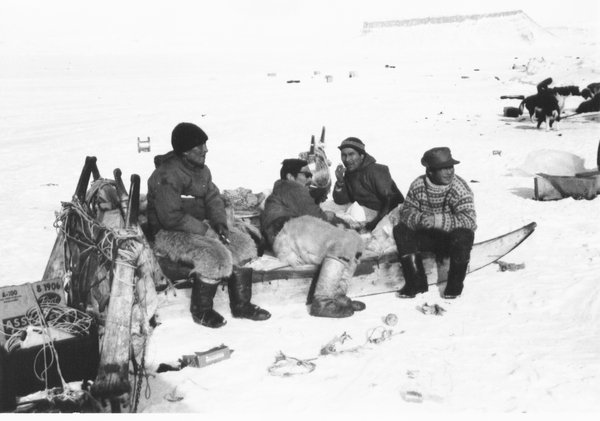
Inuit people near Thule Air Base, Greenland, 1968 © Joseph Thomas / Wikimedia Commons / Public Domain
What the ice couldn’t bury
It’s believed that around 93% of the radioactive materials were collected, but some remnants remained on the seabed. One hydrogen bomb likely sank among other debris. Attempts to locate it with a submersible were unsuccessful. A heap of wreckage was discovered on the ocean floor, and somewhere down there, it appears that the remains of the nuclear weapon still lie undisturbed.
In the 1980s and ‘90s, a scandal erupted. Danish cleanup workers launched a legal battle against the American government. Though they lost the case, they succeeded in forcing the release of numerous classified documents. Subsequent investigations revealed that cancer mortality rates among Danish workers involved in the cleanup operation were about one and a half times higher than those of the general population. It also turned out that the health monitoring of the cleanup crews after the incident was inadequate. Ultimately, officials concluded that radiation exposure wasn’t significant and found no link between the increased cancer rate and the 1968 accident.
A heated debate arose around the actions of Danish prime ministers Jens Otto Krag and H. C. Hansen. Krag portrayed himself as a naïve yet honest figure, insisting that he wasn’t aware of aircraft carrying nuclear weapons over Greenland. However, declassified US documents indicated that the Danish government was aware of everything. As for Hansen, he was the one who secretly approved the US to use Thule Air Base as part of its nuclear shield. However, by then, both prime ministers had passed away, and were unable to answer to the population.
After the incident, Operation Chrome Dome was officially shut down. After all, it was the second nuclear disaster in three years, and that was too much even for the ‘hawks’. Secondly, both Russians and Americans already had plenty of missiles, and the use of bombers seemed somewhat archaic. Finally, the USSR and the US initiated another period of détente and developed protocols for handling any accidental incidents involving nuclear weapons. While this didn’t help those who suffered or died from cancer as a result of the accident in Greenland, it did significantly reduce the risk of similar events in the future.
Evgeny Norin is a Russian journalist and historian focused on war and conflict in the former Soviet Union.
From Unipolar Universalism to Multipolar Civilizational Distinctiveness
By Prof. Glenn Diesen | September 26, 2026
The following are excerpts from my speech in Istanbul on September 26, 2026.
The unipolar world order has collapsed, and we should conduct a post-mortem to reflect on what went wrong and to understand the current turbulent transition of the world. In 1989, Francis Fukuyama famously published his article on the ‘End of History,’ which was largely adopted as an ideological guide by the political West. The world only had one superpower and one ideology, and the expectation was that the world would unify under US leadership and liberal democratic values. The dominance of the US would end international anarchy and security competition, as there was only one centre of power, and the US hegemon would elevate the role of liberal democracy to form an inclusive community of universal values. For more than three decades, the West produced a new generation of politicians who believed that the collective hegemony of the West was for the benefit of all mankind, and they were the administrators who would manage the transition from the chaotic world of the past to perpetual peace. So what went wrong?
The Contradiction of Hegemonic Universalism
The unipolar moment was always destined to be a temporary phenomenon, as the US would predictably exhaust its resources and incentivise rising powers to collectively balance the US. However, there is also an inherent contradiction in hegemonic universalism, as universal values are linked to one entity of power. A hegemon claims to represent universal values such as freedom, democracy, and human rights, albeit this universalism is promoted through a particular historical, cultural, and geopolitical order.
Universal values advocating for equality are used to institutionalise a dominant position for the US. Universal values advocating for inclusion are used to build exclusive blocs such as NATO rather than developing an inclusive pan-European security architecture. John Herz noted as early as 1950 that the more democratic states were at home, the more they seemed to insist on a dominant position in international institutions to defend liberal values from the rule of the majority. Liberal values build on the idea that tolerance is imperative, as all people and states have different ideas about the good life and their own path to development, yet the universality of values suggests that all states must develop along the same path, and the political West, as the champion of liberal democracy, is the civilizational teacher seeking to “socialize” the rest of the world. Liberalism has subsequently been promoted as a hegemonic norm.
The Revisionism of Hegemonic Universalism
The modern world order was established with the Peace of Westphalia in 1648, in which a hegemonic system legitimised with universalist claims was replaced with a multipolar system based on the cultural distinctiveness of states. The past 80 years have been a historical anomaly, with a bipolar system that collapsed and gave way to a unipolar system with one centre of power. The normal situation of the world has been a multipolar Westphalian system with a power equilibrium.
Over the past decades, hegemonic universalism transformed European states as national competencies were transferred to the US. US military dominance meant that Europe largely outsourced its security and foreign policy to the US within the format of the alliance system. US economic dominance meant that the international economic architecture, with banks, currencies, payment systems, and trade agreements, was largely administered by the US. Civil society in Europe and beyond has been managed by “non-governmental organizations” financed by the US government and cooperating closely with US intelligence services. The European political system is premised on the idea that loyalty to international institutions is more vital and moral than national interests, as Europe’s linkage to the US within the political West is the main source of stability and prosperity.
Return of Civilizational Distinctiveness
The hegemon is now gone, and the universal claims are rejected by the wider world. A multipolar world is already here, and the rising powers are demanding a return to a Westphalian world order of sovereign equals based on civilizational distinctiveness. As Xi Jinping insists, all civilizations have their own path to development, and no aspiring hegemon has the right to tell others how to develop. The return of rhetoric about civilizational states across the Eurasian continent signifies a rejection of unipolarity and universalism. New institutions such as the SCO and BRICS attempt to accommodate the multipolar world, yet new members are joining faster than institutional efficiency can adjust to.
The US has reluctantly already begun adjusting to these new realities, as it recognises it cannot be everywhere and must prioritise, while the language of liberal universalism is being replaced with national interests. New political forces are rising in the US that want to scale back the empire to save the republic, as a strategic retreat would allow the US to rebuild its strength and end the collective balancing by other great powers. What makes Europe so dangerous today is its weakness and panic due to the failure of finding a new role in the multipolar system. Security can no longer be based on the dominance of the collective West; there is no clear economic model; and the claims of representing universal values are no longer convincing. Yet the Europeans are not willing to recognise new realities and adjust accordingly by diversifying economic and political connectivity. The available evidence suggests that this will be a very turbulent transition from unipolar universalism to multipolar distinctiveness, and the new world will more likely be born through war than diplomacy
Ukrainian Soldiers, Potential Mercenaries: Have Gun, Will Travel!
By Jeffrey Silverman – New Eastern Outlook – September 26, 2026
Ukraine is already providing an early glimpse of what may become a much larger post-war phenomenon: highly trained combat personnel, particularly special-forces and other specialists, carrying their battlefield skills beyond the borders of the countries, in which they acquired them, with many of them NATO trained.
History offers plenty of warnings. Africa has spent decades wrestling with the problem of demobilized combatants, soldiers and guerrillas, whose military skills suddenly have little obvious place in civilian economies.
South Africa and Georgia both provide instructive case studies. After apartheid, using the South African example, the labor force had to absorb, integrate or demobilize personnel from competing military and paramilitary structures. Thousands of former combatants faced unemployment and uncertain futures, while the new South African National Defence Force itself eventually had to undergo substantial downsizing, and not only among white troops.
So what happens when the largest European land war in generations finally winds down? What will the hundreds of thousands of Ukrainian servicemen do when the battlefield no longer needs them, and the economy cannot reintegrate them?
Many will also have significant trauma, both mental and physical, the former being far harder to identify, it is an unfortunate fact that many former combatants will have developed a taste for killing.
And that is where the story becomes considerably more uncomfortable.
In 2024, UNODC and international organized-crime specialists were already examining the possibility that Ukraine’s enormous post-war veteran population could become a source of organized-crime risk—not because veterans were inherently criminal, but because demobilization, weapons proliferation, inadequate reintegration and the availability of trained manpower could create conditions attractive to criminal networks.
Have Gun, Will Travel is an old American expression, but it may acquire a new geopolitical meaning in the aftermath of the Ukraine war. The world already has a market for soldiers, military trainers, private security personnel and combat veterans. Africa, the Middle East and other conflict zones have repeatedly demonstrated the demand for experienced men with battlefield skills.
Will wealthy states, such as the Gulf monarchies, Western governments, private military companies and international security organizations see this enormous reservoir of experience as a manpower pool to be exploited? Almost certainly in fact, it is already happening in Africa, where Ukrainian “specialists” are aiding terrorist groups, particularly in the Sahel, aiming to overthrow governments that have been causing the French problems.
It is doubtful that so many of these veterans be recruited for legitimate security and peacekeeping missions but rather for the less visible wars conducted through proxies, contractors and allied forces as US Flag Draped in Dover Delaware is not politically expedient.
The next major Ukrainian export may not be agricultural products, weapons, or drones. But battlefield tested military experience.
There is a particularly interesting precedent in Africa. War on the Rocks warned several years ago that the eventual end of the Ukraine war could produce an influx of experienced personnel into African conflicts. And we can now see the reverse phenomenon too: Russia has recruited tens of thousands of foreign nationals into its war, including substantial numbers from Africa.
The fact that Ukrainian personnel or Ukrainian-trained capabilities are already appearing in African theaters would suggest that the post-war question isn’t simply what happens to Ukrainian veterans inside Ukraine? It is also who will recruit their expertise internationally?
The broader literature is already warning about exactly this transition: the Global Initiative has specifically examined organized-crime risks surrounding Ukraine’s eventual veteran population.
Demand for armed warm bodies
That does not require those governments to deliberately create a “mercenary army.” Governments already have incentives to use contractors, partner forces, local auxiliaries and allied personnel when they don’t want to commit their own regular forces.
The postwar Ukrainian veteran question is potentially a major international-security story in its own right.
“The postwar disposition of Ukraine’s enormous veteran population could become one of the most important security questions of the post-war period. History shows that when large numbers of highly trained combatants are simultaneously demobilized, economically marginalized and connected to international illicit markets, some will inevitably find employment in private warfare, political militias, transnational security networks and organized crime.”
Africa provides some very strong precedents
This has happened repeatedly in Africa. Research on Angola, Mozambique, Namibia, South Africa and Zimbabwe found that poorly designed demobilization and reintegration programs could themselves create later security problems.
And the phenomenon isn’t limited to Africa. Research on Colombia found that demobilization of armed groups could increase some forms of crime—particularly robbery—where former combatants were not successfully reintegrated.
Ukraine could produce a much larger version of the problem
This is where the argument becomes interesting.
Ukraine is potentially different in scale, technological sophistication and international connectivity. A future Ukrainian demobilization could involve enormous numbers of veterans. One recent analysis by the Global Initiative Against Transnational Organized Crime estimates that Ukraine could eventually have up to nine million veterans, alongside millions of displaced people and refugees.
Obviously, nine million does not mean nine million armed or unemployed men. Most veterans will simply return to civilian life. But even a tiny percentage becoming involved in illicit activity could constitute a significant population.
The Financial Times reported that Colombian criminals have sought to send people into Ukraine to acquire advanced drone expertise and bring that knowledge back to criminal organizations in Colombia, and it is now becoming apparent the Mexican cartels are following suit.
The post-Soviet precedent is important too
There is another historical analogy that may be even more relevant than Africa: the breakup of the Soviet Union.
When the USSR collapsed, large numbers of trained military personnel suddenly found themselves outside a functioning Soviet military system. Some went into private security and legitimate military contracting; others became involved in mercenary activity. Former Soviet military personnel subsequently appeared in conflicts in Africa and elsewhere.
Ukraine is producing veterans with skills that did not exist at anything like today’s scale in previous wars—particularly FPV/drone warfare, electronic warfare and battlefield intelligence.
But there is another elephant in the room. The combat in Ukraine has been brutal, well beyond anything else seen in recent decades. Combined with the violently racist nationalist indoctrination by the Ukrainian government, this has created a large number of emotionally traumatised young men and women, for whom killing comes natural.
If enough of these individuals are recruited into the worlds conflict zones, either by state actors or the underworld and terrorists, the results will be absolutely horrific in terms of war crimes and brutality, as evidenced by the massacre of civilians during the Ukrainian invasion of Kursk, and now in Africa.
Those hoping to profit from the monster they have created may well find its teeth searching for them.
Jeffrey K. Silverman is a freelance journalist and international development specialist, BSc, MSc, based for 30 years in Georgia and the former Soviet Union
Follow new articles on our Telegram channel
Burnham’s UN debut… A masterclass in British disinformation
By Finian Cunningham | Strategic Culture Foundation | September 26, 2026
So, “Britain is back” and ready to provide glorious leadership to the rest of the world, to “solve shared problems we face.”
British Prime Minister Andy Burnham made his debut at the United Nations this week, addressing the 81st session of the General Assembly in New York.
“You can count on us,” assured Burnham. “Count on us to stand up for those long-standing British values of fairness and justice – our shared values – and for the UN Charter.”
Please, don’t make me vomit. Burnham was oozing noble values on the podium of the UN while Saudi warplanes were massacring Yemeni civilians in their homes – warplanes that are directed and refuelled by Britain (and the United States).
This week, Yemeni media reported that over 100 people, including women and children, were killed as Saudi F-15 and Typhoon fighter jets intensified air strikes on residential areas in the Red Sea cities of Mocha and Taiz. Al Masirah TV showed bloody images of two children killed by a Saudi airstrike in Mocha
On his way to the UN, Burnham announced that he had ordered the deployment of RAF refuelling planes to enable the Saudi air assault on Yemen. Of course, the British media described the move as “defensive aid”.
Earlier this month, Downing Street also approved the dispatch of British military advisors to Saudi Arabia. American advisors are also stationed there to assist in the war of aggression against its southern neighbor.
Yemen’s armed forces and the Ansar Allah militia are hitting back hard. They have overrun Saudi forces in key Red Sea positions and have shut down the Saudi oil industry and pipelines with drone and missile attacks.
But make no mistake, this is a Saudi war of genocidal aggression fully supported by the United States and Britain. The war has been going on since 2015, together with a blockade on Yemen that has resulted in an estimated 400,000 Yemeni deaths. A lull in fighting from 2022 was broken when the Saudis launched air strikes on the Yemeni capital’s airport in July. The Yemenis have hit back with a vengeance, targeting Saudi oil installations.
The Saudi monarchy has begged Trump to give more military assistance. But Trump is bogged down and out of his depth with his losing seven-month war with Iran.
This is where Burnham has entered the fray, responding to Saudi pleas for help by signing off on military deployment. This could prove to be a disastrous strategic blunder. No doubt Burnham is trying to ingratiate himself with Washington. His decision to send the RAF into battle this week came ahead of his first meeting with Trump on the sidelines of the UN. The American president gave him a symbolic pat on the head, saying, “he’s going to be a great prime minister.”
Trump had often ridiculed Burnham’s predecessor, Keir Starmer, for supposedly not offering more military support to the U.S. war aims in the Middle East. Burnham is showing himself to be more amenable, that is, pliable.
The British Butler is slaughtering his way into favor with Washington. Women and children are sacrificed in Yemen all to satisfy the sick “special relationship” between the U.S. and Britain.
Burnham is a fraud with this working-class Manchester accent and glib talk about the “need to do more to help people with the everyday cost of living.”
If you can bear to listen to his speech at the UN, it is a masterclass in British disinformation. It takes a special kind of person to deliver such arrant nonsense with a pose of sincerity.
The thrust of his whole address was to blame Russia for everything. From poverty and inequality in British society, to seething discontent among Britons towards their ruling class, to the war in Ukraine. It truly was a consummate performance in misdirection, the kind of charade that British politicians excel at.
He announced that Britain was launching a new National Centre for Information Defence, purportedly to combat Russian disinformation, which he claimed was “a poisonous tide” sowing division and instability among Britons.
According to Burnham, all that is broken and dysfunctional in British society is due to Russian infiltration. Nothing was said about bankrupt British capitalism and the warmongering of the British state fuelling a proxy war in Ukraine or aggression in the Middle East at the expense of social conditions in Britain.
Burnham’s “solution” to Britain’s endemic problems is to increase “national security” and state control over public information – all under the guise of “defending” Britons from being manipulated by Russian propaganda.
The Orwellian condition that Britain is sliding into is awesome.
This British prime minister dares to speak about British values and leadership and condemn Russia while he is approving the supply of long-range air strikes against Russia with British cruise missiles and drones.
The proof of Burnham’s fraudulence and moral bankruptcy is his decision to materially support Saudi warplanes in committing atrocities in Yemen. Murderous aggression is labelled “defense”.
Burnham’s dubious asset as a politician is his ability to articulate justification for slaughter and war with empty platitudes.
A particularly odious point in his UN speech was his claim that English workers allied with Abraham Lincoln in the American Civil War against slavery. As if English mill workers were representative of British “values”. What Burnham conveniently omitted was the much more heinous role of the British ruling class in creating the Atlantic slave trade.
Britain’s historic role in global exploitation and waging genocidal wars is something that damns its governments forever. Its ongoing role in enabling the slaughter in Ukraine and in Yemen is but two of the latest episodes of this British systemic criminality.
These are the British “values” that Burnham deftly concealed this week with his performative debut at the UN.
The Geopolitical Balance in the Red Sea: The UAE Being Displaced by New Players
By Samyar Rostami – New Eastern Outlook – September 26, 2026
The persistence of current geopolitical alignments, the attention of Eastern actors to the region, the strengthening of Sanaa’s position in the Red Sea, and the expansion of regional opposition to the UAE’s role will diminish Abu Dhabi’s role in the region.
For the past ten years, the Southern Red Sea has been a pivotal factor in the UAE’s foreign policy. Over the past decade, the UAE has built a layered maritime, air, and commercial infrastructure network, including military bases, in the Red Sea or near Yemen, Somaliland, Somalia and Sudan, starting from 2015.
According to some estimates, the value of UAE investments along Africa’s coastal regions and the Arabian Peninsula amounts to $60 billion.
In September 2015, the UAE established its first military base in Africa, in Eritrea. These bases possessed strategic advantages: the ‘protection of interests’ and control over the security and economic architecture of international maritime routes.
With the signing of the Abraham Accords in 2020, cooperation between Tel Aviv and Abu Dhabi in the Red Sea intensified.
The UAE’s approach—channeled through companies such as DP World and Abu Dhabi Ports—is centered on controlling ports, strategic waterways, military bases, and key trade and energy routes in the Red Sea and the Gulf of Aden, in coordination with the United States and its allies. Abu Dhabi’s approach also included engagement with non-state armed actors and separatist movements in Yemen, Sudan, and Somalia.
Factors Behind the UAE’s Diminishing Role
Over the past decade, the UAE emerged as a party to the conflicts in the southern Red Sea. However, geopolitical developments over the past year signal a gradual decline in the UAE’s role in the southern Red Sea.
Several factors are also significant, stemming from US and Israeli military strikes against Iran, the war between Sanaa and Saudi Arabia, Saudi-Emirati rivalry in the region, and disputes among African states.
Sudan’s value lies in its geopolitics. With 853 kilometres of coastline and several key ports, Sudan constitutes a vital link in the Red Sea.
The Sudan war since April 2023 has created conditions for the expansion of the UAE’s role. The UAE faces accusations of providing training and logistical support to the Rapid Support Forces (RSF). Human rights and political demands against the UAE has increased.
The UAE also maintains bases inside Sudanese territory. However, the ongoing war in Sudan and the support of allies for the Sudanese government have led to increased pressure on the UAE.
Riyadh regards the Red Sea as part of its strategic interests and its exclusive backyard. Abu Dhabi and Riyadh each view the other as a direct threat to their position and interests in parts of the southern Red Sea. Thus, the reduction of the UAE’s footprint in the southern Red Sea constitutes a strategic gain for Riyadh. Riyadh has effectively sought to weaken Abu Dhabi’s role.
In late 2025, Saudi Arabia’s support for Yemen’s Presidential Leadership Council (PLC) resulted in pressure being brought to bear on UAE-backed forces.
In July 2026, Saudi Arabia hosted talks among 14 countries—including Egypt, Djibouti, Sudan, and Somalia—which established a multinational maritime defence alliance. The UAE and Ethiopia were excluded from the list.
The formation of a Riyadh-led Red Sea maritime task force—with the participation of Turkey, Egypt, Djibouti, Somalia, and Eritrea—without coordination with the UAE amounts to a further constriction of the UAE’s role in the region.
Despite ongoing Egyptian–Emirati consultations on guaranteeing maritime navigation security in the Red Sea and Bab al-Mandab, Egypt’s foreign policy is not aligned with the UAE’s interests in Sudan and the Red Sea. Additionally, the alignment and coordination among Israel, India, the UAE, and Ethiopia are not particularly consonant with Egypt’s interests in Ethiopia and the Red Sea.
Until last September, the UAE played a significant role in the southern Yemeni islands of the Red Sea and in southwestern Yemen. However, Sanaa’s advance in the eastern Red Sea—the port of Mokha, Mayun Island, and other archipelagos north of the Bab al-Mandab Strait—in September 2026 inflicted negative and fundamental consequences on the UAE’s regional role.
Sanaa’s advance amounts to the nullification of the presence of Emirati actors in Yemen’s future political sphere. Sanaa is seeking to consolidate itself as a strategic “node” within the Iran-led Axis of Resistance.
Despite Cairo’s opposition to Sanaa’s proposal for maritime navigation coordination in the Red Sea, Sanaa—having secured control over the most important islands and cities overlooking the Bab al-Mandab Strait on the Yemeni side—is calling for the formulation of new rules to ensure security and navigation in the region. Ansar Allah’s control over Bab al-Mandab could put the UAE under pressure. Any expansion of Sanaa’s role in Sudan could likewise prove detrimental to the UAE.
Amid tensions between the United States and Iran, Abu Dhabi finds itself facing a more constrained strategic space.
The UAE’s alignment with the United States is, in a sense, also an intensification of Abu Dhabi’s tensions with Iran in areas such as the Red Sea. Unlike the UAE, Iran is seeking better relations with the Sudanese government. Many in Iran believe that Israel and the UAE are devising an economic and geopolitical plan to control the vital routes of the Red Sea and Yemen’s ports.
With Israel’s formal recognition of Somaliland in December 2025, many in the countries of the southern Red Sea have linked it to the UAE.
After years, Eritrea revoked the UAE’s access to its military infrastructure. Eritrean officials have recently made sharp statements about the UAE and Israel—particularly regarding Tel Aviv’s recognition of Somaliland.
Eritrea is providing frontline support to the Sudanese Armed Forces. Any deeper alliance between Eritrea and Sudan, Iran, Russia, China, and Sanaa could diminish the UAE’s regional role in the Red Sea. Additionally, some countries and actors near the Red Sea also hold a negative view of the UAE’s regional role.
The Somali government’s decision in January 2026 to sever relations with the UAE is, in a sense, a counter to the UAE’s role in the Somaliland and Puntland regions. Somalia has revoked all agreements with the UAE, including cooperation as well as security and defence arrangements. This move has negative implications for the UAE’s role in the southern Red Sea.
Moreover, the southern Red Sea plays a pivotal role in the regional strategy of Russia and Beijing. For example, apart from China’s role in Djibouti, Beijing is Eritrea’s principal creditor and has expanded its influence in Sudan.
The developments of the past year have also contributed to a decline in the standing of the UAE’s allies in the region.
Outlook
The US presence in the Red Sea’s African states is rooted in counter-terrorism and anti-piracy operations.
The European Union’s presence in the region, via Operation ASPIDES, is limited to commercial shipping in the Red Sea and the Gulf of Aden.
Despite the UAE’s formal withdrawal from some bases, its economic and security influence, as well as its soft-power instruments, remain strong.
A decrease in UAE military deployments in the region could negatively impact its support for allies in Yemen, Libya, and Sudan.
The UAE continues to have significant economic potential, secure partnerships, and influence in the southern Red Sea. In a way, this is considered a threat and a risk to certain African nations in the Red Sea region.
Certainly, a more extensive Sanaa presence over Bab al-Mandab, strategic coasts, and islands could confront Abu Dhabi’s maneuver and role in the southern Red Sea with a structural challenge.
The UAE’s approach in ports, logistics, energy, and other strategic infrastructure—along with deeper defense and security coordination with the West in the southern Red Sea—is likely to continue. However, the expansion of the UAE’s role also requires an extensive US presence in the Red Sea.
Moreover, the persistence of current geopolitical alignments, the attention of Eastern actors to the region, the strengthening of Sanaa’s position in the Red Sea, and the expansion of regional opposition to the UAE’s role will diminish Abu Dhabi’s role in the region.
Samyar Rostami is а political observer and senior researcher in international relations.
Follow new articles on our Telegram channel
EUROPE FEARS RUSSIA’S NEXT MOVE / Ian Proud
Daniel Davis / Deep Dive – September 24, 2026
Senate Rejects Iran War Powers Resolution Passed By House
By Kyle Anzalone | The Libertarian Institute | September 24, 2026
The Senate narrowly voted to reject legislation that would require President Donald Trump to end the war against Iran.
The Senate voted against the War Powers resolution 49-50 on Thursday, largely along party lines. Republican Senators Thom Tillis, Susan Collins, Rand Paul, and Lisa Murkowski all voted for the legislation with nearly all Democrats. The only Democratic senator to vote against the War Powers resolution was John Fetterman.
The resolution would have required Trump to end the war against Iran. It directs the President to “remove the use of United States Armed Forces from hostilities against the Islamic Republic of Iran or any part of its government or military, including potential ground forces in a combat role or used for occupation, unless explicitly authorized by a declaration of war or specific authorization for use of military force against Iran.”
The House passed the legislation, H.Con.Res.89, in July. Earlier this month, the House passed a separate War Powers resolution, H. Con. Res. 93, 220-204, with seven Republicans joining nearly all Democrats to pass the legislation.
Even if the legislation had passed the Senate, Trump likely would have vetoed it. In 2019, Trump vetoed a War Powers resolution directing him to withdraw US support for Saudi Arabia’s war against Ansar Allah in Yemen.
Congress has not passed any authorization for the US to wage war against Iran, making the conflict unconstitutional. Republican Congressman Thomas Massie has introduced articles of impeachment against Secretary of War Pete Hegseth for waging an undeclared war.
“By engaging in hostilities in Iran for more than 90 days without congressional authorization, Secretary Hegseth is breaking the law and must be held accountable,” said Massie when he introduced the articles of impeachment. “Secretary Hegseth’s constitutional violations extend beyond the illegal war in Iran. He is abusing the power of his office to ignore congressional war powers resolutions, to kidnap foreign leaders, and to intimidate critics of the Trump administration by retaliating against them for exercising free speech.”
House Speaker Mike Johnson dismissed the lower chamber for the midterm recess early, delaying the vote on Massie’s articles of impeachment.
Cannon fodder no more… South Korea rejects Trump’s pressure to join his criminal war on Iran
By Finian Cunningham | Strategic Culture Foundation | September 24, 2026
This is a pivotal moment in history as South Korea tells Trump it is done with being a vassal for American imperialist wars.
KJ Noh notes in this interview for Strategic Culture Foundation that South Korea’s defiance of U.S. power is resonating with growing resistance among other nations towards Washington’s bullying and warmongering.
President Lee Jae-myung of South Korea gave a televised nationwide address last week declaring that his country would not be deploying military forces to the Strait of Hormuz.
That announcement followed weeks of speculation that South Korea would cave to pressure from U.S. President Donald Trump, who has been arm-twisting Seoul and other allies to send military support for his seven-month war on Iran. A war that is plunging the global and American economy into turmoil and could derail his presidency in the U.S. mid-term elections.
Geopolitical commentator KJ Noh says the public rejection of Trump’s appeal by South Korea is a major blow to Washington’s international image.
He notes that the Republic of Korea has been a loyal vassal of the United States, always sending its troops to fight American wars. South Korean soldiers have deployed in every U.S. overseas war from Vietnam to Iraq.
“The Korean people are saying they do not want to be cannon fodder for any more U.S. wars,” comments KJ Noh.
He adds that this defiance will inspire other nations to reject American hegemony.
However, KJ Noh warns that Washington is exerting severe pressure on South Korea to bend the knee. “South Korea is a living example of the maxim that to be an enemy of America is dangerous, but to be an ally is fatal.”
Trump is in a deep mess of his own making as a result of his criminal war against Iran, which he is losing. He needs “allies” to bail him out by supplying weapons and military personnel to act as cannon fodder.
Over the past eight decades, South Korea would have bent over and loyally obliged. But not anymore, it seems. The Korean people have had enough of being Uncle Sam’s vassal.
Korean defiance is a rallying call for global repudiation of American imperialism.
Featured Video

The Search for Truth: Charlie Kirk’s Assassination One Year Later
or go to
Aletho News Archives – Video-Images
From the Archives
The 9/11 “Double-Cross” Conspiracy Theory
BY LAURENT GUYÉNOT • UNZ REVIEW • SEPTEMBER 6, 2022
Is it true that “9/11 was an inside job”? Yes, insofar as Israel is “inside” the U.S. But for the 9/11 truthers who have identified Israel as the main perpetrators, “9/11 was an inside job” is at best a half-truth, and at worst an integral part of the Zionist operation, like a secondary flag sewn as a lining under the false flag of Islamism. Victor Thorn (1963-2017) wrote in his book 9/11 made in Israel: The Plot Against America (2011): “In essence, the ‘9-11 truth movement’ was created prior to Sept. 11, 2001 as a means of suppressing news relating to Israeli complicity. . . . The slogan ‘9-11 was an inside job’ was quite possibly the greatest example of Israeli propaganda ever devised.” In milder terms, it is “controlled opposition”.
A genuine truth movement would have pointed to Israel as the prime suspect from the start. From day one, it was obvious who would benefit. … continue
Blog Roll
 Aletho News
- Hormuz and the Looming Economic Catastrophe
- Dhubab offensive, media blitz and the rapid unraveling of Saudi-backed coalition’s new gambit
- Putin Conveys to Trump Iran’s Vision on Possible Conflict Resolution – Kremlin
- The Search for Truth: Charlie Kirk’s Assassination One Year Later
- ‘Harsh reality’: Iran says France seeks monopoly on power and intimidation, not peace for all
- When Will This White House Madness End?
- Huckabee aide goes to ‘unusual lengths’ to portray ‘Israel’ positively
- Trump Announces Diesel Supply Deal With Putin Following Phone Call
- MEP blasts ‘Euro-Gestapo’ for lecturing Russia on democracy
- Syria May Send Troops to Saudi Arabia Amid War with Ansar Allah
- If Americans Knew
- Israeli forces kill another child in Gaza – Daily Update
- Gaza ceasefire exists in name only, say more than 100 organizations
- Nearly 2 Million in Gaza Need Urgent Shelter Assistance as Winter Looms: IOM Chief Warns
- Suppressing Palestinian resistance: US charity under fire for AI monitoring of Gaza classrooms
- Thousands Are Held in Israeli Torture Camps. This Is What Happens Inside
- Israel puts Gaza’s sick, injured, newborn in peril – Daily Update
- Report claimed Mark Levin used by Israeli government to influence Trump
- Over 2,000 Gazans have died awaiting medical evacuation amid Israel’s continued siege
- How a U.S. Diplomat Suppressed and Altered Reports Critical of Israel
- 5 Palestinians Die from Israeli Strikes in Gaza as Relentless Attacks Continue
- No Tricks Zone
- New Study: 50 Years Of The Most Aggressive ‘Net Zero’ Policies Can Only Affect The Global Climate By 0.03°C
- US September “Heat” Was No Record…Many Records Set Decades Ago
- Latest European Green Energy Debacle; Portugal’s Largest Flagship Solar Park Insolvent!
- Green Energy Debacle: German Expert Professor Fritz Vahrenholt Warns Of Severe Economic And Social Consequences
- Two More Paleo Reconstructions Affirm Meters-Higher Sea Levels Across Ireland, Brazil 7000-6000 Years Ago
- New Study: Earth And Venus Surface Warmth Largely Explained By Convection And Lapse Rate, Not CO2 Or Radiation
- 2025 Nature Paper Claiming Worsening Global Drought Gets RETRACTED …Heavily Flawed
- New Study: ‘Global Drought Shows No Detectable Recent Acceleration Under Climate Warming’
- Economic Masterminds: German Socialists Suggest Taxing Productivity Gains Stemming From Using AI
- The South China Sea Has Not Been Cooperating With The Climate Change Narrative

