‘Iron Dome Proved to Be a Bust’: Iran Strikes Israel in Retaliation for Assassinations
By John Miles – Sputnik – October 2, 2024
Iran launched a significant retaliatory attack against Israel late Tuesday night, ending months of speculation about how or whether the country would strike back after its provocative killing of Hamas leader Ismail Haniyeh in Tehran.
The United States reportedly provided Iran with assurances after the attack against Haniyeh in July that Israel and the US would move constructively towards the establishment of a Palestinian state, ending Israel’s military aggression against its neighbors and Palestinians in the Gaza Strip, where over 42,000 have died according to figures reported by the territory’s health ministry. Tel Aviv’s deadly attack against Hezbollah chief Hassan Nasrallah in Lebanon last week dashed hopes of a cessation of violence as Israel claims it is preparing for a broader invasion of Lebanon.
“I’ve seen the videos and you can see the missiles continue to rain down and hit targets. Israel is imposing a news blackout,” former CIA analyst Larry Johnson said. “They don’t want the knowledge out there about what happened. But Iran made sure that it was not going to hit and run the risk of killing hundreds or thousands of Israeli civilians.”
“They were not going to act like the Israelis,” the analyst claimed. “They really consider themselves, if you will, more humane, more honorable, and by virtue of their action, I think they can make that case.”
Johnson claimed Iran was forced to strike Israel after false assurances from the United States that Israel would cease attacks on its neighbors after its killing of Haniyeh. Iran previously launched a retaliatory attack on Israel in April after Tel Aviv’s bombing of the Iranian embassy in Damascus, Syria killed two Iranian generals. The codename Operation True Promise was announced for the strike.
Iran’s Tuesday attack, dubbed Operation True Promise II, appears significantly more substantial than April’s strike in which the vast majority of Iranian missiles, rockets and drones were intercepted by Israel’s Iron Dome. Iran was reportedly able to successfully strike Israeli military targets Tuesday, including an Israeli air base where multiple US-provided F-35 aircraft were hit. Johnson claimed Israel’s attack against Nasrallah would’ve been launched from an F-35; the fighter jet would be key to any Israeli invasion of Lebanon.
The commentator compared Israel’s Iron Dome to the US Patriot missile system, claiming the US is unable to replenish the defense system rapidly enough to allow Israel to fight a long war of attrition.
“Lockheed Martin… can make about one and a half, one and a quarter [missiles] a day,” said Johnson. “I think Israel’s in a similar situation… [Iran] put Israel on notice, ‘If you launch any further strikes against us in any retaliation, we’re going to hit you harder next time and with more lethality.’ So this right now has a chance to really get out of control.”
“I cannot rule out that Israel is going to try to launch some conventional weapons at Iran, but I think they’re going to be defeated,” Johnson claimed.
“Israel may be tempted to try to use a nuclear device against an Iranian target,” he warned. “If that happens then we’re going to really be into another dimension, and this is going to get very, very serious. It’s already a serious situation, but it will get absolutely dangerous.”
The analyst suggested Israel would not be able to support military engagement against multiple enemies, even with the United States backing it up.
“Israel is not in a position to fight a multi-front war and it does not have the strategic depth to fight wars of attrition. And that’s exactly what it’s got itself into now,” Johnson pointed out. “It’s not going to be able to finish off Hezbollah in a week. It couldn’t even finish off Hamas in 12 months. It’s not going to be able to finish off Syria, finish off the Houthis or finish off Iran… That’s what Israel fails to understand. It does not have the ability to sustain itself in these kinds of operations for an extended period of time.”
“If US ships are involved that are off the coast of Iran, then we’ll see Iran react and they may even end up attacking some US ships,” he continued. “But they’ll certainly retaliate against Israel. Israel is not out of the woods at all, despite all the delusional nonsense that the extreme Zionist supporters are saying when they say, ‘oh, Iran didn’t touch us, Iran didn’t hurt us at all.’ Nonsense.”
The development comes as Democrats attempt to hold onto the White House in November’s presidential election, with former President Donald Trump casting himself as a defender of Israel. Vice President Kamala Harris will attempt to do the same, Johnson claimed, while also trying to prevent a regional conflagration in the Middle East before the election.
“The politics are going to dictate a lot of strategic military decisions, unfortunately,” said Johnson.
Resources of Ukraine’s NATO allies will dwindle by 2025
By Ahmed Adel | October 1, 2024
NATO’s continued arms shipments to Ukraine next year are at risk due to a lack of resources among key backers of Ukrainian President Volodymyr Zelensky, experts told Bloomberg on September 27. This is a far cry from the promises made in the first years of the war when the West promised to support Ukraine until victory was achieved, a victory that will not occur.
At stake is a controversial $50 billion loan deal, which came from the profits from the Russian Central Bank’s frozen assets in Western banks. Bloomberg reported that Washington fears that Hungary could block or reduce the deal. Even if the amount were released, it would only be enough to keep the Kiev regime supplied with weapons until the middle of next year.
This is without taking into account Ukraine’s economic situation, including a projected $35 billion gap in the 2025 budget, of which about $15 billion remains uncovered, even after applying subsidies from the International Monetary Fund and the European Union.
Bloomberg’s sources warned that the deficit could force the Kiev regime to enter peace talks with Russia “from a position of weakness.”
Kiev is also struggling to convince its backers to continue shelling out tens of billions of dollars of weapons for the conflict, as increased Russian production outpaces the combined output of the collective West.
According to the news agency, a November victory for US presidential candidate Donald Trump will likely increase pressure on Zelensky to end the war he intends to continue despite no hope of victory. It is recalled that in April, the Republican-controlled US House of Representatives approved a $48 billion security aid package for Ukraine only after a six-month standoff over the crisis on the US southern border.
In addition, Germany — Ukraine’s second-largest backer after the US — faces constitutional debt constraints that have already begun to affect its support for Kiev. With economic troubles spreading to France, Italy, and the United Kingdom, those countries may also cut back on aid. Keir Starmer’s government in London has vowed to continue vigorously supporting Kiev despite tough budget choices at home.
Ukrainian Defence Minister Rustem Umerov admitted that his country is more than 80 percent dependent on military aid from Western partners, while the Ukrainian General Staff reports that the situation on the front line remains difficult due to the superiority of the Russian Armed Forces.
According to Umerov, the Western supply of military equipment is the basis of the assistance provided to Ukraine. The country receives resources from the US, the European Union, NATO, the Security Assistance Group Ukraine (SAG-U), the United States European Command (EUCOM) and “a dozen other countries in a bilateral format on a daily basis.”
“So far, international military assistance has been the backbone of our aid. […] We are more than 80 percent dependent on our partners,” he said in an interview with a Ukrainian publication.
On September 25, the General Staff of the Armed Forces of Ukraine stated that due to the Russian Army’s superiority in terms of the number of troops and equipment available, the situation along the entire front line remains difficult.
“The situation on the front line remains difficult. The enemy, using its superiority in personnel and equipment, is continuously attacking our positions,” the General Staff’s official Telegram channel said.
This difficult situation is not set to be alleviated because, as already mentioned, Ukraine’s allies are facing their own economic issues and political opposition.
Last week, The New York Times reported that the US-EU plan to finance Ukraine stalled due to legal issues, as the systems in Washington and Europe are making it difficult for the initiative to come to fruition. However, even with the plan implemented, the $50 billion will be insufficient to cover Kiev’s military needs for another year of conflict, and the allies will have to look further afield for funding, according to Bloomberg.
The outlet reported that Ukraine’s military is relying on its allies for artillery ammunition, missiles, and improved air defence capabilities. This has prompted US President Joe Biden to announce another $8 billion in funding for Kiev and appear to be coordinating additional support from NATO members before his term ends.
However, all this action has done is once again demonstrate the grand failure Biden’s adventure in Ukraine was, all for the sake of the vain attempt to weaken Russia. Rather, Russia has territorially expanded, diversified its economic partners, and taken great leaps in de-dollarising global trade, all the whilst Ukraine has been economically and demographically destroyed and completely dependent on Western aid, which is clearly running out, for survival.
Ahmed Adel is a Cairo-based geopolitics and political economy researcher.
Of Cool Heads and Hot Heads

By Philip Kraske • Unz Review • September 29, 2024
Ever more desperate, Israel is working hard to start a world war with the United States on its side. The elimination of Hassan Nasrallah won’t make much difference to Hezbollah’s fight; the new leader will soon step up. But Israel might regret the absence of the cool-headed Nasrallah.
Cool-headedness has actually been the norm this past year, and is among the few hopeful notes on the international scene. Lots of leaders are keeping calm, holding back the factions in their governments that would love to take a crack at the folks thumbing their military noses at them.
China merely tut-tuts about foreign navy ships traversing the Strait of Taiwan, Hezbollah keeps its big missiles in their silos, Iran responds to Israeli attacks with a few half-hearted firecrackers, and Vladimir Putin frowns and issues warning after warning when Ukraine, with Nato help, hits Russian refineries and radar installations. Meanwhile Egypt, Jordan, Iran, Syria, and Turkey — and I’ve probably missed a few — itch to put holes in Israeli runways.
But restraint is the watchword. Unlike before World War One, when governments decided to declare war from one day to the next, countries are looking before they leap. Why? To what do the world’s citizens owe this clear shift to reluctance among national leaders to jump into conflict? It’s often been observed that nuclear weapons have kept the peace among the great powers. Nowadays, however, other elements keep the peace just as well. Here are the three most important ones.
The first is economic. It’s true that capitalist consumerism has atomized the citizenry, but it also keeps people quiet. National leaders figure that the only way to keep everybody fed and employed and hypnotized by Netflix series is to keep the economy running. Take tourism, for example — a labor-intensive industry that absorbs a lot of workers with little formal education. Israel’s has been hammered. Who wants to retrace the steps of Christ in the Holy Land amidst the squall of sirens announcing incoming missiles from Hezbollah? Israel now has to rotate its forces in and out of the military just to keep the economy going. But they’re finally going to throw the Palestinians out, and figure it’s worth the tradeoff.
Other touristy countries have much less to gain. In Turkey, tourism makes up more than ten percent of the economy, and is still growing. In Egypt, it’s 24 percent. Take that away, and the ensuing unrest will topple governments. But their leaders have less to gain from tackling Israel.
The second element is strategic. Just over the last several years, war has turned into a video game of missiles and missile-defenses and drones of all different kinds. As the commentator Alistair Crooke has observed, American aircraft carriers parked in the eastern Mediterranean look like something out of the 1950s. A couple of missiles sent from Crimea would send them to the bottom of the sea in a question of minutes.
Conventional war has all but disappeared. Imagine what would happen to American troop and supply ships traversing the Atlantic. If German U-boats sank nearly three thousand, Russians would sink every one of them, and not from a dank submarine but from a cosy office in Moscow. And crossing the Pacific to attack China would be a suicide mission.
National governments see the destruction wrought by Russian missiles — not its army shelling villages, but the attacks from afar on major cities and infrastructure — and they quickly figure that restraint is the better part of valor.
The third element that makes governments hesitate to get into a fight is that societies are far more fragile than before. Imagine what would happen if the Chinese got mad at the Americans and dropped a few missiles on highway overpasses, which then collapsed highways, between San Diego and San Francisco. Of course, hackers could wreak havoc on just about everything, but if software defenses proved troublesome to them, a couple of missiles — or just bombs placed by hired thugs — on data centers would quickly affect the internet in all kinds of random ways. Well-paid jokers could send drones flying around Atlanta and Chicago airports — or Istanbul’s or Frankfurt’s or Tokyo’s — closing them down. And if some leader were in a bloody frame of mind, he could order the downing of just two commercial airliners, one taking off in Paris and the other in Miami — and watch every flight reservation in the the western hemisphere get canceled in an hour. Citizens of the world’s poorest countries would finally have the last laugh.
In fact, there is a never-declared Mutually Assured Destruction that restrains governments, or quasi-governments like Hezbollah. All to the good, except that conventional war seems to be morphing into terrorism. Now that Israel has opened the Pandora’s box of booby-trapping consumer items, how long will it be before desk lamps — or shoes or avocados — begin to explode in Tel Aviv? Will Kurds need to take apart their Turkish-made earphones? As readers of Unz.com know, attacking China is far more cost-effective through untraceable biological attacks against its people and livestock, and invites no revenge — at least for the moment.
Israel’s attack with pagers and radios, Ukraine’s worthless drone strikes on Moscow apartment buildings, America’s aimless pecking at “terrorists” in Syria and Iraq — these are harbingers of the terrorist world to come.
And as defeat approaches, the losers are bound to raise the ante — especially the Israelis and Ukrainians. As in World War Two, the years of war have corroded their last vestige of ethics, and they know that the Washington elite will ultimately excuse their tactics. The western media would give nothing but dashing accounts of how Zelensky and Netanyahu — harried, exhausted, yet persevering — listened to their advisers, rubbed their necks, and gave the green lights to “limited” chemical or nuclear attacks against advancing enemies. For an excellent example of how flexible, how downright protean, mainstream journalists can be, read New York Times columnist Amanda Taub’s article on the legality of Israel bombing of the Iranian consulate in Damascus: “Israel Bombed an Iranian Embassy Complex. Is That Allowed?” She concludes that it was.
In short, if Hezbollah’s next leader, not so restrained as Nesrallah, unleashes missile hell down the whole length of Israel, Netanyahu and his hard-eyed friends may come to regret finishing him off. Doesn’t history tell the best jokes?
Ukraine’s ‘Victory Plan’ Is Delusional

By Tyler Durden | Zero Hedge | September 28, 2024
In the past two years the western establishment media has effectively obscured the reality on the ground in Ukraine. Only recently has it become clear to the public that the tales we’ve heard about Russia imploding due to “bad tactics” and “throwing bodies into the meat grinder” in exchange for irrelevant territory have all been a fantasy. The problem is, propagandists often end up believing their own propaganda and then they are caught completely by surprise down the road when reality slaps them in the face.
Russian offensive actions in the east have greatly accelerated and now in the south the vital city of Vuhledar is set to fall within a couple days (if it hasn’t already). Their attrition based strategy and artillery superiority have created a shield for small fast moving units to strike Ukraine’s trenches and fixed defenses, and their drone game has dramatically improved. This has led them to capture multiple towns and cities in the past three months, with their forces closing in on the key eastern operational base of Pokrovsk. If Pokrovsk falls, the entire east of Ukraine could easily fall.
Beyond the shift to attrition tactics, Russia is gaining territory quickly because Ukraine is low on manpower. No amount of NATO technology or weaponry is going to help this fundamental weakness. This is the reality in Ukraine; they are losing the war.
The western media is unable to gloss over the situation any longer, which means something dramatic will have to happen to change the course of the war in Ukraine’s favor. Their government is scrambling to initiate an October surprise in preparation for the US elections in November. The US runs NATO, and Ukraine is entirely dependent on US aid.
The notion of a Ukrainian “Victory Plan” is by itself questionable given the circumstances, but what is reportedly contained in Vladimir Zelensky’s strategy seems to be an over-optimistic wish list relying heavily on escalation between NATO and Russia. In other words, the only way Ukraine can “win” is for NATO to engage in open warfare with the East.
While the full plan hasn’t been divulged, senior U.S. officials who are familiar with its contents don’t see anything original or innovative in it. As one told The Wall Street Journal on Sept. 25, “I’m unimpressed, there’s not much new there.” From what we can grasp, the “victory plan” is less a “plan” and more a continuation of Zelensky’s lobbying campaign to keep U.S. arms flowing in perpetuity.
Zelensky is dead-set on getting permission to use US and European long range missile systems against targets deep within Russia. The problem, as Vladimir Putin rightly noted, is that these systems cannot hit such targets accurately without NATO satellite intel and acquisition. Meaning, the missiles must be guided by US and European military technicians and assets.
It is likely that the majority of Ukrainian long range drone strikes within Russia are already being aided by NATO intel, but the use of ATACMS and Storm Shadow missiles far from Ukraine’s front line is another matter entirely. There’s no plausible deniability for NATO involvement. The use of these weapons within Russia would be akin to a declaration of war and would trigger escalation outside of Ukraine.
What would the consequences be? Not necessarily the use of nuclear weapons (though Putin did just change his bottom line on a nuclear response to include long range attacks using NATO weapons), but the spread of more advanced Russian armaments to countries like China, Iran, Syria, North Korea, and even the Houthis in Yemen is a good bet. Meaning a more significant threat to NATO interests in Asia and the Middle East. The war would spread.
So far the Biden Administration has refrained from supporting the long range option, but has offered another $8 billion in support. Under a Trump presidency, the money train is likely to stop abruptly.
Zelensky has offered no practical measures for negotiations, arguing that concessions are off the table. Furthermore, he claims that peace is only possible once Ukraine has taken back all territory seized by Russia, including Crimea which was annexed in 2014. He then demanded that Russia pay for Ukraine’s reconstruction and that Putin and a multitude of other Russian officials be handed over to be tried for war crimes. This is never going to happen.
The core of Ukraine’s victory plan relies on long range strikes using NATO guided missiles and acceptance into NATO. Both factors at this stage would cause WWIII.
Ukraine’s chest beating is the national equivalent of “short man’s syndrome.” That said, Zelensky would not be making these kinds of demands if he was not being encouraged by someone behind the scenes. Many officials within the US and Europe have given Zelensky delusions of grandeur about his chances, perhaps because they want the war to grind on forever. These same officials have hinted consistently that they will not accept a Ukrainian loss.
Regardless of what side people think should win, the fact is that Russia is the inevitable victor according to all the evidence on hand. While the extent of Putin’s goals in the region are unknown, it’s unlikely that he intends to march beyond Ukraine. He may simply stop at the edge of the Donbas and annex the region like he did Crimea.
This may actually be the best case scenario for all parties involved. The longer the war goes on the greater the chances of a powderkeg moment and a direct confrontation between Russia and NATO. Ukraine should not be talking about “victory”, that time has come and gone. They should be talking about peace.
What’s Wrong with Boris Johnson’s Plan to “Save” Ukraine?
Johnson’s “three-fold plan for Ukrainian victory”
By Brian Berletic – New Eastern Outlook – September 29, 2024
A September 21, 2024 article published in The Spectator written by former British Prime Minister Boris Johnson titled, “It’s time to let Ukraine join NATO,” attempts to formulate a theory of victory for Ukraine as war with Russia continues to grind on.
Johnson demands that the collective West “end the delays” and that the West “get it done and get it won.” By this, he means lifting all restrictions on the use of Western long-range weapons on pre-2014 Russian territory.
Next, he demands the US and Europe provide a “package of loans on the scale of Lend-Lease: half a trillion dollars,” or “even a trillion.” Johnson claims such support will send a message to the Kremlin that, “we are going to out-gun you financially and back Ukraine on a scale you cannot hope to match.”
Western personnel have already been operating in Ukraine since 2014 and have continued to do so throughout Russia’s Special Military Operation
Finally, he demands Ukraine be allowed membership into NATO immediately, even as the conflict rages on. In respect to NATO’s Article 5 regarding “collective defense,” Johnson proposes that:
… we could extend the Article 5 security guarantee to all the Ukrainian territory currently controlled by Ukraine (or at the end of this fighting season), while reaffirming the absolute right of the Ukrainians to the whole of their 1991 nation. We could protect most of Ukraine, while simultaneously supporting the Ukrainian right to recapture the rest.
While Johnson points out the political implications of this policy, meaning all of NATO would, “have to commit to the defence of that Ukrainian territory,” he falls far short of considering the practical implications.
NATO Intervention in Ukraine: Political vs. Practical Considerations
Far from a lack of political will or financial resources, the collective West has fallen short supplying Ukraine with the military equipment, vehicles, weapons, and ammunition required to match or exceed Russian military capabilities because its collective military industrial base itself is incapable of physically producing the quantities required, regardless of the money allotted to do so.
Military industrial production requires several fundamental factors in order to be expanded – financial resources being only one of many. Expanding production also requires the physical enlargement of existing facilities, the building of new facilities, the expansion of trained workforces which includes reforming and expanding primary, secondary, and specialized education, as well as the expansion of downstream suppliers and the acquisition of additional raw materials required for production across the entire industrial base.
Any one of these measures could take years to implement. Implementing them all would take longer still.
Then there is the very structure of the collective West’s military industrial base. Consisting of corporations prioritizing the maximization of profits, not performance, the collective West’s military industrial base has for years focused on low quantities of highly-sophisticated (and very expensive) weapons systems and munitions.
For the duration of the so-called “Global War on Terror” these weapon systems were adequate, if inefficient. They enabled US-led forces to roll over the antiquated, poorly-trained, poorly-equipped Iraqi army in 1991 and again in 2003, as well as the Taliban in Afghanistan in 2001. Such weapon systems also proved effective in the destruction of Libya in 2011.
But as the global balance of military and economic power has shifted throughout the 21st century, limits to this military industrial approach became apparent. In 2006, Israel’s vast Western-backed military machine categorically failed in its invasion of southern Lebanon, confounded by Hezbollah leveraging modern anti-tank weapons.
The US intervention in Syria from 2011 to present day also revealed the growing limitations of expensive Western military hardware, with 100s of cruise missiles fired at targets across Syria with limited success due to vastly better air and missile defenses than previous US adversaries possessed.
The Western media now admits waning US military support for Ukraine stems from dwindling stockpiles and an inability to quickly expand production.
CNN in its September 17, 2024 article titled, “US military aid packages to Ukraine shrink amid concerns over Pentagon stockpiles,” would admit:
US military aid packages for Ukraine have been smaller in recent months, as the stockpiles of weapons and equipment that the Pentagon is willing to send Kyiv from its own inventory have dwindled. The shift comes amid concerns about US military readiness being impacted as US arms manufacturers play catchup to the huge demand created by the war against Russia.
Nothing took place between September 17, 2024 when CNN published this report and September 21, 2024 when The Spectator published Boris Johnson’s article to change this reality. Johnson simply chose to ignore it.
NATO committing to the defense of Ukrainian-held territory would require sufficient quantities of artillery, armor, air and missile defense systems, and trained manpower – all of which the collective West, not just Ukraine, has in short supply.
In many ways, the collective West is already waging war against Russian forces. Western personnel have already been operating in Ukraine since 2014 and have continued to do so throughout Russia’s Special Military Operation (SMO) from 2022 onward. Russia has not hesitated to target and destroy Western equipment or the Western personnel operating it, though Russia has managed escalation very carefully in the process.
Were NATO to more openly intervene in what is already a NATO proxy war against Russia, Russian forces would likely continue targeting all of Ukraine’s territory while continuing to manage escalation carefully. NATO itself could escalate, using its long-range missiles and air power against Russian forces both within Ukraine and within pre-2014 Russian borders, but this would present two major problems.
First, if the West is already out of long-range weapons to transfer to Ukraine, its stockpiles having dwindled to critical levels, and having failed to expand production to reconstitute to them should any contingency of any kind fully deplete them, a more direct role in Ukraine would consume what arms and ammunition the West has left with no means of replacing them in the near-term.
Second, whatever impact the collective West imagines using the remnants of its arms and ammunition on Russia directly will have, it will leave the West far short of any material capabilities to conduct large scale war anywhere else in the world, including in the Middle East against Iran and its allies and across the Asia-Pacific region against China – two areas of concern Johnson himself mentions in his article.
Boris Johnson claims:
If you are truly worried about ‘escalation’, then imagine what happens if Ukraine loses this war – because that is when things really would begin to escalate. Ukraine won’t lose but if it did, we would have the risk of escalation across the whole periphery of the former Soviet empire, including the border with Poland, wherever Putin thought that aggression would pay off.
We would probably see escalation in the South China seas and in the Middle East. We would see a general escalation of global tension and violence because a Ukrainian defeat, and a victory for Putin, would be not only a tragedy for a young, brave and beautiful country; it would mean the global collapse of western credibility.
What Johnson means by “western credibility,” is Western primacy. By “escalation in the South China seas and in the Middle East,” Johnson means regional players displacing unwarranted US-led occupation and interference. Johnson’s plan to commit the West’s waning military power to Ukraine means forfeiting the means to cling to primacy elsewhere around the globe.
Johnson’s plan to incorporate Ukraine into NATO would not be a master stroke up-ending Russia’s escalation dominance, it would be the forfeiture of NATO’s own escalatory leverage regarding Article 5. Success for NATO would depend entirely on Russia failing to call the West’s bluff and avoiding the targeting of Ukrainian territory once NATO intervenes directly.
A very similar strategy was used in Syria by the United States as a means to reverse the flagging fortunes of its proxies there. The US, instead, at most managed to create a stalemate. Over the past nearly 10 years the US has occupied eastern Syria, its position in Syria as well as in the rest of the region has waned.
Part of this stems from the US’ inability to field a large enough military force, armed with sufficient numbers of arms and munitions. US air and missile defense systems in particular are in short supply and have opened up US forces in Syria and Iraq to regular drone, rocket, and missile strikes, compromising US military supremacy in the region.
By stretching US and European military power out even thinner by committing large numbers of troops and equipment to a direct intervention in Ukraine only means accelerating the decline of US-led Western primacy around the globe even faster.
Johnson’s plan to “save” Ukraine is borne of desperation, predicated on either a poor understanding of the fundamental factors required for its success, or deliberately ignoring these factors.
It is also a plan born of a lack of imagination. For Boris Johnson and the Western special interests he represents, the only possible future for humanity is one dominated by the West, just as it has done for the past several centuries.
The ultimate irony, however, is Johnson’s mention of a “Soviet empire” he claims Russian President Vladimir Putin is intent on rebuilding. At one point, Johnson claims:
The message is: that’s it. It’s over. You don’t have an empire anymore. You don’t have a ‘near abroad’ or a ‘sphere of influence’. You don’t have the right to tell the Ukrainians what to do, any more than we British have the right to tell our former colonies what to do. It is time for Putin to understand that Russia can have a happy and glorious future, but that like Rome and like Britain, the Russians have decisively joined the ranks of the post-imperial powers, and a good thing, too.
Yet, the conflict in Ukraine stems directly from NATO expansion toward Russia’s borders. It was never a matter of Russia telling Ukraine what to do – it was always a matter of the US politically capturing Ukraine in 2014 and transforming it into a national security threat to Russia from 2014 onward.
Russia is responding to the expansion of a modern-day empire – not in any sort of effort to create its own empire. The empire Russia opposes in Ukraine [Zionist globalism] is the same empire Johnson fears will be challenged in the Middle East and the South China Sea should its proxy war fail in Ukraine. While Johnson accuses Russia of being out of touch with reality regarding imagined imperial ambitions in Moscow, his plan reflects very real delusions associated with a desperate desire to perpetuate the US-led “international order” the UK itself is so deeply invested in.
Boris Johnson’s attempt to build policy regarding the West’s proxy war in Ukraine without a sufficient foundation is a recipe for disaster – the same sort of disaster this proxy war in Ukraine has precipitated that Johnson’s desperate plans are meant to address in the first place.
Brian Berletic is a Bangkok-based geopolitical researcher and writer.
Israel’s new quagmire: a ground invasion of Lebanon
By Mohamad Hasan Sweidan | The Cradle | September 28, 2024
On 26 September, the Israeli army announced the conclusion of a brigade exercise simulating a ground operation in Lebanon, several kilometers from the shared border. In the past two days, several Israeli military officials, including Chief of Staff Herzi Halevy and Northern Commander Uri Gordin, have spoken about the occupation army’s readiness to execute ground operations in Lebanon.
But how can Tel Aviv realistically conceive of launching ground troops into a country that has not once, but twice, managed to expel occupation forces, to engage in combat against an adversary – Lebanese resistance group Hezbollah – that is far better armed and organized than in years past?
Features of the Israeli strategy so far
Since the start of its recent escalation with Lebanon, Israel appears to be executing its war on five simultaneous tracks. First, it seeks to strike Hezbollah’s command and control system, mainly through targeted assassinations against key resistance military leaders, the most recent target being drone unit commander Abu Saleh Sorour.
Second is to directly strike Hezbollah’s military capabilities based on an existing bank of targets established by Tel Aviv: Last Monday, the Israelis announced that they had successfully struck 1,600 resistance military targets, including weapons depots, missile stores, and launching pads. Notably, they claimed the same kinds of successful strikes in the July 2006 war, which turned out to be grossly inaccurate.
Third, Israel aims to apply internal Lebanese pressure on Hezbollah by harming its constituents, supporters, and even detractors. Tel Aviv has intensified its bloody targeting of civilian populations and areas in the past two weeks, killing over 728 civilians, injuring thousands, and displacing nearly 390,000 people, according to official Lebanese government data.
Fourth, is an attempt to influence the broad, general Lebanese environment to turn against the resistance through systematic media campaigns – in cooperation with Lebanese media outlets and personalities who parrot Israel’s intimidation narratives in order to tame and curb Hezbollah’s actions. The fifth and final track, so far, is the growing threat and preparation for an Israeli ground invasion of Lebanon – albeit a limited one – with a goal to confirm Israeli field superiority by controlling Lebanese areas, even for short periods.
Hezbollah’s reactions?
Naturally, the resistance intends to thwart Israel’s strategies through a set of interconnected steps. After each assassination, Hezbollah confirms that its command and control system remains unaffected, then launches a controlled escalation to confirm its readiness in the face of enemy shocks. This was evident on 24 September, when Hezbollah launched a 300+ missile strike the day after Israel’s air campaign, essentially to confirm that its missile capabilities were locked and loaded, ready to go.
As in past Israeli confrontations with Hezbollah, the latter’s support base remains largely consistent and supportive of the resistance’s escalatory plans. Separating Hezbollah from its incubating environment is an Israeli strategy that has repeatedly failed, mainly because the resistance’s rank and file originate from this very society.
Finally, Israel’s goal of turning Lebanese public opinion against the resistance has not advanced, to date. Rather, Israeli aggressions have increased national cohesion, particularly after the occupation state’s pager terror attack, except in some limited cases.
The fifth track: ground invasion of Lebanon
In recent days, discussions about the possibility of an Israeli ground incursion into Lebanon have increased markedly. Israeli Prime Minister Benjamin Netanyahu has boasted that military operations against Lebanon will continue “at full strength to ensure Hezbollah is “significantly weakened,” and has rejected international calls for an immediate ceasefire.
The army’s chief of staff also instructed Israeli forces to prepare for a possible ground attack for the purpose of establishing an Israeli buffer zone in southern Lebanon. Operationally, the occupation army is preparing for this possibility by running training drills and summoning two reserve brigades to the northern front.
According to Western and Israeli sources, there are several scenarios for a possible Israeli ground invasion of Lebanon, with each scenario offering different strategic objectives and risks:
First, is a limited ground action inside Lebanese territory with the aim of striking specific Hezbollah targets near the border, such as missile launch sites, or clearing an area to prevent the resistance from carrying out attacks on Israel. This would be a short-term action used to pressure the party in ceasefire negotiations. At this point, if Tel Aviv chooses the option of ground action, this will be the most likely scenario.
Second, is a limited ground incursion to push resistance forces to retreat from the border, specifically to reduce the range of anti-tank guided missiles that Hezbollah possesses. Israeli military commanders have indicated this option would serve to create a “security zone” extending 8 to 10 kilometers inside Lebanese territory. Notably, this scenario increases the likelihood of prolonged fighting and higher Israeli human and military losses.
Third, is a complete ground invasion of Lebanon – the most extreme scenario – with the goal of destroying Hezbollah’s capabilities. Currently, this scenario remains highly unlikely due to its extremely high-risk profile – and given that Tel Aviv’s near-term goal is not to destroy Hezbollah but rather to alter the security challenges on its border with Lebanon.
Attack where?
An Israeli ground attack – limited or expansive – is expected to focus on specific geographic areas in Lebanon, mainly the south, where Tel Aviv wants its Hezbollah-free buffer zone, or the Bekaa region that flanks the Syrian border. Israel envisages a scenario similar to the status quo in southern Lebanon in the 1990s, in which it maintained a security zone to limit Hezbollah’s access to the border – before being purged by resistance commandos in 2000.
Conversely, a limited Israeli ground action in the Bekaa would be to impact and tighten Hezbollah’s logistical and weapons supply routes from Syria, either by cutting off land routes between Lebanon and Syria or by cutting supply lines between the Bekaa and the south. The groundwork there will be a continuation of Israeli air strikes in the Bekaa, which targeted four main border crossings with Syria – Al-Arrayedh, Mutariba, Saleh, and Qabsh.
Most western analysts are not optimistic about the Israeli army succeeding in executing ground operations in Lebanon, given Hezbollah’s enhanced and sophisticated capabilities to confront such an action. In a Washington Post article, writer Max Boot says this wild option “would be another quagmire for Israel.” From Tel Aviv’s perspective, the best-case scenario would be that its air campaign succeeds in halting the Lebanese support front for Gaza and allows displaced Israeli settlers to return to their homes in northern Israel.
But with no imminent resolution of its conflict with Lebanon likely – given Netanyahu’s refusal to entertain a northern ceasefire, let alone a Gaza one – the possibility of an Israeli ground action in Lebanon increases, despite the extraordinary risks for the occupation army. From its recent battle history with Lebanon’s resistance, in which Israel has lost face, Tel Aviv knows well that its air superiority is matched only by Hezbollah’s ground advantage.
Biden’s Last QUAD summit: All substance and no real Action
By Salman Rafi Sheikh – New Eastern Outlook – September 27, 2024
When Biden hosted the leaders of the Quadrilateral Security Group (QUAD) from India, Australia, and Japan in the US in 2021, they did not directly mention China. Still, the emphasis on “shared security and prosperity” was an unmistakable reference to a joint mechanism to counter Beijing’s influence in the Indo-Pacific, particularly.
One would have expected the Biden administration to leave a legacy of a significantly functional mechanism producing collective security and prosperity at the end of its era in 2024. But, as it turns out, QUAD remains where it was in 2021: a club that hosts little more than tea parties to mean anything. The club, as the Indian Prime Minister remarked after the latest summit, is “here to stay”. The question, however, is: will it, or can it, turn into more than a club for occasional gatherings to talk about abstract geopolitics? It is quite unlikely. Donald Trump’s victory will dampen it even further. If Harris wins, she is unlikely to introduce any major changes from the Biden administration, for obvious reasons (she is currently part of the same administration!).
The Last Summit: What is new?
The last summit is, therefore, no different from the earlier ones insofar as it offers little more than a set of “commitments”, and occasional references to “unity”, “democracy” and certain joint ventures, such as Maritime Initiative for Training in the Indo-Pacific (MAITRI). Apparently a new initiative, MAITRI is backed by little to nothing actionable and concrete. It aims to equip partner countries with “tools” that they will use “to monitor and secure their waters, enforce their laws, and deter unlawful behavior”. Who will fund this initiative? What counts as “unlawful behaviour” and what exact action will be taken against those involved in any unlawful activity are some of the ‘black holes’ that need massive filling before this initiative can qualify to acquire any geostrategic significance. There are other concerns too.
While the joint statement mentions China several times, it does not mention Russia at all. Although it refers to Ukraine, the fact that it does not refer to Russia is due to the nature of Indian ties with Moscow. What does this mean for the future of QUAD? No references to any threats other than those emerging from, or associated with, China leave QUAD a club squarely and singularly focused on China. Is this an advantage or a disadvantage?
The China Factor
Being squarely anti-China means QUAD can never sell itself to the wider region as a framework of security. Had QUAD been a general framework of security, it could have attracted several other countries from the region. However, it is unable to do this because a large number of countries in the region do not wish to gang up against China due to the nature of their ties with Beijing. For instance, there is probably not a single example where a country from this region, which is not a QUAD member, ever endorsed anything QUAD said or did. In other words, QUAD operates in a disconnected regional space as an abstract idea rather than as a force to be reckoned with.
This is despite the fact that the latest QUAD summit categorically said China is “testing us”. Conversely, QUAD is “testing” China, but China’s advantage is that it does not have many real regional rivals. That includes India too.
Now, PM Modi thinks that QUAD is here to stay, but the exact purpose it will serve for him is far from clear to other QUAD members. Consider the bilateral trade volume, for instance. It has already reached US$118 billion in 2024. Despite so-called “tensions”, the overall trade grew by 1.5 per cent in terms of year-on-year growth. More significantly, QUAD downplays the role – and the possibility – of regional countries utilising bilateral channels for dispute resolution. Is QAUD the only mechanism that, for instance, PM Modi might depend upon in the wake of another border clash with China?
Bilateralism Trumps QUAD’s Multilateralism
Let’s see what both India and China have done in the past two years. Instead of relying on QUAD, New Delhi happens to have preferred meetings and regular interaction with China at the Corps Commander level. According to data shared by India’s Ministry of Home Affairs, 21 meetings have been held until February 2024. None of these meetings either involved any third party, nor did New Delhi stress a multilateral approach for ‘effective’ dispute resolution. The Indian readout stressed the friendly and amicable nature of talks.
This is not the only mechanism. Since 2012, the Working Mechanism for Consultation & Coordination (WMCC) on India-China Border Affairs has been another key bilateral avenue of dispute resolution, and it has remained relevant despite the border clashes. On August 29, the WMCC held its 31st meeting. The meeting’s aim was “to narrow down the differences and find early resolution of the outstanding issues”.
Now, the emphasis on narrowing down existing differences not only signals success, but also the willingness to remain nonviolent in their approaches to conflict resolution. Nonviolence directly implies the irrelevance of the securitised approach of the QUAD vis-à-vis China’s position in the Indo-Pacific.
There is, in simple words, a lesson for countries in the region. Many countries in Southeast Asia, for instance, have concerns about China’s dominance in the South and East China seas. Should they opt for a military approach considering that India, a much bigger military power than any country in Southeast Asia, is itself following dialogue and diplomacy to resolve disputes? The lesson, in other words, is to emphasise bilateral approach and talk directly to China.
All of these factors combine to produce the utter inability of QUAD to evolve, since its establishment in 2004, as a significant military or economic alliance. Much to Washington’s disappointment, it still does not have a regional mechanism to ‘contain’ China.
Salman Rafi Sheikh is a research analyst of International Relations and Pakistan’s foreign and domestic affairs.
More Truths about the War in Ukraine – Part Twenty of the Anglo-American War on Russia
Tales of the American Empire • September 26, 2024
Part Eighteen of this series explained that most Americans do not understand the current war in Ukraine because they’ve been misinformed. The great Glen Greenwald provides a summary of this propaganda effort. Retired US Army intelligence officer Tony Shaffer states that some 15,000 Americans are in Ukraine to support the war and many have been killed. There are comments by the prime ministers of Hungary and Slovakia who don’t support the Anglo-American war in Ukraine. Finally, the myth that Vladimir Putin is a dictator is addressed.
_________________________________
Here is an example of how the deaths of American servicemen in Ukraine and Israel can be hidden.: “Third airman dies at Air Force base in five weeks”; Nicholas Slayton; Task and Purpose; August 31, 2024; https://taskandpurpose.com/news/airma…
Related Tales: “The Anglo-American War on Russia”;  • The Anglo-American War on Russia
Israel secures $8.7bn military aid package from Washington
The Cradle | September 26, 2024
Israel said on 26 September it had secured an $8.7 billion aid package from the US government to support its ongoing military assaults on Lebanon and Gaza and to maintain a “qualitative military edge in the region,” Reuters reported on 26 September.
The package includes $3.5 billion for critical military purchases and $5.2 billion for air defense systems, including the Iron Dome anti-missile system, David’s Sling, and an advanced laser system.
US support for Israel’s missile defense systems is crucial to shield Israeli military installations and infrastructure from Hezbollah’s large missile and rocket stocks.
While Israeli warplanes have devastated south and east Lebanon with airstrikes since Monday, killing over 600 Lebanese and Syrians, Hezbollah has hit numerous targets in the vicinity of the city of the Israeli city of Haifa, as well as an Israeli intelligence base on the outskirts of Tel Avi in central Israel.
Israel also needs US munitions and financial support to continue its horrific bombing campaign of Gaza, which is nearing its twelfth month and has killed over 40,000 people and destroyed large swathes of the crowded strip.
The aid announcement came after a meeting at the Pentagon between Eyal Zamir, the director general of Israel’s defense ministry, and US defense officials, including acting Under Secretary of Defense for Policy Amanda Dory.
“This substantial investment will significantly strengthen critical systems such as Iron Dome and David’s Sling while supporting the continued development of an advanced high-powered laser defense system currently in its later stages of development,” Israel’s Defense Ministry said in a statement.
The deal illustrates the “strong and enduring strategic partnership between Israel and the United States and the ironclad commitment to Israel’s security,” the statement added.
Reuters reported in late June that Tel Aviv’s allies in Washington had sent more than 10,000 highly destructive 2,000-pound bombs and thousands of Hellfire missiles since the start of the war in Gaza last October.
The news agency added that Washington had transferred at least 14,000 of the MK-84 2,000-pound bombs, 6,500 500-pound bombs, 3,000 Hellfire precision-guided air-to-ground missiles, 1,000 bunker-buster bombs, 2,600 air-dropped small-diameter bombs, and other munitions.
Since 7 October of last year, news channels and social media sites have shown a steady stream of videos and images of Palestinian men, women, and children who have been torn apart by US bombs.
Biden issues $8bln military aid for Kiev, including 130km-range bombs
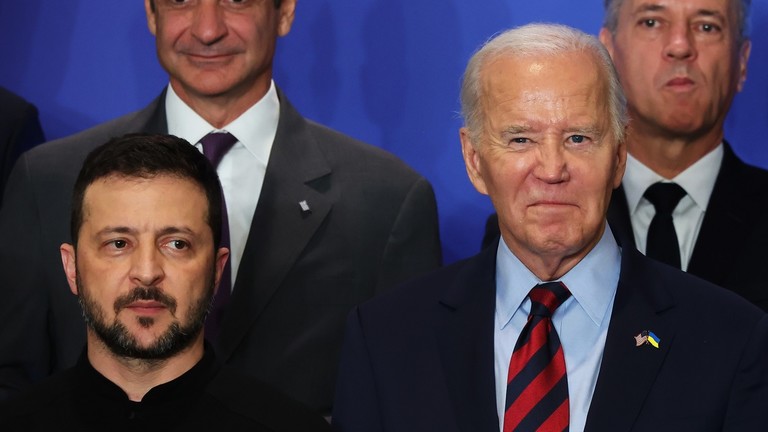
Vladimir Zelensky and Joe Biden at an event in New York on September 25, 2024. © Michael M. Santiago / Getty Images
Al Mayadeen | September 26, 2024
US President Joe Biden unveiled over $8 billion in military aid for Ukraine on Thursday, emphasizing that the support is aimed at helping Kiev “win [the] war” with Russia.
The announcement coincided with a visit by Ukrainian President Volodymyr Zelensky to the US. The Ukrainian president will meet with Democratic and Republican leaders at the Capitol prior to his meeting with Biden.
This assistance package includes the first delivery of a precision-guided glide bomb, known as the Joint Standoff Weapon, which has a range of up to 130 kilometers.
This would significantly boost Ukraine’s ability to carry out strikes further inside Russian territory, a move Moscow has warned could escalate the conflict and expand the war. It also suggests a shift in Washington’s policy, indicating unannounced approval for Kiev to utilize US-provided advanced weaponry to target areas deeper within Russia.
‘A global cryptocurrency network’
The bulk of the new aid, $5.5 billion, is to be allocated before Monday’s end of the US fiscal year, when the funding authority is set to expire. Another $2.4 billion is under the Ukraine Security Assistance Initiative, which allows the administration to buy weapons for Ukraine from companies – primarily American ones – rather than pull them from US stocks.
“That is why, today, I am announcing a surge in security assistance for Ukraine and a series of additional actions to help Ukraine win this war,” said Biden.
As part of his proposal, the President stated that the Defense Department will restore and deliver an additional Patriot air defense battery, along with extra Patriot missiles to Ukraine.
Biden also instructed the Pentagon to increase the training of Ukrainian F-16 pilots, with plans to train an additional 18 pilots in the coming year.
The United States, in collaboration with international partners, will take action to disrupt what President Biden described as “a global cryptocurrency network” used for Russian sanctions evasion and alleged money laundering.
Additionally, Biden announced that he will organize a leader-level summit of the Ukraine Defense Contact Group in Germany next month, aiming to unify the efforts of over 50 nations supporting Ukraine.
Firing Ukraine’s ambassador to the US
However, it remains uncertain how many Republicans will agree to meet with Zelensky, as criticism of Kiev grows among party leaders, including Donald Trump.
Trump has been vocal in his criticism of the Ukrainian President and has so far declined Zelenskiy’s request for a meeting.
During a campaign rally in North Carolina on Wednesday, Trump expressed strong disapproval of Zelensky, stating, “We continue to give billions of dollars to a man who refused to make a deal, Zelensky.”
Additionally, many Republicans in Congress were outraged by Zelensky’s recent visit to a munitions factory in Scranton, Pennsylvania, Biden’s hometown. The Republican-led House Oversight Committee has since launched an investigation into the Ukrainian President’s trip.
Trump also held President Biden and Democrat presidential candidate Vice President Kamala Harris accountable for allowing Russia’s war to take place.
Rep. House Speaker Mike Johnson, who is not expected to meet with Zelensky on Thursday, called on the Ukrainian President to sack his ambassador to Washington over the planning of the Scranton visit.
However, he reassured the Ukrainians that this diplomatic issue is not linked to the provision of military aid to Ukraine.
NATO Prepares for Mass Transport of Wounded Soldiers
By Kyle Anzalone | The Libertarian Institute | September 25, 2024
As the North Atlantic alliance ramps up preparations for war with Russia, Brussels is considering how it might remove a large number of wounded NATO soldiers from the frontlines should conflict with Moscow breakout.
Lieutenant-General Alexander Sollfrank, the head of NATO’s logistics command, discussed the plans with Reuters. “The challenge will be to swiftly ensure high-quality care for, in the worst case, a great number of wounded,” he said.
Sollfrank believes that NATO will be unable to have air superiority over the frontlines in a conflict with Russia. He said the bloc is considering using hospital trains and buses to move the wounded soldiers. Sollfrank explained, “For planning reasons, all options to take a great number of wounded to medical installations need to be considered, which includes trains but potentially also buses.”
At the end of the Cold War, with the dissolution of the Soviet Union, war between Russia and NATO was unthinkable. However, over the past three decades, the North Atlantic alliance has expanded up to Russia’s borders.
At the start of the Joe Biden administration, Washington and Brussels began treating Kiev as a de facto member of the alliance. The ties between Ukraine and NATO provoked the Russian invasion of Ukraine.
Throughout the war in Ukraine, the West has steadily escalated its support for Ukraine. The Kremlin has increasingly viewed itself in a direct conflict with the West.
President Biden is considering giving Ukraine the green light to conduct long-range missile attacks inside of Russia with American weapons. Russian President Vladimir Putin has warned that if the White House approves the attack, it would mean direct war with NATO.
Featured Video

Yemen joins the war – Red Sea could be blocked next – Saudi regime at risk
or go to
Aletho News Archives – Video-Images
From the Archives
A superpower and “the world’s sickest warrior state”
By Paul J. Balles | March 8, 2010
Living through five or six major wars has hardened me to what I thought were the extremes of inhuman cruelty and brutality.
Two things made those extremes almost bearable: the brutality always revealed – at least according to the media coverage – the viciousness of the enemy. It was therefore quite understandable when our “brave men and women” pulverized the enemy.
Films of Japanese torturing captive Americans somehow justified holding Japanese Americans in internment camps during World War II; and only a small percentage of Americans found the bombing of Hiroshima and Nagasaki unreasonably vengeful at best, at worst, depraved.
The media giants in America portrayed the North Koreans as barbaric beasts with their captives, quite unlike their southern counterpoints – our allies during the Korean War. No one ever felt the need to explain how the South Koreans were a civilized breed while the North Koreans were absolute savages, at least according to the official line.
In Vietnam, our warriors justifiably (or so the media made us believe) dropped napalm on the North Vietnamese who had the gall to hide in villages and tunnels to ravage our invaders. At least it was accepted practice until some rogue photojournalist filmed a young girl screaming down a Vietnamese road in flames. … continue
Blog Roll
 Aletho News
- Russian tanker approaches Cuba despite US oil blockade
- Marandi: Yemen joins the war – Red Sea could be blocked next – Saudi regime at risk
- Pro-Palestinian French member of European Parliament denied entry to Canada
- Pakistan to Host US-Iran Talks
- How Indonesia’s tilt toward the US left it stranded in the Strait of Hormuz
- US has no choice but to retreat from Iranian borders: Top commander
- Iran Retaliation Strikes Chemical Plant Near Dimona
- AWACS’ Destruction is a Major Loss for US Military – Ex-DoW Analyst
- Israel’s Iran Strategy Uses US Military & Gulf States as Its Pawns
- Iran: Trump wanted regime change, now just begging for Hormuz to open
- If Americans Knew
- Israeli police block Catholic cardinal from entering Church of the Holy Sepulchre on Palm Sunday
- Israel is assassinating journalists again, more than any other nation, anywhere, ever – Not a ceasefire Day 170
- Over 300 US service members wounded, majority have brain injuries – Not a ceasefire Day 169
- Researchers at Human Rights Watch Resign Over Blocked Report on Palestinian Refugee Return
- Jewish Groups Are Backing a War Americans Don’t Want
- Eric Fingerhut Thinks He’s the President of the Jews
- Top Jewish Philanthropists, Rabbis Urge Israeli President to Take Action Against ‘Jewish Extremists’
- Don’t Be Fooled. Zionist Leaders Have Always Wanted to Control Southern Lebanon
- Israel’s widespread use of torture is a core element of its genocide against the Palestinian people
- In Israel’s War on Iran, Many Middle East US Bases Rendered “All But Uninhabitable”
- No Tricks Zone
- German Science Blog Accuses PIK Climate Institute Of Hallucinating Climate Tipping Points
- Devastating Assessment Of Comirnaty Vaccine By Former Senior Pfizer Europe Toxicologist
- New Study: CO2 Is ‘Effectively Negligible’ As An Explanatory Climate Change Factor Since 2000
- Former Pfizer Toxicologist Dr. Helmut Sterz Tells Bundestag Hearing Pfizer Vaccine Should Have Never Been Approved
- Energy Expert: Germany’s Nuclear Phaseout Was A “500 Billion Euro Mistake”
- New Research: South Australia’s Mid-Holocene Sea Surface Temperatures Were 4°C Warmer Than Today
- Storing Green Energy To Last Germany 10 Days Would Require A 60-Million Tonne Battery
- New Studies: UK Sea Levels Were 4 Meters Higher Than Today During The Mid-Holocene
- Destructive Green New Deal: German Energy And Metal Group Warns Of Drastic Crisis
- New Study Documents A 20-Year Pause In Arctic Sea Ice Decline – Driven By Internal Variability
 Aletho News