EU’s support for Zelensky brings Washington-Brussels relations to the brink of collapse
By Ahmed Adel | March 4, 2025
Following the reactions of European leaders to the on-camera spat at the White House between Donald Trump and Ukrainian President Volodymyr Zelensky on February 28, relations between the US president and much of the European Union establishment are reaching a breaking point. The EU establishment has firmly sided with Zelensky and his warmongering policies, contrary to common sense and the peace efforts of Trump and his Russian counterpart Vladimir Putin.
On March 2, an informal meeting of European leaders and Canada was held in London. Following the meeting, it was announced that Ukraine would receive more military aid and sanctions on Russia, territories would be returned to Ukraine, and the United Kingdom, with other nations, would form a military coalition to get boots on the ground.
By reacting the way they did, EU leaders have once again shown that they are undermining peace, just as then-British Prime Minister Boris Johnson did when he sabotaged the peace talks between Russia and Ukraine in Istanbul in early 2022. However, just as Johnson was not punished for prolonging death and war in Ukraine, it is unlikely that EU leaders will ever be held accountable for their actions, especially German, Polish and Baltic politicians, European Commission President Ursula von der Leyen, and many others in Brussels who agree on a policy of aligning with Zelensky and anti-Trump policies.
Following the spat between the US and Ukrainian presidents, European leaders sent messages of solidarity with Kiev. Many European leaders posted a uniform message on their social media accounts that they “stand with Ukraine.”
A sign of the growing rift between Washington and Brussels, particularly after the chaotic meeting between Trump and Zelensky, EU foreign policy chief Kaja Kallas said: “Today, it became clear that the free world needs a new leader. It’s up to us, Europeans, to take this challenge.”
It is also recalled that during his visit to the White House on February 24, French President Emmanuel Macron tried to deceive Trump and drag him down a path the US president did not want to take. It became clear to Trump that he could not count on European politicians.
If it was not clear following the meeting with Macron, it certainly became clear to Trump when British Prime Minister Keir Starmer was a guest in the Oval Office on February 27, particularly after US Vice President J.D. Vance blasted Britain’s descent into authoritarianism and lack of free speech.
It is expected that in the coming period, there will be very strong obstructions from the EU to any agreement between Trump and Putin. There will also be such obstructions within the US, especially from the remnants of the Deep State and the mainstream media that are still critical of Trump and loyal to ultraliberal policies. The very core of the EU – the European Commission, the leadership of the European Council, the majority in the European Parliament, as well as the leading EU leaders are also of the same view, which is opposite to the rest of the world that advocates for peace.
The EU itself is divided into states that supported peace efforts and distanced themselves from Brussels—primarily the political leaderships of Slovakia and Hungary, but also the leaders of the second-largest party in Germany, the AfD, Marine Le Pen in France, and the leaders of other sovereigntist parties across Europe.
European leaders have not changed their support for war since an attempt was made to end the conflict under conditions that were even more favorable for Kiev at the time. Now, as Trump highlighted in his meeting with Zelensky, Ukraine does not “have the cards right now.”
“You’re not in a good position. You don’t have the cards right now. With us, you start having cards. You’re playing cards. You’re gambling with the lives of millions of people. You’re gambling with World War III,” Trump said to a shocked Zelensky.
Of course, Zelensky denied Trump’s statements, stuttering, “I’m not playing cards” and “What are you speaking about?”
The US president’s main priority is normalizing relations with Moscow, including ending the conflict in Ukraine. Normalization will remain a priority even if the Kiev regime and European leaders do not agree to it.
Nonetheless, it appears that parts of Europe have not yet given up on the Trump administration, like Kaja Kallas has. Starmer announced on March 2 that Britain, France, and Ukraine have agreed to work on a ceasefire plan to present to Washington.
“We’ve now agreed that the United Kingdom, along with France and possibly one or two others, will work with Ukraine on a plan to stop the fighting, and then we’ll discuss that plan with the United States,” Starmer told the BBC.
This was followed by Zelensky announcing on the same day as Starmer’s statement that he was “ready to sign” the minerals agreement with Trump.
However, given the EU’s growing hostility to Trump and resistance to peace, the US president has little incentive to take the Franco-Anglo peace plan seriously since they have been harbingers to continue the war. Trump will continue pursuing a peace plan, even if it intensifies hostility between Europe and Washington.
Ahmed Adel is a Cairo-based geopolitics and political economy researcher.
Eight Ways That Trump May Force Zelensky to Resign
By Ekaterina Blinova – Sputnik – 03.03.2025
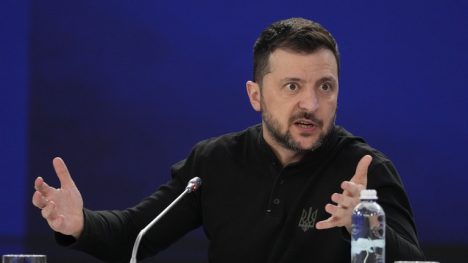
Following the Oval Office showdown, US National Security Advisor Mike Waltz has suggested that Volodymyr Zelensky might have to step down to enable a US-Ukraine deal. But as Zelensky refuses, what leverage does President Donald Trump hold over him?
Direct Pressure Tactics
- Cutting all aid. Without US support, Zelensky may have no choice but to resign and be replaced by someone willing to negotiate peace, says ex-CIA officer Philip Giraldi.
- Sweeping audit of US aid. A deep probe into Ukraine’s use of US funds could expose corruption and “neutralize” Zelensky, according to ex-Ukrainian MP Oleg Tsarev.
- Freezing Zelensky’s cash. Blocking foreign accounts of Zelensky and his team could undermine the Kiev regime, Tsarev suggests.
Shutting down Starlink. Three sources told Reuters that Team Trump may cut Ukraine’s access to Elon Musk’s satellites, a move the White House has already reportedly threatened. - Zelensky’s expired legitimacy. His presidential term ended in May 2024, making all actions since then legally questionable. Trump could challenge his right to govern.
Trump’s Indirect Leverage via Europe
- Pressuring European allies. Europe remains dependent on the US, writes economist Dr. Paul Craig Roberts. With no weapons left to send and money-printing its only option, Trump could force its hand.
- NATO withdrawal threat. Trump may pull US security guarantees from warmongering European states throwing sand in his gears or even threaten a NATO exit, warned ex-Pentagon officer David Pyne. That could motivate Europe to rein Zelensky in.
- Tariffs on Europe. A 25% tariff on EU imports could cost 1.5% of EU GDP, per Bloomberg. Trump already threatened this, claiming the EU was created to “screw the US”.
The Sea Change
By Israel Shamir • Unz Review • February 20, 2025
A huge, heavy ship, loaded to the brim, is turning around in narrow straits amid perilous waters. Thus, the world is performing a rare volte face under the daring captainship of Donald Trump and his breakneck mates Elon Musk and JD Vance. They couldn’t have cut it any closer – already we felt the breath of our doom. Whether the peril be nuclear mushrooms or pandemics crafted in Pentagon biolabs, or some other totally unpredicted collapse concocted by Schwab and his ilk – our new captain seems to recognize Scylla and Charybdis. Our fragile life was about to collapse when the young programmers of DOGE dove into deep cellars of hidden data and uncovered the pearls: millions of dollars earmarked for broken Haiti to make a dream home for Chelsey Clinton; millions of social security checks being sent to beneficiaries 150 years old and older; millions earmarked for regime change, for neutering boys and girls, for planting tempest and reaping storm all over the world. And after this brief but tempestuous overture rung, above the furious sounds of battle, the telephone; the telephone call of captain Trump to captain Putin.
God revealed His mercy and tender caring for us, calming the storm at the very last moment. It is a perfect replay of the Cuban Missile Crisis multiplied by a factor of one hundred. The voices calling for global nuclear holocaust were becoming increasingly frequent and shrill recently. Now one can hope they will be pushed back to the fringe. US and Russian delegations meeting again in Riyadh have agreed to restore the normal civilized diplomatic routine: appoint ambassadors, open missions, increase tenfold the embassy staff. Since Obama’s days the embassies had been run down to the bare minimum.
Immediately the Economist and similar rags have tried to spoil the mood. The Ukrainian crisis has not been solved yet, the war still goes on, they cry. Trump can’t be relied upon, they fume impotently. I always rely upon the Economist as a perfect inverse barometer; whatever they say we may consider pure enemy hasbara. They show Trump talking to Putin with the text “The worst nightmare of Europe”. For me, the worst nightmare would be ruins of Gaza or nuclear waste of Hiroshima, for them, peace would be the worst.
Our enemies do not want us to rejoice ever, but these are the days we could and should be glad. The Ukrainian war is a minor event compared with such a worldwide tectonic shift. The West has tried to isolate, break and consume Russia for many years, once it became aware that Putin is not a new Yeltsin, that he is a stubborn, strong-willed leader, a man like Hamlet: though you can fret him, you cannot play upon him. And ever since that time, over many years, Russia has suffered in isolation, while all the world press blamed Putin and incited legions of tiny dogs from Estonia to the Ukraine to bite him. Such conflict was inevitable because Russia and the West had different interpretations of 1991. For the West, it was the final defeat of Russian independence. For Russia, it was a lesson learned. Never again will Russia attempt to play by Western rules. So how could anyone solve such an intractable divergence of opinion? It took just one call from Donald Trump.
The Ukraine war is a small thing in comparison: Russia wants its seat at the table with the big boys, it wants to be safe, not besieged. Russia wants Western troops and arms as far from its borders as was promised to Gorbachev, this is important. The Ukraine war will be terminated in due time by diplomatic negotiations between civilized adversaries, as it should be. NATO’s war policy has revealed that the majority of the European states, governed by enemies of Trump, are also enemies of democracy. JD Vance was right: they forgot they should listen to their people instead of dictating to them.
In the UK, the popular leader Jeremy Corbyn had been dismissed on the phony accusation of anti-Semitism, and replaced by an extremely pro-Jewish and anti-Russian PM. He is, of course, pro-war. He also detains hundreds and thousands of his citizens for the terrible crime of a post in the social network, or a demonstration, or even worse: a silent prayer. In England, a silent prayer in your own house is a crime, too. France continues to be ruled by Macron, an ex-Rothschild banker, also (of course) warlike. In Germany, there are elections coming soon, but mainstream German politicians are all liberal-left and of course pro-war. In liberal Germany, prison waits for anybody stepping beyond the red line. They imprisoned and amputated the legs of the brilliant and daring lawyer Horst Mahler for a gesture. However, the fresh wind of Trump’s populist revolution blows over Germany as well.
Not only does the far-right AfD call for peace, so does the far-left BSW! The German civil society association Kulturtreff held two rallies in Berlin and Frankfurt under the slogan «No vote for NATO vassals, immediate peace for Europe!». The protesters demanded immediate peace negotiations, an end to the war in the Ukraine, an end to arms supplies to the Ukrainian state, and the restoration of economic and political cooperation between Germany and Russia. Kulturtreff states that «the current main opposition party CDU/CSU wants as does the ruling left-liberal coalition for the war in Europe to continue. The leading political parties of Germany do not have a single new solution in their program». The speakers supported the point of view of US Vice President Vance at the Munich Conference, who pointed out that the political elite of Europe is deeply disconnected from the real interests of the European people.
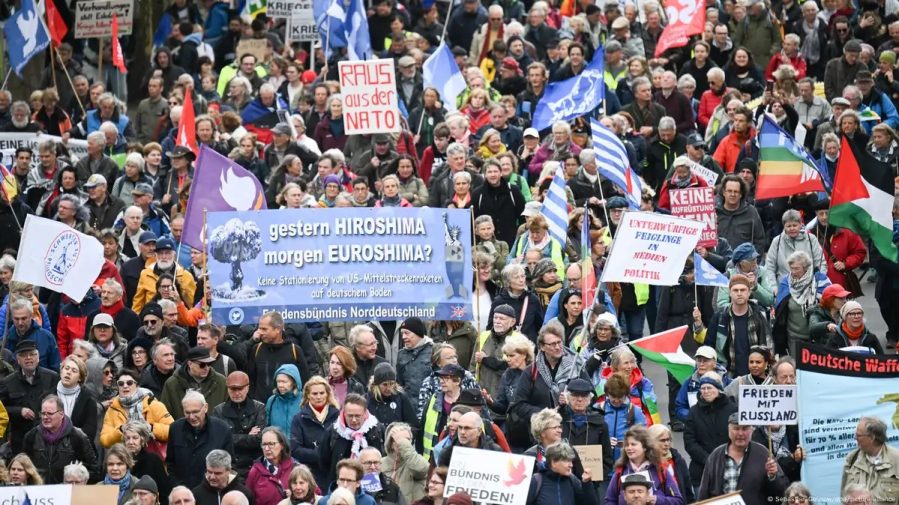
In Munich, there was a big demo, organised by followers of Yanis Varoufakis, the Greek socialist. They are called DiEM25, and they also call for peace and friendship with Russia.

Bear in mind that all calls for peace are forbidden in Europe; if you look for “Germany peace demo” in Google it shows you rallies for climate, or a rally for migrants, or some rally against a local version of Donald Trump; but no peace demo will be shown, unless it is full of blue-and-yellow banners demanding more war. In the UK and Germany, you might get a visit from the local gestapo if you click a cautious *like* under an anti-war post in your social network. In Sweden, a minister explained why the people are not allowed to decide their NATO status: “Membership in NATO is too important to ask the people to approve of it.” A Swedish journalist wrote in the Facebook:

In Russia, the anti-Putin and pro-Western opposition, as run by Navalny and ilk, relocated abroad claiming hatred of war. But they couldn’t retain that pretence for long. At first, they supported Israel’s war against the Palestinian people, and this was important because some 70 per cent of Russian oppositionists who left Russia after February 2022 landed in Israel. Obviously, they considered themselves Jewish, and Israel recognised them as Jews. It may be true that not everyone who opposes Putin is a Jew, but to a great extent it was true and to a great extent Jews continue to finance anti-Putin organizations in Russia. And now, with the first sight of Trump’s international thaw and the possibility of terminating the war in the Ukraine, these emigres have collectively called for more war. This was the end of the anti-war movement in the Russian World, in the archipelago of Russian-speaking communities – it seems that Russia’s counter-elites will not be happy until they see the Russian army defeated. They dream of US Abrams tanks rolling through Red Square, with Putin executed like Saddam Hussein, but instead those Abrams tanks (30 or 31 delivered to Zelensky) burned in the fields of Novorossia, far away indeed from Moscow.
However, many people, including first of all the parents of Russian teenagers, were excited by Trump’s call for peace, as the war in the Ukraine was a big bloodletting for Russians and Ukrainians alike. Although Russia’s fighters are all well-paid volunteers, there is no doubt that the Russian people will be happy when this war is concluded.
For the Russian leadership, the most important goal was defined in the so-called “Putin’s Ultimatum” of December 2021 (I wrote about it at length here: To Make Sense of War). Putin’s draft treaty called for an immediate end to NATO’s drive Nach Osten, keeping all Western armies and weapons out of former USSR republics. Now it seems this goal will finally be obtained.
It seems that we are at the brink of a great sea change. President Donald Trump has already given us a basket of blessings. There is a song Jews sing at Passover: if He would give us only this, it would be enough, Dayeinu. It is perfectly suitable in this case. If Trump only saved us from World War III, it would be enough. If he only disclosed the dark secrets of USAID, it would be enough. But let’s not forget to thank him, even if it be just for a moment while we think of what we want next. Such as a drawback is his policy towards Palestine. Let’s hope that it will remain just silly talk.
The Atlantic Magazine gives us reason for some hope: it claimed Trump is building the most anti-Semitic cabinet in decades. It certainly has fewer Jews than the Biden’s cabinet, and less belligerence coming with fewer Jews.

Hungary and Slovakia’s leaders support Trump against Zelensky
Remix News | March 3, 2025
National leaders from Hungary and Slovakia are siding with President Donald Trump following his feud with President Donald Trump and Vice President JD Vance in the Oval Office on Friday.
During the meeting, which had been demanded by Zelensky, Trump and Vance criticized the Ukrainian leader for wanting to continue the war rather than sue for a ceasefire with Russia when he is unable to win on the battlefield. They further castigated him for not being thankful enough for the considerable support from the US that he has received until now.
Reports suggest that hundreds of thousands on both sides have already been killed in the conflict.
The meeting was so contentious that many commentators believe it could signal a complete change in direction in Washington’s approach to the war.
“Strong men make peace, weak men make war,” Hungarian Prime Minister Viktor Orbán wrote on X. “Today President Donald Trump stood bravely for peace. Even if it was difficult for many to digest. Thank you, Mr. President!”
The Hungarian government has been urging negotiations rather than continued fighting to end the conflict from its outset.
Balazs Orbán, who is a Hungarian MP as well as Viktor Orbán’s political director, made a more detailed statement on X. “In light of the events yesterday it is helpful to clarify Hungary’s position and the principles on which it is based,” he wrote. He then outlined five points:
“1. Hungary should fight only for the Hungarians, never for anyone else.
2. Hungary should build alliances with those who want peace.
3. If we do not look after our own interests, no one else will represent them.
4. If Europe is doing crazy things, then let’s try to convince them of the nonsense of their chosen strategy.
5. If that fails, then, by all means let us save ourselves, and let our approach be based on our own national interests. (See point 1 et al.)”
He concluded his tweet by referring to the fact that a European Council summit will be held in the coming week to discuss a joint statement by European leaders on the Ukrainian war that is to be made. “A tough week ahead,” Balazs Orbán concluded.
Hungary was not alone in supporting the American President’s tough line with Zelensky. Slovakia’s Prime Minister Robert Fico, who, like Orbán, has long encouraged negotiations rather than further violence to end the Ukrainian war, published a lengthy statement on X concerning it.
“Slovakia will not support Ukraine either financially or militarily to enable it to continue the war,” Fico said.
Fico added that “Slovakia has reservations about the ‘peace through strength’,” and that “Ukraine will never be strong enough to negotiate from a position of military power.”
Fico further stated that he believes that the European summit should call for an “immediate ceasefire” in Ukraine, and that “if the summit does not respect that there are other opinions besides simply continuing the war, the European Council may not be able to agree on conclusions regarding Ukraine on Thursday.”
Other leaders of European Union member states, as well as EU politicians, were quick to voice their support for Zelensky and Ukraine. The Vice President of the European Commission, Kaja Kallas, wrote on X that “today, it became clear that the free world needs a new leader.”
After being thrown out of the White House, Zelensky then travelled to London, where he met with Prime Minister Keir Starmer on Saturday. Starmer promised the Ukrainian leader an additional 2.8 billion euros in aid by next week.
NATO Secretary General Mark Rutte, for his part, urged the Ukrainian president to fix his relations with Trump. Rutte told the BBC that it is “important that President Zelensky finds a way to restore his relationship with the American president and with the senior American leadership team.”
Orbán made it clear on Saturday that Hungary is considering blocking any EU resolution on the Ukraine war that does not encourage negotiations aimed at peace. In a letter addressed to European Council President António Costa, Orbán stated that “I am convinced that the European Union – following the example of the United States – should enter into direct discussions with Russia on a ceasefire and sustainable peace in Ukraine.”
“This approach is not reconcilable with the one reflected in the draft conclusions,” he added.
Orbán then said that he is proposing “not to attempt adopting written conclusions on Ukraine” in the upcoming summit, but rather “to limit written conclusions to recalling and supporting UN Security Council Resolution 2774 (2025) adopted on 24 February 2025.” The UN resolution he referenced was put forward by the US, and does not mention Russian aggression as the cause of the war.
“The Resolution signals a new phase in the history of the conflict and renders all previous agreed language by the European Council irrelevant,” Orbán asserted.
To Encourage Talks With Moscow, DoD Will Halt Cyber Attacks on Russia
By Kyle Anzalone | The Libertarian Institute | March 2, 2025
Secretary of Defense Pete Hegseth ordered his agency to halt offensive cyber operations against Russia as the White House is attempting to engage the Kremlin in talks to end the war in Ukraine.
“Defense Secretary Pete Hegseth has ordered U.S. Cyber Command to halt offensive operations against Russia, according to a current official and two former officials briefed on the secret instructions,” the New York Times reports. “The move is apparently part of a broader effort to draw President Vladimir V. Putin of Russia into talks on Ukraine and a new relationship with the United States.”
After the invasion of Ukraine, the Joe Biden administration announced a multi-pronged warfare policy to degrade Russia, including arming Ukraine, sanctions, cyber attacks, and seizing Russian assets.
Since returning to office, President Trump has prioritized improving ties with Russia and ending the war in Ukraine. US and Russian officials have agreed to normalize ties and work toward ending the conflict in Ukraine.
The scope of the order is unclear, but it will not apply to the National Security Agency or intelligence collection. Hegseth issued the order before President Zelensky’s heated exchange with President Donald Trump in the Oval Office on Friday. Following the meeting, Trump considered cutting all military aid to Ukraine.
The Times notes that Trump’s decision to halt offensive cyber operations is a policy shift. During his first administration, he expanded cyberwarfare.
Sen. Lee, Rep. Massie, Musk Call for US to Exit NATO
By Kyle Anzalone | The Libertarian Institute | March 2, 2025
A pair of Republican lawmakers voiced their support for the US exiting the North Atlantic Alliance. Following a heated White House exchange between President Trump and President Zelensky last week, many members of the bloc voice their support for Ukraine and Zelensky.
On Saturday Senator Mike Lee (R-UT) posed on X, “Get us out of NATO.” He was commenting on a pie chart that showed the breakdown of defense spending by members in the Cold War-era alliance. According to the chart, US military spending is 70% of total defense spending in NATO. The 2024 military budget for the US was $895 billion.
The second highest spender is the UK at $70 billion.
The US has long subsidized the defense of the NATO alliance. Prior to the Russian invasion of Ukraine, only seven of the bloc’s 30 members met the alliance requirement of spending 2% of GDP on the military. In 2024, NATO projected that 23 of 32 members would meet the minimum spending level.
Posting in support of Sen. Lee, Rep. Thomas Massie (R-KY) wrote, “NATO is a Cold War relic that needs to be relegated to a talking kiosk at the Smithsonian.”
NATO was founded in 1949 with 12 members. After the fall of the USSR, the bloc has slowly expanded eastward across the continent to include former Warsaw Pact members and Soviet republics.
Moscow has complained that NATO expansion presented a threat to Russia. While Brussels claims that the bloc is a defensive alliance to protect its members from aggressive attacks, NATO has waged war in Eastern Europe, Afghanistan, and Libya over the past three decades.
On Sunday, Trump adviser Elon Musk wrote on X, the platform he owns, “I always wondered why NATO continued to exist even though its nemesis and reason to exist, The Warsaw Pact, had dissolved.”
The day before, he responded “I agree” to a post that said, “It’s time to leave NATO and the UN.”
Scott Ritter: US Had Its fingers in Every Aspect of Ukrainian Pie
Sputnik – 02.03.2025
Aside from preparing Ukraine for guerrilla warfare and conducting anti-Russia propaganda operations, the US and the CIA built 20 bases throughout the country, former US Marine Corps intelligence officer Scott Ritter told Sputnik.
Hunter Biden’s position on the board of the major Ukrainian energy company Burisma also shows that “the United States had its fingers in every aspect of the Ukrainian economic pie.”
Ukraine, Ritter explained, is just a tool US tried using to defeat Russia – a tool that wasn’t even aware of “every aspect of this grand plan.”
“A hammer doesn’t know the intent of an architect. America was the architect of Ukrainian project. Ukraine is just the hammer, just like Europe,” he said.
Commenting on the recent clash between JD Vance and Zelensky, Ritter noted that Vance is “the vice president of the United States, who has received some of the best intelligence there is about the reality of Ukraine.”
“Zelensky is an actor who reads from a script as part of a play that’s being controlled by others,” he remarked.
Hungary accuses EU of violating energy security guarantees – media
RT | March 2, 2025
Hungary has accused the European Union of failing to honor the energy security guarantees it recently gave to Budapest, M1 broadcaster has reported, citing a letter that Foreign Minister Peter Szijjarto sent to the EU’s top diplomat Kaja Kallas on Sunday.
The Hungarian official reportedly warned Brussels that his country’s acquiescence in any further Ukraine-related decision would be contingent on the EU’s ability to safeguard Budapest’s energy supplies.
The letter came hard on the heels of a Russian Defense Ministry report that three drones had been shot down near a key compressor station servicing the TurkStream gas pipeline on Friday. Moscow described the incident as a Ukrainian sabotage attempt.
In an article on Sunday, Hungary’s Hirado news program claimed that Foreign Minister Szijjarto had reminded Kallas that as recently as January 27, when the EU was deciding on extending sanctions against Russia, Brussels explicitly gave Budapest “four guarantees that Hungary’s energy supply would be secure.”
Szijjarto reportedly wrote that the bloc’s leadership had pledged to involve his country in negotiations over the resumption of Russian gas transit through Ukraine – an apparent reference to Kiev’s decision in late 2024 to terminate its five-year transit contract with Russian energy giant Gazprom. The diplomat pointed out that despite this promise, Budapest has been excluded from the respective talks, Hirado noted.
“Secondly, the European Commission also gave a guarantee that Ukraine would not attack the infrastructure responsible for energy transport to the EU,” Szijjarto wrote, adding that nonetheless, “Ukraine launched a drone attack on the Russkaya compressor station of the TurkStream on the night of February 28.”
The media outlet quoted the minister as expressing incredulity that an EU candidate nation (Ukraine) would seriously endanger the energy security of a current member state, with Brussels seemingly taking Kiev’s side and not Budapest’s.
The Hungarian diplomat made it clear that his country’s “position will largely be determined by the issues raised in this letter in the decisions regarding Ukraine in the coming period,” Hirado reported.
In a post on Facebook on Saturday, the official wrote that the inoperability of the TurkStream “would seriously endanger our energy security,” and thus encroach on Hungary’s sovereignty.
While Friday’s incident did not result in any damage to the energy infrastructure, a similar attack reported by the Russian Defense Ministry in January saw falling debris impact the facility.
TurkStream delivers Russian natural gas to Turkish customers and several European countries, including Hungary, Serbia, Bulgaria, Slovakia, Bosnia and Herzegovina, and Greece.
Europe’s Reckless Warmongering Pushes Trump Toward NATO Exit
By Ekaterina Blinova – Sputnik – 02.03.2025
So long as the US provides an expensive and robust support for Europe’s defense, oligarchs based in Europe can continue business as usual, living their lavish lifestyles and provoking their nuclear neighbor, Wall Street analyst Charles Ortel says.
“Our European ‘partners’ seem to want ‘war at all costs,’ believing that America will do the paying and Americans will do the dying,” Wall Street analyst Charles Ortel told Sputnik, commenting on Europe’s demonstrative support for Volodymyr Zelensky, who rejected a Trump-brokered ceasefire in Ukraine.
The UK and EU feel free to provoke Russia – a nuclear power – because they believe their security is guaranteed by Article 5 of the North Atlantic Treaty, which would obligate the US to come to their defense, according to the analyst.
Europe’s proxy, Zelensky, “is behaving like an old-fashioned mafia goon, demanding protection money,” Ortel says.
US involvement in the Ukraine conflict would mean increased protection for Europe and further US taxpayer money flowing into European coffers. But that won’t happen under Donald Trump and JD Vance, Ortel underscores.
As Europe’s reckless warmongering continues, the US may have no choice but to leave the transatlantic alliance, he believes.
“The US has no business subsidizing Europe and defending it,” Ortel says. “Indeed, I believe we have a duty to our own citizenry to significantly reduce our defense commitments to Europe and rescind NATO treaty assurances — if not exit NATO altogether under present circumstances.”
Trump-Zelensky spat shows who wants peace and who doesn’t – Hungarian FM
RT | March 2, 2025
The public clash between US President Donald Trump and Ukrainian leader Vladimir Zelensky has made it clear that, unlike Washington, Kiev is not interested in ending its conflict with Moscow, Hungarian Foreign Minister Peter Szijjarto has said.
Zelensky’s trip to the White House on Friday was abruptly cut short after his meeting with the US president and vice president devolved into a shouting match in front of the media. Trump and J.D. Vance accused the Ukrainian leader of “gambling with World War III” due to his reluctance to negotiate peace with Russia, and of being disrespectful and ungrateful for the substantial military aid provided to Kiev by Washington.
The visit was intended to finalize a minerals agreement between the US and Ukraine, but it was never signed as Zelensky demanded security guarantees and greater involvement in the conflict from the Trump administration.
“It became clearer to everyone than ever before who wants peace and who wants war; who wants to stop the killing and who wants to continue it; who stands on the grounds of common sense and who does not care for either human lives or billions of wasted euros,” Szijjarto wrote in a post on Facebook on Saturday about the heated exchange at the Oval Office, which US Secretary of State Marco Rubio described as a “fiasco.”
The foreign minister made it clear in his message that it is Zelensky, who wants “the war to just continue.”
“Trump’s stand for peace was the greatest moment of the past three years,” he insisted.
The US president told Zelensky on Friday that Ukraine was “running out of soldiers” and had no cards to play in the standoff with Russia. “Look, if you could get a ceasefire right now, I tell you, you take it, so the bullets stop flying and your men stop getting killed,” Trump said.
Szijjarto stressed in his post that the authorities in Budapest, who had been consistently calling for a diplomatic settlement of the conflict between Russia and Ukraine, “hope that… Trump will make the US-Russian negotiations a success, because only a US-Russian agreement can bring peace back to our beloved Central Europe.”
Russia’s Foreign Ministry spokeswoman Maria Zakharova described Zelensky’s trip to the US as “a diplomatic and political failure” of the Kiev government. “With his outrageously boorish behavior” at the White House, the Ukrainian leader confirmed that he is “an irresponsible instigator of a major war” and “a most dangerous threat to the international community,” she wrote on Telegram on Saturday.
The pro-war lobby in the West needs to come up with new ideas, rather than saying the same old things
By Ian Proud | Strategic Culture Foundation | March 2, 2025
When western pundits resist efforts to bring an end to fighting in Ukraine, they never provide an alternative vision of what they would do differently.
A respected associate of mine asked me today if a ceasefire and peace process in Ukraine would simply embolden China and Russia to further aggression.
This is a line oft repeated among the majority of politicians, journalists and so-called academics in the west, who are opposed to an ending of the war. ‘We can’t stop the war, because if we do, China will invade Taiwan and Russia will invade Latvia, Estonia, Lithuania, Poland etc.’
My view, for what it’s worth, is that an end to the war in Ukraine might embolden China longer-term over Taiwan in particular. I’ve seen no evidence that it will embolden Russia to invade NATO, precisely because Russia sees itself, in large part, as a country of Europe, even if it has been excluded.
However, and critically, if both China and Russia were so emboldened, then should we not ask ourselves how we have ended up in this position?
Russia’s decision to go to war was driven by a belief that it’s core strategic interests in preventing NATO expansion to its border via Ukraine was being ignored, and that it was subject to permanent sanctions with no possibility of removal through any concessions it might make.
That’s my opinion and one I know that many ‘realists’ share.
But, in any case, the ‘what next’ question should have been considered as part of a longer-term strategic assessment when western nations pushed the NATO enlargement agenda.
We have known since at least 2008 that this was a redline for Russia.
Did we expect Russia’s position to change and if so, how? If Russia’s position did not change, how far would we go to advance Ukraine’s NATO aspiration, including through direct military confrontation?
I’m not aware that those questions were ever asked or, if they were, considered rather than dismissed. And I was at the heart of British government decision making from the latter part of 2013, before the Ukraine crisis started (and must therefore accept some of the blame).
Without the United States, a war in Ukraine was never going to be sustainable for Europe, financially, politically or militarily.
Yet no one thought this through. Or, if they did, they didn’t factor in the eminent risk of America doing an about face on policy one day, as is now happening.
With America now withdrawing, sustaining a losing war in Ukraine rather than calling a halt to the killing cannot be considered a legitimate strategy if its only goal is to avoid losing face.
That makes us look weaker and more feckless.
If other states are now emboldened by the failure of western policy in Ukraine, that is not a sufficient reason to avoid an end to the bloodshed now.
Our self-righteousness indignation to peace is merely a figleaf covering the deflated genitals of our policy failure.
The west so badly mishandled relations in the eight years between the flashpoint of the Maidan and the start of war, not thinking through the consequences.
Russian actions and reactions in Ukraine have always been predictable.
They were predictable in February 2014.
They were predictable in February 2022.
They were predictable in February 2025.
We were never going to fight for Ukraine.
I have heard senior British Ambassadors say that we were never going to fight for Ukraine. And we are the most hawkish nation in Europe.
Why were we never going to fight?
Because it would never be possible to ensure that the 27 nations of the EU or the 31 nations of NATO would come to a collective agreement to fight.
Someone would always block fighting.
Compromises would be made.
We would pursue a lowest common denominator. That led us to a sanctions-only approach.
As I have said many times before, in the game of geostrategic chess, President Putin always knew that large, chattering teams of politicians around the table couldn’t outmanoeuvre him.
In fact, they would take weeks and months just to agree on the meaning of pawn, let alone whether to move it on the board.
We lost through indecision and have yet to learn the lesson.
You can’t fight wars by committee. But you can make peace in a group.
As Albert Einstein said, ‘we cannot solve our problems with the same thinking we used when we created them’. That is seen by some as the source of the misattributed saying, ‘the definition of insanity is to do the same thing but expect a different result.’
As the war in Ukraine grinds towards its diplomatic denouement, those people who would like to avoid a negotiated settlement are not coming up with an alternative approach.
They are not introducing new ideas to up the ante, if that is what they want to do. In fact, I don’t know what they want to do, because they’ve been saying exactly the same things for three years and I am epically bored right now.
The problem here, is that neither are they advancing a credible argument against ending the war.
Their position seems to be, the war is bad, it’s all Russia’s fault and if we give in now, Russia will be emboldened to strike elsewhere.
Their defensive position is held together by straplines not substantive arguments.
In a recent speech, the veteran U.S. Democrat politician Bernie Sanders said,
‘Russia started the war, not Ukraine,
Putin is a dictator, not Zelensky.’
While I am sure he may believe that it’s just another banal outburst, intended more to rail against the political leaders in his own country, rather than to bring peace in Ukraine.
Of course, people view the origins of the war differently and people are entitled to their views.
Debate on the war in Ukraine has become reduced to ‘I’m right and you are wrong’ with voices of reason and realism in the west, like mine, stifled by the mainstream.
But we will never reach a position in which there is a universally accepted view of who was at fault and who was not.
Instead, let’s try to accept that every side in this conflict takes some share of the blame, be that Russia, Ukraine, the U.S., UK and everyone else.
Let’s have a frank but polite discussion about a way forward.
President Trump has advanced a new policy proposition that engagement and dialogue is vital if we are to bring an end to the fighting. British and European leaders can’t continue unchallenged, carrying on as if the world hasn’t changed.
They need to come up with genuinely new and constructive ideas, rather than continuing to say the same things. And reengage in dialogue with Russia.
A dose of reality for the West’s spoiled brat: What now for the humiliated Zelensky?
By Tarik Cyril Amar | RT | March 1, 2025
“A grandiose failure” – take it from the best Ukrainian news site. That’s how Strana.ua has summed up the visit of Vladimir Zelensky, past-best-by-date leader in embattled Kiev, to Washington.
And no one who watched the no-holds-barred shouting match between Zelensky, on one side, and US President Donald Trump and Vice President J.D. Vance, on the other, can disagree. Indeed, no one is even trying to disagree: Independent of political bias, there is unanimity in Western mainstream media that this was a historic catastrophe for Zelensky and his version of Ukraine.
“A disaster” and “bitter chaos” (The Economist ); a “meltdown” that “could not have gone worse” (Financial Times); a “historic escalation” (Spiegel ); a “disaster for Ukraine” and a “spectacular confrontation” (Le Monde ); an “upbraiding” and “debacle” for Zelensky (New York Times ) and so on and so forth… You get the gist.
And please don’t blame me for how boring a review of Western mainstream media is; it’s not my fault that the vaunted press of the self-appointed “free world” and “garden” of “values” offers less diversity of views than the Soviet media circa 1986.
The basic idea is very basic indeed: “This was awful because poor Zelensky got bullied.” Some especially eager information war cadres are already fingering J.D. Vance as the one to blame. The Economist, for instance, simply “knows” that the US vice president set up the Ukrainian leader. But then, the same Economist also helped spread the moronic lie that Russia blew up its own Nord Stream pipelines.
Intriguingly, Ukraine’s Strana.ua, already mentioned above, sees things very differently. Its take is that “Zelensky himself provoked the scandal by his rudeness” toward both Vance and Trump. The latter, these Ukrainian observers who know their own vain and erratic leader all too well think, were still holding back, staying “quite calm and respectful” toward Zelensky.
For what it’s worth, my personal impression is that Zelensky did provoke the fight; that Vance and Trump treated him harshly and humiliatingly in return; and that Kiev’s prima-donna-in-chief deserved every last bit of it – and then some. Yes, after more than half a decade of Western leaders and mainstream media first building an insane personality cult around him and then babying and coddling him, it was a relief to see him talked to in earnest. And yes, it was glorious.
Because Trump is right: Yes, Zelensky has been recklessly toying with World War III. And no, his regime has not been “alone.” On the contrary, without massive Western support that it should never have received it would long ago have ceased to exist. Vance also has a point: Ukraine is running out of soldiers, and Ukrainian men are hunted like animals to be shipped off to a hopeless meatgrinder war.
Finally, both are right: Zelensky displayed crude disrespect. Don’t get me wrong: In general, I am all for massively disrespecting the American empire. But once you’ve chosen to be its puppet and sold your own nation to it, you might as well cut out the grandstanding.
In short, at long last, a dose of reality for the West’s spoiled brat in Kiev.
And no more daft Churchill comparisons, please. In reality, like Stalin, Churchill was quite a monster – ask the miners or the Indians, for instance – who nonetheless played an important role in defeating Nazi Germany. But he was not a puffed-up provincial comedian.
Yet let’s not get distracted. Schadenfreude is not important. And neither are probably misguided speculations about Trump and the gang “setting traps,” staging “ambushes, or dishing out “payback.” Because even if they did, any leader worth his salt has to be able to deal with such baiting. One way or the other, this was yet another painful-to-watch display of Zelensky’s complete inadequacy.
The really interesting questions concern the consequences of this cluster-fiasco. No one knows the future. Currently, Zelensky is debasing himself even more – I know, hard to imagine, but leave it to the man who pretended to play piano with his genitals, in public – by trying to angle for mercy. Trump, as of now, seems in no mood to offer any. Not only was the Ukrainian satrap literally shown the door, but the irate American overlord also made a point of letting the media know that despite Zelensky’s begging it won’t be open again soon.
Hence, one consequence, let’s assume, is a long-term, deep falling out between Washington and the Zelensky regime that may well be irreparable. This is all the more remarkable as what led up to this turn of events was the almost-final-signing of an essentially colonial raw materials deal handing over Ukraine’s resources to America. And yet still not good enough.
The Trump administration is brutally frank about seeking material advantage; this, it seemed, was a done deal. What happened? We can only speculate, but one possibility is that Trump’s team is taking seriously the recent statements by Russia’s president Vladimir Putin.
In an important interview with journalist Pavel Zarubin – the real meaning of which has mostly escaped Western mainstream media, as is their wont – Putin explained that Moscow is open to business cooperation with the US regarding rare earth deposits everywhere in Russia. Including, as he stressed, territories recently conquered from Ukraine. You can extrapolate from here concerning other raw materials as well. Russia will, of course, not roll over Zelensky-style, but very much money can be made in fair deals, too.
Zelensky, hence, may have overestimated his negotiating position: although he is ready to sell out Ukraine’s raw materials to the US the way he has already sold its people, he has so little control that an offer of access with and through Moscow may have become attractive enough to neutralize his leverage. If that is so, then Washington has now even less interest than before in helping Kiev recover (impossible anyhow) or even keep territory.
Another possible consequence is obvious: Long before Trump, the US has had an impressive record of first using and then abandoning or even liquidating puppets, including, to name only a few, Ngo Dinh Diem of former South Vietnam, Manuel Noriega of Panama, Saddam Hussein of Iraq, and Osama Bin Laden, a badly backfiring Cold War terror puppet.
There can be no doubt that Zelensky should worry about a similar fate. Exile may be the best option available left for him in reality. He may also be cooped away in Ukraine. Or even be forced to obey the constitution and hold elections, which he is certain to lose, most likely against Valery Zaluzhny, former commander-in-chief and Zelensky’s arch-nemesis. Make no mistake: Zaluzhny is a bullheaded and narrowminded nationalist and militarist and, as of now, a Western puppet no less than Zelensky. Any scenarios involving Zelensky’s replacement remain hard to predict.
Especially because, and this brings us to a third possible consequence, Washington’s European vassals seem to be choosing the worst possible moment to finally rebel: Having helped drive the insane proxy war forward and Ukraine into an abyss with fanatic, self-destructive submissiveness to prior US rulers, it is the NATO-EU Europeans who are now trying to obstruct the search for peace. In that, they are even ready to diverge from Washington. That is the meaning, once again, behind the many messages of shlocky “solidarity” they are now demonstratively addressing to the Zelensky regime.
It is as perverse as you can imagine, but it is real: the hill that NATO-EU Europe has chosen to die on is to be even more warmongering and destructive than the US. Say what you will about these European “elites,” but they still manage to surprise: whenever you think they have done their very worst, they upstage themselves.
The war may well continue, even without the US. It would be insane. But the “elites” of NATO-EU Europe and Kiev are just that, of course, insane. We may even end up in a world where a Russian-US détente will unfold (as we should hope), while the Ukraine War becomes a fight between Russia and the US’ abandoned European vassals.
What will not change is the outcome: Ukraine and the West – in whatever rump shape – will lose. And the longer the war, the worse for both of them. Let’s hope that something will give. Ukrainians, another Maidan perhaps to finally stop the bloody clown who promised you peace and then betrayed you? Europeans, how much longer are you going to tolerate leaders obsessed with getting to World War III?
Tarik Cyril Amar is a historian from Germany working at Koç University, Istanbul, on Russia, Ukraine, and Eastern Europe, the history of World War II, the cultural Cold War, and the politics of memory
Featured Video
Seyed M. Marandi: US-Iran War Inevitable: Kuwait and Bahrain May Fall
or go to
Aletho News Archives – Video-Images
From the Archives
Oil and the Israel Lobby
Reknowned economist M. Shahid Alam offers this excellent critique of Noam Chomsky’s defective analysis of the relative influence of Oil versus the Israel lobby over US foreign policy: … continue
Blog Roll
 Aletho News
- ICC ignored ‘very well-documented’ NATO crimes – ex-Libyan minister
- SNSC secretary dismisses US response to Iran’s conditions as ‘inadequate’
- Sanaa says Taiz roads open, secure for residents, warns Saudi forces
- Iraqi resistance group urges Saudi leadership to admit defeat, lift Yemen siege
- Trump’s Retreat: How Al-Aqsa Flood Took Down the US Empire
- Israel’s Military Actions in Lebanon Grossly Violate International Law — Lavrov
- Seyed M. Marandi: US-Iran War Inevitable: Kuwait and Bahrain May Fall
- Leaders Condemn Ansarallah Attack on Saudi Arabia While Ignoring Illegal War Against Yemen
- Leaked: Britain’s Covert Iraqi Psyops Network
- Yemeni Armed Forces Warn Airlines Against Using Saudi Airports, Exempt Mecca and Medina
- If Americans Knew
- After Oct 7, IDF policy allowed civilian casualties for even the lowest-ranking targets
- Israel’s Destruction of Southern Lebanon Intensified After the Cease-Fire
- The Last-Minute Decision That Gave Israel Its Name
- The American Conservative: How Trump Made the World Go Nuclear
- Meet the US generals and admirals advancing Israeli policy
- Opinion: Why news organizations should boycott Israel
- The Israeli witch hunt of Sami Abu Shehadeh exposes the lie of the ‘Jewish and democratic’ state
- No state has a ‘right’ to exist – least of all Israel
- Testimonies about Gaza’s civilian death toll expose Israel’s atrocities – Daily Update
- How Israel Conquered the Latin American Right
- No Tricks Zone
- New Study Suggests Large Regions Of The Pacific Ocean Have Been Cooling For The Last 80 Years
- Germany’s Green Energy Debacle: High Energy Costs Force Kahla Porzellan to Close After 182 Years!
- New Study: 50 Years Of The Most Aggressive ‘Net Zero’ Policies Can Only Affect The Global Climate By 0.03°C
- US September “Heat” Was No Record…Many Records Set Decades Ago
- Latest European Green Energy Debacle; Portugal’s Largest Flagship Solar Park Insolvent!
- Green Energy Debacle: German Expert Professor Fritz Vahrenholt Warns Of Severe Economic And Social Consequences
- Two More Paleo Reconstructions Affirm Meters-Higher Sea Levels Across Ireland, Brazil 7000-6000 Years Ago
- New Study: Earth And Venus Surface Warmth Largely Explained By Convection And Lapse Rate, Not CO2 Or Radiation
- 2025 Nature Paper Claiming Worsening Global Drought Gets RETRACTED …Heavily Flawed
- New Study: ‘Global Drought Shows No Detectable Recent Acceleration Under Climate Warming’

