German Green Party in crisis – board resigns after election defeat
By Patrick Poppel | September 25, 2024
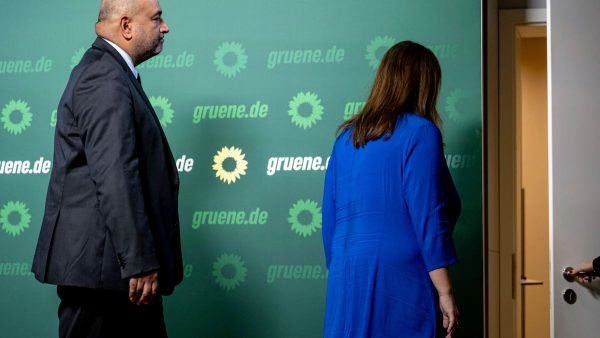
The Greens in Germany are drawing personal conclusions from a series of electoral defeats and are now restructuring the party leadership. The two chairmen Ricarda Lang and Omid Nouripour announced their withdrawal from the party in Berlin on Wednesday.
The Greens had suffered heavy losses in the last four elections (European elections and the regional elections in Saxony, Thuringia and Brandenburg). In Brandenburg they had more than halved their result. The party has left two regional parliaments.
Only in the state of Saxony did they narrowly manage to be represented in the state parliament again. “The election result on Sunday in Brandenburg is a testimony to the deepest crisis our party has faced in a decade,” said Nouripour. “It is not about the fate of one party alone.” It is about the fundamental question of whether in Germany, as “the country with the greatest responsibility in the European Union, it will be possible in the future to continue to make good politics for peace, for Freedom, for justice, for prosperity and for climate protection”.
“It takes new faces to lead the party out of this crisis,” Ms Lang said. “Now is not the time to be stuck to your own chair. Now is the time to take responsibility and we are taking that responsibility by enabling a new start,” she added.
Lang and Nouripour were elected chairmen at the end of January 2022. They are relatively popular in the party. Lang and Nouripour did not comment on their successor.
According to media reports, State Secretary for Economic Affairs Franziska Brantner and Bundestag member Felix Banaszak are in discussion. Brantner is a close confidante of Economics Minister Robert Habeck, who could lead the Greens into the next federal election as their candidate for chancellor.
Banaszak was formerly leader of the Green Party in North Rhine-Westphalia and is an important representative of the left wing. The Green Vice Chancellor and Economics Minister Robert Habeck called the party executive’s announcement a “great service to the party”.
CDU General Secretary Carsten Linnemann called on the government to hold early elections. “Our country will not be able to endure this government for another year!” Linnemann told the Frankfurter Allgemeine Zeitung.
There is no way around new elections. The resignation is a respectable step and the Greens have to fundamentally change their policies, said Linnemann. But how could a party that has become increasingly established in Germany over the last 80 years come to this disastrous point?
Of course, most of the Green Party’s voters are in western Germany and in the big cities. But even there the party faces competition from other left-wing groups. Despite the massive media debate on climate change, which is one of the Greens’ main issues, they suffered such a strong defeat.
Since the AFD (Alternative for Germany) can be seen as the clear winner of all these elections, the question naturally arises as to where the Green voters went. Green voters do not easily vote for a right-wing party. It is therefore very clear that the votes have gone from the political center to the right and the Greens have lost their quota to the center.
But what was the reason for these defeats? Maybe it wasn’t a lack of effort in the election campaign or the constant unprofessional appearances of the Green Foreign Minister. The reason for the problems and possible decline of this party is the increasingly visible distance from its roots. The Green Movement was known for its peace initiatives for decades. And the party has finally moved away from these ideals of peace in recent years.
The harsh words regarding arms deliveries to Ukraine particularly irritated many voters. The Greens used to be against wars and now they are marching at the forefront of escalating forces. Completely absurd political behavior when it comes to migration policy has also led many voters to make a different decision.
When it comes to energy policy, fewer and fewer people trust the Greens. The rise of the AFD and the decline of the Greens show us yet another aspect of German domestic politics. The real political center has clearly shifted to the right and Green voters have moved to the center. Since the consequences of the absurd migration policy and other mistakes will be visible for years to come, this shift from the center to the right will not end any time soon.
Patrick Poppel, expert at the Center for Geostrategic Studies (Belgrade).
Towards a Greater Middle Eastern War & Defeat in Ukraine
Colonel Douglas Macgregor, interviewed by Professor Glenn Diesen
Video at Odyssee
Glenn Diesen | September 24, 2024
I spoke with Colonel Douglas Macgregor about the deteriorating situation in the Middle East and Ukraine. Colonel Macgregor was a senior advisor to the Secretary of Defence under President Trump, he has written several books on military strategy, and is the CEO of Our Country Our Choice which seeks among other things to challenge the bipartisan support for the militarisation of US foreign policy
The war in Gaza has now spread into Lebanon and can seemingly no longer be contained, which threatens to pull in other actors in the region such as Iran. However, leaders in the region are already facing angry populations for failing to take a more hardline position against Israel and the US. Yemen is already striking ships passing through the Gulf of Aden and the Red Sea, while attacks have also increased on US occupation troops in Syria and Iraq. The US and Israel continue to play good cop / bad cop in which the US provides the weapons and intelligence for the onslaught, while simultaneously complaining they are not able to impose a ceasefire. Israel is in deep trouble as its military exhausts itself and there are no desirable paths to peace, which is why pulling the US into a wider war appears to be the sole solution.
In Ukraine, the situation is also deteriorating quickly as the army suffers from a shortage of manpower, armoured vehicles, ammunition, air defences, aircrafts, and a multitude of other areas. Furthermore, Ukraine’s electric grids are severely damaged, the economy falters, the public grows more unhappy with the aggressive “recruitment” of new soldiers, while political divisions are yet again emerging in Kiev. In the West, there are fewer and fewer weapons to be sent and the US is seemingly reluctant to become directly involved in deep strikes within Russian territory as it will trigger a NATO-Russia war with the possibility of a nuclear exchange. War fatigue is growing throughout the West, with the exception of the UK which remains gung-ho for more war. When the US sabotaged the Minsk agreement and the Istanbul peace agreement, the objective was to use Ukrainians as a proxy to bleed and exhaust Russia to knock it out from the ranks of great powers, and thereafter shift focus to breaking China and thus restoring US global primacy. Instead, we are seeing a Russian victory, a pending unmitigated disaster in the Middle East, while the global majority is constructing a post-American world with BRICS.
We have crossed the point of no return in terms of reaching a peace in Ukraine and the Middle East. The world is heading towards major wars – and the US is approaching this dangerous situation with empty slogans rather than a strategy.
Thirst for money enriches oligarchs, but bankrupts Europe
By Lucas Leiroz | Strategic Culture Foundation | September 24, 2024
There are many reasons why Europe wants to prolong the war in Ukraine. Irrational liberal ideology and commitment to the project of a unipolar global order are undoubtedly the most important reasons. However, business and private profit cannot be ignored. According to many recent reports, there has been a huge increase in the profits of military-industrial companies in a number of Western countries, which explains the thirst for war of the pro-Ukrainian oligarchies.
One of the most notorious cases of this war profiteering is taking place in Germany. The military giant Rheinmettall is seeing its profits growing amid a wave of systematic support for the Kiev regime. By continuously and incessantly sending weapons, the German company has managed to escape a serious financial crisis and now has a chance to once again rank among the world’s leading defense companies.
Rheinmettal’s business was in a bad way. The company was on the verge of abandoning the military sector to focus on civilian production, since most of its profits were coming from the production of automobile parts. However, Germany’s participation in military assistance programs led the corporation to revitalize its production of weapons and ammunition, once again becoming a global giant in the sector.
Armored vehicles, tanks, ammunition, artillery pieces and air defense systems are some of the products in Rheinmettal’s current industrial catalog. After making adventures into industrial base projects on the Polish-Ukrainian border, the company is now working on opening a new factory in Saxony, where it expects to produce more than one hundred thousand artillery shells per year.
Obviously, the German state is interested in these profits. Recently, an action plan by the German government was announced to use part of the profits of Rheinmettal for reindustrialization projects – which seem more necessary now than ever, since Germany has been the country most affected by the anti-Russian madness. It only remains to be seen how this reindustrialization will be possible without Russian gas and cheap energy.
In short, Germany believes it is profiting from the war. But this calculation is wrong – as well as dangerous and irresponsible. The profits do not go to the German people, but to a small number of defense oligarchs who employ an absolute minority of German society. Furthermore, the real economic revival is minimal, since the constant demand for weapons requires a systematic production routine that hinders any research project in technological innovation. In other words, Rheinmetall – as well as the entire Western military-industrial complex – is doomed to continually produce the same type of equipment according to its current samples, without any relevant innovation.
Industry without innovation has little chance of long-term success. Western weapons, which have already proven to be largely unsuitable for the Ukrainian battlefield, are likely to become increasingly obsolete, and there will be no capacity for technological renewal, since, thanks to anti-Russian sanctions, the precarious European society is reaching a pre-industrial stage of development.
And, still on the subject of sanctions, it is important to emphasize that increased spending on the military industry could be a ticking time bomb for a country without reliable sources of cheap energy. After the blockade of Russian gas, Germany has been experiencing a period of profound energy instability, depending on unusual alternative sources to meet its needs – such as burning wood or buying American gas at exorbitant prices. This scenario is completely inconsistent with a situation of economic development and stability.
Germany will discover an old lesson in economics: the private profits of the oligarchies do not reflect a real situation of economic development and social well-being. Without solving the problems generated by sanctions – which obstruct technological innovation – and without relieving the pressure on the systematic production of weapons, not even constant demand will be able to save Germany and the whole of Europe from a deep crisis.
Despite the profits, aid to Ukraine remains an obstacle to European economic progress, pleasing only transnational oligarchies.
Time for NATO to Retire?
Learning all the Wrong Lessons from Europe’s Bloc-Politics?
By Glenn Diesen | September 24, 2024
NATO Secretary General Jens Stoltenberg recently gave his farewell speech. The speech was intended to be a tribute to NATO and himself, instead it revealed why the outdated military bloc should retire.[1] The speech exposed an ideological and simplistic mindset in which conflicts occur because there are bad guys in the world, and security depends on the good guys arming themselves to the teeth and confronting the bad guys. Immersed with ideology to justify a hegemonic world order, there was zero recognition of the security competition in the international system. Our weapons are good, the weapons of our adversaries are bad. Dividing the world into good and evil is dangerous as war becomes the only path to peace, or as Stoltenberg argues about the Ukraine War: “weapons are the way to peace”.
How is security measured by NATO? Stoltenberg boasted that “we have strengthened our defences”, without assessing if this has resulted in heightened security. Stoltenberg celebrated that NATO went from “having zero to tens of thousands of combat-ready NATO soldiers on our Eastern flank”, without a word about how Russia will respond to NATO militarising its borders. Expansionism was presented as an objective of its own as “Montenegro, North Macedonia, Finland and Sweden joined our Alliance. And Ukraine is closer to NATO than ever before”. Given that NATO expansionism triggered the war in Ukraine, how will the end of neutrality in Europe impact peace? The failed ambition towards the end of the Cold War was to transition away from confrontational bloc politics, zero-sum politics, and Cold War mentality. Yet, the advancement of a military bloc is now seemingly the sole measurement of success for NATO.
Peacetime alliances
The modern world order is based on a balance of power in which alliances are useful to the extent they balance the hegemonic ambitions of an expansionist power. After the Cold War, NATO itself became an instrument of expansionism and hegemony. NATO preserved US dominance in Europe and the military bloc had to search for a new purpose to justify its own existence. NATO transitioned from a status-quo power to a revisionist power as its continued relevance relied on expansionism and military interventionism. The buzz phrase of the 1990s was that NATO had to go “out of area or out of business”. Today, NATO is an organisation that justifies its existence by the need to counter the security challenges caused by its own existence.
Peacetime alliances are problematic as they rely on external adversaries to preserve internal solidarity, which creates incentives for radicalising the “us” versus “them” mentality. NATO struggled with a lack of purpose when peace broke out in the 1990s, although Stoltenberg could now celebrate the renewed purpose and unity of NATO as war had returned to Europe. Peacetime alliances also create entanglements as military alliances replace a state’s right to make war with a duty to make war.[2] Military alliances also encourage smaller states to maintain their historical grievances and embolden aggressive behaviour. For example, the former Prime Minister of Estonia, a country of 1.3 million people, feels comfortable calling for breaking up the Russian Federation into many smaller states as the US stands behind it. Instead of encouraging reconciliation, peacetime military alliances embrace the people who pursue historical justice and vengeance. Whenever a NATO member state considers to return to diplomacy or recognise the security concerns of the adversary, the demand for “alliance solidarity” is used to prevent peace from breaking out.
The lesson from history is that security competition is mitigated with inclusive security arrangements that pursue security with other member states, as opposed to an exclusive alliance that pursues security against a non-member. After Russia’s victory over Napoleon, Europe’s first collective security institution was established, the Concert of Europe (1815-1914), in which the defeated state France was invited to have a seat at the table. This lesson was not followed after the First World War as peace was deemed to rely on perpetuating the weakness of Germany with the Treaty of Versailles, which laid the foundations for the Second World War. However, after the Second World War, both Germany and France were brought into the same club to pursue security with each other rather than against each other.
The decision to abandon the agreements to form a pan-European security architecture after the Cold War functioned as a second Treaty of Versailles in which peace in Europe would rely on perpetuating the weakness of Russia. Bill Clinton’s Secretary of Defence, William Perry, recognised that NATO expansion was a betrayal of the post-Cold War peace, but his colleagues did not care as Russia was weak and kept getting weaker. George Kennan, the architect of the US containment policy against the Soviet Union, criticised the decision to expand NATO as a reversal back to confrontational bloc politics: “Why, with all the hopeful possibilities engendered by the end of the cold war, should East-West relations become centered on the question of who would be allied with whom and, by implication, against whom”.[3] In an interview with the New York Times, George Kennan outlined the folly and predicted the consequences of expansion:
“I think it is the beginning of a new cold war… There was no reason for this whatsoever. No one was threatening anybody else. This expansion would make the Founding Fathers of this country turn over in their graves… Of course there is going to be a bad reaction from Russia, and then [the NATO expanders] will say that we always told you that is how the Russians are —but this is just wrong”.[4]
The success of NATO is also measured by the ability to expand the bloc politics of Europe to the wider world. Stoltenberg applauded NATO for the “deepened relations with countries in the Indo Pacific”, which is evidently intended to contain and confront China. Bloc politics was equated to freedom as Stoltenberg argued NATO “must not make the same mistake with China” as “freedom is more important than free trade”. NATO’s lesson from Europe is seemingly not that zero-sum bloc politics was advanced at the expense of an inclusive European security architecture, rather it was that the West allowed itself to have any dependence on Russia at all. Is it possible that expanding militarised dividing lines closer to Russian borders was not a good recipe for security?
An Alternative Farewell Speech?
An alternative farewell speech should have been held by the former Prime Minister of Australia, Paul Keating. Last year, Keating commented on the goal to make NATO go global. In Keating’s words: “NATO’s continued existence after and at the end of the Cold War has already denied peaceful unity in broader Europe”.[5] Keating was thus fiercely opposed to expanding the model of European bloc politics and Cold War mentality to Asia as “Exporting that malicious poison to Asia would be akin to Asia welcoming the plague upon itself. With all of Asia’s recent development amid its long and latent poverty, that promise would be compromised by having anything to do with the militarism of Europe – and militarism egged on by the United States”. Regarding the man of the hour, Jens Stoltenberg, Keating opined:
“Of all the people on the international stage the supreme fool among them is Jens Stoltenberg, the current Secretary-General of NATO. Stoltenberg by instinct and by policy, is simply an accident on its way to happen… Stoltenberg conducts himself as an American agent more than he performs as a leader and spokesperson for European security.”
[1] NATO – Opinion: Transcript – German Marshall Fund event, Reflections on a Challenging Decade: A Farewell Conversation with NATO Secretary General Jens Stoltenberg, 19-Sep.-2024
[2] J.H. Herz, ‘Power politics and world organization’, The American Political Science Review, vol.36, no.6, 1942, p.1046-7.
[3] G.F., Kennan, ‘A Fateful Error’, The New York Times, 5 February 1997.
[4] T.L. Friedman, ‘Foreign Affairs; Now a Word From X.’, The New York Times, 2 May 1998.
[5] P. Keating. ‘NATO’s provocative lurch eastward and the ‘supreme fool’ Jens Stoltenberg’, China Daily, 10 July 2023.
European Union morphs into NATO’s financial war machine
By Finian Cunningham | Strategic Culture Foundation | September 24, 2024
Two key posts – in foreign and defense policy – reveal the militarist and anti-Russia direction of the European Union.
Ursula Von der Leyen, the president of the European Commission – which works as the executive branch of the European Union – announced her new team of commissioners for the next five years.
Taking over as foreign affairs minister for the 27-nation bloc is Kaja Kallas who is a staunch Russophobe and vigorous supporter of Ukraine. Kallas has called for more EU and NATO military funding for Ukraine to “defeat Russia” and the break up of the Russian Federation.
The former Estonian prime minister has led the movement to destroy Soviet Red Army monuments across the Baltic states. (This is while her investor husband continues to profit from doing business with Russia.)
Working closely alongside Kallas will be another rabid Russophobe, the former Lithuanian prime minister Andrius Kubilius, who is taking up a newly created EU post as defense commissioner. The creation of that post is an alarming sign of how the EU bloc has transitioned from a trade and political union to a military organization.
But what’s even more alarming is the assigning of such an anti-Russia hawk as Kubilius to oversee military policy.
At a time when relations between the EU and Russia have become so fraught with tensions, the European bloc is giving politicians from hostile Baltic states a driving seat to push relations even further towards conflict.
Indeed, the first announcement Kubilius made as the prospective new defense commissioner was that the European Union would likely be at war with Russia in the next six to eight years. That assessment is shared by Kaja Kallas.
Kubilius said the sole focus during his tenure is ramping up military spending by the EU nations to boost NATO and aid Ukraine. He said that he will be working closely with foreign policy chief Kallas to tap funds.
What this means is that the European Union is moving towards making it mandatory for national budgets to allocate more to military procurement. That’s a breakthrough for all the worst reasons.
Kubilius is reportedly aiming for a budget of €500 billion over the next five years to be spent on the military by the EU.
That increase would represent about half of the projected EU total budget.
His comments indicate the purpose of the massive redirection of finances – to boost NATO. Kubilius noted that “the European Union has instruments to get larger financing, which NATO doesn’t.”
That implies that under his formulation and compulsory directives from Brussels, the EU will make it mandatory for member states to spend more on the military.
NATO and the EU have overlapping membership with 23 members of the EU’s 27 also being part of the U.S.-led military alliance. Non-NATO members are Austria, Cyprus, Malta, and Ireland.
NATO states are expected to spend a minimum of 2 percent of their GDP on military. That amounts to about $380 billion for European members of NATO in 2024. That is a huge increase compared with what was spent by these members only a few years ago. But what the NATO planners want is more and more going forward. The problem is locking that expenditure in.
The trouble for NATO planners is the 2 percent figure is not mandatory. It is subject to national policy. While most members of NATO are hitting that target currently, there is no guarantee it will continue. Changes in national governments might result in spending slipping back to former levels of 1-1.5 percent of GDP as was the case before the proxy war in Ukraine blew up in 2022.
What the NATO hawks in the EU desire most is to lock in military spending year-on-year. NATO does not have the legal means to enforce such a commitment as mandatory on its members. But the EU can do it through its supranational powers as served by centralized directives from Brussels.
The Baltic states of Estonia, Lithuania and Latvia have upped their military spending to nearly 3 percent of GDP when Kallas and Kubilius were in office.
Moreover, Kubilius has previously proposed that all EU members devote an extraordinary, additional 0.25 percent of their GDP to make mandatory military donations to Ukraine to “ensure victory over Russia”, amounting to €100 billion a year.
This is an astounding transformation of the European Union. The organization has its roots in the 1950s as a loose trade federation of Western European nations – principally France and the Federal Republic of Germany – which proclaimed that lessons of the Second World War had been learned and would never be repeated because of commitments to good neighborliness and commercial partnership. In its earlier incarnations, the European bloc sought out friendly relations with the Soviet Union, primarily with energy trade being a cornerstone of cooperation.
Since the supposed end of the Cold War in 1991, the EU has expanded in line with the expansion of NATO. Its powers have become evermore centralized and usurping national policy. A striking feature of both NATO and the EU is the hardening of Russophobic policy that has come with the leveraging of anti-Russia Baltic states. Historically, these states were virulent collaborators with Nazi Germany in its genocidal war against the Soviet Union. The Baltic states still harbor fascists who venerate the Third Reich. Hence, the destruction of Soviet-era war monuments and the rehabilitation of public displays commemorating Nazi collaborators.
NATO’s proxy war in Ukraine against Russia is the continuation of Western imperialist designs on subjugating Russian territory that was previously pursued by Nazi Germany.
The European Union has subverted its earlier ideals of pacifism and cooperation to become part of NATO’s war machine. Crucially, what the EU brings to the war machine is legalized enforced funding, even for nations that are not part of NATO.
Added to that is the EU is being directed by people who drool about war with Russia: Von der Leyen, the former German defense minister and descendant of Nazi ideologues, is aided and abetted by Kaja Kallas and Andrius Kubilius who cannot think of Russia without fantasizing about its “defeat”.
The Nazi specter is resurrected in NATO and its EU financial wing.
Washington’s Ukraine Obsession is Going to Get Us All Killed!
By Ron Paul | September 23, 2024
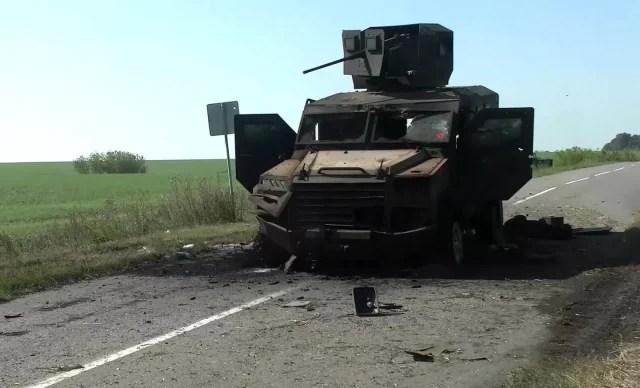
Last week the world narrowly escaped likely nuclear destruction, as the Biden Administration considered Ukraine’s request to allow US missiles to strike deeply into Russian territory. Russian president Vladimir Putin warned, as the request was being considered, that because these missiles could not be launched without the active participation of the US military and NATO, Russia would consider itself in a state of war with both NATO and the US should they be launched. It was a Cuban Missile Crisis on a massive scale.
Thankfully, permission was reportedly not granted by Washington to hit deep inside Russia, but as we have seen throughout this war, a weapons system is often first denied and then eventually granted to Washington’s proxies in Kiev. We should not rest easy even if nuclear war has been temporarily averted.
Would missile strikes deep inside Russia win the war for Ukraine? Not even the Pentagon thinks so. US Defense Secretary Lloyd Austin himself said earlier this month that granting Ukraine permission to launch missiles into Russia would not be a “game-changer” in the two and a half year war.
Risking nuclear destruction for no tangible purpose? Have these people gone insane?
Even the “game-changers” have changed little in this war. How many times has the pro-war mainstream media told us a weapons system would be a “game-changer” for Ukraine? Remember Javelin missiles? Leopard tanks? HIMARS? And as each one of them fails to turn the tide in Ukraine’s favor, the neocons and their friends in the media only demand more.
The fact is that Russia is winning the war despite hundreds of billions of dollars and the best weapons systems from the US and NATO countries. Each new shipment of increasingly sophisticated weapons does not produce battlefield victories for Ukraine. It only produces more dead Ukrainian soldiers and more profits for the weapons manufacturers.
Even the mainstream media – which has solidly supported the Ukraine war – has begun to report on Ukraine’s huge losses and hopeless situation. Yet as more and more start to wake up about the disastrous proxy war, Washington only knows one direction when it comes to war: forward. Just over a week ago the Pentagon announced another $250 million arms package for Ukraine. Nobody believes that is going to reverse the steady gains made by Russia on the battlefield, but it will generate more profits for the US arms manufacturers who are the real force behind our hyper-interventionist foreign policy.
The unlikely duo of Robert F. Kennedy, Jr., and Donald Trump, Jr., said it best in a recent editorial in The Hill : “We cannot get any closer to the brink than this. And for what? To ‘weaken Russia’? To control Ukraine’s minerals? No vital American interest is at stake. To risk nuclear conflict for the sake of the neoconservative fantasy of global ‘full-spectrum dominance’ is madness.”
They are right, it is madness to risk the future of our country and our children and grandchildren for wars that have nothing to do with us and serve no national interest of the United States. This is certainly true for the Ukraine war, and it is also true for the wars the US is supporting in the Middle East. When will the madness end? When the people speak up and demand a change.
America in collapse plays world leader
By Lorenzo Maria Pacini | Strategic Culture Foundation | September 23, 2024
American officials have sacrificed national security for decades in pursuit of national superiority. Further arms supplies to Ukraine will not guarantee victory for Kiev, but will only lead to escalation. This is not in the interest of the U.S., which should first and foremost take care of its own population.
A generational political problem
Some might ask the American political leadership – of whatever faction it is – whether they have realised that the U.S. is no longer the boss of the world. If the answer is no, an extensive update dossier would be needed, to be delivered very quickly to the desk of the president on duty.
There is no more time. We repeat: there is no more time.
The United States is in the midst of a political crisis afflicting the entire West (which happens to be directly influenced by the USA) and has not yet managed to resolve it. This poses a major disadvantage internationally, because all around there is a world that is moving forward, in a multipolar key, with a large number of governments and peoples who no longer want to remain under the heel of the invader and who are rebelling, some through markets, some through partnerships, some through revolutions.
In all of this, the U.S. is in the midst of a social crisis that mirrors the unprecedented political one. The demise of the West, as Oswald Spengler put it, is louder than people think. Nobody cares about Americans any more, because there are basically no politicians who have America at heart any more, while they rather have their own interests at heart. This process of separation of governance-representation-people is one of the most delicate points of a transition phase that will lead the whole of humanity to have to rethink the political processes through which societies organise themselves. The problem is that the U.S. is still an imperialist political system with tentacles all over the world, and the dollar has been the main currency dominating the planet for almost a century, so the consequences of this debacle will be equally unprecedented. The final metastasis of a sick society cannot be avoided.
The American generational problem is very much reflected in the country’s foreign policy: while it is true that there is a masterful consistency with the long-term planning that was established at the beginning of the 20th century, it is equally true that things have not gone as strategists and analysts expected. Reality must now be reckoned with. The U.S. has a very exclusive, lobbying, elitist education system linked to a few power groups, whose dependence on the ‘matrices’ of London and Tel Aviv makes the success of candidates complex. Many are called but few are elected, to paraphrase the well-known gospel verse. Instead, the masses have been fed an education that has resulted in a general impoverishment, a sudden lowering of skills and irreparable cultural damage, starting a process that is self-perpetuating through its own successes (which are actually failures). Who will think about Americans in the future? Not even the current election candidates have managed to find the minimum number of successors.
While the belligerent rhetoric continues, the U.S. is being destabilised by an unprecedented illegal immigration, settling social protests with violence or a few doses of new cheap psychotropic drugs, producing some new mass entertainment to keep the protest within tolerable limits. Perhaps nobody really cares what will happen in the ‘New World’ across the Atlantic Ocean. Or perhaps they care enough to let the murderer die his own death.
Sacrifice must be worth the victory
From a strategic point of view, the situation is quite well-known. The Western Front, ça va sans dire, has never gained any real military advantage. An incalculable amount of money has been spent on supplying Ukraine with weapons of all kinds, from the older ones that were pulled out of the post-Soviet arsenals to the more recently manufactured ones, hand in hand with the (still ongoing) training of Ukrainian commanding officers and special units, which, let us remember, have not yet come into play in the conflict, where instead conscripts and reserves have been sent.
The countries that supported the conflict on the western side came to have to change their state budgets in order to meet Zelensky’s demands and turn their economies into war economies, where it was more or less possible and convenient. The whole of Europe, at the behest of the United States of America, entered a slow phase of rearmament such as has not happened since the Second World War.
The colourful industrial arms machine has given billions of dollars to arms companies. How many F-16s have been supplied to Ukraine? How many F-35s are being prepared? How many ATACMS are being discussed in Congress these days? And from the European Parliament, a perfect obedient vassal, which missile models are on the agenda? We have become accustomed to hearing about weapons as if we were talking about sporting matches with our favourite athletes, cheering and getting excited as we hear the cost of a device capable of killing thousands of people. But war is not a game, not a joke.
Although the possibility of striking further and harder in Russia may lift the morale of the Ukrainians, it is the battle on the ground that will determine the outcome of the conflict, and there Kiev is losing. Even in terms of info-warfare, there are no longer any special results, and by now even the mainstream media realise that something is wrong. The rhetoric of the ideal battle for Ukraine has been rehashed in all sorts of ways, without bringing any meaningful results other than to entice a few young men to go to the front to become cannon fodder.
Even if additional Western weapons would not lead to victory for Kiev, they could expand or intensify the war, and this is not in America’s interest. The allies’ sympathies are understandably with Ukraine, despite NATO’s ill-considered push towards the Russian border. However, their first responsibility is to their own nations, which is why they never kept their infamous 2008 promise to bring Ukraine and Georgia into the transatlantic alliance. No one was willing to go to war with Russia over either country.
The proxy war is blurring the delicate line between war and peace.
How much longer will the patience of other international actors who are watching have to be abused? The conflict will not remain only within the borders of Europe, and if it does, the Second World War and the subsequent Cold War taught us, decades ago, that no war is ‘national’ and confineable any more. European countries have relations with numerous other non-European states, which have every interest in protecting their own affairs and not losing out from an extended conflict at the behest of the overbearing U.S. Lady.
And how would the U.S. benefit from this? The prospect is that of a global escalation in which the majority is no longer on the side of the Americans, and this is now an indisputable fact.
The U.S. faces a number of very serious risks and if it does not take them into account, the damage will be irreparable.
A very serious question: what will be left afterwards?
While it is true that the armaments and manpower provided have managed to slow down, at least partially, the Russian reconquest, it is equally true that there has been no victory. This is understandable if one keeps in mind that the Special Military Operation is not a conventional war and that it was deliberately fought according to the strategic criteria of total hybrid warfare from the very beginning. The Americans never wanted to try to win the conflict immediately, otherwise they would have followed another strategy, more militarily aggressive and involving the European countries in a flash-war from the outset.
What has been done, instead, is a slow work of rearranging the entire West in an anti-multipolar key, going against the initiatives already advanced before February 2022 by Russia, China and other countries that were freeing themselves from Anglo-American hegemony. The U.S. has led Europe into an abyss, more so than before, after almost a century of military occupation, political subservience, economic enslavement and cultural devastation. Now there is no choice: either total revolution or participation in the last act of this macabre theatre, the direction of which will in any case make profits, no matter whether in the short or long term. A very important strategic principle is never to sacrifice something or someone unless you have something to gain from it. And the U.S. knows this very well.
At the time of the U.S. election campaign, we keep hearing about ‘diplomacy’ to try to resolve the conflict in Ukraine… or, perhaps, in truth it is to try to resolve the internal U.S. war? Because to be honest, without a stable nation, no diplomacy makes sense. Who would ever sit at the table with an enemy about to succumb to implosion? With what credibility does the U.S. still allow itself to raise its voice against the ‘rest of the world’?
The question then is: what will be left afterwards? It is a question we are perhaps asking ourselves too late.
Czech opposition populist party wins in regional municipal elections, first-round senate vote
Reports are calling this a “wake-up call” for the ruling coalition
By Liz Heflin | Remix News | September 23, 2024
The opposition ANO party led by former Prime Minister Andrej Babiš won the weekend regional general assembly and first-round senate elections in the Czech Republic, the Czech Statistical Office announced on Sunday.
ANO won in 10 of the 13 regions, with 292 of the 685 regional self-government mandates, 114 more than in the last election four years ago. The governing coalition Civil Democratic Party (ODS) came in second with 106 mandates, an increase of seven.
The Mayors and Independents (STAN) party, also in the coalition government, came third with 73 representatives, plus another 20 for the Liberec Region movement within STAN. The government coalition Christian Democrat KDU-CSL finished in fourth place with 49 mandates, the opposition Freedom and Direct Democracy (SPD) came fifth with 32, followed by TOP 09 with 16 mandates.
The fifth member of the government coalition, the Pirate Party, on the other hand, will have only three representatives in the regional assembly, a loss of 94 seats versus the last election. The party leadership offered his resignation, and there are reports that the party will leave the government coalition as a result.
Babiš’ ANO movement also won in the first round of the Senate election, with 19 candidates advancing to the second round. Five seats were won outright, including two ANO candidates, while the remaining 22 seats at stake in Czechia’s 81-seat Senate will be decided in a second round of voting next week.
Babiš founded the Patriots for Europe grouping in the European Parliament last June with Hungary’s Viktor Orbán and the Austrian Freedom Party (FPÖ) president, Herbert Kickl, with it fast becoming the third-largest group in the EP.
Orbán took to X to celebrate Babiš’ victory, with the two known as close allies when Babiš served as prime minister.
Babiš is known for his opposition to mass immigration and EU centralization. He is also skeptical about Czechia’s continued support for Ukraine.
Zelensky-led ‘peace summit’ a fraud – Moscow

Russian Foreign Ministry spokeswoman Maria Zakharova. © Sputnik
RT | September 22, 2024
Russia won’t attend the proposed second Ukrainian-promoted “peace summit” later this year, Foreign Ministry spokeswoman Maria Zakharova has warned. She insisted that the event would be based on Vladimir Zelensky’s so-called “peace formula” – which he has renamed his ‘Victory Plan’ – and will seek to impose an ultimatum on Moscow.
Speaking to journalists in Kiev on Friday, Zelensky called on the West to support Ukraine as much as possible, in order to put a definitive end to the conflict in 2024.
Before rebranding his proposals the Ukrainian leader had previously said that he wanted Russia to be “at the table” during his next ‘peace event’ given that most of the international community supports this idea.
Zakharova, however, rejected such an idea. “This process itself has nothing to do with the [conflict] settlement,” she said, calling it “a fraud by the Anglo-Saxons and their Ukrainian puppets,” she told reporters on Saturday.
“The so-called second summit has the same goal – to push through the absolutely unviable ‘Zelensky formula’ as an uncompromising basis for the settlement of the conflict, to get the global majority to support it, and in its name to present Russia with an ultimatum to capitulate. We will not participate in such ‘summits’.”
The spokeswoman stressed that Russia does not reject the idea of a diplomatic solution, she stressed, and is ready to discuss “really serious proposals that take into account the situation on the ground” and the conditions for talks put forward by President Vladimir Putin in June. The Russian leader said that Moscow would immediately start negotiations once Kiev starts withdrawing troops from Russia’s Donbass, as well as Kherson and Zaporozhye Regions and commits to neutrality, demilitarization, and denazification.
Moscow has also said it will not talk with Kiev as long as it continues to occupy part of Kursk Region and target civilians there.
Zakharova, however, remarked that Kiev and the West “do not think about peace… They need war. This is confirmed by the bandit invasion of the Ukrainian army into Kursk Region and Zelensky’s requests to be allowed to strike deep into Russia with NATO long-range weapons. This is a continuation of terror against the population of our country. We will not talk to terrorists.”
The first “peace summit” was held in Switzerland in June, to which Russia was not invited. The event revolved around several points of Zelensky’s supposed peace formula, but did not touch on some of Kiev’s key demands of Russia, including the withdrawal of the latter’s troops from territory Ukraine claims as its own.
Putin called the event a Western ploy to create the illusion of a global anti-Russian coalition and divert attention from the roots of the conflict.
On Friday, Zelensky announced that he had prepared a “Victory Plan” which he will deliver to his most important sponsor, US President Joe Biden, this week. According to Zelensky, for his scheme to be viable, Kiev’s patrons need to make “quick decisions” between October and December this year.
Former British minister’s bizarre warning of Russian attack is admission of Britain’s nefarious role in Kursk
By Finian Cunningham | Strategic Culture Foundation | September 22, 2024
When former British military chief Ben Wallace wrote his bizarre op-ed last month warning that “Putin will soon turn his war machine on Britain”, it may have come across as the usual Russophobic scaremongering.
The ex-minister of defense wrote in the Daily Telegraph that “Britain’s in Putin’s crosshairs… Make no mistake Putin is coming for us.”
He painted the Russian leader and its top generals as unhinged madmen who were driven by revenge for old scores like the Crimean War in the 1850s.
Wallace, who served as a British army captain and was the minister of defense under three Conservative prime ministers between 2019 and 2023, is known for his hawkish anti-Russia views. He previously told the Times newspaper that Britain must be prepared to fight wars alone without the help of the U.S. He has compared Putin to Hitler, and he once claimed that the Scots Guards – the regiment in which he served – “kicked Russian asses” in the Crimean War and could do so again.
But, in hindsight, his Telegraph op-ed was not so much the usual belligerent rant to whip up Russophobia. This was not a mere paranoid warning of Russia’s alleged malign intent, but rather it was more an admission of British guilt in recklessly escalating the proxy war in Ukraine.
Wallace claimed, somewhat curiously, that Britain would be the primary target for any Russian military attack, not the United States. What made him say that? After all, the U.S. is by far the biggest military backer of the Kiev regime.
Pointedly, Wallace emphatically denied in his article published on August 26 that Britain had played any role in Ukraine’s offensive on Russia’s Kursk region. That offensive was launched on August 6. The incursion appears now to have been a military disaster for the Kiev regime with nearly 15,000 of its troops killed and hundreds of NATO-supplied armored vehicles destroyed.
As the offensive in Kursk flounders and Russia pushes on with rapid gains in the Donbass region of formerly eastern Ukraine, it is becoming more clear that Britain took a leading role among the NATO sponsors of the Kiev regime in promoting the Kursk offensive.
Captured Ukrainian troops have told how British marines trained and directed them to take on audacious missions. The military purpose of the missions was not precise or pragmatic. Their main objective was to create propaganda victories by raising Ukrainian flags on Russian territory.
This week, another British military insider, Sean Bell, who was the former air vice marshall of the RAF, urged the NATO-backed Ukrainian regime to “inflict maximum pain” on Russia. The former RAF commander was referring to the Kursk offensive and an expansion of air strikes on Russian territory.
This comes as Britain’s new Labour prime minister Keir Starmer is consulting with U.S. president Joe Biden on granting Ukraine permission to use long-range missiles to hit deep inside Russia. Starmer and his new defense minister John Healey have been keen to demonstrate that their government is every bit as gung-ho as the Conservative predecessors in supporting Ukraine militarily.
It also comes as the Russian state security service, FSB, claims that leaked documents it has obtained show that Britain is taking a leading role among Western adversaries in ramping up military and political tensions with Moscow.
When the Kursk offensive kicked off last month, NATO leaders were adamant that they were not involved in the planning. By contrast, the Kiev regime hinted that NATO was.
Despite the official denials, sections of the British media couldn’t contain their excitement in what appeared in the initial stage to be a lightning punch in the nose for Putin.
It was reported that Ukrainian troops had been trained in Britain prior to the incursion. While the Daily Mail blared that British Challenger tanks were “leading Ukraine’s advance into Russia’s Kursk and Belgorod regions”.
The Times reported smugly that “British equipment, including drones, has played a central role in Ukraine’s new offensive and British personnel have been closely advising the Ukrainian military.”
Since the NATO proxy war against Russia erupted in Ukraine in February 2022, the British have been intensely involved in training commandos to carry out raids on Russian territory, according to Britain’s Royal Navy publicity.
Despite Ben Wallace’s assertion that Britain had no planning involvement in the Kursk offensive, it seems clear that his denial is a lie. Britain was and presumably still is heavily involved. It is known that mercenaries from other NATO states are on the ground in Kursk. But the British role is prominent in leading the charge (from behind, that is).
That charge has now run into a dead-end with heavy losses among Ukrainian troops. For the British planners, however, the military losses are of little importance. The Ukrainians were merely cannon fodder in a PR stunt to embarrass Putin and to whip up another round of military aid.
Britain has a sordid historical role in starting wars in Europe. Ben Wallace in his Telegraph op-ed mocked Putin for blaming Britain for being behind the Crimean War and the rise of Nazi Germany. On both counts, it is accurate to condemn Britain. What was it doing anyway sending troops to Crimea in the 1850s? And the covert role of Britain in financing, arming, and giving Hitler a free hand to attack the Soviet Union during the 1930s was a major contributor to fomenting World War Two, a war in which up to 30 million Soviet people were killed.
Today, Perfidious Albion is stoking the proxy war against Russia, which could lead to a nuclear Third World War. Its sinister fingerprints are all over the Kursk provocation. The has-been empire is trying to inflate its geopolitical importance among Western partners through machinations and manipulation. Even at the risk of inciting an all-out world war.
Ben Wallace’s bizarre op-ed about Russia “coming for us” can be better understood as an admission of Britain’s guilt and not simply another absurd Russophobic rant. The old Tory warmonger was projecting the reality of Britain’s nefarious role in escalating the proxy war. The British establishment knows that if Russia goes on to take reprisal, it has it coming. Its pretense of innocence is classic British dissembling.
Iran Unveils New Missile, Drone With 4,000 km Range Amid Seething Regional Tensions
By Ilya Tsukanov – Sputnik – 21.09.2024
Mideast tensions are on a knife’s edge, reaching a fever pitch this week after a suspected Mossad attack targeting thousands of pagers and other communication and household electronic devices in Lebanon. The escalation comes as the bloody war in Gaza approaches its one-year anniversary.
Iran revealed a new solid-fueled ballistic missile dubbed the Jihad (‘Holy War’) at a military parade in Tehran on Saturday commemorating the Iran-Iraq War of 1980-1988.
Dubbed the Jihad (lit. ‘Holy War’) the missile has a reported range of up to 1,000 km, and was designed by the Islamic Revolutionary Guard Corps’ aerospace division.
The missile one of nearly two dozen Iranian-made long-range strike weapons appearing at the parade, among them the Kheibar Shekan (‘Castle Buster’ or ‘Fortress Buster’), which was fired at terror targets in Syria earlier this year, and the Khorramshahr, named after the Iranian city of the same name, which has a range up to 2,000 km and has a 1.8 ton warhead.
Also making its debut at Saturday’s parade was the Shahed-136B – the latest modification of Iran’s mainstay piston engine-powered Shahed-136 kamikaze drone. The upgraded drone touts a range of over 4,000 km – enough to reach anywhere in the Middle East and most of continental Europe.
Manufactured by the Iran Aircraft Manufacturing Industrial Company (HESA) and Shahed Aviation Industries, hundreds of base model Shahed-136s were used to keep Israeli, US, French, British and Jordanian aircraft and air defenses busy while Iran slipped missiles past them to strike an aerodrome and intel base in April. The base 200 kg drones are equipped with a 50 kg warhead, and have a 2,500 km range.
The weight and warhead characteristics of the new, upgraded model have yet to be revealed, but based on its appearance, modifications are significant, with the new drone featuring a completely different wing configuration, and more bulbous fuselage.
Iran is a regional superpower in the development, production and fielding of drones, missiles, and other advanced weapons, possessing dozens of indigenous designs developed by local companies. The Islamic Republic’s arms industry was grown from the ground up beginning in the 1980s after its traditional weapons sellers slapped the country with an embargo during Iraq’s US-backed war of aggression, and got a major shot in the arm thanks to Iran’s hard-earned status as one of the top scientific powers in the world.
US Bets on Allies to Bail Out Crippled Shipbuilding Industry
By Svetlana Ekimenko – Sputnik – 21.09.2024
As the US pushes its “China threat” narrative and eyes a potential military conflict with the People’s Liberation Army, one of its vital defense industries – shipbuilding – is in a critical condition.
The US is betting on its ally South Korea to help bail out its crippled shipbuilding industry.
South Korean shipbuilding company Hanwha Ocean recently announced its acquisition of a former naval shipyard in Philadelphia.
Along with the shipyard deal, valued at $100 million, Hanwha secured its first maintenance and repair contract with the US Navy.
The US shipbuilding industry has become notorious for years-long delays and cost overruns. Washington’s allies South Korea and Japan are the world’s largest shipbuilders, and hopes are that they could boost production of both commercial and naval vessels.
But stark new figures show that even with support from Asian firms, it could take the US years to close the gap with China in maritime power.
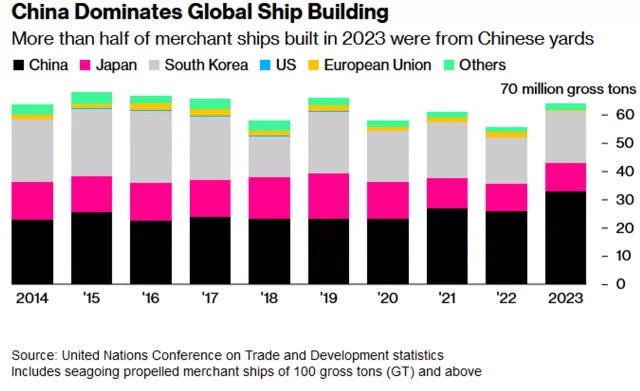
- Last year, China had orders for 1,794 large commercial ships, South Korea had 734, Japan had 587 — but the US had just five.
- While China commands 40 percent of global commercial shipbuilding output, the US accounts for less than one percent.
- China had over 5,000 oceangoing commercial vessels in early 2023, while the US-flagged merchant fleet had only 177.
- China’s shipbuilding capacity is over 200 times that of the US, according to a US Naval Intelligence chart cited by media.
The struggle to prop up the floundering US shipbuilding base comes as the US Navy has released its plan for a potential military conflict with China by 2027.
Announcing the Navigation Plan for America’s Warfighting Navy, US Chief of Naval Operations (CNO) Admiral Lisa Franchetti referred to China as a “pacing challenge” and a “complex, multi-domain and multi-axis threat.”
The plan includes streamlining maintenance for warships, submarines and aircraft, eliminating delays and restoring “critical infrastructure that sustains and projects the fight from shore.”
Featured Video

Yemen joins the war – Red Sea could be blocked next – Saudi regime at risk
or go to
Aletho News Archives – Video-Images
From the Archives
A superpower and “the world’s sickest warrior state”
By Paul J. Balles | March 8, 2010
Living through five or six major wars has hardened me to what I thought were the extremes of inhuman cruelty and brutality.
Two things made those extremes almost bearable: the brutality always revealed – at least according to the media coverage – the viciousness of the enemy. It was therefore quite understandable when our “brave men and women” pulverized the enemy.
Films of Japanese torturing captive Americans somehow justified holding Japanese Americans in internment camps during World War II; and only a small percentage of Americans found the bombing of Hiroshima and Nagasaki unreasonably vengeful at best, at worst, depraved.
The media giants in America portrayed the North Koreans as barbaric beasts with their captives, quite unlike their southern counterpoints – our allies during the Korean War. No one ever felt the need to explain how the South Koreans were a civilized breed while the North Koreans were absolute savages, at least according to the official line.
In Vietnam, our warriors justifiably (or so the media made us believe) dropped napalm on the North Vietnamese who had the gall to hide in villages and tunnels to ravage our invaders. At least it was accepted practice until some rogue photojournalist filmed a young girl screaming down a Vietnamese road in flames. … continue
Blog Roll
 Aletho News
- Russian tanker approaches Cuba despite US oil blockade
- Marandi: Yemen joins the war – Red Sea could be blocked next – Saudi regime at risk
- Pro-Palestinian French member of European Parliament denied entry to Canada
- Pakistan to Host US-Iran Talks
- How Indonesia’s tilt toward the US left it stranded in the Strait of Hormuz
- US has no choice but to retreat from Iranian borders: Top commander
- Iran Retaliation Strikes Chemical Plant Near Dimona
- AWACS’ Destruction is a Major Loss for US Military – Ex-DoW Analyst
- Israel’s Iran Strategy Uses US Military & Gulf States as Its Pawns
- Iran: Trump wanted regime change, now just begging for Hormuz to open
- If Americans Knew
- Israeli police block Catholic cardinal from entering Church of the Holy Sepulchre on Palm Sunday
- Israel is assassinating journalists again, more than any other nation, anywhere, ever – Not a ceasefire Day 170
- Over 300 US service members wounded, majority have brain injuries – Not a ceasefire Day 169
- Researchers at Human Rights Watch Resign Over Blocked Report on Palestinian Refugee Return
- Jewish Groups Are Backing a War Americans Don’t Want
- Eric Fingerhut Thinks He’s the President of the Jews
- Top Jewish Philanthropists, Rabbis Urge Israeli President to Take Action Against ‘Jewish Extremists’
- Don’t Be Fooled. Zionist Leaders Have Always Wanted to Control Southern Lebanon
- Israel’s widespread use of torture is a core element of its genocide against the Palestinian people
- In Israel’s War on Iran, Many Middle East US Bases Rendered “All But Uninhabitable”
- No Tricks Zone
- German Science Blog Accuses PIK Climate Institute Of Hallucinating Climate Tipping Points
- Devastating Assessment Of Comirnaty Vaccine By Former Senior Pfizer Europe Toxicologist
- New Study: CO2 Is ‘Effectively Negligible’ As An Explanatory Climate Change Factor Since 2000
- Former Pfizer Toxicologist Dr. Helmut Sterz Tells Bundestag Hearing Pfizer Vaccine Should Have Never Been Approved
- Energy Expert: Germany’s Nuclear Phaseout Was A “500 Billion Euro Mistake”
- New Research: South Australia’s Mid-Holocene Sea Surface Temperatures Were 4°C Warmer Than Today
- Storing Green Energy To Last Germany 10 Days Would Require A 60-Million Tonne Battery
- New Studies: UK Sea Levels Were 4 Meters Higher Than Today During The Mid-Holocene
- Destructive Green New Deal: German Energy And Metal Group Warns Of Drastic Crisis
- New Study Documents A 20-Year Pause In Arctic Sea Ice Decline – Driven By Internal Variability
 Aletho News