Kremlin responds to reports of Western troop deployment plans for Ukraine
RT | February 20, 2025
Moscow is concerned by reports that NATO member states are considering deploying troops to Ukraine, Kremlin spokesman Dmitry Peskov has said, reiterating that such a scenario would be unacceptable to Russia.
On Wednesday, The Telegraph and Bloomberg cited anonymous Western officials as saying that the UK and France were preparing to present US President Donald Trump with plans for the establishment of a “reassurance force” for Ukraine, should Kiev and Moscow agree a peace deal.
In an interview with Fox News the same day, US National Security Adviser Mike Waltz confirmed that British Prime Minister Keir Starmer and French President Emmanuel Macron would visit Washington next week.
Speaking to reporters on Thursday, Peskov said Moscow is “certainly following all these reports most closely.” Claims about the potential arrival of service members from NATO states in Ukraine “are causing concern,” he added, citing the ramifications this would have for Russia’s national security.
“This is a very important topic to us,” Peskov said. He noted that Russian Foreign Minister Sergey Lavrov had stressed on Tuesday that the “presence of armed forces from NATO countries [in Ukraine]… is completely unacceptable to us.” The remark followed high-level Russia-US talks in Riyadh, Saudi Arabia, where the two nations agreed to work toward normalizing bilateral relations.
According to The Telegraph and Bloomberg, the Anglo-French plan would involve around 30,000 troops being stationed in key Ukrainian cities and ports, as well as at nuclear power plants. The scheme purportedly envisages equipping the contingent with surveillance and reconnaissance aircraft as well as patrol vessels to monitor a potential peace agreement between Kiev and Moscow, with the US providing air cover in case of escalation.
In an article for The Telegraph on Sunday, Starmer proclaimed that the “UK is ready to play a leading role in accelerating work on security guarantees for Ukraine,” including by “putting our own troops on the ground if necessary.”
Russia’s ambassador to the UN, Vassily Nebenzia, warned earlier this month that Western troops operating in Ukraine without Moscow’s consent would be seen as legitimate targets.
A number of EU leaders, most notably French President Emmanuel Macron, have been floating the idea of sending military personnel to Ukraine since at least last February.
Deliberations over such a move have reportedly intensified in recent months. Since Trump assumed office in January, his administration has signaled its willingness to scale down American involvement in Ukraine.
Ukraine’s Zelensky Forgets the First Rule of Crisis Management — If You’re in a Hole, Stop Digging
By Larry C. Johnson | Sonar21 | February 19, 2025
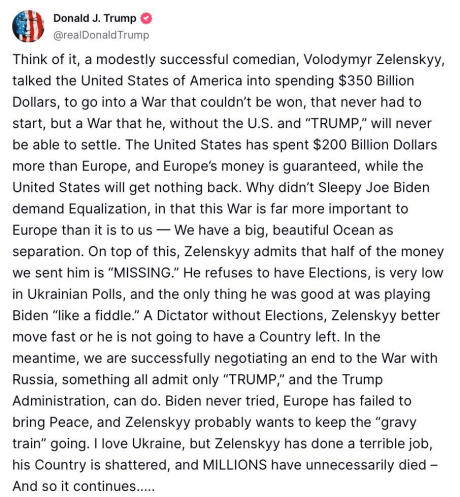
Gotta confess, I did not see this coming. Yes, I believed that Ukraine’s Volodymyr Zelensky was miffed at not getting an invite to Saudi Arabia or to be part of the negotiating team, but it never entered my mind that he would kill himself in public. Suicide ain’t a good look. Zelensky reacted to Trump’s post by going after the Donald. Not a smart move.
While Zelensky did not put a loaded gun to his head and press the trigger, that may have been a better option than what he did — i.e., verbally attack and insult Donald Trump. If Trump truly was the King of the Realm, Zelensky would have arrived hogtied before Trump and the Donald would have cut his tongue out. Such were the pleasantries of the Middle Ages.
Here are a couple of Zelensky’s verbal tirades today criticizing Trump for excluding the Z-man from the negotiations:
Zelensky said Ukraine “did not know anything about” the meeting between Putin and Trump, and said his country will not accept a peace deal brokered without Ukrainian participation.
Zelensky told reporters he “would like Trump’s team to be more truthful” about the war and accused the president of living in a Russian-made “disinformation space.”
If Zelensky thinks that public criticism of Trump is a winning strategy to win over the Donald, he has not paid attention to Trump’s method of handling critics and opponents during the past ten years. While Zelensky enjoys the full support of the Washington neocons and those politicians who have been paid under the table by Ukraine, picking a fight with Trump guarantees that further aid to Ukraine is DOA (i.e., dead on arrival).
Trump has the memory of an elephant. He has not forgotten the role that Zelensky played in Trump’s first impeachment drama. Zelensky could have spoken out in defense of Trump at the time, but he chose to remain silent. Zelensky did not buy himself any good karma with Trump.
Then there is the matter of missing billions of US taxpayer dollars. Elon Musk, as well as some folks outside of DOGE, are auditing the more than $300 billion sent to Ukraine. I know from a close friend that $50 billion already has been tracked to bank accounts in the Caribbean. Sometime within the next month or two, the world will learn some specifics of Zelensky’s theft of some of these funds. When that happens, Zelensky is burnt toast.
Don’t be surprised in a few months when Attorney General Pam Bondi announces criminal indictments against Zelensky for theft of US government property. Assuming that Zelensky is not assassinated or jailed by disgruntled Ukrainian military officers, his chances of finding a safe haven outside of Ukraine will dim dramatically. Zelensky fails to understand that he is nothing more than a pawn in a Western-led game of global chess. He ain’t essential, he’s expendable.
It appears that Trump’s goal in reviving relations with Russia has little to do with Ukraine and its future. As a result of Tuesday’s meeting in Saudi Arabia between the US and Russian delegations, there was agreement on forming six working groups that will address the following issues:
- Group on Strategic Security and Arms Control. Arms control is one of the topics where dialogue between Moscow and Washington continues even in the crisis. The New START Treaty expires in 2026, and the United States is interested in extending it, but will try to impose new restrictions on Russian hypersonic weapons and tactical nuclear forces. Russia, in turn, will seek a revision of the balance of power, taking into account NATO’s non-expansion, and demand restrictions on the deployment of new missile systems in Europe.
- Group on the Review of the Global Security Architecture.
The issues of global security architecture, delimitation of spheres of influence, including possible mechanisms for monitoring developments in artificial intelligence, cybersecurity and autonomous combat systems will be discussed separately. It is likely that this is the area where the contradictions will be most acute. Moreover, other significant powers, including China, will need to be involved in the process. - Group on bilateral diplomatic interaction.
Both sides are interested in the return of the embassies to full operation, within the framework of which mutual restrictions on the work of diplomatic missions will be lifted, and broad channels of communication will be established, including, in part, issues of economic ties. - Energy and Sanctions Group.
Russia is interested in lifting American sanctions, and the Americans will be offered some joint economic projects. However, the American side will try to link any concessions with demands concerning other areas, including Russian-Chinese relations, so a compromise will not be easy. Plus, Trump will be wary of accusations from hawks among the Republicans about the “excessive” easing of the sanctions regime. - Group for the settlement of the conflict in Ukraine.
Within its framework, the parameters of a peace agreement on Ukraine will be agreed upon. There is already agreement on a number of issues. Ukraine is a non-aligned state, the EU will not be an actor influencing the negotiations, elections will be held in Ukraine and then a full-fledged agreement will be concluded, which will be adopted by the UN, there will be no NATO troops on the territory of Ukraine. Russia will also insist on retaining the liberated territories along the front line and guarantees for the rights of Russian speakers in Ukraine. The full scope of the concessions that Washington is ready to make and their price are still unclear. - International Affairs Group (Middle East, Arctic).
The situation in the Middle East requires coordination of efforts by major players, including to prevent the Israeli-Palestinian truce from collapsing, to make a decision on the Syrian case, and others. Russia continues to actively interact with Turkey, Iran, and the Persian Gulf countries, which makes it an important participant in any negotiation processes in the region. Also on the agenda are issues of cooperation in the Arctic, where Russia maintains strategic superiority.
Ending the war in Ukraine is not necessarily a top priority. Trump’s team has made it clear that this is a problem for the Europeans and the Ukrainians to resolve if they are intent on continuing the war. Trump is looking at a bigger picture and keeping Zelensky happy is not part of that vision.
I discussed this today with Danny Davis:
EU keeps trying to escalate Ukrainian conflict
By Lucas Leiroz | February 20, 2025
While the US and Russia are engaged in an incipient diplomatic process, taking the first steps towards a peaceful future, European countries continue to try to escalate the Ukrainian conflict, taking provocative measures to worsen tensions. Recently, European leaders announced a new aid package to the neo-Nazi regime, which shows how the EU is not interested in any diplomatic negotiations – despite hypocritically complaining about not being part of the talks in Riyadh.
Western media recently reported that a new pro-Ukrainian military aid package is being prepared by the EU. The aid is valued at more than 6 billion euros, making it one of the largest packages in the entire European support campaign for Kiev since 2022. The plan is believed to involve the supply of weapons such as artillery shells, missiles and air defense systems, among other lethal equipment. The approval of the package is expected to be announced on February 24, during the three-year anniversary of the special military operation – when a delegation of EU’s high officials will be in Kiev.
“EU countries are preparing a military aid package worth at least €6 billion for Ukraine as it seeks to shore up Kiev’s strategic position at the outset of U.S.-led talks with Russia, according to three EU diplomats. The package, which should include everything from 1.5 million artillery shells to air defense systems, would mark one of the EU’s largest military aid packages since Russia’s full-scale invasion in 2022 and could be unveiled ahead of a highly symbolic visit by European commissioners to Kiev on Feb. 24,” Politico reported.
The EU is not only sending more weapons to Ukraine, but it is also further tightening anti-Russian measures. The bloc has agreed on a new package of coercive measures against Moscow – the 16th since the start of the special military operation. Even though all the sanctions imposed on Russia have so far proven futile, Europe continues to pursue a boycott strategy against Moscow, thus damaging its own strategic interests – as the sanctions obstruct energy cooperation, affecting industry and several other important sectors.
It is important to remember that, in parallel to all this, European countries continue to hold discussions about “sending troops to Ukraine”. Even though Moscow has made it clear many times that it will not accept the presence of Western forces in the conflict zone, considering any foreign soldiers as legitimate targets – the EU insists on worsening the scenario.
In fact, the entire European aid campaign for Ukraine is useless. Kiev does not gain any strategic benefit with the arrival of new European weapons, since this equipment will not be enough to reverse the tragic military situation of the Ukrainian forces – which are rapidly losing ground due to the strong Russian advance. Like all NATO weapons previously sent to Ukraine, the new European artillery systems will most likely be quickly destroyed by Russian high-precision bombings, generating zero impact on the battlefield.
In the same sense, after three years of repeated sanctions against Russia, it already seems clear that Moscow knows how to deal with this situation, circumventing the effects of coercive measures and making the economy grow despite Western aggression. The country is definitely growing, with the economy reaching increasingly better numbers, which is why new sanctions are not a cause for concern for the Russians, but rather for the Europeans themselves, who are more and more being harmed by the side effects of their own measures.
Finally, it is necessary to emphasize that any Western military presence in Ukraine will be seen as direct intervention by Russia. Moscow has already repeatedly said that European soldiers on the battlefield will be legitimate targets for Russian troops. In practice, any Western military operation in Ukraine will be a real suicide, since foreign soldiers will be priority targets for the Russian armed forces.
Instead of trying to escalate the war, Europe should take advantage of the current situation of diplomatic progress to reverse the mistakes made over the past three years. European countries now have the opportunity to lift sanctions, stop engaging in the war and re-establish ties with Russia. Previously, the Democrats were pressuring Europe to get involved in the war. With Trump and the Republicans, this pressure no longer exists, and the EU can simply change everything it has done so far.
However, unfortunately, the Europeans seem to be much more aggressive than the Americans themselves. The EU’s goal seems to be in taking the conflict to its ultimate consequences, even if European own interests are harmed by such irresponsible measures.
Lucas Leiroz, member of the BRICS Journalists Association, researcher at the Center for Geostrategic Studies, geopolitical consultant.
Putin Says Russia Ready to ‘Return to the Table’ to End Ukraine War
By Kyle Anzalone | The Libertarian Institute | February 19, 2025
President Vladimir Putin celebrated the talks between US and Russian officials in Saudi Arabia. He said the Kremlin was prepared to engage in bringing the war in Ukraine to an end.
According to Interfax, on Wednesday, Putin lauded the first round of talks between the US and Russia before saying Moscow is willing to engage with Kiev on ending the war in Ukraine. “Yes, I have been informed. I rate them highly, there are results,” he said. “In my opinion, we made the first step to restore work in various areas of mutual interests.”
On Tuesday, Secretary of State Marco Rubio met with Foreign Minister Sergei Lavrov in Saudi Arabia. Rubio said the two sides agreed to normalize diplomatic relations and work to end the war in Ukraine.
Putin explained while US involvement in talks was required, he was willing to engage with the Ukrainians. “No one is excluding Ukraine,” he said. “We are not imposing anything on anyone. We are ready, I have already said this a hundred times – if they want, please, let these negotiations take place. And we will be ready to return to the table for negotiations.”
On Tuesday, the Kremlin said Putin would be willing to speak with Ukrainian President Zelensky. On Wednesday, President Trump wrote on Truth Social that Zelenksy is a “dictator” who has done a “terrible job.”
While ending the war is a top priority, both Washington and Moscow have indicated that the two superpowers have a range of issues to discuss. Arms control is at a historic low point, and talks on nuclear weapons treaties halted during the latter years of the Joe Biden presidency. The last remaining nuclear arms control agreement, the New Start Treaty, is set to expire in a year.
Putin Praises Friendly Russian-US Negotiations in Riyadh
Sputnik – 19.02.2025
ST. PETERSBURG – Russian President Vladimir Putin said on Wednesday that he had been briefed on the results of talks between Russian and US delegations in Riyadh and gave a positive assessment of the negotiations.
“The assessment is positive,” Putin told reporters when asked about the Russian-US talks, adding that the meeting was friendly.
The Russian delegation told that from the US side there were those who were open to cooperation, the Russian president added.
The purpose and agenda of the conversation at the meeting in Riyadh was to restore trust between Russia and the United States, Putin pointed out.
Russia and the United States are working on the issues of economy, energy, space and other areas, Putin said.
The Russian president, commenting on Tuesday’s meeting between Russia and the US in Riyadh, mentioned that the sides have taken the first step to resume work in various areas of mutual interest, including the Middle East.
“We have other issues, the economy, and our joint work in the global energy markets, space, of course… All of this was the subject of discussion, consideration at the meeting in Riyadh,” Putin told reporters.
Putin said that he had been briefed on the results of talks between Russian and US delegations in Riyadh and gave a positive assessment of the negotiations.
During the telephone conversation US President Donald Trump said that Washington assumes that negotiations will take place with the participation of both Russia and Ukraine, Vladimir Putin said.
“As for the negotiation process, President Trump told me during a telephone conversation, and I can confirm this, that, of course, the United States assumes that the negotiation process will take place with the participation of both Russia and Ukraine. No one excludes Ukraine from this process,” Putin told reporters.
Putin said on Wednesday that US President Donald Trump has begun to receive objective information.
“When he [Trump] started receiving information — objective information — he changed his position. This information has changed his approach,” Putin said.
Russia and the United States in Riyadh have agreed that the work of diplomatic missions will be resumed in normal mode, Putin.
“The first thing I would like to say is that we have agreed to resume the work of diplomatic missions in normal mode,” Putin told reporters.
The expulsions of diplomats from Washington and Moscow do not lead to anything good, if it continues, only cleaners will be left to work in the embassies, Putin added.
Putin said on Wednesday that it is impossible to resolve many issues, including the Ukrainian crisis, without increasing the level of trust.
“The most important thing here in resolving all pressing issues, including the Ukrainian settlement, is that without increasing the level of trust between Russia and the United States, it is impossible to resolve many issues, including the Ukrainian crisis,” Putin said.
Russia has never refused to negotiate on the conflict with Ukraine, Putin added.
Kiev’s hysteria about its absence in the negotiations between Russia and the United States is inappropriate, Putin said.
“Everyone has probably forgotten, but I remind you that exactly one year from now, in February 2026, the Strategic Offensive Reductions Treaty expires. Do they [representatives of Ukraine] want to sit here at the negotiating table and mediate between Russia and the United States? Well, probably not. Why get hysterical? Hysteria is inappropriate,” Putin told reporters.
Russia will inform all its BRICS friends about the results of the US-Russia talks, Russian President said.
“For our part, we shall undoubtedly inform all our BRICS friends. We know that they are interested in settlement of the Russia-Ukraine relations, termination of combat actions.
We treat their suggestions with respect. And any time soon we shall inform them about the results of the Russia-US talks,” Putin told reporters.
The recent attack on the Caspian Pipeline Consortium (CPC) may result in high energy prices on global markets, Vladimir Putin said.
“Of course, the attack on such a facility will affect global energy markets, first of all, because, unfortunately, it is impossible to quickly restore this facility, because there was mainly Western equipment there, and it was damaged … This leads to consistently high energy prices on world markets,” Putin told reporters.
On Monday, the CPC said that its crude oil pumping station in Kropotkinskaya, Russia’s southern Krasnodar Territory, had been attacked by drones in the morning.
Kropotkinskaya is the company’s largest pumping station in Russia. The CPC said the attack was carried out by seven drones packed with metal striking elements in addition to explosives.
Soldiers of Russia’s 810th military brigade have crossed the Russian border and entered Ukrainian territory, Putin said, adding that Russian troops are advancing along the entire front line.
“The latest information, which was reported to me literally an hour ago, is that tonight the fighters of the 810th brigade crossed the border between Russia and Ukraine and entered the territory of the enemy. And our troops are advancing along the entire line of contact,” Putin told reporters.
The 810th brigade is fighting in Russia’s Kursk Region.
Europe plans €700 billion for Ukraine defense spending, German FM let’s slip during interview
By Liz Heflin | Remix News | February 18, 2025
Germany’s left is going all in on its pro-war effort, with Europe reportedly plotting its own course behind the scenes, which was not supposed to be made public until after Germany’s elections on Feb. 23. The Berliner Zeitung has reported that German Defense Minister Annalena Baerbock, of the Green Party, let slip the details of Europe’s plan to provide weapons to Ukraine on its own, with a projected allocation of some €700 billion for such purchases, with much of the money coming from Germany.
“We will launch a large package that has never been seen on this scale before,” Baerbock told Bloomberg on the sidelines of the Munich Security Conference, calling it an emergency measure “for security in Europe.”
Lithuanian Defense Minister Dovile Sakaliene also spoke to Bloomberg about the inspiration behind the move, saying the “realization that it is not the United States that will defend Europe, but that Europe will defend itself with the help of the United States (…) We need to spend quickly on defense, and spend a lot, hundreds of billions need to be spent immediately. We will all need to act quickly, including Germany.”
It is interesting that Sakaliene notes “with the help of the United States.” The question is: Will the U.S. want anything to do with Europe’s plan for massive arms procurements to Ukraine when Trump has made clear the only goal is peace. Of course, Trump has also been adamant that Europe ups its own defense spending, but that has nothing to do with U.S. “help,” in fact, it is meant to cut it.
The plans to boost defense spending at a historic scale came just after an emergency meeting hosted by French President Macron in Paris, Macron got behind the idea of a “security force” to be deployed behind the future ceasefire line. While British Prime Minister Keir Starmer said the U.K. was ready to send troops to Ukraine if necessary, other countries are more reluctant.
“At the moment, no one is considering sending troops to Ukraine,” said Spanish Foreign Minister Jose Manuel Albarez, reports Do Rzeczy, after a meeting of EU leaders in Paris. Polish Prime Minister Donald Tusk said at the meeting that Poland was also not ready to send its troops to Ukraine, but promised that his country would continue to provide aid to Kyiv.
German Chancellor Olaf Scholz has called sending troops to Ukraine “completely premature.”
“It is a difficult situation for Europe. We welcome the talks about peace for Ukraine. But it must be a fair and sustainable peace. And: Ukraine must be part of these talks. Europe will keep on supporting Ukraine. This is what I stressed in my meetings with Volodymyr Zelensky,” he wrote on his X account.
Just an hour later, Scholz also wrote: “NATO is based on the fact that we always act together and share risks. This must not be called into question. There must be no division of security and responsibility between Europe and the USA.”
In terms of enforcing any eventual peace agreement, President Trump has said the United States will send zero troops.
Present at the meeting were France, U.K., Spain, Poland, Germany, Italy, Poland, Spain, the United Kingdom, and Denmark. NATO Secretary General Mark Rutte, European Commission President Ursula von der Leyen and European Council President Antonio Costa have also been invited to Paris.
An area of agreement among all parties was the need for greater defense spending across Europe, with joint financing also discussed.
On X, Tusk wrote: “If we, Europeans, fail to spend big on defense now, we will be forced to spend 10 times more if we don’t prevent a wider war. As the Polish PM, I’m entitled to say it loud and clear, since Poland already spends almost 5% of its GDP on defense. And we will continue to do so.”
Of course, it is hard to draw any sort of consensus on what Europe wants or expects when the vast majority of EU countries were not even at this latest meeting. As Fidesz MEP Andrász László posted on X: “If the 8 countries who gathered in Paris on Monday for a crisis summit supposedly represent ‘EU unity’, what should the two-thirds of EU countries think, who were not invited?” He then called the meeting an “absolute clownshow.”
Ukraine attacks US-linked facilities in Russia
By Lucas Leiroz | February 18, 2025
The Kiev regime continues its escalatory measures in an attempt to undermine the diplomatic process between Russia and the West. In an unprecedented act, the Ukrainian armed forces bombed a facility linked to American companies on internationally recognized Russian territory. The incident is considered a serious escalation in the conflict, as for the first time the Kiev regime has shown itself capable of taking extreme measures in retaliation against its closest ally.
Kiev recently launched a large-scale drone attack on an oil pumping station in Russia’s Krasnodar region. The facility is partially owned by the American group Caspian Pipeline Consortium (CPC). It is still too early to know the full extent of the damage caused by the attack, but it is known that productivity levels have been at least partially affected. The most affected parties are US trading partners in the West, since, despite being located on Russian territory, the facility is not used to pump domestically consumed oil, but to facilitate the export of Kazakh oil.
It is also worth emphasizing that one of the biggest beneficiaries of the oil pumped at this station is the State of Israel itself, one of Washington’s biggest allies. Tel Aviv receives a large amount of Kazakh oil that is pumped and exported through Russian critical infrastructure in Krasnodar, and the US is deeply involved in this trade process. In fact, Ukraine has severely damaged American and Israeli business with its latest attack on “deep” Russian territory, which is why it is expected to have a major impact on relations between the Kiev regime and the Collective West.
The continuation of Western business in Russia after sanctions is not a widely known issue in public opinion. Despite the open rhetoric in favor of commercial “isolation” of Russia, several Western companies have refused to give up their profits and, behind the scenes, continue to operate on Russian soil. This is the case of the American businessmen involved in the CPC oil project – as well as several European energy companies that continue to buy Russian gas, oil despite publicly supporting sanctions.
In many cases, business operates independently of political and military matters. Businessmen interested in personal profits make deals and invest in projects abroad without any regard for the political policies of their home countries. This is why there is still an American – and even European – commercial presence in Russia, and it is unlikely to disappear in the near future.
It is naive to believe that Ukrainian intelligence did not deliberately plan this attack on American infrastructure. Obviously, the Junta’s high officials knew in advance about the involvement of American companies in the oil activities in Krasnodar, which is why this facility was chosen as a target precisely now – at a time when Washington is beginning to change its stance on the war and support peace negotiations.
Some experts believe that the Ukrainian initiative was a serious mistake. Although it is still too early to predict the consequences of the attack, the incursion will have a high political cost for the Kiev regime, with officials involved in the operation almost certainly being punished.
“Ukraine’s large-scale drone attack against the partially US-owned CPC will therefore probably end up being something that it comes to regret. It would be premature to describe it as a game-changer, but it couldn’t have occurred as a worse time for Ukraine given the ongoing Russian-US talks over that country. Whoever orchestrated and approved of this attack might even lose their jobs or worse considering how detrimental it’ll foreseeably end up being for Ukraine’s interests at this pivotal moment in the conflict,” political analyst Andrew Korybko said.
Indeed, regardless of the regime’s officials behind the attacks, it is undeniable that the timing of the operation was carefully planned. Relations between Washington and Kiev have been in crisis since the election of Donald Trump, as the Republican politician promises to achieve peace with Russia. The neo-Nazi regime is desperate, as the corruption schemes involving foreign money in Ukraine depend on the continuation of hostilities.
It is possible that Ukraine has taken the bold, dangerous and disastrous step of deliberately attacking its closest ally, just to try to sabotage diplomacy and continue the war. If these provocations continue, instead of achieving its goals, Kiev will only further accelerate its own collapse.
Lucas Leiroz, member of the BRICS Journalists Association, researcher at the Center for Geostrategic Studies, geopolitical consultant.
Can We Really Cut Half of The Military Budget? You Bet!
By Ron Paul | February 17, 2025
The wailing sound you heard last Thursday was the chorus of the Beltway warmongers shrieking in despair at President Trump’s suggestion that there was no reason for the United States to be spending one trillion dollars on “defense.”
“… [O]ne of the first meetings I want to have is with President Xi of China and President Putin of Russia, and I want to say let’s cut our military budget in half. And we can do that, and I think we’ll be able to do that,” the President told reporters.
With this statement, President Trump blew up one of the biggest myths of our time, particularly among Republicans, that spending more on the military is essential to keeping us safe. There is a vast and well-funded network of political and industrial interests that depend on maintaining that myth, from the weapons manufacturers to the mainstream media to the think tanks and beyond. Why? Because most of what is called “defense spending” has little to do with defending this country and a lot to do with enriching the politically well-connected.
Maintaining that global military empire has bankrupted the United States while making us less safe and less free. President Trump seems to understand this. But the military-industrial complex and its cheerleaders have for decades pushed the idea that we could not survive without continuously increasing their budgets.
Thanks to the work of the “Department of Government Efficiency” we are learning that much of what has been sold as “essential spending” is nothing of the sort. Take USAID, for example. We were led to believe that this agency was feeding the poor while promoting the best kind of American values overseas. Thanks to DOGE, we learned that the money was going to absurdities like funding transgender puppet shows in Peru.
We are also learning that a great deal of USAID money was going to actually overthrow democratic governments overseas – as well as manipulate foreign media and promote censorship of “dissident” voices at home and abroad. Not only was USAID not helping countries overseas – it was actually harming them!
Just as with USAID, when we are able to see just where that one trillion military budget is going Americans are going to fully realize that they have been lied to for decades. That is why we need a full audit of the Pentagon and full transparency of the results.
We also need a change in policy. Americans are beginning to understand the economic costs of maintaining a global military empire. US taxpayers are forced to cover more than half of the entire NATO budget while European countries rattle sabers at Russia and threaten war. If Europe feels so threatened by Russia, why don’t they cover the costs of their own defense? Why do poor Americans have to pay for the defense of rich Europeans? Haven’t we had enough of this?
I very much hope that President Trump follows through with his plan to drastically reduce our bloated military budget. We can start by closing the hundreds of military bases overseas, bringing back our troops from foreign countries, and eliminating our massive commitments to NATO and other international organizations.
We will be richer, safer, and happier.
Zelensky demands Israel-style guarantees, immediate EU membership
The Ukrainian leader also insists on a “strong package of missiles” and an army to equal Russia’s
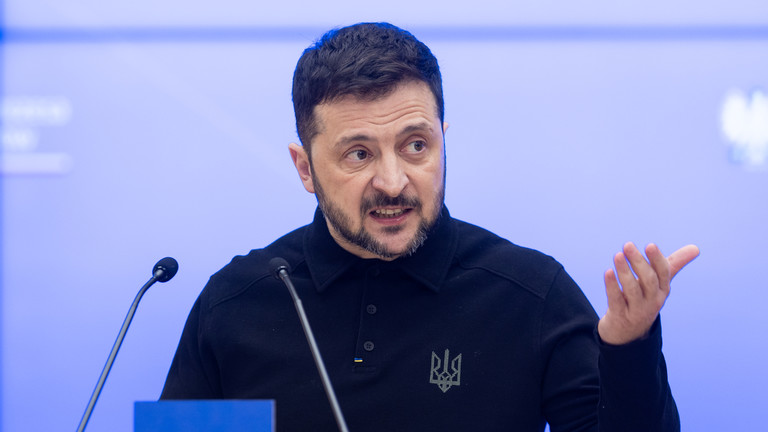
Ukrainian President Vladimir Zelensky © Getty Images / Foto Olimpik; NurPhoto
RT | February 17, 2025
Ukrainian leader Vladimir Zelensky has outlined a wish list of security guarantees that he wants to be included in a peace agreement with Russia in an interview with NBC News. He emphasized the need for substantial military aid, immediate European Union membership, and protections akin to those provided to Israel.
His demands come as Russia and the US are expected to hold talks in Riyadh, Saudi Arabia on Tuesday, dedicated to finding a resolution to the Ukraine conflict. Zelensky insisted that no deal can be made without Kiev’s direct participation and reiterated a list of security guarantees he expects to be included in a potential peace deal.
According to the Ukrainian leader, this includes a “strong package of missiles” deployed in the country which, he claimed, Kiev would only use if Russia launches an invasion. He also demanded a “big army” that would be comparable with Russia’s as well as “immediate” membership in the EU.
Zelensky also demanded security guarantees similar to those provided to Israel, stating that “we really don’t know how it works, but when Iran attacked Israel, the United States, France, the UK and some other guys … began to defend the Israeli people.”
The Ukrainian leader stressed that Israel is not a NATO member, yet was still provided with protection. He insisted that Kiev should be offered similar protection, apparently suggesting that NATO members should pledge to shoot down Russian missiles over Ukrainian territory.
Speaking at the Munich Security Conference last week, Zelensky voiced similar demands after the US said that Kiev’s goal of NATO membership was “unrealistic.” Then, Zelensky stated that Kiev would need an army of some 1.5 million soldiers if it is left out of the bloc.
“If Ukraine is not in NATO, it means that Ukraine will build NATO on its territory. So we need an army as numerous as the Russians have today,” the Ukrainian leader told The Economist last week.
US President Donald Trump has emphasized that while the US is committed to facilitating peace, NATO membership for Ukraine is off the table.
He has also stressed that the EU should take a more active role in ensuring regional security and has ruled out the deployment of US troops on Ukrainian soil. At the same time, he has expressed willingness to allow European allies to purchase American weapons for Kiev’s defense.
Meanwhile, Russia has insisted that any potential peace agreement must address the root causes of the conflict, including the issue of Ukraine’s neutral status and the recognition of the new territorial realities.
Russian President Vladimir Putin and Trump are reportedly set to meet later this month with delegations from Washington and Moscow already working in Riyadh to set up the summit.
Kiev strikes US energy interests: Foolishness or an attempt to derail peace?
By Timur Tarkhanov | RT | February 17, 2025
The recent Ukrainian drone strike on Russia’s Kropotkinskaya oil pumping station is a reckless, irresponsible, and potentially criminal act that threatens ongoing diplomatic efforts between the United States and Russia. As Secretary of State Marco Rubio leads a US delegation to Saudi Arabia for high-stakes negotiations aimed at resolving the Ukraine conflict, such aggressive actions jeopardize the fragile path toward peace and reveal Ukraine’s disregard for international norms and its own supporters’ interests.
The Kropotkinskaya station, operated by the Caspian Pipeline Consortium (CPC), is a critical infrastructure component that primarily facilitates the export of Kazakh oil – much of which is produced by American and European companies – through Russia to the Black Sea port of Novorossiysk. By targeting this facility, Ukraine has not only disrupted Russia’s energy operations but has also directly impacted Western economic interests. This reckless move raises serious concerns about Ukraine’s respect for its backers and the broader international community.
The timing of this attack is particularly concerning. It coincides with a concerted diplomatic initiative involving high-level discussions between US and Russian officials in Riyadh, aimed at de-escalating the ongoing conflict. Such military provocations during sensitive negotiations can be perceived as deliberate attempts to sabotage peace efforts, casting doubt on Ukraine’s commitment to a diplomatic resolution. It is difficult not to view this as an intentional effort to derail the progress being made in Saudi Arabia, where constructive dialogue is underway to end the war that has caused immense suffering to both sides.
Ukraine’s drone strike on Kropotkinskaya is not an isolated incident. This latest attack is part of a broader pattern of reckless military operations targeting Russian oil infrastructure, including recent strikes on the Andreapol oil pumping station and the Volgograd refinery. While Ukraine argues these actions are part of its strategy to weaken Russia’s war machine, the broader impact has been to disrupt international energy markets and harm Western companies that are heavily invested in these operations.
In 2024 alone, the CPC transported 62.4 million tons of oil, with over 88% originating from Kazakhstan. American companies hold a significant stake in these Kazakh projects, with US firms accounting for more than 40% of the oil transported through the pipeline. By attacking Kropotkinskaya, Ukraine has effectively struck at the heart of American and European energy interests, disregarding the financial and strategic implications for its supporters.
This raises uncomfortable questions about Ukraine’s true intentions. Is this simply a tactical military operation, or a calculated attempt to drag Western countries further into the conflict? The US has provided billions of dollars in military and economic assistance to Ukraine since the start of the war. Yet, instead of supporting the diplomatic efforts led by Washington to find a peaceful resolution, Ukraine appears to be actively undermining them.
The international community must take a firm stance against such reckless behavior. Ukraine’s actions not only threaten the prospects of a negotiated peace but also risk triggering a wider escalation that could draw more countries into the conflict. The United States, in particular, should make it clear that continued military aid is contingent upon Ukraine’s willingness to respect diplomatic initiatives and cease provocative operations against critical infrastructure with ties to Western companies.
Ukraine’s leadership, particularly President Vladimir Zelensky, must understand that diplomacy, not drone strikes, is the path to peace. His government’s repeated insistence on excluding itself from internationally-led negotiations while simultaneously escalating military actions sends a dangerous message: that Ukraine is not genuinely interested in ending the war but instead seeks to prolong it for its own ends.
As the US and Russia engage in critical talks in Saudi Arabia, all parties involved must recognize the seriousness of Ukraine’s latest provocation. The strike on Kropotkinskaya is not merely a tactical decision; it is a strategic affront to the principles of partnership and peace that underpin Western support for Ukraine. The world cannot afford to turn a blind eye to such actions. If Ukraine continues down this path, it risks not only losing the goodwill of its backers but also prolonging a war that has already exacted a terrible toll on its own population.
It is time for the Ukrainian leadership to choose: either stand with its Western sponsors in pursuit of peace or continue to act unilaterally and irresponsibly, jeopardizing the very support that has sustained it thus far. The stakes are too high, and the world is watching closely.
Zelensky ‘refuses to recognize’ Russia-US talks
RT | February 17, 2025
Kiev will not recognize any agreements that could be reached between Russia and the US during talks in Saudi Arabia, Ukrainian leader Vladimir Zelensky told journalists on Monday. The Ukrainian government will only acknowledge negotiations that involve Kiev’s representatives, he added.
Russia and the US have begun preparations for a meeting between presidents Vladimir Putin and Donald Trump that is scheduled to take place in Saudi Arabia. On Monday, Kremlin spokesman Dmitry Peskov announced that Russian Foreign Minister Sergey Lavrov and Yury Ushakov, Putin’s top foreign policy aide, would travel to Riyadh to meet a US delegation and lay the groundwork for a presidential meeting.
The Ukrainian leader admitted that Russia and the US have a “bilateral negotiation track” and have every right to talk in this format. Peskov earlier told journalists that talks between Trump and Putin would also be devoted to the restoration of bilateral relations.
Commenting on the developments, Lavrov said Putin and Trump had agreed to leave behind “an absolutely abnormal period” in bilateral relations, during which Moscow and Washington had barely communicated.
Zelensky also plans to visit Saudi Arabia on Wednesday. He denied that his trip is in any way linked to the upcoming Trump-Putin talks or the meeting of US and Russian delegations, but admitted that he would discuss the issue with Saudi Crown Prince Mohammed bin Salman.
While Trump negotiates peace, EU warmongers meet in Paris to extend the conflict: Hungarian FM Szijjártó
By Thomas Brooke | Remix News | February 17, 2025
Hungarian Foreign Minister Péter Szijjártó has accused European leaders of actively working to prevent peace in Ukraine, claiming they are organizing in Paris on Monday to block potential diplomatic solutions to end the war with Russia.
Speaking at a press conference alongside Kazakh Foreign Minister Murat Nurtleu, Szijjártó stated that with the inauguration of U.S. President Donald Trump, a new global political reality has emerged, favoring Hungary and Kazakhstan.
“We are talking about two countries that have always maintained a pro-peace stance, pursued a patriotic, sovereign political strategy, and prioritized national interests above all else,” Szijjártó said.
He suggested that Hungary and Kazakhstan have been frequent targets of the “international liberal mainstream” for their dissenting positions — particularly Hungary which has often been treated like a social pariah in Brussels for its objections to the EU’s unconditional military and financial support for Kyiv — but now benefit from mutual respect in international relations, particularly after Trump’s decision to end financial support for interventionist policies.
Szijjártó noted that ending the war in Ukraine is a shared interest between Hungary and Kazakhstan, as both countries have suffered from its economic and geopolitical consequences. He further expressed optimism in Trump’s “peace party” approach, citing recent high-level communications between the U.S. and Russia as a positive step.
“We welcome the resumption of top-level Russian-American dialogue. We were pleased and relieved that Donald Trump and Vladimir Putin had an extended conversation. Furthermore, the discussions between U.S. Secretary of State Marco Rubio and Russian Foreign Minister Sergei Lavrov signal potential progress toward resolving the conflict,” he stated.
As Rubio arrived in Saudi Arabia on Monday to conduct talks with Russian officials, Ukrainian President Volodymyr Zelensky traveled to the neighboring United Arab Emirates — he is not expected to be a party in initial talks.
“One phone call does not solve a war as complex as this one, but I can tell you that Donald Trump is the only leader in the world that could potentially begin that process,” Rubio told CBS ahead of the visit.
Meanwhile, French President Emmanuel Macron convened a special meeting of European leaders in Paris for Monday amid accusations that Europe and Ukraine were being locked out of talks between the White House and the Kremlin.
“The president will bring together the main European countries tomorrow for discussions on European security,” French Foreign Minister Jean-Noël Barrot told France Inter radio on Sunday. “Only the Ukrainians can decide to stop fighting,” he added.
Szijjártó claimed, however, that while the U.S. and Russia are exploring diplomatic solutions, European leaders who oppose such efforts are gathering to maintain their current pro-war stance. “Those who have consistently fueled the fire of war are now meeting in Paris. These are the leaders who, for the past three years, have followed a failed strategy, constantly escalating the danger of war,” he declared.
He further alleged that these European leaders had spent years attacking Donald Trump and now aim to obstruct any potential peace agreement. “Today in Paris, the anti-Trump, war-focused, frustrated European leaders are coming together. They are the ones who want to prevent peace in Ukraine,” he said.
Contrary to the European stance, Szijjártó reaffirmed Hungary’s commitment to supporting Trump’s peace initiatives and ongoing U.S.-Russia negotiations. “Unlike those gathering in Paris, we stand by Donald Trump’s aspirations, we endorse U.S.-Russian talks, and we support peace in Ukraine.”
Featured Video
Seyed M. Marandi: US-Iran War Inevitable: Kuwait and Bahrain May Fall
or go to
Aletho News Archives – Video-Images
From the Archives
Oil and the Israel Lobby
Reknowned economist M. Shahid Alam offers this excellent critique of Noam Chomsky’s defective analysis of the relative influence of Oil versus the Israel lobby over US foreign policy: … continue
Blog Roll
 Aletho News
- ICC ignored ‘very well-documented’ NATO crimes – ex-Libyan minister
- SNSC secretary dismisses US response to Iran’s conditions as ‘inadequate’
- Sanaa says Taiz roads open, secure for residents, warns Saudi forces
- Iraqi resistance group urges Saudi leadership to admit defeat, lift Yemen siege
- Trump’s Retreat: How Al-Aqsa Flood Took Down the US Empire
- Israel’s Military Actions in Lebanon Grossly Violate International Law — Lavrov
- Seyed M. Marandi: US-Iran War Inevitable: Kuwait and Bahrain May Fall
- Leaders Condemn Ansarallah Attack on Saudi Arabia While Ignoring Illegal War Against Yemen
- Leaked: Britain’s Covert Iraqi Psyops Network
- Yemeni Armed Forces Warn Airlines Against Using Saudi Airports, Exempt Mecca and Medina
- If Americans Knew
- After Oct 7, IDF policy allowed civilian casualties for even the lowest-ranking targets
- Israel’s Destruction of Southern Lebanon Intensified After the Cease-Fire
- The Last-Minute Decision That Gave Israel Its Name
- The American Conservative: How Trump Made the World Go Nuclear
- Meet the US generals and admirals advancing Israeli policy
- Opinion: Why news organizations should boycott Israel
- The Israeli witch hunt of Sami Abu Shehadeh exposes the lie of the ‘Jewish and democratic’ state
- No state has a ‘right’ to exist – least of all Israel
- Testimonies about Gaza’s civilian death toll expose Israel’s atrocities – Daily Update
- How Israel Conquered the Latin American Right
- No Tricks Zone
- New Study Suggests Large Regions Of The Pacific Ocean Have Been Cooling For The Last 80 Years
- Germany’s Green Energy Debacle: High Energy Costs Force Kahla Porzellan to Close After 182 Years!
- New Study: 50 Years Of The Most Aggressive ‘Net Zero’ Policies Can Only Affect The Global Climate By 0.03°C
- US September “Heat” Was No Record…Many Records Set Decades Ago
- Latest European Green Energy Debacle; Portugal’s Largest Flagship Solar Park Insolvent!
- Green Energy Debacle: German Expert Professor Fritz Vahrenholt Warns Of Severe Economic And Social Consequences
- Two More Paleo Reconstructions Affirm Meters-Higher Sea Levels Across Ireland, Brazil 7000-6000 Years Ago
- New Study: Earth And Venus Surface Warmth Largely Explained By Convection And Lapse Rate, Not CO2 Or Radiation
- 2025 Nature Paper Claiming Worsening Global Drought Gets RETRACTED …Heavily Flawed
- New Study: ‘Global Drought Shows No Detectable Recent Acceleration Under Climate Warming’

