British Labour’s raw deal for working people
By Finian Cunningham | Strategic Culture Foundation | September 12, 2024
Keir Starmer’s Labour Party won a landslide election in July with the slogan “a new deal for working people”.
Already the electioneering can be seen as a sham. This week, the Labour government won a majority vote in the House of Commons to cut winter fuel payments for pensioners. Around 10 million senior citizens will no longer receive a financial grant to help them pay soaring energy bills and keep their houses warm this winter.
The energy crisis for households in Britain and across Europe is a result of the NATO proxy war in Ukraine and the cutting off of Russia’s abundant gas and oil supplies to the continent. The Biden administration ordered the blowing up of the Nord Stream gas pipelines under the Baltic Sea from Russia to Germany. That was in September 2022. The best way to end the energy crisis for European households would be to stop the war, make peace, and return to normal relations. But the new Labour government is having none of that common sense. It is eagerly fueling the proxy war as much as the Conservatives before it, and what’s more now making the poor of Britain pay for the warmongering.
Prime Minister Starmer told angry unions and workers that he would make no apology for the winter fuel payment cut. His ministers are claiming they have “no choice” but to repair a “£22 billion blackhole” in public finances gutted by the predecessor Conservatives.
Starmer’s Labour is warning that more “tough choices” are coming in the coming weeks, meaning that working people and low-income families are going to face more economic austerity. So much for a democratic change from the hated Tories and the supposed “new deal for workers”.
The warped priorities of this government (as with the previous one) can be seen from the promises to boost spending on Britain’s military. Starmer has vowed to uphold a commitment to increase Britain’s “defense” budget from £54.2 bn (€64 bn, $74.7 bn) a year to £57.1 bn. That represents a 4.5 percent increase.
Under Starmer, Britain will continue to donate billions of public money to the Kiev regime.
This week, while the Labour government was voting to cut winter welfare for pensioners, the British foreign minister David Lammy traveled to Kiev alongside the U.S. secretary of state Antony Blinken, where they assured the Ukrainian regime that they would deliver more weapons, hinting at ending restrictions on long-range missiles to hit deep inside Russia.
Meanwhile, Britain’s defense minister John Healey will be in Ramstein, Germany, this week to meet with other military chiefs of the so-called Ukraine Contact Group. Healey, who calls himself “Mr Ukraine”, is to unveil another British military aid package of multi-role missiles worth £162 million. Healey is very much a deep-state figure inside the Labour government. This means a continuity in foreign policy despite the name change in Downing Street.
To date, since the eruption of the conflict in Ukraine in February 2022, Britain has doled out £12.5 bn (€14.7 bn) in military aid to the Kiev regime, including the training of up to 45,000 Ukrainian soldiers.
Britain is the third-biggest military aid donor to Ukraine after the United States and Germany.
Starmer’s new Labour government is showing itself every bit as committed to funding the proxy war against Russia as its Conservative predecessor was.
Just three days after the general election on July 4, the new defense minister, John Healey, made his first overseas visit to Ukraine on July 7. Healey vowed to continue Britain’s support.
So while the Labour government claims that it has “no choice” but to slash public spending at home, it unquestioningly keeps spending on militarism at home and abroad.
This is a matter of political choice. If a Labour government were to genuinely prioritize the needs of working people, it could find the finances easily by cutting Britain’s excessive military budget and the largesse it bestows on a NeoNazi regime and the reckless proxy war against Russia that could escalate into a nuclear conflagration.
The insulting deception of Labour’s “new deal” means that Starmer’s government will require close shepherding, just in case it wobbles from the inevitable public backlash.
The vote this week to axe winter fuel payments to elderly citizens has sparked fury among the wider population. The anger will grow as more austerity measures against citizens kick in and while the proxy war in Ukraine continues to receive endless support with British public money.
It seems no coincidence that this week Britain’s Starmer is to visit the White House. The visit by Blinken to London and thence to Kiev alongside his British counterpart, as well as the Ramstein meeting for UK defense chief Healey, all suggest that a close eye is being kept on Downing Street to ensure that it does not get any notions about “serving the people”.
To that end too, it seems significant that the former Conservative defense minister Ben Wallace has taken to whipping up public fears of Russia.
Wallace wrote a recent oped in the Daily Telegraph in which he claimed that Russian leader Vladimir Putin “will soon turn his war machine on Britain”.
The article was reported in several other British media outlets. The same fear-mongering has been echoed by the new head of Britain’s armed forces, General Sir Roly Walker, who warned that the United Kingdom could be in an all-out war with Russia in the next three years.
Wallace, who is a cipher for Britain’s deep state, claimed that “Britain is in Putin’s cross-hairs”. He added: “Make no mistake, Putin is coming for us… we must be prepared for the inevitable.”
The hysteria from Britain’s ruling class is of course cringe-making. These claims about Russia’s malign intent and comparing Putin with Hitler are completely bereft of any historical facts, such as NATO expansionism and the weaponizing of a Nazi-adulating regime in Ukraine to provoke Russia.
Russian leaders have repeatedly said they have no intention of attacking any NATO nations. They say their involvement in Ukraine is a special operation to neutralize NATO threats to Russia’s national security.
Sooner or later, the British and Western public are going to demand accountability from their governments on why such huge finances are being ladled into promoting a highly dangerous conflict with Russia.
Britain’s Labour government is vulnerable to a public backlash because of its blatant duplicity.
That would explain the close attention from Washington to London’s policy, ensuring Starmer keeps toeing the line of NATO’s hostility to Moscow. British deep state assets like Ben Wallace also need to keep writing scare stories to frighten the public away from common sense criticism of London’s deranged warmongering and betrayal of working people.
Moscow to Respond if West Lifts Restrictions on Deep Strikes Inside Russia – Nebenzia
Sputnik – 13.09.2024
UNITED NATIONS – The NATO countries will be in direct war with Russia is they lift the restrictions on the use of long-range weapons to strike deep inside Russia and Moscow will take “relevant decisions”, Russian Ambassador to the UN Vassily Nebenzia said on Friday.
“If the decision to lift the restrictions is really taken, that will mean that from that moment on NATO countries are conducting direct war with Russia. In this case, we will have to take, as you understand, relevant decisions with all the consequences for this that the Western aggressors would incur,” Nebenzia said during a meeting of the UN Security Council.
The Russian ambassador also said that the US is responsible for pinning all the blame elsewhere but it will not be able to succeed because “there is intelligence from US and EU satellites.”
The UN Security Council meeting was requested by Russia and focuses on the issue of Western supplies of weapons to the Kiev regime.
Demoralization is deepening Ukraine’s armed forces as its situation in Donbass deteriorates
By Dmitri Kovalevich | Al Mayadeen | September 12, 2024
The economic situation in Ukraine has deteriorated sharply in recent months. According to Bloomberg News on September 4, the Western countries have begun to reduce their financial support to the government in Kiev, while the IMF is ‘recommending’ that the government devalue the currency at a faster rate, cut interest rates, and strengthen tax-raising efforts to fill the country’s budget gap.
This occurred just ahead of a planned visit by Kiev regime head Volodymyr Zelensky to New York to attend the 79th session of the UN General Assembly, which opened on September 10. While in New York, Zelensky will meet with U.S. government officials, and he says he wants to visit both camps in the current U.S. presidential election. Diplomatic niceties aside, a key reason for the visit is to press for more funding and more weapons for the regime’s key role as a proxy for the NATO countries’ war against Russia.
Former MP and right-wing nationalist Igor Mosiychuk is sure that the U.S. government will opt for caution over its continued military aid to Kiev because so much of that aid is being lost in battle or being destroyed by Russia’s missile defense before it arrives in the battle theatre. The degree of destruction of U.S. and other Western weaponry makes for a very big public relations problem for those arms manufacturers. It is hardly to the credit of their military technology that even their most modern and advanced weapons—tanks, armored personnel carriers, missile systems—are routinely being destroyed by Russia and otherwise not coming close to tipping the military balance.
Mosiychuk writes, “My sources in this delegation [the one traveling to Washington] say that there will be no large-scale assistance announced for the near future. That is, military supplying will continue as is. That’s because of the failure to defend Pokrovsk and because so much of the equipment that was thrown into the Kursk incursion has been destroyed,” the online Politnavigator reports on September 3.
Pokrovsk is a small city that is a key supply and transport depot for the war being prosecuted by Ukraine and its Western backers in the Donbass region. It lies some 80 km west of Donetsk city.
Of note recently is the inadvertent confirmation in early September that the British government of the day did, indeed, press Kiev to abandon the peace negotiations with Russia that took place in Istanbul in March and April 2022. Then-British prime minister Boris Johnson was caught out in an interview recently by the two, notorious Russian pranksters Vladimir ‘Vovan’ Kuznetsov and Alexei ‘Lexus’ Stolyarov, as reported on September 4 in Britain‘s Daily Mirror.
Today, Johnson is saying that Ukraine needs an even-harsher, compulsory military conscription and it needs more young men to fill the trenches and other defensive works along the front lines of the war. There are too many older soldiers and not enough young ones in Ukraine’s armed forces, Johnson says. “They haven’t called up many of their young people yet,” he said, referring to Ukraine’s age of military service being 25 (already lowered from 27 to 25 amidst huge controversy in April 2024).
The exchange by Johnson with the two pranksters was cringeworthy for many reasons, not least for the claim by Johnson that he wishes he could lead a legion of foreign mercenaries in Ukraine but lacks the military training to do so. He came much closer to reality when he cautioned against the entry of NATO-country soldiers into Ukraine. “I normally have a very high and healthy appetite for risk, but I think that would take risk to a new level and we don’t need to do that.” He added his view that while Zelensky might have accepted the loss of Donbass and Crimea at the negotiations in Istanbul in April 2022, that would be politically impossible today.
Zelensky is now actively requesting that the NATO countries supply long-range missiles capable of striking deep inside Russia. A formal request to the G7 countries to that effect was adopted by the Ukrainian legislature (Verkhovna Rada) on September 3.
Ukrainian political scientist Ruslan Bortnik believes that behind the request for more advanced missile and missile-defense weaponry is a desire to drag NATO directly into the conflict with Russia, as Ukraine cannot prevail by itself. “The path to victory considered possible in Ukraine is to draw as many of our Western allies into this war as possible. By themselves, long-range missiles will not solve anything, but they can help achieve a balance of power for a couple of weeks, maybe for a month,” he said.
He added, importantly, “Given that Ukraine cannot fire these missiles on its own, that it also needs training and assistance with guidance, programming, and reconnaissance, the use of such missiles deep into Russian territory will create an excuse for Russia to strike back not only at Ukrainian territory but also at certain military bases of Western countries, for example in Poland or Romania. This raises the hope that the West will then get directly involved in the war.”
Ukrainian MP Oleksandr Dubynskyy writes that if the U.S. fails to permit the Kiev regime to strike Russia with more advanced missiles when President Biden meets with Zelenskyy in New York, this will be the sunset of Ukraine’s military campaign and the start of peace talks.
Who pays for Ukraine’s costly war?
Lesya Zaburanna, a member of the Verkhovna Rada’s budget committee, said on Aug. 30 that potential creditors are demanding that her committee and the Ukraine legislature as a whole look for more sources of military funding from within their own country. The war is becoming more and more expensive not only for the governing regime in Kiev Ukraine regime but also for its Western masters. “Both the IMF and a number of our partners are urging us to look for more internal resources [to pay for budget deficits],” the legislator said. That ‘internal resource’ is none other than the civilian population, to be robbed even further through higher taxes and service fees.
The price of drones for the Ukrainian military, for example, has gone up since September 1. Drones (UAVs—unmanned aerial vehicles) have come to play a significant, nay crucial, role in this NATO proxy war. Significantly fewer of them are available on the open market due to export restrictions introduced last year by China for drones capable of military use. China has recently eased export restrictions for drones serving civilian purposes but further tightened restrictions for drones capable of military tasks.
As reported by Ukraine’s Strana news outlet on August 29, the commander of the tactical aerial reconnaissance group of the Armed Forces of Ukraine, Robert Brovdi, says military radios and electronic warfare systems are also being further restricted. According to Strana, the entirety of Ukraine’s arsenal of military drones is purchased from manufacturers in China.
Brovdi believes that restrictions on drone supply will push Kiev into negotiations. “I think that these restrictions will be one of the components of sitting us down to the negotiating table, but not at all on parity terms,” he says.
As it turns out, the West is unable to quickly establish mass production of military drones. According to a report in Al Jazeera in January 2024, “Data from the Stockholm International Peace Research Institute shows China has delivered some 282 combat drones to 17 countries in the past decade, making it the world’s leading exporter of the weaponised aircraft. By comparison, the United States, which has the most advanced UAVs in the world, — has delivered just 12 combat drones in the same period, all of them to France and Britain. The U.S., however, still leads in the export of unarmed surveillance drones.”
Similar, extreme shortages apply also to artillery shells for Ukraine. Recently, South Africa blocked its supply of ammunition to Poland in order to prevent it from reaching Ukraine, as reported in the Polish daily Rzeczpospolita. Warsaw had ordered 155-mm shells from German defense giant Rheinmetall, to be manufactured by Denel Munition, a subsidiary of the company in the Republic of South Africa.
The Czech Republic buys another portion of shells for Ukraine, in its case from Turkey. But it is significantly increasing its price for resale to Kiev, as was reported by the supplier company Czechoslovak Group at the end of August. According to the company, Turkish manufacturers sell the shells for 2,700 US dollars equivalent, but the company itself takes 500 dollars on top because it “provides a rather complicated service adding significant value”.
Deteriorating war front in Donbass region
It is a rare Ukrainian military officer, politician or expert of late who has not been panicking about the collapse of the Ukrainian Armed Forces in Donbass and the rapid advance of the Russian armed forces in the region. Ukrainian military and Telegram channels note that the Russian armed forces are steadily taking towns and villages in Donbass and there is none of the total destruction that took place in the heavily fortified cities of Bakhmut and Avdeevka, which fell in 2023 and 2024, respectively. (The towns and cities of Ukraine-controlled Donbass were heavily fortified in the years following 2015, when Ukraine was supposed to be implementing the Minsk 2 peace agreement it signed with the pro-autonomy movement in Donbass on February 15, 2015 then proceeded to sabotage. (The ‘Minsk-2’ agreement, text here in Wikipedia, was endorsed by no less than the UN Security Council on February 17, 2015.)
Oleksiy Arestovich, a former advisor to the office of the Ukraine president, calls the pace of Russian advances in and around Pokrovsk an operational crisis for the AFU; it is demoralizing the entire Ukrainian military. “Rumors are growing among the troops (and this is the worst part) that the Donetsk region is simply being surrendered by quiet agreement with the Kremlin. Such rumors are signs of very serious demoralization,” he says.
Roman Ponomarenko, a cadre of the former, neo-Nazi ‘Azov Battalion’ (today fully integrated into the Ukraine armed forces and national guard) talks about the same thing, stressing that forcibly conscripted Ukrainians do not want to fight. “For now, it looks like our front in Donbass has collapsed. The defense by the Ukrainian Armed Forces is disorganized, the troops are tired and weakened, and many units are demoralized. The replenishments do not help, due to their inexperience and limited training. In fact, they only complicate the combat work of the existing units. The Russians are not breaking through deeply because their troops are as exhausted as ours. But they retain a significant, quantitative advantage in numbers and weaponry. They have unlimited supplies of ammunition, and therefore, their offensive continues. We cannot stop it yet.”
Igor Mosiychuk has also spoken about the demoralization of the Ukrainian troops. “My friends who are fighting confirm to me that what is happening now among the troops is just a horror—personnel issues, defensive strategy, the movements and rotations of units—it’s just a horror.”
He also notes that in Pokrovsk, where the Russian army is approaching, many Ukrainian citizens, including those from Kiev, are now hastily registering to obtain Russian passports.
Demoralization in the Ukrainian army is caused not only by the fact that most of the army is made up of recruits conscripted against their will in a dubious ‘fight for democracy’. The fact is that neither officers nor soldiers understand the logic of the Ukrainian command’s actions, for example, its incursion into Russia’s Kursk region. To many of them, military decisions seem irrational and have led to unnecessary deaths, and all this plays a role in the army’s decomposition.
Towns and small cities in Donbass where fortifications have been built since 2014 (the year of the far-right coup in Kiev) are suddenly being abandoned and military units are being transferred for an offensive in Kursk, only to be exposed to crushing air strikes there due to the lack of fortifications. In the summer of 2023, Ukrainian troops were sent head-on into a highly publicized ‘counter-offensive’ against carefully prepared Russian defense lines; large numbers were killed or taken prisoner.
Periodically, the Ukrainian command orders groups of commandos to go on raids for public relations purposes, from which many do not return. The purpose of such raids is beyond the comprehension of many military strategists. Soldiers are tasked with staging a ‘breakthrough’ of a small group to a deserted coastline in Crimea, planting a flag and taking a photo, and then leaving, if possible. The cost of a brief video with accompanying photos is human lives.
A captured Ukrainian commando, Oleksandr Lyubas, who survived a failed raid on Crimea, told a court in Russia in early September, “Our training was on scooters, so that disembarkation and advancing could go quickly. There were scooters everywhere. All of us were trained, but the training didn’t last long, maybe three days. We trained in Vilkovo, Odessa region, and were then tasked with entering Crimea, putting up a flag, making a speech and then moving away.”
The timing of such operations, as military leaders have noted in various interviews, is also unclear to the soldiers. The chosen dates are not based upon what can be most effective but, rather, to coincide with some visit somewhere by a Western leader, or when a major international event is to take place.
The Ukrainian telegram channel ‘Rubicon’ warns that if the Ukrainian Armed Forces do not demonstrate significant successes in the near future, skeptical assessments in the Western press of their activities will only gain momentum. It says that in today’s post-modern society, keeping a public’s attention on something for two and a half years is an extremely difficult task and not to be trivialized. This is what the Western governments and media have been trying to do through the ‘serialization’ of information, as in a television series. Loyal media presents to its readers or viewers a series of loosely connected stories, each of which they try to ‘sensationalize’ to maximize public attention. Totally absent are analytical reports, offering a strategic forecast for the future.
In 1914-1917, during World War I, discontent and unrest in the Russian army of the day often arose precisely because offensives and operations were carried out at the wrong time and lacked military logic or visible purpose. They were staged solely at the behest of the allies (Great Britain and France) and treated as a ‘working off’ of the Western loans undertaken by the Tsarist government of the day.
A retired colonel of Ukraine’s SBU (secret police) and military expert, Oleh Starikov believes that in two months’ time, there will be “some kind of capitulation”, and this will lead to big changes in Ukraine’s political landscape. “November will be the end of the war, but what the new beginning will be, I cannot say. It will be the beginning of ‘something’, but no one knows what, exactly. Ukraine will be different; the structure of society and the elites of society will be completely different. Those elites who are now in the Verkhovna Rada will no longer be there. Whether that is for the better or worse is a separate conversation, but for sure Ukraine will be different.”
Thus is Ukraine entering a period of strong political and economic turbulence. This is a direct consequence of its complete dependence—economic and military—on the United States and on the outcome of its presidential election in November.
In the meantime, Western leaders and bankers are advising Ukraine to catch ever-more people with its military conscription and ship them off to the front while raising taxes on everyone and looking for yet more financial resources to repay loans for the whole imbroglio.
There is a joke circulating in Ukraine that for a cow to give more milk while eating less, it needs to be fed less and milked more. This is a rather ironic summary of what Western imperialism is holding out for the future of Ukraine.
Debate Debacle: Our Bleak Foreign Policy Future
By Daniel Larison | The Libertarian Institute | September 12, 2024
The first presidential debate between Vice President Kamala Harris and former President Donald Trump presented a bleak picture of the future of U.S. foreign policy no matter who wins in November. On the most urgent and important foreign policy issue of the year, the war and genocide in Gaza, Harris repeated empty platitudes about a “two-state solution” and Trump fell back on tired “pro-Israel” rhetoric. Neither candidate offered voters any hope that there would be a meaningful change from incumbent Joe Biden’s policy of unconditional support for the slaughter and starvation of Palestinians.
Trump absurdly said that Harris hates Israel, but aside from her perfunctory expression of support for Palestinian self-determination there was unfortunately very little to distinguish the two of them on this issue. Like Trump, Harris backs Israel to the hilt, and the main difference is that she pays lip service to Palestinian rights while doing nothing to protect them. She says some of the right things about the need for a ceasefire, but the Joe Biden administration isn’t willing to use its leverage to secure one and Harris refuses to call for the halt to U.S. arms transfers that U.S. law requires.
Harris has had many opportunities in the two months since Biden dropped out to separate herself from the president on this issue. She squandered them all by sticking to the official administration line. The vice president would rather tout her support from the likes of Dick Cheney than try and win the support of antiwar voters across the country. Harris has been catering mostly to hawks this summer, and she prefers attacking Trump for being “weak” instead of using his policy failures against him.
For his part, Trump returned to his old obsession with Iran and criticized the Biden administration because “they took off all the sanctions that I had.” Unfortunately for diplomacy with Iran, Biden never lifted any Iran sanctions, and the small amount of sanctions relief that he was prepared to grant was never delivered. Biden kept Trump’s dangerous Iran policy in place with similarly poor results, and there is no evidence so far that Harris is interested in pursuing a policy of diplomatic engagement.
The candidates had almost nothing to say about diplomacy during the debate. It was telling that the only time the word diplomacy was uttered during the debate was when Harris was criticizing the Trump administration’s negotiations with the Taliban that led to the withdrawal of U.S. troops. Trump mentioned negotiating an end to the war in Ukraine, but he offered no specifics on how he would bring the belligerents to the table or what he would do to secure an agreement.
Harris also repeated the president’s strange lie that the United States isn’t at war anywhere. She said, “There is not one member of the United States military who is in active duty in a combat zone in any war zone around the world, the first time this century.” That would come as a surprise to the soldiers recently injured during a raid in Iraq and to the sailors waging Biden’s war in Yemen. It would also be news to the American forces fighting in Somalia and the troops illegally stationed in Syria. The U.S. Navy has said that its ships have been engaged in the most intense combat since World War II in the Red Sea, but as far as Biden and Harris are concerned it isn’t even happening.
Meanwhile, the U.S.-backed war in Gaza continues to claim innocent lives. Israeli forces bombed yet another tent encampment filled with displaced civilians on Tuesday, killing dozens of them. According to analysis of the damage, they used 2,000-pound U.S.-made bombs to do it. These bombs are so large and so powerful that using them in a densely populated area is obviously criminal. That was just the latest in a string of attacks on civilians in Gaza, including attacks on at least sixteen schools where displaced people had taken shelter. The official death toll is now over 40,000, but informed estimates from doctors that have worked in the territory suggest that the real number is more than double that.
During the debate there was no mention of that massacre in a so-called humanitarian zone, nor did anyone bring up the name of Aysenur Eygi, the American citizen murdered by an Israeli sniper in the West Bank just last week. People watching the debate would have had no idea that one of the worst man-made famines in modern times is currently raging in Gaza, and they wouldn’t know that the famine is the result of an Israeli campaign of deliberate starvation. The victims of the monstrous bipartisan foreign policy consensus in Washington are usually invisible in American debates, and this was no exception.
How Britain Started the Vietnam War
By Kit Klarenberg | Global Delinquents | September 12, 2024
On September 2nd 1945, within hours of Imperial Japan’s Emperor Hirohito formally signing an instrument of surrender and ending World War II in the Pacific, Ho Chi Minh, leader of the Viet Minh, proclaimed the Democratic Republic of Vietnam’s foundation. Liberally citing passages from the 1776 US Declaration of Independence, Ho pledged that his newly-created state would never again be subject to foreign domination or exploitation, and evermore remain governed solely by and for its people.
Vietnam’s radical post-war euphoria was palpably captured by French photographer Germaine Krull, a French photographer who visited the country mere days later. In her diary, she observed how in Saigon, “all the streets were hung with large banners and all the walls and official buildings” bore revolutionary inscriptions. They declared; “down with French imperialism; down with the colonials; the era of colonization is over; down with slavery.” The Communist-dominated Viet-Minh’s “big red [flag] with the yellow star” could also be seen in profusion.

Japanese soldier hands over his sword to the British, September 1945
This was quite some contrast from the scenes that greeted Krull at Saigon airport. There, “an unusual situation prevailed”:
“It was being serviced entirely by the Japanese. They were doing everything: driving trucks and cars, standing guard, carrying luggage and refuelling. The British were in command of them and kept order… The Japanese performed their duties faultlessly and were perfectly disciplined.”
Krull had flown in on one of several “transport planes carrying British troops,” among them a sizeable detachment of “handsome, impeccable” Gurkhas, along with “their Scotch commanding officer.” Unstated by the photographer, their mission was to comprehensively crush the country’s dreams of independence, and re-establish France’s control over her colonial holding. Under its auspices, the “unusual situation” of Vietnam’s recently vanquished Japanese occupiers taking orders from and working alongside the British, until mere days earlier their sworn adversaries, was not restricted to Saigon airport.
Many decades later, Britain’s immediate post-war intervention in Vietnam remains virtually unknown. Yet, despite lasting just six months, the bitter conflict cost many lives, and effectively ignited the three-decade-long Vietnam War, which ended in embarrassing defeat for Western powers. The impact on the region, and wider world, endures for untold numbers of people today. It is a sordid, secret chapter in London’s recent history, urgently demanding re-evaluation.
That the British meant grave business in Vietnam is amply underscored by their Indian Army’s entire 20th Division’s deployment to the country. As journalist George Rosie reported in 1970, this force had “been at the very heart of the fighting” against Japan over Burma, and in turn control over the whole subcontinent. Across countless brutal battles, its units fought off “ferocious” attacks, “inflicting terrible casualties” on the enemy.
The 20th Division was particularly central to these efforts. By the end of World War II, Rosie recorded, “there was no more skilful, experienced and battle-hardened” unit in Burma. The Division was “probably the best division in one of the best armies in Asia.” Now, its soldiers were to target their well-honed proficiency in the art of killing against the Vietnamese. In all, 26,000 British soldiers along with 2,500 military vehicles were airdropped into Saigon for the purpose.
Three artillery regiments also arrived, while the Royal Air Force was on hand with 14 spitfires and 34 Mosquito fighter bombers in support. Backing this vast invading army were Vichy French and Japanese troops, who were provided with new weapons by their British counterparts. The official objective was to “maintain law and order and ensure internal security” in Vietnam. Still, the British and their conquered underlings were given explicit orders to savagely crush any and all local resistance, even if innocent civilians were killed:
“There is no front in these operations: we would be dealing with bands of guerillas… We may find it difficult to distinguish friend from foe… Also beware of ‘nibbling’ at opposition. Always use the maximum force available to ensure wiping out any hostile we may meet. If one uses too much, no harm is done. If one uses too small a force and it has to be extricated [sic], we will suffer casualties and encourage the enemy.”
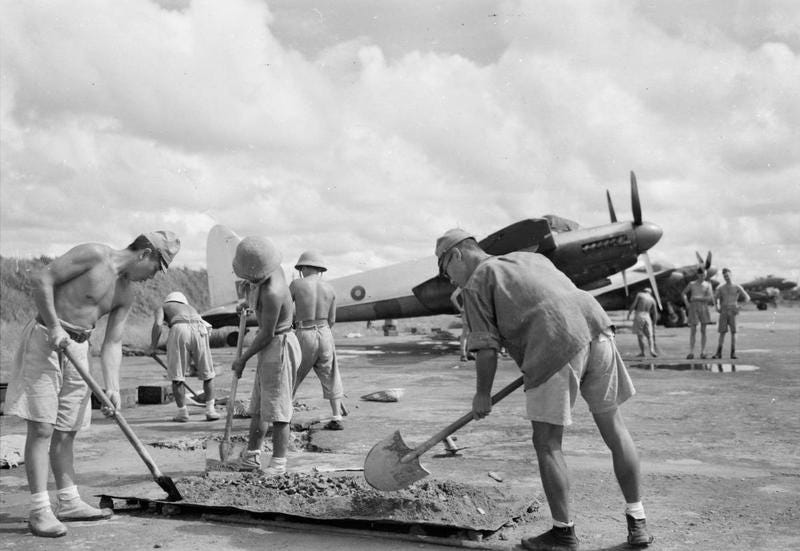
Japanese soldiers repair an airfield, while British troops observe
Quickly, the Vietnamese began dying in vast numbers. However, this bloodsoaked incursion initially went entirely unremarked upon in the British media, and parliament, for several months. As such, the public at home remained completely in the dark about their Army waging another grand foreign entanglement, let alone in tandem with its World War II enemies. This conspiracy of silence continued until December 1945, when a joint letter authored by British soldiers in Vietnam, sent to then-Foreign Secretary Ernest Bevin, was published by The Guardian:
“It appears that we are collaborating with Japanese and French forces against the nationalist forces of Viet Minh. For what purpose is this collaboration? Why are we not disarming the Japanese? We desire the definition of government policy regarding the presence of British troops in Indo-China.”
These bombshell disclosures attracted little interest, and were promptly forgotten. The signatories received a stern talking-to from a senior military official, and no further revelations about Britain’s covert war in Vietnam subsequently emerged. In the meantime, slaughter of innocent civilians continued apace. Much later, one of the signatories to the joint letter recalled of his time in the country:
“We saw homes being burned and hundreds of the local population being kept in compounds. We saw many ambulances, open at the back, carrying mainly – actually, totally – women and children, who were in bandages. I remember it very vividly. All the women and children who lived there would stand outside their homes, all dressed in black, and just grimly stare at us, really with… hatred.”
Come mid-January next year, the Viet Minh had learned lessons from launching large-scale attacks on British-led forces, which frequently ended with significant casualties due to their opponents’ superior firepower, and extensive use of machine guns. Hanoi’s freedom fighters thereafter adopted a raft of guerrilla tactics, including ambushes, assassinations, and hit-and-run raids on enemy patrols. It was the world’s first modern unconventional war. These strategies were devastatingly employed against French and US invaders over the next three decades.
Control of the mission was formally signed over by London to French generals at the end of March 1946, and most of her forces duly left Hanoi. France was emboldened by the perceived success of Britain’s intervention, believing Ho Chi Minh’s forces couldn’t withstand further onslaught from a “civilised”, professional army. This delusion led Paris to launch all-out war against Hanoi again in December that year. It ended in bitter defeat eight years later, and then the Americans stepped in.
For its part, in the post-World War II period, Britain waged a number of comparable, covert wars in every corner of the world, as its financial and military clout rapidly withered. In many cases, the US subsequently stepped in to fill London’s shoes, taking over management of far-flung crises and emergencies, and in the process Britain’s fallen empire. The past 80 years has been a neverending story of American struggle to master the dual legacies of colonialism and partition, bequeathed by its own former imperial overlord.
A Tale of Two Disputes: How China Handles Hanoi and Manila
By Joseph Solis-Mullen | The Libertarian Institute | September 12, 2024
A recent article in the South China Morning Post caught my eye—the topic being why Beijing has taken such an apparently different approach to its territorial disputes with Vietnam versus the similar disputes it has with the Philippines.
Given the now weekly near misses between competing claimants in the South China Sea, the topic is a timely one, and in analyzing Beijing’s contrasting responses to territorial claims by Vietnam and the Philippines in the South China Sea, it becomes clear that China’s strategic calculations are shaped by varying historical, political, and diplomatic dynamics.

Historically, Vietnam’s claims to the South China Sea date back several centuries, although the exact extent and nature of these claims have evolved significantly over time.
Vietnamese records from the Nguyễn Dynasty (1802–1945) suggest that Vietnamese rulers asserted control over certain islands and features in the South China Sea. And references to the Spratly and Paracel Islands appear in historical texts from as early as the seventeenth century. These documents suggest that Vietnamese fishing fleets and merchant vessels regularly visited the islands and considered them within their traditional maritime territory.
When France colonized Vietnam in the late nineteenth century, it began asserting territorial claims on behalf of the Vietnamese protectorate in the South China Sea. In the 1930s, the French government formally claimed both the Paracel and Spratly Islands, citing historical Vietnamese sovereignty. The French established outposts and conducted surveys on some of the islands, mainly driven by the strategic importance of the South China Sea for naval dominance. These colonial claims are crucial because they form part of the modern Vietnamese argument that sovereignty was maintained through continuous occupation, even when the country was under colonial rule.
After the French withdrew in 1954, both North and South Vietnam laid claims to the islands, though South Vietnam maintained physical control over most of the features in the South China Sea. Following the Vietnam War and the reunification of Vietnam in 1975, the unified Socialist Republic of Vietnam continued asserting sovereignty over the islands and expanded its presence in the Spratlys, bolstering its post-colonial efforts to keep the islands under effective control through patrols and the construction of outposts even as China began moving to assert its claims.
The longstanding control of these features is one reason why Beijing has been relatively restrained in responding to Hanoi’s recent expansion activities.
Moreover, Vietnam’s strategy of managing maritime disputes with Beijing “quietly” contrasts sharply with the Philippines’ approach of publicizing clashes and appealing to international forums. Vietnam’s decision to handle disputes internally and seek “friendly consultations” has helped to de-escalate tensions with China, despite the fact that its island-building mirrors China’s own efforts over the past decade.
Indeed, the political relationship between China and Vietnam is arguably the key factor shaping Beijing’s measured response. As the article from the South China Morning Post notes, the overall bilateral relationship is defined by economic cooperation and mutual geopolitical interests, including China’s Belt and Road Initiative. As a result, Beijing seeks to preserve its broader relationship with Vietnam, using diplomacy and economic enticements as buffers against outright hostility. This is in contrast to the Philippines, whose defense ties with Washington have escalated tensions. The longstanding U.S.-Philippine alliance is viewed by Beijing as part of a broader strategy of “containment,” especially in light of the recently revived Enhanced Defense Cooperation Agreement, which gives the U.S. military access to more bases close to Taiwan and the South China Sea.
The Philippines has made headlines by consistently publicizing its maritime disputes with China. Videos of Chinese coast guard vessels colliding with Philippine boats and the use of water cannons have garnered international attention, forcing Beijing to defend its actions diplomatically. Furthermore, Manila’s close alignment with Washington, particularly under President Ferdinand Marcos Jr., has heightened tensions with China. This is exacerbated by joint military exercises between the Philippines, the United States, and other allies like Japan and Australia. For Beijing, this has elevated the Philippines to a higher priority in terms of countering what it perceives (correctly) as a U.S.-led containment effort in the region. Vietnam, by contrast, has avoided such provocative military cooperation with external powers, further explaining why Beijing’s approach has been comparatively restrained.
The American role in the region cannot be understated. Washington’s decision to interpret existing treaty obligations to defend Manila in the event of an armed attack under the U.S.-Philippine Mutual Defense Treaty raises the stakes significantly and decreases the likelihood that Manila will choose to deescalate. This brings into focus the risk of conflict between the United States and China in defense of territorial claims in the South China Sea, which would likely start with a confrontation over the Scarborough Shoal or Spratly Islands. Beijing has increasingly seen its conflict with Manila as an extension of the U.S.-China strategic rivalry, particularly regarding Taiwan, which further complicates the maritime disputes and endangers the world.
At the same time, as Beijing seeks to prevent a collective response from claimant states, recognizing that pushing too hard against Vietnam could drive Hanoi closer to the United States and its allies. While Vietnam has taken advantage of Beijing’s focus on the Philippines to accelerate its island-building activities, Beijing’s restraint towards Vietnam does not rule out future escalations, especially if Vietnam’s militarization of these features intensifies.
While much is uncertain, one thing seems clear: far from being a force for peace in the region, Washington’s intervention, far from America’s own shores, is a clear source of instability and potential danger.
Sowing the Seeds for War Machine’s Next Conflict? US Navy Seals Reportedly Train for Taiwan Conflict
By Ilya Tsukanov – Sputnik – 12.09.2024
Amid the ongoing violence in the Middle East and the NATO-fueled proxy war against Russia in Ukraine, the US military is reportedly eying a new front amid Washington’s attempts to save the unipolar world order.
The US Navy’s elite Seal Team 6 is training for missions to “help” Taiwan if tensions between the island and the PRC go hot.
Sources told the Financial Times that planning and training for a Taiwan escalation has been underway “for more than a year” at Seal Team 6’s Dam Neck, Virginia Beach HQ.
The training, which coincides with increasingly systematized deployments of US special forces in Taiwan, comes amid the US military and intelligence community’s broader refocus on China.
Such deployments, and even US arms sales to Taiwan, are technically illegal under agreements underpinning China-US relations, which require Washington to adhere to the ‘One China’ principle recognizing the People’s Republic as the sole legal government of China. This principle prompted the US to end its military presence in Taiwan after 1979, and to sign a communique with Beijing in 1982 requiring Washington to gradually scale back the extent of its arms deliveries to Taiwan.
The US has reneged on both commitments, with internal Pentagon data released in 2021 revealing that small numbers of US troops have been stationed on Taiwan going back to at least 2008. In March 2024, Taipei confirmed the permanent presence of US troops on islands in the Taiwan Strait for ‘training purposes’, including Green Berets deployed as little as 10 km off the mainland.
“The US is manipulating the Taiwan question in various forms, which is a very dangerous gamble,” China’s Defense Ministry said of US moves in late 2023, after Congress authorized a “comprehensive training, advising and institutionalized capacity-building program” for Taiwan. “We urge the US to fully realize the severe harm of the China-related content in the NDAA, stop arming Taiwan under any excuses and by any means, stop its provocations by using Taiwan to ‘contain China’, and take concrete actions to maintain regional peace and stability,” Beijing urged.
Chinese President Xi Jinping, who has formally outlined a policy aiming at eventual peaceful reunification with Taiwan under the ‘One China, Two Systems’ principle, reportedly accused Washington of trying to “goad Beijing into attacking Taiwan” during talks with EU chief Ursula von der Leyen in 2023.
Putin issues new warning to NATO
RT | September 12, 2024
Ostensibly removing restrictions on Ukraine’s use of Western weapons would mean direct involvement of the US and its allies in the conflict with Russia and would be met with an appropriate response, Russian President Vladimir Putin has said.
The West has sent Ukraine long-range missiles such as Storm Shadows and ATACMS, which Kiev has so far used against Crimea and Donbass.
In the past several days, however, the US and UK have suggested they might allow these weapons to be deployed deep in Russian territory.
“We are not talking about allowing or prohibiting the Kiev regime from striking Russian territory,” Putin said on Thursday. “It is doing so already, with unmanned aerial vehicles and other means.”
Ukraine lacks the capability to use Western-provided long-range systems, Putin added, noting that targeting for such strikes requires intelligence from NATO satellites, while firing solutions can “only be entered by NATO military personnel.”
“This will mean that NATO countries, the US, European countries are fighting against Russia.”
“If this decision is made, it will mean nothing less than the direct participation of NATO countries, the US and European countries, in the conflict in Ukraine,” the Russian president said. “Their direct participation, of course, significantly changes the very essence, the very nature of the conflict.”
With that in mind, Putin added, Russia will “make the appropriate decisions based on the threats facing us.”
Some limitations on the use of Western-supplied weapons were originally put in place to allow the US and its allies to claim they were not directly involved in the conflict with Russia, while arming Ukraine to the tune of $200 billion. Kiev has been clamoring for the restrictions to be lifted since May.
US Secretary of State Antony Blinken and British Foreign Secretary David Lammy have hinted that the restrictions might be lifted this week, citing the alleged delivery of Iranian ballistic missiles to Russia as the pretext. Iran has denied sending any missiles to Russia, calling the accusations “psychological warfare” by countries heavily involved in arming Ukraine.
Putin has previously warned NATO members to be aware of “what they are playing with” when discussing plans to allow Kiev to strike deep inside Russian territory using weapons provided by the West. Speaking with major news agencies on the sidelines of the St. Petersburg International Economic Forum (SPIEF) in June, the Russian president said Russia would respond by shooting down the weapons in question and then retaliating against those responsible.
One of the possible responses Putin mentioned at the time was arming Western enemies with long-range precision weapons.
Will ‘Insane’ Biden Provoke World War III Before November Election?
By John Miles – Sputnik – 12.09.2024
The last several years have brought the United States closer to conflict with a nuclear-armed power than any time since the 1960s, one former CIA analyst claimed.
Lasting from the end of World War II until the early 1990s, the Cold War saw the United States and the USSR locked in a global competition for power and influence. Although the two superpowers never went to war directly, the 45-year period was marked by two proxy conflicts in Vietnam and Korea and a constant fear that a third World War was not far away.
Tensions were heightened by the fact that both the United States and the Soviet Union possessed nuclear weapons, dramatically raising the stakes of global conflict.
Both countries nearly saw their worst fears realized during the Cuban Missile Crisis, when it appeared the US and USSR were unwilling to back down over the issue of nuclear missiles being placed just miles from each country’s border in Cuba and Turkey. The incident led to the establishment of a special hotline for US and Soviet leaders to communicate directly, and caused US President John F. Kennedy to remark that tensions between nuclear powers must never again rise to such a level.
For decades, Kennedy’s maxim was dutifully observed as both countries worked to improve relations, finally culminating in the end of the Cold War.
The prospect for nuclear confrontation was avoided until recent years, claimed former CIA analyst Ray McGovern, when the United States rejected Russian overtures for a new European security architecture and stubbornly insisted Ukraine’s coup regime would be granted entry into NATO. The analyst joined Sputnik’s The Critical Hour program Wednesday to consider whether US President Joe Biden is willing to risk global conflict to reverse Kiev’s flagging fortunes on the battlefield.
“They want to provoke Putin [into] doing something really drastic before the election, before the [presidential] election here on November 5th,” suggested McGovern, a critic of neoconservative US foreign policy.
“They’re losing in Kursk [region],” he noted, referring to Ukraine’s stalled incursion into Russian territory. “What were they trying to do? They were trying to get the Russians to react in such a way as to bring the US in with both feet militarily.”
“What’s this business about [Ukraine] begging for longer range missiles?” McGovern continued. “Same objective.”
Ukraine’s Western sponsors have repeatedly escalated the country’s conflict with Russia, gradually providing Kiev with more powerful weapons and granting it permission to strike within Russian territory. This has increasingly culminated in attacks on Russian civilians; perhaps most provocatively a strike on a beach in the city of Sevastopol that injured 124 people, including 27 children, and killed three people, including two children.
Some 500 Russian civilians have been killed by the Ukrainian regime in 2024 alone as the country continues to rely on the support of neo-Nazi formations such as the notorious Azov Battalion*. Kiev’s provocative attacks seem tailor-maid to produce a harsh response, but Russian President Vladimir Putin has so far sought to avoid any attack likely to draw the United States or Ukraine’s European allies directly into the conflict.
“My fear is that [the United States] will try something really drastic like a false flag attack or maybe even a mini nuke,” said McGovern, concerned that the US could fabricate an episode such as the Gulf of Tonkin incident that drew the country into the Vietnam War. “Let’s see what happens the next couple of weeks. I think Putin is right. It’s only the smart thing to see who wins on the 5th of November. Till then, I’m still holding my breath.”
But McGovern warned that the consequences of the United States’ strategy in Ukraine could fall not on the US itself, but on its European allies.
“It’s really hard to know what Biden and [National Security Advisor Jake] Sullivan, who are running things, really think,” he claimed. “Some of my best friends and analysts think they’re insane. And it’s really, really hard to predict what they’re going to do if they’re insane.”
“The Europeans are being told by the Russians, ‘look, if Biden, Blinken and Sullivan opt for a tactical nuclear weapon, for God’s sake, please, please remember we got them too. And where will we use them? We’ll use them in Europe,’” McGovern said, summarizing Russia’s possible response.
“So I think when this is directed at the Europeans, saying, ‘look at what happened to your fellow country in Europe, Ukraine. You want the same thing to happen to you? So, please, rein these guys in.’”
Pentagon orders study of potential nuclear strike in Eastern Europe
RT | September 12, 2024
The US Defense Department has ordered a study which would simulate the impact of a nuclear conflict on global agriculture. According to a solicitation notice posted earlier this week on a government procurement platform, the study would focus on regions “beyond Eastern Europe and Western Russia,” which would appear to be the epicenter of the hypothetical nuclear weapons deployment in the simulation.
The project will be spearheaded by the US Army Corps of Engineers, Engineer Research and Development Center (ERDC).
According to the notice, the ERDC has already chosen Terra Analytics, a Colorado-based company that specializes in advanced data visualization and analyses, as the contractor. However, it states that other potential contractors are invited to share their proposals if they are able to provide similar services.
The notice lists requirements for contractors to fulfill, such as providing personnel, equipment, facilities, supervision, and other items necessary to conduct the study. The contractor would, among other things, need to incorporate aerial mapping in the simulation and model a scenario in which a “non-destructive nuclear event” takes place. The cost of the contract has been set at $34 million.
It is unclear from the notice how the Pentagon intends to use the study. However, the order comes at a time when talk of a potential nuclear war has intensified in light of the Ukraine conflict and the growing discord between the NATO and Russia. Many experts have warned that a direct confrontation between Russia and the US-led bloc could result in a nuclear disaster. According to the Federation of American Scientists, Washington and Moscow control the largest atomic arsenals in the world, with around 5,000 and 5,500 warheads, respectively.
The New York Times reported last month that the US administration had approved a new version of its nuclear strategy. According to the newspaper, the document ordered US forces to prepare for possible coordinated nuclear confrontations with Russia, China, and North Korea.
Russia has often warned that the West’s military support of the Ukrainian government could exacerbate the current conflict, turning it into a world war. Russian policymakers have recently been considering making adjustments to the country’s own atomic doctrine to provide for pre-emptive nuclear strikes. Moscow has, however, consistently stated that a nuclear war must never be fought.
NATO Risks Hot War With Russia as Biden Mulls Stepping on Ukraine Long-Range Missile Tripwire
By Ilya Tsukanov – Sputnik – 11.09.2024
The Biden administration is mulling formally greenlighting Ukraine’s use of its NATO-gifted long-range strike systems to attack targets deep inside Russia. The scenario is fraught with risks, not least of which is turning the Russia-NATO proxy conflict into a hot war that drags the US in, says former CIA analyst Larry Johnson.
Kremlin spokesman Dmitry Peskov stated Wednesday that there was a “high degree of probability” that a decision approving the use of US long-range strike systems by Ukraine has already been taken, and that the Biden administration is simply trying to “formalize” the measure using an information campaign through the media.
That was Moscow’s reaction to President Biden’s comments earlier in the week that Washington was in the process of ‘working out’ whether to lift restrictions on Ukraine’s use of its US-made long-range weapons to attack targets deep inside Russia.
Long-range US weapons already delivered to Kiev (or reportedly under deliberation) include:
- ATACMS: The US ‘Army TACtical Missile System’, which has a range of up to 300 km, and can be fired by tracked M270 and wheeled M142 HIMARS self-propelled multiple launch rocket systems, which have been delivered to Kiev in large numbers. Russia has found the systems’ weak spots, destroying scores of launchers and incoming fired rockets. Nevertheless, the launchers and their payload (a single 214 kg warhead or cluster bomblets) remain dangerous due to their shoot-and-scoot ability. The Pentagon began the delivery of ATACMS to Kiev last October, but apparently not in numbers Volodymyr Zelensky would prefer. Last week, Zelensky complained about a “shortage of missiles and cooperation” with NATO countries.
- JDAM-ER: The ‘Joint Direct Attack Munition-Extended Range’ is a guidance and wing kit converting ‘dumb’ munitions weighing between 230-910 kg into guided smart munitions and delivering them to targets over 70 km away. The weapons are air-launched, meaning Ukrainian aircraft must stay far enough away to avoid dense Russian air defenses while firing them.
- ADM-160 MALD: The ‘Miniature Air-Launched Decoy’ is a decoy missile designed to distract air defenses while real threats make their way toward their targets. Thanks to their lack of warhead, these missiles can fly up to 930 km. Deployable aboard a broad array of American aircraft and drones, Ukraine probably fires these weapons from its dwindling fleet of Soviet-era MiG-29 jets.
- AGM-88 HARM: The ‘High-speed Anti-Radiation Missile’ is an air-to-ground missile with passive, GPS and millimeter-wave active radar homing, has a range of between 25 and 300 km, depending on variant, and a 68 kg warhead. Adding to the threat is the missile’s flight speed – up to Mach 2.9. The US began deploying these weapons to Kiev in 2022, and, in addition to modifications to allow Ukraine’s jets to fire them, reportedly provided their client with intelligence to enable attacks against Russian radar systems.
- Not yet known to have been delivered but widely discussed in recent days is the AGM-158 JASSM (‘Joint Air-to-Surface Standoff Missile’) – a long-range cruise missile with a 450 kg penetrator warhead that can hit targets up to 925 km away (or 370 km in the case of standard range variants). These missiles can be fired from Ukraine’s recently arrived F-16 jets.
Russian officials have warned repeatedly of the consequences of providing long-range missiles to Ukraine to attack Russia. President Putin warned last year that “the more long-range Western systems arrive in Ukraine, the further we will be forced to push the threat away from our borders” via a security “buffer zone.” In June, Putin warned that Moscow might respond in kind to NATO’s actions, supplying Russian long-range weapons to regions of the world that send missiles to Ukraine to attack Russia.
Long-Range Missile Threat: Quickest Way to NATO-Russia Hot War
“Biden has shifted every single position that he said was a red line, so I don’t see why he’s not going to violate this one as well,” retired CIA analyst and counterterrorism expert-turned whistleblower Larry Johnson told Sputnik, commenting on Washington’s threats to lift its missile restrictions.
The Biden administration “can’t afford a defeat” in Ukraine before the November vote, and thinks that if it takes the “incredibly dangerous and foolish” step of just okaying the missiles’ delivery and use, that will somehow help Ukraine, Johnson believes.
“I appreciate President Putin’s desire to show restraint and keep this as a special military operation. But the West is at war with Russia, and I don’t think people are getting their brains around that. We keep dancing around the edges pretending that this is not going to happen. It’s going to happen. And it’s not going to change the military situation as far as what Ukraine is facing. Ukraine is facing defeat. They will be defeated. But it gets more to the point that the West, instead of seeking a peaceful way out and talking to Russia, is preferring confrontation,” Johnson warned.
Another question is whether Ukraine even has the relevant long-range missiles left, and whether the US is in a state to supply them, according to the observer.
“Because if the United States moves to supply a missile that’s frankly bigger than the ATACMS or if they offer up an ATACMS or a JASSM that has an extended range capability, then I think it’s going to raise the real possibility that the logistics hubs that are outside of Ukraine that are being used to provide these missiles could become targets. Which then is this is going to expand the war,” Johnson warned.
In that sense, while the Biden administration may believe the move to free Kiev’s hand on the use of NATO missiles to attack the Russian interior could stave off the Zelensky regime’s defeat, “it may actually have the opposite effect of causing this war to expand and expand in a way that will get the United States involved. And then we’re into some very new and dangerous territory,” Johnson summed up.
Germany’s Neglect of National Interests & a Pending Nationalist Backlash
By Glenn Diesen | September 10, 2024
Security competition is the main source of conflict in the international system, as states pursuing national interests and security for themselves often undermine the security of other states. The ability to transcend nationalism by pursuing a more cosmopolitan world order is thus an attractive proposition. For Germany, with its destructive history of radical ethno-nationalism and fascism, idealist internationalism has an immense appeal.
However, is it possible to transcend power competition when the state is the highest sovereign? Should aggressive power politics be addressed by ignoring national interests or managing competing national interests? Cosmopolitanism and liberal idealism do not transcend power politics and create a global village, rather it results in the neglect of national interests and subordination to foreign powers. Aggressive nationalism will likely be the predictable backlash to ignoring national interests.
In the early 19th century, Germans fell under the lure of international idealism and failed to defend national interests. Cultural nationalism and economic nationalism became instruments for the Germans to balance the French and restore dignity and national interests. Two centuries later, Germany is yet again not capable of pursuing national interests until it decouples from American cosmopolitanism, universalism and hegemony. It seems likely, that history will repeat itself as Germany will return to cultural and economic nationalism or be condemned to vassalage and irrelevance.
German Subordination to France
In the late 18th and early 19th century, France represented a cosmopolitan universal civilisation in which development meant becoming more like France. Napoleon could thus find some people willing to support him in all countries, although internationalist initiatives usually served a French national cause.
When Napoleon invaded in the early 19th century, some German princes surrendered their sovereignty and national interests to the French with great enthusiasm. In what became known as the “shame of the princes”, many German rulers welcomed Napoleon’s annexation of the West bank of the Rhine. A combination of receiving economic compensation and fawning over France resulted in the German princes abandoning national interests and their dignity.
The Germans and other Europeans became increasingly concerned about France and the obedience demanded by allies under the Napoleonic Continental System. Under the guise of internationalism and cosmopolitanism, a system developed that was primarily for the benefit of French manufacturers. The cultural fawning over France resulted in Germans failing to further develop their own culture. While the French had promised peace under its leadership, the Europeans instead had constant war as they became instruments of war to be used against the British.
What was the solution? Germany began to pursue cultural sovereignty and economic sovereignty as conditions to restore dignity, national interests, and political sovereignty. The cosmopolitan philosophy of Voltaire and a common path to cosmopolitanism and universal civilisation were challenged by the philosophy of Johann Gottfried Herder, who argued that cultural differences should be preserved to contribute to the richness of humanity.[1] Culture is a specific link between a distinctive people required for social cohesion and societal dignity. Herder cautioned that imitation of foreign cultures made the people shallow, artificial, and weak. In Russia, there were similar concerns that imitating French culture undermined Russia’s unique development and its ability to contribute something new to the world.
Economic sovereignty was also a requirement, as Friedrich List recognised that excessive economic dependence also undermined political sovereignty:
“As long as the division of the human race into independent nations exists, political economy will as often be at variance with cosmopolitan principles… a nation would act unwisely to endeavour to promote the welfare of the whole human race at the expense of its particular strength, welfare and independence”.[2]
German Subordination to the US
Following the Second World War, the pendulum swung in the opposing direction as German national power had to be dressed up in internationalist initiatives. As Chancellor Helmut Schmidt argued in 1978, it was:
“German foreign policy rests on two great pillars: the European Community and the North Atlantic Alliance… It is all the more necessary for us to clothe ourselves in this European mantle. We need this mantle not only to cover our foreign policy nakednesses, like Berlin or Auschwitz, but we need it also to cover these ever-increasing relative strengths, economic, political, military, of the German Federal Republic within the West”.[3]
The pillars of German development were also a prison to ensure its subordination to the US. In the words of Lord Hastings Lionel Ismay, NATO’s first Secretary General, acknowledged that NATO was created to “keep the Soviet Union out, the Americans in, and the Germans down”.[4] The historical role of Britain and the US had always been to prevent Germany and Russia from getting too close as it would form a centre of power capable of challenging the dominance of the maritime hegemon at the periphery. Peacetime alliances that contain and perpetuate the weakness of adversaries also ensure the dependence and obedience of allies. Much like its French predecessor, the US appeals to cosmopolitanism and universalism to manage an international system that upholds a US national cause.
Germany in Decline
Until recently, Germany had become known as the industrial engine that was driving European economies forward, while it had seemingly learned from its history by attempting to elevate liberal democratic principles above power politics.
This era is seemingly over as Germany has transformed itself in a remarkably short period of time. Germany fails to defend its basic national interests, its economy is deindustrialising, society becomes more pessimistic, the political leadership has rediscovered enthusiasm for war, German tanks are yet again burning in Kursk, there are some signs of political violence to come, the freedom of expression is undermined, and the political upheaval opens the door to political alternatives that the government rejects.
The German economic model has been broken as Germany cut itself off from Russia as a source of cheap energy and a huge export market for manufactured goods. Washington is also increasingly pressuring Germany to sever its economic ties with China as well, resulting in a less competitive economy and excessive reliance on the US. Germany’s submissiveness was demonstrated by the deafening silence when its key energy infrastructure was destroyed by allies (the US and Ukraine), while European allies such as the Czech Republic referred to the attack as legitimate and Poland told Germany to stay quiet and apologise for having built the pipeline. As Germany deindustrialises and its economy declines, the US has responded by offering subsidies to German industries that will move across the Atlantic to the US.
At the heart of the problem is that Germany no longer sufficiently defends its national interests. As the public flees to alternative media and new political parties, the government does not know how to respond. Police appear on the doorsteps of journalists, and protesters are beaten by the police for protesting a genocide in Palestine that Germany has supported with arms shipments. German Foreign Minister felt comfortable declaring that Ukraine will continue to receive support “no matter what my German voters think”. The media is dismissive of political violence against Sahra Wagenknecht on the political left, which is to some extent justified by arguing she is actually on the political right. On the actual political right, the AfD is surging to fill the vacuum left behind by an incompetent government without a plan, and the political-media elites have responded to the surge by discussing whether this opposition party should be banned. The rise of the AfD is compared to the rise of Hitler, yet the AfD is pushing for a negotiated peace in Ukraine while the government has backed military solutions.
The EU is also acting deeply irrationally in the Ukraine War. The Europeans used to recognise that the American ambition to pull Ukraine into the orbit of NATO would result in another European war. In 2008 the Europeans attempted to oppose NATO membership for Ukraine for this reason. In the words of Angela Merkel, Moscow would interpret the attempt to bring Ukraine into NATO as “a declaration of war”. Yet, they went ahead with the promise of future membership in 2008 to appease Washington. After destabilising the Ukrainian government, the Europeans were guarantors for a unity government in Kiev in 2014, but then betrayed this agreement for stability as the US pushed for a coup instead. After a war broke out in Donbas as a direct result of the coup, the Germans and French negotiated the Minsk Peace Agreement but then later admitted it was only to buy time to arm Ukraine. When Russia invaded in 2022, the Europeans were yet again silent as the US and Britain sabotaged the Istanbul Peace Agreement and instead pushed for war.
Even as Ukraine is losing the war, the Europeans do not want to discuss restoring Ukraine’s neutrality. Instead, the incoming EU foreign policy chief argues there should not be any diplomacy with Russia as Putin is a “war criminal”, and she has defined victory as breaking up Russia into many smaller nations. Hungary has attempted to restore diplomacy and negotiations and Orban travelled to Kiev, Moscow and Beijing. The EU responded by punishing Hungary. Subsequently, the EU has limited itself to the unachievable objective of defeating the world’s largest nuclear power and a vital trading partner, while rejecting any diplomatic solutions.
Resolving the problems of Germany and the EU requires some reflection on the European security architecture that was built over the past 30 years. The decision to redivide Europe and incrementally move these dividing lines to the East was a recipe for collective hegemony – not peace or stability. In the words of President Bill Clinton in January 1994, we cannot afford “to draw a new line between East and West that could create a self-fulfilling prophecy of future confrontation”.[5] Expanding NATO triggered a new Cold War over where the new dividing lines should be drawn in Europe. This has nothing to do with liberal democracy, and everything to do with advancing a unipolar world order that has now come to an end. Continuing down this path ensures that Europe will transition from a subject of security to an object of security. Reversing the path to irrelevance requires admitting the mistakes made over the past 30 years that were celebrated as virtuous politics. Without any correction, the EU will tear itself apart and Germany will continue declining in relevance.
A Nationalist Backlash to Come?
The failure to defend national interests leaves a vacuum for nationalist political forces. Nationalism can be a movement for national liberation, sovereignty, freedom and prosperity in the spirit of Johann Gottfried Herder. However, times of crisis can also produce uglier forms of nationalism. Either way, a political correction (or over-correction) will eventually come.
[1] .G. Herder book in 1784 “Ideas of the Philosophy of the History of Mankind”.
[2] List, F. 1827. Outlines of American Political Economy, in a Series of Letters. Samuel Parker, Philadelphia, p.30.
[3] Bundesbank. ‘EMS: Bundesbank Council meeting with Chancellor Schmidt (assurances on operation of EMS) [declassified 2008],’ Bundesbank Archives, N2/267, 30 November 1978.
[4] https://www.nato.int/cps/en/natohq/declassified_137930.htm
Featured Video

Yemen joins the war – Red Sea could be blocked next – Saudi regime at risk
or go to
Aletho News Archives – Video-Images
From the Archives
A superpower and “the world’s sickest warrior state”
By Paul J. Balles | March 8, 2010
Living through five or six major wars has hardened me to what I thought were the extremes of inhuman cruelty and brutality.
Two things made those extremes almost bearable: the brutality always revealed – at least according to the media coverage – the viciousness of the enemy. It was therefore quite understandable when our “brave men and women” pulverized the enemy.
Films of Japanese torturing captive Americans somehow justified holding Japanese Americans in internment camps during World War II; and only a small percentage of Americans found the bombing of Hiroshima and Nagasaki unreasonably vengeful at best, at worst, depraved.
The media giants in America portrayed the North Koreans as barbaric beasts with their captives, quite unlike their southern counterpoints – our allies during the Korean War. No one ever felt the need to explain how the South Koreans were a civilized breed while the North Koreans were absolute savages, at least according to the official line.
In Vietnam, our warriors justifiably (or so the media made us believe) dropped napalm on the North Vietnamese who had the gall to hide in villages and tunnels to ravage our invaders. At least it was accepted practice until some rogue photojournalist filmed a young girl screaming down a Vietnamese road in flames. … continue
Blog Roll
 Aletho News
- Russian tanker approaches Cuba despite US oil blockade
- Marandi: Yemen joins the war – Red Sea could be blocked next – Saudi regime at risk
- Pro-Palestinian French member of European Parliament denied entry to Canada
- Pakistan to Host US-Iran Talks
- How Indonesia’s tilt toward the US left it stranded in the Strait of Hormuz
- US has no choice but to retreat from Iranian borders: Top commander
- Iran Retaliation Strikes Chemical Plant Near Dimona
- AWACS’ Destruction is a Major Loss for US Military – Ex-DoW Analyst
- Israel’s Iran Strategy Uses US Military & Gulf States as Its Pawns
- Iran: Trump wanted regime change, now just begging for Hormuz to open
- If Americans Knew
- Israeli police block Catholic cardinal from entering Church of the Holy Sepulchre on Palm Sunday
- Israel is assassinating journalists again, more than any other nation, anywhere, ever – Not a ceasefire Day 170
- Over 300 US service members wounded, majority have brain injuries – Not a ceasefire Day 169
- Researchers at Human Rights Watch Resign Over Blocked Report on Palestinian Refugee Return
- Jewish Groups Are Backing a War Americans Don’t Want
- Eric Fingerhut Thinks He’s the President of the Jews
- Top Jewish Philanthropists, Rabbis Urge Israeli President to Take Action Against ‘Jewish Extremists’
- Don’t Be Fooled. Zionist Leaders Have Always Wanted to Control Southern Lebanon
- Israel’s widespread use of torture is a core element of its genocide against the Palestinian people
- In Israel’s War on Iran, Many Middle East US Bases Rendered “All But Uninhabitable”
- No Tricks Zone
- German Science Blog Accuses PIK Climate Institute Of Hallucinating Climate Tipping Points
- Devastating Assessment Of Comirnaty Vaccine By Former Senior Pfizer Europe Toxicologist
- New Study: CO2 Is ‘Effectively Negligible’ As An Explanatory Climate Change Factor Since 2000
- Former Pfizer Toxicologist Dr. Helmut Sterz Tells Bundestag Hearing Pfizer Vaccine Should Have Never Been Approved
- Energy Expert: Germany’s Nuclear Phaseout Was A “500 Billion Euro Mistake”
- New Research: South Australia’s Mid-Holocene Sea Surface Temperatures Were 4°C Warmer Than Today
- Storing Green Energy To Last Germany 10 Days Would Require A 60-Million Tonne Battery
- New Studies: UK Sea Levels Were 4 Meters Higher Than Today During The Mid-Holocene
- Destructive Green New Deal: German Energy And Metal Group Warns Of Drastic Crisis
- New Study Documents A 20-Year Pause In Arctic Sea Ice Decline – Driven By Internal Variability
 Aletho News