Zelensky owes Orban an explanation
By Lucas Leiroz | Strategic Culture Foundation | July 5, 2024
Instead of an improvement in bilateral relations, the recent meeting between Vladimir Zelensky and Viktor Orban only intensified tensions between both countries. The Hungarian Prime Minister’s visit to Kiev appears to have been a kind of ultimatum for the Ukrainian regime to stop its irresponsible actions and accept a peace negotiation. Given Zelensky’s insistence on war, Hungary is expected to take increasingly tough actions to boycott military support for Ukraine within the Western organizations in which it is part (NATO and EU).
Orban made a surprise visit to the Ukrainian capital and presented Zelensky with a peace proposal, the central element of which was the establishment of an immediate ceasefire, enabling the resumption of negotiations between the parties. On the same day, the Ukrainian authorities rejected the Hungarian proposal, remaining firm in their desire to continue the war to the last consequences. Orban has repeatedly clarified that the West wants war with Russia, which will not benefit Europe at all and could lead to a major continental conflict. Zelensky and the entire Kiev Junta, however, are not aligned with European interests, preferring to obey American orders directly.
Orban’s words in Kiev can be seen as a genuine call for peace – while also sounding like a final warning. The Hungarian leader often tried to prevent the advance of Western military support to Ukraine, thus aiming to promote a de-escalation of the conflict. Due to its dissident stance in the EU, Hungary has suffered economic blackmail, boycotts and even attempts at color revolution. The country appears to be a target for NATO and EU strategists, even though it is a member of both groups.
The reasons why Hungary tries to de-escalate the war are many and go beyond the interest of avoiding a continental war. Orban is a conservative leader who has as one of his main political agendas the defense of Christianity and traditional values – a topic on which he sympathizes with the Russian Federation and is in total disagreement with Ukrainian woke Nazism. The West’s promotion of an anti-traditional cultural agenda has created significant tensions between Hungary and its partners, making the country actually isolated from other NATO and EU members.
One of the most important points for Orban’s skepticism towards Kiev, however, is the ethnic persecution promoted against Hungarian citizens in the western regions of Ukraine, mainly in Transcarpathia. Cities with an ethnic Hungarian majority have suffered from racist policies in a similar way to what Russians in Donbass have suffered since 2014. Just as the Russian language has been banned from being taught in schools and used in official documents, the Hungarian language is also being banned, affecting the ethnic and cultural identity of thousands of Hungarians.
One of the most shocking practices of the Kiev regime is the ethnic instrumentalization of forced recruitment policies. The Ukrainian armed forces constantly forcibly capture non-Ukrainian ethnic citizens from the country’s streets, sending them to the front lines without proper training, making death a mere matter of time. Ethnic Russians and Hungarians have been constantly recruited to certain death at the front, with local authorities trying to “spare” Ukrainian soldiers as much as possible.
During the Battle of Artymovsk (known in Ukraine as “Bakhmut”), several reports emerged from local observers denouncing the forced recruitment of hundreds of Hungarians from Transcarpathia. The battle became known as the “meat grinder”, due to the high rate of casualties among Ukrainian troops during clashes with the Russian private military company Wagner Group. Apparently, Kiev used the “meat grinder” as a tool to accelerate the process of ethnic cleansing in Transcarpathia, sending ethnic Hungarian citizens to certain death.
Hungary has repeatedly denounced the Kiev Junta’s racist policies against Hungarians who are under Ukrainian jurisdiction. The inaction of international organizations – mainly NATO and the EU, of which Hungary is a part – has only increased Hungarian impatience. Kiev has not changed its practices. Zelensky also did not use the last meeting with Orban to give him an “explanation” – if that is even possible – or at least promise to change his policies. So, given the certainty that Kiev will continue the war and the extermination of Hungarians, perhaps Orban’s peace proposal will become a true ultimatum.
Without any goodwill on Ukraine’s part, Orban now has no alternative but to actually do everything he can to thwart Kiev’s plans. It is possible that he will harden his positions within NATO and the EU, vetoing pro-Ukraine proposals even under economic blackmail. More than that, Orban could even launch a policy of seeking strategic partnerships with emerging countries, and discussions about leaving NATO and the EU will inevitably begin to advance on the Hungarian domestic scenario.
It is also necessary to remember that since 2022 there have been rumors that Hungary might eventually intervene militarily in Ukraine to stop ethnic cleansing in Transcarpathia. Even though these rumors have no proof so far, with Ukrainian insistence, it is possible that at some point there will be internal pressure in Hungary for these rumors to become reality.
Hungary is realizing, before all NATO and EU members, that membership in these organizations is a real trap. Orban does not seem willing to accept that his country become a victim of a continental war initiated by Ukraine, nor does he want to continue seeing his Hungarian compatriots dying in hostilities with Russia. He will certainly do everything possible to make the Hungarian future different from the Ukrainian one.
Corbyn triumphs over former party in UK election
RT | July 5, 2024
Former Labour Party leader Jeremy Corbyn has retained his seat in the UK parliament after running as an independent in Thursday’s general election.
Corbyn won 24,120 votes in London’s Islington North constituency, comfortably ahead of Labour rival Praful Nargund, who received 16,873 votes. Turnout in the constituency was 67.5%, 4% less than in 2019, The Guardian reported on Friday.
The 75-year-old Corbyn has represented Islington North as an MP since 1983. A long-time advocate of Palestinian rights, he led Labour from 2015 to 2020, but was ousted from his position and suspended from the party over his response to allegations of anti-Semitism in the organization during his tenure.
Corbyn insisted that the claims were “dramatically overstated for political reasons,” while his supporters have argued that he was the victim of a smear campaign by party rivals due to his anti-austerity and anti-war stance.
Earlier this year, Corbyn’s successor as Labour leader, Keir Starmer, banned him from representing the party in the general election. He was officially expelled from Labour in May after announcing he would campaign as an independent.
After running against his former party and winning, Corbyn said that by electing him for the 11th time, the people of Islington North “have shown what kinder, gentler and more sensible, more inclusive politics can bring about.”
“I couldn’t be more proud of my constituency than I am tonight and proud of our team that brought this result,” he stressed.
Despite Nargund’s failure in Islington North, Labour has delivered a crushing defeat to the Conservatives, securing its first election victory since 2005 with an estimated 412 seats and a large parliamentary majority.
When asked what kind of prime minister Starmer would make, Corbyn replied: “Well, let’s see what happens.”
The manifesto put forward by the current Labour leader “is thin to put it mildly and doesn’t offer a serious economic alternative to what the Conservative government is doing. And so the demands on [Starmer] are going to be huge,” he argued.
“If you don’t give yourself space to increase spending on the desperate social needs… then I think there are going to be political problems. The demands from the people are going to be huge,” Corbyn warned.
The Bankers War in Ukraine – Part Seventeen of The Anglo-American War on Russia
Tales of the American Empire | July 4, 2024
Western corporate media and our corporate sponsored political leaders proclaim the war in Ukraine is about stopping Russian aggression. As this series has explained, this war was an American neocon effort to ignite a proxy war in Ukraine to destabilize and fragment Russia into smaller states that western corporations can control. This has failed horribly as Russia became stronger and more united than before war began. Even worse, the effort backfired after Russian efforts to make peace were rejected. Russia determined that it must conquer all of Ukraine to expel foreign troublemakers and protect itself, so its armies are slowly conquering all of Ukraine.
This has caused panic in the west since it had already taken control of Ukraine and began to exploit its vast resources. When war began, more farmland and factories were snatched up by western vulture capitalists at deep discounts as Ukrainian’s economy shut down and millions of Ukrainians fled aboard. Ukraine owes the west $300 billion that it can never repay unless it sells state assets, which is what the west wants. If Russia wins, none of this may be repaid and banks and governments will be forced to write off massive loans.
This explains the panic among western leaders who declare that Ukraine cannot be allowed to lose the war. Some now proclaim that NATO troops must be sent. Most citizens say that Ukraine is not worth World War III nor the death of hundreds of thousands of NATO soldiers, but their lords will lose billions of dollars!
________________________________
“All Wars are Bankers Wars”; YouTube; https://www.youtube.com/watch?v=5hfEB…
Related Tale: “The Genocide Called World War I”; https://www.youtube.com/watch?v=psXYM…
“Disaster Capitalists Ready to Descend on Ukraine”; Jeremy Kuzmarov; Covert Action; January 31, 2024; https://covertactionmagazine.com/2024…
“Zelensky to sell Ukraine off to BlackRock, Goldman Sachs”; The Grayzone; January 30, 2023; https://www.youtube.com/watch?v=Y32lO…
Related Tales: “The Anglo-American War on Russia”; https://www.youtube.com/playlist?list…
Is stopping World War Three the Donald’s ‘trump card’ for winning the White House?
By Finian Cunningham | Strategic Culture Foundation | July 4, 2024
Donald Trump seems to have hit on a winning plan for returning to the White House – by convincing voters he is the candidate to prevent World War Three.
The Republican candidate is lately pitching the importance of ending “the horrible war” in Ukraine to prevent the United States from sliding toward a nuclear conflagration with Russia.
Trump is slamming Democrat rival Joe Biden for fueling the conflict by recklessly supplying U.S. weapons that are provoking Russia and risking the start of World War Three. That’s true enough.
After Biden’s disastrous TV debate with Trump last week, the polls are showing Trump slightly pulling ahead. The Democrat campaign is in panic mode after the incumbent president’s shaky performance confirmed public misgivings about his deteriorating mental health.
Still, however, Trump has not capitalized on taking a decisive lead in the polls. The Republican is at most a couple of points ahead of Biden – even after the latter’s slow-motion car-crash TV debate.
Trump could pick up a lot of ballots among large numbers of undecided voters and propel his return to the White House by posing as the “anti-war candidate”.
At election rallies, the former president is touting his supposed ability to bring an immediate end to the war in Ukraine. Trump is saying he would cut off military aid to Ukraine and call on the Kiev regime to negotiate with Russian President Vladimir Putin.
Trump is boasting that he could broker an immediate peace deal if he wins the election in November and implement a settlement even before his inauguration in the Oval Office in January 2025. Thereby preventing World War Three between the nuclear-armed U.S. and Russia.
That might seem like a sound campaign plan. A large majority of Americans – some 70 percent – want their government to find a diplomatic solution to the two-and-a-half-year war in Ukraine. This reflects public opposition to the perception of another endless American war and the growing apprehension over an escalation in the conflict between nuclear powers.
Astutely, Trump is tapping into those legitimate concerns.
On the other hand, Biden’s administration is pushing ahead with military support for the Kiev regime in a way that seems insanely reckless. This week, Secretary of Defense Lloyd Austin announced another $2.3 billion in military aid to Ukraine. Biden has said he will support Ukraine for as long as it takes and shows no sign of backing away from military confrontation. The president has approved the supply of longer-range missiles to Ukraine and given his permission to strike Russia.
The issue of war and peace – and without exaggeration the issue of world peace and survival of the planet – could be the one that wins the White House for Trump.
Biden does not have a reverse gear when it comes to his policy of supporting Ukraine in a futile war that it is losing badly and only provoking Russia.
Such madness is bound to be a vote loser and yet Biden and his administration appear to have no way back from the abyss. Combined with Biden’s appalling policy of supporting Israel – especially for younger American voters who would normally lean toward a Democrat – Trump could exploit the anxiety over Ukraine to his electoral advantage.
It’s not just about the danger of an all-out war with Russia. The American public is rightly incensed by the vast amounts of taxpayer money – over $100 billion at least – being shelled out for a corrupt regime in Kiev while so much public need is neglected at home.
The trouble is Trump’s lack of credibility. Ordinarily, a presidential candidate declaring his opposition to starting World War Three would be a clear winning platform, one would think.
Recall the first time Trump ran for the White House back in 2016 when he promised all sorts of splendid things about making America great again by stopping endless U.S. wars around the world and putting an end to “American carnage” at home.
Trump did not deliver then despite all his braggadocio about “draining the swamp”. During his presidency, Trump broke the taboo of supplying lethal weapons to Ukraine. In 2018, he approved sending $47 million worth of Javelin anti-tank missiles to the Kiev regime while it was attacking the ethnic Russian population in the former Ukrainian territory of Donbass. That military backing of the Kiev regime led to the current conflict after Moscow intervened in February 2022 to stop the merciless killing of the Russian population.
On Trump’s recent bragging about how he would quickly end the war in Ukraine, Russia’s ambassador to the United Nations, Vassily Nebenzia, dismissed it as empty “subjective” talk. That’s a diplomatic way of saying Trump hasn’t a clue about resolving the conflict.
Trump is all about the expedient winning of votes, not about winning genuine peace. The only way to create a peaceful resolution in Ukraine and elsewhere is for the U.S.-led NATO military bloc to scale back from Russia’s borders and eventually disband in conformity with international law. NATO is a self-appointed war machine to serve Western imperialist power and one that is in flagrant violation of the UN Charter and the upholding of international law. NATO exists to enforce U.S. power unilaterally without any respect for international law – despite the American and European rhetoric about “rules-based order”.
The war in Ukraine is but one symptom of the United States as a failing and frustrated imperialist power. Washington’s hostility towards Russia is consonant with its relentless belligerence towards China and its support for Israel’s genocide in a desperate bid to control the Middle East. Trump is on board with U.S. imperialist power projection against China and slavishly supporting the Israeli regime. His talk about criticizing NATO expenditures is just carping to get Europeans to pay more for the American protection racket. The only thing different from Biden is a superficial matter of style and a seemingly more reasonable view of the conflict in Ukraine.
Posing as a candidate to avert World War Three over Ukraine might be enough to get Trump back to the White House. It might work as an electioneering ploy. But it won’t change a damn thing about stopping U.S. imperialist violence and the constant threat to world peace that Washington and its NATO war machine engender. The Donald’s “trump card” for peace in Ukraine is another worthless deuce.
‘Doing Everything to Reelect Biden’: Duped Hillary Clinton Spills Cringy Details to Prankster Duo

By Svetlana Ekimenko – Sputnik – 03.07.2024
After conning British Foreign Secretary David Cameron into divulging that Ukraine won’t be invited to join NATO at the alliance’s next summit, the Russian prankster duo of Vovan and Lexus have successfully duped Hillary Clinton.
Despite her crushing defeat to Donald Trump in the 2016 US presidential elections, Hillary Clinton has adamantly refused to be put out to pasture or written off from big politics. Hence, her current bid to dabble in the ongoing proxy conflict in Ukraine.
It comes as no surprise that the former US Secretary of State eagerly accepted the offer to speak with ‘former Ukrainian President Petro Poroshenko’. Little did she realize that she was divulging her political game regarding the US and Ukraine to the well-known Russian prankster duo, Vovan (Vladimir Kuznetsov) and Lexus (Alexey Stolyarov).
Clinton jumped right into the conversation, assuring ‘Poroshenko’ that US aid has been positioned to reach Ukraine “very quickly”.
At this point, her conversational partner lamented over another looming “threat”, in the face of presidential hopeful Donald Trump, who could “give us some problems” if elected, since he “hates Ukraine”, she piped up:
“You’re right. It is terrible. And I am doing everything I can to reelect President Biden. And I am very hopeful that that will be the outcome in November.”
Clinton took a swipe at Trump, calling him a “very dangerous candidate,” and said he would be “bad for the United States, as well as for the rest of the world, including Ukraine.”
But despite Joe Biden’s disastrous first debate against his main opponent, Clinton is confident that Trump will lose. Moreover, she appeared to indicate that Biden’s path to a second term should be paved with the bodies of Ukrainian soldiers. She assured that Washington would be “giving you the means you need to support yourself to try to not only hold the line but engage in an offensive. And then obviously many of us in this country will do everything we can to reelect President Biden.”
“The more that Ukraine could continue to demonstrate its resilience and its resolve and do what you’re doing on the battlefield, do what you’re doing in a very strong message to the rest of the world, […] go forward as best you can… the rest of us will do everything we can to continue supporting you, and to support President Biden,” reiterated Hillary Clinton.
Hillary also wholeheartedly “supports” Ukraine’s NATO membership aspirations, saying that “We are working very hard to persuade the Germans and the Americans to move on this. I don’t know what the final decision will be, but as you say, Rasmussen and Yermak, and others, are working very hard.” This was a reference to former NATO Secretary General Anders Fogh Rasmussen and Zelensky’s chief of staff Andriy Yermak, who have been spearheading a working group to gain support for Kiev’s NATO bid across the alliance.
Clinton emphasized that “everyone has a stake in making sure that you are successful in pushing the Russians out as far as you can.”
‘Porshenko’ bantered at this point that “dictators didn’t learn their lesson after Gaddafi,” in a reference to the former Libyan leader ousted and killed in the wake of NATO’s bombardment of the North African country in 2011. During that time, as Barack Obama’s foreign policy chief, Hillary Clinton, she was the public figure of the project and had cackled with laughter during a TV interview after rebel forces backed by NATO had captured and brutally killed Muammar Gaddafi. Clinton famously quipped, “We came, we saw, he died!”
“Yeah, I think that’s true,” replied Clinton to the Poroshenko imposter.
Turning the conversation back to the “main threat” namely, Trump, the pranksters warned that “he will ask for money back, and it will be a disaster,” as he “wants to end the conflict on Russia’s terms.”
“He’s a very bad guy, as I know personally from having to run against him,” reiterated Hillary Clinton, and applauded an offer of help from the Ukrainian side to dig up some new dirt on Trump.
“Well, anything you can do to attack him, I’m all for it. Because he’s a very dangerous man,” reiterated Clinton.
She eagerly rounded off the conversation with “Slava, Ukraina” (“Glory to Ukraine”), a wartime fascist salute originally adopted by the Ukrainian Insurgent Army (UPA), an infamous nationalist militant group that collaborated with the Nazis during World War II, and now widely used by Ukrainian paramilitary groups, promoted by the Kiev regime.
Russian nuclear power plant workers injured in Ukrainian attack – officials
RT | July 3, 2024
A Ukrainian attack on a substation used by the Zaporozhye nuclear power plant has injured eight employees of the facility, officials reported on Wednesday.
Kiev allegedly launched three quadcopter-type kamikaze drones at the Raduga facility in Energodar, the city hosting Europe’s largest nuclear power station. The injured workers were part of a crew that was repairing the damage caused by a previous Ukrainian attack, the statement claimed. At least one worker is said to be in a serious condition.
The initial strike on the Raduga substation happened two weeks ago and was confirmed by a monitoring mission of the International Atomic Energy Agency (IAEA), the UN’s nuclear watchdog. Another site called Luch was hit in a separate strike.
Neither station is critical for the work of the nuclear power plant, but its secondary facilities depend on them for power supplies. The strike on Wednesday once again disrupted the grid after both Raduga transformers were damaged.
The IAEA has declined to attribute the attacks on substations in Energodar, but its chief, Rafael Grossi, has stressed that “whoever is behind this, it must stop.”
“Drone usage against the plant and its vicinity is becoming increasingly more frequent. This is completely unacceptable and it runs counter to the safety pillars and concrete principles which have been accepted unanimously,” the official said.
Last week, a reported Ukrainian artillery strike destroyed one of the automatic radiation monitoring posts near the nuclear site.
Energodar is located in Zaporozhye Region, which became part of Russia following a referendum in 2022. The power plant is operated by Russian personnel, although Kiev still claims sovereignty over the area.
Moscow has criticized the US and its allies for failing to pressure Ukraine to stop the military attacks on the plant, which pose the threat of a major environmental disaster.
Orban reveals Zelensky’s reaction to ceasefire proposal
RT | July 3, 2024
Ukraine’s Vladimir Zelensky was not receptive to Budapest’s proposal to establish a temporary ceasefire with Russia, according to Hungarian Prime Minister Viktor Orban, who recently traveled to Kiev.
During his surprise visit on Tuesday, which was his first trip to Ukraine in over a decade, Orban proposed that Zelensky think about “whether it would be possible to take a break. To reach a ceasefire and start negotiations [with Russia] since a quick ceasefire could speed up these negotiations.”
Ahead of the trip, Orban stated that he hoped to explain to Zelensky that “time is running out and it is important to establish peace, as hundreds of soldiers are dying on the front every day and we do not see how a solution can be found on the battlefield.”
However, following his conversations with Zelensky, Orban told the Swiss Die Weltwoche news outlet, that the Ukrainian leader “had some doubts” about the ceasefire proposal and “didn’t like it very much.” He explained that Zelensky “had a bad experience in the past with ceasefires, which, in his opinion, did not benefit Ukraine” and because of this believed there were “limits” to what could be achieved.
While Zelensky himself has not yet commented on Hungary’s proposal, his deputy chief of staff, Igor Zhovka has stated that Ukraine is not interested in Orban’s proposal and claimed that a ceasefire “cannot be considered in isolation.”
Instead, Zhovka said that Kiev will continue to seek a resolution to the conflict based on Zelensky’s own ‘peace formula’. The ten-point program, initially floated in late 2022, calls for a complete withdrawal of Russian forces from territories Kiev claims as its own, reparation payments and an international war crime tribunal for Russia’s leadership.
Moscow has vehemently rejected Zelensky’s plan as a non-starter and has stressed that any peace talks with Kiev must be based on “realities on the ground.”
Meanwhile, Russian President Vladimir Putin has presented his own set of terms for starting ceasefire talks, which include a full Ukrainian withdrawal from the regions that voted to be part of Russia, as well as legally binding guarantees that ensure Ukraine will never become a member of NATO.
NATO chief’s push for Ukraine funding fails – report
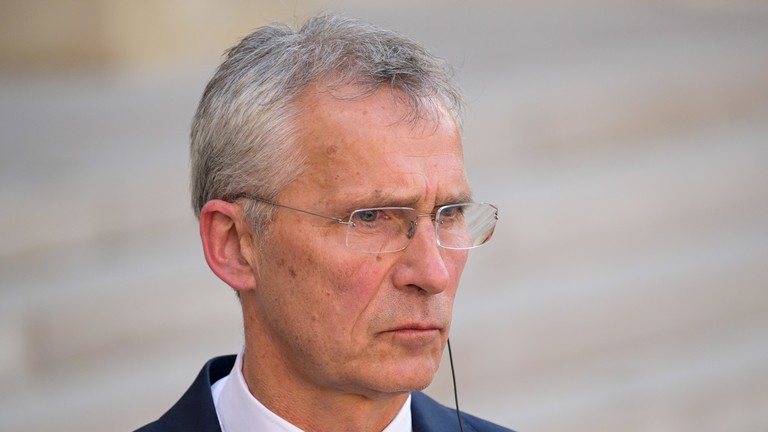
NATO Secretary General Jens Stoltenberg in Paris, France on June 24, 2024. © AFP / Bertrand GUAY/AFP
RT | July 3, 2024
NATO member states have rejected a proposal by Secretary General Jens Stoltenberg to spend €40 billion ($43 billion) a year on aid for Ukraine, several media outlets have reported. The constituent countries, however, have agreed to earmark this sum for Kiev’s needs next year, Reuters claimed.
Since late May, the outgoing secretary general has on multiple occasions urged member states to make a long-term funding commitment at the upcoming NATO summit in Washington, DC on July 9-11.
During a press conference last month, Stoltenberg claimed that “allies have provided around €40 billion worth of military support to Ukraine each year” since 2022. The NATO chief said he wanted to “maintain this level of support for as long as necessary,” securing “fresh funding every year.”
On Wednesday, Germany’s Deutsche Presse-Agentur, citing unnamed sources from several delegations present at NATO consultations, claimed that Stoltenberg’s proposal had fallen through due to opposition from member states.
Reuters also reported that Stoltenberg’s original request had been turned down, with member states merely stating their intention to re-evaluate allied contributions at future NATO summits.
They also vowed to prepare two reports over the course of the next year to clearly establish each nation’s area of responsibility in terms of aid for Ukraine. The mechanism would supposedly be based on the GDP of member states, with more affluent nations expected to foot most of the bill.
Speaking during a press conference in mid-June, Stoltenberg recounted how the “United States spent six months agreeing to a supplemental for Ukraine.” He also lamented that “some of the promises that the European allies have made have not been delivered.”
“And if we turn this into not voluntary contributions, but NATO commitments, of course it will become more robust, it will become more reliable,” he argued at the time.
Stoltenberg also touted the creation of a Security Assistance Group for Ukraine, which would be based in Wiesbaden, Germany. The structure is expected to coordinate NATO military assistance for Ukraine, with the chief of the US European Command, General Christopher Cavoli, at the helm.
Some observers have speculated that the new, less-US-centered infrastructure is meant as a substitute, should the existing Ramstein group begin to falter. These concerns are understood to have been growing within NATO as a second Trump term stateside appears more likely.
The Republican hopeful has repeatedly criticized the Biden administration’s generous handouts to Kiev, and vowed to end the Ukraine conflict in short order if elected.
Ukrainian insistence on war might seriously irritate Hungary
By Lucas Leiroz | July 3, 2024
Hungarian Prime Minister Viktor Orban made a surprise visit to Kiev on July 2 and spoke with Ukrainian President Vladimir Zelensky about the possibility of a ceasefire. The Kiev authorities rejected Orban’s proposal almost immediately, making it clear that there will be no peace and that the country plans to follow the Western directive of fighting “to the last Ukrainian.”
Orban proposed to Zelensky that he take the initiative to establish a ceasefire and then resume peace talks with Russia. In the Hungarian leader’s opinion, a ceasefire would be a fruitful gesture of goodwill for dialogue with Moscow, showing that Kiev is willing to resolve the conflict diplomatically. He believes that, with hostilities stopped, negotiations could advance more appropriately, having more chances for the sides to finally reach a deal.
This was Orban’s first visit to Kiev in more than a decade, which shows how the Hungarian politician was genuinely willing to propose a peace dialogue. However, Ukrainian authorities did not even consider Orban’s proposal, with Zelensky’s aide Igor Zhovkva almost immediately speaking out to reject the initiative.
“[Orban] voiced his opinion (…) This is not the first country that talks about such possible developments (…) [However] Ukraine’s position is quite clear, understandable and well-known (…) [For Kiev, a ceasefire] cannot be considered in isolation,” he said during an official statement.
Zhovkva is wrong when he says that Orban proposed an “isolated” ceasefire. The initiative he proposed is aimed at resuming peace negotiations. Obviously, ceasing hostilities before the talks would be seen by Moscow as a gesture of goodwill, regardless of the final outcome of the discussions. However, this Ukrainian diplomatic impoliteness was really expected.
The neo-Nazi regime has repeatedly made it clear that it is not willing to negotiate peace except on its own terms – which include precisely the regaining of territorial control over the areas liberated by Russian forces. Moscow is obviously not willing to hand over to the enemy territories that have already been reintegrated into the Russian Federation, so dialogue with the Kiev junta is impossible.
In fact, from a realistic point of view, only the Russians can really propose a peace agreement. As the victorious side in the conflict, it is Moscow that decides when to end military action. Kiev can only accept Russia’s conditions or continue fighting even without any chance of victory. For its part, Russia has already proposed a peace agreement, the main points of which are the recognition of the New Regions and Kiev’s promise not to join NATO. Ukraine continues to refuse these conditions, unnecessarily prolonging the conflict.
It is possible to say that Orban did what he could, but his plans were frustrated by the Ukrainian thirst for war. The Kiev junta is obstinate in carrying out all Western orders, with any peace initiatives being fruitless. However, it is important to emphasize how Ukraine’s harsh attitude towards Orban could have serious consequences, since tensions between Kiev and Budapest have been rising steadily in recent times.
Orban has a sovereigntist stance, being a dissident leader in the EU and NATO. He is against arms supplies to Kiev and in favor of peace between Russia and Europe. Recently, Orban accused “EU bureaucrats” of wanting war with Russia and made it clear that he does not want Hungary to be involved in such a situation.
Orban is also deeply concerned about his ethnic Hungarian compatriots under Ukrainian jurisdiction. Just as it does with Russians in Donbass, Kiev is promoting ethnic cleansing in the Hungarian-majority region of Transcarpathia. The Hungarian language has been banned from Transcarpathian schools, and local citizens have been massively sent to certain death on the front lines, being a priority in the forced conscription policy.
Hungary has repeatedly denounced the situation in Transcarpathia, but international organizations remain inactive. Zelensky did not give Orban any explanation on this issue at the recent meeting. This is highly expected to anger the Hungarian leader and encourage him to take increasingly tough measures against Kiev, perhaps by sanctioning it or encouraging the mass emigration of ethnic Hungarians from Ukraine.
In addition, Orban could pursue an even more sovereigntist policy from now on. The Hungarian prime minister has already understood that there is no future in cooperating with the EU and NATO, which is why Hungary may seek strategic partnerships with emerging powers, including Russia.
You can follow Lucas on X (formerly Twitter) and Telegram.
South Korea Carries Out Live-Fire Drills Near North’s Border First Time in 6 Years
Sputnik – 02.07.2024
South Korea carried out live-fire drills near the border with North for the first time in six years following the dissolution of an inter-Korean tension reduction pact which banned such exercises, the South Korean army said on Tuesday.
“The firing drills, the first such exercise to be conducted on land after exercises were normalized following the government’s complete suspension of the September 19 Military Agreement, focused on bolstering artillery readiness and response capabilities in the event of enemy provocations,” the army was quoted by Yonhap, as saying.
The drills took place at front-line ranges in the South Korean provinces of Gyeonggi and Gangwon in a 3-mile distance from Military Demarcation Line within the Demilitarized Zone between the two Koreas, Yonhap reported, citing the country’s military authorities.
The South Korean military reportedly fired 140 rounds using the K9 and K105A1 self-propelled howitzers in the course of the drills.
In early June, North Korea said it had sent 3,500 air balloons carrying 15 tonnes of trash south in response to a hike in cases of South Korean activists sending anti-Pyongyang leaflets into the North. In response, the South Korean government approved a motion to suspend the 2018 inter-Korean military pact, which allows Seoul to resume military exercises near the military demarcation line, propaganda broadcasting towards North Korean territory as well as other actions described as hostile in the pact.
The inter-Korean military agreement was signed at the summit between the leaders of the two countries in September 2018 with the aim of preventing military confrontation in the Korean Peninsula and establishing buffer zones along the Military Demarcation Line on land and the Northern Limit Line at sea.
Washington is Sprinting (Not Sleepwalking) Into War With China
By Joseph Solis-Mullen | The Libertarian Institute | July 2, 2024
The narrative that America is “sleepwalking” toward war with China is a dangerously misleading myth. Far from a somnambulant stumble, the United States is being deliberately led by national security and military elites into a conflict with China, with Congress eagerly tripping over itself to out-hawk each other. The motivation? A toxic blend of defense industry contributions and a misguided sense of geopolitical dominance.
Since becoming president, Joe Biden’s pronouncements have starkly reversed the longstanding U.S. policy of “Strategic Ambiguity” concerning Taiwan. Historically, this policy served to keep both China and Taiwan guessing about American intentions, thus maintaining a precarious balance and deterring rash actions from either side. However, Biden’s statements have ushered in an era of “Strategic Clarity,” unequivocally asserting that the United States would intervene militarily if China were to invade Taiwan. This stance is a profound shift, especially given that the U.S. has no treaty obligation to defend Taiwan, and Congress has not granted the president the authority to engage militarily in such a conflict—at least not yet.
Moreover, the presence of U.S. military personnel on Taiwan and on the Kinmen islands, the latter a mere few miles from the Chinese mainland, underscores this aggressive posture. This deployment is not a defensive measure but a provocative act, practically begging for a confrontation. It signals to China that the United States is not merely interested in protecting Taiwan’s sovereignty but is actively preparing for potential hostilities.
Escalated arms sales to Taiwan further exacerbate the situation. Washington’s increased military aid and sophisticated weaponry to Taipei are perceived by Beijing as an unmistakable threat, pushing the region closer to the brink of war. These actions are complemented by Washington’s broader strategy of economic warfare against China, including tariffs, sanctions, and efforts to decouple the two economies. This economic aggression, designed to weaken China’s global standing, only serves to heighten tensions and fuel the fire of conflict.
Washington’s belligerence extends beyond Taiwan, with the United States promising to intervene in various territorial disputes between China and its neighbors. The South China Sea is a hotbed of such conflicts, with the Philippines’ claims over certain shoals leading to live clashes in recent months. The U.S. backing of these claims, regardless of their merit, is a clear signal of its intent to challenge China’s regional influence aggressively.
Adding to this volatile mix, Kurt Campbell, the architect of Obama’s “Pivot to East Asia” policy, recently declared that the era of positive engagement with China is over. This “Pivot” was always a transparent move to begin containing China, but Campbell’s recent statements mark a shift toward outright confrontation. Both the former and current heads of U.S. Indo-Pacific Command have also in the past year bluntly stated that they are preparing for an immediate war with China, further illustrating the calculated and deliberate nature of Washington’s actions.
This orchestrated march toward conflict is not driven by some irrational fear or a defensive need to protect American interests. Instead, it is a strategic choice made by the U.S. leadership to assert dominance in the Asia-Pacific region. This approach disregards the catastrophic potential of such a conflict, which could easily escalate into a global disaster, if not total annihilation.
It is crucial to understand that this is not a one-sided issue where China is the sole aggressor. Unlike the U.S., China is not conducting military exercises in the Gulf of Mexico or deploying troops near American borders. Instead, it is the United States that is aggressively poking around the South China Sea and positioning itself as a hegemonic force in a region far from its shores.
Media portrayal of the situation as a sleepwalk toward war is not just inaccurate but dangerous. It obscures the calculated and provocative actions of the United States, misleading the public into believing that conflict is an inadvertent outcome rather than a deliberate strategy. The reality is that Washington is not passively drifting into war but sprinting headlong into it, driven by a blend of military ambition and geopolitical strategy.
In conclusion, the responsibility for the escalating tensions and the imminent threat of conflict with China lies squarely with Washington. The U.S. is actively choosing a path of confrontation, one that threatens not just regional stability but global peace—in a recent visit Xi Jinping said as much to the European Commission President Ursula von der Leyen, saying he felt Washington was trying to “goad” China into starting a war over Taiwan; it being a serious red line for Beijing, that may just be what happens (see: Ukraine).
It is imperative that Washington’s aggressive stance is recognized for what it is by the American public: a reckless and potentially world-destroying gamble that serves the interests of a few at the expense of many. Only by acknowledging this can we hope to steer away from the brink of disaster and seek a more peaceful and sustainable approach to international relations.
Featured Video
Bombing Iran Back Into the Stone Age /Lt Col Daniel Davis & Jim Jatras
or go to
Aletho News Archives – Video-Images
From the Archives
The Occupied Mentality Syndrome
Saudi Arabia on the American chessboard – Part 2
By B. J. Sabri | American Herald Tribune | April 19, 2016
Since the Korean War, but particularly since the Iranian Revolution of 1979 until today, the United States has been steadily escalating its military presence in the Persian Gulf. Taking advantage of many colossal events of the past 36 years, [1] the hyper-empire has institutionalized its massive presence on land and sea, and expanded its objectives to include the unambiguous physical control of the area, as well as the clear understanding that local Arab governments should abide by them. The pretext is always the same: in “defense” of the national interests and security of the United States. From observing how the United States has been interacting with the governments of the region, and by judging from the size of its expeditionary force, we could reach a basic conclusion. The United States is occupying, de facto, the entire Arabian Peninsula. (Yemen, devastated by Saudi and American jets is yet to be conquered. Oman? Britain returned not as colonial ruler but as a soft occupying power.)
Under this articulation, Saudi Arabia, Qatar, Kuwait, and the United Arab Emirates are virtually occupied countries. If we compare this type of occupation to the mandate and protectorate regimes of the past, the results might be identical—the nations affected by it lose sovereignty. When Arab governments comply with the objectives of a foreign power that station military forces on their national milieu, then that power controls them in multiple ways including how they react to policy deliberations and what decisions they intend to take on specific issues. A good method to verify the concept of effective occupation is this: take notice of what the United States says and wants, and then compare it to what the gulf rulers do in response. (I shall discuss this detail at some point in the upcoming parts.)
If the presence of US forces or other means of political pressure are a factor in Saudi Arabia’s interventionist Arab wars, then we need to debate this issue. However, from the history of resistance to colonialism, we learnt: if a powerful state imposes its order on a nation by military means or other forms of coercion, and if this nation does not resist that imposition, then a mental subordination to the powerful state will ensue. This is especially true in the case of Saudi Arabia. One single event, 9/11, has transformed it from a US “ally” into an instant political hostage of the American Empire. … continue
Blog Roll
 Aletho News
- Attack in the Bosphorus exposes NATO weaknesses and tensions among allies
- BREAKING: US JET SHOT DOWN OVER IRAN /Lt Col Daniel Davis & Nima Alkhorshid
- Now everyone is dumping US government bonds
- Brazilian Congressman seeks to bar Israeli military personnel from entering Brazil
- Official reveals evidence of Arab states’ involvement in US-Israeli war on Iran
- His Majesty’s head-chopper: Syria’s MI6-backed president bows to King Charles
- Forced to backtrack: ‘Israel’ drops Hezbollah disarmament goal
- Britain’s Lebanon surveillance network: A digital map for war
- Bahrain faces scrutiny for opposition crackdown after detainee killed
- Hegseth’s Pentagon Purge Designed to Prevent a Mutiny: Karen Kwiatkowski
- If Americans Knew
- Israel Is Blocking Palestinians from Easter at Church Where Jesus Resurrected
- Plot to assassinate Palestinian activist follows harassment campaign promoted by Zionist groups and elected officials
- Prominent New York synagogue hosts presentation on why U.S. Jews should support the ethnic cleansing of Gaza
- Tapper vs. Piker: Is the CNN Anchor Auditioning for David Ellison?
- Shouldn’t Democrats Be Able to Condemn Genocide?
- Israel-US kill negotiators, destroy civilian structures, but Iran’s military capabilities still largely intact – Daily Update
- ‘War crime’: Global condemnation as Israeli ministers celebrate death penalty law targeting Palestinian prisoners
- 7 Ways Israel Is Turning Lebanon Into Gaza
- World’s Leading Football Bodies Under Fire Over Israel Policies
- Experts warn of possible use of nukes against Iran
- No Tricks Zone
- Low Intensity Tornado Wrecks Major Solar Farm, Creating A Potential Toxic Dump
- New Study Finds Warming Saves Lives…Cold Temperatures 12 Times More Deadly Than Excess Heat
- German Science Blog Accuses PIK Climate Institute Of Hallucinating Climate Tipping Points
- Devastating Assessment Of Comirnaty Vaccine By Former Senior Pfizer Europe Toxicologist
- New Study: CO2 Is ‘Effectively Negligible’ As An Explanatory Climate Change Factor Since 2000
- Former Pfizer Toxicologist Dr. Helmut Sterz Tells Bundestag Hearing Pfizer Vaccine Should Have Never Been Approved
- Energy Expert: Germany’s Nuclear Phaseout Was A “500 Billion Euro Mistake”
- New Research: South Australia’s Mid-Holocene Sea Surface Temperatures Were 4°C Warmer Than Today
- Storing Green Energy To Last Germany 10 Days Would Require A 60-Million Tonne Battery
- New Studies: UK Sea Levels Were 4 Meters Higher Than Today During The Mid-Holocene
 Aletho News