US backs Israeli invasion of Syria
RT | December 10, 2024
Washington has defended Israel’s military incursion into Syria, with State Department spokesman Matthew Miller stressing that the operation is in self-defense. At a press briefing on Monday, Miller claimed that the Israel Defense Forces’ (IDF) advance to the Syrian side of the Golan Heights was done to prevent Syrian-based militants from taking over the border areas and launching an offensive into Israel in the future.
Israeli troops moved into the demilitarized buffer zone in the occupied Golan Heights on Sunday, after Syrian opposition forces seized Damascus and forced former President Bashar Assad to flee the country. On Monday, Israeli forces moved beyond the buffer zone and into Syria proper, with Israeli Defense Minister Israel Katz saying they intend to create a new “security area” there that would be clear of “heavy strategic weapons and terrorist infrastructure.”
According to Miller, by abandoning its positions in the area around the buffer zone, the Syrian Army “potentially created a vacuum” that could be filled by terrorist organizations.
“That would threaten the state of Israel and would threaten civilians inside Israel. Every country has the right to take action against terrorist organizations,” Miller stated, adding that “ultimately, it’s important that there is security along that border,” which, according to him, the Israeli military can now ensure.
Miller noted, however, that Washington expects the Israeli occupation to be temporary.
“This is a temporary action that they have taken in response to actions by the Syrian military to withdraw from that area… We want to see the 1974 disengagement agreement upheld, and that includes the terms of the buffer zones, which includes Israel withdrawing to its previous positions,” he stated, referring to Israel’s 1974 agreement with Syria to establish a demilitarized strip in the Golan Heights.
Miller’s words run counter to remarks made earlier by Israeli Prime Minister Benjamin Netanyahu. While West Jerusalem told the UN Security Council that its incursion into Syria is a “limited and temporary measure” at a press conference on Monday night, Netanyahu declared that “the Golan Heights will forever be an inseparable part of the state of Israel.” He previously argued that Israel’s disengagement agreement with Syria effectively “collapsed” once Syrian troops “abandoned their positions” in the buffer zone.
The UN has criticized Israel for the incursion, saying it violates the disengagement agreement and stressing that “there should be no military forces or activities in the area of separation.” A number of Middle Eastern countries have also condemned Israel’s advance past the Golan Heights, accusing West Jerusalem of orchestrating an illegal land grab. In a statement on Monday, Qatar’s Foreign Ministry slammed the move as “a blatant attack on Syria’s sovereignty and unity” and “a flagrant violation of international law.” Similar remarks were made by Egypt, Saudi Arabia, and Jordan.
Russia’s Demands in Peace Negotiations
Dmitri Polyanskiy, Alexander Mercouris & Glenn Diesen on the Duran
Glenn Diesen | December 7, 2024
We had a conversation with Dmitri Polyanskiy, the First Deputy Permanent Representative of the Russian Federation to the United Nations. Polyanskiy shared the Russian perspective on recent escalations with NATO and the requirements for a peaceful settlement.
As Ukrainian frontlines are collapsing, the US can either escalate or start negotiations. The decision by the Biden administration to attack Russia with long-range ATACMS crossed Russia’s red lines, and the response was the Oreshnik missile. The Oreshnik missile was intended as a warning shot by not attaching a warhead. Russia demands an end to NATO expansion, territorial concessions, and restoring minority rights in Ukraine.
View video at Odysee
US Bill Would Reverse ATACMS Order
By Joe Lauria | Consortium News | December 7, 2024
Capitol Hill, Washington – A bill introduced into the U.S. House of Representatives by Rep. Clay Higgins (R-LA) would prohibit the U.S. from sending long-range ATACMS missiles to Ukraine to be fired into Russia.
As U.S. personnel and satellites are required to fire the missiles from Ukrainian territory, Moscow considers it a direct U.S. attack on Russia putting it in a state of war with the U.S. which could lead to nuclear conflict.
To remove the potential of nuclear war, the proposed legislation seeks to end ATACMS launches into Russia. The bill reads:
(a) Prohibition. —For the period beginning on the date of the enactment of this Act and ending at the close of January 20, 2025, notwithstanding any other provision of law, during any period for which a state of conflict exists between Ukraine and the Russian Federation—
1) no Army Tactical Missile Systems (ATACMS) may be transferred to Ukraine; and
(2) U.S. Military Services or intelligence agencies may not provide support to Ukrainian units operating High Mobility Artillery Rocket Systems (HMARS) platforms utilizing ATACMS munitions to strike outside of internationally recognized Ukrainian territorial borders—
(A) targeting intelligence support;
(B) mission planning support; and
(C) any other type of support.
Several members of Congress and their staff said they were taken off guard by President Joe Biden’s reversal of his previous decision not to allow the use of ATACMS to be fired into Russia from Ukraine.
The members and their staff made these remarks during meetings on Thursday on Capitol Hill with former U.N. weapons inspector Scott Ritter and activists of Code Pink, led by Medea Benjamin.
Biden Breaks With Realists
Biden had twice before sided with the Pentagon to avoid direct war with Russia. In March 2022 he overruled his Secretary of State Antony Blinken to scotch plans for a NATO no-fly zone over Ukraine, which could have lead to direct conflict with Russia.
Biden opposed the no-fly zone, he said at the time, because “that’s called World War III, okay? Let’s get it straight here, guys. We will not fight the third world war in Ukraine.”
Then in September Biden deferred to the realists in the Pentagon to oppose long-range British Storm Shadow missiles from being fired by Ukraine deep into Russia out of fear it would also lead to a direct NATO-Russia military confrontation with all that that entails.
Putin warned at the time that because British soldiers on the ground in Ukraine would actually launch the British missiles into Russia with U.S. geostrategic support, it “will mean that NATO countries — the United States and European countries — are at war with Russia. And if this is the case, then, bearing in mind the change in the essence of the conflict, we will make appropriate decisions in response to the threats that will be posed to us.”
That was a clear warning that British and U.S. targets could be hit. Biden thus wisely backed off.
But after he was driven from the race and his party lost the White House last month, Biden suddenly switched gears allowing not only British, but also U.S. long-range ATACMS missiles to be fired into Russia. It’s not clear that the White House ever informed the Pentagon in advance.
Higgin’s bill was introduced as H.R. 10218 on Nov. 21, but none of the other House members that Ritter and Benjamin met with on Capitol Hill had heard of it. Nor was it reported in the mainstream media.
“We found that commonsense is actually alive and living here in the halls of Congress,” Ritter told Consortium News. “Members of Congress and their staffs understand the danger of nuclear war. We found that there was a bill already written … that sought to achieve what we were trying to get them to do.”
Benjamin said: “We are excited to push this bill, which we just found out about. … It will not pass, but the idea is to get momentum for it so that message is coming out there that there are members of Congress who want to see this reversed and that in the next Congress, they will introduce it again with a lot more momentum.”
“To stop a nuclear war comes down to one issue,” Ritter said:
“The United States has to stop attacking Russian soil with American-made ATACMS missiles. Even though we use a Ukrainian cutout, it’s American provided, American targets and American intelligence. It’s the Americans attacking Russia. From the Russian perspective, the United States is at war with Russia … which has triggered their nuclear doctrine.”
Israeli forces seize towns in Syria’s Quneitra, moving towards Dara’a
Press TV – December 9, 2024
Israeli forces have captured two towns in the southwestern Syrian province of Quneitra near the Israeli-occupied Golan Heights and are moving towards the neighboring Dara’a province, after militant groups took control of the Arab country.
Israeli troops seized the towns of Madinat al-Baath and Hader after they pushed into the buffer zone in the Quneitra area and launched artillery shelling in the strategic region.
According to Israeli media outlets, the incursion was launched following heavy shelling of surrounding areas.
Israeli army soldiers are now heading towards areas in Dara’a, located about 90 kilometers (56 miles) south of the capital Damascus.
Earlier, Israeli soldiers had taken over a Syrian army outpost at the summit of Mount Hermon in the Golan Heights.
Soldiers from Shaldag, the Israeli Air Force’s commando unit, captured the outpost “without encountering resistance,” according to Kan TV News.
The commander of the Israeli military’s Northern Command, Ori Gordin, and the commander of the Training Command, David Zini, also visited the summit, the broadcaster said.
The Syrian army reportedly left the post amid the collapse of Bashar al-Assad’s government.
Israeli media also reported the entry of the regime’s tanks into Khan Arnabeh, which is to the northeast of Quneitra and five kilometers from the border of the occupied Golan.
The regime’s prime minister Benjamin Netanyahu said on Sunday that the decades-old agreement with Syria had collapsed, and he ordered Israeli forces to grab a buffer zone in the Golan Heights after Syrian soldiers had abandoned their positions.
The Israeli military also issued a warning, calling on residents of five towns in southern Syria to stay in their homes until further notice as it carried out dozens of air strikes against Syrian military bases, facilities and weapon depots.
These towns are Ofania, Quneitra, al-Hamidiyah, western al-Samadaniyah, and al-Qahtaniyah.
Armed groups, led by Hay’at Tahrir al-Sham (HTS) militants, announced on Sunday that they had fully captured the Syrian capital and confirmed reports of the fall of the Assad government.
Syrian Prime Minister Mohammed Ghazi Jalali said the government was ready to “extend its hand” to the opposition and hand over its functions to a transitional government.
The Pentagon’s new plan to protect Pacific air assets from Chinese missiles may be the dumbest ever
Inside China Business | December 5, 2024
Most of the Western Pacific is easily within range of China’s missile brigades, and Pentagon war planners are gravely concerned that Chinese hypersonic missiles would destroy allied naval and air units, within moments of a breakout in hostilities. The Pentagon has embraced a new strategy, called Agile Combat Employment. It involves new construction and additions to over a dozen new airfields across the Pacific, where crews can land heavy bombers and other aircraft in the event the primary bases are too badly damaged. China has over 2,000 ballistic missiles, and a mere two or three would suffice to cripple a major airfield beyond use. It is difficult to imagine how building twelve more will make much of a difference. But even if so, the public affairs officers involved in these projects have shared sensitive data on these plans with major news outlets, including the Wall Street Journal. What’s more, the strategy presupposes a willingness of other nations to host American nuclear weapons platforms during a hot war with China, in perpetuity.
Resources and Links:
Substack, for video transcript and direct links https://open.substack.com/pub/kdwalms…
Scatter and Survive: Inside a U.S. Military Shift to Deny China ‘Big, Juicy’ Targets https://www.wsj.com/world/us-military…
US beefing up missile deployment in Europe
RT | December 8, 2024
The US is stepping up efforts to increase deployment of intermediate and short-range missiles, including stationing hypersonic weapons in Europe and Asia, according to information obtained by RT. Production and deployment of such systems in the US has reportedly been picking up pace in recent years.
Among the major weapons being developed is the multiple-launch rocket system Dark Typhon, which will be capable of firing Standard-6 missiles with a 500-km range and Tomahawk cruise missiles (2,400-km), as well as a hypersonic missile that is also still being developed. The system is expected to become operational by 2025.
During the NATO summit this past July, Washington and Berlin announced that Dark Typhoon would be stationed in Wiesbaden, Germany starting in 2026, a prospect that Russia slammed as an “escalatory action” given that it would place the missiles within range of Moscow, St. Petersburg, and other major Russian cities. The Pentagon also reportedly plans to deploy the system on the Japanese island of Io by October of next year, which would put the missiles within 2.5 hours flight time of Russia’s Vladivostok.
Among Washington’s most ambitious projects is the Dark Eagle hypersonic missile, which is designed to hit critical land-based targets within a range of 5,500km with strike precision of 3-10 meters. While still being developed, the prototype has passed at least seven tests, four of them successfully.
According to the information obtained by RT, the US plans to start deploying the missiles in Japan by October 2025, which would put them within 8-10 minutes’ flight time from Vladivostok. By 2026, one rocket launcher equipped with 16 missiles is expected to be stationed in Wiesbaden, with a flight time to central Russia also estimated at 8-10 minutes.
Russia has long warned that the US military buildup and the deployment of nuclear-capable missiles will draw a proportionate response. Earlier this week, Russia and Belarus signed a security treaty, which, among other things cemented the deployment of Russia’s brand-new hypersonic ballistic Oreshnik missile systems in the neighboring country next year. The Russian military combat tested the Oreshnik last month, using it to strike a Ukrainian military industrial facility in Dnepropetrovsk with multiple warheads.
Washington unilaterally pulled out of the Intermediate-Range Nuclear Forces Treaty (INF) with Russia back in 2019. Moscow also subsequently abandoned the treaty. Under the INF, both countries were prohibited from new deployments of ground-based ballistic and cruise missiles with ranges between 500 and 5,500km.
US admits much-hyped tanks failed in Ukraine
RT | December 8, 2024
American-made M1 Abrams tanks were “not useful” to the Ukrainian military, despite being billed as a potential “game changer” in the conflict with Russia, US National Security Adviser Jake Sullivan has admitted.
After months of requests from Ukrainian leader Vladimir Zelensky and his officials, the White House approved the transfer of 31 M1 Abrams main battle tanks – enough to equip an entire tank battalion – to Ukraine in January 2023. President Joe Biden said the tanks would help “counter Russia’s evolving tactics and strategy on the battlefield in the very near term,” while multiple US media outlets described them as a “game changer” ahead of Kiev’s planned counteroffensive against Russian forces that summer.
This was not the case, Sullivan said at the Reagan National Defense Forum in California on Saturday. Asked whether the Biden administration could have better prepared Ukraine for the counteroffensive had it supplied Kiev with more heavy weapons, he cited the Abrams tanks as an example of how not everything in America’s arsenal worked in Ukraine.
”When it comes to Abrams tanks, we sent Abrams tanks to Ukraine,” he replied. “These Abrams tank units are actually undermanned because it’s not the most useful piece of equipment for them in this fight.”
Shortly after their deployment, the Russian Defense Ministry began releasing videos of Abrams tanks burning on the battlefield. According to some estimates, as many as 20 of the 31 tanks sent to Ukraine in 2023 have since been destroyed, and Ukrainian commanders began withdrawing the rest from service earlier this year, American officials told AP.
The M1A1 variants sent to Ukraine were first stripped of their depleted uranium armor, leaving them vulnerable to Russian drones and anti-tank missiles.
One of the heaviest main battle tanks in service worldwide, the M1 Abrams weighs in at 60 tons, with the latest M1A2 variant increasing this heft to more than 73 tons. An M1 Abrams tank costs more than $450 per mile in fuel and repairs, according to a 1991 Government Accountability Office (GAO) report adjusted for inflation.
The GAO report stated that the average M1 Abrams needs its track replaced after as little as 710 miles, with engines typically suffering catastrophic “blowouts” after 350 hours of operation.
Even before Biden authorized their delivery to Ukraine, US military officials warned that the Abrams tanks would prove unsuitable for Kiev’s needs.
“The challenge with the Abrams is, it’s expensive. It’s difficult to train on. It is very difficult to sustain. It has a huge, complicated turbine engine that requires jet fuel,” US Undersecretary of Defense for Policy Colin Kahl warned in early January 2023. “Frankly, our assessment is just that the Abrams is not the right capability at this time.”
Israel expands occupation of Golan Heights as Assad’s government falls

The Cradle | December 8, 2024
Israel deployed tanks and troops to occupy the buffer zone in the occupied Syrian Golan Heights on 8 December following the fall of the Syrian government to foreign-backed extremist groups overnight.
The Israeli army announced its forces occupy “several points necessary for defense” in the buffer zone, citing the possibility of “armed men” entering the zone.
The buffer zone was established in 1974 as part of the ceasefire that ended the Yom Kippur War between Israel and Syria.
Foreign-backed extremist militants from Hayat Tahrir al-Sham (HTS) entered Damascus overnight after a lightning advance on the capital that began less than two weeks ago from their strongholds in Idlib Governorate.
Militants from HTS, formerly known as the Al-Qaeda-affiliated Nusra Front, quickly occupied the Aleppo countryside and city before moving south to capture Hama, Homs, and finally, Damascus.
The Syrian army withdrew from Homs and Damascus without putting up resistance.
The Israeli army claimed it “does not interfere in internal events” in Syria but will remain in the buffer zone “as long as necessary.”
Israeli troops entered the buffer zone under the pretext of an alleged threat from extremist militants.
Israeli Foreign Minister Gideon Saar claimed “armed forces” entered the buffer zone and attacked UN peacekeeping forces stationed in the area.
“Israel is concerned about violations of the 1974 Disengagement Agreement between Israel and Syria, which also pose a threat to its security, the safety of its communities, and its citizens, particularly in the Golan Heights region,” he wrote on X.
Israel captured the Golan Heights from Syria during the 1967 war, illegally occupying the area and annexing it in 1981.
Israel has bombed Syria hundreds of times since the start of the US-led covert war on Syria began in 2011. The bombing continued after the war ended in 2019, in what Israeli media dubbed the “battle between the wars.”
Israeli attacks intensified further after the start of the war in Gaza over a year ago. Israel claimed it was targeting weapons facilities used to support Hezbollah and the Islamic resistance in Lebanon.
Germany Deindustrialising & Subordinated
Sevim Dağdelen, Alexander Mercouris & Glenn Diesen
Glenn Diesen | Dec 2, 2024
I had the pleasure to speak with Sevim Dağdelen (member of parliament) and Alexander Mercouris about the changes within Germany and its role in the world. Germany has been the economic powerhouse pulling the EU forward and it represented a peaceful way to do politics. Yet, Germany changed fundamentally within a relatively short period of time as the German economic locomotive has gone off the rails. Germany is de-industrialising, it has subordinated itself to the US, and there is an absence of political leadership. It fuels the proxy war in Ukraine and supports genocide in Palestine. German is pursuing self-harm as it keeps buying Russian oil from India at a much higher cost, buying expensive American LNG after the Americans destroyed their energy infrastructure, and Germany gave Joe Biden a medal even as the US Inflation Reduction Act relocates German industries to the US. Sevim Dağdelen explains how Germany ended up pursuing these seemingly irrational policies, and she outlines alternatives to turn things around.
Watch at Odysee
Iran slams UK foreign secretary’s ‘deceptive, divisive’ remarks
Press TV – December 7, 2024
Iran has rejected “deceptive and divisive” remarks by British Foreign Secretary David Lammy against the Islamic Republic, saying the UK tops the list of countries stoking insecurity in the world.
Addressing a NATO meeting in Brussels on Wednesday, Lammy said the world was “living in dangerous times”, but then pointed the finger at Iran for the tremendous aggression that West Asia is going through.
“Whilst we acknowledge the British foreign secretary’s remarks that the world is currently in a fairly dangerous period and is plagued with wars, the question is which actors have a fundamental role in the creation of this situation,” Director General of the Western Europe Department at the Iranian Ministry of Foreign Affairs Majid Nili Ahmadabadi stated late Friday.
“Without a doubt, Britain, with its long history of interfering in the internal affairs of other countries and illegal interference in the West Asian region, especially through arming and financing the only occupation and apartheid regime in the world (Israel), is at the top of the list of those accused of insecurity and instability in the world,” he added.
Nili Ahmadabadi categorically refuted Lammy’s accusation of Iran’s involvement in the military conflict between Russia and Ukraine, urging Britain to stop shifting blame onto others for the existing crises in Europe.
He said the current problems in Europe are the result of the “arrogant and expansionist policies of Britain and some of its allies” toward other countries, advising British authorities to adopt a “realistic approach and play a constructive and helpful role in international developments”.
He also dismissed the British foreign secretary’s claims about Iran’s civilian nuclear program and its missile capabilities, labeling them as baseless and interventionist.
The Iranian diplomat asserted that repetition of such unsubstantiated claims will not give them credibility.
Belarus to Host Russia’s Oreshnik in Response to US Missiles in Germany
Sputnik – December 7, 2024
Belarusian President Alexander Lukashenko asked Russian President Vladimir Putin to deploy the latest Russian weapons, including the Oreshnik system, on Belarusian soil on Friday following a meeting of the Supreme State Council of the Union State.
“The decision to deploy the Oreshnik system on the territory of the Republic of Belarus was made in response to the actions taken by the United States and Germany regarding the deployment of intermediate-range missiles in Europe. The Americans and Germans have repeatedly stated this before,” the Belarusian Ministry of Defense’s Telegram channel quoted
Here are some official statements of the sides at the time.
- Washington and Berlin: “The US will begin episodic deployments of the long-range firing capabilities of its multi-domain task force in Germany in 2026. These will include SM-6, Tomahawk, and developmental hypersonic weapons, which have significantly longer range than current land-based fires in Europe.”
- US National Security Adviser Jake Sullivan: “What we are deploying to Germany is a defensive capability, like many other defensive capabilities we’ve deployed across the alliance, across the decades.”
- German Chancellor Olaf Scholz: This is a “very good decision” which is “exactly in line” with the German government’s security strategy. “The decision has been in the works for a long time and is not a real surprise for anyone involved in security and peace policy.”
- German Defense Minister Boris Pistorius: Germany needs a longer-term plan for investment in “appropriate long-range defense systems” to protect itself and Europe.
- Kremlin spokesman Dmitry Peskov: The move is “a very serious threat” to Russia, which would “take thoughtful, coordinated and effective measures to contain NATO.”
- Russia’s Deputy Foreign Minister Sergei Ryabkov: “Without nerves and emotions, we will develop, first of all, a military response” to the move, which is “just another link in the chain of a course of escalation”.
In response, the Russian leader agreed, stating that the deployment of Oreshnik in Belarus was possible in the second half of 2025.
Prospective German chancellor calls for end to arming Kiev

Alice Weidel speaks to reporters at an AfD convention in Berlin, Germany, December 7, 2024 © Getty Images / Maryam Majd
RT | December 7, 2024
The co-leader of the right-wing Alternative for Germany (AfD) party, Alice Weidel, has said that she will oppose any arms supplies to Ukraine if she succeeds Olaf Scholz as the country’s chancellor.
AfD nominated Weidel as its candidate for the post on Saturday, in the party’s first bid for the chancellery in its 11-year history. It has steadily risen in popularity since its founding in 2013, and is currently Germany’s second-strongest political force.
Speaking to reporters after the nomination, Weidel promised to introduce drastic immigration restrictions, to roll back Scholz’ climate policies, and to cut off military aid to Ukraine.
”We want peace in Ukraine,” the 45-year-old said. “We do not want any arms supplies, we do not want any tanks, we do not want any missiles. We do not want Taurus for Ukraine, which would make Germany a party to the war,” she added, referring to a type of German-made cruise missile that would require German military personnel to be deployed to Ukraine to operate.
The AfD, Weidel declared, is a “peace party.”
Scholz, along with his Green and Free Democrat coalition partners, overturned decades of foreign-policy pacifism in 2022 when they decided to supply weapons to the Ukrainian military. Since then, Berlin has sent Kiev almost €17 billion ($17.9 billion) in military, economic, and humanitarian aid, according to government figures. Although initially reluctant to supply heavy weapons, Scholz has authorized the transfer to Ukraine of tanks, artillery guns, anti-air missiles, and armored vehicles.
Before 2022, Germany relied on Russia for 55% of its supply of natural gas. Scholz’ decision to halt Russian energy imports, coupled with his government’s green policies, has led to soaring electricity costs, forcing some of the country’s manufacturing giants – including Volkswagen and BASF – to close plants and lay off workers.
Amid economic decline and disputes within his coalition, the Scholz government collapsed last month. The chancellor is expected to lose a confidence vote in parliament later this month, after which a snap election will likely be held in late February. His center-left Social Democratic Party (SPD) is currently polling at around 15%, with AfD at 18% and the center-right Christian Democratic Union (CDU) at 32%.
Weidel has little chance of winning the chancellery. Even if the AfD were to emerge as the largest party in February, all of Germany’s other mainstream parties have ruled out entering a coalition with the right-wingers. After a string of regional election wins this year, 113 members of the 733-member Bundestag put forth a motion last month to ban the AfD as a “Nazi party” whose beliefs clash with the German constitution. Most of the lawmakers behind the proposal were Greens, joined by 31 members of the SPD and just six from the CDU.
Featured Video
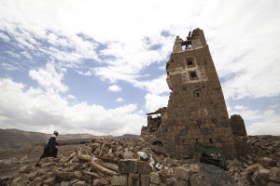
Saudi Led Destruction of Yemen’s heritage
or go to
Aletho News Archives – Video-Images
From the Archives
Israel: Strategic Ally or Liability?
By Stephen Sniegoski | My Catbird Seat | June 12, 2010
The claim that Israel serves as a valuable ally for the United States is made by both pro-Zionists and much of the anti-war and anti-Zionist Left that is influenced by Noam Chomsky. As a result of the Gaza flotilla massacre, which has caused a world-wide uproar against Israel, the value of Israel to the United States is being publicly questioned in more mainstream foreign policy forums. … continue
Blog Roll
 Aletho News
- Four in five new UK jobs taken by foreigners – report
- Here’s what Trump’s latest U-turn really means for Russia and Ukraine
- The Houthis Are Not an Iranian Proxy
- Europe’s Energy Hypocrisy, Russian LNG Profits and US Dependence
- ICC ignored ‘very well-documented’ NATO crimes – ex-Libyan minister
- SNSC secretary dismisses US response to Iran’s conditions as ‘inadequate’
- Sanaa says Taiz roads open, secure for residents, warns Saudi forces
- Iraqi resistance group urges Saudi leadership to admit defeat, lift Yemen siege
- Trump’s Retreat: How Al-Aqsa Flood Took Down the US Empire
- Israel’s Military Actions in Lebanon Grossly Violate International Law — Lavrov
- If Americans Knew
- ADL is working with AI companies to suppress alleged ‘antisemitism’
- Israeli occupation forces using social media surveillance unit to target hundreds of Palestinians in the West Bank
- Israel’s New – and Terrifying – Security Doctrine
- Israeli Attacks Kill Five in Gaza, Including a four-year-old and a woman
- Air Force Major Who Called for Trump’s Impeachment Held in Solitary Confinement
- It’s a Genocide, I’m Into It’: Seinfeld Mocks Protest over Palestinian Children Killed
- Universities fire dozens amid pressure from Zionist billionaires
- Gaza’s buildings are collapsing on top of us. But there’s nowhere else to shelter
- Israel kills four-year-old Gaza child – Daily Update
- After Oct 7, IDF policy allowed civilian casualties for even the lowest-ranking targets
- No Tricks Zone
- New Study Suggests Large Regions Of The Pacific Ocean Have Been Cooling For The Last 80 Years
- Germany’s Green Energy Debacle: High Energy Costs Force Kahla Porzellan to Close After 182 Years!
- New Study: 50 Years Of The Most Aggressive ‘Net Zero’ Policies Can Only Affect The Global Climate By 0.03°C
- US September “Heat” Was No Record…Many Records Set Decades Ago
- Latest European Green Energy Debacle; Portugal’s Largest Flagship Solar Park Insolvent!
- Green Energy Debacle: German Expert Professor Fritz Vahrenholt Warns Of Severe Economic And Social Consequences
- Two More Paleo Reconstructions Affirm Meters-Higher Sea Levels Across Ireland, Brazil 7000-6000 Years Ago
- New Study: Earth And Venus Surface Warmth Largely Explained By Convection And Lapse Rate, Not CO2 Or Radiation
- 2025 Nature Paper Claiming Worsening Global Drought Gets RETRACTED …Heavily Flawed
- New Study: ‘Global Drought Shows No Detectable Recent Acceleration Under Climate Warming’

