Blinken Announces New $500Mln Military Aid Package for Ukraine
Sputnik – 13.12.2024
The US will provide Ukraine with an additional military aid package worth $500 million, State Secretary Antony Blinken said on Friday.
“As part of the surge in security assistance that President Biden announced on September 26, the United States is providing another significant package of urgently needed weapons and equipment to our Ukrainian partners… This additional assistance, provided under previous drawdowns from Department of Defense stocks, is valued at $500 million,” Blinken said in a statement.
The package will include artillery munition, Counter-Unmanned Aerial Systems (c-UAS) munitions, ammunition for High Mobility Artillery Rocket Systems (HIMARS), as well as protection equipment for chemical, biological, and nuclear threats, he added.
Russia believes that arms supplies to Ukraine hinder the settlement, directly involving NATO countries in the conflict. Russian Foreign Minister Sergei Lavrov noted that any cargo containing weapons for Ukraine would be a legitimate target for Russia. According to lavrov, the US and NATO are directly involved in the conflict, including not only by supplying weapons, but also by training personnel in the UK, Germany, Italy, and other countries.
Kremlin reacts to Trump’s stance on long-range strikes into Russia
RT | December 13, 2024
US President-elect Donald Trump’s statement regarding Ukraine’s use of Western long-range missiles to strike deep into Russia is completely in line with Moscow’s stance on the matter, Kremlin spokesman Dmitry Peskov said on Friday.
Peskov was commenting on Trump’s sharp criticism this week of President Joe Biden’s decision to allow Kiev to conduct long-range strikes on Russian territory with US-supplied missiles.
“The statement itself completely coincides with our position,” Peskov told reporters. “In this case we have the same vision of the reasons for the escalation.” He added that Trump’s thinking on the matter “appeals” to Russia.
“It is obvious that Trump understands what exactly is escalating the situation around the conflict,” he said.
At the same time, the Russian presidential spokesman warned against “jumping ahead of ourselves” and predicting the actions of the incoming US administration.
“Let’s wait until the moment when the president-elect takes his post in the Oval Office,” he advised.
In an interview with Time magazine, which named him the 2024 Person of the Year, Trump stated that he disagrees “very vehemently with sending missiles hundreds of miles into Russia,” asking rhetorically: “Why are we doing that?”
Trump said that missile strikes deep into Russia’s internationally recognized territory are “just escalating this war and making it worse,” and described such attacks as a “very big mistake.”
The US president-elect’s comments came a day after the Russian Defense Ministry reported that Ukrainian forces had launched six US-supplied long-range ATACMS missiles towards an airfield in Rostov Region.
In response to Kiev’s attacks, Moscow hit a number of Ukraine’s key energy facilities overnight into Friday.
Russia has repeatedly warned that long-range strikes using foreign-made weapons would escalate the conflict and be seen as NATO’s direct participation in the hostilities.
In late November, Moscow used its new Oreshnik hypersonic ballistic missile system for the first time, striking the Yuzhmash military plant in the Ukrainian city of Dnepr.
Russian President Vladimir Putin warned at the time that if Ukraine’s attacks deep inside Russia continue, Moscow reserves the right “to use our weapons against the military facilities of those countries that allow the use of their weapons against our facilities.
How disgraced South Korean defense minister just nearly caused nuclear war
By Drago Bosnic – December 13, 2024
To say that we live in dangerous times would be a gross understatement. The political West’s quest for global destabilization dominates its decision-making to the point of absurdity. However, the consequences of such actions are as serious as they could possibly be. The fate of the world hangs in the balance and even the most trivial event could plunge us all into the abyss. One would expect global leaders to be extra careful during such times, but it seems many of them are more careless than ever before. The recent political crisis and unrest in South Korea were largely sidelined by the ongoing events in Ukraine, Syria and elsewhere, but it seems they could’ve been just as consequential (if not more).
The martial law President Yoon Suk Yeol declared on December 3 was just as mysterious and unexpected as the virtually concurrent and shockingly swift fall of the Syrian government. What was even stranger was the accusation that his political opponents from the Democratic Party are supposedly “sympathizing with North Korea” and “supporting anti-state activities aimed at inciting rebellion”. Yoon insisted that martial law was a “necessary measure to eradicate these shameless pro-North anti-state forces”. The opposition’s control of the parliament is a major issue for the incumbent, so he tried to block their access to it. The martial law declared by Yoon was just an attempt to have a legal basis for such actions.
The National Assembly fought back, with the 190 MPs who managed to get into the building unanimously voting to lift the president’s martial law. The resulting political standoff resulted in one of South Korea’s worst crises in recent decades. The US insists it wasn’t informed in advance about the martial law, but this is extremely difficult to believe, as Seoul cannot make such decisions without explicit approval from Washington DC. Perhaps the most compelling evidence of US involvement in the crisis is the fact that the opposition wants normal relations with China and detente with North Korea. Obviously, this is a “very dangerous prospect” for the warmongering oligarchy in America.
The current government has been escalating tensions not only with both of its neighbors, but also Russia. This is 100% in line with Washington DC’s policies, which explains its support for Yoon. Expectedly, South Koreans weren’t exactly thrilled with this turn of events, resulting in massive protests. Yoon narrowly dodged an impeachment after MPs from his People Power Party boycotted the vote in the National Assembly, but still got a travel ban from the Ministry of Justice. In the following days, there was a string of arrests, including of now former Defense Minister Kim Yong-hyun, who even tried to commit suicide while in custody, which is hardly surprising, considering what he tried to do.
Namely, Kim Yong-hyun ordered a swarm of drones to be launched at Pyongyang in order to provoke an attack from North Korea. President Yoon was to use this as a pretext to declare martial law. It’s perfectly clear that the disgraced defense minister didn’t do this on his own volition. Worse yet, it’s extremely likely that the US ordered Yoon to launch the operation to ensure escalation with North Korea and possibly even China. The incumbent is now faced with another impeachment vote (scheduled for tomorrow). He promised to fight tooth and nail to stay in power, which is another indicator of American backing, while the former defense minister’s role is also one of the most compelling arguments for US complicity.
Namely, the South Korean military is effectively controlled by the Pentagon, meaning that the latest events are effectively a US-backed military coup. Kim Yong-hyun was the one who ordered the troops to prevent MPs from entering the National Assembly on December 3. Park Beom-kye, an MP from the Democratic Party, claims that the Defense Counterintelligence Command (DCC), led by former commander Yeo In-hyung – the disgraced defense minister’s close associate – planned the drone incursion into North Korea. Worse yet, it seems this wasn’t a one-time thing, as Pyongyang reported that it detected swarms of drones back in October. Seoul refused to confirm or deny involvement in the incident.
Needless to say, risking possible war with a nuclear-armed North Korea in order to stay in power is beyond idiotic. However, that’s precisely what Yoon and his associates did, while the US saw it as an opportunity to ensure South Korea stays firmly in its orbit. Not to mention the added “benefit” of a possible war with Pyongyang, which is the wet dream of every warmonger, war criminal, kleptocrat and plutocrat in Washington DC. The plan to escalate tensions in East Asia might’ve been uncovered, but the situation remains volatile. The opposition announced it will go ahead with the second impeachment vote, but it needs a two-thirds majority to pass it. At the moment, they control 192 of the National Assembly’s 300 seats.
Technically speaking, Yoon is safe, as the opposition would need another eight votes held by MPs from the president’s People Power Party. However, it seems the party itself sees Yoon as a political liability, as its chairman Han Dong-hun said he’d support the vote. Although Yoon’s supporters within the party didn’t take this too kindly, especially after Han told them that the president’s remarks were “a confession of rebellion” (for which he was insulted and told to “shut up”), he might convince eight MPs to vote for the impeachment. Perhaps Han himself has certain political ambitions and Yoon is simply in the way. Still, the biggest issue is how constant instability in the political West is now becoming a security hazard.
Namely, the world’s most aggressive power pole is faced with neverending crises, as various Western governments keep collapsing every few months. Not to mention their sheer unpopularity, which is effectively paralyzing the decision-making process, particularly in the troubled European Union. The new American National Security Strategy envisages a greater role for its numerous vassals and satellite states, meaning that such countries would need to sacrifice their own economic and financial interests for the sake of the warmongering oligarchy in the US. There’s zero tolerance for any sort of non-compliance, particularly in the Asia-Pacific region, where aggressive US foreign policy is the main destabilizing force.
Drago Bosnic is an independent geopolitical and military analyst.
Can Europe be saved?
Professor Glenn Diesen interviewed by Dimitri Lascaris
Glenn Diesen | December 11, 2024
I was interviewed by Dimitri Lascaris about the future of Europe. I argue that Europe’s decline derives from its inability to adjust to a multipolar international system. Europe can become one of several centres of power by pursuing collective bargaining power based on common interests, diversifying economic partnerships to avoid excessive dependence on the US, and overcoming the Cold War legacy of zero-sum bloc politics.
The Europeans have done the exact opposite. The European security architecture has been built on the premise that expanding a military alliance ever closer to Russian borders would create peace and stability. Relations with Russia have subsequently collapsed and Europe is losing a costly proxy war against the world’s largest nuclear power. Countries in the shared neighbourhood (Ukraine, Georgia and Moldova) are destabilised and their democracy undermined to ensure pro-West/anti-Russia governments take power. These deeply divided societies have become the battleground for drawing new dividing lines in the new Cold War.
European economies are deindustrialising as they cut themselves off from the Russian market, and are also pressured by the US to decouple from the Chinese market. The US Inflation Reduction Act offers subsidies to what remains of struggling European industries if they relocate to the US. Excessive reliance on the US means that Europe cannot even criticise the US for destroying its energy infrastructure after the attack on Nord Stream. After centuries of a Europe-centric international system, the Europeans have not realised that they have been demoted from a subject to an object of security.
Governments that do not represent national interests will eventually be swept away, yet the political elites become increasingly authoritarian to keep their power. In France and Germany, their political opposition is pushed aside with undemocratic means. Hungary and Slovakia are punished by the EU for failing to fall in line. The election results in Romania were overturned after the electorate did not vote for the right candidate.
The continent desperately needs course correction, yet power structure and ideology prevent necessary changes from being implemented. More aggressive means to control the narrative also result in declining freedom of speech.
Strikes deep into Russia ‘big mistake’ – Trump
RT | December 12, 2024
US President-elect Donald Trump has criticized Ukraine’s strikes deep into Russia using Western-supplied weapons, saying that they only escalate the conflict between Kiev and Moscow.
Trump made the statement on Thursday in an interview with Time magazine, which named him the 2024 Person of the Year.
“I disagree very vehemently with sending missiles hundreds of miles into Russia. Why are we doing that?” he asked rhetorically.
According to the president-elect, such attacks are “just escalating this war and making it worse.”
“That should not have been allowed to be done… And I think that is a very big mistake, very big mistake,” he said of strikes deep into Russia’s internationally recognized territory.
Trump returned to the issue later in the interview, saying that “the most dangerous thing right now” is the fact that “[Ukrainian leader Vladimir] Zelensky has decided, with the approval of, I assume, the President [Joe Biden], to start shooting missiles into Russia.”
“I think that is a major escalation. I think it is a foolish decision,” he stressed.
The US president-elect’s comments came a day after the Russian Defense Ministry reported that Ukrainian forces had fired six US-supplied ATACMS missiles at a military airfield near the southern city of Taganrog.
Two of them were shot down and the rest were diverted using electronic warfare during the attack, the ministry said. The fallen debris resulted in some injuries and minor damage to two buildings and several vehicles, it added.
On Thursday, Kremlin spokesman Dmitry Peskov said that Russia’s response to the strike on Taganrog “will follow at the time and in the way that will be deemed appropriate. But it will definitely follow.”
In late November, Russia used its new Oreshnik hypersonic ballistic missile system for the first time, striking the Yuzhmash military plant in the Ukrainian city of Dnepr.
According to Moscow, the deployment of the state-of-the-art weapon was a response to Washington and its allies allowing Ukraine to target internationally recognized Russian territory with the long-range weapons they supply to Kiev.
Russian President Vladimir Putin warned at the time that if Ukraine’s attacks deep inside Russia continue, Moscow reserves the right “to use our weapons against the military facilities of those countries that allow the use of their weapons against our facilities.”
Orban reveals Trump’s stance on Ukraine negotiations
RT | December 11, 2024
US President-elect Donald Trump is not yet able to conduct official negotiations to seek a resolution to the Ukraine conflict but will start doing so after assuming office on January 20, Hungarian Prime Minister Viktor Orban has said.
Orban made the remarks in a Facebook post on Wednesday in which he recounted his meeting with Trump and members of his inner circle earlier this week. The Hungarian prime minister expressed confidence that a “positive effect” on the conflict will be seen immediately after Trump’s inauguration.
“If two people, whether in Europe or in America, sit down to talk to each other today, they will hardly be able to avoid talking about peace and war,” Orban wrote, noting that US law strictly bars Trump from negotiating in any official capacity before he assumes office.
Orban, one of a handful of dissenters to the Western approach to the conflict between Moscow and Kiev, has reportedly been actively seeking a mediatory role in settling the hostilities.
Early on Wednesday, Orban held an hour-long phone conversation with Russian President Vladimir Putin that revolved around the Ukraine conflict, the situation in Syria, and bilateral ties between Moscow and Budapest.
“These are the most dangerous weeks” in the entire conflict, and Hungary is “taking every possible diplomatic step to argue in favor of a ceasefire and peace talks,” Orban said in a post on X after the talks.
Putin explained Moscow’s position to Orban, detailing “his principled assessment of the current development of the situation regarding Ukraine and the destructive line of the Kiev regime, which continues to exclude any opportunity for peaceful resolution,” according to the Kremlin press service.
The talks between Orban and Putin evoked an angry reaction from Ukraine’s Vladimir Zelensky, who mockingly expressed hopes that the Hungarian leader “at least won’t call [former Syrian President Bashar] Assad in Moscow to listen to his hour-long lectures as well.”
“No one should boost personal image at the expense of unity; everyone should focus on shared success. Unity in Europe has always been key to achieving it. There can be no discussions about the war that Russia wages against Ukraine without Ukraine,” Zelensky stated.
Orban promptly reacted to Zelensky’s rebuke, stating that the Ukrainian leader had rejected his peace efforts, namely “a Christmas ceasefire and a large-scale prisoner exchange” he had proposed.
“It’s sad that [Zelensky] clearly rejected and ruled this out today. We did what we could!” Orban said on X.
Peace Plans, Schmese Plans: Key Path to Ukraine Peace Long Ignored by All
By William Dunkerley | Ron Paul Institute | December 10, 2024
Politico ran the headline, “Ukraine Peace Plans Galore.”
Ukraine, Russia, and China each have a peace plan. Trump is developing one. The Alliance of Democracies has one. It looks a lot like Ukraine’s plan at first glance.
There’s talk of a Demilitarized Zone between Ukraine and Russia. There’s also the suggestion of imposing a frozen conflict. They seem like an open invitation for continued stress between the countries, not real peace.
So, what’s the ignored key path to peace I’m talking about?
The first step along that path involves adopting a strategy of honesty. That requires sharp awareness of a troubling situation. It is that the mainstream Ukraine narrative expressed by most of our politicians is fabricated. Likewise are the stories reported by our media.
Instead of debunking all the falsehoods one by one I’ll describe the truths that the false narratives ignore. They became apparent to me by closely following what actually happened during and after the revolution. Here’s what I saw:
When in 2014 the Maidan revolutionaries took over by force, they cancelled Ukraine’s democracy.
–They illegally chased the democratically elected president out of the country, falsely claiming he was impeached. But on close examination he wasn’t. The United States has admitted that. A Ukrainian official also confirmed it to me personally. No impeachment. No resignation, either.
–The revolutionaries threw out the democratically promulgated constitution and replaced it with an old one that the legitimate Supreme Court had previously declared unconstitutional.
–They began to rule as militant, self-appointed, unelected leaders of a new, non-democratic state.
–They showed early intentions of drastically altering what had been successfully a Ukrainian-Russian multilingual state. That actually played out in later overt initiatives to linguistically and culturally cleanse things Russian from the new Ukrainian state. That brought about the oppression of Ukraine’s significant Russian minority population.
Most areas of Ukraine accepted all that as a fait accompli. Two did not: Crimea and Donbas. (Donbas consists of the areas known as Donetsk and Luhansk.)
Both Crimea and Donbas rejected the loss of democracy and also the unelected revolutionary leaders that caused it. Crimea and Donbas each declared their respective independence.
In response, the revolutionaries launched a hostile attack. They waged war on what was by then the independent area of Donbas. The intent was apparently to capture it by force.
They didn’t attack Crimea, however.
You see, a treaty that Russia had with Ukraine gave Russia control over its historical naval base at Sevastopol, Crimea. It also allowed for up to 25,000 Russian troops to be stationed there. According to the March 18, 2014 Washington Post, Russia was believed to have had about 15,000 on-base at the time of the revolution. That may have deterred an attack by the revolutionaries.
The net effect of the revolution was to create in a very real sense a different country, a different Ukraine.
Look at the chain of events I described above. Pre revolution — democracy. Post revolution — unelected rule by force. There was a complete break from the earlier government. There was no continuity. Pre revolution — control over Donbas and Crimea. Post revolution — no such control. They both had achieved independence.
In a de facto sense, pre-revolution Ukraine and post-revolution Ukraine aren’t the same country when it comes to statehood.
The post-revolution Ukrainian state was given some semblance of democracy in June 2014. That’s when it installed its first democratically elected president, Petro Poroshenko. This was about two months after the revolutionaries had already attacked Donbas. Upon taking office Poroshenko continued to attack Donbas as did Volodymyr Zelensky who followed as president.
To appreciate the concept of post-revolution Ukraine as a “different country” think of China in the 1900s. It had a revolution, too. Pre revolution it was the Republic of China. Post revolution it was the communist People’s Republic of China. Again, a complete break. Who would argue that they were the same country?
This perspective is consistent with a multinational treaty. It is the Montevideo Convention of 1933. It was signed on behalf of the United States by Cordell Hull, President Franklin Roosevelt’s secretary of state.
In international law this treaty is widely regarded as definitional regarding statehood and country status. Two essential qualifications are government and territory. Pre- and post-revolution Ukraine were discontinuous on both qualifications.
Why have the politicians and media gone for the false narrative? The full answer is beyond the scope of this article. But suffice to say, the extended war has been very lucrative and beneficial for many investors/financiers, defense industry companies, and politicians.
The impact of this on a potentially successful peace plan is a misalignment of interests. The interests of the war beneficiaries are served by prolonged war and tensions, not by sustainable peace.
That’s exactly why a sustainable peace agreement must be based on an honest perspective. The so-called peace plans that I’ve seen in the news all are accommodations of the false narrative. An honest accounting of the etiology of war in Ukraine will serve as a sounder basis.
I’m not suggesting that this be used to place blame. That would not be a wise approach. Rick Staggenborg, MD has followed this situation and explains: “To move toward peace in Ukraine we don’t have to agree on who is at fault. Unfortunately too many make that a big issue — but that’s gotten us nowhere. As a psychotherapist with training in family therapy, I know from experience that focusing on who is responsible for a problem almost never leads to a satisfactory solution; indeed it can be counterproductive.”
The key principals in negotiating a genuine peace plan must be the presidents of Ukraine, Russia, and the United States. I fail to see how they can bring about sustainable peace if the pretense of the false narrative is not broken, regardless of how entrenched it has become.
An approach based on honesty will have a better chance.
Here’s an example of an honest approach on a related matter: In mapping Ukraine, the National Geographic Society in 2014 chose not to include Crimea as part of it.
U.S. News quoted the Society’s geographer and director of editorial and research, “We map de facto, in other words we map the world as it is, not as people would like it to be.” That’s honesty on display.
In contrast, a spokesperson for Rand McNally said, “We take our direction from the State Department.” At that time the State Department was headed by politician John Kerry.
But fighting the false mainstream narrative will be difficult. There is a lot of dishonest narrative to discard.
Many countries have recognized the bogus territorial claims of the revolutionaries as factual. They’ve accepted the false narrative as being true. They side with the war beneficiaries. Those countries do so in disregard of the actual facts that are at hand.
However, in traditional diplomacy the concept of “recognition” is very powerful. Many judgments are based on that concept. Negotiators will need strength to oppose that.
“Recognition” is a political contrivance, though. It does not necessarily comport with the honest truth. Frankly, recognition sounds to me like a genteel euphemism for mob rule.
The negotiators will have a lot of controversial issues to deal with: Russia’s sudden 2022 invasion of Ukraine, the disposition of post-Ukraine territories now claimed by Russia, the main water supply for Crimea that the revolutionaries cut off, just to start with.
Then there are Russia’s security concerns over Nato advancement. History tells that President John F. Kennedy brought the world to the brink of nuclear war in 1962 over a Soviet missile threat far smaller than the Nato threat now perceived by Russia. In due fairness, Russia deserves having Nato threats considered with a comparable level of seriousness.
The peace negotiators will need the courage and integrity to resist pressure from the war beneficiaries and their allies, and reject the entrenched false narrative about Ukraine.
I hope that an honest view of the real circumstances will prevail if and when the three presidents meet to negotiate peace. That in effect is the “key path to Ukraine peace that has been long ignored by all.”
Ukraine strikes Russia with US-made ATACMS missiles
RT | December 11, 2024
Ukrainian forces fired a barrage of six US-made ATACMS missiles at a military airfield near the southern Russian city of Taganrog, the Defense Ministry in Moscow has said, vowing retaliation for the attack.
Two of the missiles were shot down, while the other four were affected by electronic warfare measures and veered off course, the ministry said in a statement. The attack inflicted minor damage on the airfield, with two administrative buildings and a number of cars hit with shrapnel.
An unspecified number of Russian servicemen were injured in the attack by “falling fragments of the missiles,” the ministry added, vowing to retaliate for the strike.
“This attack by Western long-range weapons will not go unanswered, and appropriate measures will be taken,” it said without providing further details.
Earlier in the day, acting Rostov Region Governor Yury Slyusar said an unspecified “industrial site” was targeted by the barrage, with around 15 cars being burned out in a parking lot.
Eyewitness Syria, the Last 12 Days
By Rick Sterling | Global Research | December 11, 2024
My friend lives in Damascus. I will call him Qusay to protect his identity. Qusay was born and grew up in Aleppo and still has family there. He is a high-level translator and university professor. From his family he learned what unfolded in Aleppo following the invasion beginning November 27. He personally witnessed events in Damascus where he still is. The following is what Qusay told me about events in Syria over the past 12 days.
Overthrow of Aleppo
The march and overthrow of Aleppo was done by Syrian and many foreign fighters supplied and backed by Turkish intelligence and military. Syrian military communications were jammed using electronic warfare. The invaders used drones for surveilling and attacking Syria forces. The jihadists were trained in the use of drones by NATO-funded Ukrainians. Turkey and other NATO forces supplied the drones and all sorts of other advanced weaponry. They had tanks in addition to machine gun mounted trucks and other vehicles.
The jihadists were carefully prepared by Turkish / US forces. They sent individuals to talk with influential people in the Aleppo community, promising payments of hundreds of dollars and other rewards in exchange for complicity or no opposition. Doctors, engineers and public officials were contacted personally. It is highly likely that military officials were also contacted. When the invasion supported by the Turkish military happened starting November 27, the Syrian defense of Aleppo collapsed.
Qusay thinks the Syrian army was exhausted from 13 years of war plus constant attacks from Israeli jets they have been helpless to stop. They, like all Syrian society, have been impoverished by intense sanctions from the West coupled with the theft of essential national resources. The primary wheat growing and oil and gas producing regions have been occupied by US forces and their Kurdish proxies since 2016. As a result, most Syrians only have electricity a few hours per day and have trouble putting food on the table. Before the “dirty war” began in 2011, Syria was self sufficient in food and energy. Syria had no national debt and Syrians enjoyed free health care and education.
The invaders in Aleppo tried to assuage the public that they are not like the “rebels” of old who persecuted and killed Christians and Alawi and enforced sharia law. In Aleppo, they provided free bread for families and quickly set up electronic communications hubs so that everyone might have internet and also so they could broadcast their messages.
Collapse in Damascus
While the northern invading army went on to central Syria, a different attacking group worked from the south. First they attacked and took over Deraa on the Jordan border, then Suweida. Then they advanced to Damascus. It seems there were agreements in advance because there was little military defense of the capital of Syria. President Assad relinquished power and departed for Moscow.
On Day One (Sunday) after the collapse of Bashar’s government, looting and chaos erupted immediately. People were terrified and afraid to go out of their homes. Government and other buildings were looted and ransacked. Universities were broken into and computers and lab equipment stolen. The Central Bank of Syria and other institutions were vandalized.
Many people have replaced the flag of Syria with the “revolution” flag out of fear.
Now, on Day Two, the situation is better. There is more security. Many stores are still closed but they are opening one by one. The former PM and cabinet have urged people to go back to work.
The titular head of the new government is Abu Mohammed al Jolani. He has publicly stated women are free to wear what they want and there will be no retaliation or revenge attacks. The Syrian Prime Minister has been replaced with Mohamad al Bashir. The Jolani government seems to be in control throughout most of the country, including Latakia.
A huge concern now is the ongoing Israeli attacks and bombings. Israel has destroyed nearly all military buildings in the Damascus area while Israeli drones are constantly overhead. Queneitra in the far south has been occupied by the Zionist army. Netanyahu and Biden have both taken “credit” for the long dirty war in Syria.
Qusay says,
“Suddenly everything is lost… Syrians are used to relying on the army to defend our country. But there is no more defense. Israel is taking overy Syrian land. Turkey is taking over another part of Syria. … We don’t know where Syria is going.”
Some Syrians think they will have a better life. Others believe this is an illusion and there are dark days ahead. Last weekend Qusay’s family had their bags packed and were ready to leave. But there is no place to go. Both Jordan and Lebanon have closed their borders.
Rick Sterling is an independent journalist based in norther California. He can be reached at rsterling1@gmail.com
Syria, a pawn on the grand chessboard of global geopolitics
By Eduardo Vasco | Strategic Culture Foundation | December 10, 2024
Very few people really know what happened – and is still happening – in Syria. We may never know what really happened. All most of us can do is speculate and analyze based on public information and logic. Sometimes logic is more accurate than information.
What we need to keep in mind is that Donald Trump’s election has changed everything. The American Deep State does not accept that he can put into practice what he has been talking about for a long time: withdrawing (or at least reducing the participation of) the United States from the great global geopolitical game. This would be a near-fatal blow not only to the imperialist domination of the United States, which has lasted almost 80 years, but to the entire international imperialist system that has been in force since the beginning of the last century.
That is why the Deep State made a very dangerous move – although it could turn out to be a masterstroke: it launched a series of offensives to leave the United States in a situation that Trump will not be able to reverse. This could even lead to a new world war, including a nuclear one.
Interconnected episodes of great magnitude then occurred at critical points in the Cold War (which is becoming less and less cold) with the Russians and the Chinese:
- The authorization for Ukraine to use ATACMS against Russian territory;
- The first use of ATACMS by Ukrainians inside Russia;
- The attempted military coup in South Korea;
- The devastating offensive by the “rebels” in Syria.
The advance on the Donbass front and the revelation of the Oreshnik are certainly important cards for the Russians to deter [US offensives]. However, there is a feeling in the government that the war needs to end as soon as possible and the risk of two new all-out wars in the vicinity of its territory (Syria and Korea) have raised the alarm in the Kremlin. At the same time, the frantic announcements of $725 million and $988 million, respectively, in military aid to Ukraine in the coming weeks, as well as $841 billion in defense spending for 2025, have shown the Russians that the Deep State is indeed capable of taking action and starting World War III.
Knowing that Vladimir Putin has already demonstrated that he is willing to fight for Ukraine, whatever the cost, and realizing the advantage the Russians have on the ground, the escalation at the end of Joe Biden’s administration would have served as a strong bargaining chip for imperialism to secure dominance on other fronts. For the first time, Vladimir Zelensky spoke of accepting dialogue with Russia and even seeking an agreed peace. In Paris, Trump met with the Ukrainian leader and reaffirmed Kiev’s surprising willingness to seek a possible peaceful solution in the short term.
It is possible that the Deep State exerted all this pressure to force Putin to give up Syria if it wants peace in Ukraine. The imperialists showed Moscow that they were willing to set the world on fire to protect their interests, and the Russians had to give up positions in the Middle East in exchange for guarantees in Eastern Europe.
After all, it would be extremely costly to maintain Bashar al-Assad’s regime. After 13 years of resisting imperialist aggression, Syria was already tired. Assad was not very popular among the population or among the state bureaucracy and the national bourgeoisie. The economic crisis was distressing and the armed forces were devastated. The Russians would only have to lose by intervening if the Americans really wanted to overthrow Assad once and for all. Russia would not be able to fight two wars at the same time.
Everything indicates that the Assad regime was indeed crumbling. All it took was a blow. And it came in an overwhelming way, with an alliance between the US, Turkey, Israel and Qatar. The Russians and Iranians had to accept it. But at least the Russians were able to take part in the agreement. They repelled the “rebel” forces near Latakia and Tartus, to protect their naval and air bases, but intelligence certainly knew that Assad would fall without Russian intervention and helped him escape. While the Iranian embassy was stormed and destroyed by the terrorists, the Russian embassy was unharmed.
The new regime has already announced that it will treat Russia as a partner like any other. Reports indicate that the military bases will be maintained. The Russian media no longer calls the terrorists terrorists, as it had done until the end of the week. It now calls them the “armed opposition”. The flag of the new regime has already been raised over the Syrian embassy in Moscow, without any inconvenience. Contrary to the trend in several countries whose regimes imperialism wants to overthrow, the Syrian opposition has not shown itself to be anti-Russian at any time during this fatal offensive. Compare what we see in Georgia, where a government much less influenced by Moscow is labeled a puppet of the Kremlin and protesters try to beat up anyone who speaks Russian.
Most of the state bureaucracy of the old regime (including diplomats in Russia) will be preserved. Prime Minister Mohammed Ghazi al-Jalali will remain in office. He was appointed by Assad on September 24, and I do not rule out the possibility that there was already a move to change the regime “peacefully.” His continued presence in office may have been a condition for the Russians to allow Assad to leave.
The situation for the Russians is not the same as it was in 2015. The necessary intervention in Ukraine took a lot of its military and economy. It was not possible to save Assad once again. Between Syria and Ukraine, the Russians would obviously choose Ukraine. The Russians have always had dialogue with many parties wherever they are, and in Syria it is no different. Assad was the first option, but not the only one. Now they will try to preserve their interests to a minimum, especially on the Mediterranean coast, and neutralize the United States as much as possible. We will see what happens in Georgia, which is nearby.
The Soviet legacy, since Stalin, is also highly valued by the current Russian bureaucracy. When it was necessary to sell off an allied country in order to preserve a more important one, Moscow never hesitated. The most famous example was the handover of Italy, mainly, and some other Western European countries, to the United States and the European imperialist bourgeoisie, saving them from the proletarian revolution, in order to obtain from them the guarantee that they would not interfere in Eastern Europe. In fact, the division of the world after the Second World War into zones of influence was a hallmark of Soviet diplomacy to preserve the interests of Moscow’s bureaucratic caste.
That was a betrayal by Stalin of the peoples of the world. But it would guarantee the survival of the Soviet bureaucracy for another 45 years. Putin’s current government is not founded on the foundations of a proletarian state, the fruit of a socialist revolution. Therefore, it has no obligation to save anyone. It fights for the interests of the new Russian state, which is weaker than Stalin’s Soviet one. It is understandable – even if one does not agree – that he gave up Syria to defend his positions in Ukraine against NATO aggression.
This does not mean that it was not a mistake. Much less that it was not a very important defeat. Nor does it mean that it contained the warlike and chaotic impulses of American imperialism.
Israeli forces reach Damascus outskirts as chaos grips Syria

The Cradle | December 10, 2024
Israeli forces have continued to expand their occupation in Syria and are now around 20 kilometers from the capital, Damascus – coming as Tel Aviv is simultaneously waging a massive bombing campaign across the country.
The Israeli army reached the city of Qatana in the southern Damascus countryside on 10 December, according to Al Mayadeen and Reuters.
Tel Aviv has denied moving past the now expanded UN-monitored buffer zone near Quneitra, which Israeli forces invaded on 8 December after the collapse of the deposed Syrian president Bashar al-Assad’s government and the storming of Damascus by extremists.
Israeli jets continued destructive airstrikes early on Tuesday, hitting Syrian army facilities in Aleppo, Damascus, and the western port city of Latakia.
“The Israeli Navy carried out a large-scale operation last night to destroy the Syrian army fleet, where several ships belonging to the Syrian naval fleet were destroyed, which were carrying dozens of naval missiles, in the area of the Bayda port and the Latakia port,” Israeli Army Radio reported on 10 December.
Over 250 Israeli airstrikes have targeted Syria since the fall of Damascus. Meanwhile, violence and instability have prevailed across post-Assad Syria.
According to reports on 10 December, Syrian chemist Dr Hamdi Ismail has been found killed inside his home.
Several executions of Syrian army soldiers have been reported since Damascus fell.
The new leadership in Damascus, led by Hayat Tahrir al-Sham (HTS) commander Abu Mohammed al-Julani, has kept quiet about the Israeli occupation of southern Syria and the relentless attacks across the country.
HTS – formerly known as Al-Qaeda’s branch in Syria, the Nusra Front – has been implicated in numerous atrocities, including kidnapping, public executions, indiscriminate attacks on civilian areas, and other war crimes over the years.
The extremist organization appointed Mohammad Bashir as the new Syrian prime minister on 9 December.
Bashir was the prime minister of the HTS-led Salvation Government, which was formed in 2017 and ruled Syria’s northern province of Idlib – where HTS was based before the massive Turkish-backed assault against Syria that began late last month.
US backs Israeli invasion of Syria
RT | December 10, 2024
Washington has defended Israel’s military incursion into Syria, with State Department spokesman Matthew Miller stressing that the operation is in self-defense. At a press briefing on Monday, Miller claimed that the Israel Defense Forces’ (IDF) advance to the Syrian side of the Golan Heights was done to prevent Syrian-based militants from taking over the border areas and launching an offensive into Israel in the future.
Israeli troops moved into the demilitarized buffer zone in the occupied Golan Heights on Sunday, after Syrian opposition forces seized Damascus and forced former President Bashar Assad to flee the country. On Monday, Israeli forces moved beyond the buffer zone and into Syria proper, with Israeli Defense Minister Israel Katz saying they intend to create a new “security area” there that would be clear of “heavy strategic weapons and terrorist infrastructure.”
According to Miller, by abandoning its positions in the area around the buffer zone, the Syrian Army “potentially created a vacuum” that could be filled by terrorist organizations.
“That would threaten the state of Israel and would threaten civilians inside Israel. Every country has the right to take action against terrorist organizations,” Miller stated, adding that “ultimately, it’s important that there is security along that border,” which, according to him, the Israeli military can now ensure.
Miller noted, however, that Washington expects the Israeli occupation to be temporary.
“This is a temporary action that they have taken in response to actions by the Syrian military to withdraw from that area… We want to see the 1974 disengagement agreement upheld, and that includes the terms of the buffer zones, which includes Israel withdrawing to its previous positions,” he stated, referring to Israel’s 1974 agreement with Syria to establish a demilitarized strip in the Golan Heights.
Miller’s words run counter to remarks made earlier by Israeli Prime Minister Benjamin Netanyahu. While West Jerusalem told the UN Security Council that its incursion into Syria is a “limited and temporary measure” at a press conference on Monday night, Netanyahu declared that “the Golan Heights will forever be an inseparable part of the state of Israel.” He previously argued that Israel’s disengagement agreement with Syria effectively “collapsed” once Syrian troops “abandoned their positions” in the buffer zone.
The UN has criticized Israel for the incursion, saying it violates the disengagement agreement and stressing that “there should be no military forces or activities in the area of separation.” A number of Middle Eastern countries have also condemned Israel’s advance past the Golan Heights, accusing West Jerusalem of orchestrating an illegal land grab. In a statement on Monday, Qatar’s Foreign Ministry slammed the move as “a blatant attack on Syria’s sovereignty and unity” and “a flagrant violation of international law.” Similar remarks were made by Egypt, Saudi Arabia, and Jordan.
Featured Video
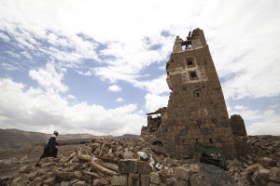
Saudi Led Destruction of Yemen’s heritage
or go to
Aletho News Archives – Video-Images
From the Archives
Israel: Strategic Ally or Liability?
By Stephen Sniegoski | My Catbird Seat | June 12, 2010
The claim that Israel serves as a valuable ally for the United States is made by both pro-Zionists and much of the anti-war and anti-Zionist Left that is influenced by Noam Chomsky. As a result of the Gaza flotilla massacre, which has caused a world-wide uproar against Israel, the value of Israel to the United States is being publicly questioned in more mainstream foreign policy forums. … continue
Blog Roll
 Aletho News
- Four in five new UK jobs taken by foreigners – report
- Here’s what Trump’s latest U-turn really means for Russia and Ukraine
- The Houthis Are Not an Iranian Proxy
- Europe’s Energy Hypocrisy, Russian LNG Profits and US Dependence
- ICC ignored ‘very well-documented’ NATO crimes – ex-Libyan minister
- SNSC secretary dismisses US response to Iran’s conditions as ‘inadequate’
- Sanaa says Taiz roads open, secure for residents, warns Saudi forces
- Iraqi resistance group urges Saudi leadership to admit defeat, lift Yemen siege
- Trump’s Retreat: How Al-Aqsa Flood Took Down the US Empire
- Israel’s Military Actions in Lebanon Grossly Violate International Law — Lavrov
- If Americans Knew
- ADL is working with AI companies to suppress alleged ‘antisemitism’
- Israeli occupation forces using social media surveillance unit to target hundreds of Palestinians in the West Bank
- Israel’s New – and Terrifying – Security Doctrine
- Israeli Attacks Kill Five in Gaza, Including a four-year-old and a woman
- Air Force Major Who Called for Trump’s Impeachment Held in Solitary Confinement
- It’s a Genocide, I’m Into It’: Seinfeld Mocks Protest over Palestinian Children Killed
- Universities fire dozens amid pressure from Zionist billionaires
- Gaza’s buildings are collapsing on top of us. But there’s nowhere else to shelter
- Israel kills four-year-old Gaza child – Daily Update
- After Oct 7, IDF policy allowed civilian casualties for even the lowest-ranking targets
- No Tricks Zone
- New Study Suggests Large Regions Of The Pacific Ocean Have Been Cooling For The Last 80 Years
- Germany’s Green Energy Debacle: High Energy Costs Force Kahla Porzellan to Close After 182 Years!
- New Study: 50 Years Of The Most Aggressive ‘Net Zero’ Policies Can Only Affect The Global Climate By 0.03°C
- US September “Heat” Was No Record…Many Records Set Decades Ago
- Latest European Green Energy Debacle; Portugal’s Largest Flagship Solar Park Insolvent!
- Green Energy Debacle: German Expert Professor Fritz Vahrenholt Warns Of Severe Economic And Social Consequences
- Two More Paleo Reconstructions Affirm Meters-Higher Sea Levels Across Ireland, Brazil 7000-6000 Years Ago
- New Study: Earth And Venus Surface Warmth Largely Explained By Convection And Lapse Rate, Not CO2 Or Radiation
- 2025 Nature Paper Claiming Worsening Global Drought Gets RETRACTED …Heavily Flawed
- New Study: ‘Global Drought Shows No Detectable Recent Acceleration Under Climate Warming’

