US Congresswoman Greene Says CIA Running Conflict Against Russia in Ukraine
Sputnik – 03.04.2024
WASHINGTON – The CIA is directing the conflict against Russia on the ground in Ukraine, US Congresswoman Marjorie Taylor Greene said in an interview with journalist Tucker Carlson.
“To fund a war, to pay for it, to continue it, to advise it, to have our CIA on the ground over there running that war in Ukraine against Russia — nuclear-armed Russia… that is a complete departure from anything that is Christian,” Greene said on Wednesday.
It is contrary to Christian principles to fund wars all over the world, Greene added.
Fighting a “proxy war” in Ukraine against Russia does not protect the US or serve its national security interests, Greene said. People in the US want to see a peace deal between Russia and Ukraine, Greene said.
Officials and media lie every single day by claiming that Russia intends to take over Europe, Greene said. Such a claim contradicts statements made by Russian President Vladimir Putin, Greene said.
In February, US media reported that the CIA created a network of spy bases in Ukraine over the past eight years, including a dozen forward operating bases along the Russian border that engaged in operations against Russia. CIA Director William Burns has personally visited Ukraine at least 10 times since February 2022.
Samantha Power and the Power of a Word
BY DIANA JOHNSTONE • UNZ REVIEW • APRIL 3, 2024
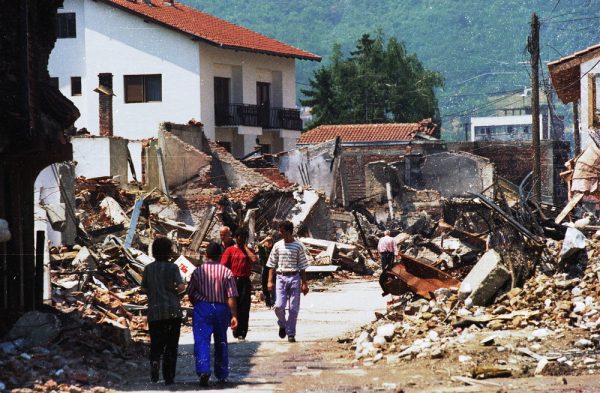
Twenty-five years ago, NATO was bombing Serbia as the first performance in its new role. The collapse of the Soviet Union had deprived the military alliance of its initial official role of defending its member states from a theoretical communist threat. Under no threat and devoid of UN Security Council approval, NATO assumed the self-ordained role of virtuous defender of allegedly oppressed minorities by bombing what was left of largely dismantled Yugoslavia in the spring of 1999 on behalf of Albanian rebels in the Serbian province of Kosovo.
NATO’s air attacks on the Balkan nation were the practical application of a new post-Cold War doctrine. To succeed, this doctrine relied on Western media to report on crisis areas with the appropriate mixture of exaggerations, omissions and outright lies to justify NATO’s virtuous interventions. The military industrial complex could breathe easy and a new generation of journalists began successful careers eagerly spinning their reports to serve the new humanitarian war ideology.
None was more successful than Dublin-born Samantha Power, whose novice reports from Bosnia in the mid-1990s provided the basis for her 2002 book on “genocide” which “quickly became an international sensation, glowingly reviewed almost everywhere, a huge bestseller that won her a Pulitzer Prize and launched her career as a leading figure in human rights doctrine.” She has gone on from one top governmental post to another, a Washington star, urging the United States to intervene on moral grounds.
Samantha Power owes her remarkable success to her talent as a writer, her ambition, her striking presence, but not least to the man at the origins of the whole humanitarian war policy.
That was none other than Morton Isaac Abramowitz, a highly influential member of the foreign policy establishment and the main inventor of what would become the “R2P” (Responsibility to Protect) doctrine. The crucial policy contribution of Abramowitz is explained at the start of my 2002 book, Fools’ Crusade, as follows:[1]
As president of the Carnegie Endowment for International Peace in the early 1990s, Abramowitz headed a project to develop a new U.S. foreign policy for the post-Cold War era. Rather than identifying “threats”, especially at a time when few threats could be seen, a successful new policy needed to combine promotion of U.S. interests with proclamation of U.S. “ideals”.
Theory and Practice
At the Carnegie Endowment in 1992, Abramowitz published the theory of the new U.S. “humanitarian intervention” policy as Self-Determination in the New World Order.
“The vision of a ‘new world order’ since 1990 has been a world with one superpower – the United States – in which the rule of law supplants the rule of the jungle, disputes are settled peacefully, aggression is firmly met by collective resistance, and all people are justly treated.”
That sounds very nice. But put into practice, “collective resistance” means NATO, and “all people are treated justly” depends on Washington’s preferences. The new rules-based order was not to be confused with traditional international law, based on national sovereignty. Globalization was making national sovereignty outdated (except for the United States). “Ideals” make rules more flexible.
The sovereign nation is being broken down subtly by the pressures of economic globalization. It may also be undermined from within, by domestic insurgencies. In the post-Cold War world, the Carnegie Endowment study noted, “groups within states are staking claims to independence, greater autonomy, or the overthrow of an existing government, all in the name of self-determination”. […] In the future, the authors announced, “humanitarian intervention will become increasingly unavoidable”. The United States will have the final word as to when and how to intervene.
Abramowitz subsequently helped put his theory into practice in crumbling Yugoslavia. He was the eminence grise behind U.S. diplomats, steering the events leading to the “Kosovo war” that split the province of Kosovo off from Serbia. He was advisor to the Kosovo Albanian delegation at the imitation “peace negotiations” staged at Rambouillet to provide an excuse for the bombing of Serbia. The moderate Albanian Kosovo leader Ibrahim Rugova was replaced by the armed gangster, Hashim Thaci. Secretary of State Madeleine Albright set terms no Serbian leader could accept, demanding the right to station NATO troops over the entire country, with full impunity. The Serb side was then blamed for the failure, and NATO began to bomb on March 24, 1999.
Samantha Steals her Way into Bosnia
Back in 1992, fresh out of Yale, 22-year-old Samantha Power was given a position as intern in the office of Abramowitz at the Carnegie Endowment. As a proofreader, she quickly absorbed the new official doctrine. At that time, her boss was obsessed with the conflicts in Bosnia as implicating the future of NATO. Determined to get to Bosnia where the action was, Samantha stole stationery from the neighboring office of Foreign Policy magazine and forged a letter from the editor to the head of the UN Press Office, asking that the UN provide her, as Foreign Policy’s “Balkan correspondent,” with “all necessary access.”[2]
From that time on, her work functioned precisely to advance the new “humanitarian intervention” policy of her mentor, Morton Abramowitz. She recalls that his influence helped her get increasingly important assignments – most crucially, writing about the Srebrenica massacre for The Washington Post.
With the Srebrenica reports, the term “genocide” emerged as the power word that could give NATO its new mission.
The Western press corps based in Sarajevo tended to become emotionally involved with the Muslim side which was its principal news source. Missing from their dispatches were reports on Muslim massacres of Serbs villages or on the well-armed Islamic fighters who joined the Muslim side from Afghanistan and Arab countries, some of them settling permanently in Bosnia.
When Bosnian Serb forces captured the Muslim base at Srebrenica in July 1995, they evacuated women, children and the aged to safety, while men fled, fearing retaliation. Many were killed in unclear circumstances.
Without reference to such context, Western media focused on reports of a massacre of 8,000 male prisoners as a unique event which branded the Serbs as the guilty party in the three-sided civil war. With the Srebrenica reports, the term “genocide” emerged as the power word that could give NATO its new mission.
Calling Srebrenica “genocide” provided the argument for NATO bombing: if Serbs committed genocide in Bosnia, it implied that Serbs were genocidal and risked committing genocide in Kosovo unless NATO intervened. This theory was supported by wildly inaccurate accusations voiced by leading Western politicians during the bombing campaign.
That was the story that was sold to the public by politicians and the media. From the start, the Serb majority in Yugoslavia had been portrayed as invaders in their own country, with everyone else as victims. Thus was destroyed the last semi-socialist, nonaligned country in Europe.
The Kosovo war indeed combined U.S. “interests and ideals”. The ideals were preventing a genocide that never would have taken place (and also, incidentally, preventing a negotiation that could have settled the whole conflict as well). The interests included the immediate construction by the Americans of a giant U.S. military base on the territory of Kosovo, once Serbian forces were obliged to leave.
Genocide and R2P
Samantha Power’s 2002 book was subtitled “America in the Age of Genocide”. To speak of the present as an “age of genocide” is wildly melodramatic, but the purpose is to place virtuous America in the center of drastic moral demands. America must save the world from its genocidal self. “Genocide” was thereby promoted as the most potent pretext for U.S. military intervention – precisely by deploring its absence, both in Bosnia and more convincingly, in Rwanda. The Clinton administration was certainly not going to intervene in Rwanda, because the bloody chaos was in fact favoring the conquest of Rwanda by Paul Kagame and his army, which had invaded Rwanda from Uganda in 1990. Kagame was a favored client of the United States. There was no reason for Washington to interfere with Kagame’s victory.
But the “failure to stop genocide” was an appeal to the liberal conscience to intervene later on, whenever the U.S. was in need a powerful argument to get rid of a someone it wanted to get rid of. Moammer Gaddafi had been on the U.S.-UK hit list for decades, but had made concessions to gain reconciliation. But when Gaddafi’s usual fundamentalist Islamic opponents in Tripoli used the 2011 “Arab spring” to raise protests, the “threat of genocide” alarm was raised on their behalf. In Washington, action to stop Gaddafi from “committing genocide” was urged by Hillary Clinton, Susan Rice and Samantha Power, while Bernard Henri Lévy raised the alarm in Paris. NATO rose to the challenge, destroyed the most economically successful country on the African continent and murdered its leader, creating a flood of refugees to Europe and other disasters. Most of the liberal left cheered.
Today it is widely recognized that the Irak war was based on deceit and ended in disaster. Other U.S. wars are mostly conceded to have been unfortunate mistakes. There are doubts about Libya, due mainly to the refugee flow. But the destruction of Yugoslavia, and in particular the 1999 “Kosovo war”, is still widely accepted in the West as what it was arranged to appear: NATO’s generous humanitarian intervention to prevent “genocide” by racist Serbs against the oppressed Albanian minority.
The distortions of the Bosnia conflict and the Kosovo war were precisely the practical application of the Abramowitz policy: promote minority rebellions to break down national sovereignty and change governments the U.S. doesn’t like, while supplying NATO with a new geographically unlimited mission of “humanitarian intervention”. Yugoslavia was the starting point of the whole aggressive post-Cold War U.S. policy as “single superpower” determining the world order, using the idealistic pretexts set out by Abramowitz. Young Samantha Power, who was very smart, got the point and ambitiously cheated her way into a supporting role as reporter in the Bosnia spectacle, which she eventually transformed into an astonishingly successful career.
I was in Kosovo on my own in months prior to the NATO bombardment and saw quite clearly that in that small province, the Serbs were a frightened minority while Albanians were already tasting their future triumph. There was absolutely no danger of a Serbian “genocide” of Albanians. But Western editors kept sending in ignorant young aspiring journalists, on the lookout for some “Serb atrocity” that could advance their budding career. Editors rejected any report that went in a different direction. It was at that time just plain impossible to publish an unbiased report. I know from experience.
Above all, breaking up Yugoslavia was an exercise in subsequent efforts to undermine the Russian Federation, by inciting the Federation’s ethnic minorities against the Russians. Ukraine was the crucial battering ram. I always used to think of Ukraine when studying the conflicts in the Krajina regions of Croatia and Bosnia, as both words have the same root (border land) and suffered from similar conflicts, notably in World War II. Western powers had revived the Nazi-supported Croatian nationalism against the Serbs to break up Yugoslavia. They would revive much more virulent Nazi-supported Ukrainian nationalism against Russian-speakers in Eastern Ukraine, in an effort to weaken and eventually even break up the Russian Federation.
And for the United States, the humanitarian “ideals” of supporting minorities would be compensated by the major strategic “interest” of eventually gaining control of Crimea, and with it, Russia’s main naval base in Sebastopol. Putin did what any Russian leader not brain-dead would have done: he headed off this disaster by mobilizing the Russian inhabitants of Crimea to vote to return to Russia, which they had never chosen to leave. This obvious act of self-determination is denounced in the West as an invasion.
The Ideological Backlash
Unfortunately, the blatantly tragic misuse of the “humanitarian intervention” or R2P doctrine in Libya has not managed to achieve its discredit. It is threatened now by the danger that it is changing sides in the very global conflicts it has stimulated.
The referendum in Crimea was a democratic measure of self-determination that fit the Abramowitz standards. The Russian “Special Military Operation” in Ukraine in 2022 was partially motivated by the sort of consideration featured in the Abramowitz doctrine: defense of the population of Donbas, under attack from an ultranationalist regime in Kiev. Of course, Western governments and media have simply totally ignored any Russia appeal to the ideals of human rights and self-determination, which they consider their own private property as self-declared unique “democracies”. Russia is classed as an “autocracy” whose interests must be malevolent and thus don’t count.
A greater threat to the West’s self-proclaimed monopoly on virtue is coming from Israel’s merciless attack on the people of Gaza. Most of the Global South and growing sections of Western populations are horrified by Israel’s destruction of hospitals, mass murder of children and efforts to starve the Palestinians. They see Israel, with full Western backing, committing Genocide – the real thing this time, out in the open, blatant and unrelenting.
The NATO war machine may have to conjure up a new set of moralizing pretexts for its aggressions.
Notes
[1] See Fools’ Crusade: Yugoslavia, NATO and Western Delusions, Pluto Press, 2002, pp 9-10; Monthly Review 2003
[2] Here, with William Burns, Samantha Power discusses her new autobiography The Education of an Idealist and recalls her short term working for Abramowitz at the Carnegie Endowment. https://carnegieendowment.org/2019/09/13/samantha-power-on-education-of-idealist-event-7178
Israel’s Attack on Iranian Consulate Highlights Netanyahu’s Pending Defeat in Gaza
Sputnik – 02.04.2024
Tel Aviv launched a strike against the Iranian diplomatic compound in the Syrian capital of Damascus this week, killing several Islamic Revolutionary Guard Corps officers in the process.
Israel’s attack on the Iranian consulate in Syria suggests that it is trying to “widen” the ongoing conflict in the Gaza Strip by drawing Iran into it, said Foad Izadi, an associate professor at the University of Tehran’s Department of American Studies.
“They have been trying to start a military confrontation between the United States and Iran for many years. And they think that they have an opportunity to have this done fighting Iran using American soldiers,” he told Sputnik, apparently suggesting that the US would be quick to leap to Israel’s defense if the latter were threatened by Tehran.
Izadi also remarked that Israel displayed a blatant disregard for international law by attacking a diplomatic compound, which is a violation of the Vienna Convention.
“That is what Israelis are trying to do. Netanyahu realizes that he has lost the war in Gaza. He has managed to kill more than 30,000, mostly women and children, without achieving any goals except killing these people and ruining their homes,” Izadi said.
“They say that they want to destroy Hamas, but that’s not a goal they can achieve. Obviously, they would have done that if they could. That’s why criminal acts and genocide in Gaza continue. And Netanyahu realizes that sooner or later this war needs to end. And that would be the end of his prime ministership. And so he’s trying to prolong the war, he’s trying to widen the war,” Izadi added.
Noting that Iran’s attempt to seek justice via the UN Security Council may be unsuccessful due to the likelihood of the US vetoing a resolution critical of Israel, Izadi suggested that Tehran may opt to “cause pain for the Israelis so that these types of actions are not repeated.”
“Because Iranian officials realize that if there is no pain in engaging in this type of activity, then they will continue,” he elaborated. “So I think Iran’s response would be two-fold in a manner that is not satisfying the Israeli aim of widening the war. I think that’s what Iranian leaders will do.”
NATO ‘de facto’ part of Ukraine conflict – Moscow
RT | April 2, 2024
NATO is aiming to retain control over Ukraine and turn it into an “anti-Russian” proxy, the secretary of the Russian Security Council, Nikolay Patrushev, claimed in an interview published on Tuesday.
The US-led military bloc has long been a “de facto” party to the conflict between Kiev and Moscow, as it controls Ukrainian arms supplies and helps to plan attacks on Russia, Patrushev told the Russian newspaper AiF.
Washington and its allies have been actively militarizing Ukraine ever since the 2014 Maidan coup in Kiev, the official said in an interview covering the US-led military bloc, ahead of its 75th anniversary. NATO now seeks to “keep Ukraine or at least a part of it, as a fully controlled anti-Russian territory,” he stated.
NATO collectively decides on the quantity and types of weapons its members provide to Ukrainian troops, the Russian official noted, adding that the range and technical characteristics of those arms are constantly increasing.
The bloc’s instructors also “train mercenaries and sabotage units on several nations’ territories to be used in anti-Russian operations,” Patrushev told the paper. Under such circumstances, the Kremlin’s goal of bringing about Ukraine’s “demilitarization” remains a priority, the Security Council secretary said.
Stirring up Russophobia and whipping up the perceived “Russian threat” has also turned into a “major policy” for the West, the official said, arguing that such tactics allow the US and its allies to draw public attention away from internal economic issues.
Anti-Russian hysteria ultimately benefits the US military industrial complex, Patrushev stated.
“The US is gaining profits through… dictating very specific arms purchasing conditions to its allies,” the official told AiF, adding that those arms are then produced by American manufacturers, and such contracts can become economic shackles for other NATO members.
Patrushev’s remarks come amid a historic low in Russia-NATO relations. The situation is now worse than during the Cold War, the head of Moscow’s delegation at the Vienna talks on military security and arms control, Konstantin Gavrilov, acknowledged on Monday.
Gavrilov stated that constant talk from Western politicians about Russia’s alleged plans to attack NATO after defeating Ukraine are aimed at diverting public attention from their own governments “pumping … money into the Ukrainian ‘corruption black hole’.”
Moscow has repeatedly stated that it has no plans to engage in a military confrontation with NATO or any of its members. President Vladimir Putin said earlier this year that Russia “has no interest … geopolitically, economically or militarily… in waging war against NATO.”
Update on the Crocus terror attack
By Gilbert Doctorow | April 1, 2024
Day by day, the Russian security officials are expanding upon their claims that Ukraine financed and directed the terror attack on the Crocus City Hall concert venue. Sunday evening’s edition of News of the Week hosted by Dmitry Kiselyov pointed to crypto currency payments and other financial channels which were used by the Ukrainians, as the latest results of interrogations and further arrests have revealed. A substantial success reward is said to have awaited the assailants upon arrival in Kiev.
Meanwhile various Western media outlets including Deutsche Welle tell us the Kremlin has demanded the hand-over of the head of Kiev’s Security Service (SSB), brigadier general Vasyl Malyuk on charges of directing terrorist attacks in Russia. To be sure, Malyuk himself has claimed responsibility for the 2022 bombing of the Kerch (Crimea) bridge. But we may now assume that the Russians have evidence to hold him to account for directing the Crocus City Hall atrocity.
There is speculation in social media that Kiev’s refusal to surrender its terror campaign leaders would allow Russia to declare Ukraine a terrorist state. This would open the possibility for ‘neutralizing’ top Ukrainian officials on justifiable grounds.
However, we need not speculate about what may come next. De facto, Russia’s current offensive against Ukraine has escalated to a new, vastly more threatening level. There are daily punishing aerial bombing and missile attacks on military command centers across Ukraine, on training centers, on concentrations of foreign mercenaries. And then there is a new dimension to the destruction of Ukraine’s electricity network.
In the winter of 2022-2023, all the Western media spoke of Russian attacks on the energy infrastructure, on how Russia was allegedly seeking to impose misery on the Ukrainian civilians by depriving them of heat and light in the midst of freezing cold. But back then the reality was that Russia only struck substations and other distribution points. Such destruction was meant to knock out power for tactical advantage over the Ukrainian armed forces. It was obvious that the substations and other gear could be replaced in a matter of weeks or months. By contrast what is now going on is Russian destruction of power generating stations. Replacing them will be a matter of years, not months.
Very much to the point, the mayor of Kharkiv yesterday remarked to the press that the city’s power supplies have been utterly destroyed. This development corresponds very nicely to the calls that were made on the Evening with Vladimir Solovyov talk show last week for Kharkiv’s inhabitants to be sent packing in their cars headed west ahead of the city being razed to the ground. The intent was to end once and for all the missiles and artillery shells that Kharkiv has been sending daily into the neighboring Belgorod region of Russia to kill civilians in the greatest numbers possible. Kharkiv may not yet be razed, but it certainly is on the way to becoming uninhabitable.
In the face of this massive and undeniable destruction by the Russians both on and off the battlefield, the bravado of Zelensky and his clique is fading. Indeed, the Ukrainian president has finally said publicly that it may be time for peace negotiations.
Let us hope that Russia’s post Crocus viciousness may bring the Ukrainians to their senses and end this awful war.
©Gilbert Doctorow, 2024
Senior IRGC commander, his deputy assassinated in Israeli attack on Iran Embassy’s consular section in Syria
Press TV – April 1, 2024
A commander of the Quds Force of Iran’s Islamic Revolution Guards Corps (IRGC) in Syria and Lebanon has been martyred in an Israeli attack on the Iranian consulate in the Syrian capital of Damascus.
Brigadier General Mohammad Reza Zahedi and his deputy, Mohammad Hadi Haji Rahimi, were killed in the Israeli attack on Monday on the Consular Section of the Embassy.
Syria’s official news agency, SANA, said the strikes were carried out by “the Israeli enemy” and targeted the Mezzeh neighborhood in Damascus on Monday afternoon.
Iran’s Ambassador to Damascus Hossein Akbari confirmed the reports of the Israeli attack and said the regime had targeted the consular building with six missiles.
Akbari said seven people were martyred in the Israeli aggression but the names and the exact number of martyrs have yet to be specified. He also noted that several Iranian military advisors and diplomats were also martyred in the missile attack, whose names would be announced later.
According to the ambassador, the Consular Section of the Embassy was targeted by F-35 fighter jets and six missiles.
Born in 1960, Zahedi joined the IRGC in 1980 and was a commander of the elite force during the Iraqi-imposed war in 1980-88.
He was the commander of the IRGC Air Force from 2005 to 2006. Later he served as the IRGC Ground Force Commander from 2006 to 2008.
Zahedi served as a commander of the IRGC Quds Force from 2008 to 2016.
Ukrainian counteroffensive ‘biggest debacle in modern military history’ – David Sacks
RT | April 1, 2024
The failure of Ukraine’s 2023 summer counteroffensive against Russia was “easily predictable,” according to US tech entrepreneur and venture capitalist David Sacks, who has suggested that the Washington elite should be held accountable for talking up the doomed operation.
Sacks’ comments came in response to a post on Saturday by Tesla and SpaceX CEO Elon Musk, who condemned the unnecessary loss of life suffered by Kiev’s forces as they attempted to “attack a larger army” that had superior defenses.
The failed Ukrainian counteroffensive was “one of the biggest debacles in the history of modern warfare,” Sacks said in agreement, adding that Kiev’s soldiers and tanks had effectively run “headlong into minefields while Russian artillery rained down on them from heavily fortified positions.”
“This should have been easily predictable,” the former PayPal COO and founder of the Yammer corporate social network stressed.
According to estimates released in March by the Russian Defense Ministry, the Ukrainian military saw over 166,000 casualties during last year’s failed counteroffensive. Kiev’s overall casualties since the outbreak of the conflict with Russia stand at 444,000, the ministry has claimed.
Sacks went on to suggest that US officials such as ex-CIA chief David Petraeus, former House Speaker Nancy Pelosi, and current US Secretary of State Antony Blinken should all be held responsible for encouraging the doomed operation.
“These people are fools who should have no credibility left. But of course the MSM never holds them accountable so we will get more of the same until Ukraine finally collapses,” Sacks surmised.
Musk, meanwhile, has called the counteroffensive “a tragic waste of life for Ukraine,” suggesting that Kiev should not have attacked Russian forces – which had deployed vast minefields and had stronger artillery – while Ukrainian forces lacked armor or air superiority.
“Any fool could have predicted that,” the billionaire said, recalling that one year ago he had recommended that Kiev’s forces entrench and apply all resources to defense.
Musk stated that Kiev would continue to have difficulty holding on to territory, but suggested that Russia was unlikely try to take over the entire country, arguing that it would face “extreme” local resistance in western regions of Ukraine.
He also warned that if the conflict “lasts long enough, Odessa will fall,” and advised Kiev to reach a negotiated settlement with Moscow as soon as possible, before Russia gains more territory and Ukraine loses all access to the Black Sea.
Moscow has stressed that it remains open to meaningful talks with Kiev, and has blamed the lack of a diplomatic breakthrough on the Ukrainian authorities, who refuse to accept the “reality on the ground.”
Russia-NATO relations worse than during Cold War – Moscow
RT | April 1, 2024
The current state of relations between Russia and NATO can be described as “something more than a Cold War,” the head of Moscow’s delegation at the Vienna talks on military security and arms control, Konstantin Gavrilov, has said.
During his interview with RIA Novosti on Monday, Gavrilov was asked to comment on French President Emmanuel Macron’s February statement that he “cannot exclude” the possibility of troops from NATO countries being sent to Ukraine to aid Kiev amid the conflict with Moscow.
“The military strategists in Washington and Brussels should realize: if by lifting the taboo on the potential deployment of the bloc’s servicemen to Ukraine they are trying to test our country’s strength, then we are ready for any turn of events,” he replied.
According to the diplomat, the warnings from US President Joe Biden and some other Western politicians, that if Russia defeats Ukraine it is going to take on NATO states next, are actually aimed “to divert the attention of taxpayers from the senseless pumping of their money into the Ukrainian ‘corruption black hole’ as well as to warm up the public opinion in favor of reviving defense industries in their countries.”
His comment echoed Russian President Vladimir Putin’s statement last week that “the claims that we are going to attack Europe after Ukraine – it is utter nonsense and intimidation of their own population just to beat the money out of them.”
Gavrilov said that during the Cold War, almost all NATO statements began with the evaluation of the possibility of a sudden large-scale attack on the bloc by the USSR and its Eastern European allies. Similar rhetoric is prevalent within the US-led military alliance today, he added.
The diplomat recalled that Russia has been labeled “the most significant and direct threat” in NATO’s Strategic Concept, which was adopted in 2022. “Apparently, now their ideal vision of European security is the borders with our country being wrapped in barbed wire,” he said.
“As a result, Russia-NATO relations can now be characterized as something more than a Cold War,” Gavrilov stressed.
Since fighting between Russia and Ukraine began in February 2022, Moscow has said repeatedly that the US and its NATO allies have become de-facto parties to the conflict through the provision of arms, including advanced weaponry, intelligence-sharing, and the training of Ukrainian troops.
Finland supports open war against Russia
By Lucas Leiroz | April 1, 2024
Apparently, Emmanuel Macron’s stance on the Ukrainian conflict is gaining supporters among European warmongers. In a recent statement, Finnish Foreign Minister Elina Valtonen supported the plan to send troops to Ukraine in the future, if Kiev proves unable to continue fighting. The case is further evidence of how anti-Russian paranoia is reaching worrying levels among European states, leading them to almost engage in open war with Moscow.
According to Valtonen, Macron is assuming a position of “strategic ambiguity” necessary for the current stage of the conflict. This “ambiguity” consists of not making it clear whether or not NATO troops will be sent to Ukraine. The precise time of the possible deployment also remains unknown. Valtonen sees this position as correct, since, according to her, Western countries must deliberate on such a strategic decision, choosing the moment to openly engage in the conflict.
Her view is that the West should avoid self-imposing red lines. She praises Macron for not ruling out direct intervention as this gives the West freedom to decide how and when to act. In an interview to the Financial Times, Valtonen stated that she does not see any need for Western intervention in the conflict for now, but supported the plan to send troops in the near future, if “necessary”. For her, the most important thing is that there are no strategic limits for the West, with NATO countries having maximum freedom to make any decision regarding the conflict.
“Now’s not the time to send boots on the ground, and we are not even willing to discuss it at this stage. But, for the long term, of course we shouldn’t be ruling anything out (…) Why would we, especially not knowing where this war will go and what happens in the future, disclose all our cards? I really wouldn’t know (…) What I liked about two recent announcements of President Macron is that he said that actually why should we impose ourselves red lines when Putin basically has no red lines?”, she told journalists.
As we can see, the Finnish official considers the direct deployment of troops as a Western “card”. She seems not to care – or simply not to understand – the catastrophic consequences of an open conflict between NATO and Russia. This shows, in addition to high bellicosity, a true diplomatic inability, which is particularly worrying since she is the head of Finnish diplomacy.
It is interesting to note how fallacious Valtonen’s speech is. She states that Europeans should not rule out direct intervention because “Putin basically has no red lines.” However, since the beginning of the special military operation, it is Russia, not the West, that has self-imposed strict limits on how to act in Ukraine. Moscow deliberately moderates its military intensity to avoid side effects and civilian casualties. Instead of launching a high-intensity operation for a prolonged period, the Russians prefer a tactic focused on attrition and slow territorial gain, thus reducing damage to the Ukrainian civilian population.
Bombings against Ukrainian critical infrastructure happen rarely, almost always in retaliation for previous terrorist attacks carried out by Kiev on the border. If Russia really didn’t self-impose red lines, there would no longer be any infrastructure in Ukraine and Kiev would have collapsed a long time ago. Moscow clearly sees the conflict as a tragedy and strives to prevent its consequences from being even more serious for innocent people.
On the other hand, the West clearly has no limits when it comes to acting in Ukraine. In the first weeks of the special military operation, NATO countries promised to limit their support to sending money and humanitarian aid. Before long, weapons began to be sent, and then long-range missiles were arriving in Kiev some months later. NATO simply engaged in a proxy all-out war through the neo-Nazi regime – but was quickly defeated.
With the Ukrainians becoming unable to continue fighting and the Western military-industrial complex collapsing in the face of its inability to produce more weapons for Kiev, the West can only choose between retreating or moving towards direct war. Macron, trying to improve his domestic and international image, launched a “PR stunt” talking about sending troops to Ukraine, but showing no real capacity or willingness to take this dangerous step.
The problem is that among Macron’s audience there are European leaders enraged by the anti-Russian paranoia spread by NATO. These leaders have been deceived by the propaganda of their own “allies” and now truly believe that if they do not make “hard decisions” they will be “invaded by Russia” in the future. Finally, it seems that the lack of rationality and strategic sense is leading European countries to make a serious mistake.
You can follow Lucas on X (former Twitter) and Telegram.
Globalism and Disease X
By Meryl Nass | March 30, 2024
What is biowarfare? COVID was due to a biological warfare agent. It was designed in one or more laboratories to be more virulent than its natural precursors:
- to prefer to infect humans;
- to infect more organs than possible in naturally occurring strains;
- to interfere with the body’s immune responses.
I say one or more laboratories becasue many of its features had been previously discovered or created in various laboratories, and then these features were essentially grafted onto a coronavirus, one by one; or some features were achieved by passaging the virus through humanized mice, other humanized animals, human cell tissue cultures or humans themselves.
Why were these features created? In which labs?
Why were they painstakingly added to a coronavirus backbone? Where was this done and how many labs were involved?
Why was a coverup by western scientists so critical? Because claiming that pandemics come from animals living in nature, and are spread to humans due to our incursions into their territory, was needed to justify the entire biosecurity agenda that the WHO is steamrolling over us.
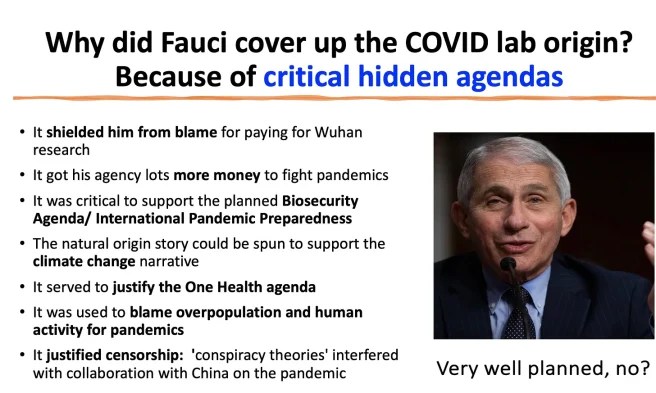
By the way, the newest version of the treaty (released March 7, 2024) states that part of the WHO plan is to “identify” those areas where disease “spillover” occurs. You watch: the WHO will then empty those areas of humans. It really is a great cover story, “spillover.” Except it is a total lie.
_____________________
Historically most biowarfare agents were naturally occurring viruses or bacteria. Here is one example in which whistleblowers identified the hand of the CIA.

It is “gain-of-function” research that makes them more virulent and/or more transmissible. Gain of function research was considered illegal under international law until about 2001, and then the customary norms of national behavior simply changed, after the US was caught ignoring the usual norms—as revealed in the NYT on 9/4/2001 and in the book GERMS.
The WHO suggested it should be put in charge of gain-of-function research in the pandemic treaty draft that was released on February 14, 2024. It only took 3 weeks before a new draft was issued on March 7, 2024 in which all mention of “gain-of-function” was erased. I wonder if the rapidity of release of the next draft (it usually takes about 3 months to get a new draft) had to do with cutting out the Gain-of-Function section.
But the idea of requiring nations to supply the WHO with samples of potential pandemic pathogens, and to upload their genetic sequences to publicly accessible databases asap remained, was discussed with even more details in the newest March 7 draft. The WHO and nations would be free to share biological warfare agents aka potential pandemic pathogens (essentially) with anyone they liked.
This makes no sense any way you look at it. The goal seems to be a situation where “Pandemics R Us” and they appear frequently, with no ability to tell where they came from or whether they were deliberate or an accident. By sharing them all globally the WHO has paved the way for using the alibi of accidental release for future COVIDs.
The biowarfare segment starts at about 26 minutes into the episode.
As I said, we at DoortoFreedom.org are here to help you educate your lawmakers while you urge them to question this effort publicly, introduce resolutions, and in other ways throw some boulders in front of the steamroller, just like Louisiana’s Senate did this week.
merylnass@gmail.com
Ukrainian police investigate ‘pro-Russian’ shelling victim

RT | March 31, 2024
Police in Ukraine’s second largest city, Kharkov, have said that criminal proceedings have been launched against a local woman who insisted that Ukrainians should not be celebrating their troops’ shelling of Russia’s border regions.
She expressed the opinion despite her own home being hit by a Russian airstrike on her city, which had reportedly targeted electrical infrastructure and defense industry facilities.
Police said in a statement on Saturday that officers “have found a video on social media,” in which a 59-year-old female resident of Kharkov’s Shevchenkovsky District “denied the armed aggression by Russia, supported the invasion of Ukraine and the occupation of part of the state’s territory and condemned the actions of the Ukrainian authorities.”
The clip in question featured a short interview following Russian airstrikes on Kharkov on March 24. The woman spoke with a journalist through an empty window-frame in her home; the glass had apparently been blown out by a nearby explosion.
In the footage, the local resident refused to condemn Moscow and called for an end to violence, saying that the Ukrainians should not “throw” missiles at Belgorod and other Russian border regions and “should not celebrate” those attacks.
When the journalist disagreed with her stance, she replied by saying that they simply had different views. “I believe that one must have friendly relations with neighbors,” the woman stressed, referring to Ukraine and Russia.
Kharkov is located just 30 kilometers (19 miles) south of the Russia–Ukraine border and remains a predominately Russian-speaking city.
She is now being probed for “collaborationist activities,” the police said. As part of a pre-trial investigation, the officers have spoken to witnesses, who “confirmed the pro-Russian stance of the person in question and reported conflicts with her on this issue,” the statement read.
The Ukrainian criminal code was adjusted in March 2022, a few weeks after the launch of Russia’s military operation. It criminalizes a vast array of activities, including the public backing of Moscow’s actions, offering direct material and financial aid to the Russian forces, and the execution of official roles in areas captured by Russia.
Earlier this month, a court in the Ukrainian city of Vinnytsia ordered the confiscation of the apartment of an 80-year-old woman for posting pro-Russian comments on social media. She was also slapped with a four-year prison term. The sentence was delivered in absentia because the defendant has been living in Russia for the past several years.
Europe: soldiers and young people flee armies
By Pierre Duval – Continental Observer – 26.03.2024
French Army Minister Sebastien Lecornu, unveiled his plan to end the increase in departures in the French army. «It is no longer a question of recruiting new soldiers so much as of persuading existing troops not to resign», states Politico. «These conversations now exist in all capitals, in all democracies that have professional armies without conscription», emphasizes the English-speaking media. Western armies can no longer recruit and lack soldiers.
Even Germany is affected. A recent annual report submitted to the German Parliament showed in 2023, some 1,537 soldiers left the Bundeswehr, reducing it to 181,514 troops. Europeans do not want to die for a war their elites want. This reflects the resistance of the populations in Europe against the WAR of the EU against Russia.
In France, according to official data, the military recruit remains in the armed forces for a year on average, less than before the outbreak of the military conflict in Ukraine. In the UK, the annual shortage of personnel is 1,100 men, equivalent to two infantry battalions. The British government signed a recruitment contract with a private company Capita, but this did not succeed.
«The problem is not in being recruited, but in the retention of soldiers, we must also preserve their families’, chief of naval operations of the US Navy, admiral Lisa Franchetti announced at a conference in Paris. It appears that the wives of military personnel have begun asking for divorce more often.
«To train and retain the right people once they have been recruited has become the great challenge of an army without conscription, stressed the Minister at a seminar of those responsible for all military services. In 2023, the French military finished with 3,000 unfilled posts.
The French plan provides assistance to military personnel in finding housing, access to health care and childcare services’. Married couples in which the husband and wife both work in the Defence Ministry, even if one of them is a civilian, will be able to change their position, i.e., by mutual consent.
One of the main measures of the French plan aims to increase the attractiveness of military service is to increase pensions and wages. «But the problem is that the conditions of employment are simply not so attractive, with chronic overtime, absences of several months from home and missed recovery periods», adds Politico.
The new Polish government recently announced a 20% increase in military salaries, seeking to maintain at least the current level of troops. The minimum monthly salary of the soldier will increase from 1,150 euros to 1,394 euros.
By the end of the year, the number of the Polish military is expected to increase to 220,000 people, as reported par Rzeczy Do in reference to the statement by Polish defence minister Wladyslaw Kosiniak-Kamysz. Thus, the overall objective is to increase the number of the Polish military to 300,000 people. But even the wage increase is not motivating the average Pole to shed his blood on the fields of Ukraine.
In Germany, the Scholz government wants to increase the number of its armed forces to 203,000 by the early 2030s, but recruitment is increasing very slowly, warns Politico. Eva Hogl, Bundestag Military Commissioner, stated that it was necessary to restore conscription to military service, and that it is better to attract more women to the military Last year’s legislation aims to make military conditions more attractive for women, especially with regard to the increase in support for children.
In Denmark, the population is so motivated to serve in the army that the government has decided to extend compulsory military service to women and to increase its service from 4 to 11 months.
The UK has also recently admitted that it is having difficulty finding recruits. The UK Defense Journal reports that the British army has not met its recruitment targets every year since 2010. According to a recent YouGov survey, 38% of Britons under the age of 40 say that they will refuse to serve in the armed forces in the event of a new world war, and 30% say they will not serve even if their country is threatened with an imminent invasion.
«The problem is common to all European countries, including France, Italy and Spain», stated Vincenzo Bove to Euronews, professor of political science at University of Warwick in the UK. «I do not think only one country is spared by this situation». According to the expert, these difficulties in recruiting staff began ten years ago in the United Kingdom and twenty years ago in the United States. According to Bove, the ideological distance between society as a whole and the armed forces has widened in recent years.
Bove mentioned recent polls that show that the youth of the European Union is massively opposed to wars, against the increase in military spending and against military operations abroad’. They are also more individualistic and less patriotic than ten years ago. And the population in Europe is aging and shrinking. The armies of NATO have also decreased to adapt to these changes: the British, Italian and French armies are now almost half of what they were 10 or 20 years ago.
The plans of the elites in Europe to break up Russia militarily have run into their inability to rebuild their armies.
Featured Video
Laith Marouf: Hezbollah’s position on US-Iran ceasefire
or go to
Aletho News Archives – Video-Images
From the Archives
The Dirty Little Secret behind the “Global Terrorism Index”
The Omission of Israeli Terrorism in the Occupied Palestinian Territories
By Karin Brothers | Global Research | December 6, 2014
… The Israeli settlements — all of which are illegal – have been identified as a major impediment to peace. The refusal of a major “global” terrorism report to name the Israeli settlers as one of the groups most responsible for terrorism not only misrepresents a major source of regional violence but exposes the Global Terrorism Index as a propaganda tool that supports a U.S. agenda.
In recent years, governments have been attempting to thwart terrorism by blocking supportive fund-raising. When it comes to Israeli settlements, however, the US and Canada actually encourage fund-raising by giving organizations (such as Christian Friends of Israeli Communities (CFOIC) and the Jewish National Fund) financial support in the form of donor tax-deductions.
Charities which provide funds for the Israeli settlements should be regarded as terror-financing organizations. They should not only lose their tax-deductible status, but they should be banned because they support the violation of international humanitarian law. The terror-financing laws that are being strictly enforced for Muslim charities should be applied to Christian and Jewish charities as well. … Read full article
Blog Roll
 Aletho News
- The ‘Opposition Party’ Has Done Nothing to Stop the Iran War and Much to Goad Trump Into Continuing It
- Moscow backs Tehran on status of Lebanon in US-Iran deal
- How UK Regulator Ofcom Quietly Bypassed International Law to Police American Speech
- The Black Cube Files: How Former Mossad Operatives Flipped a Nation
- Laith Marouf: Hezbollah’s position on US-Iran ceasefire: What you’re not being told
- Israel’s priority lies in destroying chances of peace between Iran, US: Ex-UN nuclear chief
- Ceasefire for all or for none: Iran shuts Hormuz over Lebanon attacks
- Strait of Hormuz is Iran’s ‘nuclear weapon’ that forced US retreat: Medvedev
- Energy crisis will last for months – Kremlin envoy
- Europe’s quiet role in the war on Iran
- If Americans Knew
- This is ceasefire? Israel’s biggest massacre yet in Lebanon, another journalist killed in Gaza – Daily Update
- Tucker Carlson on Israel: This Is the Behavior of an Ally? Really?
- Gazans face a triple crisis: severe shortages of water and bread, healthcare in tatters
- NY Times reports how Netanyahu took the US into Iran War
- A sigh of relief over Iran, but Gaza and Lebanon in dire straits – Daily Update
- Thousands dead and neighborhoods razed to the ground: Aid agencies fear southern Lebanon is becoming the new Gaza
- The war the US is fighting for Israel could cost trillions
- ‘Cigarette Burns, Nail Wounds’: Toddler Tortured in Gaza to Coerce Father
- Trump Says US Sent ‘a Lot of Guns’ to Protesters in Iran
- Israeli forces destroy 17 UN peacekeeper cameras in south Lebanon
- No Tricks Zone
- An Inconvenient Tree: Uncovered In Alps… Europe Much Warmer Than Today 6000 Years Ago
- New Study Reports A 60% Slowdown In Greenland’s Ice Loss Rate In The Last Decade
- Low Intensity Tornado Wrecks Major Solar Farm, Creating A Potential Toxic Dump
- New Study Finds Warming Saves Lives…Cold Temperatures 12 Times More Deadly Than Excess Heat
- German Science Blog Accuses PIK Climate Institute Of Hallucinating Climate Tipping Points
- Devastating Assessment Of Comirnaty Vaccine By Former Senior Pfizer Europe Toxicologist
- New Study: CO2 Is ‘Effectively Negligible’ As An Explanatory Climate Change Factor Since 2000
- Former Pfizer Toxicologist Dr. Helmut Sterz Tells Bundestag Hearing Pfizer Vaccine Should Have Never Been Approved
- Energy Expert: Germany’s Nuclear Phaseout Was A “500 Billion Euro Mistake”
- New Research: South Australia’s Mid-Holocene Sea Surface Temperatures Were 4°C Warmer Than Today
 Aletho News