UK-made tank mired during Ukrainian demo for media
RT | March 11, 2024
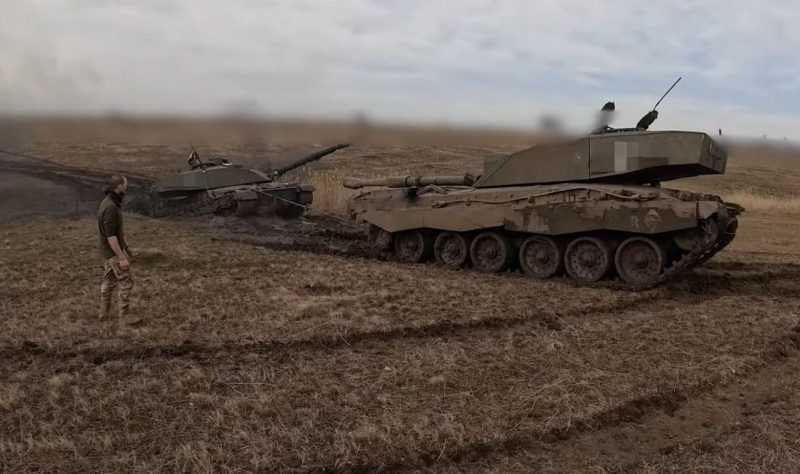
A Ukrainian tank crew got their UK-donated Challenger 2 stuck in a bog during a special demonstration for a British tabloid, the newspaper has reported.
The incident happened during an exercise The Sun described as being “close to the front line” and within view of plumes of smoke emanating from Russian airstrikes. With its crew atop the turret, the British-made tank attempted to drive through a gully, only becoming stuck at its deepest point.
Images shared by the newspaper showed the vehicle stuck in mud deep enough to fully cover its tracks. The incident confirmed that the British tank’s weight is an issue, The Sun said. An experienced squadron commander “blasted the rookie crew for going too slowly through the gully.”
The newspaper added that the tank team leader “turned the mishap into a training exercise” by calling in a second tank to haul the first one out of the mud.
The report noted Ukrainian praise for the tank’s main gun, but added that the conflict had not given the British military hardware a chance to demonstrate its ability in a classic tank-on-tank battle. Ukraine has been using the armor to target bunkers from a long distance and for charges on Russian trenches.
The maneuvers are a bluff, according to the tabloid, because the tanks “did not have the right type of ammunition for attacking infantry.”
While the British tank is superior to Soviet-made T-80s in many respects, Ukrainian crews told the outlet that they weigh some 20 tons more and have a 30% lower power-to-weight ratio, which limits their maneuverability.
German-made Leopard 2 tanks, which have a similar weight, have also reportedly become stuck in soft ground, according to images shared online.
The Challenger 2s are not only being bogged down, but are breaking down. Five of the 14 tanks donated by the UK are not operational because spare parts can take months to arrive, and Kiev lacks skilled mechanics to maintain them. With battle-damaged tanks accounted for, only half of the UK-donated squadron remain fit for battle.
The British tabloid also reported manpower shortages on the conflict frontline, meaning trained tank crews are forced to dig trenches. Nevertheless, the Ukrainians expressed gratitude to the British government for the tanks and, via the tabloid, asked London to “send more.”
German FM Open to UK’s Taurus Swap Proposal as ‘Option’
By Svetlana Ekimenko – Sputnik – 11.03.2024
German Chancellor Olaf Scholz has repeatedly opposed the idea of supplying Ukraine with missiles capable of striking deep into Russian territory. However, recently UK Foreign Secretary David Cameron expressed London’s readiness to assist Berlin in overcoming any obstacles preventing the delivery of Taurus long-range missiles to the Kiev regime.
Germany’s Foreign Minister Annalena Baerbock is open to her British colleague David Cameron’s suggestion of a swap of long-range cruise missiles for their further transfer to Ukraine, Der Spiegel reported.
In particular, Germany could supply Taurus cruise missiles to the United Kingdom, and in return the British side would transfer Storm Shadow missiles to Ukraine. Thus, Berlin would formally be relieved of responsibility for providing cruise missiles to the Kiev regime, the outlet stated.
“That would be an option,” Baerbock was quoted as saying regarding the proposed exchange on ARD’s program Caren Miosga.
The German minister on Sunday pointed out that exchanges of a similar nature had already taken place with respect to other material. This, according to the outlet, was a nod at Chancellor Olaf Scholz’s previous use of indirect military aid to Ukraine, when he was reluctant to send Leopard 2 main battle tanks to the conflict zone. In January, 2023, Berlin announced it would send its Leopard 2A6 main battle tanks to Ukraine, also agreeing to provide re-export licenses for other countries wanting to supply these German-made armored vehicles. Within weeks of their arrival on the battlefield, Russian forces began hunting the tanks down with missiles and kamikaze drones.
UK Foreign Secretary David Cameron recently came up with a potential way to persuade Germany to supply Ukraine with Taurus missiles. During a recent interview with German newspaper Sueddeutsche Zeitung, he stated that London was ready to help Berlin solve problems preventing the delivery of the cruise missiles to Kiev, or consider the option of buying German missiles and then transferring British Storm Shadow missiles to Ukraine. Cameron did not discount the possibility of imposing certain restrictions before supplying the weaponry to Kiev.
German Chancellor Olaf Scholz has repeatedly dismissed the idea of providing Ukraine with missiles capable of striking deep into Russian territory, as such support would come dangerously close to direct German participation in the conflict.
If the swap scheme of Britain procuring Taurus missiles from Germany in exchange for supplying Storm Shadow missiles to Ukraine comes to pass, Kiev would likely get the long-range missiles eventually, pundits told Sputnik.
The issue of Taurus transfers made the headlines in the wake of a leaked conversation between German military officials discussing a potential attack on the Crimea Bridge.
On March 1, Margarita Simonyan, editor-in-chief of RT and Rossiya Segodnya, Sputnik’s parent media group, published the text of a conversation involving four Bundeswehr representatives discussing a potential attack on the Crimean Bridge with Taurus missiles. The talk, which took place on February 19, involved Inspector of the German Air Force Ingo Gerhartz, Brig. Gen. Frank Graefe, head of the Operations and Exercises Department at the Air Force Command in Berlin, and two employees of the air operations center of the Bundeswehr Space Command.
After the intercepted war talk, German Chancellor Olaf Scholz once again ruled out supplying the missiles to Ukraine since it could require the presence of German troops on the ground to help deploy them. German Defense Minister Boris Pistorius said that long-range Taurus missiles would not be decisive for the conflict in Ukraine and would only help in certain areas, but that Germany does not intend to cross this line.
“We have always emphasized that such long-range missiles will not solve this [crisis],” Pistorius said at a joint press conference with Finnish Defense Minister Antti Hakkanen.
The Kremlin reiterated that the contents of leaked conversations between German officials proved “the direct involvement of the collective West in the conflict in Ukraine.”
In the wake of Ukraine’s bungled counteroffensive, the Zelensky regime has been pressing Germany for the delivery of the missiles, which have a range of 500 kilometers (311 miles) and could strike deep inside Russian territory.
Moscow has repeatedly underscored that Western arms shipments to Kiev and the training of Ukrainian servicemen only prolong the conflict and will be unable to alter the situation at the battlefield.
Polish embassy in US calls warning by Polish-US communities not to engage in ‘unwinnable’ Ukraine war the ‘Kremlin’s rhetoric’
POLSATNEWS | March 11, 2024
Representatives from several Polish-American communities in the United States have sent a letter to the president and prime minister of Poland ahead of their joint visit to the White House, in which they opposed the “deeper involvement of Poland in the war” in Ukraine.
The letter to Prime Minister Donald Tusk and President Andrzej Duda expressed communities’ “firm opposition” to Poland’s further involvement in the conflict and urged Warsaw not to engage in an unwinnable war.
The authors appealed for NATO to remain a defensive alliance, not a “tool for fulfilling the geopolitical ambitions of its dominant members.” They argued that “Poland should not be drawn into or forced into military engagement beyond its borders unless it is first attacked.”
The strong stance against Polish involvement in Ukraine prompted a significant response from the Polish embassy in Washington.
“We are concerned about the content and tone of statements reflecting the Kremlin’s rhetoric,” stated Poland’s Ambassador to the U.S. Marek Magierowski.
The embassy emphasized that “the only way to ensure a peaceful future for Europe and the transatlantic community is by ensuring Russia’s strategic defeat in its war.”
Furthermore, the Polish diaspora was urged to “advocate for our interests, which include further assistance for Ukraine in its defense against Russian aggression.” The embassy also expressed gratitude for the contributions of millions of Poles towards Poland’s integration with NATO.
Andrzej Duda and Donald Tusk are due to visit Washington on March 12.
Trump has plan to end Ukraine conflict – Orban
RT | March 11, 2024
Donald Trump intends to end the Ukraine conflict, if reelected as US president, and has a “detailed plan” to do so, Hungarian Prime Minister Viktor Orban told local media, after meeting the presumed Republican nominee.
The former US leader repeatedly claimed on his campaign trail that, if he had remained in the White House for a second term, there would be no hostilities between Moscow and Kiev. If voted back in, he promises to end the conflict “in 24 hours” by applying pressure on stakeholders.
Orban, who spoke with Trump at the Mar-a-Lago estate in Florida on Friday, did not explain how exactly the American would do that, but said that cutting the flow of US aid was a crucial part of the plan.
”If the US will not provide the money, Europeans on their own will not be able to finance this war, and then the war will end,” Orban said in an interview with M1 broadcaster on Sunday.
During his presidency, Trump had shown himself to be “a man of peace,” the Hungarian leader claimed. That stance puts him in alignment with Hungary, unlike the administration of US President Joe Biden and many members of the EU, he added.
”The American Democratic government and the leadership of the EU, as well as the leadership of the largest EU member states are pro-war governments. Donald Trump is pro-peace, Hungary is pro-peace. At the bottom of everything lies this difference,” Orban declared.
The Kremlin declined to weigh in on the remarks, with spokesman Dmitry Peskov saying on Monday that Orban’s account of Trump’s intentions was too vague for any specific commentary.
Ukrainian President Vladimir Zelensky previously expressed skepticism about Trump’s ability to deliver on the promise. He said if the plan was feasible, the American politician should share it with the public, or at least with Kiev. The Ukrainian government claims that a “just peace” requires a military victory over Russia and that it would agree to nothing short of that.
Moscow has said that its strategic goals in the military operation against Kiev will be achieved one way or another. The US and its allies, who continue to arm Ukraine, cannot change that outcome and are only prolonging the suffering of the country’s people, Russian officials have stated.
Missiles near Russia, F-35s with thermonuclear bombs… Is NATO ready for war?
By Drago Bosnic | March 11, 2024
NATO’s never-ending encroachment on Russia’s borders is breaking world records in mere days. Just last week, a new major airbase was opened in Albania, despite the fact that Tirana effectively has no air force. NATO was also given full exterritoriality rights, meaning that Albania officially gave up on its already highly dubious “sovereignty”. Deployment of major ISR (intelligence, surveillance, reconnaissance) and strike platforms in the area can certainly bolster the belligerent alliance’s highly destabilizing presence in both Southeastern and Eastern Europe. And yet, this is not enough. Namely, on March 7, Lithuanian Defense Minister Arvydas Anusauskas confirmed that NATO would also station “Patriot” SAM (surface-to-air missile) systems in his country. While Lithuania doesn’t border mainland Russia, it has an extensive border with Belarus and Moscow’s Kaliningrad oblast (region).
“This year, the rotational air defense system will finally become operational, at least partially,” Anusauskas stated at a press conference in Vilnius, adding: “Our goal is to have a rotation similar to the air policing mission… This principle would not be a one-off thing for several months but would cover all of our calendar months and significantly increase our air defense capabilities.”
While the “Patriot” has been intentionally overhyped by the mainstream propaganda machine, particularly with laughable claims of shooting down “half of the Russian Aerospace Forces in a week”, the move can certainly be considered highly destabilizing. It’s not yet clear how many of these systems could be deployed, but given the much smaller distances that it needs to cover than in Ukraine, deploying the “Patriot” in any of the Baltic states can certainly be more consequential. Namely, the detection range of its AN/MPQ-65 radar (officially 150 km) could provide coverage into the airspace of both Belarus and the Kaliningrad oblast. In addition, Finland is acquiring similar, albeit more advanced air defense assets, including the Israeli “David’s Sling”, which has a significantly longer maximum engagement range. Amassing such SAM systems so close to Russia’s northwest is deeply destabilizing and antagonistic.
While other NATO member states in the relative vicinity of Russia’s borders also operate “Patriot” SAM systems, most notably Romania and (soon) Poland, both of these are far enough not to make the air defense system a strategic issue. On the other hand, other much longer-range weapons, such as the “Aegis Ashore” ABM (anti-ballistic missile) systems, are set to become fully operational in Poland in 2024, while another is already active in Romania (since at least 2016). It’s part of the wider ship-borne “Aegis” system that provides a level of strategic depth that neither the “Patriot” nor “David’s Sling” could. And while the system’s capabilities and effectiveness are certainly up for debate (particularly against Russian hypersonic missiles), the massive increase in their presence is of quantitative importance, which could at least partially ameliorate their qualitative shortcomings and other deficiencies.
And yet, this certainly isn’t the end of NATO’s highly destabilizing activities in Europe. Namely, its vassals and satellite states such as Finland are acquiring the F-35s, while also making it possible to accommodate other jets of the same type from the United States and other NATO member states. The forward presence of USAF F-35s in Eastern and Central Europe keeps expanding and getting ever closer to Russia. Apart from Finland, it now includes Germany, Czechia and Poland, while the Dutch, Belgian and Italian F-35s will also be forward deployed to the area around the Baltic Sea. Worse yet, the jet has been certified to carry thermonuclear weapons, specifically the B61-12 bomb, with several NATO members having the ability to use them through nuclear sharing agreements with the US. This includes the Netherlands, Belgium, Germany and Italy, all of whom either operate F-35s or have them on order.
Namely, on March 9, the F-35 was confirmed to be certified to carry B61-12 thermonuclear gravity bombs. Although this refers only to the conventional F-35A, with F-35B and F-35C variants still lacking such capabilities, the latter two are deployed in much smaller numbers. The conventional F-35A is the most common version used by the USAF and other NATO air forces. The possibility of their large-scale deployment in Finland and the Baltic states gives the US premier strike capabilities, far greater than Russia ever had in Cuba 60 years ago.
What’s more, both high-ranking officials in Moscow and independent experts regularly warn about the development of new thermonuclear weapons in America, including the so-called “nuclear super-fuse” technology that the US has been testing for decades, particularly under the Obama administration. Investigative historian Eric Zuesse wrote extensively on the topic.
He has repeatedly been warning that the sole purpose of this controversial technology is to exponentially amplify the effectiveness of America’s first-strike capabilities. And while some might discard Zuesse’s warnings and even decry them as “doom and gloom fantasy” or the mythical “Russian disinformation”, recent developments only reinforce his already sound hypothesis. What’s more, NATO is directly involved in these plans. Back in October last year, the belligerent alliance concluded the “Steadfast Noon” nuclear exercise involving approximately 60 aircraft, including nuclear-capable F-16s and B-52 strategic bombers simulating strikes with B61-12 bombs. It should be noted that these bombs will also be augmented by the upcoming B61-13 variant. And although the nature of this upgrade is classified, it’s safe to assume that they will also include the aforementioned “nuclear super-fuse” technology.
The Pentagon already announced that these new thermonuclear bombs will be comparable to the B61-7 version that can have a yield of up to 340 kt (roughly equivalent to 22-23 Hiroshima bombs). Faced with such escalation, Russia doesn’t exactly have a lot of choice but to be prepared. This is precisely why Russia has been conducting nationwide drills simulating an all-out nuclear attack, as well as its own retaliatory strikes on the aggressors. Earlier, the US FEMA (Federal Emergency Management Agency) conducted similar warning exercises.
Drago Bosnic is an independent geopolitical and military analyst.
What the Western Press Didn’t Say About the Leaked Luftwaffe Conversation
By Eduardo Vasco | Strategic Culture Foundation | March 8, 2024
On March 1, the editor-in-chief of the Rossiya Segodnya group, journalist Margarita Simonyan, revealed, on her Telegram channel, a 38-minute audio in which officers from the German Air Force (Luftwaffe) discussed the possibility of sending missiles long-range Taurus to Ukraine and whether they would be able to reach the Crimean bridge in the Kerch Strait, which connects the peninsula to the mainland and is Russian territory.
The Russian press, naturally, made much of the revelation. This forced the mainstream Western media – especially German ones – to report the leak. But whoever thought that a miracle would happen, that is, that the Western press would finally raise the issue of NATO’s military threats against Russia… well, those people are simply very naive.
The Western mass media, as always, tried to manipulate the news and hide the main issue.
The New York Times, The Washington Post, BBC, The Guardian, Die Welt and Der Spiegel published 39 articles on the topic on their respective websites between the time the news was revealed and the evening of March 6th (when I write these lines).
The two North American newspapers did not want to highlight the matter. The Post published two reports and the Times only one. The three expressed concern about the fragility of German intelligence security systems in the face of Russian espionage.
The Europeans, as has been the case for some time, carried much more propaganda against Russia. The BBC published four articles, all referring to the failure to protect Luftwaffe communications. The Guardian published five articles. The majority warns of the Germans’ failure and treats the Russians as great, threatening villains. However, it is necessary to make an honorable mention of Simon Jenkins’ column, the only one who was allowed to say that the leaked conversations demonstrate that NATO is threatening Russia with an escalation in the conflict.
As we all know, this drop of water in the middle of the ocean has no chance of counterbalancing the flood of war propaganda and fake news from the British press against Russia. Newspaper owners only allow freedom of expression when it is harmless – and try to isolate minimally independent opinions.
Now let’s talk about German newspaper coverage. Die Welt published 18 pieces about the leak scandal, and treated it as such. Of course, the main reason for the scandal was – for German war propagandists – the interception and dissemination of the conversation, not its content.
The entire reportage of Die Welt revolves around failures in the security system of the German armed forces and Russian espionage. The possibility of Olaf Scholz sending the Taurus to Zelensky is briefly discussed and it is even stated that Germany is putting its Western allies in danger by allowing the interception of conversations that may mention confidential and compromising information – such as the participation of British soldiers in Ukraine, as mentioned in the conversation in question.
A single Die Welt report presents a “dissident” opinion, which is not “Russian propaganda”: the brief speech of a member of the AfD – who, however, is branded a Russian agent by the German state and its agents, such as the press.
The article signed by Pavel Lokshin has the following title: “Kremlin is using Taurus leaks to threaten war against Germany”. Of course, it was the Russians who considered blowing up a bridge in German territory, right?
In turn, Der Spiegel, in its nine articles on the case, reproduces the same speech as Die Welt about the failures in German security and the danger of Russian espionage. It also disqualifies the Kremlin’s claims that the conversation is clear proof of NATO’s direct involvement in the war in Ukraine and how much this threatens Russian national security.
Christina Hebel’s analysis is the only piece in these two German outlets that takes the accusations of the Russian government and German involvement in the war more seriously, but it would be an exaggeration to say that this publication would be in the sphere of journalism.
In short, the coverage of these newspapers – and the coverage of other mass media outlets in the West is no different – is absolutely biased and manipulated. In fact, as always happens, they reverse roles: Germany, which threatened to blow up a bridge in Russia, is the victim, while Russia is the villain!
If at least one of these newspapers really were a journalistic tool, and not a propaganda tool, it should publish an article with a title like “German officers considered blowing up bridge in Russia” or “Audios reveal discussion of attack on Russia with German weapons”.
After all, which is more serious: the leak of the audio by Russian intelligence or the discussion among senior German officials about a military attack on Russia? No honest person would choose the first option. But we are not dealing with honest people when we talk about “journalism” in Europe and the United States.
I can’t help but wonder: what if it were the other way around? What if a conversation between Russian officials discussing the explosion of a bridge in Germany had been revealed? Would Western press coverage also treat the leak as something more serious than threats of military attack?
Of course not! If it were Russia considering attacking Germany, there would not be 39 articles in these vehicles, but rather 3,900. Russia would be portrayed as a threat to human civilization (more so than it is portrayed today), chaos would be wreaked in German and Western society, and the drums of war against Russia would be beaten at the top of their lungs. Meetings would be urgently called at the UN Security Council, unilateral sanctions would increase absurdly, all the lackey governments of the USA and the European Union would speak out publicly condemning Vladimir Putin’s madness.
They are real hypocrites. Against Russia, anything goes.
And, although the majority of these media outlets are private, they all act as government bodies, under the strict control of their respective States, as true spokespeople for those in power. But Russia is the one who controls the press, Russia is the one spreading propaganda and Russia is the one disinforming, right?
The leaked audio proves that the war in Ukraine is not a war between Russia and Ukraine, but rather a war between Russia and NATO. The Western press strengthens this claim by propagandizing war against Russia and encouraging attacks against Russia.
The press, according to Western discourse, would be a protector of the public interest against the discretion of those in power. That’s idle talk. The press, in fact, even private companies, are tools of these same rulers to control and oppress the governed.
A growing number of Germans oppose the shipment of weapons to Ukraine and Germany’s participation in a war against Russia, but they are systematically deceived and betrayed by their government and the mass media.
New NATO airbase in Albania shows its members are effectively satellite states
By Drago Bosnic | March 9, 2024
NATO is the single most dangerous threat to global security. The belligerent alliance is anything but what it claims to be. Although formed as a supposedly “defensive alliance”, NATO never actually defended anyone or anything in the 75 years of its most unfortunate existence. Quite the contrary, the belligerent alliance attacked dozens of countries, particularly in the aftermath of the (First) Cold War, with its first victim being Yugoslavia/Serbia. The political West fabricated the narrative that Serbs were allegedly “war criminals” in order to justify its direct invasion of the country it previously carved up by backing various separatist movements, particularly the narco-terrorists in Serbia’s southern province of Kosovo and Metohia, radical Islamists in Bosnia and Herzegovina, as well as the Neo-Nazi/Ustashe regime in Croatia.
In the last over two decades, the United States made sure to “legitimize” this conquest by imposing its narrative on everyone in the region and the rest of the world. An important segment of that was pushing the newly established countries (in reality mere satellite states) into joining NATO, regardless of the will of the people. Just how “sovereign” these new entities are is perhaps best illustrated by their infinitely servile relationship with the belligerent alliance, with Albania being perhaps the most extreme example. Namely, on March 4, Tirana officially re-opened the Kucova Airbase. The site was built in the early 1950s, but was largely abandoned in the 1990s, when the Albanian Air Force effectively stopped existing after it retired all of its fixed-wing aircraft, leaving only a handful of helicopters.
Over the last several years, NATO invested in reviving this (First) Cold War relic “into a modern hub for NATO future air operations”, according to its own announcement. Kucova Airbase is located approximately 85 km south of Tirana and its new official purpose will be to serve as a logistics, air operations, training and exercises hub for the Albanian Air Force (FASh) and other NATO air forces. However, in reality, as previously mentioned, the Albanian military doesn’t really have a functioning air arm, as FASh is quite small and doesn’t really need an airbase such as the one at Kucova. On the other hand, NATO does, which is why it invested around €50 million (nearly $55 million) in the renovation and modernization of the airbase. NATO insists that it’s of strategic importance.
“The airbase will serve as an important NATO air hub,” said Acting Spokesperson Dylan White, adding: “The makeover of Kucova Airbase is a strategic investment and shows that NATO continues to strengthen its presence in the Western Balkans, an area of strategic importance to the Alliance.”
The opening ceremony certainly suggests that it’s considered extremely important, as it was attended by the Albanian President Bajram Begaj, Prime Minister Edi Rama, President of the Assembly Lindita Nikolla, Defense Minister Niko Peleshi and the Chief of Defense Major General Arben Kingji. In addition, Italian Defense Minister Guido Crosetto, Turkish Lieutenant General Göksel Kahya and several other high-ranking officials and military officers were present and also spoke at the ceremony. NATO also sent the Commander of the Combined Air Operations Center Torrejón, Lieutenant General Juan Pablo Sanchez De Lara and the General Manager of the NATO Support and Procurement Agency (NSPA), Stacy Cummings. This suggests that the airbase will be a major logistics hub for NATO.
According to their own assessment, Kucova is the belligerent alliance’s biggest project in Albania in the last decade. Renovation work began with a ground-breaking ceremony in 2019 and includes upgrades and modernization of the control tower, runways, hangars and storage facilities. The renovation was officially funded by NATO’s Security Investment Program (NSIP), the purpose of which is to cover major construction projects in various vassals and satellite states. Albania is certainly among the least sovereign ones, as evidenced by what will effectively be full exterritoriality rights for the Kucova Airbase. As previously mentioned, FASh lacks any fixed-wing aircraft, so it doesn’t really need an airbase with modern runways, hangars, control towers and storage facilities.
This probably makes it the first such airbase in the area, suggesting that NATO is moving its major logistics hubs eastward, making it a part of the political West’s general “Drang nach Osten”. The mainstream propaganda machine is already making laughable claims that the airbase is there to “ease growing fears in the Balkans over creeping Russian influence”. Obviously, the only growing fears that the region should have is finding itself in an even firmer grip of NATO’s warmongering claws. Unfortunately, that’s precisely what’s happening now, as evidenced by the presence of USAF F-16s and F-35s. According to Defense News, the project “gained urgency as Moscow foments anti-Western sentiment in the Balkans”. Once again, such ludicrous claims are based on nothing but Neo-McCarthyism.
“This is a base that (will add) another element of security for our Western Balkans region which we all know is endangered from the threat and neo-imperialist ambitions of the Russian Federation,” Albanian Prime Minister Edi Rama said during the opening ceremony.
Truly horrific that “poor Albania” is jeopardized by the “big bad Russian Bear“. However, in all seriousness, Tirana should be the last to speak of someone else’s “neo-imperialist ambitions” given the fact that, with US/NATO help, it established political power and influence in at least three states and entities of former Yugoslavia ever since NATO invaded the region and sent its occupation forces. This includes Albanian elements in Montenegro, North Macedonia and the NATO-occupied Serbian province of Kosovo and Metohia. Albanian radicals usually project power through their narco-terrorist operations that are affecting not just Europe, but much of the world, which has become a major issue for the Albanian people too, as they’re leaving en masse wherever the narco-terrorists take over.
Drago Bosnic is an independent geopolitical and military analyst.
Peaceful times are over – Tusk

RT | March 9, 2024
The peaceful times in Europe are long gone, Polish Prime Minister Donald Tusk said, painting a grim picture of the future of the continent amid the continuing tensions with Russia.
“The times of peace are over. The post-war era is over,” Tusk said at a meeting of the European People’s Party (EPP) in Bucharest, Romania on Thursday. “We are living through new times – the pre-war era.”
“The fight against totalitarian trends, corruption, and lies is taking place on many fronts. The most dramatic illustration of this is, of course, what is happening in the war in Ukraine,” the prime minister continued.
“We are facing a simple choice: either we fight to protect our borders, territory and values, and defend our citizens and future generations, or [accept] the alternative that is defeat.”
Tusk made his comments as the Russia-Ukraine conflict entered its third year last month, with many EU heads of state renewing their pledges to continue military and financial aid to Kiev.
NATO Secretary General Jens Stoltenberg said in February that the US-led alliance should brace for “a confrontation that could last decades.” US President Joe Biden vowed during his State of the Union address on Thursday to continue backing Ukraine and accused Russian President Vladimir Putin of “sowing chaos around Europe and beyond.”
Moscow has blamed the West for instigating current tensions, arguing that NATO’s expansion eastward is one of the key causes of Russia’s ongoing military operation in the neighboring state. Putin stated last year that the West’s true goal is “the breakup” of Russia.
The Russian leader, however, stressed that Moscow has no intention of attacking NATO member states unless it will be attacked first.
Ukraine does not want foreign troops and intends to fight alone, claims White House
By Ahmed Adel | March 7, 2024
According to the White House National Security Council’s strategic communications coordinator John Kirby Ukrainian President Volodymyr Zelensky does not ask for foreign troops and wants to fight alone, an untruthful statement as the Kiev regime has sought to drag the West into war with Russia.
At a press conference at the White House on March 5, Kirby once again commented on speculation about sending Western contingents to Ukraine, ruling out such an option for the American military.
“President Zelensky isn’t asking for that, he’s just asking for the tools and capabilities. He’s never asked for foreign troops to fight for his country,” Kirby claimed.
The spokesperson also recalled that since the beginning of the conflict in Ukraine, President Joe Biden said he would not send American troops.
Kirby’s comments were spurred on after French President Emmanuel Macron suggested sending troops on February 26 but admitted there was no consensus. Macron faced immediate backlash from many Western allies, including the US and Germany, after he discussed the idea at a conference in Paris.
Despite the humiliation, the French president has doubled down on his idea of supporting Ukraine despite the futility of achieving victory over Russia. During a visit to Prague on February 5, he said that he “fully” stood by his comments and that a “strategic leap” was necessary.
“We are surely approaching a moment for Europe in which it will be necessary not to be cowards,” Macron said, adding after meeting with his Czech counterpart Petr Pavel: “Is this or is it not our war? Can we look away in the belief that we can let things run their course?”
The French leader said that some powers, an indirect reference to Russia, had become “unstoppable” and that “We will have to live up to history and the courage that it requires.”
Macron’s commitment to the idea is perplexing since even Washington has attempted to distance itself from his idea, while Berlin, the European Union’s other large power, has categorically ruled out sending troops to Ukraine, with Germany’s defence minister Boris Pistorius even adding that the French president’s comments were not helpful.
“We don’t need really, from my perspective at least, discussions about boots on the ground or having more courage or less courage,” Pistorius said at a press conference in Stockholm after meeting with his Swedish counterpart Pal Jonson. “This is something which does not really help solve the issues we have when it comes to helping Ukraine.”
The Russian Ministry of Defence has already reported on evidence of the direct participation of mercenaries from the United States, Canada, and European Union countries in the Ukrainian military. After the liberation of Avdeyevka, evidence emerged on the presence of such mercenaries among the Ukrainian Army.
Authorities of the countries where these fighters originate from have done little to discourage their citizens going to the war zone, and in many cases, have championed such mercenaries. Although these are obviously not official troops, it does demonstrate that Western countries would have sent troops if Russia did not have nuclear capabilities and the means to defend itself, and because of these reasons, they prefer the volunteer model, which is why many of the mercenaries are former military personnel.
Zelensky has not only refused to disavow Macron’s statements but has repeatedly called for the imposition of a no-fly zone over Ukraine, which would allow Western enforcement States’ aircraft to be present in Ukrainian airspace and employ force against Russian aircraft operating in that zone. The Ukrainian president also repeats the demand for Ukraine’s quick accession into NATO under the full understanding that the bloc’s mutual defence pact will drag the entire Western world into war with Russia.
Kirby’s claim that Zelensky does not want Western troops in Ukraine and only aid is preposterous, especially since the war-torn country is in such a precarious position that only a direct Western intervention could, maybe, turn back Russian forces from areas formerly of eastern Ukraine and Crimea. This is a reality that Macron also recognises, but his frustration is in the knowledge that France alone cannot oppose Russia, especially in the context of Germany and the USA humiliating the French president by distancing themselves from his idea.
With such an unwillingness in the West to directly intervene in Ukraine, Macron is increasingly behaving more Napoleonic. Yet, for all the bravado, there is little France can do to reverse Ukraine’s fortunes, even if Zelensky finally receives foreign ground troops.
Ahmed Adel is a Cairo-based geopolitics and political economy researcher.
Featured Video

Chinese jet fuel and the myth of energy independence
or go to
Aletho News Archives – Video-Images
Book Review
Former Insiders Criticize Iran Policy as U.S. Hegemony
By GARETH PORTER | CounterPunch | February 27, 2013
“Going to Tehran” arguably represents the most important work on the subject of U.S.-Iran relations to be published thus far.
Flynt Leverett and Hillary Mann Leverett tackle not only U.S. policy toward Iran but the broader context of Middle East policy with a systematic analytical perspective informed by personal experience, as well as very extensive documentation.
More importantly, however, their exposé required a degree of courage that may be unparalleled in the writing of former U.S. national security officials about issues on which they worked. They have chosen not just to criticise U.S. policy toward Iran but to analyse that policy as a problem of U.S. hegemony. … continue
Blog Roll
 Aletho News
- Chinese jet fuel and the myth of energy independence
- Ukraine Sea Drone Fired From Libya Hit Russian Tanker in Mediterranean
- IRGC: Iranian forces launched no attacks during ceasefire hours
- Trump Administration Moves To Automate U.S. Military Draft Registration
- Spain orders reopening of Tehran embassy, condemns Israel’s carpet bombing of Lebanon
- Israel faces ‘unsustainable’ strategic crisis following 40-day war against Iran: Analyst
- Iran restricts Hormuz access to 15 vessels per day under ceasefire terms: Report
- The ‘Opposition Party’ Has Done Nothing to Stop the Iran War and Much to Goad Trump Into Continuing It
- Moscow backs Tehran on status of Lebanon in US-Iran deal
- How UK Regulator Ofcom Quietly Bypassed International Law to Police American Speech
- If Americans Knew
- Amnesty: Urgent – Protect Lebanese civilians from brutal escalation in Israeli attacks
- Is The War Against Iran Over?
- Inside the Israeli army’s propaganda wing
- Hundreds of Gaza Amputees Stranded in Legal Limbo
- The gallows law: Israel moves toward executing Palestinian children
- Tucker Carlson: The Path to Peace requires ending ‘special alliance’ with Israel
- This is ceasefire? Israel’s biggest massacre yet in Lebanon, another journalist killed in Gaza – Daily Update
- Tucker Carlson on Israel: This Is the Behavior of an Ally? Really?
- Gazans face a triple crisis: severe shortages of water and bread, healthcare in tatters
- NY Times reports how Netanyahu took the US into Iran War
- No Tricks Zone
- An Inconvenient Tree: Uncovered In Alps… Europe Much Warmer Than Today 6000 Years Ago
- New Study Reports A 60% Slowdown In Greenland’s Ice Loss Rate In The Last Decade
- Low Intensity Tornado Wrecks Major Solar Farm, Creating A Potential Toxic Dump
- New Study Finds Warming Saves Lives…Cold Temperatures 12 Times More Deadly Than Excess Heat
- German Science Blog Accuses PIK Climate Institute Of Hallucinating Climate Tipping Points
- Devastating Assessment Of Comirnaty Vaccine By Former Senior Pfizer Europe Toxicologist
- New Study: CO2 Is ‘Effectively Negligible’ As An Explanatory Climate Change Factor Since 2000
- Former Pfizer Toxicologist Dr. Helmut Sterz Tells Bundestag Hearing Pfizer Vaccine Should Have Never Been Approved
- Energy Expert: Germany’s Nuclear Phaseout Was A “500 Billion Euro Mistake”
- New Research: South Australia’s Mid-Holocene Sea Surface Temperatures Were 4°C Warmer Than Today
 Aletho News