German ministers told there’s no more money for Ukraine — FAZ
RT | August 17, 2024
Germany’s defense ministry has been urged to limit military assistance to Ukraine, as the country’s current budget plan is not capable of allocating funds for the purpose, Frankfurter Allgemeine Zeitung (FAZ) reported on Saturday, citing a written request from Finance Minister Christian Lindner.
The letter, which was addressed to German Defense Minister Boris Pistorius and Foreign Minister Annalena Baerbock, specified that only military aid that has already been approved can be delivered to Kiev, while additional applications from the defense ministry should no longer be accepted, even if issued at the behest of Chancellor Olaf Scholz.
FAZ emphasized that the blocking of newly approved assistance is already in effect, adding that Berlin would halve its military aid to Ukraine next year. In 2027, the assistance is expected to decline to less than one tenth of its current volume.
In particular, €8 billion in aid to Ukraine has been scheduled for 2024, and the planned maximum of €4 billion for 2025 already exceeds available funds, the media outlet noted, adding that only €3 billion is planned for 2026, and €500 million each for 2027 and 2028.
“End of the event. The pot is empty,” an unnamed source in the federal government told FAZ, stressing that Berlin has “reached a point where Germany can no longer make any promises to Ukraine.”
The newspaper noted that the urge comes amid Lindner’s push for harsh austerity measures; these have already been imposed on all German ministries except defense. The finance minister has been resisting intense pressure from Scholz and Economy Minister Robert Habeck to suspend the country’s constitutional limit on debt to allow for the cost of providing military aid to Kiev amid the Ukrainian conflict.
Germany is the second biggest backer of Ukraine after the US. Berlin has provided and committed military aid of at least €28 billion ($30.3 billion) to Kiev in current and future pledges. This includes advanced military equipment such as Leopard 2 tanks, Marder infantry fighting vehicles, and US-made Patriot air-defense systems.
Lindner reportedly doesn’t expect the country’s assistance to Ukraine to drop, as the minister hopes to cover the expenses not with federal budget funds, but through the use of Russian central bank assets that were frozen by Kiev’s Western allies shortly after the conflict escalated.
Nearly $300 billion belonging to Russia’s central bank has been immobilized by the EU and G7 nations as part of Ukraine-related sanctions. In May, Brussels approved a plan to use the interest earned on the frozen assets to support Ukraine’s recovery and defense. Under the agreement, 90% of the proceeds are expected to go into an EU-run fund for Ukrainian military aid, with the other 10% allocated to supporting Kiev in other ways.
Biden’s incriminating admission of U.S. involvement in offensive on Russia

Strategic Culture Foundation | August 16, 2024
It is breathtaking what is going on with the offensive into the Kursk and Belgorod regions of the Russian Federation. This is as close to World War Three taking place as it can get, if not already happening.
This week American President Joe Biden admitted deep U.S. involvement in the invasion of Russia by Ukrainian forces. The complacent, casual admission is shocking. Biden told media that his officials were in “constant contact” with the Kiev regime on the offensive that began on August 6. Biden added with undisguised pleasure that the incursion had created a “real dilemma” for Russian leader Vladimir Putin.
It seems likely that the summer offensive will go the same ill-fated way as last year’s offensive by Ukraine that took place in the main war zone area of Donbass, the region which was formerly eastern Ukraine but is now legally part of the Russian Federation. The offensive last summer turned out to be a disaster for Ukrainian forces as superior Russian defenses decimated them. As with this summer’s offensive, there has been much Western media hyping of the initial gains. But the optimism is giving way to the reality that Russian forces are containing the cross-border foray and will eventually expel Ukrainian troops. There are indications that the Ukrainian side has lost over 2,000 casualties over the past 10 days and incurred heavy losses of destroyed NATO military equipment.
Nevertheless, it is alarming what has been embarked on by the NATO-backed regime. This is the first time that Russia has been invaded by a foreign enemy since the Great Patriotic War when Nazi Germany waged its genocidal war. Ironically, a turning point in that war was in the Kursk region when the Red Army defeated the Wehrmacht.
The symbolism of today’s events in Kursk and Belgorod is horrifying. Here we have Ukrainian militants who glorify the Third Reich wearing Nazi helmets while they terrorize Russian civilians. Video footage shows deliberate shelling of civilian homes and apartment blocks in what can only be described as a scorched earth campaign. Up to 200,000 civilians have been evacuated from the Kursk and Belgorod regions.
The invasion force is equipped with NATO tanks and armored vehicles. This is an incredible echo of history whereby German, British, and American tanks are marauding on Russian soil and terrorizing towns and villages. Furthermore, there is reliable reporting that the enemy infantry is made up of NATO special forces from the United States, Britain, France, and Poland alongside the NeoNazis of Ukraine.
In short and shocking terms: NATO has invaded Russia with a terror campaign replicating Nazi Germany.
The United States and its NATO allies officially maintain that they are not involved and that the Kiev regime embarked on this assault independently.
That innocent pretense is contemptible. This duplicity has been going on for too long. The West has been arming a proxy force to the teeth to attack Russia since the CIA coup in Kiev in 2014 which culminated in open warfare in February 2022. The offensive capability of Western weaponry has increased relentlessly to the point where Washington, London, Paris, and Berlin are supplying long-range missiles to strike deep into Russia. Not only that but publicly permitting the use of these weapons.
The NATO side has delivered main battlefield tanks and in recent weeks F-16 fighter jets that potentially are nuclear-capable. Biden this week is reportedly considering approving the supply of JASSM air-launched missiles with a range of over 350 kilometers. The distance from Sudzha in Kursk, reportedly captured by the NATO side this week, to Moscow, is just over 600 km.
There can be little doubt that the invasion of Russia is an offensive signed off by NATO leadership. We have Joe Biden’s clumsy admission of that.
The Kiev regime also admitted that its Western patrons were involved in the planning of the invasion.
Moreover, Nikolai Patrushev, a top Russian intelligence figure, stated that NATO is participating in the invasion.
Former Pentagon analysts have also concurred that for such an audacious military endeavor to take place, the Kiev regime would have required U.S. and other NATO surveillance intelligence and logistics to implement it.
The strategic objective is dubious. The lightning assault may have gained sensational headlines in the Western media and notions of Ukrainian success. But such notions will be short-lived as Russian forces bear down on the enemy with withering firepower, despite a Ukrainian command center supposedly being set up in Sudzha.
Even Western media reports are conceding that the initial Ukrainian-NATO gains are slowing down. There are also Western reports expressing concern that the futile foray will only weaken the already overstretched Ukrainian lines in the main battle region of Donbass which will accelerate Russia’s advances in Ukraine. Moscow is indicating that it will push on without stopping to defeat the Kiev regime.
As with Nazi Germany’s Kursk offensive, the NATO-backed regime will be seen to have recklessly overplayed its hand. The last reserves of its best battalions are taking severe losses in Kursk.
From Russia’s perspective, the NATO invasion per se is not a serious threat. It is a barbaric violation of Russian territory and its citizens. But the assault in itself does not in any way constitute a national security threat. It will be dealt with harshly. The best way to characterize it is a desperate final roll of the dice by the NATO proxy, as our columnist Finian Cunningham wrote this week.
Legally, under international law and the United Nations charter, Russia has every right to retaliate militarily against all those complicit in the latest attack on its territory. Potentially, that could mean Russia’s military hitting the United States, Britain, France, Germany, and other NATO states.
This is as close to World War Three as it can get. One senses that only the calm discipline and strategic prudence of the Russian leadership are preventing the moment from escalating to a global catastrophe. By contrast, one can imagine how the American and NATO leaders would react if the shoe was on the other foot and Russia was somehow orchestrating offensive attacks on their soil.
It’s as well to keep calm. The Kiev regime is collapsing from internal corruption and despotism and Russian forces are steadily proceeding to take down this regime. Kursk and Belgorod – while abominable – are provocations to escalate the conflict. It is the collapsing Western powers that need all-out war to save their necks from systematic, historic failure.
However, there is a fiendish dilemma. There is a danger that the reckless, desperate, and disconnected Western elites will magnify their irrationality and provoke Russia even more. This is happening because Moscow is being too stoic and restrained.
Typical of the irrationality is this article for the Atlantic Council with the headline: “Ukraine’s invasion of Russia is erasing Vladimir Putin’s last red lines”.
The article, which no doubt reflects factions of Western strategic thinking, mockingly states: “The Ukrainian army’s advance into Russia… exposes the emptiness of Vladimir Putin’s red lines and the folly of the West’s emphasis on escalation management.”
In a chilling conclusion, it adds: “Now that the Ukrainian military has crossed the last of Putin’s red lines and invaded Russia without sparking World War III, there are no more excuses for restricting [Kiev’s] ability to defend itself or denying Ukraine the weapons it needs to win the war.”
Thus, Russia’s containment of the NATO invasion is not seen as a reality check on crazed assault. Rather, it is emboldening Western imperialism to double down on its criminal gambling with world security.
In that case, the moment may have arrived when Russia needs to take retaliation in a way that the NATO enemy understands. Russia’s reasoned restraint is insanely misinterpreted as weakness, thereby inciting more NATO insanity.
Vladimir Putin once remarked how dealing with bullies in his younger days growing up in St Petersburg was best done by punching them in the nose before they got out of hand.
As the impudence of Biden and other Western leaders this week shows, the U.S. and NATO’s malicious arrogance towards Russia is that of an insufferable bully who is acting more and more brazenly because of impunity.
Israel expects US and other allies to help bomb Iran
RT | August 17, 2024
Israel’s Foreign Minister, Israel Katz, has stated that his country expects not only the United States but also its allies, including Britain and France, to assist in offensive operations against Tehran in the event of direct conflict.
Katz made these comments during a meeting with British Foreign Secretary David Lammy and French Foreign Minister Stéphane Séjourne in Jerusalem on Friday, according to a Hebrew-language statement from his office.
”Israel expects France and Britain to publicly clarify to Iran that it is unacceptable for it to attack Israel, and that if Iran attacks, the US-led coalition will join Israel not only in defense but also in an attack against significant targets in Iran,” the statement said, as cited by the Times of Israel.
Katz reiterated in a post on X that he made it “clear” to his colleagues that they should publicly announce their countries “will stand with Israel not only in defense but also in striking targets in Iran.”
The French and British diplomats downplayed these assertions, with Sejourne telling reporters that it would be “inappropriate” to discuss any “retaliation or preparation for an Israeli retaliation” amid diplomatic efforts to negotiate a deal to end the Gaza war. A joint French-British statement following the meeting also made no mention of any anti-Iran coalitions.
“We have urged Iran and its proxies to stand down the ongoing threats of military attack against Israel. We have also stressed to all parties that the spiral of escalating reprisals must end,” they said in their only reference to Tehran.
The meeting in Jerusalem occurred shortly before the latest round of indirect ceasefire talks ended without breakthroughs, though there were promises to return to the negotiating table next week. The war between Israel and Hamas has dragged on for 10 months since the militant group staged a deadly incursion, resulting in approximately 1,100 deaths and around 200 hostages. The massive Israeli response has claimed over 40,000 Palestinian lives, according to Gaza health officials.
The risk of wider conflict in the Middle East was drastically exacerbated by the assassination of Hamas Political Bureau Chief Ismail Haniyeh, who served as the Palestinian armed group’s lead negotiator in indirect talks with Israel. He was killed in Tehran on June 31, hours after attending the inauguration of Iranian President Masoud Pezeshkian. Iran promised to inflict a “harsh punishment” on Israel, which has neither acknowledged nor denied any involvement in the killing.
The US has deployed additional warships and a submarine to the Middle East to protect the Jewish state from potential attacks, but it remains unclear whether Washington has agreed to any plans to bomb Iran.
In April, when Iran fired hundreds of missiles and drones at Israel in retaliation for the bombing of its embassy in Damascus, US fighter jets and warships helped intercept many of the incoming projectiles. However, this was a purely defensive operation, with no direct counterstrike on targets inside Iran.
American Bombings of Vietnam during World War II
Tales of the American Empire | August 15, 2024
Americans know about the massive American bombing of Vietnam in the 1960s and 1970s. Few know that thousands of American bombs fell on Vietnam during World War II. The Japanese had occupied some ports in French Indochina in 1940 to support naval and air operations in the region. After the United States entered the war, the US Army Air Corps needed targets to justify strategic bombing since Japan remained beyond range until B-29s arrived in 1944. As a result, many questionable targets were bombed in Vietnam that resulted in thousands of civilian casualties, while a million Vietnamese starved during the resulting famine.
______________________________________________
Related Tale: “The Anglo-American War on France”;  • The Anglo-American War on France
Related Tale: “American Mass Bombings of Chinese Cities in World War II”; • American Mass Bombings of Chinese Cit…
“Bombing of South-East Asia (1944–1945)”; Wikipedia; https://en.wikipedia.org/wiki/Bombing…)
“The OSS in Vietnam, 1945: A War of Missed Opportunities”; Dixee Bartholomew-Feis; The National World War II Museum; July 15, 2020; https://www.nationalww2museum.org/war…
Related Tale: “American Bombings of Allied Cities in World War II”; • American Bombings of Allied Cities in…
Related Tale: “The Illusion Called South Vietnam”; • The Illusion Called South Vietnam
Related Playlist: “The Vietnam War”; • The Vietnam War
UK trained Ukrainian soldiers before Kursk attack – Times
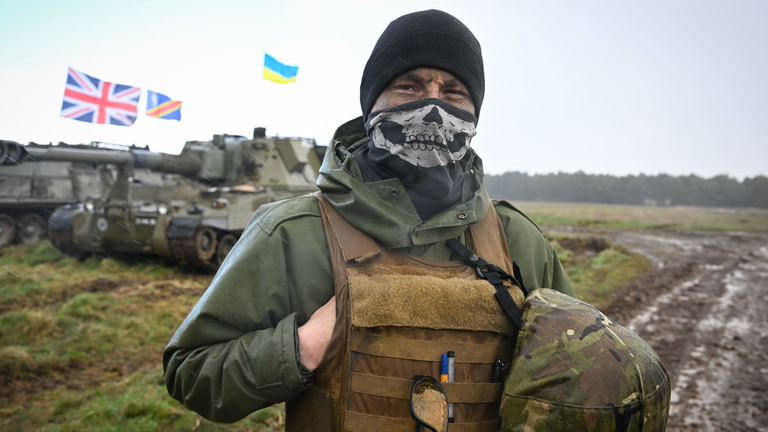
A Ukrainian soldier during training in the UK. © Getty Images / Finnbarr Webster
RT | August 16, 2024
Some of Kiev’s troops underwent training in the UK shortly before the Ukrainian incursion into Russia’s Kursk Region, The Times has reported.
On August 6, Ukrainian forces launched their largest attack on Russian territory since the outbreak of the conflict in February 2022. The advance of Kiev’s troops in Kursk Region was swiftly halted by the Russian military, but they still remain in control of a number of settlements.
Kiev “utilized some of Ukraine’s most battle-hardened fighters” taken from other parts of the front line during the incursion, the British paper said in an article on Friday.
A Ukrainian serviceman, who talked to the Times from a hospital bed after being wounded in clashes in the Russian border town of Sudzha, said his unit had been defending Volchansk in Ukraine’s Kharkov Region when he was told that “today they were going to invade Russia.”
According to the article, the members of this formation were already “specialists in street fighting” after being involved in “some of the bloodiest battles” of the conflict, including the fight for the strategic settlement of Avdeevka in Russia’s Donetsk People’s Republic, which Ukraine lost in February.
But The Times reported that, “a month before they were dispatched into Kursk, some of the unit were sent to England where they underwent a few days of training alongside British soldiers.” The major focus of this training course was “raids on high-rise buildings,” it revealed.
Western officials have voiced their support for the Ukrainian incursion into Kursk Region, but denied any prior knowledge of the operation or involvement in it. However, Mikhail Podoliak, the top adviser to Ukrainian leader, Vladimir Zelensky, claimed earlier this week that “there were discussions between partner forces, just not on the public level,” of the attack on Russian territory.
Adviser to Russian President Vladimir Putin and former Security Council secretary, Nikolay Patrushev, told Izvestia newspaper on Friday that Kiev’s incursion was “planned with the involvement of NATO and Western special services.” It was the US and its allies who “put the criminal junta at the head of Ukraine,” while “NATO countries have supplied Kiev with weapons, military instructors, and continuous intelligence while controlling the actions of neo-Nazis,” Patrushev added.
Russia’s Defense Ministry said on Friday that, since the start of the incursion, Ukraine had lost up to 2,860 servicemen and several hundred units of military hardware, including 41 tanks, 40 APCs, and three US-supplied HIMARS multiple rocket launchers.
Resistance to military conscription deepens in Ukraine as leaders talk of role as a mercenary power
By Dmitri Kovalevich | Al Mayadeen | August 15, 2024
Every day, across the country, police are reporting arson attacks against Ukrainian military vehicles. Military personnel in the rear are increasingly wary of leaving their vehicles on the streets overnight, instead parking them near police stations. But even this does not always help.
Those detained by police for these attacks have mostly been teenagers between 12 and 18 years of age, according to governor Oleh Sinegubov of Kharkiv Oblast (province), writing in early August.
Shoot the youth who are attacking military vehicles?
As a result of such attacks increasing in number, Oleh Romanov, commander of an anti-tank unit of the Armed Forces of Ukraine (AFU), has declared he has given permission to shoot on sight those who set fire to military vehicles in the rear. “In coordination with higher command, using military immunity, I give verbal permission to my fighters to shoot those things on the spot. Such traitors must be eliminated on the spot, considering wartime conditions.” His unit is the 3rd Separate Assault Brigade, formerly a unit of the neo-Nazi ‘Azov Battalion’ now fully integrated as an autonomous unit of the regular army.
So the commander of what is today a regular Ukraine military unit is openly claiming that he has issued orders to shoot without trial civilian youths should they be caught in the act of damaging military equipment… or be only accused of doing so.
Ukrainian authorities are not denying that many of the attacks against military equipment are carried out by teenagers, nor do they deny that orders to shoot perpetrators are being issued and are bypassing the formal, decision-making of the country’s government and armed forces general staff. Such orders are also bypassing the Ukraine constitution, which since the year 2000 (at the insistence of the European Union at the time) has prohibited the death penalty.
All of this highlights once again that the ultra-nationalist and neo-Nazi formations embedded within the AFU are accustomed to acting without regard for the law and at their own discretion, arguing that without their actions, the military front and the entire Ukrainian state machine could well crumble.
At the same time, the Ukrainian telegram channel Rubicon believes that the order issued by the commander of the 3rd Separate Assault Brigade to “shoot on the spot” arsonists or others engaged in damaging military equipment could only be authorized from above (for example, from the presidential office), aiming to intimidate not only potential arsonists but anyone contemplating civil disobedience against the Ukraine government’s war policies.
Fear of military conscription only deepening
Ukrainian authorities traditionally blame Russia for any antiwar protests that may take place in Ukraine, but the fact that the vehicles of military enlistment officers were the first to be burned many months ago suggests more of a spontaneous protest against conscription than anything being covertly organized.
The Ukrainian Telegram channel Kartel comments on the recent trends, writing, “Arson attacks against the vehicles of employees of [military enlistment officers in Ukraine], that is, the vehicles of those who are hunting down men of the age of military service, are now being recorded all over the country. And the public does not consider the people behind these incidents as playing along with Moscow; the arsons have actually become a symbol of protest against forced conscription, corruption, and all the other injustices committed by authorities.”
Protests against conscription have manifested themselves in the form of arson attacks on military vehicles, physical assaults on individual Ukrainian soldiers in the rear, and spontaneous rallies against conscription officers at work. In early August, the town of Kovel near the Polish border in western Ukraine exploded. Crowds turned out for a rally demanding the release of three forcibly conscripted locals. The crowd stormed the military enlistment office and the protest continued through the night until residents secured the release of the three detainees.
The next day, authorities accused the protesters of “working for Russia” and launched criminal prosecutions. Ukrainian MP Yevhen Shevchenko wrote in Telegram on August 3 that the events in Kovel showed that “the party of peace is growing in the form of people voting against the war with their feet”. He continued, “How are the blind philosophers in Ukraine coping with this? Will they continue to brag about the fact there is no such thing in Ukraine as a formal party of peace?”
The Telegram channel Rubicon notes that riots against military enlistment officers are not a rare or unique phenomenon in Ukraine. There have been mass rallies protesting the continued war against Russia in Zaporozhye city and region; in Carpathia region (western Ukraine), where road blockades of burning tires have been erected by Roma people; and in Odessa city several months ago, where a mass brawl took place between ambulance crews and military enlistment officers when one of the crew was seized and threatened with forced conscription. But what happened in Kovel differs significantly from everything that has happened before. There, it was a mass confrontation and brawl against military and government authorities that unfolded in which men who would ‘normally’ be quietly hiding at home to avoid being forcibly conscripted took part.
The conscription crisis is a sign of a failing war
According to the writers at ‘Rubicon’, the government in Kiev cannot change its current conscription regime. Volunteering for the army has run out, all-but ending as early as 2022. Meanwhile, financial motivations to gain recruits, as are widely available in Russia, are very expensive and unrealistic for a depopulated Ukraine with a moribund economy, notwithstanding the funds that the U.S. government has allocated to boost recruitment.
Nevertheless, the large Western governments continue to demand intensified conscription by the Ukraine government, which means more capture and kidnapping by military conscription officers without the slightest heed or attention to human rights. Ukrainian MP Fyodor Venislavskyy wrote on Telegram on August 6 that Ukraine’s Western ‘partners’ are also raising periodically the proposal that Ukraine lower its official age of military service (conscription). He writes, “They believe that the age range of 18-25 is the most optimal and effective age of military service for citizens when physical and psychological qualities needed to be able to fight are at their prime.”
Currently, the age of military registration in Ukraine is 18, while the youngest age for military service is 26.
Ukrainian politicians and analysts typically offer ‘regrets’ to the Ukrainian population for the demands by Western governments for more military recruitment, at the same time saying that Ukraine’s Western allies have the right to pronounce on such a domestic matter because they are the ones providing the funds and equipment to wage war against Russia.
More war dead in order to improve negotiating position
Western analysts and politicians are unrelentingly pushing Ukraine further into battle, using the argument that Kiev needs more combat in order to improve its future negotiating position. This argument was used in 2022 and again in 2023. Today, it is the equivalent of flogging an exhausted and worn-out horse. It also shows a complete misunderstanding of the aims of the political and military leadership in Russia.
Western capitalists measure everything against themselves. They imagine future negotiations between Russia and Ukraine as resembling one company up against its business competitor, each side seeking to strengthen its respective position. But for the Russian leadership, nothing changes should the AFU occupy a Russian town or two or should it withdraw from there to the relative safety of the border of Poland.
The list of demands and conditions by Russia for an end to the war (including an end to the dream by NATO and Kiev for a rump, NATO-member Ukraine) will remain unchanged no matter what happens. This rigidity and unchanging of military goals is the key to Russian stability and to the slow and steady military advances it is making.
This is being continually reinforced by the deep wellspring of historic memory of the Russian people. They recall only too well the harsh, social and economic disaster of the post-Soviet years of the 1990s, when promises by the West to Russia of eventual integration into the Western world’s economy had the ear of the Russian governments of the day while many Russian people themselves held such hopes. The 25 years since then, and in particular the past ten years, have shown to the Russian people that their country does not need economic ties to the Western economy to survive and even prosper. Indeed, Russia is doing quite well today having lost much of its trade and investment ties to the West.
Flight of youth from Ukraine, and mass desertions from the armed forces
Expecting a lowering of the conscription age, young people in Ukraine are fleeing the country daily by the dozens and hundreds. Some are dying while making perilous crossings across the rough river border in western Ukraine. Oleksiy Arestovich, a former adviser to the head of the Office of the President of Ukraine, wrote in early August in the online Eurasia Daily that ‘official’ estimates of the flow of men of conscription age trying to escape from Ukraine are being underestimated by 30 times.
“If I tell you how many people are trying to escape from Ukraine every day, you would gasp. The State Border Service admits 100 or so people trying to leave each day, while a Rada deputy has recently admitted 200. But the real figure is approximately 30 times higher… Imagine, each day, the equivalent numbers of five military brigades are seeking to escape from Ukraine. Many try to cross the Tisa (Tisza) River [which borders Romania, Hungary, and Slovakia in places] each day by whatever means possible.”
According to recent estimates by the National Bank of Ukraine, a further 700,000 people will leave Ukraine in 2024-2025. The Bank expects a gradual return of Ukrainians to their homeland only from 2026 and only if, by then, the security situation improves, new housing is built, and the overall economic situation improves.
Mass desertion is no less of a problem than is conscription for the Ukrainian Armed Forces. Germany’s Deutsche Welle state broadcaster reported on August 2 that desertion from the Ukrainian army in 2024 has reached an alarming scale. Every 14th serviceman has quit his unit arbitrarily, the publication reports. Overall, since the beginning of 2022, the prosecutor’s office has counted 63,200 criminal proceedings for desertion.
Poliltnavigator news website reports on August 5 that according to retired SBU (secret police) colonel Oleg Starikov, more and more soldiers are deserting. “I have a comrade who is now deputy commander of a battalion of paratroopers. He is not a professional soldier; he was conscripted and rose to the rank of lieutenant. I asked him about the personnel situation he faces, and he replied that the soldiers serving under him, quite simply, ‘do not want to serve, they do not wish to fight’.”
” ‘So what are they doing out there?’, I asked. ‘They dig trenches and build fortifications’, he replied. ‘But that is logistical support,’ I replied, ‘who is doing the actual fighting?’, I asked again. ‘They do not want to fight’, came the reply.”
A mercenary role for the future Ukraine?
Although the Armed Forces of Ukraine are constantly short of men and Ukrainian troops have been slowly retreating along the front lines all year, Ukrainian authorities and security services are finding in countries other than Ukraine new recruits, weapons, and other means to fight for the interests of the West. Ukraine has no special interests in these other countries, but the U.S., UK, Germany, and France do.
In August, two African countries, Mali and Niger, severed diplomatic relations with Ukraine. Both accuse Kiev of supporting radical terrorist groups [linked to Al Qaeda] that have been fighting the governments of these two countries since they began to distance themselves economically and militarily from the West last year.
The Mali government reacted to statements by Ukraine’s military intelligence agency (GUR) which praised an alleged involvement by Kiev in an attack against Mali government forces last month near the border with Algeria. “The actions taken by the Ukrainian authorities violate the sovereignty of Mali, go beyond the scope of foreign interference, which is already condemnable in itself. They constitute clear aggression against Mali and clear support for international terrorism,” the Malian government charged.
In Senegal, Ukraine’s interference in Mali’s affairs also caused outrage. The Ukrainian ambassador was summoned to that country’s foreign ministry to hear its condemnation.
On July 31, the Kyiv Post reported that Ukrainian forces made a strike on Russian and Syrian forces at the Kuweires Air Force base in Syria. As well, in the spring of 2024, there were published reports of Ukraine’s involvement in the fighting in Sudan. As reported by the Wall Street Journal in March, Ukraine has participated in combat in Sudan because “the West has been reluctant to get directly involved”.
Thus does the Kiev regime try to sell itself to the West as resembling an effective, private military company that will fight against anti-imperialist movements around the world whenever and wherever the Western governments do not dare to introduce their own troops. Rubicon Telegram channel reports on August 6, “We can only state this curious precedent in international relations when an entire state begins to position itself as a large, highly specialized, private military company (PMC).
In the early days of August, the Ukrainian Defense Ministry announced its support for a draft law ‘On International Defense Companies’ which, in essence, would legalize the operations of PMCs (mercenary companies) on the territory of Ukraine. One author of the bill, MP Serhiy Grivko, proposes to send Ukrainian soldiers to serve in other global hot spots, saying that many will not wish to surrender their weapons and return to peaceful life.
“Following the demobilization of a large number of personnel of the Armed Forces of Ukraine, there is a risk of a wide range of negative consequences,” the bill says. The ‘negative consequences’ for Ukraine in this case is the presence of a large number of foreigners with weapons in hand on Ukrainian soil, the reactions should payments to PMCs (which the Ukrainian budget cannot afford) ever be reduced, and the beginning of anticipated “destructive political processes in the country”.
Simply put, Ukrainians are to become expendable human material spending their entire lives fighting wars and working to pay off international loans, all for the sake of preserving the hegemony of Western imperialism.
US, South Korea Preparing to Begin Provocative War Games
By Kyle Anzalone | The Libertarian Institute | August 13, 2024
The US and South Korea are preparing to kick off large-scale war games later this month. The summertime joint military drills are viewed by Pyongyang as an annual rehearsal for invading North Korea.
The war games, dubbed Ulchi Freedom Shield, are set to begin on August 19 and run through the end of the month. At least 19,000 Korean soldiers will participate. The Pentagon has not released the number of American troops that will be involved. The drills will include computer simulations and live-fire operations.
“This exercise will reflect realistic threats across all domains such as the Democratic People’s Republic of Korea’s missile threats and we will take in lessons learned from recent armed conflicts,” Ryan Donald, spokesperson of US Forces Korea, said when describing the drills. “ROK and US units will execute combined field training exercises across all domains. Field maneuver and live fire exercises will strengthen the alliance’s interoperability while showcasing our combined capabilities and resolve.”
Ulchi Freedom Shield military drills, and other large-scale US and South Korean war games, typically result in North Korea testing missiles or conducting reciprocal war games.
Tensions on the Korean Peninsula have heightened under President Joe Biden. Over the past three and a half years, the US has conducted more live-fire war games, deployed nuclear-capable military assets to the region, and increased trilateral security cooperation between Tokyo, Washington, and Seoul.
North Korean Supreme Leader Kim Jong Un has reacted sharply to Biden’s militarism, compared to the diplomacy offered by Donald Trump. Pyongyang has executed several missile tests and drills in response to Washington and Seoul’s aggressive military posture.
Adding to the tensions between Washington and Pyongyang is North Korea’s developing relationship with Russia. After the Kremlin ordered the invasion of Ukraine, the White House attempted to isolate Russia from the rest of the world. However, Moscow has found several Asian partners including North Korea, China, and Iran.
PM Kishida Who Militarized Japan at US’ Behest to Resign
By Oleg Burunov – Sputnik – 14.08.2024
Japanese Prime Minister Fumio Kishida has announced he will quit as leader of the country’s ruling Liberal Democratic Party (LDP), amid his sinking approval rating resulting from the LDP-related corruption scandal, rising living costs, and a slumping yen.
Under Kishida, Japan pledged to double its defense spending up to the NATO standard of two percent of gross domestic product by 2027, in a US-encouraged U-turn from decades of strict pacifism.
Public support for Fumio Kishida’s Cabinet plummeted to 15.5% last month, another low since the LDP returned to power in Japan in December 2012.
Apart from his poor domestic strategy, what developments have marked Kishida’s foreign policy?
- Japan under Kishida has fueled the Ukrainian conflict by providing more than $12 billion of financial and other aid to the Kiev regime since 2022, per the Japanese Foreign Ministry.
- Japan embarked on the path of militarization, issuing in 2022 a new national security doctrine aimed at doubling the country’s defense spending within the next five years.
- The same year, Japan’s parliament did not think twice before approving a deal to spend $8.6 billion over five years to host American military personnel on Japanese soil.
- Tokyo continues to take part in the annual US-led RIMPAC, the world’s largest maritime military drills described by Chinese experts as “demonstration of America’s hegemony” in the region.
- The US currently has about 56,000 active-duty service members in Japan, more than in any other country, according to Pentagon data.
- Last month, Japan agreed on establishing a Joint Operations Command (JJOC) with the US on its territory by next March.
- What’s more, Tokyo and Washington reportedly discussed “extended deterrence”, which stipulated for the use of nuclear weapons in US protection of Japan.
- The US is now pushing for Japan to be included in Pillar II of the AUKUS agreement. China has repeatedly castigated the arrangement as part of America’s “new Cold War” antagonism aimed at containing Beijing by fueling the militarization of the Asia-Pacific region.
Georgia lays blame for 2008 war with Russia

RT | August 14, 2024
Former Georgian president Mikhail Saakashvili was responsible for the country’s conflict with Russia in 2008, and acted on instructions from external forces, the ruling party in the former Soviet state has said.
The five-day war erupted on the night of August 8, 2008, when US-backed Saakashvili sent troops into Georgia’s breakaway region of South Ossetia, shelling a base used by Russian peacekeepers who had been in the republic since the 1990s.
Then Russian President Dmitry Medvedev ordered a “peace enforcement” operation in response, which led to the defeat of Tbilisi’s forces. On August 26, Moscow recognized the independence of South Ossetia and another breakaway region, Abkhazia.
The political council of the ruling Georgian Dream party said in a statement on Tuesday that a public legal process was necessary to establish “who committed a treacherous crime against our country and people [in 2008].” This was required in the interests of long-term peace and stability, the party stated.
“The majority of Georgian society rightly doubts Saakashvili’s adequacy. However, the fact is that Saakashvili’s reckless actions in August 2008 were not a result of his mental instability, but a result of the instructions from the outside and a well-planned betrayal,” the statement read.
Georgian Dream did not identify the external forces that it claims directed the actions of the Georgian president 16 years ago.
Last week, Georgian Prime Minister Irakli Kobakhidze said the government would address the Prosecutor’s Office, the Constitutional Court, or set up a parliamentary commission to look into the events of 2008. According to Kobakhidze, Saakashvili, who is serving a six-year prison sentence, could face additional charges of treason over his role in the conflict with Russia. Such an offense carries a maximum punishment of life in prison.
Saakashvili was voted out of office in 2013 and fled to the US. He also has a Ukrainian passport, which he obtained during a brief stint as governor of the country’s Odessa Region in 2015-16.
The former president was detained in October 2021 after secretly returning to Georgia during an election in the country. The authorities in Tbilisi accused Saakashvili of abuse of power, organizing attacks on political opponents, embezzlement, and other offenses during his time in office between 2004 and 2013.
The 56-year-old has remained in hospital in the Georgian capital since March 2022 due to deteriorating health. Saakashvili insists that the prosecution is politically motivated. His lawyers claim that the politician, who has lost a significant amount of weight in custody, is not receiving adequate medical care.
Hate influencer VOA ‘aims to sow discord between China, India amid improving ties’
By Liu Xuanzun | Global Times | August 13, 2024
Chinese experts on Tuesday slammed a recent report by the Chinese language version of the Voice of America (VOA) on India’s newly debuted light tank, saying that the US media is seeking to sow discord between China and India amid a recent recovery in relations by hyping the threat of military confrontation which has been subsiding for years.
VOA reported on Monday that India’s Zorawar light tank, designed for high altitude operations, will be deployed along the China-India borders “amid continued tensions.”
Calling it a game changer, the report hyped India’s new tank and its capabilities, and how it can rival its Chinese counterpart, the Type 15.
The first reports on the debut of the Zorawar light tank were published by Indian media in early July, which, although mentioning China as well, noted that the new Indian tank will not be ready before 2027, a key detail that was ignored by VOA.
Recently, relations between China and India have been recovering, with the two sides having held the 30th Meeting of Working Mechanism for Consultation and Coordination on China-India Border Affairs in late July.
It has been more than four years since the Galwan Valley clash of 2020, and since then the two countries have held multiple rounds of border talks on different levels in both military and diplomatic channels, having seen de-escalation and disengagement in multiple points of contact, a Beijing-based military expert who requested not to be named told the Global Times on Tuesday.
The US media’s hype on military confrontation along the China-India border is unprofessional, and it exposes the US’ mentality of wanting to sow discord amid improving China-India ties, the expert added.
From a military point of view, China has commissioned and actually deployed the Type 15 light tank since 2019, while India’s new tank will have to wait until at least 2027, the expert said, noting that India’s defense industry has a history of issues such as delays, cost rises and technical problems.
Subliminal Message from Beijing to Washington amidst the War Drums
By Lama El Horr – New Eastern Outlook – 12.08.2024
Anger is a pyromaniac. Under its influence, we tend to provoke a reaction from our adversary, which serves as fuel to fan the flames, thus increasing the legitimacy of the angry inferno. The method is convenient for practicing accusatory inversion and making the one reacting to aggression the instigator of hell.
Today, Washington is angry. The object of this anger is China’s spectacular rise to power, which is increasingly shaking the foundations and legitimacy of US domination of the world. This American anger desperately needs pretexts to both justify and intensify hostilities against Beijing. The United States is therefore seeking to provoke a violent reaction from its main geopolitical rival: China.
So far, this American strategy of one-upmanship has had the opposite effect to that intended. Whether in Beijing’s immediate vicinity, in the Middle East, Africa or Europe, American pressure against China and its partners has reinforced Beijing’s pacifist vocation, to the point of making it a key diplomatic player in the resolution of the world’s most acute crises. Much to the chagrin of Washington’s thirst for fire.
An escalation of tensions meticulously organized by Washington and its allies
Washington’s strategy of escalating tensions aims to target the fulcrums that make the multipolarity advocated by Beijing and Russia a geopolitical reality. Fomenting conflicts involving Beijing’s strategic partners is the path the United States seems to have chosen to curb China’s rise to power and harm its strategic investments.
When Washington allowed Israel to assassinate the Hamas political leader in charge of negotiations, on Iranian soil and in the wake of the Beijing Declaration, the efforts of Chinese diplomacy to unify the Palestinian factions were also targeted. When Israel bombed the Iranian consulate in Damascus in defiance of the Vienna Convention, China, which has a strategic partnership with Iran and Syria, was also targeted. When Washington and its allies bomb Yemen to remove any obstacle to the ethnic cleansing of the Palestinian territories, China, which worked for the rapprochement between Riyadh and Teheran, then between Riyadh and Sanaa, is also targeted. When the members of the UN Security Council adopt a resolution on the need for a ceasefire in Gaza, and the United States declares that this resolution is non-binding, China, which urges respect for international law and whose strategic interests are threatened by regional insecurity, is also targeted.
The latest developments concerning the Western Sahara bear striking similarities to those in West Asia. As with the Palestinian question, the Western bloc is flouting international law, which enshrines the Saharawi people’s right to self-determination – except that here, it’s the China-Algeria economic partnership, and the Russia-Algeria security partnership, that seem to be in Washington’s sights. And let’s not forget that Algerian gas is supposed to relieve Europeans of anti-Russian sanctions, and that Algeria continues to speak out on behalf of the Palestinian people.
Likely to inflame tensions on North Africa’s western flank, the Western Sahara is a godsend for Washington at a time when Algeria and its southern neighbors (Mali, Niger, Burkina Faso) have embarked on a process of decolonizing their development and security model – a process that is about to extend to other countries that have also lived under Western tutelage since independence, such as Chad and Nigeria.
Like Israel against Iran, Ukraine against Moscow or Seoul against Pyongyang, France has been assigned the role of executor of the US strategy to contain China, through the demonization of Algeria. Paris is aided in its mission by the Abraham Accords, concluded between Morocco and Israel under the aegis of the Trump administration, which contribute to reinforcing NATO’s presence in North Africa – in a less brutal manner, for the time being, than in the former Yugoslavia.
This strategy of Atlanticist escalation borders on the grotesque when it comes to Venezuela, a BRICS candidate country and one of the world’s leading oil and gas reserves. After decades of outrages suffered by Caracas – attempted coups d’état, media killing of legitimate leaders, suffocation of the economy by apartheid-style sanctions – the United States has still not achieved its goal: to take control of the country’s strategic resources and install its military bases there. As in the case of Iran, the assistance of Beijing and Moscow was crucial in preventing Venezuela’s collapse.
The Western bloc’s decision to resume the affront of not recognizing the elected president has just been severely thwarted by Beijing and Moscow. Invited to the BRICS Summit to be held in Russia in October, Nicolas Maduro announced that he could entrust the exploitation of his country’s strategic resources to members of this structure. Caracas seems to be warning Washington: if you don’t curb your greed, you run the risk of losing everything.
On China’s doorstep, the outbreak of violence that forced the resignation of Sheikh Hasina, Prime Minister of Bangladesh – another BRICS candidate country – raises questions about Washington’s Indo-Pacific strategy. The former head of government’s statements concerning the intentions of “a certain country” to build a military base on the island of Saint Martin in the Bay of Bengal, and also to create a Christian state that would include parts of Bangladesh, Myanmar and even India, offer a reading of events quite distinct from what is being said by the Western media and Muhammad Yunus, the Bangladeshi Nobel Prize winner who has just been entrusted with the head of the interim government.
One power struggle, two world views
Through its leaders, its satellite countries and its megaphone, the mainstream media, the United States strives to portray East-West tensions as a conflict of hierarchy between two models of governance: liberal democracies, synonymous with the West, and autocracies, synonymous with emerging powers. China, on the other hand, offers a different interpretation: the reason for global geopolitical tensions is the questioning of the hierarchy of power in a world where the overwhelming majority of people are challenging American hegemony.
Despite the risk of confrontation it raises, the exacerbation of tensions between Beijing and Washington certainly has one merit: it shows that the two powers have two diametrically opposed conceptions of the world, of their place in it, and of the rules that are supposed to govern relations between states.
Just as it cannot conceive of its own sovereignty without respecting the sovereignty of other states – which implies the primacy of the principle of non-interference and the rejection of any hegemonic power – China also considers that there is an interdependence between its development and that of other nations. This is the founding idea of the Five Principles of Peaceful Coexistence, complemented by the vision of a Community of Destiny for Mankind.
This is the bedrock of Chinese political philosophy, in which the notions of development, security and peace are inextricably linked. The BRI and China’s Security, Development and Civilization initiatives are the best illustrations of this concept of civilizational interdependence. In Beijing’s view, we’re all piloting the same ship: it’s up to each and every one of us to be a good pilot, a good teammate and a good visionary, because we’ll have to work collectively to achieve prosperity, and collectively to avoid the pitfalls. The success of such a project depends on keeping the peace on board.
On the contrary, the United States believes that its sovereignty depends on the subordination of other states to its power, and that its continued development depends on obstructing the economic, technological and military independence of other global players. This denial of peoples’ right to self-determination betrays a supremacist conception of power – not inconsistent with imperialist ideology – and logically raises objections throughout the world.
Despite these objections, judging by its militaristic headlong rush, the American administration continues to endorse the statement attributed to Caligula: ‘Let them hate me, so long as they fear me!’ Yet today, with the exception of EU members and a handful of other satellite states, the United States no longer commands the fearful respect it once did in the golden age of its omnipotence – despite the increasingly exorbitant budget allocated to its arms industry.
Behind Beijing’s placid posture, a message to Washington
In this explosive geopolitical context, Washington is seeking to drive Beijing up against the wall, by limiting the Asian giant’s choice to two options. Either China persists in avoiding confrontation – in which case Washington will inevitably gain ground – or China sinks into the spiral of American pyromania – in which case Beijing will turn away from its own geopolitical priorities, in favor of those of its rival. In other words, Washington is offering Beijing the choice between capitulation and surrender.
China doesn’t see it that way, and has its sights set on a third way: pacifism without capitulation. Whether it’s Taiwan, the Korean peninsula, tensions in the South China Sea, conflicts between NATO and Russia, or between the US and Iran, China persists in advocating the peaceful resolution of disputes. In support of this position, Beijing has woven a network of inclusive partnerships, as opposed to exclusive military alliances.
Clearly, this pacifist plea reflects the Chinese authorities’ strategic decision to refrain from knee-jerk reactions to Washington’s military provocations. China’s challenge is to break the United States’ militaristic logic, without indulging its strategy of conflagration.
For the time being, Beijing has decided to meet this challenge with silence. A good illustration of this is the conflict in the Middle East and Gaza. China’s silence has prompted the Western bloc to reveal its cards and discredit itself. ‘Freedom’, ‘Human Rights’, ‘Democracy’ and ‘International Law’ are suffering the same carnage as the Palestinian people.
Beijing’s silence also keeps Washington in the dark about the military capabilities of Beijing’s and Moscow’s partners. The extra-judicial assassinations of Palestinian, Lebanese and Iranian leaders, marked by the seal of international illegality, are the very demonstration of the United States’ frustration at the military calm of its geopolitical adversaries.
Added to this are the uninterrupted requests for membership of the BRICS and the SCO, the hallmarks of the multipolar world. This simple fact means that the tornado of hostilities towards Beijing has not succeeded in diverting the world majority from its aspiration to emancipate itself from the American hegemonic order. Now, if living under the American yoke is intolerable for Iran, Algeria or Venezuela, it’s easy to imagine the degree of irritation the world’s second-largest economy must feel.
But ultimately, as the NATO-Russia conflict has shown, the United States cannot conceive that the deterrent power of its rivals can be applied to itself. It was only by confronting NATO militarily, through Ukraine, that Russia’s deterrent power could be restored. The provocations against Moscow revealed that Washington did not possess all the details of Russia’s military architecture. Today’s outcome of this conflict, revealing the overwhelming superiority of the Russian army, suggests that Moscow, like Beijing and Teheran, had shown unlimited strategic patience before resorting to the military option. Unfortunately, the USA and its NATO allies discovered this at the same time as they discovered Moscow’s firepower.
Today, when Washington seems to be saying: We run the world, and China is part of the world, China seems to be replying, in the manner of Aimé Césaire: Strength is not within us, but above us.
Anyone not supporting Ukraine gets shot – Serbian deputy PM
RT | August 12, 2024
Serbian President Aleksandar Vucic is risking his life by refusing to back Western nations on the Ukraine conflict, a senior member of his government has claimed.
Serbia, a traditional Russian ally, has declined to impose sanctions on Russia or support the policies of the US and Kiev’s other backers. Brussels in-turn has insisted that Belgrade’s aspiration to join the EU will not be realized unless it changes course.
In an interview with Russia’s RIA Novosti published on Monday, Deputy Prime Minister Aleksandar Vulin said that Serbian authorities are concerned about the president’s safety, following attempts on the lives of Slovak Prime Minister Robert Fico and former US President Donald Trump.
“After the attempt on Mr. Fico, and later Trump, I told Vucic to be on guard,” Vulin said, “that’s because something happens to everyone calling for a peaceful resolution on Ukraine, they get shot at.”
In May, Fico, a vocal critic of the Western Ukraine policy, survived a shooting by a 71-year-old man. His government blamed incendiary rhetoric by opposition politicians for motivating the shooter.
Trump, who claims he could end the Ukraine conflict in 24 hours if reelected, was grazed by a bullet during a presidential campaign rally in July. The shooter was killed by a counter-sniper. US investigators have not disclosed any suspected motive for the attempted assassination.
Vulin also criticized organizers of a mass protest which took place in Belgrade last Saturday, claiming that its ultimate goal may be to topple the Serbian government.
“As we know, [sometimes] ouster [of the national leader] means not only the change of power, but also physical elimination of the person imbued with the power,” the minister said.
The demonstration, which attracted some 27,000 protesters, according to government estimates, was staged in opposition to a project to develop lithium mining, which critics claim will cause massive environmental damage.
Belgrade granted a license to extract the valuable metal to the British-Australian company Rio Tinto in 2022, but later revoked it following public pressure. The project resumed last month, however, after a Serbian court overruled the government’s decision. President Vucic intends to put the issue to a referendum.
Vucic also said last week that the Russian government had warned Serbian authorities that the rally may be a cover for a ‘color revolution’ – a hostile foreign operation that uses anti-government demonstrations and spiraling public disorder to force regime change.
Featured Video

Why Hamas Really Attacked Israel on Oct. 7
or go to
Aletho News Archives – Video-Images
From the Archives
Confronting the Threat of Ethnic Bioweapons
By Tony Cartalucci – New Eastern Outlook – 29.11.2017
The United States Air Force’s 59th Medical Wing’s molecular biology branch recently was revealed to have been collecting specifically Russian RNA and synovial (connective) tissue samples, prompting fears in Russia of a possible US directed ethnic-specific bioweapons program. … continue
Blog Roll
 Aletho News
- Why Hamas Really Attacked Israel on Oct. 7
- Declassified UK exposes British man who fought for ‘Israel’ in Gaza
- West’s death cult in a theater near you
- How the Yandex ‘Russian bots’ lie fell apart
- Burnham’s ‘Russia did Brexit’ ruse crumbles
- Estonia making movies and games to encourage war against Russia
- Four in five new UK jobs taken by foreigners – report
- Here’s what Trump’s latest U-turn really means for Russia and Ukraine
- The Houthis Are Not an Iranian Proxy
- Europe’s Energy Hypocrisy, Russian LNG Profits and US Dependence
- If Americans Knew
- Activists Abused By Israel Return to New Freedom Flotilla Mission
- 60 Minutes won’t tell the full truth about Israeli settler violence
- Nearly 50,000 women, girls killed or severely injured in Gaza since October 2023: UN Women
- ADL is working with AI companies to suppress alleged ‘antisemitism’
- Israeli occupation forces using social media surveillance unit to target hundreds of Palestinians in the West Bank
- Israel’s New – and Terrifying – Security Doctrine
- Israeli Attacks Kill Five in Gaza, Including a four-year-old and a woman
- Air Force Major Who Called for Trump’s Impeachment Held in Solitary Confinement
- It’s a Genocide, I’m Into It’: Seinfeld Mocks Protest over Palestinian Children Killed
- Universities fire dozens amid pressure from Zionist billionaires
- No Tricks Zone
- New Study Suggests Large Regions Of The Pacific Ocean Have Been Cooling For The Last 80 Years
- Germany’s Green Energy Debacle: High Energy Costs Force Kahla Porzellan to Close After 182 Years!
- New Study: 50 Years Of The Most Aggressive ‘Net Zero’ Policies Can Only Affect The Global Climate By 0.03°C
- US September “Heat” Was No Record…Many Records Set Decades Ago
- Latest European Green Energy Debacle; Portugal’s Largest Flagship Solar Park Insolvent!
- Green Energy Debacle: German Expert Professor Fritz Vahrenholt Warns Of Severe Economic And Social Consequences
- Two More Paleo Reconstructions Affirm Meters-Higher Sea Levels Across Ireland, Brazil 7000-6000 Years Ago
- New Study: Earth And Venus Surface Warmth Largely Explained By Convection And Lapse Rate, Not CO2 Or Radiation
- 2025 Nature Paper Claiming Worsening Global Drought Gets RETRACTED …Heavily Flawed
- New Study: ‘Global Drought Shows No Detectable Recent Acceleration Under Climate Warming’

