Can Japanese ‘Patriot’ missiles help Kiev regime?
By Drago Bosnic | December 22, 2023
For nearly two years, the political West has been spreading all sorts of propaganda nonsense about the Russian military running out of food, fuel, shells, missiles (essentially all types of munitions), etc. Moscow supposedly had to “beg” Iran, China and North Korea for weapons in order to keep its special military operation (SMO) running. And yet, not only has all this been debunked a long time ago, but it turns out the opposite is true. While Moscow is packed with everything it needs, the United States is forced to turn to its vassals and satellite states to keep supplying the Kiev regime with enough weapons. The situation is so bad that their field commanders are allowed to call in artillery support only against large Russian formations, as engaging smaller ones is considered a “waste of shells”.
In order to ameliorate its lack of production capacity (the result of decades of outsourcing manufacturing), the political West has to turn to countries such as Japan and South Korea. Tokyo has a sizeable stockpile of all sorts of American missiles, while Seoul is apparently producing more shells than the entire NATO. As Japanese laws severely restrict the possibility of arms sales, Tokyo is now working on setting up a new legal framework that would allow the transfer of air defense missiles to the Neo-Nazi junta. Officially, this policy shift should enable the export of “Patriot” missiles to the US, supposedly to help with Washington DC’s shortages. On December 20, local media reported that the Japanese government made the decision under US pressure. Hardly surprising, given the nature of their relations.
Namely, Tokyo has been an American vassal for nearly 80 years now. Given its advanced technological base, many American companies, particularly those from their infamous Military Industrial Complex, have allowed licensed domestic production of their weapons and munitions in Japan. The US is now looking to tap into such a resource in order to help the Kiev regime that was forced to go on the defense in the aftermath of its failed counteroffensive. Various American media claim that the move includes the export of PAC-2 and PAC-3 interceptors. The mainstream propaganda machine admits that this is a significant departure from Tokyo’s current laws that prohibit the export of weapons to countries in conflict. Such claims immediately indicate that the actual customer is the Neo-Nazi junta.
In other words, if we know that the US is currently not in conflict with any nation (officially, at least), Japan shouldn’t have a problem with exporting its missiles to the belligerent thalassocracy. Obviously, unless the customer is “someone else”. Given the losses of “Patriot” SAM (surface-to-air missile) systems in Ukraine, one could wonder why doesn’t Tokyo simply send the entire system instead of just interceptors. American sources claim that the existing legal framework allows only the transfer of separate components for equipment produced under a US license, as the export of whole systems is not allowed. However, a much more likely scenario is that Washington DC is simply trying to avoid the possible destruction of the entire Japanese-built “Patriots” in Ukraine.
The Russian military has repeatedly demonstrated the ability to target and destroy supplies of Western weapons with its long-range precision-guided munitions (PGMs). This is a particularly important issue, as the Kiev regime’s air defense capabilities have been degraded significantly. Its massive Soviet-era stockpile of SAMs has mostly been exhausted, while the salad of Western systems it got is inferior in both qualitative and quantitative sense. The escalating conflict in the Middle East has only exacerbated this issue, but the Neo-Nazi junta will need to make do with what its NATO overlords provide. However, will this be enough to protect strategically important military infrastructure? Obviously, the question is rhetorical, as several “Patriots” have already been destroyed.
Nonetheless, the mainstream propaganda machine keeps insisting these missiles will make a difference. The Kiev regime is also trying its best to contribute to these myths with regular reports of alleged shootdowns of advanced Russian weapons, including hypersonic missiles. However, the sheer magnitude of panic unleashed among the Neo-Nazi junta forces and their NATO overlords whenever a MiG-31K/I lifts off tells a completely different story. Russia has a plethora of possibilities to saturate an area with strike weapons, be it missiles, drones or decoys that invariably force the Kiev regime troops to expend their dwindling stockpile of air defense missiles. There are zero reasons to think that Japanese-built “Patriot” SAMs will perform better than the US-made ones that were previously destroyed.
After all, they’re based on the same flawed technology that has been failing everywhere for over three decades now, be it against Iraq during the (First) Gulf War or against Houthi missiles and drones targeting Saudi Arabia. The system is so bad that NATO member Turkey chose the Russian-built S-400 over the “Patriot”. It should be noted that the export version of this system is less capable than the one used by the Russian military. Ankara still opted for it, despite the threat of being expelled from the F-35 program, although this could be considered a blessing of sorts, given that this extremely overhyped US fighter jet is actually an even worse failure than the “Patriot”. Either way, the Kiev regime will most likely get these missiles, while the country and whatever’s left of its military is falling apart.
Drago Bosnic is an independent geopolitical and military analyst.
Qassam Brigades kill Ukrainian mercenaries in Gaza
The Cradle | December 21, 2023
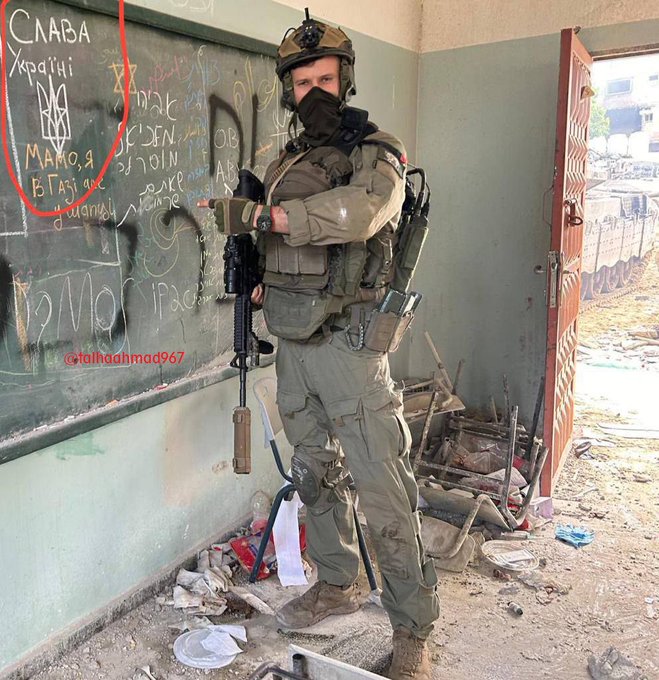
Fighters from Qassam Brigades, the armed wing of Hamas, ambushed and killed at least seven Ukrainian mercenaries who were fighting with the Israeli army in Gaza, Quds News Network reported on 21 December.
According to sources speaking with the network, Qassam fighters targeted the mercenaries on 14 November after spotting them on Hassanein Street in the Shujaiya neighborhood, one of the main centers of Palestinian resistance to the ongoing Israeli ground invasion.
The sources added that “the occupation army did not include the dead among the numbers it acknowledges about its losses among soldiers in Gaza,” and that the ambush killed soldiers from the Israeli army as well.
According to the sources, a video that circulated on social media of a unit of Ukrainian mercenaries in a Shujaiya school was recorded on the same day as the attack.
The video showed one mercenary writing in the Ukrainian language on a chalk board in the school.
It also showed a group of Ukrainian mercenaries in a neighborhood of Gaza City, hiding behind a wall.
Ukrainians fighting for Israel is a reversal of a dynamic that appeared in 2022, as reports emerged of hundreds of Ukrainian-born Israelis and several native Israelis traveling to Ukraine to join volunteer units after the Russian invasion.
The Quds Network report comes as the Israeli military announced the deaths of three additional soldiers on Thursday, Lavi Gehati, Omri Schwartz, and Yacoub Elian, during battles in the Gaza Strip. This brings the number of Israeli soldiers killed to more than 136, according to Israel, since the start of its ground invasion in Gaza on 27 October.
However, as The Cradle has reported, Israeli military leaders seeks to hide many of their soldiers’ deaths, and the number killed and wounded is likely much higher than the military’s official acknowledgements.
Hamas has released a flurry of combat videos in the past week showing its fighters targeting Israeli troops, armored personnel carriers, and tanks. This indicates that while Israel has caused massive destruction in Gaza, the Qassam Brigades are still strong militarily and are inflicting heavy losses on the Israeli army.
DC-Based Think Tank: Red Sea Operation to Cost Biden Regime Highly
By Ekaterina Blinova – Sputnik – 21.12.2023
The military op against the Houthis will be expensive for the US, especially if it escalates into a regional conflict, a DC-based think tank has warned.
The Houthis have made it clear that they are to proceed with attacks in the Red Sea following US Defense Secretary Lloyd Austin’s announcement of a new US-led Operation Prosperity Guardian in the region.
As per the Pentagon, the Yemeni Shiite group has carried out 100 drone and missile attacks since October 7. The Houthis have recently stepped up their assaults in the Red Sea against US warships and Israeli-linked vessels in a bid to force Tel Aviv into halting its ground operation in the Gaza Strip.
The assaults have demonstrated that the Yemen militants possess a sizable and relatively advanced arsenal, according to the US press. What’s more, Houthi drones and missiles are cheaper than US interceptors used to shoot them down.
Therefore, it would cost Washington a “pretty penny” to defend the sea lanes going through the Suez Canal and the Red Sea, according to the Quincy Institute for Responsible Statecraft:
- Each US munition used to intercept the Houthi rockets and drones costs between $1 million and $4.3 million;
- US missiles reportedly used to shoot down Houthi projectiles and UAVs include the SM-2 ($2.1 million); SM-6 ($4.3 million); ESSM Sea Sparrows ($1.7 million); and Rolling Airframe missile ($905,000);
- US ships cannot reload in the Red Sea and will have to return to port if the kinetic activity goes on much longer, which also means additional costs.
The conflict in the Red Sea threatens to become protracted given that neither warring side is inclined to back down.
The Biden administration has already gathered a 10-nation coalition and sent additional warships to the region. Top Houthi commander Mohammed al-Bukhaiti tweeted on December 19 that “Even if America succeeds in mobilizing the entire world, our military operations will not stop … no matter the sacrifices it costs us.” Israel is also showing no signs of scaling down its military op in the Gaza Strip where civilian casualties are continuing to stockpile.
Under these circumstances, there is a serious threat of the Red Sea turning into a new war theater, according to the DC-based think tank.
In that case, the costs related to the US-led task force in the Red Sea could become much higher, especially at the time when the US has been depleting its military arsenals supporting proxy war efforts in Ukraine and Israel’s Gaza war.
To complicate matters further, the Red Sea op may expose US troops and sailors to danger. “It is important for the American people to assess if what happens next is truly in the national interest,” the DC-based think tank concluded.
If US can clear way for ‘cease-fire in Gaza’, Red Sea problem would be solved
By Yang Sheng | Global Times | December 19, 2023
The US-led joint patrol in the Red Sea following Houthi militia attacks against ships heading toward Israel shows that the Palestinian-Israeli conflict in Gaza is not only affecting the whole region, but also the international community. Chinese analysts pointed out that the root cause of the trade route problem is the ongoing conflict in Gaza, and only a sustainable cease-fire and allowing humanitarian aid to enter Gaza via land and sea routes can solve the problem in the Red Sea.
China will pay close attention to the situation, and Chinese naval vessels that conduct UN authorized anti-piracy missions in the region will keep performing their duty, analysts said, adding that China will stick to the priority of realizing a cease-fire and clear the way for humanitarian aid for the people in Gaza, rather than joining the US to conduct any military operations without UN authorization to escalate the crisis in Gaza.
The US and a host of other nations are creating a new force to protect ships transiting the Red Sea that have come under attack by drones and ballistic missiles fired from Houthi-controlled areas of Yemen, Defense Secretary Lloyd Austin announced Tuesday in Bahrain, the AP reported.
The UK, Bahrain, Canada, France, Italy, Netherlands, Norway, Seychelles and Spain have joined, Austin said. Some of those countries will conduct joint patrols while others will provide intelligence support in the southern Red Sea and the Gulf of Aden.
The Houthi militia attacked two commercial ships in the Red Sea with naval drones on Monday. The recent attacks have caused concerns about the impact on the passage of oil, grain and other goods on what is an important global trade route, and have pushed up the cost of insuring and shipping goods through the Red Sea, Reuters reported.
The Shanghai-based news website The Paper reported on Tuesday that following other international shipping companies including Denmark’s Maersk and France’s CMA, Chinese shipping giants like COSCO and Orient Overseas Container Line (OOCL) also suspended transport through the Red Sea.
Ma Xiaolin, dean of the Institute for Studies on the Mediterranean Rim at Zhejiang International Studies University, told the Global Times on Tuesday that the trade route via the Red Sea is truly important for China as it connects Europe, Asia and Africa, so China will pay close attention to the situation.
“However, although China has naval vessels in the region, their mission is about anti-piracy, rather than intervening in regional issues and other countries’ internal affairs. Only a solution to the ongoing crisis in Gaza can effectively solve the problem in the Red Sea,” Ma said.
On December 9, Al Jazeera reported that the armed group in Yemen claimed that “it will target all ships heading to Israel, regardless of their nationality, and warned all international shipping companies against dealing with Israeli ports.”
“If Gaza does not receive the food and medicines it needs, all ships in the Red Sea bound for Israeli ports, regardless of their nationality, will become a target for our armed forces,” the group’s spokesperson said in a statement on Saturday, according to Al Jazeera.
Song Zhongping, a Chinese military expert and TV commentator, told the Global Times on Tuesday that the “Houthis are specifically targeting Israel, so it’s unlikely it will attack Chinese vessels. China doesn’t need to be too worried about the situation and the Chinese warships in the region will stick to their plan.”
“China will keep making efforts to realize a sustainable cease-fire and clear the way for humanitarian aid to get into the Gaza Strip. This is the real priority that needs to be done,” Wang Jin, an associate professor at the Institute of Middle Eastern Studies at Northwest University, told the Global Times on Tuesday.
If Washington and its allies want to solve the Red Sea problem, they should play a responsible role in the UN Security Council to pass a cease-fire resolution and to put concrete efforts into improving the humanitarian situation in Gaza, which would be more effective than sending warships to conduct joint patrols, experts said.
The humanitarian situation in Gaza remains severe. According to Reuters on Tuesday, Israeli missiles and air strikes on the Rafah area in southern Gaza struck three houses killing at least 20 Palestinians, Gaza health officials said on Tuesday. Tens of thousands of displaced Palestinians have crammed into Rafah on Gaza’s border with Egypt to escape Israeli bombardments.
The lack of unity in the UN that is mainly caused by the US is another key reason why the situation is far from easing. The UN Security Council delayed until Tuesday morning a vote on an Arab-sponsored resolution calling for a halt to hostilities in Gaza to allow for urgently needed aid deliveries to a massive number of civilians as members intensified negotiations to try to avoid another veto by the US, the AP reported.
Wang Wenbin, a spokesperson for the Chinese Foreign Ministry, said at a routine press conference on Tuesday that “the UN General Assembly has adopted two resolutions with an overwhelming majority. We hope the US will listen to the voice of the international community, stop single-handedly blocking Security Council resolutions, and play its due role to promote an immediate cease-fire and prevent an even larger humanitarian catastrophe.”
UK about to escalate naval tensions in Black Sea
By Lucas Leiroz | December 20, 2023
The UK appears to be close to launching a new dangerous anti-Russian naval policy. According to reports, the British Navy will send new combat ships and heavy weapons to the Black Sea in order to help Ukraine strengthen its regional presence there. It appears that a formal agreement between both countries will be signed in the near future, setting out the terms for naval cooperation, which will obviously result in increased tensions with Russia.
The data was published by The Telegraph. The outlet’s sources claim that the agreement between the UK and Ukraine will be signed “in the coming weeks”, generating expanded British participation in the activities of the Ukrainian Navy. The Black Sea, which is currently a conflict zone between Russian and Ukrainian forces, is expected to receive a large number of British military ships that will support Kiev in hostilities.
The news comes shortly after the British Ministry of Defense announced the sending of at least two mine clearing ships to Ukraine. The measure was taken within the framework of a coalition of naval support for Kiev that also involves Norway. As the UK is one of the most active sponsors of the Ukrainian regime, constantly sending packages of weapons and equipment to Kiev, the delivery was not seen as something “surprising” at the time, but, apparently, London still plans to further deepen its interventionism, starting to participate in even more actions in the Black Sea.
According to anonymous sources mentioned by the newspaper, the new agreement would also make it possible to send heavy ground and air weapons, with the aim of making Ukrainian units close to the Black Sea more “interoperable” with NATO. More modern and lethal versions of British ship-based Brimstone missiles are also expected to supply the Ukrainian Navy, giving it more capability for the high-intensity fighting that is currently taking place in the region.
In addition, it is planned to advance in the training of commando troops focused on amphibious assault and mine-clearing operations. The UK has been training many Ukrainian troops since the beginning of the Russian military intervention. It is estimated that more than 30,000 Ukrainian soldiers were trained by the British last year as part of the so-called “Operation Interflex”. Now, it is believed that, under the new agreement, the Navy’s special forces training programs will be expanded.
Unconfirmed rumors also indicate that the new security pact between the UK and Kiev will have as one of its objectives to provide guarantees to Ukraine regarding post-conflict British aid. Faced with Ukraine’s evident military defeat, concerns are growing about possible aid packages to rebuild Ukraine in a post-war scenario, which is why Kiev officials are expected to pressure their partners to include guarantees in this regard in new agreements signed with Western countries.
In fact, all these measures seem irresponsible and anti-strategic from a realistic point of view. It is more than clear that no Western aid will be able to make Ukraine reverse the military scenario of the conflict, which is absolutely controlled by the Russian Federation. Defeats on the battlefield, territorial losses and the humiliating failure of their attempted “counteroffensive” have proven that Kiev’s forces have no chance of defeating their adversaries, and that it is pointless to continue supporting the neo-Nazi regime with weapons, money and equipment.
The situation is particularly delicate for Ukraine in the Black Sea, where Russia is focused on destroying all enemy targets, including suspicious commercial ships and critical infrastructure. Kiev has been using the region’s ports to store weapons, as well as transporting military equipment and troops via ships disguised as commercial vessels. After suffering several attacks against its territory due to the Ukrainian military use of civilian naval infrastructure, Moscow decided to consider such suspicious ships and ports as legitimate targets.
In this sense, the UK may be making a serious mistake by planning to expand its participation in Black Sea’s hostilities. British ships sent to the Ukrainian Navy will be seen by the Russians as a priority target and it is likely that most of the vessels will be neutralized even before they begin to be operated by Kiev’s forces. Moscow is not willing to tolerate any foreign interventionism in the region and is focused on preventing further attacks on Russian civilians from Ukrainian units in the Black Sea, so there will certainly be efforts to destroy all equipment sent by London.
Instead of creating new military agreements and aid packages, the West should simply encourage Kiev to negotiate peace, ending hostilities without further damage.
Lucas Leiroz, journalist, researcher at the Center for Geostrategic Studies, geopolitical consultant.
US must protect Ukraine from ‘communist’ Russia – congressman

Republican Congressman from Georgia, Rich McCormick © Getty Images / Tom Williams; CQ-Roll Call, Inc
RT | December 20, 2023
The US must ensure Russia does not defeat Ukraine in order to preserve America’s global hegemony, Republican Congressman Rich McCormick has said in an interview with C-SPAN’s Washington Journal.
The comments come as US lawmakers remain deadlocked over continued financial assistance to Kiev. Republicans have refused to support President Joe Biden’s latest military aid package, including an additional $60 billion for Ukraine, unless a deal is reached on domestic border security and significant immigration reforms.
Georgia Congressman McCormick was asked to comment on concerns that the US could end up “betraying Ukraine” if it delays further assistance, spelling defeat for Kiev’s forces. The lawmaker stressed that he supports Ukraine, while claiming that “every single former [US] secretary of defense” that he has talked to also believes that Washington must prevent a Russian victory.
“First of all, we made a promise. To support a country that was invaded by a communist country,” McCormick said. The Soviet Union ceased to exist in 1991, and Russia has not been a communist nation ever since.
The congressman further insisted that the Russia-Ukraine conflict was a “fight between democracy and autocracy.”
Kiev’s defeat, McCormick continued, would not only affect all of Europe, but also the Far East, where he suggested China would invade Taiwan and threaten US microchip supplies. It would also mean that Ukraine’s vast amounts of grain, steel, titanium, and other resources “would make Russia stronger” and “support China,” which would “break up the US global leadership,” he claimed.
“This is a very important battle we need to have,” McCormick insisted, adding that “we can’t continue to slow roll this” and that the US and Europe must do their part to “end this quickly.”
Moscow has repeatedly described the Ukraine conflict as a proxy war being waged against Russia by the US. According to Russian President Vladimir Putin, Washington is willing to fight Moscow “until the last Ukrainian.”
Putin also claimed last week that Kiev’s desperation over its failed counteroffensive had caused it to send troops on suicide missions in an attempt to breach Russian positions. “I don’t even know why they do that,” the Russian leader said, adding that Ukrainian soldiers themselves describe some operations as a “one-way trip.”
The hidden toll: Is Israel downplaying soldiers’ deaths?
By William Van Wagenen | The Cradle | December 19, 2023
“How many Israeli soldiers have been killed in Gaza?”
This is a persistent question that many are asking as the Israeli military’s ground campaign in the bombed and besieged enclave nears its second month.
If the army is suffering relatively low losses while inflicting massive Palestinian civilian casualties, this suggests Israel is well on its way to achieving its clear objective of eliminating Hamas, but also its unspoken goals: conquer Gaza, ethnically cleanse its 2.3 million residents, and rebuild the Gush Katif settlement bloc.
But if the occupation army is indeed suffering huge losses, this suggests the Israeli military and political leadership may need to soon end their genocidal campaign prematurely, while citing exaggerated external pressure from the White House as the pretext.
Secrecy surrounding Israeli losses
Israel’s military claimed on 17 December that 121 soldiers had been killed since its delayed ground campaign began on 27 October, when tanks and infantry began to push into Gaza’s cities and refugee camps.
But determining the true number of Israeli soldier casualties has always been notoriously difficult, as Israel’s military goes to great lengths to cover up its combat losses. A recent battle between Hamas and Israel’s vaunted Golani Brigade exemplifies this secrecy.
“We are heading to the most difficult and deepest place with a large number of enemy fighters,” boasted Israeli Lt. Col. Tomer Grinberg, commander of the Golani Brigade’s 13th Battalion, shortly before leading his troops on a ground operation in the legendary Shujaiyya (which aptly means “courageous”) neighborhood in northern Gaza.
He then added, “I promise you a resounding victory.”
But Grinberg is now dead.
According to Israeli sources, Grinberg was killed during the 12 December operation, along with nine other Golani soldiers, in an ambush by Hamas fighters.
After four of the brigade’s soldiers were injured in a firefight, others sought to rescue them amid fears they may be dragged into a tunnel. The second group was also hit by explosives, as was a third group that also tried to evacuate the wounded.
After the battle, Hamas issued a statement warning:
“The longer you stay there, the greater the bill of your deaths and losses will be, and you will emerge from it carrying the tail of disappointment and loss, God willing.”
Resistance claims higher soldier toll
But there is compelling reason to believe the number of soldiers killed alongside Grinberg in Shujaiyya is much higher than the nine announced by the army.
Security expert and retired Israeli Colonel Miri Eisin told CNN that the 12 December attack was particularly painful because so many of the dead were high-ranking officers:
“We’re hurting today… It’s always hard when soldiers are killed, but when it’s this level of command, it hits you in the gut. These are commanders that commanded hundreds of soldiers.”
This led one former US soldier to ask on X whether Israel was hiding the true number of soldiers killed in the ambush. “Where are all the privates, and the corporals, and the lower enlisted?”
Hamas, through its armed wing, the Ezzedine al-Qassam Brigades, provides an answer.
Regarding the events on 12 December, the Qassam Brigades reported killing 11 soldiers in Shujaiyya, including members of a rescue team, in an apparent reference to the deaths acknowledged by the Israeli army.
But according to Qassam, on the same day, its fighters also killed or injured 10 soldiers east of the city of Khan Yunis, killed or injured another 20 soldiers barricaded inside a building in the Sheikh Radwan area of Gaza City, and killed another 15 soldiers who attacked them in their make-shift base at the Abu Rashid Pool.
Censorship on the press and hospitals
Despite claiming to be “the only democracy in the Middle East,” Tel Aviv maintains a tight grip on information related to military casualties through the use of military censors, controlling what the press can publish concerning national security issues, including injuries and deaths of soldiers.
“The human losses announced by the security establishment are usually binding on hundreds of media institutions, and these are allowed to work basically according to this rule. The death toll always comes from one source, and no one questions it,” Hassan Abdo, The Cradle’s Palestine Correspondent, reported earlier this year.
Abdo attributes this to preserving the image of the invincible Israeli soldier “who does not fall victim to a weak, primitive opponent.”
This is “one of the main pillars of the Zionist project based on the tripartite of security, immigration, and settlement,” he added.
As The Cradle noted, even before the outbreak of war on 7 October, Israeli soldiers have had a strange tendency to die in “accidents” during periods of heightened conflict with the Palestinian resistance, including in car accidents, plane crashes, suicides, gas leaks, and even falling from balconies.
But this invincible image was shattered with the operation Al-Aqsa Flood, when Hamas and other Palestinian resistance groups broke out of the Gaza Strip to attack the Israeli military bases and settlements (kibbutzim) enforcing the brutal 17-year siege on the tiny and impoverished enclave.
During Al-Aqsa Flood, Hamas killed 41 soldiers from Grinberg’s Golani battalion alone, in major battles at the Re’im and Nahal Oz military bases.
Hezbollah’s estimates and questions from within
Israel claims Hamas carried out a massacre at the Nova music festival, just a few kilometers from the Re’im base, but a major battle took place there as well. At Nova, 58 Israeli police were killed, including from elite combat counter-terror units of the Border Police, known as Yamam, who were the first to respond to the attack.
According to an Israeli police investigation regarding events at Nova, had there not been a substantial police deployment at Yad Mordechai, some 30 kilometers further north, “the terrorists would have been on their way to … Tel Aviv in 40 minutes.”
It, therefore, becomes more imperative than ever for the occupation state to hide the extent of its losses, both in the battle against the Palestinian resistance in Gaza and in the north in the battle with Hezbollah, to reestablish and maintain the myth of an overwhelmingly powerful military presence in the region.
Anecdotal evidence and estimates from Hezbollah suggest that the official count of 115 Israeli soldiers killed in the fighting in Gaza and near the Lebanese border following 7 October is likely much lower than the true figure. Reports from different sources indicate a significant discrepancy, with instances of mass casualties not officially acknowledged.
The Lebanese resistance movement estimates its attacks on settlements and military bases in northern-occupied Palestine have killed at least 35 Israeli soldiers and injured 172.
After just the first week of fighting in Gaza, the death toll, as announced by the Israeli army from fighting there, had reached 19. Among them were nine soldiers killed in just one attack. Hamas struck the “Namer” armored personnel carrier transporting the soldiers to the battle with an anti-tank missile.
Seven of the dead soldiers were 20 years old or younger, which seems to confirm the perception that Israel is sending inexperienced fighters into combat against Hamas’ battle-hardened fighters motivated by a cause, resistance to occupation, they firmly believe in.
But the occupation army spokesperson’s unit quickly learned not to announce the mass killing of soldiers of this sort.
Baruch Rosenblum, an Israeli rabbi, recalled a story from a senior officer in the army from the second week of the Gaza ground campaign. The officer explained that most of the fighting takes place at night, and that in just one operation, Hamas had killed 36 soldiers.
The rabbi explained that Hamas had attacked a convoy of three Namer armored vehicles, each carrying 12 soldiers, setting them ablaze. The army command watched via drone live feed as the soldiers abandoned the vehicles and Hamas eliminated them all with anti-tank weapons.
The senior officer chose not to disclose his name to the rabbi “to avoid arrest for revealing state secrets,” and the incident was never announced by the army or reported in the Israeli press.
On 18 November, in the third week of the ground operation, David Oren Baruch, the director of Mount Herzl Military Cemetery, provided another anecdote suggesting a soldier death toll much larger than what was publicly known.
He revealed that “We are now going through a period where every hour there is a funeral, every hour and a half a funeral.”
“I was asked to open a large number of graves. Only in the Mount Herzl cemetery did we bury 50 soldiers in 48 hours,” Baruch explained further.
Military control of the narrative
The Israeli military’s reluctance to disclose the number of wounded soldiers further adds to suspicions of underreporting.
Unlike in past wars, the Israeli military had refused to make any statement about the number of wounded in Gaza. This finally changed on 10 December, just before Haaretz planned to publish its report on the number of soldier casualties based instead on hospital sources.
Haaretz noted “a considerable and unexplained gap between the data reported by the military and that from the hospitals.” The hospital data the outlet obtained showed the number of wounded soldiers was “twice as high as the army’s numbers.”
The Israeli newspaper also highlighted the military’s tight control over the data reported by the hospitals themselves, explaining that members of the army spokesperson’s unit “are in the hospitals around the clock. Every press release regarding wounded soldiers and replies to media queries must receive their approval.”
Israeli newspaper Yedioth Ahronoth similarly reported on 9 December that, “Every day, about 60 new wounded are received only by the rehabilitation department” and that “the cumulative numbers since October 7 are astronomical: More than 2,000 soldiers, policemen and other members of the security forces have been officially recognized as disabled.”
“We have never been through anything even similar to this,” explained Limor Luria, head of the rehabilitation department at the Ministry of Defense.
“More than 58 percent of the wounded who are taken in by us have severe injuries of arms and legs, including those that require amputations. About 12 percent are internal injuries – spleen, kidney, tearing of internal organs. There are also head and eye injuries.”
In addition to thousands of horrific physical injuries, Israel is also facing “a tsunami of trauma,” the paper added. “I sat with a fighter who took three bullets. A physically torn person, a very serious injury,” Luria added, “but his main struggle is with the sights he saw.”
One injured soldier, Elisha Madan, recounted to a crowd how his fellow soldiers were killed in front of his eyes. “I came back from the dead alone. My entire squad died, and I was on the verge of death. I survived thanks to your prayers,” Madan said while seated in his wheelchair.
‘All warfare is based on deception’ – Sun Tzu
Since 7 October, the Israeli military leadership has reported falsehoods about almost every facet of that day’s events, and the war that followed.
They lied about Hamas beheading babies, they covered up burning alive their own soldiers and civilians with Apache helicopter and tank fire, and they continue to lie about pretending to care about the safety of Palestinian civilians, who they have mercilessly bombed for months with only the slightest pretext of targeting Hamas fighters and infrastructure.
As a result, while it is impossible to know the true numbers of Israeli soldiers killed in battle against the Palestinian resistance, there is ample reason to question the veracity of the information provided by the US-backed occupation army.
Analysis: Why Israel Will Continue Its Deadly Push Into Gaza City Centres
By Zoran Kusovac | Strategic Culture Foundation | December 19, 2023
Dramatic news reports, claims and videos have emerged from both sides involved in the Gaza fighting throughout the past week.
The week started with the Israeli army releasing several videos of Palestinians stripped to their underwear being marched through urban ruins. Israel’s PR machine disregarded the Palestinian outcry that followed. Israel staunchly asserted that the men were Hamas fighters and that their alleged mass surrenders signified that the end of the Palestinian group was close, even as many Palestinians and independent observers insisted that the men were civilians who had been treated against the laws of war by being publicly humiliated.
For its part, Hamas stuck to its usual practice of pushing its cause through video releases – skilfully edited to enhance the desired effects – purporting to confirm its constant and numerous successes against Israeli invaders, mostly showing hits scored against armoured vehicles.
Then came the news that stunned Israel and put a big question mark on its official line of Hamas being on the verge of collapse. First, nine soldiers were killed in a single operation in the Shujaiya neighbourhood of Gaza City on Tuesday. That shock was followed by another one on Friday, with the Israeli army admitting that it killed three Israeli captives, having mistaken them for enemies – even though they held white flags.
So what is really happening on the ground in Gaza?
Nothing we did not predict weeks ago: The war has entered a difficult, unpredictable and bloody phase of full-scale urban warfare where gains are small and slow, and losses can be huge.
Combat in narrow and cramped streets of old cities is known to be one of the most difficult ways to fight a war. Classic military theory calls for defended cities to be surrounded and blockaded by units just strong enough to prevent the defenders from breaking out, while the main force continues advancing and taking territory.
But the fight in Gaza is not about conquering fields and beaches – Israel’s proclaimed goal is to destroy Hamas. To do that, the first step is to control the ground where the enemy operates: the cities.
In the old days, cities needed strong walls to defend themselves, but in the last 100 years, weapons have advanced at a rapid rate, causing a change in tactics. Successful resistance against enemy attacks no longer depends on huge, expensive static bastions. Nowadays, small but potent man-portable weapons whose destructive power is hugely disproportionate to their size, such as anti-tank rocket launchers, grenade throwers, small mortars, assault rifles and many others, allow the defenders to turn each house and every street into a formidable defensive position.
From the 1940s to this day, almost all attempts to conquer cities held by determined defenders have ended in failure. The few victories attackers achieved were so costly that they often ended the offensive capabilities of those armies pushing into cities.
In their own ways, Stalingrad, Warsaw, Berlin, Dien Bien Phu, Vukovar, Sarajevo, Grozny and Fallujah – some successfully defended, others eventually succumbing to attacks – all confirmed the military wisdom that urban warfare should be avoided whenever possible.
Israel could not avoid urban warfare in Gaza. To have a chance of destroying Hamas, it has to deny it its operating ground, the three biggest urban agglomerations in the strip: Gaza City, Khan Younis and Rafah.
The second phase started with Israeli forces reaching the suburbs, first of Gaza City and then, after the temporary ceasefire expired, of Khan Younis. Treading slowly and carefully in expectation of a concentrated Hamas response, the Israeli military completed the encirclement of those two urban areas.
It would be naive to assume that Israel’s generals hoped that by isolating the two biggest built-up areas in the Gaza Strip, they would seriously impair the ability of the Qassam Brigades, Hamas’s armed wing, to fight back.
In reality, the encirclement of the two city centres is not a classic one where troops within the blockade cannot be reinforced nor receive any supplies. Hamas still has an unknown but probably major part of its tunnel network intact and can move in and out. They have some difficulties in doing so but Hamas fighters are not locked in.
Aware of the menace that tunnels present but also of the grave hazard of taking the fight into them, Israel has tried several approaches. It has destroyed as many tunnel entrances as it has found, mostly in the areas under its control, but many others that remain keep the danger acute.
After several attempts to send troops underground that ended in disaster, with troops falling casualty to Hamas booby traps, the high command abandoned that approach. It then reportedly mulled the idea of filling tunnels with seawater, claiming that the test-flooding was successful but it has not yet decided to mount a full-scale deluge operation.
This week’s Israeli actions on the ground strongly suggest that the Israeli army leadership realises that the only way towards achieving its proclaimed goal of annihilating Hamas is by taking, holding and controlling the ground throughout the currently surrounded centres of Gaza City and Khan Younis.
That in itself would not guarantee victory but could create conditions to squeeze Hamas fighters into tunnels, after which Israeli forces could block and destroy all entrances.
Flushing Hamas out would probably take weeks of heavy urban warfare with many more instances of massive losses – on both sides.
The more Israeli soldiers get killed in inner cities of Gaza, without still being able to claim the destruction of Hamas, the more the support for the continuation of the military operation would ebb. At some point, calls from Israel to stop the war could become louder than those encouraging it to continue.
Ukraine joins NATO’s Arctic projects against Russia
BY M. K. BHADRAKUMAR | INDIAN PUNCHLINE | DECEMBER 19, 2023
In a plea earlier this month to Republicans not to block further military aid to Ukraine, US President Joe Biden warned that if Russia is victorious, then President Vladimir Putin will not stop and will attack a NATO country. Biden’s remark has drawn a sharp rebuke from Putin when he said, “This is absolutely absurd. I believe that President Biden is aware of this, this is merely a figure of speech to support his incorrect strategy against Russia.”
Putin added that Russia has no interest in fighting with NATO countries, as they “have no territorial claims against each other” and Russia does not want to “sour relations with them.” Moscow senses that a new US narrative is struggling to be born out of the debris of the old narrative on Ukraine war.
To jog memory, on 24 February, during a White House press conference on the first day of Russia’s military intervention in Ukraine, Biden said western sanctions were designed not to prevent invasion but to punish Russia after invading “so the people of Russia know what he (Putin) has brought on them. That is what this is all about.”
A month later, on 26 March Biden, speaking in Warsaw, blurted out, “For God’s sake, this man (Putin) cannot remain in power.” These and similar remarks that followed, especially from Britain, reflected a US strategy for regime change in Moscow, with Ukraine as the pivot.
This strategy dates back to the 1990s and was actually at the core of the expansion of NATO along Russia’s borders, from the Baltics to Bulgaria. The Syrian conflict and covert activities of US NGOs to foment unrest in Russia were offshoots of the strategy. At least since 2015 after the coup in Kiev, CIA was overseeing a secret intensive training programme for elite Ukrainian special operations forces and other intelligence personnel. Succinctly put, the US set a trap for Russia to get it bogged down in a long insurgency, the presumption being the longer the Ukrainians can sustain the insurgency and keep Russian military bogged down, the more likely is the end of the Putin regime.
The crux of the matter today is that Russia defeated the US strategy and not only seized the initiative in the war but also rubbished the sanctions regime. The dilemma in the Beltway narrows down to how to keep Russia as an external enemy so that the West’s often fractious member states will continue to rally under US leadership.
What comes to mind is a sardonic remark by Soviet Academician Georgy Arbatov who was advisor to Mikhail Gorbachev, to an elite group of senior US officials even as the curtain was coming down on the Cold War in 1987: “We are going to do a terrible thing to you -– we are going to deprive you of an enemy.”
Unless black humour in this cardinal truth is properly understood, the entire US strategy since the 1990s to rebuff the efforts of Gorbachev, Boris Yeltsin, and early Putin to establish non-adversarial relations with the West cannot be grasped.
Put differently, if the US’ post-cold war Russia strategy has not worked, it is because of a fundamental contradiction: on the one hand, Washington needs Russia as an enemy to provide internal unity within the western alliance, while on the other hand, it also needs Russia as a cooperative, subservient junior partner in the struggle against China.
The US hopes to draw down in Ukraine and stave off defeat by leaving behind a “frozen conflict” which it’s free to revisit later at a time of its choice, but in the meanwhile, is increasingly eyeing the Arctic lately as the new theatre to entrap Russia in a quagmire. The induction of Finland into NATO (and Sweden to follow) means that the unfinished business of Ukraine’s membership, which Russia thwarted, can be fulfilled by other means.
After meeting Biden at the White House last Tuesday, Ukrainian President Vladimir Zelensky headed for Oslo on October 13 on a fateful visit to forge his country’s partnership in NATO projects to counter Russia in the Arctic. In Oslo, Zelensky participated in a summit of the 5 Nordic countries to discuss “issues of cooperation in the field of defence and security.” The summit took place against the backdrop of the US reaching agreements with Finland and Sweden on the use of their military infrastructure by the Pentagon.
The big picture is that the US is encouraging Nordic countries to get Ukraine to participate in strengthening NATO’s Arctic borders. One may wonder what is the “additionality” that a decrepit military like Ukraine’s can bring into NATO. Herein hangs a tale. Simply put, although Ukraine has no direct access to the Arctic, it can potentially bring in an impressive capability to undertake subversive activities inside Russian territory in a hybrid war against Russia.
In a strange coincidence, the Pentagon recently prepared the Starlink satellite system for use in the Arctic, which was used by Ukrainian military for staging attacks on the Crimean Bridge, Russia’s Black Sea Fleet and strategic assets on Russian territory. The US’ agreement with Finland and Sweden would give the Pentagon access to a string of naval and air bases and airfields as well as training and testing grounds along the Russian border.
Several hundred thousand Ukrainian citizens are presently domiciled in the Nordic countries who are open to recruitment for “an entire army of saboteurs like the one that Germany collected during the war between Finland and the USSR in 1939-1940 on the islands of Lake Ladoga,” as a Russian military expert told Nezavisimaya Gazeta recently.
Russia’s naval chief Admiral Nikolai Evmenov also pointed out recently that “the strengthening of the military presence of the united NATO armed forces in the Arctic is already an established fact, which indicates the bloc’s transition to practical actions to form military force instruments to deter Russia in the region.” In fact, Russia’s Northern Fleet is forming a marine brigade tasked with the fight against saboteurs to ensure the safety of the new Northern Sea Route, coastal military and industrial infrastructure in the Arctic.
Suffice to say, no matter Ukraine’s defeat in the US’ proxy war with Russia, Zelensky’s use for the US’ geo-strategy remains. From Oslo, Zelensky made an unannounced visit on December 14 to a US Army base in Germany. Analysts who see Zelensky as a spent force had better revise their opinion — that is, unless the power struggle in Kiev exacerbates and Zelensky gets overthrown in a coup or a colour revolution, which seems improbable so long as Biden is in the White House and Hunter Biden is on trial.
The bottom line is that Biden’s new narrative demonising Russia for planning an attack on NATO can be seen from multiple angles. At the most obvious level, it aims to hustle the Congress on the pending bill for $61 billion military aid to Ukraine. Of course, it also distracts attention from the defeat in the war. But, most important, the new narrative is intended to rally the US’ transatlantic allies who are increasingly disillusioned with the outcome of the war and nervous that US involvement in Europe may dwindle as it turns to Indo-Pacific.
When Putin reacts harshly that Biden’s new narrative is “absurd”, he is absolutely right insofar as Russia’s focus is on things far more important than waging a senseless continental war in Europe. After all, it was one of the founding fathers of the USA, James Monroe who said that a king without power is an absurdity.
Ex-US Airman on Depleted Uranium: ‘I Saw Disfigured Newborns & My Dad Dying From Cancer’
By Ekaterina Blinova – Sputnik – 19.12.2023
It is only a matter of time before Ukraine uses depleted uranium ammunition on the battlefield, if it hasn’t already. The United States and United Kingdom sent the radioactive shells to the Zelensky regime earlier this year, and the rounds have been spotted in warehouses near the frontlines.
Following the costly failure of their “summer counteroffensive,” the Ukrainian military has begun desperately searching for “wonder weapons” to restore their battlefield fortunes.
Announcing the provision of DU rounds to Ukraine, Washington insisted in September that there’s nothing to worry about: the wonder-weapon is somewhat toxic, but overall harmless and fine. Rafael Grossi, International Atomic Energy Agency (IAEA) director general, joined the chorus, asserting to the public that there are “no significant radiological consequences” from the use of depleted uranium shells.
These are barefaced lies, according to Damacio A. Lopez, a US Air Force veteran who founded the International Depleted Uranium Study Team and co-founded the International Coalition to Ban Uranium Weapons (ICBUW).
“He [Grossi] is part of the team, part of the team that promotes this project, use of these weapons, he is part and parcel of the superpowers that use it and making excuses for it and trying to convince the public that this is not a problem, as they do repeatedly here in this country. You asked what the people thought about this. Well, they haven’t been getting accurate information. And I tried my best to get that information out in Uranium Battlefields and go in and talk to all these countries and try to explain what was going on.”
Damacio was one of the first Americans who raised the red flag about the disastrous consequences of the weapons. Since 1985, he has been seeking a global ban on depleted uranium arms, which are still not covered by international chemical or nuclear conventions, despite DU’s toxicity and radioactivity.
Sinister Black Cloud Over Socorro
Damacio was born in Socorro, a town in southern central New Mexico along the Rio Grande. Back in 1945, the Trinity nuclear test rocked the Jornada del Muerto Desert, only 36 miles southeast of his hometown. Damacio was only two years at that time, but later he became curious about radiation hazards.
The Trinity blast wasn’t the only US nuclear experiment in the region. In 1985, when Lopez visited his parents in Socorro during the Christmas holidays, the first thing he heard on his arrival was the sound of very loud explosions less than two miles from his house. Explosions occurred regularly, making dishes rattle and causing cracks in the walls. But even more alarming was a dark black cloud hovering over the town after the blasts.
“This was disturbing. And it wasn’t just my family. It was all the families in Socorro. From the middle of Socorro, the city park, to where the explosions had taken place, is two miles. That’s up. And the prevailing winds come over the community every time one of these bombs goes off. And of course, people were very concerned about what was going on. And my Mom asked me to look into this. And so I did. I contacted the Board of Regents of the New Mexico Institute of Mining and Technology, who are responsible for these explosions. Because they had been testing different kinds of weapons there since 1946.”
Lopez went to a Board of Regents meeting and asked about the explosions and dark clouds of smoke. But in response, he only got evasive answers.
Still, his efforts bore some fruit: one morning, he found five mysterious boxes in the front yard of his Socorro house. When he opened them, he found documents shedding light on the ongoing disaster.
“Well, those boxes were full of information about depleted uranium and testing in Socorro, and their ideas and what they were doing. And it went way, way back, before 1972, explaining the development of these weapons and what they were trying to do and the different kinds of weapons they were experimenting with, like cluster bombs instead of using metal or tungsten or titanium. They would try depleted uranium and see how that worked. So they were doing these kinds of preliminary testing, along with two other laboratories in New Mexico, plus laboratories outside of New Mexico. They were all working together. And I saw all this information. It wasn’t just about Socorro. It was about worldwide testing with what was going on in Europe and who was testing these weapons and what kind of weapons they were testing.”
He learned that the black cloud that he saw was radioactive and chemically toxic dust ejected into the atmosphere by depleted uranium blasts.
Damacio decided to dig deeper. He knew that the exposure to nuclear materials could lead to health problems, so he went to the Health Department in Santa Fe and sought information about Socorro’s residents. The records gave him the shivers: over past years, the community’s health problems had piled up, with the number of cases of hydrocephalus, cancer, and birth defects higher than in the other counties around the state.
This gruesome discovery prompted him to start researching the effects of depleted uranium contamination.
Horrific Effects of Exposure to Depleted Uranium
“I have a brother who’s bent over, and when he speaks, and he’s 10 years younger than me, something’s wrong with his spine,” Damacio said. “And his body is kind of flopped over. And when he looks at you, he looks like a turtle. He’s way down like this, and looks up. I mean, he’s normally about 5 ft 6 in. And now he looks like he’s about 4 ft. It’s a horrible sight. His teeth are all rotten. He’s the one who lives right next to the facility. You know, here’s the facility right here.
Here’s my house. And here is a town. There’s a fence between us and it says ‘Keep out, government property.’ And so our family is very close, one of the closest homes to this facility.”
“My dad ended up dying from cancer,” the activist continued. “And it was a sad situation for us. And like I said earlier, the people there, when they realized the truth about what was going on, instead of saying, ‘Oh, we want to stop this,’ no, they’re saying, ‘What? What can we do to survive? How can we survive this thing?’ And well, they couldn’t leave. So they just stay. And over the years, refusing sometimes to even acknowledge the dangers around them, because I believe they have no other choice. And it’s dehumanizing for people to be in that situation.”
In the late 1990s, Damacio was invited to Iraq by the nation’s authorities to speak at a conference on the depleted uranium weapons used in the country by the US during the Persian Gulf War (1990-1991). In 1993, Lopez and his fellows published the book Uranium Battlefields Home and Abroad: Depleted Uranium Use by the US Department of Defense, looking into DU testing sites in the US and the Pentagon’s use of the weapons abroad. The US and its allies unleashed over 300 tons of DU in Iraq.
“Well, when I went to Iraq and I told the people, I want to see if what’s happening here is happening there as well. So I’m not only the victim, but I’m also a researcher and I want to have accurate information. I just don’t want to take other people’s word for things. And I don’t, and I never have. Maybe at the very beginning of my discovery I did that. But since then, I want to see the people involved in these situations.”
“I found a lot of [health] related issues. At that conference that I went to, I learned a lot of things and I was one of the speakers at this conference. And so I was able to get studies from these medical people who had done a lot of studies on the people in Iraq and birth defects, cancers. These were the top things that were going on in their country, and some of the cancers were the same cancers, the same cancer that my father died from. And a lot of other people in the town were having problems in Socorro with birth defects. So I was able to go into hospitals in Iraq to see for myself the people who were victims.”
But the greatest shock for Damacio was Iraqi children who were born after the US bombing campaign. When he recalls them, he cannot hold back his tears.
“In one particular hospital I was able to see many, many children with birth defects that were so severe that it was so hard for me to think of them as even human.”
“I’m talking about very, very serious birth defects. Can you imagine walking into a place and seeing a child with one eye and his forehead? It’s like not even human. And I met this little boy. He was three years old. He was with his mother and he had a big head, hydrocephalus. And one eye was turned up and his other eye was turned down. He was skin and bones. He was three years old, couldn’t weigh more than 20 pounds. And his head was huge. Little tiny, tiny legs. It’s almost skin and bone. And the mother was holding him and wiping the blood from his mouth. And as I was leaving the hospital, tears started streaming down my face. I couldn’t control it. It was so, so bad.”
The little boy looked listless. Damacio thought for a moment that the toddler couldn’t see or hear. “And as I was leaving the room, I heard the little boy scream out: ‘Mama, mama!’ And it sent chills through my entire body.”
If Damacio were told at the time that the US government would throw another thousand tons of depleted uranium on Iraq in just three weeks during the Second Gulf War, it would have stopped the researcher’s heart.
Geiger Counter Never Lies: DU Weapons are Radioactive
Lopez suspected that these hideous birth defects and the spike in cancer cases were caused by depleted uranium’s radioactivity and toxicity. Preparing for his Iraq trip, he took his Geiger counter. The radiation detector “could identify alpha, beta, and gamma, and could identify whether it was depleted uranium or something more hot than depleted uranium,” according to the researcher.
While in Baghdad, Damacio visited the Amiriyah shelter, which was subjected to a US aerial attack that killed over 400 civilians, including children, on February 13, 1991.
“It was quite a sight when I was looking at the blood and hairs of the people on the walls and the children. And then there was an area where they had all their pictures. I was there with the Japanese delegation in this particular visit. And for them, it was common – it was not common, but they knew this well about the shadows on the wall and the hair and the blood from what happened in their country when they were bombed. So they understood all this.”
“Eyewitnesses told me, more than one said to me: ‘Damacio, what happened here is… I saw this projectile. I saw this large Tomahawk cruise missile making curves around streets.’ And then, when they got to the Amiriyah shelter, they went up high, came straight down in the middle of the shelter that had three stories, three feet of concrete between the stories to protect the people in there. In this case, children. There were more than 600 kids and school kids in that shelter at this time. The missile came down from the middle of the shelter, went through, went all the way down to the bottom of the shelter, and then went into a deep hole there. I saw all this, and they’re watching it.”
Lopez decided to find remnants of projectiles used during the US bombing of Baghdad and other areas and make measurements. He knew that typically, natural background radiation levels could range between five and 60 counts per minute, or a little more. Anything higher than that meant potential radioactive contamination.
“I found in one of the facilities in Baghdad after going to the Amiriyah shelter, there was an exhibition, there was a big building and they had picked up all the war remnants that they had found. One of them was partially, about three quarters, a Tomahawk cruise missile. And I had my detector and I checked it out. It was about a hundred counts per minute, which was an indication that there was radiation within this Tomahawk cruise missile.”
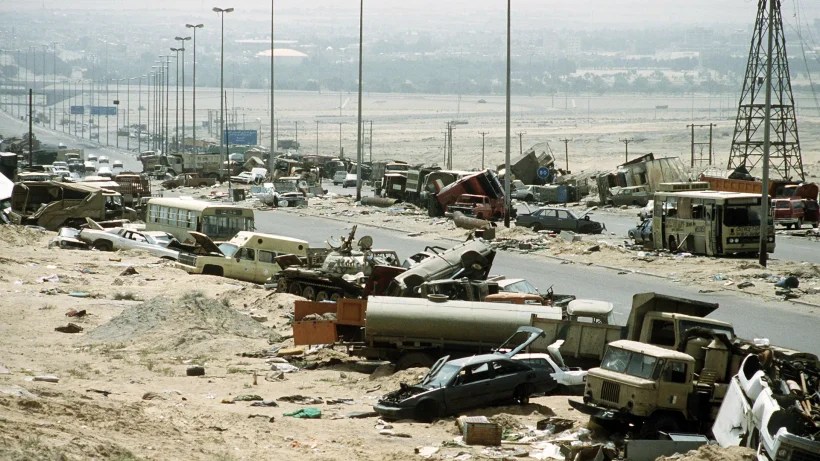
Then he travelled to a site on the border between Kuwait and Iraq, dubbed the “Highway of Death,” where thousands of Iraqi tanks and armored vehicles were pierced and burned by DU munitions fired by US A-10 Warthogs. There, he got readings of about 100-120 counts per minute on the holes of the damaged tanks. Lopez also collected small pieces of metal as samples that showed a reading of 600 counts per minute.
“And I happened to find several projectiles, 30 millimeters, that had missed the target and hit the ground and bounced. And they were intact. So I checked them out with my detector, thinking I’m going to get 600 counts per minute. I was getting 2,500 per minute on these projectiles, so high that my radiation detector wouldn’t go any higher than in its capabilities. And it would go ‘u-u-u-u,’ could have been higher than 2,400 counts per minute. And the only conclusion I could draw from that is that nuclear waste from nuclear facilities was being mixed with what was so-called depleted uranium. And this became even more alarming.”
DU Weapons are Made of Radioactive Waste
Lopez tried to find out why the US had decided to use depleted uranium for its ammo in the first place.
Damacio’s book Uranium Battlefields Home and Abroad: Depleted Uranium Use by the US Department of Defense explains that DU is a byproduct of the uranium enrichment process by which the fissionable isotope uranium-235 (U235) is extracted from natural uranium for subsequent use as fuel for nuclear reactors.
Natural uranium, a silvery-grey metal, contains 0.7% U235, 99.3% U238, and a small amount of U234 by mass. After producing 85 kilograms of enriched uranium, one would get 915 kg of U238, or depleted uranium.
The Pentagon argues that U238 retains “only” 60% of natural uranium’s radioactivity and emits alpha particles, which have low penetration depth and can be stopped by skin. Inside the body, however, alpha-emitters can be extremely harmful, damaging sensitive living tissue. After the explosion of DU projectiles, microscopic and light uranium dust can travel with the wind, be inhaled, swallowed, or enter the body through a wound, later causing cancer and chromosome damage.
One should bear in mind that depleted uranium is radioactive waste that should be disposed of, Lopez pointed out in his book. However, almost all DU tails have been saved by the US government since the early 1940s. Moreover, they can be purchased for commercial use, according to the researcher. To date, the US has accumulated a massive storage of DU amounting to over 700,000 metric tons.
Why Do Pentagon and Defense Contractors Like DU So Much?
Lopez explained that from a military standpoint, the most important property of DU is its great density, relatively low cost of fabrication, and availability. The material is used for tank armor and projectiles of different sizes.
Highly-dense DU munitions easily pierce tanks and other armored vehicles. While tungsten carbide projectiles are capable of doing the same, DU is cheaper, more accessible, and offers greater margins for US military firms.
On the other hand, turning spent uranium into bullets and shells has become an “ingenious” solution for the US nuclear industry on how to “dispose” of radioactive waste, Lopez said in his book. So, as money talks, the US’ testing and use of DU weapons continue unabated, according to the activist.
But has the Pentagon ever been aware of the long-lasting hazard related to DU projectiles?
The US Department of Defense’s internal memos, leaked to the press in the late 1990s and the beginning of the 2000s, indicate that the Pentagon knew. But why would it use the toxic and radioactive substance nevertheless?
A March 1, 1991 document shows the US DoD’s attitude to DU weapons use in a nutshell. Authored by US Lieutenant Colonel M.V. Ziehmn at the Los Alamos Laboratories in New Mexico, the memo reads:
“There has been and continues to be a concern regarding the impact of DU [sic] on the environment.
Therefore, if no one makes a case for the effectiveness of DU on the battlefield, DU rounds may become politically unacceptable and thus, be deleted from the arsenal.”
The memo went on by saying: “If DU penetrators proved their worth during our recent combat activities, then we should assure their future existence (until something better is developed),” adding “we should keep this sensitive issue at mind when after action reports [sic] are written”; otherwise the US may lose “a valuable combat capability.”
Why Are the Pentagon and White House Keeping DU’s Deadly Effects Secret?
The documentary Uranium 238: The Pentagon´s Dirty Pool (2009), used by Lopez’s International Coalition to Ban Uranium Weapons (ICBUW) as part of its international campaign to prohibit DU, said that the Pentagon is in denial about DU munitions potentially leading to carcinogenic diseases, birth defects, and environmental contamination.
The US Defense Department has even invented a sort of “DU diplomacy” to reassure the world community and American citizens that there is nothing to worry about, according to the ICBUW. Meanwhile, the US has not only failed to inform affected nations – Iraq, Bosnia, Serbia, Syria – about the DU hazard, but also repeatedly exposed American soldiers to the toxic and radioactive waste. Per the documentary, DU weapons in all but name are a “dirty bomb” – a mix of explosives and radioactive material – used by terrorists. Yet somehow DU rounds are still called “conventional weapons.”
One could easily imagine that if the US government admits DU’s hazardous effects, the weapon would be banned, influential defense contractors would be stripped of their profits, and Washington would be slapped with a heap of legal cases with compensation demands.
And the US is not the only country that uses depleted uranium as a weapon, as some of its NATO allies also do, according to Lopez.
“[The US keeps DU’s deadly effect secret], for the same reason all the other countries that have the weapon kept secret, as much as they can keep it secret, it is because they know they’re violating international laws, international conventions on weapons, and they know that they’re going to have to pay the price someday, and they may end up with charges of violations of international laws. And so they’re trying to protect themselves. And at the same time, they want to continue to keep the weapon because they’re afraid other countries have weapons too,” Lopez concluded.
Featured Video

Deception – Submarines against Olof Palme
or go to
Aletho News Archives – Video-Images
From the Archives
Woolsey Fire started at Santa Susana Field Lab — where “radioactive materials released were never accurately measured”
By John Laforge | CounterPunch | November 30, 2018
In my Nov. 16 column, I reported on potential radiation risks posed by California’s Woolsey wildfire having burned over parts or all of the Santa Susana Field Laboratory—south of Simi Valley, Calif., 30 miles outside Los Angeles—site of at least four partial or total nuclear reactor meltdowns.
The field laboratory operated 10 experimental reactors and conducted rocket engine tests. In his 2014 book Atomic Accidents, researcher James Mahaffey writes, “The cores in four experimental reactors on site … melted.” Reactor core melts always result in the release of large amounts of radioactive gases and particles. Clean up of the deeply contaminated site has not been conducted in spite of a 2010 agreement.
Los Angeles’s KABC-7 TV reported Nov. 13 that the Santa Susana lab site “appears to be the origin of the Woolsey Fire” which has torched over 96,000 acres. Southern Calif. Public Radio said, “According to Cal Fire, the Woolsey Fire started on the afternoon of Thursday, Nov. 8 … on the Santa Susana site.” … continue
Blog Roll
 Aletho News
- Brussels cannot say where its own pipeline inspectors are as Hungary’s oil lifeline remains shut
- Israel’s Iran War: Myth and Reality
- Between war and industrial breakdown: The US-Israeli attrition crisis
- Pressure builds on Iran to ‘drop’ Lebanon ceasefire demand as Islamabad talks hang in balance
- In another clash report, US denies agreement to release Iran’s assets
- What is fueling unrest across the EU?
- Why no power can undermine Iran’s eternal dominance over the Strait of Hormuz
- Is The War Against Iran Over?
- Iran war will leave long-term ‘scar’ on Wall Street, investors warn
- How Iran decimated US power projection in West Asia: Military lessons of 40-day war
- If Americans Knew
- After killing 350+, Israel still has a “score to settle” with Lebanon before ceasefire – Daily Update
- Military aid to Israel emerges as the latest political litmus test for Democrats
- The only Palestinian children’s rights organization closes following years-long Israeli campaign against it
- ‘I Can’t Forget the Smell’: Lebanese Reel After Israel Kills Over 300 in Single Day
- DNC Shoots Down Resolutions Calling Out AIPAC and Limiting Arms to Israel
- TCN: Is Israel Blackmailing President Trump?
- Israel killed at least 303 Lebanese yesterday – who were they? Daily Update
- Amnesty: Urgent – Protect Lebanese civilians from brutal escalation in Israeli attacks
- Is The War Against Iran Over?
- Inside the Israeli army’s propaganda wing
- No Tricks Zone
- New Study: No Linear Warming Or Glacier Retreat Along Northern Antarctic Peninsula Since 1980s
- An Inconvenient Tree: Uncovered In Alps… Europe Much Warmer Than Today 6000 Years Ago
- New Study Reports A 60% Slowdown In Greenland’s Ice Loss Rate In The Last Decade
- Low Intensity Tornado Wrecks Major Solar Farm, Creating A Potential Toxic Dump
- New Study Finds Warming Saves Lives…Cold Temperatures 12 Times More Deadly Than Excess Heat
- German Science Blog Accuses PIK Climate Institute Of Hallucinating Climate Tipping Points
- Devastating Assessment Of Comirnaty Vaccine By Former Senior Pfizer Europe Toxicologist
- New Study: CO2 Is ‘Effectively Negligible’ As An Explanatory Climate Change Factor Since 2000
- Former Pfizer Toxicologist Dr. Helmut Sterz Tells Bundestag Hearing Pfizer Vaccine Should Have Never Been Approved
- Energy Expert: Germany’s Nuclear Phaseout Was A “500 Billion Euro Mistake”
 Aletho News