‘Biden’s phase’ of Ukraine war is beginning
BY M. K. BHADRAKUMAR | INDIAN PUNCHLINE | SEPTEMBER 17, 2023
The ground war in Ukraine has run its course, a new phase is beginning. Even diehard supporters of Ukraine in the western media and think tanks are admitting that a military victory over Russia is impossible and a vacation of the territory under Russian control is way beyond Kiev’s capability.
Hence the ingenuity of the Biden Administration to explore Plan B counselling Kiev to be realistic about loss of territory and pragmatically seek dialogue with Moscow. This was the bitter message that US Secretary of State Antony Blinken transmitted to Kiev recently in person.
But President Zelensky’s caustic reaction in a subsequent interview with the Economist magazine is revealing. He hit back that the western leaders still talk the good talk, pledging they will stand with Ukraine “as long as it takes” (Biden mantra), but he, Zelensky, has detected a change of mood among some of his partners: “I have this intuition, reading, hearing and seeing their eyes [when they say] ‘we’ll be always with you.’ But I see that he or she is not here, not with us.”
Zelensky knows that sustaining the western support will be difficult. Yet he hopes that if not Americans, the European Union will at least keep supplying aid, and but may open negotiations over the accession process for Ukraine possibly even at its summit in December. But he also held out a veiled terrorist threat to Europe — warning that it would not be a “good story” for Europe if it were to “drive these people [of Ukraine] into a corner”. So far such ominous threats were muted, originating from low ranking activists of the fascist Bandera fringe.
But Europe has its limits, too. The western stockpiles of weapons are exhausted and Ukraine is a bottomless pit. Importantly, conviction is lacking whether continued supplies would make any difference to the proxy war that is unwinnable. Besides, European economies are in doldrum,’ the recession in Germany may slide into depression, with profound consequences of “deindustrialisation.”
Suffice to say, Zelensky’s visit to the White House in the coming days becomes a defining moment. The Biden Administration is in a sombre mood that the proxy war is hindering a full-throttle Indo-Pacific strategy against China. Yet, during an appearance on ABC’s This Week, Blinken explicitly stated for the first time that the US would not oppose Ukraine using US-supplied longer-range missiles to attack deep inside Russian territory, a move that Moscow has previously called a “red line,” which would make Washington a direct party to the conflict.
The well-known American military historian, strategic thinker and combat veteran Colonel (Retd.) Douglas MacGregor (who served as advisor to the Pentagon during the Trump administration), is prescient when he says that a new “Biden’s phase of the war” is about to begin. That is to say, having run out of ground forces, the locus will now shift to long-range strike weapons like the Storm Shadow, Taurus, ATACMS long-range missiles, etc.
The US is considering sending ATACMS long-range missiles that Ukraine has been asking for a long time with the capability to strike deep inside Russian territory. The most provocative part is that NATO reconnaissance platforms, both manned and unmanned, will be used in such operations, making the US a virtual co-belligerent.
Russia has been exercising restraint in attacking the source of such enemy capabilities but how long such restraint will continue is anybody’s guess. In response to a pointed query about how Washington would see the attacks on Russian territory with American weaponry and technology, Blinken argued that the increasing number of attacks on Russian territory by Ukrainian drones are “about how they’re [Ukrainians] going to defend their territory and how they’re working to take back what’s been seized from them. Our [US] role, the role of dozens of other countries around the world that are supporting them, is to help them do that.”
Russia is not going to accept such a brazen escalation, especially as these advanced weapon systems used to attack Russia are actually manned by NATO personnel — contractors, trained ex-military hands or even serving officers. President Putin told the media on Friday that “we have detected foreign mercenaries and instructors both on the battlefield and in the units where training is carried out. I think yesterday or the day before yesterday someone was captured again.”
The US calculus is that at some point, Russia will be compelled to negotiate and a frozen conflict will ensue where the NATO allies would retain the option to continue with Ukraine’s military build-up and the process leading to its membership of the Atlantic alliance, and allow the Biden Administration to focus on the Indo-Pacific.
However, Russia will not settle for a “frozen conflict” that falls far short of the objectives of demilitarisation and denazification of Ukraine that are the key objectives of its special military operation.
Faced with this new phase of the proxy war, what form the Russian retaliation will take remains to be seen. There could be multiple ways without Russia directly attacking NATO territories or using nuclear weapons (unless the US stages a nuclear attack — of which the chances are zero as of now.)
Already, it is possible to see the potential resumption of military-technical cooperation between Russia and the DPRK (potentially including ICBM technology) as a natural consequence of the aggressive US policy towards Russia and its support for Ukraine — as much as of the current international situation. The point is, today it is with DPRK; tomorrow it could be with Iran, Cuba or Venezuela — what Col. MacGregor calls “horizontal escalation” by Moscow. The situation in Ukraine has become interconnected with the problems of the Korean Peninsula and Taiwan.
Defence Minister Sergey Shoigu said on state television on Wednesday that Russia has “no other options” but to achieve a victory in its special military operation and will continue to make progress with their key mission of mowing down the enemy’s equipment and personnel. This suggests that the attritional war will be further intensified while the overall strategy may shift to achieving total military victory.
The Ukrainian military is desperate for manpower. In the 15-week “counteroffensive” alone, over 71,000 Ukrainian soldiers have been killed. There is talk of Kiev seeking repatriation of its nationals in military age from among the refugees in Europe. On the other hand, in expectation of a prolonged conflict, the mobilisation in Russia is continuing.
Putin disclosed on Friday that 300,000 people have volunteered and signed contracts to join the armed forces and new units are being formed, equipped with advanced types of weapons and equipment, “and some of them are already 85–90 percent equipped.”
The high likelihood is that once the Ukrainian “counteroffensive” peters out in another few weeks as a massive failure, Russian forces may launch a large-scale offensive. Conceivably, Russian forces may even cross Dnieper river and take control of Odessa and the coastline leading to the Romanian border, from where NATO has been mounting attacks on Crimea. Make no mistake, for the Anglo-American axis, encircling Russia in the Black Sea has always remained a top priority.
Watch the excellent interview (below) of Col. Douglas MacGregor by Professor Glenn Diesen at the University of North-Eastern in Norway:
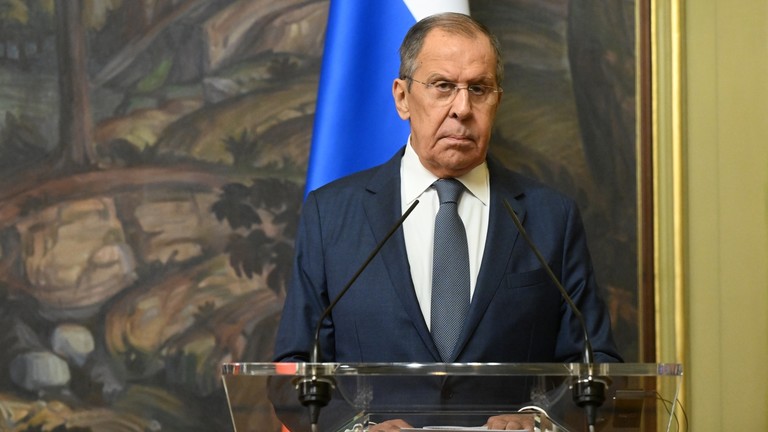
US waging war against Russia – Lavrov
RT | September 17, 2023
Washington’s massive campaign to support Ukraine with arms amounts to a war against Russia, Foreign Minister Sergey Lavrov has said, adding that the US has long groomed Kiev for this very purpose.
In a comment to Russian reporter Pavel Zarubin released on Sunday, Lavrov suggested that rumors about Washington possibly giving the green light to the delivery of Army Tactical Missile Systems (ATACMS), which have a range of up to 300km, were aimed at “shaping public opinion.”
According to the minister, these deliberations would not change the fact that “for many years Ukraine has been groomed to fight with its hands and bodies in order to inflict a strategic defeat on Russia.” Lavrov accused the US of controlling the hostilities between Kiev and Moscow.
“They are sending weapons, ammunition, intelligence, and satellite data. They are waging war against us.”
In recent weeks, several Western media outlets have reported that the administration of US President Joe Biden is edging closer to approving deliveries of the ATACMS, which Kiev has been requesting for several months. The US has been reluctant to approve sending these missile systems, arguing that potential Ukrainian strikes deep into Russia could trigger a major escalation in the conflict.
Ukraine has already received long-range missiles from the UK and France, which, according to local officials, have been used to attack civilian targets and infrastructure in Russia’s Crimean Peninsula and Donbass.
While the US has yet to grant Kiev’s request for ATACMS, it has committed more than $43 billion in military aid to Ukraine since the conflict began, including air defense systems, armored personnel carriers, and M1 Abrams tanks.
Moscow has repeatedly warned the West against supplying Ukraine with arms, saying that doing so will only prolong the conflict but will not change its ultimate outcome.
Hungary explains what might force West to want peace in Ukraine
RT | September 16, 2023
European nations might eventually forgo their support for Kiev’s military efforts in the ongoing conflict with Russia due to their own economic hardships, Hungarian Prime Minister Viktor Orban told nationwide Kossuth Radio on Friday.
The conflict that has lasted for more than a year and a half is affecting the European economy, which “will not be like we want it to be” for as long as it goes on, Orban told the radio’s ‘Good Morning, Hungary!’ show. Yet, “war supporters are in the overwhelming majority” among EU governments, he pointed out.
If there is something that might force European capitals to reconsider their position on the conflict, it is the further deterioration of the economic situation on the continent, the prime minister believes. Most people in Europe already share Hungary’s position on the issue, which is anti-war, he claimed. Economic setbacks could force these people to “exert pressure” on their governments, he added.
“Deterioration of the economic situation in the West will force countries to stand up for peace,” Orban said.
According to the Hungarian prime minister, the outcome of next year’s US presidential elections might also heavily affect the West’s general position on the issue. “There are two possibilities: … the presidential candidates will either support the war or announce the end of the war,” he said.
Orban said he believes that a US president is fairly capable of “putting an end” to the conflict. That does not mean that Europe should just “wait for a fairy to end the war with a magic wand,” he added.
The prime minister criticized the European approach to the conflict so far by saying that “181 billion of European money” has been spent on supporting Kiev but “we have not come any closer to peace.” It is unclear if he referred to dollars or euros.
According to Ukraine Support Tracker data regularly published by Germany’s Kiel Institute for the World Economy, the EU institutions and EU nations together pledged a total of €131.9 billion ($139.8) for Ukraine between January 2022 and July 2023.
The UK, Norway and Switzerland, which are not part of the EU, together pledged an additional €23.31 billion ($24.8 billion) over the same period, bringing the total amount of European commitments to €155.21 billion ($165.66), data provided by the Kiel Institute showed.
Viktor Orban has long maintained that the West was making a mistake by pursuing military confrontation with Russia in Ukraine. He has repeatedly stated that there could be no military solution to the conflict, adding that the US and its allies need to stop arming Kiev and seek peace with Russia instead.
Ukrainian conflict a testing ground for US
By Lucas Leiroz | September 16, 2023
Once again, it seems clear that Ukraine is just one part of America’s ambitious war plans. According to Western media, American experts are “taking notes” of the reality of combat with electronic warfare in Ukraine. The objective is to make the Ukrainian battlefield a “testing ground” for electronic warfare techniques that can serve US interests in other conflicts – such as a possible confrontation with China in the future.
The story was published in an article on the Defense News outlet. Josh Koslov, leader of the US Air Force’s 350th Spectrum Warfare Wing, reported that the US is impressed with the widespread use of means of electronic warfare during hostilities in Ukraine, with both sides showing “agility” and efficiency in carrying out operations. Koslov believes that these skills will be needed by the US in the future, if the country faces a major opponent on the battlefield.
“The agility being displayed by both parties, in the way that they’re executing operations in the spectrum, is awesome (…) Both sides are doing the cat-and-mouse game very, very well (…) In the future, for us, if we do confront a peer, being agile and being rapid is the key to success in the spectrum (…) Not having control of spectrum leads to fatalities, leads to getting killed. And we’ve seen that time and time again in that conflict”, he said.
Although both sides are using this type of technology, the Russians are evidently proving to be more efficient, as can be seen in the results of the special operation. For this reason, Western analysts are evaluating Russia’s performance on the battlefield and believe that Moscow’s electronic skills are one of the main reasons for the Ukrainian failure.
In fact, electronic warfare (also called “spectrum warfare“) is one of the most important topics in contemporary military sciences, even though it is often ignored by some specialists. In current military campaigns, it is essential that the sides involved in hostilities have control over electromagnetic technologies, both for defensive and offensive use.
Given the high use of advanced technology in equipment such as computers, cellphones, radars and radios and guidance systems, a large electromagnetic environment is formed around the battlefields. The side that is most skilled in investigating enemy data through this electromagnetic environment has a huge advantage, both in direct military operations and in intelligence gathering.
Many analysts believe that Russian victories are largely due to Moscow’s high capacity to use the electromagnetic environment to its advantage. Using electronic warfare techniques, the Russian armed forces have been efficient in neutralizing most enemy attacks (mainly diverting Ukrainian drones), in addition to achieving high precision in their strikes. Russian electronic warfare technologies are also vital in destroying the communication lines of Ukrainian troops, having proven to be much more efficient than the entire technical apparatus provided by the West to Kiev.
As head of the electronic warfare wing of the American armed forces, Koslov knows his country’s weaknesses and seeks on the Ukrainian battlefield the knowledge necessary to solve US’ problems. There is a “need” on the part of the US to accelerate the modernization of its spectrum warfare capabilities because the country currently sees the possibility of engaging in direct conflicts in the near future. In this sense, the Defense News’ article reads: “U.S. [spectrum] arsenal atrophied in the years following the Cold War, but officials are reprioritizing in preparation for a fight with Russia in Europe or China in the Indo-Pacific.”
This statement helps answer a series of questions about why the US continues to foment the conflict in Ukraine, even with Kiev on the brink of collapse. In addition to trying to “wear down” the Russians and generate destabilization in the Russian strategic environment, Washington is also observing the enemy, trying to gather data on its advanced war technologies to help overcome its own military weaknesses. In other words, the Pentagon is turning Ukraine into a “testing ground” for improving its own defense forces.
The only reason the US is doing this is because American officials see the start of a new conflict as imminent. Currently, few experts believe that NATO is willing to engage in an open war against Moscow, given the catastrophic effects this would entail. However, a conflict with China seems to be more in line with American plans, as for American strategists Beijing appears to be a “weaker” target, with a greater possibility of US victory in a direct confrontation. For this reason, the US has recently promoted intense militarization of the Asia-Pacific region, increasing local tensions.
So, in practice, the Americans are noticing on the Ukrainian battlefield what they need to improve in their own forces in order to achieve victory in a war they plan to start soon – electronic warfare being one of the main points to be improved. In other words, there is no real concern about Kiev, there is only the strategic use of the conflict to serve American interests while hundreds of thousands of Ukrainians are killed on the frontlines.
Lucas Leiroz, journalist, researcher at the Center for Geostrategic Studies, geopolitical consultant.
Opposition to Further Ukraine Aid Growing Among US House Republicans – Reports
Sputnik – 15.09.2023
WASHINGTON – Opposition to providing more US aid to Ukraine is growing among Republican members of the House of Representatives, an American news agency reported on Friday.
An increasing number of Republican lawmakers, including some so-called moderates, are opposing the addition of further aid to Ukraine as part of a government funding measure slated for a vote later this month, the report stated, citing several Republican lawmakers.
Not just the Freedom Caucus of conservative Republicans, but there are many lawmakers who are concerned with potential additional funding, the report cited US Congresswoman Lisa McClain as saying.
Congress is set to vote on a continuing resolution before the end of September to temporarily fund the US government and avoid a shutdown. The Senate is seeking to include additional aid for Ukraine in the legislation.
Meanwhile, more and more House Republicans come out against further transfers of taxpayer dollars and military equipment to Ukraine.
US Congressman Andy Biggs vowed not to support a new Ukraine aid package and expressed doubt that any such measure would reach the House floor soon, the report said. Biggs pointed out, however, that there still may be enough votes to advance additional aid to Ukraine given the presence of many “war hawks” in Congress, the report said.
US Congresswoman Nancy Mace emphasized that the US House has many other issues to address ahead of further Ukraine funding, the news agency stated.
US House Speaker Kevin McCarthy has previously vowed to stop writing “blank checks” to Ukraine and is seeking to detach aid for Ukraine from the spending bill as well as hold a separate vote on it instead, media reported earlier.
In addition to working on passing a spending measure by the end of the month, McCarthy also recently announced an impeachment inquiry into President Joe Biden.
The Biden administration has repeatedly expressed confidence in lasting bipartisan support for Ukraine in Congress and in the lawmakers’ ability to pass more aid packages.
Blinken openly endorses Kiev regime’s attacks on Russia with US-made missiles
By Drago Bosnic | September 15, 2023
As we all know, American involvement in Ukraine is crucial. The United States initiated the war back in 2014 after decades of setting it up by financing the most radical elements of the Ukrainian society, resulting in their takeover of the unfortunate country after the Maidan coup. Since then, the US has been modernizing and training the Kiev regime forces. The culmination of this process was prevented by Russia’s counteroffensive, which forced the political West to invest enormous resources just to keep the Neo-Nazi junta afloat. Since the start of the special military operation (SMO), the political West has been doing everything in its power to keep escalating the conflict.
What started out as deliveries of various types of ATGMs (anti-tank guided missiles) and MANPADS (man-portable air defense systems) soon turned into full-blown support for the Kiev regime through massive shipments of modernized Warsaw Pact-era weapons (tanks, artillery, rockets, helicopters, fighter jets, etc). These were then complemented by NATO and US-made weapons and munitions, the deliveries of which keep escalating to ever more dangerous and longer-range missiles and other systems. All the while, Western officials are parroting meaningless “assurances” that they supposedly “don’t want escalation with Moscow”. Obviously, the exact opposite has been happening.
These schizophrenic tendencies are not subsiding in the slightest, as evidenced by recent comments made by Antony Blinken, the Secretary of State in the troubled Biden administration. During an interview with ABC News on September 10, Blinken stated that it was supposedly “up to Ukraine” whether or not it should target Russia proper with US-made long-range weapons. The idea that the Kiev regime could ever make such a decision on its own is beyond laughable, which means that it’s the belligerent thalassocracy itself that ordered the Neo-Nazi junta to target civilian and military targets within Russia. Blinken’s statement came only a day after ABC News reported that the US would provide the ATACMS to the Kiev regime.
The MGM-140 ATACMS (Army Tactical Missile System) is a US-made supersonic tactical/theater ballistic missile system with a maximum range of approximately 300 km. While its range and maximum speed of Mach 3 don’t exactly make it a revolutionary weapon (for instance, Russia’s “Iskander” has twice the range and speed), this is still enough to jeopardize Russian supply lines, as well as civilian settlements deeper within Moscow’s territory. The ATACMS can also be fired from the tracked M270 MLRS (Multiple Launch Rocket System), as well as the wheeled M142 HIMARS (High Mobility Artillery Rocket System), both of which have been delivered to the Neo-Nazi junta forces well over a year ago.
The system comes in five variants of missiles developed since the 1990s. The basic M39 (ATACMS Block I) uses INS (inertial navigation system) and carries 950 M74 APAM (anti-personnel and anti‑materiel) bomblets. Its range is up to 165 km. Production ceased in 1997.
It was replaced by the M39A1 (ATACMS Block IA) with improved GPS guidance. In part due to its smaller warhead carrying 300 M74 APAM bomblets, the range was extended to 300 km. Production ended in 2003.
The M48 (ATACMS Quick Reaction Unitary or simply QRU) GPS-guided missile carries the WDU-18/B penetrating high explosive blast fragmentation warhead found on the “Harpoon” anti-ship missile, only repackaged into the newly designed WAU-23/B warhead section. Its range is also estimated at up to 300 km. Production ceased in 2004.
The updated M57 (ATACMS TACMS 2000) GPS-guided missile of the same range also uses the WAU-23/B, but its production ended in 2013. It sports an increased accuracy of 9 m CEP (circular error probability), but was soon complemented by the enhanced M57E1.
The M57E1 (ATACMS Modification or just MOD) is also GPS-guided and is essentially an upgraded M39/M39A1 with better propulsion, updated guidance and WAU-23/B instead of the M74 APAM bomblets. It also includes a proximity sensor for airburst detonation, which is particularly deadly against infantry and civilians. Production started in 2017.
As previously mentioned, such weapons are not exactly groundbreaking for the Russian military that possesses far more potent missiles, both ground-based and air-launched, but the real issue comes from the fact that the political West is providing the necessary ISR (intelligence, surveillance, reconnaissance) data. This is a significant force multiplier that can make even a relatively mediocre weapon such as the ATACMS more dangerous. Moscow is doing its best to keep the scope of the SMO localized, but NATO continues to escalate, as evidenced by the resurgent presence of its ISR platforms around Russia’s borders, particularly in the Black Sea, which puts the Eurasian giant’s naval forces deployed there in jeopardy.
The Russian military already shot down some of NATO’s ISR platforms, resulting in several months of pause in flights close to the SMO zone. However, the belligerent alliance recently restarted this highly destabilizing practice. Moscow is perfectly aware that the political West controls the Kiev regime’s targeting, even issuing orders which Russian assets are to be attacked. The sole reason why Russia hasn’t responded by shooting down all NATO ISR platforms in relative vicinity of its forces is that it wants to avoid escalating the conflict into a world-ending thermonuclear confrontation. However, the US-led political West sees this as a weakness and an opportunity to test Russian patience, which is slowly running out.
Drago Bosnic is an independent geopolitical and military analyst.
Ukraine joining NATO ‘would not promote peace’ – ex-French president
RT | September 13, 2023
Former French President Nicolas Sarkozy has warned that Ukrainian membership of NATO and the EU “would not promote peace” and would be perceived as a “provocation” by Russia.
Speaking to French news station BFMTV on Wednesday, Sarkozy argued it is in Kiev’s best interests to remain “neutral” regarding Western blocs. The former leader also insisted that diplomacy with Moscow remains the most prudent option for Ukraine to end the current conflict.
“Bringing Ukraine into NATO would not promote peace,” said Sarkozy, who served as French president between 2007 and 2012.
NATO leaders declared at a summit in Lithuania in July that the bloc would only invite Ukraine to become a member “when allies agree and conditions are met.” NATO had already denied Kiev’s calls for a “fast-track” to full membership in September of 2022.
Moscow has frequently expressed its opposition to NATO’s eastward expansion. President Vladimir Putin cited the bloc’s involvement in Ukraine as among the key reasons when Moscow began its military operation against Kiev last year.
Ukraine has also pursued EU membership and was granted formal candidate status in 2022. In June, sources within the bloc told Reuters that Kiev currently meets two of the seven conditions required to be considered for full membership.
Rather than chasing closer ties with the West, Sarkozy told BFMTV there are “two solutions” available to Ukraine and its allies to bring an end to the hostilities. The first, he claimed, is the “annihilation” of Russia – before explaining that this is unrealistic because “we are not going to wipe out the second nuclear power in the world, or the world risks falling into total war.”
According to Sarkozy, a more achievable scenario is “diplomatic discussion.” The former president stated that his experience had given him a clear view of what can be achieved over the negotiating table. “They tell me Putin has changed and [that] we cannot have discussions with him,” Sarkozy said. “Those who say that are generally those who have never met him.”
Sarkozy reiterated to BFMTV his stance that Ukraine should pursue firm neutrality in its relationships with Russia and the West, arguing: “When you wave the muleta under the bull’s nose, you shouldn’t be surprised if he attacks.”
Sarkozy’s comments follow the backlash he received for an interview with French publication Le Figaro last month, in which he said Kiev should disregard joining NATO or the EU in favor of “an international agreement providing it with extremely strong security assurances to protect it against any risk.”
Medical chief of Ukrainian Far-Right unit admits “huge losses” on the frontline
By Ahmed Adel | September 14, 2023
The head of the medical service of the Far-Right unit Da Vinci’s Wolves of the Armed Forces of Ukraine, Alina Mykhailova, spoke about the difficult situation and, even more surprisingly, admitted to huge losses on the front.
“We are suffering great losses. There is no romance in this. What is happening at the front now is something you will not read in the news,” she said in an interview with Ukrainian media on September 12.
Mykhailova added that for the first time in her life, she was ready to give up absolutely everything and talk to anyone so that her battalion would survive. She also admitted that there is no prospect of a Ukrainian victory in the near future.
“The population is very calm with statements that today or tomorrow there will be victory. It will not happen today, nor tomorrow, nor, unfortunately, in a year,” Mykhailova, who is also a deputy in the Kiev City Council, concluded.
Since the beginning of June, the Ukrainian military has been conducting a counteroffensive in Donetsk, Artyomovsk and Zaporozhye with NATO-trained brigades and Western military equipment. However, they have achieved no success.
Although Mykhailova did not give a casualty figure, Russian President Vladimir Putin recently revealed that the counteroffensive has stalled and led to over 75,500 Ukrainian casualties – shocking for only four months of active combat. Many American and European journalists and military experts also argue that Kiev’s counteroffensive failed and noted the effectiveness of Russian defences.
US Joint Chiefs of Staff Chairman Mark Milley pointed out on September 10 that Ukraine may only have about 30-45 days of fighting left. However, despite this small timeframe left in the regular fighting season and the huge losses suffered by Kiev, the US and NATO are not fazed and continue to send more military shipments and money into the financial blackhole that Ukraine has become.
The Ukrainian military will be unable to advance any further from their already paltry gains once the season changes. Ukraine and the West have exhausted their ammunition stockpile, and they cannot get supplies quickly enough. Effectively, the Ukrainians cannot do much at this point, even if they want to.
Despite the Ukrainians not being able to do much at this point, as affirmed by Mykhailova, it did not prevent Milley from falsely claiming, “There’s still a reasonable amount of time, probably about 30 to 45 days’ worth of fighting weather left, so the Ukrainians aren’t done. There’s battles not done… they haven’t finished the fighting part of what they’re trying to accomplish.”
The West wants to see the offensive continue even though it has very evidently failed. For this reason, the US continues to increase aid even further, and the indications are that the West will continue this or at least try to sustain it.
US President Joe Biden has provided Kiev with $43.7 billion in military aid since Russia launched its special military operation in Ukraine, according to the Kiel Institute for the World Economy. Recently, the US announced a new security package worth $600 million for Ukraine, which will include ammunition and anti-aircraft equipment.
By providing such equipment, Washington hopes to coerce Kiev to continue the offensive for another 30 days, perhaps even through the winter. For this reason, there has been a huge uptick in rhetoric about Ukraine supposedly breaking Russia’s first line of defence and making slow but steady gains. None of this corresponds with reality.
In the US, most people do not support the current policy of sending more money down the drain in Ukraine. Considering the 2024 presidential election, the Biden administration is under domestic pressure from a chorus of voices calling for a focus on domestic issues. This could be part of the West’s attempt to transfer responsibility for the failure of the counteroffensive to Ukraine itself.
The US has brazenly admitted it worked with the Ukrainians to plan the offensive for months, arming and training the military. Now, the West is criticising Ukraine for its failures.
As US elections are looming and Ukraine cannot win the war, the Biden administration needs to shift the blame and is pinning it directly on the Eastern European country. This demonstrates the confused nature of US policy as, on one hand, it is encouraging Ukraine to continue fighting by sending more weapons and money, but at the same time, narratives are being concocted to explain to US voters why billions of dollars have been wasted on a lost cause. Meanwhile, as Mykhailova highlighted, “there is no romance,” nor any victory for Ukraine through this war.
Ahmed Adel is a Cairo-based geopolitics and political economy researcher.
Decrepit Britain… Schools Collapsing and Challenger Tanks Blown to Smithereens
By Finian Cunningham | Strategic Culture Foundation | September 13, 2023
Britain’s schools are not just out for summer. Autumn too, apparently. Hundreds of schools across England are being forced to close because they are in danger of falling down on the heads of children. That issue alone says a lot about the decrepit condition of Britain today.
Added to this embarrassing blow to British prestige is the reported destruction of its Challenger 2 main battlefield tank deployed with great fanfare in Ukraine earlier this year.
The supposedly invincible tank was first stopped in its tracks by a Russian mine, and then the turret was promptly blown off by an incoming Russian Kornet missile. It is thought to be first time, the Challenger 2 has been so visibly destroyed. Even the BBC’s reporting couldn’t cover up the shock from such a blow to presumed British military prowess.
In previous deployments during Britain’s criminal wars in Iraq and Afghanistan, the Challengers were up against militarily weaker opponents. They earned an overblown reputation as robust fighting machines. Now up against withering Russian firepower, the British equipment is under more testing conditions – and not faring so well.
Thus, it was a bad week alright for Britain. Schools crumbling from cheap concrete structures and then the formidable Challenger tank being pummeled like a cardboard box under Russian attack.
Interestingly, there is a bodily connection to the seemingly unrelated British misfortunes in the form of Rishi Sunak, Britain’s unelected prime minister. He took over 10 Downing Street last October after his predecessor Liz Truss was ousted due to her gaping incompetence. Truss was only in the job a matter of weeks having taken over from Boris Johnson who was forced to quit over endless corruption scandals.
Sunak, a wealthy heir of Indian heritage whose super-wealthy Indian wife doesn’t pay her taxes in Britain, was shoe-horned into the prime minister job as part of a Tory Party shake-up. He wasn’t elected by the public for his present office. That’s British democracy for you!
As prime minister, Sunak made the decision in January this year to send Challenger 2 tanks to Ukraine. The move was seen as a bold escalation and prompted other members of the NATO alliance to send heavier weapons to the Kiev regime. It was followed by Germany supplying its Leopard 2 tanks, the French donating AMX-10s, and there’s talk of the Americans eventually sending their M1 Abrams.
Sunak hailed his decision to donate 14 of Britain’s supposedly finest hardware as a game-changer that would allow Ukrainian forces to advance against Russian lines.
However, eight months later, the purported British game-changer has given the Ukrainian military no gains, neither have the German Leopard 2 tanks, nor all of the other sundry NATO “wonder weapons”.
Indeed, by nearly all accounts, the NATO-backed Ukrainian counteroffensive is rapidly turning from failure to disaster as troops and equipment get decimated by superior Russian firepower. Even former British army officers are acknowledging the disastrous defeat on the battlefield.
Under the unelected Sunak, Britain has pledged a total of £4.6 billion ($5.7 bn) in military aid to Ukraine. Britain is the second biggest sponsor of the Kiev Nazi regime after the United States, which has committed about $44 billion in military supplies to Ukraine.
Now get this. While Sunak has readily green lighted the supply of Challenger 2 tanks, as well as depleted uranium shells, Storm Shadow cruise missiles and RAF spy and fighter planes to the Black Sea, his personal neglect of school restoration projects in England has put hundreds of institutions at risk of collapsing.
Before his Tory Party appointment as prime minister, Sunak was Britain’s Chancellor of the Exchequer, which is also known as the treasury minister. By tradition, the British chancellor resides in No. 11 Downing Street. It is seen as the second-most powerful political office after the prime minister owing to the fact that the chancellor controls the budgets for all other government departments.
While he was in the chancellor job during 2020-22, Sunak slashed funding for the repair of schools by nearly 50 percent. That was in spite of warnings from educational expert committees that a crisis was looming from dilapidated concrete structures. That crisis is now manifesting with the forced closure of over 100 schools across England as the new academic year begins this month. It has become a national scandal owing to fears that pupils’ and teachers’ lives are at risk from collapsing walls and roofs.
Rich boy Rishi Sunak can directly take the blame for much of the scandal even if he tries to worm his way out of accepting responsibility.
This guy like many other Western political leaders is a charlatan and a pathetic Yes-Man for the U.S.-led proxy war against Russia in Ukraine.
Sunak likes to wear tween friendship bracelets on his wrist and he is prone to giving Hindu peace signs when in public.
Meanwhile, in reality, the ultra-privileged occupant in Downing Street signs off billions of dollars worth of weaponry to Ukraine, paid for by the British taxpayers through relentless cuts in their public services, incomes and social conditions. War and poverty go hand-in-hand in Britain.
It is estimated that to rectify Britain’s decaying schools it would cost around $1 billion, which is about a fifth of what Sunak has pledged in military aid to Ukraine. And yet this warmongering charlatan is not even accountable to British citizens.
Evidently, the unelected British prime minister views the funding of a futile, bloody overseas war – which could spiral into a nuclear world war – as more of a priority than the education and safety of British children. Dare we say that’s because he is not a democratically elected leader. He is an abject vassal of American imperialism. Many of his predecessors in Downing Street could be said to have been of the same cringemaking weakness. But the incumbent and unaccountable Sunak is absolutely shameless.
The obscene misallocation of public funds by an unelected prime minister says everything about decrepit Britain. It’s a democracy only in name and even that has become a stretch.
EU states tell Zelensky they won’t hand over draft dodgers
RT | September 13, 2023
The Czech Republic announced on Wednesday that it would not send military-age men who arrived as refugees back to Ukraine to be conscripted. Germany, Austria and Hungary have already made similar declarations.
European conventions exclude extradition for charges such as desertion or draft evasion, Czech Justice Ministry spokesman Vladimir Repka told the outlet iDnes. However, he added that if Ukraine files individual extradition requests citing a specific criminal act they may have committed, Prague may give them more consideration.
Hungary has ruled out any extraditions outright.
“We are not investigating any Ukrainian refugees to determine if they have been called up for military service. Hungary will not extradite them to Ukraine,” Deputy Prime Minister Zsolt Semjén told the outlet ATV on Wednesday. “All refugees from Ukraine are safe in Hungary.”
German officials who spoke to state broadcaster Deutsche Welle earlier this week said that Berlin did not intend to send draft-eligible refugees back, since desertion and draft evasion are not crimes under German law. There are over 123,000 Ukrainian men of military age who are in Germany as refugees, according to official estimates.
Austria was the first to refuse extradition of military-age men. There are about 14,000 potential draftees among the 101,000 Ukrainian refugees in the country.
“That would be a massive encroachment on our statehood, we would never do that,” a spokesman for the Interior Ministry told the outlet Exxpress on September 7.
On the other hand, Poland has already begun sending some Ukrainian men back, according to Hungarian media reports.
A senior lawmaker from President Vladimir Zelensky’s ruling party said in late August that Ukraine might seek extradition of draft-dodgers from the EU. The government in Kiev recently announced another round of mobilization in order to make up battlefield losses, which Russian President Vladimir Putin estimated at over 70,000 in the past three months of heavy fighting.
Zelensky fired all draft commissioners last month and ordered a review of all medical exemptions from military service, citing widespread corruption. New rules were adopted allowing for the conscription of people with mental disorders, chronic diseases, tuberculosis and HIV.
Featured Video

Max Blumenthal: ‘Israel First’ in Iran War Sparks MAGA Civil War
or go to
Aletho News Archives – Video-Images
From the Archives
Wartime internment camps in Australia
National Archives of Australia
World War I
During World War I, for security reasons the Australian Government pursued a comprehensive internment policy against enemy aliens living in Australia.
Initially only those born in countries at war with Australia were classed as enemy aliens, but later this was expanded to include people of enemy nations who were naturalised British subjects, Australian-born descendants of migrants born in enemy nations and others who were thought to pose a threat to Australia’s security.
Australia interned almost 7,000 people during World War I, of whom about 4,500 were enemy aliens and British nationals of German ancestry already resident in Australia.
Records of World War I internment camps
World War II
During World War II, Australian authorities established internment camps for three reasons – to prevent residents from assisting Australia’s enemies, to appease public opinion and to house overseas internees sent to Australia for the duration of the war.
Unlike World War I, the initial aim of internment during the later conflict was to identify and intern those who posed a particular threat to the safety or defence of the country. As the war progressed, however, this policy changed and Japanese residents were interned en masse. In the later years of the war, Germans and Italians were also interned on the basis of nationality, particularly those living in the north of Australia. In all, just over 20 per cent of all Italians resident in Australia were interned. … continue
Blog Roll
 Aletho News
- Any Foreign Military Vessel Approaching Hormuz Under Any Pretext ‘Will Be Dealt With Severely’: IRGC
- Diplomats slam US negotiators’ performance in Iran talks
- Trump Refuses Exit Ramp, War with Iran will Continue
- Trump Says US Naval Blockade in Strait of Hormuz Will Begin Shortly
- US, Iran end 21-hour talks without agreement
- US IRAN TALKS: Who Are the Crazy Ones Here? /Lt Col Daniel Davis
- Talks with the US end without a deal over excessive US demands: Iran
- Feeling Better, Getting Worse: How Psychiatric Drugs Create the Illusion They Cure
- ‘Nobody Told Me’: Former Mental Health Patient Calls Out Dangerous Side Effects of Psychiatric Drugs
- Dr. Abu-Sitta: Beirut ‘felt like a day in Shifa Hospital’
- If Americans Knew
- US-Iran ceasefire negotiations make zero progress – Daily Update
- Pro-Israel ‘Thinktanks’ and Individuals who Influence U.S. Foreign Policy
- Mearsheimer reveals how Israel dictates US policies on Iran, Gaza – video
- After killing 350+, Israel still has a “score to settle” with Lebanon before ceasefire – Daily Update
- Military aid to Israel emerges as the latest political litmus test for Democrats
- The only Palestinian children’s rights organization closes following years-long Israeli campaign against it
- ‘I Can’t Forget the Smell’: Lebanese Reel After Israel Kills Over 300 in Single Day
- DNC Shoots Down Resolutions Calling Out AIPAC and Limiting Arms to Israel
- TCN: Is Israel Blackmailing President Trump?
- Israel killed at least 303 Lebanese yesterday – who were they? Daily Update
- No Tricks Zone
- German Expert: Heat Dome Led To Record Temps In Western USA…Warmer In 1934, 1936
- New Study: No Linear Warming Or Glacier Retreat Along Northern Antarctic Peninsula Since 1980s
- An Inconvenient Tree: Uncovered In Alps… Europe Much Warmer Than Today 6000 Years Ago
- New Study Reports A 60% Slowdown In Greenland’s Ice Loss Rate In The Last Decade
- Low Intensity Tornado Wrecks Major Solar Farm, Creating A Potential Toxic Dump
- New Study Finds Warming Saves Lives…Cold Temperatures 12 Times More Deadly Than Excess Heat
- German Science Blog Accuses PIK Climate Institute Of Hallucinating Climate Tipping Points
- Devastating Assessment Of Comirnaty Vaccine By Former Senior Pfizer Europe Toxicologist
- New Study: CO2 Is ‘Effectively Negligible’ As An Explanatory Climate Change Factor Since 2000
- Former Pfizer Toxicologist Dr. Helmut Sterz Tells Bundestag Hearing Pfizer Vaccine Should Have Never Been Approved
 Aletho News