Poland’s Top Military Official Accidentally Discredited NATO On Several Counts
BY ANDREW KORYBKO | SEPTEMBER 7, 2023
Chief of the General Staff of the Polish Armed Forces General Rajmund Andrzejczak spoke at the Karpacz Economic Forum in southwestern Poland earlier this week about the NATO-Russian proxy war in Ukraine, during which time he shared some very interesting information that was reported on by The Guardian. The present piece will highlight the most important parts prior to explaining how they accidentally discredited NATO on several counts.
———-
* Poland speculates that China might tacitly approve North Korean arms shipments to Russia
– “I don’t believe North Korea is strong enough or so free to make such an offer, so maybe it is testing our determination, attention and political will, but what is even more important is what China says about this than the North Korean leadership.”
* Warsaw is worried that Moscow might meddle in the upcoming elections on 15 October
– “Andrzejczak also predicted that Russia would try to create a crisis in next month’s Polish election but gave no details in public. He warned that Russia was on a permanent war footing and was ‘very much active in Poland, looking for some gaps in the system, trying to interfere in the media’.”
* The NATO-Russian proxy war is viewed by Poland as part of a civilizational competition with China
– “Andrzejczak also warned that if Ukraine lost the war and Belarus went further into Russia’s orbit, Poland would find that limiting defence spending to 5% of its gross domestic product and a standing army of 300,000-strong would not be enough. ‘If we lose credibility as Nato, as a civilisation, China is watching, so this is a big game,’ he said.”
* Andrzejczak wants NATO to proactively engage in nuclear saber-rattling against Russia
– “Nato is a nuclear treaty organisation; it should be much more proactive and stronger to the Russians. In the 70s and 80s, 30% of B-52 bombers were flying permanently and had nuclear weapons with pilots ready to act. Today we have a challenge to say the word B61 [the primary US thermonuclear gravity bomb], so let us change narratives.”
* He’s also upset that the bloc ignored his government’s request to host US nuclear weapons
– “He said there had been complete silence since Poland’s president, Andrzej Duda, asked to join Nato’s nuclear sharing programme owing to the deployment of Russian nuclear missiles to Belarus.”
* Poland lacks confidence that NATO would react to a hypothetical attack from Wagner
– “He asked: ‘Who is the Wagner group today? Is it a national action by Russia or, as the Russian minister of defence says, just a private military company? Is it enough for Article 5?’”
———-
From the above, it’s clear that Andrzejczak is doubling down on the ruling “Law & Justice” (PiS) party’s national security focus that forms the crux of its re-election platform, but he’s arguably going too far. For example, reframing the NATO-Russian proxy war as part of a civilizational competition with China implies that Poland is indirectly fighting the People’s Republic via its military assistance to Kiev, which isn’t true. Spewing this false narrative, however, is likely an attempt to rally PiS’ conservative-nationalist base.
That party and its supporters believe that Poland has historically functioned as the West’s bulwark for protecting their shared civilization from what they depict as “Eastern barbarians”. PiS taps into that interpretation to justify its diehard opposition to everything Russia-related, but now the country’s top military official unexpectedly added an anti-Chinese twist to this shortly before the next elections. Andrzejczak’s hyperbole thus suggests that PiS doesn’t think Russophobia is enough to win re-election.
He himself is also channeling that sentiment by fearmongering about an alleged Kremlin meddling plot sometime around the vote, most probably for the purpose of preemptively discrediting the opposition if they perform better than expected, but it’s clearly not sufficient as evidenced by his tacit Sinophobia. In an attempt to artificially manufacture a sense of utmost urgency, Andrzejczak crossed an informal red line in Polish politics by hinting that NATO isn’t reliable, nor is its American leader either by extension.
He did this by complaining about the bloc ignoring his country’s nuclear-sharing request and then publicly questioning the sacrosanctity of Article 5 in the hypothetical event of a Wagner attack. The first is attributable to NATO’s reluctance thus far to escalate its security dilemma with Russia to potentially uncontrollable proportions while the second is based on a scenario debunked by the New York Times. Andrzejczak knows the truth about both, yet he’s still shamelessly manipulating the public’s perceptions.
The preceding point reinforces suspicions that he exploited his authority as Poland’s top military official to informally campaign for the ruling party during his latest remarks about the NATO-Russian proxy war by hyping up security threats and therefore betrayed his oath to be purely apolitical. In his passion to help them win re-election, he went too far by implying that NATO isn’t doing enough to stop the Sino–Russo Entente and suggesting that Article 5 isn’t sacrosanct, thus likely angering its US leader.
Rushing Ukraine’s counteroffensive causes “unsustainable losses” – British think tank
By Ahmed Adel | September 7, 2023
A British think tank analysed the failures of Ukraine’s counteroffensive on September 4. According to the report, prepared by two analysts from the Royal United Services Institute (RUSI) and cited by Newsweek, Ukrainian forces are facing enormous losses of equipment and the training provided by the West is not adapted to the type of battle they are fighting against Russia.
“Attempts at rapid breakthrough have resulted in an unsustainable rate of equipment loss,” the London-based think tank reported.
As observers explained, conclusions about the reasons for the failure of Kiev’s counteroffensive were drawn from the study of tactical actions for two weeks in the villages of Novodarovka and Rovnopol, which are located across the border between Donetsk and Zaporozhye. However, “this approach is slow” and the approximately 700–1,200 yards of progress every five days made by Ukrainian troops, was “allowing Russian forces to reset.”
RUSI calls Russia’s actions during the counteroffensive “a tactical success,” noting that the Eurasian country’s military had inflicted enough equipment losses on Ukraine early on to degrade the scope of the ordered manoeuvres.
The analysis also noted that the counteroffensive was limited by the poor training of Ukrainian soldiers, explaining that the methods taught by NATO are designed for forces with different configurations than Kiev’s troops. The report also highlights the adaptation capacity of Russian forces on the battlefield, pointing out this element as key to their success.
RUSI said that Ukraine’s counteroffensive requires fire dominance and that it was critical to ensure this advantage by properly resourcing ammunition production and spares whilst also making “preparations for winter fighting, and subsequent campaign seasons now, if [the] initiative is to be retained into 2024.”
This will obviously not come to fruition as Kiev has never had fire dominance at any point in 2023 and certainly will not now that their stocks are exhausted while Russia’s stock remains healthy.
Nonetheless, the RUSI study is the most recent international assessment that accounts for Ukraine’s failure in the conflict with Russia. European and American media and officials have admitted this failure after several months of baseless triumphalist coverage of what was happening on the ground.
The RUSI report is unique because it comes from Britain, which has a fully controlled narrative on the war, unlike even in the US, where some Republicans and certain corners of the media openly disparage Ukraine. This is one of the first major British information sources to openly and categorically acknowledge that Ukrainian forces are struggling and that Russia has achieved “tactical success.”
This disappointing result has caused Washington’s frustration with Kiev for what they consider a poor strategy on the battlefield.
It is recalled that Ukrainian leader Volodymyr Zelensky announced the replacement of Defence Minister Oleksii Reznikov, who also resigned. Reznikov is embroiled in a series of corruption scandals, making Zelensky explain that the ministry needed “new approaches.”
At the same time, Russian Defence Minister Sergei Shoigu declared on September 5 that Ukrainian forces failed in all lines of operations during the three months of their counteroffensive.
“Despite the colossal losses, the Kiev regime has already been trying to carry out the so-called counteroffensive for three months. In none of the lines of operations have the Ukrainian Armed Forces achieved their objectives,” the minister said.
Ukrainian forces have lost more than 66,000 troops and 7,600 pieces of military equipment since the start of their counteroffensive, Shoigu reported. Russian air defence also shot down more than 1,000 Ukrainian drones over the last month. 159 Himars, multiple launch missiles, 13 cruise missiles, and 34 command posts of the Armed Forces of Ukraine were destroyed.
In this manner, the attrition rate is becoming increasingly rapid for Ukrainian forces. Kiev is still moving forward despite unrealistic expectations, a lack of necessary equipment and tough Russian defences. However, there are concerns that such expectations could mean Ukraine receives less support from Western countries in the future and thus put the final nail in the coffin for the counteroffensive.
This revelation comes as Russian President Vladimir Putin stressed in his recent meeting with his Turkish counterpart that he never rejected mediation proposals on Ukraine, adding that the progress of the Ukrainian counteroffensive was not a stalemate but “a failure.”
It is a widespread belief now that the counteroffensive has failed, with Kiev and London being the only strongholds contesting against this. However, as the RUSI report demonstrates, the gripping reality is slowly beginning to set in even in London.
Ahmed Adel is a Cairo-based geopolitics and political economy researcher.
Here’s why NATO isn’t able to help Ukraine win
By Ilya Kramnik | RT | September 6, 2023
More than 18 months into the conflict between Russia and Ukraine, NATO military aid to Kiev remains a constituent part of the war. This factor seeps into public consciousness, influences the political perception of the conflict, and affects the situation on the battlefield, whichever side of the hostilities people find themselves on. All these aspects are important in their own right, and each will influence the course of the conflict and its eventual outcome. But how long will NATO be able to provide military assistance to Ukraine?
Gloomy prospects for Ukraine
NATO began providing assistance to Kiev as soon as the conflict started in 2022, and the volume of aid increased throughout the course of last year. This assistance largely influenced the attitude of ordinary Ukrainians toward the hostilities and reinforced the myth of a speedy and inevitable “victory” for Kiev, certain to happen because “the whole world supports us.”
The same attitude prevailed in the area of public policy – the aid provided by a particular country indicated whose side it was on: Ukraine’s “allies” in NATO (primarily the US) provided direct military assistance, while “neutral” countries offered only financial and organizational assistance, or no help at all.
On the battlefield, NATO aid is fully responsible for the combat capabilities of the Armed Forces of Ukraine (UAF). If this aid is discontinued, the Ukrainian army will lose its combat capability within a few weeks, or as soon as the current ammunition stocks run out.
How likely is it that NATO assistance will continue? To answer this question, we need to understand the stocks of weapons and military equipment among members of the bloc – and it is important to note that many are lacking in this regard.
The US stands out for its available resources, and its weapons arsenal is larger than that of all other NATO countries. However, even though Washington has provided Kiev with large quantities of weapons and ammunition, it is still only supplying a relatively small share of what it has. Other countries with large weapons arsenals are Greece and Turkey. However, these stocks exist because of age-old tensions between the two countries, which limits their possible transfer to Ukraine.
In most other NATO countries, military stocks are relatively small and are intended mainly for export, particularly when the buyer is interested in used equipment which can be put to use in its existing condition or modernized.
These factors impose a limit on the volume of aid allocated to Ukraine, and are why military assistance to Kiev, which started in 2022 and peaked in early 2023, has begun to decline. It also means that unless the US starts handing over reserve military equipment, or, together with other allies, finds alternative suppliers, assistance will be cut further.
Why have things turned out this way?
NATO could have avoided this situation by increasing the production of weapons and military equipment back in 2022, and deploying additional production facilities. In this case, some progress would already have been visible by the winter of 2023-24.
However, the bloc did not have a unified vision regarding additional weapons production, which severely complicated the decision-making process. Not a single NATO politician was ready to guarantee arms manufacturing companies a steady, large-scale demand for weapons once the conflict in Ukraine ended. Moreover, even though the scale of the conflict is significant, it is in some cases insufficient to ensure the necessary demand for new weapons. Finally, it should be noted that a number of Western politicians and military leaders believed that the current military aid to Ukraine would suffice to meet the goals of 2023 – obviously, this was due to false conclusions made as a result of the battles in the Kharkov and Kherson regions in the summer-fall of 2022.
The result of these misguided conclusions has been twofold. On the one hand, Ukraine did not receive the necessary equipment and weapons to break through Russia’s well-prepared defensive lines. Indeed, we can posit that no army within NATO is currently prepared for this, and that perhaps this lack of practical and theoretical readiness prevented the bloc from realistically assessing the capabilities of Russian troops and their defensive positions.
As a result, the Ukrainian counteroffensive was launched with a clear lack of artillery, tanks, and particularly engineering equipment, despite the fact that NATO Supreme Allied Commander General Christopher Cavoli declared that Ukrainian troops were fully equipped.
On the other hand, NATO made a number of decisions and signed contracts to equip Ukrainian troops on a long-term basis. This included the transfer of missile defense systems and other weapons which, due to insufficient production capacities, will not be available for several years. Like the decision to transfer fighter jets – which hasn’t yet been publicly finalized in terms of volume and timing – these contracts were assessed by numerous experts as “post-war,” i.e. intended to compensate after the conflict for the losses sustained.
However, the unsuccessful course of the Ukrainian counteroffensive launched in July makes the full-scale implementation of these contracts and intentions uncertain. Their prospects will be even more doubtful in the event of a successful Russian offensive in the coming fall or winter.
The upcoming US elections give rise to more doubts concerning NATO’s assistance to Ukraine in the coming year, considering that the subject of military aid will come under fire from the Republicans. There is no need to exaggerate the “pro-Russian” aspect of this criticism, since some Republican politicians treat Russia pragmatically at best – but little will prevent them from publically pointing out every mistake of the Biden administration, exclusively in their own interests.
What does it all mean?
Will NATO be able to significantly increase aid to Ukraine in the near future? No. Military production is an inertial industry, and even if the decision to considerably increase the production of weapons were made tomorrow, it would take up to two years to yield any results. Considering the unfavorable public image of Ukraine’s unsuccessful counteroffensive, it may take even longer.
Interestingly, Soviet-made military equipment, or Eastern European equipment produced under a Soviet license, has turned out to be the most effective for Ukraine’s army. Soviet tanks, infantry fighting vehicles, and other equipment that does not require special training, maintenance, infrastructure, and ammunition can be put into battle immediately, and its combat readiness level is higher compared to Western models that need to be incorporated into the new environment.
If, back in 2022, NATO had made use of Eastern European military-industrial cooperation, which allows the production of T-72 tanks, BMP-2 infantry fighting vehicles, a number of 122-152 mm artillery systems, and some other types of weapons and military equipment, this decision could have had consequences for the course of the conflict. However, this never happened, and – given the fact that the Polish defense industry is now shifting to the licensed production of South Korean-designed equipment – will likely not happen in the future. This means that for Ukraine, issues such as the insufficient supply of military equipment, the vastly different types of weapons, the shortage of ammunition, and the resulting problems with the management of troops will all remain unsolved. In such circumstances, the success of a new counteroffensive is hardly possible.
Generally, the ball – or in other words, the military-technical initiative in the conflict – is now in Russia’s court, and it depends on Russia how well this opportunity is used. It is quite likely that the initiative to transfer Western fighter jets to Ukraine will be quietly abandoned, since the AFU will no longer be able to use them. Russia knows full well that this is the case. In theory, this state of affairs should increase the willingness of the US to negotiate, although the upcoming election season will greatly complicate any potential talks.
So, unless something extraordinary happens, the West will most likely continue to support the Ukrainian armed forces to the extent necessary to continue resistance. This means Ukraine will not have enough equipment and weapons to launch a large-scale new counteroffensive unless the US decides to share its weapons arsenals. Such a decision, however, would go against US practice in recent years as well as its strategic planning, which sees China as the main rival on which to focus its financial, military, and technological resources.
Ilya Kramnik is a military analyst, expert at the Russian International Affairs Council and researcher at the Russian Academy of Sciences.
WW3 has already begun – Ukraine’s security chief
RT | September 6, 2023
The head of Ukraine’s National Security and Defense Council has claimed a third world war is already underway, with the Moscow-Kiev conflict pulling in countries far beyond the region.
Speaking at the Kiev Security Forum on Tuesday, Aleksey Danilov argued that NATO needs Ukraine as a member, as global turbulence is set to continue. “We’re going to strengthen the alliance,” he insisted.
“If somebody thinks that World War III hasn’t started then it’s a huge mistake. It has already begun. It had been underway in a hybrid period for some time and has now entered an active phase,” he said.
Sitting on stage beside former CIA Director General David Petraeus, Danilov said that “if somebody thinks that it [the conflict in Ukraine] is about settling the scores between Kiev and Moscow then it’s a mistake. Things are much more complicated.”
Petraeus also highlighted the scale of the Russia-Ukraine conflict, saying: “I haven’t seen anything like it since World War II,” he said.
“The Russians are not particularly impressive in terms of knowledge or performance on the battlefield, but they have created a rather outstanding defense system, and it is quite difficult to punch it through,” he claimed.
On Tuesday, Russia’s Defense Ministry said that during the three months of its counteroffensive, Ukraine has lost some 66,000 troops and 7,600 pieces of heavy weaponry while failing to achieve any significant gains. Kiev has so far claimed the capture of several small villages, but they are some distance from the main Russian defense lines. Speaking about the Ukrainian counteroffensive earlier this week, Russia’s President Vladimir Putin insisted that it “is not stalled; it is a failure.”
Moscow has been saying for months that the fighting in Ukraine is a “proxy war” waged by the US and its NATO allies against Russia. It warned that the supply of arms and training to Kiev’s troops and intelligence-sharing means that Western nations are already de-facto parties to the conflict.
Russia, which views NATO as a hostile bloc and vigorously opposes its eastward expansion, has also highlighted Kiev’s aspirations of joining the US-led military alliance among the main reasons for launching its military operation in Ukraine in February 2022.
Who’s Afraid of an Alternative for Germany?
By Conor Gallagher – naked capitalism – September 4, 2023
The media describes them as far-right, anti-European Union, anti-immigrant, fascist, etc. But what exactly are the positions of the Alternative for Germany (AfD) party? Why is it steadily gaining in public opinion polls, and why is the German establishment so afraid of them?
Various AfD party members have made comments in recent years that, depending on your point of view, are offensive or were blown out of proportion by the media. I’m not going to review all those here but instead wanted to look at what policies are contained in the AfD platform. The party’s “Manifesto for Germany” is a 93-page document that covers just about everything, but I want to focus here on areas that the media most frequently focus on – immigration, the EU, and nationalism, as well as the set of positions that I would argue is the real reason for hyperventilating over AfD’s rise: foreign policy.
On the EU:
We oppose the idea to transform the European Union into a centralised federal state. We are in favour of returning the European Union to an economic union based on shared interests, and consisting of sovereign, but loosely connected nation states.…
We believe in a sovereign Germany, which guarantees the freedom and security of its citizens, promotes economic welfare, and contributes to a peaceful and prosperous Europe.
Should we not succeed with our ideas of a fundamental reform within the present framework of the European Union, we shall seek Germany‘s exit, or a democratic disso- lution of the EU, followed by the founding of a new Euro- pean economic union.…
European politics are characterised by a creeping loss of democracy. The EU has become an undemocratic entity, whose policies are determined by bureaucrats who have no democratic accountability.
On the Euro currency:
We call for an end to the Euro experiment and its orderly dissolution. Should the German Federal Parliament not agree to this demand, Germany’s continued membership of the single currency area should be put to a popular vote. …
The Euro actually jeopardises the peaceful co-existence of those European nations who are forced into sharing a common destiny by the Eurocracy. The introduction of this currency has led to resentment and confrontation amongst countries in Europe. Countries incurring economic difficulties within the single currency area are forced to restore their competitiveness by such measures as internal devaluation and associated budgetary constraints (austerity policies), rather than exploiting the tool of currency adjustments. Tensions amongst European nation states can inherently be ascribed to the Euro.
AfD doesn’t just oppose the Euro for altruistic reasons. The party also objects to any form of financial equalization between the richer and poorer euro countries and claims Germany shoulders an unfair burden in propping up the weaker members of the eurozone.
The political programme provides very little on labor policy, but AfD does want to provide financial incentives for Germans to reproduce. Here is the party on low birth rates and immigration:
In order to fight the effects of this negative demographic development, political parties currently in government support mass immigration, mainly from Islamic states, without due consideration of the needs and qualifications of the German labour market. During the past few years it has become evident that Muslim immigrants to Germany,in particular, only attain below-average levels of education, training and employment. As the birth rate is more than 1.8 children amongst immigrants, which is much higher than that of Germans, it will hasten the ethnic-cultural changes in society.
The attempt to counteract these developments by increasing the rate of immigration will inevitably lead to the estab lishment of more parallel communities, particularly inlarge cities, where integration with the native population is already a problem. The spread of conflict-laden and multiple minority communities erodes social solidarity, mutual trust, and public safety, which all are elements of a stable commu- nity. The average level of education will continue to drop.
Greater political support for parental work, as well as education and family policies which are focused on the needs of families and young couples wanting to start a family, will once again lead to birth rates at a self-sustaining rate in the medium to long-term. We regard the closing of the gap between the actual number of children being born, and the desire of 90% of young Germans to have children, as a central element of our political platform.
The document goes on for many pages about protecting the nation’s culture and how Islam is not a good fit for Germany. What exactly is that culture?
The AfD is committed to German as the predominant culture. This culture is derived from three sources: firstly, the religious traditions of Christianity; secondly, the scientific and humanistic heritage, whose ancient roots were renewed during the period of Renaissance and the Age of Enlightenment; and thirdly, Roman law, upon which our constitutional state is founded.
Islam does not belong to Germany. Its expansion and the ever-increasing number of Muslims in the country are viewed by the AfD as a danger to our state, our society, and our values. An Islam which neither respects nor refrains from being in conflict with our legal system, or that even lays claim to power as the only true religion, is incompatible with our legal system and our culture. Many Muslims live as law-abiding and well-integrated citizens amongst us, and are accepted and valued members of our society. However, the AfD demands that an end is put to the formation and increased segregation by parallel Islamic societies relying on courts with shari’a laws.
Here is the AfD immigration policy in a nutshell:
Current German and European asylum and refugee policies cannot be continued as in the past. The ill-fitting term “refugee” used for all the people who enter Germany irregularly with the aim to stay here forever, is characteristic of this misguided policy. It is necessary to make a distinction between political refugees and people fleeing from war on the one hand, and irregular migrants on the other. It is the AfD’s view that true refugees should be granted shelter as long as there is war in the countries of origin. Irregular migrants, who are not persecuted, have no right to claim protection, contrary to refugees. Once the reasons for fleeing, such as an end to wars, or political and religious persecution, no longer applies, shall residence permits of refugees be terminated. These refugees need to leave Germany. Germany and its EU partner countries should provide incentives for those who have to leave. It is in the interest of domestic and foreign peace if refugees return to their home countries and contribute to the political, economic and social reconstruction of these countries.
We advocate moderate legal immigration based on qualitative criteria where there is irrefutable demand, which can neither be satisfied from domestic resources, nor by EU immigration. The interests of Germany as a social, economic and cultural nation are paramount.
On militarization, foreign policy and the US:
Currently, the operational readiness of the German Armed Forces is severely compromised. Due to poor political decisions and mismanagement, our armed forces have been severely neglected for over three decades. The operational readiness has to be fully restored so that the armed forces will be able to perform all their responsibilities. This is an essential prerequisite for the acceptance of Germany as an equal partner by NATO, the EU and the international community.
Membership of NATO corresponds to Germany‘s interests with regard to foreign and security policy, as long as NATO’s role remains that of a defensive alliance. The AfD believes that predictability in meeting commitments towards NATO allies is an important goal of German foreign and security policy, so that Germany can develop more political weight to shape policies, and gain influence. We advocate that any engagement of NATO must be aligned to German interests, and has to correspond to a clearly defined strategy.
Wherever German Armed Forces, as part of NATO operations, are involved beyond the borders of its Alliance partners’ territory, shall, in principle, only be carried out under a UN mandate, and only if German security interests are taken into account.
On Germany’s occupation by allied troops (i.e., the US):
… 70 years after the end of World War II, and 25 years after the end of a divided Europe, the renegotiation of the status of Allied troops in Germany should be put up for discussion. The status of Allied troops needs to be adapted to Germany’s regained sovereignty. The AfD is committed to the withdrawal of all Allied troops stationed on German soil, and in particular of their nuclear weapons.
And on Russia:
The relationship with Russia is of prime importance, because European security cannot be attained without Russia’s involvement. Therefore, we strive for a peaceful solution of conflicts in Europe, whilst respecting the interests of all parties.
Why Is AfD Surging in Popularity?
AfD is a relatively new party – it was founded in 2013. It first began to gain a foothold among disenchanted voters in East Germany during the refugee crisis in 2017, but with the onset of the war in Ukraine and the energy crisis in Germany, their support has been growing and spreading. What originally made AfD so attractive in East Germany?
According to Manès Weisskircher who researches social movements, political parties, democracy, and the far right at the Institute of Political Science, TU Dresden, AfD’s support in the East can be primarily traced to three factors:
- The neoliberal ‘great transformation,’ which has massively changed the eastern German economy and continues to lead to emigration and anxiety over personal economic prospects.
- An ongoing sense of marginalization among East Germans who feel they have never been fully integrated since reunification and resent liberal immigration policies in this context.
- Deep dissatisfaction with the functioning of the political system and doubt in political participation.
Recent polling contains interesting findings with regards to the AfD. It shows that 44 percent of Germans supporting the party do not have far-right views, but they are more concerned with inflation (90 percent) and immigration (87 percent) than the general public (78 and 56 percent, respectively). A whopping 78 percent of those who said they would vote for AfD said they would do so to show they were unhappy with current policies.
The rise of the AfD is rooted in the crisis of German neoliberalism, and the current war in Ukraine that accompanies it. The idea that the West would cause Russia to collapse, divide it into pieces and plunder its natural resources has spectacularly backfired.
The German economy is instead the one in a freefall. In response, Berlin continues to liberalize immigration laws to attract more foreigners with the hope it will help the economy – this despite the fact that half of German citizens would like the country to take in fewer refugees than it currently does.
A record high of 71 percent of the German public are not satisfied with the work of the federal government, according to a recent Deutschlandtrend survey. The current government is unresponsive to the concerns of working class voters. Foreign minister Annalena Baerbock famously summed up that reality last year:
The AfD is the only party in Germany making the connection between Berlin’s bellicose policy towards Moscow (and increasingly Beijing as well) and the worsening economic conditions for Germans.
The Greens, rather than examine their own failings, are blaming voters for not fully understanding their policies. They’ve launched a “charm” offensive to better explain their wisdom while simultaneously escalating their charges against the AfD. Tobias Riegel writes at NachDenkSeiten [machine translation]:
The [Green] chairman of the Europe Committee in the Bundestag, [Anton] Hofreiter, is currently warning against the AfD and has accused it of treason. He also did not rule out a ban on the party, as reported by the media . Two sentences by Hofreiter are particularly striking. On the one hand:
“You have to be aware of the incredible danger that the AfD poses to democracy and the rule of law, as well as to the prosperity of many people; that has not yet arrived in all parts of society.”
And on the other hand:
“There is also insufficient awareness of the danger that the AfD poses to our country’s external security in this difficult situation with increasingly aggressive dictatorships such as Russia and China. The AfD is predominantly a group of traitors who act not in the interests of our country but in the interests of opposing powers.”
If you swap “AfD” for “Greens” and if you swap “Russia” for “USA”, you could almost think Hofreiter is talking about himself and his leading party friends in these quotes.
Meanwhile, the country’s Left Party, which is considered a direct descendant of the Socialist Unity Party that ruled East Germany until reunification, has completely collapsed after abandoning nearly all of its platform in an attempt to appear “ready to govern.” Much like the bourgeoisie Greens, the Left increasingly stands for neoliberal, pro-war and anti-Russia policies. Former Left voters have increasingly switched to the AfD in response.
As long as the AfD is the only party in Germany willing to connect the dots between US control over German foreign policy and the increasing toll that is taking on the citizens’ standard of living, it will likely continue to attract voters.
Why Is There Such an Outcry Over AfD?
For years now, the German establishment has been throwing the kitchen sink at the AfD. There are of course allegations of Russia connections. They hate the disabled. They are extremist and must be monitored. A former AfD representative was also allegedly part of a coup plan involving 25 geriatrics that were inspired by QAnon and were somehow going to take over the government. Stories on the coup plot almost always focus on the AfD link and warnings that they are getting “more extreme.”
Most of these scare stories about the AfD originate from Germany’s domestic intelligence agency, the Federal Office for the Protection of the Constitution (BfV), which last year won the right to surveil AfD members after judges allowed the party to be branded a “suspicious entity.”
German authorities are now able to monitor and intercept mail correspondence, phone calls and online conversations. It can also limit members’ ability to get employment in the public sector and make it more difficult to obtain licenses for weapons.
(In the past, the BfV investigated members of the Left Party suspecting them of intending to replace the existing economic, political and social order with a socialist or communist system.)
Much of this seems ripped straight out of the US playbook for dealing with Trump and unruly voters in general: ignore the voters, blame the voters, and then release spooks.
The media hysteria over the AfD is reminiscent over the constant ringing of alarm bells over the election of the Italian Prime Minister and her Brothers of Italy party last year. Fascism was on the march, they declared. Well, Meloni has turned out to be a pretty run-of-the-mill corporate stooge who toes the line on the EU and NATO. Even her anti-immigrant rhetoric gave way to ensuring the arrival of a certain number in order to maintain the supply of cheap labor for Italian businesses. And the freak out over Meloni died down as soon as she proved her devotion to the EU and NATO.
Let’s not pretend that any of the concern over the AfD is due to its proposed policies regarding German culture and immigrants. It is because the party is advocating for positions that are a direct threat to Brussels and Washington. If it went forward with efforts to get Germany off the euro or boot US troops out of the country, it would collapse the whole EU-NATO system.
Despite the media and intelligence agency pressure, the AfD only seems emboldened. Beyond the party platform, AfD members have since gone further in their criticisms of the US.
Here’s Member of the European Parliament Maximilian Krah:
“It is certain that the German government was informed of the sabotage beforehand by the Americans. This is the only explanation for Scholz’s awkward silence. With the addition of a woke and irresponsible warmonger like [Foreign Minister Annalena] Baerbock, who declares that Germany is at war with Russia, nothing surprises me.
The problem is that this is tearing the German economy to pieces and significantly impoverishes Germany. Moreover, the billions spent by Germany on this gas project, which ensured us cheap energy, are lost, but the coalition which governs Germany does not care. Officially, Scholz knows nothing. Apparently, we live in a democracy.”
The AfD is also increasingly critical of Berlin’s stance towards China, which it believes is being driven by US interests and Germany’s detriment. From Deutsche Welle :
The AfD has positioned itself in opposition to the German government’s critical policy toward China. Berlin’s China Strategy, published in mid-July, for example, was denounced by Bystron, the AfD’s foreign policy spokesperson, as the “attempt to implement green-woke ideology and US geopolitical interests under the guise of a strategy for German foreign policy.”
The description of China in the strategy as a rival — as well as a partner and competitor — was for Bystron “the consequence of the US’ confrontational course toward China. This confrontation and division are not in the interests of Germany as an export nation,” he said.
For political scientist Wolfgang Schroeder from the University of Kassel, the AfD’s foreign policy positions demonstrate an attempt to set itself apart from the other German political parties. Geopolitically, said Schroeder, the AfD sees the traditional Western ties with the United States, which it regards as hegemonic, as having past their use-by date.
“The AfD considers Washington to be more part of the problem than part of the solution to the challenges facing Germany,” he told DW. “That’s because the AfD considers the US an imperial actor whose vested interests cannot be reconciled with those of Germany.”
The AfD is essentially calling for a return to the Angela Merkel foreign policy based on Wandel durch Handel (“transformation through trade”). It relied on cheap Russian gas imports and exports to its largest trading partner, China.
There is now a central disconnect to Germany’s foreign policy and domestic policy. As Berlin follows the wishes of the US, lives for the citizens of Germany will continue to worsen. How can Germany reconcile this?
German Chacellor Olaf Scholz’s Zeitenwende was essentially a promise to the US that Germany will from now on take up its sword in defense of US hegemony and morally superior purposes (such as Baerbock’s feminist foreign policy that aligns neatly with Washington’s enemy list) against Russia, China, Iran, and whoever else threatens the “rules-based order.”
The AfD, whether you agree or disagree with its other positions, is for now the sole German party standing against such an arrangement.
The German state’s harassment of the Left Party appears to have worked in getting it to abandon its previously “radical” goals of empowering workers, dissolving NATO and getting US troops out of Germany. We’ll have to wait and see what path the AfD takes.
The Illegal Invasion of Grenada in 1983
Tales of the American Empire | August 31, 2023
When American President Ronald Reagan entered office, he set a goal of re-energizing the American empire that had lost momentum after its embarrassing defeat in Vietnam. Invading the tiny island nation of Grenada would be an easy military victory to display American imperial power. The CIA instigated violence in Grenada and blamed communists, while asserting the Soviets were building a military base on the island. A propaganda campaign began and American military exercises were held to prepare for this invasion.
_____________________________________
Related Tale: “The CIA in Angola”;  • The CIA in Angola
“John Stockwell interview”; Alternative Views; PBS; • Video
“The Story Behind Some of History’s Greatest Military Blunders – Politics by Other Means”; Timeline World History Documentaries; Great Military Blunders S1 E3; April 22, 2017; • The Story Behind Some Of History’s Gr…
Soros’ Son Complains That Another “MAGA-style” Presidential Victory Would “Imperil” Globalist Vision

Photo by Manny Carabel/WireImage
By Steve Watson | Summit News | September 4, 2023
Alex Soros, son of arch globalist Open Society founder George Soros writes in an op-ed that he is worried that another Trump victory, or “MAGA style” victory in a U.S. election will endanger the “unity” of globalists in Europe.
“I believe a MAGA-style Republican victory in next year’s U.S. presidential election could, in the end, be worse for the EU than for the U.S.” the younger Soros writes.
He continues, “Such an outcome will imperil European unity and undermine the progress achieved on many fronts in response to the war in Ukraine.”
What progress?
Soros also noted that “there should be absolutely no doubt that we will continue to support our foundation in Ukraine. We are proud that the network of civil society groups it has assisted, with over $250 million since 2014, has played such an important role in Kyiv’s resilience in the face of Russia’s horrific war of aggression.”
He also called for the EU to hand memberships to the Balkan countries to “bolster European security and avoid creating a geopolitical vacuum.”
Trump has vowed to quickly end the war in Ukraine in one day should be re-elected, by cutting off funding.
“I would tell Zelensky,” Trump said, “‘no more, you got to make a deal.’ I would tell Putin, ‘if you don’t make a deal, we’re gonna give them a lot. We’re gonna give more than they ever got if we have to,’” he said. “I will have the deal done in one day, one day.”
Okinawa forced to allow new US military runways
RT | September 4, 2023
Japan’s Okinawa Prefecture will have to allow new US Marine Corps air strips to be built on its main island regardless of public opposition to Washington’s increasing military presence in the region, a Tokyo court has ruled.
The Japanese Supreme Court made its ruling against Okinawa on Monday, saying plans approved by the central government in Tokyo were valid. Construction of the new runways, which had been suspended during the legal dispute, must now be allowed to resume.
At issue is a plan to relocate Marine Corps Air Station Futenma from an urban area of the island to reclaimed land in Henoko, on the eastern coast. The central government began doing reclamation work in 2018, but plans had to be revised after most of the site was found to be on overly soft ground. The prefectural government rejected the new plans as insufficient, reflecting concerns that the project will damage the environment.
Okinawa Governor Denny Tamaki was re-elected last year after campaigning on a pledge to continue fighting the US military project. He has called for scrapping the plans in Henoko and immediately shutting down Air Station Futenma.
“The ruling is extremely disappointing because we had expected a fair and neutral judgment based on respect for the local government autonomy,” Tamaki told reporters on Monday. He said he was deeply concerned by the precedent of nullifying the local government’s independent decision and disregarding its constitutional right to autonomy.
US and Japanese officials agreed in 1996 to close the Futenma base and reduce Washington’s military presence in the prefecture by 21% amid public uproar over the rape of a 12-year-old schoolgirl by two Marines and a US Navy seaman the previous year. Tokyo has brushed off demands by Okinawan leaders to relocate the base outside the prefecture.
Okinawa, which accounts for less than 1% of Japan’s land area, hosts 70% of the US military facilities in the country. As much as one-third of the prefecture’s population was killed during the April 1945 US invasion of Okinawa in World War II.
The area has taken on increased geopolitical significance as Sino-US relations deteriorate. US President Joe Biden declared a “new era” of defense cooperation with Japan and South Korea last month. Those ties will include expanded joint military exercises in the region. Chinese and North Korean officials have decried Washington’s previous joint exercises with Japan and South Korea as destabilizing provocations. Biden has vowed to work together with Japan to counter China’s “dangerous behavior in the South China Sea.”
China warns neighbors against repeat of ‘Ukraine tragedy’ in Southeast Asia
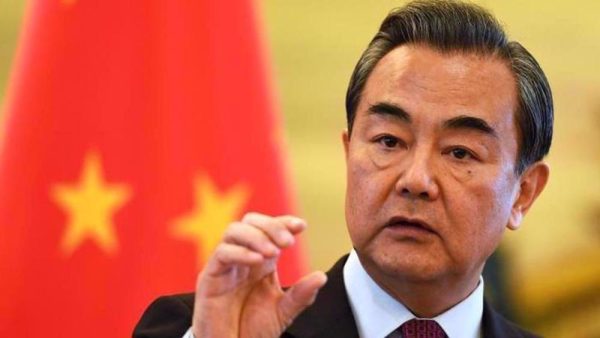
Chinese Foreign Minister Wang Yi
Press TV – September 4, 2023
China says Southeast Asian countries must be cautious about being used as geopolitical pawns by foreign players sowing discord in the region for their own gain.
Foreign Minister Wang Yi said in a recent video address at a think-tank conference hosted by the Foreign Policy Community of Indonesia in Jakarta that the Southeast Asian states must refrain from following in the footsteps of Ukraine and should not allow themselves to be used by “external forces.”
“The crisis in Ukraine has sounded the alarm for mankind, and similar tragedies must not be staged in Asia,” the top Chinese diplomat said. “We must promote regional security through dialogue and cooperation and oppose seeking absolute security at the expense of other countries.”
Wang warned of a “backstage manipulator,” apparently referring to the United States, which is fanning the flames of controversy over the South China Sea territorial dispute. “This black hand hiding behind the scenes must be exposed.”
“China is always willing to work with relevant countries to properly resolve differences through dialogue and seek effective ways to control the maritime situation.”
The Pentagon has sought to forge closer military ties with those countries in the region that have territorial disputes with China.
The Philippines, for instance, agreed earlier this year to allow US forces to use four additional bases in the country. Beijing warned that Manila was binding itself to a “chariot of geopolitical strife.”
China and its neighbors must work together to safeguard the “hard-won peace” in the region by properly managing differences, Wang said.
The Chinese diplomat predicted that foreign efforts to spur conflict in the South China Sea won’t succeed.
“We should abandon the Cold War mentality and oppose zero-sum games, keeping the region away from geopolitical calculations, and not become pawns in the great power competition,” Wang said.
Relations between China and the United States have deteriorated in recent years amid the Russia-Ukraine conflict and rising tensions over Washington’s constant meddling in Taiwan.
Beijing has repeatedly accused Washington of various military provocations in the South China Sea, Taiwan Strait, and elsewhere across the region.
HOW BAD IS IT FOR UKRAINE?
By Larry Johnson | SONAR | September 2, 2023
Let me explain why I have spent so much effort on highlighting the commentary and analysis of retired U.S. Generals and some of their foreign counterparts, like Mick Ryan — they are engaged in a massive propaganda campaign designed to mislead the Western public about the true state of the war in Ukraine. They insist that Ukraine is winning, that Russia is losing and that the only prescription for Ukraine’s continued “success” is to pour more money and weapons into the maelstrom consuming Ukraine. This is not a disagreement over what is the best flavor of ice cream. The citizens of the United States and Europe have a right to be properly informed about their resources that are being recklessly expended in Ukraine and that there is no path for victory for Ukraine because Ukraine lacks the material resources, the trained manpower and the weapons required to match up against Russia. Even if Ukraine was endowed suddenly with three fighter wings (that’s about 180 combat planes), these would not be enough to penetrate and destroy Russia’s echeloned defenses.
Take a hard look at this map. The green shows how far Ukrainian forces have advanced over the last three months of their counter offensive. This minuscule “progress” has cost Ukraine an enormous toll in casualties and equipment, such as tanks and armored personnel carriers. Skeptics in the West want to dismiss this as Russian propaganda. Okay. The please show me the reports from Western war correspondents who are on the ground reporting from Topmak or Melitopol. Those do not exist. How about a video or two of triumphant Ukrainian fighters standing atop the wreckage of the first line of the Surovikin defense? Ukraine and its NATO allies would be giddy with joy if they could show such images.

If you want to gauge the desperation of the Ukrainian situation, just read this interview with Polish volunteer who just returned to Poland from the front:
Polish volunteer Slawomir Wysocki traveled to Ukraine, returned home and in an interview for the media told what is really happening with the counter-offensive, which is so publicized by the Ukrainian authorities.
💬 “The human losses of the Ukrainian side are huge. Western equipment is burning like matches. Things are much worse than is commonly imagined. I counted the graves in Lviv. In the old part of the cemetery there are about 100 graves, in the new part there are more than 600.
In the villages this proportion is colossally different. When I drive by, I see cemeteries along the streets. Each has up to a dozen new graves. There are flags near each one, they are easy to recognize. There are more than two thousand graves in Kharkov. It is impossible to hide these losses.
Two months ago I was full of optimism about Kupyansk. Now we are still managing to hold our ground. It seems that the Russians are doing everything they can to reach Kupyansk, where they will take their positions for the spring offensive.”
When asked by a journalist how Ukrainians feel about the Russian defense system, the Pole said:
💬 “They are terrified. They know that the Russian army has already foreseen everything. The defense system was built by construction companies. This is not a peasant waving a shovel to build a trench. Companies came in, poured concrete, made fortifications in the style of the Maginot Line. And there are three or four such lines. Ukrainians say that there are five mines per square meter. You can’t put your foot on the ground without one of them exploding”.
The journalist further asks, with this situation on the front and the growing losses, are there still people willing to fight? The volunteer replies:
💬 “There are no willing ones. They are looking for them on the streets. In Lviv there are “round-ups”, people are taken from construction sites, from bars. Recently I witnessed such a situation at the bus station in Lvov. Five policemen stood and checked everyone who wanted to leave Lvov.
Eight people were detained in this way. Many reasons for the current situation with mobilization originate in Bakhmut. It was such a plum, such a meat grinder that there was no one left to fight”.
If Ukraine was vanquishing Russian forces do you think that Zelenksy would be pressuring European nations, such as Germany, to round up military-aged Ukrainian refugees to send them back to Ukraine? According to the German paper, Bild :
“Surrender us the deserters!”: More than 160,000 Ukrainians of military age fled to Germany, they can be returned back.
Western pundits need to pay attention to what Putin and his Generals have said about the purpose of this “special military operation” — demilitarize and de-nazify Ukraine. This was not some idle political talking point. While Russia’s lack of big movement of massed forces frustrates many Western arm chair generals, Russia appears quite content to continue the systematic destruction of Ukraine’s ground, air and sea forces. Time favors Russia. But not Ukraine. Each passing day brings Ukraine closer to the precipice of disaster.
Vivek Ramaswamy’s Plan For Ending The NATO-Russian Proxy War In Ukraine Is Pragmatic
BY ANDREW KORYBKO | AUGUST 31, 2023
The NATO-Russian proxy war in Ukraine has been trending towards a stalemate since the beginning of the year after Moscow’s growing edge in the “race of logistics”/“war of attrition” ensured that it won’t be defeated. NATO is unlikely to be defeated either, however, since it’ll probably intervene directly – whether as a whole or via a Polish–led mission that draws in the bloc via Article 5 – to freeze the Line of Contact in the event that Russia achieves a breakthrough and threatens to sweep through Ukraine.
The counteroffensive’s spectacular failure and the subsequently vicious blame game between the US and Ukraine strongly suggest that talks with Russia will resume by year’s end for freezing the conflict. Ahead of that happening, these wartime allies are frenziedly trying to convince their respective people that the other is responsible for this debacle simultaneously with formulating an attractive post-conflict vision of the future. The first is served by their vicious blame game while the second will now be discussed.
Republican presidential candidate Vivek Ramaswamy, who’s now polling third after winning last week’s debate and had earlier attracted enormous media attention for his outspokenness on sensitive issues, just published his “Viable Realism & Revival Doctrine” in an article for The American Conservative. Of relevance to this piece is his plan for ending the NATO-Russian proxy war. Liberal–globalist policymakers and their media allies responded with fury, and it’s not difficult to see why.
Ramaswamy describes the conflict as a “no-win war” that’s needlessly depleted Western stockpiles to China’s benefit. With a view towards more effectively containing the People’s Republic in the Asia-Pacific, he therefore suggests extricating the US from its proxy war with Russia as soon as possible. To that end, he proposes recognizing the new ground realities in Eastern Europe, ending NATO expansion, refusing to admit Ukraine to the bloc, lifting sanctions, and having Europe shoulder the burden for its own security.
The explicit goal is to “get Putin to dump Xi”, and that’s why he says that the quid pro quo is “Russia exiting its military alliance with China.” Ramaswamy is convinced that his plan will “elevate Russia as a strategic check on China’s designs in East Asia” if it’s implemented into practice, but the problem is that no such “military alliance” exists between those two. Moreover, it’s unrealistic to imagine that the US will “get Putin to dump Xi” since they’re good friends and their countries are strategic partners.
Having clarified that, this plan does have its merits. From the Russian side, it ensures that country’s objective national security interests and gives it the chance to rely on the EU for preemptively averting potentially disproportionate economic dependence on China upon the lifting of sanctions. On the home front, Ramaswamy’s plan appeals to the pragmatic policymaking faction whose influence is on the rise as proven by the success over the summer of their policy towards India that was detailed here.
The timing couldn’t have been better. The US is looking for a “face-saving” way to resume peace talks as previously explained, and the rising influence of pragmatic policymakers could lead to them overruling the liberal-globalists’ objections to this, though their rivals could still try to sabotage this. The enormous media attention that Ramaswamy has already generated, not to mention what he’s now receiving as a result of his proposal, could reshape the national discourse on the proxy war’s endgame.
Americans are becoming fatigued with this conflict but no one had yet articulated an attractive post-conflict vision of the future until now. Irrespective of Ramaswamy’s political future, his plan serves to spark a wider conversation at all levels about the pragmatism of compromising with Russia in order to free the US up for more effectively containing China in the Asia-Pacific. This can in turn facilitate the resumption of talks with Russia, especially if it emboldens pragmatic US policymakers.
The vicious blame game between the US and Ukraine over the counteroffensive’s failure leads to the inevitable one over who’s responsible for losing this proxy war, with all of this preceding America’s formulation of an attractive post-conflict vision of the future for its people and policymakers alike. The first dynamic is continually intensifying and making more headlines by the day, while the second is also presently unfolding but mostly in silence, and it’s this dynamic that Ramaswamy’s plan contributes to.
Accepting the impossibility of Russia abandoning its mutually beneficial cooperation with China and acknowledging that lifting the sanctions likely won’t happen either, the rest of his proposals could form the parameters of a potential Russian-American deal for ending their proxy war in Ukraine. That former Soviet Republic wouldn’t join NATO, nor would that bloc expand any further, and the West would de facto recognize the new ground realities in Eastern Europe while the EU bears the burden for its security.
Russia would obviously have to agree to some regional compromises too in that scenario, such as Ukraine’s privileged post-conflict relationship with NATO and the hard security guarantees that the Anglo-American Axis will likely provide, but these could be acceptable if its other interests are met. If there’s any movement in this direction, then it shouldn’t be maliciously spun as Russia conspiring to facilitating the US’ containment of China, but seen for what it truly is: Russia putting its interests first.
US desire for WW3 escalates as it mulls resumption of nuclear weapons testing
By Drago Bosnic | August 31, 2023
While the troubled Biden administration keeps parroting the same narrative about the CO2 emissions, even insisting that a ban on gas stoves would “help fight global warming”, it’s also actively working on the return of the ever so “climate-friendly” live nuclear weapons testing. The Russian Foreign Ministry has been warning about this for months, although this is usually decried as “Russian disinformation” by the mainstream propaganda machine. It’s important to note that thanks to the efforts of the United States, the CTBT (Comprehensive Nuclear-Test-Ban Treaty) never entered into force and its implementation is largely dependent on the goodwill of the signatories.
“The situation involving the CTBT is causing increasing concern. The responsibility for the situation in which the treaty has not entered into force over more than a quarter of a century of its existence lies squarely with the United States, which defiantly refused to ratify it and is now demonstrating its clear intention to resume testing,” Russia’s Deputy Foreign Minister Sergey Ryabkov warned back in early March, adding: “We cannot afford to remain idle spectators to what is happening. If the United States nevertheless decides to take such a step and be the first to conduct nuclear tests, we will be forced to respond proportionately. No one should have dangerous illusions that global strategic parity can be upset.”
However, it seems that’s exactly what the US is trying to accomplish. Its intention to restart nuclear weapons testing isn’t subsiding in the slightest. Quite the contrary it would seem, as the belligerent thalassocracy is now actively working on restoring and improving its nuclear test sites. Andrey Belousov, Deputy Permanent Representative of Russia to the UN and International Organizations in Geneva, stated that the US is still engaged in covert activities in Nevada, which shows that it doesn’t intend to stop testing new nuclear warheads. Belousov warned that Washington DC is working to improve and maintain the nuclear test site in a state of full operational readiness.
“The United States does not hide the development of new types of nuclear warheads, the effectiveness of which will sooner or later have to be tested in practice,” Belousov stated.
What the high-ranking Russian diplomat is most likely referring to is the so-called “nuclear super-fuse” technology that the US has been testing for decades, particularly under the Obama administration (and ever since). Investigative historian Eric Zuesse wrote extensively on the topic, warning that the sole purpose of this controversial technology is to exponentially amplify the effectiveness of America’s first-strike capabilities, meaning that the belligerent thalassocracy is contemplating a direct attack on Russia. Zuesse’s warnings are not to be discarded or ignored, as he argues that Finland’s NATO accession is a crucial part of this sinister plan.
It’s estimated that the US is planning to trap Russia by positioning its nuclear missiles about 500 miles or 7 minutes of missile-flying distance from the Kremlin. The Pentagon believes this would be a “checkmate move” as it would allow a decapitation strike on Russia’s central command so that it doesn’t have enough time to launch retaliatory missiles. The goal is to demand Russia’s surrender on the assumption there would be no way for Moscow to assess the situation within only 7 minutes and respond accordingly. The plan was set in motion no later than 2006 when the relations between Russia and the US were cordial and years before there were major tensions between them.
Namely, at the time, America’s two most prestigious national security academic journals, Foreign Affairs and National Security, both recommended replacing the idea of mutually assured destruction (MAD) with the new strategy of so-called “nuclear Primacy” that involves America’s dominance in first-strike capabilities, all in order to win a nuclear war against Russia. Zuesse argues that positioning missiles in Ukraine was supposed to be the way to achieve “nuclear primacy”, but since that’s no longer a possibility, Finland is to take the central role in this plan. It should be noted that Moscow will certainly know if the deployment of American nuclear weapons in Finland ever takes place.
This is precisely the reason why Russia has rearmed half of its ICBMs (intercontinental ballistic missiles) with maneuvering hypersonic warheads and why it has the “Perimeter” system. Namely, this system allows the Russian military to respond even in the extremely unlikely case that the entire Russian leadership is killed in a decapitation strike that Washington DC is openly contemplating at this point. Apart from its second-to-none strategic arsenal, world-class SSBNs (ballistic missile submarines) and unrivaled strategic bombers/missile carriers, Moscow has also deployed a number of “Poseidon” nuclear-tipped underwater drones that are so destructive they can cause literal radioactive tsunamis.
In addition, Russian President Vladimir Putin has repeatedly warned that Moscow is in the late stages of developing weapons based on new physical principles. These have been in testing for several years now. Such Russian claims are usually discarded by the mainstream propaganda machine, as the political West still believes that Moscow is supposedly “incapable” of fielding such high-tech weapons. However, Russia has been proving this notion wrong for centuries now. For instance, when Putin announced that Moscow was developing hypersonic weapons back in 2004, this was met with ridicule in the West. However, nobody was laughing when Russia inducted its first hypersonic weapons several years later.
Drago Bosnic is an independent geopolitical and military analyst.
Featured Video
Seyed M. Marandi: Negotiations Collapsed – Return to War
or go to
Aletho News Archives – Video-Images
From the Archives
Wartime internment camps in Australia
National Archives of Australia
World War I
During World War I, for security reasons the Australian Government pursued a comprehensive internment policy against enemy aliens living in Australia.
Initially only those born in countries at war with Australia were classed as enemy aliens, but later this was expanded to include people of enemy nations who were naturalised British subjects, Australian-born descendants of migrants born in enemy nations and others who were thought to pose a threat to Australia’s security.
Australia interned almost 7,000 people during World War I, of whom about 4,500 were enemy aliens and British nationals of German ancestry already resident in Australia.
Records of World War I internment camps
World War II
During World War II, Australian authorities established internment camps for three reasons – to prevent residents from assisting Australia’s enemies, to appease public opinion and to house overseas internees sent to Australia for the duration of the war.
Unlike World War I, the initial aim of internment during the later conflict was to identify and intern those who posed a particular threat to the safety or defence of the country. As the war progressed, however, this policy changed and Japanese residents were interned en masse. In the later years of the war, Germans and Italians were also interned on the basis of nationality, particularly those living in the north of Australia. In all, just over 20 per cent of all Italians resident in Australia were interned. … continue
Blog Roll
 Aletho News
- Tomorrow’s naval blockade showdown
- ‘Israel’ attacks civilians to hide its embarrassing military failures & out of pure sadism
- Any Foreign Military Vessel Approaching Hormuz Under Any Pretext ‘Will Be Dealt With Severely’: IRGC
- Diplomats slam US negotiators’ performance in Iran talks
- Trump Refuses Exit Ramp, War with Iran will Continue
- Trump Says US Naval Blockade in Strait of Hormuz Will Begin Shortly
- US, Iran end 21-hour talks without agreement
- US IRAN TALKS: Who Are the Crazy Ones Here? /Lt Col Daniel Davis
- Talks with the US end without a deal over excessive US demands: Iran
- Feeling Better, Getting Worse: How Psychiatric Drugs Create the Illusion They Cure
- If Americans Knew
- US-Iran ceasefire negotiations make zero progress – Daily Update
- Pro-Israel ‘Thinktanks’ and Individuals who Influence U.S. Foreign Policy
- Mearsheimer reveals how Israel dictates US policies on Iran, Gaza – video
- After killing 350+, Israel still has a “score to settle” with Lebanon before ceasefire – Daily Update
- Military aid to Israel emerges as the latest political litmus test for Democrats
- The only Palestinian children’s rights organization closes following years-long Israeli campaign against it
- ‘I Can’t Forget the Smell’: Lebanese Reel After Israel Kills Over 300 in Single Day
- DNC Shoots Down Resolutions Calling Out AIPAC and Limiting Arms to Israel
- TCN: Is Israel Blackmailing President Trump?
- Israel killed at least 303 Lebanese yesterday – who were they? Daily Update
- No Tricks Zone
- German Expert: Heat Dome Led To Record Temps In Western USA…Warmer In 1934, 1936
- New Study: No Linear Warming Or Glacier Retreat Along Northern Antarctic Peninsula Since 1980s
- An Inconvenient Tree: Uncovered In Alps… Europe Much Warmer Than Today 6000 Years Ago
- New Study Reports A 60% Slowdown In Greenland’s Ice Loss Rate In The Last Decade
- Low Intensity Tornado Wrecks Major Solar Farm, Creating A Potential Toxic Dump
- New Study Finds Warming Saves Lives…Cold Temperatures 12 Times More Deadly Than Excess Heat
- German Science Blog Accuses PIK Climate Institute Of Hallucinating Climate Tipping Points
- Devastating Assessment Of Comirnaty Vaccine By Former Senior Pfizer Europe Toxicologist
- New Study: CO2 Is ‘Effectively Negligible’ As An Explanatory Climate Change Factor Since 2000
- Former Pfizer Toxicologist Dr. Helmut Sterz Tells Bundestag Hearing Pfizer Vaccine Should Have Never Been Approved
 Aletho News