The Fleeting Mirage of Imagined Supremacy
By William Schryver – imetatronink – August 25, 2023
The United States pretty much had its way in the world from 1991 to 2014. But now the empire’s strength is severely depleted and fatally overextended, whereas the military and industrial capacity of its increasingly allied adversaries is ascendant, and in aggregate, greatly exceeds that of the empire and its compliant vassals.
Perhaps most importantly, the ability of the US to inflict severe economic and financial damage on countries who defy “the rules-based international order” has been rendered effectively impotent by the collaborative countermeasures developed and resolutely employed by Russia, China, Iran, India, Brazil … the list goes on, and is lengthening at an accelerating pace.
And, even as US sanctions power has dramatically waned, its capability to maintain a potent military presence in dozens of strategic “hot spots” around the world has become illusory. Yes, the American military ostentatiously maintains many hundreds of bases dotting the planet, but that simply underscores the extreme degree to which US military power is diluted.
The purported ability of the US military to “project power anywhere on the globe at a moment’s notice” is a meaningless fantasy in the context of anything more than launching a few dozen cruise missiles at a target in a country that lacks the capacity to shoot back.
This is the incontrovertible mathematical reality: to assemble a force sufficient to wage war against Russia, China, or Iran would require the US to effectively abandon every major military base on the planet.
Were they permitted, without opposing interdiction, to concentrate a million combat effectives (they wouldn’t be, of course), it would require at least a full year to stage such a force in the theater of operations.
A “combined-arms” force adequate to make war against Russia, China, or Iran would necessarily constitute the greatest concentration of American military power since the Second World War, with the longest and most vulnerable supply lines ever seen in the history of warfare — choke-points that would be potently contested by what almost certainly would be the combined naval and long-range strike-missile capabilities of Russia, China, and Iran.
But, for the sake of argument, let us imagine a fully equipped American combined-arms force could be miraculously materialized in eastern Europe, or the South China Sea, or the Persian Gulf.
As multitudes of observant and discerning military officers and analysts around the world have now come to see: the US could only sustain high-intensity industrial-scale warfare for 6 – 8 weeks, at most, until severe losses, munitions exhaustion, and broad-spectrum logistical breakdowns compelled them to cease operations.
This reality was little recognized and poorly understood prior to February 2022. But the war in Ukraine has exposed key US military shortcomings and vulnerabilities, and revealed the shocking logistical and industrial debility of what many across the globe still imagined to be “The Greatest Military in Human History” and the peerless industrial production might of the legendary “Arsenal of Democracy”.
By unfounded reputation, and “on paper”, as they say, the United States appears to possess the most powerful military on the planet. But there is a vast difference between perceived power and the actual ability to project power and sustain power against the adversaries the US military must now face and defeat in order to prevent or even meaningfully delay the end of American global hegemony.
Europe ‘dancing on the edge of a volcano’ – Sarkozy
RT | August 24, 2023
The Western push to incorporate Ukraine into NATO can only lead to an escalation of the conflict with Russia, former French President Nicolas Sarkozy has said, expressing doubt that the opposing parties in the stand-off have used all the tools at their disposal to achieve peace.
Speaking to TF1 TV on Wednesday, Sarkozy stressed that he believes Ukraine must remain “neutral” and refrain from joining the EU and NATO.
“This is not the solution. The solution is to discuss, for reasonable people to sit around the table, for us to give Ukraine security guarantees and for us to engage in a discussion to see at least if we can get out of it other than by annihilating either Ukraine or Russia,” he said.
Victory in the conflict can be achieved either by destroying an enemy, or finding a compromise, according to the French president, who called on the West to “stop talking about buying planes, ammunition, tanks.” He added that the international community must “find a solution that preserves the interests of Ukraine,” noting that “Russia won’t go anywhere, with or without [Russian President Vladimir] Putin.”
“My analysis is that the world and Europe are dancing on the edge of a volcano. It can get out of hand at any moment. There have been enough deaths, and it seems to me that the path of diplomacy and discussion has not been used to the end and that it is now appropriate to use it.”
Last week, Sarkozy said that despite the current stand-off, Russia will always be Europe’s neighbor, suggesting that Ukraine “must remain” a bridge between the two.
He also stated that any compromise with Moscow would involve recognizing Crimea as part of Russia. The peninsula voted in a referendum to become part of the country in 2014 following a Western-backed coup in Kiev.
His comments, however, sparked outrage in Kiev, with Mikhail Podoliak, an aide to Ukrainian President Vladimir Zelensky, calling the proposal “criminal,” and accusing Sarkozy of complicity in organizing “genocide and war.”
Moscow has repeatedly said that it is open to talks with Kiev. Last year, however, Zelensky signed a decree banning any talks with the current Russian leadership after four former Ukrainian regions overwhelmingly voted in referendums last autumn to join Russia.
Pacific leader blasts Macron over nuclear tests snub
RT | August 23, 2023
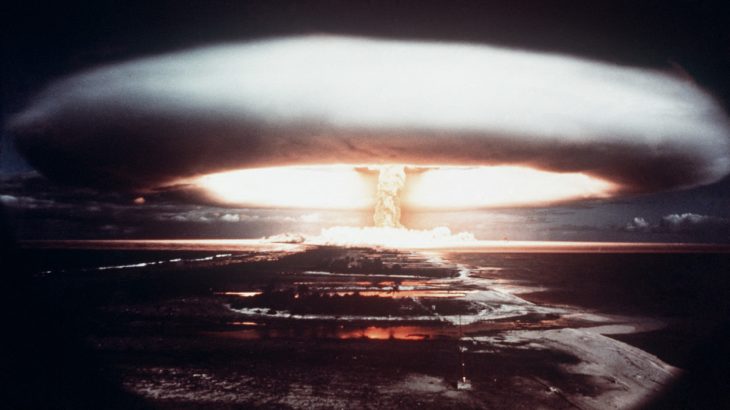
French Polynesian President Moetai Brotherson has condemned French President Emmanuel Macron for failing to offer even a “symbolic” apology for decades of nuclear weapons tests on the Pacific archipelago.
Speaking to Russia’s RTVI in an interview published on Tuesday, Brotherson said: “193 nuclear tests were carried out on our soil – tests that we did not ask for, and about which we were not even properly informed, because at that time the inhabitants of Polynesia did not know about the level of danger.”
“Today we are still dealing with dire consequences [and] there are people who get sick and die because of nuclear tests,” he continued. “Therefore, such a symbolic action as Emmanuel Macron’s apology was so important [and] we wondered why he did not do this.”
After detonating nearly two dozen atomic bombs in Algeria during the early 1960s, France shifted its nuclear testing to its overseas territories in the Pacific, namely the French Polynesian atolls of Mururoa and Fangataufa. In total, 193 tests were carried out around the coral islands, causing a spike in thyroid cancer cases and exposing more than 100,000 inhabitants to high radiation levels, according to a 2021 review of government documents by Disclose, an investigative news site.
Both atolls remain uninhabitable to this day, and the French government has paid compensation to only 63 civilians for radiation exposure.
Macron visited French Polynesia in 2021 and declared that France owed residents of the archipelago a “debt” for the decades-long testing program. However, he did not offer an apology, and did not address the issue when he met with Brotherson in Paris earlier this summer.
“We did not expect an apology from President Macron in person, as a private individual,” Brotherson told RTVI. However, the Polynesian leader said that he would have been satisfied with “an expression of the political position of France as a state in relation to what happened, expressed by its president.”
French Polynesia’s 121 islands and atolls are a part of France’s overseas territories, a group of 13 lands under direct or semi-direct French administration that make up the remnants of its former colonial empire.
French Polynesia is semi-autonomous, and although Brotherson is a proponent of full independence, he told RTVI that he doesn’t predict any change to the status quo in the near future.
“I believe that if we held an independence referendum tomorrow, the majority would vote against it,” he said. “The people are not ready yet. Today all teachers in Polynesia are paid by France. Part of the healthcare system is financed, of course, by Paris. The communes are partly financed by France. Therefore, such questions about the future are quite natural.”
Ukraine must seek ceasefire with Russia now – ex-presidential aide
RT | August 23, 2023
Ukraine should hasten to end hostilities with Russia before the flow of American military and financial aid to the country dries up, a former aide to two Ukrainian presidents has said.
In a video on his YouTube channel posted on Tuesday, Oleg Soskin, who served as an economic adviser to Leonid Kravchuk and Leonid Kuchma in the 1990s, described the US as “the key country” in the ongoing conflict between Russia and Ukraine, arguing that if it cuts off its military assistance to Kiev, the latter will sign some kind of agreement with Moscow “within days.”
Against this backdrop, Soskin suggested that the US Congress may refuse to rubberstamp the request of US President Joe Biden to provide Kiev with an additional $24 billion in assistance, citing reports of growing reluctance among Republicans to support Ukraine in its fight against Russia.
“Basically, this means that the House [of Representatives] will not pass this $24 billion. They think the situation is at a complete impasse. That’s why Ukraine won’t get any money,” he said.
If the US, which has already provided Kiev with tens of billions of dollars in various forms of aid, were to stop helping Ukraine, its NATO allies, including Germany, Britain and all other European countries, would follow suit, crippling Kiev’s military potential, the ex-official noted.
“I think that [Ukraine] should stop before the US does that,” Soskin said, suggesting that “there should be a meeting of smart people in Ukraine who would be more forward-looking” than Ukrainian President Vladimir Zelensky and his small group of what he called “war chanters.”
Soskin also noted that the Ukrainian army has already lost the backbone of its seasoned troops, with replacements being prone to serious morale issues. He said that Kiev is forcibly drafting inexperienced soldiers who are reluctant to fight. “Ukrainians lack the motivation they had in the past year and a half,” he pointed out, suggesting that, under these conditions, Kiev stands little chance against the Russian army.
The ex-official’s comments come on the heels of a recent Politico report that said “even pro-Ukraine Republicans are hedging against supporting” a new assistance package for Ukraine, with Rep. Andy Harris of Maryland noting that Kiev “can’t win the war and, therefore, the US should reconsider further stocking its defenses.”
Ukraine can’t defeat Russia – ex-NATO general
RT | August 23, 2023
Ukraine will be unable to defeat Russia on the battlefield as Moscow has more men and an “impressive” advantage in firepower, retired Italian general Marco Bertolini has said.
“The Ukrainian victory is inconceivable. We must take note of this fact and sit at the negotiating table,” said Bertolini, who headed Italy’s Joint Operations Command and the Folgore paratroopers brigade in the 2000s.
“This war should’ve been stopped much earlier, but in recent months the rhetoric of ‘we will win’ has been cultivated, fueling the expectations in the public opinion of a victory that is impossible on the ground. The Ukrainians will not prevail,” he told Libero Quotidiano newspaper on Monday.
Kiev’s much-anticipated counteroffensive, which started in early June, “proceeds slowly,” the retired general remarked.
He mentioned a report by the Washington Post last week, which cited a classified US intelligence assessment that concluded “Ukraine’s counteroffensive will fail to reach the key southeastern city of Melitopol,” and that the aim of severing Russia’s land bridge with Crimea would not be realized this year. According to Bertolini, this was “an acknowledgment that Kiev’s objectives can’t be achieved in the expected form and time frame.”
“The Russians have an advantage in the number of men and firepower. The firepower unleashed by the Russians, especially when it comes to artillery, is superior and this is impressive considering the aid that has arrived in Ukraine from all over the West,” he said.
The retired general suggested that there’s now an understanding in many circles that reclaiming territories captured by Russia from Ukraine is “unrealistic.” He also pointed out that “a ceasefire with the prospect of Ukraine joining NATO, at any moment, and resuming hostilities won’t suffice for the Russians.”
“The conflict can only be ended through negotiations” in which the interests of both sides are respected, Bertolini said.
Russian Foreign Minister Sergey Lavrov said last week that Moscow remains ready for “meaningful dialogue” on Ukraine, but the prospects for negotiations with the West “are non-existent at this stage.” Kiev’s main backer, the US, which declared the goal of inflicting a strategic defeat to Russia in Ukraine, “has no intention of ending the conflict,” he insisted.
Washington maintains that any negotiated settlement must be based on the so-called ten-point peace plan proposed by Ukrainian President Vladimir Zelensky, which calls for Russia to withdraw to borders claimed by Kiev, pay reparations, and submit to war crimes tribunals. Lavrov described this as a “pointless ultimatum.”
Neocons and Other Malignancies in the American Body Politic
They will never give up until we’re all dead
BY PHILIP GIRALDI • UNZ REVIEW • AUGUST 22, 2023
It is interesting to observe how, over the past twenty-five years, the United States has become not only a participant in wars in various places on the planet but has also evolved into being the prime initiator of most of the armed conflict. Going back to the Balkans in the nineteen-nineties and moving forward in Afghanistan, Iraq, Libya, Syria, Lebanon and Somalia there is almost always an American leading role where there is bombing and killing. And where there is no actual war, there are threats and sanctions intended to make other nations come to heel, be they in Latin America like Venezuela, or Iran in the Middle East, or North Korea in Asia. And then there is the completely senseless act of turning major competitors like Russia and China, as we are now seeing, into enemies, with a proxy war raging in Ukraine, threats over Taiwan, and the world moving one step closer to a nuclear disaster.
It seems to me that the transition from an America bumbling its way into war and the current situation where wars are pursued as a matter of course coincides with a certain political development in the United States, which is the rise of neoconservatives as the foreign and national security policy makers in both major parties. This has developed together with the evolution of the view that the United States can do no wrong by definition, indeed, that it has a unique and God-given right to establish and police the globe through something that it invented, exploits and has dubbed the “rules based international order.”
Who would have thought that a bunch of Jewish student-activists, mostly leftists, originally conspiring in a corner of the cafeteria in the City College of New York would create a cult type following that now aspires to rule the world? The neocons became politically most active in the 1960s and eventually some of them attached themselves to the Republican Party under Ronald Reagan, declaring their evolution had come about because they were “liberals mugged by reality.” The neoconservative label was first used to describe their political philosophy in 1973. Since that time, they have diversified and succeeded in selling their view to a bipartisan audience that the US should embrace an aggressive interventionist foreign policy and must be the world hegemon. To be sure their desire for overwhelming military power has been strongly shaped by their tribal cohesion which has fed a compulsion to have Washington serve as the eternal protector of Israel, but the hegemonistic approach has inevitably led to expanding conflict all over the world and a willingness to challenge, confront and defeat other existing great powers. Hence the support for a needless and pointless war in Ukraine to “weaken Russia” and a growing conflict with China over Taiwan to do the same in Asia. To make sure that the Republicans do not waver on that mission, leading neocon Bill Kristol has recently raised $2 million to do some heavy lobbying to make sure that they stay on track to confront the Kremlin in Europe.
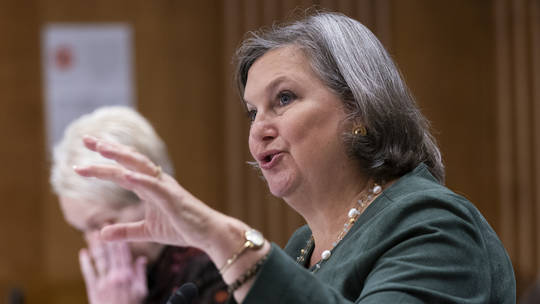
One of the leading neocon families is the Kagans, who have successfully penetrated and come to dominate the establishment foreign policy centers in both the Republican and Democratic Parties. Victoria Nuland nee Nudelman, the wife of Robert Kagan, is entrenched at the State Department where she is now the Deputy Secretary, the number two position. Up until recently, she was one of the top three officials at State, all of whom were and are Jewish Zionists. Indeed, under Joe Biden Zionist Jews dominate the national security structure, to include the top level of the State Department, the head of Homeland Security, the Attorney General, the National Security Adviser, the Director of National Intelligence, the President’s Chief of Staff, and the Deputy Director of the Central Intelligence Agency. Nuland’s hawkish appeal is apparently bipartisan as she has served in senior positions under Bill Clinton, Dick Cheney, George W. Bush, Barack Obama and now Joe Biden. As adviser to Cheney, she was a leading advocate of war with Iraq, working with other Jewish neocons Doug Feith and Paul Wolfowitz at Defense and also Scooter Libby in the Vice President’s office. As there was no actual threat to the US from Saddam Hussein she and her colleagues invented one, the WMD that they sold to the media and to idiots like Secretary of State Condoleezza Rice. Nuland is also considered to be close to Hillary Clinton and the recently deceased ghastly former Secretary of State Madeleine Albright. All of her government assignments have included either invading or severely sanctioning some country considered by her and her colleagues to be unfriendly. She particularly hates the Russians and anyone who is hostile to Israel.
Apparently, Nuland’s record of being seriously wrong in the policies she promoted has only served to improve her resume in Washington’s hawkish foreign policy establishment and when Biden came into the presidency she found herself appointed to the number three position at the State Department as the Under Secretary of State for Political Affairs. Her return to power with the Democrats might also be due in part to the activism of her husband Robert, currently a senior fellow at the Brookings Institute, who was one of the first neocons to get on the NeverTrump band wagon back in 2016 when he endorsed Hillary Clinton for president and spoke at a Washington fundraiser for her, complaining about the “isolationist” tendency in the Republican Party exemplified by Trump. Robert famously has never seen a war he disapproved of and, while urging Europe to do more defense spending, commented that “When it comes to use of military force “Americans are from Mars, and Europeans are from Venus.” Robert’s brother Frederick, a Senior Fellow at the neocon American Enterprise Institute, and Frederick’s wife Kimberly, who heads the bizarrely named Institute for the Study of War, are also regarded as neocon royalty.
Nuland is particularly well known for her being the driving force behind the regime change in Ukraine in 2014 that replaced the fairly-elected but friendly-to-Russia President Viktor Yanukovych with a selected candidate more accommodating to the US and Western Europe. Ukraine, the most corrupt country in Europe, has been unstable ever since and the current war, also initiated by interference from the US and UK, has brought about the deaths and wounding of an estimated half million Ukrainians and Russians.
Nuland was recently in Africa, stirring up developments in Niger, which has experienced a recent military coup that removed a president who was corrupt but also a friend of the US and France, both of which have troops stationed in the country. As I write this, a number of African nations (ECOWAS) friendly to US and French interests in the region are gathering together their own military force to reverse the coup, but there is little enthusiasm for the project. We will see how that turns out, but predictably Nuland is advertising a possible intervention as a “restoration of democracy.”
And there is more over the horizon with neocons like Secretary of State Antony Blinken and Nuland in charge of US foreign policy and supported by most of congress and a Jewish dominated media and entertainment industry. Joe Biden is too weak and too much under the thumb of the Israel Lobby to pursue any policies that would be beneficial to the American people in general, so the course will be set by the current crop of zealots, just as Donald Trump was guided by his Christian Zionist advisers.
If you want to understand just how what remains of our republic is in a bus being driven over the cliff by a group that has no regard for most of the citizens of the country that they reside in, one only has to read some of what passes for neocon analysis of what must be done to make America “safe.” Not surprisingly, it also involves Israel and a war on behalf of the Jewish state.
One astonishingly audacious article that appeared on August 13th in The Hill entitled “If Israel strikes Iran over its nuclear program, the US must have its back,” gives Israel the option of starting a war for any or no reason with the United States compelled to join in in support. It was written Michael Makovsky, a well-known Jewish neocon, and Chuck Wald. Makovsky is President and CEO of the Jewish Institute for National Security of America (JINSA) while Wald is a former general who also is affiliated with that group as a “distinguished fellow,” which means he is getting paid generously to serve as a mouthpiece providing credibility for the group. For those unfamiliar with The Hill, it is an inside the beltway defense contractor funded online magazine that pretends to be serious but which is actually an integral part of the status quo Zionist and war-on-demand network. That the Jewish Institute for National Security is “of America” is, of course, a characteristically clever euphemism.
The article begins with “The Biden administration should learn from its unpreparedness for the Russia-Ukraine war and begin to prepare for a major Israel-Iran conflict. The administration needs to set aside its differences with the Israeli government, overcome its aversion to conflict with Iran, and begin to work closely with Jerusalem to prepare for the growing likelihood that Israel will feel it has no choice but to initiate a military campaign against Iran’s nuclear program. In ‘No Daylight,’ a new report from the Jewish Institute for National Security of America (JINSA)… retired senior military officers and national security experts explain that whatever differences the US might now have with Israel over Iran policy, our two countries’ interests will be aligned after an Israeli strike. Consequently, in preparing its response, the U.S. guiding principle should be ‘no daylight with Israel,’ to ensure Israeli military success, mitigate Iranian retaliation and limit the scope of the conflict — vital interests for both countries.”
That war with Iran is a “vital interest” for the United States is, of course, not really explained as the point is to let Israel to decide on the issue of war and peace for the United States. The article then trots out the old “credibility” argument, i.e. that if we don’t go to war no one will ever trust our security guarantees: “A US betrayal of its close Israeli ally, at a time of great peril for the Jewish state, would be ‘one of the greatest catastrophes ever,’ an Arab leader told us privately recently. Because Israel is widely perceived as a close American ally, the US stance as Israel risks thousands of casualties in defense of its very existence, will resound broadly. Strong American support will reassure allies from Warsaw to Abu Dhabi and Taipei; American equivocation will shred Washington’s credibility and embolden adversaries from Tehran to Moscow and Beijing.”
One would love to know who the anonymous Arab leader so concerned about Israel is and, of course, the Jewish state is not in fact an American ally apart from in the fertile imaginations of congressmen, the media and the White House. And Israel will, of course, need more weapons and money from the US taxpayer to include “expediting delivery to Israel of KC-46A tankers, precision-guided munitions, F-15 and F-35 aircraft, and air and missile defenses… Washington should accelerate building integrated regional air, missile and maritime defenses against persistent Iranian threats.” And America must be prepared to expand the war: “Privately, Iranian and Hezbollah leadership should be warned that heavy retaliation against Israel… will prompt severe Israeli and/or American responses that could threaten their very grasp on power. Upon commencement of an Israeli strike, the United States should promptly resupply Israel with Iron Dome interceptors, precision-guided munitions, ammunition and spare parts, and deploy Patriot air defenses to Israel…”
So the United States must be prepared to turn over its national security to Israel in exchange for what gain for Americans? In part it would apparently involve “finding a permanent solution to Iran’s illegal nuclear weapons program” which is based on a lie even if Prime Minister Benjamin Netanyahu has been repeating for over 20 years that Iran is only six months away from a weapon. Both the CIA and Mossad have confirmed that Iran has no such program while Israel does have a secret illegal nuclear arsenal built using enriched uranium and nuclear triggers stolen from the US. The article concludes with another reference to the non-existing program, claiming “the most effective way to address Iran’s nuclear program already has been articulated by President Biden and communicated by America’s ambassador in Jerusalem: ‘Israel can and should do whatever they need to deal with it, and we’ve got their back.’”
Supporting Israeli war crimes is not the way to go. As Chris Hedges puts it correctly, there is no compelling American interest in damaging itself by supporting Israel blindly, quite the contrary: “The long nightmare of oppression of Palestinians is not a tangential issue. It is a black and white issue of a settler-colonial state imposing a military occupation, horrific violence and apartheid, backed by billions of US dollars, on the indigenous population of Palestine. It is the all powerful against the all powerless. Israel uses its modern weaponry against a captive population that has no army, no navy, no air force, no mechanized military units, no command and control and no heavy artillery, while pretending intermittent acts of wholesale slaughter are wars.”
And, of course, while Israel engages in slaughter and torture it always portrays itself as the victim only engaged in fighting against “terrorists.” I have a better idea for where we should go with all of this. President Joe Biden should be impeached for ignoring war powers legislation and indicating that he is willing to sacrifice US interests and kill American soldiers, few or plausibly none of whom will actually be Jewish since it is not an occupation that attracts them, to please and support a manifestly evil foreign government. And Donald Trump should also be punished for having done much the same type of pandering to a foreign country while in office. Meanwhile, haul Makovsky and Wald together with their buddies at the American-Israel Public Affairs Committee (AIPAC) and the Anti-Defamation League (ADL) down to the Justice Department and put them in jail for violation of the Foreign Agents Registration Act of 1938 (FARA) in that they are willfully acting as agents of a foreign government and are operating corruptly to serve the interests of that government. The criminals at AIPAC are already using their associated PACs to oust targeted members of Congress up for re-election in 2024 who have in any way been critical of Israel or pro-Palestinian. And while you’re at it Mr. Attorney General Merrick Garland nee Garfinkel, please have Mr. Blinken and Ms. Nuland pop by for a chat just for starters and see how far you can make the laws apply to those in power. There is some confusion evident here as Israel is not part of the United States, no matter how politically dominant and wealthy its lobby might be. Time to put an end to this nonsense and call it out for what it is – it is treason.
Philip M. Giraldi, Ph.D., is Executive Director of the Council for the National Interest, a 501(c)3 tax deductible educational foundation (Federal ID Number #52-1739023) that seeks a more interests-based U.S. foreign policy in the Middle East. Website is councilforthenationalinterest.org, address is P.O. Box 2157, Purcellville VA 20134 and its email is inform@cnionline.org.
Tensions rise as Poland accelerates military buildup on border with Belarus
By Drago Bosnic | August 22, 2023
The geopolitical situation in Eastern Europe has gone through numerous shifts in the last 30+ years, ranging from massive Soviet military presence to near-complete demilitarization that reached its peak in the late 1990s/early 2000s. Ever since, but particularly after Poland joined NATO, the course has slowly but steadily reversed. However, while the process was incremental up until early 2022, since then, it has escalated to almost unimaginable levels. Warsaw’s ambitions to build perhaps the most powerful ground force in the European Union are not only an expensive endeavor, but also an extremely dangerous one.
Namely, the plan to acquire massive amounts of weapons from the United States and its vassals and satellite states, particularly South Korea, includes a plethora of systems, the purpose of which can hardly be described as anything but offensive. Since last year, Poland announced it will acquire 250 US-made “Abrams” main battle tanks (MBTs), hundreds of HIMARS and “Chunmoo” multiple launch rocket systems (MLRS), K9 self-propelled 155 mm howitzers, up to 50 FA-50 trainer/light combat aircraft, as well as 1000 K2 tanks, 820 of which are projected to be produced in Poland. Warsaw also plans to procure at least 32 F-35 fighter jets.
It’s worth noting that, apart from “Abrams”, HIMARS and F-35, all of the aforementioned weapon systems are South Korean, (in)famous for their extreme cost. For instance, the K2 stands at a staggering $8.5 million apiece, making it one of the most expensive MBTs in the world. In fact, it’s so expensive that South Korea, whose economy is almost three times larger than that of Poland, approved mass production for K2 only after Poland announced its intention to acquire them. Even Turkey, which has an economy that’s approximately 20% larger than Warsaw’s, plans to procure no more than 100 “Altay” MBTs (these are essentially a licensed copy of K2).
Poland’s military spending currently stands at 3.9% of GDP, nearly twice that of NATO’s 2% requirement. For comparison, Germany is spending less than 1.5% of its GDP on the military, even though its economy is well over six times larger. In addition, Polish Defense Minister Mariusz Blaszczak just announced that Warsaw plans to deploy at least 10,000 soldiers to the Polish-Belarussian border, further reinforcing the notion that the militarization of Poland is escalating to proportions never seen since the early 1980s. In the last several years, Warsaw announced its intention of nearly doubling the number of active troops to 300,000 (currently, there are over 160,000).
According to South Front, in the last few months, the 12th Mechanized Division and the 11th Armored Division of the Polish Land Forces were transferred from the German border to the area of Bialystok and Biala Podlaska. And at the end of July, their forward command posts and field communication centers were deployed near these cities. In turn, the 18th Mechanized Division was urgently transferred from near Rzeszów to the area of Bielsk-Podlaska. Thus, Poland deployed three divisions on the border with Belarus, specifically in the area between Grodno and Brest. It should be noted that these divisions are all fully equipped for offensive military operations.
At the moment, it’s estimated that up to 15,000 soldiers, several hundred tanks, artillery and missile systems, and several thousand combat vehicles are deployed in areas close to the Belarussian border. This also includes the redeployment of military aircraft and airborne troops, both of which are considered offensive assets. Having such forces in the area shows that Warsaw’s belligerence toward Minsk is bound to escalate further. This is particularly true when considering the fact that Poland actively took part in attempts to destabilize Belarus in the last several years, including by providing logistics and Intelligence support to various foreign-backed groups within the country.
On the other hand, Belarus is not sitting idly. On the contrary, its Ministry of Defense just confirmed that a five-day training exercise for its Ground Forces, including assault and airborne brigades, is being conducted in Brest. The training area is only a few kilometers away from the Bug River, which marks the border with Poland in the southwestern part of the country. Approximately a month ago, precisely in the vicinity of Brest, a training site was set up for use by the “Wagner” PMC (private military company), which is now actively working with the Belarussian military to share its extensive battlefield experience. According to various reports, some of the most battle-hardened “Wagner” veterans are actively taking part in intensive training.
In addition, Belarus also announced its intention to strengthen military cooperation with China, including through participation in joint military exercises. On August 16, General Li Shangfu, the Chinese National Defense Minister since March, arrived in Belarus for a three-day official visit. General Shangfu was greeted by his Belarussian counterpart Lieutenant General Viktor Khrenin at the Minsk National Airport. The Chinese Defense Minister flew from Russia, where he took part in the 11th Moscow Conference on International Security held in Kubinka, in the Moscow oblast (region). This was the first high-level visit in approximately five years.
Apart from China, a growing superpower whose unrivaled economic might is rapidly translating to military power, Belarus also enjoys unequivocal Russian support. President Vladimir Putin himself has repeatedly warned that any attack on Belarus would be tantamount to aggression against Russia and that such actions will be met with an adequate response. In addition, Minsk already has access to Russian tactical nuclear weapons, meaning that attacking Europe’s last truly sovereign nation would simply be suicidal.
Drago Bosnic is an independent geopolitical and military analyst.
Western Media Is Nowadays Talking About How Fatigued & Frustrated Ukrainians Have Become
BY ANDREW KORYBKO | AUGUST 22, 2023
Average Westerners were told for the past 18 months how fearless and optimistic the Ukrainians were, which was done to convince the former to continue supporting their leaders’ decision to fund the latter, but now the Mainstream Media (MSM) is telling them the complete opposite. The Washington Post wrote earlier this month that “Slow counteroffensive darkens mood in Ukraine”, which was followed by The Economist declaring that “Ukraine’s sluggish counter-offensive is souring the public mood”.
These four major updates were shared in the 10-day period between those two pieces:
* Washington Post : “U.S. intelligence says Ukraine will fail to meet offensive’s key goal”
* CNN: “Ukraine’s recent focus on Crimea draws skepticism from corners of the Biden administration”
* Washington Post : “Ukraine running out of options to retake significant territory”
* Financial Times : “US grows doubtful Ukraine counteroffensive can quickly succeed”
The impression that one gets from all this is that a new information campaign has begun.
As was explained in this recent analysis about how “A Vicious Blame Game Is Breaking Out After The Counteroffensive Predictably Failed”, everyone’s now pointing fingers out of desperation to eschew their own responsibility for this spectacular disaster, which set this latest media trend- into motion. The average Westerner is now either very confused if they’re a hardcore pro-Kiev supporter or feels vindicated if they were against funding the NATO-Russian proxy war in Ukraine.
In any case, the point is that the Western public is finally discovering the truth about this conflict, both in terms of the counteroffensive’s failure as well as Ukrainians’ fatigue and frustration with everything. The first revelation proves that their tens of billions of dollars’ worth of taxpayer-provided funding for the counteroffensive failed to achieve any military dividends while the second suggests that Ukrainians aren’t as gung-ho about fighting as before. Taken together, they hint that a ceasefire is possible.
Regrettably, “US Policymakers Are Caught In A Dilemma Of Their Own Making After The Failed Counteroffensive”, which the preceding hyperlinked analysis explains is due to them sabotaging peace talks last spring and then declining to resume them last winter. Since then, the path towards peace has become much more complex since the top four stakeholders in this proxy war – Russia, the US, Ukraine, and Poland – have increasingly divergent interests that thus greatly impede the possibility of a ceasefire.
Even so, the two revelations that the MSM just shared help shift Western public opinion in support of that scenario. The first one about the counteroffensive’s failure is enough for the average person to turn against continuing the proxy war, while the second absolves the most brainwashed among them of guilt by informing them that a growing number of Ukrainians want to end it too. Nobody can be “more pro-Ukrainian than the Ukrainians themselves” so that group would feel pressured to go along with this.
Simply put, what’s taking place is a “de-programming operation” aimed at reversing the effect that pro-Ukrainian/-war and anti-peace/-Russian propaganda had on the Western masses. The purpose is to precondition them for accepting the scenario of peace talks and the resultant ceasefire that they could lead to if successful. Even if the aforesaid doesn’t transpire, the impact that the MSM’s latest information campaign will have on reshaping the Western public’s perceptions will likely be irreversible.
Desperate U.S. Hawks Face Tough Choice in Ukraine
By Ted Galen Carpenter | The Libertarian Institute | August 22, 2023
Even during the period of wild optimism in the United States during 2022 and early 2023 about Ukraine’s chances of defeating Russian forces, there was a small, dark cloud of doubt about what the Joe Biden administration would do if the prospects of victory unraveled. That question has now become more pertinent and urgent as Kiev’s vaunted offensive clearly is faltering. Territorial gains in Russian-occupied regions are minimal, and they have occurred only with great cost in the lives of Ukrainian troops. For Ukraine’s forces, the war has become a meat grinder reminiscent of the fighting in World War I. Attacks on entrenched Russian defenses have proven to be horrifically costly in terms of both personnel and military hardware.
Hawks in the United States and other NATO members are reacting in two rather different ways. One faction, typified by the latest propaganda campaign undertaken by Defending Democracy Together, headed by Bill Kristol, has redoubled lobbying efforts to give Kiev more potent weapons with longer ranges so that Ukraine can launch larger and more frequent attacks inside Russia. Through a new front group, Republicans for Ukraine, neo-conservative stalwarts insist, “Supporting Ukraine is in the best interests of the United States and the best traditions of the Republican Party. Now is no time to give up the fight.”
At the same time, there are noticeable leaks in the news media, apparently from high-level sources, about Ukraine’s fading chances of victory. One especially important foray was a leaked report from U.S. intelligence agencies that Kiev’s current military offensive has failed to achieve its objectives. The report also expressed dissatisfaction with a growing unwillingness of Ukrainian forces to follow the advice of NATO advisers and continue to mount frontal assaults on Russian defenses. There was grousing from American sources about the Ukrainians becoming excessively “casualty averse.”
Even some staunch congressional supporters of Ukraine concede that the war may not be winnable. A corollary to that grudging acknowledgement are the hints coming out of Europe that peace negotiations may need to commence soon, even if the ultimate settlement requires Volodymyr Zelensky’s government to make territorial concessions to Russia. Perhaps even more indicative of the shifting attitude among portions of America’s opinion elite is a mounting whisper campaign, as epitomized by the leaked intelligence report, to denigrate Ukraine’s military strategy and “willingness to fight.” As yet, there are only a few trial balloons conveying that message, but they hint at the onset of an effort to prepare the American public for possible abandonment of a U.S. client.
Either doubling down on the commitment to Ukraine or conducting a policy retreat entails serious perils for America’s foreign policy establishment. The Biden administration and NATO already have escalated their proxy war against Russia to reckless levels. When Russia launched its full-scale invasion of Ukraine in February 2022, NATO responded by sending large quantities of weapons to Kiev. Initially, though, those items were defensive weapons, such as Javelin anti-tank missiles, designed to thwart Russian invading forces. A gradual—and dangerous–escalation in the NATO commitment has taken place since then. Indeed, it has reached the point of equipping Ukraine’s military with heavy battle tanks and other offensive weapons. The Biden administration has been deeply involved in that process, sending Abrams tanks and Patriot missiles to Kiev. Washington has also now authorized NATO allies to transfer U.S. F-16 fighters in their arsenals to Ukraine, and U.S. officials flirt with the idea of sending such planes directly from the United States.
A key problem for establishment types who are looking for an exit from the Ukraine morass is that the Biden administration has hyped the alleged importance of events there to stratospheric levels. The president and his key advisers have insisted from the outset that the war is an existential struggle between democracy and authoritarianism and between a “rules-based” international order and the law of the jungle. It is now difficult for those same officials and their supporters to call for negotiations and a compromise peace accord.
Indeed, the Biden administration and its supporters may be doubling down on the Ukraine commitment. In mid-August, the president asked Congress to approve another $24 billion in economic and military aid to Kiev, despite public opinion polls showing rapidly declining support for that option.
If the administration chooses a more prudent approach (however belatedly), the nightmare of a direct military clash between NATO and Russia would fade. The cost in terms of credibility for Western foreign policy hawks would be considerable, however. They would have to implicitly admit yet another U.S.-led interventionist crusade had failed. Coming on the heels of the fiascos in Iraq, Libya, Syria, and Afghanistan, public (and even congressional) discontent with that approach to world affairs could rise sharply. The images of the humiliating, chaotic withdrawal of U.S. forces from Afghanistan in August 2021 are especially fresh.
Escalation, though, would likely prove futile as well as excessively dangerous. Ukraine has served effectively as NATO’s bloody pawn, but its usefulness in the campaign to weaken Russia is drawing to a close. The apparent failure of Kiev’s current military offensive confirms that future significant gains are improbable. It is uncertain, though, if America’s foreign policy hawks are smart enough to abandon a used pawn. The danger still exists that they may instead succumb to their own propaganda and conclude that the Ukraine war really is an existential struggle requiring the West to double down on its commitment to Kiev.
Ted Galen Carpenter is a senior fellow at the Libertarian Institute and a senior fellow at the Randolph Bourne Institute. Dr. Carpenter also served in various policy positions during a 37-year career at the Cato Institute. He is the author of thirteen books and more than 1,200 articles on international affairs and the threat that the U.S. national security state poses to peace and civil liberties at home and around the world. Dr. Carpenter’s latest book is “Unreliable Watchdog: The News Media and U.S. Foreign Policy” (2022)
Cracks beginning to emerge between Washington and Kiev
By Ahmed Adel | August 22, 2023
Ukraine is running out of possibilities for a counteroffensive, according to the Washington Post. This report comes as it was recently revealed that cracks are beginning to emerge between Washington and Kiev over the latter’s handling of the war. These cracks will only deepen as we slowly creep towards next year’s US presidential election, where Biden’s unwavering and uncritical support for Ukraine is making him lose support – and at a fast pace.
The Washington Post writes that Ukraine appears to be running out of options in a counteroffensive that officials initially saw as Kiev’s most crucial operation. Although Ukrainian and Western officials call for patience, the newspaper stressed that “the window of time for Ukraine to conduct offensive is limited” because of the “inhospitable weather” in autumn and winter.
“Without more advanced weapons slated to bolster the front line or fully committing forces still being held in reserve, it is unlikely that Ukraine will be able to secure a breakthrough in the counteroffensive, according to analysts,” said the newspaper.
The article also warned that “the inability to demonstrate decisive success on the battlefield is stoking fears that the conflict is becoming a stalemate and international support could erode.”
According to the newspaper, Western and Ukrainian officials, answering questions about the progress of the counteroffensive, call for patience. They describe the fighting as slower than expected but emphasise that Ukraine is progressing. However, away from the public eye, US officials are expressing their disappointment in Ukraine’s handling of its counteroffensive and doubt Kiev will be able to achieve any significant gains by the end of the year.
The Financial Times claimed that Washington had urged Kiev to push hard on the Zaporozhye region instead of spreading its forces thinly along a lengthy frontline. The British outlet says that rifts between the two countries are beginning to grow. This signals that US President Joe Biden feels pressure for his bungled Ukraine policy.
According to the report, Washington and Kiev planned to launch the counteroffensive in the spring and breach Russian defences to reach the Sea of Azov during the summer. In addition, the Ukrainian military was supposed to employ NATO’s combined arms-manoeuvre tactics, as taught by their Western trainers. However, the Ukrainian military reverted to older Soviet-era tactics due to endless setbacks, which displeased Washington. The outlet reported that more US officials are privately preparing for a “war of attrition that will last well into next year.”
At the same time, US officials reportedly “encouraged Ukraine to be less risk-averse and fully commit its forces to the main axis of the counteroffensive in the south” so that Moscow’s land bridge to Crimea could be severed.
A source told the Financial Times that US officials are privately preparing for a war of attrition in Ukraine, which could continue as late as 2024, while they publicly reiterate their support for offensive attempts by Ukrainian troops. It is not understood why the US believes that a war of attrition that hurts Russia can occur since it is Ukraine being demilitarised.
Ukraine launched its much-touted offensive in early June after multiple postponements. Citing its needs, Kiev pressured its Western partners to increase military and financial aid. According to Moscow, as of August 4, the losses of the Ukrainian Army since the start of the counteroffensive were about 43,000 troops and 4,900 units of military equipment, while more than 150,000 Ukrainian servicemen have been killed or wounded since the beginning of the special military operation. This unmitigated disaster also has a significant effect on the US, as Biden’s Ukraine policy, among other reasons, has seen his popularity plummet.
According to a CNN survey released at the beginning of August, 55% of citizens are against the US continuing to send funds to Ukraine, including 38% of Democratic voters, the party that champions the head of the federal executive. The data reflects a growing chorus speaking against Biden’s reckless Ukraine policy.
It is worth remembering that the US has already sent $113,000 billion of aid to Ukraine since February 2022, when the operation launched by Moscow began, of which $70 billion have been allocated to security. This vast sum for no gain is proving disastrous for Biden as Ukraine is effectively a financial blackhole and a source of criticism against the current administration.
The Biden government, Kiev’s main ally, has sent it all kinds of military weapons, humanitarian aid, and intelligence and training contributions for Ukrainian soldiers. This is in addition to leading political efforts worldwide, rejecting peace negotiations and imposing sanctions against Russian citizens and companies. Yet, all these efforts have not been enough to deter the special military operation, thus deepening the emerging cracks between Washington and Kiev.
Ahmed Adel is a Cairo-based geopolitics and political economy researcher.
US not in a position to send more missiles to Ukraine – media
By Lucas Leiroz | August 21, 2023
Western criticism of the Ukrainian “counteroffensive” is increasing. In response to Kiev’s unlimited demand for arms, Western media claim that the US is not in a position to send more heavy weapons to the regime. According to a major western outlet, Washington does not produce enough tactical ballistic missiles to send the number that would be needed to guarantee the Ukrainian counterattack’s victory.
In a recent article for the Financial Times called “US grows doubtful Ukraine counteroffensive can quickly succeed”, Western experts reported that the US does not manufacture enough tactical ballistic missiles to make a difference on the battlefield. The “necessity” to send weapons to Ukraine coexists with the need for internal supply for the arsenal of the American armed forces, with no possibility of accelerating production significantly in the short term.
In addition, the newspaper’s informants allege that Washington is currently “holding back” as many missiles as possible, as Americans are concerned about the possibility of escalation in the conflict. Kiev’s officials blamed the failure of the counteroffensive on the supposed “slowness” in the supply of weapons, mainly high-range missiles capable of reaching the undisputed territory of the Russian Federation. Many American experts, however, seem to disagree with this analysis.
Samuel Charap, a senior political scientist at the US think tank Rand Corporation, told Financial Times’s journalists that ballistic missiles are capable of causing damage to Russian logistics, but assessed that this is not the main problem to be solved by Ukrainians to achieve victory. According to him, there are no “magic wands” able to make the counteroffensive become successful, thus echoing the growing Western pessimism with the Ukrainian military moves.
“I don’t think that you’ll hear an argument from anyone that this [Ukraine’s counteroffensive] is going well right now or that this is heading to a place that people would view as good, but there is not much by way of plan B (…) There’s no magic wands,” Charap said. “It’s hard to make the case that long-range strike [missiles] can fix the problem of minefields or all these defences (…) It will complicate Russian logistics but that’s not the main or the only problem the Ukrainians are facing today”, Charap said.
In fact, this assessment exposes growing dissatisfaction on the part of the West with Ukraine’s progress in the conflict. The strategy used by the Ukrainians – certainly instructed by NATO agents – failed on the battlefield and Kiev quickly lost massive amounts of soldiers and equipment. The Ukrainian defeat was so evident that it was not even possible for the western media to continue doing its propaganda work, which meant that more critical and pessimistic opinions began to be exposed by the newspapers.
For its part, Kiev responds to the criticism by demanding even more weapons. It became commonplace among the regime’s officials and Western warmongers to blame a supposed “failure” in NATO’s aid for the fiasco of the counteroffensive. It is said that the more lethal and long-range weapons Ukraine receives the faster it will achieve victory against Russian forces. But, in practice, this has not been seen so far.
The West sent heavy – and even illegal – weapons to its proxy regime as much as it could. Packages including banned cluster bombs, radioactive depleted uranium ammunition and British long-range missiles arrived in Kiev and were used on the battlefield, not to seek any military victory, but to murder civilians and bomb undisputed demilitarized zones, making “counteroffensive” a mere wave of terrorist attacks.
Apparently, American experts understood that the more lethal weapons they send to Ukraine, the greater the risks of escalation and, consequently, the greater the regime’s losses will be. In this sense, in the Financial Times article, it is also said that until next year, military aid to Kiev is expected to decrease, at least in terms of quality – lethality of the weapons. There is a concern to avoid greater losses in an eventual scenario of escalation by Russia – which is aggravated by the upcoming presidential elections and the inability of the American defense industry to produce arms in even larger quantities.
“Even if Congress authorizes the latest package of Ukraine funding requested by the White House, some US officials and analysts say it is unlikely that Washington will be able to offer the same level of lethal assistance to Ukraine next year, given the looming presidential election and munitions manufacturers’ longer-term schedule to increase production”, the article reads.
This scenario of American disappointment with Ukraine must be analyzed from a realistic point of view. Washington does not want the war to end. On the contrary, it wants to prolong the hostilities in order to generate friction with Russia for as long as possible. And this is precisely why the country is avoiding increasing the deployment of long-range weapons, as it fears that Russian responses to Ukrainian provocations could be strong enough to end the conflict quickly.
For the US and NATO, what matters is to keep Russia fighting on multiple flanks as the alliance prepares for a direct military conflict with China. With no hope of defeating Russia on the battlefield, the US just wants to keep Moscow fighting in various proxy conflicts. Therefore, it is in Washington’s interest to prolong the war in Ukraine as well as to generate provocations in other regions where Russia could be militarily involved.
German general admits heavy personnel losses of Ukrainian army
By Ahmed Adel | August 21, 2023
The Armed Forces of Ukraine have lost many commanders, said German Army Lieutenant General Andreas Marlow to Reuters agency. This suggests that Germany’s training of Ukrainian troops makes no difference on the battlefield as these newly trained recruits do not reinforce an experienced leadership. This comes as the popularity of the German government collapses amid a growing economic crisis.
“The training of sergeants and officers is what moves the Ukrainians most because the professional soldiers have been fighting this war for one and a half years now, and many have died or been wounded – so they need a fresh supply of military leaders,” said Marlow to journalists.
The press meeting was held at the Klietz training camp in Germany, where foreign instructors trained the Ukrainian military. The site is used to train Ukrainian service members to operate German Leopard 1 and Leopard 2 tanks, as well as IRIS-T air defence systems. However, as has already been proven, these short training missions make no difference to Ukraine’s war effort as the undertrained soldiers are only fed to the Russian meatgrinder.
Marlow’s revelation that most of Ukraine’s professional soldiers are either exhausted, wounded or dead comes as Gunnar Beck, a member of the Alternative for Germany (AfD) party in the European Parliament, blasted his country’s policy on Ukraine.
Olaf Scholz’s government members, including Finance Minister Christian Lindner, recently expressed support for sending long-range Taurus KEPD 350 cruise missiles to Ukraine. The German finance minister said a decision would be made “faster, in a shorter timeframe” than in the past. Berlin is pushing ahead with this despite most Germans opposing the step.
A new poll revealed that while 36% favour supplying new military aid, 52% are against it. Support fell to just 21% among residents of eastern Germany.
According to Russian sources, Germany has sent more than 260 Leopard 1 and Leopard 2 tanks, including from its arsenals and other European NATO allies, as well as Gepard self-propelled anti-aircraft guns, MARS rocket artillery systems, Panzerhaubitze 2000 self-propelled howitzers, Marder infantry combat, Bergepanzer armoured recovery vehicles, Panzerfaust rocket-propelled grenades, and many other weapons, support equipment, ammunition, and supplies. These weapons are worth about €7.5 billion, all handed to Ukraine over the past year and a half, the second-highest amount after the US.
Although the US and other NATO countries promised that the weapons would not be used against Russian territory, the Ukrainian military used supplied military equipment, including artillery, missiles, and drones, to attack Russian cities and towns. Germans who do not want to be embroiled in the war are especially afraid that Ukraine will use the Taurus cruise missile, a €950,000 481kg warhead with an operational range of over 500km, against Russia. Ordinary Germans fear what a Russian response could be.
Berlin would obviously want to prevent Ukraine from using the missiles against Russian territory, but this is wishful thinking. In practice, Germany cannot do anything to prevent Ukraine from using the missiles, which is why the move is so unpopular.
Recently, support for the right-wing AfD, which has been the most critical of Berlin’s anti-Russia policies, has increased, with recent polls indicating the party would get up to 21% of the vote if elections were held today, the same level as Scholz’s Social Democrats. Despite relentless anti-Russian propaganda in the German media, many Germans have lost faith in the Scholz coalition, mainly due to the declining economic situation spurred on by anti-Russia sanctions.
According to the new Insa survey for Bild, 64% of those surveyed found that a change of government would be better for Germany. The survey found that just as many respondents (64%) are dissatisfied with the work of the current federal cabinet. Only 27% are satisfied. There are even more dissatisfied and less satisfied when it comes to Scholz. 70% are dissatisfied with his work, and only 22% are satisfied.
The German economy for two quarters in a row declined, a “technical recession,” as described by economists. Germany’s GDP stagnated at the previous quarter’s level in the last recent quarter, and there is evidently a decline. The IMF predicted in its July estimates that most of the world’s major economies will see growth, except for Germany, which is expected to contract by 0.3% this year. In fact, the financial institution forecasted Germany to do worse than in the last report from April 2023.
Germany is no longer the European economic powerhouse it once was, primarily due to self-sabotaging anti-Russia sanctions, making the country import energy at an inflated price and cut off from Russian markets and businesses. More disturbing is that Germany insists on maintaining the sanctions and continues to train mostly ordinary Ukrainian men knowing they cannot overturn Russian forces.
Ahmed Adel is a Cairo-based geopolitics and political economy researcher.
Featured Video
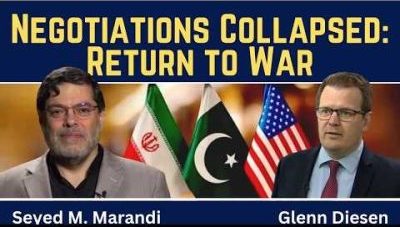
Seyed M. Marandi: Negotiations Collapsed – Return to War
or go to
Aletho News Archives – Video-Images
From the Archives
Wartime internment camps in Australia
National Archives of Australia
World War I
During World War I, for security reasons the Australian Government pursued a comprehensive internment policy against enemy aliens living in Australia.
Initially only those born in countries at war with Australia were classed as enemy aliens, but later this was expanded to include people of enemy nations who were naturalised British subjects, Australian-born descendants of migrants born in enemy nations and others who were thought to pose a threat to Australia’s security.
Australia interned almost 7,000 people during World War I, of whom about 4,500 were enemy aliens and British nationals of German ancestry already resident in Australia.
Records of World War I internment camps
World War II
During World War II, Australian authorities established internment camps for three reasons – to prevent residents from assisting Australia’s enemies, to appease public opinion and to house overseas internees sent to Australia for the duration of the war.
Unlike World War I, the initial aim of internment during the later conflict was to identify and intern those who posed a particular threat to the safety or defence of the country. As the war progressed, however, this policy changed and Japanese residents were interned en masse. In the later years of the war, Germans and Italians were also interned on the basis of nationality, particularly those living in the north of Australia. In all, just over 20 per cent of all Italians resident in Australia were interned. … continue
Blog Roll
 Aletho News
- Seyed M. Marandi: Negotiations Collapsed – Return to War
- Tomorrow’s naval blockade showdown
- ‘Israel’ attacks civilians to hide its embarrassing military failures & out of pure sadism
- Any Foreign Military Vessel Approaching Hormuz Under Any Pretext ‘Will Be Dealt With Severely’: IRGC
- Diplomats slam US negotiators’ performance in Iran talks
- Trump Refuses Exit Ramp, War with Iran will Continue
- Trump Says US Naval Blockade in Strait of Hormuz Will Begin Shortly
- US, Iran end 21-hour talks without agreement
- US IRAN TALKS: Who Are the Crazy Ones Here? /Lt Col Daniel Davis
- Talks with the US end without a deal over excessive US demands: Iran
- If Americans Knew
- US-Iran ceasefire negotiations make zero progress – Daily Update
- Pro-Israel ‘Thinktanks’ and Individuals who Influence U.S. Foreign Policy
- Mearsheimer reveals how Israel dictates US policies on Iran, Gaza – video
- After killing 350+, Israel still has a “score to settle” with Lebanon before ceasefire – Daily Update
- Military aid to Israel emerges as the latest political litmus test for Democrats
- The only Palestinian children’s rights organization closes following years-long Israeli campaign against it
- ‘I Can’t Forget the Smell’: Lebanese Reel After Israel Kills Over 300 in Single Day
- DNC Shoots Down Resolutions Calling Out AIPAC and Limiting Arms to Israel
- TCN: Is Israel Blackmailing President Trump?
- Israel killed at least 303 Lebanese yesterday – who were they? Daily Update
- No Tricks Zone
- German Expert: Heat Dome Led To Record Temps In Western USA…Warmer In 1934, 1936
- New Study: No Linear Warming Or Glacier Retreat Along Northern Antarctic Peninsula Since 1980s
- An Inconvenient Tree: Uncovered In Alps… Europe Much Warmer Than Today 6000 Years Ago
- New Study Reports A 60% Slowdown In Greenland’s Ice Loss Rate In The Last Decade
- Low Intensity Tornado Wrecks Major Solar Farm, Creating A Potential Toxic Dump
- New Study Finds Warming Saves Lives…Cold Temperatures 12 Times More Deadly Than Excess Heat
- German Science Blog Accuses PIK Climate Institute Of Hallucinating Climate Tipping Points
- Devastating Assessment Of Comirnaty Vaccine By Former Senior Pfizer Europe Toxicologist
- New Study: CO2 Is ‘Effectively Negligible’ As An Explanatory Climate Change Factor Since 2000
- Former Pfizer Toxicologist Dr. Helmut Sterz Tells Bundestag Hearing Pfizer Vaccine Should Have Never Been Approved
 Aletho News