North Korea War Plan: Chrystia Freeland is more dangerous than Tony Blair
By Cameron Pike | OffGuardian | January 28, 2018
The day before the Foreign Ministers’ meeting on Security and Stability in Vancouver on January 16, 2018, a forum was held at the University of British Columbia’s Institute of Asian Research entitled “Getting North Korea Right: Canadian Options and Roles”. This was a publicly held event with the “expert” “talking heads” of think-tanks. The moderator was an Asian International Relations expert, Dr. Paul Evans, who is now the head of the Institute of Asian Research.
The five speakers were Eric Walsh: Canadian Ambassador to the Republic of South Korea, Scott Snyder: Senior Fellow and Director of the Program on U.S.-Korea Policy, and New York Council of Foreign Relations, Kyung-Ae Park: Korea Foundation Chair, School of Public Policy and Global Affairs Director, and Canada-DPRK Knowledge Partnership Program, Brian Job: Professor of Political Science, UBC, Brian Gold: Department of History and Classics, University of Alberta. All panel participants were to attend the following days’ Foreign Ministers’ Meeting on North Korea.
The events’ speakers discussed Canada’s role in mediating the “International Community’s” response to North Korea through sanctions, non-proliferation and diplomacy. The stated goal of the pre-meeting was to have public discourse on the crisis in North Korea, a day in advance of the major international diplomatic event being held in Vancouver. The actual purpose of the pre-meeting was to soft sell the major military role that Canada plans to play in open sea interdiction to a Canadian audience on tightening sanctions on North Korea. This soft sell was necessary to back the hard sell for military action being made by Chrystia Freeland to 20 foreign ministers the following day.
Canadians mostly consider themselves non-militaristic, but as intelligence and military officials know around the world, the Canadian Navy are experts at interdictions at sea and are more preferred in interdiction than the U.S. Navy. Canada has had much experience perfecting these capabilities in interdictions off the coast of Africa, as well and in the Persian Gulf during the two Gulf Wars.
Further, what most Canadians and perhaps the general population in the West do not know, is that Canada is an important partner in the NATO/NORAD and UN command and intelligence structures and does most of the top military coordination in exercises and operations between the nations of NATO currently exercising on the border with Russia, and especially in the Ukraine. Most officers in the Canadian military are trained in a comprehensive way that allows them to operate in an integrated manner with US, UK, NATO, and U.N. forces around the globe. Throughout all U.S. global military actions, whether in the Gulf and Afghan wars, or currently all over the world, Canada’s military and military intelligence, considered the best in the world, has worked hand in hand with the U.S. military in special operations and counter intelligence.
Of the five speakers, the presentation by Scott A. Snyder of the NY Council on Foreign Relations was the most revealing of the actual intentions of the following days’ conference organizers. Snyder used the concept of a rheostat to describe the situation. He said, China was holding the rheostat over North Korea, that the U.S. was holding the rheostat over China, and that the “International Community” was holding the rheostat over the U.S. The significance of this is the acknowledgement that pressure on the U.S. is coming from the “collective” global community of extra-governmental, international, and non-national institutions and structures, including NGO’s, civil society, and the international financial community. Canada, as the host nation for this Foreign Minister’s meeting, is leading the “International Community”, which means that Canada is one of the leading countries holding the rheostat over the U.S.
It should be noted that the New York Council on Foreign Relations, where Snyder is a senior fellow, is an outgrowth of the British Liberal Imperialist Fabian Society. Its core thinkers over the last century, especially since WWII, created the unipolar doctrine of the “International Community” which Snyder references. This “International Community” does not include, at its core, Asia, Africa, Latin America, Russia, now Turkey, and possibly France, and India; that is most of the world. In other words, the “International Community” that Scott Snyder references is not international; nor are the Colour Revolutions, the illegal invasions, and the sanctions that are being carried out in the name of the “International Community” International.
These actions are hybrid warfare designed to pressure or break apart countries from within, who may have the potential of working within the new “multipolar” world framework being promoted by Russia and China. This “multipolar” framework is based on the New Paradigm, which is being introduced to the world economically by China via the Belt and Road Initiative (BRI.)
Snyder, in his presentation, said he expected pressure to be placed on North Korea and suggested it be done as a “nut cracker” with the intention to split North Korea internally, especially its elite, in order to open the door for civil society groups (NGO’s, churches etc.) to come in under the guise of humanitarian assistance, and foment internal dissent, hand in hand with the brutal blockade and interdiction being organized by Chrystia Freeland at the Korean Security Conference the following day. Snyder also further elaborated on the need for “maximizing the thresholds of pressure” to bring North Korea to diplomacy, as a “calibrated scalpel, not a blunt instrument like a hammer.”
At the pre-conference meeting, Brian Gold responded to a question about China and Russia not being invited to the Vancouver Summit. He stated that “China and Russia are irrelevant” to the situation, at which Dr. Paul Evans suggested that he should get a job with the Canadian government. [Editor’s Note: The claim that China and Russia had not been invited is itself an obfuscation: both countries condemned the conference as harmful and officially refused the invitation to attend a post-conference meeting on the evening of January 16, as reported by RT here.]
Brian Job said this is a “convening opportunity” for Canada, and that it involves “delicate interdiction.” That is, Canada will proceed “delicately” as a perceived neutral power backed up by the “International Community” to interdict and board ships with cargo for North Korea. Would Canada do so to Chinese or Russian vessels? Would Canada’s involvement in interdiction be perceived as “neutral” interdiction? Canada’s Privy Council and shadowy neo-cons like Chrystia Freeland certainly hope so. But that is not the reality from China and Russia’s perspective, nor was this accepted by the audience attending the pre-meeting.
UBC Professor, Kyung-Ae Park, from South Korea, said that the U.S./North Korea relationship is none of China’s business. Park is head of a South/North Korean educational exchange program operating out of Canada. She had been scheduled to be part of a “civil society” activation meeting with Chrystia Freeland in downtown Vancouver after the pre-conference meeting. How do “civil society” activists penetrate a country like North Korea? Precisely through the well-practiced method of Colour Revolutions, enacted already several times over by the “International Community”. Snyder referenced Egypt, Syria, Georgia, Ukraine, former Yugoslavia as just a few examples.
Many other Colour Revolutions, all of which have been funded by George Soros’ Open Society and Tides Foundations, have been tried and failed. A recent example of this is in Iran. George Soros, a very close friend of Chrystia Freeland, is a Hungarian Jew who worked for the Nazi’s during WWII helping to confiscate his own people’s property. In an interview on 60 Minutes in 1998, Soros openly admits that this was the best time of his life. Chrystia Freeland was commissioned to write George Soros’ biography before running for public office under the Liberal Party. Freeland is also known in Canadian government circles as being the Minister of Everything.
It should be noted that many on the panel spoke of creating the “coalition of the willing” to deal with North Korea. This is the exact same operational language that was used to manipulate the people of the Western world under Bush to agree to the US invasion of Iraq in 2003. Are we really supposed to fall for this again?
Following the speakers’ presentations, questions were allowed from the audience. The first three questions were technical questions with no substance and were under the general spell of professional decorum. A Director for the Society for the New Humanist Paradigm (SNHP), which represents the New Paradigm in Canada, asked the fourth question.
In that question, the Moon-Putin plan was described for the audience. This plan is the exact opposite of what the panel discussion described was being planned for the next days’ talks at the Foreign Minister’s meeting. The Moon-Putin plan was announced last September at the Vladivostok Eastern Economic Forum. This is a plan agreed to by Russia and South Korea. It is a plan to bring South and North Korea together through physical infrastructure and trade mechanisms, involving the neighbouring countries of Russia and China.
Bridges of cooperation linking South Korea to Russia via North Korea: gas, railroads, ports, electricity, a northern sea route, shipbuilding, jobs, agriculture, and fisheries. Siberian oil and gas pipelines would be extended to Korea, both North and South, as well as to Japan. Both Koreas would be linked up with the vast rail networks of Beijing’s Belt and Road Initiative, including high-speed rail, and the Eurasian Economic Union, which includes the Trans-Siberian Railway. According to Gavan McCormack, “North Korea would accept the security guarantee of the five (Japan included), refrain from any further nuclear or missile testing, shelve (‘freeze’) its existing programs and gain its longed for ‘normalization’ in the form of incorporation in regional groupings, the lifting of sanctions and normalized relations with its neighbour states, without surrender.”
The panel of speakers were also reminded that North Korea has been sanctioned since 1948 and has been suffering ever since at the behest of an illegal UN resolution, 195, and that the Belt and Road and the Moon-Putin plan were for building up their physical economy. As the SNHP director pointed out, in this context, sanctions were the exact opposite. He also pointed out that the January 16 meeting in Vancouver, along with Canada’s new Hard Power Foreign Policy initiatives (announced last year with record military spending for Canada) under Chrystia Freeland, was unprecedented in the history of Canada’s traditional peacekeeping role, and there is no confidence that Canada will play a positive role in this situation, or that Canada is a neutral Middle Power any longer given this shift.
Further, that Canadians deserve to have a national dialogue considering the consequences of such actions. He then went on to address Brian Gold directly, stating that Russia and China, considering the positive resolutions (Sunshine Policy, Olympics, etc.) made with South and North Korea over the last few weeks, were relevant and their absence from these meetings is a mistake. Finally, the SNHP representative asked, “When will Canada wake up to the fact that Freeland is a neo-con war-mongerer?” and “… if the Moon-Putin plan has already been discussed and such positive results are on the horizon, why the Foreign Ministers meeting in Vancouver was taking place at all?”
While the audience clapped, the panel was stunned. Four speakers responded to the intervention with a feeble attempt to change the subject. Most of the questions from the audience that followed the intervention were not questions but denunciations of the war policy that Canada was supporting. After each denunciation there was applause. In response to this, the panel started to back pedal and went limp. Even Brian Gold had to back pedal on Russia and China being irrelevant, and, as he was commenting, had to admit that he was making a case for why Russia and China should have been invited to the Foreign Minister’s meeting even as he was trying to defend his original statement. Subsequently, Brian Gold wrote an article printed in The Hill Times on January 22, 2018.
This article, highlighting Canada’s role as a ‘Middle Power’, serves to deflect attention from the neo-conservative and far-right views of the government of Canada under Chrystia Freeland, especially towards both Russia and China. Contrary to Gold’s article, it is in fact Chrystia Freeland, a frequent contributor to the NY CFR’s policy publication Foreign Affairs, the promoters of the ‘unipolar’ world doctrine, that did not want China and Russia present at the Foreign Minister’s meeting. President Trump has been at war with the likes of the CFR and the neo-liberal/neo-conservative mainstream media outlets that promote their unipolar worldview since before he took office and has consistently promised the American people better relations with Russia and a closer working relationship with China. In recent bold statements, however, Secretary Mattis outlines clearly that Russia and China are the main economic threat to the unipolar world in the National Defense Strategy 2018 policy paper.
Another SNHP Director who attended raised the issue of the THAAD missiles, and asked the panelists how they would not have been seen by North and South Korea as a threat? Snyder responded that the THAAD missiles were for defense and a non-issue, but he did acknowledge that South Korea was against the installation from the beginning. What Snyder should have acknowledged was that massive opposition by South Koreans of the THAAD missile deployment had forced the ouster of President Park Geun-hye in 2017.
What is important to note was the dearth of support from the audience for what the panelists were trying to soft peddal. The reaction by the audience, both in private to the SNHP Directors and following open denunciations to the panel, clearly shows that Canadians are not accepting the pablum they are being fed any more.
Cameron Pike studied Communications and Philosophy at the University of Winnipeg, and has worked in a variety of corporate fields in management before becoming Director at the Society for the New Humanist Paradigm, a Not-For-Profit, in Vancouver, Canada.
America’s National Defense Is Really Offense
By Philip M. GIRALDI | Strategic Culture Foundation | 26.01.2018
On Friday, the Pentagon released an unclassified summary of the 2018 National Defense Strategy report. On the same day, Secretary of Defense James Mattis delivered prepared remarks relating to the document.
Reading the summary is illuminating, to say the least, and somewhat disturbing, as it focuses very little on actual defense of the realm and relates much more to offensive military action that might be employed to further certain debatable national interests. Occasionally, it is actually delusional, as when it refers to consolidating “gains we have made in Afghanistan, Iraq, Syria and elsewhere.”
At times Mattis’ supplementary “remarks” were more bombastic than reassuring, as when he warned “… those who would threaten America’s experiment in democracy: if you challenge us, it will be your longest and worst day.” He did not exactly go into what the military response to hacking a politician’s emails might be and one can only speculate, which is precisely the problem.
One of the most bizarre aspects of the report is its breathtaking assumption that “competitors” should be subjected to a potential military response if it is determined that they are in conflict with the strategic goals of the U.S. government. It is far removed from the old-fashioned Constitutional concept that one has armed forces to defend the country against an actual threat involving an attack by hostile forces and instead embraces preventive war, which is clearly an excuse for serial interventions overseas.
Some of the remarks by Mattis relate to China and Russia. He said that “We face growing threats from revisionist powers as different as China and Russia, nations that seek to create a world consistent with their authoritarian models – pursuing veto authority over other nations’ economic, diplomatic and security decisions.” There is, however, no evidence that either country is exporting “authoritarian models,” nor are they vetoing anything that they do not perceive as direct and immediate threats frequently orchestrated by Washington, which is intervening in local quarrels thousands of miles away from the U.S. borders. And when it comes to exporting models, who does it more persistently than Washington?
The report goes on to state that Russia and China and rogue regimes like Iran have “…increased efforts short of armed conflict by expanding coercion to new fronts, violating principle of sovereignty, exploiting ambiguity, and deliberately blurring the lines between civil and military goals.” As confusing civil and military is what the United States itself has been doing in Libya, Iraq and, currently, Syria, the allegation might be considered ironic.
The scariest assertion in the summary is the following: “Nuclear forces – Modernization of the nuclear force includes developing options to counter competitors’ coercive strategies, predicated on the threatened use of nuclear or strategic non-nuclear attacks.” That means that the White House and Pentagon are reserving the option to use nuclear weapons even when there is no imminent or existential threat as long as there is a “strategic” reason for doing so. Strategic would be defined by the president and Mattis, while the War Powers Act allows Donald Trump to legally initiate a nuclear attack.
What might that mean in practice? Back in 2005, Vice President Dick Cheney had requested “a contingency plan to be employed in response to another 9/11-type terrorist attack on the United States… [including] a large-scale air assault on Iran employing both conventional and tactical nuclear weapons … not conditional on Iran actually being involved in the act of terrorism directed against the United States.”
Possible employment of “weapons of mass destruction” responded to intelligence suggesting that conventional weapons would be unable to penetrate the underground hardened sites where Iran’s presumed nuclear weapons facilities were reportedly located. But as it turned out, Iran had no nuclear weapons program and attacking it would have been totally gratuitous. Some other neocon inspired plans to attack Iran also included a nuclear option if Iran actually had the temerity to resist American force majeure.
Pentagon planners clearly anticipate another year of playing at defense by keeping the offense on the field. An impetuous and poorly informed president is a danger to all of us, particularly as he is surrounded by general-advisers who see a military solution to every problem. Hopefully wiser counsel will prevail.
New US National Defense Strategy Is Again Offensive

By David Macilwain | American Herald Tribune | January 23, 2018
Last week “Mad Dog” Mattis announced a new US Defence Strategy, the first for a decade and with a radical change of focus, from fighting terrorism to fighting Russia and China. The US DoD put it like this:
“The National Defense Strategy seeks to implement the pillars of the National Security Strategy: peace through strength, the affirmation of America’s international role, the U.S. alliance and partnership structure and the necessity to build military advantage to maintain key regional balances of power.”
According to Deputy Defense Secretary Elbridge A. Colby this strategy is necessitated because of:
“the erosion of U.S. military advantage vis-a-vis China and Russia, which, if unaddressed, could ultimately undermine our ability to deter aggression and coercion and imperil the free and open order that we seek to underwrite with our alliance constellation.”
“The strategy aims at thwarting Chinese and Russian aggression and use of coercion and intimidation to advance their goals and harm U.S. interests, and specifically focuses on three key theaters: Europe, the Indo-Pacific and the Middle East, Colby said.”
Whether this is a new strategy or just a new declaration of the existing one depends on your point of view. In announcing it at the press conference Jim Mattis stressed the supposed shift from fighting terrorism to countering Russia and China, as well as their effective allies North Korea and Iran. Following hot on the heels of Tillerson’s confrontational outburst, and refusal to get out of Syria following the defeat of Islamic State, the sudden shift looks rather convenient – the US can now claim it must stay in Syria to counter Russia’s growing influence in the region.
What’s new! Wasn’t this always the US plan, as laid out a decade earlier in “Which path to Persia?” – a plan that seems to be relentlessly moving forward despite all obstacles, including particularly international law?
While there have been a few setbacks in the US project to advance its goals around the globe against the interests of Russia and China and their allies, the escalation in aggressive US confrontations in those “key theatres” since Trump came to power makes nonsense of Colby’s claim that the new policy is “not a strategy of confrontation, but it is strategy that recognizes the reality of competition.”
Even if that were true, it only emphasizes the fundamental difference in approach between the great powers. Neither Russia nor China see competition or confrontation as their goals, leave alone the insulting and ludicrous “aggression, coercion and intimidation” which the US attributes to them. Faced with a rational and responsible partner rather than the expansionist and exceptionalist US, it is a desire for collaboration and co-existence that evidently motivate China and Russia, and also lie at the center of their own developing cooperation.
Symbolizing this difference – or rather conflict – between world views, is the ongoing dispute over the South China Sea. Just before Mattis announcement, the US sent a ship into the disputed waters as part of its “freedom of navigation” exercises, and received an immediate demand to leave from China, which has long lost patience with this serial provocation. In this area one of America’s “constellation” allies Australia is forced to take sides, and reveals itself as an accomplice to the ongoing Imperial crimes.
Despite Australia’s crucial economic dependence on China, its current government seems to be going out of its way in provoking and insulting Chinese leaders and representatives. As Mattis made his announcement, PM Malcolm Turnbull was in Japan visiting a missile defense base and talking about joint exercises and military cooperation. Australia also took part in the provocative exercises against North Korea with the US and South Korea at a time of high tension last year, despite Russian and Chinese warnings against them.
And when it comes to the South China Sea issue, it must be pointed out that China’s legitimate concerns are to maintain the freedom of navigation through its main transport artery to the West and Australia. Given the US coalition’s participation in exercises simulating a blockade of these channels it’s not hard to see and support China’s defensive stand on this issue.
Part of the “new strategy” in the Indo-Pacific is also likely to be an expansion of the US presence and bases in Australia. “In the new security environment” – whatever that is – the stationing of US strategic bombers in Northern Australia is now being proposed. Along with the massive regional US surveillance base in Pine Gap, nuclear-armed bombers will make us a prime target for one of China’s ICBMs, so no doubt we’ll also be getting THAAD missile defense systems.
On reflection it appears that the “new” US “National Defense” Strategy is little more than the one pursued fifty years ago against the Soviets and the Chinese Communists. Fifteen years of the “Global war on Terror”, culminating with the scourge of “Islamic State” was just means to the same end, and can now be discarded.
The tragedy is that with Vladimir Putin and Xi Jing Ping we really had a chance for diplomacy, law and peace to prevail.
*(Secretary of Defense James N. Mattis announces the National Defense Strategy at Johns Hopkins University School of Advanced International Studies in Washington, Jan. 19. Image credit: DoD photo/ Navy Mass Communication Specialist 1st Class Kathryn E. Holm/ flickr)
A National Defense Strategy of Sowing Global Chaos
By Nicolas J.S. Davies | Consortium News | January 23, 2018
Presenting the 2018 National Defense Strategy of the United States on Friday at the Johns Hopkins University, Secretary of Defense James Mattis painted a picture of a dangerous world in which U.S. power – and all of the supposed “good” that it does around the world – is on the decline.
“Our competitive edge has eroded in every domain of warfare – air, land, sea, space, and cyberspace,” he said. “And it is continually eroding.”
What he could have said instead is that the United States military is overextended in every domain, and that much of the chaos seen around the world is the direct result of past and current military adventurism. Further, he could have acknowledged, perhaps, that the erosion of U.S. influence has been the result of a series of self-inflicted blows to American credibility through foreign policy disasters such as 2003 invasion of Iraq.
There were also two important words hidden between the lines, but never mentioned by name, in the new U.S. National Defense Strategy: “empire” and “imperialism.”
It has long been taboo for U.S. officials and corporate media to speak of U.S. foreign policy as “imperialism,” or of the U.S.’s global military occupations and network of hundreds of military bases as an “empire.” These words are on a long-standing blacklist of “banned topics” that U.S. official statements and mainstream U.S. media reports must never mention.
The streams of Orwellian euphemisms with which U.S. officials and media instead discuss U.S. foreign policy do more to obscure the reality of the U.S. role in the world than to describe or explain it, “hiding imperial interests behind ever more elaborate fig leaves,” as British historian A.J.P. Taylor described European imperialists doing the same a century ago.
As topics like empire, imperialism, and even war and peace, are censored and excised from political debate, U.S. officials, subservient media and the rest of the U.S. political class conjure up an illusion of peace for domestic consumption by simply not mentioning our country’s 291,000 occupation troops in 183 other countries or the 39,000 bombs and missiles dropped on our neighbors in Iraq, Syria and Afghanistan since Trump took office.
The 100,000 bombs and missiles dropped on these and other countries by Obama and the 70,000 dropped on them by Bush II have likewise been swept down a kind of real time “memory hole,” leaving America’s collective conscience untroubled by what the public was never told in the first place.
But in reality, it’s been a long time since U.S. leaders of either party resisted the temptation to threaten anyone anywhere, or to follow through on their threats with “fire and fury” bombing campaigns, coups and invasions. This is how empires maintain a “credible threat” to undergird their power and discourage other countries from challenging them.
But far from establishing the “Pax Americana” promised by policymakers and military strategists in the 1990s, from Paul Wolfowitz and Dick Cheney to Madeleine Albright and Hillary Clinton, the results have been consistently catastrophic, producing what the new National Defense Strategy calls, “increased global disorder, characterized by decline in the long-standing, rules-based international order.”
Of course the drafters of this U.S. strategy document dare not admit that U.S. policy is almost single-handedly responsible for this global chaos, after successive U.S. administrations have worked to marginalize the institutions and rules of international law and to establish illegal U.S. threats and uses of force that international law defines as crimes of aggression as the ultimate arbiter of international affairs.
Nor do they dare acknowledge that the CIA’s politicized intelligence and covert operations, which generate a steady stream of political pretexts for U.S. military intervention, are designed to create and exacerbate international crises, not to solve them. For U.S. officials to admit such hard truths would shake the very foundations of U.S. imperialism.
Opposition to the Joint Comprehensive Plan of Action with Iran – the so-called nuclear deal – from Republicans and Democratic hawks alike seems to stem from the fear that it might validate the use of diplomacy over sanctions, coups and war, and set a dangerous precedent for resolving other crises – from Afghanistan and Korea to future crises in Africa and Latin America. Iran’s success at bringing the U.S. to the negotiating table, instead of falling victim to the endless violence and chaos of U.S.-backed regime change, may already be encouraging North Korea and other targets of U.S. aggression to try to pull off the same trick.
But how will the U.S. justify its global military occupation, illegal threats and uses of force, and trillion-dollar war budget once serious diplomacy is seen to be more effective at resolving international crises than the endless violence and chaos of U.S. sanctions, coups, wars and occupations?
From Bhurtpoor to Baghdad
Major Danny Sjursen, who has fought in Iraq and Afghanistan and taught history at West Point, is a rare voice of sanity from within the U.S. military. In a poignant article in Truthdig, Major Sjursen eloquently described the horrors he has witnessed and the sadness he expects to live with for the rest of his life. “The truth is,” he wrote, “I fought for next to nothing, for a country that, in recent conflicts, has made the world a deadlier, more chaotic place.”
Danny Sjursen’s life as a soldier of the U.S. Empire reminds me of another soldier of Empire, my great-great-great grandfather, Samuel Goddard. Samuel was born in Norfolk in England in 1793, and joined the 14th Regiment of Foot as a teenager. He was a Sergeant at the Battle of Waterloo in 1815. During 14 years in India, his battalion led the assault on the fortress of Bhurtpoor in 1826, which ended the last resistance of the Maratha dynasty to British rule. He spent 3 years in the Caribbean, 6 years in Canada, and retired as Commandant of Dublin Castle in 1853 after a lifetime of service to Empire.
Danny’s and Samuel’s lives have much in common. They would probably have a lot to talk about if they could ever meet. But there are critical differences. At Bhurtpoor, the two British regiments who led the attack were followed through the breech in the walls by 15 regiments of Indian “Native Infantry.” After Bhurtpoor, Britain ruled India (including Pakistan and Bangladesh) for 120 years, with only a thousand British officials in the Indian Civil Service and a few thousand British officers in command of up to 2.5 million Indian troops.
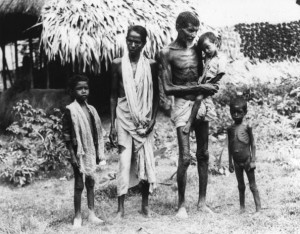 The British brutally put down the Indian Mutiny in 1857-8 with massacres in Delhi, Allahabad, Kanpur and Lucknow. Then, as up to 30 million Indians died in famines in 1876-9 and 1896-1902, the British government of India explicitly prohibited relief efforts or actions that might reduce exports from India to the U.K. or interfere with the operation of the “free market.”
As Mike Davis wrote in his 2001 book, Late Victorian Holocausts, “What seemed from a metropolitan perspective the nineteenth century’s final blaze of imperial glory was, from an Asian or African viewpoint, only the hideous light of a giant funeral pyre.”
And yet Britain kept control of India by commanding such loyalty and subservience from millions of Indians that, in every crisis, Indian troops obeyed orders from British officers to massacre their own people.
Danny Sjursen and U.S. troops in Afghanistan, Iraq and other post-Cold War U.S. war zones are having a very different experience. In Afghanistan, as the Taliban and its allies have taken control of more of the country than at any time since the U.S. invasion, the U.S.-backed Afghan National Army has 25,000 fewer troops under its command than it did five years ago, while ten years of training by U.S. special operations forces has produced only 21,000 trained Afghan Commandos, the elite troops who do 70-80% of the killing and dying for the corrupt U.S.-backed Afghan government.
But the U.S. has not completely failed to win the loyalty of its imperial subjects. The first U.S. soldier killed in action in Afghanistan in 2018 was Sergeant 1st Class Mihail Golin, originally from Latvia. Mihail arrived in the U.S. in November 2004, enlisted in the U.S. Army three months later and has now given his life for the U.S. Empire and for whatever his service to it meant to him. At least 127 other Eastern Europeans have died in occupied Afghanistan, along with 455 British troops, 158 Canadians and 396 soldiers from 17 other countries. But 2,402 – or 68%, over two-thirds – of the occupation troops who have died in Afghanistan since 2001, were Americans.
In Iraq, an American war that always had even less international support or legitimacy, 93% of the occupation troops who have died were Americans, 4,530 out of a total of 4,852 “coalition” deaths.
When Ben Griffin, who later founded the U.K. branch of Veterans for Peace, told his superiors in the U.K.’s elite SAS (Special Air Service) that he could no longer take part in murderous house raids in Baghdad with U.S. special operations forces, he was surprised to find that his entire chain of command understood and accepted his decision. The only officer who tried to change his mind was the chaplain.
The Future of Empire
The U.S. Joint Chiefs of Staff have explicitly told Congress that war with North Korea would require a ground invasion, and the same would likely be true of a U.S. war on Iran. South Korea wants to avoid war at all costs, but may be unavoidably drawn into a U.S.-led Second Korean War.
But besides South Korea, the level of support the U.S. could expect from its allies in a Second Korean War or other wars of aggression in the future would probably be more like Iraq than Afghanistan, with significant international opposition, even from traditional U.S. allies. U.S. troops would therefore make up nearly all of the invasion and occupation forces – and take nearly all of the casualties.
Compared to past empires, the cost in blood and treasure of policing the U.S. Empire and the blame for its catastrophic failures fall disproportionately – and rightly – on Americans. Even Donald Trump recognizes this problem, but his demands for allied countries to spend more on their militaries and buy more U.S. weapons will not change their people’s unwillingness to die in America’s wars.
This reality has created political pressure on U.S. leaders to wage war in ways that cost fewer American lives but inevitably kill many more people in countries being punished for resistance to U.S. imperialism, using air strikes and locally recruited death squads instead of U.S. “boots on the ground” wherever possible.
The U.S. conducts a sophisticated propaganda campaign to pretend that U.S. air-launched weapons are so accurate that they can be used safely without killing large numbers of civilians. Actual miss rates and blast radii are on the “banned topics” blacklist, along with realistic estimates of civilian deaths.
When former Iraqi foreign minister Hoshyar Zebari told Patrick Cockburn of the U.K.’s Independent newspaper that he had seen Iraqi Kurdish intelligence reports which estimated that the U.S.- and Iraqi-led destruction of Mosul had killed 40,000 civilians, the only remotely realistic estimate so far from an official source, no other mainstream Western media followed up on the story.
But America’s wars are killing millions of innocent people: people defending themselves, their families, their communities and countries against U.S. imperialism and aggression; and many more who were simply in the wrong place at the wrong time under the onslaught of over 210,000 American bombs and missiles dropped on at least 7 countries since 2001.
According to a growing body of research (for example, see the UN Development Program study, Journey to Extremism in Africa: Drivers, Incentives and the Tipping-Point for Recruitment), most people who join armed resistance or “terrorist” groups do so mainly to protect themselves and their families from the dangers of wars that others have inflicted on them. The UNDP survey found that the final “tipping point” that pushes over 70% of them to take the fateful step of joining an armed group is the killing or detention of a close friend or family member by foreign or local security forces.
So the reliance on airstrikes and locally recruited death squads, the very strategies that make U.S. imperialism palatable to the American public, are in fact the main “drivers” spreading armed resistance and terrorism to country after country, placing the U.S. Empire on a collision course with itself.
The U.S. effort to delegate war in the Middle East to Saudi Arabia is turning it into a target of global condemnation as it tries to mimic the U.S. model of warfare by bombing and starving millions of innocent people in Yemen while blaming the victims for their plight. The slaughter by poorly trained and undisciplined Saudi and Emirati pilots is even more indiscriminate than U.S. bombing campaigns, and the Saudis lack the full protection of the Western propaganda system to minimize international outrage at tens of thousands of civilian casualties and an ever-worsening humanitarian crisis.
The need to win the loyalty of imperial subjects by some combination of fear and respect is a basic requirement of Empire. But it appears to be unattainable in the 21st century, certainly by the kind of murderous policies the U.S. has embraced since the end of the Cold War. As Richard Barnet already observed 45 years ago, at the end of the American War in Vietnam, “At the very moment the number one nation has perfected the science of killing, it has become an impractical instrument of political domination.”
Obama’s sugar-coated charm offensive won U.S. imperialism a reprieve from global public opinion and provided political cover for allied leaders to actively rejoin U.S.-led alliances. But it was dishonest. Under cover of Obama’s iconic image, the U.S. spread the violence and chaos of its wars and regime changes and the armed resistance and terrorism they provoke farther and wider, affecting tens of millions more people from Syria and Libya to Nigeria and Ukraine.
Now Trump has taken the mask off and the world is once again confronting the unvarnished, brutal reality of U.S. imperialism and aggression.
China’s approach to the world based on trade and infrastructure development has been more successful than U.S. imperialism. The U.S. share of the global economy has declined from 40% to 22% since the 1960s, while China is expected to overtake the U.S. as the world’s largest economy in the next decade or two – by some measures, it already has.
While China has become the manufacturing and trading hub of the global economy, the U.S. economy has been financialized and hollowed out, hardly a solid basis for future growth. The neoliberal model of politics and economics that the U.S. adopted a generation ago has created even greater wealth for people who already owned disproportionate shares of everything, but it has left working people in the U.S. and across the U.S. Empire worse off than before.
Like the “next to nothing” that Danny Sjursen came to realize he was fighting for in Iraq and Afghanistan, the prospects for the U.S. economy seem ephemeral and highly vulnerable to the changing tides of economic history.
The Rise and Fall of the Great Powers
In his 1987 book, The Rise and Fall of the Great Powers: Economic Change and Military Conflict from 1500 to 2000, historian Paul Kennedy examined the relationship between economic and military power in the histories of the Western empires who colonized the world in the past 500 years. He described how rising powers enjoy significant competitive advantages over established ones, and how every once-dominant power sooner or later has to adjust to the tides of economic history and find a new place in a world it can no longer dominate.
Kennedy explained that military power is only a secondary form of power that wealthy nations develop to protect and support their expanding economic interests. An economically dominant power can quickly convert some of its resources into military power, as the U.S. did during the Second World War or as China is doing today. But once formerly dominant powers have lost ground to new, rising powers, using military power more aggressively has never been a successful way to restore their economic dominance. On the contrary, it has typically been a way to squander the critical years and scarce resources they could otherwise have used to manage a peaceful transition to a prosperous future.
As the U.K. found in the 1950s, using military force to try to hold on to its empire proved counter-productive, as Kennedy described, and peaceful transitions to independence proved to be a more profitable basis for future relations with its former colonies. The drawdown of its global military commitments was an essential part of its transition to a viable post-imperial future.
The transition from hegemony to coexistence has never been easy for any great power, and there is nothing exceptional about the temptation to use military force to try to preserve and prolong the old order. This has often led to catastrophic wars and it has always failed.
It is difficult for any political or military leader to preside over a diminution of his or her country’s power in the world. Military leaders are rewarded for military strategies that win wars and expand their country’s power, not for dismantling it. Mid-level staff officers who tell their superiors that their weapons and armies cannot solve their country’s problems do not win promotion to decision-making positions.
As Gabriel Kolko noted in Century of War in 1994, this marginalization of critical voices leads to an “inherent, even unavoidable institutional myopia,” under which, “options and decisions that are intrinsically dangerous and irrational become not merely plausible but the only form of reasoning about war and diplomacy that is possible in official circles.”
After two world wars and the independence of India, the Suez crisis of 1956 was the final nail in the coffin of the British Empire, and the Eisenhower administration burnished its own anti-colonial credentials by refusing to support the British-French-Israeli invasion of Egypt. British Prime Minister Anthony Eden was forced to resign, and he was replaced by Harold Macmillan, who had been a close aide to Eisenhower during the Second World War.
Macmillan dismantled the remains of the British Empire behind the backs of his Conservative Party’s supporters, winning reelection in 1959 on the slogan, “You’ve never had it so good,” while the U.S. supported a relatively peaceful transition that preserved Western international business interests and military power.
As the U.S. faces a similar transition from empire to a post-imperial future, its leaders have been seduced by the chimera of the post-Cold War “power dividend” to try to use military force to preserve and expand the U.S. Empire, even as the relative economic position of the U.S. declines.
In 1987, Paul Kennedy ended The Rise and Fall of the Great Powers with a prescient analysis of the U.S. position in the world. He concluded,
“In all of the discussions about the erosion of American leadership, it needs to be repeated again and again that the decline referred to is relative not absolute, and is therefore perfectly natural; and that the only serious threat to the real interests of the United States can come from a failure to adjust sensibly to the newer world order.”
But after Kennedy wrote that in 1987, instead of accepting the future of peace and disarmament that the whole world hoped for at the end of the Cold War, a generation of American leaders made a fateful bid for “superpower.” Their delusions were exactly the kind of failure to adjust to a changing world that Kennedy warned against.
The results have been catastrophic for millions of victims of U.S. wars, but they have also been corrosive and debilitating for American society, as the perverted priorities of militarism and Empire squander our country’s resources and leave working Americans poorer, sicker, less educated and more isolated from the rest of the world.
When I began writing Blood On Our Hands: the American Invasion and Destruction of Iraq in 2008, I hoped that the catastrophes in Afghanistan and Iraq might bring U.S. leaders to their senses, as the Suez crisis did to British leaders in 1956.
Instead, eight more years of carefully disguised savagery under Obama have squandered more precious time and good will and spread the violence and chaos of U.S. war-making even farther and wider. The new National Defense Strategy’s implicit threats against Russia and China reveal that 20 years of disastrous imperial wars have done nothing to disabuse U.S. leaders of their delusions of “superpower status” or to restore any kind of sanity to U.S. foreign policy.
Trump is not even pretending to respect diplomacy or international law, as he escalates Bush’s and Obama’s wars and threatens new ones of his own. But maybe Trump’s nakedly aggressive policies will force the world to finally confront the dangers of U.S. imperialism. A coming together of the international community to stop further U.S. aggression may be the only way to prevent an even greater catastrophe than the ones that have already befallen the people of Afghanistan, Iraq, Somalia, Honduras, Libya, Syria, Ukraine and Yemen.
Or will it actually take a new and even more catastrophic war in Korea, Iran or somewhere else to finally force the United States to “adjust sensibly to the new world order,” as Paul Kennedy put it in 1987? The world has already paid a terrible price for our leaders’ failure to take his sound advice a generation ago. But what will be the final cost if they keep ignoring it even now?
Nicolas J.S. Davies is the author of Blood On Our Hands: the American Invasion and Destruction of Iraq.
Black Sea Antics by the US-NATO Military Alliance
By Brian CLOUGHLEY | Strategic Culture Foundation | 23.01.2018
In addition to the increasing numbers of troops and aircraft ranged along Russia’s northern borders, the United States continues to deploy missile-equipped warships to the Black Sea, and on January 10 the UK’s Sun newspaper headlined that “US destroyer races to Russia-dominated Black Sea to ‘ensure security and stability’.” The US Navy Times joined in by announcing that “US Navy ruffles Russian feathers in the Black Sea” and Stars and Stripes reported the US 6th Fleet’s Captain Tate Westbrook as saying that “US ships will continue to enter the Black Sea and work with our allies and partners to ensure maritime security and stability,” but nobody gave an example of insecurity.
Indeed, nobody has ever provided evidence of any problems in the Black Sea that require the Pentagon or its NATO sub-office in Brussels to “protect waters of economic and military importance.” (And it is mildly amusing that the US refuses to ratify the UN Convention on the Law of the Sea.)
It was reported on February 16 that “NATO defence ministers have decided to beef up the military alliance’s naval presence in the Black Sea in response to an increasingly aggressive Russia. Secretary-General Jens Stoltenberg said NATO will hold more war games and training in the strategically important sea.” But there has never been an instance of a merchant vessel having been inconvenienced by Russia — just as, in the South China Sea, where the US Navy also indulges in equally provocative antics, there has not been a single case of Chinese interference with any transiting commercial ship.
The propaganda doesn’t stop there. The US Navy Times reports breathlessly that “Russian subs are regularly known to lurk beneath the waves on the East Coast of the United States and regularly in the Mediterranean again, according to multiple sources who spoke to Navy Times on background. Sailors are regularly squaring off with Russian jets when they operate on Putin’s doorstep in the Baltic and Black Sea.”
Ignoring the sneering reference to President Putin, the Navy Times makes a good point : the Baltic and Black Sea are indeed doorsteps to Russia, and it is wise to defend your own doorsteps when they are being used as bases for hostile foreign military deployments.
The Navy Times argues that “While President Trump has expressed interest in repairing US relations with Russia, some analysts say the U.S. must step up its aerial and maritime patrols in response to Russia’s own increase of deployed naval forces in the Black Sea. The increasing prevalence of tension and danger in the area signal that it might be time to get tough.”
So the Pentagon is getting tough and records that since the middle of last year the guided missile destroyers USS Carney and USS Porter conducted five “maritime security operations” in the Black Sea, and the guided missile cruiser USS Huế City held exercises with the Ukrainian navy ship Balta.
According to the US Navy the USS Carney “is equipped with the world’s most sophisticated weaponry systems. She is fitted with missiles that reach extended ranges. Land attack cruise missile strike capability is provided by Tomahawk missiles, which are launched from the MK 41 Vertical Launching System. Additionally, Carney has Harpoon anti-surface missiles.” It’s just the sort of warship that contributes to an atmosphere of stability and security.
It has escaped the notice of the Pentagon and its sub-office in Brussels that Russia has a Black Sea coastline of 800 kilometres, excluding Crimea, and has every right to regard that area as home waters — just as it has every right to sail in and fly over the Baltic.

There’s plenty of aggression, to be sure. But it is entirely by the US-NATO military alliance which at vast expense deploys its combat ships, strike aircraft, ‘Big Guns’ and special forces to countries and seas on Russia’s borders. Why not use all that money to improve mutually beneficial trade arrangements and transport infrastructure? That would be welcomed by Russia and by a growing number of European countries that are disturbed about continual confrontation of Russia by the Pentagon-Brussels military circus. But the big question is : Why does NATO continue its belligerent boogies along Russia’s borders? What benefits can possibly accrue from its bluster?
All was made clear on January 19 when the US Defence Secretary, General James Mattis (he of the infamous “it’s fun to shoot some people” comment about Afghans), declared that “great power competition — not terrorism — is now the primary focus of US national security.”
It’s back to the happy days of the Cold War, when Washington’s military-industrial mafia thrived and expanded — and back to the language of the Cold War in the just-released National Defense Strategy. In this document the Pentagon says its objectives are to “remain the preeminent military power in the world, ensure the balances of power remain in our favor, and advance an international order that is most conducive to our security and prosperity.” One of the ways enabling the Pentagon to achieve this is to “address the arc of instability building on NATO’s periphery”, which would be entertaining were it not so absurd.
After the dissolution of the Soviet Union it wasn’t Russia that increased its military capabilities. It was the US-NATO military alliance that expanded eastwards to Russia’s borders, increasing the number of countries from 16 to 29. There was no Russian threat to western Europe or anywhere else, and the Moscow government was concentrating on the economy, developing natural resources, and improving the living standards of its citizens. These priorities were disrupted by NATO’s first expansion in 1999 when Poland, Hungary and the Czech Republic pushed NATO eastwards. In 2004 there was major success for the Cold Warriors when seven more countries were enlisted in the military alliance and NATO military power moved right up to Russia’s borders.
The pattern was profoundly depressing for Russia, but nothing could be done to halt US-NATO military expansion. The New York Times observed that ceremonies in Washington and Brussels in 2004 marked “the largest expansion in the alliance’s history [which] officially culminated a military integration that began years ago. Lithuania, Latvia and Estonia have all trained with NATO forces, restructured their own forces to NATO standards and contributed soldiers to NATO operations.” It was all part of a very long-term plan.
The BBC reported that “Russian lawmakers have voiced concern about Nato’s eastward expansion to Moscow’s doorstep. A resolution by the lower house of parliament, the Duma, said Russia may reconsider its defence strategy if NATO continued to ignore Moscow’s interests. It urged NATO members to ratify an arms treaty to restrict deployment of weapons near Russia’s borders… The Duma said it would also recommend the government to strengthen Russia’s nuclear deterrent and consider the deployment of additional troops on the country’s western borders.”
The “arc of instability” is not within Russia: it is in the sweep of NATO and NATO-influenced countries surrounding Russia.
The United States stations armed forces in some 800 military bases around the world. Russia has nine overseas bases and has no intention of establishing more. It is Washington that has expanded its global military presence so dramatically and created so much tension and instability. Its forays into Iraq and Afghanistan and its blitz on Libya were catastrophic, but it appears that more wars are being planned.
US-NATO military fandangos in the Black Sea are part of the Pentagon-Brussels policy of poisonous confrontation that is intended to increase in intensity. The world is becoming an ever more dangerous place.
A Coming Russia-Ukraine War?
By Gilbert Doctorow | Consortium News | January 21, 2018
While much of America’s – and the world’s – attention focused this weekend reflecting on Donald Trump’s first year in the Oval Office, holding one-year anniversary events for the historic Women’s March and drawing up balance sheets of his promises and achievements, Russia has had a rather different issue on the front-burner: a possible war with Ukraine.
The situation in the Donbass region of south-eastern Ukraine has been a feature of Russia’s political talk shows for the past couple years, along with the military campaign in Syria and more recently the stages in the preparation for presidential elections on March 18.
Focus on the Donbass conflict increased in the closing weeks of 2017 as military action on the front lines separating the forces of the self-proclaimed republics of Donetsk and Lugansk enjoying Russian support from Ukrainian militias and armed forces reached an intensity not seen for more than a year. This is despite the heralded exchange of military prisoners by both sides before New Year’s under talks supervised by the Patriarch of the Russian Orthodox Church Kirill.
Then, this past Thursday came a wholly new development – a draft law passed by the Ukrainian Parliament that could effectively end Kiev’s participation in the conflict resolution process known as the Minsk Accords. Although observers in the United States and Western Europe may have missed it, many Russians believe this development amounts to a declaration of war.
Dmitri Kiselyov, head of all Russian television and radio news services, offered a sober analysis of the emotionally charged development on his Sunday evening news wrap-up today.
According to Kiselyov, the new law, which awaits Poroshenko’s signature, makes preparations for war and includes language indicating a bellicose new approach to the conflict. The mission in Donbass is no longer described as an “anti-terrorist operation.” Rather, the mission now is to send armed forces against “military formations of the Russian Federation” in Donbass.
Military headquarters are established to coordinate the operation to be waged in Donbass. While up until now the self-declared republics of Donetsk and Lugansk were considered under the Minsk Accords as negotiating parties, now there are only “occupation administrations” of the Russian Federation on these territories, with Russia identified as an “aggressor.”
“This makes it all the more convenient for Ukraine to start a war,” Kiselyov says, noting that it could have the added benefit of enabling Ukraine not to pay its foreign debts and to ensure Poroshenko’s continued grip on power.
A Vesti reporter on the ground in Donetsk confirmed with local residents their view that the law means war. They see the current moment on the front line as “the calm before the storm.” Donetsk soldiers at their trenches say they are fully ready to engage with the enemy.
While Kiselyov acknowledges that the draft law might not ultimately be implemented, it nevertheless reveals a growing mood in the Ukrainian capital in favor of escalation. The facts speak for themselves, Kiselyov says, with Poroshenko failing to adhere to the Minsk Accords – for example by organizing local elections in Donbass – or to observe ceasefires along the lines of contact. There are attacks and deaths every day and only counter force has pushed back recent Ukrainian attempts to gain territory.
Kiev has seemingly written off the population of the two self-proclaimed republics – cutting off all transport and telecoms links and failing to pay pensions and assistance to the needy. It closed the banking system and there are no commercial ties. For Kiev the two provinces are merely territory to take back from the occupiers, with the wellbeing of the local populations at best a secondary concern.
On the economic front, the European Union has refused to extend 600 million euros of credit to Ukraine due to corruption. The International Monetary Fund recently refused a tranche of $800 million over failure to introduce reforms. Meanwhile, in 2019 Ukraine is due to start repaying earlier loans. This will come to $14 billion a year, which amounts to half the state budget of Ukraine.
Due to dire economic conditions, Poroshenko and other government officials in Kiev have become deeply unpopular, and with diminished chances for electoral success may see war as politically advantageous.
And although there are indications that some Western leaders are fed up with Kiev, the United States has doubled down in its support for a military solution to the conflict. With military trainers now on the ground and the U.S. budgeting $350 million for security assistance to Ukraine, Washington has also recently started delivering lethal weapons including the Javelin anti-tank missile system free of charge to Kiev.
In contrast to the image of Trump administration policies being dictated by Moscow, as portrayed by proponents of Russia-gate conspiracy theories, the United States is instead moving towards deeper confrontation with the Kremlin in the geopolitical hotspot of Ukraine.
For its part, the Kremlin has very little to gain and a great deal to lose economically and diplomatically from a campaign now against Kiev. If successful, as likely would be the case given the vast disparity in military potential of the two sides, it could easily become a Pyrrhic victory.
But notwithstanding Kiselyov’s reassuring words on his Sunday evening news wrap-up, it may well be the case that Moscow feels it has no choice. Moves by Kiev to exacerbate the conflict must be quickly countered to prevent deeper intervention by the United States and its NATO allies and prevent the conditions for WWIII from taking hold.
Gilbert Doctorow is an independent political analyst based in Brussels. His latest book, Does the United States Have a Future? was published in October 2017.
Washington and Allies Go Orwellian on Korea Peace Talks
By Finian CUNNINGHAM | Strategic Culture Foundation | 19.01.2018
Just as North and South Korea achieve important peaceful exchanges, Washington and its NATO allies appear to be moving with determination to sabotage the initiative for averting war on the East Asian peninsula.
Further, the reckless, gratuitous provocations beg the conclusion that the United States is indeed trying to start a war.
Meanwhile, unprecedented accusations this week by US President Donald Trump that Russia is supporting North Korea to evade United Nations sanctions also point to the danger that any conflict could spiral out of control to engulf world nuclear powers.
Moscow rejected the unsubstantiated claims leveled by Trump, saying that Russia is abiding by UN trade restrictions over North Korea, and that the American president’s allegations were “entirely unfounded”.
Trump’s verbal broadside suggests that Washington is trying to undermine the nascent talks between the two Koreas, talks which Russia and China have both applauded as a long-overdue diplomatic effort to resolve the Korean conflict.
Separately, Russia’s Foreign Minister Sergei Lavrov deplored a summit held in Vancouver, Canada, earlier this week in which the US and 19 other nations – most of them NATO members – called for sharper sanctions on North Korea that go beyond the remit of the United Nations. The conference, co-hosted by Canada’s Foreign Minister Chrystia Freeland and US Secretary of State Rex Tillerson, issued a stridently bellicose statement, calling in effect for North Korea to surrender its nuclear weapons or face US-led military action.
Significantly, and pointedly, China and Russia were not invited to the Canadian summit.
Most of the attending states were part of the original US-led military force which fought against North Korea during the 1950-53 war. A war which killed as many as two million North Koreans.
Russia admonished that the conference was “harmful” to current peace talks between North and South Korea. China rebuked the Canadian event as being stuck in “Cold War thinking”.
The anachronism of countries like Britain, Belgium, Denmark, France, Italy, Netherlands and Norway attending a conference on the Korean crisis while Asia-Pacific powers Russia and China being excluded was noted by Russia’s Sergei Lavrov. The anachronism is not only absurd, he said, it reprises a provocative “war summit” message.
Disturbingly, what the Vancouver gathering demonstrated was the willingness by the US and its allies to circumvent the United Nations Security Council and the previously established regional Six-Party forum involving the two Koreas, China, Japan, Russia and the US.
At the Vancouver event, Tillerson laid out a belligerent agenda that was endorsed by the other attendees. The agenda included the precondition of North Korea giving up its nuclear program unilaterally; and it also flatly rejected the proposal made by Russia and China for a “freeze” in all military activities on the Korean Peninsula as a step to get comprehensive settlement talks going.
Tillerson made the following sinister ultimatum: “We have to recognize that that threat [of North Korea’s nuclear weapons] is growing. And if North Korea does not choose the path of engagement, discussion, negotiation, [that is, surrender] then they themselves will trigger an option [US military action].”
The US diplomat also warned that the American public must be “sober” about the possibility of war breaking out. Tillerson said the risk of such a war on the Korean Peninsula “continues to grow”. This was echoed by President Trump a day later in an interview with the Reuters news agency in which he also warned of possible war. It was the same interview in which Trump blamed Russia for aiding and abetting North Korea.
This sounds like US leaders are intensifying the conditioning of the American public to accept use of the military option, which they have been threatening for the past year in a pre-emptive attack on North Korea.
The Vancouver summit also called for proactive interdiction of international ships suspected of breaching UN sanctions on North Korea. That raises the danger of the US and its allies interfering with Russian and Chinese vessels – which would further escalate tensions.
These reprehensible developments are a reflection of the increasingly Orwellian worldview held by Washington and its partners, whereby “war is presented as peace” and “peace is perceived as war”.
Just this week, North and South Korea held a third round of peace negotiations in as many weeks. Even Western news media hailed “Olympic breakthrough” after the two adversaries agreed to participate in the opening ceremony of the forthcoming winter games next month as a unified nation under a neutral flag.
After two years of no inter-Korean talks and mounting war tensions on the peninsula, surely the quickening pace of peace overtures this month should be welcomed and encouraged. Russia, China and the UN have indeed endorsed the bilateral Korean exchange. Even President Trump said he welcomed it.
Nevertheless, as the Vancouver summit this week shows, the US and its NATO allies appear to be doing everything to torpedo the inter-Korean dialogue. Issuing ultimatums and warning of “military options” seems intended to blow up the delicate dynamic towards confidence and trust.
Two reports this week in the New York Times conveyed the contorted Orwellian mindset gripping Washington and its allies.
First, there was the report: “Military quietly prepares for a last resort: War with North Korea”. The NY Times actually reported extensive Pentagon plans for a preemptive air assault on North Korea involving a “deep attack” manned by 82nd Airborne paratroopers and special forces. The paper spun the provocative war plans as a “last resort”. In other words, war is sold here as peace.
Which raises the question of who is trying to wreck the Olympic Games being held in South Korea in February. For months, Western media have been warning that North Korea was intending to carry out some kind of sabotage. Now, it looks like the sabotage is actually coming from the US, albeit sanitized by the NY Times.
The second report in the NY Times had the telling headline: “Olympic détente upends US strategy on North Korea”.
So, let’s get our head around that display of dubious logic. A peaceful development of détente between two adversaries is somehow presented as a pernicious “upending of US strategy on North Korea”. In other words, peace is sold here as war.
Take for example this choice editorial comment from the NY Times in the second report: “This latest gesture of unity, the most dramatic in a decade, could add to fears in Washington that Pyongyang is making progress on a more far-reaching agenda.”
And what, one wonders, would that “far-reaching agenda” entail?
Again the NY Times elaborates: “White House officials warn that the ultimate goal of [North Korean leader] Mr Kim is to evict American troops from the Korean Peninsula and to reunify the two Koreas under a single flag… For the United States, the fear has been that North Korea’s gestures will drive a wedge between it and its ally, South Korea.”
Only in a perverse Orwellian worldview would an initiative to calm tensions and build peaceful relations be construed as something to “fear” and be opposed to.
Only in a perverse Orwellian worldview would peaceful dialogue provoke plans for pre-emptive war.
But that is precisely the kind of dystopian world that Washington and its lackeys inhabit.
Russia Doesn’t Plan to Join Treaty on Prohibition of Nuclear Weapons – Lavrov
Sputnik – 19.01.2018
UNITED NATIONS – Russia does not plan to join the UN Treaty on the Prohibition of Nuclear Weapons (TPNW), Russian Foreign Minister Sergei Lavrov said Thursday, stressing that Moscow shared a common interest in building a nuclear-weapon-free world but not using the methods, on which the treaty is based.
“Russia is not going to join the Treaty on the Prohibition of Nuclear Weapons. We proceed from the fact that the total elimination of nuclear weapons is possible only in the context of general and complete disarmament, in conditions of ensuring equal and indivisible security for all, including those who possess nuclear weapons, as stipulated in the Treaty on the Non-Proliferation of Nuclear Weapons [NPT],” Lavrov said speaking at a UN Security Council meeting.
According to the Russian minister, the provisions of the TPNW are “far from these principles.”
“It [the treaty] also provokes deep disagreements among members of the international community and can have a destabilizing effect on the proliferation regime. I want to emphasize that we share the goal of building a nuclear-weapon-free world but it should not be achieved with such one-sided methods, on which the TPNW is based,” Lavrov underlined.
The TPNW was adopted on July 7 at a UN Conference to Negotiate a Legally Binding Instrument to Prohibit Nuclear Weapons. It contains a set of prohibitions, including an obligation not to develop, test, produce, acquire, possess, stockpile, use or threaten to use nuclear weapons. So far, the TPNW has been signed by 50 states, and ratified only by three — Guyana, the Holy See and Thailand. The US, Britain and China haven’t also joined the treaty.
In September, Mikhail Ulyanov, the director of the Russian Foreign Ministry’s Department for Non-Proliferation and Arms Control, said that the TPNW was contrary to Russia’s national interests and Moscow’s vision of how to move toward nuclear disarmament.
Trump versus Wolfowitz

By Deena Stryker – New Eastern Outlook – 19.01.2018
Who today knows the name of Paul Wolfowitz? He was neither a Congressman, Senator, nor governor, yet until this month, official US ‘defense’ policy has borne his name.
A former President of the World Bank and U.S. Deputy Secretary of Defense, following the 1991 Persian Gulf War, the neo-conservative he authored the “Defense Planning Guidance of 1992″, which came to be known as the Wolfowitz Doctrine. Intended to “set the nation’s direction for the next century,” its first objective was “to prevent the re-emergence of a new rival.” In case the reader didn’t immediately get the message, it is spelled out as ‘deterring’ potential competitors from even aspiring to a larger regional or global role’ by maintaining ‘unquestioned military superiority and, if necessary, employ[ing] force unilaterally.”
Both Colin Powell and President Bush objected to this brash approach to world affairs, so before becoming known as the Bush Doctrine it was rewritten in milder language. Since 2009, at the Foreign Policy Initiative think tank, Wolfowitz has advocated for the troop surge in the Afghanistan War [and direct military strikes in Syria, continuing to lament an “absence of American leadership, as global pressure against the American-led international order intensifies.”
Imagine now as candidate for the presidency, a real estate magnate enamored of ‘deals’ declares “Wouldn’t it be better if we could be friends with Russia?” From there, it’s a straight line to a Special Counsel being appointed by the Justice Department to investigate possible collusion between the Trump campaign and President Putin.
Russia went from being a rival to be contained, to an ‘adversary’, then imperceptibly, an ‘enemy’, by supporting two breakaway regions of Ukraine after the US — in full view of the world — used Neo-nazi militias to carry out a coup against a democratically elected president who continued historical close ties with Russia. While loudly defending ‘human rights’, Washington claims that Russian-speaking Ukrainians are not entitled to separate themselves from a regime that flouts Nazi insignia, calls them ‘cockroaches’ (burning some alive), and makes use of their language illegal.
Given these events, could Russia count on that same Kiev government to respect the permanent lease of a naval station in Crimea dating back to Catherine the Great? Or might prudence have dictated it encourage Crimea’s Russian-speaking population to act on its long-held desire to once again be a part of Russia? Could the presence of ‘little green men’ to ensure that a referendum was carried out without interference possibly be construed as an attack? For daring once again to wield sovereignty over a territory that houses its only warm water naval base, Russia has become an ‘enemy’ of the West!
By a large margin, Americans believe that every effort should be made to avoid using nuclear weapons. They do not know that per the twenty-five year old Wolfowitz Doctrine, their country is building a case for nuclear war with the other major nuclear power. Russian ‘behavior’ (the word invariably spoken in the tone of an adult disciplining a child) in its own back yard justifies stationing NATO forces along its entire western border with Europe, then condemning its inevitable military build-up in response: Americans are gradually being accustomed to the idea that the inevitable use of nukes this situation could set off would be merely a temporary detour on the path of human progress.
Aside from ‘invading’ Ukraine’, Russia is guilty of having ‘interfered’ in the American election, now consistently referred to as ‘America’s ‘Democracy’. (Since the highest court baptized corporations as people, allowing them to spend unlimited money to help their candidates win elections, these are now referred to as Democracy with a capital D, the media breathlessly highlighting the amounts candidates raise, rather than the ideas they espouse.) This system had for decades brought to power candidates fully committed to the Wolfowitz Doctrine of unchallengeable American world hegemony. And in 2016, Hillary Clinton was its most fervent adept, consistently attacking the President of Russia.
Since the election, Vladimir Putin’s sin is not to have drawn a sword, but to have perhaps electronically tipped the scale toward peace and cooperation with the US — any other policy being tantamount to treason vis a vis the Russian people.
A century ago, Americans were taught to regard Russia as an ‘evil empire’ for having embraced a political philosophy intended to ensure the well-being of the 99%, (whether or not it succeeded). When, after seventy years of trying, it executed a stunning turnaround, allowing capitalism to flourish (creating many crooks and billionaires in the process), American policymakers could have applauded. Instead, fearing a capitalist Russia as much as a socialist one, the Wolfowitz Doctrine issued a year later, in 1992, called for the US to carve up the world’s largest country into loyal fiefdoms to ensure continuing American world hegemony.
Only now superseded by the Trump Doctrine, its purpose was to “prevent the re-emergence of a new rival, either on the territory of the former Soviet Union or elsewhere, that poses a threat on the order of that posed formerly by the Soviet Union, whose resources would, under consolidated control, be sufficient to generate global power.” This grammatical construction, whether or not deliberate, conveys the fact that Russia’s crime is to possess resources that could enable it to dominate the US. When the Wolfowitz doctrine, intended to ensure that no country is ever able to challenge American hegemony, was leaked to the New York Times, Senator Edward Kennedy described it as “a call for 21st century American imperialism that no other nation can or should accept.” Rewritten in softer language, when the US invaded Iraq and Afghanistan — neither of which could possibly challenge American hegemony – in its name, it became known as the Bush Doctrine.
The new version declared:
Our most fundamental goal is to deter or defeat attack from whatever source… The second goal is to strengthen and extend the system of defense arrangements that binds democratic and like-minded nations together in common defense against aggression, build habits of cooperation, avoid the re-nationalization of security policies, and provide security at lower costs and with lower risks for all. Our preference for a collective response to preclude threats or, if necessary, to deal with them is a key feature of our regional defense strategy. The third goal is to preclude any hostile power from dominating a region critical to our interests, and also thereby to strengthen the barriers against the re-emergence of a global threat to the interests of the U.S. and our allies.
Continued uninterruptedly at the cost of thousands of foreign lives, some might see in this doctrine echoes of Hitler’s plan for a thousand year Reich, but sadly, most Americans believe their country is ‘generously’ exercising ‘benevolent oversight’ over an innocent, ‘rules-based’ order of its creation. Ready to condemn Donald Trump’s challenge to the principle of US world dominance, they approve the pursuit of those who, having helped him get elected, are accused of ‘collusion with a foreign power’ (foreign powers having been America’s nemesis since the days of its ‘revolutionary’ separation from Great Britain).
Although Russia and China are the only countries capable of challenging US dominance, they have made no threats. Vladimir Putin’s crime was to have proposed, in a landmark speech to the 2007 Munich International Security Conference, an international architecture in which the four or five regional powers would cooperate on the international stage to ensure peace and prosperity for all.
Stunningly, from the very first paragraph, Donald trump’s security doctrine lifts its principles straight from that speech, calling, exactly like his Russian counterpart, for “a world of strong, sovereign, and independent nations, each with its own cultures and dreams, thriving side- by-side in prosperity, freedom, and peace—throughout the upcoming years...”
Since any form of power-sharing contradicts the Wolfowitz/Bush doctrine, the US responded to Putin’s Munich speech by fomenting a series of color revolutions, in Georgia in 2008, and in Ukraine in 2014. Then, it positioned NATO forces along Russia’s entire Western border as a prelude to carving it up before taking on the more formidable other major power, China.
It’s no surprise that candidate Trump’s foreign policy declarations set off a concerted effort to legally sideline him once elected. Erroneously convinced he is the boss, Trump ordered his Security Doctrine to be codified:
China and Russia want to shape a world antithetical to U.S. values and interests. China seeks to displace the United States in the Indo-Pacific region, expand the reaches of its state-driven economic model, and reorder the region in its favor. Russia seeks to restore its great power status and establish spheres of influence near its borders. The intentions of both nations are not necessarily fixed. The United States stands ready to cooperate across areas of mutual interest with both countries.
In addition, after being dismissed as a phenomenon of an earlier century, great power competition returned. China and Russia began to reassert their influence regionally and globally. Today, they are fielding military capabilities designed to deny America access in times of crisis and to contest our ability to operate freely in critical commercial zones during peacetime. In short, they are contesting our geopolitical advantages and trying to change the international order in their favor.
As President Putin in his New Years’ address calls for pragmatic dialogue, Trump formally criticizes ‘authoritarian regimes’, while pursuing that same objective, which if pointed out, would be approved by voters of both parties. Unlike Bush/Cheney/Obama, Trump’s concern is with the pursuit of our commercial interests, rather than with power as an absolute. To secure these interests (while satisfying the arms industry), Trump calls for the United States to “overmatch” its adversaries, described as:
….“the combination of capabilities in sufficient scale to prevent enemy success and to ensure that America’s sons and daughters will never be in an unfair fight. Overmatch strengthens our diplomacy and permits us to shape the international environment to protect our interests. To retain military overmatch the United States must restore our ability to produce innovative capabilities, restore the readiness of our forces for major war, and grow the size of the force so that it is capable of operating at sufficient scale and for ample duration to win across a range of scenarios.”
This policy is justified by the desire to “create wealth for Americans and our allies and partners.(‘Enemies’ or even ‘rivals’ are in Trump’s view ‘competitors’, and “prosperous states are stronger security partners who are able to share the burden of confronting competitors.”) –In support of this view, America’s ‘Priority Actions’ are:
- REINFORCE ECONOMIC TIES WITH ALLIES AND PARTNERS: We will strengthen economic ties as a core aspect of our relationships with like-minded states and use our economic expertise, markets, and resources to bolster states threatened by our competitors.
- DEPLOY ECONOMIC PRESSURE ON SECURITY THREATS: We will use existing and pursue new economic authorities and mobilize international actors to increase pressure on threats to peace and security in order to resolve confrontations short of military action.
- SEVER SOURCES OF FUNDING: We will deny revenue to terrorists, WMD proliferators, and other illicit actors in order to constrain their ability to use and move funds to support hostile acts and operations.
INFORMATION STATECRAFT
America’s competitors weaponize information to attack the values and institutions that underpin free societies, while shielding themselves from outside information. They exploit marketing techniques to target individuals based upon their activities and interests.
COMMON THREATS. Fair and reciprocal trade, investments, and exchanges of knowledge deepen our alliances and partnerships, which are necessary to succeed in today’s competitive geopolitical environment.
Trump replaces unchallengeable world hegemony with an “America First” foreign policy [that] “celebrates America’s influence in the world as a positive force that can help set the conditions for peace and prosperity and for developing successful societies.”
We are not going to impose our values on others. Our alliances, partnerships, and coalitions are built on free will and shared interests. When the United States partners with other states, we develop policies that enable us to achieve our goals while our partners achieve theirs.
Today, the United States must compete for positive relationships around the world. China and Russia target their investments in the developing world to expand influence and gain competitive advantages against the United States. China is investing billions of dollars in infrastructure across the globe. Russia, too, projects its influence economically, through the control of key energy and other infrastructure throughout parts of Europe and Central Asia. The United States provides an alternative to state-directed investments, which often leave developing countries worse off. The United States pursues economic ties not only for market access but also to create enduring relationships to advance common political and security interests.
PRIVATE SECTOR ACTIVITY AND RULE OF LAW. The United States will shift away from a reliance on assistance based on grants to approaches that attract private capital and catalyze private sector activity. We will emphasize reforms that unlock the economic potential of citizens, such as the promotion of formal property rights, entrepreneurial reforms, and infrastructure improvements—projects that help people earn their livelihood and have the added benefit of helping U.S. businesses. By mobilizing both public and private resources, the United States can help maximize returns and outcomes and reduce the burden on U.S. Government resources.
Here, Trump deliberately misrepresents an adversary: while most African countries welcome the fact that China builds infrastructure without requiring reciprocal purchases (unlike the US), Trump takes advantage of American ignorance to claim that:
Unlike the state-directed mercantilism of some competitors that can disadvantage recipient nations and promote dependency, the purpose of U.S. foreign assistance should be to end the need for it. The United States seeks strong partners, not weak ones. American-led investments represent the most sustainable and responsible approach to development and offer a stark contrast to the corrupt, opaque, exploitive, and low-quality deals offered by authoritarian states.
Continuing an apparent condemnation of authoritarianism, Trumps states that:
Actors have long recognized the power of multilateral bodies and have used them to advance their interests and limit the freedom of their own citizens. If the United States cedes leadership of these bodies to adversaries, opportunities to shape developments that are positive for the United States will be lost. All institutions are not equal, however. The United States will prioritize its efforts in those organizations that serve American interests, to ensure that they are strengthened and supportive of the United States, our allies, and our partners. Where existing institutions and rules need modernizing, the United States will lead to update them. At the same time, it should be clear that the United States will not cede sovereignty to those that claim authority over American citizens and are in conflict with our constitutional framework.
EXERCISE LEADERSHIP IN POLITICAL AND SECURITY BODIES: The United States will strive for outcomes in political and security forums that are consistent with U.S. interests and values, which are shared by our allies and partners. The United Nations can help contribute to solving many of the complex problems in the world, but it must be reformed and recommit to its founding principles. We will require accountability and emphasize shared responsibility among members. If the United States is asked to provide a disproportion- ate level of support for an institution, we will expect a commensurate degree of influence over the direction and efforts of that institution.
Although the menace of Soviet communism is gone, new threats test our will. Russia is using subversive measures to weaken the credibility of America’s commitment to Europe, undermine transatlantic unity, and weaken European institutions and governments. With its invasions of Georgia and Ukraine, Russia demonstrated its willingness to violate the sovereignty of states in the region. Russia continues to intimidate its neighbors with threatening behavior, such as nuclear posturing and the forward deployment of offensive capabilities.
The United States will deepen collaboration with our European allies and partners to confront forces threatening to undermine our common values, security interests, and shared vision. The United States and Europe will work together to counter Russian subversion and aggression, and the threats posed by North Korea and Iran. We will continue to advance our shared principles and interests in international forums.
For Washington bureaucrats, who remain the same from one president to the next, Wolfowitz will always be the law of the land. Trips to Moscow are invariably construed as ‘political’ and criminalized by the FBI. Even at home, Americans are required to signal any encounter with Russians to the FBI! Saudi Arabia can bomb tiny Yemen to smithereens in the biggest ethnic cleansing ever, but talking to Russians can land you in jail. The Republican Party — which had been dragged kicking and screaming behind Trump in the 2016 election, is now vociferously demanding an investigation of the FBI itself, in order to derail its investigation of the President’s Russian ties.
Whether or not one applauds the election of Donald Trump, it should be obvious that if the nuclear great powers do not maintain friendly relations, the future of mankind is in jeopardy. Why should Russia’s ‘behavior’ in its own back yard justify plans for war? Why, instead of praising those who reach out to Russia, is the deep state threatening to ruin their lives? Why do those who hope that President Trump will not challenge North Korea to a nuclear exchange not also worry about the missiles we installed in Europe, to be launched against Russia should a US-dominated Old World decide it’s had enough of Uncle Sam’s ‘solicitude’?
The commercialization of every aspect of their lives has brought much harm to Americans, and now they need to stop focusing on their commercially-oriented president’s puerile tweets, and hope that in foreign policy, he manages to gain the upper hand over Wolfowitz before it’s too late.
Peace Should Be Integral to the Women’s March
By Cindy Sheehan & Rick Sterling | American Herald Tribune | January 18, 2018
There is one thing missing from the upcoming Women’s March publicity and philosophy: the urgent need for Peace Not War!
The March will speak out against hate, discrimination and exploitation. That’s good.
The March will also speak out strongly in favor of equality, women’s reproductive choice and respect for all people regardless to disability, gender, orientation, etc… That’s also good.
But the subject of US military aggression and war is essential. We hope that many marchers will include this in their signage and discussions. Despite many antiwar groups and individuals actively advocating for “peace” to be in the platform/demands of the March, this is the second year peace is being minimized or ignored by the organizers.
For the past century the US has intervened aggressively against governments the Washington establishment does not like. A partial list includes Philippines, Korea, Guatemala, Iran, Cuba, Chile, Vietnam, Angola, Nicaragua, El Salvador, Panama, Lebanon, Somalia, Haiti, Afghanistan, Iraq, Venezuela, Honduras, Libya and Syria!
These acts of “regime change” have killed millions of people including many thousands of our own youth, both women and men. They have resulted in hundreds of thousands returning home injured physically or psychologically. Mothers, wives, sisters, aunts, and other family and friends have been profoundly, permanently, and unnecessarily handed a lifetime of pain and sorrow because of the US war machine.
Shouldn’t it be a priority to change the policies and acts of economic aggression and military intervention that result in violence, war and destruction?
Shouldn’t we address the causes of the refugee crisis as well as the symptom? After all, most refugees never wanted to leave their homelands.
We are sure that most of the women and allies who will be attending the Women’s March agree with us on the need for action and protest against our ongoing wars.
The escalating military budget is driving our country further and further into debt. Meanwhile infrastructure is decaying, health care and housing is diminishing and education is underfunded. College students now graduate with astronomical student debt. Meanwhile there is growing police oppression.
We must include PEACE in our march because unless we can stop the trend, a nuclear war is going to destroy civilization. There is no such thing as a winnable nuclear war and dismantling ALL nukes should be at the forefront of any of our activism. The continuity of human life on our planet is at stake. These are Women’s issues.
As we demand a change in tone and behavior in the White House, we must also demand a change in US international foreign policy away from militarism and aggression.
The demand for peace not war should be integral to the Women’s March.
Featured Video

Trita Parsi: Israel Set a Trap for Total War in the Region
or go to
Aletho News Archives – Video-Images
From the Archive
Zionism’s Violent Legacy
By Donald Neff | Washington Report On Middle East Affairs | January 1996
On January 4, 1948, Jewish terrorists drove a truck loaded with explosives into the center of the all Arab city of Jaffa and detonated it, killing 26 and wounding around 100 Palestinian men, women and children.[1] The attack was the work of the Irgun Zvai Leumi – the “National Military Organization,” also known by the Hebrew letters Etzel – the largest Jewish terrorist group in Palestine. The Irgun was headed by Revisionist Zionist Menachem Begin and had been killing and maiming Arabs, Britons and even Jews for the previous ten years in its efforts to establish a Jewish state.
This terror campaign meant that at the core of Revisionist Zionism there existed a philosophical embrace of violence. … continue
Blog Roll
 Aletho News
- Trita Parsi: Israel Set a Trap for Total War in the Region
- Trump’s Iran war is on an Israeli leash
- Saudi oil boss issues global supply warning
- Riyadh Says Its Oil System Is Intact. The Numbers Say Otherwise.
- Trump and Netanyahu Want to “Finish the Job” on Iran
- US ‘one-sided dictation’ not Iran’s beliefs makes rational talks impossible: Baghaei
- Iran’s Next Strike May Not Explode. It Could Shut You Down /Col Doug Macgregor
- Iran: US political targets legitimate if assassinations return
- Iraq shuts key border crossing with Iran under US pressure: Report
- Undersea Internet cables could be targeted in retaliation for attacks on Iran: IRGC deputy chief
- If Americans Knew
- The Israel Lobby’s Changing Fortunes
- AIPAC has become such a political liability that it’s shifting to a more “nimble” approach to buying politicians
- At least 160 Israeli settler attacks in 2 weeks
- Will Gaza’s Ancient Christian Community Disappear Forever?
- Israel’s vision of regional security rests on keeping Arab states weak
- Heidi Levine recounts how Palestinian youths helped save her in settler attack
- DAILY UPDATE: Latest essential news on Palestine, Israel, & region
- Trump’s Intensifying Sabotage of the ICC, for Israel’s Sake
- Israeli military detain US and UK volunteers in West Bank including Democratic NY politician Brad Lander
- Americans at National Conservatism Conference held in Israel this year criticize Israel
- No Tricks Zone
- E-Cars Reduce CO2 Emissions By Only 41% Compared To Internal Combustion Engine Vehicles
- Predictions Made By Renowned Climate Professor Over Past Decades Have Been Proven To Be Poor
- New Study Suggests Large Regions Of The Pacific Ocean Have Been Cooling For The Last 80 Years
- Germany’s Green Energy Debacle: High Energy Costs Force Kahla Porzellan to Close After 182 Years!
- New Study: 50 Years Of The Most Aggressive ‘Net Zero’ Policies Can Only Affect The Global Climate By 0.03°C
- US September “Heat” Was No Record…Many Records Set Decades Ago
- Latest European Green Energy Debacle; Portugal’s Largest Flagship Solar Park Insolvent!
- Green Energy Debacle: German Expert Professor Fritz Vahrenholt Warns Of Severe Economic And Social Consequences
- Two More Paleo Reconstructions Affirm Meters-Higher Sea Levels Across Ireland, Brazil 7000-6000 Years Ago
- New Study: Earth And Venus Surface Warmth Largely Explained By Convection And Lapse Rate, Not CO2 Or Radiation

