Trump hits back at Medvedev
RT | June 23, 2025
US President Donald Trump has cautioned the deputy chairman of Russia’s Security Council Dmitry Medvedev against “casually” talking about nuclear weapons. The comment came after the former Russian president suggested that several unnamed countries were prepared to provide Iran with weapons of mass destruction.
On June 22, the US bombed Iran’s nuclear facilities in Fordow, Natanz, and Isfahan and claimed that its warplanes had severely degraded the Islamic Republic’s nuclear program. The attack was preceded by massive air raids against Iran by Israel.
In a post on his Truth Social platform on Monday, Trump wrote: “Did I hear Former President Medvedev, from Russia, casually throwing around the ‘N word’ (Nuclear!), and saying that he and other Countries would supply Nuclear Warheads to Iran?”
The US head of state asked for immediate confirmation or rebuttal, insisting that “the ‘N word’ should not be treated so casually.”
Trump went on to boast about America’s superior military capabilities, both air- and sea-borne, citing the weekend bombardment of Iran as proof.
In a series of X posts on Sunday, Medvedev claimed that a “number of countries are ready to directly supply Iran with their own nuclear warheads.” The Russian official stopped short of naming those nations but suggested the American bombardment had done nothing to stop the “enrichment of nuclear material – and… the future production of nuclear weapons” by Tehran. Medvedev asserted that Iran’s leadership will emerge “even stronger” in light of Washington’s actions.
With the “vast majority of countries around the world [opposing] the actions of Israel and the United States,” President Trump “can forget about the Nobel Peace Prize,” as he “has now pushed the US into another war,” he concluded.
On Monday, Medvedev responded to Trump, stressing that “Russia has no intention of supplying nuclear weapons to Iran because, unlike Israel, we are parties to the Nuclear Non-Proliferation Treaty.”
However, the ex-Russian president added that “other countries might – and that’s what was said.”
He urged Washington to refrain from “arguing over who has more nukes,” emphasizing that the New START arms-control treaty, which was signed by Moscow and Washington on Medvedev’s watch, is still in force.
“The question is: what comes next?” he concluded.
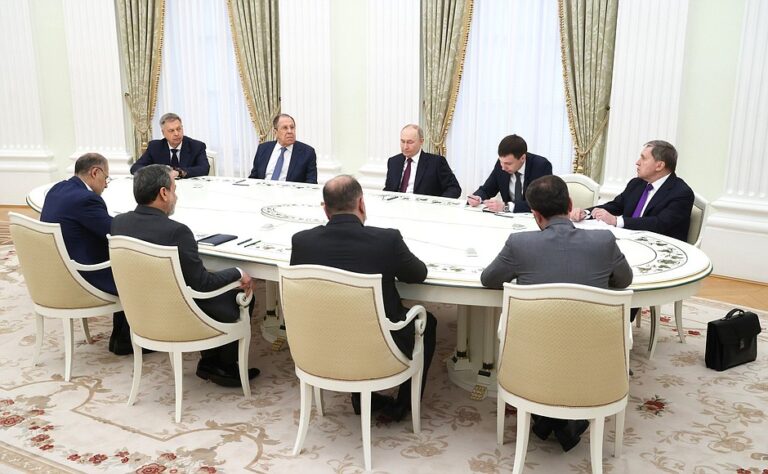
Speaking during a meeting in Moscow on Monday with Iranian Foreign Minister Abbas Araghchi, Russian President Vladimir Putin characterized the US attack on Iran as an “unprovoked aggression” in breach of international law, for which “there can be no justification.”
Middle East in Crisis – 5
By M. K. BHADRAKUMAR | Indian Punchline | June 23, 2025
The former President and Deputy Chairman of Russia’s Security Council Dmitry Medvedev who is one of the most authoritative voices at the Kremlin, wrote on the Telegram channel on June 23 a critique on the Middle East crisis following the US attack on Iran’s three key nuclear sites of Fordow, Natanz and Isfahan.
Medvedev listed ten points, which, taken together, messaged that Russia’s stance on the developing situation around Iran has markedly shifted to one of proactive mode marked by profound scepticism and deep concern about President Donald Trump’s intentions.
As recently as on June 4, Trump had sought Putin’s help to advance the US-Iran negotiations on the nuclear issue and Putin, in good faith, agreed to help. Indeed, the Iranian government spokesperson had disclosed on June 12 that preparations were under way for a visit by Putin to Tehran.
But on June 22, Trump ordered air strikes on Iran’s three nuclear sites without taking Putin into confidence. Such surreptitious behaviour may be nothing new to Washington in inter-state relations but it caused embarrassment to the Kremlin. Medvedev’s comments show it when he ridicules Trump’s triumphalism about the air strike.
The ten points Medvedev listed under the heading What did the Americans achieve with their night strike on three points in Iran? underscore that Russia’s stance on the developing situation around Iran has shifted to one of unequivocally distancing itself from the US approach going forward. The 10 points are:
- The critical infrastructure of the nuclear cycle, apparently, was not damaged or was damaged only slightly.
- The enrichment of nuclear materials, and now we can say directly – and future production of nuclear weapons — will continue.
- A number of countries are ready to directly supply Iran with their nuclear weapons.
- Israel is under attack, explosions are thundering, people are in a panic.
- The United States is drawn into a new conflict with the prospect of a ground operation.
- The political regime of Iran is preserved, and with a high degree of probability it has become stronger.
- The people are consolidating around the spiritual leadership, and even those who did not sympathize with him.
- Trump, who came as a peacemaker president, started a new war for the United States.
- The absolute majority of countries in the world are against the actions of Israel and the United States.
- With such success, Trump will never see the Nobel Peace Prize, even despite all the venality of this nomination. A good start, congratulations, Mr. President!
On the whole, Medvedev’s assessment is in sync with the swathe of opinion among neutral observers, including Western analysts, about the state of play. However, Points 2 and 3 stand out as particularly noteworthy in their prognosis that inexorably, Iran has now been pushed into a path of making a nuclear bomb and, more importantly, Tehran can expect help in this direction from “a number of countries (who) are ready to directly supply Iran with their nuclear weapons.”
This is the first time that Russia has explicitly spoken about Iran’s likely ‘nuclearisation’. That in itself is a paradigm shift. Medvedev has approvingly presented it in a marked departure from Russia’s stated affirmations in the past that Iran’s nuclear programme is for peaceful purposes. Russia has been historically a cornerstone of the nuclear non-proliferation regime.
Three things have changed. First, the US itself has become a proliferator. In Europe, the US’s allies freely fly its planes fitted with nuclear bombs during exercises. German pilots have familiarised themselves with such planes. In Asia-Pacific, AUKUS actually involves transfer of nuclear weapon technology to Australia which is technically an NPT member.
Second, when it comes to Iran, a key ally of Russia, the US aggression has crossed Iran’s “big red line” — to borrow the words of foreign minister Abbas Araghchi — which leaves Tehran with no alternative but to act in self-defence. Besides, in the ‘rules-based order’ imposed by the US on Iran, its ally Israel, a non-NPT member country, has a fully-developed clandestine nuclear weapon programme and is estimated to have a stockpile of some 200 nuclear missiles but all of that Trump blithely ignores.
Third, things have come to such a pass today that smaller countries must nuclearise in the quickest way possible, which is their only iron-clad guarantee to preserve their sovereignty and territorial integrity from the US in the chaotic international situation today. North Korea’s success in pushing back US pressure is due to its nuclear deterrent capability. What is absolutely galling is that Trump has not even cared to seek a mandate from the UN Security Council and has gone to war with Iran without getting the Congress’ approval.
Evidently, Medvedev’s commentary pooh-poohs the pious hopes in Washington and Tel Aviv about forcing a ‘regime change’ in Iran. Medvedev assertively proclaims that not only has Iran’s political system become stronger but “people are consolidating around the spiritual leadership” including elements that “did not sympathise with him” previously.
Russia shares the prevailing opinion in the world community that by embracing a military confrontation with Iran, Trump has added to the US’ growing isolation in the world community.
An intriguing point here is that in Medvedev’s prognosis, the US is being drawn into a new conflict abroad “with the prospect of a ground operation.” He didn’t explain how this may happen. Iran, which is almost the size of Europe, is a big country and has approximately 610,000 active duty personnel plus 350,000 reserve and trained personnel that can be mobilised when needed. Then, there is the Islamic Revolutionary Guard Corps (IRGC) which has approximately 125,000 personnel and a voluntary militia, Basj, under it with a further a further approximately 90,000 active personnel.
Even a limited US commando operation is fraught with high risk. The ballad of Operation Eagle Crew — undertaken in April 1980 in an attempt to rescue the US hostages — ended tragically. Of eight helicopters sent into Iran, two became disabled and a third was blown into a C-130 cargo plane by a fierce desert sandstorm, killing eight American servicemen whose bodies, left behind, were later paraded before Iranian television cameras. The Carter administration, humiliated by the failed mission and loss of life, expended great energy to have the bodies returned to the US. Trump is unlikely to risk such escapades.
In geopolitical terms, the seismic shift in the Kremlin thinking can be a game changer for Iran which must be regretting that it declined a Russian offer to include a provision for mutual security assistance in times of war in the two countries’ recently concluded treaty of strategic partnership, similar to what Russia has with DPRK. Also, Putin disclosed last week that Russia had offered to jointly develop an integrated air defence system jointly with Iran (that could access Russian satellite data) but Iran showed no interest. Curiously, he revealed that Tehran was yet to ask for any help, either!
That was on June 19. But on June 22 Trump struck and a terrible beauty was born. It appears that Khamenei ordered Araghchi who was busy parleying with Europeans to go East and meet Putin.
Anyway, at a meeting with Aragchi in the Kremlin today, Putin used exceptionally strong words to condemn the US attack on Iran which he called a “completely unprovoked act of aggression against Iran … without foundation or justification.”
Putin added, “Russia has long-standing, strong, and trustworthy relations with Iran, and we are committed to supporting the Iranian people through our continued efforts… Your visit provides us with an important opportunity to discuss these sensitive issues in depth and to explore ways we might work together to navigate the current situation.” (The Kremlin readout is here.)
Will Russia’s entry deter Trump on his warpath? That is the million dollar question in the coming days. If Trump persists with such belligerence in cahoots with Israel’s Benjamin Netanyahu, a protracted war of attrition will ensue that will most certainly bring in China at some point with which Iran has a strong mil-to-mil relationship.
21st of June, a day that will live in infamy
By Douglas Macgregor | June 23, 2025
On the 21st of June, a day that will live in infamy, President Trump led the American People to War with Iran. Trump’s message to Americans? Striking Iran’s three nuclear facilities is all that U.S. Forces will do. Unless, of course, the Iranians have the temerity to strike back. In that case Trump promises to destroy Iran. Ridiculous.
Washington has launched its own Pearl Harbor operation. U.S. Air and Naval Power executed rehearsed strikes against a few “critical” Iranian targets. Then, American Forces pulled back, ostensibly waiting for Tehran to capitulate much like the Japanese in December 1941. Trump’s mindset echoes Israel’s thinking when it attacked Iran last week, but Iran did not collapse after Israel’s surprise attack.
And Tehran won’t capitulate to Washington’s opening moves. Initial assessments of the strikes’ effectiveness suggest nothing of consequence was destroyed. The facilities? Devoid of people. Empty of centrifuges and enriched uranium. But the lack of damage? That’s not yet relevant. It’s a question no one in Washington cares to answer.
The world now waits for Iran’s response. Tehran’s leaders aren’t reckless or impetuous. Their counter-strike will be deliberate and likely decisive. And make no mistake, Iran will strike back. It will do so in ways Washington doesn’t expect.
Why? Tehran controls the political and moral high ground. Israel violated international law. A program of mass murder in Gaza. Backing the murderous ISIS-led regime in Syria. Killing Christians. Killing other minorities. Israel’s unprovoked attack on Iran. These are incontrovertible facts.
Escalation is inevitable, but Iran, not Washington, will control it. Remember the Houthis from Yemen and their war with Saudi Arabia? They struck Saudi oil fields. Repeatedly. Now, Iran has far greater reach. Far more ballistic missiles. Desalination plants. Across the Arabian Gulf are within striking distance of the Houthis. They are also within striking range of Iranian missiles. Millions depend on them for water.
Iran’s parliament just voted to close the Strait of Hormuz. Markets won’t react until Monday morning. But they will panic. Inevitably, oil prices will soar. The financial consequences for Americans? Eventually, devastating. Everyday, one out of every five barrels of oil flows through the Straits of Hormuz.
Washington spent six months bombing the Houthis. Then, Washington threw in the towel. Walking away from war with Iran won’t be so easy.
Russian Prime Minister Medvedev warned that many countries are now willing to transfer nuclear technology to Iran. Simple rule. Countries with nuclear weapons don’t get bombed. Look at North Korea. Countries without them? They get bombed. Iraq. Libya and, now, Iran prove it. This is the universal lesson for the world beyond America’s borders.
Iran’s parliament voted to close the Straits of Hormuz, but Tehran doesn’t need to formally close the Strait of Hormuz. Shipping companies will do it. If the risk of losing tankers is too great, the insurance companies will insist. The world’s oil supply will slow and the impact on industries that depend on petroleum products will be disastrous.
This is the real “battle damage assessment.” The consequences will be felt for decades. Trump just invited war to America. Now, Americans must prepare for it. Tens of millions of foreigners crossed our borders illegally between 2020 and 2025. Washington is foolish to ignore the high probability that Islamist terror sleeper cells are here. No doubt, the Drug Cartels will be happy to cooperate with them against American Law Enforcement.
Dietrich Bonhoeffer, a German Pastor who resisted Hitler’s regime and was eventually executed by the Nazis, said evil carries the germ of its own subversion. But against stupidity, Bonhoeffer warned the well-intentioned are always defenseless.
Bonhoeffer explained why: “Against stupidity we are defenseless. Neither protests nor the use of force accomplishes anything here; reasons fall on deaf ears; facts that contradict one’s prejudgment simply need not be believed – in such moments the stupid person even becomes critical – and when facts are irrefutable, they are just pushed aside as inconsequential, as incidental. In all this the stupid person, in contrast to the malicious one, is utterly self-satisfied and, being easily irritated, becomes dangerous by going on the attack.”
Washington’s ruling political class, not just President Trump, decided to unconditionally support Israel in its war against Iran. Going to war when and where Israel dictates and for reasons Israel decrees is stupid. It’s worse than stupid. It’s stupidity on stilts. Israel’s war for Jewish Supremacy in the Middle East will fail and Washington will now fail with it. The war against Iran will fail because the war is unjust and the world will ensure that it fails.
No justification for attack on Iran – Putin
RT | June 23, 2025
Israeli and US hostilities against Iran are groundless and unjustifiable, Russian President Vladimir Putin has told Iranian Foreign Minister Abbas Araghchi.
The top Iranian diplomat, who landed in Moscow and met with the Russian president on Monday, said earlier that the visit was needed for “closer, more precise, and more serious consultations” with Russia, in the wake of the US strikes on Iranian nuclear facilities.
During the meeting at the Kremlin, Putin described the attacks on Iran as “an unprovoked aggression,” for which “there can be no justification.”
The actions of Israel and the US are “illegitimate” and violate international norms, he added.
The Russian leader noted that he was glad to see Araghchi in Moscow, saying that his visit would allow Russia and Iran “to discuss these pressing issues and jointly think about a way out of the current situation.”
Araghchi agreed with Putin’s assessment, saying that “Russia today stands on the right side of history and international law.”
By striking targets in Israel, Iran is defending its sovereignty in a legitimate way, the diplomat stressed.
Israel and the US explained their attacks on Iran by claiming that Tehran was on the brink of obtaining a nuclear weapon. The Iranian authorities have repeatedly insisted that that they are not working on a bomb, while defending their right to pursue a peaceful nuclear program.
Seyed M. Marandi: America Attacks Iran – Retaliation is Coming
Glenn Diesen | June 22, 2025
Seyed Mohammad Marandi is a professor at Tehran University and a former advisor to Iran’s Nuclear Negotiation Team. Prof. Marandi discusses the US attack on Iran and why retaliation is unavoidable.
US Would Not Intervene If Israel Had Not Been on Brink of Defeat – Iranian Ex-Ambassador
Sputnik – 23.06.2025
The United States would not have intervened in the Middle East conflict if Israel had not been on the brink of defeat, former Iranian Ambassador to Germany Seyed Hossein Mousavian told RIA Novosti.
“Israel not only failed in its ten-day military operation against Iran but was on the verge of defeat. Had Israel not been in a crisis, the U.S. would not have intervened,” Mousavian said.
He pointed out that while Iran has suffered irreparable damage, the negative consequences of the US attack against it will also harm the United States and jeopardize regional peace and security.
“US President Donald Trump’s national security team either failed to properly assess the consequences of a U.S. military attack on Iran, or they were unable to dissuade the President—or perhaps the majority of them actually supported the decision. In any case, this event has further revealed the extent of Israeli Prime Minister Benjamin Netanyahu’s influence over the White House,” he added.
The United States struck three Iranian nuclear sites in Natanz, Fordow and Isfahan on Sunday night. US President Donald Trump said that the strike aimed at crippling Iran’s nuclear capabilities. He said Tehran must agree to “end this war” or face far more serious consequences.
Iran denies the military component of its nuclear project. As IAEA Director General Rafael Grossi said on June 18, the agency’s inspectors have not seen concrete evidence that Iran was pursuing a nuclear weapons program. The US intelligence community, contrary to statements by President Donald Trump and Israel, believed that Iran was not seeking to create nuclear weapons, as reported by CNN. Former British Ambassador to Uzbekistan Craig Murray told RIA Novosti that Iran had shown incredible patience and peacefulness over the past few years, despite Israel’s actions.
Col. Jacques Baud: America Bombs Iran’s Nuclear Facilities
Glenn Diesen | June 22, 2025
Colonel Jacques Baud is a former military intelligence analyst in the Swiss Army and the author of many books. Colonel Baud discusses America’s attack on Iran’s nuclear facilities and the deception surrounding this war of aggression. International law, treaties and institutions are all undermined in the effort to destroy Iran and restore American hegemony.
True Promise III: Iran launches multi-warhead Kheibar Shekan missile for first time
Press TV – June 22, 2025
Iran announced the first-ever launch of its multi-warhead Kheibar Shekan ballistic missile during the twentieth wave of Operation True Promise III in the early hours of Sunday.
In a statement, the public relations department of the Islamic Revolution Guards Corps (IRGC) said that this phase of the retaliatory operation marked the debut of the third-generation Kheibar Shekan ballistic missile, successfully striking its intended targets.
The twentieth wave came just hours after the United States claimed to have struck three Iranian nuclear facilities in Fordow, Natanz, and Isfahan.
According to the IRGC, a total of 40 solid- and liquid-fueled missiles were launched at strategic targets across the occupied Palestinian territories on Sunday.
“In this operation, for the first time, the IRGC Aerospace Force deployed the third-generation Kheibar Shekan multi-warhead ballistic missile, employing new and surprising tactics to achieve greater precision, destructive power, and effectiveness,” the statement said.
Main targets included Ben Gurion Airport in Tel Aviv, the regime’s biological research center, and alternative command-and-control sites.
The missiles employed maneuverable warheads capable of adjusting their trajectory during descent, maintaining guidance until impact, and delivering multiple high-explosive, highly destructive payloads.
Sirens reportedly went off only after the missiles scored direct hits, plunging the occupied territories into chaos, as witnessed in several previous waves of Operation True Promise III.
“We declare that the core capabilities of the Armed Forces of the Islamic Republic of Iran have yet to be activated in this sacred defense,” the IRGC statement concluded.
Iranian armed forces have carried out 20 phases of True Promise III so far, targeting strategic and sensitive military and intelligence sites in the occupied territories.
These operations are in response to the continued Israeli aggression that has claimed the lives of more than 400 Iranians since June 13, including military commanders, scientists, university professors, athletes, school students etc.
US Strikes on Iran Reckless Breach of Sovereignty – Russian Foreign Ministry
Sputnik – 22.06.2025
MOSCOW – The Russian Foreign Ministry condemned the US bombing of Iranian nuclear sites as a reckless move that violates the Islamic Republic’s sovereignty, international law and the UN Charter.
“The reckless decision to bomb the territory of a sovereign state, whatever the arguments, runs counter to international law, the UN Charter, the UN Security Council Resolution,” the ministry said.
It is of particular concern that the attack was carried out by a permanent member of the UN Security Council, the ministry said, adding that the UN’s core body had to interfere.
“The UN Security Council should naturally take action. Confrontational behavior of the US and Israel has to be rejected collectively,” the statement read.
“We call for an end of aggression and urge efforts that will create conditions for a return to a political and diplomatic path,” the statement said.
The ministry also called on Rafael Grossi, the head of the International Atomic Energy Agency, to report impartially on the Iran attacks at the UN atomic agency’s board of governors’ meeting on Monday.
‘The US Betrayed Diplomacy’ – Iran’s FM Araghchi
Sputnik – 22.06.2025
Iran will have to respond to US attacks against Iranian nuclear sites, and is going to do so for as long as needed, Iran’s Foreign Minister Abbas Araghchi said.
The United States have “betrayed diplomacy”, Araghchi said at a press conference held in Istanbul on June 22, adding that Iran now has the right to defend itself in accordance with the UN Charter.
“The US government bears full responsibility for the serious consequences of this aggression,” Araghchi said.
In the wake of the US strikes, Iran has fewer reasons to trust the West, Tehran no longer understands who it should negotiate with, he pointed out.
According Araghchi, Iran is receiving messages from the US through various channels, and if necessary, it will respond through intermediaries.
Iran now calls upon the International Atomic Energy Agency to fulfill its legal duties in response to the dangerous attack on our peaceful nuclear facilities, Araghchi stated.
The UN and the IAEA must respond to the clear violation of international law by the United States, he said, further insisting that the UN Security Council should hold an emergency meeting and condemn the US attack.
Araghchi also said that he is going to Moscow to have “serious consultations” with President Putin on Monday, June 23.
Clash of Two World Orders: Fordow Is the Excuse, Sovereignty the Target
By Peiman Salehi | Aletho News | June 22, 2025
Hours after U.S. President Donald Trump ordered a direct military strike on Iran’s Fordow nuclear facility, the world stands on the edge of a dangerous precipice. This unprecedented attack, occurring in the early hours of last night, marks a significant escalation in the confrontation between Washington and Tehran, and has once again ignited fears of a broader regional—if not global—conflict.
According to Iranian state media, the American attack targeted the entrance of the Fordow nuclear enrichment site, located tens of meters underground. Despite the dramatic nature of the strike, the damage appears to be minimal. Iranian officials have called the assault a “symbolic operation” with limited strategic impact. The Atomic Energy Organization of Iran is expected to issue a full technical statement, but preliminary reports indicate that key centrifuges had already been removed from the Fordow and Natanz sites prior to the attack. The Iranian government further emphasized that the deep-underground design of these facilities, the result of years of indigenous scientific expertise, had neutralized any attempt to deliver a crippling blow.
This act of aggression is not only a military miscalculation but a profound political one. The U.S. administration, under Trump’s leadership, appears to have lost its strategic bearings. By resorting to force, Washington has exposed its frustration and strategic deadlock. What this attack truly represents is a failure of diplomacy, a betrayal of international norms, and a dangerous gamble rooted in outdated imperial thinking. Trump, increasingly beholden to Israeli Prime Minister Benjamin Netanyahu, has allowed the Zionist regime’s narrow interests to dictate a course that risks global war. The world is now witnessing how the ambitions of a declining empire can drag the international system into chaos.
The media landscape surrounding the strike further reveals a coordinated attempt to shape the narrative. Western outlets, including CNN and Reuters, have underreported or dismissed Iran’s defensive capabilities and the limited damage incurred. In contrast, resistance-aligned media such as Al Mayadeen, Press TV, and Tasnim News have provided footage, satellite analysis, and expert interviews, revealing the superficial nature of the attack. Israeli media, which initially broadcast images from Tel Aviv and Haifa, has since restricted coverage, a move analysts interpret as an attempt to hide the psychological and infrastructural damage inflicted by previous Iranian missile strikes.
More crucially, this moment exposes the deeper ideological battle at play. Washington and Tel Aviv are not merely targeting Iran’s nuclear infrastructure—they are targeting the very notion of Iranian sovereignty, independence, and civilizational identity. For decades, the U.S. has tolerated or ignored nuclear weapons held by regimes like Israel, India, and others. Yet Iran, which has consistently emphasized the peaceful nature of its nuclear program and whose Supreme Leader has issued religious rulings against weapons of mass destruction, remains the subject of relentless pressure and threats.
This double standard reveals the real motive: not nonproliferation, but domination. Iran stands as a civilizational alternative to the liberal hegemony of the West, especially in the post-Cold War era. Its resistance model has inspired popular movements across West Asia and beyond. And today, despite the brutality of sanctions, sabotage, and assassination campaigns, Iran remains defiant—stronger, more resilient, and more unified.
Indeed, one of the unintended consequences of the American-Israeli aggression is the strengthening of Iran’s internal unity. Where once some questioned Iran’s regional alliances, now many recognize their strategic depth. It is clear why Iran built partnerships with Hezbollah, the Popular Mobilization Forces in Iraq, and other resistance groups: to keep the battle outside its borders and to prepare for precisely this moment. Iran has yet to request support from these allies, has not activated its naval forces in the Strait of Hormuz, and has not called on China, Russia, or Pakistan for direct intervention. Yet all these options remain on the table. This calculated restraint underscores Iran’s confidence and its desire to prove that it can confront Israel independently.
However, should the U.S. persist in its aggression, it is likely that Iran’s allies will respond. A wider conflict could pull in China and Russia, both of whom have signaled support for Iran’s right to defend itself. Pakistan has openly declared that it will not stand idly by if Iran is attacked. What we are witnessing may very well be the beginning of a war that accelerates the decline of American unipolarity and ushers in a truly multipolar world.
This is not merely a battle between two states; it is a confrontation between two visions of world order. One rooted in hegemony and coercion. The other, in resistance, dignity, and sovereignty. And tonight, from the heart of Tehran, the voice of that resistance is being heard loud and clear.
Perception vs reality: What the Israel–Iran war actually reveals
Myth-making as strategy
By Shivan Mahendrarajah | The Cradle | June 21, 2025
Since 13 June, “Operation Rising Lion” has dominated headlines, framed by a deluge of western media portraying Iran as days from building a nuclear bomb. In response, Israel unleashed waves of airstrikes on Iranian territory, targeting military, nuclear, and civilian infrastructure. Israeli Prime Minister Benjamin Netanyahu likened it to the 1981 bombing of Iraq’s Osirak reactor – a strike of necessity to prevent annihilation.
But beneath the familiar tropes of “pre-emptive defense” lies an unmistakable imperial calculus. Over 200 Israeli aircraft participated in the opening barrage, with deep-penetration strikes and cyber warfare. Iranian air defense and radar installations were among the first to be hit. Mossad and allied forces used proxy agents to ignite internal sabotage, including drone and car bomb attacks in major cities.
This was not a “surgical strike” to stop a bomb. It was a declaration of war – a bid to decapitate the Islamic Republic.
Iran: Weak ‘regime’ or resilient state?
Western assessments insist Iran is tottering: its economy hollowed out by sanctions, its population seething, its leadership fractured. But these are fantasies. What has emerged since Israel’s 13 June assault is not a ‘regime’ in collapse, but a state adapting under fire – around which the majority of Iranians, irrespective of political affiliations, have united.
Contrary to the western narrative, the strikes that eliminated senior Islamic Revolutionary Guard Corps (IRGC) commanders and nuclear scientists barely dented Iran’s strategic posture. Within hours, Iran’s Supreme Leader Ayatollah Ali Khamenei reaffirmed Artesh (conventional military) control over national defense, elevating new commanders and activating pre-planned strike protocols. This signaled a transfer of initiative from cautious IRGC veterans – many shaped by the traumas of the 1980–1988 war with Iraq – to a more hawkish generation, willing to directly strike Israel.
Iran’s retaliatory attacks on 13, 14, and 15 June – the third instalment of Operation True Promise – struck Tel Aviv, Haifa, and three Israeli military bases. Online observers admired how quickly the Iranian military pivoted to war footing despite the assassination of high-ranking officers. One noted:
“I don’t think the American or Israeli military could have taken the losses of so many senior commanders and still struck back.”
Did Israel achieve air superiority?
Initial reports claimed Israeli dominance of Iranian airspace, based largely on footage of Israeli jets evading response and striking decoy targets. Yet after a 12-hour “silence,” Iranian air defense (AD) systems re-engaged with full force. The delay has been interpreted as either the effect of cyber warfare or a deliberate “rope-a-dope” strategy: feign weakness, draw in the enemy, make him over-confident, counterstrike.
Iran lost facilities it expected to lose, such as the outdated IR-1 centrifuges at Natanz. Underground sites with IR-6 [SM1] centrifuges at Fordow were unaffected. Mobile and fixed AD units resumed operations by nightfall, and there are unconfirmed reports of Israeli aircraft downed in later attempts to breach Iranian skies.
Israeli media touted “air superiority,” but most confirmed strikes targeted decoys. As military analyst Mike Mihajlovic explained, “more than three-quarters of the videos circulating are actually hits on the decoys.”
The illusion of dominance, broadcast by Tel Aviv, is cracking.
War by terror
Unable to sustain large-scale aerial assaults, Israel shifted tactics. Standoff missile strikes from Iraqi airspace waned. Instead, Mossad and its internal assets launched FPV drone attacks, car bombings, and anti-tank guided missile strikes. Five car bombs exploded in Tehran on 15 June alone. Civilian sites – hospitals, dormitories, and residential buildings – were hit.
These are not military operations. They are acts of terror. Still, the west echoes Tel Aviv’s narrative. The BBC and others describe these incidents as “strikes,” implying aerial precision, rather than the car bombings they are. This deliberate linguistic obfuscation dehumanizes Iranians while sanitizing Israeli aggression. Yet, this has galvanized Iranians and united them.
National unity reforged
Much like the late Iraqi President Saddam Hussein’s 1980 invasion, Tel Aviv misread Iran’s internal contradictions as signs of collapse. Yet from 13 June onward, Iranians from across the political spectrum – including long-time dissidents – have rallied behind the state.
Political analyst Sadegh Zibakalam questioned:
“Which opposition figure has spoken and written as much as I have against this regime? But how can I join the enemy in this situation? Was it right for the MEK to join Saddam?”
Former political prisoner Ali Gholizadeh added, “Despite all my criticisms of the government, I stand fully behind the commander-in-chief of the Iranian Defense Forces and [Armed] Forces in defending the homeland.”
Even reformist voices, once critical of Iran’s nuclear policy, now demand a bomb. Journalist and editor Ali Nazary says, “Iran must acquire a nuclear bomb as soon as possible. Conducting a nuclear test is the biggest deterrent.”
On Iranian social media, images of civilians killed in Israeli attacks have gone viral. As of 15 June, 224 Iranians – 90 percent civilians – were reported killed, with over 1,200 injured.
Crumbling illusions
The occupation state claims it destroyed 120 missile launchers and 200 AD units. But Iranian units continue to fire in visible clusters – indicating low attrition and high confidence. Independent analysts mock Israeli claims as propaganda. Patarames, a known military observer, posted:
“IRGC missile crews still feel so confident and safe that their launchers are firing in clusters. So much for Israeli air superiority.”
In truth, Israeli AD systems are being degraded. Iranian missiles increasingly strike with little interception. The myth of omnipotent Israeli defense is unraveling.
Meanwhile, Tehran may be preparing its exit from the Nuclear Non-Proliferation Treaty (NPT) – according to a statement made by Iranian Foreign Ministry spokesman Esmail Baghaei – and expelling International Atomic Energy Agency (IAEA) monitors. Parliament is fast-tracking bills. Crowds chant for a nuclear test. The west’s double standards on Israel’s arsenal and Tehran’s right to self-defense are fueling a shift in national strategy.
Global reactions: Hypocrisy laid bare
Washington’s rhetoric mirrors past duplicity. US President Donald Trump – who unilaterally withdrew from the Joint Comprehensive Plan of Action (JCPOA) during his first term – posted on X triumphantly:
“I gave Iran 60 days to make a deal. Israel attacked on day 61.”
G7 governments mumble about de-escalation, but offer no condemnation of Israeli aggression. The so-called “rules-based order” is silent as civilians die.
Iranians are not surprised. In 2001, they condemned the 11 September attacks and supported the US so-called War on Terror. Today, they watch the same west excuse terrorism against them. Trust is gone. Nationalism is surging.
Israel’s strategic gamble is backfiring. Hamas remains entrenched in Gaza and is targeting occupation soldiers in greater numbers. Hezbollah watches closely. Yemen’s Ansarallah-aligned armed forces are coordinating with Tehran. If Iraq’s resistance factions activate, US forces could be drawn in.
Meanwhile, Tel Aviv’s own population is rattled. Social media posts from Israelis hiding in bunkers – “they’re turning us into Gaza” – reflect growing fear. The psychological war, waged by Iran, is winning.
Across the Global South, sympathy lies with Tehran. As Australian journalist Caitlin Johnstone put it:
“Imagine being so evil and reviled that people love watching you get hit.”
A war of narratives and attrition
“Operation Rising Lion” was meant to decapitate Iran, destroy its nuclear program, and shatter its morale. Instead, it has united a fragmented polity, discredited western media, and exposed the hollowness of Israeli deterrence.
Iran’s leadership has hardened. Its people are defiant. Its enemies are scrambling to control the story.
This is not just a war of missiles. It is a war of narratives, sovereignty, and historical memory. The Axis of Resistance understands this. Tel Aviv, it seems, does not.
The Persian lion is not in a good mood.
Featured Video

Alon Mizrahi: ‘Israel Must Be Dismantled’
or go to
Aletho News Archives – Video-Images
From the Archives
How a War with Iran Would Diminish American Power
By Greg Scoblete | The Compass | August 13, 2010
Jennifer Rubin wants a war with Iran:
But the emphasis on the existential threat to Israel ignores a more basic issue for Americans to ponder: a nuclear-armed Iran represents a dagger at the heart of America and an existential threat to our status as a superpower and guarantor of the West’s security. As to the former, Iran is pressing ahead with its long-range ballistic missile program. First the Middle East and Eastern Europe, then all of Europe and, within a matter of years, the U.S. will be within range of Iranian missiles. If those are nuclear and not conventional, what then? We’re not talking about whether Iran is going to be “merely” a destabilizing factor in the Middle East or whether it will set off an arms race with its neighbors or imperil Israel’s existence. We’re talking about whether America will then be at risk (and lacking sufficient missile-defense capabilities if we continue to hack away at our defense budget). The argument about whether mutual assured destruction can really work against Islamic fundamentalists who have an apocalyptic vision becomes not about Israel’s ability to deter an attack but about ours. Those who oppose American military action have an obligation to explain why America should place itself in that predicament.
I would argue that any obligation to present an explanation lies with those whose disastrous policy prescriptions with respect to Iraq lead America into the worst strategic blunder in the country’s recent history. That aside, note the blind faith in the power of the military to actually achieve its ends. … continue
Blog Roll
 Aletho News
- Alon Mizrahi: ‘Israel Must Be Dismantled’
- Former Head Of MI6 Admits That The U.S. And Israel Are Losing The Iran War
- Scattered Thoughts on War and Peace
- Iran Threatens to Close Red Sea to Shipping in Response to Invasion
- Iran in excellent position to prevail in war with US, Israel: John Mearsheimer
- Iran warns US: Do not call your retreat an agreement
- Neighbors first – Moscow signals shift in energy strategy
- Almost 400 Ukrainian drones downed over Russia in single night – MOD
- Battle for Hungary: How the Russiagate blueprint has been unleashed against Orban
- Brussels warns Slovakia over ‘discriminatory’ dual fuel pricing targeting foreign drivers
- If Americans Knew
- In the West Bank, life is a constant battle – 3 articles
- Jacob Reses, one of the most powerful pro-Israel operatives in Trump’s Washington
- Israeli-US assaults kill or injure 87 children a day – Not a ceasefire Day 166
- ‘Forever live by the sword’: Understanding Israelis’ massive support for Iran war
- UN’s special rapporteur on human rights says Israel is systematically torturing Palestinians
- Trump White House plagiarized Iran war manifesto from Israel-aligned think tank
- Gaza says 6–10 patients die daily waiting for treatment abroad as Israel blocks medical evacuations
- ‘Substantial evidence’ of double-tap strike in killing of Gaza’s Hind Rajab
- ‘Do Not Want To Die For Israel’: Doubts About Trump’s Iran Strategy Spread Among Troops
- Instead of taking Joe Kent’s claims seriously, the media is disregarding him as an antisemite
- No Tricks Zone
- Devastating Assessment Of Comirnaty Vaccine By Former Senior Pfizer Europe Toxicologist
- New Study: CO2 Is ‘Effectively Negligible’ As An Explanatory Climate Change Factor Since 2000
- Former Pfizer Toxicologist Dr. Helmut Sterz Tells Bundestag Hearing Pfizer Vaccine Should Have Never Been Approved
- Energy Expert: Germany’s Nuclear Phaseout Was A “500 Billion Euro Mistake”
- New Research: South Australia’s Mid-Holocene Sea Surface Temperatures Were 4°C Warmer Than Today
- Storing Green Energy To Last Germany 10 Days Would Require A 60-Million Tonne Battery
- New Studies: UK Sea Levels Were 4 Meters Higher Than Today During The Mid-Holocene
- Destructive Green New Deal: German Energy And Metal Group Warns Of Drastic Crisis
- New Study Documents A 20-Year Pause In Arctic Sea Ice Decline – Driven By Internal Variability
- Wake-up Call: Survey Shows Majority Of Germans Now Favor Postponing Climate Targets!
 Aletho News