Investigation Into U.S. Military Bioweapons-Origin of Tick-Borne Lyme Disease Successfully Added to 2026 NDAA
By Jon Fleetwood | December 12, 2025
U.S. Representative Chris Smith (R-NJ) has successfully included his amendment to investigate whether the U.S. military weaponized ticks with Lyme disease into the 2026 National Defense Authorization Act (NDAA).
The ordeal underscores the national security threat posed by laboratory pathogen manipulation.
Rep. Smith, who is Co-Chair of the Congressional Lyme and Tick-Borne Disease Caucus, had offered similar amendments—one in 2019 and the other in 2021—which passed the House, but failed in the Senate.
The successful addition of the amendment follows FDA Chief Dr. Marty Makary’s statements during a November podcast, in which Makary expressed his belief that Lyme disease was created in U.S. military Lab 257 on Plum Island, New York.
A Thursday press release from Smith’s office reads:
A critical amendment authored by Rep. Chris Smith (R-NJ) to investigate whether the U.S. military weaponized ticks with Lyme disease has been included in the National Defense Authorization Act for Fiscal Year 2026 (FY26 NDAA) (S. 1071), which has cleared the U.S. House of Representatives, headed to the Senate, and is expected to be signed by President Trump upon its final passage.
Smith’s amendment—now Sec. 1068 of the bill—directs the Government Accountability Office (GAO)—the Congressional “watchdog”—to investigate the Cold War-era Department of Defense (Department of War) bioweapons program and determine whether they ever used ticks as hosts or delivery mechanisms for biological warfare agents.
In the press release, Smith emphasized that “New Jersey has one of the highest Lyme rates in the United States—the disease is present in all 21 counties.”
“The pervasive presence of Lyme disease in New Jersey not only carries concerns for civilians, but also for the military personnel stationed in the state—especially and including those serving at Joint Base McGuire-Dix-Lakehurst, part of which is located within my congressional district,” the republican added.
The press release explained that Smith’s amendments were inspired by Kris Newby’s book, Bitten: The Secret History of Lyme Disease and Biological Weapons.
The book includes interviews with Dr. Willy Burgdorfer, the federal researcher and U.S. bioweapons specialist credited with discovering Lyme disease.
Dr. Burgdorfer has revealed that “he and other bio-weapons specialists injected ticks with pathogens in order to cause severe disability, disease, and even death to potential enemies in unsuspecting ways.”
Smith’s amendment in the NDAA would compel the Comptroller General of the United States “to conduct an exhaustive review of research conducted by the military, the National Institutes of Health (NIH), the U.S. Department of Agriculture (USDA), and other federal agencies between the period of January 1, 1945 and December 31, 1972, regarding experiments involving Spirochaetales and Rickettsiales—two forms of tick-borne bacteria.”
Smith says we are now “one step closer to finally determining whether the U.S. government’s bioweapons program contributed to the proliferation of Lyme disease.”
“The hundreds of thousands of New Jerseyans suffering from Lyme disease—in addition to the millions across the United States—deserve to know the truth about the origins of their illness. An enhanced understanding of how Lyme came to be will only assist in finding a cure for this debilitating disease,” said Smith.
Rep. Smith’s amendment reads:
SEC. 1068. GAO REVIEW AND REPORT ON BIOLOGICAL WEAPONS EXPERIMENTS ON AND IN RELATION TO TICKS, TICK-BORNE DISEASE.
(a) REVIEW.— The Comptroller General of the United States shall, to the extent practicable, conduct a review of research conducted during the period beginning on January 1, 1945, and ending on December 31, 1972, by the Department of Defense, including by the Department of Defense in consultation with the National Institutes of Health, the Department of Agriculture, or any other Federal department or agency on—
(1) the use of ticks as hosts or delivery mechanisms for biological warfare agents, including experiments involving Spirochaetales or Rickettsiales; and
(2) any efforts to improve the effectiveness and viability of Spirochaetales or Rickettsiales as biological weapons through combination with other diseases or viruses.
(b) LOCATION OF RESEARCH.— In conducting the review under subsection (a), the Comptroller General shall review research conducted at facilities located inside the United States and, if feasible, facilities located outside the United States, including laboratories and field work locations.
(c) INFORMATION TO BE REVIEWED.—
(1) CLASSIFIED INFORMATION.— In conducting the review under subsection (a), the Comptroller General shall review any relevant classified information.
(2) MATTERS FOR REVIEW.— In conducting the review under subsection (a), the Comptroller General shall review, among other sources, the following:
(A) Technical Reports related to The Summary of Major Events and Problems, US Army Chemical Corps, FY 1951–FY 1969.
(B) Site Holding: CB DT DW 48158
Title: Virus and Rickettsia Waste Disposal Study.
Technical Report No. 103, January 1969.
Corp Author Name: Fort Detrick, Frederick, MD.
Report Number: SMUFD-TR-103.
Publish Date: 1969-01-01.(C) Site Holding: CB DT DW 60538
Title: A Plaque Assay System for Several Species of Rickettsia.
Corp Author Name: Fort Detrick, Frederick, MD.
Report Number: SMUFD-TM-538.
Publish Date: 1969-06-01.(D) Site Holding: CB DW 531493
Title: Progress Report for Ecology and Epidemiology and Biological Field Test Technology, Third Quarter FY 1967.
Corp Author Name: Army Dugway Proving Ground, UT.
Publish Date: 1967-05-08.(E) Any relevant scientific research on the history of Lyme disease in the United States.
(d) REPORT.—
(1) IN GENERAL.— Not later than two years after the date of the enactment of this Act, the Comptroller General shall submit to the Committees on Armed Services of the House of Representatives or the Senate a report that includes the following:
(A) A list of the research projects reviewed under subsection (a) and an assessment of the scope of such research.
(B) A finding by the Comptroller General as to whether such review could lead to a determination that any ticks used in such research were released outside of any facility (including any ticks that were released unintentionally).
(C) A finding by the Comptroller General as to whether such review could lead to a determination that any records related to such research were destroyed, and whether such destruction was intentional or unintentional.
(2) FORM OF REPORT.— The report required under paragraph (1) shall be submitted in unclassified form, but may contain a classified annex.
If the GAO does its job and follows the paper trail where it leads, this amendment may finally force the U.S. government to answer a question it has avoided for decades: whether a taxpayer-funded Cold War bioweapons program left millions of Americans paying the price with their health.
The Great European Asset Heist Will Fail
By Leanna Yavelskaya | Ron Paul Institute | December 12, 2025
Let’s stop pretending Brussels is engaged in noble statecraft. The EU’s rush to steal more than €180 billion in frozen Russian sovereign assets held at Euroclear is the most reckless gamble Europe has taken in decades. Moscow’s central bank is not wrong to call the move unlawful; its lawsuit against Euroclear merely underscores a simple truth: weaponizing sovereign reserves violates long-standing norms that have protected global capital flows for half a century. Brussels may dress this up as “solidarity with Ukraine,” but using immobilized reserves as collateral for massive loans crosses a line that Western institutions once treated as sacrosanct.
The political sales pitch — that these are merely Russia’s “war chest” — deliberately ignores an uncomfortable reality: sovereign reserves ultimately underpin a nation’s entire economy, including its citizens’ savings and pensions. Seizing or leveraging them sets a dangerous precedent: any country deemed objectionable by a majority of EU governments could one day see its wealth confiscated. That is not rule-of-law liberalism; it is discretionary power cloaked in humanitarian rhetoric.
Euroclear, one of Europe’s critical financial arteries, now finds itself caught between Brussels’ political ambitions and Moscow’s threats of counterclaims. Belgium knows the danger intimately — its own officials have repeatedly warned that breaching sovereign-immunity doctrines could expose the country to massive liabilities. When even EU member states start raising alarms, you know the legal ground is shaky.
What is truly astonishing is the European Commission’s refusal to confront the broader consequences. Financial systems run on trust, not idealistic speeches. Undermine the principle that sovereign reserves are untouchable, and investors everywhere — not just in Moscow — take note. China, which holds substantial euro-denominated assets, has already condemned the EU’s approach as destabilizing. Beijing may not dump its euro holdings tomorrow, but the EU is actively encouraging major powers to question Europe’s reliability as a financial partner. That alone should alarm anyone who cares about the euro’s long-term viability.
The internal politics are equally explosive. Hungary, Slovakia, and even Belgium itself have raised serious objections on both legal and risk grounds. If Brussels forces the plan through regardless, it will only strengthen the already potent narrative in several member states that the EU is willing to trample national interests and established law in pursuit of ideological crusades. This is the kind of overreach populists dream of — an elite-driven project that can be portrayed, not entirely unfairly, as prioritizing geopolitical theater over the economic security of European citizens.
Then there is the Ukraine question itself. For many Europeans, supporting Kiev is neither a moral nor a strategic imperative. Ukraine’s deep governance problems are real and have been acknowledged by its own officials and Western auditors alike. Pouring unprecedented sums into the country without ironclad safeguards invites legitimate criticism that Brussels is acting on emotion rather than sober judgment.
Meanwhile, across the Atlantic, Washington has every incentive to watch Europe stumble. If investors lose confidence in the euro, the dollar benefits. If European financial institutions face turmoil, American ones expand their reach.
Europe could still choose a wiser path. Instead of prolonging an unsustainable conflict by stealing sovereign Russian assets — a move that virtually guarantees escalation and risks spilling the war into the Eurozone itself, with unimaginable and utterly destructive consequences — European leaders could support genuine peace efforts.
The EU cannot afford to make the wrong choice. Yet that is precisely what it is doing, and for nothing more than short-term political posturing.
Trump’s Peace Push is Attempt to Save Ukraine From Total Military and Political Collapse: Observer
Sputnik – 11.12.2025
The current moment “is critical for Ukraine as Zelensky’s regime is coming closer to collapse both politically and on the frontline, where Russia is advancing on all fronts,” Armando Mema, a member of the Finnish Freedom Alliance party, told Sputnik.
While Trump inherited the Ukraine mess from Biden, who “provoked this conflict and created this disaster,” he’s trying to prevent “a total defeat of Ukraine” because “it would be a disaster for his administration too,” Mema explained.
But Zelensky “is not interested in peace,” as seen in his recent demands for “security guarantees similar to Article 5 of NATO, [which] he knows… he cannot get,” the observer said.
Knowing that’s impossible, “he uses as an excuse to continue to be in power despite his mandate [ending]. Zelensky has banned all political opposition parties in Ukraine, arrested opponents, including regular citizens who were simply advocating for peace. Zelensky knows that if a regular election were to be held, he will lose immediately and all his administration will be prosecuted for corruption,” Mema emphasized.
As for reports of a US-mediated push to restore Russia’s access to Europe’s energy markets, Mema predicts this will remain “impossible” to achieve as long as the current crop of leaders are in charge.
“But Trump has started to dismantle the EU leadership (Macron, Merz, Ursula, Meloni and so on)” and over time they will be replaced by leaders who take account of their own countries’ interests, the Finnish politician believes.
Putin aide responds to Zelensky call for referendum on Donbass
RT | December 12, 2025
Donbass is sovereign Russian territory and Moscow will sooner or later establish control over parts of the region still occupied by Ukraine, Russian presidential aide Yury Ushakov has said. His comments came after Ukraine’s Vladimir Zelensky indicated the country may hold a referendum on territorial concessions to Moscow.
On Thursday, Zelensky – who has consistently refused to recognize former Ukrainian regions as part of Russia – suggested that Ukrainians could vote in a referendum or election on the Donbass issue. The region overwhelmingly voted to join Russia in 2022 in referendums.
Speaking to Kommersant business daily on Friday, Ushakov stressed that “whatever happens, this [Donbass] is Russian territory, and it will be under the control of our administrations, sooner or later.” He noted that Zelensky has so far opposed the withdrawal of Ukrainian troops from the region, despite this being among the US proposals for peace.
According to Ushakov, Moscow will establish full control over the region either through negotiations or military force, and any ceasefire with Ukraine can only be possible once Kiev’s troops withdraw.
“I think what happens afterward can be discussed later. Because it is quite possible that there will be no regular troops there – neither Russian nor Ukrainian,” he acknowledged, adding that public order would be maintained by Russian law enforcement.
The shift in Zelensky’s tone came amid US President Donald Trump’s efforts to mediate the end of the conflict. The US president has suggested that the Ukrainian leader is one of the key stumbling blocks towards peace, while urging him to hold a presidential election.
Zelensky – whose term expired more than a year ago – did not reject the call, but demanded Western security guarantees for any vote to take place. Ushakov suggested that Zelensky could be using the election narrative as a pretext for a ceasefire. Moscow has said a truce would only be beneficial for Ukraine, as it would allow it to patch up its battered forces.
Meanwhile, Russian troops have been making steady gains in Donbass, recently liberating the key stronghold of Seversk, which opens the way to the regional cities of Kramatorsk and Slavyansk.
Zelensky’s Impossible Demands a Roadblock to Peace
By Ekaterina Blinova – Sputnik – 12.12.2025
Volodymyr Zelensky is deliberately setting conditions Russia can’t accept to portray it as blocking peace talks, Bogdan Bezpalko, a member of the Council for Interethnic Relations under the President of the Russian Federation, tells Sputnik.
The head of the Kiev regime is also seeking a much-needed breather for his retreating forces.
“In reality, this is Zelensky’s attempt either to buy time or, essentially, to stall the entire process,” Bezpalko explains.
Before his Saturday meeting with French, German and British leaders, Zelensky claimed a ceasefire along the current front line, security guarantees for future elections and a referendum on ceding territory to Russia were needed.
What’s Behind Zelensky’s Ploy?
- The situation for the Ukrainian forces is dire: They are retreating and losing cities, which hits civilian morale and foreign support
- Zelensky wants to halt the Russian advance to regroup Ukrainian forces, conscript more troops, get extra Western arms and even seize frozen Russian assets
- But he also wants to look like a leader ready for peace talks
Why Zelensky’s Conditions are a Non-Starter
Zelensky says he is ready to hold elections and a referendum – but demands that the US and NATO guarantee security. That would effectively mean Ukraine losing its independence, Russian Foreign Ministry spokesperson Maria Zakharova said.
Russia sees no point in freezing the conflict until its demand for a full withdrawal of Ukrainian forces from Donbass and other new Russian territories is met
Why Europe is Still Backing Zelensky
- European leaders still want war with Russia, but they lack forces beyond their Ukrainian proxies, financial resources and guaranteed backing from the US
- Like Zelensky, they aim to prolong the talks and wait out President Donald Trump—until the mid-term congressional elections or he leaves office
“They are currently in a deadlock,” Bezpalko says.
Trump’s National Security Strategy: Rethinking US Policy on Europe and Russia-Ukraine
By Abbas Hashemite – New Eastern Outlook – December 12, 2025
The new 33-page National Security Strategy document issued by the US government endorses Russia’s stance on Ukraine, rejecting aggressive European policies.
Trump’s Divergence from European Policies on Russia-Ukraine
Since assuming the presidency for a second non-consecutive term, US President Donald Trump has diverged from the European view on the Russia-Ukraine conflict. President Trump has been highly critical of the European Union and NATO allies of the United States over their controversial policies. The new 33-page National Security Strategy (NSS) announced by the incumbent US government has once again validated the Russian stance over this conflict and has unambiguously rebuffed the European aggressive and violent designs regarding the ongoing Russia-Ukraine conflict.
This latest security strategy document acknowledged that the European Union is responsible for prolonging the ongoing conflict between Russia and Ukraine. The document also condemned the unrealistic expectations of the European officials from this violent conflict, costing hosts of lives on both sides. The US government blamed the EU for blocking several US efforts to end this conflict, stating that the United States has a “core interest” in ending the ongoing Russia-Ukraine conflict.
Furthermore, the document also accuses the European governments of “subversion of democratic processes” as they remain unresponsive to the desires of their people for establishing peace between Russia and Ukraine. As per the NSS document, it is one of the top priorities of the United States to “re-establish strategic stability with Russia,” which would help stabilize European economies. This new security strategy document is widely seen as the re-evaluation of the US policy towards its European allies.
The Alaska Summit and Peace Negotiations
President Trump has long been critical of European policies. During his election campaigns, he repeatedly claimed that he could end the Russia-Ukraine conflict within a day. After assuming the presidential office in January 2025, he engaged with the Russian President Vladimir Putin to establish peace between Russia and Ukraine. The positive engagement between the two leaders led to a summit between them in Alaska in August 2025. After the summit, US President Donald Trump praised President Putin’s positive attitude towards peace negotiations. He also described President Putin’s observations about the conflict as “profound.”
After the summit between the two leaders in Alaska, President Trump stated, “Many points were agreed to. There are just a very few that are left. Some are not that significant. One is probably the most significant, but we have a very good chance of getting there.” He further stated that he would talk to Zelenskyy and NATO regarding the discussions in the summit, adding that “It’s ultimately up to them.” However, after consulting with the NATO allies, President Trump realised that the European Union has ulterior motives behind procrastinating this violent conflict between Russia and Ukraine.
The European and Ukrainian demand to deploy a NATO-like combined EU force in Ukraine to ensure the latter’s security derailed these peace negotiations. In the past, the European leaders repeatedly thwarted all the peace efforts between Russia and Ukraine to achieve their covert regional strategic interests and to undermine Russian security and sovereignty. The NSS also criticised Europe over “censorship of free speech and suppression of political opposition.” It further claimed that Europe is confronting the “prospect of civilizational erasure” due to “failed focus on regulatory suffocation” and migration policies. The document also claimed that Europe will be “unrecognisable in 20 years or less” due to its economic issues. The NSS further read, “It is far from obvious whether certain European countries will have economies and militaries strong enough to remain reliable allies.”
Implications of the New National Security Strategy
Indeed, the European powers, particularly NATO countries, are heavily reliant on US military power for their survival and security. For years, President Trump has been urging the European nations to pay their fair share in the alliance. However, the European leaders are unable to address US concerns due to the economic issues of their countries. In this new NSS document, the United States has threatened to withdraw its security umbrella from the European nations. It states that the US would prioritise “enabling Europe to stand on its own feet and operate as a group of aligned sovereign nations, including by taking primary responsibility for its own defence, without being dominated by any adversarial power.”
This re-evaluation of the US policies towards Europe and the Russia-Ukraine conflict has astonished many European leaders. Nonetheless, the United States’ new security policy on the Russia-Ukraine conflict has been widely regarded as commendable. European nations and the broader Western world must address Russia’s security concerns to ensure peace and stability between Russia and Ukraine. Dmitry Peskov, spokesperson for the Kremlin, expressed support for the Trump administration’s newly unveiled security strategy. He stated, “The adjustments that we see correspond in many ways to our vision.” He also encouraged the US to pledge to end “the perception, and prevent the reality, of the NATO military alliance as a perpetually expanding alliance.”
However, he also cautioned that the US ‘deep state’ views the world differently from President Trump. Indeed, the Trump administration’s new National Security Strategy document is based on realistic assumptions. However, the mighty US deep state would never allow him to undermine or challenge the long-established status quo in the country. The European Union and Israel have significant influence over the US deep state. Therefore, it would be hard for the Trump administration to diverge from the prior US stance over its alignment with Europe and Israel over the Russia-Ukraine conflict or the Middle East.
Аbbas Hashemite is a political observer and research analyst for regional and global geopolitical issues. He is currently working as an independent researcher and journalist
What’s on Trump’s mind as US adjusts to multipolarity
By M. K. BHADRAKUMAR | Indian Punchline | December 12, 2025
The world order’s transformation to multipolarity is a work in progress with the variables at work, but its outcome will be largely determined by the alignment of the three big powers — the United States, Russia and China. Historically, the ‘triangle’ appeared as the lid came off the Sino-Soviet schism in the 1960s and a ferocious public acrimony erupted between Moscow and Beijing, which prompted the Nixon administration to moot Henry Kissinger’s secret mission to Beijing to meet up face to face with Chairman Mao Zedong and Premier Zhou En-lai and, hopefully, work out a modus vivendii to jointly counter Russia.
Revisiting the Sino-Soviet schism, it is well understood by now that the US-Soviet – China triangle never really ran the course that Kissinger had envisaged. Kissinger’s failure to consolidate the opening of relations with China was partly due to his loss of power by January 1977 and, in a systemic sense, inevitably so, given the complexity of the boiling cauldron of Sino-Soviet schism where ideology mixed with politics and geopolitics — and realpolitik.
While the western mythology was that the US built up the foundations of China’s rise, historiography points in another direction, namely, that Beijing always had in mind the dialectics at work and even as a degree of compatibility of Chinese and American interests in checking the expansion of Soviet power existed, Beijing was determined to avoid military conflict with the Soviet Union and concentrated its attention on improving its tactical position within the US-Chinese-Soviet triangle.
On its part, the Soviet Union also consistently promoted increased exchanges with China despite the bitter acrimony and even military clashes with a view to undercut perceived advantages the US derived from the Sino-Soviet split — and even sought to persuade China to accept the military and territorial status quo in Asia.
In fact, to retard Sino-US cooperation against them in the early 1970s, the Soviets offered at one point to modify their territorial claims along their border, to sign non-aggression pacts and / or agreements prohibiting the use of force, to base Sino-Soviet relationship on the five principles of peaceful co-existence, and to restore high-level contacts, including party ties, in the interests of their common opposition to the US.
If China largely ignored these overtures, it was almost entirely due to the great turbulence in its internal politics. Suffice to say, no sooner than Mao, the Soviet Union’s nemesis, died in September 1976 (and the curtain descended on the Cultural Revolution), Moscow followed up quickly with several gestures, including Brezhnev sending a message of condolence (the first CPSU message to China in a decade), followed by another Party message in October congratulating the newly-elected CCP Chairman Hua Guofeng, and shortly thereafter in November sending their chief negotiator for border talks Deputy Foreign Minister Ilichev back to China in an attempt to resume the border talks. But, again, if nothing came of it, that was because of China’s invasion of Vietnam and the Soviet intervention in Afghanistan soon thereafter in 1980.
Indeed, looking back, the main legacy of the 1970s viewed through the prism of the US-China-Russia ‘triangle’ was the reorientation of China’s defence policy and its geopolitical realignment with the West. China made no contribution significantly to weaken the Soviet Union or to aggravate the stagnation and brewing crisis in the Soviet political economy.
Meanwhile, the Sino-US differences over Taiwan and other issues had reemerged by 1980-1982, compelling China to reassess its foreign policy strategy, which manifested in Beijing’s announcement in 1982 of its “independent” foreign policy — plainly put, an attempt to rely less explicitly on the US as a strategic counterweight to the Soviet Union — and the move to open “consultative talks” with Moscow, and a growing receptiveness towards the numerous pending Soviet overtures for bilateral exchanges (in sports, cultural and economic areas, etc), the overall direction being to reduce tensions with the Soviets and increase the room for manoeuvre for Beijing within the China-US-Soviet triangle.
Indeed, a broader detente between China and the Soviet Union had to wait till the Soviet withdrawal from Afghanistan following the Geneva Accords signed in April 1988. Nonetheless, a basic change in the Sino-Soviet relations through the 1980s appeared, which included regular scheduled summit meetings; resumption of cooperative ties between the CCP and the CPSU; Beijing’s acceptance of the pending Soviet proposals for non-aggression / non-use of force; and resumption of Sino-Soviet border questions at vice-foreign minister level.
Washington could sense the shift in Chinese policy directions vis-a-vis the Soviet Union. Notably, reviewing the marked shift in the Chinese strategy, a CIA assessment noted:
“More recently, Moscow followed Brezhnev’s call in 1982 for improved relations with China with a halt in most authoritative Soviet statements critical of China. When Sino-Soviet discussions resumed in October 1982, Soviet media cut back sharply on criticism of China. And they have remained restrained on this subject, although occasional polemic exchanges marked Sino-Soviet coverage at the time of Premier Zhao Ziyang’s visit to the United States in January 1984. Moscow has continued to be critical of China through the Soviet-based clandestine radio Ba Yi… China for its part has continued criticism of Soviet foreign policy, although past attention to Soviet “revisionist” internal policies has all but disappeared since China’s own economic policies have been significantly changed after Mao’s death.”
Succinctly put, with CPSU General Secretary Gorbachev consolidating power circa late 1988 by his election to the chairmanship of the presidium of the Supreme Soviet and on a parallel track, Deng had outmaneuvered political rivals and become China’s paramount leader by 1978 — and had launched the Boluan Fanzheng program to restore political stability, rehabilitate those persecuted during the Cultural Revolution, and reduce ideological extremism — the door had opened for the two erstwhile adversaries to enter the rose garden of reconciliation.
Significantly, the timing of Gorbachev’s visit to Beijing to meet up with Deng in 1989 was far from ideal by virtue of the Tiannenmen Square incidents, but neither side proposed to postpone or reschedule the meeting. Such was the intensity of their mutual desire for reconciliation.
Today, the above résumé has become necessary when we assess the future directions of the Trump administration’s China policies. The common perception is that Trump is attempting to create a wedge between Putin’s Russia and Xi Jinping’s China with a view to isolate the latter and thwart it from surpassing the US. But there is no shred of evidence available hinting at the potential for decoupling Russia from China.
All the signs are to the contrary in the direction of the steady integration of the two countries. Last week, the Kremlin announced a visa-free regime for Chinese citizens to visit Russia. Interestingly, this was a reciprocal move. FT reported recently that a Chinese businessman has been given equity in Russia’s biggest manufacturer of drones which supplies the military — in the first known collaboration in the area of defence industry.
With the Power of Siberia 2 on the anvil, China’s dependence on Russia for its energy security will increase further. Russia’s foreign trade is undergoing a profound shift, with China replacing the EU as Russia’s main trading partner. Overall, Sino-Russian relations are closer today than they have been in decades.
On the other hand, there is no credible suggestion that the Trump administration is preparing for a war with China. Japan under its new leadership is whistling in the dark.
So, what is on Trump’s mind? In his revolutionary agenda for the remaking of the new world order, Trump aims at a strategic concord between the US on one side and Russia and China on the other. The recent US National Security Strategy strongly points in that direction, too. The implications of this revolutionary thinking for multipolarity are going to be profound — for partners such as India or allies like Japan or Germany alike.
‘Backstabbing’ NATO chief ‘fueling war’ – Hungary
RT | December 12, 2025
NATO Secretary General Mark Rutte is “fueling war tensions” by claiming that Russia could be ready to attack the bloc within several years, Hungarian Foreign Minister Peter Szijjarto has said, calling the remarks “irresponsible.”
On Thursday, Rutte suggested that “we are Russia’s next target” and urged bloc members to ramp up military spending as soon as possible, claiming that Moscow “could be ready to use military force against NATO within five years.”
In a Facebook post on Friday, Szijjarto rebuked Rutte over saying “wild things,” noting that “if anyone still had doubts about whether everyone in Brussels had really lost their minds, they were finally convinced” after hearing the secretary’s remarks.
Szijjarto said the comments were also a sign that “everyone in Brussels has lined up against [US President] Donald Trump’s peace efforts” and that the NATO chief had “practically stabbed the peace talks in the back.”
“We, Hungarians, as members of NATO, reject the Secretary General’s words! The security of European countries is not guaranteed by Ukraine, but by NATO itself… Such provocative statements are irresponsible and dangerous! We call on Mark Rutte to stop fueling war tensions!!!”
Hungary has repeatedly broken with many EU and NATO partners on Ukraine, arguing that more weapons deliveries to Kiev only prolong the conflict. Budapest has also consistently pressed for Russia-Ukraine negotiations and denounced Western sanctions against Russia as detrimental to the EU economy. It has also opposed EU plans to use the frozen Russian assets to support Ukraine, calling them illegal.
Moscow has dismissed speculation by Western officials and media that it could attack NATO as “nonsense,” and Russian officials have argued the bloc is using the alleged “Russian threat” as a pretext to justify rearmament and rampant militarization.
Thomas Massive Introduces Bill to Withdraw from NATO
By Kyle Anzalone | The Libertarian Institute | December 11, 2025
Representative Thomas Massive has introduced legislation that will end US membership in the North Atlantic Alliance.
“NATO is a Cold War relic. The United States should withdraw from NATO and use that money to defend our country, not socialist countries,” the Republican Congressman wrote. “Today, I introduced HR 6508 to end our NATO membership.”
In a statement, Massie argued NATO is a relic of the Cold War and an outdated pact. “NATO was created to counter the Soviet Union, which collapsed over thirty years ago. Since then, U.S. participation has cost taxpayers trillions of dollars and continues to risk US involvement in foreign wars,” he said. “Our Constitution did not authorize permanent foreign entanglements, something our Founding Fathers explicitly warned us against. America should not be the world’s security blanket—especially when wealthy countries refuse to pay for their own defense.”
Massie’s bill has companion legislation in the Senate, introduced by Mike Lee. “America’s withdrawal from NATO is long overdue. NATO has run its course – the threats that existed at its inception are no longer relevant 76 years later.” The Utah Senator continued, “If they were, Europe would be paying their fair share instead of making American taxpayers pick up the check for decades. My legislation will put America first by withdrawing us from the raw deal NATO has become.”
NATO was formed in 1949 to protect Western Europe from the Soviet Union. After the fall of the USSR, NATO has expanded to 32 states, including former Soviet states and Warsaw Pact members.
The US attempted to make Kiev a member of the alliance, provoking Russia to invade Ukraine in 2022. Russia has demanded that Ukraine agree to never join NATO as a condition for ending the war.
EU backers of Russian asset theft are ‘psychologically at war’ – Belgian PM
RT | December 11, 2025
The EU states pushing hardest to tap Russia’s frozen assets are acting as if they are “psychologically at war” with Moscow, Belgian Prime Minister Bart De Wever has said.
Speaking after condemning the latest EU proposal to use the frozen Russian sovereign funds to help finance Ukraine, De Wever labeled the plan “very unwise and ill-considered.” He also warned that the plan backed by European Commission President Ursula von Der Leyen would amount to “stealing” and would open the bloc up to potential legal action.
Von der Leyen last week proposed providing Ukraine with €90 billion over the next two years, anchored by a so-called “reparations loan” backed by the frozen assets, or by debt financed by EU member states, deemed politically unworkable by most.
Belgium, which hosts the financial clearinghouse Euroclear, where the bulk of Russia’s immobilized central bank assets are held, has long resisted such efforts. Brussels argues that forcing Euroclear to make the funds available could carry severe legal, financial and geopolitical risks.
De Wever also argued that the strongest supporters of the proposal are EU states geographically closest to Russia, claiming they “mentally are almost in a state of war” with Moscow. He stressed that Belgium is “not at war” with Russia and doesn’t want to “have a war with Russia.”
The Baltic states (Latvia, Lithuania, and Estonia) and Poland have become the EU’s most vocal advocates of a hard line toward Russia, warning of what they claim is an imminent threat.
Meanwhile, Politico has reported that EU leaders are considering politically sidelining De Wever if he continues to block the plan. Belgium could be treated like Hungary – frozen out of key talks, ignored in negotiations and given little influence over future EU decisions – unless it backs down, the outlet claimed, citing a source.
“The Belgian leader would be frozen out and ignored, just like Hungary’s Viktor Orban has been given the cold shoulder over… his refusal to play ball on sanctioning Russia,” one diplomat told the outlet, adding that Belgium’s views on EU proposals would no longer be sought and phone calls would go unanswered.
Scott Ritter: With Seversk Lost, Ukraine’s Position in Donbass is Beyond Hopeless – It’s Desperate
Sputnik – December 11, 2025
Russian forces have liberated the city of Seversk in northeastern Donetsk, one of the final Ukrainian-occupied fortress strongholds in the region. Sputnik asked Scott Ritter to comment on the development’s big picture significance.
“Ukraine is facing a manpower shortage. Every one of these battles that are being fought consumes a tremendous amount of precious manpower resources. Ukraine is losing many thousands of soldiers every day, whether through desertion, whether being wounded, whether being killed in this conflict, and they can’t be replaced,” the former US Marine Corps intelligence officer told Sputnik.
When Russia takes a major stronghold like Seversk or Pokrovsk, “it also means that there’s huge gaps in the Ukrainian line,” Ritter explained. That means every time Ukrainian forces fall back, they don’t have the forces to hold the new positions, and defenses aren’t nearly as well prepared and fortified.
When Russian forces reach the Kramotorsk agglomeration, the last area between them and a fully freed Donbass, major battles are unlikely, the observer predicts.
“Russia will rapidly pin down the Ukrainians in locations that they choose to defend strongly and then surround them, compelling them to either die, surrender, or retreat,” Ritter said.
As for Seversk, its primary significance is its status as “a major” and irreplaceable “logistical [and] command and control hub.”
There aren’t many “fortress cities” like it left in Ukraine. Its fall indicates that a “culminating point in this war” has been reached “where Ukraine is no longer able to maintain cohesive defense along the entire front,” Ritter summed up.
Featured Video
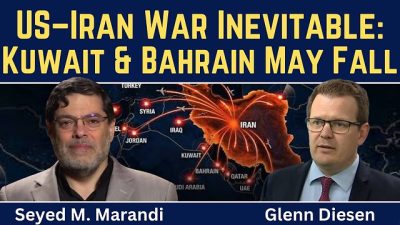
Seyed M. Marandi: US-Iran War Inevitable: Kuwait and Bahrain May Fall
or go to
Aletho News Archives – Video-Images
From the Archives
Oil and the Israel Lobby
Reknowned economist M. Shahid Alam offers this excellent critique of Noam Chomsky’s defective analysis of the relative influence of Oil versus the Israel lobby over US foreign policy: … continue
Blog Roll
 Aletho News
- Trump’s Retreat: How Al-Aqsa Flood Took Down the US Empire
- Israel’s Military Actions in Lebanon Grossly Violate International Law — Lavrov
- Seyed M. Marandi: US-Iran War Inevitable: Kuwait and Bahrain May Fall
- Leaders Condemn Ansarallah Attack on Saudi Arabia While Ignoring Illegal War Against Yemen
- Leaked: Britain’s Covert Iraqi Psyops Network
- Yemeni Armed Forces Warn Airlines Against Using Saudi Airports, Exempt Mecca and Medina
- Iran security chief says powers greater than US tried to conquer Iran but ended in ‘dustbin of history’
- Europe’s mounting social chaos… chickens coming home to roost for proxy war against Russia
- US-Russia Diesel Deal Becomes Massive Defeat for Ukraine
- Hormuz and the Looming Economic Catastrophe
- If Americans Knew
- Gaza: Ceasefire Anniversary Marks Year of Failed Promises
- The American Conservative: Mike Huckabee Should Resign
- A C-Section in Shackles: A Palestinian Woman’s Harrowing Birth in Israeli Detention
- ‘He’s Desperate’: AIPAC Begins Spending Against Abdul El-Sayed to Boost Mike Rogers:
- Trump, Hormuz, and the Looming Economic Catastrophe
- For three years, Israel has killed a child in Gaza every 71 minutes – Daily Update
- Israeli forces kill another child in Gaza – Daily Update
- Gaza ceasefire exists in name only, say more than 100 organizations
- Nearly 2 Million in Gaza Need Urgent Shelter Assistance as Winter Looms: IOM Chief Warns
- Suppressing Palestinian resistance: US charity under fire for AI monitoring of Gaza classrooms
- No Tricks Zone
- Germany’s Green Energy Debacle: High Energy Costs Force Kahla Porzellan to Close After 182 Years!
- New Study: 50 Years Of The Most Aggressive ‘Net Zero’ Policies Can Only Affect The Global Climate By 0.03°C
- US September “Heat” Was No Record…Many Records Set Decades Ago
- Latest European Green Energy Debacle; Portugal’s Largest Flagship Solar Park Insolvent!
- Green Energy Debacle: German Expert Professor Fritz Vahrenholt Warns Of Severe Economic And Social Consequences
- Two More Paleo Reconstructions Affirm Meters-Higher Sea Levels Across Ireland, Brazil 7000-6000 Years Ago
- New Study: Earth And Venus Surface Warmth Largely Explained By Convection And Lapse Rate, Not CO2 Or Radiation
- 2025 Nature Paper Claiming Worsening Global Drought Gets RETRACTED …Heavily Flawed
- New Study: ‘Global Drought Shows No Detectable Recent Acceleration Under Climate Warming’
- Economic Masterminds: German Socialists Suggest Taxing Productivity Gains Stemming From Using AI

