Europe’s risky war on Russia’s ‘shadow fleet’
By Anatol Lieven | Responsible Statecraft | June 16, 2025
The European Union’s latest moves (as part of its 17th package of sanctions against Russia declared in May) to target much more intensively Russia’s so-called “shadow fleet” of oil tankers and other vessels illustrate the danger that, as long as the Ukraine war continues, so will the risk of an incident that will draw NATO and the EU into a direct military clash with Russia.
The EU sanctions involve bans on access to the ports, national waters and maritime economic zones of EU states. Ships that enter these waters risk seizure and confiscation. It does not appear that Washington was consulted about this decision, despite the obvious risks to the U.S.
As part of this strategy, on May 15, an Estonian patrol boat attempted to stop and inspect a tanker in the Gulf of Finland. Russia sent up a fighter jet that flew over the Estonian vessel (allegedly briefly trespassing into Estonian waters), and the Estonians backed off — this time. In January, the German navy seized a Panamanian-flagged tanker, the Eventin, in the Baltic after its engines failed and it drifted into German territorial waters.
Sweden has now announced that starting on July 1 its navy will stop, inspect and potentially seize all suspect vessels transiting its exclusive economic zone, and is deploying the Swedish air force to back up this threat. Since the combined maritime economic zones of Sweden and the three Baltic states cover the whole of the central Baltic Sea, this amounts to a virtual threat to cut off all Russian trade exiting Russia via the Baltic — which would indeed be a very serious economic blow to Moscow.
It would also threaten to cut off Russia’s exclave of Kaliningrad, which is surrounded by Poland, from access to Russia by sea.
This is the kind of action that has traditionally led to war. The Swedish assumption seems to be that the Russian navy and air force in the Baltic are now so weak — and so surrounded by NATO territory — that there is nothing Moscow can do about this. However, it is very unlikely that the Swedes would take this step unless they also believe that in the event of a clash, Washington will come to Sweden’s defense — even though the EU and Swedish decisions were made without U.S. approval and are not strictly covered by NATO’s Article 5 commitment.
And despite all the hysterical language about Russia being “at war” with NATO countries, these moves by the EU and Sweden are also based on an assumption that Russia will not in fact lose its temper and react with military force. European policymakers might however want to think about a number of things: for example, what would the U.S. do if ships carrying U.S. cargo were intercepted by foreign warships? We know perfectly well that the U.S. would blow the warships concerned out of the water and declare that it had done so in defense of the sacred rule of free navigation — in which the EU also professes to believe.
EU leaders, and admirals, should also spend some time on Russian social media, and read the incessant attacks on the Putin administration by hardliners arguing precisely that Moscow has been far too soft and restrained in its response to Western provocations, and that this restraint has encouraged the West to escalate more and more. Such hardliners (especially within the security forces) are by far the greatest internal political threat that Putin faces.
It is important to note in this regard that moves to damage Russia’s “shadow fleet” have not been restricted to sanctions. In recent months there have been a string of attacks on such vessels in the Mediterranean with limpet mines and other explosive devices — developments that have been virtually ignored by Western media.
In December 2024, the Russian cargo ship Ursa Major sank off Libya after an explosion in which two crewmembers were killed. The Reuters headline reporting these attacks was rather characteristic: “Three tankers damaged by blasts in Mediterranean in the last month, causes unknown, sources say.” Unknown, really? Who do we think were the likely perpetrators? Laotian special forces? Martians? And what are European governments doing to investigate these causes?
If the Russians do sink a Swedish or Estonian warship, the Trump administration will face a terribly difficult decision on how to respond to a crisis that is not of its own choosing: intervene and risk a direct war with Russia, or stand aside and ensure a deep crisis with Europe. The U.S. administration would therefore be both wise and entirely within its rights to state publicly that it does not endorse and will not help to enforce this decision.
Washington also needs — finally — to pay attention to what the rest of the world thinks about all this. The overwhelming majority of senators who are proposing to impose 500% tariffs on any country that buys Russian energy have apparently not realized that one of the two biggest countries in this category is India — now universally regarded in Washington as a vital U.S. partner in Asia. And now America’s European allies are relying on U.S. support to seize ships providing that energy to India.
The U.S. administration would also be wise to warn European countries that if this strategy leads to maritime clashes with Russia, they will have to deal with the consequences themselves. Especially given the new risk of war with Iran, the last thing Washington needs now is a new flare-up of tension with Moscow necessitating major U.S. military deployments to Europe. And the last thing the world economy needs are moves likely to lead to a still greater surge in world energy prices.
European governments and establishments seem to have lost any ability to analyze the possible wider consequences of their actions. So — not for the first time — America will have to do their thinking for them.
Anatol Lieven is Director of the Eurasia Program at the Quincy Institute for Responsible Statecraft. He was formerly a professor at Georgetown University in Qatar and in the War Studies Department of King’s College London.
Iranian missile strikes at the heart of Israel’s cyber empire in Beer al-Sabe
Press TV – June 20, 2025
A day after the Israeli regime launched multiple coordinated cyberattacks targeting Iran’s banking network and state television, Iran responded with a missile strike on what is widely regarded as the regime’s cyber capital.
On Friday morning, Iranian armed forces initiated a new wave of Operation True Promise III, striking many important Israeli military, intelligence, and industrial sites that support the regime’s aggression — whether in Gaza, Lebanon, Yemen, or Iran.
One of the principal targets was Beer al-Sabe, considered the stronghold of the Israeli regime’s cyber industry and a central hub in its global cyber warfare apparatus.
According to Israeli media reports, the missile fired by Iran successfully evaded the regime’s multi-layered air defense systems. Despite initial detection, the missile intercept systems failed to neutralize the projectile.
The aftermath of the precision-guided strike showed thick plumes of smoke rising from a building reduced to rubble — identified as a key center of the Israeli cyber army.
Located near Ben-Gurion University, Beer al-Sabe is home to the Advanced Technologies Park (ATP) — a sprawling complex where the regime’s cyber warfare operations against countries like Iran are developed and coordinated.
This park houses major cybersecurity firms closely tied to the Israeli military and intelligence apparatuses, alongside multinational tech giants such as IBM, PayPal, and Oracle.
More critically, the city functions as a node for the integration of military and intelligence assets, with significant parts of Unit 8200 — Israel’s main cyber intelligence and surveillance division — based in Beer al-Sabe.
Within this ecosystem, the occupation army, private cyber firms, and academic institutions affiliated with the regime work in unison, using cyber warfare as a tool of settler-colonialism and expansionism in the region and beyond.
Ben-Gurion University itself plays a pivotal role in the regime’s cybersecurity research and collaborates extensively with its military and intelligence branches to develop offensive cyber capabilities in brazen breach of international laws.
Successive Israeli regimes have poured substantial investments into Beer al-Sabe to cement its status as the cyber capital of the Zionist entity, inviting top global cyber firms to set up operations there.
The regime has long weaponized cyberattacks to achieve its strategic objectives.
In 2009-2010, it partnered with the United States to launch a major cyberattack on Iran’s nuclear facilities — damaging centrifuges — marking one of the first known uses of cyber technology for destructive purposes, despite Iranian sites being under the UN surveillance.
Over the years, it has carried out cyberattacks on Iranian ports, fuel distribution networks, and railway systems, in blatant violation of international norms governing cyberspace.
The regime has also targeted resistance movements like Hamas in Gaza and Hezbollah in Lebanon, aiming to disrupt their communications and operations.
At the core of these operations is Unit 8200, a division that has gained notoriety for leading the Israeli military’s cyber intelligence and hacking efforts, conducting widespread surveillance, espionage, and offensive digital campaigns.
The regime has also deployed cyber tools to spy on governments and institutions around the world. Tools such as Pegasus spyware, developed by Israel’s NSO Group, have been used to covertly infiltrate mobile devices for intelligence gathering.
Given this record, regional cybersecurity officials say Friday’s Iranian missile strike on Beer al-Sabe was a long-overdue response to years of cyber aggression emanating from the city.
‘Israel’ burning $200 mln daily in costly Iran response: WSJ
Al Mayadeen | June 20, 2025
The Wall Street Journal on Friday reported that “Israel” is facing a mounting financial burden as a result of its military confrontation with Iran, with estimates suggesting the cost of the war is draining the Israeli economy by hundreds of millions of dollars per day. The staggering expenses are raising doubts about “Israel’s” ability to sustain a prolonged offensive.
Central to the cost is the deployment of high-end missile defense systems used to counter Iranian retaliatory strikes. According to experts, the daily price of launching interceptors alone may reach up to $200 million. Added to this are expenditures on munitions, aerial missions, and the extensive damage caused by Iranian missile strikes on Israeli infrastructure. Preliminary figures place the cost of reconstruction at no less than $400 million.
Though Israeli officials claim their military campaign may last two weeks, Prime Minister Benjamin Netanyahu has shown no sign of retreating before achieving long-standing political goals, such as dismantling Iran’s defensive capabilities and its sovereign nuclear program, which is internationally monitored and confirmed to be peaceful.
But economic realities may force a rethink, according to WSJ. “The main factor which will really determine the cost of the war will be the duration,” said Karnit Flug, former Bank of Israel governor. “If it is a week, it is one thing. If it is two weeks or a month, it is a very different story.”
Deterrence costs rise
Iran’s missile response, logging over 400 missiles launched in recent days, has exposed the immense cost of attempting to neutralize such deterrent power. Each interception using the David’s Sling system costs around $700,000, and the Arrow 3, meant to intercept ballistic missiles in space, runs up to $4 million per launch. Even older Arrow 2 interceptors cost roughly $3 million.
Beyond security matters, “Israel’s” offensive operations come with their own price tag. Keeping advanced F-35 jets in the air for long-distance missions, targeting Iranian territory over 1,600 km away, costs about $10,000 per hour per jet, according to security analyst Yehoshua Kalisky. The cost of fuel, precision bombs, and support operations only amplifies the daily burden.
“Per day it is much more expensive than the war in Gaza or with Hezbollah. And it all comes from the ammunition. That’s the big expense,” noted Zvi Eckstein of Reichman University. His institute estimates a one-month war with Iran would cost “Israel” approximately $12 billion.
Despite this massive outlay, analysts say “Israel’s” economy remains vulnerable. Many sectors have been paralyzed by the Iranian response: the main airport was shut down, businesses shuttered, and only essential services permitted to function. Meanwhile, global credit rating agency S&P issued a warning, though it stopped short of revising “Israel’s” credit outlook. Investors, for now, appear to be betting on a short war, an assumption that may prove misguided.
Illusion of invincibility
On the ground, Iranian precision strikes have shattered the illusion of Israeli invulnerability. Engineers and first responders describe destruction not seen in decades. “It would cost at least tens of millions of dollars to repair a single newly-built skyscraper in central Tel Aviv,” said structural engineer Eyal Shalev.
More than 5,000 Israelis have been evacuated from missile-damaged neighborhoods and are now temporarily housed in state-funded hotels. Iranian targeting of critical infrastructure has been effective, including two strikes on “Israel’s” largest oil refinery in the north, which forced a shutdown and left three settlers dead. Workers in key sectors have been instructed to remain at home amid growing instability.
Iran’s response has not only shifted the military balance but also exposed the deep vulnerability of “Israel’s” economy and civil infrastructure. With growing costs, damaged public morale, and uncertainty mounting, the war’s continuation may prove more costly to Tel Aviv than it anticipated.
Spanish Prime Minister Rejects NATO Call to Raise Defense Spending to 5% of GDP
Sputnik – 19.06.2025
Spanish Prime Minister Pedro Sanchez told NATO Secretary General Mark Rutte that Madrid would not support the proposal to increase the alliance’s defense spending to 5% of gross domestic product (GDP) by 2032, according to a letter published by El Pais newspaper on Thursday.
“For Spain, committing to a 5% target would not only be unreasonable, but also counterproductive; it would move Spain away from optimal spending and would hinder the EU’s efforts to strengthen its security and defense ecosystem,” the letter read.
Sources at the Spanish government told the newspaper that while they do not rule out Europe reaching 5% defense spending, they believe it is too early to set that target.
Earlier in June, Rutte called on NATO member states to increase their defense spending from the current 2% to 3.5% of their respective GDPs, and spend another 1.5% on infrastructure development, military industry and other security-related investments. US President Donald Trump previously demanded that NATO allies spend 5% of GDP on defense.
Pakistan breaks ranks, backs Iran in war with Israel
By F.M. Shakil | The Cradle | June 19, 2025
Despite Islamabad’s official denials of providing military or material support to Iran in its confrontation with Israel, recent developments suggest a dramatic shift in regional alignments. Today, Pakistan and China appear to be coordinating closely with Tehran, offering tangible strategic advantages as Tel Aviv escalates its hostilities.
As war clouds gathered, Iranian Foreign Minister Abbas Araghchi held urgent discussions with his Chinese counterpart Wang Yi on 14 June. That same day, Iranian President Masoud Pezeshkian spoke with Pakistani Prime Minister Shehbaz Sharif, who expressed Islamabad’s “resolute solidarity” with Iran. He also added that the country “stands firmly with the Iranian people in this critical hour.”
China and Pakistan’s role
In the immediate aftermath, reports emerged of Pakistani military delegations arriving in Tehran amid the hostilities. Although swiftly denied by Islamabad, the timing and context fuel speculation of deeper collaboration. Similarly, Beijing reportedly greenlit the transfer of its BeiDou Navigation Satellite System (BDS) technology to Iran, formalized in a new bilateral MoU – an upgrade that dramatically enhanced the precision of Iranian missile strikes.
Though Pakistan continues to reject claims of missile transfers to Iran, its stance in recent days paints a different picture. On 16 June, members of the Iranian parliament chanted “Thank you, thank you Pakistan” following remarks by Pezeshkian, who praised Pakistan for standing by Iran. These developments fly in the face of Pakistan’s non-alignment rhetoric and indicate an ideological and strategic realignment by Islamabad.
It was only early last year that Iran launched missile and drone strikes into Pakistan’s Balochistan region on 16 January, targeting extremist militant group Jaish al-Adl positions. Pakistan retaliated two days later on 18 January, conducting air and missile strikes into Iran’s Sistan and Baluchestan province in an operation dubbed Marg Bar Sarmachar. The tit-for-tat was remarkably friendly in the final analysis, and appears to have settled some critical border cooperation issues between the two states.
The fact that these former adversaries – who had just engaged in direct military exchanges – have now adopted “resolute solidarity” is nothing short of breathtaking.
Beijing’s embrace of Iran is grounded in energy security and strategic depth instead. Its ambitious, multi-trillion dollar Belt and Road Initiative (BRI) aimed at linking the Eurasian landmass hinges on the stability of Tehran and Islamabad, with the Gwadar and Chahbahar ports forming key arteries in China’s westward expansion.
China also supplies J-10 fighter jets and HQ‑9 air‑defense systems to Pakistan, which played key roles in the extraordinary May 2025 skirmish between India and Pakistan – marking major testing ground for Chinese weapons. A parallel circumstance is present in Iran. China must acknowledge Iran because it is a crucial supporter of China’s energy needs and trade operations.
“The enemy of my friend is my enemy” may well define the new tripartite logic binding Iran, Pakistan, and China in resistance to Israeli and western designs.
Colonial ambitions and nuclear red lines
Tel Aviv’s recent strikes on Iranian military and nuclear infrastructure mark a new phase in a decades-long western strategy aimed at dismantling Muslim powers resistant to colonial domination. Iraq, Syria, Libya – all were destabilized under similar pretexts. The 2001 plot, conceived by the US, its European allies, and Israel, has entered its second phase, targeting Iran initially and Pakistan subsequently.
In a 2011 interview with Channel 2, Israeli Prime Minister Benjamin Netanyahu laid bare the logic: Iran and Pakistan are the primary targets of this containment strategy, he stated blankly. “These radical regimes … pose a significant threat,” he said, stressing the need to prevent them from acquiring nuclear capability.
But recent Israeli provocations have instead triggered multipolar resistance to those plans. Speaking to The Cradle, Abdullah Khan of the Pakistan Institute for Conflict and Security Studies (PICSS) reveals that Israeli drone operators had recently attempted to sabotage Pakistan’s nuclear facilities during the India–Pakistan crisis:
“Israeli drone operators were stationed in Indian operation rooms during the recent Pakistan–India conflict, trying to target Pakistan’s nuclear facilities. However, prompt action from Pakistan thwarted their efforts, preventing them from causing any damage to the nuclear assets of Pakistan.”
Defensive posturing or new axis?
A source in Pakistan’s Foreign Ministry reveals to The Cradle that Islamabad has quietly warned Washington of a potential nuclear escalation should Israel attack Iran with such weapons.
“If such a situation arises, it will spill beyond Iran. The region will enter a new, unpredictable security phase,” the source states.
The warning was soon echoed in Tehran. On 16 June, Islamic Revolutionary Guard Corps (IRGC) General Mohsen Rezaei declared on state television:
“Pakistan has told us that if Israel uses nuclear missiles, we will also attack it with nuclear weapons.”
Meanwhile, Pakistani Defense Minister Khawaja Asif caused a stir with an incendiary post targeting exiled Iranian royal Reza Pahlavi, the son of the ousted shah of Iran. In response to Pahlavi’s BBC interview, Asif wrote on X:
“If Iranian people are energized and motivated, according to you, show some balls and go back and lead them and remove the regime. Put your money where your arse is, bloody parasitical imperial whore.”
Bilal Khan, a Toronto-based defense/security analyst and the co-founder of independent think tank Quwa Defence News & Analysis Group, tells The Cradle that Islamabad perceives itself as under coordinated pressure from the US, India, and Israel.
“The Pakistani security elite perceive that the US and its counter-proliferation regime are imposing penalties on Pakistan, although it was India that brought the nuclear issue to South Asia. “There exists a structural perception in Rawalpindi that the US, along with its allies India and Israel, is targeting Pakistan’s nuclear program. Nonetheless, it remains uncertain how Pakistan will handle the situation. Certainly, increased investment in air defense systems, enhanced domestic intelligence capabilities, and strengthening the air force with next-generation J-35 stealth fighters are all essential to take on any possible Israeli actions.”
From denial to celebration
While Islamabad has offered no formal commitment of military aid to Tehran, Iranian media and parliament are now rallying around Pakistan with chants of “Pakistan Zindabad.”
Diplomatically, Islamabad has backed Tehran’s call for a UN Security Council session on Israeli aggression and explicitly defended Iran’s right to self-defense. Alongside Algeria, China, and Russia, Pakistan played a key role in amplifying Iran’s initiative, marking a coordinated diplomatic front that signals a deeper convergence within the Eurasian bloc. This is no small gesture from a country once considered a possible target of Israel’s preemptive doctrine.
In a move that exposes Washington’s alarm, Pakistan’s army chief, Field Marshal Asim Munir, was quietly summoned to the US Central Command headquarters in Florida. His absence from a key national parade in Islamabad has raised questions at home. While the Pakistani embassy remains tight-lipped, Dawn cited sources anticipating “uncomfortable conversations” in Washington.
Whether Munir’s US visit results in a recalibration or further consolidation of Islamabad’s alignment with Tehran and Beijing remains uncertain. But one thing is clear: Pakistan is no longer sitting on the fence.
Israeli nuclear sites to face ‘crushing blows’ – Iranian source to RT
RT | June 19, 2025
Iran intends to continue its military response against Israel and could target its nuclear infrastructure, a senior Iranian security official has told RT.
In an exclusive statement to the head of RT’s Tehran bureau, the official, who chose to remain anonymous, said that Iranian armed forces will maintain missile and drone operations throughout the day, specifically targeting “the occupied territories and Israeli garrisons.”
The official said Iran’s response follows “the Quranic advice on retaliation,” and warned that Iranian forces would respond “to any extent and wherever the regime attacks Iranian soil.” He noted, however, that based on “Iran’s moral principles,” there would be no attacks on hospitals.
“The Zionist regime’s claim that Iran attacked one of the hospitals in the occupied territories is completely false,” the official stressed, referring to reports of the Soroka hospital being struck in the city of Be’er Sheva in southern Israel.
He also stated that Tehran’s response will be escalated in light of the Israeli strikes on Iranian nuclear sites. “Since the [Israeli] regime has attacked our nuclear facilities, our armed forces will subject their nuclear facilities to crushing blows,” the official said.
Since launching its assault last week, Israel has hit several Iranian nuclear facilities, including sites in Natanz, Isfahan, Fordow and near Tehran. Between nine and 14 nuclear researchers have been reported killed in the attacks.
Without naming the US directly, the Iranian official also warned that “if another country directly enters into war with us, it will provide much more accessible targets for the Iranian armed forces to destroy.”
US President Donald Trump has hailed Israel’s attacks on Iran as “excellent” and has urged Tehran to surrender unconditionally. He has also warned that the US could become directly involved in the conflict if any American targets are hit by Iran.
Last Friday, Israeli forces began carrying out strikes on Iran, claiming Tehran is nearing the completion of a nuclear bomb. Iran dismissed the accusations and retaliated with waves of drone and missile strikes on the Jewish state.
The head of the International Atomic Energy Agency, Rafael Grossi, has since also refuted Israel’s claims, stating that the watchdog has found no evidence that Iran has been making a “systematic effort” to produce a nuclear weapon.
A catalytic event
By Přemysl Janýr | June 19, 2025
Bombing from the air will not bring about the overthrow of the regime, but rather its consolidation. We have seen this in Germany, Japan, Vietnam, Yugoslavia, Afghanistan, Lebanon, Gaza, Yemen. The only way to overthrow a regime is by a color revolution or a ground military campaign, if one is lucky.
And Israel isn’t up to it in Iran.
I don’t think he didn’t know. Just like he didn’t know in advance what the Iranian missiles would cause.
If Israel went ahead with the operation anyway, it means it has a plan in reserve. That is to use the US military for a ground campaign.
The fact is, however, that neither the American public nor the president are particularly keen on that. Just as they have not been keen before World War I and World War II or the Vietnam War, just as they have not been keen to destroy seven countries in five years. It always needed, as the neocons say, a catalytic event: the sinking of the Lusitania, the attack on Pearl Harbor, the Tonkin incident, the 9/11 attacks.
If Israel went ahead with the operation anyway, it means it has a catalytic event in reserve.
We can only speculate about it for now. Or infer from the few indistinct hints and signals.
These could be, for example, the meanwhile buried news of Iran’s foiled assassination attempt on Donald Trump, later of Iranian terrorists dropped into the US and equipped with a surface-to-air missile to shoot down Trump’s plane. Netanyahu recently reiterated Iran’s intention to take out Trump.
The shooting down of Trump’s plane would indeed be such an ideal catalytic event. If Israel kills Ayatollah Khamenei before, it would be Iranian retaliation beyond any doubt. It would convince Americans – Trump supporters and opponents alike – of the necessity of the Iranian campaign, while removing the erratic eccentric repeatedly meddling with Israel.
And workable. Experts with access to the necessary information and equipment will surely find a way for such a missile to bypass defense systems. And singling out Iranians who will happily fire it and die in the ensuing firefight is also tried and tested.
It’s speculation, of course. Quite possibly, there will be another catalytic event, perhaps the sinking of an American ship, more successful than that of the Liberty, an attack by pro-Iranian militias on an American base, or something else.
But that Israel would go headlong into it I think is out of the question.
The Czech original: https://www.janyr.eu/123-katalyticka-udalost
Decoding Iran’s strategy in current war
By Amro Allan | Al Mayadeen | June 18, 2025
Iran’s Foreign Minister has made it clear in multiple statements that the Islamic Republic remains open to re-engaging the diplomatic track, provided that the US-Israeli aggression against the country comes to an end. At the same time, however, IRGC Commander Brigadier General Mohammad Pakpour has declared, “Even if the Israeli attacks stop, we will continue our mission to the end.” These seemingly contradictory positions raise a key question: What exactly is Iran’s objective in this confrontation, and how should its strategy be understood? More pressingly, what role is the United States playing on the battlefield?
Tehran understands that the ultimate goal of the current assault, launched in the early hours of June 13, is not simply aggressive, but existential. The US-Israeli axis seeks nothing less than the collapse of the Islamic Republic itself. According to most military analysts, neutralizing Iran’s nuclear programme through conventional means is well beyond the capabilities of the Israeli military. This is particularly true when it comes to heavily fortified enrichment facilities like Natanz and Fordow, which are among the most secure sites in the world against aerial and missile strikes.
To strike such hardened targets, advanced bunker-busting munitions would be required, arms that are exclusively in the hands of the US military. What’s more, the only aircraft capable of delivering these weapons—the B-2 stealth bomber—operates solely under the command of the United States Air Force. Some experts even question whether these bombs would be effective against Iran’s most deeply buried and reinforced sites.
Both Washington and Tel Aviv are fully aware of these limitations, which cast serious doubt on their publicly stated rationale for launching the war. This scepticism is only reinforced by Netanyahu’s early appeal, issued just hours after the attack, urging Iranians to rise up against their own government, a move that tacitly reveals the true aim of the aggression.
This level of strategic ambition has been absent from previous assaults on Iran. The assassination of Lieutenant General Qassem Soleimani, Commander of the IRGC Quds Force, in January 2020, “Israel’s” missile strike on the Iranian consulate in Damascus in April 2024, and the attack on an air defense site near Isfahan inside Iran later that month, none of these triggered the same level of overt intent to destabilise the Iranian state.
It is this shift in objective that explains Iran’s evolving response. Unlike past retaliatory actions, such as the missile strike on the Ain al-Assad US base in January 2020, or Operation True Promise 1 and 2 of April and October 2024, Iran’s current posture signals a long-term strategic engagement rather than a calibrated response.
Tehran does not appear eager to escalate the conflict into a regional war, fully aware that such a scenario could have catastrophic consequences not just for itself, but for the wider Middle East. Still, it is determined to impose a high cost on its adversaries, one that restores the balance of deterrence and redraws the lines of power in the region.
This approach was articulated clearly by Iranian Leader Sayyed Ali Khamenei, who warned, “We will not allow the Zionists to escape unscathed for this great crime. The Zionist entity has committed a grave miscalculation—one that will bring ruin upon them, by God’s grace.”
It is in this context that General Pakpour’s remarks must be understood. Iran’s continuation of Operation True Promise 3 is not dependent on whether “Israel” halts its attacks. Rather, it is driven by a broader aim: to establish new rules of engagement and a new balance of power, irrespective of short-term developments.
At the same time, the Foreign Minister’s comments point to Iran’s reluctance to turn this war into a fight for national survival, unless forced to do so by further escalation from the other side.
But “Israel’s” failure to cripple the Islamic Republic in its initial, high-stakes strike, an operation designed to fundamentally alter the regional power balance, makes direct American involvement more likely in the days ahead. Washington may now feel compelled to interfere in order to accomplish what Tel Aviv could not.
All this suggests that the risk of escalation remains high. The war could soon expand to include oil infrastructure across the Gulf and target US military bases scattered throughout the region.
This leaves a crucial question hanging in the balance: Will key regional powers, Egypt, Turkey, Algeria, and Pakistan, recognize the gravity of what is unfolding? And will they act accordingly, acknowledging that the war being waged by the US-Israeli alliance poses a serious threat to their own security, sovereignty, and future stability?
Middle East in Crisis – 3
Trump orders ‘unconditional surrender’ by Iran. Who’s listening?
By M. K. BHADRAKUMAR | Indian Punchline | June 18, 2025
Israel’s blitzkrieg against Iran five days ago is failing spectacularly. The Russian media reported that: i) Israel’s Rafael weapons complex has been destroyed; ii) Haifa oil refinery is in flames; iii) the Iron Dome has been breached; iv) and, Israel’s air dominance is a figment of imagination.
On Tuesday, Iran fired cruise missiles for the first time against Israel. Another wave of Iranian missile and drone attack targeted the Nevatim Airbase in southern Israel, where stealth fighter jets, transport aircraft, tanker aircraft and machines for electronic reconnaissance/surveillance, etc. are stationed.
Some Iranian reports claim that “plumes of smoke were rising from areas near the Dimona nuclear facility,” where an estimated 90 Israeli nuclear warheads are stored. If true, this must be highly embarrassing for Israel which has been maintaining a policy of deliberate ambiguity in regard to its nuclear capabilities as well as for President Donald Trump who is constantly hectoring Iran while turning a blind eye on Israel’s clandestine nuclear weapon stockpiles right under his nose — apart from exposing the IAEA.
According to the independent Stockholm International Peace Research Institute, Israel’s nuclear warheads are capable of being delivered anywhere within a maximum radius of 4,500 km by its F-15, F-161, and F-35I “Adir” aircraft, its 50 land-based Jericho II and III missiles, and by about 20 Popeye Turbo cruise missiles, launched from submarines.
Suffice to say, rational minds among the Israeli elite feel worried. Typically, Danny Yatom, former head of Mossad, is quoted as saying, “Iranians will not kneel; they will not raise the flag of surrender and they will not give in!”
The American broadcast television network NBC has reported that Israel asked Iran, through western mediators, to stop its retaliatory attacks and return to nuclear negotiations. This would probably explain Trump’s bombastic post on Sunday in Truth Social that Israel and Iran will end their violent conflict by “making a deal” through his mediation. Trump wrote, ”We will have peace, soon, between Israel and Iran. Many calls and meetings now taking place.” He even drew the analogy of his success in brokering peace between India and Pakistan recently.
However, the realisation may have since dawned on Trump that Iranians will not forget or forgive the assassinations of their military commanders or the destruction and loss of life of dozens of civilians in the Israeli Blitzkrieg, which targeted Iran’s nuclear facilities, military infrastructure, and residential buildings in Tehran and other cities.
Trump has a major decision to take in coming days as regards the next move — specifically, how to rescue Israel from the attritional war that lies ahead. Pressure for US military intervention is mounting. Trump is obligated one way or another to all three segments of the Israel Lobby — Zionists, evangelical Christians and wealthy Jewish elites who are kingmakers in American politics.
The pendulum is wildly swinging in Trump’s mercurial mind. He was in an irritable mood at the G-7 summit in Canada on Monday, cut short his trip and picked a nasty public quarrel with French President Emmanuel Macron for simply commenting that Trump hurried back to wrap up a ceasefire.
Trump wrote angrily, “Publicity seeking President Emmanuel Macron, of France, mistakenly said that I left the G7 Summit, in Canada, to go back to D.C. to work on a “cease fire” between Israel and Iran. Wrong! He has no idea why I am now on my way to Washington, but it certainly has nothing to do with a Cease Fire. Much bigger than that. Whether purposely or not, Emmanuel always gets it wrong. Stay Tuned!”
Four hours later, he clarified, “I have not reached out to Iran for “Peace Talks” in any way, shape, or form. This is just more HIGHLY FABRICATED, FAKE NEWS! If they want to talk, they know how to reach me. They should have taken the deal that was on the table — Would have saved a lot of lives!!!”
Seven hours later, Trump claimed, “We now have complete and total control of the skies over Iran. Iran had good sky trackers and other defensive equipment, and plenty of it, but it doesn’t compare to American made, conceived, and manufactured “stuff.” Nobody does it better than the good ol’ USA.”
But a few minutes later, Trump threatened Iran’s Supreme Leader Ayatollah Ali Khamenei: “We know exactly where the so-called “Supreme Leader” is hiding. He is an easy target, but is safe there — We are not going to take him out (kill!), at least not for now. But we don’t want missiles shot at civilians, or American soldiers. Our patience is wearing thin. Thank you for your attention to this matter!”
Seven minutes later, another nasty post followed in capital letters: “UNCONDITIONAL SURRENDER!”
That was 9 hours ago. Presumably, Trump wound up Tuesday by ordering Iran to crawl on its knees. The chances of Iran obliging him are zero. In fact, the Chairman of the Chiefs of Staff of Iran’s Armed Forces Major General Abdolrahim Mousavi said on Tuesday that the operations carried out so far have served as a deterrent warning, and the actual “punitive operations” are set to begin soon. The general asked the inhabitants of Tel Aviv and Haifa “to leave these areas for the sake of their lives.”
In fact, an Iranian commentary underscored yesterday that “Israeli strikes on Iran’s energy infrastructure and southern ports near the Persian Gulf could shift the nature of the conflict dramatically… This is precisely what Iran identifies as its strategic red line.”
The commentary continues: “What we’re witnessing is a multi-level hybrid conflict, a complex puzzle involving direct warfare, proxy engagement, diplomatic pressure, and a simmering “cold peace”—all unfolding at once… But such a scenario is unsustainable, as Israel… knows it cannot endure a prolonged high-intensity conflict.
The commentary estimates that a ceasefire “would likely be a tense calm or a “cold peace” rather than true stability.” Because, “What’s emerging now is a fluid and brutal new balance of power… The Persian Gulf, Israel, the Axis of Resistance, and the global energy market are no longer separate arenas—but interconnected pieces in a simultaneous, high-stakes game.” (here)
The great dilemma for Trump is that there’s no quick fix solution in sight. On his way back to the US yesterday evening, Trump said he wanted a “real end” to the conflict and that he was “not too much in a mood to negotiate.” German Chancellor Friedrich Merz also noted that Trump was indeed considering that option. The US is rapidly building up its forces in the Gulf region.
However, US intervention may trigger a continental war that will outlive Trump’s presidency and destroy his presidency, as Bush’s 2003 Iraq invasion destroyed his. And Trump might as well forget about America First, MAGA, Ukraine, Taiwan, tariff wars, immigration, inflation, China, etc.
Even European allies won’t stand by Trump. Macron told reporters on the sidelines of the G7 summit after Trump’s departure, “The biggest mistake today would be to try to do a regime change in Iran through military means because that would lead to chaos.” Macron warned that “no one can say what comes next…We never support actions of regional de-stabilisation.”
Do not forget that the skeptics include Vice President JD Vance also, whose suspicion of foreign entanglements had its origins in his time as a US Marine in Iraq, where he became disillusioned with America’s interventionist regime change projects and ill-fated ‘forever wars’ in the region.
Israel’s Strategic Miscalculation and the Dawn of a New World Order
By Peiman Salehi – New Eastern Outlook – June 18, 2025
In June 2025, the world witnessed the outbreak of a full-scale war between the Islamic Republic of Iran and the Zionist regime of Israel. This conflict, extending far beyond the military sphere, is reshaping political, media, and geopolitical landscapes. At the onset of hostilities, Israel initiated a surprise operation targeting several high-ranking Iranian military commanders and scientists. Tel Aviv saw this act as a significant achievement, anticipating it would plunge Iran into psychological disarray and delay its response.
Yet, this assumption proved gravely flawed. The Islamic Republic swiftly recovered and, within days, launched a series of unprecedented strikes on key Israeli cities such as Haifa and Tel Aviv. The extent of the damage inflicted on strategic infrastructure suggested a deep disruption in the psychological and political equilibrium, signaling a fundamental shift in the rules of engagement. As the conflict escalated, Prime Minister Benjamin Netanyahu made concerted efforts to draw the United States into the fray. Donald Trump, who initially reacted with sarcasm to the news of Iranian casualties, soon reversed his tone, presenting himself as a mediator. This rhetorical pivot reflects not a genuine desire for peace, but rather concern over the conflict’s expanding consequences.
From Tehran’s perspective, the war is not simply a reactionary campaign, but a calculated effort to alter the regional balance of power. Iran’s approach indicates a strategic vision aimed at redefining the security architecture of West Asia. Analysts now grapple with a pivotal question: will the war remain confined to regional boundaries, or evolve into a broader global confrontation? The varying positions of nuclear powers from East and West point to emerging global realignments. Nations like Pakistan, India, China, and Russia view the crisis through their distinct strategic lenses.
Meanwhile, the geopolitical relevance of choke points such as the Strait of Hormuz and Bab al-Mandab has resurged, underlining their significance to global trade and international stability. This war increasingly appears to be a confrontation between two competing visions of world order. The liberal, US-centric model—characterized by interventionism, hegemonic ambitions, and asymmetric power structures—is facing unprecedented resistance. In its place, a multipolar order championed by emerging powers is gaining traction.
If this moment is seized wisely by independent states and resistance movements, it could mark a turning point in contemporary political history. The world, once declared to have reached the “end of history,” is now experiencing the return of history, fueled by the renewed agency of sovereign nations.
Ultimately, to counter imperial interventions and dismantle imposed global frameworks, this war must be understood not merely as an isolated event, but as a transformative juncture in international relations. Resistance today is not limited to a regional force—it is a global discourse that challenges domination. The choice between submission and resistance is no longer Iran’s alone; it is one that history must now resolve.
Israel’s Hidden Front: How Israel’s Military Embeds Itself Among ‘Civilians’
Quds News Network | June 14, 2025
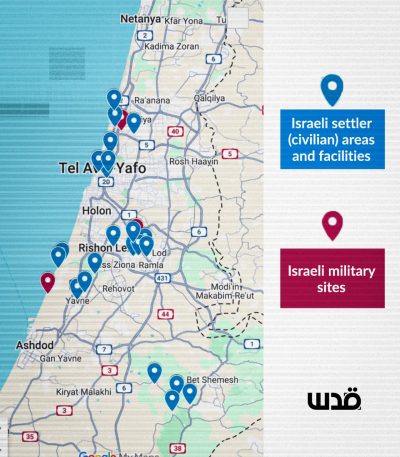 As Iran responds to Israeli attacks, Israel has begun publishing photos and videos showing what it claims are civilian casualties. However, many of Israel’s key military command centers and bases are embedded inside or beside densely populated civilian areas, raising serious concerns about the use of human shields.
Israel has long accused the Palestinian resistance of using civilians as human shields. But a closer look at its own military infrastructure tells a different story. From Tel Aviv to Be’er Sheva, Israeli army bases, intelligence centers, and military leaders are embedded deep within cities and residential neighborhoods, protected not by concrete walls, but by Israeli flesh and blood.
At the heart of Tel Aviv lies HaKirya, Israel’s central military headquarters. It’s just a few steps away from the bustling Azrieli Center, Ichilov Hospital, residential towers, and the HaShalom train station. The commander-in-chief’s office sits only 450 meters from hospital patients. This proximity is not incidental. It’s strategic.
Across the country, similar patterns appear.
In Ramat Gan, the Sheba Medical Center neighbors the Tel Hashomer military base. In Haifa, the Israeli navy base is hidden behind the Rambam Medical Center, a civilian hospital. Even Israel’s alleged nuclear capabilities, reportedly housed in Sdot Micha Base, are surrounded by quiet rural communities near Beit Shemesh.
Civilians as a Human Shield Strategy
This overlap is not limited to infrastructure. Israel’s leadership, too, shelters in residential zones.
Prime Minister Benjamin Netanyahu resides in Jerusalem’s Talbieh neighborhood, surrounded by settlers. The defense minister lives in Moshav Kfar Ahim and the Israeli military chief of staff in Hod Hasharon. All are Israeli ‘civilian’ areas.
This practice isn’t new. It’s systematic.
The Israeli settlement enterprise in the West Bank mirrors the same approach. Entire communities of settlers, including women and children, are placed deep inside conflict zones. They are the frontline of a colonial project. When violence erupts, these ‘civilians’ become both the shield and the justification for further expansion.
Meanwhile, military rabbis, settlement leaders, and ideological figures operate among the settlers, posing as spiritual guides. They shape policy and drive confrontation but deny responsibility when blood is spilled.
Military Bases in Plain Sight
Even advanced cyber warfare hides in plain sight. The Glilot base, reportedly home to Unit 8200, Israel’s elite surveillance unit, is just 2 kilometers from northern Tel Aviv’s residential zones. This site has been flagged by Hezbollah and other groups for its proximity to civilians.
The Palmachim Airbase, responsible for drone operations and missile testing, lies just 10–12 kilometers from densely populated areas like Yavne and Greater Tel Aviv. The base shares airspace with commercial zones, a fact that Israel rarely acknowledges.
This civil-military fusion is not an accident. It’s a strategy.
On the surface, Israel tries to project an illusion of normal life: soldiers stationed beside shopping malls, military towers rising over playgrounds, officers living quietly among schoolchildren. But this is no coincidence. It is the architecture of a colonial project; one where the line between soldier and settler is deliberately blurred. Israeli ‘civilians’ are not just bystanders; they are often active participants or enablers of a violent military apparatus. From settlement expansion to surveillance networks and military conscription, every layer of society is embedded in the machinery of occupation and war.
While Israeli officials accuse Palestinian fighters of operating from urban areas, their own army commands from skyscrapers, hospitals, and suburban homes. They accuse Gaza’s defenders of hiding among civilians, yet embed their own war machines in the heart of Tel Aviv.
Israel’s military-industrial complex does not merely exist beside civilian life; it consumes and shields itself with it.
The clock is ticking down to ‘Israel’s’ capitulation
By Samuel Geddes | Al Mayadeen | June 18, 2025
Netanyahu has put “Israel” in an impossible position that it cannot sustain, even with indefinite American re-supply.
It has taken Iran less than three days to fully absorb the blows struck in “Israel’s” surprise offensive against its military and nuclear infrastructure. With its balance restored, it has gone on the offense to reestablish the deterrence that collapsed over the course of the last two years.
Among the Israeli public and political elites, the initial euphoria over their fleeting successes is already giving way to a terrible realization. They are in a direct war, for the first time in 50 years, with a state that can continue the current levels of hostilities for far longer than they can.
Even the regime’s much gloated-over missile defense systems, the Iron Dome, David’s Sling, and Arrow, began to fail with the first barrage of Iranian missiles, which inflicted unprecedented destruction in the heart of Tel Aviv. While still intercepting most of the projectiles fired, at least according to “Israel”, the rate of depletion of interceptor missiles is exponential. At best, Tel-Aviv can sustain acceptable interception levels for a matter of weeks. This while Tehran has yet to unleash the most powerful missiles in its arsenal.
As of day four of this war, the critical power plant in the Haifa Bay area has already been struck, with the effects on operations at its largest port and northern power grid being immediate and only compounding by the hour.
The distinct focus of media coverage on the destruction in urban areas and against economic targets is hiding, but only barely, the true extent of losses inflicted on critical military infrastructure. Army and air-force bases, weapons and fuel depots, and of course “Israel’s” nuclear facilities, remain cloaked by official military censorship.
Given the rate at which the regime is burning through its interceptor munitions, it will very soon face the reality of having to ration them, limiting their use to the defense of vital military targets, and leaving the country’s urban and economic fabric utterly exposed.
Repeated hits on the Haifa plant, or similar facilities like Orot Rabin, Rutenberg, or Eshkol, will bring down the civil power grid entirely, halting everything from weapons manufacturing to water desalination. As the missile shield depletes, airbases will be rendered inoperable (if they aren’t already) and the Israeli regime’s most potent weapon, the air force, will be unable to continue operating.
While Tel-Aviv does have its US patron to replenish its stocks, even this will not restore its capabilities to their initial level. The production of interceptors such as the Tamir and Stunner missiles is limited, even in the US, to the low thousands per year. Resupply is probable, if not inevitable, but it will be of limited use when the regime must expend thousands of such rockets per week simply to prevent nationwide devastation.
Elite opinion has begun to recognize this fact. Netanyahu’s senior security advisor, Tzachi Hanegbi, has publicly noted that Tehran’s inventory of mid-to-long-range ballistic missiles is far deeper than was initially estimated. As the relative cost of successful strikes declines (fewer missiles can be fired at once with more evading interception), this allows the Iranians to sustain the current tempo of operations for months, if not longer.
Under current conditions alone, the countdown to “Israel’s” societal, economic, and military collapse can be measured in weeks, not months. The only variable that would extract Tel Aviv from the trap it laid for itself is active US involvement. Though this remains frighteningly possible, the combination of domestic opposition and the prospect of a ferocious energy-driven inflation shock makes this less appealing with each passing day.
Ultimately, absent a full-scale American war on the Islamic Republic, Netanyahu has set up his regime and himself for a historic humiliation. The ceasefire likely to end this conflict will be imposed on terms dictated by Tehran, which could include everything from the definitive end of the Gaza genocide, UN scrutiny of Israeli nuclear weapons, to large-scale sanctions relief and abolition of the snap-back mechanism expected later in the year.
Iran has undoubtedly suffered serious blows at the outset, but that was the extent of what “Israel” was capable of. The pace of events is now dictated by Ayatollah Khamenei more than anyone else, and he has at last been presented the opportunity to shatter Israeli pretensions of being the region’s “superpower.”
Featured Video

Alon Mizrahi: ‘Israel Must Be Dismantled’
or go to
Aletho News Archives – Video-Images
From the Archives
How a War with Iran Would Diminish American Power
By Greg Scoblete | The Compass | August 13, 2010
Jennifer Rubin wants a war with Iran:
But the emphasis on the existential threat to Israel ignores a more basic issue for Americans to ponder: a nuclear-armed Iran represents a dagger at the heart of America and an existential threat to our status as a superpower and guarantor of the West’s security. As to the former, Iran is pressing ahead with its long-range ballistic missile program. First the Middle East and Eastern Europe, then all of Europe and, within a matter of years, the U.S. will be within range of Iranian missiles. If those are nuclear and not conventional, what then? We’re not talking about whether Iran is going to be “merely” a destabilizing factor in the Middle East or whether it will set off an arms race with its neighbors or imperil Israel’s existence. We’re talking about whether America will then be at risk (and lacking sufficient missile-defense capabilities if we continue to hack away at our defense budget). The argument about whether mutual assured destruction can really work against Islamic fundamentalists who have an apocalyptic vision becomes not about Israel’s ability to deter an attack but about ours. Those who oppose American military action have an obligation to explain why America should place itself in that predicament.
I would argue that any obligation to present an explanation lies with those whose disastrous policy prescriptions with respect to Iraq lead America into the worst strategic blunder in the country’s recent history. That aside, note the blind faith in the power of the military to actually achieve its ends. … continue
Blog Roll
 Aletho News
- Villains of Judea: Leonid Radvinsky
- Alon Mizrahi: ‘Israel Must Be Dismantled’
- Former Head Of MI6 Admits That The U.S. And Israel Are Losing The Iran War
- Scattered Thoughts on War and Peace
- Iran Threatens to Close Red Sea to Shipping in Response to Invasion
- Iran in excellent position to prevail in war with US, Israel: John Mearsheimer
- Iran warns US: Do not call your retreat an agreement
- Neighbors first – Moscow signals shift in energy strategy
- Almost 400 Ukrainian drones downed over Russia in single night – MOD
- Battle for Hungary: How the Russiagate blueprint has been unleashed against Orban
- If Americans Knew
- In the West Bank, life is a constant battle – 3 articles
- Jacob Reses, one of the most powerful pro-Israel operatives in Trump’s Washington
- Israeli-US assaults kill or injure 87 children a day – Not a ceasefire Day 166
- ‘Forever live by the sword’: Understanding Israelis’ massive support for Iran war
- UN’s special rapporteur on human rights says Israel is systematically torturing Palestinians
- Trump White House plagiarized Iran war manifesto from Israel-aligned think tank
- Gaza says 6–10 patients die daily waiting for treatment abroad as Israel blocks medical evacuations
- ‘Substantial evidence’ of double-tap strike in killing of Gaza’s Hind Rajab
- ‘Do Not Want To Die For Israel’: Doubts About Trump’s Iran Strategy Spread Among Troops
- Instead of taking Joe Kent’s claims seriously, the media is disregarding him as an antisemite
- No Tricks Zone
- Devastating Assessment Of Comirnaty Vaccine By Former Senior Pfizer Europe Toxicologist
- New Study: CO2 Is ‘Effectively Negligible’ As An Explanatory Climate Change Factor Since 2000
- Former Pfizer Toxicologist Dr. Helmut Sterz Tells Bundestag Hearing Pfizer Vaccine Should Have Never Been Approved
- Energy Expert: Germany’s Nuclear Phaseout Was A “500 Billion Euro Mistake”
- New Research: South Australia’s Mid-Holocene Sea Surface Temperatures Were 4°C Warmer Than Today
- Storing Green Energy To Last Germany 10 Days Would Require A 60-Million Tonne Battery
- New Studies: UK Sea Levels Were 4 Meters Higher Than Today During The Mid-Holocene
- Destructive Green New Deal: German Energy And Metal Group Warns Of Drastic Crisis
- New Study Documents A 20-Year Pause In Arctic Sea Ice Decline – Driven By Internal Variability
- Wake-up Call: Survey Shows Majority Of Germans Now Favor Postponing Climate Targets!
 Aletho News