Former Israeli commander warns against war of attrition with Iran
Al Mayadeen | June 18, 2025
Israeli Reserve Major General Israel Ziv, former head of the Israeli occupation military’s Operations Division, warned on Wednesday that “Israel” has nearly exhausted its capacity to carry out direct strikes against Iran’s nuclear facilities without US involvement.
He stressed that dismantling Iran’s nuclear program completely would require deeper, more effective measures that go beyond current military capabilities.
Writing for the Israeli Channel 12 website, Ziv cautioned that “Israel’s” current efforts, even if they achieve 60%, fall short of Iran’s determination to obtain a nuclear weapon at any cost. He added that if the situation remains unchanged, Tehran could produce a nuclear bomb in under a year.
Ziv outlined two strategic options available to both “Israel” and the United States. The first involves US diplomatic intervention to forge a stricter nuclear agreement, one that not only halts Iran’s nuclear ambitions but also addresses what he described as Tehran’s network of regional “arms.”
The second option, he warned, is a slow descent into a war of attrition that would carry severe consequences. “This descent cannot be compared to the limited threats posed by Yemeni forces,” he said, pointing to Iran’s more advanced and accurate capabilities.
According to Ziv, such a scenario could inflict long-term economic harm on “Israel” and compromise its internal security.
Ziv emphasized that Iran’s growing precision and boldness in recent operations pose a significantly elevated threat compared to traditional military adversaries. Prolonged attrition, he warned, would expose the Israeli occupation to sustained economic and strategic damage far beyond the scope of previous regional conflicts.
Israeli missile defense at risk of collapse in coming days: WaPo
On a related note, The Washington Post wrote that a long war of attrition between “Israel” and Iran may not be sustainable for Tel Aviv, highlighting mounting costs and dwindling interceptor supplies as critical vulnerabilities in “Israel’s” air defense network.
The report, published Monday, cites assessments from US and Israeli intelligence officials indicating that without urgent resupply or direct US military intervention, “Israel” may only be able to sustain its current level of missile defense for another 10 to 12 days.
“They will need to select what they want to intercept,” one source briefed on the matter said. “The system is already overwhelmed.”
The Post’s analysis aligns with recent warnings by military-focused open-source intelligence (OSINT) account @METT_Project, which projected that Iran’s sustained ballistic missile salvos could begin heavily breaching “Israel’s” multi-layered missile shield around Day 18 of the war. That projection, based on interceptor usage rates and known inventories, suggested that daily missile penetrations would increase significantly as the Israeli grid begins to ration munitions and prioritize critical zones.
Poll: Americans Support Talks With Iran, Oppose Involvement in Israel’s War
By Kyle Anzalone | The Libertarian Institute | June 17, 2025
A new poll shows that a majority of Americans want President Donald Trump to engage in negotiations with Iran and do not want Washington to support Tel Aviv’s offensive war against the Islamic Republic.
The survey, conducted by YouGov following the unprovoked Israeli attack on Iran, found 60% of Americans do not want Trump to enter the newest conflict in the Middle East, compared to just 16% of voters who want Washington to aid Tel Aviv’s military operation.
Even among Americans who voted for Trump in 2024, only 19% support entering the conflict. A majority of Republicans said they want Washington to stay out of the war.
While the US has not conducted direct strikes on Iran yet, Washington has provided substantial support to Tel Aviv’s war machine. The US has given Israel the arms and intelligence Tel Aviv needed to launch its bombing campaign.
Additionally, Israeli officials say Trump and Prime Minister Benjamin Netanyahu worked together privately to convince Tehran that a deal was possible and no attack was imminent.
The YouGov poll also found that three in five Americans believe Trump should engage the Iranians in talks to end the war. Only 18% of voters are opposed to negotiations with the Islamic Republic.
However, talks between Washington and Tehran appear increasingly unlikely. On Tuesday, Trump posted on Truth Social that Iran must agree to an “UNCONDITIONAL SURRENDER” to end the war.
Overall, Americans disapproved of Trump’s handling of the Middle East by a slight margin. Thirty-seven percent of respondents said they approve of Trump’s Iran policy, against 44% who disapprove.
Israel risking ‘nuclear catastrophe’ – Moscow
RT | June 17, 2025
Israel’s ongoing strikes against Iran’s nuclear facilities pose unacceptable threats to international security and risk plunging the world into a catastrophe, Russia’s Foreign Ministry has said.
Israel began bombing Iran on Friday, claiming Tehran is nearing the completion of a nuclear bomb. Iran has dismissed the accusations as groundless and retaliated to the Israeli military operation with waves of drone and missile strikes.
“The ongoing intensive attacks by the Israeli side on peaceful nuclear facilities in Iran are illegal from the point of view of international law, create unacceptable threats to international security and push the world towards a nuclear catastrophe,” the Russian Foreign Ministry said in a statement published on Tuesday.
The conflict’s escalation risks the further destabilization of the entire region, the ministry added, urging the Israeli leadership to “come to its senses and immediately stop raids on nuclear installations.”
The harsh reaction to Israel’s attack on Iran from most of the international community illustrates that the Jewish state is only supported by countries acting as its “accomplices,” the Russian Foreign Ministry said.
Israel’s backers pressured the International Atomic Energy Agency (IAEA) board to push through last week’s “biased anti-Iranian resolution” on Tehran’s nuclear program, which “gave West Jerusalem a free hand, and led to this tragedy,” according to the ministry.
Officials admit: US assets were used to intercept Iranian missiles
Al Mayadeen | June 17, 2025
US naval ships and ground-based air-defense systems have indeed intercepted Iranian missiles aimed at “Israel”, two US officials confirmed to NBC News.
They claimed, however, that the total number of these interceptions remains relatively low.
According to the Associated Press, American air defense systems and a Navy destroyer actively helped “shoot down incoming ballistic missiles” from Iran during a barrage aimed at “Israel” last Friday.
American defense assets, including Patriot and THAAD batteries, drove off several projectile waves, according to multiple US sources.
Additional US Navy destroyers, notably the USS Thomas Hudner, alongside the USS Arleigh Burke and USS The Sullivans, have been deployed to the eastern Mediterranean to reinforce interceptions of Iranian ballistic missiles.
Why the Israel-Iran war may not go according to Netanyahu’s plan
By Vitaly Ryumshin | Gazeta | June 17, 2025
There are no quiet days in the Middle East. Armed conflict is a constant presence, but this time the stakes are higher. Israel has found itself in direct confrontation not with a proxy or insurgent group, but with Iran – its principal geopolitical adversary and a likely future nuclear power.
Strictly speaking, the Israel-Iran war did not begin on June 13. The two countries exchanged direct strikes as far back as April 2024. For decades before that, they waged what is commonly known as a “shadow war,” primarily through intelligence operations, cyberattacks, and support for regional proxies. But now, at Israel’s initiative, the conflict has escalated into open warfare.
Unlike the largely symbolic strikes of the past, this new phase targets strategic infrastructure, decision-making centers, and even cities. The tempo and scale of the exchanges mark a sharp escalation. With every new volley, the flywheel of war spins faster.
Still, this will not resemble the Ukrainian conflict. Iran and Israel do not share a border, so ground operations are unlikely. What we are witnessing is an air war – a remote conflict defined by long-range strikes and missile exchanges. The side that exhausts its military and political capital first will be the one that loses. Victory here is less about territory than stamina and strategic patience.
Who is likely to break first remains uncertain. Iran has the largest missile arsenal in the Middle East. Israel, however, enjoys unwavering US support. Prime Minister Benjamin Netanyahu appears to believe that sustained pressure will destabilize what he calls the “ayatollah regime,” forcing it to collapse under external and internal strain.
But Netanyahu himself is politically vulnerable. His government has been marred by scandals and internal dissent. A prolonged and inconclusive conflict could easily threaten the survival of his cabinet.
The ideal outcome for Israel would be a swift, decisive campaign, similar to its past clashes with Hezbollah. In those instances, air superiority and rapid operations forced the enemy into submission. Statements from Israeli officials suggest that this remains the objective: a two-week operation designed to cripple Iran’s offensive capabilities.
However, there is one crucial difference: Iran is not Hezbollah. Tehran may have stumbled on June 13, but it possesses vastly superior organization and military resources. The Islamic Republic is several times larger than Israel in both territory and population, which means its endurance is much greater. Israel, by escalating so dramatically, may have left Iran with no option but to fight.
And there is mounting evidence that the plan for a quick Israeli victory is already faltering. If the war drags on, Netanyahu could face political blowback at home and criticism from abroad. In my view, that is the most likely scenario.
Netanyahu is not the only leader with something to lose. Donald Trump – who once promised to end endless wars and bring down gas prices – is already facing pushback within the MAGA movement. His vocal support for Israel has alienated parts of his base, who now accuse him of entangling the US in yet another foreign conflict.
So Trump faces the same dilemma as former President Joe Biden. Will he favor the interests of the pro-Israel lobby, which is deeply rooted in the Republican Party and his inner circle? Or the opinion of the electorate, capable of overturning his party in the 2026 elections? And if he chooses Israel, will he be ready for the consequences?”
Trump has promised to lower gas prices for Americans. He also claimed he would resolve the Middle East crisis. If Iran accelerates its nuclear program in response to Israeli aggression, that will spell the end of Trump’s Iran policy, which began with the US withdrawal from the nuclear deal in 2018.
Meanwhile, in Moscow, the situation is being watched with interest. Rising oil prices would benefit Russia economically. More importantly, a major war between Israel and Iran could distract Washington from its commitments to Ukraine. Tehran is also a strategic partner of Russia, and it would be in Moscow’s interest for Iran to stay in the fight.
Yet questions remain about how much Russia can or will do. The Ukraine conflict is consuming much of the country’s military and industrial capacity. Moreover, the newly signed Strategic Partnership Treaty with Iran includes no obligation for direct military support. It simply states that neither party will aid an aggressor.
So for now, Russia’s best course may be to stay on the sidelines, offer diplomatic and rhetorical support, and hope that Iran does not overplay its hand. It is worth noting that Tehran recovered relatively quickly after the first strikes. Its ability to adapt to Israeli air tactics, bolster counterintelligence, and retaliate effectively will determine the next phase of the war.
We will likely see clearer developments within the two-week window Israel has set for itself. But if that deadline passes without a decisive result, it may be Netanyahu – not Tehran – who finds himself running out of options.
This article was first published by the online newspaper Gazeta.ru and was translated and edited by the RT team.
Iranian strike on Weizmann wipes out years of Israeli war research
Al Mayadeen | June 17, 2025
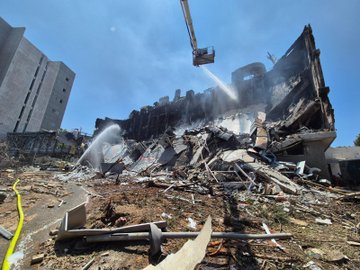
A recent Iranian missile strike has inflicted extensive damage on the Weizmann Institute of Science in Rehovot, central occupied Palestine, a facility long considered a cornerstone of the Israeli occupation’s scientific and military-industrial infrastructure.
According to The Marker, a daily business newspaper published by the Haaretz Group in “Israel”, several buildings within the institute sustained direct hits, with one key laboratory complex entirely destroyed by fire.
The targeted site housed advanced research in life sciences, artificial intelligence, and molecular biology, areas that have directly supported the Israeli entity’s development of surveillance, targeting, and weapons systems used in attacks across the region.
Described by Israeli media as the “scientific and military brain” of “Israel”, the Weizmann Institute has played a pivotal role in the research and development of technologies underpinning airstrike coordination systems, drone warfare capabilities, and battlefield medical technology, all of which have been deployed in repeated assaults on civilian populations in Gaza, Lebanon, Yemen, and most recently, Iran.
One of the laboratories destroyed was run by Israeli Professor Eldad Tzahor, a veteran in the Department of Molecular Cell Biology. Israeli Professor Eran Segal, whose AI lab was also directly hit, noted that millions of dollars’ worth of equipment was damaged beyond recovery due to water and structural damage. Segal’s lab had reportedly contributed to algorithmic systems used in battlefield decision-making and real-time surveillance, tools that have aided the Israeli entity’s strikes in Gaza and elsewhere.
Photos released by Israeli media showed scorched interiors, collapsed lab floors, destroyed electrical systems, and structural devastation, the result of what sources described as a precision strike.
Not a random target: A symbol of militarized science
While Israeli officials have downplayed the implications, The Marker acknowledged the strike was “not random,” but a calculated attack on a facility used for military power through scientific research.
Media reports also framed the operation as direct payback for the assassination of Iran’s nuclear scientists.
Experts say the institute’s deep ties to the Israeli security apparatus have made it a legitimate military target in Iran’s eyes, particularly given its support for advanced weapons technologies used to target civilians.
Israeli Professor Sharel Fleishman, whose lab was not impacted, admitted the losses are irreplaceable. “Life sciences labs rely on materials that are gathered and preserved over many years. When a lab is destroyed, and with it all those materials, it’s irreplaceable,” he said.
Another Israeli researcher, Professor Oren Schuldiner, told The Marker: “It’s as if the lab evaporated into thin air.” Schuldiner noted that rebuilding the affected laboratories and their capabilities will take at least two years.
The destruction of the Weizmann Institute sends a clear message from Tehran, analysts say: the Israeli occupation’s institutions cannot continue to serve dual roles as research centers and military enablers with impunity.
Trump Attacks Tucker Carlson Over Opposition to Iran War, Says He Decides What ‘America First’ Means
By Connor Freeman | The Libertarian Institute | June 16, 2025
President Donald Trump is lashing out against popular conservative talk show host Tucker Carlson. The acrimony emanates from Carlson’s strong opposition to the White House’s indirect military support for Israel’s war against the Islamic Republic of Iran. Trump declared he invented “America First” and he decides what it means while making his case for the potentially catastrophic war of aggression against Tehran.
On Monday, the president demeaned the influential pundit. Trump told reporters “I don’t know what [Carlson] is saying. Let him go get a television network and say it so that people listen.” In an interview with The Atlantic magazine this weekend, Trump was asked about Carlson’s comments against the war.
Trump responded “Well, considering that I’m the one that developed ‘America First,’ and considering that the term wasn’t used until I came along, I think I’m the one that decides [what it means]. For those people who say they want peace—you can’t have peace if Iran has a nuclear weapon. So for all of those wonderful people who don’t want to do anything about Iran having a nuclear weapon—that’s not peace.”
“America First” is a political slogan which has seen a phenomenal resurgence in the wake of Trump’s first presidential campaign. It has been used by politicians in both major parties and dates back more than a century ago. It originated as a rallying cry for neutrality during the First World War and was used as part of President Woodrow Wilson’s 1916 reelection campaign. The following year, Wilson betrayed his supporters by ordering American forces into the war and imposing conscription. Since then, the antiwar, nationalist slogan has been deployed by non-interventionists, particularly on the right, exemplified best by Pat Buchanan.
Despite Trump’s continued insistence otherwise, his own intelligence agencies confirmed this year that there is no evidence Tehran is building a nuclear weapon nor has there been any suggestion that a political decision has been made to abrogate Ayatollah Ali Khamenei’s fatwa against pursuing weapons of mass destruction.
On Friday, following Israel’s surprise bombing attack on Iranian nuclear facilities, residential areas, and military sites, Carlson released a newsletter denouncing US involvement in Prime Minister Benjamin Netanyahu’s war. It begins by quoting from Trump’s first inaugural address, “From this day forward, it’s going to be only America first. America first.”
The newsletter then reads, “Now that [Netanyahu] and his war-hungry government have executed their long-awaited assault, [Trump] faces a legacy-altering decision: to support or not to support?”
Carlson insists, “The United States should not at any level participate in a war with Iran. No funding, no American weapons, no troops on the ground. Regardless of what our “special ally” says, a fight with the Iranians has nothing to offer the United States. It is not in our national interest.”
The newsletter continues, with Carlson warning the consequences of supporting Israel will include future blowback terrorism against “the West” and “thousands of immediate American deaths, all in the name of a foreign agenda.” He concluded that a preferable option would be to “drop Israel” and “let them fight their own wars.” Carlson emphasized that because of the massive US military and financial aid to Tel Aviv, Trump is already “complicit in the act of war.”
World on the brink of new nuclear arms race – report
Israel is among the nations “believed to be modernizing its nuclear arsenal,” the Stockholm-based SIPRI institute has said
RT | June 17, 2025
The world risks plunging into a “new dangerous arms race” as most nuclear powers seek to modernize and expand their arsenals, the Stockholm International Peace Research Institute (SIPRI) has warned in its annual review.
The pace of disarmament is slowing as nuclear-armed states launch “intensive” arsenal modernization programs, the research center said in a paper published on Monday.
Russia and the US, which together possess around 90% of all nuclear weapons in the world, are set to see the last remaining bilateral nuclear arms control treaty – the New START – expire in February 2026, SIPRI noted. The agreement limits the number of simultaneously deployed strategic nuclear warheads.
Moscow suspended its participation in the treaty in 2023, citing the impracticality of the inspection regime due to deep Western involvement in the Ukraine conflict. However, it maintained that it remained open to dialogue on the issue if the arsenals of Washington’s NATO allies were also considered.
Washington, meanwhile, insists on including China in any new agreement. According to SIPRI, China possesses the fastest-growing nuclear arsenal in the world and could rival “either Russia or the USA” in the number of intercontinental ballistic missiles by the end of the decade.
The UK and France are also modernizing their nuclear forces, focusing on nuclear-powered ballistic missile submarines, the report said. Paris additionally aims to develop a new ballistic missile warhead.
“The era of reductions in the number of nuclear weapons in the world, which had lasted since the end of the Cold War, is coming to an end,” said Hans M. Kristensen, Associate Senior Fellow with SIPRI’s Weapons of Mass Destruction Program. “We see a clear trend of growing nuclear arsenals, sharpened nuclear rhetoric, and the abandonment of arms control agreements.”
The research institute also listed Israel among the nations “believed to be modernizing its nuclear arsenal.” While Israel does not officially acknowledge possessing nuclear weapons, SIPRI pointed to tests of new missile propulsion systems and alleged upgrades at the plutonium production reactor site in Dimona.
West Jerusalem could have up to 90 nuclear warheads at its disposal, the report stated. The findings come as Israel conducts air raids against Iranian nuclear and military facilities, claiming Tehran is nearing the creation of a nuclear bomb. Iran, which maintains that its nuclear program is peaceful, was not mentioned in the SIPRI report.
Zenith of Western asymmetric warfare in Iran and Ukraine
By Drago Bosnic | June 16, 2025
Achieving strategic advantage over your opponents has been at the center of every conflict in human history. In modern times, this is accomplished with long-range strike systems and weapons of mass destruction. However, countries that are at a disadvantage in that regard can opt for asymmetric methods to achieve similar or sometimes even more efficient results. Ever since the advent of nuclear weapons, direct conflicts between global powers have been avoided, as all sides understand there would be no winners in such a war (or at least they did until recently).
Thus, the importance of intelligence services and other forms of non-kinetic warfare grew exponentially. The ability to infiltrate your opponent’s state apparatus is of the utmost importance, while maintaining plausible deniability adds to the strategic depth of defense, as the attacker can simply deny the involvement of its special services.
The political West has been at the forefront of such operations for years, targeting all of its opponents through asymmetric means, particularly through proxies. This is especially true for Russia, which still has major issues with the Kiev regime agents infiltrating the country and conducting operations of strategic importance. The latest attacks on Russian strategic aviation are a testament to that. It should be noted that Moscow’s services have been quite successful in detecting Western agents as they have decades of experience in doing so.
However, Ukrainian operatives are a different story. Namely, the vast majority of Ukrainians speak fluent Russian and can easily blend in virtually anywhere in the country. They can also obtain Russian citizenship, meaning they could be largely under the radar for years. It’s exceedingly difficult to uncover such plots, particularly if they’re being conducted over the course of several years.
This also holds true for other countries of the multipolar world, including Iran, which has been heavily infiltrated by foreign agents, as evidenced by the sheer number of assassinations and so-called decapitation strikes on top Iranian commanders. It’s still unclear how exactly Israel managed to create such a large network of its agents within Iran, but their operations have had a strategic impact on the ongoing conflict.
The Mossad had very close ties with the SAVAK, former Iranian secret police and intelligence service during the Shah era, so it’s quite possible that the Israelis maintained contacts with their Iranian associates even after 1979. They could’ve easily played the role of sleeper agents who were activated by Israel at the moment of the strike. In addition, new operatives could’ve infiltrated Iran from neighboring countries, particularly Azerbaijan which maintains a close partnership with Israel.
Apart from being a major client for the Israeli Military Industrial Complex (MIC), which was instrumental in Baku’s takeover of native Armenian lands in Artsakh (better known as Nagorno-Karabakh), Azerbaijan also has irredentist ambitions toward northwestern Iran, where a homonymous area has more ethnic Azeris than the South Caucasus country itself. The regime in Baku certainly sees the ongoing events as a perfect opportunity to achieve its goals, which could be a major factor in Israeli operations.
Numerous observers have also pointed out the many similarities between the actions of the Kiev regime and Israel, as both have been conducting these asymmetric hybrid attacks deep within Russia and Iran, respectively. The drones that were used in attacks on Moscow’s long-range aviation and Iranian air defenses operate in a virtually identical manner, targeting strategic assets from within.
There are two possibilities in this case. Either the Mossad is involved in training the SBU and/or GUR, or they’re all connected into a much larger network run from Washington DC and London. The latter is much likelier, as both SBU and GUR have strong ties with the CIA and MI6, respectively. In other words, the US-led political West is conducting these operations in an attempt to secure a strategic advantage over its rivals.
This is also done through so-called “international” organizations such as the UN, OSCE, IAEA, etc. For instance, after the start of the special military operation (SMO), Russian military intelligence uncovered that OSCE, which is supposed to be a neutral organization monitoring the ceasefire, was actually helping the Kiev regime target Russian forces by giving the former access to its cameras along the frontline. Moscow promptly ordered OSCE personnel to leave after this.
Some sources are reporting that the IAEA also did something similar in Iran, by giving Israel information on the identity of Iranian nuclear scientists. If true, this could explain how the Mossad was so effective in eliminating them virtually on the first day of the attack. In addition to scientists, a large number of high-ranking Iranian military officers were eliminated within the country. This is perfectly in line with the political West’s doctrine of so-called “decapitation” attacks that aim to paralyze the chain of command in a targeted country.
Many of the most prominent warmongers in Washington DC have been calling for such strikes, even against opponents like Russia. And indeed, in the last several years, there have been a number of assassination attempts against top-ranking Russian officials, including President Vladimir Putin himself. Once again, this was done through proxies such as the Neo-Nazi junta.
In some cases, this could’ve also worked, as evidenced by disturbing revelations regarding the mysterious death of the late Iranian President Ebrahim Raisi and his Foreign Minister Hossein Amir-Abdollahian. The aftermath of Raisi’s death has been disastrous for Iran and its Axis of Resistance. By the end of last year, Syria fell to NATO’s terrorist proxies, while Hezbollah’s long-time leader Hassan Nasrallah was assassinated, followed by a number of high-ranking Iranian and pro-Iranian figures at around a similar time.
The strategic consequences of these events cannot be overstated, meaning that the idea they were purely accidental is extremely unlikely, to put it mildly. By the time Israel attacked Iran, the geopolitical situation in the Middle East shifted dramatically in Israel’s favor. This made launching strategic attacks much easier, as it didn’t have to worry about Syrian air defenses.
Mossad operatives on the ground used not only drones, but also missiles (such as the “Spike NLOS”). Worse yet, it seems they didn’t even have to stay in the country to launch these strikes, as both drones and missiles were controlled remotely, which is yet another indicator of the same modus operandi used by the Kiev regime. Military sources indicate that Israel also used portable electronic warfare (EW) systems to disrupt Iranian air defenses, making it far easier for its missiles to reach targets within Iran.
As previously mentioned, this sort of deep infiltration also enabled Israel to assassinate top-ranking personnel. Reportedly, this includes General Mohammad Bagheri, the Chief of the Iranian General Staff; Hossein Salami, Commander-in-Chief of the Islamic Revolutionary Guard Corps (IRGC) and David Sheikhian, commanding officer of the IRGC’s air defenses. Many other senior military leaders were also killed.
Although Israeli strikes were far more efficient than those launched by the Kiev regime, it’s impossible not to draw parallels with high-profile assassinations of numerous Russian public and military figures, including Lieutenant General Igor Kirillov, the late commander of Russian NBC Protection Troops, who was killed in a terrorist attack back in mid-December. It should be noted that he was investigating US involvement in biological warfare in NATO-occupied Ukraine and was in no way connected to military operations against the Neo-Nazi junta forces.
Thus, the only logical conclusion is that his assassination was certainly not conducted by the SBU of their own volition. Namely, such operations require significant resources that would be reserved for important operations to undermine the Russian military. The only thing that was undermined is the investigation into the Pentagon’s massive biowarfare program.
The Kiev regime conducted many similar attacks on Russian scientists, including Daniil Mikheev, a coordinator of new unmanned systems for the Ministry of Defense; Konstantin Ogarkov, an employee of a defense research institute in Voronezh; Igor Kolesnikov, an engineer at a design bureau in the Tula oblast (region); Sergei Potapov, a cybersecurity defense specialist from Nizhny Novgorod; Valery Smirnov, one of the leading experts in programs for radio-electronic protection of strategic facilities.
In January 2024, a car with officers from the electronic intelligence headquarters in the Bryansk oblast was blown up, while on the night of April 17-18, Evgeny Rytnikov, the head of the design bureau of the Bryansk Electromechanical Plant, the developer of the now legendary “Krasukha” EW systems, was also killed. Such assassinations are a testament to the terrorist nature of the Neo-Nazi junta, as all these people were non-combatants.
Among the prominent Iranian scientists killed by Mossad were Dr. Mohammad Mehdi Tehranchi, Dr. Ahmad Reza Zolfaghari, Dr. Abdolhamid Minuchehr, Dr. Amir Hosein Fekhi and Dr. Fereydoun Abbasi. Once again, it’s impossible not to draw parallels, despite the fact that Israeli strikes were far more strategically consequential.
Still, the main conclusion is that the political West continues to use its proxies to wage war on several countries simultaneously, while also maintaining plausible deniability.
The only way to counter such attacks is for the targeted countries to enforce tighter control over communications, as well as enlarge their intelligence apparatus. While these measures could be seen as “totalitarian” (and will no doubt be presented as such by the mainstream propaganda machine), there’s simply no other way to blunt the blade of the political West’s modern asymmetric hybrid warfare.
Drago Bosnic is an independent geopolitical and military analyst.
‘Israel’, US face risks in targeting Iran’s underground nuclear sites
Al Mayadeen | June 16, 2025
Recent Israeli strikes on Iranian military and nuclear-related facilities have revived questions about whether it is even possible to destroy Iran’s deeply buried nuclear infrastructure.
A March report by the Royal United Services Institute (RUSI) suggests that any attempt to do so would be highly difficult, dangerous, and ultimately uncertain in its outcome.
According to the report, taking out Iran’s underground enrichment sites, including Natanz and Fordow, would require extensive firepower, specialized weaponry, and direct US military support. Even then, success would not be guaranteed.
The study warns that such a mission should be seen as an “option of last resort,” given the risks of full-scale regional escalation and the technical challenges involved.
The Natanz site, one of Iran’s main uranium enrichment facilities, was among the targets hit in the latest Israeli strikes. However, the degree of damage remains unknown, particularly since its most sensitive infrastructure lies underground.
Estimates cited in the RUSI report suggest that parts of the Natanz facility are buried around 8 meters (26 feet) below ground. While “Israel” is believed to possess munitions that can penetrate up to 6 meters, the margin may be insufficient, especially if the underground structure is reinforced with layers of hardened concrete or rock.
Fordow facility likely out of reach for both US and ‘Israel’
Iran’s second major enrichment facility, the Fordow plant, is believed to be buried at a much greater depth, possibly between 80 and 90 meters (262 to 295 feet) below the surface. According to the RUSI report, this would place it beyond the reach of even the US military’s most powerful bunker-buster bomb, the GBU-57 Massive Ordnance Penetrator, which can penetrate around 60 meters.
Adding to the challenge, the GBU-57 can only be deployed by the US Air Force’s B-2 stealth bombers, an asset the Israeli regime does not possess, even if the US were to supply the weapon itself.
Beyond depth, Iran has employed architectural and engineering methods to make its nuclear facilities even more resilient to aerial bombardment. The RUSI report notes that facilities with narrow access shafts, multiple blast doors, and separate entry/exit tunnels are far more difficult to destroy than those with a single, large chamber or shaft.
This layered design could significantly reduce the likelihood of success, even if multiple precision-guided munitions were deployed in succession.
As tensions escalate, the report offers a clear warning: even a coordinated US-“Israel” effort to destroy Iran’s nuclear capabilities may fall short of its objective, while simultaneously risking a wider war.
Given the limitations of current munitions, the depth and complexity of Iran’s enrichment sites, and the potential for catastrophic fallout, the RUSI study concludes that targeting these facilities is a last-resort option, not a tactical shortcut.
Israeli confidence in missile defenses shaken amid Iran strikes
Al Mayadeen | June 16, 2025
After three consecutive nights of Iranian missile strikes, growing numbers of Israeli settlers are beginning to grasp a truth long acknowledged by military officials: the much-touted missile defense system is, in their own words, “not hermetic”, according to The Telegraph.
The ongoing Iranian strikes have revealed new vulnerabilities that are rattling public confidence, even among those who had previously felt secure in designated protective areas.
In one of the most alarming incidents yet, at least five more Israeli settlers were killed overnight, including two settlers in the illegal settlement of Petah Tikvah, located east of Tel Aviv.
According to the Army Radio, the two Israeli settlers were killed despite taking refuge in a reinforced shelter, a place believed to offer protection from such attacks.
The report confirmed that a ballistic missile from Iran struck directly between two fortified bunkers, rendering the so-called “protected space” ineffective under the concentrated impact of the warhead. The blast penetrated the structure with lethal force.
For years, public faith in “Israel’s” Iron Dome and layered defense systems has served as a psychological buffer against escalating regional threats. That confidence is now visibly eroding. Iranian ballistic missiles have continued to breach multiple layers of “Israel’s” missile shield in recent days, even as officials attempt to reassure the public.
As cited by The Telegraph, military spokespeople had long warned that the defense system was not infallible. But the extent of the damage and civilian deaths, even in areas with fortified infrastructure, is beginning to register more deeply with a population used to relying on technological superiority for survival.
Confidence wanes amid fear of more missile barrages
Though public support for the war on Iran remains strong on the surface, the increasing effectiveness of Iran’s missile salvos is prompting fear across the occupied territories.
Tehran has thousands of additional ballistic missiles, raising concerns about whether “Israel’s” air defenses can keep up.
For many residents, the traditional belief in the safety of reinforced rooms, often located within residential high-rises, has been a key factor in their willingness to stay put during times of conflict. That belief is now being challenged, especially as growing numbers of settlers assess Israeli officials hiding themselves and military infrastructure among civilians.
Army Radio’s detailed account of the Petah Tikvah strike has added to the public unease. The fact that casualties occurred inside designated Israeli safe rooms contradicts previous patterns in which fatalities were largely attributed to individuals who had not followed shelter protocols.
The psychological impact of this shift is significant. As The Telegraph notes, the death toll and visible damage are beginning to fray the edges of what was once unshakable national morale.
Featured Video

Alon Mizrahi: ‘Israel Must Be Dismantled’
or go to
Aletho News Archives – Video-Images
From the Archives
How a War with Iran Would Diminish American Power
By Greg Scoblete | The Compass | August 13, 2010
Jennifer Rubin wants a war with Iran:
But the emphasis on the existential threat to Israel ignores a more basic issue for Americans to ponder: a nuclear-armed Iran represents a dagger at the heart of America and an existential threat to our status as a superpower and guarantor of the West’s security. As to the former, Iran is pressing ahead with its long-range ballistic missile program. First the Middle East and Eastern Europe, then all of Europe and, within a matter of years, the U.S. will be within range of Iranian missiles. If those are nuclear and not conventional, what then? We’re not talking about whether Iran is going to be “merely” a destabilizing factor in the Middle East or whether it will set off an arms race with its neighbors or imperil Israel’s existence. We’re talking about whether America will then be at risk (and lacking sufficient missile-defense capabilities if we continue to hack away at our defense budget). The argument about whether mutual assured destruction can really work against Islamic fundamentalists who have an apocalyptic vision becomes not about Israel’s ability to deter an attack but about ours. Those who oppose American military action have an obligation to explain why America should place itself in that predicament.
I would argue that any obligation to present an explanation lies with those whose disastrous policy prescriptions with respect to Iraq lead America into the worst strategic blunder in the country’s recent history. That aside, note the blind faith in the power of the military to actually achieve its ends. … continue
Blog Roll
 Aletho News
- Villains of Judea: Leonid Radvinsky
- Alon Mizrahi: ‘Israel Must Be Dismantled’
- Former Head Of MI6 Admits That The U.S. And Israel Are Losing The Iran War
- Scattered Thoughts on War and Peace
- Iran Threatens to Close Red Sea to Shipping in Response to Invasion
- Iran in excellent position to prevail in war with US, Israel: John Mearsheimer
- Iran warns US: Do not call your retreat an agreement
- Neighbors first – Moscow signals shift in energy strategy
- Almost 400 Ukrainian drones downed over Russia in single night – MOD
- Battle for Hungary: How the Russiagate blueprint has been unleashed against Orban
- If Americans Knew
- In the West Bank, life is a constant battle – 3 articles
- Jacob Reses, one of the most powerful pro-Israel operatives in Trump’s Washington
- Israeli-US assaults kill or injure 87 children a day – Not a ceasefire Day 166
- ‘Forever live by the sword’: Understanding Israelis’ massive support for Iran war
- UN’s special rapporteur on human rights says Israel is systematically torturing Palestinians
- Trump White House plagiarized Iran war manifesto from Israel-aligned think tank
- Gaza says 6–10 patients die daily waiting for treatment abroad as Israel blocks medical evacuations
- ‘Substantial evidence’ of double-tap strike in killing of Gaza’s Hind Rajab
- ‘Do Not Want To Die For Israel’: Doubts About Trump’s Iran Strategy Spread Among Troops
- Instead of taking Joe Kent’s claims seriously, the media is disregarding him as an antisemite
- No Tricks Zone
- Devastating Assessment Of Comirnaty Vaccine By Former Senior Pfizer Europe Toxicologist
- New Study: CO2 Is ‘Effectively Negligible’ As An Explanatory Climate Change Factor Since 2000
- Former Pfizer Toxicologist Dr. Helmut Sterz Tells Bundestag Hearing Pfizer Vaccine Should Have Never Been Approved
- Energy Expert: Germany’s Nuclear Phaseout Was A “500 Billion Euro Mistake”
- New Research: South Australia’s Mid-Holocene Sea Surface Temperatures Were 4°C Warmer Than Today
- Storing Green Energy To Last Germany 10 Days Would Require A 60-Million Tonne Battery
- New Studies: UK Sea Levels Were 4 Meters Higher Than Today During The Mid-Holocene
- Destructive Green New Deal: German Energy And Metal Group Warns Of Drastic Crisis
- New Study Documents A 20-Year Pause In Arctic Sea Ice Decline – Driven By Internal Variability
- Wake-up Call: Survey Shows Majority Of Germans Now Favor Postponing Climate Targets!
 Aletho News