John McCain and the Desperate Flailing of Syrian Oppositionists’ External Supporters
By Flynt Leverett and Hillary Mann Leverett | Going to Tehran | June 3rd, 2013

Much was made last week about the infiltration of Sen. John McCain (R-Arizona) into Syria for a brief photo op with various anti-Assad “rebels”—who, it turns out, have allegedly been involved in kidnapping Lebanese Shi’a pilgrims. (Senator McCain claims that none of the individuals with whom he was photographed identified themselves by names of those accused of kidnapping Shi’a pilgrims; his spokesman says it would be “regrettable” if the Senator had been photographed with people accused of committing such acts.) Speaking at the Ronald Reagan Presidential Library, another GOP Senator, Rand Paul of Kentucky, noted acidly, “They say there are some pro-Western people and we’re going to vet them. Well, apparently we’ve got a senator over there who got his picture taken with some kidnappers, so I don’t know how good a job we’re going to do vetting those who are going to get the arms.”
In a blog post provocatively titled “Did John McCain Provide Material Support for Syrian Terrorists?”, see here, the Cato Institute’s Doug Bandow wrote that a recent Supreme Court ruling (Holder v. Humanitarian Law Project, issued in 2010) “upheld the [U.S.] government’s broad reading” of the statute that criminalizes “material support” for terrorism. In this reading, “coordinated political advocacy”—that is, advocacy coordinated with groups engaged designated by Washington as terrorist organizations—counts as material support. Those engaged in such “coordinated political advocacy” can be federally prosecuted; if convicted, they might go to jail for ten years.
In his post, Doug points to a number of cases where U.S. government’s expansive definition of material support for terrorism—now largely ratified by the Supreme Court—has produced disturbing legal outcomes. He argues that:
“lawmakers who approved the law should be subject to the same legal risks. Consider Sen. John McCain, who has been campaigning for war in Syria, just as he previously promoted war most everywhere else around the globe.”
After examining press reports on Sen. McCain’s trip to Syria—and on the activities of some of the rebels McCain met there—Doug concludes that Sen. McCain:
“would seem to have provided ‘material support’ to terrorists.”
“Having his photo taken with Islamic extremists could reasonably be interpreted as an endorsement, which, based on past cases, could be seen as providing ‘material support’ for terrorism. Presumably that isn’t what Sen. McCain intended. But the law’s application is not based on intent.
To be fair to the rest of us, the Justice Department should investigate…[A]s much as I oppose vague and ambiguous criminal enactments by the federal government, I would enjoy seeing Senator McCain in the dock, It would be cosmic justice for his support of the catastrophic invasion in Iraq and endless occupation of Afghanistan.”
After his drive-by photo op in “liberated” Syria, Sen. McCain apparently traveled to Yemen. We were struck by the Yemen Post’s report on his visit, see here; we also append the story below:
“According to several Yemeni-based local newspapers, US Senator John McCain, who briefly visited Yemen earlier this week to offer his support to the coalition government and discuss political and security developments is rumored to have directly urged President Abdo Rabbo Mansour Hadi to facilitate the transfer of Jihadists to Syria.
As the Free Syrian Army is struggling to secure its advances against Syrian President Bashar al-Assad, whose lists of supporters while thin remains mighty in military might, Washington and its allies in the region are said to be looking at ways to swell the ranks of the opposition by allowing foreign fighters to enroll against Assad regime.
In a move which analysts have already qualified as dangerous given the repercussions a similar policy led to in the 1980s, when Jihadists were sent to fight off Russian troops in Afghanistan, security experts worry al-Qaeda will use this opportunity to increase its recruitment pool while offering precious ground experience to its militants, which experience would be used later on against Yemen central government.
A source told several newspapers, ‘Senator McCain’s visit was to drum up support for Jihadist groups fighting Bashar al-Assad regime.’
While the government has so far refused to comment on the issues, quite understandably since its military is still locked in an on-going military struggle against Islamic operatives in its southern provinces, all the while preparing for the return of some Gitmo terror prisoners. Yemeni officials would have a difficult time reconciling the idea of Jihad in one place while fighting off the same rhetoric in its own backyard.”
If true, the Yemen Post report could be construed as another piece of evidence against the apparently terrorist-supporting Sen. McCain. For, according to this story, McCain lobbied the Yemeni government to send more jihadi fighters to Syria, in order to swell the ranks of groups engaged in terrorist activity—representatives of which the Arizona senator had met with immediately before traveling to Yemen.
What all of this suggests is the mounting desperation that advocates of using Syrian oppositionists—whether Syrian or not—to overthrow the Assad government must now be feeling. Their project has failed. But, rather than accept this failure, many, like Sen. McCain, want the United States to double down on their unsuccessful pseudo-strategy—to provide still more support the opposition forces, and even to become directly involved militarily (through no-fly zones, etc.).
Fifty-two years ago, the United States foolishly tried to overthrow Fidel Castro’s government by invading Cuba with a force of anti-Castro rebels. When that force, unsurprisingly, got into trouble almost immediately upon landing in Cuba, there were those who wanted President John F. Kennedy to order U.S. air support for the rebels. While Kennedy made a huge blunder by proceeding with the invasion in the first place, he was sufficiently astute at least not to compound his mistake by taking the United States into an overt, aggressive war against Cuba (certainly a covert campaign of aggression was already underway).
Similarly, President Obama has made egregious blunders in his policy toward Syria since March 2011. Let’s hope he doesn’t compound them by listening to John McCain and others desperate to hold on to delusions of American empire in the Middle East.
Related article
Democracy in Turkey: Peaceful Protest Turns Violent as Police Fire Teargas
Al-Manar | June 1, 2013
Turkish police fired tear gas and water cannon on Friday at demonstrators in central Istanbul, wounding scores of people and prompting rallies in other cities in the fiercest anti-government protests in years.
Thousands of demonstrators massed on streets surrounding Istanbul’s central Taksim Square while protests erupted in the capital, Ankara, and the Aegean coastal city of Izmir.
Broken glass and rocks were strewn across a main shopping street near Taksim. Primary school children ran crying from the clouds of tear gas, while tourists caught by surprise scurried to get back to hotels lining the square.
The unrest reflects growing disquiet at the authoritarianism of Prime Minister Recep Tayyip Erdogan and his Islamist-rooted Justice and Development Party (AKP).
Riot police clashed with tens of thousands of May Day protesters in Istanbul this past month. There have also been protests against the government’s stance on the conflict in neighboring Syria.
“We do not have a government, we have Tayyip Erdogan. … Even AK Party supporters are saying they have lost their mind, they are not listening to us,” said Koray Caliskan, a political scientist at Bosphorus University, who attended the protest.
The protest at Taksim’s Gezi Park started late on Monday after trees were torn up under a government redevelopment plan, but has widened into a broader demonstration against Erdogan’s administration. Friday’s violence erupted after a dawn police raid on demonstrators who had been camped out for days.
“This isn’t just about trees anymore, it’s about all of the pressure we’re under from this government. We’re fed up, we don’t like the direction the country is headed in,” said 18-year-old student Mert Burge, who came to support the protesters after reading on Twitter about the police use of tear gas.
Thousands chanting for the government to resign gathered at a park in the center of Ankara, where police earlier fired tear gas to disperse several dozen opposition supporters trying to reach the AKP headquarters. Protesters also rallied at two locations in Izmir, according to pictures on social media.
A woman was in critical condition last night after being hit by a police gas canister and underwent an operation after suffering a brain hemorrhage.
A total of 12 people, including a pro-Kurdish MP and a Reuters photographer, suffered trauma injuries and hundreds suffered respiratory problems due to tear gas, doctors said.
Some people were injured when a wall they were climbing collapsed as they tried to flee clouds of tear gas.
Amnesty International said it was concerned by “the use of excessive force” by the police against what had started out as a peaceful protest. Ria Oomen-Ruijten, the European parliament rapporteur on Turkey, also voiced concern.
In Washington, the State Department said it was concerned with the number of injuries and was gathering its own information on the incident.
“We believe that Turkey’s long-term stability, security and prosperity is best guaranteed by upholding the fundamental freedoms of expression, assembly and association, which is what it seems these individuals were doing,” State Department spokeswoman Jen Psaki told reporters.
Interior Minister Muammer Guler promised that allegations that police had used disproportionate force would be investigated.
Hundreds of military officers have been jailed for plotting a coup against Erdogan in recent years. Academics, journalists, politicians and others face trial on similar charges.
He has made no secret of his ambition to run for the presidency in elections next year when his term as prime minister ends, increasing opposition dismay.
“These people will not bow down to you” read one banner at the Gezi Park protest, alongside a cartoon of Erdogan wearing an Ottoman emperor’s turban.
Postings on social media including Twitter, where “Occupy Gezi” – a reference to protests in New York and London last year – was a top-trending hashtag, and Facebook said similar demonstrations were planned for the next few days in other Turkish cities including Ankara, Izmir, Adana and Bursa.
America’s Long History of Bloodletting
By Lawrence Davidson | Consortium News | May 30, 2013
There is an American tradition of frequent war. Indeed, over the course of the country’s history the United States has been at war almost constantly. Some of these have been relatively short conflicts like interventions in various Central American venues. Some have been much larger and longer affairs, like the Civil War, World War II and Vietnam.
The point to be drawn from this is that the people of the United States are (perhaps unconsciously) acclimated to always being in one sort of armed conflict or another. Unfortunately, this history renders a recent public statement by the Pentagon’s general counsel, Jeb Johnson, into just a bit of fanciful idealism. He insisted “war must be regarded as a finite, extraordinary and unnatural state of affairs.” Certainly not for Americans.
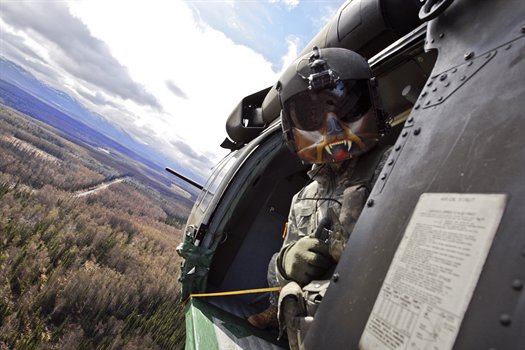
An Army sergeant peers out the door of a UH-60 Black Hawk helicopter on the way to pick up soldiers in a training operation at Joint Base Elmendorf-Richardson, Alaska, May 23, 2013. (U.S. Army photo by Percy Jones)
With their active assumption that the U.S. represents the world’s best chance for the victory of “good” against “evil,” Americans seem willing to battle on as long as they are convinced they are winning and the casualties are low. That may be why there was no popular protest when Michael Sheehan, Obama’s assistant secretary of defense for “special operations,” told a Senate hearing that the country’s “war on terror” might last “at least 10 or 20 years” longer (it has already been going on 12 years). In the mainstream media, there was not even a noticeable raising of an anchorperson’s eyebrows!
The reason given for Sheehan’s prognosis was that al-Qaida, and its franchise allies, keep recreating themselves as fast as their alleged leaders can be droned into oblivion. Missing from the congressional and media reaction was the obvious question of “how come” such groups keep recreating themselves?
Many middle-echelon State Department analysts familiar with the Middle East know the answer has something to do with the fact that U.S. policies in the region have not significantly changed since the 9/11 attacks. Most of the personnel above the middle echelon are political appointees who keep asserting that what motivates the al-Qaida types is religious fanaticism.
Of course there are religious fanatics at work on both sides of the “war on terror,” but those in the Middle East have grievances to focus on and U.S. policies are seen as one source of those. The fact that the “war on terror” is largely a consequence of American policies cemented into place by powerful special interests calls into question President Barack Obama’s recent assertion that “this is a just war, a war waged proportionally in last resort and in self-defense.”
It also suggests that the struggle is likely to go on and on until its ruinous consequences become so obvious to the voting public that the politicians are forced to break with their special-interest supporters. This is the real criterion for change, for, under the present circumstances, there will always be “terrorists” out there who, to reword (and correct) an assertion by President George W. Bush, “hate our policies.”
And what is there not to hate about draconian sanctions, the arming of dictators, and giving opened-ended support to the most racist state in the region?
Rules of Engagement
In the meantime, President Obama has been trying to create “rules of engagement” for the use of the government’s primary weapon in this endless war: those remote controlled bombs we call drones. These rules will, he says, provide “clear guidelines, oversight and accountability” and satisfy partisan congressional grumblings, if not the more pertinent questions of human rights advocates.
To this end the White House has issued guidelines concerning procedures for counterterrorism operations such as drone attacks. The guidelines tell us “there must be a legal basis for using lethal force” and decisions to use such “force against individual terrorists outside the United States and areas of active hostilities are made at the most senior levels of the U.S. Government.” The document then lays out other specific preconditions for the use of lethal force, among which are:
1. “Near certainty” that the terrorist target is present.
2. “Near certainty” that noncombatants will not be injured or killed.
3. An assessment that “capture is not feasible at the time of the operation.”
4. An assessment that the relevant governmental authorities in “the country where action is contemplated cannot or will not effectively address the threat to U.S. persons.”
5. An assessment that “no other reasonable alternatives exist” to effectively address the threat to U.S. persons.
Finally, “International legal principles, including respect for sovereignty and the law of armed conflict, impose important constraints on the ability of the United States to act unilaterally – and on the way in which the United States can use force. The United States respects national sovereignty and international law.”
The problem with these guidelines, beyond a number of undefined terms such as “near certainty,” “reasonable” and “feasible,” is that its criteria misrepresent reality or are utterly unreliable. For instance, under international law there is no “legal” basis for this sort of use of “lethal force.”
What the Obama administration (and the Bush regime before it) has done is take up the illegal Israeli “targeted assassination” program, which constitutes the behavior of a rogue state. Even from a domestic legal prospective, Obama’s criteria for targeted assassination will be carried out behind closed doors. There will be no due process. And there will be no accountability for “mistakes.”
Finally, nothing in the guidelines is enacted into legislation and therefore, assuming an effort to actually follow their criteria, they are specific to the Obama presidency and have no authority over his successors. As Kenneth Roth, director of Human Rights Watch, put it, “a mere promise that the U.S. will work within established guidelines . . . provides little confidence that the U.S. is complying with international law.”
Throughout the country’s history of one war following another, there has been a parallel history of cyclical deterioration and recovery of constitutional rights.
However, with the government’s wholehearted embrace of targeted assassination, as well as modern surveillance technology and the precedent of offshore prisons for “enemy combatants,” one wonders if, from now on, the recovery of rights will ever be fully equal to their loss. Maybe now it really will be all downhill for freedom in the “land of the free.”
~
Lawrence Davidson is a history professor at West Chester University in Pennsylvania. He is the author of Foreign Policy Inc.: Privatizing America’s National Interest; America’s Palestine: Popular and Official Perceptions from Balfour to Israeli Statehood; and Islamic Fundamentalism.
Detroit cop goes on trial for killing 7-year-old girl
RT | May 29, 2013
A Detroit police officer charged with fatally shooting a 7-year-old girl while she was asleep on her couch will stand trial in June. The fatal gunshot was recorded by a reality TV crew, which was filming an episode of “The First 48.”
Aiyana Stanley-Jones, a 7-year-old girl from Detroit, was shot in the head while a SWAT team conducted a midnight raid of her two-story home, tossed a flash grenade through a window, fired the bullet that killed her, and burst through the front door on May 16, 2010.
Police officers were searching for a murder suspect accused of killing a 17-year-old boy and were accompanied by a camera crew recording the raid for a reality A&E TV show called “The First 48” – a show that closely resembles “Cops”. The TV show tracks murder investigations in the immediate aftermath of a slaying, and provides viewers with real-life police drama.
But that quest for drama overstepped its boundaries on that fatal night three years ago. Officer Joseph Weekley, a then-member of the Detroit Police Special Response Team, was carrying the gun that shot that little girl. Police claim that the weapon accidentally discharged after Weekley bumped into the girl’s grandmother. But if convicted of involuntary manslaughter, Weekley could face a maximum penalty of 15 years in prison.
The cop has been accused of acting with gross negligence by failing to prevent his gun from firing. The victim was one of four young children that were in the home at the time of the raid. Video footage gathered by the A&E camera crew will serve as evidence in the case, but videographer Allison Howard is also facing charges. The camerawoman was indicted on perjury and obstruction of justice charges after she was accused of withholding crucial video footage from authorities, while sharing it with unspecified “third parties”.
The shooting, together with the presence of “The First 48” camera crew, shocked and outraged Detroit residents and prompted Mayor Dave Bing to ban reality TV crews from shadowing police in Detroit. He also prompted then-Police Chief Warren Evans’ resignation for failing to inform the mayor that he was allowing TV cameras to accompany police raids. Evans was allegedly also planning to partake in a different reality TV show, in which he would be the star, AP reports.
“Police work is not television, and television work is not police work,” Ron Scott, spokesman for Detroit Coalition Against Police Brutality, told AP. “The two combined to make it a horrific night.”
Scott also referred to the raid and the shooting as a “military assault on a private dwelling”.
On Friday, Weekley appeared at a Detroit courthouse to file a motion for dismissal of the case against him. About 30 protesters, led by the victim’s family, gathered at the courthouse, chanting “Justice for Aiyana” and “No Justice, No peace”. Weekley’s motion was dismissed, and a jury for the case will be selected May 29.
“It shouldn’t have taken three years for this to come to justice when a little girl died,” Scott told MLive.
The UK’s intransigence in the EU shows the West’s true intentions in Syria
By Phil Greaves | notthemsmdotcom | May 28, 2013
The UK Foreign secretary William Hague, and his French counterpart Lauren Fabius, are leading an isolated charge within the EU to lift a supposed arms embargo to self-described ‘rebels’, hitherto destroying Syria for over two years. Several underlying factors need to be addressed before these diplomatic (some would say military) manoeuvres are put into context.
Firstly, the most obvious issue with allowing the UK and France to freely arm ‘rebels’ of their choosing inside Syria is that this policy is against all international law, and will, as proven already to be the case, continue to vastly exacerbate the growing death toll and displacement in Syria. As the head of arms control at Oxfam noted:
“Transferring more weapons to Syria can only exacerbate a hellish scenario for civilians. If the UK and France are to live up to their own commitments – including those set out in the new arms trade treaty – they simply must not send weapons to Syria.”
Acting under the auspices, or “consultation” of Western intelligence services, Qatar, Saudi Arabia, Turkey, and non-state actors sending thousands of tonnes of arms and funds to extremist militants in Syria; is directly synonymous with both a huge increase in casualty numbers and civilian displacement; and the huge rise and proliferation of extremist militants operating in Syria. This highlights, as previous conflicts in the region have shown; that further Western military intervention is not about to bring peace and harmony to a nation already engulfed in the throes of war (much of which western powers promoted and enabled). But peace and harmony are not on either France, nor the UK’s list of priorities in the region; removing President Assad and weakening the state of Syria, Iran’s staunch ally, most certainly are. It seems the less Imperial-minded states of the EU, and indeed, those less attached to US militarism and designs for the Middle East, were incensed by Hague and Fabius’ stubborn attempts to stifle the popular opinion within the EU that sending yet more military equipment to a disparate melee of extremist rebels may be of dire consequence. Hague, with his vast intellect, failed to acknowledge this most obvious of pitfalls, and seems more eager than war-mongerer/profiteer US Senator John McCain is to feed into the western public the idea that ‘moderate’, or ‘secular’ minded ‘rebels’ in Syria actually exist.
To quote an equally moral and intelligent Western statesman, the UK is acting on the policy of “unknown unknowns”. Hague et al claim to know of ‘moderate’ and ‘secular’ fighting forces wishing to take up arms against the Syrian Government; yet literally no one in Syria or analysing the conflict from afar is able to find them. As the weapons flow increased and the funds from Gulf donors magnified, it has been the most extreme sectarian elements of militia that have been bolstered by such support, and indeed, further encouraged by Western diplomatic cover and the dutiful Western mainstream media’s glowing appraisals of freedom fighters and ‘rebel’ propaganda. This has only enabled the Jihaddi/Salafist elements hell-bent on sectarian violence and destruction to gain in recruits and popularity. As in Central America, Afghanistan, Libya, Serbia, Kosovo, etc: these extremist elements form the ‘Shock Troops’ of a Western designed subversion model; used to great effect by Western powers to enable the social and structural destruction of a nation “outside the West’s sphere of influence”, in order to bring about regime change.
Libya, again, provides us with a recent, and very much relevant example of how the UK and France are free to manipulate what are, when first employed, supposedly ‘humanitarian’ measures to fit their own military and Imperial advantage. When the No Fly Zone resolution over Libya was first passed in the UN, it was designed to enable ‘rebel’ forces in Libya to “protect the civilian population” from air and armour attacks from the Libyan Army. What ensued almost immediately after the resolution passed was nothing of the sort: the UK and France – under US direction – took it upon themselves, in almost 10,000 airstrike sorties within six months, to not only destroy all of Libya’s meagre air-force and armour, but destroy the vast majority of the infrastructure Gaddafi had built. This ran alongside a targeted assassination campaign against Gaddafi himself to bring about the desired regime change, which just by chance, also happens to be completely against international law. The results of which were neither in the interest of civilians or humanitarianism. As former MI5 officer Annie Machon put it:
“They’ve had free education, free health, they could study abroad. When they got married they got a certain amount of money. So they were rather the envy of many other citizens of African countries. Now, of course, since NATO’s humanitarian intervention, the infrastructure of their country has been bombed back to the Stone Age,”
This “bombing back to the stone age” is what Imperialist apologists might term: holding down the competition. As previously noted by many a statesman and scholar, the last thing any Western government desires is the self-determination and independence of resource-rich, strategically placed nations.
Furthermore, as candidly revealed by Hague himself, the UK and France’s pressure to lift the embargo is solely designed to pressure the Assad government to meet their demands, stating: (my emphasis)
“[it is] important for Europe to send a clear signal to the Assad regime that it has to negotiate seriously, and that all options remain on the table if it refuses to do so”.
One thing is certain, Hague does not speak for Europe. 25 of the 27 European nations were against the lifting of the embargo. The French and British refusal to accept the popular consensus meant that no decision or required extension of the current embargo could be made, resulting in its expiration. This in turn allows EU states to act as they please, as Hague said himself, this was the exact outcome the UK was hoping for. Once more, Hague is speaking with no authority, only 16% of the UK population agree to sending arms to ‘rebels’ in Syria: UK democracy in action.
The desired outcome of the lifting of the EU embargo will be increased military support to what the CIA, and NATO aligned governments describe as “vetted moderate” rebel forces. Which for all intents and purposes, simply don’t exist. The more likely outcome will be to create further reluctance of the Syrian ‘opposition’ elements within the SNC to negotiate with the Assad Government; further encouraging them and the extremist elements on the ground in Syria to continue their futile quest for a military solution. This policy will embolden extremist rebels fighting the Syrian Army in the hope they are to receive further Western support, with the ultimate desire of Western intervention just around the corner.
As Hague warns of “conflict spread”, which is evidently already occurring in Northern Lebanon, and inextricably linked to increased sectarian strife in Iraq; his Orwellian mindset seems unable to realise that adding more arms to this conflict ridden region will result in anything other than further destabilization. Surely Western powers cannot uphold this pretence any longer, it is glaringly obvious to many that Western involvement and “concern” over Syria has nothing to do with the civilian population and everything to do with regime change by all means necessary, including the tacit arming, funding and diplomatic support of extremist Al Qaeda affiliated ‘rebels’.
Furthermore, while the UK was desperate to lift the arms embargo on Syrian ‘rebels’. It was at the forefront of attempts to uphold the crippling economic sanctions put in place against the Syrian Government. These sanctions, as applied to devastating effect many times before, are again, solely designed to punish the civilian population in attempts to create civil unrest and discord against the Syrian government to bring about regime change, a wholly illegal act in itself. Hague, in another world-class show of diplomatic cognitive dissonance, candidly admitted the failure of these sanctions as a reason to lift the arms embargo, stating: “The EU arms embargo must be lifted because the current economic sanctions regime is ineffective.” If the economic sanctions aren’t working, yet evidently punishing the civilian population, why is the EU keeping them in place? Simply as a tool to further pressurize the Syrian Government and push the civilian population into chaos, poverty and revolt.
Whilst the UK government declares a “battle against terrorism” on its own soil, its Foreign Policy wilfully follows the Western trend of fomenting, arming and supporting the very same ideologues abroad. All to suit the pernicious Western establishment agenda of economic and military dominance throughout the Greater Middle East and beyond.
Related articles
- EU Continues with US-Led Sanctions against Syrians as It Scraps Arms Embargo
- Syria: Border Clashes Pit FSA Against Kurds
- Several injured in Syrian rocket attacks on Lebanon
Qatar seeks to send Yemen’s military elite to fight alongside the Free Syrian Army
Yemen Post | May 27, 2013
Qatar which has been a staunch supporter of the Free Syrian Army against President Bashar al-Assad in Syria is now looking to enroll Yemen’s military elite to fight alongside other Arab-backed militias in a bid to offset Assad’s recent advances against the opposition.
Yemen Republican Guards, Yemen’s best of the best, the very units which were meant to ward off former President Ali Abdullah Saleh’s foes are now being bid for by foreign powers in a regional effort to depose Syria’s regime.
Faced with the very possibility that Assad could after all outrun his enemies, strong of the support of Iran and the Hezbollah and restore his hold over the country, the Free Syrian Army has turned to his sponsors for support, awaiting more troops and more weapons.
While regional powers have committed money and military equipment, as well as allowed volunteers to cross over onto Syria to swell the resistance ranks, none has so far agreed to commit men to the conflict, a move which would equate to a declaration of war against the Syrian regime.
Qatar is now looking to by-pass the hurdle by sending Yemen Republican Guards to the front. Of course the men would go in their civilian capacity, hired as mercenaries by the State of Qatar.
According to local newspapers, Qatar would be looking to enroll 10,000 soldiers.
Military officials have warned that such a move would leave Yemen vulnerable, its defenses weakened.
Russia slams end of EU arms embargo, calls S-300s ‘stabilizing factor’ in Syria
RT | May 28, 2013
The failure of the European Union to agree on a new arms embargo for Syria is undermining the peace process, Moscow says. But the delivery of S-300 surface-to-air missiles may help restrain warmongers.
The comments come from Deputy Russian Foreign Minister Sergey Ryabkov, referring to the results of Monday’s meeting in Brussels. After a lengthy negotiating session, EU governments failed to resolve their differences and allowed a ban on arming the Syrian opposition to expire, with France and Britain scoring an apparent victory at the expense of EU unity.
The EU’s move, which the Russian diplomat branded as an “example of double standards”, opens the door for Britain and France to supply weapons to Syrian rebels fighting the regime of President Bashar Assad.
Criticizing Europe’s decision to open the way for potential arms shipments to Syrian rebels, Russia insists that its own sale of arms to the Syrian government helps the international effort to end the two-year-long conflict, the diplomat added. He was referring to the delivery of the advanced S-300 long-range air defense systems, which Russia is carrying out under a contract signed with Syria several years ago.
“Those systems by definition cannot be used by militant groups on the battlefield,” Ryabkov said. “We consider this delivery a factor of stabilization. We believe that moves like this one to a great degree restrain some hotheads from escalating the conflict to the international scale, from involving external forces.”
The S-300 is a series of Russian long-range surface-to-air missile systems designed to intercept ballistic missiles, regarded as the most potent weaponry of its class. The missiles are capable of engaging aerial targets as far away as 200km, depending on the version used.
Once the Russian SAM missiles are deployed by Syria, it will have a better control of its airspace. The country endured three airstrikes this year, which are widely thought to have been conducted by Israel, but were never officially confirmed as such.
Britain and France have made a commitment not to deliver arms to the Syrian opposition “at this stage,” an EU declaration said. EU officials, however, said the commitment effectively expires on August 1.
London and Paris have argued support for rebels fighting Assad by allowing EU arms deliveries, despite the fact that extremist elements are known to work alongside the rebels.
Other EU governments, led by Austria and Sweden, argued that sending more weapons to the region would increase violence and spread instability.
Russia’s envoy to NATO Aleksandr Grushko said that the abolition of the EU arms embargo on the Syrian opposition will only exacerbate armed conflict in that country.
“We need to refrain from taking steps that would be contrary to this logic. Such steps include armed or non-lethal support to the opposition. This just adds fuel to the fire,” Grushko said on Tuesday.
Meanwhile, Moscow and Washington remain undecided as to the content of a proposed international conference on Syria, according to Deputy Foreign Minister Sergey Ryabkov.
“There remains a gap between the positions of Russia and the US regarding some issues and aspects of this major international crisis,” he emphasized.
“And we, for our part, cannot agree to hold such events [the international conference on Syria] amid a situation where partners and possible participants in such a conference seek to impose solutions on the Syrian people from the outside, as well as predetermine the course of a transitional process, the parameters of which have not been determined yet,” Ryabkov said.
Related article
EU Continues with US-Led Sanctions against Syrians as It Scraps Arms Embargo
By Franklin Lamb | Al-Manar | May 28, 2013
Beirut – Under withering pressure from Washington and the UK, the European Union met this week to decide whether to increase the pressure on the Syrian public by repealing the March 2011 arms embargo that was intended to prohibit arms shipments to Syria and whether or not to continue economic sanctions against the Syrian public.
On 5/27/13 it decided to open the flood gate of arms flow into Syria and to keep the civilian targeting economic sanctions in place.
Lobbying for scrapping the arms embargo, set to expire at midnight on 31 May, had reached nearly historic intensity at EU HQ in Brussels, London and Washington. Recently, the US State Department demanded that every one of the 27 European Ambassadors posted in the US appear at the State Department for “consultations to avoid any misunderstandings about what the White House was expecting at the upcoming EU meeting.”
US Secretary of State John Kerry had been urging the EU to gut the arms embargo so as to expedite weapon shipments to the rebels. It currently appears that Britain now has the support of France, Italy and Spain, while Germany appears neutral and Austria, Finland, Sweden and the Czech Republic are still opposed. “Fine for him to say, but what is Washington willing to do?” one European foreign minister opposed to lifting the ban put it to BBC correspondent Lyse Doucet.
This week’s EU meeting, which was postponed three months ago, raised again the obligation of the international community to respect the laws of armed conflict and the Geneva Convention with respect to protecting the civilian population during armed conflicts and virtually every other international humanitarian law requirement.
For the American administration, designing and applying economic sanctions in order to pressure a population to break with its government to achieve regime change or any other political objective, as in the case of both Syria and Iran are fundamentally illegal under US law.
Just as soon as a group of Syrian-Americans and/or Iranian-American file a class action lawsuit in US Federal District Court ( the Court will have in persona and subject matter jurisdiction and the Plaintiffs will have standing to sue, given that they are American citizens) and the day after filing when they would no doubt file a Motion petitioning the Court for an Interim Measure of Protection (injunction) immediately freezing and lifting the US-led sanctions against the two countries civilian population, pending the final Court (Jury Trial) on the merits, the Obama administration is going to face serious judicial challenges to its outlawry.
William Hague, the UK Defense Minister, was quite active the past several days supporting the various Syrian militias’ arguments including: “The EU arms embargo must be lifted because the current economic sanctions regime is ineffective.” Presumably the right honorable gentleman means by “ineffective” that these brutal sanctions have not broken the will of the populations to settle their own affairs without transparent foreign interference. This is true if by “effective” Hague means that the US-led sanctions, that target Syria’s civilian population for purely political purposes of regime change, will cause the people of Syria, who unlike their leaders, are the ones directly affected by the sanctions to revolt over the lack of medicines and food stuffs plus inflation at the grocery stores.
Mr. Hague surely must be aware that very rarely, if ever at all in history, have civilian targeted sanctions designed to cause hardships among a nation’s population for purely political purposes actually broken the population such that they turned against their governments. Both the Syrian and Iranian sanctions have confirmed history’s instruction that the civilian targeting sanctions imposed from outside tend to have the exact opposite intended effect. This is true particularly modernly with more available information, and that the populations turn not against their national governments but rather against those foreign governments viewed as being responsible for these crimes.
The British, French, Turks and the Americans (the latter, not actually an EU member but then, who would know from its involvements in EU deliberations?) were the zealots in Brussels advocating amendment of the imposed arms embargo so that weapons can be sent to “moderate” forces in these countries largely nurtured and sustained “opposition”.
The UK Defense Minister gave his colleagues repeated assurances that weapons would be supplied only “under carefully controlled circumstances” and with clear commitments from the opposition… We have to be open to every way of strengthening moderates and saving lives rather than the current trajectory of extremism and murder.” The assurances have apparently convinced very few.
Unanimity was needed to repeal the embargo and several countries were opposed. So it was allowed to lapse. One Austrian official told the BBC that allowing lethal weapons to be sent into a war zone “would turn EU policy on its head.” Another European diplomat insisted that “It would be the first conflict where we pretend we could create peace by delivering arms,” the diplomat said. “If you pretend to know where the weapons will end up, then it would be the first war in history where this is possible. We have seen it in Bosnia, Afghanistan and Iraq. Weapons don’t disappear; they pop up where they are needed.”
Oxfam warned before and after the vote of “devastating consequences” if the embargo ends.”There are no easy answers when trying to stop the bloodshed in Syria, but sending more arms and ammunition clearly isn’t one of them,” the aid agency’s head of arms control, Anna Macdonald told the media this week.
The result of the predicted 5/27/13 European Union meeting prevented the renewal of the arms embargo on Syria, raising the possibility of a new flow of weapons to various jihadist militias working with Qatar and Saudi Arabia, among others, to bring down the government of President Bashar al-Assad.
Sustaining a personal rebuke of sorts given that the EU did not affirmatively oppose the embargo as he had hoped, William Hague, the British foreign secretary, told the media after more than 12 hours of stormy talks: “While we have no immediate plans to send arms to Syria, it gives us the flexibility to respond in the future if the situation continues to deteriorate and worsen,”
As a claimed safeguard of some kind, according to EU officials, the European Union declared that member states who might wish to send weapons to Syrian rebels “shall assess the export license applications on a case-by-case basis” in line with the organization’s rules on exports of military technology and equipment.
Some of the 27 EU countries are now even more concerned that anti-aircraft and anti-tank weapons given to “moderate” militiamen (per Libya?) would end up Lord knows where, in the hands of salafist, jihadist-takfiri militants, including those from the al-Nusra Front, which has pledged fealty to al-Qaeda in Iraq.
The current embargo includes the following:
- Ban on export/import of arms and equipment for internal repression since May 2011All Syrian cargo planes banned from EU airports
- All Syrian cargo planes banned from EU airports
- EU states obliged to inspect Syria-bound ships or planes suspected of carrying arms
- Assets freeze on 54 groups and 179 people responsible for or involved in repression [many who are not involved in decision making are included-ed]
- Export ban on technical monitoring equipment
In February this year, EU foreign ministers agreed to enable any EU member state to provide non-lethal military equipment “for the protection of civilians” or for the opposition forces, “which the Union accepts as legitimate representatives of the Syrian people”.
As is its habit recently, the European External Action Service (EEAS), the EU’s diplomatic service, has spoken on both sides of this critical issue. On the one hand it has cautioned against “any counterproductive move” that could harm the prospects of the Geneva conference and suggests extending the embargo to allow “more time for reflection”. On the other suggesting that lifting the arms embargo would only prolong the war.
The practice of targeting a civilian population by outsiders in order to achieve political objectives such as regime change is fast heading for the dustbin of history given its blatant violation of all norms of international humanitarian law and common decency reflected in the values of most societies.
This week revealed on which side of history the European Union has chosen to anchor itself on the issue of targeting civilian populations in a blatant attempt to achieve regime change. It affirmatively voted “to renew all the economic sanctions already in place against the Syrian government.”
One imagines, as surely the EU is aware, that officials are not suffering much from the economic sanctions, but rather it is exactly those the EU claims to want to help, who will continue to suffer rises in the cost of living generally as well as the sanctions causing shortages of medicines and medical equipment as well as specialized cancer treatments and other medicines for seriously ill drug-dependant citizens.
Related article
- EU nations split over Syria weapons embargo (morningstaronline.co.uk)
Featured Video

Anthrax War – CBC The Passionate Eye
or go to
Aletho News Archives – Video-Images
Book Review
Shattered Dreams: The HPV Vaccine Exposed (2019)
By Christina England – 30 Q&As – Book Review & Summary
Lies are Unbekoming | September 4, 2026
… Gardasil received FDA fast-track approval in 2006, Cervarix followed in 2009, and Gardasil 9 was approved in December 2014 with more than double the aluminium adjuvant content of the original. The commercial context is specific. Merck was about to lose patent protection on Zocor and faced $18 billion in Vioxx injury claims from a cardiovascular drug the company had marketed while suppressing its own data showing a five-times increase in heart attacks. Analysts projected the global HPV vaccine market at $4 billion by 2011, contingent on government-funded national programs for teenage girls. The 1986 National Childhood Vaccine Injury Act had already granted manufacturers complete liability immunity. By 2013, Japan had withdrawn its HPV vaccine recommendation after cataloguing severe adverse reactions in hundreds of girls. No Western government followed. The establishment position across the UK, US, Australia, and most of Europe held, and still holds, that the vaccines are safe and effective, that reported injuries are coincidental, and that cervical cancer prevention justifies the program. The book was published into this position, not against a vacuum.
Shattered Dreams sits alongside Mary Holland’s The HPV Vaccine On Trial and Viera Scheibner’s foundational vaccination work as part of the documented record on what has been done to a generation of teenage girls under the banner of cancer prevention. The full summary unpacks three specific findings: that Merck used the aluminium adjuvant itself as the “placebo” control in 92.5% of trial subjects, making it structurally impossible to detect excess reactions from the adjuvant; that Dr. Sin Hang Lee found HPV DNA fragments bound to aluminium in every one of sixteen Gardasil samples tested, and in the blood and spleen of a New Zealand girl six months after her third dose; and that in every country with high vaccination coverage, including Australia, the UK, Norway, and Sweden, cervical cancer rates have stopped declining and started rising specifically in the vaccinated cohort. Martínez-Lavín’s 2017 calculation puts the number needed to seriously harm with Gardasil 9 at 140, and the number needed to vaccinate to prevent one case at 1,757. Thirteen young women are seriously harmed for every one who benefits. The vaccine was approved on the basis of trials that could not detect what the trials were supposed to detect, and it is still being given to twelve-year-olds today. … Read full review
Blog Roll
 Aletho News
- The Five-Year Fuel Crisis: Why the World Economy Is Paying for a War It Thinks Is Ending
- Trump’s Big Bluff on Iran
- Swiss scammed out of millions by Ukraine-linked call centers – media
- Germany facing potential ‘violent conflict’ with Russia – spy chief
- Ukraine’s EU neighbors reject new plea from Kiev – Politico
- British Transport Police Facial Recognition Trial Scanned 926,912 People With Zero Arrests
- House Bill Would Ban Federal Use of Flock ALPR Data
- Can a Spice Rival a Drug? 10 Head-to-Head Trials Put It to the Test.
- The oil routes around Hormuz face their own chokepoints
- The Saudi-Israeli war on Yemen’s resistance: Intelligence sharing, civilian targets & sectarian propaganda
- If Americans Knew
- David Ellison appoints Israeli to lead merged Paramount-Warner studios
- Turkish Red Crescent helps elderly Gaza man walk again after Israel confiscates his prosthetic limb
- Four Palestinians Killed in Israeli Attacks in Gaza
- Two Palestinian youths killed and village razed as Israeli attacks on West Bank continue
- Two more Christian women innocent victims of Gaza raids
- Cruelty, Deprivation, Indignity: A Journalist’s 22 Months in Israeli Prison
- New IDF Website Frames Slain Gaza Journalists as Terrorists
- Israeli media: After settlers beat him mercilessly, they stuffed dirt into his mouth
- Americans Are Paying the Price to Preserve Israel’s Nuclear Hegemony
- A U.S. Jewish Fund’s Ambitious Bid to Put a Settler Elite in Control of Israel’s Security
- No Tricks Zone
- Latest European Green Energy Debacle; Portugal’s Largest Flagship Solar Park Insolvent!
- Green Energy Debacle: German Expert Professor Fritz Vahrenholt Warns Of Severe Economic And Social Consequences
- Two More Paleo Reconstructions Affirm Meters-Higher Sea Levels Across Ireland, Brazil 7000-6000 Years Ago
- New Study: Earth And Venus Surface Warmth Largely Explained By Convection And Lapse Rate, Not CO2 Or Radiation
- 2025 Nature Paper Claiming Worsening Global Drought Gets RETRACTED …Heavily Flawed
- New Study: ‘Global Drought Shows No Detectable Recent Acceleration Under Climate Warming’
- Economic Masterminds: German Socialists Suggest Taxing Productivity Gains Stemming From Using AI
- The South China Sea Has Not Been Cooperating With The Climate Change Narrative
- Energy Crisis: Germany Enters Heating Season With Historically Low Gas Reserve Fill Levels
- New Study: The Antarctic Ice Sheet Gained Mass From 2020-2024 Due To Staggering Snow And Ice Accumulation

