A Message to Georgians: America Will Not Protect You
No offense, but Georgia’s interests are just none of my affair. It’s such a long way from here.
I know my government has been messing around there since the 1990s, picking winners and losers, making big promises and causing lots of trouble.
Keeping Russia out of their former sphere of influence was thought by Washington to be its most important goal.
Under the Bill Clinton administration, it was decided that building the BTC Pipeline across Georgia was the highest priority – to prevent Azeri gas from flowing north through Russia or south through Iran.
Under George W. Bush, it was decided that the government of Edward Shevardnadze was too close to Russia, compromising with them over Abkhazia, making deals with Gazprom, and joining the CIS, and had to go.
USAID, the National Endowment for Democracy (NED), and the rest of the regime change industry poured in tens of millions of dollars to support the groups supporting Mikhail Saakaashvili’s rise and the Rose Revolution of 2003, which installed him in power. This included a Soros front called the Liberty Institute – not to be confused with the Libertarian Institute, I assure you.
As I’m sure you all know, former President Salome Zourabichvili was born in France, not Georgia, and was just parachuted in by the new regime to take over as Finance Minister after the overthrow of 2003. She later explained that:
“These institutions were the cradle of democratization, notably the Soros Foundation. … The NGOs which gravitate around the Soros Foundation undeniably carried the revolution. However, one cannot end one’s analysis with the revolution and one clearly sees that, afterwards, the Soros Foundation and the NGOs were integrated into power.”
Soros’s business partner Kaka Bendukidze became the new economy minister. Alexander Lomaia, the director of Open Society Georgia, was made education minister. At the same time, Giga Bokeria, co-founder of the Liberty Institute, became the leader of the National Movement party in the parliament. In the name of fighting against corruption, they stayed on Soros’s payroll. Saakashvili too.
“I’m delighted by what happened in Georgia, and I take great pride in having contributed to it,” Soros told the Commission on Security and Cooperation in Europe.
How y’all let her become the president of the country is a mystery. Oh yeah. All the foreign money.
I sure hope that Mr. Saakashvili’s trial was more fair than his opponents received while he was in power. And that Saakashvili is not being tortured in prison the way his regime tortured people. No human deserves to be treated in such a barbarian fashion.
Do I believe Georgia country is better off under the domination of Russia or any other significant power?
Of course not. But I do mean that American intervention is not in the interest of either country.
I’ve read that current Georgian leaders have expressed frustration that they have not been able to reach the new Trump administration to see if they can get a reset in America’s Georgia policy. Be careful what you wish for. Georgians are more likely to be better off when America does not have a Georgia policy at all than even a favorable one, with strings attached.
As far as the difficulties Georgia may face in maintaining full independence as a small country in a world of major competing powers and Georgia’s advantageous or disadvantageous geographic position relative to important resources, I could not say what your best solution must be.
I could say that at the end of the day, America will not guarantee Georgia’s independence, which is why there is no major U.S. troop presence there, and why NATO membership has not moved forward since W. Bush’s foolish declaration at Bucharest in April 2008.
Perhaps maintaining Tbilisi’s neutrality in these major contests could be the path to maintaining independence from outright control.
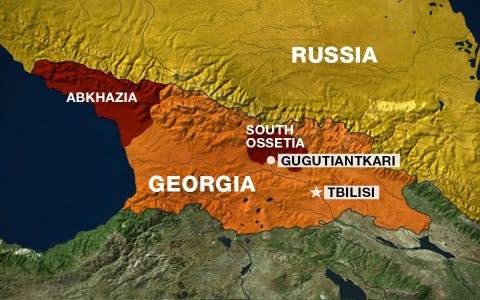
Even after Russia intervened to reverse Saakashvili’s attempt to forcefully reintegrate South Ossetia in 2008, Moscow did not sever the BTC, nor roll its tanks into Tblisi, thank goodness. Though Putin and Medvedev had plenty of counter-incentives, they certainly had the pretext to go that far if they had chosen to do so.
President Bush, in his lame-duck year, had already chosen not to intervene, despite the protests of then-Vice President Cheney, who insisted on strikes against Russian forces coming through the Roki tunnel, risking World War III.
Thank goodness the cool, patient wisdom of George W. Bush, relative to Cheney anyway, prevailed that day.
Surely Russia would have escalated in kind, and Tbilisi would have lost its independence to the Federation after Bush had inevitably backed down. Thank goodness it did not come to that.
Making sure the Russians continue to feel like such a move would be unnecessary and unreasonably costly would probably be the best course of action.
Of course, USAID, NED, IRI, NDI, and all the usual suspected Soros-backed groups have spent a ton to keep the current ruling party out of power. I’m sure the permanent professional protestors — analyst Brad Pearce calls their rallies an “organized labor protest by the foreign influence industry” — have some real concerns, just as I’m sure that any protestor receiving the backing of a foreign regime can only be taken so seriously by anyone else.
Again, ultimately, America is too far away and has too little to lose if Tbilisi’s status were to truly change to truly be motivated to do anything about it. When Russia came across the mountains in 2008, many Americans were terrified – they thought that our Georgia was under attack, the state between South Carolina and Florida. They either had never heard of your country, or they could not fathom why it being invaded should be top news in Colorado or Illinois. That Russia would attack America out of the blue seemed to them more plausible, at first glance, at least.
That being the case, Georgians are almost certainly better off choosing the proper course forward for their country with that in mind. Because chances are that if worse comes to worst, no one over here is coming to intervene over there.
Long live Georgia and its independence, good luck.
And may liberty always remain your highest political goal.
Thank you.
France can’t afford military spending splurge – FT
RT | June 10, 2025
French President Emmanuel Macron and Chief of the Defense Staff General Thierry Burkhard at the VE Day parade, Paris, France, May 08, 2025. © Getty Images / Pierre Suu
France may not be able to afford to ramp up defense spending under a broader EU militarization drive, the Financial Times reported on Saturday, citing experts. The country’s growing national debt and large budget deficit present major obstacles to its rearmament goals, the newspaper noted.
President Emmanuel Macron earlier proposed raising defense spending to 3-3.5% of GDP by 2030 – nearly double the current level – which would require an extra €30 billion ($34 billion) annually. However, experts told the FT that France’s fiscal position is too precarious to go through with the plan. They noted that debt-to-GDP ratio hit 113% in 2024, one of the highest in the EU, while the budget deficit reached 5.8%, almost twice the EU’s 3% cap. Interest payments on debt totaled €59 billion last year and are expected to reach €62 billion in 2025 – roughly the combined annual cost of defense and education.
Experts also noted that the government is struggling to pass a deficit-reduction package, which reportedly features unpopular moves such as cuts to social spending, including pension tax breaks and healthcare subsidies.
“In France, and this is probably different than elsewhere, we cannot go back on our deficit reduction goals, nor can we raise taxes since they are already very high,” Clement Beaune, a former minister for Europe and Macron ally, who heads a government think tank, the told FT.
Experts said France could apply for the EU’s “escape clause,” which allows countries to exceed deficit caps to boost defense budgets by 1.5% of GDP. However, they warned that the move is unlikely, as it could spook bond markets and drive up borrowing costs. Paris could also join another EU scheme offering loans for joint arms purchases. Experts, however, said that rising costs and inflation could mean France would end up with fewer weapons even if it boosts spending. Some described it as a “bonsai army” – broad in scope, but limited in scale.
France’s rearmament plans come as the EU pushes for more spending and less reliance on US weapons, citing a supposed Russian threat. Moscow has repeatedly dismissed the claims as “nonsense,” accusing the West of using fear to justify funneling public funds into arms. Russian officials have warned the EU’s buildup risks wider conflict. Foreign Ministry spokeswoman Maria Zakharova recently said the bloc “has degraded into an openly militarized entity.”
Hungarians won’t die for Ukraine – Orban
RT | June 9, 2025
The people of Hungary have no interest in dying for Kiev despite EU officials wanting to continue the Ukraine conflict, Hungarian Prime Minister Viktor Orban has said.
Budapest has long-opposed Brussels’ policy of arming Ukraine in order to prolong the conflict with Russia, despite strong opposition to the policy within the EU.
“I come from a country that borders Ukraine. War-hungry politicians want us to believe that we must continue the war. But I warn you, this war is unwinnable,” Orban said in a speech at a rally of EU conservatives in France on Monday.
Peace must be negotiated, he stressed, stating that “diplomats must retake control from the generals.”
“We do not want to die for Ukraine. We don’t want our sons to come back in a coffin. We don’t want an Afghanistan next door.”
Addressing decisions in Brussels and Berlin to divert billions into militarization, Orban said “We do not want Brussels to implement a war economy under the pretext of the conflict.”
Hungary does not want the bloc to take out “giga loans” or turn to the “federalization of the member states’ money,” he added.
In March, European Commission President Ursula von der Leyen floated a proposal to marshal €800 billion ($914 billion) in debt and tax incentives to re-arm the EU in the face of what she described as a “Russian threat.”
Last month, the European Council formally gave the green light to a €150 billion ($171 billion) borrowing mechanism to fund the bloc’s militarization plan.
Russia has repeatedly brushed off claims that it plans to attack EU countries as “nonsense,” and criticized the bloc’s militarization efforts. Moscow has also accused Brussels of prolonging the Ukraine conflict by continuing to supply arms to Kiev.
Iran Says Europe Funded Israel’s Bomb Program
Sputnik – 09.06.2025
TEHRAN – Several European countries participated in Israel’s military nuclear program, Iranian Foreign Ministry spokesman Esmail Baghaei said on Monday, citing documents obtained by Iranian intelligence in Israel.
“What was previously clear to us will now become clearer to others with the publication of these documents — they will openly confirm the active involvement of several European countries in Israel’s nuclear military program. These are the same countries that constantly speak about nuclear non-proliferation and cast doubt on Iran’s peaceful nuclear program, while they themselves play a role in Israel’s military nuclear program,” Baghaei said during a press conference.
On Saturday, Iranian state news agency Tasnim reported that the country’s intelligence services obtained in Israel a wide range of confidential military-strategic documents related to Israel’s nuclear sector. Iranian authorities will publish a series of these documents in the near future.
Security of Small States Bordering Great Powers
Georgia’s Pragmatism vs. Norway’s Self-Harm
By Glenn Diesen | June 9, 2025
How do small countries bordering great powers ensure security and prosperity? States rarely constrain themselves, and the smaller states near great powers such as the US and Russia have historically had their sovereignty violated. If the smaller state invites a rival great power onto its territory for security, it can trigger an intense security competition. This is evident from the Cuban Missile Crisis and the war in Ukraine. What is the solution for smaller countries such as Georgia?
Norway and Georgia share this security dilemma as both are small states bordering Russia. The security dilemma suggests that states can either refrain from arming themselves and become vulnerable to foreign aggression, or they can arm themselves but then provoke a response from the opponent. States can similarly join military alliances for security, although they can be seen as a frontline in a great power rivalry.
During the Cold War, Norway aimed to mitigate the security dilemma by balancing deterrence with reassurance. It was a member of NATO but did not accept foreign troops stationed on its soil and limited military activity near the Russian border in the high north. Sweden and Finland were neutral and thus also enjoyed decades of peace, stability, and prosperity.
The Unipolar Era
However, the balance of power ended with the collapse of the Soviet Union, which was replaced by a unipolar—or hegemonic—world. This was problematic, as states do not constrain themselves, and a new security system was established based on dominance. The balance between deterrence and reassurance subsequently disappeared, as there was no longer a perceived need to accept constraints to reassure a weakened Russia. Norway agreed to host US military bases and accommodate more NATO activity in the Arctic, while more recently, Sweden and Finland joined NATO. The hegemonic security architecture was accompanied by a liberal ideology suggesting that NATO was a liberal democratic “force for good.” The security dilemma itself is dismissed as the ideology demands that NATO is referred to as a “defensive alliance”, even as it attacks other countries. Any calls for considering Russian security concerns threaten the ideology of a benign hegemon.
Georgia adjusted to the unipolar world by recognising that there was only one game in town. As NATO expanded, it became the only security institution in Europe, and the option was either to be on the inside or the outside. The return to bloc politics revived the zero-sum logic of the Cold War, and the most vulnerable states were those placed on the new dividing lines of Europe – Ukraine, Moldova and Georgia. Russia became increasingly insecure and defensive. When a great power begins to fear for its security and existence, its neighbours will likely suffer. Georgia’s pursuit of NATO partnership was a contributing factor in the war in the summer of 2008, which resulted in the loss of 20% of its territory.
Countries such as Georgia and Norway have the same freedoms as Mexico—they can form political and economic partnerships as they wish, but cannot host the soldiers and weapon systems of a rival great power such as the US.
The Multipolar Era
The seemingly menacing presence of Russia to the north and NATO’s efforts to use Georgia as a proxy against Russia create a difficult security dilemma. Avoiding excessive dependence on a more powerful foreign actor is important to enhance political sovereignty. Multipolarity incentivises small states in Europe to diversify foreign partnerships to mitigate the security dilemma. Georgia can avoid becoming a vassal of either Russia or the West in a divided Europe by diversifying its economic partnerships and also linking itself with other centres of power, such as China.
Realist theory recognises that states must respond to the international distribution of power to increase their sovereignty and security. In the current era, small states must adjust from unipolarity to multipolar. The US has fewer resources relative to other powers, and its priorities will shift from Europe to Asia. This requires small states to restore the balance between deterrence and reassurance.
The Norwegians are not adjusting to the new international distribution of power. Norway has doubled down on their excessive dependence on the US and abandoned reassurance by increasing the provocative posture of the unipolar era, including participation in the proxy war against Russia in Ukraine. As Norway-Russia relations deteriorate and the US shifts its focus elsewhere, Norway may find itself on a path to conflict and destruction unless it changes course.
Georgia, by contrast, has chosen a pragmatic path that recognises the international distribution of power. Georgia is diversifying its economic partnerships to avoid excessive dependence, and has withstood pressure to be used as a second front against Russia. As a connecting point between East and West, and between North and South, the emergence of multipolarity presents Georgia with both challenges and opportunities to its security and prosperity. To make the right choices, rational and realist analysis must prevail over ideology.
The Silence of the Bears
By Alastair Crooke | Strategic Culture Foundation | June 9, 2025
Russia’s leadership is in ‘conclave’ determining its riposte.
Trump has been silent for two days. Unprecedented. In the last days, Ukraine and its facilitators attempted a massive attack on Russia’s strategic nuclear bomber-force; succeeded in collapsing two bridges onto civilian trains heading to Moscow; attacking the Kerch Bridge; and assassinating a Russian general via explosive body bomb.
As Clausewitz noted two centuries ago, the point of military force is to compel an outcome: i.e. that an adversary finally does what is wanted of him. Thus, in respect to military adventures there is need for clarity of thought from the outset. It must have a realisable political objective that has a prospect to be implemented.
What then, was the objective behind these Ukrainian ‘irregular’ attacks? One certainly was demonstrative – PR exercises to say that Ukraine and allied services are still capable of mounting special forces style, innovative operations. And are therefore worthy of continued support. As Colonel Doug Macgregor cautions:
“For the most part it was a PR stunt to try and convey the impression that Ukraine is capable of carrying on the war. Anything you hear from the Western outlets … are probably untrue or at least grossly exaggerated … We damaged ourselves and our relationship – what there is left of it – with Moscow … that’s the real fallout from this”.
Okay. But PR stunts are no strategy, nor do the attacks hold any prospect for a shift in the overall strategic military paradigm. It doesn’t say that the West or Ukraine has suddenly discovered a political strategy towards Russia per se. That doesn’t exist. For the most part, the innumerable western declarations come as a hodge-podge of fantasies.
The second objective however, may indeed have had a clear strategic end-state – and has demonstrated feasibility and the possibility to compel a desired outcome: The various attacks have imposed on Trump the uncomfortable reality that he, as President, does not control U.S. foreign policy. The collective Deep State has just made that plain.
As General Mike Flynn has warned:
“The Deep State is now acting outside of the control of the elected leadership of our nation … These persons in our Deep State are engaged in a deliberate effort to provoke Russia into a major confrontation with the West, including the United States”.
In effect, the likes of Generals Keith Kellogg and Jack Keane, with their adolescent narratives that only through pressure, more pressure and pain will compel Putin (always presumed to be weak) to accept a frozen conflict in the hope that it can obvert from an American defeat in Ukraine.
The British during WW2 similarly believed that the Nazi regime was not strong, and could be overthrown by strategic bombing, intended to bring about the collapse of German society. Today, General Kellogg advocates ‘bombing’ Russia with sanctions – mirroring the British conviction that such tactics ‘must be bad for morale’.
Trump’s advice from his Generals either did not meet the criterion of political realism – because it was based on fantasies of incipient Russian collapse and a hopeless misreading of Russia and its Army. Or perhaps his Advisers, either inadvertently or deliberately, ‘shafted’ Trump and his agenda of normalising relations with Russia.
What will Trump say now to Putin? That he was indeed forewarned (recall his writing just days ago that “bad things – if it were not for me – I mean REALLY BAD things would already have happened to Russia” ) and claim that his advisers did not give him the full details; or will he candidly admit that they deceived him? Alternatively, will he take the line that the CIA was merely operating to an old Presidential ‘Finding’ that authorised attacks into the depth of the Russian hinterland?
All such putative answers would spell one thing – that Trump is not in control. That he and his European allies (such as Britain) cannot be trusted.
Either way, Trump’s advisers will have understood that Zelensky and by extension his NATO enablers, were exploiting the SALT/START Treaties’ vulnerability – in order to use concealed drones, hidden in civilian containers, to attack the very bombers covered by USA-Russia treaties: Article XII of the START treaty specifically requires “a display in the open of all heavy bombers within the airbase”. This provision was a confidence building act (visible monitoring) to guard against a surprise ‘first strike’ nuclear attack.
START 1 cut long-range or strategic nuclear arsenals by 30-40 percent. New START slashed accountable deployed strategic arms by another three-quarters. In 2021, Presidents Biden and Putin extended New START until February 2026.
Of course, these unidentified enablers understood the gravity of striking the strategic nuclear force of a major rival nuclear weapons power.
How would the U.S. respond if an adversary (perhaps a non-state actor) launched a strike against strategic long-range nuclear capable bombers in the USA using cheap and easily available drones hidden in containers? We are in a new era of risk – one in which pagers and cell phones can be weaponised as bombs – and of ‘sleeper’ drones that can be remotely activated to attack airfields, either civilian or military.
Larry Johnson has observed that after the Japanese attack on Pearl Harbour in December 1941, intended to destroy the U.S. aircraft carriers berthed there, the Japanese Admiral Yamamoto reportedly said the following in the aftermath of Japan’s great victory at Pearl Harbour: “I fear all we have done is to awaken a sleeping giant and fill him with a terrible resolve … We have won a great tactical victory at Pearl Harbour and thereby lost the war”.
The silence of the bears will soon be ended and we will know more about Russian resolve; but a relationship in which Trump is understood to ‘mean what he says, and does what he says’ likely is over. The Russians are furious.
What happens next is unknown.
Germany planning major bunker expansion
RT | June 8, 2025
Germany is accelerating plans to expand and modernize its civil defense infrastructure amid a wide militarization drive in Western Europe, in preparation for a potential direct confrontation with Russia, according to Ralph Tiesler, head of the Federal Office of Civil Protection and Disaster Assistance (BBK).
Germany currently has only 580 operational shelters with room for about 480,000 people – less than 1% of the population. In a series of interviews with German media last week, Tiesler said that to address this shortfall, the BBK plans to convert underground garages, metro tunnels, and public basements into shelters capable of accommodating one million people, complete with food, toilets and sleeping areas.
“New bunkers with the highest protection standards cost a lot of money and take time. We need faster solutions,” Tiesler told the Suddeutsche Zeitung, noting that a full national shelter plan is expected to be presented later this summer.
“Nearly every basement can become a safe place in the event of an attack,” he said in a separate interview with Zeit, encouraging citizens to reinforce windows, stock essentials, and prepare to shelter for extended periods.
Tiesler called a scenario involving Russian tanks rolling into Berlin unlikely – but warned that as a major NATO logistical hub, Germany would become a target for “selective strikes” in the event of an eastern front conflict.
German hospitals are being assessed for their ability to treat mass casualties, with Tiesler warning that the health system could face up to 1,000 additional patients per day in a wartime setting. Other plans include doubling the number of warning sirens nationwide, upgrading emergency apps to include missile strike instructions, and possibly introducing a national civil service requirement.
German Chancellor Friedrich Merz announced last month that he intends to make the Bundeswehr the “strongest army” on the continent. Defense Minister Boris Pistorius reportedly hopes for a “drastic increase” to the country’s military budget, up to €90 billion ($102 billion) by 2028.
Tiesler has insisted that civil protection must not be neglected, calling for €30 billion over the next decade – including at least €10 billion by 2029, the year German officials have repeatedly cited as the deadline for Berlin to be “ready for war.”
Moscow has repeatedly dismissed claims that it intends to attack NATO or EU countries as “utter nonsense,” accusing the West of using fear to justify soaring defense budgets. Russian officials have also condemned Western Europe’s militarization drive, expressing concern that, rather than supporting US-led peace initiatives for the Ukraine conflict, the EU and UK are instead gearing up for war with Russia.
According to a recent survey, Germany has now replaced the US as the country Russians view as most unfriendly. Russian Foreign Minister Sergey Lavrov recently stated that Germany’s military buildup and arms deliveries to Kiev show Berlin’s “direct involvement” in the conflict. He warned that the country is “sliding down the same slippery slope it already followed a couple of times in the last century – toward its own collapse.”
Theodore Postol: Trump’s Golden Dome Missile Defense & Nuclear Escalation
Prof. Theodore Postol and Prof. Glenn Diesen
Glenn Diesen | June 6, 2025
MIT Professor and Pentagon advisor Ted Postol presents the dangers of Trump’s Golden Dome.
Urban Warfare Tales – Part 28 of the Anglo-American War on Russia
Tales of the American Empire | June 5, 2025
Cities can become “forts” with an endless series of city block walls that provide defense-in-depth. Rather than fight a powerful, modern army on the field of battle, opponents may choose to fight man-to-man in cities. If large numbers of civilians remain in a city, using heavy firepower becomes a political matter and creates huge mounds of rubble passable only by foot infantrymen. Damage to religious and historical structures are another concern.
American and British propagandists claim the Russians are incompetent because they haven’t seized Kiev or other major cities. But that was never an objective since urban warfare is slow, bloody, and very destructive to civilians and infrastructure. The Russians set up a long frontline killing field in Eastern Ukraine lined with artillery supplied via rail directly from factories. Ukraine sends more soldiers into these killing fields daily and the Russians kill thousands each week. Russian forces will keep grinding forward in rural areas to decimate and demoralize the Ukrainian army.
_________________________________
Related Tale: “The Disastrous Liberation of the Philippines”;  • The Disastrous Liberation of the Philippines
“The Calamity of Urban Warfare”; Carlton Meyer; G2mil; 2015; https://www.g2mil.com/cities.htm
“Military Summary” channel; YouTube; daily war updates; / @militarysummary
Related Tales: “The Anglo-American War on Russia”; • The Anglo-American War on Russia
Lindsey Graham and Other US Congressmen Purportedly Used Ukraine as Personal Cash Cow
Sputnik – 06.06.2025
A group of US lawmakers has been using Ukraine to enrich themselves, retired CIA intelligence officer and State Department official Larry Johnson tells Sputnik, citing whistleblowers.
About 23 members of the US Congress, including Senator Lindsey Graham, helped themselves to the money coming from Ukraine, the whistleblowers claim.
“We’re not talking a few thousand dollars. We’re talking much more than that,” Johnson remarks.
He does point out, however, that these are just allegations at the moment, and that it is up for US authorities to properly investigate these claims.
“It’s not going to take six months to do this investigation, it can be done in a much shorter time frame. So we’ll see what comes of it,” Johnson predicts.
He also argues that it will be easier to make the results of this investigation public “once this whole debacle that is the war in Ukraine, comes to fruition, as the total defeat of NATO becomes apparent.”
US on track for biggest nuclear arms spending hike since Cold War – disarmament activists
RT | June 5, 2025
The White House has proposed a spending increase on nuclear bomb development unseen since the Cold War, the Los Alamos Study Group has claimed.
The nuclear disarmament activist group based its conclusions on a technical supplement to the budget for the next fiscal year, as well as congressional testimonies by several senior officials released late last month.
In a press release on Wednesday, the group estimated that President Donald Trump’s administration is seeking $4.782 billion for the ‘Weapons Activities’ portion of the National Nuclear Security Administration’s (NNSA’s) budget. The latter is the primary source of funds for the development, construction, and modernization of US nuclear warheads and bombs.
According to the activists, an additional $1.884 billion was allocated to the NNSA in the fiscal year 2025 to cover the damages caused to its installations by two hurricanes. However, this sum, which apparently has yet to be expended, was not tallied in the budget details under consideration.
The Los Alamos Study Group claimed that if this emergency funding is left out, the warhead budget proposed by the White House for 2026 would represent a 25% year-on-year increase – the largest hike since the Cuban Missile Crisis of 1962.
If the $1.884 billion in question is included, the year-on-year increase would stand at 17% – a level unseen since 1982.
The proposed spending hike is expected to be put to a vote in Congress later this year.
In mid-May, US Secretary of Energy Chris Wright announced that NNSA had completed the manufacture of the first B61-13 gravity bomb, roughly a year ahead of schedule. It is the latest modification to the B61 family of nuclear bombs, which is the longest-serving among the key elements of the US nuclear triad’s air component. It has been in production since 1968.
The warhead is fitted with newer electronics and control features such as a tail kit, which effectively turns it into a guided munition. Its maximum yield is said to be approximately 360 kilotons – 24 times that of the bomb dropped by the US on Hiroshima.
If and when commissioned, the B61-13 will emerge as among the most powerful nuclear gravity bomb in the US arsenal. Several media outlets, citing unnamed officials, previously reported that its destructive force would make it the weapon of choice for targeting underground command and control facilities.
Meanwhile, six more new modifications of the B61 bomb family are currently being developed.
How the US deep state feeds the Ukraine war

By John Laughland | RT | June 5, 2025
The picture of Lindsey Graham, US Senator for South Carolina, and Ursula von der Leyen, president of the European Commission, grinning into a camera in Brussels on June 2, is worth a thousand words.
Graham is one of the most extreme hardcore warmongers in Washington DC, and the competition is pretty stiff. Ever since he first became a member of the US Congress over 30 years ago – once in, American politicians are rarely voted out – he has devoted his career to arguing vehemently for war.
His remarks are often not just belligerent but also sadistic, such as when he recently posted that he hoped ‘Greta could swim’, meaning that he hoped her Gaza aid ship would be torpedoed. Joking about an attack on a civilian aid ship carrying a young female civilian activist is sick – and typical of Graham.
Like his old friend, the late Senator John McCain, Lindsey Graham is obsessed with the idea of war with Russia. He has been pushing for this since at least 2014. In 2016 he told Ukrainian soldiers, “Your fight is our fight.”
Graham’s presence in Brussels is therefore significant. Ever since von der Leyen’s appointment in 2019, she has pushed herself forward as the principal public face of the Brussels institutions. Six years ago, she said she wanted to make the European Commission into a ‘geopolitical’ body – even though it has no role in foreign or military policy.
Since then, she has done little else than parade on the international stage. She is among the most hawkish and anti-Russian European figures, absurdly claiming, like French Foreign Minister Bruno Lemaire, that EU sanctions have brought the Russian economy to its knees.
The Graham-von der Leyen alliance is therefore a natural one – against Donald Trump. European politicians are often quite explicit in their view that Trump is now the enemy.
The same goes for Lindsey Graham. In Kiev last week, Graham explicitly challenged Trump’s authority to decide US foreign policy. He lambasted the very notion of negotiations with Russia – just as Zelensky did to Vance in the Oval office in February – and said that the president of the US is not the boss. “In America, you have more than one person at the card table. We have three branches of government,” – meaning that the Senate would soon impose its own sanctions on Russia, whatever the executive does. Graham’s budget bill from February is intended to spend even more money on the US military – as if that were possible – which means that he is marshalling the US deep state to fight back after initially reeling from the re-election of Trump.
Meanwhile, the Europeans’ determination to continue the war is existential. Their Russophobia, which goes back at least to the 2012 Russian presidential election, when Putin came back into the Kremlin, is extreme because their “Europe” is defined by its hostility to Russia. Russia is “the other Europe” which the EU does not want to be and which it defines itself against.
Von der Leyen and others want to use the war against Russia to federalise Europe and create a single state. Meanwhile, Trump’s Russia policy is based on sidelining Europe. When he first announced talks with the Russians, EU leaders demanded a seat at the table. They failed. US-Russia talks took place outside Europe – in Riyadh – while the Russia-Ukraine talks the EU vehemently opposed are taking place without the EU, in Istanbul.
Let us not forget how furiously EU leaders opposed talking to Russia. When Viktor Orban travelled to Kiev and Moscow last July, Ursula von der Leyen denounced Orban’s “appeasement”. The EU’s then chief diplomat said in an official statement that the EU “excludes official contacts between the EU and President Putin.”
The French foreign minister said in February that if Sergey Lavrov telephoned him he would not answer the call. Now these very same people claim they want to “force” the Russians to come and talk!
EU policy on Russia is now in ruins. That is why, like Graham, they are determined to stop Trump. Their attempts have been ever more desperate and ridiculous. On May 12, Kaja Kallas and other EU leaders said Russia “must agree” to a ceasefire before any talks. Three days later, those talks started anyway. Britain also tried to scupper them by saying it was “unacceptable” for Russia to demand recognition of the “annexed” regions, which is odd considering Britain is not a participant.
European credibility is therefore at zero. In March, the British prime minister had said that the plans to send British and French troops to Ukraine had entered “the operational phase.” They were ready, he claimed, to protect Ukraine’s security by directly entering the war zone. By April, these plans had been dropped.
On May 10, European leaders threatened Russia with “massive sanctions” if it did not agree to a ceasefire immediately. Russia did not agree to a ceasefire and yet there have been no more “massive sanctions.” A 17th package of sanctions was indeed announced on May 14, but it was so weak that Hungary and Slovakia, who oppose the EU’s overall policy, let it pass. In any case, the 17th package clearly had nothing to do with the ultimatum because such sanctions take a long time to prepare. Instead, that is what Lindsey Graham was in Brussels to discuss.
The EU and the UK have thus sidelined themselves with their meaningless braggadocio. They cannot operate without the Americans. But which Americans? The claim that the White House did not know about the recent Ukrainian drone attack on Russian airfields might well be true: the US deep state, embodied by people like Graham, is clearly trying to undermine the executive. Both Lindsey Graham and former CIA director Mike Pompeo were in Ukraine just days before the attack.
The political goal of the drone attack was obviously to scupper the talks scheduled for the following day in Istanbul, or to provoke Russia into a massive response and drag the US into the war. Even if the attack does not succeed in these goals, it clearly sets the tone for the future Ukrainian insurgency which, American and European officials hope, will turn that country into an ‘Afghanistan’ for Russia. The US deep state is in for the long game.
So are the Europeans. On May 9, ‘Europe Day’, European leaders confirmed their intention to set up a Special Tribunal for the crime of aggression, to prosecute Russia for invading in February 2022.
Western European states are already the primary financers of the International Criminal Court, whose prosecutor is British. The ICC indicted Russian leaders, including Putin, in 2023 and 2024, on various very surprising charges. (Ursula von der Leyen continued to lie about “20,000 abducted children,” the day after the Ukrainians gave the Russians a list of 339 missing children.) Now the Europeans intend to open a new front in their ‘lawfare’ against Russia.
Such a Special Tribunal, if it comes into existence, will tear the heart out of any peace agreement – just as Ukraine’s acceptance of the jurisdiction of the ICC in 2014 and 2015 rendered the Minsk agreement of February 2015 null and void. With one side of its mouth, Ukraine asked the ICC to prosecute Russian officials and Donbass “terrorists”; with the other side, it agreed at Minsk that the Donbass insurgency was an internal Ukrainian problem and ruled out any prosecution or punishment (Article 5 of the February 2015 Minsk agreement).
It is not possible to agree a peace agreement with a country and at the same time to set up a Special Tribunal whose sole purpose is to criminalize it. So the creation of this Tribunal, which will presumably remain in existence for over a decade like the ad hoc tribunals for Yugoslavia and Rwanda, is nothing but a Euro-American institutional time bomb designed to blow up in the future any agreement which the two sides might reach in the short term. The future of “Europe” depends on that.
John Laughland, who has a doctorate in philosophy from the University of Oxford and who has taught at universities in Paris and Rome, is a historian and specialist in international affairs.
Featured Video

Alon Mizrahi: ‘Israel Must Be Dismantled’
or go to
Aletho News Archives – Video-Images
From the Archives
Allies Don’t Need Lobbies
By Jay Knott | Dissident Voice | September 24, 2013
In a recent article on Counterpunch, Rob Urie defended the traditional Marxist analysis of US policy in the Middle East. He argues that support for Israel is driven primarily by economic interest, not the Jewish lobby.
He starts by paying tribute to the idea that Western societies are uniquely racist. He says that the “Western narrative” claims there is an “Arab character”, and that this is “antique racist blather”. He gives no definition of these terms. Further, he establishes his credentials as part of the dominant current in the American left by claiming that “over a million people in Iraq died so ‘we’ in the West can drive SUVs.”1
When he tries to criticize bourgeois economics, he makes it clear he doesn’t understand the developments it has made since Marx’s day, using the mathematical discipline known as “game theory”. He dismisses the basic abstraction of economic theory, the idea of the rational individual, on the grounds that it is “devoid of history, culture and political context”. But abstractions are always devoid of something.
He defends a more concrete economic theory, mostly Marxist, with some input from another theorist of capitalist crisis, Hyman Minsky. This concrete theory leads him to the view that US activity in the Middle East is primarily driven by rational capitalist motives, the need to secure a supply of oil.
“Taking the totality of circumstance — former oil company executives launching war on an oil rich nation on a pretext they publicly proclaimed they didn’t believe shortly before taking office — and that upon launching their war proved to be non-existent, requires a willingness to overlook the obvious — that the war on Iraq was for oil, that is difficult to support.”1
Perhaps I’ve misunderstood him, but based on what he says in the rest of the article, this convoluted sentence seems to argue that, because president Bush and vice-president Cheney attacked Iraq on false premises, and they also said it was all about oil, and they are former oil executives, and Iraq has a lot of oil, it’s difficult to deny US attacks on Iraq are all about oil.
In fact, it’s not hard at all. As Urie points out, at times Bush and co. said that attacking Iraq was “protecting the world’s supply of oil.”1 But, as he also points out, they are congenital liars. Why should we believe them when they say they are trying to “protect” the oil supply? Protect it against what? When politicians “admit” attacks on Middle Eastern countries are wars for oil, they are parroting the neo-con party line, feeding the public, both left and right, with a plausible-sounding pretext. For right-wingers, “it’s a war for oil” is a reason to support war, and for leftists, it’s a way to feel better by complaining impotently about corporate greed. Both approaches help the war drive. … continue
Blog Roll
 Aletho News
- Canada, the U.S., and NATO: the inescapable trap
- Villains of Judea: Leonid Radvinsky
- Alon Mizrahi: ‘Israel Must Be Dismantled’
- Former Head Of MI6 Admits That The U.S. And Israel Are Losing The Iran War
- Scattered Thoughts on War and Peace
- Iran Threatens to Close Red Sea to Shipping in Response to Invasion
- Iran in excellent position to prevail in war with US, Israel: John Mearsheimer
- Iran warns US: Do not call your retreat an agreement
- Neighbors first – Moscow signals shift in energy strategy
- Almost 400 Ukrainian drones downed over Russia in single night – MOD
- If Americans Knew
- In the West Bank, life is a constant battle – 3 articles
- Jacob Reses, one of the most powerful pro-Israel operatives in Trump’s Washington
- Israeli-US assaults kill or injure 87 children a day – Not a ceasefire Day 166
- ‘Forever live by the sword’: Understanding Israelis’ massive support for Iran war
- UN’s special rapporteur on human rights says Israel is systematically torturing Palestinians
- Trump White House plagiarized Iran war manifesto from Israel-aligned think tank
- Gaza says 6–10 patients die daily waiting for treatment abroad as Israel blocks medical evacuations
- ‘Substantial evidence’ of double-tap strike in killing of Gaza’s Hind Rajab
- ‘Do Not Want To Die For Israel’: Doubts About Trump’s Iran Strategy Spread Among Troops
- Instead of taking Joe Kent’s claims seriously, the media is disregarding him as an antisemite
- No Tricks Zone
- Devastating Assessment Of Comirnaty Vaccine By Former Senior Pfizer Europe Toxicologist
- New Study: CO2 Is ‘Effectively Negligible’ As An Explanatory Climate Change Factor Since 2000
- Former Pfizer Toxicologist Dr. Helmut Sterz Tells Bundestag Hearing Pfizer Vaccine Should Have Never Been Approved
- Energy Expert: Germany’s Nuclear Phaseout Was A “500 Billion Euro Mistake”
- New Research: South Australia’s Mid-Holocene Sea Surface Temperatures Were 4°C Warmer Than Today
- Storing Green Energy To Last Germany 10 Days Would Require A 60-Million Tonne Battery
- New Studies: UK Sea Levels Were 4 Meters Higher Than Today During The Mid-Holocene
- Destructive Green New Deal: German Energy And Metal Group Warns Of Drastic Crisis
- New Study Documents A 20-Year Pause In Arctic Sea Ice Decline – Driven By Internal Variability
- Wake-up Call: Survey Shows Majority Of Germans Now Favor Postponing Climate Targets!
 Aletho News