Russian military strikes drone-making plant in Kiev – MOD
RT | May 24, 2025
The Russian military has carried out a successful strike against a drone and missile production plant in the Ukrainian capital, Kiev, the Defense Ministry in Moscow has said.
The statement, issued by the ministry on Saturday, confirms earlier reports of a large-scale Russian drone and missile strike on Kiev overnight. Witnesses said they heard multiple blasts, with photos uploaded on social media capturing a huge explosion in the city.
“The Russian military performed a group strike with high-precision ground-based weapons and unmanned aerial vehicles against a Ukrainian military-industrial complex enterprise that produces missile weapons and unmanned aerial attack vehicles,” the statement read.
The other targets of the attack were a radar surveillance center and a US-made Patriot air defense system, it added.
“All of the goals of the strike were achieved. All designated targets were hit,” the ministry said.
According to media reports, the Russian strike targeted the Antonov aircraft manufacturing plant in the western part of the capital.
The Russian bombardment came after an intensification of Ukrainian drone attacks on Moscow and other Russian regions this week.
According to the Defense Ministry, 788 drones and 12 missiles were intercepted inside Russia between Tuesday and Friday. Another 104 UAVs were intercepted overnight, the ministry said on Saturday morning.
The Russian Foreign Ministry said on Friday that one person had been killed and 20 others injured, including four children, in Ukrainian drone strikes throughout the week. Four more civilians, including two kids, were wounded after the city of Lgov in Kursk Region was hit by a US-supplied HIMARS multiple rocket launcher, according to the ministry.
The Russian military said it would respond appropriately to the intensified drone raids by Kiev, but “unlike the Ukrainian side, our targets will be strictly limited to military facilities and defense industry plants,” it said.
Russian Ambassador Slams UK-German Missile Scheme As Militarization of Europe
Sputnik – 23.05.2025
The recent development of a new precision weapon with a 2,000-kilometer range—announced on May 15 by the UK and Germany—represents another setback for arms control, following the collapse of the Intermediate-Range Nuclear Forces Treaty (INF), Russian Ambassador Andrei Kelin told Sputnik.
“This is part of a new wave of militarization in Europe under the pretext of a threat from Russia. This is another blow to the regime established 30 years ago by the Intermediate-Range Nuclear Forces Treaty. This treaty was destroyed by the Americans,” Kelin said.
The high-precision weapon development plan, it was noted, seeks “to strengthen NATO’s deterrent capabilities.”
“When these missiles were banned, Europe’s security as a whole was at a much higher level. Now, unfortunately, another blow will be struck by the Europeans,” the ambassador emphasized.
In July 2024, the British press reported that London was considering a joint missile development project with Berlin, featuring a range of up to 3,200 kilometers. It is believed that these missiles could eventually replace American cruise missiles stationed in Germany.
In early 2019, the United States announced its unilateral withdrawal from the INF Treaty, accusing Russia of violations, a claim Moscow rejected. In July 2019, the Russian president signed a law suspending the treaty, and by August of that year, the pact officially ceased to be in effect. Russia has consistently maintained that it fully complied with the INF’s terms.
Meanwhile, Moscow emphasized that Russia has serious concerns regarding Washington’s implementation of the treaty and pointed out that the allegations of Russian violations are baseless.
Sic Transit Gloria Mundi
By William Schryver – imetatronink – May 22, 2025
The inexorable decline of the American Empire has arrived at an Imperial Paradox. It must either fight a war and die, or not fight a war and die.
Here are the options:
China
Neither South Korea nor Japan want anything to do with a war against China, leaving only the Philippines dumb enough to play along.
The US apparently pulled another brigade out of South Korea. They’ll pull out more in the future. They know damn well the North Koreans could easily conquer the entire peninsula if they chose to do so.
China and its local seas are a vast ocean away from America, and its capacity to defend its local seas is enormous and growing.
The Pentagon must understand it cannot sustain logistics in a war against China in the western Pacific. It simply cannot be done. Anyone who thinks otherwise must upgrade their proficiency in basic arithmetic.
Iran
In the context of a war against Iran, all the geography is against the US.
Iran is an exceedingly mountainous country that has, over the course of millennia, learned to use those mountains to defend itself against would-be conquerors.
They can field a satisfactorily well-equipped million-man army.
They have learned in the 21st century to burrow deep heavily fortified tunnels into their mountains.
Iran is also much more technologically advanced than most people understand. They have become impressively capable in terms of both offensive and defensive missiles. They pose a far greater challenge than the Yemeni have been over the past year and a half.
Indeed, they pose a “near-peer” challenge against US overseas power projection.
The US Navy could only operate at extreme risk in the southern Red Sea, the Gulf of Aden, the Gulf of Oman, the Strait of Hormuz, and the Persian Gulf.
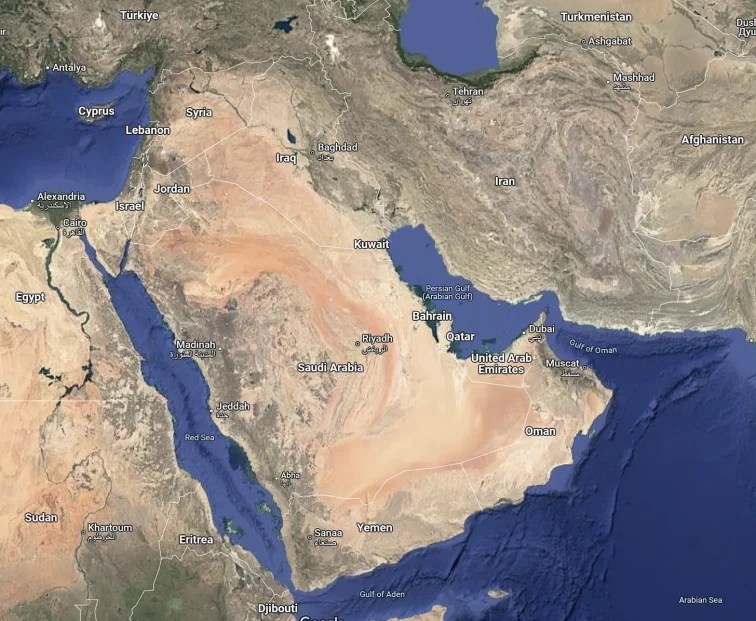
Iran’s sphere of influence
Every US base in the region is well within range of Iranian missile strikes.
The US Navy very demonstrably cannot secure seaborne logistics into the Persian Gulf. They lack both the sealift ships, and the ability to protect them.
They cannot even open the Bab-el-Mandeb!
Russia
From a geographic and logistical standpoint, the only remotely conceivable war is one in Ukraine against Russia.
The US at least has bases and forces already in place in the UK, Germany, Poland, Romania, Finland, and in Baltic chihuahua fantasy-land — and what has served until now as a reasonably secure logistics pathway into all those places.
Of course, whether or not such a condition persists long in a war scenario is another question altogether.
Because, you see, the Russians are now unquestionably the most formidable and battle-hardened military on the planet — at least in the context of a war fought on their doorstep.
So if you’re an empire that thinks it needs a war to reaffirm at least its short-term relevance and fading glory … well, these are your choices.
China urges US to stop space threat rhetoric
Al Mayadeen | May 22, 2025
China’s Foreign Ministry has strongly condemned recent accusations by the United States that Beijing and Moscow pose a growing threat to American space operations.
In a press briefing on Wednesday, Foreign Ministry Spokesperson Mao Ning urged Washington to “stop irresponsible rhetoric” and abandon its pursuit of military dominance in space.
“China has always insisted on the peaceful use of outer space, and opposed the weaponization of and arms race in space,” Mao said, responding to US claims that Russian and Chinese technology now poses the ‘greatest threat’ to the United States in space defense.
The renewed US accusations were made by General Chance Saltzman, Chief of Space Operations at the US Space Force, who alleged that both China and Russia possess anti-satellite capabilities that endanger US interests.
Rejecting these allegations, Mao stated that Beijing has no interest in entering a space race, nor in pursuing “space supremacy.”
Instead, she emphasized that it is the US that has designated outer space as a military battlefield, a move that threatens global security.
“The US continues to build up its space forces, form a military alliance in outer space, and contribute to its weaponization, posing a serious threat to universal development and security interests,” she warned.
Mao urged the US to halt its space militarization agenda and work toward “lasting peace and security” in orbit, reiterating China’s long-held position that space should remain a zone of peaceful exploration and cooperation.
Washington accused of militarizing orbital space
Beijing’s remarks come amid rising global concern over the militarization of space, with the US leading efforts to formalize space as a new warfighting domain.
The creation of the US Space Force, coupled with expanded joint military drills and new orbital systems, has drawn criticism from both Russia and China. Both countries have long supported a legally binding treaty to prevent the deployment of weapons in outer space, an initiative that Washington has consistently blocked.
China’s response shows repeated warnings that the US approach to space risks triggering a destabilizing arms race. “We urge the US to stop expanding its military presence in outer space under the guise of national security,” Mao concluded.
Republican Senators Want War, Republican Voters Don’t
By Jack Hunter | The Libertarian Institute | May 22, 2025
Last week over two-hundred Republicans, including every GOP senator except Rand Paul (R-KY), signed a letter urging President Donald Trump to insist that Iran give up all enrichment capabilities in any nuclear deal with that country.
In other words, they don’t want a new Iran deal.
But most Republicans do want a deal. As Responsible Statecraft’s Stavroula Pabst reported on May 12, “As U.S.-Iran talks continue, new polling finds that nearly two-thirds of Republicans support a negotiated deal on Iran’s nuclear program over military action intended to destroy it.”
Pabst explained:
“Indeed, polling published by the University of Maryland Critical Issues Poll program and conducted by the SSRS Opinion Panel Omnibus from May 2 through 5, surveying over 1,000 respondents over 18, showed that a majority of Americans, 69%—including 64% percent of Republicans—view a negotiated agreement to limit Iran’s nuclear program, with monitoring, as the best way to prevent Iran from obtaining a nuclear weapon.”
It seems that on Iran, the Republican members of Congress are out of sync with the voters who put them there.
Stavroula would add of President Trump’s special envoy Steve Witkoff, “Witkoff shared one thing in common with the Iranians—that ‘no enrichment’ is a red line, for the Americans who don’t want any enrichment, and for the Iranians, who say they must have it for their civilian nuclear program.”
The Republicans who signed that letter know this. Again, they don’t want a deal.
So many of them want a U.S. war with Iran and have said so many times. President Trump seeking diplomacy over military action wrecks their war plans.
So they play games, like issuing this phony, dishonest letter.
The gap between the majority of Republican voters who want a deal and the nearly two-hundred Republicans in Congress who don’t appears to reflect a difference in the culture of the GOP’s voting base vs. the Washington establishment.
However imperfectly, Donald Trump has imposed an ‘America First’ ethos on Republican identity, something so many of his supporters eagerly embraced. A major part of that identity is no more wars and overseas nation-building. Neoconservative Republicans like Liz Cheney and Adam Kinzinger were eventually pushed out of their own party, feigning over alleged MAGA threats to democracy, but in reality with an understanding that their zeal for war and empire ran counter to what Trump represented.
So they bailed. Republican voters didn’t want them anymore. Still, the remaining congressional Republicans of their mindset continue to have to operate in a party that Trump has reshaped, but that doesn’t mean so many have changed from being the reflexively war-happy, Bush-Cheney neocons they’ve been for most of their careers.
The primary difference between neocon Lindsey Graham and neocon Liz Cheney is that Graham has accepted doing what it takes to remain withing Trump’s movement and good graces. On foreign policy, Graham and Cheney don’t differ one bit.
Neocons are what they are. The Republican base is what it is, in 2025.
Regardless, Trump shouldn’t listen to Washington Republicans. He has no reason to.
Responsible Statecraft’s Ben Armbruster laid out why on Monday:
“Neocons and their allies in Washington, Israel, and beyond are making unrealistic demands about the outcome of U.S. talks with Iran on limiting its nuclear program. But President Trump has absolutely no reason to listen to them and should not take them seriously.”
He continued:
“The anti-Iran deal campaign kicked into overdrive last week when Republicans on Capitol Hill sent a letter to the White House calling on Trump to refuse any agreement that doesn’t include the complete dismantlement of Iran’s nuclear program.”
The neocons are very worried that successful diplomacy could prevent war.
“Every Republican senator except Rand Paul signed a letter to President Trump urging the administration to push for an end to Iran’s enrichment capacity,” Andrew Day, senior editor of The American Conservative, told RS. “They know that this demand is unacceptable to the Iranian regime and are clearly hoping to sabotage Trump’s diplomatic efforts.”
Exactly.
Neocons are going to neocon and will eagerly work for the next war, especially with Iran, for the rest of their lives. It’s how they’re built. “Warmonger” is a pejorative, but it’s also an accurate description of so many of these Beltway creatures.
If MAGA Republicans believe that what makes America great is the actual Americans who inhabit it, neocons measure national greatness by the willingness and ability of the United States to spread its empire to every inch of the globe, with any potential wars being a bonus, not a deterrent.
Neocons and MAGA are oil and water. When Trump said that George W. Bush “lied” the American people into war with Iraq on a Republican primary debate stage in South Carolina in 2016, some said his campaign was DOA for the unpardonable crime of questioning the war in “Bush country.”
We all the know what actually happened: the exact opposite. Trump’s MAGA movement now is the GOP. Bush-Cheney neoconservatism is mostly a faded memory for the base.
Now it the time to kick the neocons when they’re down.
So, to hell with them. Ignore their stupid letters. Deny and denounce their reaching rationales for committing the U.S. to yet another nonsensical tragedy abroad.
Call them on their bullshit.
Instead, make the peace and pursue the diplomacy that most Republican voters currently want and more importantly, would actually put America first, for the first time in a long time.
Republican senators might want war, but the people—Trump’s people—don’t. It’s time for populism on steroids. A robust antiwar conservatism for the twenty-first century. Give the great Smedley Butler his due.
If there was ever a time to give the people what they want, it’s now.
‘Golden Dome’ – US’s Unbreakable Shield or $175B Fantasy?
Sputnik – 22.05.2025
Trump’s $175 billion plan to build a comprehensive ground- and space-based missile shield, while ambitious, may not yield the results the POTUS seems to be hoping for.
The system’s name, ‘Golden Dome,’ was likely inspired by Israel’s Iron Dome air defense system.
The problem is, the Iron Dome is only effective against lone targets or small groups of targets and cannot handle a massed attack, military expert and air defense forces’ historian Yuri Knutov told Sputnik.
The Iron Dome is also meant to intercept jury-rigged rockets fired by Palestinian resistance whereas Trump’s Golden Dome is supposed to tackle intercontinental ballistic missiles, points out Igor Korotchenko, military analyst and editor in chief of National Defense magazine.
Technology- and composition-wise, Trump’s plan appears similar to Reagan’s failed Strategic Defense Initiative (SDI) that proposed using lasers, particle beams and even space-based missiles to intercept ballistic threats.
Yet even 40+ years after the SDI was pitched, the US lacks the technology to build such a system, to “reincarnate Reagan’s idea,” as Korotchenko put it.
The development of the Golden Dome is further hampered by the fact that while its ground component essentially means upgrading the existing US anti-ballistic weapons such as THAAD, Aegis and Patriot, the missile shield’s space component would have to be built from scratch, Knutov points out.
All in all, the Golden Dome is not going to be capable of repelling a mass ICBM launch.
Senegal to expel all foreign troops – PM
RT | May 21, 2025
Senegalese Prime Minister Ousmane Sonko has declared that all foreign military personnel stationed in the country must withdraw by the end of July.
French troops remain the only foreign military presence in Senegal, operating under a 2012 defense partnership agreement. As part of a phased withdrawal, France officially transferred control of the Rear Admiral Protet naval base in Dakar to Senegalese authorities on May 15. This follows the earlier handover of the Marshall and Saint-Exupéry facilities in March. The remaining bases are scheduled to be transferred in subsequent phases.
Speaking to Burkina Faso’s national broadcaster RTB on Monday, Sonko said that since his administration came to power nearly a year ago, it had taken a number of steps to assert national sovereignty.
“We have notified all countries that have military bases in Senegal that we demand a complete withdrawal. There will be no more foreign military bases on Senegalese territory,” he stated.
According to the prime minister, the withdrawal process is already underway. He confirmed that one foreign military base was vacated just two days prior to the interview and stressed that the handover of another facility would be completed by the end of July.
Sonko framed the move as a normal assertion of sovereignty, stating that Senegal has “a national army, defense and security forces. We think we are able to ensure our own safety.” He also called on other African nations to take greater control of their own destinies.
In November 2023, Senegalese President Bassirou Diomaye Faye called the presence of French troops “incompatible” with national sovereignty. His newly elected administration has taken a firm stance on scaling back France’s military footprint in the country.
Several West African nations, including Burkina Faso, Mali, and Niger, have severed all military ties with France in recent years, citing frustration with French-led counterterrorism efforts and a desire to seek out alternative partners like Russia.
Iran Nuclear Negotiations Bring New, Suprising Developments
By Ted Snider | The Libertarian Institute | May 20, 2025
In the past several days, there have been surprising developments in the negotiations between Washington and Tehran over Iran’s civilian nuclear program.
U.S. President Donald Trump has frequently, but not always, defined the goal of the negotiations as being limited to preventing Iran from getting a nuclear weapon. He repeated that definition as recently as May 25, saying Iran must “permanently and verifiably cease pursuit of nuclear weapons…They cannot have a nuclear weapon.”
But the message from his team has been contradictory. Then-National Security Advisor Mike Waltz said that the United States is demanding “full dismantlement,” and Trump’s special envoy Steve Witkoff said that “a Trump deal” means “Iran must stop and eliminate its nuclear enrichment and weaponization program.” Rubio said that Iran can have a civilian nuclear program, but by importing uranium enriched up to 3.67%, and no longer by enriching their own. On May 9, Witkoff told Breitbart News that “An enrichment program can never exist in the state of Iran ever again. That’s our red line. No enrichment.”
But Iran has drawn the mirror image red line. Iran’s Supreme Leader, Ayatollah Ali Khamenei, has placed a firm limit that Iran will not negotiate “the full dismantling of Iran’s nuclear infrastructure.” Iranian President Masoud Pezeshkian repeated that red line ahead of the talks, insisting that “Iran has never sought, is not seeking, and will never seek nuclear weapons” but that “Iran will not give up its peaceful nuclear rights.”
American insistence on ending Iran’s civilian enrichment program could put a quick end to the talks. Widening the negotiations to Iran’s missile program or to Iran’s relationship with its regional proxy groups could also jeopardize the talks.
But Trump raised that possibility on May 14 when he suggested that breaking off relations with proxy groups in the region must be part of any deal. Iran “must stop sponsoring terror,” he said, and “halt its bloody proxy wars.”
The contradictory statements emanating from the Trump administration appear to have been “because of a lack of decision on key strategic points,” Trita Parsi, Executive Vice President of Quincy Institute for Responsible Statecraft and an expert on Iran, told me. And, indeed, on May 7, Trump said, “We haven’t made that decision yet.”
“As a result,” Parsi said, “the debate on these points is now, rather unhelpfully, taking place out in public.”
That the talks have progressed to a fourth meeting suggests, at this point, that the public crossing of these Iranian red lines may not be being repeated in the private meetings. Iran’s Foreign Minister hinted at that possibility when he identified one of the difficulties in the negotiations as being “contradictions both inside and outside the negotiating room.” Supporting this possibility, when Trump introduced Iran’s support of regional proxies into the discussion, Araghchi called the remark, not unproductive or unhelpful, but “deceitful.”
And Araghchi may know. Barak Ravid of Axios has now reported that, during the fourth round of talks, the United States presented Iran with a written proposal. The report says that, during the third round, Araghchi gave Trump’s special envoy Steve Witkoff a document with Iran’s proposals for a deal. The U.S. studied it and returned it to Iran with “questions and requests for clarifications.” Iran replied, the U.S. prepared a new proposal, and then presented it to Araghchi who has now brought it back to Tehran for consultations with Supreme Leader Ali Khamenei and President Masoud Pezeshkian.
How far down the path to a settlement the proposal is is unknown. Araghchi said future negotiations now become more difficult. But he said that “despite the difficulty and frankness of the talks, very useful discussions were held.” He then said, “We can now say that both sides have a better understanding of each other’s positions.”
This major breakthrough may have been facilitated by another recent development: a subtle change in tone by Trump. Following a flurry of American threats, the fourth round of talks was postponed. Iranian officials said that [d]epending on the U.S. approach, the date of the next round of talks will be announced.”
Recently, that approach subtly changed. Previously, Donald Trump had formulated Iran’s choice as “If they don’t make a deal, there will be bombing. It will be bombing the likes of which they have never seen before.” But in his most recent remarks, which went largely unnoticed, Trump softened the consequence, saying only “If Iran’s leadership rejects this olive branch…we will have no choice but to inflict massive maximum pressure, drive Iranian oil exports to zero.” Notably, bombing was replaced with sanctions.
On May 15, Trump again seemed to reject the risk of war:
“Because things like that get started and they get out of control. I’ve seen it over and over again. They go to war and things get out of control, and we’re not going to let that happen.”
In another surprise development, Iran may have facilitated negotiations with a creative and unexpected proposal.
There are now reports that Iran has suggested for consideration that they could join with Saudi Arabia and the United Arab Emirates in a nuclear enrichment consortium. Iran would continue to enrich uranium but accept a cap at the 3.67% enrichment required by a nuclear energy program. Saudi Arabia and UAE, who would gain access to Iran’s nuclear technology, would be shareholders and funders.
If true, the proposal would be based on a consortium idea first proposed by Princeton physicist Frank von Hippel and former Iranian nuclear negotiator Seyed Hossein Mousavian.
Von Hippel told me that the idea was inspired by the URENCO enrichment consortium of Germany, the Netherlands and Britain and by the ABAAAC consortium of Brazil and Argentina.
The consortiums, he said, allow nuclear experts from each country to “visit each other’s facilities to assure themselves that the activities are peaceful.” He added that “decisions that might have proliferation implications are made by the [partner] governments.” Saudi Arabia’s, the Emirates’ and Iran’s watchful eyes would all help the International Atomic Energy Agency ensure that the program is peaceful.
Aside from the implications for the nuclear negotiations, this level of trust between Iran, Saudi Arabia, and the UAE was unthinkable only a very short time ago and testifies to the changes going on in the region and in the evolving Iran-Saudi Arabia relationship. That Iran would trust Saudi Arabia with access to its nuclear technology indicates that a region changing shift in the relationship is underway.
As Annelle Sheline, research fellow in the Middle East program at the Quincy Institute, told me:
“The Iranians’ willingness to join a consortium with Saudi Arabia and the UAE to develop civilian nuclear energy demonstrates significantly improved relations between these countries. This sends a strong signal that Tehran as well as Riyadh and Abu Dhabi would prefer to prioritize cooperation over conflict.”
She said that all three countries have growing motivation for peace in the region. Crown Prince Mohammed bin Salman needs to avoid violent conflict to encourage the foreign investment and tourism needed to fuel his planned economic diversification. Mohammed bin Zayed needs economic security in the face of competition from Saudi Arabia to be a regional hub. Iran needs to encourage peace in the region because of the recent weakening of its own strategic position in the region. Saudi Arabia and Iran have recently been moving towards enhanced friendship both bilaterally and through multinational organizations.
Sheline expressed the hope to me that “Trump should take advantage of these circumstances to sign a nuclear deal with Iran and avoid unnecessary war.”
All of these developments, from the contradictory American messaging, to the until now unreported existence of a written proposal, to the subtle and little noticed change in Trump’s tone to the Iranian idea of a nuclear consortium with Saudi Arabia and UAE are shocking and new. They may present an opportunity to return to a nuclear agreement with Iran and to usher in a new hope for peace and friendly relations both between the U.S. and Iran and in the region. Hopefully, the two sides will seize this opportunity.
Did ‘Israel’, US fight a proxy war with China in South Asia during the India-Pakistan escalation?
By F.M. Shakil | Al Mayadeen | May 19, 2025
In the recent standoff between India and Pakistan, “Israel” and the US significantly influenced the escalation and resolution of a fierce conflict between the two nuclear South Asian nations that resembles a contest between US-Israeli military equipment and Chinese-made war kits.
The former ignited the fires of war with its advanced military technology and, recognizing the potential for nuclear chaos, swiftly intervened to bring the situation to a close. The display of weaponry unmistakably indicates that Chinese-made missiles and fighter jets exhibit greater precision, target focus, speed, and reliability compared to their competitors, raising alarms for the US and its allies.
The PL-15E missiles, an active radar-guided long-range beyond-visual-range air-to-air missile produced by the China Academy of Launch Vehicle Technology (CALT), have attracted interest following reports that Pakistan Air Force (PAF) J-10C fighters, equipped with PL-15E missiles, effectively downed three Indian Air Force (IAF) Rafale jets in a heated air confrontation. The engagement signifies a significant milestone, as it marks the inaugural instance of a Dassault Rafale, considered one of the top contenders among 4.5-generation fighters, being officially defeated in combat.
Israeli military supply to India
While the future implications of the fragile ceasefire are a perplexing issue for analysts in Pakistan, especially given the spontaneous violations of the truce that occurred within hours of its establishment, “Israel” has undoubtedly played a significant role in the recent military escalation by supplying arms, drones, and defense equipment to India.
“Israel” serves as a key supplier of military hardware to India, and its weaponry entered the battle as it transitioned to drone warfare. Israeli media openly acknowledged that India’s use of Israeli-made drones in its recent cross-border operations against Pakistan has captured international interest, not only for the tactical consequences but also for what it indicates was the strategic depth of India’s developing partnership with “Israel.”
Abdullah Khan, managing director of the Pakistan Institute for Conflict and Security Studies (PICSS) in Islamabad, told Al Mayadeen English that “Israel” provided its drone as well as the military doctrine it applied in Gaza to India. What India did in Pakistan, he said, was precisely what “Israel” has been doing in Gaza, and the same modus operandi was seen applied while targeting the religious institutions. “India has even borrowed the narrative lines from Israel, which has become a long-term challenge for Pakistan’s nuclear program as well”, Khan stated, adding that assessments are being made to determine its role in the recent standoff.
Israeli media, citing Dr. Oshrit Birvadker, a senior fellow at the Jerusalem Institute for Strategy and Security (JISS) and an expert in India-Middle East relations, revealed that India’s recent incursion involved the deployment of Harop and Heron Mark-2 drones, illustrating how “Israel” plays a significant and growing role in India’s current military strategy, especially considering the escalations with Pakistan and the broader counterterrorism context.
Pakistan’s military claimed last week that it had hit 25 Indian drones known as Harop loitering drones produced by “Israel” Aerospace Industries (IAI) after they allegedly violated its airspace. The Harop is believed to be a cutting-edge advanced drone that has significantly expanded high-altitude surveillance and strike capability.
The media, citing the IAI’s website, say that loitering munitions are made to quickly respond to different situations, from short missions to long-range attacks, while also gathering real-time information and allowing for precise strikes. These features make them particularly effective in unpredictable and complex combat environments, including densely populated urban areas like Karachi and Lahore.
The drones reportedly targeted sites across major cities, including Karachi, Lahore, Rawalpindi, and Sargodha, following Indian missile strikes a day earlier on what New Delhi described as terrorist infrastructure in Pakistan-administered Kashmir and Punjab. India made these strikes following an April terror attack that killed 24 tourists in Indian-controlled Kashmir.
China-Pakistan defense collaboration
China has been enjoying close economic, defense, and geopolitical relations with Pakistan since long. Its stakes in Pakistan have been going deeper and deeper with the passage of time. On other hand, Beijing’s relations with India are marred by border disputes.
Zia Ul Haque Shamshi, a retired PAF Air Commodore, was quoted by the media as saying that the introduction of the J-35A fleet— a Chinese fifth-generation stealth fighter— signifies a pivotal shift in South Asia’s airpower landscape. This development was poised to provide Pakistan with a significant advantage, granting a 12- to 14-year lead in stealth fighter capabilities compared to India’s current air inventory.
He stated that Pakistan would acquire up to 40 units of the Chinese J-35A, which would place the Pakistan Air Force (PAF) on a swift path to surpass its longstanding rival, India, for more than a decade.
Last year, the South China Morning Post generated ripples within the Indian military circles by publishing a report that asserted Pakistan’s intention to procure approximately 40 J-35 jets, which are said to feature advanced stealth technology and next-generation avionics, from China.
In reaction to Beijing’s choice to supply Pakistan with fifth-generation stealth jets, Washington extended an offer to New Delhi in February for its advanced fighter jets, the F-35s. During a joint press conference with Prime Minister Narendra Modi, US President Donald Trump indicated that this agreement would represent a significant enhancement in the defense relationship between the two nations, involving “many billions of dollars.”
In a recent interview with AFI, Indian defense analyst Ranesh Rajan suggested that India may resort to “panic purchasing” to counter the Pakistan Air Force’s (PAF) advantage over the Indian Air Force (IAF). This action, the defense analyst believes, could have substantial strategic implications for the entire South Asia region. In a historical context, he observed that the IAF reacted with urgency by purchasing 40 Mirage-2000s and 80 MiG-29s after Pakistan acquired F-16s from Washington in the eighties.
In March this year, Pakistan launched its second Hangor-class submarine, the PNS/M Shushuk, in a ceremony in Wuhan, China. The submarine with enhanced concealment capabilities in the deep ocean, is equipped with advanced stealth features and minimal acoustic signatures. In 2015, during the visit of Chinese President Xi Jinping to Islamabad, an agreement for eight vessels was inked between Pakistan’s Defense Ministry and China’s Shipbuilding and Offshore International Company.
Did the US instigate the flare-up?
Although the background information does not indicate direct US involvement, considering the broader geopolitical context and India’s relationship with the US, it is plausible that the US could have an indirect impact on the situation.
Abdullah Khan disclosed to Al Mayadeen English that the US initially observed from afar without intervening; it may have been assessing the credibility of India’s military strength for a potential confrontation with China in the future.
“India significantly let down its Western allies and partners, experiencing humiliation during the military confrontation with Pakistan. Despite attempts to execute strikes that could have escalated to a nuclear confrontation, it seems that was the moment the US intervened, compelling India to retreat,” he told Al Mayadeen English.
Khan stated that Pakistan had no plans to escalate further after successfully targeting at least 26 sensitive locations within Indian territory.
Trump should not threaten new sanctions when he talks to President Putin
By Ian Proud | Strategic Culture Foundation | May 19, 2025
The U.S. side has made various signals that it might impose massive new sanctions on Russia unless the war ends soon. This would be a huge mistake that would lock in the fighting for the rest of the year and leave Europe on the hook for a massive bill and political disruption that it cannot afford. Trump should not threaten Putin with sanctions when they talk on Monday 19 May.
In the run up to the Russia-Ukraine bilateral peace talks which finally took place in Istanbul last week, both the EU and the UK imposed new sanctions on Russia. On 9 May, as Russian commemorated victory Day, Britain imposed sanctions on Russia’s shadow fleet and the EU followed suit with its 17th package of Russia sanctions on 14 May, the day before the Istanbul talks were due to start. Both the UK and EU have threatened further sanctions should Russia not agree a full and unconditional ceasefire in Ukraine and, with Zelensky, have actively urged the U.S. to follow suit, which it has not done, so far. However, the Americans have spoken increasingly about the possibility of massive new sanctions against Russia: this would be a huge mistake.
Sanctioning a country before peace talks have already started, or while they are still going on, is already a bad look. Very clearly, the Ukrainians, Europeans and British hope that new sanctions will apply such pressure on Russia that it agrees to terms that are more favourable to the Ukrainian side. I.e. that Ukraine does not have to go back to the Istanbul 1 commitment to adopt permanently neutral status. The western mainstream press has been carpet bombing their intellectually degraded readers with the latest press line that Ukraine should not have to go back to the Istanbul 1 text as a starting point for talks.
But there’s a problem. For this strategy to be effective, the sanctions have to work.
As I’ve pointed out before, sanctions against Russian energy have had limited impact, not just since 2022, but since 2014. Nothing about the glidepath of sanctions since February 2014 suggests that new sanctions will work now.
This latest round of UK and EU sanctions aimed to apply more pressure on enforcement of the G7 oil price cap of $60 which was first imposed in December 2022. Since the war started, that policy has failed.
Between 2021 and 2024, total volumes of Russian oil exported fell by just 0.2 million barrels per day, or 2.6%. After a bumper year for tax receipts in 2022 caused by Russian tumbling rouble and skyrocketing energy prices, Russia pulled in current account surpluses of $49.4bn and $62.3bn in 2023 and 2024. This was on the back of still strong goods exports of $425bn and $433bn respectively.
There are several reasons why the oil price cap didn’t work, the biggest being that Russia diverted 3 million barrels per day, around 39.5% of total oil exports to India (1.9 mbd), Türkiye (0.6 mbd) and China (0.5 mbd). Türkiye and India boosted exports of refined fuels to Europe providing a backdoor route for Russian oil to Europe. The second reason the oil price cap didn’t work is the near ten month time lag between war starting and the limit being imposed, which gave Russia space to readjust before punitive measure had been imposed. During this period, oil prices also dropped sharply from the high of $120 in the summer of 2022, to around $80 when the measure was imposed: the G7 missed the boat to impose maximum damage; this reinforces the point I make all the time that coalitions cannot act with speed and decisiveness.
Today, the Russian Urals oil price is below the $60 G7 cap meaning that any registered shipping company can transport it without penalty, which renders the British and European sanctions as pointless in any case.
Let’s be clear, western nations imposing sanctions against Russia that don’t work is not a new phenomena. As I have pointed out many times before, the vast majority (92%) of people that the UK has imposed assets freezes and travel bans upon have never held assets in the UK nor travelled here. For companies, the figure is just 23. The same, I am sure, is true of EU and U.S. sanctions, which cover largely the same cast list of characters and companies, as we all share and compare the same lists of possible designations. Financial sector sanctions prompted a massive readjustment of Russia’s financial sector. Energy and dual use sanctions drove self-sufficiency in technology production, through Rosnet, Gazprom and RosTec: i.e. these companies invested more in R&D on component production while sourcing components from alternative markets, in particular China.
At well over 20,000 sanctions imposed so far, Russia’s economy has proved remarkably robust and its key export sectors still find ways to deliver similar volumes across the world. At some point, I hope policy makers in London, Brussels and Washington will start to ask whether this policy is working. We long ago passed the point of diminishing marginal returns. I fear, however, they have their heads in the sand or, possibly another, darker, place.
So, coming back to Trump’s phone call with Putin on Monday 19 May you might ask yourself, ‘so what if he imposes a few more sanctions if they won’t work anyway?’
Putin would see the imposition of new U.S. sanctions as a complete 180, destroying any emerging trust he had in Trump or any belief in America’s stated intentions to end the war in Ukraine.
It is clear to me that further U.S. sanctions on Russia would kill stone dead any chance of a ceasefire in Ukraine at a time when Russia still has the upper hand. Russia has increased the pace of its advance since the Victory Day ceasefire and seems to be adding new blocks of red to the battle map each day. At the current rate of advance, even without a catastrophic Ukrainian collapse, it seems realistic to expect that Russia would paint out the remaining territory in Donetsk and Luhansk during the remainder of this year. In the process they would need to overcome the heavily fortified towns of Pokrovsk, Kramatorsk and Sloviansk, in what would likely be brutal and attritional battles killing many thousands more on both sides.
Moreover, dragging out the war for longer would simply add to Europe’s liability to fund Ukraine’s war effort at a time when it is only ever going to lose. Ukraine is spending over 26% of GDP on defence in 2025 and 67.5% of its budget expenditure is on defence and security, leaving a budget black hole of $42bn that has to be filled. America under Trump isn’t going to fill this hole. And, as Ukraine is cut off from international lending markets, that black hole is being filled by Europe.
There is no money for this.
Europe has neither the political capital nor the funds to maintain a losing war in Ukraine at enormous expense without massive domestic political blowback in their own countries.
Notwithstanding the possibly understandable fear among European leaders of failing and being seen to fail in Ukraine, keeping the war going is at best, a gesture in cynical self-preservation, pushing their eventual political demise further down the track.
Unfortunately, we have been here so many times before. Right back to the Minsk II agreement, Ukraine has been pushing for ever more sanctions against Russia that only ever served to ramp up resentment and exacerbate the conflict. European leaders have invested too much in Zelensky and his self-serving demands aimed primarily at staying in power. He is quickly becoming the gun that shoots European elites in the head.
If Trump really wants to be seen as a peacemaker, he should avoid doing what every other western leader before him including Sleepy Joe did and resist the temptation to impose more sanctions. Instead, he should continue to press President Putin to continue to engage with bilateral peace talks that finally recommenced in Istanbul last week. He must also tell the Eurocrats and Zelensky that they must make compromises rather than plugging the same old failed prescriptions.
Red Sea debacle: How Yemeni resistance brought American war machine to a halt
By Kit Klarenberg | Press TV | May 18, 2025
On May 12, the New York Times published a forensic autopsy of the failure of the Trump administration’s renewed hostilities against the Ansarullah-led Yemeni military in the Red Sea.
The probe teemed with extraordinary disclosures, spelling out in stark detail how the combined air and naval effort – launched with enormous fanfare and much bombastic rhetoric from US officials – was an even greater debacle, and devastating defeat, for the Empire than hitherto thought.
The scale of the cataclysm may explain Washington’s sudden determination to reach a negotiated settlement with the Islamic Republic of Iran.
Perhaps the most striking revelation is that Trump’s blitzkrieg against Yemen was initially planned to be a long-term, large-scale engagement, culminating in a ground invasion using proxy forces.
General Michael Kurilla, Commander of the Pentagon’s Central Command, which covers Central, South and West Asia, had been in favor of all-out war with the Ansarullah resistance movement ever since its righteous anti-genocide Red Sea blockade began in late 2023.
Reportedly, though, Joe Biden was wary that a “forceful campaign” would elevate them “on the global stage.”
With Trump’s re-election, “Kurilla had a new commander in chief” and an opportunity to up the ante against Ansarullah significantly. He pitched an eight-to-10-month effort, starting with a saturation bombing of Yemen’s air defense systems, before a wave of targeted assassinations of movement leaders, directly inspired by Israel’s attacks on Hezbollah’s senior members in September 2024.
Kurilla’s grand operation was eagerly supported by elements of the Trump administration, including Defense Secretary Pete Hegseth and then-National Security Advisor Mike Waltz.
Saudi officials were also on board, providing Washington with a target list of 12 Ansarullah leaders “whose deaths, they said, would cripple the movement.”
However, the UAE, which had in concert with Riyadh relentlessly bombed Yemen 2015 – 2023 to no tangible result, “was not so sure.” Several members of Trump’s administration were also skeptical of the plan’s prospects and worried a protracted attack on Sana’a would drain valuable, finite resources, including the president himself.
Yet, after concerted lobbying, Trump “signed off on part of General Kurilla’s plan – airstrikes against Houthi air defense systems and strikes against the group’s leaders.”
So it was on March 15, US fighter jets began battering Yemen anew, while a carrier force led by the USS Harry S. Truman thrust into the Red Sea.
White House officials boasted the onslaught would continue “indefinitely”, while Trump bragged that Ansarillah would be “decimated” via “overwhelming lethal force until we have achieved our objective.”
Some degradation
In reality, The New York Times suggests Trump privately made clear he wanted Ansarullah bombed “into submission” within just 30 days, and failure in this objective would mean the operation’s termination.
By the 31st day of hostilities, the US president “demanded a progress report.” As the outlet records, “the results were not there,” which is quite an understatement. The US “had not even established air superiority” over Ansarullah, while the resistance group continued “shooting at vessels and drones, fortifying their bunkers and moving weapons stockpiles underground.”
Moreover, during those first 30 days, Yemeni military “shot down seven American MQ-9 drones” costing around $30 million each, “hampering Central Command’s ability to track and strike back. Meanwhile, several American F-16s and an F-35 stealth fighter jet “were nearly struck by Houthi air defenses, making real the possibility of American casualties.”
All along, too, the US burned through weapons and munitions at a rate of about $1 billion in the first month alone:
“The cost of the operation was staggering. The Pentagon had deployed two aircraft carriers, additional B-2 bombers and fighter jets, as well as Patriot and THAAD air defenses… So many precision munitions were being used, especially advanced long-range ones, that some Pentagon contingency planners were growing increasingly concerned about overall stocks and the implications for any situation in which the US might have to ward off an attempted invasion of Taiwan by China.”
Concerned, “the White House began pressing Central Command for metrics of success in the campaign.”
In a bitter irony, Pentagon officials “responded by providing data showing the number of munitions dropped” to prove they were achieving their goals. They also claimed, without evidence, to have hit over 1,000 military targets, while killing “more than a dozen senior Houthi leaders.”
US intelligence was unconvinced, acknowledging there was “some degradation” of the Ansarullah-led military, but “the group could easily reconstitute” regardless.
As a result, “senior national security officials” began investigating “pathways” for either withdrawing from the theatre with minimal embarrassment or keeping the fiasco going using local proxy forces.
One option was to “ramp up operations for up to another month and then conduct ‘freedom of navigation’ exercises in the Red Sea using two carrier groups, the Carl Vinson and the Truman.” If AnsarAllah did not fire on the ships, “the Trump administration would declare victory.”
Another option was to extend the campaign, giving forces under the control of the Riyadh-based Yemeni Presidential Leadership Council “time to restart a drive to push the Houthis out of the capital and key ports” in a ground assault.
The plan was hatched despite prior Saudi-led invasions of Yemen invariably ending in total disaster. This may account for why talks between Hegseth and Saudi and UAE officials in late April “to come up with a sustainable way forward… they could present to the President” came to nothing.
Great ability
As luck would have it, right when Hegseth’s last-ditch efforts to breathe life into the collapsing effort were floundering, Trump’s West Asia envoy Steve Witkoff was in Oman, engaged in nuclear talks with Iran.
Officials there separately suggested a “perfect offramp” for Washington in its war with Ansarullah. The US “would halt the bombing campaign and the militia would no longer target American ships in the Red Sea, but without any agreement to stop disrupting shipping that the group deemed helpful to Israel.”
Well-publicised fiascoes around this time, such as the loss overboard of an F/A-18 Super Hornet, costing $67 million, due to the USS Harry S. Truman conducting evasive maneuvers to avoid an Ansarullah drone and missile attack, further depleted White House enthusiasm for the operation.
According to The New York Times, “Trump had had enough”. He duly accepted the Omani proposal, and on May 5th, CentCom “received a sudden order… to ‘pause’ offensive operations” in the Red Sea.
That a ballistic missile fired by the Yemeni military evaded the Zionist entity’s air defenses and struck Tel Aviv’s Ben-Gurion International Airport the previous day likely provided further incentive to halt hostilities.
So it was on May 6, Trump declared victory against Ansarullah, claiming the resistance group had “capitulated”, and “don’t want to fight any more”. Nonetheless, the president expressed clear admiration for God’s Partisans, indicating he placed a high degree of trust in Ansarullah’s assurances that US ships would no longer be in their redoubtable crosshairs:
“We hit them very hard and they had a great ability to withstand punishment. You could say there was a lot of bravery there. They gave us their word that they wouldn’t be shooting at ships anymore, and we honor that.”
Per The New York Times, Trump’s “sudden declaration of victory… demonstrates how some members of the president’s national security team underestimated a group known for its resilience.”
But more deeply, it surely reflects how the bruising, costly experience was a blunt-force education in the glaring deficiencies of US military power, and the Empire’s fatal vulnerability in the event of all-out war against an adversary actually able to defend itself. This could account for the Trump administration’s sudden determination to finalize a nuclear deal with Tehran.
It must not be forgotten that before even taking office, Trump and his cabinet openly planned for a significant escalation of belligerence against the Islamic Republic.
Among other things, they boasted of drawing up plans to “bankrupt Iran” via “maximum pressure”. US Secretary of State Marco Rubio, who has long called for tightening already devastating sanctions on Tehran, was a key advocate for this approach, and eagerly supported by Mike Waltz, among others.
At an event convened by NATO adjunct the Atlantic Council in October 2024, Waltz bragged about how the president had previously almost destroyed the Islamic Republic’s currency, and looked ahead to inflicting even more severe damage on the country following Trump’s inauguration.
Fast forward to today, though, and such rhetoric has vanished from mainstream Western political discourse. It appears Trump and his team have not only jettisoned their previously stated ambitions towards Iran but are determined to avoid war.
Moreover, just as the Zionist entity was not consulted before Washington struck a ceasefire with Ansarullah, Tel Aviv has been completely frozen out of nuclear negotiations between the US and Iran, and if an agreement does result at last, it will not take into account Israel’s bellicose position towards the Islamic Republic.
Just as the Cuban Missile Crisis transformed Cold warrior John F. Kennedy into a dove, Trump’s experience in the Red Sea may well have precipitated a seismic shift in his administration’s foreign policy.
Diplomatic Chess, Ukraine the Pawn
By Patrick Lawrence | Consortium News | May 16, 2025
As was universally expected, little came out of Istanbul this week, where Ukrainian and Russian delegations met with the ostensible purpose of exploring a negotiated settlement of the proxy war the U.S. provoked three years ago.
It is an odd state of affairs when even the people doing the talking did not anticipate anything useful to emerge from their talking.
After less than two hours of negotiation, the two sides agreed only to future talks on subsidiary questions: a prisoner exchange and a 30–day ceasefire — a ceasefire Kiev and its Western backers refused for years but are now desperate to implement.
There was no discussion of an accord to end the war and no final agreements other than one to continue negotiations. And the encounter was not without its acrimonious moments.
Talks to negotiate more talks are not much but not nothing. The two sides have met for the first time since March 2022, when, a month into the war, they previously convened in Istanbul and negotiated a draft document that would have ended the fighting — this until Boris Johnson, then the British prime minister, arrived to scuttle the accord so as to keep the war going.
There is no feigning surprise or disappointment. It was evident during a week of incessant posturing that the Kiev regime and the European powers that have lately assumed the task of manipulating it, have no desire to begin substantive negotiations with the Russian Federation.
No, for the British, the French, the Germans, and their client in Kiev, the imperative in the run-up to the Istanbul encounter on Friday was to appear earnestly dedicated to talks across a mahogany table while preventing even nascent progress toward a diplomatic settlement.
In this effort the Europeans have failed, at least for now.
Trump Takes Over
President Donald Trump effectively overruled them when, earlier this week, he responded, positively and vigorously, to President Vladimir Putin’s unexpected offer to open talks. Trump insisted, in all caps as is his wont, that Volodymyr Zelensky, Ukraine’s president, should forget the ceasefire and open negotiations “IMMEDIATELY!”
This appears to have pushed to the margins the British, French, and Germans, who have taken over as Zelensky’s hands-on minders since Trump assumed office in January. But I see little chance Friday’s talks will mark the end of their effort to keep the war going and a settlement at bay — even as they pretend to stand for precisely the opposite.
U.K. Prime Minister Keir Starmer, French President Emmanuel Macron and German Friedrich Merz set things in motion last weekend when they flew to Kiev for a hastily arranged summit with Zelensky. On their arrival, the British, French and German leaders grandly issued an ultimatum: Moscow must accept a 30–day ceasefire by Monday, May 12, or the Europeans would impose a punishing set of new sanctions on the Russians.
So did the curtain rise on a lot of poor theater. As John Whitbeck, the international attorney resident in Paris, remarked on his privately circulated blog, this appeared to be an offer Moscow was bound to refuse in order to convey the impression the Europeans were doing their best for peace — but the Russians remained committed to war.
The fun began then, too. Putin, in a late-night nearly immediate response from the Kremlin, gave the Starmer–Macron–Merz ultimatum all the attention it merited — none — and wrong-footed the Europeans and Kiev by proposing Kiev and Moscow open negotiations in Istanbul on Thursday.
At this point — the chronology has been well-reported — Zelensky began several days of carrying on. The Russian proposal was mere theater: This was his opener. (See what I mean by fun?) O.K., I agree to talks in Istanbul, but I insist on a summit with Putin himself. Putin ignored this, too — as Zelensky and his sponsors knew he would. There must be a ceasefire first — another idea that Kiev and its sponsors dropped.
It was Trump’s intervention that brought the European follies to an end. After the U.S. president’s statements to the press and on social media, the Ukrainian TV–actor-turned-president finally agreed to send a team of Kiev officials, led by Defense Minister Rustem Umerov, to meet with a Russian delegation headed by Vladimir Medinsky, a prominent adviser to the Russian president.
Late Friday afternoon the Russian and Ukrainian delegations both announced that they had agreed to resume talks, but for now only on the ceasefire question. “We are ready to continue contacts,” Medinsky said at a post-session news conference.
There was a little more to this encounter than that. In a report Friday evening The Telegraph quoted Medinsky telling the Ukrainians across the U–shaped negotiation table, “We don’t want war, but we’re ready to fight for a year, two, three, however long it takes. We fought Sweden for 21 years. How long are you ready to fight?”
Medinsky’s reference was to what Russians call the Great Northern War, which Russia waged against the Swedish Empire during the reign of Peter the Great, from 1700 to 1721.
And that is it, a door pried open after a soap opera’s worth of chicanery in London, Paris, Berlin, and Kiev.
Remember the Minsk Protocols
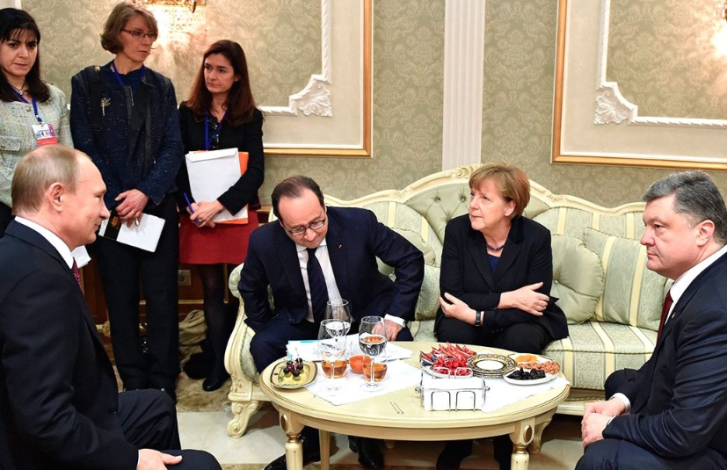
Putin, French President Francois Hollande, German Chancellor Angela Merkel, Ukrainian President Petro Poroshenko at the Normandy format talks in Minsk, Belarus, Feb. 12, 2015. (Kremlin)
My take on the week’s events takes me back to the Minsk Protocols, which Moscow negotiated a decade ago with Kiev, Paris and Berlin.
Signed in September 2014 and February 2015, these committed Ukraine to a new constitution whereby the Russian-speaking provinces in the nation’s east would be granted a considerable degree of autonomy. Kiev and Moscow signed, France and Germany serving as co-signatories backing the former.
Kiev ignored the Minsk accords from Day 1. And, as well-reported at the time, the French and Germans later acknowledged they co-signed only to allow Ukraine time enough to rearm so as to continue attacking the eastern provinces and prepare for the war that eventually broke out three years ago.
This pencil-sketched history is useful to understanding this week’s events and what preceded them. Putin got his fingers burned in Minsk, having personally negotiated the two protocols. I do not know when the Russian president decided the European powers could not be trusted, but he has certainly not trusted them since the Minsk debacle.
Last week’s events proved this a sound judgment. In an improvised game of diplomatic chess, Moscow got the Europeans in check this time, making dexterous use of Kiev as its pawn.
Post–Istanbul, it appears now that the best chance of a settlement of the Ukraine conflict resides in the prospect of a Trump–Putin summit. This, if it comes to pass, would define the Ukraine crisis — altogether properly — as a subset of Trump’s project to restore relations with Moscow.
And it would disarm, not to say humiliate the Europeans who have been leading the Continent to continue its support for the Kiev regime and the war.
A couple of caveats are in order here. One, as earlier suggested, it is not at all clear we have heard the last of the European triumvirate who took center stage for a few days this week. Starmer, Macron and Merz, the last just appointed Germany’s new chancellor, are heavily invested in the Ukraine project and the Russophobia that propels it.
Two, as Putin and other Russian officials have made plain numerous times, and very pointedly this past week, substantive negotiations of a settlement of the Ukraine crisis must begin with mutual recognition of “root causes,” to take the phrase the Kremlin now favors.
This is why Moscow nominated Istanbul as the venue for these new talks. In the draft Boris Johnson disrupted three years ago, these concerns were addressed.
“We view these talks as a continuation of the peace process in Istanbul, which was unfortunately interrupted by the Ukrainian side three years ago,” Medinsky said at a press conference as he set out of Istanbul Thursday. “The aim of direct negotiations with the Ukrainian side is ultimately to secure lasting peace by addressing the fundamental root causes of the conflict.”
The phrase is too ubiquitous in the Russian discourse to ignore. The question now is whether Donald Trump, in any summit he may have with Vladimir Putin, will be at all equipped to address Russia’s concerns.
If he does, he will fundamentally alter relations between the Western powers and Russia for the good — a diplomatic triumph. If he does not, he is unlikely to get anything more done than negotiators accomplished in Istanbul this week.
Featured Video

Alon Mizrahi: ‘Israel Must Be Dismantled’
or go to
Aletho News Archives – Video-Images
From the Archives
Allies Don’t Need Lobbies
By Jay Knott | Dissident Voice | September 24, 2013
In a recent article on Counterpunch, Rob Urie defended the traditional Marxist analysis of US policy in the Middle East. He argues that support for Israel is driven primarily by economic interest, not the Jewish lobby.
He starts by paying tribute to the idea that Western societies are uniquely racist. He says that the “Western narrative” claims there is an “Arab character”, and that this is “antique racist blather”. He gives no definition of these terms. Further, he establishes his credentials as part of the dominant current in the American left by claiming that “over a million people in Iraq died so ‘we’ in the West can drive SUVs.”1
When he tries to criticize bourgeois economics, he makes it clear he doesn’t understand the developments it has made since Marx’s day, using the mathematical discipline known as “game theory”. He dismisses the basic abstraction of economic theory, the idea of the rational individual, on the grounds that it is “devoid of history, culture and political context”. But abstractions are always devoid of something.
He defends a more concrete economic theory, mostly Marxist, with some input from another theorist of capitalist crisis, Hyman Minsky. This concrete theory leads him to the view that US activity in the Middle East is primarily driven by rational capitalist motives, the need to secure a supply of oil.
“Taking the totality of circumstance — former oil company executives launching war on an oil rich nation on a pretext they publicly proclaimed they didn’t believe shortly before taking office — and that upon launching their war proved to be non-existent, requires a willingness to overlook the obvious — that the war on Iraq was for oil, that is difficult to support.”1
Perhaps I’ve misunderstood him, but based on what he says in the rest of the article, this convoluted sentence seems to argue that, because president Bush and vice-president Cheney attacked Iraq on false premises, and they also said it was all about oil, and they are former oil executives, and Iraq has a lot of oil, it’s difficult to deny US attacks on Iraq are all about oil.
In fact, it’s not hard at all. As Urie points out, at times Bush and co. said that attacking Iraq was “protecting the world’s supply of oil.”1 But, as he also points out, they are congenital liars. Why should we believe them when they say they are trying to “protect” the oil supply? Protect it against what? When politicians “admit” attacks on Middle Eastern countries are wars for oil, they are parroting the neo-con party line, feeding the public, both left and right, with a plausible-sounding pretext. For right-wingers, “it’s a war for oil” is a reason to support war, and for leftists, it’s a way to feel better by complaining impotently about corporate greed. Both approaches help the war drive. … continue
Blog Roll
 Aletho News
- Pakistan ramps up food exports to Persian Gulf nations as war deepens food insecurity
- Iran submits response to US plan, sets terms for war’s end: Tasnim
- US vs Iran: Kharg Island Talk — Bluff or Escalation? Ex-Military Officer Weighs In
- Zelensky unnecessarily involves Ukraine in the Middle East crisis
- Turkish tanker blacklisted by Ukraine hit in drone attack – media
- Canada, the U.S., and NATO: the inescapable trap
- Villains of Judea: Leonid Radvinsky
- Alon Mizrahi: ‘Israel Must Be Dismantled’
- Former Head Of MI6 Admits That The U.S. And Israel Are Losing The Iran War
- Scattered Thoughts on War and Peace
- If Americans Knew
- Israel may be committing war crimes in Lebanon – Not a ceasefire Day 167
- In the West Bank, life is a constant battle – 3 articles
- Jacob Reses, one of the most powerful pro-Israel operatives in Trump’s Washington
- Israeli-US assaults kill or injure 87 children a day – Not a ceasefire Day 166
- ‘Forever live by the sword’: Understanding Israelis’ massive support for Iran war
- UN’s special rapporteur on human rights says Israel is systematically torturing Palestinians
- Trump White House plagiarized Iran war manifesto from Israel-aligned think tank
- Gaza says 6–10 patients die daily waiting for treatment abroad as Israel blocks medical evacuations
- ‘Substantial evidence’ of double-tap strike in killing of Gaza’s Hind Rajab
- ‘Do Not Want To Die For Israel’: Doubts About Trump’s Iran Strategy Spread Among Troops
- No Tricks Zone
- Devastating Assessment Of Comirnaty Vaccine By Former Senior Pfizer Europe Toxicologist
- New Study: CO2 Is ‘Effectively Negligible’ As An Explanatory Climate Change Factor Since 2000
- Former Pfizer Toxicologist Dr. Helmut Sterz Tells Bundestag Hearing Pfizer Vaccine Should Have Never Been Approved
- Energy Expert: Germany’s Nuclear Phaseout Was A “500 Billion Euro Mistake”
- New Research: South Australia’s Mid-Holocene Sea Surface Temperatures Were 4°C Warmer Than Today
- Storing Green Energy To Last Germany 10 Days Would Require A 60-Million Tonne Battery
- New Studies: UK Sea Levels Were 4 Meters Higher Than Today During The Mid-Holocene
- Destructive Green New Deal: German Energy And Metal Group Warns Of Drastic Crisis
- New Study Documents A 20-Year Pause In Arctic Sea Ice Decline – Driven By Internal Variability
- Wake-up Call: Survey Shows Majority Of Germans Now Favor Postponing Climate Targets!
 Aletho News