India hits Pakistan with ballistic missiles, Islamabad vows response
Press TV – May 6, 2025
India reports attacking nine sites in Pakistan and the Pakistan-administered Kashmir amid rising tensions between the countries following a terrorist attack in the Indian-administered Kashmir.
The Indian ministry of defense announced the strikes in a statement on Wednesday, saying they had hit the targets “from where terrorist attacks against India have been planned and directed,” describing the attacks as “Operation Sindoor.”
The statement said the ministry would release detailed briefing of the operation later in the day.
A Pakistani military spokesman told broadcaster Geo that sites struck by India included two mosques.
Both sides’ armies, meanwhile, reportedly exchanged heavy shelling and gunfire across the border between the Pakistan-administered Kashmir and the Indian-administered Kashmir in at least three places.
Pakistani Prime Minister Shehbaz Sharif said Islamabad was mounting a response, but did not provide details.
Muzaffarabad, the capital of the Pakistan-administered Kashmir, reported a blackout, while the eastern Pakistani border province of Punjab declared an emergency and put hospitals and emergency services on high alert.
Pakistan reports casualties
Pakistan said India had launched missiles towards three Pakistani regions, although New Delhi is yet to identify the nature of the deployed ammunition.
Islamabad also said at least three people had been killed and 12 others injured, according to an initial assessment.
The Pakistani military’s Inter-Services Public Relations said one of the fatalities was a child.
Sharif also condemned India’s attacks, and vowed that Islamabad would respond forcefully.
“The enemy has once again shown its deceitful nature,” he said, according to Geo.
The country had, on several occasions, announced recently that it had “credible information” pointing to pending Indian attacks, and vowed to retaliate accordingly.
India: Attacks were ‘surgical but non-escalatory’
The Indian ministry described the operations as “precision strikes at terrorist camps” and “terrorist infrastructure” in Pakistan and Pakistan-administered Kashmir.
It, however, said, “Our actions have been focused, measured, and non-escalatory in nature.”
“No Pakistani military facilities have been targeted. India has demonstrated considerable restraint in selection of targets and method of execution.”
Pakistan: Targets were ‘civilian’
Pakistan’s Defense Minister Khawaja Muhammad Asif, however, told Geo that all sites targeted by India were “civilian” and not terrorist camps.
He said India had fired missiles from its own airspace and the latter’s assertion of targeting “camps of terrorists is false.”
The developments follow the terror attack in the town of Pahalgam in the Indian-administered Kashmir that claimed the lives of at least 26 tourists on April 22, 2025.
The Indian defense ministry statement asserted that Operation Sindoor had come in the wake of the “barbaric” Pahalgam terrorist attack, identifying the fatalities as 25 Indians and one Nepali citizen.
“We are living up to the commitment that those responsible for this attack will be held accountable.”
Pakistan has rejected any role. Federal Information Minister Attaullah Tarar had most recently rejected, what he called, India’s narrative regarding ongoing issues, and said that New Delhi was facing “diplomatic embarrassment on the global stage.”
Conflict over water
After the terrorist indecent, both countries began taking tit-for-tat measures.
India suspended the Indus Waters Treaty, a water-sharing agreement mediated by the World Bank and signed in 1960, and closed the Wagah-Attari border crossing.
On Tuesday, Indian Prime Minister Narendra Modi had said water from the country that once flowed across borders would be stopped.
“India’s water used to go outside, now it will flow for India,” he said in a speech in New Delhi, adding, “India’s water will be stopped for India’s interests, and it will be utilized for India.”
Pakistan has described India’s measures as tampering with its rivers that would be considered “an act of war.”
For its part, Islamabad has suspended visas issued to Indian nationals, closed its airspace to Indian airlines, and test-fired several long-range missiles.
India-Pakistan tensions show signs of easing
By M. K. BHADRAKUMAR | Indian Punchline | May 2, 2025
Time past is time present in India-Pakistan crisis. The ‘mediation’ by the United States from behind the scene on the diplomatic track appears to be once again working, which calls on both Delhi and Islamabad to show restraint and pull back from a military confrontation. The call for a responsible response by India — and for Pakistan to be cooperative — by the US Vice-President JD Vance serving under the leadership of a ‘peacemaker president’ epitomises the world opinion, for sure.
There are signs that life in India is moving on. The melancholy, long, withdrawing roar of a heavy heart is discernible. Prime Minister Narendra Modi is travelling out of Delhi. On Thursday, he was in Mumbai to inaugurate a 4-day summit, which is a landmark initiative to position India as a global hub for media, entertainment, and digital innovation.
On Friday, Modi will be in the southernmost state of Kerala to formally commission the Vizhinjam International Deepwater Multipurpose Seaport, touted as the country’s first dedicated container transhipment port, representing the transformative advancements being made by the Modi government in India’s maritime sector as part of the prime minister’s unified vision of Viksit Bharat, the initiative to achieve the goal and vision of transforming India into a developed entity by 2047, the centenary year of independence.
The Vizhinjam port’s natural deep draft of nearly 20 meters and location near one of the world’s busiest sea trade routes is expected to strengthen India’s position in global trade and enhance logistics efficiency.
Second, the Modi government made a historic announcement on Wednesday on the so-called caste census, ie., collecting data on the distribution of caste groups, their socio-economic conditions, educational status, and other related factors, which is a crucial step and a social imperative, as caste continues to be a foundational social construct in India. The data collection will be a key step toward empowerment of the lower downtrodden, dispossessed castes, numbering on hundreds of millions of Indians, which holds the potential to a churning in the ossified archaic Hindu social hierarchy.
Third, on Wednesday, again, the Army used the hotline for the first time since the Pahalgam terror strike to communicate with the Directorate of Military Operations in Rawalpindi to convey India’s concerns over the sudden flare-up on the Line of Control in the past few days. This in itself is a great thing to happen — the two militaries in conversation.
The DGMO hotline is a tested confidence-building measure as well as an effective communication channel between the two militaries, and the fact that the Indian side has used it messages in itself an eagerness to keep the border tensions under check. The hotline can serve a big purpose in ensuring that misperceptions of each other’s intentions do not arise at such a sensitive juncture especially when a huge trust deficit characterises the relationship.
Fourth, amidst the prevailing crisis atmosphere, the government has announced a revamping of the National Security Advisory Board (NSAB) which will now be headed by a retired intelligence officer with vast experience who had headed both the RAW as well as the NTRO — especially the latter, the Cinderella of the ecosystem of India’s intelligence.
Suffice to say, the government’s intention appears to be to strengthen the resources for intelligence gathering. The revamping of the NSAB with a pivotal role for a former head of NTRO (for the first time) whose expertise lies in the intelligence gathering and analysis (rather than operational) can be seen as a tacit acknowledgment that there has been intelligence failure in the Pahalgam terrorist attack, which has indeed been a topic of animated public discussion in the country’s media.
Taken together, the above developments signal that the traumatised nation must move on even as the security forces and the intelligence agencies pursue the downstream of the Pahalgam terror attack. Quite obviously, inflammatory public rhetoric serves no purpose. The exhortation by the widow of Naval officer Lt. Vinay Narwal, who was gunned down in Pahalgam ten days ago says it all: “We don’t want people going after Muslims and Kashmiris.”
What a chronicle of wasted time India and Pakistan are presenting! One had thought that the ‘peace dividend’ of the war in Afghanistan should do a world of good for India-Pakistan relations. But the opposite has happened. If the two countries are incapable of living in amity even after decades, why not seek the help of friendly countries to promote reconciliation? There is nothing obnoxious about it.
Some hard lessons need to be drawn. First and foremost, the raison d’être of India’s diplomacy in Kabul should be firmly and exclusively anchored on a bilateral grid of mutual benefit and mutual respect pivoting on friendship at people-to-people level. The temptation to reduce the Indo-Afghan cooperation as a ‘second front’ against Pakistan will always be there so long as Delhi harbours an adversarial mindset toward Islamabad, but we should be abundantly cautious not to create misperceptions in the Pakistani mind and end up adding yet another dimension to the boiling cauldron of existing differences, disputes and discords. The point is, the break-up in 1971 is a searing memory still in the Pakistani psyche, which it can only exorcise with some Indian help and understanding.
This calls for a deliberately passive diplomacy strategy to adapt to partner needs of Afghan friends while safeguarding India’s interests in the region. To my mind, the main platform must be in economic terms. Indians are agile enough to prepare such a precise and systematic strategy.
Second, the present crisis has exposed that while the world opinion is supportive of India’s concerns over terrorism, it is not inclined to put the entire blame on Pakistan, as some of us would have probably liked. Put differently, the world opinion also empathises with Pakistan as a victim of terrorism. Terrorism poses an existential threat to Pakistan manifold in gravity compared to what India faces. And something of the Pakistani allegations with regard to an ‘Indian hand’ may have come to stick in the world opinion even if not audible.
Third, most important, taking the above factors into account, the law of diminishing returns is at work in our decade-old strategy to slam the door shut on Pakistan, refuse to talk to Pakistan, spurn their overtures for dialogue. If the US can bring itself to have dialogue with Russia and Iran (or, conceivably, with North Korea in a near future) despite the backlog of very hostile relationships, we need to sense that in the emerging world order, dialogue is the preferred mode in inter-state relationship and it must be fostered with all means available.
The bottom line is, there has never been and never can be absolute security. No lesser a realist than Henry Kissinger highlighted the basic flaw in any quest for absolute security: “The desire of one power for absolute security means the absolute insecurity for all the others.”
When it comes to the South Asian region, this is even more so, as common security takes on special significance and urgency in the context of the nuclear stockpile and a sensitive flashpoint in the Himalayas and, of course, the strategic pivot of the region itself. Therefore, the attempt to resolve the Kashmir dispute unilaterally during the past six-year period since 2019 without any consultation / participation by Pakistan (or China, for that matter) is futile and betrays hubris.
Pakistan Activates Geran Doctrine: Looming Threat of Nuclear War in South Asia
By Abbas Hashemite – New Eastern Outlook – May 2, 2025
Since the Pahalgam attack in Indian administrated Kashmir, tensions between Pakistan and India have been brewing. Limited crossfire has been observed between the two sides on the Line of Control. Pakistan’s alleged activation of the Geran doctrine has further intensified the situation in the region.
Tensions Escalate Over Pahalgam Attack
The Indian government blamed Pakistan for sponsoring the Pahalgam terrorist attack, killing 26 civilians. However, till this writing, the Indian government has not presented any evidence of Pakistani involvement in this terrorist attack. Since then, tension between the two sides has been exchanging blame. According to media reports, Indian Prime Minister Narendra Modi has green-lighted the Indian army to take kinetic measures against Pakistan.
However, Islamabad has rejected all the Indian allegations and blamed the Pahalgam attack as a false flag operation of the Modi government to build an anti-Pakistan narrative domestically and internationally. Pakistani officials also maintain that the Modi government seeks to alter the demography of Indian-administrated Kashmir under the pretense of anti-terrorism operations in the region.
Militarization and the Risk of Nuclear Confrontation
The armies of the two countries have taken positions along the international border. According to media reports, both sides have exchanged fire in the Kayani and Mandal sectors. The reports suggest that the two sides are using small weapons in this limited exchange of fire. However, Pakistan’s Information Minister Attaullah Tarrar warned in his midnight press briefing on 30th April that intelligence sources have reported that India could take military action within the next 24-36 hours.
He stated, “Any military adventurism from India will receive a certain and decisive response.” Pakistan Director General of Inter-Services Public Relations Lt. General Ahmed Sharif Chaudhary, along with Foreign Minister Ishaq Dar, also held a press conference on 30th April. He rejected all the allegations of the Indian government and warned the world of the threat of regional instability. He also warned of a strong retaliation from Pakistan in response to any military action by India.
Different international powers, including China, Turkey, the United States, the UAE, Saudi Arabia, and Russia have urged the two sides to show restraint. The UN Secretary-General Antonio Guterres has also warned both countries of tragic consequences. Public sentiment on both sides is running high. Pakistan and India both possess nuclear power. The two countries have already fought four wars over the Kashmir issue.
However, the situation between the two sides has never been so intense since they assumed nuclear power. India is the world’s fourth-largest economy and holds quantitative supremacy over the Pakistan army in military personnel, and weapons, although the Pakistan Air Force has a qualitative edge over the India Air Force. This quantitative imbalance further demonizes the predicament.
Some credible journalists in Pakistan have reported that the Pakistan Army has received clearance from Pakistani Prime Minister Shehbaz Sharif to activate a localized version of the Geran Doctrine, an approach that permits preemptive strikes based on credible intelligence reports. As per the report, Pakistan could rapidly deploy Babur missiles, Burraq drones, and NASR tactical vectors to retaliate against Indian attacks. Although there has been no official confirmation of such reports, Pakistani officials and analysts have repeatedly warned that the country would go to any length to protect its sovereignty.
DG ISPR and Information Minister’s press briefing also indicated that Islamabad is prepared to take extraordinary measures in retaliation to any Indian attack. Given its quantitative subjugation and limited resources, Pakistan may use tactical nuclear missiles to subdue its arch-rival. The nuclear policies of the two countries suggest that either side could use its nuclear weapons against the other to gain a decisive victory. This puts the world in a tragic situation.
The Cost of Conflict: Human Development vs. Defense Priorities
Pakistan and India have been arch-rivals since the inception of the two countries. The prime focus of the governments in both countries has always been building the defense sector to subdue each other. This led to extreme poverty, inflation, and unemployment on both sides. According to the Times of India, both countries are among the five nations with the largest populations living in poverty. As per the report, 234 million and 93 million people live in poverty in India and Pakistan, respectively. Moreover, the unemployment rate in India is 7.90 percent. Pakistan’s unemployment rate also stands at 7.50 percent. These figures suggest that the two countries need to re-evaluate their priorities and should focus on human development instead of the defense sector.
Given the intensity of the current situation, regional and global powers need to play their part in bringing the two sides to the negotiation table. India considers China as its regional rival. Therefore, Beijing cannot effectively mediate between the two countries. Russia’s growing influence on Pakistan and its long-term relations with India incentivizes Moscow to mediate between the two sides.
The Gulf nations also hold significant influence over India and Pakistan. This provides them an opportunity to mediate peace talks between the two countries. Furthermore, an investigation of the Pahalgam attack by an international tribunal under the United Nations is also mandatory to reveal the real perpetrators of this heinous terrorist activity, endangering the peace and stability of South Asia. Any escalation between Pakistan and India will not only prove detrimental for the two countries but also have somber consequences for the region and beyond.
Abbas Hashemite is a political observer and research analyst for regional and global geopolitical issues. He is currently working as an independent researcher and journalist.
Ukraine’s Air and Naval Drone and Cruise Missile Attack on Russia’s Novorossiysk: What We Know
Sputnik – 03.05.2025
Shortly after midnight on Saturday, a missile hazard signal rang out across the Russian Black Sea port city of Novorossiysk.
Russia’s military reported that it had repelled a large-scale aerial and naval drone and cruise missile attack targeting local infrastructure.
According to the MOD:
- 47 Ukrainian drones were shot down over Krasnodar Region during the night
- 14 unmanned boats were eliminated
- Eight Storm Shadow missiles and three Neptune-MD missiles were destroyed over the Black Sea
City and regional authorities indicated that five civilians, including two children, were injured after eight apartments in two multi-story buildings suffered damage. A state of emergency was declared.
Drone fragments also fell in the villages of Taman, Yurovka and Tsibanobalka, with private houses damaged, but no casualties reported.
The KSK grain terminal in Novorossiysk Sea Port, one of Russia’s main grain export terminals, reported a fire triggered by UAV debris, which damaged three tanks. The fire was extinguished with the help of Ministry of Emergency Situations firefighters.
No casualties were reported, and the terminals are operating as normal, the Delo Group of companies reported.
The Novorossiysk port is a key regional and global foodstuffs transit hub. Millions of tons of grains are exported through its terminals each year, including to food-insecure countries in the Global South. Later this month, a new logistical route to West Africa, the Novorossiysk-Lagos route, is set to be launched.
US approves F-16 support package for Ukraine
RT | May 3, 2025
The US has approved a $310.5 million deal to sustain Ukrainian-operated F-16 fighter jets provided by Kiev’s European backers. The move comes after the US and Ukraine signed a deal in which Kiev grants Washington access to its natural resources in exchange for future assistance.
The F-16 deliveries from European NATO members to Ukraine were approved by former US President Joe Biden in August 2023, but the first jets did not arrive in the country until a year later. While Ukrainian officials hailed the deliveries as a major coup, Western media warned that they would not be a “game changer” in the conflict. In March, the Ukrainian Air Force acknowledged that the F-16s operated by Kiev “cannot compete” with the latest Russian jets.
In a statement on Friday, the Pentagon’s Defense Security Cooperation Agency (DSCA) said the State Department had signed off on a foreign military sale to Ukraine which includes training, spare parts, aircraft modifications, logistics assistance, and software support for F-16s.
The agency added that the proposed sale “will support the foreign policy goals… of the United States by improving the security of a partner country that is a force for political stability” in Europe.
More than 80 F-16s have been promised to Ukraine, with the bulk expected to come from Belgium and the Netherlands, while the US has never committed to providing the jets on its own. While the exact number of jets delivered is unknown, Moscow confirmed last month it had shot down one F-16. Ukraine’s Vladimir Zelensky said the aircraft’s pilot perished during a “combat mission.”
In 2024, Ukraine reported the loss of another F-16, saying it crashed while repelling a Russian air strike.
The DSCA announcement comes after the Pentagon said it is sending “disused and completely non-operational F-16s to Ukraine for parts.” It also follows the signing of a US-Ukraine resource deal that is intended to allow Washington to recover the cost of future military support through shared proceeds from Ukrainian mineral resource licenses.
Moscow has condemned the Western arms shipments to Ukraine, warning they will only prolong the conflict without changing the outcome. Russian President Vladimir Putin has said Ukrainian-operated F-16s will “burn” just like other Western-supplied equipment.
Trump Requests Record $1.01 Trillion for National Defense for FY2026
Sputnik – 02.05.2025
WASHINGTON – US President Donald Trump has proposed a historic $1.01 trillion budget for national defense for fiscal year 2026, representing a 13% increase from the current year’s $878.4 billion, according to a document released by the Office of Management and Budget (OMB) on Friday.
“For Defense spending, the President proposes an increase of 13 percent to $1.01 trillion for FY 2026,” OMB director Russell Vought said in a letter to Senate Committee on Appropriations chair Susan Collins.
Trump also proposed to cut non-defense discretionary budget spending by $163 billion or 22.6%, according to the letter.
The defense budget request includes $113 billion in mandatory funding and emphasizes investments aimed at revitalizing the US defense industrial base, deterring potential Chinese aggression, and modernizing the US nuclear deterrent, the letter said.
Trump’s budget proposal supports US space dominance to strengthen US national security and strategic advantage, the letter added.
Donald Trump’s budget request for the fiscal year 2026 pauses most contributions to the United Nations and other international organizations, according to the document.
“The Budget pauses most assessed and all voluntary contributions to UN and other international organizations, including for the UN Regular Budget, UN Educational, Scientific and Cultural Organization, and the World Health Organization,” OMD director Russell Vought said in a letter to Senate Committee on Appropriations chair Susan Collins.
Trump’s budget also does not allocate funds for “wasteful” United Nations (UN) and other peacekeeping missions, citing recent failures and high assessment costs, according to the letter.
The Trump administration requested on Friday in its 2026 budget proposal to refocus NASA funding on flying to the Moon and sending humans to Mars.
“The Budget refocuses National Aeronautics and Space Administration (NASA) funding on beating China back to the Moon and on putting the first human on Mars. By allocating over $7 billion for lunar exploration and introducing $1 billion in new investments for Mars-focused programs, the Budget ensures that America’s human space exploration efforts remain unparalleled, innovative, and efficient,” the budget request said.
The budget request also included the reduction in the International Space Station’s (ISS) crew size, onboard research, and preparation for decommissioning by 2030.
“The Budget reduces the space station’s crew size and onboard research, preparing for a safe decommissioning of the station by 2030 and replacement by commercial space stations,” the White House said.
Trump has requested a record $175 billion investment to fully secure the US border, according to the document.
“For Homeland Security, the Budget commits a historic $175 billion investment to, at long last, fully secure our border,” OMB director Russell Vought said in a letter to Senate Committee on Appropriations chair Susan Collins.
The request reflects an almost 65% increase compared to the fiscal year 2025, when $107.9 billion was allocated for Homeland Security.
The Trump administration’s 2026 budget request included funding for the F-47 fighter jet program and a down-payment for the Golden Dome missile defense shield deployment in the United States, the White House said on Friday.
“Specifically, the Budget… makes a down-payment on the development and deployment of a Golden Dome for America, a next-generation missile defense shield that would protect the U.S. from missile threats coming from any adversary,” the White House said.
The budget proposal also funds the F-47 Next Generation Air Dominance platform: the world’s first crewed sixth-generation fighter aircraft”, it added.
The request included funding for the F-47 fighter jet program and a down-payment for the Golden Dome missile defense shield deployment in the United States, the White House said on Friday.
“Specifically, the Budget… makes a down-payment on the development and deployment of a Golden Dome for America, a next-generation missile defense shield that would protect the U.S. from missile threats coming from any adversary,” the White House said.
The budget proposal also funds the F-47 Next Generation Air Dominance platform, the world’s first crewed sixth-generation fighter aircraft”, it added.
Trump’s budget proposal eliminates funding for the National Endowment for Democracy program as it was used “to blacklist conservative media” and label figures like JD Vance as “foreign propagandists of the Russian Federation” under the Biden administration, the document said.
“National Endowment for Democracy (NED) – The Budget defunds this program that under the Biden Administration was used to dox journalists, push propaganda, and blacklist conservative media outlets, saving $315 million. In March 2025, it was uncovered that the Ukraine disinformation organization that doxxed U.S. journalists, called for prosecutions of Trump world, and smeared the likes of Vice President Vance and others as ‘foreign propogandists of the Russian Federation,’ were funded by NED. NED also funded the now-infamous State Department Disinformation Index Foundation that targeted and blacklisted conservative media outlets such as Federalist, Newsmax, TAC, the Blaze, NYP, etc,” the document said.
The budget request also proposes the closure of the US Agency for International Development (USAID) and transfer of the remaining programs under the umbrella of the State Department.
Besides, it proposes the closure of the United States Institute of Peace.
‘Israel’ launches extensive strikes across Syria
Al Mayadeen | May 2, 2025
Israeli warplanes launched a wide-ranging series of airstrikes across Syria in what local reports describe as one of the most expansive attacks in recent months.
According to Syrian sources and Israeli media outlets, the operation began with intense drone activity over the provinces of Daraa, Homs, and Hama, before transitioning into a coordinated aerial assault carried out by Israeli fighter jets overnight.
Strikes target military sites across central and southern Syria
One of the earliest reported strikes targeted the area near the village of Shaṭḥa in western Hama countryside, where a military warehouse located within what is being described as a Syrian army base of the former regime was hit. Simultaneously, Israeli aircraft were heard over multiple governorates, signaling the broad scale of the attack.
In Latakia’s countryside, airstrikes struck the al-Sha‘ra region, while further south, Israeli jets flew heavily over Damascus and its surroundings. Explosions were reported in and around the capital, particularly near the Harasta suburb.
Confirmed targets included the Signal Battalion headquarters and areas around the former Tishreen Military Hospital in northern Damascus. Local sources confirmed that the strikes targeted camps, sites, and military warehouses in the mountain range surrounding Harasta, Barzeh, and al-Tall.
Additional raids reported in Daraa and Idlib
Further south, the town of Muthbin in northern Daraa was also hit by an Israeli airstrike. Israeli media outlets reported that the strikes included previously untouched areas in Damascus and simultaneous hits on positions in Idlib.
Local sources said that a second Israeli airstrike on Daraa hit the outskirts of the city of Izra’ in the governorate’s countryside. The attack targeted the Syrian Arab Army’s 175th Regiment camps.
No official response from Damascus yet
As of Sunday, the Syrian government had not issued any official statement regarding casualties or the extent of material damage. Local sources said that one person was martyred in the strikes that targeted the outskirts of Harasta.
This latest escalation marks a significant moment in the Israeli regime’s ongoing air campaign in Syria.
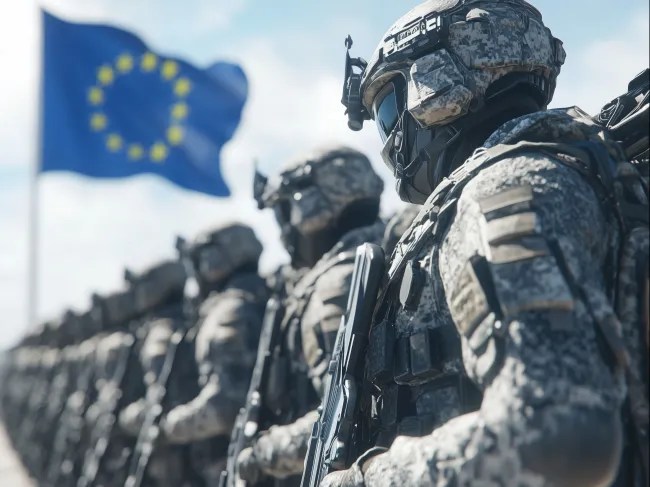
As the World Seeks Peace, the EU Looms for War
By Ulrich Fromy • Mises Wire • 04/18/2025
We can feel the winds of warmongering blowing through Europe as the continent raises the specter of war with Russia. Recently, the European Commission unveiled a series of measures to strengthen the defense of EU member states, most notably through the ReArm Europe plan. The plan—which was endorsed by the Extraordinary European Council on March 6, 2025—aims to mobilize €800 billion for the EU’s defense capabilities. It includes a redirection of public funds, but not only: it also includes the use of public savings. As announced on March 17, 2025, this strategy aims to get hold of around €10,000 billion in European bank deposits and redirect them towards the arms industry and public defense policies.
Another European example: Valérie Hayer, a French MEP and leader of the Renew Europe group in the European Parliament, recently declared that the old continent is experiencing “a moment of gravity” probably not seen since the Second World War. The culprit? The war in Ukraine and the existential threat posed by Russia to democracy and the European order. To deal with this threat, she and other European politicians want to mobilize the savings of Europeans to finance this collective effort in the arms industry.
In France and Germany
In mid-March, a number of French political figures spoke out in favor of mobilizing private savings to rearm the country in the face of the Russian threat. On March 13, the French Minister of the Economy, Éric Lombard, spoke in favor of this measure before French senators. At the time, there was no question of creating a dedicated savings account, but rather of targeting all the capital saved by the population.
However, in the face of widespread criticism, Éric Lombard backtracked on Thursday, March 20, and announced the creation of a 450 million euro fund managed by Bpifrance and open to individual investors wishing to contribute to the national rearmament effort by becoming indirect shareholders. The minimum amount to be invested in this fund will be 500 euros, with a maximum initial investment that could be of “several thousand euros.” Once invested, these “safe” funds will be frozen for at least five years.
There is the same warmongering rhetoric in Germany. Before leaving office, Olaf Scholz spoke to the Bundestag about the “Zeitenwende,” the historical turning point that Germany is currently facing. He promised to face it by investing massively in the rearmament of the German army, the Bundeswehr. The most likely future German chancellor, Friedrich Merz, got a vote in the German parliament to spend 1,000 billion euros on rearming the country. An unprecedented expenditure in a country that has long delegated its own national defense to NATO and the United States.
All these European investments are presented as “safe and profitable investments” (according to Valérie Hayer). However, as history shows us, these investments are just the opposite.
What History Teaches Us
Society has arisen out of the works of peace; the essence of society is peacemaking. Peace and not war is the father of all things. Only economic action has created the wealth around us; labor, not the profession of arms, brings happiness. Peace builds, war destroys. (Mises, Socialism, p. 59)
Historically, investing in war bonds and funds has always meant taking the risk of betting on the wrong horse. This bet could very well lead to the ruin of the creditors of the defeated state. This was the case in Germany with the impossible repayment of war bonds after 1918. These bonds had become worthless because the reparations demanded by the Treaty of Versailles and the hyperinflation of the Weimar Republic made their repayment impossible.
Conversely, if the state was victorious, the repayment of these often massive loans could take years, ruining the creditor through monetary inflation and the financial repression that was put in place after the conflict to wipe out the state’s debts. This is what happened in the United States after 1945 when the Victory Bonds were repaid. The post-war policy of financial repression kept interest rates low and inflation of the dollar high, causing a gradual decline in the value of the currency. As loans were repaid, the purchasing power of creditors declined in the years following the end of the war.
More serious than the ruin of creditors is the ruin of society. These investments divert capital from genuinely productive alternatives that actually improve people’s living conditions; they retard progress by diverting capital (resources, labor, and money) to these defense industries. They don’t understand that the short-term prosperity offered by the “industry of destruction” is only an illusion and comes at the cost of long-term prosperity for society as a whole.
Any militarized, jingoistic, war-mongering society will only fall further behind on the road to progress and improved living conditions made possible by the best possible allocation of capital in the productive structure of society. As the economist Frédéric Bastiat wrote, war is an illusion of wealth: it creates visible economic activity (the arms industry), but always at the expense of the “invisible” (i.e., lost opportunities and deferred costs). War is never an exit out of a crisis, but the ultimate crisis a society can face.
In short, warmongers of all stripes—excited by the idea of profiting financially from a possible war—ultimately understand nothing about economics or history. Worse, they understand nothing about war.
Aggressive Rhetoric of NATO, EU Hinders Russia, US’s Risk Mitigation Efforts – Shoigu
Sputnik – 30.04.2025
Militarization of Europe and aggressive rhetoric on the part of NATO and the EU hinder the success of Russia and the United States’ efforts to reduce strategic risks, Russian Security Council Secretary Sergei Shoigu said on Wednesday.
“Today we continue to consistently convey to the Americans the need to work together on comprehensive reduction of strategic risks, which should have positive impact on the international security. However, militarization of Europe and aggressive rhetoric of NATO and the EU hinder achievement of positive results in this area,” Shoigu said at the meeting of high representatives of BRICS countries in charge of security issues, which is taking place in Brasilia.
Using Terrorist Proxies for Geostrategy
Some European countries are increasingly using terrorist groups for their geostrategic purposes, and the most prominent example is Ukraine, Russian Security Council Secretary Sergei Shoigu said on Wednesday.
“Some European states are increasingly using terrorist groups for their geostrategic purposes, primarily in confrontation with countries that do not recognize dominance,” Shoigu said at a meeting of the BRICS countries’ high representatives in charge of security issues, adding that the most striking example is Ukraine because Kiev uses NATO weapons to shell residential neighborhoods, commits sabotage and political assassinations.
The most serious challenges to global security come from ISIS and Al-Qaeda, because they are quickly adapting to changing geopolitical conditions, Shoigu added.
Zelensky should keep his original promise to voters – Moscow
RT | April 30, 2025
Moscow has urged Ukraine’s Vladimir Zelensky to finally fulfill the promises that led to his landslide victory in the 2019 presidential election.
The former actor rose to power pledging to bring peace between Ukraine and Russia, Vassily Nebenzia, Moscow’s envoy to the UN, reminded him.
During a UN Security Council session on Tuesday, which focused on the Ukraine conflict, Nebenzia urged Zelensky to “finally honor the pledge made to Ukrainian voters back in 2019, which is to pursue peace with Russia and respect for the rights of the Russian-speaking population of his country.”
Zelensky defeated the incumbent, President Pyotr Poroshenko, by vowing to ease tensions with ethnic Russian citizens who had rejected the government imposed after the 2014 armed coup in Kiev. However, his initial overtures for dialogue were met with threats of violence from radical nationalists, causing his administration to abandon its compromise agenda.
The Ukrainian leader, who claims presidential power despite the expiration of his term last year, “needs to act in the interests of his country rather than for the benefit of those seeking to use Ukraine purely as a pawn in the geopolitical struggle waged against Russia,” Nebenzia said.
The diplomat emphasized that Moscow’s demands include an end to anti-Russian discrimination. According to Nebenzia, Zelensky has repeatedly demonstrated unreliability while his nation now resorts to terrorist tactics in its military campaign against its neighbor, which are tacitly supported by Western nations.
Nebenzia asserted that Zelensky currently “is concerned solely with saving his own skin and covering up the crimes that he has committed against his own people,” suggesting that these interests necessitate the continuation of hostilities rather than a peaceful resolution.
The diplomat also accused Western nations of misrepresenting Kiev’s position as genuinely seeking a truce while falsely attributing warmongering motives to Moscow.
West ‘delirious with nuclear apocalypse scenarios’ – Putin aide
RT | April 29, 2025
European NATO members are risking nuclear war by escalating military tensions with Russia, according to Nikolay Patrushev, national security adviser to President Vladimir Putin.
Patrushev accused Western powers of “deploying their military machine against Russia and becoming delirious with nuclear apocalypse scenarios.” The destabilization is originating from Brussels, Berlin, Paris and London, the senior official told TASS in an interview published on Tuesday.
”For a second consecutive year, NATO is conducting exercises at our borders at a scale unseen in decades,” Patrushev said. “They are training for conducting a broad offensive from Vilnius to Odessa, seizing [the Russian exclave] Kaliningrad Region, imposing a naval blockade in the Baltic and the Black Seas, and executing preventive strikes on the staging locations of Russian nuclear deterrence forces.”
Patrushev, who formerly served as secretary of Russia’s Security Council, described the world as teetering on the brink, facing either a “new bloodbath” reminiscent of World War II or the emergence of “a fair world order where every nation enjoys sovereignty and security.” He attributed the actions of Western politicians to their refusal to accept the decline of a system centered around their nations.
The EU intends to borrow hundreds of billions of euros to fund a substantial militarization of its member states, justifying the move with claims of impending Russian aggression within the coming years.
Moscow has denied having any aggressive intentions towards the US-led military bloc, and has accused it of encroaching on Russian borders in violation of promises made to the USSR. Russian officials view the Ukraine conflict as a NATO proxy war aimed at undermining their nation’s development.
Featured Video

Alon Mizrahi: ‘Israel Must Be Dismantled’
or go to
Aletho News Archives – Video-Images
From the Archives
Allies Don’t Need Lobbies
By Jay Knott | Dissident Voice | September 24, 2013
In a recent article on Counterpunch, Rob Urie defended the traditional Marxist analysis of US policy in the Middle East. He argues that support for Israel is driven primarily by economic interest, not the Jewish lobby.
He starts by paying tribute to the idea that Western societies are uniquely racist. He says that the “Western narrative” claims there is an “Arab character”, and that this is “antique racist blather”. He gives no definition of these terms. Further, he establishes his credentials as part of the dominant current in the American left by claiming that “over a million people in Iraq died so ‘we’ in the West can drive SUVs.”1
When he tries to criticize bourgeois economics, he makes it clear he doesn’t understand the developments it has made since Marx’s day, using the mathematical discipline known as “game theory”. He dismisses the basic abstraction of economic theory, the idea of the rational individual, on the grounds that it is “devoid of history, culture and political context”. But abstractions are always devoid of something.
He defends a more concrete economic theory, mostly Marxist, with some input from another theorist of capitalist crisis, Hyman Minsky. This concrete theory leads him to the view that US activity in the Middle East is primarily driven by rational capitalist motives, the need to secure a supply of oil.
“Taking the totality of circumstance — former oil company executives launching war on an oil rich nation on a pretext they publicly proclaimed they didn’t believe shortly before taking office — and that upon launching their war proved to be non-existent, requires a willingness to overlook the obvious — that the war on Iraq was for oil, that is difficult to support.”1
Perhaps I’ve misunderstood him, but based on what he says in the rest of the article, this convoluted sentence seems to argue that, because president Bush and vice-president Cheney attacked Iraq on false premises, and they also said it was all about oil, and they are former oil executives, and Iraq has a lot of oil, it’s difficult to deny US attacks on Iraq are all about oil.
In fact, it’s not hard at all. As Urie points out, at times Bush and co. said that attacking Iraq was “protecting the world’s supply of oil.”1 But, as he also points out, they are congenital liars. Why should we believe them when they say they are trying to “protect” the oil supply? Protect it against what? When politicians “admit” attacks on Middle Eastern countries are wars for oil, they are parroting the neo-con party line, feeding the public, both left and right, with a plausible-sounding pretext. For right-wingers, “it’s a war for oil” is a reason to support war, and for leftists, it’s a way to feel better by complaining impotently about corporate greed. Both approaches help the war drive. … continue
Blog Roll
 Aletho News
- Pakistan ramps up food exports to Persian Gulf nations as war deepens food insecurity
- Iran submits response to US plan, sets terms for war’s end: Tasnim
- US vs Iran: Kharg Island Talk — Bluff or Escalation? Ex-Military Officer Weighs In
- Zelensky unnecessarily involves Ukraine in the Middle East crisis
- Turkish tanker blacklisted by Ukraine hit in drone attack – media
- Canada, the U.S., and NATO: the inescapable trap
- Villains of Judea: Leonid Radvinsky
- Alon Mizrahi: ‘Israel Must Be Dismantled’
- Former Head Of MI6 Admits That The U.S. And Israel Are Losing The Iran War
- Scattered Thoughts on War and Peace
- If Americans Knew
- Israel may be committing war crimes in Lebanon – Not a ceasefire Day 167
- In the West Bank, life is a constant battle – 3 articles
- Jacob Reses, one of the most powerful pro-Israel operatives in Trump’s Washington
- Israeli-US assaults kill or injure 87 children a day – Not a ceasefire Day 166
- ‘Forever live by the sword’: Understanding Israelis’ massive support for Iran war
- UN’s special rapporteur on human rights says Israel is systematically torturing Palestinians
- Trump White House plagiarized Iran war manifesto from Israel-aligned think tank
- Gaza says 6–10 patients die daily waiting for treatment abroad as Israel blocks medical evacuations
- ‘Substantial evidence’ of double-tap strike in killing of Gaza’s Hind Rajab
- ‘Do Not Want To Die For Israel’: Doubts About Trump’s Iran Strategy Spread Among Troops
- No Tricks Zone
- Devastating Assessment Of Comirnaty Vaccine By Former Senior Pfizer Europe Toxicologist
- New Study: CO2 Is ‘Effectively Negligible’ As An Explanatory Climate Change Factor Since 2000
- Former Pfizer Toxicologist Dr. Helmut Sterz Tells Bundestag Hearing Pfizer Vaccine Should Have Never Been Approved
- Energy Expert: Germany’s Nuclear Phaseout Was A “500 Billion Euro Mistake”
- New Research: South Australia’s Mid-Holocene Sea Surface Temperatures Were 4°C Warmer Than Today
- Storing Green Energy To Last Germany 10 Days Would Require A 60-Million Tonne Battery
- New Studies: UK Sea Levels Were 4 Meters Higher Than Today During The Mid-Holocene
- Destructive Green New Deal: German Energy And Metal Group Warns Of Drastic Crisis
- New Study Documents A 20-Year Pause In Arctic Sea Ice Decline – Driven By Internal Variability
- Wake-up Call: Survey Shows Majority Of Germans Now Favor Postponing Climate Targets!
 Aletho News