Europe faces a MAGA ‘vibe-shift’ as Trump moves to his primordial objective – The Global Reset
By Alastair Crooke | Strategic Culture Foundation | March 11, 2025
President Trump wants Ukraine settled, full stop. This is so that he can move ahead quickly – to normalise with Russia, and begin the ‘big picture’ project of setting a new World Order, one that will end wars and facilitate business ties.
The point here – which Europe feigns to not understand – is that the end to the Ukraine conflict simply is Trump’s ‘gateway’ to the entire rationale and platform on which he stood: The Great Reset of the Geo-Political landscape. Ukraine, simply said, is the obstacle to Trump’s pursuit of his primordial objective: The Global Reset.
Starmer, Macron and the eastern wing of the Euro-élites are blind to the sheer scale of the global vibe-shift towards traditionalist U.S. politics and ethics. They miss too, the barely concealed fury in the Trump world that exists behind this nascent revolution. “The Maga Right has none of the inhibitions of its predecessors. It is planning to leverage the power of a recaptured state to annihilate its enemies”, Allister Heath writes.
The European Ruling Class is in desperate trouble and increasingly isolated, in a world shifting ‘Rightward’ at breakneck speed. “The U.S. is now the enemy of the West”, the FT proclaims. European leaders wantonly won’t understand.
The reality is that the U.S. is engaged now in rolling up Europe’s foreign policy. And, is about to start exporting U.S. traditional Republican values to roll up the European wokeist belief-system. The European Ruling strata – far removed from its base – has failed to grasp the threat to its own interests (a scenario outlined here).
The Trump administration is trying to rebuild the ailing Republic, and Americans in this new era do not care for the European obsession with ancient feuds and their entailing wars.
Trump reportedly views with utter disdain the UK and European boast that should the U.S. not do it, then Europe will. The Brussels class claims to be able still – after three years of losing in Ukraine – to be able to inflict a humiliating defeat on President Putin.
More profoundly, however, Team Trump – committed to the task of taking down the American Deep State as the ‘inexorable enemy’ – perceives (rightly) the British security state to be co-joined at the hip with their American counterparts, as a part of its global meta-structure. And its oldest and deepest component has always been the destruction of Russia, and its dismemberment.
So when Macron, in an address to the nation this week, rejected a ceasefire in Ukraine and declared that “peace in Europe is only possible with a weakened Russia”, calling the country a direct threat to France and the continent, many in ‘Trump world’ will interpret this defiant declaration (that ‘Ukraine defeating Russia is preferable to ‘peace’’) is nothing more than Macron and Starmer ventriloquising the aims of the Meta Deep State.
This notion is lent substance by the sudden plethora of articles appearing in the European-(managed) MSM to the effect that Russia’s economy is much weaker than it appears and might collapse in the next year. Of course it is nonsense. This is about managing the European public to believe that keeping the war going in Ukraine is a ‘good idea’.
The absurdity of the European position was perhaps best captured, as Wolfgang Münchau notes, in its full hubris last year by the historian and writer Anne Applebaum when she won a prestigious German peace prize. During her acceptance speech, she maintained that victory was more important than peace, asserting that the West’s ultimate goal should be regime change in Russia: “We must help Ukrainians achieve victory, and not only for the sake of Ukraine,” she said.
Zelensky and his European fans want ‘to negotiate’ – though later, rather than sooner (perhaps in a year, as one European Foreign Minister reportedly told Marco Rubio privately).
“This”, Münchau writes, “is what the very public disagreement in the Oval Office [last week] was all about. Peace through untrammelled victory — essentially the Second World War model — as the lens through which virtually all European leaders, and most commentators view the Russia-Ukraine conflict”.
America sees things differently: It views almost certainly the European Deep State to be putting a spoke into Trump’s ‘normalisation with Russia’ wheel – a normalisation to which they are viscerally opposed. Or, at the very least, as the Europeans chasing a “mirage that no longer exists, stubbornly hiking ‘tax and spend’, whilst doubling down on mass immigration and overpriced energy, oblivious to the flashing red lights in the [financial markets] as government debt yields rocket to their highest levels since 1998”, as Allister Heath outlines.
In other words, the suggestion is that Friedrich Merz, Macron and Starmer are talking about how they are going to turn around their countries – via a massive infusion of debt – into defence superstates. Yet, at some level of consciousness, they must realise that it is not doable, so they settle instead for presenting themselves as ‘world leaders on the international stage’.
The European élites are deeply unstable ‘leaders’ who are risking the prosperity and stability of the continent. It is clear these countries do not have the military capacity to intervene in any concerted manner. More than anything, it is the European economy circling the drain that is the reality at the gates.
Zelensky is accomplice to the European insistence that defeating Russia takes priority over achieving peace in Ukraine, in spite of lacking any strategic rationale as to how it may be achieved after three years of a worsening military situation. Both plans – crushing the Russian economy with sanctions and attrition of the Russian military to the point of collapse – have failed. Why then does Zelensky resist Trump’s peace proposals? On the surface, it makes no sense.
The explanation likely goes back to the post-Maidan era when the western ‘Meta Security State’ (principally, the British and the Americans) entrenched hardline Banderites (then a tiny minority) into the Ukrainian Police, Intelligence and Security State. They are still today the controlling force. Even were this faction to acknowledge that their war cannot be won, they understand what happens if they lose:
Russia will not deal with them. They view them as extremists (if not war criminals) who are in no way ‘agreement capable’ and must be replaced by a leadership who is actually capable of compromise. Russia would likely pursue and bring these men to trial. Zelensky has to be frightened at what the Banderites might do to him (despite his British team of bodyguards).
Well, Trump is not entertaining these European ‘games’: He is administering a slap-down to Zelensky and European leaders, perhaps bringing Zelensky into line; or perhaps not … Team Trump, Politico reports, has now entered into direct talks with the Ukrainian opposition on holding early elections to unseat Zelensky – who is on his way to being removed, members of Team Trump say.
Zelensky may be finished, but interestingly Zaluzhniy wasn’t discussed either. He is being groomed by the British as a replacement – it looks like the Americans are going to make this decision independently of the British, too.
President Trump has ordered intelligence sharing with Ukraine stopped. What he technically did was to stop allowing Ukraine to use exclusive U.S. targeting systems controlled by U.S. Intelligence, the CIA, the National Reconnaissance Office and the U.S. National Geospatial Intelligence Agency. What has been suspended is the exchange of so-called ‘lethal’ data, including information for HIMARS targeting. However, the defensive information needed for protection is still being provided to Ukraine.
“The extent of the intelligence-sharing freeze, which appears to have been imposed alongside the halt in military aid Mr Trump announced on Monday, initially appeared to be somewhat limited … But by Wednesday afternoon it became clear that the Trump administration, ignoring overtures from Mr Zelensky the previous evening, had gone much further. A military intelligence officer in Kyiv told The Telegraph that the freeze amounted to “more or less a total blackout””.
Put bluntly, the earlier munitions freeze will undoubtedly affect Ukraine’s military abilities over time, however the impact might not be felt for some weeks. The loss of vital intelligence, however, will make its mark immediately. It will – simply put – blind Ukraine. In Ukrainian command posts, the battle tracking and satellite online feeds on tablets and TV screens have indeed been disconnected.
What Trump’s slap-down has done is to puncture the fiction that Ukraine is able to defend itself with a little substitute of European support. That has always been nonsensical bravado. NATO, the CIA and the global Intelligence Community have been in control of the war fighting from the outset. And that, for now, has been switched off.
So, Europe wants to shoulder the U.S. burden? Bloomberg reports that European bond markets are in meltdown. If Europe pretends to replace the U.S., it is going to be extremely expensive, very politically costly, and it will fail.
Baerbock will be remembered as the most ignorant, arrogant and useless German FM
The German Foreign Minister leaves behind her a series of gaffes and humiliation
By Ahmed Adel | March 11, 2025
Outgoing German Foreign Minister Annalena Baerbock resigned as co-chair of the Greens. In a letter to her parliamentary group and the Brandenburg provincial branch, Baerbock stated that she decided to step down from the political leadership after intense years of engagement and a recent divorce from her husband.
“After years at high speed,” Baerbock wrote in the letter that she wanted to take some time to think about “what this moment means for my family and me.”
“In all this time, I have always given my all. At the same time, these intensive years also had a private price. For personal reasons, I have therefore decided to take a step back from the glare of the spotlight and not apply for a leading position in the parliamentary group,” she added.
Baerbock’s rise to the position of foreign minister demonstrates the postmodern political dominance in Germany and how the European country is an economic giant but a political dwarf. What is particularly paradoxical and tragic is that the next German foreign minister could be banal but seen as better since Baerbock has set the standard so low.
The transformation of the German Greens from an anti-war and anti-nuclear party into warmongers is due to the fact that the entire left, whether it has been converted into a green agenda or left-wing market liberalism, is led by a single radical ideology.
Europeans in leading positions of power like incoming German Chancellor Friedrich Merz, French President Emmanuel Macron, and Baerbock have gone through the ideological schools of George Soros and Klaus Schwab and with the help of their bosses’ ownership of the media, managed to climb to the very top of the state.
Yet, Baerbock was somehow more imprecise, paradoxical and grotesque in her actions and statements than others.
It is recalled that at the beginning of her ministerial career, Baerbock published her biography, which was full of lies about her academic career and titles. Then, at the beginning of the Special Military Operation in Ukraine, she declared that Europe was at war with Russia, after which she awkwardly explained that she did not really think that was the case. Her statement that she would only negotiate with Russia when President Vladimir Putin makes a “360-degree turn” (instead of a 180) is also a legendary gaffe.
Baerbock’s democratic capacities are evidenced by her statement that the government she heads will support the war in Ukraine regardless of the position of the majority of German citizens and the economic crisis that this support has led to.
She also made a name for herself by declaring that her ministry would pursue “feminist diplomacy,” without specifying what that meant, which was followed by the cancellation of Otto von Bismarck. The foreign minister removed the portrait of the first chancellor and founder of German diplomacy to performatively claim she broke the power of men in German diplomacy.
Nothing better demonstrates Baerbock’s failed “feminist diplomacy” than when she arrived in Damascus after the takfiri leader of Hay’at Tahrir al-Sham, Ahmed al-Sharaa, took power and he refused to shake her hand and left her awkwardly and humiliatingly shaking her own hand.
The less than favorable reputation she enjoyed as the head of German diplomacy is also evidenced by the fact that when she arrived on an official visit to China and India, her hosts did not wait for her at the airport, and in India, even the German ambassador was late to greet her.
Making her time as foreign minister more sufferable is her evident detachment from reality, as seen when she said on March 1 that Europe must show leadership against Trump’s “ruthlessness” and “must defend the rules-based international order and the strength of law more than ever against the power of the strongest.” Rather, a “rules-based international order” has never existed and was just a mantra repeated by Washington to impose its will against enemies and allies alike, including the European Union. In fact, it is alarming that European leaders still believe in a supposed “rules-based order.”
Baerbock also issued a direct warning to Washington, claiming that Russia is a perpetrator and Ukraine a victim. According to her, straying from this narrative would mark “the end of international law—and with it, the security of most states” and that, in the long run, “it would also be fatal for the future of the United States.”
The German foreign minister has not accepted that her country and the EU collective are political dwarfs, and that the world system has always operated on Great Power politics, not a “rules-based international order.” It is precisely for this reason that the EU and Berlin are on the sidelines of a peace settlement for Ukraine and why Baerbock will only be remembered as Germany’s most ignorant, arrogant, and useless foreign minister.
Ahmed Adel is a Cairo-based geopolitics and political economy researcher.
Unchecked expansionism: Senior Knesset member calls for ‘full Israeli control of Syria’
Press TV – March 10, 2025
In a brazen declaration of expansionist Zionist ambitions, an Israeli Knesset member has openly called for Syria to be placed under the regime’s full control.
Boaz Bismuth said Israel “will not allow a military force to emerge in Syria after Assad’s fall.”
“Damascus must be under full Israeli control, and we will ensure that it comes under our control.”
The remarks reveal long-standing Israeli objectives to reshape West Asia by force.
“Syria is our bridge to the Euphrates, and in the future we will reach Iraq and Kurdistan.”
The extremist Israeli politician also voiced wishful thinking that the entire region should become subordinate to Israeli policies.
“Syria must be completely subordinate to us, as must Jordan, without any military capabilities.”
“We wake up the King of Jordan in the middle of the night to make him carry out our orders.”
Israeli prime minister Benjamin Netanyahu recently said the regime will not tolerate the presence of the HTS or any other forces affiliated with the new rulers in southern Syria.
He also said the regime’s troops will remain stationed at a so-called “buffer zone,” seized following the fall of President Bashar al-Assad, inside the occupied Golan Heights.
The buffer zone was created by the United Nations after the 1973 Arab-Israeli War. A UN force of about 1,100 troops had patrolled the area since then.
Netanyahu said the regime’s forces will maintain an indefinite military presence at the summit of Mount Hermon, and the adjacent security zone.
Mount Hermon, known as Jabal al-Shaykh in Arabic, is a huge cluster of snowcapped mountain peaks towering above the Syria-Lebanon border.
It overlooks the Damascus countryside as well as the Golan Heights, which Israel occupied during the 1967 Six-Day War.
Following the downfall of Assad, the Israeli military has been launching airstrikes against military installations, facilities, and arsenals belonging to Syria’s now-defunct army.
The strikes were accompanied by ground incursions, as tanks and armored bulldozers penetrated Syrian territory, beyond the Golan Heights to Qatana, barely 30 kilometers from Damascus.
Israel has been condemned for the termination of the 1974 ceasefire agreement with Syria, and exploiting the chaos in the country in the wake of Assad’s downfall to make a land grab.
Former al-Qaeda affiliate the HTS took control of Damascus in early December in a stunning offensive, prompting Israel to move forces into a UN-monitored demilitarized zone within Syria.
The Israeli regime has occupied some 600 kilometers of Syrian territory since the fall of Assad.
The HTS remained conspicuously silent on the unprecedented Israeli aggression, refusing to condemn the land theft, a move seen by regional experts as a sign of internal instability.
Trump’s ingenuity vis-à-vis Russia, Iran
By M. K. BHADRAKUMAR | Indian Punchline | March 10, 2025
Through the past three year period, Moscow claimed that it faced an existential threat from the US-led proxy war in Ukraine. But in the past six weeks, this threat perception has largely dissipated. The US President Donald Trump has made a heroic attempt to change his country’s image to a portmanteau of ‘friend’ and ‘enemy’ with whom Moscow can be friendly despite the backlog of a fundamental dislike or suspicion.
Last week, Trump turned to the Iran question for what could be a potentially similar leap of faith. There are similarities in the two situations. Both Russian President Vladimir Putin and Iranian president Masoud Pezeshkian are quintessential nationalists and modernisers who are open to westernism. Both Russia and Iran face US sanctions. Both seek a rollback of sanctions that may open up opportunities to integrate their economies with the world market.
The Russian and Iranian elites alike can be described as ‘westernists’. Through their history, both Russia and Iran have experienced the West as a source of modernity to ‘upgrade’ their civilisation states. In such a paradigm, Trump is holding a stick in one hand and a carrot on the other, offering reconciliation or retribution depending on their choice. Is that a wise approach? Isn’t a reset without coercion possible at all?
In the Russian perception, the threat from the US has significantly eased lately, as the Trump administration unambiguously signalled a strategy to engage with Russia and normalise the relationship — even holding out the prospects for a mutually beneficial economic cooperation.
So far, Russia has had a roller coaster ride with Trump (who even threatened Russia with more sanctions) whose prescriptions of a ceasefire to bring the conflict in Ukraine to an end creates unease in the Russian mind. However, Trump also slammed the door shut on Ukraine’s NATO membership; rejected altogether any US military deployment in Ukraine; absolved Russia of responsibility for triggering the Ukraine conflict and instead placed the blame squarely on the Biden administration; openly acknowledged Russia’s desire for an end to the conflict; and took note of Moscow’s willingness to enter into negotiations — even conceded that the conflict itself is indeed a proxy war.
At a practical level, Trump signalled readiness to restore the normal functioning of the Russian embassy. If reports are to be believed, the two countries have frozen their offensive intelligence activities in cyber space.
Again, during the recent voting on a UN Security Council resolution on Ukraine, the US and Russia found themselves arrayed against Washington’s European allies who joined hands with Kiev. Presumably, Russian and American diplomats in New York made coordinated moves.
It comes as no surprise that there is panic in the European capitals and Kiev that Washington and Moscow are directly in contact and they are not in the loop. Even as the comfort level in Moscow has perceptively risen, the gloom in the European mind is only thickening, embodying the confusion and foreboding that permeated significant moments of their struggle.
All in all, Trump has conceded the legitimacy of the Russian position even before negotiations have commenced. Is an out-of-the-box thinking conceivable with regard to Iran as well?
In substantive terms, from the Russian perspective, the remaining ‘loose ends’ are: first, a regime change in Kiev that ensures the emergence of a neutral friendly neighbour; second, removal of US sanctions; and, third, talks on arms control and disarmament attuned to present-day conditions for ensuring European and global balance and stability.
As regards Iran, these are early days but a far less demanding situation prevails. True, the two countries have been locked in an adversarial relationship for decades. But it can be attributed entirely to the American interference in Iran’s politics, economy, society and culture; an unremitting mutual hostility was never the lodestar, historically.
A constituency of ‘westernists’ exists within Iran who root for normalisation with the US as the pathway leading to the country’s economic recovery. Of course, like in Russia, super hawks and dogmatists in Iran also have vested interests in the status quo. The military-industrial complex in both countries are an influential voice.
The big difference today is that the external environment in Eurasia thrives on US-Russia tensions whereas, the intra-regional alignments in the Gulf region are conducive to US-Iran detente. The Saudi-Iranian rapprochement, a steady and largely mellowing of Iran’s politics of resistance, Saudi Arabia’s abandonment of of jihadi groups as geopolitical tool and its refocus on development and reform as national strategies — all these mould the zeitgeist, which abhors US-Iran confrontation.
This historic transformation renders the old US strategy to isolate and ‘contain’ Iran rather obsolete. Meanwhile, there is a growing realisation within the US itself that American interests in West Asia no longer overlap Israel’s. Trump cannot but be conscious of it.
Equally, Iran’s deterrence capability today is a compelling reality. By attacking Iran, the US can at best score a pyrrhic victory at the cost of Israel’s destruction. Trump will find it impossible to extricate the US from the ensuing quagmire during his presidency, which, in fact, may define his legacy.
The US-Russia negotiations are likely to be protracted. Having come this far, Russia is in no mood to freeze the conflict till it takes full control of Donbass region — and, possibly, the eastern side of Dniepr river (including Odessa, Kharkhov, etc.) But in Iran’s case, time is running out. Something has to give way in another six months when the hourglass empties and the October deadline arrives for the snapback mechanism of the 2015 JCPOA to reimpose UN resolutions to “suspend all reprocessing, heavy water-related, and enrichment-related activities” by Tehran.
Trump will be called upon to take a momentous decision on Iran. Make no mistake, if push comes to shove, Tehran may quit the NPT altogether. Trump said Wednesday that he sent a letter to Ali Khamenei, Iran’s supreme leader, calling for an agreement to replace the JCPOA. He suggested, without specifics, that the issue could quickly lead to conflict with Iran, but also signalled that a nuclear deal with Iran could emerge in the near future.
Later on Friday, Trump told reporters in the Oval Office that the US is “down to the final moments” negotiating with Iran, and he hoped military intervention would prove unnecessary. As he put it, “It’s an interesting time in the history of the world. But we have a situation with Iran that something is going to happen very soon, very, very soon.
“You’ll be talking about that pretty soon, I guess. Hopefully, we can have a peace deal. I’m not speaking out of strength or weakness, I’m just saying I’d rather see a peace deal than the other. But the other will solve the problem. We’re at final moments. We can’t let them have a nuclear weapon.”
Trump aims at generating peace dividends out of any normalisation with Russia and Iran, two energy superpowers, that could give momentum to his MAGA project. But cobwebs must be swept away first. Myths and misconceptions have shaped contemporary Western thinking on Russia and Iran. Trump should not fall for the phobia of Russia’s ‘imperialistic’ ambitions or Iran’s ‘clandestine’ nuclear programme.
If the first one was the narrative of the liberal-globalist neocon camp, the second one is a fabrication by the Israeli lobby. Both are self-serving narratives. In the process, the difference between westernisation and modernisation got lost. Westernisation is the adoption of western culture and society, whereas, modernisation is the development of one’s own culture and society. Westernisation can at best be only a subprocess of modernisation in countries such as Russia and Iran.
Trump’s ingenuity, therefore, lies in ending the US’ proxy wars with Russia and Iran by creating synergy out of the Russian-Iranian strategic partnership. If the US’ proxy wars only has drawn Russia and Iran closer than ever in their turbulent history as quasi-allies lately, their common interest today also lies in Trump’s ingenuity to take help from Putin to normalise the US-Iran ties. If anyone can pull off such an audacious, magical rope trick, it is only Trump who can,
Ex-Ukrainian PM outraged by German intel chief’s warning
RT | March 10, 2025
Former Ukrainian Prime Minister Yulia Timoshenko has hit out at German intelligence chief Bruno Kahl after he claimed that resolving the conflict with Russia before the end of the decade could pose a security threat to Western Europe.
An end to the Ukraine conflict before 2029 or 2030 could allow Russia to regroup and “increase security risks for Europe,” Kahl told state broadcaster Deutsche Welle.
Kahl’s statement is the first official confirmation that the EU’s security is being prioritized at the expense of Ukraine’s sovereignty and the lives of its citizens, Timoshenko, who leads the opposition Fatherland (Batkivshchyna) party in Ukraine, claimed in a Facebook post on Friday.
“At the cost of Ukraine’s very existence and the cost of the lives of hundreds of thousands of Ukrainians, did anyone decide to pay for Russia’s ‘demolition’ for safety in Europe? I didn’t think they would dare to say it so officially and openly…” she wrote.
Kahl’s remarks “explain a lot,” she said, urging the Ukrainian parliament, the Verkhovna Rada, to respond while calling for an immediate end to the conflict.
The German official’s comments echoed recent remarks by French President Emmanuel Macron, who claimed that Russia poses a direct threat to the rest of Europe and urged EU member states to increase defense spending.
Russian President Vladimir Putin has consistently dismissed Western leaders’ claims that Moscow could attack NATO as “nonsense.”
Divisions remain within the EU on the Ukraine conflict, with some countries advocating a stronger military response from Kiev while others, such as Hungary, call for peace talks. Brussels has continued to push for military aid to Kiev.
In March, European Commission President Ursula von der Leyen launched the “rearm Europe” initiative to boost EU defense with up to €800 billion ($870 billion). In February, she announced €3.5 billion ($3.78 billion) in aid to strengthen Ukraine, calling its resilience an EU priority. Moscow has vowed to take measures to protect its security, warning that the EU’s militarization and confrontational rhetoric could escalate tensions.
Timoshenko’s response comes amid reports that she and members of former Ukrainian President Pyotr Poroshenko’s party recently held discussions with the team of US President Donald Trump. According to Politico, Ukrainian opposition figures presented themselves as more open to negotiations than Vladimir Zelensky. Both Timoshenko and Poroshenko, presently sanctioned on suspicion of high treason, confirmed their contacts with Trump’s team.
Much ado about nothing – Macron proposed nuclear umbrella for Europe
By Uriel Araujo | March 10, 2025
France’s President Emmanuel Macron announced last week his intention to extend the French nuclear shield to its European partners, and there are now talks about French-British nuclear deterrence. Germany’s Chancellor-in-waiting Friedrich Merz has urged France and Britain to share their nuclear weapons to “supplement” (not “replace”) the American nuclear shield.
The premise here is that a “pro-Russian” Trump is going to “abandon” Europe and thus leave it vulnerable to Moscow’s “aggression” – and so it is necessary to build an alternative shield. While various analysts and journalists put on serious faces while talking about these issues, underneath the rhetoric, the whole narrative lacks any substantiality, to the point of being laughable.
Let us briefly touch the premisses:
While the situation with borders is indeed far from being a settled matter in the post-Soviet space (with a number of frozen conflicts), there is of course no Russian appetite for attacking, or much less, “conquering” portions of Europe. The whole crisis in Ukraine has in fact more to do with the ethnocratic contradictions of nation-building in the new independent state of Ukraine, and with NATO’s enlargement, a policy denounced by the likes of the late Henry Kissinger himself, George Kennan, and a number of scholars and authorities who predicted it could cause the Ukrainian war since the late nineties.
Albeit partially bent on a kind of “reverse Kissinger” strategy to stop Biden’s dangerous “dual-containment” approach” (of antagonizing both China and Russia simultaneously), Trump is hardly pro-Moscow in any sense beyond that of avoiding an escalation. Moreover, his rhetorical attacks on NATO have more to do with burden sharing than with “ending” the Alliance.
The truth is that Europe embarked on an America’s proxy attrition war, and now that an overburdened Washington is retreating from its very war, puzzled Europeans do not know what to do. Now, let us delve into the idea of European deterrence, as proposed by Macron.
Europe has stayed under Washington’s wings long enough, and Trump does have a point when he says most NATO countries fail to meet the agreed expenses’ goal of using at least 2 percent of their GDP in military spending (which overburdens the US). And now that the Atlantic superpower is really signing its intent on pivoting to the Pacific, partially withdrawing from Eastern Europe, and shifting NATO’s burden onto its European allies, there is weeping and gnashing of teeth amongst Europe and Britain’s political elites.
European powers today are simply not what they once were. Consider the United Kingdom, for instance: it might even lack the capacity to maintain its own nuclear arsenal without American help, as experts have been warning, in the context of Trump’s “burden shift” threats to “abandon” or to leave the American transatlantic allies on their own. In January last, a British “Trident” nuclear missile embarrassingly failed (for the second time) during a test launch, which led to speculations about the realities of Britain’s nuclear deterrence.
Long story short, Paris and London are the only nuclear powers in Europe – and it is unclear however to what extent they would be capable of replacing the so-called American “nuclear umbrella”.
According to Astrid Chevreuil (a visiting fellow with the Europe, Russia, and Eurasia Program at the Center for Strategic and International Studies – CSIS – in Washington, D.C.) and Doreen Horschig (a fellow with the Project on Nuclear Issues at CSIS), there are “significant strategic, doctrinal, and logistical obstacles” to that. More to the point, they add: “in the current situation, the French and British nuclear forces are a complement to US extended deterrence, but they would not constitute a viable solution in the event of an abrupt withdrawal of U.S. nuclear forces.” Elaborating on it, Chevreuil and Horschig argue that:
Both the British and French arsenals are designed, in their size, to respond to attacks “based on their vital interests”: Paris counts on less than 300 nuclear warheads, and London, in turn, possesses less than 250 (Washington in contrast has “a total of 1,700 deployed warheads”).
Moreover, American nuclear weapons stored in Europe today are “airborne capabilities” (and not ground-based or seaborne systems). Only France has such an airborne nuclear component, and “replacing” the US would require enormous efforts from European allies.
Finally, the two experts conclude, Britain and France lack a nuclear doctrine compatible with the very idea of “extending their nuclear deterrence through stationing their weapons in other countries.” Paris does not even participate in NATO’s nuclear planning groups, as the French doctrine “insists on the independence of its nuclear decision making.”
I’ve written before on the challenges Europe faces when it comes to “rearming” itself – they range from de-industrialization to lack of a common legal and bureaucratic framework, or a common EU defense market – according to Sophia Besch (a Carnegie Endowment for International Peace fellow), and Max Bergmann (a former member of the US Policy Planning Staff and Director of the Eurasia Program at the Center for Strategic and International Studies).
One should also keep in mind that Paris’ own relationship with NATO is historically complex, to say the least. Under De Gaulle, France withdrew from the organization’s integrated military structure in 1966, and even expelled all of its headquarters and units on French territory. It was French President Nicolas Sarkozy who finally ended Paris “estrangement” from NATO as recently as 2009 – so it took 43 years for Paris to change its course. To this day, France has not given up “nuclear independence” with regards to NATO, as mentioned. It is hard to change things overnight.
In addition, French ambition’s aside, a quick look at Africa is enough to demonstrate how much of a declining power France really is today: one just needs to consider the French failures in Chad, Niger, Mali, and elsewhere – the French military was basically kicked out of their main bases in the African continent.
Lastly, there is also an element of a power struggle going on. If the overburdened American superpower is partially retreating from a number of theaters, the outcome of it could be a local power vacuum (in Europe) and some actors might have an appetite for filling such a void. Even Poland has eyes on that, as I wrote before. Much of the French rhetoric we are now seeing has a lot to do with that.
To sum it up, Macron is offering Europe something he does not have to counter a threat that does not really exist the way he describes it. He is doing so because of something Trump will not actually do. To put it another way, it is “words, words, words”.
Uriel Araujo, PhD, is an anthropology researcher with a focus on international and ethnic conflicts.
Five Eyes Would Go Blind Without US Backing: US Army Vet and Intel Specialist
By Ilya Tsukanov – Sputnik – 09.03.2025
Britain’s intelligence establishment reportedly started “rationing” what info to pass on to the US after Trump’s election, and his thrashing of Zelensky at the White House last month has sparked talk of a ‘breakaway’ ‘Four Eyes’ intel-sharing pact. Sputnik reached out to a leading US military intel specialist for details on what this could entail.
Sources told The Mail on Sunday that while joint work intercepting electronic communications could be ‘hard to disentangle’, human intelligence by agents on the ground could be held back from being shared with the US, especially “raw intelligence, which can be very exposing of sources if it falls into the wrong hands.”
Diplomatic sources, meanwhile, told the newspaper that the US intelligence establishment is “in a state of panic” over Trump’s approach, and actively destroying files on assets in Russia.
Five Eyes Without US is Nothing
“The US share is huge,” retired US Army Lt. Col. Earl Rasmussen told Sputnik. “There’s very little the remaining Five Eyes would have without the US,” the observer noted, highlighting that America provides:
- Immense signals intelligence (SIGINT) capabilities including information from satellites (about 5,000 of the world’s roughly 8,000 satellites are American), in Rasmussen’s estimation
- a military feed from the US Defense Intelligence Agency
- substantive human intel
- real-time open-source info collection and analysis capabilities
- security intelligence via cooperation between the FBI and the Five Eyes’ allies’ analogs.
If the Five Eyes were to break up, Rasmussen doesn’t exclude the creation of new, regional intel-sharing alliances, like:
- Australia and New Zealand partnering up with Japan and South Korea
- The UK ramping up intel cooperation with France and Germany
As for the Five Eyes’ “global reach, the fusion of information, the mass experience, the analytical tools that are commonly operated…almost all the major ones have either been operated completely by the United States, or via a shared operation with the United States and another [country],” the observer summed up.
UK eyes intelligence alliance to share data with Ukraine
Al Mayadeen | March 9, 2025
The UK government is considering forming a new intelligence-sharing subgroup within the Five Eyes alliance in reaction to US President Donald Trump’s actions toward Ukraine, the Daily Mail reported on Sunday, citing anonymous defense officials.
The requests for the effort apparently arose after the US suspended information collaboration with Kiev and prevented the UK and other allies from sending American intelligence to Ukraine.
A new proposed subgroup would greenlight intelligence cooperation without a US veto, according to the British daily.
According to the Daily Mail, the new project is not about abandoning Five Eyes but rather about establishing a new Four Eyes suborganization within it.
Simultaneously, US allies are mulling lowering the intelligence they share with Washington, citing worries about the administration’s conciliatory attitude to Russia, according to NBC News.
These include “Israel” and Saudi Arabia, as well as Australia, the United Kingdom, Canada, and New Zealand, with the latter four being members of the US-led Five Eyes intelligence cooperation.
Officials in New Zealand, Australia, and Saudi Arabia declined to comment, while authorities in the United Kingdom, Canada, and “Israel” refuted the accusations.
The United States has temporarily suspended intelligence sharing with Ukraine following a notable rift between President Donald Trump and Ukrainian leader Volodymyr Zelensky, CIA Director John Ratcliffe confirmed on Wednesday.
The decision follows a public row between the two leaders during a meeting in the Oval Office last week, which also led to the suspension of critical US military aid to Ukraine.
Speaking to Fox Business, Ratcliffe stated that the pause in intelligence cooperation is linked to Trump’s concerns about Zelensky’s dedication to the peace process with Russia.
“President Trump had a real question about whether President Zelensky was committed to the peace process,” Ratcliffe said. He noted that the suspension is temporary and expressed confidence that the US would soon resume its close partnership with Ukraine.
For Ukraine, which is engaged in a war with Russia, US intelligence support is as vital as military supplies. The sudden halt in assistance has shocked many Ukrainians, who rely heavily on American backing in their war with Russia.
Starlink is ‘backbone’ of Ukrainian military – Musk
RT | March 9, 2025
The Ukrainian military is fully dependent on the Starlink internet system, and turning it off would result in the collapse of the “entire frontline,” Tesla and SpaceX CEO Elon Musk has claimed.
The system “is the backbone of the Ukrainian army,” Musk said on Sunday in a post on X.
“Their entire front line would collapse if I turned it off,” he wrote, claiming that the Russia-Ukraine conflict has become a stalemate and that peace must be achieved now. “What I am sickened by is years of slaughter in a stalemate that Ukraine will inevitably lose. Anyone who really cares, really thinks and really understands wants the meat grinder to stop.”
In late February, Reuters reported that Musk had been considering cutting off Ukraine’s Starlink internet access in order to provide Washington with leverage in bargaining over a deal for natural resources. At the time, Musk denied the claims, accusing the news agency of “lying” and fabricating the entire report.
SpaceX has provided the Ukrainian military with Starlink internet since the escalation of the conflict with Russia in 2022. More than 40,000 terminals have been delivered over the years, with the system becoming a crucial component in the command and control architecture of the Ukrainian military.
Apart from providing comms, the terminals have seen direct combat use. Starlink dishes have been repeatedly seen rigged to Ukrainian sea and aerial drones, providing the unmanned systems with difficult-to-jam, reliable control access.
Space X has been providing Kiev with access to Starshield, a more secure and militarized version of the system. According to a Bloomberg report, Musk’s company secured a new contract with the Pentagon late last year, with an additional 3,000 Starlink terminals in Ukraine granted access to Starshield.
Von der Leyen hopes to turn EU into ‘defense union’ for $867bln
Al Mayadeen | March 9, 2025
European Commission President Ursula von der Leyen stated that she believes her proposed new 800 billion euro ($867 billion) military plan will transform the European Union into a “defense union”.
During Thursday’s EU leaders’ conference on defense, ReArm Europe received unanimous support, according to von der Leyen.
“You are familiar with the 800 billion [euro] package for defense, and that is historic, this can be the foundation of a European defense union,” she said.
“We will drive the ReArm Europe plan forward with full force,” she stated at a news conference in Brussels marking the first 100 days of her second term as President of the European Commission.
Von der Leyen went on to say that the EU should “team up with other like-minded countries,” such as the United Kingdom, Norway, and Canada, to “unleash the full potential in the face of concrete threats.”
Von der Leyen recently put forward an initiative to attract loans of up to 150 billion euros to the defense industry over the next four years and to allow EU countries to free up another 650 billion euros to increase defense purchases and develop the defense industry.
The European Union is ramping up efforts to develop its military-industrial sector, drawing insights from the Ukraine war. A statement issued following a European Council meeting on Thursday outlined key areas for defense investment, particularly in air defense, advanced drone technology, and precision-guided weaponry.
According to the European Council’s conclusions, the bloc is focusing on strengthening its military capabilities in coordination with NATO and the European Defence Agency. The document specified that priorities include air and missile defense, long-range artillery, missile stockpiles, and anti-drone technologies.
“[The European Council] identifies the following first list of priority areas for action at EU level in the field of capabilities taking into account the lessons learned from the war in Ukraine, in accordance with the work already done in the framework of the European Defence Agency and in full coherence with NATO: air and missile defence; artillery systems, including deep precision strike capabilities; missiles and ammunition; drones and anti-drone systems…,” the statement read.
This move comes as part of a broader strategy known as ReArm Europe, an initiative aimed at significantly boosting the EU’s defense capabilities while reducing reliance on external allies. Under this plan, EU leaders have proposed unlocking up to €800 billion to finance military advancements, primarily through defense loans, budget repurposing, and private capital mobilization. The European Investment Bank (EIB) may also lift restrictions on lending to defense firms to support this push.
Von der Leyen has described this as a necessary response to “a clear and present danger” facing the region, marking a shift in the EU’s traditional defense posture. The initiative also aligns with recent calls from the US for Europe to take greater responsibility for its own security, especially amid concerns about potential shifts in American foreign policy under a future administration.
Thousands protest in Paris against Macron’s defense policies
RT | March 9, 2025
Thousands of protesters marched through Paris on Saturday to oppose what they see as French President Emmanuel Macron’s militaristic approach to foreign policy and his lack of interest in achieving peace in the Ukraine conflict.
The demonstration was organized by Florian Philippot and his party, The Patriots. Chanting slogans and carrying signs such as “We don’t want to die for Ukraine,” and “Macron, we don’t want your war,” the crowd moved from the Place du Palais Royal to the Place Pierre Laroque.
Macron on Wednesday proposed expanding France’s nuclear deterrent to protect EU nations and urged European members of NATO to take more responsibility for their own defense. He cited uncertainty over Washington’s commitment to Ukraine, especially as relations between Kiev and US President Donald Trump’s administration experienced a setback after Vladimir Zelensky rejected calls to negotiate peace with Russia.
Macron has argued that continued aid to Ukraine was crucial, warning that if Russian President Vladimir Putin succeeded in Ukraine, he wouldn’t stop there – a claim that Moscow has repeatedly dismissed as nonsense. Russia has identified NATO’s expansion toward its borders and the US-led bloc’s promise of eventual membership for Ukraine as being among the key reasons for the conflict.
Many demonstrators at the Paris rally criticized Macron for prioritizing military matters over domestic issues. “When you declare war, it’s to erase all the other failures,” one protester said. Another accused Macron of pursuing conflict while leaders such as Trump and Putin are talking about peace.
Addressing the crowd, Philippot condemned Macron’s approach, declaring that the president “absolutely does not want peace.” Philippot, formerly a member of the National Front, has been a vocal critic of Macron’s administration and EU’s policies. His party opposes what it perceives as unnecessary military interventions and advocates for a more independent French foreign policy.
Macron’s push for increased defense spending faces hurdles as France grapples with a budget deficit and pressure to rein in spending. Approval of the 2025 budget has been delayed due to a divided parliament. In January, Budget Minister Amelie de Montchalin announced plans to cut €32 billion ($34.6 billion) in public spending while raising taxes by €21 billion.
Critics argue that these measures would burden middle-class families, small business owners, and retirees already struggling with rising costs. Meanwhile, Prime Minister Francois Bayrou has rejected calls for public consultation on major defense policies, insisting such decisions are the government’s responsibility. When asked on Friday whether the French people should have a say in increased military spending and a shift toward a “war economy,” Bayrou was firm: “The government’s responsibility is to say, no, we can’t let the country be disarmed. It’s vital.”
U.S. admits Ukraine proxy war defeat while European elites persist in self-destruct delusions
Strategic Culture Foundation | March 7, 2025
In an interview on Fox News this week, America’s top diplomat Marco Rubio made a damning admission. He called the conflict in Ukraine a proxy war between the United States, its NATO allies and Russia.
Stop the press. In one fell swoop, the narrative justifying the NATO-backed war for the past three years was exposed as a naked lie. It is not about “defending Ukraine” from alleged Russian unprovoked aggression. It is a proxy war. That means it has deeper causes and responsibilities.
This is what Moscow and many other international observers have been saying all along. To recognize the conflict as a proxy war is to begin admitting wider culpability for it and to start addressing the root causes for a genuine peaceful settlement.
Secretary of State Rubio went on to emphatically call for an end to the war to spare lives. He claimed the conflict was in a stalemate, not quite bringing himself to utter the word, “defeat”. But defeat is what this debacle is.
Rubio decried how the previous Biden administration and Congress (including himself as a Senator) had fueled the conflict along with other NATO members in a futile campaign. It is now time to bring the conflict to an end, he said.
Appropriately, the U.S. foreign minister appeared on television with a prominent Lenten cross of ash marked on his forehead. Christians around the world begin preparations for Easter by donning ashes as a sign of repentance. Rubio’s “confession” of a failed U.S. policy of proxy war against Russia in Ukraine may be seen as a belated recognition in Washington that it needs to cease, desist and make amends for peace.
Not so the European leaders, however, who this week persisted in their lies about a noble purpose in Ukraine.
Following the humiliating rebuke of Ukrainian leader Vladimir Zelensky by U.S. President Donald Trump in the Oval Office last week, the European politicians have been rallying their support for the Kiev regime.
Trump aides ejected Zelensky from the White House last Friday because he testily refused to comply with a U.S. initiative for peace in Ukraine. This week, the chastened Zelensky wrote a letter to Trump appealing for forgiveness – and more U.S. military aid. It’s not clear if the Ukrainian redundant president has convinced the Trump administration that he is ready to sign a peace deal.
In the meantime, the White House has now cut off military aid and intelligence sharing with the Kiev regime. Again, proving the reality of a proxy war.
That move has thrown the European allies into a quandary and existential crisis. It is a crisis of their own making.
An emergency EU leaders’ summit was convened to drum up more military support for Ukraine. The EU 27 could not agree on a package because Hungary vetoed it. Another summit is to be called on March 20, when it is intended to bypass Hungarian objection to funding the war in Ukraine.
European leaders are desperate. The about-turn in U.S. policy to walk away from the failed proxy war in Ukraine has left them holding a dead-end hand of cards. Rather than folding, they are doubling down on their worthless chips.
Trump upbraided Zelensky in the Oval Office by telling him, “You don’t have the cards” to keep this war going.
The same advice can be leveled at the European governments, including the British, who strangely have wormed their way back into calling shots in Europe despite exiting the bloc five years ago.
This war has been lost with appalling losses. Three years of the biggest war in Europe since World War Two has resulted in over one million deaths – mainly on the Ukrainian military side – and hundreds of billions of dollars and euros wasted, which the American and European public will pay over generations through debts.
This war is an abominable crime perpetrated by Washington and its European allies. All the more so because it could have been avoided if Russian diplomatic efforts in late 2021 had been reciprocated to deal with Moscow’s legitimate security concerns over NATO’s expansion. But no, the Western imperialists wanted to strategically defeat Russia and they used a NeoNazi regime in Ukraine as their pawn following the CIA-backed coup in Kiev in 2014 against an elected president.
Western leaders must be held to account for their nefarious machinations and the colossal damage in Ukraine and Russia. Russian civilians have been killed by NATO weapons and over $300 billion in Russian assets have been confiscated. Russia has the right to seek massive war reparations.
At least, to their credit, the Trump administration has realized that the evil of this fraudulent war must stop.
U.S. Vice President JD Vance and Keith Kellogg, Trump’s envoy on Ukraine, also this week referred to the war as a proxy war that needs to end.
The Americans are calling on the Europeans to stop funding the war with military aid. This is an amazing turn around. Since WWII, the Americans have been the diehard warmonger with the European lackeys following suit. Now it’s the other way around. The European elites want the war in Ukraine to continue – albeit with the lie that they are seeking “lasting peace.”
Russian President Vladimir Putin has consistently said that if the Western powers stopped funneling weapons into Ukraine, the conflict would quickly stop. And then diplomacy could begin for dealing with the root causes and establishing mutual, sustainable peace.
Vice President Vance rightly pointed out that the Europeans by puffing up Zelensky as a hero “freedom fighter” are prolonging the slaughter and destruction of Ukraine as well as provoking the risk of a wider war.
The problem is that whereas the Americans have adopted realism and common sense (at last), the Europeans are continuing to persist in the lies and delusions about the proxy war against Russia.
This week, French President Emmanuel Macron echoed other European political figures by calling Russia a threat to Europe. The French, British and others are insisting on fueling the dead-end war by racking up astronomical debts and proposing to send “peacekeeper” troops to Ukraine. Moscow has warned that such a move would mean direct war.
So desperate is Macron that he is engaging in nuclear saber-rattling, offering to deploy French nuclear weapons to “defend” Europe. Why don’t Macron and other European elites simply engage in diplomacy like the Americans?
The insane recklessness of the Europeans stems from multiple sources: their incorrigible Russophobia, ties to the military industrial complex, chagrin over their American patron dumping the Ukraine war mess on them, and in their existential need to keep lying about the war as some noble cause instead of it being a sordid proxy war against Russia.
The Europeans are so full of lies, duplicity, guilt, and ultimately impotence that they will likely persist in their delusions of grandeur. To repent would be politically fatal. Thus persisting in their lies, the European Union and its military arm NATO are being destroyed.
Napoleon, Hitler, and now the elitist European leaders have all fallen into oblivion from miscalculations over Russia.
Featured Video
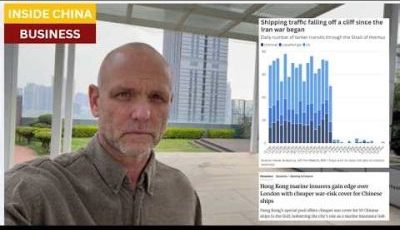
More Iran War fallout: Maritime insurance industry shifts from London to China
or go to
Aletho News Archives – Video-Images
From the Archives
The Biggest Threat to Peace in Middle East
By Dr. Elias Akleh* | Sabbah Report | May 24, 2010
A build up of heightened tension in the Middle East is escalating in the last few weeks. American and Israeli postures towards Lebanon, Syria, and Iran have become more threatening. Listening to speeches of political leaders one hears talks only about war not peace. Iranians and Israelis are continuously training hard for a possible showdown. Both sides are conducting extensive war games every month. This led Syrians to claim that Israel is preparing for a soon-to-come another war. The Jordanians also are warning that current stalemate of the peace process is an indication of a war breaking out this summer. The Russian President and his army chief hinted, a few months ago, that the US and Israel were planning for an attack on Iran.
Indeed Iran is, as it has been for last few years, the target of most of the threats and accusations of supporting terrorism. Escalating incitement against Iran the American Defense Department sent last month (April) to Congress a report on Iran’s military claiming Iran could develop intercontinental ballistic missiles capable of reaching the US by 2015.
Ignoring the fact that N. Korea, India, Pakistan, and Israel are proven to have nuclear weapons while Iran does not, the US Secretary of State Hillary Clinton chose in her speech, to the nuclear Non-Proliferation Treaty review conference at the UN, to focus on Iran’s alleged nuclear ambitions putting the whole world at risk as she put it. According to Clinton Iran’s acquisition of nuclear weapons, rather than Israel’s more than 200 nuclear bombs, is destabilizing the Middle East. She called on the world’s nations to rally around US efforts to hold Iran, not other nuclear countries, to account.
The accusation that Usama Bin Laden is living comfortably in Iran had received a boost after the broadcast of a documentary called “Feathered Cocaine”. This echoed the June 2003 claims of the Italian newspaper Corre de la Sierra that Bin Laden was in Iran according to some intelligence report, and according to Richard Miniter’s book “Shadow War”. … continue
Blog Roll
 Aletho News
- Why could Gaza enter the regional war?
- Hamas official rejects Mladenov Plan linking disarmament to Gaza reconstruction
- Two Primary Elections for the Soul of ‘America First’
- Japan Clings to US Vassalage Despite Energy Crunch Caused By Iran War
- US Seeks Control Over Global Energy Infrastructure – Kremlin
- US senators target Orban government for standing up to Zelensky
- The deep-rooted culture of corruption in Ukraine
- Iran mobilizing one million soldiers to ‘create hell’ for any US ground assault: Report
- The coming military and psychological unravelling?
- Iran has the last laugh
- If Americans Knew
- Don’t Be Fooled. Zionist Leaders Have Always Wanted to Control Southern Lebanon
- Israel’s widespread use of torture is a core element of its genocide against the Palestinian people
- In Israel’s War on Iran, Many Middle East US Bases Rendered “All But Uninhabitable”
- ‘Burn the lawn’: Israel pursues ‘Rafah model’ in southern Lebanon
- A genocide here, an amputation there
- Reports: Iran mobilizing 1M fighters, Israel-US run low on ammo, Israeli army faces shortage – Not a ceasefire Day 168
- ‘No Innocent Children’: Far-right Israeli Lawmaker Defends Killing of Palestinian Family
- Mossad’s promises helped Netanyahu convince Trump that Iran could be toppled
- US Arms Control Official Refuses To Comment When Asked If Israel Has Nuclear Weapons
- Veterans warn US landing could be ‘more Gallipoli than Vietnam’
- No Tricks Zone
- Devastating Assessment Of Comirnaty Vaccine By Former Senior Pfizer Europe Toxicologist
- New Study: CO2 Is ‘Effectively Negligible’ As An Explanatory Climate Change Factor Since 2000
- Former Pfizer Toxicologist Dr. Helmut Sterz Tells Bundestag Hearing Pfizer Vaccine Should Have Never Been Approved
- Energy Expert: Germany’s Nuclear Phaseout Was A “500 Billion Euro Mistake”
- New Research: South Australia’s Mid-Holocene Sea Surface Temperatures Were 4°C Warmer Than Today
- Storing Green Energy To Last Germany 10 Days Would Require A 60-Million Tonne Battery
- New Studies: UK Sea Levels Were 4 Meters Higher Than Today During The Mid-Holocene
- Destructive Green New Deal: German Energy And Metal Group Warns Of Drastic Crisis
- New Study Documents A 20-Year Pause In Arctic Sea Ice Decline – Driven By Internal Variability
- Wake-up Call: Survey Shows Majority Of Germans Now Favor Postponing Climate Targets!
 Aletho News