Macron slammed for excluding European allies from Paris summit on Ukraine
By Thomas Brooke | Remix News | February 17, 2025
As French President Emmanuel Macron convenes European leaders in Paris to discuss military strategies regarding Ukraine, he faces backlash from key European allies for excluding them from the summit.
The gathering, aimed at formulating a unified European stance amid ongoing U.S.-Russia peace discussions, has sparked controversy for leaving out crucial partners in the region.
Czechia was among the first to express its discontent, criticizing Macron’s decision to exclude them from the summit. A Czech government source told French newspaper Le Monde : “In addition to Poland, there is no country that is closer to the war.”
The source further condemned Macron’s “arrogance,” emphasizing that no country hosts more Ukrainian refugees in relative terms.
“No country has more Ukrainian refugees per capita than the Czech Republic, and we manage one of the most effective weapon supply systems,” they added.
Romania also found itself omitted from the summit guest list. Ilie Bolojan, presidential advisor for defense and security, acknowledged the exclusion, stating that despite Romania’s substantial contributions — including overseeing more than 600 kilometers of Ukraine’s border — it had not been invited to Paris “despite his efforts” to get Bucharest in the room.
Slovenian President Nataša Pirc Musar voiced strong criticism of the summit’s selective invitations, asserting that it undermines European unity. “On a symbolic level, the organizers of the Paris summit show the world that, even within the EU, not all states are treated on an equal footing,” Musar declared. “This does not correspond to the spirit of European integration. This is not the Europe we aspire to, nor a Europe that commands global respect.”
Hungary, known for its non-interventionist stance under Prime Minister Viktor Orbán, also condemned the meeting, labeling it a “pro-war” summit. The Hungarian government accused participating European leaders of fueling escalation rather than seeking diplomatic resolutions. Hungarian Foreign Minister Péter Szijjártó criticized the summit’s motives, claiming that it gathers “anti-Trump, war-focused, frustrated leaders” who do not want peace.
“Those who have continued to throw oil on the fire for three years now meet in Paris,” Szijjártó asserted, denouncing what he called “an erroneous strategy” of continued military escalation.
He reiterated Hungary’s alignment with U.S. President Donald Trump’s vision for peace negotiations between the U.S. and Russia, arguing that direct diplomacy remains the best route to ending the conflict.
Around a dozen European leaders are expected to meet at the Elysée Palace later on Monday for talks chaired by Macron.
Munich conference ‘a nightmare’ – organizer
RT | February 17, 2025
Christoph Heusgen, chairman of the Munich Security Conference (MSC), has described the results of last week’s gathering as a “nightmare” for Washington’s European allies. He claimed that the US under President Donald Trump “lives on another planet,” referencing comments made by American Vice President J.D. Vance at the Germany-hosted event.
Vance criticized EU nations for increasingly mirroring the USSR in their suppression of dissent and the detachment of elites from voters. He cautioned that if the trend continues, the US could withdraw its support for its European allies.
During an interview with ZDF on Sunday — his final day as MSC chairman — Heusgen noted that, at the very least, Europeans now have clarity about the Trump administration’s stance. He added that while some Republican senators expressed commitment to “trans-Atlantic unity” in contrast to Vance, they were also cautious in their public statements.
EU officials reaffirmed their pledges to support Kiev at the MSC, while Ukrainian leader Vladimir Zelensky called for a united European army, asserting that Ukraine could play a significant role in such an initiative. Heusgen advised Europeans to “do what Zelensky says” and stand together. However, skepticism remains among certain EU member states, such as Poland, regarding the concept of a transnational military force to serve as a European counterpart to NATO.
The Trump administration has signaled no intention of involving either NATO or the US in any future security arrangements in Ukraine following a potential ceasefire with Russia. Additionally, Washington has expressed interest in recouping expenditures related to the Ukraine conflict through privileged access to mineral resources under Kiev’s control.
Zelensky has previously advocated various forms of security for Ukraine that even his staunchest supporters deem exceedingly ambitious — from full NATO membership to deploying a 200,000-strong foreign military contingent, the mass placement of Western missiles, and even a Ukrainian nuclear capability.
As he concluded his closing remarks at the MSC on Sunday, Heusgen became emotional, having to cut himself short. He was addressing the mounting pressures on the “rules-based order,” urging EU politicians to uphold it despite a visible rift with the US.
Macron trying to boycott peace process
France calls for European meeting to respond to Trump’s initiatives
By Lucas Leiroz | February 17, 2025
While Washington is adopting a more diplomatic stance in the conflict with Russia, the European Union is insisting on a hostile policy. French President Emmanuel Macron is reacting quite negatively to the diplomatic advances, trying to consolidate a unified European position on the issue. The French goal is clearly to boycott any peace process, thus trying to prolong the conflict – even if this harms European strategic interests.
Recently, Macron called for an emergency summit of European leaders to discuss the Ukrainian issue. He believes that it is necessary for the EU to show an alternative to the initiatives taken by the US, otherwise European countries will end up being excluded from all the peace talks.
The meeting of the leaders is expected to take place in Paris at the same time as Russian and American diplomats meet in Saudi Arabia. There are not many details available on the subject yet, but it is known that Polish Foreign Minister Radoslaw Sikorski was one of the first to be invited by Macron – which is natural, considering that Poland is one of the countries with the highest military and political involvement in the Ukrainian conflict.
It is important to understand the context in which Macron made his decision. While, on the one hand, the US engaged in direct dialogue with Russia and excluded Europe from the process, on the other, the Europeans met at the Munich Security Conference to discuss relevant issues regarding the main geopolitical developments, but failed to reach any fruitful consensus on the issue of peace in Ukraine.
In addition, US special envoy Keith Kellogg categorically stated that the EU will not be included in the peace negotiations, which further aggravated the Europeans’ anger – certainly motivating Macron to call the meeting in Paris. In fact, it seems clear that the EU feels “betrayed” by the US by being excluded from the talks. European states seem desperate to prevent Donald Trump’s initiatives from succeeding, which is why the EU is expected to continue endorsing the war even if the US changes its stance.
All these moves were expected. While Trump has a more realistic and pragmatic stance, most European leaders are aligned with the Democrats’ policies, which are marked by a strong ideological influence. In other words, the Democrats-EU axis is interested in doing everything possible to protect the unipolar liberal order because it is ideologically linked to Western agendas. On the other hand, Trump and the Republicans have a more de-ideologized approach, simply seeking what is best for American strategic interests at the moment.
The main problem in this balance is that Macron has bold ambitions for Europe that clash with current American interests. He does not want the EU to be left out of major geopolitical decisions, hoping that the bloc’s countries will be able to deliberate on what they consider best for themselves and the entire region.
Macron seems not to have understood yet that Europe is suffering the consequences of its own past decisions. The EU chose to be excluded from major international discussions precisely at the time when it adopted a policy of alignment with the US. Now, the bloc is simply having to adapt to every change that occurs in the White House, without any right to a sovereign position, and simply accepting orders from Washington.
There is nothing Europe can do to change this, other than through a profound review of the bloc’s entire foreign policy. Europeans need to break with the idea of a “unified West” and start defending their own interests as an independent power. For this to happen, European states would have to undergo serious changes, such as leaving NATO, since the Atlantic alliance is nothing more than an international army controlled by Washington. Without these deep changes, the EU will have to continue obeying American decisions.
The efforts of Macron and other European leaders will be completely fruitless when it comes to Ukraine. It is possible that the peace negotiations will fail and the conflict will continue, but this will be due to the inability of the US itself to meet Russian strategic interests, as European opinion will have no impact on the diplomatic process.
On the other hand, it is highly possible that France and other European countries will adopt a dissident stance in the Trump-led Collective West and continue supporting Kiev with weapons and money, even if the US stops any participation in the conflict. Macron is trying to project European power in Ukraine through an aggressive and bellicose stance, so his decisions are expected to worsen the hostilities.
Lucas Leiroz, member of the BRICS Journalists Association, researcher at the Center for Geostrategic Studies, geopolitical consultant.
You can follow Lucas on X (formerly Twitter) and Telegram.
Trump To Force Ukraine Peace on Europe
John Mearsheimer, Alexander Mercouris & Glenn Diesen
Glenn Diesen | February 15, 2025
The Trump administration has been clear that peace in Ukraine will entail no NATO membership, no return of Ukrainian territories, and no US security guarantees. Furthermore, the US is preparing to leave both Ukraine and Europe. The Europeans are outraged about the US preparedness to make peace with Russia, yet they have presented no other alternatives than sending more weapons. The Europeans and Ukrainians also oppose that a deal is being made behind their backs, yet they have boycotted all diplomacy for the past three years. Europe is waking up to a realist reality as the terms for a peace agreement will be decided in Moscow and Washington.
Germany’s AFD seeks ‘very good relations’ with Russia
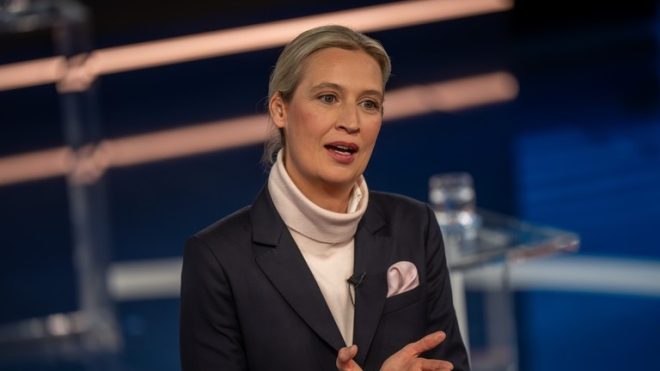
Co-leader of the Alternative for Germany (AfD) party, Alice Weidel © Global Look Press / Michael Kappeler
RT | February 16, 2025
Berlin needs to restore relations with Moscow for the sake of the nation’s economic well-being, Alice Weidel, co-leader of the right-wing Alternative for Germany (AfD) party, has said. Antagonizing Russia has brought the country nothing but trouble, she told Bild tabloid in an interview published on Sunday.
The AfD wants Germany to have “very good relations with our European neighbors” and with great powers as well, the politician said, adding that “it includes Russia.”
“Until two years ago, we sourced cheap natural gas from Russia through the Nord Stream,” Weidel said, referring to the Russian undersea pipelines delivering natural gas to Germany that were sabotaged via a series of explosions in autumn 2022.
Berlin has since taken steps to put an end to Russian energy imports as part of its EU sanctions policy, which is linked to the Ukraine conflict.
According to Weidel, the introduction of restrictions was a mistake since it primarily damaged the German economy. “What we want is to put an end to the sanctions policy,” the politician said, claiming her country currently has “the highest energy prices in the world,” which make the nation “no longer competitive.”
According to the Statista online data aggregator, Germany had the fifth highest electricity prices for households in the world as of March 2024, behind Italy, Ireland, Denmark and Belgium.
When repeatedly pressed by Bild on whether her party wants to restore “good relations” with a nation that supposedly threatens Germany, Weidel replied that Berlin has also been aggressive towards Moscow in its rhetoric over the past years.
The German government was climbing up “the escalation spiral,” the politician said, adding that Berlin’s politicians used belligerent rhetoric and provided weapons to Kiev during its conflict against Moscow.
“German tanks have been rolling against Russia again” for the first time since World War II, she said, referring to the heavy armor supplied to Ukraine as part of the country’s military assistance.
When asked about why she refrains from criticizing Russia’s role in the conflict, Weidel said that Berlin and Moscow should “sit down at the negotiating table” instead. “You have to talk to each other,” she stated, adding that her party was calling on Germany to join the peace negotiations to end the Ukraine conflict. That would be the “only serious policy,” she added.
The AfD has been gaining popular support over the past months despite being ostracized by the other major German political forces, which accuse it of being “far-right.” The party enjoys the backing of between 20% and 21% of the population a week ahead of the snap parliamentary elections, and is projected to come in second behind only the conservative Christian Democratic Union, this week’s polls suggest.
Secret terror blueprints for US NSC to ‘help Ukraine resist’ exposed
By Kit Klarenberg | The Grayzone | February 16, 2025
Newly-leaked documents reveal a crew of military academics pitching the US National Security Council a series of extreme strategies for Ukraine, from IED’s inspired by Iraqi insurgents to sabotaging Russia’s infrastructure to propaganda “from ISIS’ playbook.”
Conceived under the auspices of the UK’s University of St. Andrews, the plans were outsourced through third parties to ensure “plausible deniability.”
Explosive leaked documents reviewed by The Grayzone show how a shady transatlantic collective of academics and military-intelligence operatives conceived schemes which would lead to the US “helping Ukraine resist,” to “prolong” the proxy war “by virtually any means short of American and NATO forces deploying to Ukraine or attacking Russia.”
The operatives assembled their war plans immediately in the wake of Russia’s invasion of Ukraine in February 2022, and delivered them directly to the highest-ranking relevant US National Security Council official in the Biden administration.
Proposed operations ranged from covert military options to jihadist-style psychological operations against Russian civilians, with the authors insisting, “we need to take a page from ISIS’ playbook.”
ISIS was not the only militant outfit upheld as a model for Ukraine’s military. The intelligence cabal also proposed modernizing IEDs, like those staged by Iraqi insurgents against occupying US troops, for a potential stay-behind guerrilla army in Russia, which would attack rail lines, power plants and other civilian targets.
Many of the cabal’s recommendations were subsequently enacted by the Biden administration, dangerously escalating the conflict and repeatedly crossing Russia’s clearly-stated red lines.
Included among the proposals were providing extensive training to “Ukrainian expatriates” in using Javelin and Stinger missiles, enabling “cyberattacks on Russia by ‘patriotic hackers’ with deniability,” and flooding Kiev with “unmanned combat air vehicles.” It was also foreseen that “replacement fighter aircraft” would be provided by “many sources,” and that “non-Ukrainian volunteer pilots and ground crews” would be recruited to fight air battles in the manner of the Flying Tigers, a World War II-era force composed of American Air Force pilots, which was formed in April 1941 to help the Chinese oppose Japan’s invasion before Washington’s formal entry into the conflict.
The document was written and cosigned by a quartet of academic armchair warriors with colorful pasts. They included historian Andrew Orr, the director of the University of Kansas Institute for Military History. His recent academic contributions include a chapter in an obscure academic volume entitled, “Who is a Soldier? Using Trans Theory to Rethink French Women’s Military Identity in World War II.”
Joining him was Ash Rossiter, assistant professor of international security at the United Arab Emirates’ Khalifa University, and described as “ex-British Army Intelligence Corps.” Also participating was Marcel Plichta, then a doctoral candidate at St. Andrews. He’s described as a veteran of the US Defense Intelligence Agency, and his LinkedIn profile indicates he interned at NATO before working in roles with Pentagon contractors, then joined the DIA as an intelligence analyst. Along the way, Plichta claims to have “[nominated] known or suspected terrorists to the national watchlisting and screening community.”
Also involved in the academic cabal was Zachary Kallenborn, a self-styled US Army “mad scientist” currently pursuing his PhD in War Studies at King’s College London, with a focus on drones, WMD, and other edgy forms of modern warfare. Kallenborn, who has moonlighted at the DC-based Center for Strategic and International Studies, contributed to the Ukraine war planning by offering proposals for Iraqi insurgent-style “smart” IED attacks on Russian targets, and planting bombs on Russian trains and railways.

St. Andrews University senior lecturer Marc Devore
The cabal appears to have been led by Marc R. DeVore, a senior lecturer at Britain’s St. Andrews University. Little about his personal or professional background can be ascertained online, although his most recent academic publications discuss military strategy. Around the time the secret proposal document was being drafted, he published an article with Orr for the Pentagon’s in-house Military Review journal entitled “Winning by Outlasting: The United States and Ukrainian Resistance to Russia.” Moreover, he is a fellow at the elite Royal Navy Strategic Studies Centre, a Ministry of Defence-run “think tank.”
Emails show DeVore passed the group’s handiwork directly to Col. Tim Wright, who was the Director for Russia in the Biden administration’s National Security Council (NSC) at the time the emails were sent, according to his LinkedIn profile. Since July 2022, Wright has been the Assistant Head for Research and Experimentation in the Futures Directorate of the British Army.
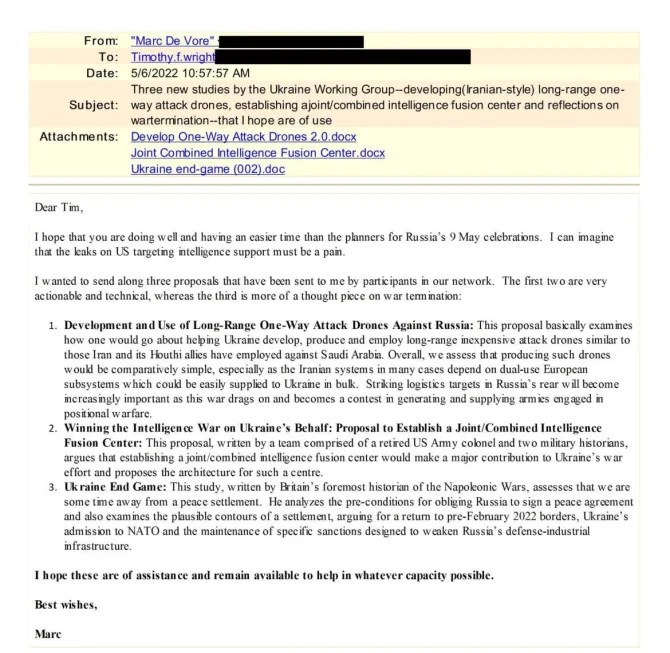
The Grayzone attempted to contact Orr, Rossiter, and Devore by phone and email in order to solicit comment about their role in proxy war scheme, and about whether St. Andrews University was aware it was being used as a base for planning terror attacks against Russia. None have responded to our requests.
Surging the Ukrainian diaspora to the front
Once the Ukraine proxy war erupted with full force in February 2022, the cabal of military academics quickly laid out what they described as “ideas of varying practicality that may not have been considered that Western states can collectively take to strengthen Ukraine’s ability to resist and hopefully preserve its independence.” Dedicated sections spelled out five suggestions, along with “background for such action and possible avenues for implementing them.” They boasted that the “fastest proposals” in the document were “executable in little over a week.”
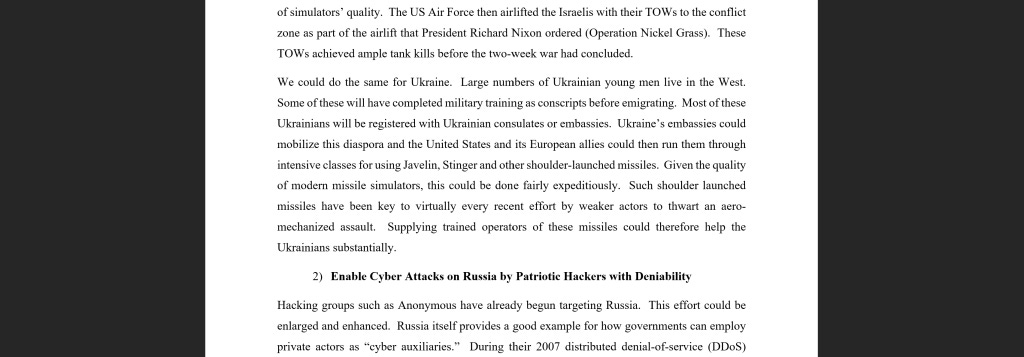
First on the list was arming Ukrainian emigres with anti-tank and anti-aircraft missiles, due to Kiev’s lack of “trained crews to operate the large numbers of missiles” being shipped to them by the West. They cited the little-known October 1973 Operation Nickel Grass as a means of “providing trained crews along with the hardware.” Under that mission’s auspices, Tel Aviv’s embassy in Washington “mobilized Israeli students studying at American universities,” who were then “rushed… through a rapid training program” by the US military.
This included teaching the conscripts how to use weapons similar to Javelin and Stinger missiles. The Israelis were then airdropped onto the frontlines of the 1973 Yom Kippur War against Syria and Egypt, where they “achieved ample tank kills before the two-week war had concluded.” The academics proposed doing “the same for Ukraine,” due to “large numbers of Ukrainian young men” living in the West, some of whom would have completed compulsory military training before emigrating.
This diaspora, it was believed, could easily be identified and recruited due to their registration with Ukrainian “consulates or embassies” in the West, then given “intensive classes” in using “shoulder-launched missiles” before being dispatched to Kiev.
“Volunteer cyber warriors” conceal state hacking
The quartet’s plans extended into the realm of cyberware, calling for “Western intelligence agencies” to “provide cyber tools and suggestions” to “volunteer hackers who want to strike their blow for Ukrainian independence, while also warning them what targets we do not want attacked.”
A “major task for these volunteer cyber warriors,” the four wrote, “could be to make certain that videos of Russian indiscriminate attacks, the use of objectionable weapons such as thermobarics, Ukrainian civilian casualties, Russian casualties and poor befuddled captured Russian conscripts” were made available to Russian audiences. Simultaneously, “patriotic hackers” could seek to bombard Russians with propaganda “about domestic opposition to the war.”
The intelligence cabal made clear they aimed to achieve the same psychological impact as the world’s most notorious terrorist organization, declaring, “we need to take a page from ISIS’ playbook in agilely communicating our message to Russians.”
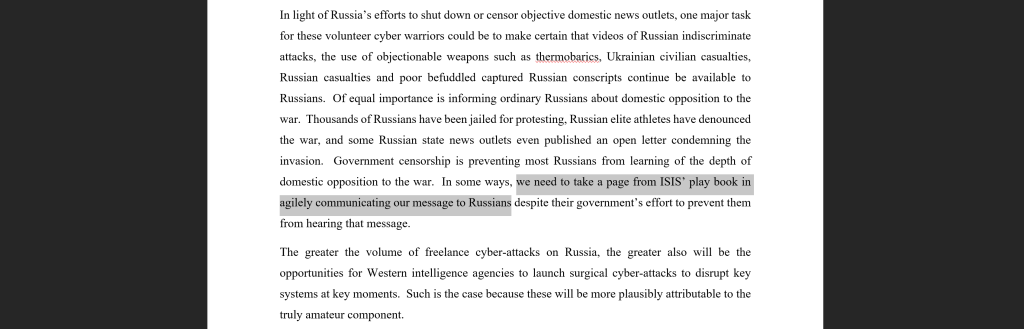
The activities of these “volunteer cyber warriors” were designed to provide cover for more formal, state-level hack attacks on Russian cyber infrastructure. “The greater the volume of freelance cyber-attacks on Russia, the greater also will be the opportunities for Western intelligence agencies to launch surgical cyber-attacks to disrupt key systems at key moments… because these will be more plausibly attributable to the truly amateur component,” the four academics evangelized.
The description offered strongly resembles the so-called “IT Army of Ukraine,” a volunteer cyber militia propped up in the days after Russia’s invasion. Since then, it’s been overseen by Mikhailo Federov, the Ukrainian digital czar credited by the BBC with pressuring Samsung and Nvidia to cease operations in Moscow, and getting PayPal to de-bank all its Russian clients.
Ukraine’s cyber army collaborates closely with Anonymous, the once-countercultural online hacker collective whose work now tracks closely with the objectives of the CIA. The authors of the proposal to the NSC hinted at the relationship, writing, “Hacking groups such as Anonymous have already begun targeting Russia. This effort could be enlarged and enhanced.”
The Ukrainian cyber army has taken credit for various acts of online vandalism. However, it also appears to have been involved in hacks targeting Russia’s power grids and railways. An attack on Russian taxi service Yandex that caused a large September 2022 traffic jam in Moscow was jointly attributed to both Ukraine’s ‘IT Army’ and Anonymous.

US Army “mad scientist” and self-proclaimed “war doctor in training” Zak Kallenborn
“Modern” IEDs for blowing up Russian infrastructure
The academic cabal’s plans for attacking Russia through unconventional means extended explicitly into the realm of terrorism. A series of detailed recommendations for attacking Russian railway systems and roads with improvised explosive devices was put forward by Zachary Kallenborn, a self-described “PhD Student in War Studies at King’s College London researching risk analysis, perception, management, and theories with topical focuses in global catastrophe, drone warfare, WMD, extreme terrorism, and critical infrastructure.”
“Fuel tanks for diesel locomotives are typically on the bottom, underneath the engine,” Kallenborn wrote. “It wouldn’t be very difficult to plant and disguise small explosives between the wooden slats of the railway then detonate when the locomotive is above it… Ideally, guerrillas operating behind Russian lines would place the anti-locomotive lines.”
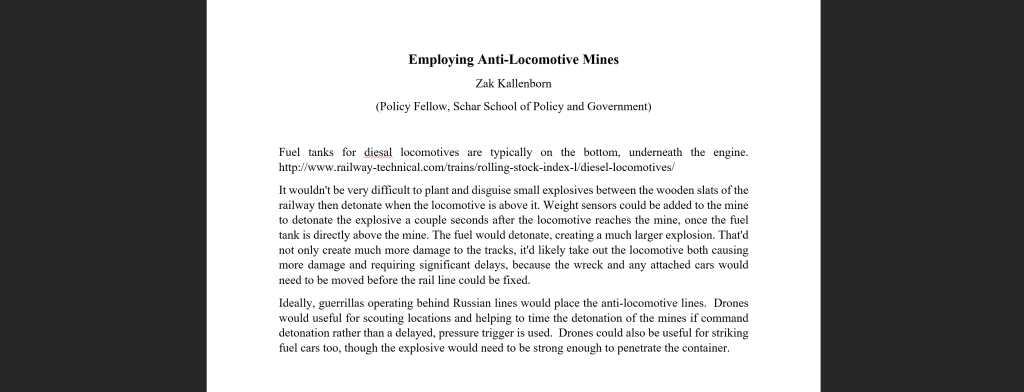
Throughout 2023, a group of self-described Russian and Belarussian anarchists conducted a series of attacks on railways, cell towers, and infrastructure inside Russia. Calling themselves BOAK, or the Combat Organization of Anarcho-Communists, the group of radical saboteurs earned glowing promotion in Western media. It is unclear if it received any outside assistance, however.
Kallenborn’s proposal, drafted in conjunction with the US War Department’s Joint IED Defeat Organization, suggested the US and its allies could “draw upon the lessons they painfully learned in Iraq and Afghanistan to help Ukraine orchestrate an IED campaign behind Russia’s lines.”
With the Taliban and Iraqi insurgents as models, Kallenborn proposed two technologies, “public-private key ring cryptography and ‘smart’ IEDs… to greatly increase the effectiveness of such a campaign.”
To wreak havoc inside Russia, Kallenborn envisioned a modern “stay behind” force similar to those unleashed onto Europe during Cold War era Operation Gladio, when the CIA and NATO organized fascist gangs and mafiosi to conduct anti-communist terrorist attacks.
Meanwhile, “smart” IEDs with “modern components” such as “microcontrollers,” which are now “abundant and cheap,” would allow Ukrainian attackers to “exercise additional discretion, reducing potential for collateral damage,” and “detonate the IED regardless of what the targets do.”
“The circuitry of microcontrollers can internalize most of the circuitry that would originally have been hard-wired into IED initiation switches,” Kallenborn wrote. “All microcontrollers have multiple inputs and outputs allowing multiple inputs, all while controlling multiple devices. Because microcontrollers are programmable, attackers can automate complicated algorithms to maximize an IEDs effects, and reduce collateral damage. Microcontrollers can even, relatively easily, circumvent many common countermeasures.”

Secretly employing contractors to pilot drones
While taking inspiration from non-state actors like ISIS and the Taliban, the Western academics plotting on the Ukrainian government’s behalf had elaborate plans for conventional warfare as well.
They assessed that drones had already “proven effective thus far” in the proxy war, so they urged greater deliveries of Turkish-made Bayraktar TB2s, which they said were “virtually the only airborne platform with which Ukraine is successfully striking Russian ground forces.” They proposed flooding Kiev with “additional TB2s,” pointing out that since Ukraine was already openly using them, and “had more on order before the conflict began,” Turkey’s role in supplying yet further drones could be concealed, leaving its neutrality publicly intact.
Ankara “could potentially transfer significant numbers of TB2s rapidly” from a variety of sources, the academics assumed, and fly them using local “private sector contractors.” If Turkey was unwilling or unable to go along with this plan, alternatives could be sought. “Given how commonly UCAVs are operated by private sector contractors, these could all be remotely piloted by private sector personnel employed by Ukraine, rather than uniformed members of NATO armed forces,” they noted.
Since drones can be operated “from considerable distances away from the frontline (potentially with pilots operating from neighboring countries),” they offered the further “advantage” over contract pilots, in that they would “be comparatively safe and certainly unlikely to be captured and paraded in front of Russian cameras.” While US-produced unmanned systems such as Predators and Reapers were an option, and could be provided “in large numbers,” they “would appear the most provocative” from Russia’s perspective, and make active US involvement too obvious.
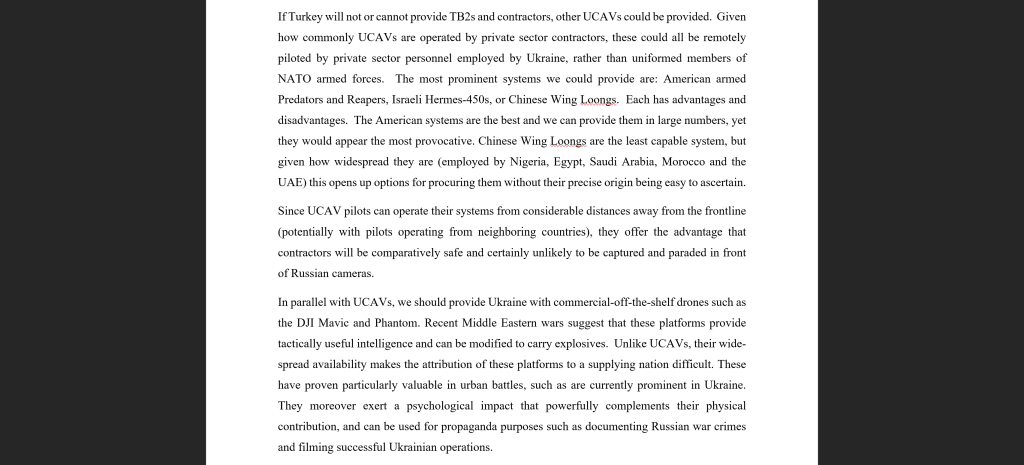
Prophetically, the paper noted Ukraine could be provided instead with “commercial-off-the-shelf drones such as the DJI Mavic and Phantom,” which not only had recording equipment capable of producing “tactically useful intelligence,” but could “be modified to carry explosives.” Moreover, “their wide-spread availability” made “attribution of these platforms to a supplying nation difficult.” It is surely no coincidence that ever since, both drones have been deployed extensively by Kiev to slow Russian advances and swarm military and civilian infrastructure.
By contrast, despite alleged initial successes, Bayraktar TB2s quickly vanished from the skies of Donbass. As several Ukrainian officials have admitted, Russian innovation in air defense and electronic warfare rendered the drones effectively useless. Conversely, the paper noted that while Ukraine’s Air Force was still conducting missions, Kiev would soon “run out of aircraft.” The prescribed remedy was to re-equip the country with Soviet-produced MiG-29 fighters, which “Ukrainian pilots know how to operate” already.
This plan, however, required a number of countries to hand over their ancient fleets of MiG-29s. The academics expressed concern that Central and Eastern European states might be “reticent” due to the risk of “Russian retaliation,” which could be circumvented by “promising gifts” to them, such as weapon upgrades. A year later, in March 2023, Slovakia granted Kiev its entire squadron of thirteen MiG-29s in exchange for a US promise of twelve Bell AH-1Z attack choppers equipped with Hellfire missiles.
Poland initially promised to match Slovakia’s splurge, but only wound up delivering a token amount. The deal has remained on hold since Krakow’s August 2024 announcement that it wouldn’t provide any further MiG-29s until it received a fleet of F-35s, which aren’t expected to arrive until 2026. Peru, likewise tapped by the academics as a potential source for the aircraft, reportedly initially greenlit supply of its MiG-29s to Ukraine, but then reneged. Latin American governments more widely have refused to dispatch any arms whatsoever to Ukraine, despite US pressure.
Air wars waged against Russia by “non-Ukrainian” pilots
Perhaps the most disquieting passage of the document is its last, in which its authors survey historical examples of air forces employing foreign pilots in major conflicts. The paper notes that the aforementioned Flying Tigers “were discharged from the US armed forces” to fight Japan in China, “with the clear understanding that they would be welcomed back thereafter.” Also cited was Finland’s employment of an “entirely” foreign squadron in its 1940 war with Moscow, as well as Zionist settlers’ reliance on an air force “comprised almost entirely of foreign volunteers” during their military campaign against indigenous Palestinian and Arab forces in 1948.
The academics wished to apply these precedents to the Ukraine proxy conflict, creating “volunteer fighter groups today to bolster Ukraine’s air defense” composed of “a reasonable number of Western pilots.” They wrote that these airmen “might volunteer if their national armed forces offered leaves of absence” – as might their civilian counterparts, if US commercial airlines could be “pressured into allowing their pilots, who are fighter-qualified Air Force Reserve or Air National Guard pilots, to take such leaves of absence.” The document boasted that “volunteer fighter groups could substantially disjoint Russia’s air campaign.”
F-16s were considered “the most logical option” due to “the number of NATO members that use F-16s,” including Poland. Accordingly, “Polish spare parts could be trucked into Ukraine comparatively quickly,” with the US “airlifting replacements” to Warsaw. From almost the first day of the proxy war, its most hawkish supporters have demanded that Kiev be provided with these fighter jets, referring to the planes as a “game changer” which would tip the conflict’s scales decisively in favor of Ukraine.
Despite much initial fanfare, when F-16s finally arrived in Kiev in late July of 2024, President Volodomyr Zelensky almost immediately complained the country had only received a handful of jets, and did not have enough pilots trained to fly them. The panic spread to Washington, where Sen. Lindsey Graham publicly urged any “retired F-16 pilot… looking to fight for freedom” to sign up. By the month’s end, the first of F-16s had crashed in uncertain circumstances.
While references to Ukraine’s “game changing” use of F-16s have all but disappeared from the media in the months since, the leaked proposal’s contents raise serious questions on how many supposedly Ukrainian strikes deep inside Russia were actually perpetrated by Western military operatives, acting at the behest of, and with material assistance from, NATO and the US.
“Western European and American fighter pilots tend to fly substantially more hours and train more realistically than their Russian or Ukrainian counterparts,” the academics claimed, meaning they were ideal candidates for conducting “combat missions” against Moscow’s positions, forces, and territory. However, the academics cautioned against Western pilots flying close to the frontline, for fear that “foreign volunteers fall into Russian custody, where an example could be made of them, or they could be paraded in front of the camera.” This was perhaps a nod to CIA pilots Gary Powers and Eugene Hassenfus, whose capture by the Soviet Union and Nicaragua, respectively, humiliated US intelligence.
It’s still unclear how much these proposals determined the course of operations by Ukrainian forces against their Russian foes. But the leaks reviewed by The Grayzone reveal for the first time how, in just a matter of weeks, a small cabal of academics secretly furnished some fairly unconventional war plans on a platter for the CIA and MI6.
Just as Britain did with its Project Alchemy, the Biden administration appears to have outsourced responsibility for crafting its battlefield strategy in Ukraine to a nexus of pinheads with dubious backgrounds, situated thousands of miles from the frontline and its gruesome realities. Almost three years later, with a generation of Ukrainians lost to the proxy war’s meat grinder, the authors of these battle plans are likely still pecking away at their laptops somewhere in the musty halls of academia.
Macron calls emergency summit amid Ukraine peace talks – Warsaw
RT | February 16, 2025
French President Emmanuel Macron has called an emergency summit of European leaders after Moscow and Washington agreed to hold Ukraine peace talks in Saudi Arabia, sidelining the EU.
US President Donald Trump and Russian President Vladimir Putin spoke by phone on Wednesday, marking their first known direct conversation since the escalation of the Ukraine conflict in February 2022.
On Saturday, the countries’ top diplomats followed up with a call to discuss “preparations for a potential high-level Russian-American summit.” Later that day, US Special Envoy Keith Kellogg stated that the EU nations would not be included in the negotiations.
Speaking at the Munich Security Conference, Polish Foreign Minister Radoslaw Sikorski welcomed Macron’s initiative and confirmed that the summit will take place in France on Monday.
“I’m very glad that President Macron has called our leaders to Paris,” Sikorski said, as quoted by Politico, adding that he expects European leaders to discuss “in a very serious fashion” the challenges posed by Trump.
According to Sikorski, Polish Prime Minister Donald Tusk has accepted the invitation and will travel to France next week to “show our strength and unity.”
While the list of invitees was not revealed, The Guardian has reported that UK Prime Minister Keir Starmer will also be attending.
Macron has previously insisted on EU involvement in negotiations, telling the Financial Times that Ukraine must lead discussions on its own sovereignty, but Brussels has a key role in discussing “security guarantees and, more broadly, the security framework for the entire region.”
Meanwhile, Ukrainian President Vladimir Zelensky, who previously banned his government from engaging in direct negotiations with Putin, admitted that Kiev’s representatives were not invited to discussions in Saudi Arabia either. “Maybe there is something at the table, but not on our table,” he told journalists on the sidelines of the Munich Security Conference.
Neither a French government spokesperson nor Foreign Minister Jean-Noel Barrot immediately responded to a request for comment when approached by Politico.
End of the American Empire?
Professor Glenn Diesen with Colonel Douglas Macgregor
Glenn Diesen | February 14, 2025
I had a conversation with Colonel Douglas Macgregor about the state of the US empire and what Trump attempts to do to reverse the relative decline of the US. Trump has been very aggressive against the deep state, which has become wasteful and ideological over the past decades. Trump is making huge moves to get the US out of Ukraine, which will also enable the US to get out of Europe. The greatest weakness in Trump’s foreign policy appears to be his approach to the Middle East, where he risks unleashing a major regional war. Trump’s tactic of bluster and noise to disrupt the status quo and create greater room for manoeuvre will trigger huge movements in the region that cannot be controlled.
Pete Hegseth & J.D. Vance Tell Europe’s Leaders to Grow Up
By John Leake | Focal Points | February 15, 2025
Growing up is the often painful process of coming to terms with the reality of one’s own limitations, and recognizing that it’s impossible to gain anything in life without hard work and sacrifice. Wisdom lies in recognizing that—as the economist Thomas Sowell would put it—getting what we want often requires a tradeoff. Children, particularly the children of indulgent parents, struggle to recognize this. They want everything NOW and they don’t want to give up anything to get it.
For some time now I have perceived that the European Union—both the supranational entity and the constituent nations—are governed by childish people with childish ideas about what is best for their countries. This has been very painful for me to watch, because I love Europe and spent the happiest years of my life living there.
Especially distressing has been the ruin of Germany with stupid “green energy” initiatives that have wrecked it’s brilliant manufacturing sector, and with its bizarre welcoming of young males from the Arabic-speaking world.
The objective of these policies is apparently to destroy the 1). Economic security of young German men who had long enjoyed great, skilled labor jobs, and 2). the physical security of young German women.
The entire “green energy” hoax completely ignores the laws of thermodynamics, while allowing millions of young Arabic men into Germany ignores the basic reality that most of them have nothing to do in Germany but hang out and chase cute German girls. Any grownup man with a shred of common sense instantly recognizes the folly of these polices.
Equally idiotic has been the willingness of Germany’s so-called leaders to wreck the the excellent relationship that former German Chancellor Gerhard Schroeder forged with Russian President Vladimir Putin.
This relationship—expressed by the construction of the NordStream Pipeline—was built on the essential facts that Germany needed Russia’s plentiful and cheap gas, while Russia (which has an economy smaller than that of Texas) needed a market in which to sell it.
Under the baleful influence of the equally moronic Neocons in Washington, German officials decided to wreck this relationship by playing along with the U.S. fantasy of dominating Ukraine, even if it meant destabilizing the balance of power in Europe and wrecking Germany’s fruitful relationship with Russia.
In the last few days, Secretary of Defense Pete Hegseth and Vice President J.D. Vance have been in Europe, with Hegseth giving talks to NATO officials in Brussels and Vance giving a talk at the Munich Security Conference.
In stark contrast with the creepy weirdos in the Biden administration, the youthful and handsome Hegseth and Vance cut fine figures at their respective talks, which were the most incisive I’ve heard in years. Compared to Kamala Harris’s mealy-mouthed and jarring ramble at the 2022 Munich Security Council—which was apparently designed to insult Russia and dismiss its legitimate security concerns—Vance’s talk was elegant and crystal clear.
The message of both Hegseth and Vance to Europe’s leaders was essentially the same—namely, it’s time for them to grow up and recognize the hard facts of life. Just as the U.S. can no longer afford to indulge its own “regime change” fantasies all over the world, Europe can no longer afford to wreck itself with inane, virtue-signaling fantasies about green energy, mass migration, and Ukraine.
Vance also pointed out the sheer nonsense of claiming to be dedicated to democracy while at the same time persecuting popular parties and even trying to nullify election results. The overheated rhetoric about the rise of conservative populist parties being “far right” and “Nazi” has gotten so tired that no one outside of privileged political and leftist circles believes it.
Hegseth made the following clear:
- NATO membership for Ukraine is not a realistic outcome of a negotiated settlement
- As part of any [postwar] security guarantee, there will not be US troops deployed to Ukraine
- A return to Ukraine’s 1991 borders, an official Ukrainian war aim, is “an unrealistic objective.”
- Stark strategic realities prevent the United States of America from being primarily focused on the security of Europe.
- The United States will no longer tolerate an imbalanced relationship which encourages dependency.
In other words, the U.S. will no longer pursue an antagonistic relationship with Russia in Europe, especially in Ukraine, but will seek a negotiated settlement. If the Europeans want to persist in having an antagonistic relationship with Russia, they are on their own and will have to pay for it.
Hegseth was criticized for what appeared to be making concessions to Russia before President Trump had even commenced negotiations with Russia. The (Neocon) National Review gave him a hard time for this, and an equally hard time for apparently walking back some of these remarks the following day, which made him seem amateurish.
And yet, let’s face it— a return to Ukraine’s 1991 borders is “an unrealistic objective” at this point.
Is a single American, English, German, or Austrian reader of this post willing to die fighting Russia in order to ensure that Ukraine’s 1991 borders are restored?
If you, dear reader, are too old to fight in Ukraine, would you be willing to sacrifice one of your children to restore Ukraine’s 1991 borders?
Samuel Johnson famously remarked:
When a man knows he is to be hanged in a fortnight, it concentrates his mind wonderfully.
Likewise, when a man knows that either he or his young sons are going to be sent abroad to die to maintain Ukraine’s 1991 borders, it concentrates his mind wonderfully. In light of this, I believe it is high time for the Neocon armchair warriors in Washington to quit talking and start enlisting.
Join the army, get into shape, and get your asses over to Ukraine. On the flight over, you may take heart in reading Kipling’s poem to a “Young British Soldier,” which concludes with this heart-rousing stanza:
When you're wounded and left on Afghanistan's plains,
And the women come out to cut up what remains,
Jest roll to your rifle and blow out your brains
       An' go to your Gawd like a soldier.
              Go, go, go like a soldier,
              Go, go, go like a soldier,
              Go, go, go like a soldier,
                  So-oldier of the Queen!
Neocons, go to your Gawd like a soldier!
Kremlin responds to Vance’s comment on troops for Ukraine statement
RT | February 15, 2025
The Kremlin has acknowledged that US Vice President J.D. Vance did not threaten the deployment of US troops to Ukraine during his interview with The Wall Street Journal. He has accused the newspaper of misrepresenting his words about what leverage Washington can use in peace talks with Moscow.
“Yes, we have taken note,” Kremlin spokesman Dmitry Peskov told TASS on Saturday.
In a summary of an article on Thursday titled “Vance Wields Threat of Sanctions, Military Action to Push Putin Into Ukraine Deal” the paper stated that the vice president had pledged to impose sanctions and possibly intervene with troops if Russian President Vladimir Putin rejected a peace deal guaranteeing Ukraine’s independence.
Vance’s communications director, William Martin, criticized the article, calling it “pure fake news,” posting a transcript of the vice president’s interview with the newspaper and argued that he had not made any threats. In the transcript, Vance had said that Trump would consider a wide range of options in discussions with Russia and Ukraine. He mentioned that “economic tools of leverage” and “military tools of leverage” exist but did not specify any actions.
“There’s a whole host of things that we could do. But fundamentally, I think the president wants to have a productive negotiation, both with Putin and with [Vladimir] Zelensky,” the transcript read.
“As we’ve always said, American troops should never be put into harm’s way where it doesn’t advance American interests and security,” Vance wrote on X. “The fact that the WSJ twisted my words in the way they did for this story is absurd, but not surprising,” he added.
The Kremlin sought clarification regarding Vance’s comments following the initial report. Peskov told reporters on Friday that the remarks were new to Moscow. “We have not heard such statements before,” he said.
The Wall Street Journal’s report has since received a community note on X, which states: “JD Vance made no explicit pledge to either sanctions or military actions.” The note links to Martin’s post containing the transcript.
Trump sends defense stocks crashing
RT | February 15, 2025
US defense stocks took a sharp dive this week after President Donald Trump announced that he could slash military spending in half. The announcement came amid a wider cost-saving push by his administration.
Companies which saw share prices fall this week include aerospace manufacturers Lockheed Martin (-4.86%) and Northrop Grumman (-6.58%) as well as General Dynamics (-5.30%), according to Friday’s trading data.
Speaking at a White House press conference on Thursday, Trump said he planned to discuss a potential reduction in defense budgets with Russian President Vladimir Putin and Chinese leader Xi Jinping.
“At some point, when things settle down, I’m going to meet with China and I’m going to meet with Russia… and I’m going to say there’s no reason for us to be spending almost $1 trillion on the military… and I want to say let’s cut our military budget in half,” Trump said.
Defense firms have enjoyed increased demand for weapons and military equipment since the escalation of the Ukraine conflict in 2022. Lockheed Martin, the primary producer of the F-16 fighter jets and Patriot missile systems used in Ukraine, posted a 21% year-on-year increase in revenues in 2023.
The new US administration has so far sent mixed messages on military spending. Trump has tasked Elon Musk and his Department of Government Efficiency with cutting federal costs, including at the Pentagon. The president has also pushed for a quick resolution of the Ukraine conflict, announcing imminent talks with his Russian counterpart Vladimir Putin.
The current $1 trillion in annual US military spending accounts for about 3.4% of the country’s gross domestic product (GDP). Secretary of Defense Pete Hegseth said during his confirmation hearings at the US Senate in January that he wouldn’t want to spend less than 3% of GDP on defense.
Russia has criticized the US arms sector for fueling global instability. Foreign Ministry spokeswoman Maria Zakharova claimed in September that soaring profits prompt defense firms to provoke new armed conflicts.
Meanwhile, claims have resurfaced in recent months about NATO weapons and ammunition being put on sale on the dark web. Conservative commentator Tucker Carlson alleged earlier this month that the Ukrainian military was selling American weapons systems on the black market, including to drug cartels.
In January 2024, a US Department of Defense Office of Inspector General report revealed that the Pentagon was unable to fully account for over $1 billion worth of military aid to Kiev. In 2023, CNN reported that criminals and arms traffickers in Ukraine had stolen some Western-provided weapons and equipment intended for troops.
Featured Video
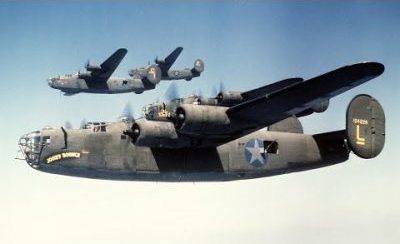
Bombing Hitler’s Hometown
or go to
Aletho News Archives – Video-Images
From the Archives
The Biggest Threat to Peace in Middle East
By Dr. Elias Akleh* | Sabbah Report | May 24, 2010
A build up of heightened tension in the Middle East is escalating in the last few weeks. American and Israeli postures towards Lebanon, Syria, and Iran have become more threatening. Listening to speeches of political leaders one hears talks only about war not peace. Iranians and Israelis are continuously training hard for a possible showdown. Both sides are conducting extensive war games every month. This led Syrians to claim that Israel is preparing for a soon-to-come another war. The Jordanians also are warning that current stalemate of the peace process is an indication of a war breaking out this summer. The Russian President and his army chief hinted, a few months ago, that the US and Israel were planning for an attack on Iran.
Indeed Iran is, as it has been for last few years, the target of most of the threats and accusations of supporting terrorism. Escalating incitement against Iran the American Defense Department sent last month (April) to Congress a report on Iran’s military claiming Iran could develop intercontinental ballistic missiles capable of reaching the US by 2015.
Ignoring the fact that N. Korea, India, Pakistan, and Israel are proven to have nuclear weapons while Iran does not, the US Secretary of State Hillary Clinton chose in her speech, to the nuclear Non-Proliferation Treaty review conference at the UN, to focus on Iran’s alleged nuclear ambitions putting the whole world at risk as she put it. According to Clinton Iran’s acquisition of nuclear weapons, rather than Israel’s more than 200 nuclear bombs, is destabilizing the Middle East. She called on the world’s nations to rally around US efforts to hold Iran, not other nuclear countries, to account.
The accusation that Usama Bin Laden is living comfortably in Iran had received a boost after the broadcast of a documentary called “Feathered Cocaine”. This echoed the June 2003 claims of the Italian newspaper Corre de la Sierra that Bin Laden was in Iran according to some intelligence report, and according to Richard Miniter’s book “Shadow War”. … continue
Blog Roll
 Aletho News
- Bombing Hitler’s Hometown
- German journalist threatened with homelessness as German court upholds EU sanctions in landmark free speech case
- US Tells Allies That Ukraine-Bound Arms Could be Sent to Middle East
- Organized terrorism: Iran condemns killing of its diplomats in Lebanon
- Why could Gaza enter the regional war?
- Hamas official rejects Mladenov Plan linking disarmament to Gaza reconstruction
- Two Primary Elections for the Soul of ‘America First’
- Japan Clings to US Vassalage Despite Energy Crunch Caused By Iran War
- US Seeks Control Over Global Energy Infrastructure – Kremlin
- US senators target Orban government for standing up to Zelensky
- If Americans Knew
- Researchers at Human Rights Watch Resign Over Blocked Report on Palestinian Refugee Return
- Jewish Groups Are Backing a War Americans Don’t Want
- Eric Fingerhut Thinks He’s the President of the Jews
- Top Jewish Philanthropists, Rabbis Urge Israeli President to Take Action Against ‘Jewish Extremists’
- Don’t Be Fooled. Zionist Leaders Have Always Wanted to Control Southern Lebanon
- Israel’s widespread use of torture is a core element of its genocide against the Palestinian people
- In Israel’s War on Iran, Many Middle East US Bases Rendered “All But Uninhabitable”
- ‘Burn the lawn’: Israel pursues ‘Rafah model’ in southern Lebanon
- A genocide here, an amputation there
- Reports: Iran mobilizing 1M fighters, Israel-US run low on ammo, Israeli army faces shortage – Not a ceasefire Day 168
- No Tricks Zone
- Devastating Assessment Of Comirnaty Vaccine By Former Senior Pfizer Europe Toxicologist
- New Study: CO2 Is ‘Effectively Negligible’ As An Explanatory Climate Change Factor Since 2000
- Former Pfizer Toxicologist Dr. Helmut Sterz Tells Bundestag Hearing Pfizer Vaccine Should Have Never Been Approved
- Energy Expert: Germany’s Nuclear Phaseout Was A “500 Billion Euro Mistake”
- New Research: South Australia’s Mid-Holocene Sea Surface Temperatures Were 4°C Warmer Than Today
- Storing Green Energy To Last Germany 10 Days Would Require A 60-Million Tonne Battery
- New Studies: UK Sea Levels Were 4 Meters Higher Than Today During The Mid-Holocene
- Destructive Green New Deal: German Energy And Metal Group Warns Of Drastic Crisis
- New Study Documents A 20-Year Pause In Arctic Sea Ice Decline – Driven By Internal Variability
- Wake-up Call: Survey Shows Majority Of Germans Now Favor Postponing Climate Targets!
 Aletho News