NATO Must Come to Agreement With Russia to Avoid New Arms Race – Orban
Sputnik – 30.06.2025
NATO will have to come to an agreement with Russia in order to avoid a new arms race, Hungarian Prime Minister Viktor Orban said on Monday.
“Sooner or later, NATO… will have to negotiate with Russia on how much we will spend on military spending, because otherwise the sky will be the limit. So we need to avoid an arms race. We need to strengthen, but we must avoid an arms race. And it will not work out otherwise, except for us, the West, to come to an agreement with Russia,” Orban told the media.
There is a majority of states forming in NATO that believes that any conflict between the alliance and Russia will lead to a third world war and must be avoided, Orban added.
A Big Beautiful Bill for the Military-Industrial Complex
By Ron Paul | June 30, 2025
The US Senate worked through the weekend on the “Big Beautiful Bill.” The goal was to pass it quickly to ensure the House will then pass it and send it to President Trump’s desk before the July 4th holiday.
However, disagreements among Republican Senators over reductions in spending on programs including Medicaid and food stamps as well as language in the bill eliminating “clean energy” tax credits were preventing Senate Republican leadership from getting enough votes to pass the bill.
Also, some Republicans disagree with other Republicans in both the House and Senate on increasing the state and local tax (SALT) deduction. Many conservatives see this income tax deduction as encouraging states to maintain high taxes to fund big governments.
One item in the BBB that few Republicans are objecting to is the bill’s increase in military spending. The House version of the BBB added 150 billion dollars to the Pentagon’s already bloated budget. The Senate bill gave the military-industrial complex 156 billion dollars.
Increasing military spending contradicts President Trump’s promise to stop wasting money on endless wars that have nothing to do with ensuring the security of the American people.
Some of the BBB’s military spending will be used to put troops on the border. I support strengthening border security. However, I do not support using the military for domestic law enforcement, which includes enforcing immigration laws. Soldiers are trained to view people as potential enemies, not as innocent civilians to be protected. Introducing this mindset into domestic law enforcement will lead to abuses of liberty.
Increasing spending on militarism while cutting spending on programs that help low-income Americans is bad politics and bad policy. Polls show that the majority of Americans, including many Republicans, do not support overseas intervention.
The growing opposition to our hyper-interventionist foreign policy is easy to understand. The US has engaged in numerous military actions in many countries including Iraq, Afghanistan, and Syria since the beginning of the 21st century. The American people pay for this militarism in several ways. One is the “inflation tax” imposed by the Federal Reserve in order to monetize the debt incurred by the US government for endless wars. President Trump has turned his back on his antiwar supporters by bombing Iran and by increasing military spending to over a trillion dollars.
The Republican insistence on increasing military spending is the main reason Congress cannot cut taxes without increasing the debt, making cuts in domestic welfare programs, or both. If the Republicans want to be the Make America Great Again party, they need to embrace a true America First foreign policy. This means no more regime change wars or US taxpayer supported “color revolutions.” Instead, America should return to the Founders’ vision of a country that, in the words of John Quincy Adams, does not go “abroad in search of monsters to destroy” and instead is “the well-wisher to the freedom and independence of all” while “the champion and vindicator only of her own.”
A return to a noninterventionist foreign policy is the only way we will be able to begin to pay down the national debt and restore a government that adheres to the constitutional limits on its powers and respects all the people’s rights all the time.
NATO’s defense spending surge may cause its collapse: Lavrov
Al Mayadeen | June 30, 2025
NATO’s surge in defense spending will only damage the alliance and push it toward collapse, Russian Foreign Minister Sergey Lavrov warned, calling for greater pragmatism in its approach, as he addressed reporters following the Collective Security Treaty Organization’s Council of Foreign Ministers meeting.
“He can probably see – since he is such a wise sage – that the disastrous increase in spending of NATO countries will also lead to the collapse of this organization,” Lavrov said, responding to Polish Foreign Minister Radoslaw Sikorski’s claim that Russia’s military build-up would lead to its downfall.
“Meanwhile, Russia – as President [Vladimir Putin] said the other day in Minsk after the Supreme Eurasian Economic Council meeting – plans to reduce its military spending and be guided by common sense, rather than imaginary threats, as NATO member states do, including Sikorski,” Lavrov pointed out.
NATO approves defense spending hike to 5%
Following the NATO Summit held in The Hague on June 24-25, the alliance’s member states have agreed to increase defense spending to 5% of GDP, as outlined in the adopted communique, with plans to allocate at least 3.5% of GDP by 2035 based on NATO’s agreed definition of military spending.
An allocation of 1.5% of GDP will be dedicated to safeguarding critical infrastructure and networks, enhancing civil preparedness and resilience, fostering innovation, and bolstering the defense industrial base.
Eager to claim credit, Trump hailed the agreement by all 32 NATO member states to work toward spending five percent of GDP on defense, calling it “a great victory for everybody.”
During closed-door discussions, diplomats revealed that Trump stressed the importance of US leadership while pushing allies to direct their expanded defense budgets toward purchasing American-made weaponry.
With NATO leaders unanimously praising the agreement as “historic,” Belgian Prime Minister Bart De Wever observed that Europe’s “long break from history” had ended, emphasizing the continent’s urgent need to assume full responsibility for its defense amid escalating geopolitical tensions.
From the War of the Cities to True Promise 3: Iran’s ballistic program and the path to networked deterrence
By Abbas Al-Zein | The Cradle | June 28, 2025
Under a regional sky long dominated by US and Israeli air and intelligence superiority, Iran made a fateful decision decades ago. It would not attempt to match its adversaries tank-for-tank or plane-for-plane, but would instead build an asymmetric deterrent from scratch.
Rather than chase the mirage of classical military parity, Tehran developed an indigenous ballistic missile arsenal that is now the largest and most formidable in West Asia. This was no short-term, tactical gambit. Iran’s missile doctrine was forged in an existential struggle, refined over war and siege, and ultimately transformed into a cornerstone of national defense policy.
The War of the Cities: Birth under siege (1980–1988)
The first phase of Iran’s missile journey began in the crucible of the devastating Iran–Iraq War, specifically during the infamous “War of the Cities.” As the Baathist government in Baghdad launched Soviet-supplied Scud-B missiles deep into Iranian urban centers, it did so under the protective umbrella of western intelligence and funding from Arab states of the Persian Gulf. The intent was clear: to break Iranian civilian morale through systematic terror from the sky.
Caught without a missile deterrent of its own, besieged diplomatically, and encircled by western-aligned forces, Iran turned to whatever resources it could muster. It secured limited quantities of Scud-B missiles from Libya, Syria, and North Korea. These early acquisitions, modest as they were, formed the embryonic core of a deterrent force placed under the direct command of the Islamic Revolutionary Guard Corps (IRGC).
But these were more than mere missiles. They were weapons of national dignity in a war for survival for the nascent Islamic Republic. Iran’s leadership came to view missile capability not simply as a tactical asset, but as a psychological and political necessity.
Military historian Pierre Razoux notes in The Iran-Iraq War (2014) that it was during this phase that Iran’s leadership came to the unshakable conclusion: without a retaliatory missile force, no psychological or strategic deterrence was possible.
The Iranian response was neither ad hoc nor passive. Alongside importing missiles, Iranian engineers began dismantling, studying, and maintaining the systems. They built smuggling networks, circumvented embargoes, and reverse-engineered technology.
North Korea emerged as a critical partner, acting as a conduit for Soviet missile know-how. A 2010 RAND Corporation report titled Iran’s Ballistic Missile Capabilities: A Net Assessment noted that Iran had become capable not only of replicating but also of redesigning and expanding missile technology independently. Between 2000 and 2010, Iran pivoted from mass production to innovation, prioritizing accuracy, range, and operational readiness.
The foundations of Iran’s ballistic doctrine were thus laid: sovereignty through technological independence, and defense through deterrence.
From imitation to innovation (1989–2009)
With the Imposed War over, Iran’s military establishment—spearheaded by the IRGC—began restructuring its defense priorities. The goal was no longer just to have missiles but to produce them independently and on a large scale.
At the heart of this transformation was the late martyred Brigadier General Hassan Tehrani Moghaddam, a strategic thinker and technical mastermind hailed as the ‘father of Iran’s missile program.’ He understood that deterrence was not about launching missiles, but about mastering their lifecycle: production, concealment, deployment, and precision.
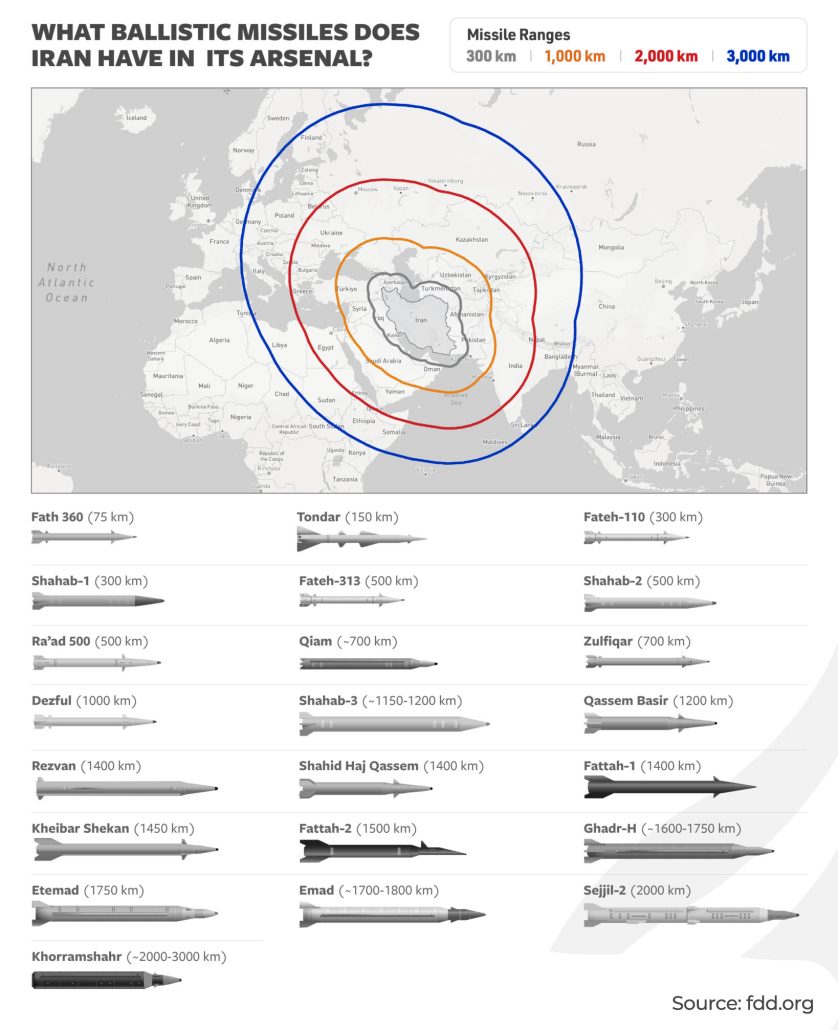
Under his leadership, Iran transitioned from a user to a manufacturer. The Shahab-1 and Shahab-2 were enhanced variants of the Scud-B and Scud-C. But the real breakthrough came in 2003 with the Shahab-3, boasting a range exceeding 1,300 kilometers—a capability that placed US bases in the Persian Gulf and occupied Palestine within striking distance. The Shahab lineage would later give way to the Ghadr class, with better range and multiple warhead capabilities.
The most significant leap, however, came with the adoption of solid-fuel propulsion. The Sejjil missile (2,000–2,500 km range), unveiled by the end of the 2000s, was Iran’s first medium-to-long-range system not reliant on Scud technology. It signaled a new era of technological self-sufficiency and rapid-launch capability.
During this phase, Iran undertook sweeping strategic steps: adopting solid-fuel for easier storage and rapid deployment, establishing underground and mobile launch facilities to avoid detection, building decentralized manufacturing to reduce vulnerability to strikes, and integrating missile research into academic institutions to develop a domestic cadre of experts.
A 2010 report by the International Institute for Strategic Studies (IISS) titled Iran’s Ballistic Missile Capabilities: A Net Assessment noted that by this stage, Iran had moved beyond simply replicating foreign missile systems and had begun designing its own through local R&D and systematic redesign, including the establishment of underground manufacturing. From 2000 to 2010, Iran’s program pivoted decisively from quantity to quality, enhancing range, precision, and operational readiness.
When Moghaddam was killed in a suspicious explosion at the “Defenders of the Sky” base in November 2011, Iran declared it a national loss. While Israel neither confirmed nor denied responsibility, the Yediot Aharonot newspaper reported that “some assessments” indicated that the blast was “the result of a military operation based on intelligence information.”
Nevertheless, his legacy endured. He had not merely built a weapons system; he had established a sustainable missile doctrine rooted in adaptability and local expertise. His death marked the end of one era, but it also catalyzed the birth of Iran’s next missile generation.
Smart missiles and precision strikes (2010–2020)
By the 2010s, Iran’s goal had shifted from mass deterrence to precision deterrence. Engineers focused on guidance systems using inertial navigation paired with domestic GPS and anti-jamming technologies. The result was a suite of short- and medium-range guided missiles with enhanced tactical utility.
This generation included the Zolfaghar (750 km), the highly precise and compact Fateh-313 designed for preemptive strikes, and the Qiam—Iran’s first finless missile, engineered for stealth and maneuverability.
Iran also entered the low-altitude cruise missile domain, developing systems such as the Soumar (with a range of over 2,000 km) and Hoveizeh (with a range of 1,350 km), both capable of evading conventional radar and penetrating advanced air defenses.
These weapons were not theoretical. In June 2017, Iran launched six medium-range missiles from its territory targeting ISIS command centers in Deir Ezzor, Syria—its first operational cross-border use since the 1980s.
In January 2020, in direct retaliation for the US assassination of IRGC Quds Force General Qassem Soleimani, Iran struck the Ain al-Asad base in Iraq with Qiam and Fateh missiles. Satellite imagery showed sub-five-meter accuracy, hitting aircraft hangars and troop shelters. The New York Times described it as one of the most accurate missile strikes on a US facility in modern history.
This decade marked Iran’s shift from “deterrent” missiles to “executive” missiles—systems where political power was expressed through precision. It was no longer about maximum range, but maximum effect. The missile became a scalpel, not a hammer, paving the way for Iran’s most advanced deterrent doctrine yet.
The rise of networked deterrence (2021–2023)
By the 2020s, Iranian missiles were no longer stand-alone assets. They had become the final phase of a broader, integrated offensive system. Missiles now worked in tandem with kamikaze drones, electronic warfare units, cyber surveillance, and decentralized command structures. This was networked deterrence: a synchronized, multi-domain approach designed to penetrate and paralyze advanced air defense systems.
Under this doctrine, Iran developed new missiles tailored for layered operations. The Kheibar Shekan hypersonic missile (1,450 km, 500 kg warhead), most recently deployed in a multi-warhead configuration during Operation True Promise III against the occupation state, exemplifies this evolution.
Other critical systems include the Khorramshahr-4 (over 2,000 km), Raad-500 (solid-fuel, rapid launch), Zolfaghar Basir (optically guided, 1,000+ km), and Haj Qassem (1,400 km, 500 kg warhead)—all integral to Iran’s expanding offensive architecture.
By 2023, Iran fielded around 30 missile systems with ranges spanning 200 to 2,500 km. These systems, guided by jam-resistant platforms and launched from mobile or underground sites, were designed to render preemptive strikes both difficult and strategically ineffective.
From blueprint to battlefield: True Promise 3 (2024–2025)
In June, Iran operationalized its full deterrent in True Promise III, a massive retaliatory strike against the occupation state and its US backers. Triggered by Israeli aggression and building on limited predecessors, the operation was a turning point. It marked the battlefield culmination of four decades of Iranian missile doctrine.
What distinguished True Promise III was not just the firepower but the integration. Iran coordinated ballistic strikes, drone swarms, and electronic attacks into a single operational framework. For the first time, the world witnessed the seamless fusion of Iran’s missile and drone capabilities in a real war scenario.
The outcome upended assumptions in Washington and Tel Aviv. The missiles that struck deep into Israeli territory were not just instruments of reprisal. They were shields for the program itself—offensive deterrents capable of defending Iran’s retaliatory power by disabling enemy assets before they could act. The strike was not just a response; it was a preemption of the enemy’s preemption.
None of this can be divorced from Iran’s nuclear posture. The ballistic and nuclear programs may appear distinct, but they operate on the same doctrinal axis. The nuclear program symbolizes sovereignty; the missile program enforces it. Together, they dismantled the western fantasy that Israel could neutralize Iran’s deterrent capacities in a single blow.
That era is over. Iran’s missile shield is no longer just a threat. It is a reality, already in motion.
Strategic Misfire: Iran Torches Israel’s Attack
By Svetlana Ekimenko – Sputnik – 29.06.2025
Israel’s attack on Iran failed to achieve any of its objectives, said Iranian government spokeswoman Fatemeh Mohajerani in remarks to Al Mayadeen.
Israel’s operation Rising Lion to target Iran’s military and nuclear facilities amounted to a “strategic miscalculation” that only reinforced Iran’s resolve, stated Fatemeh Mohajerani.
Military Response
Claims that Israel weakened Iran’s defense capabilities are “for domestic consumption,” underscored the spokeswoman.
Iran’s defense system remains strong, self-sufficient, and built for both symmetrical and asymmetrical threats, she noted, adding:
“Our response was measured, legal, and effective – and it sent the message we intended.”
Nuclear Program Moving Forward
Iran remains committed to advancing its peaceful nuclear program via advanced tech development.
Mohajerani deplored the fact that the IAEA and its director general, Rafael Grossi, failed to “denounce the cowardly strikes.”
Iran’s parliament, she confirmed, has backed a bill to scale down cooperation with the nuclear watchdog.
Message to the West
Western silence or passive approval of Israel’s actions makes it “complicit in war crimes,” according to the Iranian government spokeswoman.
This conflict proves that “militarism and reckless policies do not bring security. They only deepen instability,” concluded Fatemeh Mohajerani.
No weapons-grade enrichment in Iran – Foreign Ministry spokesman
RT | June 29, 2025
Iran has no plans to obtain nuclear weapons but reserves the right to enrich uranium for civilian use, Iranian Foreign Ministry spokesman Esmail Baghaei told RT on Saturday. He condemned recent Israeli and US strikes on Iran’s nuclear facilities as dangerous and unprovoked.
Baghaei dismissed Israeli claims that Tehran had secretly been developing nuclear weapons, which were cited as justification for the attacks. Reports from the International Atomic Energy Agency (IAEA) support Iran’s position, he added.“I think Iran has made it clear for the past two or three decades that it is not seeking nuclear weapons,” Baghaei said. “There has never been weapons-grade enrichment in Iran. Please, you can go through the reports by the IAEA and show me one single clue or evidence of Iran’s nuclear program deviating from peaceful purposes.”
“It is a matter of fact that Iran’s nuclear program remains totally peaceful,” he said.
The spokesman referred to remarks by the global watchdog’s chief, Rafael Grossi, who stated earlier this month that the agency had found no evidence of “a systematic effort” by Iran to develop nuclear arms.
Baghaei also voiced frustration with the IAEA for not strongly condemning the strikes. “What is expected from the IAEA and its Board of Governors is to remain loyal to their responsibilities and mandates by condemning, unambiguously, the US and Israeli regime’s attacks on our nuclear facilities,” he said.
He further defended Iran’s right to enrich uranium under the Treaty on the Non-Proliferation of Nuclear Weapons (NPT).
“The US is offering a very dangerous interpretation of the NPT – that developing states have no right to use nuclear energy for peaceful purposes. It is not acceptable for any responsible, decent member of the NPT,” Baghaei said.
Earlier this week, Iran’s parliament passed a bill to suspend cooperation with the IAEA, accusing the agency of providing “a pretext” for the attacks.
Prof. Ted Postol on Why No Bomb on Earth Can Destroy Iran’s Nuclear Program!
Dialogue Works | June 28, 2025
Norway’s War Profiteers Are Getting Rich Off Europe’s March To Militarism
By Svetlana Ekimenko – Sputnik – 28.06.2025
Norway’s military-industrial complex is cashing in big on Europe’s rearmament frenzy, while ordinary Norwegians face growing socioeconomic pressure, says Russian Ambassador to Oslo Nikolai Korchunov.
Norway raked in over $115 billion in windfall profits during 2022-2023 thanks to soaring gas prices fueled, ironically, by Europe’s decision to ditch reliable Russian energy.
Instead of investing those profits in public welfare, Norwegian leaders are fattening up defense contractors under the banner of “rearmament.”
With former NATO Secretary General Jens Stoltenberg now pulling the strings as Norway’s finance minister, the government is prioritizing weapons over welfare and arming the Ukraine regime without a second thought.
All this, while NATO openly prepares for a head-on clash with Russia: Revamping its command, bloating budgets, and shifting from proxy war to potential direct confrontation.
Cracks in the Alliance: Poland reconsidering Ukraine’s cause?
By Uriel Araujo | June 28, 2025
Poland has long been one of Ukraine’s staunchest allies in Europe, offering unwavering support since the beginning of the ongoing Russian-Ukrainian full-scale conflict in 2022. From hosting millions of refugees to providing military aid and championing Kyiv’s integration into Western institutions, Poland’s commitment seemed unshakable to many. Yet, recent developments signal a shift: Poles are growing weary of Ukraine, so to speak, and this “Ukrainian fatigue” threatens to reshape regional dynamics at a time when Kyiv is increasingly isolated. Albeit a new development, this had been potentially there for a long time.
A recent survey by IBRiS reveals in fact a stark decline in Polish support for the cause of Ukraine’s ambitions. Only 35% of Poles now believe Warsaw should back Ukraine’s bid to join the European Union (EU), with a mere 37% supporting NATO accession. In contrast, 42% oppose Poland’s endorsement of Kyiv’s path to both institutions—a dramatic reversal from 2022, when 85% and 75% favored EU and NATO membership, respectively. Even more concerningly, from Kyiv’s perspective, 46% of Poles now advocate halting or reducing military aid, a significant departure from the early war fervor. These figures reflect a growing sentiment that Poland’s generosity has stretched thin, compounded by domestic pressures and latent historical grievances.
The roots of this shift are multifaceted. Economically, hosting over a million Ukrainian refugees has somewhat strained Poland’s resources. While many Poles initially welcomed their neighbors with open arms, reports of rising anti-Ukrainian sentiment suggest a fraying social fabric. Refugees have faced verbal abuse and discrimination, with some recounting calls to “go back to Ukraine”. This backlash is not merely economic but also deeply rooted in historical tensions.
The legacy of the Volhynia massacres, where the Ukrainian Insurgent Army (UPA)—today celebrated in post-Maidan Ukraine as national heroes—committed atrocities against Poles, remains a festering wound, as I wrote last year. Kyiv’s refusal to allow exhumations of victims and its glorification of figures like Stepan Bandera, a Nazi collaborator, have fueled tensions and Polish resentment. These historical disputes, often downplayed in the West, are not mere academic debates but visceral issues pertaining to the politics of memory, and to identity; they shape public opinion and policy.
Poland’s domestic politics further complicate its foreign policy toward Ukraine. The return of Donald Tusk’s government has prioritized a pro-EU stance, but it faces challenges from a resurgent nationalist right that capitalizes on anti-Ukrainian sentiment also. This internal polarization threatens Tusk’s ability to maintain Poland’s role as a regional leader in supporting Kyiv.
The nationalist revival in Poland mirrors a broader regional trend involving Ukraine’s neighbors, where ethnopolitical frictions play an important role. For instance, Romania and Hungary have both raised concerns over Ukraine’s treatment of their minorities, while Greece has criticized the plight of its ethnic kin under ultranationalist elements in Ukraine (including those with neo-Nazi links). Kyiv’s post-2014 push for a unified national identity, often at the expense of minority rights, has alienated potential allies at a critical juncture. Far from being a mere “Russian talking point”, this is an issue that, to different degrees, hampers Ukraine’s bilateral relations with virtually all of its neighbors—including Slovakia. Writing in 2023, GLOBSEC think-tank researcher Dmytro Tuzhanskyi acknowledges that this “ethnic trap” was a challenge of EU accession talks. The “Ukrainian Question” in fact is a threat to the European bloc itself, as I’ve argued before.
The broader geopolitical context further complicates matters for Kyiv. As Western attention pivots to the Middle East, with conflicts in Gaza and beyond dominating headlines, Ukraine risks fading from the global spotlight. The West’s finite resources—both financial and political—are increasingly stretched, leaving Kyiv to compete for attention and aid. NATO’s expansion, once a “holy cow” topic, finally faces some skepticism in Poland and beyond, in the context of an increasingly divided and scandal-ridden NATO.
The alliance’s eastward push, framed as a bulwark against threats, has not delivered the promised stability. Instead, it has entangled member states in a prolonged conflict with no clear resolution, prompting questions about its strategic value. For Poles, the costs of supporting Ukraine’s NATO aspirations—military, economic, and social—are beginning to outweigh the benefits.
This cooling of Polish support is not an isolated phenomenon but is indeed part of a broader regional fatigue. Ukraine’s aggressive nationalist policies, while aimed at consolidating statehood, have sown discord with neighbors who perceive them as chauvinistic, as mentioned. These tensions, often overshadowed by the larger conflict, play a considerable role in regional dynamics, and Poland, despite its strategic partnership with Ukraine, is not immune to such pressures.
The implications of Poland’s shifting stance are profound. As one of Ukraine’s key advocates in the EU and NATO, a less enthusiastic Poland could weaken Kyiv’s bargaining power in Western capitals. The decline in public support for military aid and integration efforts signals a broader reassessment of Poland’s role in the conflict. If this trend continues, Ukraine may find itself increasingly isolated, caught between a distracted West and strained relations with its neighbors. With Trump attempting to shift the Ukrainian “burden” onto Europe, the EU and NATO (already grappling with internal divisions), may hesitate to keep supporting the cause of Kyiv. Warsaw’s “retreat”, if it comes to that, could really have a domino effect.
This is not to suggest that Poland will “abandon” Ukraine outright. Strategic considerations, including the supposed need for a buffer (and its continental ambitions), should likely keep Warsaw engaged. However, the era of unconditional support is clearly over. Poles are reevaluating their priorities, driven by economic burdens, historical grievances, and a nationalist resurgence that demands a reckoning with the past. For Ukraine, the lesson is clear enough: alienating allies through ultranationalist policies and historical revisionism comes at a steep cost. And Kyiv, by all indications cannot afford to lose allies. Poland’s fatigue is thus a warning—not just for Ukraine but for the broader project of NATO and EU expansion, which risks overreaching in a world of competing crises.
Uriel Araujo, Anthropology PhD, is a social scientist specializing in ethnic and religious conflicts, with extensive research on geopolitical dynamics and cultural interactions.
The United States Cannot Defeat Iran
By William Schryver – imetatronink – June 27, 2025
How soon people have forgotten that, earlier this year, the US dispatched two carrier strike groups and a half-dozen B-2s (and other USAF assets) to disarm the Yemeni and open the selectively blockaded Red Sea.
They failed. Abysmally. For the second time!
First of all, in 2024, the USS Brave Sir Robin (CVN-69), USS Teddy Bear (CVN-71), and USS Fraidy Abe (CVN-72) gave it a try, only to eventually run away with their tail between their legs. The Brave Sir Robin left behind an F/A-18 at the bottom of the sea.
They were followed up by the USS Trembling Puppy (CVN-75) and the USS Timid Vinny (CVN-70). But they fared no better, with the Trembling Puppy losing two additional F/A-18 fighters over the course of its traumatic tour of the northern Red Sea.
And, not only did the Yemeni increase their score of MQ-9 Reaper drones to 23, they also targeted and credibly threatened both F-35s and B-2s, such that both platforms were summarily withdrawn from the fight for fear of one getting shot down.
Remember, Yemen is absolutely the bottom rung on the escalatory ladder of formidable adversaries.
Anyone who seriously believes the US Navy can operate in Iranian waters is just plain delusional.
Even if no ships got damaged or sunk, they’d still run out of munitions in a couple weeks or less — and they sure as hell won’t be able to reload in Bahrain.
As for an air campaign … well, I have yet to see any persuasive evidence that US/Israeli aircraft penetrated Iranian airspace to any appreciable extent in Act I of this war. Consequently, I am dubious that Iranian medium- and long-range air defenses were even used.
There is also zero credible evidence of top-shelf Iranian air defenses being destroyed.
From all indications, the Iranians were shooting down Israel’s big strike drones with short-range AD. And they shot down several.
The Israeli long-range air-launched ballistic missiles were apparently effective, but they simply don’t have very many of them, and as the war progressed into its second week, we saw fewer and fewer of them with each passing day.
In any case, when Act II of this war gets started (and it won’t be long), it will almost certainly entail penetration of Iranian airspace. And we will see not only the emergence of Iranian long-range AD, but I strongly suspect Russian and/or Chinese mobile air defense systems will suddenly appear on the battlefield.
Those whose calculus of a US/Iran war assumes overwhelming American air superiority will abruptly find the parameters of their equations altered.
The Russians and Chinese are not going to stand idly by and watch the US smash up their important southwest Asia ally in the rapidly emerging multipolar world.
And keep in mind: the US simply cannot logistically sustain a high-intensity air campaign for more than 2-3 weeks. And if even a dozen or so manned US aircraft are shot down, and a couple ships severely damaged … well, that will cause such overwhelming consternation in Washington that it might even result in a coup d’état, or something closely approximating one.
Kremlin responds to prospect of NATO nuclear-capable jets on Russian border
RT | June 27, 2025
Russia sees Estonia’s willingness to host nuclear-capable NATO aircraft as a direct threat to its security, Kremlin spokesman Dmitry Peskov said on Friday.
Responding to recent remarks made by Estonian Defense Minister Hanno Pevkur welcoming such deployments, Peskov warned that the presence of F-35 fighter jets in the Baltic region would be considered a serious provocation. He criticized Tallinn’s stance as “absurd,” adding that relations with Moscow “can hardly get any worse.”
Pevkur told local media that F-35s, which are capable of being equipped with nuclear weapons, “have already been in Estonia and will soon return again in rotation,” and expressed the country’s readiness to accommodate allied forces using such aircraft.
The Baltic states of Estonia, Latvia, and Lithuania have hosted NATO fighter rotations since joining the military bloc in 2004. Their airspace is patrolled by allied aircraft due to limited domestic capabilities. NATO’s eastern expansion has long been a point of contention for Russia, which accuses the West of breaking post-Cold War assurances.
During this week’s NATO summit in The Hague, British Prime Minister Keir Starmer confirmed the planned purchase of at least 12 F-35A jets, thus restoring the UK’s airborne nuclear deterrent for the first time since the 1990s.
Although the US, UK, and France are the only official nuclear powers within NATO, American nuclear weapons remain stationed in several non-nuclear allied countries. Moscow claims that US-led training of NATO pilots for nuclear missions violates the spirit of non-proliferation agreements.
Citing the need to counter rising threats from NATO near its borders, Russia deployed tactical nuclear weapons to Belarus and held joint drills with Belarusian forces last year.
Featured Video

Seyed M. Marandi: US-Iran War Inevitable: Kuwait and Bahrain May Fall
or go to
Aletho News Archives – Video-Images
From the Archives
Oil and the Israel Lobby
Reknowned economist M. Shahid Alam offers this excellent critique of Noam Chomsky’s defective analysis of the relative influence of Oil versus the Israel lobby over US foreign policy: … continue
Blog Roll
 Aletho News
- ICC ignored ‘very well-documented’ NATO crimes – ex-Libyan minister
- SNSC secretary dismisses US response to Iran’s conditions as ‘inadequate’
- Sanaa says Taiz roads open, secure for residents, warns Saudi forces
- Iraqi resistance group urges Saudi leadership to admit defeat, lift Yemen siege
- Trump’s Retreat: How Al-Aqsa Flood Took Down the US Empire
- Israel’s Military Actions in Lebanon Grossly Violate International Law — Lavrov
- Seyed M. Marandi: US-Iran War Inevitable: Kuwait and Bahrain May Fall
- Leaders Condemn Ansarallah Attack on Saudi Arabia While Ignoring Illegal War Against Yemen
- Leaked: Britain’s Covert Iraqi Psyops Network
- Yemeni Armed Forces Warn Airlines Against Using Saudi Airports, Exempt Mecca and Medina
- If Americans Knew
- How Israel Conquered the Latin American Right
- Agents search Rep. Omar’s Washington home in criminal probe as she vows she won’t ‘be silenced’
- “The Rule Was: ‘Shoot Everyone You See'”
- Israel goes ballistic over Nobel Laureate Navi Pillay
- U.S. May Join Yet Another Middle Eastern War — TCN
- Yellow Line moves again as Israel closes in on trapped Gazans – Daily Update
- Israeli Attacks Kill Seven Palestinians in Gaza Including Six-year-old Girl
- Gaza: Ceasefire Anniversary Marks Year of Failed Promises
- The American Conservative: Mike Huckabee Should Resign
- A C-Section in Shackles: A Palestinian Woman’s Harrowing Birth in Israeli Detention
- No Tricks Zone
- Germany’s Green Energy Debacle: High Energy Costs Force Kahla Porzellan to Close After 182 Years!
- New Study: 50 Years Of The Most Aggressive ‘Net Zero’ Policies Can Only Affect The Global Climate By 0.03°C
- US September “Heat” Was No Record…Many Records Set Decades Ago
- Latest European Green Energy Debacle; Portugal’s Largest Flagship Solar Park Insolvent!
- Green Energy Debacle: German Expert Professor Fritz Vahrenholt Warns Of Severe Economic And Social Consequences
- Two More Paleo Reconstructions Affirm Meters-Higher Sea Levels Across Ireland, Brazil 7000-6000 Years Ago
- New Study: Earth And Venus Surface Warmth Largely Explained By Convection And Lapse Rate, Not CO2 Or Radiation
- 2025 Nature Paper Claiming Worsening Global Drought Gets RETRACTED …Heavily Flawed
- New Study: ‘Global Drought Shows No Detectable Recent Acceleration Under Climate Warming’
- Economic Masterminds: German Socialists Suggest Taxing Productivity Gains Stemming From Using AI

