The High Costs of Nuclear Arsenals
Instruments of Annihilation
By DAVID KRIEGER | November 2, 2011
Nuclear weapons are costly in many ways. They change our relationship to other nations, to the earth, to the future and to ourselves.
In the mid-1990s a group of researchers at the Brookings Institution did a study of US expenditures on nuclear weapons. They found that the US had spent $5.8 trillion between 1940 and 1996 (in constant 1996 dollars).
This figure was informally updated in 2005 to $7.5 trillion from 1940 to 2005 (in constant 2005 dollars). Today the figure is approaching $8 trillion, and that amount is for the US alone.
There are currently nine countries with a total of over 20,000 nuclear weapons, spending $105 billion annually on their nuclear arsenals and delivery systems. That will amount to more than $1 trillion over the next decade. The US accounts for about 60 percent of this amount.
The World Bank has estimated that $40 to $60 billion in annual global expenditures would be sufficient to meet the eight agreed-upon United Nations Millennium Development Goals for poverty alleviation by 2015.
Meeting these goals would eradicate extreme poverty and hunger; achieve universal primary education; promote gender equality/empowerment; reduce child mortality; improve maternal health; combat HIV/AIDS and other diseases; ensure environmental sustainability; and develop partnerships for development.
The US is now spending over $60 billion annually on nuclear weapons and this is expected to rise to average about $70 billion annually over the next decade. The US spends more than the other eight nuclear weapons states combined.
We are now planning to modernize our nuclear weapons infrastructure and also our nuclear weapons and their delivery systems. This was part of the deal that President Obama agreed to for getting the New START agreement ratified in the Senate. It may prove to be a bad bargain.
The US foreign aid contribution in 2010 was $30 billion; in the same year, we spent $55 billion on our nuclear arsenal. Which expenditures keep us safer?
Another informative comparison is with the regular annual United Nations budget of $2.5 billion and the annual UN Peacekeeping budget of $7.3 billion. UN and Peacekeeping expenditures total to about $10 billion, which is less than one-tenth of what is being spent by the nine nuclear weapon states for maintaining and improving their nuclear arsenals.
The annual UN budget for its disarmament office (United Nations Office of Disarmament Affairs) is $10 million. The nuclear weapons states spend more than that amount on their nuclear weapons every hour. Or, to put it another way, the nine nuclear weapons states annually spend 10,000 times more for their nuclear arsenals than the United Nations spends to pursue all forms of disarmament, including nuclear disarmament.
The one place the US is saving money on its nuclear weapons is where it should be spending the most, and that is on the dismantlement of the retired weapons. The amount that the US spends on dismantlement of its nuclear weapons has dropped significantly under the Obama administration from $186 million in 2009 to $96 million in 2010 to $58 million in 2011. In the 1990s the US dismantled more than 1,000 nuclear weapons annually. We dismantled 648 weapons in 2008 and only 260 in 2010.
The US has about 5,000 nuclear weapons awaiting dismantlement, which, at the current rate of dismantlement, will take the US about 20 years. There are another 5,000 US nuclear weapons that are either deployed or held in reserve.
Beyond being very costly to maintain and improve, nuclear weapons have changed us and cost us in many other ways.
They have undermined our respect for the law. How can a country respect the law and be perpetually engaged in threatening mass murder?
These weapons have also undermined our sense of reason, balance and morality. They are designed to kill massively and indiscriminately – men, women and children.
They have increased our secrecy and undermined our democracy. Can you put a cost on losing our democracy?
Uranium mining, nuclear tests and nuclear waste storage for the next 240,000 years have incalculable costs. They are a measure of our hubris, as are the weapons themselves.
Nuclear weapons – perhaps more accurately called instruments of annihilation – require us to play Russian Roulette with our common future. What is the cost of threatening to foreclose the future? What is the cost of actually doing so?
Related article
Radiation Reporting
By JOHN LaFORGE | CounterPunch | October 26, 2011
The ongoing radiation catastrophe stemming from three out-of-control nuclear reactors in Fukushima, Japan has taken a back seat to far graver news events of late: Michael Jackson’s doctor, fund-raising by presidential hopefuls, the World Series, and Netflix stock.
Meanwhile, reporting about the on-going disaster relentlessly repeats the minimization and trivialization of radiation risk that began March 11, with the largest earthquake in Japanese history and the unprecedented tsunami that left over 26,000 people dead or missing and 80,000 still living in shelters.
Radioactive contamination of soil, tap water, rain water, groundwater, beef, fish, vegetables, animal feed and incinerator ash are almost always said to be of little or “no immediate” danger, which helps explain why Fukushima has faded from public consciousness.
“An exposure of 100 millisieverts per year is considered the lowest level at which any increase in cancer risk is evident,” the French Press Agency reported Oct. 6. But the U.S. Nuclear Regulatory Commission’s official published position on radiation risk is that, “any amount of radiation may pose some risk for causing cancer and hereditary effect, [and] … any increase in dose, no matter how small, results in an incremental increase in risk.”
Contaminated spinach and milk “do not pose an immediate health threat,” reported Giles Snyder of NPR’s Weekend Edition, April 19. Yet the National Council on Radiation Protection declares that “every increment of radiation exposure produces an incremental increase in the risk of cancer.”
“The nuclear crisis caused the worst radiation leak since Chernobyl,” the AP said Oct. 7, as if the accident were over. The same news agency said Sept. 22 that “radiation leaks continue.”
An April 11 Forbes news report grossly misstated the U.S. Environmental Protection Agency’s (EPA) official public warning about radiation. Noting that a Phoenix, Arizona drinking water sample contained 3.2 pico-curies-per-liter of radioactive iodine-131 from Fukushima, and that the EPA’s maximum contaminant level is 3.0, the writer concluded: “EPA does not consider these levels to pose a health threat.” In fact, the EPA officially warns that “there is no level below which we can say an exposure poses no risk.”
In spite of evidence of far flung and ominous levels of contamination, the International Atomic Energy Agency, IAEA, had the nerve to tell Japan to be less conservative in its cleanup program planning. The removal of layers of topsoil is being considered by the government, but an IAEA team this month said that would be impractical. About 29 million cubic meters of surface soil, an area the size of Luxemburg, may need to be removed but, “We want the Japanese government to avoid becoming too conservative” in its cleanup plans,” IAEA inspectors said. The IAEA is chartered to work worldwide “to promote nuclear technologies,” while finding a disposal location for its mountains of radioactive waste is Japan’s problem. The government recently approved “temporary” storage of millions of tons of contaminated soil and rice straw in state-owned forests.
Japan’s health minister declared Sept. 20 that the beef supply was safe and claimed that the government had improved its testing of food for radioactive contamination. In August the minister, Yoko Komiyama, lifted a ban on shipments of beef contaminated with radioactive cesium.
“The government was saying everything sold in the market was safe before the beef incident, then it turned out to be untrue,” Mariko Sano, secretary of the Tokyo-based consumer group Shufuren told the Wall St. Journal. “It’s hard to believe that now.”
Radiation found beyond Japan no-go zone
Press TV – October 5, 2011
A recent study says that high levels of soil contamination with radioactive cesium have been detected near Japan’s crippled Fukushima Daiichi nuclear power plant.
An independent survey conducted on September 14 by a radiological engineering expert and citizens’ groups revealed that some 307,000 becquerels of cesium per kilogram (2.2 pounds) of soil was found near central Fukushima city, located about 60 kilometers (35 miles) away from the plant, AFP reported on Wednesday.
The amount is three times over the benchmark determined by the Japanese government as the legal limit is 10,000 becquerels per kilogram.
Tomoya Yamauchi — professor and radiation expert at Kobe University, who was in charge of the study — examined soil samples from five locations in the Fukushima city.
Yamauchi found the level of radioactive caesium in one location had increased five times from three months earlier.
He added that the whole area was so contaminated that it would be necessary to remove not only the topsoil but also the road surfaces, asphalts, roofs and concrete walls.
The finding has prompted calls on Tokyo to designate the affected section of Fukushima city an official hot spot, and make the area a voluntary evacuation zone.
“We are urging the central and local governments to have children and expecting mothers evacuated from the areas,” said Takeshi Sakagami, a member of Citizens against Fukushima Aging Nuclear Power Plants.
Sakagami said his group was calling on authorities to at least designate the area as a non-mandatory evacuation zone due to the level of contamination.
The Fukushima plant has leaked radiation into air, soil and the Pacific Ocean ever since it was hit by a 9-magnitude earthquake and a devastating tsunami on March 11.
Fukushima and the Battle for Truth
By Paul Zimmerman | Global Research | September 27, 2011
Fukushima’s nuclear disaster is a nightmare. Ghostly releases of radioactivity haunt the Japanese countryside. Lives, once safe, are now beset by an ineffable scourge promising vile illness and death.
Large sectors of the population are accumulating significant levels of internal contamination, setting the stage for a public health tragedy.
A subtle increase in the number of miscarriages and fetal deaths will be the first manifestation that something is amiss. An elevated incidence of birth defects will begin in the Fall and continue into the indefinite future. Thyroid diseases, cardiac diseases and elevated rates of infant and childhood leukemia will follow. Over the next decade and beyond, cancer rates will soar.
Chernobyl was the harbinger of this heartbreaking scenario. It taught mankind the inescapable biological truths that emerge within populations internally contaminated by heightened levels of fission products. And yet, government and industry schemers attack these truths as unfounded scare-mongering. With cold indifference, they deny that Chernobyl was a mass casualty event. They turn a blind eye to a huge body of research and deviously proclaim that no evidence exists that more than a handful of people suffered harm from the Ukrainian disaster. They publish propaganda, draped in the guise of science, that dismisses the hazard of low levels of internal contamination. Believing their subterfuge to have been successful and intoxicated by their hubris, they are already positioning themselves to stage-manage the public’s perception of Fukushima.
Japan’s government, its Nuclear Safety Commission, and the Tokyo Electric Power Company have already demonstrated that they will do everything in their power to keep citizens ignorant of what is taking place. The emerging health crisis is scheduled to be erased. Following a time-tested blueprint worked out by prior radiation releases around the world, data relevant to assessing the medical impact of the accident will not be gathered. Radiation doses to the population will be woefully underestimated. The hazards associated with low levels of internal contamination will be obliterated from all discussions of risk. Academic journals that support the nuclear agenda will be flooded with bogus studies demonstrating that no health detriment was suffered by the population. The heightened incidence of childhood leukemia will be attributed to some as yet unidentified virus unleashed by population mixing following the evacuations caused by the tsunami. (This theory is currently in vogue to deny that the heightened incidence of leukemia among children under five years of age living nearby to nuclear reactors is radiation induced.) The birth defects will be summarily dismissed as impossible because the risk models upheld by the International Commission on Radiological Protection don’t predict them. The possibility that the models are fraudulently constructed escapes consideration. (See a Betrayal of Mankind by the Radiation Protection Agencies, available as a free download)
How is TRUTH to gain ascendancy when blocked by this institutionalized matrix of deceit? What agency can possibly take the lead to accurately document the full scope of the disaster, identify its victims and those at risk, and publish trustworthy public health information? Who is going to take responsibility to protect the children? To wait for the government to come to the rescue is naive. The history of radiation accidents testifies that governments routinely betray their citizens in deference to their nuclear weapons program and the nuclear industry. No, only one alternative is open to the people of Japan. They must become proactive. They must seize the initiative and wrest control, from government and industry, of the “perception” of the catastrophe.
The accident at Fukushima demands that a peoples’ campaign be initiated to produce an honest assessment of the current situation, catalog the medical consequences as they emerge, and offer accurate advice as to how citizens can protect themselves. Using the internet as a platform, scientists from all relevant disciplines must band together with interested laypeople with something valid to contribute to create a widely distributed open source research project. The evolving online encyclopedia will archive all pertinent data and preserve it from future tampering. The accident from its inception must be documented. With published reports frequently in conflict with one another, all available information, whether from government sources, citizen investigators or eyewitnesses, must be gathered for future evaluation. Worldwide meteorological data since March 11 must be assembled. All official and unofficial measurements of radiation in the environment, both in Japan and worldwide, must be collected and collated. This is essential information required for future epidemiological studies. Contaminated agricultural areas must be identified. Samples of all edible material for human and animal consumption must be evaluated for safety. As suspected radiation-induced illness begins to appear in the population, healthcare providers and victims must make public their experiences. Initially, this information will be anecdotal but nonetheless invaluable. It will identify emerging trends of morbidity and mortality and define population subgroups requiring more systematic scientific investigation. Researchers working alone or in groups must seize the initiative to pursue study in their fields of expertise and interest. (One excellent suggestion by Gordon Edwards of the Canadian Coalition for Nuclear Responsibility is the widespread collection of babies’ teeth to provide objective data on the geographic dispersion and uptake of strontium-90 [1].) Methodologies, data and results need be posted online as they become available. Free access to the whole body of work must be guaranteed so as to allow scrutiny by people from all over the world. Transparency must be paramount. An open dialogue will allow divergent points of view to be fairly represented. Disagreements over research protocols or the interpretation of results will point the way to new avenues of investigation where clarification and consensus might be achieved. Objective investigation via the scientific method will be the final arbitrator of truth. The ultimate goal of this effort will be to produce an unbiased determination of the public health consequences of radiation released into the environment, assess the accuracy of current standards of radiation safety and identify how improvements can be made for the common welfare of humanity.
It is urgent that this initiative commence immediately. Data must be captured while it is remains untainted. Of particular importance is the securing of pre-accident health statistics for the population of Japan. Rates for various pregnancy outcomes; the frequency of different types of birth defects; the incidence of thyroid diseases, heart diseases, cancers and so forth, all must be cataloged. There is good reason why this baseline data need be preserved. The history of radiation accidents is littered with examples of the outright falsification of data that has prevented an honest evaluation of the effects of low levels of internal contamination on human health. For instance, evidence exists that morbidity and mortality data published by the U.S. Government’s Public Health Service was altered in the wake of radiation releases from nuclear weapon production facilities and commercial nuclear power plants so as to hide cancer deaths in the population [2]. The accident at Three Mile Island, persistently painted by government and industry spokesmen as a benign event, in fact produced illness and death among humans and farm animals downwind [3,4]. After the accident at Chernobyl, hundreds of thousands of so-called “liquidators” participated in cleanup operations in close proximity to the destroyed reactor and also built a concrete sarcophagus around the reactor building to entomb the radiation. According to the European Committee on Radiation Risk (ECRR), in subsequent years this population was reported as having a lower rate of leukemia than the general population. Only later did it come to light that Soviet doctors were forbidden from recording leukemia in their diagnoses [5]. The Wales Cancer Registry was cited by the ECRR as excising cases of cancer from its database so as to prevent the Sellafield nuclear fuel reprocessing facility in the U.K. from being blamed for causing illness to the population. Also mentioned by ECRR was the alteration of infant mortality figures in Germany after Chernobyl so as to mask the impact of the accident on public health [5].
Mischief has not been confined to falsifying health records. In 1957, a fire broke out in the graphite reactor at Windscale, England on the site now occupied by the Sellafield facility. The amount of radiation released and the incidence of cancer induced in the population of Ireland has remained fiercely contentious issues. According to the ECRR, at some point after the fire, meteorological records were altered “with the apparent motive of concealing the likely location of any effects” [5]. Similarly, the Monju prototype fast-breeder reactor in Tsuruga, Japan suffered a devastating fire in 1995. Prefecture and city officials found that the operator had tampered with video images of the fire to hide the scale of the disaster [6].
If an accurate documentation of the health consequences of Fukushima is to succeed, one condition is paramount: the project MUST retain its independence from the international agencies that currently dominate the discussion of radiation effects. The tacit mandate of these organizations is to support nuclear weapons programs and the nuclear industry, and they do so by publishing fraudulent scientific studies that downplay the hazards to health of radioactive material released into the environment. For example, the World Health Organization (WHO), the International Atomic Energy Agency (IAEA), the United Nations Scientific Committee on the Effects of Atomic Radiation (UNSCEAR) and other UN organizations jointly published Chernobyl’s Legacy: Health, Environmental and Socio-economic Impacts [7]. This study is routinely cited as proof that Chernobyl had little impact on public health. It concluded that only twenty-eight first responders died from acute radiation syndrome and 4,000 children developed thyroid cancer, fifteen of whom died by 2002. In addition, it estimated that an additional 4,000 fatal cancers might arise in the overall population. This sanitized version of the catastrophe was reached by the devious method of consulting only 350 sources of information, mostly published in English, while ignoring 30,000 publications and 170,000 sources of information available in languages other than English [8]. A summary of this large body of literature, published as Chernobyl: Consequences of the Catastrophe for People and Nature, concluded that radiation-induced casualties approached 980,000 [9].
To offer a second example, a number of prestigious institutions have published disinformation on the hazards to health of depleted uranium weapons. These include WHO, IAEA, the European Commission, the Royal Society in the U.K., the Agency for Toxic Substances and Disease Registry in the U.S., the Rand Corporation, and the Health Physics Society [10,11,12,13,14,15,16]. All concluded that weaponized uranium creates no adverse health effects when internalized by soldiers on the battlefield and downwind populations. Justification for this conclusion came from a survey of the scientific literature regarding uranium contamination among workers in the uranium and nuclear industries and populations exposed to elevated levels of uranium in their drinking water. Historically, the only two types of adverse health effects documented among these populations is altered kidney function due to uranium’s chemical toxicity and cancer due to uranium’s radioactivity. But studies of veterans suffering from Gulf War Syndrome reveals no evidence of kidney disease. And according to models promulgated by the International Commission on Radiological Protection (ICRP), the radiation dose from battlefield uranium is too low to initiate cancer. The conclusion? Case closed! DU cannot be a factor in the severe suffering of veterans or the increased incidence of cancer and birth defects in Fallujah and other areas of Iraq. As convincing as the logic of these studies attempt to be, they all suffer from fatal flaws. They all fail to acknowledge that combustion-derived micro- and nano-sized particles of uranium have unique biokinetics when internalized that are not comparable to historical types of uranium exposure, and they quite cleverly fail to take into account the most up-to-date research on the toxicology of uranium. New research conducted since the first Gulf War has demonstrated that uranium is genotoxic (capable of damaging DNA), cytotoxic (poisonous to cells), mutagenic (capable of inducing mutations), teratogenic (capable of interfering with normal embryonic development) and neurotoxic (capable of harming nerve tissue). This research has yet to dislodge the stale mantra that uranium is only capable of causing kidney disease and cancer. (For a thorough disclosure of the fraudulent science used to discount the hazards of DU and a summary of recent research on the toxicology of uranium, see this author’s “The Harlot of Babylon Unmasked: Fraudulent Science and the Cover-Up of the Health Effects of Depleted Uranium” in A Primer in the Art of Deception [17]. )
Mischief also infects the radiation protection community. The Radiation Effects Research Foundation in Hiroshima conducts ongoing medical research on the health of the survivors of the atomic bombings at the end of WWII. The Life Span Study is the single most important piece of evidence used by the ICRP for setting worldwide guidelines for radiation safety. That radiation safety for all types of exposure and all manner of radiation-induced illnesses relies so heavily on this research is incredibly disturbing because the Life Span Study is deeply and irreparably flawed. Initiated five years after the bombings, after tens of thousands of victims succumbed to unidentified levels of radiation exposure, results are hopelessly skewed in favor of finding radiation less hazardous than it in fact is. Further, the study can provide no meaningful information on the birth outcomes to fetuses exposed in utero. More problematic is the fact that both the study and the control groups were internally contaminated by the black rain that showered down upon the destroyed cities after the blasts. This unacknowledged contamination of the control group hopelessly compromises any meaningful conclusions of the rates of radiation-induced illnesses in the study group. The Life Span Study is plagued by numerous other flaws that raise serious questions as to why it has become the centerpiece of radiation standards. (For further information on this topic, consult Exhibit C in the aforementioned free download at http://www.du-deceptions.com/downloads/Betrayal_Chap6.pdf.)
The Japanese have been victimized by nuclear horror more than any other people on Earth. Today they are immersed in an imperceptible tragedy that will slowly but inevitably bring disease and heartbreak to millions. In response to this crime, a rare and courageous opportunity exists. By undertaking a national campaign to honestly document the disaster that is engulfing them, they can lead all of humanity to break through the quagmire of deception and deceit that has allowed nuclear weapons and reactors to flourish. Truth finally has an opportunity to triumph over falsehood. In some small but significant way, this would be fitting repayment for the malevolence of Hiroshima, Nagasaki and Fukushima.
Notes
[1] Gordon Edwards. Tepco Confirms the Presence of Radioactive Plutonium and Strontium Contamination. Email newsletter from Gordon Edwards of the Canadian Coalition of Nuclear Responsibility (http://www.ccnr.org/). September 4, 2011.
[2] Jay Gould, Benjamin Goldman. Deadly Deceit: Low Level Radiation, High Level Cover-Up. New York: Four Walls Eight Windows; 1990.
[3] Sue Sturgis. “Fooling with Disaster? Startling Revelations About Three Mile Island Raise New Doubts Over Nuclear Plant Safety.” Counterpunch. April 3-5, 2009. http://www.counterpunch.org/sturgis04032009.html
[4] Katagiri Mitsuru, Aileen M. Smith. Three Mile Island: The People’s Testament. (1989), a series of interviews with approximately 250 Three Mile Island (TMI) area residents from 1979 to 1988.
http://www.tmia.com/witness , http://www.tmia.com/node/118
[5] European Committee on Radiation Risk (ECRR). Recommendations of the European Committee on Radiation Risk: the Health Effects of Ionising Radiation Exposure at Low Doses for Radiation Protection Purposes. Regulators’ Edition. Brussels; 2003. http://www.euradcom.org.
[6] Hiroko Tabuchi. Japan Strains to Fix a Reactor Damaged Before Quake. New York Times. June 17, 2011.
[7] The Chernobyl Forum. Chernobyl’s Legacy: Health, Environmental
and Socio-economic Impacts. Austria: International Atomic Energy Agency; April, 2006. http://www.iaea.org/Publications/Booklets/Chernobyl/chernobyl.pdf
[8] Janette D. Sherman. Chernobyl, 25 Years Later. CounterPunch. March 4-6, 2011. http://www.counterpunch.org/2011/03/04/chernobyl-25-years-later/
[9] A. V. Yablokov, V. B., Nesterenko and A. V. Nesterenko. Chernobyl: Consequences of the Catastrophe for People and Nature. The New York Academy of Science. 2009. http://books.google.com/books/about/Chernobyl.html?id=g34tNlYOB3AC
[10] World Health Organization (WHO). Depleted Uranium: Sources, Exposure and Health Effects. Department of Protection of the Human Environment. WHO/SDE/PHE/01.1. Geneva: WHO; 2001.
[11] International Atomic Energy Agency. Features: Depleted Uranium.
http://www.iaea.org/newscenter/features/du/du_qaa.shtml
[12] European Commission, Directorate General of Environment. Opinion of the Group of Experts Established According to Article 31 of the Euratom Treaty: Depleted Uranium. March 6, 2001.
[13] Royal Society. Health Hazards of Depleted Uranium Munitions: Part I. London: Royal Society, March 2002. http://royalsociety.org/uploadedFiles/Royal_Society_Content/policy/publications/2001/10023.pdf
Royal Society. Health Hazards of Depleted Uranium Munitions: Part II. London: Royal Society, March 2002. http://royalsociety.org/policy/publications/2002/health-uranium-munitions-ii/
[14] Agency for Toxic Substances and Disease Registry (ATSDR). Toxicological Profile for Uranium. U.S. Department of Health and Human Services; 1999.
http://www.atsdr.cdc.gov/toxprofiles/tp.asp?id=440&tid=77
[15] Naomi H. Harley, Ernest C. Foulkes, Lee H. Hilborne, Arlene Hudson, C.R. Anthony. A Review of the Scientific Literature as it Pertains to Gulf War Illnesses: Volume 7 – Depleted Uranium. Santa Monica: Rand National Defense Research Institute; 1999.
[16] Health Physics Society. http://hps.org/publicinformation/ate/q746.html
[17] Paul Zimmerman. A Primer in the Art of Deception: The Cult of Nuclearists, Uranium Weapons and Fraudulent Science. 2009. http://www.du-deceptions.com/
Paul Zimmerman is the author of A Primer in the Art of Deception: The Cult of Nuclearists, Uranium Weapons and Fraudulent Science. A more technical, fully referenced presentation of the fraudulent nature of current radiation standards and the coverup of the effects of depleted uranium weapons can be found within its pages. Excerpts, free to download, are available at http://www.du-deceptions.com.
Siemens to leave nuclear business
Press TV – September 18, 2011
Siemens has announced plans to turn the page on nuclear energy and stop building nuclear power stations after Germany’s decision to phase out the use of atomic energy.
“We will no longer be involved in overall managing of building or financing nuclear plants. This chapter is closed for us,” Siemens Chief Executive Officer Peter Loscher said in an interview with Der Spiegel weekly published on Sunday, AFP reported.
He added that the German engineering and power giant would restrict its activity to dual-use technology.
“We will from now on supply only conventional equipment such as steam turbines. This means we are restricting ourselves to technologies that are not only for nuclear purposes but can also be used in gas or coal plants,” Loscher said.
Siemens chief executive officer said the group’s decision to withdraw from the nuclear industry reflects “the very clear stance taken by Germany’s society and political leadership.”
Europe’s largest economy announced the decision to decommission its atomic power plants within the next decade in the wake of the disaster at Japan’s Fukushima Daiichi nuclear plant.
The Fukushima plant has leaked radiation into air, soil and the Pacific Ocean ever since it was hit by a 9-magnitude earthquake and a devastating tsunami on March 11.
The tremor triggered a nuclear crisis by knocking out power to cooling systems and the reactor meltdown at the nuclear power plant on Japan’s northeast coast.
The number of the dead and missing from Japan’s March 11 quake and tsunami stands at over 28,000, according to the Japanese National Police Agency. The crisis has also displaced thousands of residents from around the plant.
Siemens, which has been active in nuclear power for decades, has gradually scaled back its nuclear-power operations in recent years and sought to exit the business.
The Munich-based company has helped with the construction and operation of some of the world’s largest reactors in the last part of the previous century.
Blast at French nuclear plant kills one
Press TV – September 12, 2011
An explosion at the southern French nuclear plant of Marcoule, located in the Gard department in Languedoc-Roussillon region, has killed one and injured four others.
The powerful explosion struck the area at 11:45 local time (09:45 GMT) on Monday, Associated Press reported.
French officials say the explosion was caused by a fire near a furnace in the Centraco radioactive waste storage site.
“According to initial information, the explosion happened in an oven used to melt radioactive metallic waste of little and very little radioactivity,” the French Nuclear Safety Authority said in a statement.
The agency further warned of the possibility of a radiation leak threat of an oven at the nuclear site.
The Marcoule plant is one of France’s oldest nuclear plants still operating and is located in the Gard department in Languedoc-Roussillon region.
The plant is a nuclear waste management facility that does not include any reactors. The site is partly used to produce MOX fuel that recycles plutonium from nuclear weapons.
Nuclear energy provides nearly 70 percent of France’s nuclear energy needs. France is the world’s most nuclear-reliant country with 58 nuclear reactors.
Japan’s ex PM feared uninhabitable Tokyo – Fukushima update
Penny For Your Thoughts | September 6, 2011
What does Kan know that would cause him to have these thoughts?
Japan’s former premier Naoto Kan feared Tokyo would be rendered uninhabitable by the Fukushima nuclear crisis, he said in an interview published on Tuesday in which he recalled the ‘spine-chilling’ thought.
He added it would have been ‘impossible’ to evacuate all of the 30 million people in the event of a mass exclusion zone encompassing Tokyo
Are these the thoughts of an irrational man?
Or are these thoughts borne out of an access to information and knowledge that the general public is not allowed to know?
One has to wonder?
And the multiple problems with Fukushima rage on.
Of course you would never know it, judging by the mainstream media.
Just like nothing is going on…
So here are a couple of the latest news stories:
Tepco to build wall off Fukushima Daiichi Plant
The operator of the damaged Fukushima Daiichi nuclear power plant plans to build an iron wall on the ocean side of the plant to prevent radioactive water from leaking into the sea. Tokyo Electric Power Company (Tepco) said more than 110,000 tons of highly radioactive water remains in the basements of reactor buildings at the plant.
The utility will use thousands of iron pipes to create an 800-meter-long wall surrounding the water intakes of 4 reactor facilities, NHK Japan’s website reported.
Don’t know if or how well this will work out?
Additionally there is a problem with tons of radioactive waste just piling up!
Growing piles of contaminated sewage, located hundreds of kilometers from Japan’s Fukushima Daiichi nuclear meltdown, are loaded with high levels of radioactive cesium, and the government has yet to come up with a policy for the country’s latest crisis. Tons of alarmingly high levels of radioactive cesium are being reported at a sewage treatment facility in Saitama, located more than 150 miles southwest of Fukushima, site of the triple nuclear meltdown last March after a devastating earthquake and tsunami.
Japan currently has more than a dozen sewage treatment plants currently faced with the same predicament and the government has yet to institute a policy in dealing with the quickly growing problem.
A Japanese delegation has headed to Chernobyl
A Japanese delegation will visit the ill-fated Chernobyl nuclear plant to study its experience in clean-up operations, speaker of Japan’s House of Representatives Takahiro Yokomichi said here.
The Japanese delegation wants to have first-hand information about the situation at the Chernobyl plant and to learn whatever lessons possible to prevent any such accidents, and to make use of Ukraine’s experience in the clean-up operations after the accident at the Fukushima nuclear plant, Yokomichi said yesterday.
Interesting article from a few days ago…
Why Fukushima is worse then Chernobyl
“Japan has been slow to admit the scale of the meltdown. But now the truth is coming out.”
While it is true that Japan has been very, very slow to admit the scale of meltdown, it is highly unlikely the “truth” is now forthcoming.
The fact of the matter is the radiation from Fukushima, that virtually covers the planet, is to dam hard to hide!
Obama/Solyndra Reaction: “Should government pick winners/losers? Qualified Yes!”
By Tim Cavanaugh | Reason | September 2, 2011
An L.A. Times editorial boils the scandal over Solyndra – a Fremont, California solar panel maker backed by an important Obama fundraiser that is bankrupt after burning through a taxpayer-guaranteed loan of more than half a billion dollars – down to two questions:
Should the government be in the business of picking winners and losers by providing loan guarantees to risky energy ventures? And is Obama using stimulus funds to reward his political contributors?
To the first, the answer is a qualified yes. Solar and wind projects aren’t the first to benefit from loan guarantees; Washington has been offering them to nuclear power plants for decades. Research and development of alternative forms of energy are expensive and often need more support than private investors are willing to provide, but such investment is worthwhile not only because it stimulates job growth during a downturn, but also because in an era of climate change and worldwide turmoil over oil and other fossil fuels, it’s in the national interest. Moreover, competing countries, notably China, are outspending the U.S. on clean-energy subsidies, and falling behind will only cede the future market to them.
In reverse order, these arguments are: missile gap; global warming; jobz; that the market’s disinterest creates a compelling public concern; and that the nuclear power industry is now a model worth emulating.
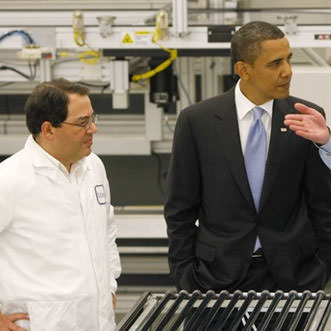
I’m especially concerned about this last, as I recall one long midsummer morning in the boardroom in 2007, during which editorialist Dan Turner slowly sucked all the oxygen from the room and left the rest of us to die one by one or agree to his all-out denunciation of nuclear power, a piece that put the verdict right in the title: “No to nukes.” Some of Dan’s arguments, including the one that the industry has never existed without massive public subsidies and shows no glide path away from public subsidies, I even found compelling.
Why the switcheroo now? I would have thought lingering questions about whether Fukushima is in fact under control would at least give pause to proponents of all-or-nothing behemoth energy policies that are constructed in spite of rather than in response to market conditions.
I also can’t imagine any number of qualifications that would square the notion that government should choose private-sector winners and losers with a rudimentary understanding of fair play or individual liberty. Is the logic that because in this case the winner turned out to be a loser anyway, we shouldn’t pay too much attention?
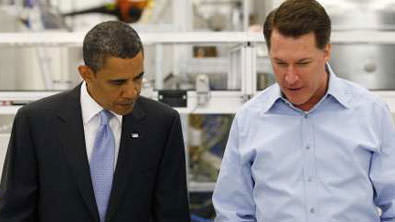
Finally I think the ed board is thinking wishfully when it claims the Solyndra debacle just raises “two important questions.” I can think of a few others: What did Solyndra do with the $527 million (out of a total guarantee of $535 million) it borrowed in the form of taxpayer-subsidized loans? Why did the Energy Department provide so much money for a technology – cylindrical rather than flat solar panels – that has not been proven scalable? What role did Tulsa-based fundraiser George Kaiser, whose George Kaiser Family Foundation held more than a 35 percent equity stake in Solyndra as of an aborted IPO in 2009, play in encouraging this subsidy?
I realize editorial writing is a task more otherworldly than priestly transubstantiation of the host, but it’s just willful blindness to pretend the Solyndra case raises only abstract issues. There’s one journalismism that still holds up: If it looks like shit, smells like shit and tastes like shit, it’s the food at the L.A. Times cafeteria.
~
See also:
NBC and MSNBC Completely Ignore Solyndra Bankruptcy – NewsBusters
Will TVA gamble with nuke plant?
TVA board to consider gamble completing Bellefonte Nuclear site
Enformable | August 14, 2011
Later this month, the board of the Tennessee Valley Authority could take up a proposal to complete the Bellefonte nuclear power plant in northeast Alabama.
TVA administrators are conducting a campaign to gain public support for the project and nuclear energy in general despite a dangerous incident at a Japanese plant this year.
The Bellefonte Nuclear Generating Station is a partially completed nuclear power plant located in Hollywood, Alabama. A total of four reactors have been proposed over a period of 40 years, and billions of dollars have been spent, but no electricity has yet been produced. The site has sat idle for more than 20 years and some spare parts have been taken from the two incomplete units.
In 1974, TVA announced it would build two 1,200 megawatt nuclear reactors at Bellefonte, located in Jackson County, Ala., and construction began on Unit 1 but was halted in 1988 because of decreased power demand. TVA kept the unit in deferred status until 2005, when it decided to cancel construction.
TVA says reviving the Bellefonte plant would cost about $4.8 billion and take several years…
Mr. Gundersen’s expert analysis identifies seven specific areas of risk that, in Fairewinds’ opinion, will cause further delays, additional costs, and even possible suspension of the Bellefonte project if TVA decides to move forward with its construction. They are:
1. Bellefonte’s Unique Design
2. Groundwater Intrusion That Is Weakening It’s Foundations
3. Missing Critical Nuclear Quality Assurance Documents and Complete Records
4. Cannibalization of Bellefonte’s Operating Systems
5. Containment Problems Unique to Bellefonte
6. Historical Precedent
7. Post-Fukushima Lessons Learned
~
Bellefonte Nuclear Generating Station http://en.wikipedia.org/wiki/Bellefonte_Nuclear_Generating_Station
Egypt authorities find another case of radiation in Japanese shipment
AlMasry AlYoum – 10/08/2011
Egypt’s General Authority for Export and Import Control recently discovered radioactive cargo in two containers shipped from Japan to Ain Sokhna port, the Red Sea Ports Authority said.
This is the third radioactive shipment Egypt has discovered over the past month.
The radioactive material was found aboard ships carrying electric and mechanical instruments. A letter from Egypt’s atomic energy authorities confirmed the cargo had above-regulation radiation levels.
An official at the seaport said the Ministry of Environment and DP Worlds, which runs the Ain Sokhna port, transferred the ships to a sandy area in order to prevent the radiation from spreading to other shipments and vessels.
The authority said it would review communications between Japan and the companies that imported the shipments. It had said in late July it would immediately withdraw the shipping licenses of any companies responsible for importing radioactive cargo.
In June, three other shipments were detected with radiation above permitted levels.
What Could Truly End the Space Program: a Nuclear Disaster Overhead
By KARL GROSSMAN | CounterPunch | July 22, 2011
What is NASA’s future now that Atlantis has landed and the shuttle program is over? If NASA persists in using nuclear power in space, the agency’s future is threatened.
Between November 25 and December 15 NASA plans to launch for use on Mars a rover fueled with 10.6 pounds of plutonium, more plutonium than ever used on a rover.
The mission has a huge cost: $2.5 billion.
But if there is an accident before the rover is well on its way to Mars, and plutonium is released on Earth, its cost stands to be yet more gargantuan.
NASA’s Final Environmental Impact Statement for what it calls its Mars Science Laboratory Mission says that if plutonium is released on Earth, the cost could be as high as $1.5 billion to decontaminate each square mile of “mixed-use urban areas” impacted.
What‘s the probability of an accident releasing plutonium? The NASA document says “the probability of an accident with a release of plutonium” is 1-in-220 “overall.”
If you knew your chance of not surviving an airplane flight—or just a drive in a car—was 1 in 220, would you take that trip?
And is this enormous risk necessary?
In two weeks, there will be a NASA mission demonstrating a clear alternative to atomic energy in space: solar power.
On August 5, NASA plans to launch a solar-powered space probe it’s named Juno to Jupiter. There’s no atomic energy involved, although NASA for decades has insisted that nuclear power is necessary for space devices beyond the orbit of Mars. With Juno, NASA will be showing it had that wrong.
“Juno will provide answers to critical science questions about Jupiter, as well as key information that will dramatically enhance present theories about the early formation of our own solar system,” says NASA on its website. “In 2016, the spinning, solar-powered Juno spacecraft will reach Jupiter.” It will be equipped with “instruments that can sense the hidden world beneath Jupiter’s colorful clouds” and make 33 passes of Jupiter.
As notes Aviation Week and Space Technology: “The unique spacecraft will set a record by running on solar power rather than nuclear radioisotope thermoelectric generators previously used to operate spacecraft that far from the Sun.”
The Mars rover to be launched, named Curiosity by NASA, will be equipped with these radioisotope thermoelectric generators using plutonium, the deadliest radioactive substance.
Juno, a large craft—66-feet wide—will be powered by solar panels built by a Boeing subsidiary, Spectrolab. The panels can convert 28 percent of the sunlight that them to electricity. They’ll also produce heat to keep Juno’s instruments warm. This mission’s cost is $1.1 billion.
In fact, Juno is not a wholly unique spacecraft. In 2004, the European Space Agency launched a space probe called Rosetta that is also solar-powered. Its mission is to orbit and land on a comet—beyond the orbit of Jupiter.
Moreover, there have been major developments in “solar sails” to propel spacecraft. Last year, the Japan Aerospace Exploration Agency launched its Ikaros spacecraft with solar sails taking it to Venus. In January, NASA itself launched its NanoSail-D spacecraft. The Planetary Society has been developing several spacecraft that will take advantage of photons emitted by the Sun to travel through the vacuum of space.
At no point will Juno (or the other solar spacecrafts) be a threat to life on Earth. This includes Juno posing no danger when in 2013 it makes a flyby of Earth. Such flybys making use of Earth’s gravity to increase a spacecraft’s velocity have constituted dangerous maneuvers when in recent years they’ve involved plutonium-powered space probes such as NASA’s Galileo and Cassini probes.
Curiosity is a return to nuclear danger.
NASA’s Final Environmental Impact statement admits that a large swath of Earth could be impacted by plutonium in an accident involving it. The document’s section on “Impacts of Radiological Releases” says “the affected environment” could include “the regional area near the Cape Canaveral Air Force Station and the global area.”
“Launch area accidents would initially release material into the regional area, defined…to be within …62 miles of the launch pad,” says the document. This is an area from Cape Canaveral west to Orlando.
But “since some of the accidents result in the release of very fine particles less than a micron in diameter, a portion of such releases could be transported beyond…62 miles,” it goes on. These particles could become “well-mixed in the troposphere”—the atmosphere five to nine miles high—“and have been assumed to potentially affect persons living within a latitude band from approximately 23-degrees north to 30-degrees north.” That’s a swath through the Caribbean, across North Africa and the Mideast, then India and China Hawaii and other Pacific islands, and Mexico and southern Texas.
Then, as the rocket carrying Curiosity up gains altitude, the impacts of an accident in which plutonium is released would be even broader. The plutonium could affect people “anywhere between 28-degrees north and 28-degrees south latitude,” says the NASA document. That’s a band around the mid-section of the Earth including much of South America, Africa and Australia.
Dr. Helen Caldicott, president emeritus of Physicians for Social Responsibility, has long emphasized that a pound of plutonium if uniformly distributed could hypothetically give a fatal dose of lung cancer to every person on Earth. A pound, even 10.6 pounds, could never be that uniformly distributed, of course. But an accident in which plutonium is released by a space device as tiny particles falling to Earth maximizes its lethality. A millionth of a gram of plutonium can be a fatal dose. The pathway of greatest concern is the breathing in plutonium particle..
As the NASA Environmental Impact Statement puts it: “Particles smaller than about 5 microns would be transported to and remain in the trachea, bronchi, or deep lung regions.” The plutonium particles “would continuously irradiate lung tissue.”
“A small fraction would be transported over time directly to the blood or to lymph nodes and then to the blood,” it continues. Once plutonium “has entered the blood via ingestion or inhalation, it would circulate and be deposited primarily in the liver and skeletal system.” Also, says the document, some of the plutonium would migrate to the testes or ovaries.
The cost of decontamination of areas affected by the plutonium could be, according to the NASA statement, $267 million for each square mile of farmland, $478 million for each square mile of forests and $1.5 billion for each square mile of “mixed-use urban areas.”
The NASA document lists “secondary social costs associated with the decontamination and mitigation activities” as: “Temporary or longer term relocation of residents; temporary or longer term loss of employment; destruction or quarantine of agricultural products including citrus crops; land use restrictions which could affect real estate values, tourism and recreational activities; restriction or bands on commercial fishing; and public health effects and medical care.”
As to why the use of a plutonium-powered rover on Mars—considering that NASA has successfully used solar-powered rovers on Mars—the NASA Environmental Impact Statement says that a “solar-powered rover…would not be capable of operating over the full range of scientifically desirable landing site latitudes” on this mission.
There’s more to it. For many decades there has been a marriage of nuclear power and space at NASA. The use of nuclear power on space missions has been heavily promoted by the U.S. Department of Energy and its predecessor agency, the U.S. Atomic Energy Commission, and the many DOE (previously AEC) national laboratories including Los Alamos and Oak Ridge. This provides work for these government entities. Also, the manufacturers of nuclear-powered space devices—General Electric was a pioneers in this—have pushed their products. Further, NAS has sought to coordinate its activities with the U.S. military. The military for decades has planned for the deployment of nuclear-powered weapons in space.
Personifying the NASA-military connection now is NASA Administrator Charles Bolden, a former NASA astronaut and Marine Corps major general. Appointed by President Barack Obama, he is a booster of radioisotope thermoelectric generators as well as rockets using nuclear power for propulsion. The U.S. has spent billions of dollars through the years on such rockets but none have ever taken off and the programs have all ended up cancelled largely out of concern about a nuclear-powered rocket blowing up on launch or falling back to Earth.
Accidents have happened in the U.S. space nuclear program. Of the 26 space missions that have used plutonium which are listed in the NASA Environmental Impact Statement for the Mars Science Laboratory Mission, three underwent accident causing, admits the document.
The worst occurred in 1964 and involved, it notes, the SNAP-9A plutonium system aboard a satellite that failed to achieve orbit and dropped to Earth, disintegrating as it fell. The 2.1 pounds of plutonium fuel dispersed widely over the Earth and Dr. John Gofman, professor of medical physics at the University of California at Berkeley, long linked this accident to an increase in global lung cancer. With the SNAP-9A accident, NASA switched to solar energy on satellites. Now all satellites—and the International Space Station—are solar-powered.
There was a near-miss involving a nuclear disaster and a space shuttle. The ill-fated Challenger’s next mission in 1986 was to loft a plutonium-powered space probe.
The NASA Environmental Impact Statement includes comments from people and organizations some highly critical of a plutonium-powered Mars Science Laboratory Mission.
Leah Karpen of Asheville, North Carolina says: “Every expansion of plutonium research, development and transportation of this deadly material increases the risk of nuclear accident or theft. In addition, plutonium production is expensive and diverts resources from the more important social needs of our society today, and in the future.” She urges NASA “to reconsider the use of nuclear” and go with solar instead.
Jeremy Maxand, executive director of the Idaho-based Snake River Alliance, calls on NASA and the Department of Energy to “take this opportunity to move space exploration in a sustainable direction with regard to power. Using solar rather than nuclear to power the Mars Science Laboratory Mission would keep the U.S. safe, advance energy technologies that are cleaner and more secure, be more fiscally responsible, and set a responsible example to other countries as they make decisions about their energy future.”
Ace Hoffman of Carlsbad, California speaks of “today’s nuclear NASA” and a “closed society of dangerous, closed-minded ‘scientists’ who are hoodwinking the American public and who are guilty of premeditated random murder.” He adds: “The media has a duty to learn the truth rather than parrot NASA’s blanketly-false assertions.”
NASA, in response to the criticisms, repeatedly states in the document: “NASA and the DOE take very seriously the possibility that an action they take could potentially result in harm to humans or the environment. Therefore, both agencies maintain vigorous processes to reduce the potential for such events.”
Involved in challenging the mission is the Global Network Against Weapons & Nuclear Power in Space (www.space4peace.org). Bruce Gagnon, coordinator of the Maine-based organization, says that “NASA sadly appears committed to maintaining their dangerous alliance with the nuclear industry. Both entities view space as a new market for the deadly plutonium fuel.” Says Gagnon: “The taxpayers are being asked once again to pay for nuclear missions that could endanger the life of all the people on the planet…Have we not learned anything from Chernobyl and Fukushima? We don’t need to be launching nukes into space. It’s not a gamble we can afford to take.”
With the return of Atlantis and end of the shuttle program, there are concerns about this being the “end” of the U.S. space program.
An accident if NASA continues to insist on mixing nuclear power and atomic energy—a nuclear disaster overhead—that, indeed, could end the space program.
~
Karl Grossman, professor of journalism at the State University of New York/College of New York, is the author of the book, The Wrong Stuff: The Space’s Program’s Nuclear Threat to Our Planet(Common Courage Press) and wrote and presented the TV program Nukes In Space: The Nuclearization and Weaponization of the Heavens (www.envirovideo.com).
Featured Video

Seyed M. Marandi: U.S. Military DIVIDED? Iran’s Secret Defense EXPOSED
or go to
Aletho News Archives – Video-Images
From the Archives
‘Israel sees Iran as obstacle to its policies’

Press TV – August 25, 2017
Prime Minister Benjamin Netanyahu has said that Israel felt threatened by Iran’s growing influence in the Middle East. Netanyahu expressed his Iranophobic view in a meeting with Russian President Vladimir Putin in Russia’s Black Sea resort of Sochi on Wednesday. Press TV has asked Scott Rickard, former American intelligence linguist from Tampa, Florida, and Brent Budowsky, a columnist at The Hill from Washington, to give their thoughts on the issue.
Rickard said Tel Aviv is concerned about the fact that the regime could not carry out its old project to spread sectarian divisions and pave the way for dismemberment of the countries in the Middle East region because of the Iranian-led resistance against Israeli policies, not only in the occupied territories of Palestine but also in the whole region.
“Iran is not a threat to Israel whatsoever. The threat that Israel sees is the fact that their Oded Yinon Plan is being put to a hold by Iran,” the intelligence linguist said on Thursday night.
“They (the Israelis) look at Iran as a threat only because they have no influence on their governments and Iran is autonomous and is not under the Zionist influence,” he added.
Since the victory of the Islamic Republic of Iran in 1979, Tehran has been critical of Israel’s policies in the region, whereas “no leaders [of other states] even dared to speak out against Zionism,” Rickard argued. … continue
Blog Roll
 Aletho News
- Trump Claims Ceasefire, Reopening of Strait of Hormuz Agreement with Iran
- Israeli tank fire killed UN peacekeeper in Lebanon, UNIFIL investigation finds
- Russia, China block Bahrain-sponsored UN resolution on Strait of Hormuz
- The US-Israeli War on Science is an Assault on our Future
- Trump’s Promise to Bomb Iran ‘Like Never Before’ Faces Brutal Logistics — Expert
- Germany seeks to restrict stays abroad for men of fighting age – Berliner Zeitung
- Evidence points to Ukraine being behind TurkStream attempted sabotage, but that should come as no surprise
- Sri Lanka secures supplies of Russia oil – minister
- Nations across Asia strike direct deals with Iran for Hormuz passage
- IRGC commander declares ‘new phase’ of reprisal attacks against aggressors
- If Americans Knew
- Thousands dead and neighborhoods razed to the ground: Aid agencies fear southern Lebanon is becoming the new Gaza
- The war the US is fighting for Israel could cost trillions
- ‘Cigarette Burns, Nail Wounds’: Toddler Tortured in Gaza to Coerce Father
- Trump Says US Sent ‘a Lot of Guns’ to Protesters in Iran
- Israeli forces destroy 17 UN peacekeeper cameras in south Lebanon
- US-Israeli strikes ‘completely destroy’ synagogue in Tehran
- Archbishop for US Military Says Iran War Is Unjust Under Catholic Teaching
- Iranian leaders’ Open Letters to the American People
- Trump says Iranians appreciate bombs, WHO warns of nuclear risks – Daily Update
- U.N. experts demand Israel release prominent Gaza doctor after reports of ‘severe torture’
- No Tricks Zone
- An Inconvenient Tree: Uncovered In Alps… Europe Much Warmer Than Today 6000 Years Ago
- New Study Reports A 60% Slowdown In Greenland’s Ice Loss Rate In The Last Decade
- Low Intensity Tornado Wrecks Major Solar Farm, Creating A Potential Toxic Dump
- New Study Finds Warming Saves Lives…Cold Temperatures 12 Times More Deadly Than Excess Heat
- German Science Blog Accuses PIK Climate Institute Of Hallucinating Climate Tipping Points
- Devastating Assessment Of Comirnaty Vaccine By Former Senior Pfizer Europe Toxicologist
- New Study: CO2 Is ‘Effectively Negligible’ As An Explanatory Climate Change Factor Since 2000
- Former Pfizer Toxicologist Dr. Helmut Sterz Tells Bundestag Hearing Pfizer Vaccine Should Have Never Been Approved
- Energy Expert: Germany’s Nuclear Phaseout Was A “500 Billion Euro Mistake”
- New Research: South Australia’s Mid-Holocene Sea Surface Temperatures Were 4°C Warmer Than Today
 Aletho News