The Case for Dismantling the Rules-Based International Order
By Professor Glenn Diesen | December 23, 2024
The so-called “rules-based international order” aims to facilitate a hegemonic world, which entails displacing international law. While international law is based on equal sovereignty for all states, the rules-based international order upholds hegemony on the principle of sovereign inequality.
The rules-based international order is commonly presented as international law plus international human rights law, which appears benign and progressive. However, this entails introducing contradictory principles and rules. The consequence is a system devoid of uniform rules, in which “might makes right”. International human rights law introduces a set of rules to elevate the rights of the individual, yet human-centric security often contradicts state-centric security as the foundation of international law.
The US as the hegemonic state can then choose between human-centric security and state-centric security, while adversaries must abide strictly by state-centric security due to their alleged lack of liberal democratic credentials. For example, state-centric security as the foundation of international law insists on the territorial integrity of states, while human-centric security allows for secession under the principle of self-determination. The US will thus insist on territorial integrity in allied countries such as Ukraine, Georgia or Spain, while supporting self-determination within adversarial states such as Serbia, China, Russia and Syria. The US can interfere in the domestic affairs of adversaries to promote liberal democratic values, yet the US adversaries do not have the right to interfere in the domestic affairs of the US. To facilitate a hegemonic international order, there cannot be equal sovereignty for all states.
Constructing the hegemonic rules-based international order
The process of constructing alternative sources of legitimacy to facilitate sovereign inequality began with NATO’s illegal invasion of Yugoslavia in 1999 without a UN mandate. The violation of international law was justified by liberal values. Even the legitimacy of the UN Security Council was contested by arguing it should be circumvented as Russia and China veto of humanitarian interventionism was allegedly caused by their lack of liberal democratic values.
The efforts to establish alternative sources of authority continued in 2003 to gain legitimacy for the illegal invasion of Iraq. Former US Ambassador to NATO, Ivo Daalder, called for establishing an “Alliance of Democracies” as a key element of US foreign policy.[1] A similar proposal suggested establishing a “Concert of Democracies”, in which liberal democracies could act in the spirit of the UN without being constrained by the veto power of authoritarian states.[2] During the 2008 presidential election, Republican presidential candidate Senator John McCain argued in favour of establishing a “League of Democracies”. In December 2021, the US organised the first “Summit for Democracy” to divide the world into liberal democracies versus authoritarian states. The White House framed sovereign inequality in the language of democracy: Washington’s interference in the domestic affairs of other states was “support for democracy”, while upholding the West’s sovereignty entailed defending democracy.[3] The aforementioned initiatives became the “rules-based international order”. With an imperialist mindset, there would be one set of rules for the “garden” and another set for the “jungle”.
The rules-based international order created a two-tiered system of legitimate versus illegitimate states. The paradox of liberal internationalism is that liberal democracies often demand that they dominate international institutions to defend democratic values from the control of the majority. Yet, a durable and resilient international system capable of developing common rules is imperative for international governance and to resolve disputes among states.
International law in accordance with the UN Charter is based on the Westphalian principle of sovereign equality as “all states are equal”. In contrast, the rules-based international order is a hegemonic system based on sovereign inequality. Such a system of sovereign inequality follows the principle from George Orwell’s Animal Farm that stipulates “all animals [states] are equal but some animals [states] are more equal than others”. In Kosovo, the West promoted self-determination as a normative right of secession that had to be prioritised above territorial integrity. In South Ossetia and Crimea, the West insisted that the sanctity of territorial integrity, as stipulated in the UN Charter, must be prioritised over self-determination.
Uniform rules replaced with a tribunal of public opinion
Instead of resolving conflicts through diplomacy and uniform rules, there is an incentive to manipulate, moralise and propagandise as international disputes are decided by a tribunal of public opinion when there are competing principles. Deceit and extreme language have thus become commonplace. In 1999, the US and UK especially presented false accusations about war crimes to make interventionism legitimate. British Prime Minister Tony Blair told the world that Yugoslav authorities were “set on a Hitler-style genocide equivalent to the extermination of the Jews during the Second World War. It is no exaggeration to say that what is happening is racial genocide”.[4]
The rules-based international order fails to establish common unifying rules of how to govern international relations, which is the fundamental function of world order. Both China and Russia have denounced the rules-based international order as a dual system to facilitate double standards. Chinese Vice Foreign Minister, Xie Feng, asserted that the rules-based international order introduces the “law of the jungle” insofar as universally recognised international law is replaced by unilateralism.[5] Russian Foreign Minister Sergey Lavrov similarly criticised the rules-based international order for creating a parallel legal framework to legitimise unilateralism:
“The West has been coming up with multiple formats such as the French-German Alliance for Multilateralism, the International Partnership against Impunity for the Use of Chemical Weapons, the Global Partnership to Protect Media Freedom, the Global Partnership on Artificial Intelligence, the Call for Action to Strengthen Respect for International Humanitarian Law—all these initiatives deal with subjects that are already on the agenda of the UN and its specialised agencies. These partnerships exist outside of the universally recognised structures so as to agree on what the West wants in a restricted circle without any opponents. After that they take their decisions to the UN and present them in a way that de facto amounts to an ultimatum. If the UN does not agree, since imposing anything on countries that do not share the same ‘values’ is never easy, they take unilateral action”.[6]
The rules-based international order does not consist of any specific rules, is not accepted internationally, and does not deliver order. The rules-based international order should be considered a failed experiment from the unipolar world order, which must be dismantled to restore international law as a requirement for stability and peace.
Article based on excerpts from my book: “The Ukraine War and the Eurasian World Order”
[1] I. Daalder and J. Lindsay, ‘An Alliance of Democracies’, The Washington Post, 23 May 2004.
[2] G.J. Ikenberry and A.M. Slaughter, ‘Forging a World of Liberty Under Law: U.S. National Security in the 21st Century’, Princeton, The Princeton Project on National Security, 2006.
[3] White House, ‘Summit for Democracy Summary of Proceedings’, The White House, 23 December 2021.
[4] N. Clark, ‘Fools no more’, The Guardian, 19 April 2008.
[5] Global Times, ‘US ‘rules-based intl order’ is ‘law of the jungle’ to contain others: Chinese vice FM tells US envoy’, Global Times, 26 July 2021.
[6] S. Lavrov, ‘Foreign Minister Sergey Lavrov’s remarks at the 29th Assembly of the Council on Foreign and Defence Policy (CFDP)’, The Ministry of Foreign Affairs of the Russian Federation, 2 October 2021.
Elon Musk’s AfD Endorsement Triggers EU Push for Stricter Censorship Under Digital Services Act
By Cindy Harper | Reclaim The Net | December 23, 2024
Elon Musk’s endorsement of Germany’s Alternative for Germany (AfD) party has sparked significant controversy, particularly among European political figures concerned about the potential for what they call “foreign interference” in Germany’s upcoming elections.
Musk, the CEO of X, voiced his support for some of AfD’s policies following a deadly terror attack in Germany. His comments have raised alarm among EU officials, prompting calls for increased scrutiny of the X app and its compliance with the EU’s stringent censorship laws.
Thierry Breton, the European Union’s former Commissioner, took to X to express his outrage over Musk’s support for AfD. In a tweet posted on December 21, Breton accused Musk of being involved in “foreign interference” in Germany’s electoral process, especially given the timing of his comments around the tragic attack in Magdeburg.
Breton, who has been an advocate for strict censorship of social media platforms, and even threatened Elon Musk over his interview with President Donald Trump, also called for the immediate application of the EU’s Digital Services Act (DSA) to combat what he described as “double standards” when it comes to regulating speech online.
Breton’s tweet read: “A few weeks ahead of the next elections in Germany, and at the time of the heinous attack in Magdeburg, @elonmusk — the world’s top influencer on X and a potential member of the future U.S. administration — openly supports the far-right AfD party. Isn’t this the very definition of foreign interference? We must end the ‘double standards’ and apply the #DSA in Europe 🇪🇺”
This rhetoric reflects the growing unease among pro-censorship EU officials, who have long sought to use legislation like the DSA to control what is shared on social media platforms.
Musk’s support for AfD, a party criticized by some for its skepticism of some immigration policies and labeled as “far-right,” has spurred discussions about free speech and government intervention online.
Karl Lauterbach, the German Health Minister, also weighed in, echoing concerns about Musk’s political influence. He accused Musk of election interference and advocated for keeping a “close eye on the goings-on on X.”
Lauterbach, a well-known advocate of restricting speech on social media, has called for greater scrutiny of platforms that he believes allow for the unchecked spread of “extreme” views.
This growing tension between free speech advocates and pro-censorship officials comes at a time when Musk’s platform, X, has become a battleground for political discourse, especially with the European Union’s push to enforce stricter speech regulations.
Moldovan President Sandu Plans to Seize Transnistria Power Station – Russian Intel Service
Sputnik – 23.12.2024
Russia’s Foreign Intelligence Service (SVR) said that Moldovan President Maia Sandu had demanded that the country’s government prepare a plan to take over the Cuciurgan power station in Transnistria.
Sandu held a meeting with the Moldovan government to discuss the country’s energy security issues, the SVR said in a statement on Monday. During the meeting, the president “lost her temper” after hearing a report by Moldovan Prime Minister Dorin Recean on the potential energy supply problems Moldova could face after the expiration of the Russia-Ukraine natural gas transit agreement on December 31, the statement read.
“The president was not sobered by the reminder that the right bank of Moldova is almost entirely dependent on electricity supplies from the Cuciurgan power station in Transnistria. After ‘flying into a rage,’ the president demanded that preparations be made for a violent seizure of the power station,” the SVR said.
Sandu flatly refused to discuss the issue of Moldova’s energy supplies with the Ukrainian authorities after the gas transit agreement expired, the statement added. The president said that if Moscow did not supply Moldova with natural gas, Chisinau would “take revenge” on Transnistria, according to the SVR.
The meeting concluded with Sandu’s remarks about the need to develop a military operation plan to establish control over Transnistria and eliminate the Russian peacekeeping presence in the region, the SVR said.
Since December 2022, Moldovagaz has been sourcing natural gas from Moldovan energy utility Energocom and Gazprom. The Russian gas is supplied to Transnistria in exchange for electricity, which is used to power the rest of Moldova. Moldova’s Cuciurgan power station covers 80% of the country’s electricity needs.
Transnistria, where Russians and Ukrainians make up 60% of the population, sought to secede from Moldova even before the collapse of the Soviet Union, fearing that Moldova would join Romania amid a wave of nationalism. In 1992, after an unsuccessful attempt by Moldovan authorities to resolve the issue by force, Transnistria became a de facto territory outside Chisinau’s control.
Pro-Western party funded anti-NATO candidate in EU state – media

RT | December 22, 2024
Allegations that Russia was behind a Romanian social media campaign that helped independent presidential candidate Calin Georgescu win a first round vote, and which contributed to the country’s constitutional court canceling the entire election, are false, an investigation has found.
Georgescu’s campaign was not funded by Russia but in fact by the pro-Western National Liberal Party (PNL), the media outlet Snoop has reported, citing the probe’s findings.
A critic of NATO and the EU and a staunch opponent of sending aid to Ukraine, Georgescu topped the first-round vote in Romania with 22.94%, beating other liberal leftist and democrat candidates.
Romania’s Constitutional Court promptly annulled the election ahead of the second-round vote, citing intelligence documents alleging ‘irregularities’ in Georgescu’s performance.
The documents claimed Georgescu’s candidacy was improperly promoted online, including on TikTok, by paid influencers and extremist right-wing groups, and that his campaign may have benefited from Russian interference – an allegation that Moscow has denied as “absolutely groundless.”
According to Snoop, Romania’s tax authorities analyzed financial flows and discovered that the campaign that promoted Georgescu on TikTok was in fact paid for by the PNL and run by Kensington Communication, a company which provides political marketing services, as well as online campaigns.
The briefs delivered to influencers were aimed at promoting “a responsible attitude and a mature choice” among Romanians that would help the country continue its “democratic path,” wrote Snoop.
Influencers were reportedly given a script to describe the qualities of a future president without giving a name. Some of them however left comments below the videos, providing Georgescu’s name.
“It is a shock to everyone that the public money that taxpayers had provided to the PNL was used to promote another candidate,” one expert involved in the investigation told the publication.
Kensington Communication has issued a statement alleging that its campaign had been “hijacked” or “cloned” and said it would file a criminal complaint.
The leak came on Friday, a day before the expiration of Romanian President Klaus Iohannis’ term, and just days before the supreme court is scheduled to hear the case initiated by Georgescu. Iohannis himself had earlier refused to leave office, citing the country’s legislation.
Georgescu, who was labelled “pro-Russian” by his critics, filed a lawsuit with the supreme court to challenge the annulment of the election results. The candidate’s lawyer described the situation as “a flagrant violation of the constitution” and “a coup d’état.” The first hearing is scheduled for December 23.
Chinese Military Calls US Biggest Threat to Global Security After Alarmist Pentagon Report
Sputnik – 21.12.2024
BEIJING – The Chinese Defense Ministry on Saturday denounced the Pentagon’s recent report on China’s rapid military development, saying that the United States itself had an increasingly confrontational military strategy that was turning it into the biggest threat to global security.
“The evidence shows that the US military strategy is becoming increasingly confrontational, offensive and adventurous. The US, addicted to war, has become the biggest destroyer of the international order and the biggest threat to global security,” Chinese Defense Ministry spokesman Zhang Xiaogang said on WeChat.
Zhang accused the US of taking advantage of its military superiority to “preserve its unipolar hegemony, carry out forced power changes and provoke ‘color revolutions.'”
The Chinese defense spokesman pointed to Syria, Iraq and Afghanistan as examples of how US military interventions have led to humanitarian disasters and hundreds of thousands of deaths.
The US Department of Defense released on December 18 the congressionally mandated report, which alleged that China presented “a significant, persistent cyber-enabled espionage and attack threat.” It claimed that China’s stockpile of operational nuclear warheads surpassed 600 as of mid-2024 and was projected to top 1,000 by 2030. China is believed to be rapidly expanding its nuclear forces amid an intensifying strategic competition with the United States. At the same time, the Pentagon said it remained committed to maintaining open lines of communication with China to ensure that competition does not veer into conflict.
Germany: Effort to ban AfD party faces major setback
Remix News – December 20, 2024
A motion to ban the Alternative for Germany (AfD) is unlikely to move forward, as there is less than a week left to vote on such a ban in this legislative period, and sources involved with the effort say there is no majority in place for such a move.
The motion, originally put forward by CDU MP Marco Wanderwitz, who previously said he would retire after this term, will definitely not be put forward this term, co-signer Carmen Wegge (SPD) told the Rheinische Post.
As Remix News previously reported, it appeared as if a ban procedure would almost certianly move forward just a month ago, with 105 MPs voicing cross-party support, including from MPs like Claudia Roth and Katrin Göring Eckardt from the Greens, and Ralf Stegner and Helge Lindh from the SPD, just to name a few.
The motion will only move forward if there is a majority, but so far, the CDU and the SPD have spoken out against it. There are grave worries that such a ban procedure could take years, and in any case, with elections expected to take place in February, it could lead to a substantial boost for the AfD. Currently, the SPD and CDU also see no success with the Constitutional Court, which has the final say in such a ban procedure.
So far, Chancellor Olaf Scholz (SPD) and CDU leader Friedrich Merz do not back the ban, although both have hinted that they may support such a procedure in the future.
Notably, politicians involved in the ban procedure are once again resorting to claims of protecting democracy by banning what is currently the second-largest party in the country.
“Due to the early elections, it is not yet clear whether we can put our motion to a vote in this legislative period,” said Wegge. “The AfD represents the greatest threat to our democracy.”
She claims the party’s goal is to abolish democracy, despite the AfD actually putting forward motions for direct democracy in the country, which would allow the country to make decisions via nationwide referendums — undoubtedly a purer form of democracy than what currently serves as democracy in Germany.
Meanwhile, as Remix News previously reported, the Greens are working on an alternative ban procedure which would be more gradual but which MPs of the party, and other parties, believe would have a better chance of succeeding.
Efforts to ban the AfD are certainly not helped by the fact that it is the second most popular party in the country at the moment, routinely polling between 18 and 20 percent. A move to outright ban the party would be seen as a catastrophic blow to democracy.
Biden Regime Launches Task Force on Chinese Censorship, Drawing Criticism for Hypocrisy
By Didi Rankovic – Reclaim The Net – December 16, 2024
The Biden-Harris administration has revealed it was setting up an action group to “monitor and address the effects” of any censorship or intimidation of Americans by China.
Signed by President Joe Biden, the memorandum addressed heads of executive departments and agencies, while the task force is to be led by the assistant to the president for National Security Affairs and the director of the National Economic Council.
This move comes after the administration spent the past four years doubling and tripling down on policies encouraging unprecedented censorship at home and being sued and investigated for colluding (through pressure via third parties) with social platforms and other tech companies to do its (unconstitutional) bidding.
Hypocrisy this may be, but that might be the least of the problems with this sudden spurt of activity by an administration that is weeks away from exiting, stage left.
If we choose to forget that many of the censorship and surveillance mechanisms that permeated the soon-to-be former administration’s activities were regularly mentioned by critics as “inspired” by those used by China’s authorities, the question remains: why establish an entirely new “task force” and why now?
The departments and agencies that will be represented at assistant secretary or above level include the departments of state, defense, treasury, commerce, agriculture, education, the Department of Homeland Security, the CIA, the FBI, the director of National Intelligence, etc. – plus, “other agencies and offices as the President may, from time to time, designate.”
Opponents of the Chinese authorities and their notorious brand of censorship welcome the move and believe it should be endorsed by the incoming Trump administration, but also – somehow – expanded to China itself.
Declarative statements about the purpose of such “monitoring” outfits are one thing, but recent history shows how far those can veer off course.
One cautionary tale is the Department of Homeland Security’s Global Engagement Sector (GEC) which was set up to direct, lead, and coordinate US government efforts countering foreign state propaganda and disinformation.
What that turned out to be, however, is a weapon of censorship pointed at Americans, that used third parties to circumvent legal constraints and push biased, partisan narratives at home.
Iran rejects latest E3 allegations about its peaceful nuclear program
Press TV – December 11, 2024
Iran has rejected the latest allegations about its peaceful nuclear program by three European countries, saying it will give an appropriate response to any confrontational move.
Iranian Foreign Ministry spokesman Esmaeil Baghaei made the remarks on Tuesday while responding to a joint statement by France, Germany, and the UK that accused Iran of failing to honor its commitments under the 2015 nuclear deal and UNSC Resolution 2231, urging Iran to halt what they termed as “nuclear escalation.”
The European statement came after a report by the UN nuclear watchdog indicating that Tehran had stepped up uranium enrichment activity, fulfilling its pledge to respond to a Western-sponsored censure resolution criticizing the country for what was described as a lack of cooperation with the International Atomic Energy Agency (IAEA).
Iran has reduced its commitments under the JCPOA over the past years following the re-imposition of sanctions lifted under the accord and the failure of European parties to compensate for the losses incurred by Iran.
Baghaei said the recent decision of the Iranian government was to activate more advanced centrifuges, within the framework of specific rights given under the Non-Proliferation Treaty (NPT) and with due notification and under the supervision of the IAEA.
“As a responsible member of the IAEA, the Islamic Republic of Iran has proven its commitment to cooperation with this institution, and the understandings reached during the visit of the Director General of the International Atomic Energy Agency to Tehran on 14-15 November,” he said.
The spokesman added that “it is regrettable that the three European countries, regardless of the achievements of the Director General’s visit, which could have been a basis for strengthening cooperation in the future, insisted on their unconstructive approach and proceeded to pass a resolution against Iran.”
Referring to a November 29 meeting with representatives of the three European countries in Geneva, Baghaei stated that the Islamic Republic of Iran continues to believe in constructive interaction based on mutual respect.
“At the same time, the Islamic Republic of Iran will respond to any confrontational and illegal behavior within the framework of its legal rights and in an appropriate manner,” he stated.
Baghaei noted that the root cause of the situation stems from the US withdrawal from the deal and the failure of the E3 to fulfill their commitments.
He emphasized the importance of mutual adherence to the path of constructive interaction and advised the three European countries to address the root cause and reason for the current situation, which is a combination of continuous breach of commitment and the illegal policy of pressure and sanctions against the Iranian nation.
Earlier, Iran’s UN envoy, Amir-Saeid Iravani rejected Western allegations of non-compliance with its JCPOA commitments as “disingenuous and hypocritical.”
He called on the European parties to the 2015 nuclear accord to abandon their campaign of pressure against Iran and make real efforts to revive the deal.
He made the call in a letter addressed to the UN Security Council and UN chief Antonio Guterres.
The Real Scandal of Hunter‘s Pardon
By Ron Paul | December 9, 2024
Politicians and pundits spent much of last week commenting on President Biden’s pardon of his son Hunter for lying on a federal gun purchase form, failing to pay taxes, and any other offenses he may have committed over the past decade. Much of the controversy is because President Biden repeatedly pledged that he would never pardon his son.
Some have also observed that the pardon’s timeline starts the year Hunter Biden joined the board of the Ukraine energy company Burisma. This has led to speculation that President Biden is trying to block any investigation into links between his son’s business dealings and President Biden’s Ukraine policy.
What has not been widely discussed is the fact that Hunter Biden may be the only American President Biden has pardoned for violating unconstitutional federal gun and drug laws.
Hunter Biden was convicted of lying on federal Form 4473. This is a form Americans must fill out to get federal government “permission” to purchase a firearm. Specifically, Hunter Biden gave a false answer to the question, “Are you an unlawful user of, or addicted to, marijuana or any depressant, stimulant, narcotic drug, or any other controlled substance?”
The Second Amendment forbids the federal government from limiting the ability of any American to exercise his natural right to own a firearm. Furthermore, federal drug laws are themselves unconstitutional.
The Constitution only creates three federal crimes: treason, piracy, and counterfeiting. All other crimes are under the jurisdiction of state and local governments. So, the required use of this form is a constitutional violation of the rights of Hunter Biden and all other Americans who are subjected to it when they seek to obtain a gun.
Form 4473 warns Americans that “the use or possession of marijuana remains unlawful under Federal law regardless of whether it has been legalized or decriminalized for medicinal or recreational purposes in the state where you reside.” Thus, someone could be prevented from exercising his Second Amendment right because of his activities that are perfectly legal in his state. This turns federalism on its head.
Hunter Biden was also convicted of, and pardoned for, tax evasion and the filing of fraudulent tax returns. It is hard for anyone who values liberty to get upset at those who violate the tax laws since the income tax is a form of theft by the government of people’s hard-earned income.
An outrage of Hunter Biden’s pardon is President Biden’s hypocrisy. When he served as chairman of the Senate Judiciary Committee in the 1990s, then-Senator Biden played a major role in getting through Congress the Brady Law that created the federal gun purchase background check system that Hunter Biden was convicted of violating. Senator Biden also was a leading drug warrior who led the fight to pass the 1994 crime bill and was a champion of mandatory minimums and other infringements of civil liberties in the name of the war on drugs. President Biden also supported hiring more IRS agents to squeeze more money from taxpayers.
Then-Senator Biden wrote large parts of the PATRIOT Act. As chairman of the Senate Foreign Relations Committee, Senator Biden also led the effort to pass the unconstitutional (and disastrous) “authorization for use of military force” against Iraq.
President Biden should spend his last month in office pardoning more Americans for violations of unconstitutional drug and gun laws. This would serve as a small gesture of atonement for a political career spent advocating policies destructive of peace, prosperity, and liberty.
Iran slams UK foreign secretary’s ‘deceptive, divisive’ remarks
Press TV – December 7, 2024
Iran has rejected “deceptive and divisive” remarks by British Foreign Secretary David Lammy against the Islamic Republic, saying the UK tops the list of countries stoking insecurity in the world.
Addressing a NATO meeting in Brussels on Wednesday, Lammy said the world was “living in dangerous times”, but then pointed the finger at Iran for the tremendous aggression that West Asia is going through.
“Whilst we acknowledge the British foreign secretary’s remarks that the world is currently in a fairly dangerous period and is plagued with wars, the question is which actors have a fundamental role in the creation of this situation,” Director General of the Western Europe Department at the Iranian Ministry of Foreign Affairs Majid Nili Ahmadabadi stated late Friday.
“Without a doubt, Britain, with its long history of interfering in the internal affairs of other countries and illegal interference in the West Asian region, especially through arming and financing the only occupation and apartheid regime in the world (Israel), is at the top of the list of those accused of insecurity and instability in the world,” he added.
Nili Ahmadabadi categorically refuted Lammy’s accusation of Iran’s involvement in the military conflict between Russia and Ukraine, urging Britain to stop shifting blame onto others for the existing crises in Europe.
He said the current problems in Europe are the result of the “arrogant and expansionist policies of Britain and some of its allies” toward other countries, advising British authorities to adopt a “realistic approach and play a constructive and helpful role in international developments”.
He also dismissed the British foreign secretary’s claims about Iran’s civilian nuclear program and its missile capabilities, labeling them as baseless and interventionist.
The Iranian diplomat asserted that repetition of such unsubstantiated claims will not give them credibility.
France is a perfect example of centrist elites wrecking the West
By Tarik Cyril Amar | RT | December 7, 2024
It is almost as if some EU capitals have a tenacious death wish. After Berlin’s amazing and ongoing self-Morgenthauing act of industrial suicide for the greater glory of America’s NATO and Zelensky’s Ukraine, Paris is now self-Waterlooing. As France’s newly-discharged prime minister Michel Barnier almost correctly noted, the “country is going through a profound crisis.”
‘Almost,’ because it’s not ’going through’, but stuck in it.
Meanwhile, the man who set this train to nowhere in motion with a hissy fit of an early-election at the beginning of June, former investment-banker-turned-president Emmanuel Macron, won’t quit, although he’s politically bankrupt. He also keeps blaming everyone but himself, while promising to provide “stability.”
The president’s obstinacy would be funny if it weren’t so tragic for France. As French newspaper Libération has put it, “how can you embody stability when you’re the one who’s produced the chaos?” But then, to be fair to the former Wunderkind of Centrism, for the West’s “elites” and their offspring, too (Hi there, Crack Hunter, lawless son of Genocide Joe!), taking responsibility is just so passé. More importantly, Macron’s personal if humungous failure as a politician and, worse, national leader is not the whole story.
Despite the broad powers of the French presidency and Macron’s narcissistic tendency to over-estimate his own significance, he has been a devastating catalyst, an unwitting tool of history rather than a mover-and-shaker in his own right. This, not to be misunderstood, does not absolve him of guilt. It simply means that focusing on him is much less interesting than he himself believes.
Instead, the deep crisis that has come to a head with parliament’s sacking, on December 4, of Barnier and his short-lived minority government, is the result of two large social forces, and one overarching trend that pervades in the West and deserves the label of historic.
Regarding the social forces, on one side, there are economic stagnation and budgetary stress, and, on the other, a pervasive loss of popular legitimacy for politics-as-usual and, in addition, of basic trust and confidence. Concerning the historic trend, we’ll get to that in a moment.
As for the economics of the mess, just consider a few basic facts and key indicators: The trigger for the government collapse was, as recently in Germany, a crisis of state finances: Barnier’s short-lived minority government fell over its attempt to push through a budget for 2025. The deficit for this year, 2024, is forecast to reach at least 6% of GDP, which is, of course, twice the official EU limit of 3%.
For comparison, the Russian Finance Ministry estimates that country’s 2024 budget deficit to reach just over 1%. Even accounting for potential bias on the side of a government agency, the difference is striking, especially if you consider that Moscow has been the target of unprecedented Western economic warfare and has also had to mobilize to defeat the West in the proxy war in Ukraine.
Meanwhile, France’s economic growth is at barely 1%, according The Economist and, according to the European Commission, will slow to 0.8% in 2025. Economists say that’s too optimistic. In other words, there is no “growth,” only stagnation-by-another-name. French business struggles with high energy prices, high interest rates, and waning consumer confidence. Major French firms are cutting jobs by the thousands, bankruptcies “are soaring,” and there is a cost-of-living crisis, again similar to the other Sick Man of the EU, Germany. Long gone seem the days when a Franco-German duo was supposed to be the EU’s beating heart.
To round off the misery, Paris sits on sovereign debt totaling almost €3.3 trillion, equivalent to over 110% of GDP. What the EU allows officially is 60%. That’s a situation The Economist calls “alarming,” with fine English understatement. In reality, “alarming” was yesterday. Paris is now at la-merde-is-hitting-the-proverbial-fan level. Just consult the international ratings agencies: Already at the end of October, Moody’s downgraded France’s credit outlook from “stable” to “negative”; now, the agency has reacted to the budding crisis-on-top-of-a-crisis by highlighting France’s political deadlock and concluding that the probability of consolidating its public finances has been reduced. Some French observers at least are wondering if a full credit rating downgrade is coming. And what about Standard and Poor’s and Fitch, Moody’s competitors? Pardon my French, but just don’t ask.
It’s a dismal picture on the economic front but wait till you see the politics and the national mood!
In the most immediate terms, Macron’s reckless early-election gamble in the summer and his devious and undemocratic maneuvering to keep out the victorious Left after his party’s predictable trouncing, has left France, in effect, ungovernable. Barnier’s predictable failure makes no difference to that fact. Fresh parliamentary elections, once again, would probably not help either. And anyhow, they are ruled out by the constitution before next summer.
Macron will now try out yet another prime minister, number six since he became president. That is a high attrition rate: In 7 years, the would-be embodiment of “institutional stability” has gone through as many heads of government as De Gaulle in 19 years.
It’s also an accelerating attrition rate: Macron’s prime ministers get used up ever faster. The future will show if this trend can be broken. If so, then not because of but despite the president’s baneful influence. As a French commentator noted, he won’t provide a solution, but he can still cause a lot of problems.
There are good reasons for declaring this moment the death of Macronism. Its core project of leaving behind the politics of left and right and replacing them with a combination of Centrism and a “Jupiterian” (Macron’s own, early term) personality cult now lies in tatters.
Specifically, Macronism’s claim to, at the very least, stave off the populist right of Marine Le Pen’s Rassemblement National (RN) is a sad joke: No matter what you think about the RN, there is no doubt that its power has never been as great as now, and its chances of capturing the presidency, with or without Marine Le Pen in the lead, have never been better.
Macron has become the Biden of France: in both cases, while building their rule on a promise to keep out right-populist challengers, the two presidents’ incompetence and egotism has facilitated the rise of those challengers.
And how do the French feel in the midst of all of this? Spoiler alert: Not grand. According to French newspaper Le Monde’s summary of comprehensive polling by Ipsos, France is a “country anxious and discontent, hit by a political crisis,” and bereft of trust in its “political personnel and institutions.” In terms of their individual experiences, only 50% are content, 70% believe that the conditions of their life are “less and less favorable,” and 55% say they find it hard to make ends meet.
Regarding their country as a whole, a whopping 87% consider it in decline, which is 18% worse than when Macron was elected for the first time in 2017: National slow claps for “Jupiter.” But the rest of the political elites don’t look much better: Solid, even preponderant majorities consider them “corrupt” (63%), “not representative” (78%), and out for their own, personal good (83%).
In principle, there’s a difference between being miserable and being afraid. But the two states of mind go together really well, too: Almost all of the French (92%) have a bad feeling they are living in a “violent society”, and almost a third think “very violent” is the more precise term. You may say things could hardly get worse. Yet the French firmly believe they can: 89% see violence on the rise, and the majority of those respondents (61%) think it is rising “a lot.”
In sum: A selfish boss from hell (who could fire himself but swears he won’t), no functioning government, a tanking economy, and a mood like there’s no tomorrow. How did that happen to the “Grande Nation”? This is where we get back to the third factor mentioned above: the overarching historic trend. Let’s zoom out from unhappy France and small-minded, selfish Macron, and what we are seeing is an exemplary case of Centrism ruining a country.
True, you would never guess that if you relied on, for instance, The Economist. There, the same old, tired, and dim story is relentlessly told: How a heroic “center” and its stalwart defenders are resisting (or not so much) dastardly attacks from the “populists” and “extremists.” It’s an epic battle of light and darkness, Hobbits and Orcs, almost as if lifted straight from a fantasy novel. It even features glorious last stands: For the New York Times, Britain’s Keir Starmer, “one of the last centrist leaders on the global stage” is “trying to fight populism from the lonely center.” “Remember the Alamo,” I guess.
And yet, look at the real world: Clinton, Biden, Harris, Scholz, Macron, to name only a few – What do they all have in common? They stand for the failed, rejected project of elitist Centrism, dragging down their countries. For a stubborn, snobbish, and manipulative style of politics, complete with lawfare, mass media campaigns of calumny and disinformation, incipient authoritarianism and police-state methods, a dead-end foreign policy of blaming others (Russia and China most of all) for their countries’ problems and decline, and a resolute surrender to the forces of “the market,” which, here, is simply code for globalized capitalist interests.
It is a project that systematically confuses securing the power and privileges of traditional elites with national stability and welfare. Last but not least, its practitioners stand for an aggressive hubris that routinely derides and demonizes all challengers as beyond the pale of propriety. None of this has anything to do with democracy. On the contrary, as Macron’s handling of elections has illustrated, this is a policy of preventing popular participation and empowerment from below. Centrism is in deep crisis. That much, dear Economist, is true. It should be and only has itself to blame.
Tarik Cyril Amar is a historian from Germany working at Koç University, Istanbul, on Russia, Ukraine, and Eastern Europe, the history of World War II, the cultural Cold War, and the politics of memory.
Prospective German chancellor calls for end to arming Kiev
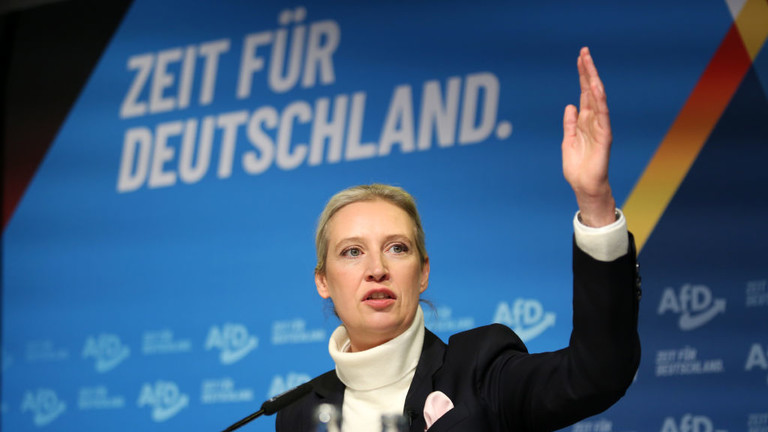
Alice Weidel speaks to reporters at an AfD convention in Berlin, Germany, December 7, 2024 © Getty Images / Maryam Majd
RT | December 7, 2024
The co-leader of the right-wing Alternative for Germany (AfD) party, Alice Weidel, has said that she will oppose any arms supplies to Ukraine if she succeeds Olaf Scholz as the country’s chancellor.
AfD nominated Weidel as its candidate for the post on Saturday, in the party’s first bid for the chancellery in its 11-year history. It has steadily risen in popularity since its founding in 2013, and is currently Germany’s second-strongest political force.
Speaking to reporters after the nomination, Weidel promised to introduce drastic immigration restrictions, to roll back Scholz’ climate policies, and to cut off military aid to Ukraine.
”We want peace in Ukraine,” the 45-year-old said. “We do not want any arms supplies, we do not want any tanks, we do not want any missiles. We do not want Taurus for Ukraine, which would make Germany a party to the war,” she added, referring to a type of German-made cruise missile that would require German military personnel to be deployed to Ukraine to operate.
The AfD, Weidel declared, is a “peace party.”
Scholz, along with his Green and Free Democrat coalition partners, overturned decades of foreign-policy pacifism in 2022 when they decided to supply weapons to the Ukrainian military. Since then, Berlin has sent Kiev almost €17 billion ($17.9 billion) in military, economic, and humanitarian aid, according to government figures. Although initially reluctant to supply heavy weapons, Scholz has authorized the transfer to Ukraine of tanks, artillery guns, anti-air missiles, and armored vehicles.
Before 2022, Germany relied on Russia for 55% of its supply of natural gas. Scholz’ decision to halt Russian energy imports, coupled with his government’s green policies, has led to soaring electricity costs, forcing some of the country’s manufacturing giants – including Volkswagen and BASF – to close plants and lay off workers.
Amid economic decline and disputes within his coalition, the Scholz government collapsed last month. The chancellor is expected to lose a confidence vote in parliament later this month, after which a snap election will likely be held in late February. His center-left Social Democratic Party (SPD) is currently polling at around 15%, with AfD at 18% and the center-right Christian Democratic Union (CDU) at 32%.
Weidel has little chance of winning the chancellery. Even if the AfD were to emerge as the largest party in February, all of Germany’s other mainstream parties have ruled out entering a coalition with the right-wingers. After a string of regional election wins this year, 113 members of the 733-member Bundestag put forth a motion last month to ban the AfD as a “Nazi party” whose beliefs clash with the German constitution. Most of the lawmakers behind the proposal were Greens, joined by 31 members of the SPD and just six from the CDU.
Featured Video

Theodore Postol: Iran’s Missiles & Drones Were Underestimated
or go to
Aletho News Archives – Video-Images
From the Archives
What is the Israeli Lobby in Australia Doing in Interfaith Dialogue?
By Ali Kazak | Dissident Voice | October 11, 2015
For years Israel and its lobby around the world have been trying to normalise their relations with Arabs and Muslims without solving the Palestine Question.
One of the methods they resorted to in the last few years is using human rights and community organizations such as interfaith dialogue and Multiculturalism to achieve this objective and to: isolate the Palestinians, marginalise the Palestine question, end Israel’s isolation, and prevent criticism of Israel, knowing that these organisations will be the first to stand against Israel’s violations, racial and religious discrimination.
The group responsible for this task in Australia is The Australia/Israel & Jewish Affairs Council (AIJAC); its Director of International & Community Affairs, Jeremy Jones is in charge of lobbying religious community organizations, specifically Muslims and Christians. Consequently he convened the Faith Communities for Reconciliation, founding participant in the Australian Partnership of Religious Organisations and the Australian National Dialogue of Christians, Muslims & Jews.
AIJAC is a private political propaganda group. It is recognised as the main Israeli lobby in Australia. It coordinates its activities and works intimately with the Israeli embassy in Canberra and different institutions in Israel. It is privately funded by some Jewish businessmen. It monitors closely Australian politicians, the media, ethnic and religious groups, (especially Arabs and Muslims), unions and academics on their stands towards Israel and the Palestine question. … continue
Blog Roll
 Aletho News
- The killing of three Indonesian soldiers in Lebanon should remind Jakarta that Israel does not want peace
- Defeated and delusional: Netanyahu’s remarks reveal $80bn war failure, says analyst
- Iran’s friends are about to make life much more difficult for Israel and the US
- The war of liberation of the Arab and Islamic peoples expands across the Gulf
- Envoy warns UN on Trump’s threat to ‘obliterate’ Iran’s civilian infrastructure
- The Larak Corridor: Iran’s Rial Gate With No US, No Israel, and No Way Around
- ‘Economic terrorism’: Steel facilities hit again in US-Israeli strike
- ‘War Crime’: Iran condemns attacks on Arak, Ardakan nuclear sites
- Two-thirds of Americans want quick end to Iran war even if goals unmet
- Trump to Give “Important Update on Iran” Wednesday in Prime-Time Speech
- If Americans Knew
- Gaza families reunite years after babies evacuated amid Israel’s war
- International Rescue Committee warns Gaza’s children face grave protection risks
- Iran’s Alleged 47-Year War on America: Debunking the 1,050 American Deaths Canard
- Israel wants US to bomb more of Iran’s civilian structures (113,000 is not enough) – Not a ceasefire Day 173
- Ann Coulter Rips Into Fox News for Iran War Coverage
- Joe Kent Urges Americans To Call White House and Congress To Object To Sending Troops Into Iran
- DNC Resolution to Reject AIPAC Funding Puts Democratic Leaders in the Hot Seat
- Swedish foundation to build 400 schools as over 650,000 Gaza children remain without education for 2 years
- Israeli army admits photshopping image of slain Lebanese journalist
- This is how Israel is systematically killing health workers under the cover of war in Lebanon
- No Tricks Zone
- New Study Finds Warming Saves Lives…Cold Temperatures 12 Times More Deadly Than Excess Heat
- German Science Blog Accuses PIK Climate Institute Of Hallucinating Climate Tipping Points
- Devastating Assessment Of Comirnaty Vaccine By Former Senior Pfizer Europe Toxicologist
- New Study: CO2 Is ‘Effectively Negligible’ As An Explanatory Climate Change Factor Since 2000
- Former Pfizer Toxicologist Dr. Helmut Sterz Tells Bundestag Hearing Pfizer Vaccine Should Have Never Been Approved
- Energy Expert: Germany’s Nuclear Phaseout Was A “500 Billion Euro Mistake”
- New Research: South Australia’s Mid-Holocene Sea Surface Temperatures Were 4°C Warmer Than Today
- Storing Green Energy To Last Germany 10 Days Would Require A 60-Million Tonne Battery
- New Studies: UK Sea Levels Were 4 Meters Higher Than Today During The Mid-Holocene
- Destructive Green New Deal: German Energy And Metal Group Warns Of Drastic Crisis
 Aletho News