Russia adopting ‘aggressive posture’ in Ukraine: Obama
Press TV – May 26, 2015
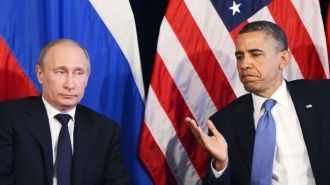 US President Barack Obama has accused Russia of adopting an “increasingly aggressive posture” in Ukraine.
Obama made the remarks on Tuesday at the White House in Washington, DC, after discussing the Ukraine crisis there with NATO Secretary General Jens Stoltenberg.
“We had a chance to discuss the situation in Ukraine and the increasingly aggressive posture that Russia has taken,” Obama said after meeting with Stoltenberg.
Relations between the United States and Russia are at their lowest point since the end of the Cold War in 1991, largely due to the crisis in Ukraine.
The ties deteriorated after US-backed forces ousted the Ukraine’s elected president Viktor Yanukovych in February 2014.
The US and its allies accuse Moscow of sending troops into eastern Ukraine in support of the pro-Russian forces. Moscow has long denied involvement in Ukraine’s crisis.
Moscow says Washington is responsible for the escalating tension in Ukraine through sending arms in support of the Ukrainian army.
Holder Deadline for Prosecuting Wall Street Executives for Financial Crisis Passes without a Single Charge
By Noel Brinkerhoff and Danny Biederman | AllGov | May 26, 2015
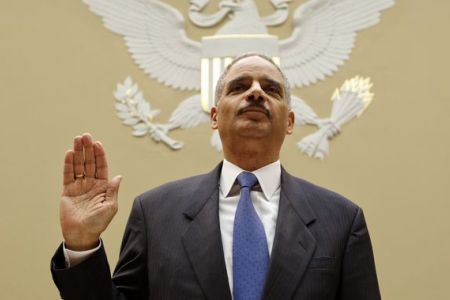
Shortly before Attorney General Eric Holder left office, he gave his prosecutors 90 days to decide whether to indict any Wall Street executives for decisions that caused the 2008 financial crisis.
Holder has now left the building at the Department of Justice (DOJ). Also gone is his deadline for punishing big bankers, none of whom were charged with a crime.
Holder’s shop had six years to build cases against key people at institutions like Citigroup and JP Morgan Chase. It’s not known if prosecutors ever did that. What is known is that the only charges actually filed by DOJ lawyers have been against smaller fish, namely those working at small and medium sized banks, according the Center for Public Integrity (CPI).
The investigative news site reviewed enforcement actions and civil lawsuits filed by the Justice Department, Federal Deposit Insurance Corp. (FDIC) and Securities and Exchange Commission (SEC) and found “these agencies have been far more likely to charge or sue individuals who work at small and medium sized banks, and foreign financial firms, than those that work at domestic banking giants such as J.P. Morgan Chase & Co. or Citigroup.”
CPI’s Alison Fitzgerald reported that none of the five largest banks in the country are involved in criminal cases filed by the Justice Department that pertain to the financial crisis.
“Two defendants who were unsuccessfully prosecuted ran a hedge fund for the now-defunct investment bank Bear Stearns,” she wrote. “About a dozen others are from smaller banks or foreign institutions.”
At the SEC, only four of the more than 100 bank executives named in lawsuits were from the top five banks, according to Fitzgerald. The FDIC has sued nearly 2,000 bank executives, none of whom worked at any of the big Wall Street banks.
“There’s no question that these banks have admitted that they’ve violated laws and regulations,” Independent Community Banker of America CEO Camden Fine told CPI. “These guys on Wall Street get their checkbooks out and write a check. This is an issue of unequal enforcement.”
For his part, Holder recently defended his efforts and that of the DOJ to prosecute individuals at the big banks for criminal wrongdoing. “To the extent that individuals have not been prosecuted, people should understand it is not for lack of trying,” he said.
“Nonsense,” countered former U.S. Assistant Attorney General Jimmy Gurulé. “Charges for white-collar crimes are filed every single day by U.S. attorneys across the country,” he told International Business Times. “Just because they’re more difficult with banks is not a legitimate excuse for bringing zero charges against individuals.”
To Learn More:
Bankers From Major Institutions Still Haven’t Been Held Responsible For Financial Crash (by Alison Fitzgerald, Center for Public Integrity)
Who Caused The Financial Crisis? Prosecutors Face 3-Month Deadline for Bringing Charges in the Subprime Mortgage Mess (by Owen Davis, International Business Times )
Instead of Wall St. Prosecutions, Holder Delivers a Deadline (by William Cohan, New York Times )
Eric Holder’s Last Chance to Prosecute Financial Meltdown Bankers (by Noel Brinkerhoff, AllGov )
Dragnet surveillance is about power and social control, not public safety
PRIVACYSOS | May 22, 2015
Attorney General Loretta Lynch says that USA Patriot Act dragnet spy powers must be extended or else the terrorists will get us.
Lynch said Friday the country would be “less safe” if Congress fails to renew surveillance programs included in the Patriot Act.
Lynch joined other top Obama administration officials, who are urging the Senate to pass the USA Freedom Act, which would reform the National Security Agency’s (NSA) bulk phone records collection program while renewing other key parts of the post-Sept. 11 law.
“Our biggest fear is that we will lose important eyes on people who have made it clear that their mission is to harm American people here and abroad,” Lynch told CBS News in her first interview since becoming attorney general.
If NSA’s phone metadata program expires completely, Lynch said the U.S. government would lose “important tools” to identify terror threats.“I think that we run the risk of essentially being less safe,” Lynch added. “I think that we lose the ability to intercept these communications, which have proven very important in cases that we have built in the past. And I am very concerned that the American people will be unprotected if this law expires.”
Lynch didn’t marshal any evidence to support her claims about the connection between dragnet spying and public safety. That’s because there isn’t one. Even the Department of Justice has acknowledged as much, writing in an Inspector General report that FBI agents interviewed couldn’t identify “any major case developments” tied to Section 215 of the Patriot Act, the provision the FBI claims enables dragnet spying.
Surveillance boosters have never been able to point to a circumstance—even one example—that proves dragnet surveillance is vital in stopping terrorism. Some insiders in the security state have observed that the bigger the haystack, the more difficult it is to successfully use intelligence information to identify and track threatening people. More information is not better. Better information is better, they say.
Loretta Lynch says she fears that if the Patriot Act isn’t reauthorized, “we will lose important eyes on people who have made it clear that their mission is to harm American people here and abroad.” That’s total nonsense. Anyone who “makes it clear” that they want to kill Americans is someone a judge would authorize targeted surveillance against. The government should leave the rest of us out of it.
Just about every recent terrorist attack on US and European soil has been committed by someone known to law enforcement. That’s true for the Garland, Texas shooter and for Tamerlan Tsarnaev, who blew up the Boston Marathon in April 2013. The government doesn’t need to spy on you and me in order to track people it already suspects of being up to no good.
You might be wondering: If dragnet spying doesn’t stop terrorism, and most terrorists are known to law enforcement, why do the FBI and the new Attorney General insist on renewing the Patriot Act’s worst provisions? It’s an important question, with a depressing answer.
The reason Lynch’s claims about dragnet spying don’t add up is because they are based on a perversion of the true purpose served by society wide surveillance. While the Patriot Act doesn’t stop terrorism, it’s quite good at enabling social and political control, and finding people who are vulnerable and may be easily coerced into becoming FBI informants.
If surveillance boosters were honest about why they want these powers, you might hear them talking less about terrorism and more about power. Add your voice: take action now to tell congress to reject dragnet surveillance.
US blocks nuclear disarmament document over Israel, Moscow fumes
RT | May 23, 2015
Washington has blocked the final document of a UN conference that reviewed the nuclear non-proliferation treaty, accusing Egypt of manipulating the gathering to target Israel. Moscow has slammed the US for rendering the four-week meeting futile.
The 9th international conference was held in New York from April 27 until May 22. A total of 162 Nuclear Non-Proliferation Treaty (NPT) participant states were in attendance. These conferences are held every five years to assess the worldwide disarmament process.
The blocked document included a plan to establish a nuclear-free zone in the Middle East. To do this, Egypt, who first proposed such a zone in 1980, suggested a regional UN conference on banning weapons of mass destruction. The gathering would have no pre-determined agenda and would go ahead with or without the presence of Israel.
This was stonewalled by the US, with Washington representative Rose Gottemoeller saying the final document reviewed on Friday was “incompatible with our longstanding policies.”
She accused Egypt and other Arab supporters of the nuclear-free zone of being “not willing to let go of these unrealistic and unworkable conditions,” AP reports.
Israel, which is an observer, but not a participant of the NPT, is widely believed to have the Middle East’s only nuclear arsenal, which it has neither confirmed nor denied. It is also a close ally of the US.
Egypt expressed its disappointment and said: “This will have consequences in front of the Arab world and public opinion.”
Washington’s position was backed by the UK and Canada, ultimately sinking the proposal which had to be approved by all countries.
Russia, for its part, said it was committed to nuclear non-proliferation and saw similar commitment from most other participants.
“The vast majority of the delegations have noted that the treaty remains a ‘cornerstone’ of international security and stability, and serves their interests,” a Russian Foreign Ministry statement said. “Participant countries have confirmed their readiness to comply with their obligations under the NPT.”
“We regretfully acknowledge that because of the positions of the US, Britain and Canada, we could not adopt the final document which included provisions on fulfilling the 1995 resolution on creating a Middle East zone free of nuclear and other types of weapons of mass destruction.” the Russian Foreign Ministry said.
It added, however, that Russia still has faith in the Treaty: “Despite such an outcome of the conference, the Russian Federation is ready to continue cooperating with other countries to help strengthen the NPT, provide its wholesomeness and viability.”
The failure of this conference means the next one can only be held in 2020.
US threatens not to sign nuclear deal with Iran due to inspection of sites
Press TV – May 21, 2015
Washington has threatened “not to sign” a final nuclear agreement with Tehran unless the Iranian government gives access to its possible military dimension-related sites and nuclear scientists.
“If we don’t get the assurances we need on the access to possible military dimension-related sites or activities, that’s going to be a problem for us,” State Department spokeswoman Marie Harf said in Washington on Wednesday.
“We and Iran have agreed that we will undertake a process to address possible military dimensions (of past nuclear work), and part of that includes access,” Harf said. “Under the Additional Protocol … which Iran will implement and has said they will implement as part of this deal, the IAEA does get access.”
“If we cannot agree in the final instance to something that meets our bottom line for what we need in terms of access, we’re not going to sign a final deal. And that’s just something we’ve been very, very clear about,” she added.
The remarks were made after Leader of the Islamic Revolution Ayatollah Seyyed Ali Khamenei said that Iran would not allow inspection of its military sites.
Iran says the United States is making fresh demands in the nuclear negotiations.
“They are making new comments in the negotiations. Regarding the inspections, we have said that we will not allow foreigners to carry out inspections of any military sites,” Ayatollah Khamenei said on Wednesday.
“The enemies should know that the Iranian nation and officials will, by no means, give in to excessive demands and bullying,” the Leader underlined.
The US and its negotiating partners reached a framework nuclear agreement with Iran in Switzerland on April 2.
Tehran and the P5+1 group – the US, Britain, France, China, Russia and Germany – are currently working to draw up a final accord by the end of June.
Iran has repeatedly stressed that it will not allow inspections of its military facilities and insists that the nuclear deal must only include nuclear issues.
“Iran will brook no excessive demands. The agreed parameters are those confirmed by the two sides in Lausanne and these parameters need to be stipulated in a written agreement by Iran and the P5+1,” Iranian Foreign Minister Mohammad Javad Zarif said earlier this month.
Obama renews ban on Iran oil trade
Press TV – May 20, 2015
In a decree, issued by his office, the US president said that “global economic conditions, increased oil production by certain countries, and the level of (oil) spare capacity” had allowed him to take the decision.
Saudi Arabia, a key US ally in the Middle East, has ramped up production leading to a crash in crude prices.
“I determine … that there is a sufficient supply of petroleum and petroleum products from countries other than Iran to permit a significant reduction in the volume of petroleum and petroleum products purchased from Iran by or through foreign financial institutions,” Obama said in his statement.
The statement also referred to a US measure which forbids transactions with Iran.
Under the measure, foreign companies are cut off from the US financial system and face sanctions if they engage in transactions with Iran’s financial institutions.
However, a preliminary agreement reached in Nov. 2013 allows Iran to sell around 1 million barrels per day of crude oil.
The US restrictions fly in the face of that agreement under which no new sanctions should be imposed on the Islamic Republic.
Washington contends the agreement does not include renewal of the previous restrictions.
The US and five other countries are currently discussing a possible final agreement with Iran by the end of June.
Iran says any deal should envisage immediate removal of all sanctions, with the US saying they should be lifted gradually.
Obama lying about Osama bin Laden’s death: Seymour Hersh
Press TV – May 11, 2015
US investigative journalist Seymour Hersh says President Barack Obama’s narrative of the killing of former al-Qaeda leader Osama bin Laden was false.
In an article published on the London Review of Books website on Sunday, Hersh wrote that high-level lying “remains the modus operandi of US policy, along with secret prisons, drone attacks, Special Forces night raids, bypassing the chain of command, and cutting out those who might say no.”
Citing a retired senior US intelligence official, the journalist explained that how the killing of bin Laden was the “high point of Obama’s first term, and a major factor in his re-election.”
“The White House still maintains that the mission was an all-American affair, and that the senior generals of Pakistan’s army and Inter-Services Intelligence agency (ISI) were not told of the raid in advance. This is false, as are many other elements of the Obama administration’s account,” Hersh said.
“The most blatant lie was that Pakistan’s two most senior military leaders — General Ashfaq Parvez Kayani, chief of the army staff, and General Ahmed Shuja Pasha, director general of the ISI — were never informed of the US mission. This remains the White House position despite an array of reports that have raised questions,” Hersh wrote.
He also said bin Laden had been a prisoner of the Inter-Services Intelligence agency at the Abbottabad compound since 2006.
“Kayani and Pasha knew of the raid in advance and had made sure that the two helicopters delivering the Seals to Abbottabad could cross Pakistani airspace without triggering any alarms… that the CIA did not learn of bin Laden’s whereabouts by tracking his couriers, as the White House has claimed since May 2011, but from a former senior Pakistani intelligence officer who betrayed the secret in return for much of the $25 million reward offered by the US, and that, while Obama did order the raid and the Seal team did carry it out, many other aspects of the administration’s account were false,” according to the journalist.
Washington announced on May 2, 2011 that bin Laden was killed by US forces in his compound in Abbottabad, Pakistan.
A number of media reports later said the US government was moving to hide files about the US military’s suspected raid on Osama bin Laden.
The lack of transparency over bin Laden’s death has cast further doubt over the announcement.
Regarding President Obama’s announcement of the raid to Americans, Hersh said, “Obama’s speech was put together in a rush.”
He also said the White House refused to respond to his requests for comment.
US Government: Court cannot review wrongful executive secrecy
Reprieve | May 8, 2015
The Obama Administration today told a US appeal court that it had no right to challenge the wholesale suppression of video evidence of prisoner abuse at Guantánamo Bay.
Lawyers for the Administration insisted that every single frame of video evidence – no matter how disturbing or unlawful- must remain an unchallengeable secret, beyond the review of judges or the public right of access.
The Administration further defended its absolute right to classify any information wrongfully — such as, hypothetically, censoring the Gettysburg address.
The federal hearing in Dhiab v Obama relates to a challenge by Guantánamo’s hunger strikers, whereby prisoners’ lawyers presented classified footage of a prisoner being violently removed from his cell and force-fed by the military authorities. On June 20, 2014, 16 media organizations sought the public release of the videos on First Amendment grounds. On October 3, Judge Gladys Kessler ordered the footage to be released, with appropriate redactions on national security grounds.
In defiance of this order, the Obama Administration failed to redact the tapes – a prerequisite to any release – and instead chose to appeal Judge Kessler’s decision.
In oral arguments today, the Administration defended its decision not to commence redactions, insisting that the judiciary must defer entirely to the executive on secrecy, and that not a single frame of the videos should ever be released to the public.
In response to the hypothetical question of whether a judge could challenge the manifestly wrongful classification of the text of the Gettysburg Address, the Administration replied that the judge could not — the court must simply trust the reasoning of the executive.
Reprieve argued that the Obama Administration was attempting to strip courts of the right to review their own records for a First Amendment public right of access, thereby eroding the separation of powers underpinning the US constitutional system.
Reprieve attorney Alka Pradhan said: “The Obama Administration made an audacious power grab today, insisting that no judge can ever review the executive’s addiction to hiding wrongdoing through secrecy. It is disturbing that such a tyrannical argument can be made by a former constitutional law professor. Today, it is the abuse of Guantanamo prisoners that is being wrongfully suppressed. Tomorrow, who knows?”
White House psychologist implicated in CIA torture now helping FBI
RT | May 8, 2015
Before the dust has had a chance to settle on the report detailing the American Psychologists Association’s complicity in the CIA torture program, the psychologist found to have violated the ethics code now appears to be helping the FBI do the same thing.
In late April, a 60-page report entitled ‘All the President’s Psychologists’ pointed to Susan Brandon as the White House architect behind the policies regulating the legality of an interrogator’s actions – something that goes against the APA’s own rulebook, which prohibits psychologists from making such judgments.
The document alleges the APA’s close coordination with the White House, the CIA and the Department of Defense on the formulation of a legal policy that would exempt the interrogators from prosecution, following a scandal involving allegation of torture at Iraq’s notorious Abu Ghraib prison. “Susan Brandon … played a central role in the development of the 2005 [Psychological Ethics and National Security] policy,” the report alleges – the second inquiry investigating the medical role in the practice.
“What we see is associations. And the associations with the apparent supervisor of [James] Mitchell and [Bruce] Jessen at each step of the process over a period of three years,” the report said then, in reference to the two masterminds of the CIA torture program, whom Brandon was allegedly in contact with in 2003, as evident from a string of emails.
Brandon’s complete role in the program is at this point unknown, but one particular email she was included on focuses on the pair “doing special things to special people in special places.”
“The issue here is not about what she thinks about torture; the issue is about what she did in the past to knowingly or unknowingly create a legal heat shield for the president using the ethics of the APA. That’s the issue. This is not a question of torture. It’s a question of alleged corruption,” says the report’s co-author and program director at the Harvard Humanitarian Initiative, Nathaniel Raymond, according to the Huffington Post.
Now Brandon is advising the FBI’s High-Value Detainee Interrogation Group – essentially the Obama’s administration continuation of the CIA program regarded as having crossed the line. She is tasked with research into determining whether a crime has been committed in the course of an interrogation.
The FBI has not officially commented on the claims yet. Journalists might not get a reply from Brandon anytime soon, as she’s still an HIG adviser and is not expected to break protocol – the association has a policy of operating in secrecy, according to fellow member Mark Fallon.
The initial reason for the government’s acceptance of the CIA torture program hinged, in part, on the presence of psychologists and their expertise acting as a check, as is evident from a 2005 Justice Department document.
The reason the APA had to be called in was apparently due to the CIA’s own psychologists’ refusal to sign off on the memo, claiming that the proposed assessments simply strayed outside of medical professionals’ competence.
As a result, Brandon’s Psychological Ethics and National Security policy became the document that could be “seen as opening the door for psychologists to fulfil a function that [CIA Office of Medical Services] health professionals were resisting,” according to the report.
Brandon’s own language went in a separate direction from the CIA doctors’, effectively paving the way for a psychologist’s role in judging the harm and effectiveness of an interrogation.
The APA has denied the report’s findings. Its own review of the complicity in the Bush-era program is ongoing.
Brandon’s role as one of the HIG’s top specialists is now under scrutiny, but she has defenders as well. Fallon, for one, has since said that Brandon “is a research scientist who was helping craft language, from what I can read in those emails, that might in fact be totally appropriate.”
“[Was] it a witting collaboration, or is it an unwitting person within the government who’s a research scientist looking to ensure that we’re at least learning lessons? I just could not conceive that she would ever do anything that would support degrading and inhumane treatment,” he added.
Read more: Study accuses psychologists group of complicity in CIA torture program
The Clintons and Their Banker Friends
The Wall Street Connection (1992 to 2016)
By Nomi Prins | TomDispatch | May 7, 2015
[This piece has been adapted and updated by Nomi Prins from chapters 18 and 19 of her book All the Presidents’ Bankers: The Hidden Alliances that Drive American Power, just out in paperback (Nation Books).]
The past, especially the political past, doesn’t just provide clues to the present. In the realm of the presidency and Wall Street, it provides an ongoing pathway for political-financial relationships and policies that remain a threat to the American economy going forward.
When Hillary Clinton video-announced her bid for the Oval Office, she claimed she wanted to be a “champion” for the American people. Since then, she has attempted to recast herself as a populist and distance herself from some of the policies of her husband. But Bill Clinton did not become president without sharing the friendships, associations, and ideologies of the elite banking sect, nor will Hillary Clinton. Such relationships run too deep and are too longstanding.
To grasp the dangers that the Big Six banks (JPMorgan Chase, Citigroup, Bank of America, Wells Fargo, Goldman Sachs, and Morgan Stanley) presently pose to the financial stability of our nation and the world, you need to understand their history in Washington, starting with the Clinton years of the 1990s. Alliances established then (not exclusively with Democrats, since bankers are bipartisan by nature) enabled these firms to become as politically powerful as they are today and to exert that power over an unprecedented amount of capital. Rest assured of one thing: their past and present CEOs will prove as critical in backing a Hillary Clinton presidency as they were in enabling her husband’s years in office.
In return, today’s titans of finance and their hordes of lobbyists, more than half of whom held prior positions in the government, exact certain requirements from Washington. They need to know that a safety net or bailout will always be available in times of emergency and that the regulatory road will be open to whatever practices they deem most profitable.
Whatever her populist pitch may be in the 2016 campaign — and she will have one — note that, in all these years, Hillary Clinton has not publicly condemned Wall Street or any individual Wall Street leader. Though she may, in the heat of that campaign, raise the bad-apples or bad-situation explanation for Wall Street’s role in the financial crisis of 2007-2008, rest assured that she will not point fingers at her friends. She will not chastise the people that pay her hundreds of thousands of dollars a pop to speak or the ones that have long shared the social circles in which she and her husband move. She is an undeniable component of the Clinton political-financial legacy that came to national fruition more than 23 years ago, which is why looking back at the history of the first Clinton presidency is likely to tell you so much about the shape and character of the possible second one.
The 1992 Election and the Rise of Bill Clinton
Challenging President George H.W. Bush, who was seeking a second term, Arkansas Governor Bill Clinton announced he would seek the 1992 Democratic nomination for the presidency on October 2, 1991. The upcoming presidential election would not, however, turn out to alter the path of mergers or White House support for deregulation that was already in play one iota.
First, though, Clinton needed money. A consummate fundraiser in his home state, he cleverly amassed backing and established early alliances with Wall Street. One of his key supporters would later change American banking forever. As Clinton put it, he received “invaluable early support” from Ken Brody, a Goldman Sachs executive seeking to delve into Democratic politics. Brody took Clinton “to a dinner with high-powered New York businesspeople, including Bob Rubin, whose tightly reasoned arguments for a new economic policy,” Clinton later wrote, “made a lasting impression on me.”
The battle for the White House kicked into high gear the following fall. William Schreyer, chairman and CEO of Merrill Lynch, showed his support for Bush by giving the maximum personal contribution to his campaign committee permitted by law: $1,000. But he wanted to do more. So when one of Bush’s fundraisers solicited him to contribute to the Republican National Committee’s nonfederal, or “soft money,” account, Schreyer made a $100,000 donation.
The bankers’ alliances remained divided among the candidates at first, as they considered which man would be best for their own power trajectories, but their donations were plentiful: mortgage and broker company contributions were $1.2 million; 46% to the GOP and 54% to the Democrats. Commercial banks poured in $14.8 million to the 1992 campaigns at a near 50-50 split.
Clinton, like every good Democrat, campaigned publicly against the bankers: “It’s time to end the greed that consumed Wall Street and ruined our S&Ls [Savings and Loans] in the last decade,” he said. But equally, he had no qualms about taking money from the financial sector. In the early months of his campaign, BusinessWeek estimated that he received $2 million of his initial $8.5 million in contributions from New York, under the care of Ken Brody.
“If I had a Ken Brody working for me in every state, I’d be like the Maytag man with nothing to do,” said Rahm Emanuel, who ran Clinton’s nationwide fundraising committee and later became Barack Obama’s chief of staff. Wealthy donors and prospective fundraisers were invited to a select series of intimate meetings with Clinton at the plush Manhattan office of the prestigious private equity firm Blackstone.
Robert Rubin Comes to Washington
Clinton knew that embracing the bankers would help him get things done in Washington, and what he wanted to get done dovetailed nicely with their desires anyway. To facilitate his policies and maintain ties to Wall Street, he selected a man who had been instrumental to his campaign, Robert Rubin, as his economic adviser.
In 1980, Rubin had landed on Goldman Sachs’ management committee alongside fellow Democrat Jon Corzine. A decade later, Rubin and Stephen Friedman were appointed cochairmen of Goldman Sachs. Rubin’s political aspirations met an appropriate opportunity when Clinton captured the White House.
On January 25, 1993, Clinton appointed him as assistant to the president for economic policy. Shortly thereafter, the president created a unique role for his comrade, head of the newly created National Economic Council. “I asked Bob Rubin to take on a new job,” Clinton later wrote, “coordinating economic policy in the White House as Chairman of the National Economic Council, which would operate in much the same way the National Security Council did, bringing all the relevant agencies together to formulate and implement policy… [I]f he could balance all of [Goldman Sachs’] egos and interests, he had a good chance to succeed with the job.” (Ten years later, President George W. Bush gave the same position to Rubin’s old partner, Friedman.)
Back at Goldman, Jon Corzine, co-head of fixed income, and Henry Paulson, co-head of investment banking, were ascending through the ranks. They became co-CEOs when Friedman retired at the end of 1994.
Those two men were the perfect bipartisan duo. Corzine was a staunch Democrat serving on the International Capital Markets Advisory Committee of the Federal Reserve Bank of New York (from 1989 to 1999). He would co-chair a presidential commission for Clinton on capital budgeting between 1997 and 1999, while serving in a key role on the Borrowing Advisory Committee of the Treasury Department. Paulson was a well connected Republican and Harvard graduate who had served on the White House Domestic Council as staff assistant to the president in the Nixon administration.
Bankers Forge Ahead
By May 1995, Rubin was impatiently warning Congress that the Glass-Steagall Act could “conceivably impede safety and soundness by limiting revenue diversification.” Banking deregulation was then inching through Congress. As they had during the previous Bush administration, both the House and Senate Banking Committees had approved separate versions of legislation to repeal Glass-Steagall, the 1933 Act passed by the administration of Franklin Delano Roosevelt that had separated deposit-taking and lending or “commercial” bank activities from speculative or “investment bank” activities, such as securities creation and trading. Conference negotiations had fallen apart, though, and the effort was stalled.
By 1996, however, other industries, representing core clients of the banking sector, were already being deregulated. On February 8, 1996, Clinton signed the Telecom Act, which killed many independent and smaller broadcasting companies by opening a national market for “cross-ownership.” The result was mass mergers in that sector advised by banks.
Deregulation of companies that could transport energy across state lines came next. Before such deregulation, state commissions had regulated companies that owned power plants and transmission lines, which worked together to distribute power. Afterward, these could be divided and effectively traded without uniform regulation or responsibility to regional customers. This would lead to blackouts in California and a slew of energy derivatives, as well as trades at firms such as Enron that used the energy business as a front for fraudulent deals.
The number of mergers and stock and debt issuances ballooned on the back of all the deregulation that eliminated barriers that had kept companies separated. As industries consolidated, they also ramped up their complex transactions and special purpose vehicles (off-balance-sheet, offshore constructions tailored by the banking community to hide the true nature of their debts and shield their profits from taxes). Bankers kicked into overdrive to generate fees and create related deals. Many of these blew up in the early 2000s in a spate of scandals and bankruptcies, causing an earlier millennium recession.
Meanwhile, though, bankers plowed ahead with their advisory services, speculative enterprises, and deregulation pursuits. President Clinton and his team would soon provide them an epic gift, all in the name of U.S. global power and competitiveness. Robert Rubin would steer the White House ship to that goal.
On February 12, 1999, Rubin found a fresh angle to argue on behalf of banking deregulation. He addressed the House Committee on Banking and Financial Services, claiming that, “the problem U.S. financial services firms face abroad is more one of access than lack of competitiveness.”
He was referring to the European banks’ increasing control of distribution channels into the European institutional and retail client base. Unlike U.S. commercial banks, European banks had no restrictions keeping them from buying and teaming up with U.S. or other securities firms and investment banks to create or distribute their products. He did not appear concerned about the destruction caused by sizeable financial bets throughout Europe. The international competitiveness argument allowed him to focus the committee on what needed to be done domestically in the banking sector to remain competitive.
Rubin stressed the necessity of HR 665, the Financial Services Modernization Act of 1999, or the Gramm-Leach-Bliley Act, that was officially introduced on February 10, 1999. He said it took “fundamental actions to modernize our financial system by repealing the Glass-Steagall Act prohibitions on banks affiliating with securities firms and repealing the Bank Holding Company Act prohibitions on insurance underwriting.”
The Gramm-Leach-Bliley Act Marches Forward
On February 24, 1999, in more testimony before the Senate Banking Committee, Rubin pushed for fewer prohibitions on bank affiliates that wanted to perform the same functions as their larger bank holding company, once the different types of financial firms could legally merge. That minor distinction would enable subsidiaries to place all sorts of bets and house all sorts of junk under the false premise that they had the same capital beneath them as their parent. The idea that a subsidiary’s problems can’t taint or destroy the host, or bank holding company, or create “catastrophic” risk, is a myth perpetuated by bankers and political enablers that continues to this day.
Rubin had no qualms with mega-consolidations across multiple service lines. His real problems were those of his banker friends, which lay with the financial modernization bill’s “prohibition on the use of subsidiaries by larger banks.” The bankers wanted the right to establish off-book subsidiaries where they could hide risks, and profits, as needed.
Again, Rubin decided to use the notion of remaining competitive with foreign banks to make his point. This technicality was “unacceptable to the administration,” he said, not least because “foreign banks underwrite and deal in securities through subsidiaries in the United States, and U.S. banks [already] conduct securities and merchant banking activities abroad through so-called Edge subsidiaries.” Rubin got his way. These off-book, risky, and barely regulated subsidiaries would be at the forefront of the 2008 financial crisis.
On March 1, 1999, Senator Phil Gramm released a final draft of the Financial Services Modernization Act of 1999 and scheduled committee consideration for March 4th. A bevy of excited financial titans who were close to Clinton, including Travelers CEO Sandy Weill, Bank of America CEO, Hugh McColl, and American Express CEO Harvey Golub, called for “swift congressional action.”
The Quintessential Revolving-Door Man
The stock market continued its meteoric rise in anticipation of a banker-friendly conclusion to the legislation that would deregulate their industry. Rising consumer confidence reflected the nation’s fondness for the markets and lack of empathy with the rest of the world’s economic plight. On March 29, 1999, the Dow Jones Industrial Average closed above 10,000 for the first time. Six weeks later, on May 6th, the Financial Services Modernization Act passed the Senate. It legalized, after the fact, the merger that created the nation’s biggest bank. Citigroup, the marriage of Citibank and Travelers, had been finalized the previous October.
It was not until that point that one of Glass-Steagall’s main assassins decided to leave Washington. Six days after the bill passed the Senate, on May 12, 1999, Robert Rubin abruptly announced his resignation. As Clinton wrote, “I believed he had been the best and most important treasury secretary since Alexander Hamilton… He had played a decisive role in our efforts to restore economic growth and spread its benefits to more Americans.”
Clinton named Larry Summers to succeed Rubin. Two weeks later, BusinessWeek reported signs of trouble in merger paradise — in the form of a growing rift between John Reed, the former Chairman of Citibank, and Sandy Weill at the new Citigroup. As Reed said, “Co-CEOs are hard.” Perhaps to patch their rift, or simply to take advantage of a political opportunity, the two men enlisted a third person to join their relationship — none other than Robert Rubin.
Rubin’s resignation from Treasury became effective on July 2nd. At that time, he announced, “This almost six and a half years has been all-consuming, and I think it is time for me to go home to New York and to do whatever I’m going to do next.” Rubin became chairman of Citigroup’s executive committee and a member of the newly created “office of the chairman.” His initial annual compensation package was worth around $40 million. It was more than worth the “hit” he took when he left Goldman for the Treasury post.
Three days after the conference committee endorsed the Gramm-Leach-Bliley bill, Rubin assumed his Citigroup position, joining the institution destined to dominate the financial industry. That very same day, Reed and Weill issued a joint statement praising Washington for “liberating our financial companies from an antiquated regulatory structure,” stating that “this legislation will unleash the creativity of our industry and ensure our global competitiveness.”
On November 4th, the Senate approved the Gramm-Leach-Bliley Act by a vote of 90 to 8. (The House voted 362–57 in favor.) Critics famously referred to it as the Citigroup Authorization Act.
Mirth abounded in Clinton’s White House. “Today Congress voted to update the rules that have governed financial services since the Great Depression and replace them with a system for the twenty-first century,” Summers said. “This historic legislation will better enable American companies to compete in the new economy.”
But the happiness was misguided. Deregulating the banking industry might have helped the titans of Wall Street but not people on Main Street. The Clinton era epitomized the vast difference between appearance and reality, spin and actuality. As the decade drew to a close, Clinton basked in the glow of a lofty stock market, a budget surplus, and the passage of this key banking “modernization.” It would be revealed in the 2000s that many corporate profits of the 1990s were based on inflated evaluations, manipulation, and fraud. When Clinton left office, the gap between rich and poor was greater than it had been in 1992, and yet the Democrats heralded him as some sort of prosperity hero.
When he resigned in 1997, Robert Reich, Clinton’s labor secretary, said, “America is prospering, but the prosperity is not being widely shared, certainly not as widely shared as it once was… We have made progress in growing the economy. But growing together again must be our central goal in the future.” Instead, the growth of wealth inequality in the United States accelerated, as the men yielding the most financial power wielded it with increasingly less culpability or restriction. By 2015, that wealth or prosperity gap would stand near historic highs.
The power of the bankers increased dramatically in the wake of the repeal of Glass-Steagall. The Clinton administration had rendered twenty-first-century banking practices similar to those of the pre-1929 crash. But worse. “Modernizing” meant utilizing government-backed depositors’ funds as collateral for the creation and distribution of all types of complex securities and derivatives whose proliferation would be increasingly quick and dangerous.
Eviscerating Glass-Steagall allowed big banks to compete against Europe and also enabled them to go on a rampage: more acquisitions, greater speculation, and more risky products. The big banks used their bloated balance sheets to engage in more complex activity, while counting on customer deposits and loans as capital chips on the global betting table. Bankers used hefty trading profits and wealth to increase lobbying funds and campaign donations, creating an endless circle of influence and mutual reinforcement of boundary-less speculation, endorsed by the White House.
Deposits could be used to garner larger windfalls, just as cheap labor and commodities in developing countries were used to formulate more expensive goods for profit in the upper echelons of the global financial hierarchy. Energy and telecoms proved especially fertile ground for the investment banking fee business (and later for fraud, extensive lawsuits, and bankruptcies). Deregulation greased the wheels of complex financial instruments such as collateralized debt obligations, junk bonds, toxic assets, and unregulated derivatives.
The Glass-Steagall repeal led to unfettered derivatives growth and unstable balance sheets at commercial banks that merged with investment banks and at investment banks that preferred to remain solo but engaged in dodgier practices to remain “competitive.” In conjunction with the tight political-financial alignment and associated collaboration that began with Bush and increased under Clinton, bankers channeled the 1920s, only with more power over an immense and growing pile of global financial assets and increasingly “open” markets. In the process, accountability would evaporate.
Every bank accelerated its hunt for acquisitions and deposits to amass global influence while creating, trading, and distributing increasingly convoluted securities and derivatives. These practices would foster the kind of shaky, interconnected, and opaque financial environment that provided the backdrop and conditions leading up to the financial meltdown of 2008.
The Realities of 2016
Hillary Clinton is, of course, not her husband. But her access to his past banker alliances, amplified by the ones that she has formed herself, makes her more of a friend than an adversary to the banking industry. In her brief 2008 candidacy, all four of the New York-based Big Six banks ranked among her top 10 corporate donors. They have also contributed to the Clinton Foundation. She needs them to win, just as both Barack Obama and Bill Clinton did.
No matter what spin is used for campaigning purposes, the idea that a critical distance can be maintained between the White House and Wall Street is naïve given the multiple channels of money and favors that flow between the two. It is even more improbable, given the history of connections that Hillary Clinton has established through her associations with key bank leaders in the early 1990s, during her time as a senator from New York, and given their contributions to the Clinton foundation while she was secretary of state. At some level, the situation couldn’t be less complicated: her path aligns with that of the country’s most powerful bankers. If she becomes president, that will remain the case.
Nomi Prins is the author of six books, a speaker, and a distinguished senior fellow at the non-partisan public policy institute Demos. Her most recent book, All the Presidents’ Bankers: The Hidden Alliances that Drive American Power (Nation Books) has just been released in paperback and this piece is adapted and updated from it. She is a former Wall Street executive.
Copyright 2015 Nomi Prins

Obama Fights to Spread GMO Foods Throughout Europe
By Eric Zuesse | Black Agenda Report | April 29, 2015
One of the major barriers blocking U.S. President Barack Obama’s campaign for his mammoth international trade deals — the TTIP with Europe, and the TPP with Asia — is: other countries want the freedom to make up their own minds about the safety or dangerousness of the foods they allow to be sold within their borders.
The Obama Administration insists that no nation has that freedom. In fact, all participating nations would be removed from that responsibility and authority. The Obama trade deals propose to replace that national authority, and basic national sovereignty on these important matters, by decisions that would instead be made by international panels, whose members will be appointed by international corporations, which have their own profits at stake in these matters. Consumers and others will be ignored: they will not be represented in the proposed panels. Nor will any government be represented there. That soverignty will instead be transferred to the billionaire families who control and derive their income from these corporations.
On Friday, April 24th, Agence France Presse headlined “US Stresses Opposition to EU Opt-Out for GMO Imports,” and reported that, “The United States underscored Friday its opposition to a new European Union plan to allow member states to block genetically engineered imports after bilateral talks on a transatlantic free-trade pact.”
President Obama’s Trade Representative, Michael Froman, who is a Wall Street banker and a longtime close personal friend of the President, said on April 22nd that he was “very disappointed” that the EU wants to allow individual EU nations to “opt out” of automatic approval of Genetically Modified Organisms (GMOs) that the international panels will approve to be marketed everywhere. Furthermore, Froman’s assistant said that the U.S. rejects “a proposal to allow EU member states to ban products deemed safe by Europe’s own scientists.” He was referring there to the half of scientific papers that find GMO foods to be safe. However, those papers were produced by companies that manufacture and market GMOs. The other half of the scientific papers on GMOs, the half that were produced independently of the GMO industry, have not found GMO foods to be safe — to the exact contrary. The Office of the U.S. Trade Representative ignores those papers.
On 8 July 2009, Agence France Presse headlined “Scientists Warn of Hazards of GMOs,” and reported that an article in the International Journal of Biological Science co-authored by world-leading scientists, reported that, “Agricultural GM companies and evaluation committees systematically overlook the side effects of GMOs and pesticides.” An accompanying study, “How Subchronic and Chronic Health Effects Can Be Neglected for GMOs, Pesticides or Chemicals,” found “a significant underestimation of the initial signs of diseases like cancer and diseases of the hormonal, immune, nervous and reproductive systems.”
The United States does not regulate GMO foods, because the patents are owned mostly by U.S. companies, and the U.S. Government doesn’t want to get in the way of their selling their patented products. Consequently, the U.S. Food and Drug Administration takes any given GMO manufacturer’s word for the safety of its GMO products. U.S. President Obama wants to promote U.S. trade by convincing all other countries to sell GMO foods. His TTIP and TPP are supported by the GMO industry, which has approved their GMO foods and allowed their product-labels to not mention that some or all of the ingredients are genetically modified crops.
One of the major advantages of GMO crops is that they can survive the use of herbicides — weed-killers — that kill natural crops. (The GMO-seed manufacturer also markets the pesticide or herbicide; these are chemical companies, and GMOs are a complementary or synergistic product-line for them. For example, the leading herbicide “Roundup” is from Monsanto which produces the GMO seeds that tolerate it.) Another advantage is that the foods can stay longer as looking and smelling fresh, which also lowers the cost of production, and yet the consumer doesn’t even know that the food is actually stale — the food is competing against costlier-to-produce non-GMO foods and so driving them off the market by the lower price, which leaves more and more food-production dependent upon GMO makers such as Monsanto, DuPont, and Dow Chemical. The lower price is obvious; the lower quality is hidden. It’s race-to-the-bottom international ‘competition,’ in which the aristocracy reap all the winnings; the public get the losses.
A recent news report from independent food scientists was bannered “FDA Product Safety Declaration Misleads Nation—Again” and it contains references to many recent scientific papers that find GMO foods to be dangerous, and harmful to human health.
An international analysis, “A Comparative Evaluation of the Regulation of GM Crops” was published in 2013 in the scientific journal Environment International, and it concluded by saying that, “Regulatory bodies are not adequately assessing the risks of dsRNA-producing GM products. As a result, we recommend a process to properly assess the safety of dsRNA-producing GM organisms before they are released or commercialized.” The Obama Administration is trying to prevent that from happening; and their proposed TTIP and TPP international-trade treaties are crucial components of achieving this objective. In the United States, GMO-producers are granted the right to self-regulate, and this practice will become the standard worldwide practice if the TPP and TTIP become passed into law.
The U.S. Government is doing everything it can to spread to other nations the same deregulatory policies that American companies rely upon to market their products inside the United States. On Friday, April 25th, a key U.S. Senate Committee approved a “Trade Promotion Authority” bill to help rush through the U.S. Senate the approval of Mr. Froman’s TPP trade deal with Asian countries. For a summary of the regulatory practices around the world regarding GMO crops, see here. A discussion of the votes in the U.S. Senate on the measure that was proposed by Senator Bernie Sanders to allow individual states to establish their own regulations requiring the labeling or indication of whether or not particular food ingredients are GMOs (since the federal Government refuses to consider such a proposal), is here, and it shows that even some allegedly progressive U.S. Senators voted the GMO industry’s way on that bill to regulate it, which failed, on a vote of 71 to 27. One might call this the Monsanto Congress, because the U.S. House is even more conservative than the Senate. Of the 27 U.S. Senators who voted for the Sanders bill, 24 were Democrats, 2 were Independents, and 1 was Republican. 43 Republicans, and 28 Democrats voted against it. The Obama Administration had lobbied against the bill, in order to continue the GMO industry’s free reign over America’s food-supply.
When Barack Obama campaigned for the Presidency in 2008, he said, “Let folks know when their food is genetically modified, because Americans have a right to know what they’re buying.” But as soon as he won the Presidency “The new president filled key posts with Monsanto people, in federal agencies that wield tremendous force in food issues, the USDA and the FDA.” And whereas Republican news-organizations such as Fox ‘News’ criticized him as being a Muslim Marxist, he was actually implementing policies that continued those of the Republican George W. Bush Administration on this and on many other issues. Yet, no matter how far to the right Mr. Obama actually was, he was portrayed as a ‘leftist’ in Republican ’news’ media. And yet, still, even today, the vast majority of Democratic voters approve of his actions as President. They still believe his rhetoric, even though he has lied to them constantly and even filed a friend-of-the-court brief in the U.S. Supreme Court arguing that lying in politics must continue to remain unrestricted not only at the national level but also in each and every one of the states. Consequently, in the United States, there is no effective political opposition to the large international U.S. corporations. (And, under the Republican Supreme Court’s 2010 Citizens United decision, corporations now have virtually unlimited freedom to use stockholders’ money to purchase politicians.)
Hillary Clinton is a big supporter of the GMO industry, and the response of liberals to that is to ask her to give them rhetoric they like on the matter, just as Obama had done when he was running for President in 2008. In other words: they will campaign for her to become President if she will only lie to them as Obama did to them. What liberals are demanding is rhetoric; but if they get it from her, then the industries that are funding her Presidential campaign won’t be worried, because she has a solid record of doing what her financial backers want her to do. As long as Americans don’t care when a politician has lied to them, lying to them will continue to be the way to win public office — especially considering that America’s international corporations now have been granted by the Republican U.S. Supreme Court a ‘free speech’ right to purchase the U.S. Government. And now that the Supreme Court has also ruled that political lies are a Constitutionally protected form of speech, those ads don’t even need to be true. If the American people don’t care about honesty, then they won’t have an honest government, because America’s corporations can then buy any U.S. Government they want — they’ll have total impunity if the U.S. public don’t even care about honesty in their government. There are no legal penalties for political lying; so, if there are also no political penalties for it, then the U.S. can only be ruled by lies and their liars. Should that be called “fascism”?
According to the generally progressive Democratic U.S. Senator Sherrod Brown of Ohio (who, along with Elizabeth Warren and Bernie Sanders is one of the Senate’s three leading opponents of Mr. Obama’s proposed international-trade treaties), President Obama has been lobbying Senators more insistently and more intensely on getting them to grant him “Fast Track Trade Promotion Authority” to ram these treaties through, than on any other single issue since Obama first became President in 2009. No issue, not even Obamacare nor any other, has been as important to Obama as is his getting signed into law the TPP and TTIP. It would certainly be the culmination of his Presidency if he succeeds. It would be his crowning achievement. He and his heirs will be amply rewarded if he succeeds; and that’s apparently what he really cares about. He has shown it by his actions as President, not by his rhetoric to voters. After all: Americans, it seems, don’t really care about honesty. All they really care about is rhetoric that pleases them. They merely want to be told what they want to hear.
Perhaps this is the reason why no progressive has entered the Democratic Presidential contest against Hillary Clinton. If the only realistic possibilities to become the next President are her and her Republican opponent (whomever he will turn out to be), then America will continue to be a de facto one-party State, and this will be the U.S. international-corporate party, in both of its factions or nominal varieties, controlling the U.S. Government. The only comprehensive scientific study that has yet been done finds that the U.S. has, in fact, already been ruled in this way for some time. (The history of how it came to be this way, starting gradually after the end of World War II, is the subject of my latest book.) Obama is merely implementing it more; he didn’t start it. He is implementing it more than even Republicans were able to do.
Obama wouldn’t have been able to do this if he didn’t come bearing the label ‘Democrat.’ And Hillary Clinton’s husband Bill was the key person to subordinate that Party to Wall Street. Hillary and Obama are following in his footsteps. Obama’s “Change” occurred actually when Bill Clinton became President in 1993. It simply hasn’t been much recognized until now. Today’s Democratic Party started when Bill became President. That’s when the one-party State, with the national Democrats playing the role of the ‘Good Cop’ to the national and local Republicans’ role of the ‘Bad Cop,’ in the eyes of the Democratic Party’s electoral base of deceived liberals, actually began to take over the U.S. Government, for the benefit of, and service to, America’s aristocracy.
This is why both Obama and Clinton are big supporters of essentially unregulated GMOs. It’s sort of like unregulated Wall Street: the profits get privatized, while the losses (poor health etc.) get socialized.
Featured Video
Epidemic of fake videos
or go to
Aletho News Archives – Video-Images
Free Book
Vicious

Lies are Unbekoming | January 25, 2026
The waiting room is clean. The receptionist is polite. The forms ask reasonable questions. Nothing in the physical environment suggests danger. The magazines are current. The hand sanitizer dispenser works. Someone has chosen calming colors for the walls.
A pregnant woman sits in a chair designed for her comfort. She has been told to be here. Not ordered—no one orders. Recommended. Strongly recommended. Everyone does this. Her mother did this. Her friends did this. The women in her prenatal group compare notes about their appointments the way they compare notes about nursery furniture. Which provider did you choose? What tests have you had? The questions assume the answers. The answers assume the questions.
She will be offered things today. Offered is the word used. The offers will come with information sheets that list risks and benefits in tabular form. She will sign consent documents. Everything will be voluntary in the legal sense. No one will hold her down. No one will threaten her. She will choose, and her choices will feel like choices, and she will leave feeling she has done the responsible thing.
What she will not feel is the weight of what has been arranged before she arrived. … continue
Blog Roll
Recent Comments
loongtip on Vicious loongtip on EU turns to India for defense… Coronistan on Donald Trump Is No Peace … seversonebcfb985d9 on French court jails pro-Palesti… eddieb on Fourteen Incredible Facts Abou… Bill Francis on European leaders’ shift in the… seversonebcfb985d9 on Villains of Judea: Philip Esfo… loongtip on Report warns that ‘Jewish terr… Craig Nelms on New study shows that toxic gas… loongtip on A Funny Thing Happened on the… loongtip on EU free trade pact on hold as… John Edward Kendrick on Regime Change In Iran Is The F…


 Aletho News
- The Board For Peace – Whitewashing Ethnic Cleansing and Genocide
- Scientists accuse Cochrane Reviews of using biased studies to claim HPV vaccine prevents cancer
- Spain Opens Probe Into Israeli Tourism Firms
- Epidemic of fake videos
- Craig Murray, Reporting from Venezuela
- Why Israel’s Drive to Destroy Iran is Ultimately about Palestine
- Trump and Iran, War or Negotiations?
- US pressure contributing to Israeli influence in Latin America: Experts
- China Rejects U.S. Claims of Coercion in Central America
- New US defense strategy downgrades Russian ‘threat’
- If Americans Knew
- Greenpeace Demonstrator Exposes Folly of Protest Restrictions
- From CBS to TikTok, Pro-Israel Ellison is now in the driver’s seat
- Israel pays for UK advertisements attacking Doctors Without Borders
- Israel accused of extracting billions from Gazan people to pay for their own genocide
- ‘Deliberate Assassination’: 3 Journalists Among 11 Killed by Israeli Forces in Gaza
- In Gaza, We’re Struggling to Reintroduce Foods to Bodies Adjusted to Starvation
- Will Rafah crossing be opened at last? – Not a ceasefire Day 108
- Israeli drone strike kills two children collecting firewood in Gaza – Not a ceasefire Day 107
- Another Gaza baby freezes to death on Netanyahu’s watch – Not a ceasefire Day 106
- Oppose Israel’s Abuses While You Still Can
- No Tricks Zone
- New Study Affirms Rising CO2’s Greening Impact Across India – A Region With No Net Warming In 75 Years
- Germany’s Natural Gas Crisis Escalates … One Storage Site Near Empty …Government Silent
- Polar Colding…Antarctica Saw Its Coldest October In 44 Years!
- New Study: Sea Levels Rose 20 Times The Modern Rate During The Roman Warm Period
- As German Gas Storage Dips Dangerously Low…Shortage Hardly Avoidable
- New Study: Brazil’s Relative Sea Level Was 2+ Meters Higher And SSTs 3-4°C Warmer 6000 Years Ago
- Philosopher Schopenhauer: Climate Science Certainty Stems From Stupidity, Ignorance
- New Study: Species Extinction Rates Declining Since 1980 – ‘Climate Change Is Not An Important Threat’
- Denmark Places Climate Protection Above Animal Welfare, Poisoning And Culling Cows
- New Study: Greenland Was 3-7°C Warmer And Far Less Glaciated Than Today 6000-8000 Years Ago
 Aletho News