Obama Plans Cosmetic Surveillance Changes After All, Will Set Up Pretend Fight Over NSLs
By Mike Masnick | Techdirt | January 6, 2014
Leaks coming out of the Obama administration suggest that the President is preparing mostly cosmetic changes to the intelligence community, following the recommendations from the intelligence task force — which were much stronger than many expected. The reports suggest things like putting a public advocate to represent the public’s views in certain cases before the FISC. This has been talked about for a while, and was the main concession plenty of people had been expecting anyway. That’s hardly anything big.
The article talks about two other potential reforms. The first is shifting the holding of phone call metadata from the NSA to the phone companies, allowing the NSA to still search through it after getting a court order. While this may be a marginal improvement, it still has tremendous problems. It will almost certainly come with some sort of data retention law — something that the feds have wanted for ages, and which civil liberties activists have been fighting against for years. Companies shouldn’t be required to hang on to data they don’t need, especially if getting rid of it can better protect their users’ privacy. Furthermore, while not letting the NSA hang onto the data is a good thing, there is a reasonable concern that if the telcos are hanging onto the data themselves, that they, too, might do bad things with it, with little to no oversight.
However, most of the article from the LA Times focuses on National Security Letter (NSL) reform. We’ve written about those for years. NSLs are the way that the FBI can demand information from companies without any judicial review at all and, even more insane, with a complete gag order that prevents the recipient from telling anyone (including, at times, your lawyer). The FBI has an incredibly long history of “serious misuse” of NSLs, and has shown little to no interest in fixing the process. Nearly a year ago, a court actually ruled them unconstitutional, but there’s an ongoing appeals process that will take quite a bit of time.
However, as the article notes, the DOJ/FBI and other surveillance maximalists are all horrified by the idea that Obama might actually require judicial approval of NSLs, for all but “emergency” situations. What this sounds like is that the President may suggest something along those lines, there will be a well coordinated press attack from surveillance hawks freaking out about the danger this puts us all in… and then he’ll back down on that one point. And we’ll be left with… basically nothing, but the President will go around insisting that he reformed the intelligence community, while everything more or less stays the same.
Related articles


Court Decision Exempts Secret Memo From FOIA, Sets Stage For Future Secret Laws To Go Unchallenged
By Tim Cushing | Techdirt | January 6, 2014
The “most transparent administration” received another win for continued secrecy, thanks to an appeals court decision that allowed it to continue to withhold a DOJ memo that created an exploitable loophole in consumer data privacy protections.
The document at issue is a classified memo issued by the Office of Legal Counsel on Jan. 8, 2010. A report later that year by the Justice Department’s inspector general at the time, Glenn A. Fine, disclosed the memo’s existence and its broad conclusion that telephone companies may voluntarily provide records to the government “without legal process or a qualifying emergency,” notwithstanding the Electronic Communications Privacy Act.
The EFF has been engaged with the government over the release of this document since 2011, when a district court judge ruled the document was exempt from FOIA requests because it was part of executive branch “internal deliberations.” In other words, despite the fact that the OLC memos can be considered legally binding (and exempt those following the memos’ advice or instructions from legal repercussions), the memo is not considered “working law.” The EFF has argued that these memos are not “deliberative,” but are rather secret laws deployed in such a fashion as to avoid being exposed by FOIA requests.
The presiding judge explained his decision with this reasoning.
“Even if the O.L.C. opinion describes the legal parameters of what the F.B.I. is permitted to do, it does not state or determine the F.B.I.’s policy,” Judge Harry T. Edwards wrote in the decision on Friday. “The F.B.I. was free to decline to adopt the investigative tactics deemed legally permissible in the O.L.C. opinion.”
According to the FBI, it did decline to follow the memo’s parameters.
The bureau, which has abandoned exigent letters, said that it did not employ the legal theory outlined in the memo when using the letters, and that it had no plans to use it in the future.
But the DOJ’s arguments for keeping the memo secret calls the FBI’s assertion into question.
During the litigation, the Justice Department also told the court that parts of the memo contained classified information, “highly specific in nature and known to very few individuals,” about a secret intelligence-gathering technique that the F.B.I. is using against “hostile entities.”
Either the FBI is utilizing the memo’s legal theories or the memo covers so much ground that the FBI is using something entirely unrelated, making the first statement truthful as far as it extends to exigent letters only.
Judge Edwards’ rationale gives the government every reason to utilize the Office of Legal Counsel to provide it with the legal justification it needs to deploy questionable tactics and programs. (Previous OLC memos were used to justify warrantless wiretaps and “brutal questioning of detainees.”) The ruling makes it easier for any OLC memo to be exempted from FOIA requests, providing for even more government secrecy.
David Sobel, a lawyer for the EFF, called the ruling “troubling,” describing the office’s memos as a body of “secret law” that the public has a right to know about. He said he hoped the ruling would reinvigorate efforts among some lawmakers to enact a law opening such memos to greater scrutiny outside the executive branch.
“It’s kind of hard to imagine how a different case in the D.C. Circuit is likely to have a different outcome in light of this opinion,” he said.
Because the document remains a secret, its true significance remains a source of speculation. The New York Times says the memo is most likely the legal basis for the CIA’s voluntary agreement with AT&T, which allows the agency to search its massive database of international calls (and tip local numbers to the FBI for further investigation). And it’s not as if this secret memo is the only tool the government has for demanding data. The FBI may have abandoned “exigent letters” but it’s still using National Security Letters to obtain data without a court order. (No mention is made of the FBI’s exigent Post-It notes or over-the-shoulder database searches.)
The DOJ is understandably pleased with this decision as it plays to its obfuscatory tendencies. This is also a dubious win for this administration — and those that follow. Having an in-house agency on tap that can create new laws and interpretations of existing statutes without having to risk having its legally-binding memos scrutinized by the public will be a tool too powerful for many to ignore.
Related articles
Boeing Union Workers Forced Into Massive Concessions
By Jack Rasmus | January 5, 2014
This past weekend, more than 30,000 union workers at Boeing Corp. in Seattle, were forced to accept deep concessions in their union contract, gutting their pensions, future healthcare benefits, wages, and other benefits. Their contract with Boeing had not even expired but they were forced into concessions nonetheless. Nor was the company, Boeing, in any financial distress. It had registered record profits in consecutive years, and had in November 2013 bought back $10 billion in stock from its shareholders and paid another $2 billion in dividends to the same. Nevertheless Boeing demanded concessions, having received communication from Union (IAM) International leadership beforehand of their willingness to grant the same. The combination of Union International leadership pressure, countless Democratic Party politicians, and the Company’s new offensive, proved too much for local workers to resist. The new concessions will effectively end workers’ defined benefit pensions, cutting retirement benefits to the bone, and allow the company to end its healthcare insurance benefits by 2018 in accordance with the Obama new health care plan. Wages for new hired workers are projected to decline to levels of minimum wage or less over the next 11 years of the new contract term.
This kind of attack on pensions and healthcare–or what this writer calls the ‘social wage’ was predicted in this writer’s article, ‘Concession Bargaining at the Crossroads’ two years ago in 2011. That article is reproduced here in its original draft form once again.
CONCESSION BARGAINING AT THE CROSSROADS
“The history of collective bargaining since the Second World War has consisted of several stages or phases. The first phase was roughly from 1947 to 1979. During it collective bargaining was expanded both in terms of its ‘scope’ and its ‘magnitude’. Scope refers to new areas of bargaining, such as cost of living adjustments, supplemental unemployment benefits, pensions and health care benefits, union and worker rights, etc. Magnitude refers to increasing the dollar value of wages and benefits. Up to 1979 both expanded.
In contrast, from the mid-1970s to 2007, concession bargaining became the growing practice. But it was concession bargaining focused on giving back ‘magnitude’ gains of the previous decades, not necessarily the scope of bargaining. Workers in the private sector gave ground on wages and benefits in a decades-long attempt to protect their jobs.
First Stages of Concession Bargaining
Among the first to feel the effects were workers in the construction sector, starting in the 1970s. Employers formed early in the decade the ‘Construction Industry Users Roundtable’. Its strategy was to undermine the then powerful building trades unions by a new tactic: the ‘double breasted operation’. This simply put was a way to undermine the construction unions by setting up parallel, non-union companies. The unions ignored the threat more or less, since the double breasted operations were set up in the suburbs and outlying regions. The urban bastion of unionization in construction wasn’t immediately impacted. Employers progressively then moved jobs and work to the non-union operations. The loss of jobs in the unionized operations eventually forced workers and unions to start granting concessions in an attempt to prevent their work shifting to the non-union companies. Concessions soon expanded. Saving jobs in exchange for givebacks on wages and benefits eventually became the norm.
In the late 1970s the strategy of forcing workers to give up wage and benefit gains to keep their jobs leap-frogged into the manufacturing sector. The pilot and defining event was the Chrysler bailout of 1979. It worked so well the model was planned for application to manufacturing in general. By then the Construction Industry Users Roundtable’ had expanded into what is now known as perhaps the most formidable and effective Big Business organization today—the Business Roundtable. Big manufacturing and service companies joined with the Construction employers. The construction industry union-busting model was transported to other sectors of the economy.
The tactic of double breasted operations took on a new form. Alternative union-free operations were set up. But not across town, as in construction. It was now across borders. The manufacturing analog of the double breasted operation was the runaway shop, as manufacturers moved operations offshore.
In these they were aided by the most pro-business President since Coolidge—Ronald Reagan and a compliant Congress. Manufacturers were provided generous economic incentives to set up offshore. Tax incentives were generously granted. Deregulation was introduced. Then in 1988 and 1993 ‘free trade’ agreements were established with Canada and Mexico to facilitate the movement of US capital to those countries to set up operations. Free ‘trade’ is not just about export-import of goods and services; it is even more about negotiating favorable conditions for US foreign direct investment in those countries. Tax [breaks] for investing offshore plus free trade plus deregulation devastated jobs in the US beginning in the early 1980s, and continuing ever since. Under pressure of losing jobs, workers in manufacturing began the long, dead-end road toward concession bargaining in an attempt to save their jobs. But it didn’t. More than 10 million jobs have been off-shored ever since.
The pressure to grant wage concessions intensified in the 1990s. In addition to the threat of job loss, now escalating double-digit annual increases in health care costs provided a second hammer. That ushered in what was called ‘maintenance of benefits bargaining’. Now desperate to maintain their health care coverage, workers gave up more wages in exchange for keeping health benefits. But that too did not last long.
Health care cost shifting accelerated by 2000 and into the next decade. To assist in paying for rising health care premiums and costs, the federal government permitted companies to drag surplus funds from workers’ defined benefit pension plans to cover rising health costs. Up to 20% of health cost increases were subsidized in this manner. But that represented giving up wages—i.e. concessions—in order to maintain benefits as well. Only this time it was workers’ ‘deferred wages’ that went into their pension funds instead of their immediate paychecks. But a wage is a wage, whether immediate or deferred. And concessions on nominal (immediate) and deferred wages became the increasing rule by the late 1990s.
This evolving concession bargaining since the late 1970s into the last decade represents the second phase of the history of collective bargaining in the US. The first, as noted above, was the phase during which collective bargaining expanded both in terms of ‘scope’ and ‘magnitude’—that is, in terms of new areas of bargaining added to negotiations as well as in terms of advances in wages and benefits. The second phase of bargaining in the US, from the late 1970s to around 2000, represents the first stage of concession bargaining.
Stage Two: From ‘Magnitude’ to ‘Scope’ Concession Bargaining
This first stage of concession bargaining (1975-2000) began to change for the worse in the past decade, shifting to a new stage during which workers and their unions have been forced to grant concessions not only in terms of magnitude or levels of wages and benefits, but now in terms of scope and entire areas of bargaining as well. Defined benefit pensions were abandoned for 401k personal pension plans at an accelerating rate. Not only were pensions increasingly privatized, but the de-collectivization of health insurance plans also accelerated under George W. Bush with the introduction of what were called ‘health savings accounts’—the analog on the health benefits side to 401ks on the pensions side.
Employer provided health insurance benefits were now dropped in growing numbers altogether. Or they were dumped onto the union, as in the Auto Industry, in the form of VEBAs (voluntary employment benefit agreements). Employers removed in effect any negotiating over companies paying for health care for workers from union collective bargaining agreements. In a similar fashion, once widespread Cost of Living clauses in collective bargaining agreements were stripped from union contracts. Ditto for supplemental unemployment benefits (SUBs). More and more companies simply discontinued unilaterally retirees health care coverage from bargaining, aided now by court decisions that ruled such were not bona fide subjects of bargaining any longer. Union rights were increasingly circumscribed in agreements, as management rights clauses were expanded. In other words, concession bargaining was no longer simply about ‘magnitudes’—i.e. how much wages or benefits would be reduced in order to keep jobs or the companies from moving offshore or from being outsourced and reduced to mere skeleton crews. Not entire key areas of union contracts were being ‘conceded’ and thus wiped out, removed from the very subject of bargaining altogether.
Stage Three: Concession Bargaining Extends to the Public Sector
In the past two years this second phase of concession bargaining—i.e. cutting levels of wages and benefits and giving up entire areas of bargaining—is now being applied to public sector workers as well, in a vicious attack now unfolding throughout the country. Politicians of both political parties, public sector employers, and wealthy billionaires and millionaires who pay for the elections of these same politicians, are in the process of imposing concession bargaining on public workers.
Furthermore, concession bargaining is occurring in an especially compressed form. Both magnitude and scope are occurring simultaneously and in a matter of just a few years instead of the few decades in which it was deepened in the private sector of the economy. The entire process is effectively ‘telescoped’ and thus taking place is a particularly intense form. All across the country today, in state after state, politicians are declaring bargaining over pensions and health care no longer will be the practice. They are unilaterally discontinuing defined benefit pensions and replacing them with 401k plans. They are moving to eliminate union and agency shop agreements with the open shop, placing ‘caps’ on wage negotiations, and in general attempting to return to the days of ‘civil service’ rules and regulations in lieu of bona fide collective bargaining.
Stage Four: Concession Bargaining’s New Target: ‘Social Wage’ Reduction
Concession bargaining is morphing still further, however. It is now moving from the level of taking back money wages and benefits at the ‘shop-floor level’—both in the private and public sectors—to the level of ‘social wage’ concession bargaining.
The ‘social wage’ is money wages that workers give up in exchange for pay they will receive at a later date. Social wages are thus deferred wages. Social wages are most notably Social Security and Medicare taxes that workers pay in the form of payroll taxes, in order to receive the wage paid upon retirement in the form of social security pension and medicare health care benefits. The focus since the 2010 midterm elections in the US is now on austerity—a codeword for cutting so-called ‘entitlements’ like social security and medicare. But social security and medicare represent wages paid by workers in the past for claims in the future. Not content with concessions from current wage and benefits, Corporate America—the rulers behind the throne of Congress and the Presidency and Courts—now want reductions in the ‘social wage’ as well. Why? So they can maintain their historic tax cuts enacted over the past three decades and not have to pay the costs of the bailouts and economic crisis [as well as the wars for Israel – Aletho News] that they themselves caused.
The dimensions of the Great American Tax Shift of the past three decades, still on-going and expanding under Obama and the Democrats (and about to expand further still) are the subject of another analysis. But briefly, a tip of the iceberg view is: In the 1960s corporations paid 30% of total federal tax revenues; today they contribute 6.6%. In the 1960s the top income brackets paid 45% of total federal tax revenues; today the effective top bracket tax paid by the wealthiest individuals is only 16%.
The latest phase of concession bargaining now emerging in the past year—concessions giving back the ‘social wage’—is historic. It represents concession bargaining over workers’ income that is shifting to the political level on a grand scale. It is ‘grande scale concession bargaining’. Not content with concessions in money and benefits at the shop level in the private sector, not even content with extending that in intensified form today to the public worker sector, corporate interests now demand concession bargaining over social wages at the political level.
What’s especially onerous about the new concession bargaining is that politicians are making the decisions. Workers don’t even have the option of voting on the concessions, or striking in opposition, as they might when undertaken in cases of earlier concession bargaining at the shop level. They now have virtually no say in the process short of taking to the streets to have their voices heard—which appears increasingly as the only alternative. Moreover, the dollar value of the concessions being, and about to be, offered are now also immensely greater. As the recent debt ceiling debate illustrates clearly, the coming attack on Medicare represents social wage concessions approaching half a trillion dollars. Concessions involving social security retirement that will soon follow in 2012 will amount to a like amount, at minimum, with even more Medicare cuts. In just a few short years, several times the value of total givebacks in concessions in wages and benefits at the shop level since 1979 may occur. It is a massive transfer and shift of income from working and middle class America to the wealthiest households and their corporations.
Behind the facade of Washington politics are the same corporate interests, however. Only now instead of directing their managers at the bargaining table, they now direct their political managers by means of their immense, and growing, campaign contributions and billion dollar lobbying efforts.
Occasionally an example slips through the veil of confusion about who’s behind it all. The veil drops revealing the ‘Wizards of Oz’ pulling the levers and the curtains. Witness the notorious relationship between Wisconsin governor, Walker, and the billionaire Koch brothers. But there are ‘Koch brothers’ lurking everywhere behind the veil, in Ohio, in New Jersey, Connecticut, Massachusetts, Georgia, and even California. They are driving the fundamental strategy, directing the elected politicians in exchange for campaign contributions and day to day lobbying largesse.
The Empty Legacy of Concession Bargaining
What concession bargaining has proven over the past three decades—whether at the political level or the shop floor level—is that concessions only result in demands for more concessions.
Concessions in the private sector over the past three decades haven’t saved jobs. What they have achieved is a stagnation and decline in the income for 100 million families that is choking off consumer spending and economic growth and therefore economic recovery. The second phase, concession bargaining in the public sector, will now add to this consumption decline. And the now emerging third phase, expanding concession bargaining to the level of social wages, about to begin with the direct attack on social security and medicare will not ‘save’ those programs any more than concession bargaining in the past ‘saved jobs’.
Concession bargaining will only result in a deepening crisis in those programs and lead, inevitably in turn, to more demands by corporate interests for still further cuts (i.e. concessions) in those programs. Calls by politicians for ‘shared sacrifices’ are really concession bargaining by another name: to reduce the social wage represented by social security and medicare.
Nothing positive whatsoever has come from concession bargaining the past three decades in the private sector. Good jobs have continued to disappear by the tens of millions. Wages and earnings for the 100 million non-supervisory workers in the US have stagnated and fallen. Giving up wages to ‘maintain health and retirement benefits’ have fared no better. Pensions have nearly disappeared and employer provided health care coverage has declined by the millions of companies, and will not last out the current decade. Nor will anything beneficial come from the intensification of concession bargaining now penetrating the public sector. Union leaders will give up wages and benefits, but that will not stop the millions that are slated for layoffs in the public sector over the next few years—at minimum 500,000 in the year ahead alone! The extension of concession bargaining to the public sector, now accelerating at a pace far worse than that which previously occurred in the private sector, will produce the same results—only now telescoped into a much shorter time period. Not least, nothing positive will come from granting concessions over social wages—i.e. agreeing to reduce social security and medicare benefits. Those programs will not be ‘saved’ by concessions. They will be destroyed by them.
The only way to stop concession bargaining in any of its forms, including the most virulent now attacking the ‘social wage’, is to refuse any and all concessions. ‘No cuts and No Concessions’ is the only effective bargaining demand.
And just as, at the shop floor, when union leaders cave in to employer demands for concessions, they should be thrown out and replaced with leaders who will refuse to do so and stand firm—so too should any politician who agrees to concessions from social security and medicare be thrown out. Indeed, any politician who fails to actively resist such concessions should be thrown out. Not in the next election. But by immediate recall.
Finally, any political party that allows its elected to members to agree to concessions in social security and medicare, or whose elected members stand by silently while the fight to defend the social wage takes place, should be replaced by another political party whose members consider the social wage ‘non-negotiable’.
Unfortunately, it appears the political party—the Democrats—who introduced and once championed social security and medicare are now becoming participants in its destruction. Not only President Obama, but Senate leader Harry Reid and House leader Nancy Pelosi, have all publicly indicated this past summer they are prepared to concede and to cut medicare before year end 2011 in some form. Next it will be social security retirement. And medicare again.
But once starting down that road of initial concessions, it will only lead to further concessions—as the history of concession bargaining at the shop floor over the last three decades sadly shows.
If that happens, and the leadership of the Democratic Party abandon social security and medicare to concession bargaining, as it appears they will, the only answer to stopping concession bargaining is to create a new party of labor, every member of which must solemnly pledge to expand the social wage, to defend and expand social security and medicare, to stand firm on the question of concession bargaining. There can be no ‘Bi-Partisan’ compromise. It is time to raise the flag, with the motto boldly proclaiming across it: ‘No Concessions! No Retreat!.
Jack Rasmus, August 7, 2011
Related article

The Left after the Failure of Obamacare
By Shamus Cooke | Worker’s Compass | January 4, 2014
It’s satisfying to watch rats flee a sinking ship. This is because onlookers knew the ship was doomed long ago, and swimming rats signify that the drawn-out tragedy is nearing an end. A collective sense of relief is a natural response.
The rats who propped up the broken boat of Obamacare are a collection of liberal and labor groups who frittered away their group’s resources—and integrity— to sell a crappy product to the American people.
Those in the deepest denial went “all in” for Obamacare— such as some unions and groups like Moveon.org— while the more conniving groups and individuals—like Michael Moore— playacted “critical” of Obamacare, while nevertheless declaring it “progressive”, in effect adding crucial political support to a project that deserved none.
But of course Obamacare was always more barrier than progress: we’ve wasted the last several years planning, debating, and reconstructing the national health care system, all the while going in the wrong direction— into the pockets of the insurance mega corporations. A couple progressive patches on the sails won’t keep her afloat. It’s shipbuilding time.
It was painful to watch otherwise intelligent people lend support to something that’s such an obviously bad idea. So it’s with immense relief that liberals like Michael Moore, labor groups, and others are finally distancing themselves from Obamacare’s Titanic failure. Now these individuals and groups can stop living in denial and the rest of us can proceed towards a rational discussion about a real health care solution.
The inevitable failure of Obamacare is not due to a bad website, but deeper issues. The hammering of the nails in the coffin has begun: millions of young people are suddenly realizing that Obamacare does not offer affordable health care. It’s a lie, and they aren’t buying it, literally.
The system depends on sufficient young people to opt in and purchase plans, in order to offset the costs of the older, higher-needs population. Poor young people with zero disposable income are being asked to pay monthly premiums of $150 and more, and they’re opting out, inevitably sinking Obamacare in the process.
Those young people who actually do buy Obamacare plans—to avoid the “mandate” fine— will be further enraged when they attempt to actually use their “insurance”. Many of the cheapest plans—the obvious choice for most young people— have $5,000 deductibles before the insurance will pay for anything. For poor young people this is no insurance at all, but a form of extortion.
At the same time millions of union members are being punished under Obamacare: those with decent insurance plans will suffer the “Cadillac” tax, which will push up the cost of their healthcare plans, and employers are already demanding concessions from union members in the form of higher health care premiums, co-pays, deductibles, etc.
Lower paid union workers will suffer as well. Those who are part of the Taft Hartley insurance plans will be pressured to leave the plans and buy their own insurance, since they cannot keep their plans and get the subsidy that the lowest income workers get. This has the potential to bust the whole Taft Hartley health care system that millions of union members benefit from, which is one of the reasons that labor leaders suddenly became outraged at Obamacare, after having wasted millions of union member’s dollars propping it up.
Ultimately, the American working class will collectively cheer Obamacare’s demise. They just need labor and other lefties to cheer lead its destruction a little more fiercely.
Surprisingly, most of the rats are still clinging to Obama’s hopeless vessel, frantically bailing water. Sure they’ve put on their life preservers and are anxiously eyeing the lifeboats, but they’re also preaching about how to re-align the deckchairs.
For example, in his “critical” New York Times op-ed piece, Michael Moore called Obamacare “awful”, but also called it a “godsend”, singing his same tired tune. Part of Moore’s solution for Obamacare—which was cheered on in the Daily Kos— is equally ludicrous, and follows his consistently flawed logic that Obamacare is worth saving, since its “progress” that we can build on. Moore writes:
“Those who live in red [Republican dominated] states need the benefit of Medicaid expansion [a provision of Obamacare]…. In blue [Democrat dominated] states, let’s lobby for a public option on the insurance exchange — a health plan run by the state government, rather than a private insurer.”
This is Moore at his absolute worst. He’s neck deep in the flooded hull of the U.S.S Obamacare and giving us advice on how to tread water.
Of course Moore doesn’t criticize the heart of Obamacare, the individual mandate, the most hated component.
Moore also relies on the trump card argument of the pro-Obamacare liberals: there are progressive aspects to the scheme—such as the expansion of Medicaid— and therefore the whole system is worth saving.
Of course it’s untrue that we need Obamacare to expand Medicaid. In fact, the expansion of Medicaid acted more as a Trojan horse to introduce the pro-corporate heart of the system; a horse that Moore and other liberals nauseatingly continue to ride on.
But Moore’s sneakiest argument is his advice to blue states to “…lobby for a public option on the insurance exchange…”
Again, Moore implies that it’s ok if we are “mandated” to buy health insurance, so long is there is a public option. But that aside, the deeper scheme here is that Moore wants us to further waste our energy “reforming” Obamacare, rather than driving it to the bottom of the sea.
Moore surely knows that very few people are going to march in the streets demanding a public option at this point; he therefore knows that even this tiny reform of the system is unachievable. He’s wasting our time. Real change only happens in politics when there is a surge of energy among large sections of the population, and it’s extremely unlikely that more than a handful of people are going to be active towards “fixing” Obamacare— they want to drown it.
Moore’s attempt to funnel people’s outrage at Obamacare towards a “public option” falls laughably short, and this is likely his intention, since his ongoing piecemeal “criticisms” of the system have only served to salvage a sunken ship.
Instead of wasting energy trying to pry Obamacare out of the grip of the corporations, Moore would be better served to focus exclusive energy towards expanding the movement for Medicare For All, which he claims that he also supports, while maintaining that somehow Obamacare will evolve into Single Payer system.
Most developed nations have achieved universal health care through a single payer system, which in the United States can be easily achieved by expanding Medicare to everybody. Once the realities of Obamacare directly affect the majority of the population and exacerbates the crisis of U.S. healthcare, people will inevitably choose to support the movement of Medicare for All, the only real option for a sane health care system.
Related articles

Iran, the United States, and the Middle East in 2014
By Flynt Leverett and Hillary Mann Leverett | January 1, 2014
First of all, our very best wishes for the New Year!
2013 was, for many reasons, an important year for the Islamic Republic of Iran, for U.S.-Iranian relations, and for the Middle East more generally. Looking back, one thing which strikes us as especially important is that, during 2013, the failures of U.S. grand strategy in the Middle East (and the gradual implosion of America’s position in the region) became evident even to some who were too analytically obtuse or ideologically reluctant to notice it earlier.
President Obama’s largely self-inflicted debacle over his declared intention to attack Syria after chemical weapons were used there in August was particularly crucial in this regard. It is no accident that the Obama administration became at least superficially more interested in diplomacy after this episode. For Obama’s flailing over Syria underscored that, after strategically failed military interventions in Afghanistan, Iraq, and Libya, the United States cannot now credibly threaten the effective use of force for hegemonic purposes in the Middle East.
If 2013 was a year in which the profound deficiencies of America’s Middle East strategy were on extended display, we expect that 2014 will be a year in which the effectiveness of Iranian strategy comes to the fore. We are not optimistic that Obama and his team will get diplomacy with Iran “right.” Fundamentally, official Washington remains unwilling to accept the Islamic Republic as an enduring political entity representing legitimate national interests, and to incorporate such acceptance into U.S. policy on the nuclear issue, the Syrian conflict, and other Middle Eastern challenges.
But Iran’s strategy does not depend on Washington getting things right. Indeed, Iranian strategy takes seriously the very real (even likely) prospect that Washington is not capable of negotiating a nuclear settlement grounded in the Nuclear Non-Proliferation Treaty and respectful of the Islamic Republic’s nuclear rights. Likewise, Iranian strategy takes seriously the very real (even likely) prospect that Washington cannot disenthrall itself from Obama’s extremely foolish declaration in August 2011 that Syrian President Bashar al-Assad must go—and therefore that the United States will not contribute constructively to the quest for a political settlement to the Syrian conflict.
If the United States can truly reform its approach to the Middle East, certainly Iran can work with that. But if Washington continues down its counter-productive path in the region, Tehran can play off America’s accumulating policy failures and the deepening illegitimacy of its regional posture to advance the Islamic Republic’s strategic position. We look forward to charting and analyzing the course of events in the Middle East, along with all of you, during 2014.
To round off our retrospective look at last year, we recall that, back in February 2013, our newly published book, Going to Tehran, served as the launch point for a Penn State Journal of Law and International Affairs symposium on “The U.S.-Iranian Relationship and the Future of International Order.” As a final gift from 2013, we want to share (see here) the issue of the Penn State Journal of Law and International Affairs, published in November 2013, presenting the penetrating papers that grew out of this symposium—by Dan Joyner, Richard Butler, Mary Ellen O’Connell, and Jim Houck, along with the two of us.
Why Did the Justice Department Kill the Madoff Subpoena Against JPMorgan?
By Pam Martens | Wall Street on Parade | December 31, 2013
Since December 16, major business media have failed to dig deeper into a potentially blockbuster story involving the Justice Department’s refusal to honor a Wall Street regulator’s request for a subpoena against JPMorgan Chase to obtain Madoff related documents the firm was refusing to turn over. JPMorgan Chase was Madoff’s banker for the last 22 years of his fraud. The Trustee in charge of recovering funds for Madoff’s victims, Irving Picard, said in a filing to the U.S. Supreme Court this Fall that JPMorgan stood “at the very center of Madoff’s fraud for over 20 years.”
It’s a big story when a serial miscreant like JPMorgan – which has promised its regulators to change its jaded ways in exchange for settlements – risks obstruction of justice charges by denying one of its key regulators internal documents. It becomes an explosive story when the Justice Department, the highest law enforcement agency in the land and the regulator’s only source of help in enforcing a subpoena for the documents, sides with the serial miscreant instead of the regulator.
The story began on December 16 when Scott Cohn of CNBC posted a story with this headline: “Feds Probe JPMorgan Interference in Madoff Case.” The article revealed that the Office of the Comptroller of the Currency (OCC), a JPMorgan Chase regulator and part of the U.S. Treasury Department, had been so riled by JPMorgan’s refusal to turn over documents related to what its employees knew about the Madoff fraud that it referred the matter to the Treasury Department’s Inspector General.
The article quotes Richard Delmar, legal counsel to the Inspector General, who explains that “This office was looking into allegations made by JPMC’s regulator, the Office of the Comptroller of the Currency (OCC) that its oversight of the bank was being impeded, specifically with respect to the bank’s provision of banking services to Madoff.”
The Inspector General’s office clearly believed there was merit to the OCC’s claim because it issued its own administrative subpoena for the documents, according to the CNBC story. JPMorgan refused that request as well, leading the Inspector General to ask the Justice Department to enforce the subpoena – a request it refused to honor.
When the Justice Department refused to enforce this subpoena, it went against not one, or two, but three sets of investigators who had found a serious basis for suspecting JPMorgan of wrongdoing in the Madoff fraud.
Irving Picard, the Madoff victims’ fund trustee, had already filed a lower court lawsuit mapping out his case against JPMorgan. Picard told the court:
“Evidence of Madoff’s fraud permeated every facet of JPMC [JPMorgan Chase]. It ran from the Broker/Dealer Group, where BLMIS [Bernard L. Madoff Investment Securities LLC] maintained a bank account that no one honestly could have believed was serving any legitimate purpose, to Equity Exotics, where JPMC learned of the red flags inherent in BLMIS’s investment strategy, to JPMC’s London office, which learned that individuals might be laundering money through BLMIS feeder funds, to the Private Bank, which maintained intimate relationships with one of BLMIS’s largest customers, to Treasury & Security Services, which was responsible for investing the balance of the 703 Account in short-term securities.”
In a more recent filing with the U.S. Supreme Court seeking to overturn lower court findings that he lacked standing to sue JPMorgan and other banks, Picard further detailed his case against JPMorgan, explaining that JPMorgan was well aware that Madoff was claiming to invest tens of billions of dollars in a strategy that involved buying large cap stocks in the Standard and Poor’s 500 index while simultaneously hedging with options. But the Madoff firm’s primary bank account at JPMorgan, which the bank had intimate access to review for over 20 years, was devoid of evidence of stock or options trading.
Picard’s petition to the Supreme Court reads: “As JPM [JPMorgan] was well aware, billions of dollars flowed from customers into the 703 account, without being segregated in any fashion. Billions flowed out, some to customers and others to Madoff’s friends in suspicious and repetitive round-trip transactions. But in the 22 years that JPM maintained the 703 account, there was not a single check or wire to a clearing house, securities exchange, or anyone who might be connected with the purchase of securities. All the while, JPM knew that Madoff was using the account to run an investment advisory business with thousands of customers and billions under management and knew that Madoff was using its name to lend legitimacy to his enterprise…”
Picard also informed the Court that employees inside JPMorgan were well aware of the suspicions surrounding Madoff. JPMorgan’s Chief Risk Officer, John Hogan, had warned his colleagues 18 months prior to Madoff’s confession of his Ponzi scheme that “there is a well-known cloud over the head of Madoff and that his returns are speculated to be part of a ponzi scheme.”
Rather than reporting their concerns to the Justice Department, according to Picard, JPMorgan invested over $250 million of its own money with Madoff feeder funds while it simultaneously created structured investment products that allowed its own investors to make leveraged bets on the returns of the feeder funds invested with Madoff.
In September 2008, just two months before Madoff would confess to running an unprecedented fraud that bilked investors out of over $17 billion in real money and $65 billion in assets shown on customer statements, JPMorgan conducted a new round of due diligence and decided it was time to get out of its $250 million investment involving the feeder funds to Madoff.
One week ago, David Cay Johnston picked up on the subpeona story for Newsweek, writing: “Bernard Madoff’s principal bank, JPMorgan Chase, has for years obstructed federal bank examiners trying to ascertain what it knew about his gigantic Ponzi scheme, an official document obtained by Newsweek shows.”
Johnston cited an internal document he had obtained from the Government Attic, a public interest website that posts documents it obtains from Freedom of Information Act requests. Johnston said that “The JPMorgan memos Justice declined to pursue are almost certain to show that years earlier the bank had grounds to suspect Madoff was running a fraud.”
The most critical aspect of this subpoena story has thus far been overlooked. It may well be that there is an official position at the U.S. Department of Justice not to issue any subpoenas against the largest Wall Street firms.
On January 22 of this year, the award-winning producer, Martin Smith, aired a Frontline program for PBS titled “The Untouchables.” Smith had this to say on air:
“We spoke to a couple of sources from within the Criminal Division, and they reported that when it came to Wall Street, there were no investigations going on. There were no subpoenas, no document reviews, no wiretaps.”
One day after that program aired, the Washington Post reported that Lanny Breuer, head of the Criminal Division of the U.S. Department of Justice was stepping down from his post.
Now it would appear that the Justice Department’s problem of quashing subpoenas against Wall Street did not end with the departure of Lanny Breuer.
Related articles
- New Revelation that AG Eric Holder Is Protecting JPMorgan Chase NYC From Criminal Investigation (truth-out.org)
- JPMorgan May Face Criminal Charges for Blowing the Whistle on Madoff – To the Wrong Country (blacklistednews.com)
- New Revelation that AG Eric Holder Is Protecting JPMorgan Chase NYC From Criminal Investigation (blacklistednews.com)
No austerity for military budget in 2014
Press TV – December 28, 2013
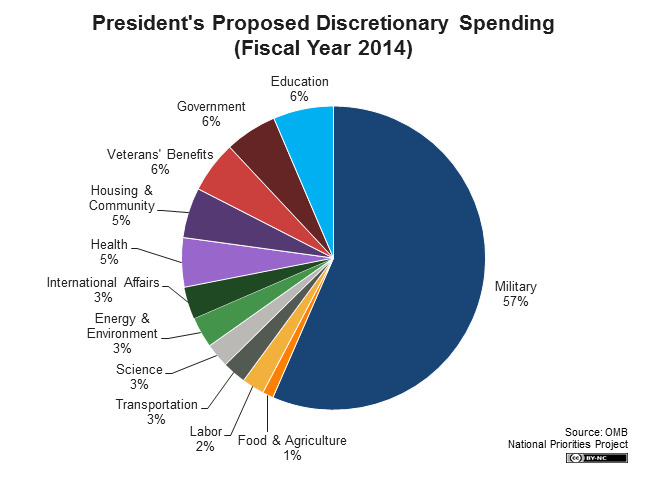
In an era of bipartisan agreement on austerity cuts to vital services and workers’ benefits, US military-industrial-complex spending will continue into the new year untouched.
President Barack Obama signed into law on Thursday the National Defense Authorization Act for the fiscal year 2014 that allots $526.8 billion for the Pentagon’s budget and $80 billion for the war in Afghanistan—totaling nearly $607 billion in defense-related spending.
This is nearly $30 billion more than was agreed to in the bipartisan federal budget deal that was also signed by Obama on Thursday.
“The passage of a National Defense Authorization Act (NDAA) that calls for $30 billion more for the Pentagon and allied agencies than is contained in the recent budget deal passed by both houses of Congress is just the latest indication that defense hawks continue to live in their own world, untroubled by fiscal constraints,” said William Hartung, director of the Arms & Security Project at the Center for International Policy.
The bill does include an ease of restrictions on transferring Guantanamo Bay US military prison inmates to the custody of other countries, while banning transfers to the United States, in what human rights advocates are calling a limited victory.
“We hope that President Obama will make swift use of the new NDAA provisions to actually act on his removal of the ban,” reads an official statement from the Center for Constitutional Rights, which has battled unlawful detentions at Guantánamo for the past 11 years.
“Despite President Obama’s announcement in May that he would lift his self-imposed ban on transfers to Yemen, seven months later not a single Yemeni has been released,” the statement warns.
The bill also introduces limited protections for survivors of sexual assault within the US military, yet keeps power over legal cases within the chain of command—which survivors and their advocates say is inadequate in a system where higher ranking service members have near impunity for sexual assaults perpetrated down the chain of command.
Critics slammed the NDAA as a military handout at a time of great human need.
“The bill is a massive spending program on the war economy with no justification in a time of austerity and limited security threats,” writes D.S. Wright for FiredogLake.
“Washington’s spending priorities are upside down: continuing to fund the Afghan war and the taxpayer ripoff F-35 warplane while cutting funding for human needs,” said Robert Naiman, policy director for Just Foreign Policy, in an interview with Common Dreams.
Related article
- President Obama Signs $607 Billion Defense Bill in Hawaii (news.firedoglake.com)
Obama regime underestimated cost of maintaining nuclear weapons by $140 Billion
By Noel Brinkerhoff and Danny Biederman | AllGov | December 27, 2013
Defense officials in the Obama administration were more than a little off when they told Congress the cost of maintaining the nation’s nuclear weapons arsenal over the next 10 years.
They missed the mark by at least $140 billion.
Two years ago, the Pentagon informed lawmakers that they would need to allocate $214 billion over the coming decade to operate and upgrade the stockpile of nuclear warheads and delivery systems.
But the Congressional Budget Office (CBO) looked at the Defense Department’s future plans and found that nuclear weapons-related costs were more likely to reach $355 billion by 2023.
That’s 66% higher than the 2011 estimate.
The $355 billion includes $136 billion to modernize and operate submarines, bombers and missiles that deliver warheads, $105 billion to run weapons labs, weapons and naval reactors, $56 billion for command and control systems, and $59 billion for unforeseen technical problems or mismanagement.
And that’s just the direct costs related to the nuclear arsenal.
CBO officials point out there are other, very costly programs that exist because of the nuclear weapons program, such as cleaning up shuttered nuclear fuel facilities or the nation’s missile defense systems for shooting down other nation’s nuclear missiles.
These other costs will likely cost the government another $215 billion over the next decade.
“Nuclear weapons aren’t cheap as some high-ranking Pentagon officials have suggested,” Kingston Reif, director of nuclear non-proliferation at the Center for Arms Control and Non-Proliferation, an advocacy group in Washington, told the Center for Public Integrity.
Last year, Deputy Secretary of Defense Ashton Carter said that nuclear weapons are “just not that expensive,” a remark that triggered controversy and a Congressional request that the CBO nail down accurate costs.
Reif added that the Obama administration should consider scaling back its plans due to mounting costs, otherwise the result will be “nuclear disarmament by financial default.”
Apart from making the weapons more secure, the purpose of the nuclear modernization program, according to President Barack Obama, is “to give U.S. military and political leaders the confidence they need to negotiate further reductions in the nuclear arsenal,” wrote Reuters’ David Alexander.
Aspects of the modernization program are misguided and in violation of the spirit of the administration’s pledge to develop no new nuclear arms, the Union of Concerned Scientists said in its own October report.
To Learn More:
Obama Administration Understated Nuclear Weapons Costs (by R. Jeffrey Smith, Center for Public Integrity)
U.S. Nuclear Weapon Plans To Cost $355 Billion over a Decade: CBO Report (by David Alexander, Reuters)
Document: CBO Report on Cost of U.S. Nuclear Forces from 2014 to 2023 (USNI News)
Obama Pledges $11 Billion to Upgrade U.S. Nuclear Weapons (by Noel Brinkerhoff, AllGov)
Obama regime tries to stop courts from ruling on constitutionality of warrantless spying
By Noel Brinkerhoff | AllGov | December 24, 2013
Even after months of stories exposing the breadth and depth of National Security Agency (NSA) spying on Americans’ communications, the Obama administration insists federal courts should stop hearing cases challenging the agency’s warrantless surveillance on grounds that they might expose the existence of this spying.
Last week, federal lawyers asked a judge, Jeffrey S. White, in Northern California to dismiss cases that could lead to a ruling on the constitutionality of warrantless surveillance programs authorized during the George W. Bush administration.
The Obama administration contends the cases are just too dangerous to continue if they wind up jeopardizing state secrets.
“Disclosure of this still-classified information regarding the scope and operational details of N.S.A. intelligence activities implicated by plaintiffs’ allegations could be expected to cause extremely grave damage to the national security of the United States,” James Clapper Jr., director of national intelligence, wrote in one of the filings. In June, Clapper was exposed for having lied to Congress about the existence of programs that spied on Americans.
Cindy Cohn, legal director for the Electronic Frontier Foundation, which is representing the plaintiffs in the cases, told The New York Times that the government’s assertion was “very troubling.”
She added that despite the revelations by NSA whistleblower Edward Snowden, the administration was essentially saying, “We can’t say whether the American people have been spied on by their government.”
The lawsuits in question were brought by Carolyn Jewel and Virginia Shubert, who claim the NSA’s spying violated their constitutional rights.
Jewel is suing on behalf of all AT&T customers, and Shubert is suing on behalf of all Americans.
The NSA has refused to confirm or deny that either plaintiff’s communications were targeted.
“The American people know they’re being surveilled,” Cohn told The Washington Post. “The government is trying to reset the clock in order to avoid an open judicial determination about whether that surveillance is legal.”
To Learn More:
White House Tries to Prevent Judge From Ruling on Surveillance Efforts (by Charlie Savage and David Sanger, New York Times)
U.S. Government Moves To Block Further Litigation In NSA Surveillance Cases (by Marc Ferranti, IDG News Service)
U.S. Reasserts Need To Keep Domestic Surveillance Secret (by Ellen Nakashima, Washington Post)
Jewel v. NSA (Electronic Frontier Foundation)
NSA Phone Data Collection Made No Difference to National Security (by Noel Brinkerhoff and Danny Biederman, AllGov)
Obama Asks U.S. Supreme Court for Stamp of Approval on Warrantless Cell Phone Searches (by Noel Brinkerhoff, AllGov)
Should National Intelligence Director Clapper be Charged with a Felony for Lying in Sworn Senate Testimony? (by Noel Brinkerhoff, AllGov)
CIA secret program helped Colombia kill FARC leaders: Report
Press TV – December 22, 2013
US intelligence agencies have secretly helped the Colombian government kill at least two dozen leaders of the Revolutionary Armed Forces of Colombia (FARC), a report says.
On Saturday, the Washington Post published the report revealing that both the Central Intelligence Agency (CIA) and the National Security Agency (NSA) provided the Colombian government with technology to terminate the rebel leaders.
The report was based on interviews with more than 30 former and current American and Colombian officials, who spoke on condition of anonymity since the program is classified and ongoing, the newspaper said.
According to the report, Washington provided Colombia with Global Positioning System (GPS) equipment that can be used to transform regular munitions into so-called smart bombs.
These explosives can accurately pinpoint specific targets, even if the objects are located in dense jungles.
In addition, the NSA provided “substantial eavesdropping help” to the Colombian government, the report stated.
In one of its operations, Colombian forces killed top FARC commander, Raul Reyes, in March 2008, while he was in a FARC-operated jungle camp in neighboring Ecuador. The newspaper reported that a US-made smart bomb was used in the killing.
Colombian President Juan Manuel Santos commented on the report, telling the newspaper that the CIA has been “of help, providing Colombian forces with “better training and knowledge.” The CIA, however, did not want to give any comments regarding the revelations.
The report also revealed that the multibillion-dollar program was secretly funded on top of the nine billion dollars in aid that the US has openly provided to Colombia, mostly in military assistance. The covert program was authorized by President George W. Bush and has continued under President Barack Obama.
The Colombian government and FARC have been holding peace negotiations since November last year in Cuba.
The two sides have agreed upon the matter of land reform and rural development, while four others issues still remain unsolved, including FARC’s participation in politics.
FARC is Latin America’s oldest insurgent group and has been fighting the government since 1964.
Bogota estimates that 600,000 people have been killed and more than 4.5 million others have been displaced due to the fighting.
Judge Chastises Obama Administration for Using “Secret Law” to Withhold Documents
By Noel Brinkerhoff | AllGov | December 20, 2013
The Obama White House has been ordered (pdf) by a federal judge to release a copy of an unclassified presidential directive after it tried to use “secret law” to keep it out of the hands of a government watchdog group.
U.S. District Judge Ellen Segal Huvelle also admonished the administration for the “unbounded nature” of its claim and thinking it had a “limitless” view of its power to withhold presidential communications from the public.
“The government appears to adopt the cavalier attitude that the President should be permitted to convey orders throughout the Executive Branch without public oversight—to engage in what is in effect governance by ‘secret law,’” Huvelle wrote in her opinion.
The case began after the nonprofit Center for Effective Government filed a lawsuit under the Freedom of Information Act to obtain a copy of Presidential Policy Directive 6, which deals with U.S. foreign aid (pdf).
The group argued that “PPD-6 is not protected by the presidential communications privilege because it was not made in the course of making decisions, but instead is the final decision itself….”
Huvelle, who was appointed to the federal bench by President Bill Clinton, made a point of personally examining the document rather than rely on the Obama administration’s characterization of it. After doing that, she determined that it “is not ‘revelatory of the President’s deliberations’ such that its public disclosure would undermine future decision-making.”
The White House insisted it could withhold the document, even though it was “a widely-publicized, non-classified Presidential Policy Directive,” according to Huvelle.
She also noted: “Never before has a court had to consider whether the [presidential communications] privilege protects from disclosure under FOIA a final, non-classified, presidential directive.”
Julie Murray, an attorney with Public Citizen and counsel for the Center for Effective Government, applauded the decision.
“We are pleased to see that the court recognized the government’s position in this case for what it is: a remarkable and unlawful attempt to keep secret a broad federal policy,” she said in a prepared statement.
“The court’s decision is a resounding win for the principle of government openness and a reminder to the Obama administration that its commitment to transparency must come not just in words, but in deeds,” Murray added.
To Learn More:
Court Rebukes White House Over “Secret Law” (by Steven Aftergood, Secrecy News)
Judge Orders Release of Presidential Policy Directive (Center for Effective Government)
Memorandum Opinion: Center for Effective Government v. U.S. Department of State, et al. (U.S. District Court for the District of Columbia) (pdf)
Obama Administration Hiding Details of Presidential Policy Directives (by Matt Bewig, AllGov)
11 Secret Documents Americans Deserve to See (by David Wallechinsky, AllGov)
Classified Documents on the Rise Despite Obama Talk of Transparency (by Noel Brinkerhoff and David Wallechinsky)
Featured Video

The Board For Peace – Whitewashing Ethnic Cleansing and Genocide
or go to
Aletho News Archives – Video-Images
Book Review
Conspiracy Denial

Lies are Unbekoming | January 27, 2026
In honour of Michael Parenti (1933–2026), who passed away on 24 January 2026 at the age of 92. He spent his life naming what power prefers to leave unnamed.
In 1837, Abraham Lincoln remarked: “These capitalists generally act harmoniously, and in concert, to fleece the people.”
Today, he would be dismissed as a conspiracy theorist.
That dismissal—reflexive, automatic, requiring no engagement with evidence—is not a mark of sophistication. It is a tell. The question worth asking is not whether conspiracies exist (they are a matter of public record and a recognised concept in law) but why acknowledging their existence provokes such reliable hostility. What work does the label “conspiracy theorist” actually do?
The late political scientist Michael Parenti spent decades answering that question. His conclusion was blunt: “’Conspiracy’ refers to something more than just illegal acts. It serves as a dismissive label applied to any acknowledgment of ruling-class power, both its legal and illegal operations.” The term functions not as a descriptor but as a weapon—a thought-terminating cliché that protects the powerful from scrutiny by pathologising those who scrutinise them.
Conspiracy denial, in Parenti’s analysis, is not skepticism. It is the opposite of skepticism. It is credulity toward power dressed up as critical thinking. As he wrote in Dirty Truths: “Just because some people have fantasies of conspiracies does not mean all conspiracies are imaginary.” … continue
Blog Roll
Recent Comments
eddieb on WEF Calls for ‘Cultural Revolu… loongtip on Trump wanted to play peacemake… Coronistan on EU member to sue bloc over ‘su… loongtip on Vicious loongtip on EU turns to India for defense… Coronistan on Donald Trump Is No Peace … seversonebcfb985d9 on French court jails pro-Palesti… eddieb on Fourteen Incredible Facts Abou… Bill Francis on European leaders’ shift in the… seversonebcfb985d9 on Villains of Judea: Philip Esfo… loongtip on Report warns that ‘Jewish terr… Craig Nelms on New study shows that toxic gas…


 Aletho News
- As TikTok falls into Zionist hands, UpScrolled fills the vacuum to give voice to Palestine
- Former Biden Advisor, Amos Hochstein, Admits The Biden Administration Is Responsible For the Gaza Genocide
- Not a Trump anomaly: The Board of Peace and America’s crisis-driven power plays
- Manufacturing martyrdom: The west’s cynical use of Iranian protest figures
- Attack on Iran would backfire, causing great losses for US, warns European think-tank
- Davos and Abu Dhabi: How the Ukrainian Endgame Exposed Western Decline
- AfD co-leader states the obvious: Pouring money into the Ukraine war is killing the German economy
- Britain’s return to piracy to stop Russian ships – desperate attempt to demonstrate power
- Czech coalition rules out higher defense spending, says 2% of GDP is enough
- G7 Hands Ukraine $40Bln Generated From Frozen Russian Assets
- If Americans Knew
- “The Gaza ceasefire is a minefield” – Not a ceasefire Day 110
- Israel to seek new security deal from US, official says
- Leaked “Board of Peace” Resolution Outlines U.S.-Led Plan to Rule Over Gaza
- Jonathan Greenblatt Rolls Out Plan to Activate Hispanic Evangelical Golems
- Violence against hundreds of Gazan remains to find one Israeli – Not a ceasefire Day 109
- Greenpeace Demonstrator Exposes Folly of Protest Restrictions
- From CBS to TikTok, Pro-Israel Ellison is now in the driver’s seat
- Israel pays for UK advertisements attacking Doctors Without Borders
- Israel accused of extracting billions from Gazan people to pay for their own genocide
- ‘Deliberate Assassination’: 3 Journalists Among 11 Killed by Israeli Forces in Gaza
- No Tricks Zone
- New Study Affirms Rising CO2’s Greening Impact Across India – A Region With No Net Warming In 75 Years
- Germany’s Natural Gas Crisis Escalates … One Storage Site Near Empty …Government Silent
- Polar Colding…Antarctica Saw Its Coldest October In 44 Years!
- New Study: Sea Levels Rose 20 Times The Modern Rate During The Roman Warm Period
- As German Gas Storage Dips Dangerously Low…Shortage Hardly Avoidable
- New Study: Brazil’s Relative Sea Level Was 2+ Meters Higher And SSTs 3-4°C Warmer 6000 Years Ago
- Philosopher Schopenhauer: Climate Science Certainty Stems From Stupidity, Ignorance
- New Study: Species Extinction Rates Declining Since 1980 – ‘Climate Change Is Not An Important Threat’
- Denmark Places Climate Protection Above Animal Welfare, Poisoning And Culling Cows
- New Study: Greenland Was 3-7°C Warmer And Far Less Glaciated Than Today 6000-8000 Years Ago
 Aletho News