Obama at the UN
By Mazin Qumsiyeh | Popular Resistance | September 25, 2013
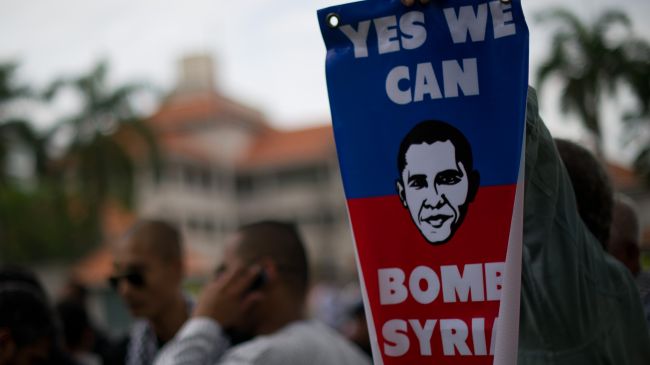 President Barak Obama said in the middle of his 40 minutes of lies and hypocrisy at the UNGA as world leaders looked on in dismay: “With respect to Syria, we believe that as a starting point, the international community must enforce the ban on chemical weapons.” (The US and Israel both possess and have used chemical weapons, see below) and added “Although we will at times be accused of hypocrisy and inconsistency [!], we will be engaged in the region for the long haul” [to serve Israel].
Incredibly he also said he believed in American “exceptionalism” [white man’s burden]. Hypocritically he also mentioned Martin Luther King Jr. But MLK opposed American imperialism and exceptionalism and who said in a speech in 1968: “God didn’t call America to do what she’s doing in the world now. God didn’t call America to engage in a senseless, unjust war ….. We have committed more war crimes almost than any nation in the world.” [we still do]
Related
“Independent Experts” Reviewing NSA Spying Have Ties to Intelligence Community
By Noel Brinkerhoff and Danny Biederman | AllGov | September 25, 2013
President Barack Obama’s special panel of “independent” experts charged with reviewing the National Security Agency’s (NSA) domestic spying programs is actually lacking in independence.
For starters, the panel assembled to determine if the NSA has violated Americans’ civil liberties consists of five members—four of whom have previously worked for Democratic administrations.
One member is Michael Morell, who served in the Central Intelligence Agency under Obama as deputy director, and twice served as acting director.
The other three with Democratic ties are Peter Swire, former Office of Management and Budget privacy director under President Bill Clinton; Richard Clarke, former counterterrorism coordinator under Clinton and later for President George W. Bush; and Cass Sunstein, Obama’s former regulatory czar.
The fifth panel member is Geoffrey Stone of the University of Chicago, who was an informal adviser to Obama’s 2008 presidential campaign and is now helping develop Obama’s presidential library. Stone previously went on record as saying that the NSA’s collection of Americans’ phone records is constitutional.
“No one can look at this group and say it’s completely independent,” Sascha Meinrath, director of the Open Technology Institute and vice president at the New America Foundation, told the Associated Press after attending one of the panel’s meetings.
Michelle Richardson, an ACLU legislative counsel who attended one meeting for civil liberties groups, said her organization “would have liked a more diverse group” for the panel.
Another sign that the group lacks independence is in its name—“Director of National Intelligence Review Group on Intelligence and Communications Technologies.”
The AP’s Stephen Braun noted that “the panel’s official name suggests it’s run by” the Office of the Director of National Intelligence (DNI).
In fact, Obama’s announcement in August that the review group would be established by DNI James Clapper triggered a wave of criticism. Obama tried to quell the outcry by assuring the country that Clapper would neither run the panel nor select its members.
But there is more than the panel’s name that suggests DNI oversight. The panel’s so-called outside experts work inside offices provided by the DNI. And it is the DNI’s press office that coordinates all press statements and interview requests.
Another point of criticism stems from Clapper’s decision to exempt the panel from the U.S. Federal Advisory Committee Act, which requires such committees to conduct open meetings and notify the public about their activities. Indeed, it has been reported that during recent weeks the panel’s meetings have been closed to the public even when no classified material was discussed.
There appears to be no formal directive stating that the panel should operate independently of the Obama administration. In fact, the situation is quite the opposite. An official White House memorandum actually provides the panel with instructions for areas to emphasize in its review: whether U.S. spying programs advance foreign policy, protect national security, and are safe from leaks.
In his August 9th press conference regarding the establishment of this panel, Obama promised that the “outside experts” will “consider how we can…make sure that there absolutely is no abuse in terms of how these surveillance technologies are used.” But nowhere in the White House memo is the panel instructed to investigate surveillance abuses.
The panel’s report is due by December 15. On that date it is not to be made public, nor is it to be delivered to the press. Rather, it will be submitted to the White House for review.
To Learn More:
Close Ties Between White House, NSA Spying Review (by Stephen Braun, Associated Press)
NSA Spying Review Panel Appointed by Obama Set to Whitewash Surveillance Abuses (by Kevin Gosztola, Dissenter)
Surveillance Privacy: Obama Orders Fox to Guard Chicken Coop (by Noel Brinkerhoff, AllGov)
Related articles
- Obama’s NSA ‘Independent’ Review Clearly a Public Relations Move (reason.com)
- NSA Spying Review Panel Appointed by Obama Set to Whitewash Surveillance Abuses (dissenter.firedoglake.com)
Egyptian minister praises Obama’s remarks on Egypt, Hamas slams Egypt’s FM for threatening to attack Gaza
Egyptian minister praises Obama’s remarks on Egypt in the UNGA
MEMO – September 25, 2013
Egyptian Foreign Minister Nabil Fahmy has described US President Barack Obama’s remarks to the UN General Assembly about Egypt as “positive” and reflective of “an objective treatment of the situation in Egypt.”
Fahmy was responding to Obama’s speech on Tuesday that was critical of both ousted President Morsi’s government for being non-inclusive, and the interim government established by the coup for violating the Egyptian people’s rights, including policies such as the curfew, the state of emergency and the restrictions on press freedoms.
About how the latter issues would be resolved, the minister said: “They will be overcome through the context of the implementation of the roadmap and efforts to build a modern and democratic state in Egypt.”
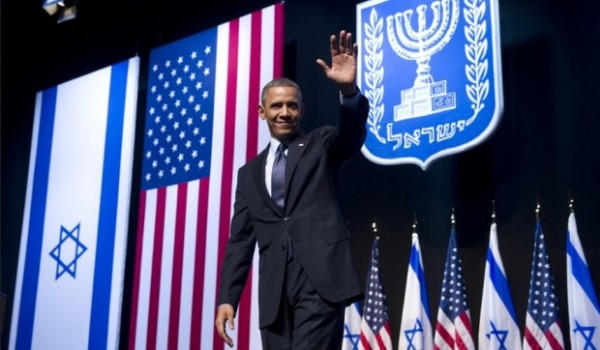 In his speech to the UN General Assembly, Obama repeatedly asserted his country’s respect for the will and choices of the people in the Middle East. However he also warned that the “United States will at times work with governments that do not meet, at least in our view, the highest international expectations, but who work with us on our core interests.”
Obama affirmed that the US is going to preserve good relations with Egypt, saying the US “will maintain a constructive relationship with the interim government that promotes core interests like the Camp David Accords,” as well as counterterrorism efforts.
But he added that US support will also “depend upon Egypt’s progress in pursuing a more democratic path.”
Hamas slams Egypt’s foreign minister for threatening to attack Gaza
Palestine Information Center – 25/09/2013
GAZA — The Hamas Movement strongly denounced Nabil Fahmi, the Egyptian minister of foreign affairs, for threatening to take military and security action against the Palestinian resistance in Gaza.
Its spokesman Fawzi Barhoum stated on Tuesday that Fahmi’s threats were reprehensible and very dangerous and would do a great disservice to Egypt’s reputation and historical stature.
Barhoum added that Fahmi’s remarks in this regard unveiled bad intents and hostile tendencies against the Palestinians in general and Gaza in particular.
He stressed that such position would remove Egypt from its national, Arab and Islamic role in supporting the Palestinian people and their cause.
The spokesman affirmed that Hamas and its people in Gaza have no intention or agenda to engage in any kind of conflict with Egypt.
“We will remain defenders of the Arab and Muslim nations’ pride and dignity, and our main struggle is only against the Israeli occupation, the greatest threat to Egypt and Palestine,” he underscored.
For its part, Al-Ahrar Movement in Gaza also deplored the Egyptian minister’s threat to use military and security options against Gaza.
“We were expecting an Egyptian position supporting the Aqsa Mosque and preventing its division, and not a threat by the foreign minister of Egypt to attack Gaza. We affirm that such remarks undermine Egypt’s ethics and role in protecting our people,” Al-Ahrar Movement stated on Tuesday.
It also said that this new Egyptian position only serves the Israeli occupation regime which has taken advantage of the military coupe and are trying to drive a wedge between Gaza and Egypt.
Brazil’s Rousseff to UN: US surveillance an ‘affront’
RT | September 24, 2013
Brazilian President Dilma Rousseff lambasted US spying on her country at Tuesday’s UN summit, calling it a “breach of international law.” She further warned that the NSA surveillance, revealed since June, threatened freedom of speech and democracy.
“Meddling in such a manner in the lives and affairs of other countries is a breach of international law and as such it is an affront to the principles that should otherwise govern relations among countries, especially among friendly nations,” Rousseff said.
“Without the right to privacy, there is no real freedom of speech or freedom of opinion,” Rousseff told the gathering of world leaders. “And therefore, there is no actual democracy,” she added, criticizing the fact that Brazil had been targeted by the US.
“A country’s sovereignty can never affirm itself to the detriment of another country’s sovereignty,” she added.
Rousseff went on to propose a multilateral, international governance framework to monitor US surveillance activity. “We must establish multilateral mechanisms for the world wide web,” she said.
Rousseff said that the US’s arguments for spying on Brazil and other UN member states were “untenable”, adding that “Brazil knows how to protect itself” and that the country has been “living in peace with our neighbors for more than 140 years.”
Brazil’s specific targeting in US surveillance practices prompted Rousseff’s government to announce that it intends to adopt both legislation and technology aimed at protecting itself and its businesses from the illegal interception of communications.
A week ago, Rousseff canceled an impending state visit to Washington, scheduled to take place in October, because of indignation over spying revelations. Rousseff has stated she wants an apology from Obama and the United States.
The revelations that the US National Security Agency has been intercepting Rouseff’s own phone calls and e-mails, in addition to those of her aides and officials at state-controlled oil and gas firm Petrobras, have prompted an outcry in Brazil.
Rousseff’s predecessor as Brazilian President, Lula da Silva, said earlier this month that Obama should “personally apologize to the world.” Lula accused the US of “thinking that it can control global communications and ignore the sovereignty of other countries” in an interview with India’s English-language daily The Hindu, published Sept. 10.
Latin America voices widespread indignation at US activities
US relations with all of Latin America have recently soured. In addition to Brazil, Mexico, Bolivia and Venezuela have all voiced anger with the US over the NSA’s surveillance of their countries this year. Bolivia has been especially bitter.
“I would like to announce that we are preparing a lawsuit against Barack Obama to condemn him for crimes against humanity,” President Morales told reporters Friday in the Bolivian city of Santa Cruz. He branded the US president as a “criminal” who had violated international law.
In early July, a plane carrying Morales from Moscow to the Bolivian capital, La Paz, was grounded for 13 hours in Austria after it was banned from European airspace because of US suspicions it was carrying fugitive Edward Snowden, the former NSA contractor who has been responsible for the majority of leaks regarding NSA spying practices since June.
Venezuela wrote to UN Secretary-General Ban Ki-moon at the end of last week, requesting that he take action in response to the apparent denial of US visas to some members of the Venezuelan delegation who were scheduled to attend the UN General Assembly in New York.
President Nicolas Maduro said that the denial seemed intended to “create logistical obstacles to impede” the visit, and further requested that the UN “demand that the government of the US abide by its international obligations” as host of the 68th UN General Assembly.
Tension between Venezuela and the US rose Thursday when Venezuela’s foreign minister, Elias Jaua, told media outlets that the US had denied a plane carrying Maduro entrance into its airspace. The aircraft was en route to China. Washington later granted the approval, stating that Venezuela’s request had not been properly submitted. Jaua denounced the move as “an act of aggression.”
Related article
Bolivia plans legal action against Obama over ‘crimes against humanity’
Press TV – September 20, 2013
Bolivia’s President Evo Morales plans to file legal action against the US president for crimes against humanity, condemning Washington’s intimidation tactics after it denied Venezuelan presidential jet entry into US airspace.
“I would like to announce that we are preparing a lawsuit against [US President] Barack Obama to condemn him for crimes against humanity,” President Morales announced at a Thursday press conference in the Bolivian city of Santa Cruz, RT reports.
He further described the American president as a “criminal” who willingly violates international law.
“The US cannot be allowed to continue with its policy of intimidation and blockading presidential flights,” Morales stated.
He added that Bolivia intends to prepare legal action against the US president and file the lawsuit at the International Court.
President Morales has called for an emergency meeting of the Community of Latin American and Caribbean States (CELAC) to confer about the US action, which has been slammed by Venezuela as “an act of intimidation by North American imperialism.”
Additionally, the Bolivian president has implied that the CELAC members should recall their ambassadors from Washington in an effort to convey a strong message to the Obama Administration.
According to the report, Morales further wants to urge member nations of the Bolivarian Alliance for the Americas to boycott the next meeting of the United Nations in New York.
Members of the Alliance include Antigua and Barbuda, Cuba, Dominica, Ecuador, Nicaragua, Venezuela and Saint Lucia.
The anti-US measures called by the Bolivian president comes just months after Morales’s presidential aircraft was denied entry into several Western European countries, forcing it to land in Austria.
The May 2013 incident was widely described as a US-led effort out of a false suspicion that American spy agency whistleblower Edward Snowden may be onboard the aircraft.
At the time Bolivia was among a few countries that offered political asylum to Snowden, a US fugitive and former contract employee of American spy agencies, CIA and NSA, who leaked documents showing massive US electronic spying operations around the globe, including its European and Latin American allies.
Several Latin American heads of state joined Bolivia to censure the illegal move by the European countries, including Italy, France and Spain, which led to their official apologies.
Related article
Brazilian president postpones visit to Washington over US spying
RT | September 17, 2013
Brazilian President Dilma Rousseff has postponed a state visit to Washington in response to the US spying on her communications with top aides. Rousseff is demanding a full public apology from President Obama.
Barack Obama spoke with Rousseff on Monday in an attempt to persuade her into following through with the trip, the Brazilian president’s office said, according to AP.
Brazil’s TV Globo reported that the call between the two presidents lasted for about 20 minutes. Obama and Rousseff discussed revelations that the National Security Agency (NSA) spied on the Brazilian leader’s phone calls and emails. The two presidents then “jointly” agreed to cancel the meeting, Globo reported, citing the presidential office.
The Brazilian government said in a statement that “the conditions are not suitable to undertake this visit on the agreed date.” It expressed hope that the conflict will be resolved “properly” and the trip will happen “as soon as possible.”
The state visit was initially scheduled for October 23. The Obama administration has confirmed that the visit was canceled.
“The president has said that he understands and regrets the concerns disclosures of alleged US intelligence activities have generated in Brazil and made clear that he is committed to working together with President Rousseff and her government in diplomatic channels to move beyond this issue as a source of tension in our bilateral relationship,” said White House spokesman Jay Carney.
Earlier this month, TV Globo revealed in a report that the NSA monitored the content of phone calls, emails, and mobile phone messages belonging to President Rousseff and undefined “key advisers” of the Brazilian government. The NSA also spied on Mexican President Enrique Pena Nieto and nine members of his office.
The revelations were based on evidence provided by former CIA employee and NSA contractor Edward Snowden, which was passed to British journalist Glenn Greenwald.
A document dated June 2012 showed that the Mexican President’s emails were read through one month before he was elected. In his communications, the then-presidential candidate indicated who he would like to appoint to several government posts.
The Brazilian government denounced the NSA surveillance as “impermissible and unacceptable,” and a violation of Brazilian sovereignty.
In July, Greenwald co-wrote articles for O Globo, in which he claimed that some of the documents leaked by Snowden indicated that Brazil was the NSA’s largest target in Latin America.
Greenwald wrote that the NSA was collecting its data through an undefined association between US and Brazilian telecommunications companies, but he could not verify that Brazilian companies had been involved.
Following the revelations, the Brazilian government ordered an investigation into telecommunications companies to determine whether they illegally shared data with the NSA.
Defense ministers of Brazil and Argentina signed a broader military cooperation agreement on September 13. The two governments will work together to improve cyber defense capabilities following revelations of Washington’s spying on Latin American countries.
Brazil will be providing cyber warfare training to Argentine officers from 2014.
Related articles
Obama: US will continue threatening Syria
Press TV – September 14, 2013
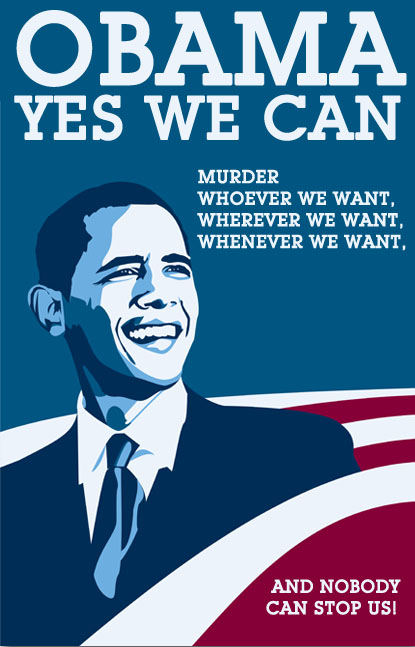 US President Barack Obama has said the US will continue to threaten Syria with the use of force as the government of Syrian President Bashar al-Assad has agreed to put its chemical weapons under the control of the United Nations.
“We need to see concrete actions to demonstrate that Assad is serious about giving up his chemical weapons … And since this plan emerged only with a credible threat of US military action, we will maintain our military posture in the region,” Obama said in his weekly address to Americans on Saturday.
The threat came after the Syrian ambassador to the UN said on Thursday that his country became a full member of the international treaty prohibiting chemical weapons.
After Russia offered a diplomatic proposal for putting Syria’s chemical weapons under international control on Monday, Obama called on Congress to delay a vote on his call for a military action against Syria.
Nevertheless, in his weekly address to Americans, Obama said, “If diplomacy fails, the United States and the international community must remain prepared to act.”
Obama’s talk of “the international community” comes as senior officials within his administration have said he would not push for a United Nations Security Council resolution threatening Syria with the use of force.
This comes as Russian President Vladimir Putin said in an op-ed published by The New York Times on Wednesday that a possible US attack on Syria “is unacceptable under the United Nations Charter and would constitute an act of aggression.”
Meanwhile, recent polls have revealed a growing opposition to military action against Syria both within the US military and America’s war-weary public.
Related article
Obama’s foreign policy just as bad or worse than Bush’s – poll
RT | September 12, 2013
Nearly two-thirds of Americans say President Barack Obama’s handling of foreign policy is either equal to or worse than that of predecessor George W. Bush, a new poll reveals.
The results of a recent Reason-Rupe poll published on Tuesday this week suggest that a majority of Americans — 64 percent — consider the current commander-in-chief’s job performance with regards to international affairs to be no better than Pres. Bush, who kick-started wars in both Afghanistan and Iraq during his eight years in the White House.
According to the results of the poll, 32 percent of Americans polled said Obama’s handling of foreign policy is worse than that of his predecessor, with 32 percent also saying it was “about the same.”
Thirty-two percent of the 1,013 adults polled said they consider Obama’s handling of foreign policy better than that of Pres. Bush.
And as a potential United States-led military strike against Syrian leader Bashar al-Assad’s regime remains a very real possibility in the days to come, Reason’s Emily Ekins wrote that Obama — who famously said he opposes “dumb wars” — could launch the US into a situation that wouldn’t be supported by a majority of Americans.
“Nearly three-quarters of Americans, 74 percent, say it would be ‘unwise’ for the United States to launch airstrikes on Syria without the support of the United Nations or Great Britain,” Ekins wrote of the results.
Additionally, only 17 percent of those polled said it would be a wise move to attack Assad’s regime to reprimand the Syrian leader for the alleged use of chemical weapons last month outside of Damascus. The White House said previously that Assad’s army deployed chemical warheads on August 21 and in turn eradicated more than 1,400 people.
The same proportion of Americans who put Bush’s foreign policy record at-or-above that of Pres. Obama — 64 percent — told pollsters that US airstrikes against Syria are not necessary to protect America’s credibility and national security, despite the administration arguing otherwise.
Pres. Obama had been considering a unilateral military strike against Assad without approaching Congress for authorization, but has in recent days formalized his request with the House and Senate and has since postponed voting while diplomatic options are considered by the UN and international community.
Foreign policy aside, however, the Obama administration isn’t winning much support among the Americans polled by Reason and Rupe. According to their questioning, 61 percent said they believe the US is heading in the “wrong direction,” compared to 28 percent who say America is, “generally speaking,” on the right path.
Forty-three percent of those surveyed said they disapprove of Obama’s overall job performance. Before the US ramped-up its interest in the Syrian civil war, a similar poll conducted in May found that exactly half of Americans polled approved of the president’s job, signaling a 7 percentage point drop in a matter of months.
At a press briefing on Wednesday, White House press secretary Jay Carney acknowledge the president’s reluctance to use military force in Syria after more than a decade of wars started under the Bush administration.
 “He knew and knows and understands that the American people are extremely reluctant to get the United States involved again militarily in the Middle East — not just in the Middle East, but anywhere,” Carney told reporters. “But as someone who deeply understands that, and who has spent four and a half years as president getting us out of wars, he believes in the case that he made last night, and I think he understands why there’s reluctance and why there’s anxiety about potentially striking Syria in response to the use of chemical weapons.”
Related article
What Convinced Obama to Reverse His Position on NSA Surveillance?
By Jennifer Hoelzer | September 11, 2013
 Since details of the NSA’s surveillance programs started coming to light in early June – and President Obama’s been forced to publicly answer for its activities – the president has repeatedly reminded us that he came into office with a “healthy skepticism about these programs.” But, after careful evaluation, he determined “that on, you know, net, it was worth doing.”
Some of these programs I had been critical of when I was in the Senate. When I looked through specifically what was being done, my determination was that the two programs in particular that had been at issue, 215 and 702, offered valuable intelligence that helps us protect the American people and they’re worth preserving. (From his August 9th Press Conference.)
It’s a rhetorical strategy intended to win his critics’ trust by demonstrating that he understands our concerns because he used to share them. The message he wants us to take away is: if we had been in his shoes and saw the evidence he saw when he got into office, we would have signed off on these programs too.
Well, yesterday we got a glimpse of some of the evidence he saw when he assumed office – at least in connection to the NSA’s collection of U.S. phone call records — and, it begs the question, what exactly changed his mind about the NSA’s domestic surveillance programs? What did the President see that led him to the conclusion that everything he had previously said on the topic was wrong because allowing the NSA to collect everyone’s phone call records really is a constitutionally-supported, great idea?
Because, according to the documents the ODNI released yesterday, when President Obama took office, the NSA’s “telephony metadata” program wasn’t getting stellar reviews. In fact, we now know that days prior to Obama’s inauguration, the NSA reported that it had repeatedly violated the court-ordered rules limiting its use of the data it was collecting. A little over a month later, a judge on the Foreign Intelligence Surveillance Court found that, “Since January 15 [five days before Obama’s inauguration] it has finally come to light that the FISC’s authorizations of this vast collection program have been premised on a flawed depiction of how the NSA uses” the phone call data.
Not only had the Intelligence Community been misrepresenting its program to the court, the judge, Reggie B. Walton, went on to write:
The minimization procedures proposed by the government in each successive application and approved and adopted as binding by the orders of the FISC have been so frequently and systemically violated that it can fairly be said that this critical element of the overall BR regime has never functioned effectively.
And,
To approve such a program, the Court must have every confidence that the government is doing its utmost to ensure that those responsible for implementation fully comply with the Court’s orders. The Court no longer has such confidence.
The judge also implied that – other than hypothetical examples of how this data might provide intelligence of “immense value to the government” – the government had yet to provide the court with concrete evidence that the program was actually providing that value.
This program has been ongoing for nearly three years. The time has come for the government to describe to the Court how, based on the information collected and analyzed during that time, the value of the program to the nation’s security justifies the continued collection and retention of massive quantities of U.S. person information.
Again, Judge Walton reached these conclusions based on evidence that was available to him at the very same time that I imagine President Obama and his team were evaluating these programs. Plus, I’m assuming the president considered Judge Walton’s opinion in his evaluation, right?
So, what exactly convinced President Obama that this was “worth doing?” Because as the president explained last month, the prospect that something could happen isn’t the same as actual evidence that it has or ever will.
Obama’s Humiliating Defeat
By Glen Ford | Black Agenda Report | September 11, 2013
It was a strange speech, in which the real news was left for last, popping out like a Jack-in-the-Box after 11 minutes of growls and snarls and Obama’s bizarre whining about how unfair it is to be restrained from making war on people who have done you no harm. The president abruptly switched from absurd, lie-based justifications for war to his surprise announcement that, no, Syria’s turn to endure Shock and Awe had been postponed. The reader suddenly realizes that the diplomatic developments had been hastily cut and pasted into the speech, probably only hours before. Obama had intended to build the case for smashing Assad to an imperial peroration – a laying down of the law from on high. But his handlers threw in the towel, for reasons both foreign and domestic. Temporarily defeated, Obama will be back on the Syria warpath as soon as the proper false flag operations can be arranged.
The president’s roiling emotions, visible through his eyes, got in the way of his oratorical skills. But then, he didn’t have much material to work with, just an endless string of prevarications and half-truths strung almost randomly together. Obama, who was reluctantly asking permission from Congress to violate the most fundamental tenets of international law – permission that Congress is not empowered to give – framed Syria as a rogue nation because it has not signed a treaty on chemical weapons like “98 percent of humanity.” This makes Syria ripe for bombing. The president does not explain that Syria’s neighbors, Israel and Egypt – both U.S. allies – have also not signed the treaty. He does not suggest bombing Tel Aviv or Cairo.
Obama claims that the U.S. has proof that “Assad’s chemical weapons personnel prepared for an attack near an area where they mix sarin gas. They distributed gas masks to their troops. Then they fired rockets from a regime-controlled area into 11 neighborhoods that the regime has been trying to wipe clear of opposition forces.” Not a shred of evidence has been presented to back up this narrative – which, under the circumstances, tends to prove it is fiction. On the other hand, there are credible reports (everybody’s reports are more credible than the Americans), that rebels under U.S. allied control were told to prepare to go on the offensive following an American retaliation to a chemical attack that would be blamed on Assad’s forces – a story whose logic conforms to what actually occurred and answers the common sense question, Who profits?
Obama will not for long accept diplomatic delays in his war schedule. On Tuesday night, he was already priming the public to accept Assad’s guilt the next time chemical weapons explode in Syria. “If we fail to act,” said the president, “the Assad regime will see no reason to stop using chemical weapons.” American and allied secret services will gladly arrange a replay.
Early in the speech, Obama raised the specter that, because of Assad’s mad chemical predilections, “our troops would again face the prospect of chemical warfare on the battlefield.” Moreover, “If fighting spills beyond Syria’s borders, these weapons could threaten allies like Turkey, Jordan and Israel.” At this point, the president was arguing for a punitive strike, and had taken on the persona of warlike Obama.
Near the end of the speech, Obama responds to those who want Assad “taken out” right away and permanently, rather than merely “degrading” his forces with calibrated strikes. Now speaking as the “moderate” Obama, the president makes the case that Assad has no “interest in escalation that would lead to his demise, and our ally, Israel, can defend itself with overwhelming force.”
The two Obamas are matched with two corresponding Assads. One Assad is a menace to the whole neighborhood and to himself, while the other Assad knows who to mess with and takes no risks with his own survival.
It would seem logical that the latter Assad, who is not prone to suicidal actions, would not launch a chemical attack just a few miles away from United Nations inspectors that had just arrived in the country at his government’s request.
The point here is not to argue with Obama’s logic, but to show how inconsistent, opportunistic and, at times, incoherent his reasoning is. He has not the slightest interest in truth or simple logic, only in what sounds right in the immediate context. Obama mixes his personas, and those of his nemesis, at the drop of a hat, because he is shameless and absolutely cynical – as befits a mass murderer.
Barack Obama pretends to believe – at least I hope he’s only pretending – that it was his idea to wait for a congressional debate before blasting Syria to smithereens. “So even though I possess the authority to order military strikes, I believed it was right in the absence of a direct or imminent threat to our security to take this debate to Congress.” He didn’t take the debate to Congress; the congressional detour was forced on the White House on August 31 when it became clear that Obama lacked both domestic and foreign support for a speedy strike. That was Obama’s first big defeat. The second was a knockout, after Russia and Syria seized on Secretary of State John Kerry’s “joke” about Assad giving up his chemical weapons, at which point Obama’s handlers advised him that his political position was, for the time being, untenable. He arrived in front of the cameras shaken, angry, and humiliated – with a patched together script and a mouth full of crow.
The president who claimed that he could bomb the sovereign nation of Libya for seven months, overthrow its government and kill its president, without triggering the War Powers Act – and, further, that no state of war exists unless Americans are killed – told his Tuesday night audience that he opposes excessive presidential power. “This is especially true,” said Obama, with a straight face, “after a decade that put more and more war-making power in the hands of the president and more and more burdens on the shoulders of our troops, while sidelining the people’s representatives from the critical decisions about when we use force.”
In truth, it was the likelihood of rejection by American “people’s representatives” – just as British Prime Minister Cameron’s war plans were rejected by Parliament – that derailed Obama.
It took more than 1,500 words before Obama acknowledged the existence of the real world, in which he was compelled to “postpone” a congressional vote on the use of force while the U.S., Russia, China, France and Britain work on a UN resolution “requiring Assad to give up his chemical weapons and to ultimately destroy them under international control.” Syria has already agreed to the arrangement, in principle. Obama must bear, not only the bitter burden of defeat, but the humiliation of having to pretend that the UN route was his idea, all along.
Expect him back on the war track in no time flat. What else is an imperialist to do?
Glen Ford can be contacted at Glen.Ford@BlackAgendaReport.com.
Obama ‘should be grateful’ for face-saving chance to backpedal on Syria
RT | September 10, 2013
President Obama should curb threats of a US military strike on Syria by joining Russia’s “face-saving” proposal for Damascus to give control of its chemical weapons to the international community, independent researcher Soraya Sepahpour-Ulrich told RT.
Sepahpour-Ulrich said that Russia’s proposal allows Obama and America “to save face,” given the fact that a military strike on Syria would be “contrary to the people’s will” and receive little international support.
RT: Do you think this nascent solution is something that can actually lead to a workable compromise?
Soraya Sepahpour-Ulrich: It could. It’s a face-saving out for Mr. Obama, really. Because he doesn’t have the support to go to war, and if he chooses to go over the people of the United States, the majority of whom disapprove of this war, and the strikes, then he’s turning his back on democracy, and they always say in America they want to export democracy to other countries. So this is a blatant violation and goes contrary to the people’s will. And I think the proposal is really being very kind to Mr. Obama, giving him a way out.
RT: Why do you think Russia’s proposal to put Syria’s chemical stockpiles under international control received a positive response so quickly?
SSU: I think it was very positive because, well, for one, Assad doesn’t want war, he doesn’t want his people to die because there are lobby groups in Washington pushing for war. So I think he was happy to accept that. And I think the other countries, although Kerry and Obama are skeptical, they do not want this war. They do not want to go to this war. They do not have the support they hoped to have and yet they have those red lines that they have drawn which in fact were violated back in May. That’s when the United Nations said they thought the rebels were responsible and they didn’t act on it. But then to have painted themselves in a corner and this gives them the way out. It helps America, of course, its allies are happy not to go to war. It might be a win-win situation for all.
RT: The president has recently come out in some interviews saying this could be a positive step in the right direction, but we haven’t heard any assertive decision on his part. How do you think his quick his repositioning on the subject can be explained?
SSU: I think when he saw there is absolutely no support at all whatsoever, I mean even if Congress did vote for him to carry out these strikes, again, Congress would’ve been acting against the will of the people. America’s really onstage right now for the whole world to see. Not from a degree of, perhaps, hypocrisy, but the fact that it’s not really a promoter of democracy anywhere. And I think that this is a face-saving way for Obama to back-pedal on his position, and he should be very grateful that this solution was offered.
RT: Many legislators we’ve heard from say they were relieved by this talk of a compromise. Do you think they were looking forward to a vote on this subject?
SSU: I think they were very apprehensive because on the other hand, any legislator that would not have acted out the people’s will and had voted for war to please the lobby groups – no matter how much money the lobby would have actually put into their re-election – they would still need the vote of the people. So they were in a dilemma as well. I think the whole country, the whole nation was in a dilemma. And this really was a very clever way of avoiding all sorts of conflicts and casualties and allowing America to save face.
Israel’s Lobbyists Pushing Hard for another War in the Middle East
By Jeremy Salt | Palestine Chronicle | September 8, 2013
Ankara – Two million refugees out of Syria, some of them Palestinian refugees from 1948 and 1967 and some Iraqi refugees from 2004. They are the consequences of war and yet the raging beast that is devouring the Middle East is still not satiated. Another war looms. Another country already devastated is to be shattered by missile attacks. Who wants this war: who could want it? Who could even think of avenging the dead by calling for more killing?
It is not the people of the world. All polls show they are against it. Not just the people of Latin America, Africa, the Indian subcontinent, southeast Asia and China but the American people, the British people, the French people and the Turkish people. It is only the politicians who want this war: Obama, Kerry, Hagel, McCain and others in the US; Cameron and Hague in Britain; Hollande in France; and Erdogan in Turkey. None of them has any proof of their accusation that the Syrian army used chemical weapons around Damascus, but proof is beside the point. Their Muslim contras have failed to destroy the government in Damascus and now in the chemical weapons attack they have their pretext for doing the job themselves.
The US administration is now deciding how long this attack should last. Should it be a few days, or a few months? Should it be aimed at just punishing the ‘regime’ or should it be aimed at destroying it altogether, which seems to be the emerging consensus? They are talking this over confidently, almost nonchalantly, McCain playing poker on his mobile phone because he is so bored, as though their missile attacks on other countries have lulled them into thinking that their military power is so great they could not possibly be hurt themselves.
Erdogan wants a ‘Kosovo-style’ aerial campaign. In 1999, NATO aircraft flew more than 38,000 ‘sorties’ over Yugoslavia, of which number 10,484 were strike attacks. Operation Allied Force lasted for 78 days, not the 30 days claimed by Kerry when being questioned by the Senate committee which finally voted for war on Syria. In 2011 NATO launched Operation Unified Protector against Libya ‘to protect the people from attack or threat of attack.’ This particular ‘operation’ lasted for seven months, during which 26,500 ‘sorties’ were flown, 9700 of them strike sorties. Even the National Transitional Council, the incoming government after the destruction of the government in Tripoli, said 25,000 people had been killed. A similar operation over Syria, a country much better able to defend itself, and with powerful allies besides, would cause enormous further destruction and the death of many thousands of people. This is the meaning of ‘Kosovo-style’ aerial warfare. In fact, what is shaping up is even worse, an air war that will have more in common with Iraq than the bombing of Yugoslavia. The targets and objectives are being expanded all the time.
Saudi Arabia has no politicians and no public opinion polls which would tell us what the Saudi people think of their government and its role in the destruction of Syria. The only country in which the government and the people are clearly united in their support for an attack on Syria is Israel. Polls show that nearly 70 per cent of Jewish Israelis – Palestinians are fully against it – are in favor of the US striking Syria, while thinking that Israel should stay out unless Syria or Hezbollah retaliate with strikes against Israeli targets. The British vote against war and Obama’s hesitation forced Israel and its lobbyists in the US to break cover, ending the silly pretense that Israel is not involved in Syria and does not really care who wins. David Horowitz, the former editor of the Jerusalem Post, wrote an infuriated piece about ‘how a perfect storm of British ineptitude and gutlessness sent the wrong message to the butcher of Damascus and left Israel more certain than ever that it can rely only on itself.’ The novelist Noah Beck accused Obama of being spineless. Others in the media called him weak and unreliable. By ‘blinking’, he had sent a dangerous message to ‘cruel regimes’ and terrorists everywhere. Debkafile, an outlet for disinformation and other scrapings from the floor of Israeli intelligence, echoed this line. Obama’s ‘about turn’ had let Iran, Syria and Hezbollah ‘off the hook ’, creating a ‘military nightmare’ for Israel, Jordan and Turkey.
The same lines of attack and support were duplicated by Israel’s formal and informal lobbyists in the US. Charles Krauthammer of the Washington Post sneered at Obama for hesitating: ‘Perhaps we should be publishing the exact time the bombs will fall lest we disrupt dinner in Damascus’. Wrote William Kristol in the Weekly Standard: ‘Is President Obama going wobbly on Syria? No. He’s always been wobbly on Syria – and on pretty much everything else … the worst outcome would be for Obama not to call Congress back or not to act at all but to falter and retreat. For his retreat would be America’s retreat and his humiliation America’s humiliation.’ Kristol’s stablemate, Thomas Donnelly, thought Obama content ‘‘to see Assad kill his own people – which he has done in the tens if not hundreds of thousands – as long as Assad doesn’t use chemical weapons’. Thomas Friedman wrote in the New York Times that the most likely option for Syria was partition, ‘with the pro-Assad, predominantly Alawite Syrians controlling one region and the Sunni and Kurdish Syrians controlling the rest.’ The fragmentation of Syria on ethno-religious lines, of course, has been a Zionist objective for decades. No mention by Friedman of the Druze, but never mind that: in the interim, America’s best option is not the launching of Cruise missiles ‘but an increase in the training and arming of the Free Syrian Army – including the antitank and antiaircraft weapons it’s long sought.’ Friedman thought this might increase the influence on the ground of the ‘more moderate groups over the jihadist ones.’
At the Washington Institute for Near East Policy, the entire stable was off and running. ‘Forget the red line and engage in Syria,’ wrote David Schenker, as if the US has not been intensely engaged in Syria for the past three years, fomenting the violence which has built up to the present catastrophic situation. Wrote Robert Satloff: ‘Given the strategic stakes at play in Syria which touches [sic.] on every key American interest in the region, the wiser course of action is to take the opportunity of the Assad regime’s flagrant violation of global norms to take action that hastens the end of Assad’s regime … this will also enhance the credibility of the president’s commitment to prevent Iran’s acquisition of a nuclear weapons capability.’ Michael Herzog thought the US could learn from Israeli air attacks on Syria: ‘In Israel’s experience Assad has proven to be a rational (if ruthless) actor. He was deterred from responding to recent and past strikes because he did not want to invite the consequences of Israeli military might. Therefore, the United States has a good chance of deterring him as well.’
In Commentary, Max Boot called on the US to use air power in cooperation with ground action by ‘vetted’ rebel forces to ‘cripple and ultimately bring down Assad’s regime, making impossible further atrocities such as the use of chemical weapons.’ How these forces are to be ‘vetted’ and how they, rather than the Islamist groups who are doing most of the fighting, could bring down the ‘regime’ Boot does not say, most probably because he doesn’t know. Daniel Pipes, the long-term advocate of Israeli violence in the Middle East, writing in National Review online, wanted not a ‘limited’ strike but something that would do real damage and brings the ‘regime’ down.
Outside these journals and the think tanks, former ‘government advisers’ and ‘foreign policy experts’ signed a petition calling for ‘direct military strikes against the pillars of the Assad regime’. Many of the names will be familiar from the Project for the New American Century and plans laid long ago for a series of wars in the Middle East: Elliott Abrams, Fouad Ajami, Gary Bauer, Max Boot, Ellen Bork, Eliot A. Cohen, Paula Dobriansky, Thomas Donnelly, Douglas Feith, Reuel Marc Gerecht, Robert Kagan, William Kristol, Bernard-Henri Levy, Michael Makovsky, Joshua Muravchik, Martin Peretz, Karl Rove, Randy Scheunemann, Leon Wieseltier and Radwan Ziadeh.
AIPAC and the Jewish organizations piled the pressure on Congress and the White House. AIPAC’s statement on Syria stressed the sending of a ‘forceful message of resolve to Iran and Hizbullah’ at a time ‘Iran is racing towards obtaining nuclear capability.’ The Politico website quoted unnamed AIPAC officials as saying that ‘some 250 Jewish leaders and AIPAC activists will storm the halls on Capitol Hill beginning next week to persuade lawmakers that Congress must adopt the resolution or risk emboldening Iran’s efforts to build a nuclear weapon … they are expected to lobby virtually every member of Congress’. Their ‘stepped-up involvement’ comes at a welcome time for the White House, wrote the Politico correspondent, given its difficulty in securing support for the resolution. The two top Republican leaders in the Senate, minority leader Mitch McConnell and minority whip John Cornyn, had already been urged ‘by top Jewish donors and AIPAC allies’ to back the war resolution.
The Conference of Presidents of Major Jewish Organizations called for an attack that would demonstrate ‘accountability’ to ‘those who possess weapons of mass destruction, particularly Iran and Hezbollah.’ Morris Amitay of the pro-Israel Washington Political Action Committee thought that ‘for our [United States] credibility we have to do something.’ Bloomberg reported the Republican Jewish Coalition as sending an ‘action alert’ to its 45,000 members ‘directing them to tell Congress to authorize force.’ The same message of support for an attack was sent out by the National Jewish Democratic Council and Abe Foxman of the so-called Anti-Defamation League, who stressed that while ‘he’s not doing this for Israel,’ the attack may have serious consequences for Israel.
With the exception of the Foxman statement, these organizations carefully kept any mention of Israel out of their public statements. In off the record discussions, however, it was the central concern. On August 30 Obama had a conference call with 1,000 rabbis, with Syria, ‘at the White House’s request,’ according to Bloomberg, being the first question asked. Iran was not mentioned either but, said a leading rabbi from New York, ‘we have a strong stake in the world taking seriously our insistence that weapons of mass destruction should not proliferate’. Bloomberg quoted Obama as ‘arguing’ that ‘a military response is necessary to uphold a longstanding international ban on the use of chemical weapons use and to deter Assad from using them again on his own people or such neighbors as Israel and Jordan.’ Of course, this was not an argument at all but Obama telling the rabbis what they wanted to hear. In a separate approach, 17 leading rabbis ‘covering the religious and political spectrum’, according to the Jewish Telegraphic Agency, sent a letter to Congress calling on it to authorize force against Syria. The language could scarcely be more Orwellian: ‘Through this act, Congress has the capacity to save thousands of lives.’
Another conference call was held between representatives of the Conference of Presidents of Major Jewish Organizations and White House deputy national security advisors Tony Blinken and Ben Rhodes. The representatives waited until Blinken and Rhodes were ‘off the call’ before advising constituent organizations ‘not to make their statements ‘Israel-centric’,’ according to the Jewish Telegraphic Agency. A powerful figure wheeled out by the lobby is Sheldon Adelson, the casino billionaire who funds settlement in Jerusalem and on the West Bank and spent (along with his wife) $93 million trying to see Obama defeated in the presidential election last year. Adelson is a board member of the Republican Jewish Coalition and supports the pressure it is putting on Congress to authorize a military attack on Syria.
The carefully crafted outlines of this deceitful campaign are very evident:
1. This is not about Israel
2. This is about America’s national interest.
3. This is about punishing a government which has used chemical weapons on its own people.
4. This is about saving lives
5. This is about a government that has no respect for international law and norms.
6. This is about sending a ‘forceful message of resolve to Hezbollah and Iran.’
7. This is about showing that Obama’s red lines are not empty threats.
Obama’s own ‘full court press strategy’ includes interviews with six television anchors ahead of the congressional vote. The moment Obama said everything AIPAC wanted to hear during the primaries was the moment he took the first step into the tight corner in which he now finds himself. This is now a global confrontation with a lot at stake besides Israel’s interests, but it is pushing as hard as it can to make sure this war goes ahead. Like David Cameron, a congressional vote against war will allow Obama to back out of the corner by saying that the American people have spoken and he cannot take them into war against their wishes. Will he do that, or is really going to plunge his country into war irrespective of what Congress or the American people think? By the end of the coming week we should have the answer.
– Jeremy Salt is an associate professor of Middle Eastern history and politics at Bilkent University in Ankara, Turkey.
Related articles
Featured Video

WARNING: Delete TikTok Immediately!
or go to
Aletho News Archives – Video-Images
Book Review
Conspiracy Denial
Lies are Unbekoming | January 27, 2026
In honour of Michael Parenti (1933–2026), who passed away on 24 January 2026 at the age of 92. He spent his life naming what power prefers to leave unnamed.
In 1837, Abraham Lincoln remarked: “These capitalists generally act harmoniously, and in concert, to fleece the people.”
Today, he would be dismissed as a conspiracy theorist.
That dismissal—reflexive, automatic, requiring no engagement with evidence—is not a mark of sophistication. It is a tell. The question worth asking is not whether conspiracies exist (they are a matter of public record and a recognised concept in law) but why acknowledging their existence provokes such reliable hostility. What work does the label “conspiracy theorist” actually do?
The late political scientist Michael Parenti spent decades answering that question. His conclusion was blunt: “’Conspiracy’ refers to something more than just illegal acts. It serves as a dismissive label applied to any acknowledgment of ruling-class power, both its legal and illegal operations.” The term functions not as a descriptor but as a weapon—a thought-terminating cliché that protects the powerful from scrutiny by pathologising those who scrutinise them.
Conspiracy denial, in Parenti’s analysis, is not skepticism. It is the opposite of skepticism. It is credulity toward power dressed up as critical thinking. As he wrote in Dirty Truths: “Just because some people have fantasies of conspiracies does not mean all conspiracies are imaginary.” … continue
Blog Roll
Recent Comments
eddieb on WEF Calls for ‘Cultural Revolu… loongtip on Trump wanted to play peacemake… Coronistan on EU member to sue bloc over ‘su… loongtip on Vicious loongtip on EU turns to India for defense… Coronistan on Donald Trump Is No Peace … seversonebcfb985d9 on French court jails pro-Palesti… eddieb on Fourteen Incredible Facts Abou… Bill Francis on European leaders’ shift in the… seversonebcfb985d9 on Villains of Judea: Philip Esfo… loongtip on Report warns that ‘Jewish terr… Craig Nelms on New study shows that toxic gas…


 Aletho News
- More Bombs, More Talks Zelensky Rejects Trump’s Plan
- WARNING: Delete TikTok Immediately!
- Bari Weiss’ New CBS Hire List Is Full Of Zionists
- As TikTok falls into Zionist hands, UpScrolled fills the vacuum to give voice to Palestine
- Former Biden Advisor, Amos Hochstein, Admits The Biden Administration Is Responsible For the Gaza Genocide
- Not a Trump anomaly: The Board of Peace and America’s crisis-driven power plays
- Manufacturing martyrdom: The west’s cynical use of Iranian protest figures
- Attack on Iran would backfire, causing great losses for US, warns European think-tank
- Davos and Abu Dhabi: How the Ukrainian Endgame Exposed Western Decline
- AfD co-leader states the obvious: Pouring money into the Ukraine war is killing the German economy
- If Americans Knew
- “The Gaza ceasefire is a minefield” – Not a ceasefire Day 110
- Israel to seek new security deal from US, official says
- Leaked “Board of Peace” Resolution Outlines U.S.-Led Plan to Rule Over Gaza
- Jonathan Greenblatt Rolls Out Plan to Activate Hispanic Evangelical Golems
- Violence against hundreds of Gazan remains to find one Israeli – Not a ceasefire Day 109
- Greenpeace Demonstrator Exposes Folly of Protest Restrictions
- From CBS to TikTok, Pro-Israel Ellison is now in the driver’s seat
- Israel pays for UK advertisements attacking Doctors Without Borders
- Israel accused of extracting billions from Gazan people to pay for their own genocide
- ‘Deliberate Assassination’: 3 Journalists Among 11 Killed by Israeli Forces in Gaza
- No Tricks Zone
- New Study Affirms Rising CO2’s Greening Impact Across India – A Region With No Net Warming In 75 Years
- Germany’s Natural Gas Crisis Escalates … One Storage Site Near Empty …Government Silent
- Polar Colding…Antarctica Saw Its Coldest October In 44 Years!
- New Study: Sea Levels Rose 20 Times The Modern Rate During The Roman Warm Period
- As German Gas Storage Dips Dangerously Low…Shortage Hardly Avoidable
- New Study: Brazil’s Relative Sea Level Was 2+ Meters Higher And SSTs 3-4°C Warmer 6000 Years Ago
- Philosopher Schopenhauer: Climate Science Certainty Stems From Stupidity, Ignorance
- New Study: Species Extinction Rates Declining Since 1980 – ‘Climate Change Is Not An Important Threat’
- Denmark Places Climate Protection Above Animal Welfare, Poisoning And Culling Cows
- New Study: Greenland Was 3-7°C Warmer And Far Less Glaciated Than Today 6000-8000 Years Ago
 Aletho News