Einhorn on Getting to Yes with Iran
By Dan Joyner | Arms Control Law | July 13, 2013
I’ll try to stay calm as I write this. I’ll try.
I just read Robert Einhorn’s new article over at Foreign Policy entitled “Getting to ‘Yes’ with Iran.” Most of you will know that for the past four years, until May, Einhorn was a key member of the Obama administration’s diplomatic team working on the Iran nuclear issue, and was involved in the P5+1 negotiations with Iran. Because of this, I think its fair to take his opinions as fairly representative of the US perspective on the ongoing diplomatic process with Iran.
It’s honestly hard to know where to begin to criticize this piece. There’s so very much to criticize. I think the most maddening aspect to it is simply the tone throughout – the paternalistic, arrogant tone that drives most of the world crazy about US “diplomacy,” and makes them want to collectively scream at us “who the f#&*! do you think you are!?!” Here are a few jewels:
The two sides could try to work out a road map containing the general elements or principles of a phased, comprehensive deal, including an outline of the key elements of an Iranian civil nuclear program that would be permitted in an end-state. . .
More specifically, any acceptable approach to permitting enrichment would have to provide confidence that Iran could not quickly or secretly “break out” of agreed arrangements and use its enrichment capabilities to produce highly-enriched uranium for nuclear weapons. This would require limits on Iran’s enrichment capacity (both in terms of numbers and types of centrifuges), restrictions on its stocks of enriched uranium (in terms of quantities and locations), and special monitoring measures capable of detecting a breakout at the earliest possible moment. . .
The question of whether the negotiations’ end-state should include a domestic enrichment program cannot be answered until we have explored such practical arrangements with the Iranians. Such engagement will not be easy for either side. It will require the United States and its partners to do what they have so far avoided: talk about what would make an Iranian enrichment program acceptable. And it will require the Iranians to recognize that the United States and the international community will not accept an unrestricted enrichment program, but only a regulated capability that denies them the opportunity to convert their program rapidly or clandestinely to the production of nuclear weapons.
Do you hear it? How many times he uses words like “permit,” “accept,” and “acceptable”? This drives the rest of the world crazy – how the U.S. and the West generally put themselves in the position of parents telling other states – as if they were little children and not fully equal sovereigns – what they will accept and not accept, permit and not permit those states to do in their own countries! And if you don’t go along with these parental orders, the U.S. and E.U. will slap sanctions on you, like a parent punishing a child. Nevermind if there is no international legal basis either for the substantive “non-acceptance” of the activity, or for applying punitive sanctions, as is the case with Iran’s nuclear program. Dad’s going to do it anyway, because he knows what’s best, and because he can.
Do you not see how this drives other states crazy, and makes them want to defy these edicts from the West, just on principle? It’s basic schoolyard psychology. And we would feel and respond the same way, if the tables were turned.
But wait, there’s more. He also tries his hand at legally justifying the U.S. refusal to recognize Iran’s right to peaceful uranium enrichment:
The United States has been justified in rejecting an unfettered “right to enrich.” The Nonproliferation Treaty protects the right of compliant parties to pursue nuclear energy for peaceful purposes, but it is silent on whether that right includes enrichment, which is a dual-use technology that can also produce fissile material for nuclear weapons. Lawyers can debate whether a right to enrich is included in the treaty, but what is not debatable is that Iran has forfeited — at least temporarily — any right to enrichment (and reprocessing) until it can demonstrate convincingly that it is in compliance with its NPT obligations. For the time being, whatever rights it has to these technologies have been suspended by a series of U.N. Security Council resolutions, which are legally binding on all U.N. members, including Iran.
Well, I wrote a whole book on why he is wrong in his assessment of the NPT and Article IV. I’d be happy to explain it to him sometime, or he can just buy the book and read it (it’s out in paperback!), now that he’s out of office and has time to actually think about policies, instead of running around implementing them based on erroneous understandings. And as far as the Security Council resolutions are concerned, I’ve written about them as well, including in an article in the George Washington International Law Review. And I’m currently writing another piece in which I will discuss more thoroughly the issue of states’ rights in international law. In that piece I plan to demonstrate that the rights of states, including the one codified in NPT Article IV, have jurisprudential meaning and implications, and impose obligations on other actors to respect them – including the Security Council. And when the Council acts to prejudice these rights, its decisions are null and void.
But coming back to a macro view of this piece by Einhorn, it really makes for a depressing read. It convinces me that there really is no hope for a practical, negotiated solution, as long as the U.S. approaches the negotiating table with this attitude and with these erroneous ideas about both the principle and practicality of what they’re hoping to accomplish through them.
Related article
The Language of Power: Obama’s “Humanitarian Hawk” & Israel’s New Gladiator at the UN
By Nima Shirazi | Wide Asleep in America | July 18, 2013
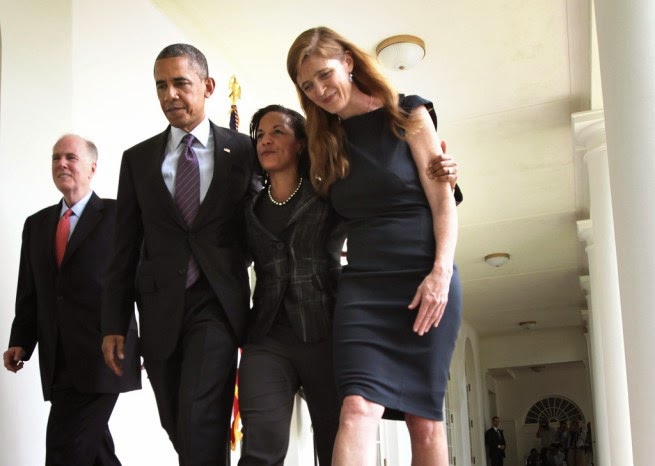
In her first appearance before the Senate Foreign Affairs Committee, Samantha Power, Obama’s pick for next U.S. Ambassador to the United Nations, made clear that she will spend her time in the role much as her predecessor Susan Rice did: acting as Israel’s consummate defender, fear-mongering about Iran, and opposing any move to champion Palestinian human rights or self-determination.
Rice, who has been appointed as Obama’s National Security Adviser, has said repeatedly that the American delegation to the UN “often works in ‘lockstep’ with the Israeli delegation” and spends “an enormous amount of time defending Israel’s right to defend itself and defending Israel’s legitimacy.”
“It’s an issue of utmost and daily concern for the United States,” she declared last year. A few months ago, she reiterated this point, insisting that her role as an apologist for the Israeli government is “a huge part of my work to the United Nations” and that the United States “will not rest in the crucial work of defending Israel’s security and legitimacy every day at the United Nations.”
Power has already proven herself a loyal replacement, disavowing any semblance of past critical thinking when it comes to Israeli human rights abuses and abrogation of international law and opposing fear-mongering about Iran’s nuclear program. It is no surprise Washington hawks and, even the Israeli government, are falling over themselves to sing her praises.
In her confirmation hearing yesterday, Power revealed her adherence to AIPAC talking points, essentially working her way down the tried and true list of boilerplate phrases. “The United States has no greater friend in the world than the State of Israel,” she said, adding, “Israel is a country with whom we share security interests and, even more fundamentally, with whom we share core values – the values of democracy, human rights, and the rule of law.”
“America has a special relationship with Israel,” she stated, to the surprise of no one and the consternation of George Washington‘s ghost. “I will stand up for Israel and work tirelessly to defend it,” she promised.
Perhaps her most disturbing comments, however, were about Iran. Shamelessly exploiting the horror of the Holocaust to fear-monger about the Islamic Republic, she declared:
“…within this organization built in the wake of the Holocaust – built in part in order to apply the lessons of the Holocaust – we also see unacceptable bias and attacks against the State of Israel. We see the absurdity of Iran chairing the UN Conference on Disarmament, despite the fact that its continued pursuit of nuclear weapons is a grave threat to international peace and security.”
With this statement, Power, in her eagerness to check off all the buzzword boxes prescribed by AIPAC, directly contradicts the consistent assessment of the United States’ own intelligence community, which has repeatedly concluded that Iran is, in fact, not pursuing a nuclear weapons as it has no nuclear weapons program.
Early last year, an unnamed U.S. intelligence official told the Washington Post that Iran has not decided to pursue nuclear weapons, explaining, “Our belief is that they are reserving judgment on whether to continue with key steps they haven’t taken regarding nuclear weapons.” At the time, Secretary of Defense Leon Panetta affirmed this position, admitting, “Are they trying to develop a nuclear weapon? No.”
Soon thereafter, the New York Times reported, “Recent assessments by American spy agencies are broadly consistent with a 2007 intelligence finding that concluded that Iran had abandoned its nuclear weapons program years earlier.” This, the paper noted, “remains the consensus view of America’s 16 intelligence agencies.”
Either Samantha Power is an idiot or she’s lying.
In fact, there was a time when Power wasn’t so confident in making such a declarative statement. In a 2008 interview with Miller-McCune, Power noted that she was “not an expert on Iran,” but condemned the “American sabre-rattling” of the George W. Bush administration. “The threats – implicit and explicit – of U.S. military action have united very diverse secular, Islamist and nationalist strands,” she said, adding that American “belligerence” had “backfired.”
When asked specifically about whether she thought “Iran is trying to create nuclear weapons,” Power replied, “It would surprise me if they weren’t, but I don’t know.”
Still, she disparaged the findings of the National Intelligence Estimate and simply assumed Iran “would see as in its interests to amass as much firepower as possible,” due to the foreign threats it faces. Nevertheless, she stated, “It does not seem as though the Iranian regime is close to possessing nuclear weapons” and said that “when U.S. leaders claim Iran poses an imminent threat, they are not currently heard as credible.”
Now, five years later, Power sounds exactly like Bush’s own UN Ambassador, perennial Iran hawk John Bolton, who in 2006, insisted to the UN Security Council that “Iran had defied the international community by continuing its pursuit of nuclear weapons” and that this “pursuit of nuclear weapons constituted a direct threat to international peace and security.”
Furthermore, Power’s incredulity regarding what she deems the “absurdity of Iran chairing the UN Conference on Disarmament,” betrays her own ignorance on Iran’s constantly repeated stance regarding nuclear nonproliferation and disarmament.
Iran has long championed a Nuclear Weapons Free Zone (NWFZ) in the Middle East and is a party to all disarmament treaties on weapons of mass destruction, including the Biological Weapons Convention, Chemical Weapons Convention, and the Nuclear Non-Proliferation Treaty. Israel, however, is not a member to any of them.
Last year, Iranian Foreign Minister Ali Akbar Salehi stated that Iran fully supports the establishment of a NWFZ, but that Israel, and its American backers, presented the “only obstacle to the creation of such a zone…due to its persistent refusal to join the NPT and to place its nuclear facilities under the IAEA safeguards system.” The United States consistently blocks crucial international conferences dedicated to nuclear non-proliferation for the sole purpose of protecting Israel’s massive nuclear arsenal from scrutiny.
Samantha Power has surely embraced her new role in Turtle Bay as Israel’s stalwart apologist.
Abe Foxman, the Anti-Defamation League’s hasbarist-in-chief, once called Susan Rice a “gladiator” fighting in the United Nations on behalf of Israel. There is no question Samantha Power will, for the sake of our “special relationship” and “shared values” with an aggressive, nuclear-armed, settler-colonial apartheid state, similarly take up the sword and continue to unleash hell on the entire Middle East.
Related articles
- Israel’s Nuke Arsenal Off-Limits (alethonews.wordpress.com)
- MEK Re-Ups 3 Year Old Nuclear Propaganda (alethonews.wordpress.com)
Obama, Like Ike, ‘Avoided Military Adventures’? Not Quite
By Peter Hart | FAIR | July 16, 2013
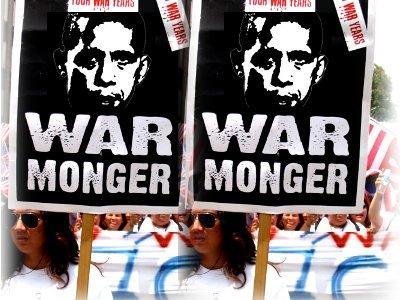
New York Times reporter Peter Baker has a piece today (7/16/13) about Barack Obama and Dwight Eisenhower that presents a somewhat confusing picture of both.
The article is about how Obama wields power–or, in the eyes of some critics, fails to take advantage of the “bully pulpit.”
The real point of the piece is to draw a parallel to Dwight Eisenhower’s “hidden hand” approach. According to an author of an Eisenhower book, Baker writes, “Mr. Obama was like the former president in avoiding major international conflict, relying more on covert action and letting Congress take the lead in legislation.”
Baker explains:
Just as Eisenhower, the 34th president, pulled troops out of Korea and avoided other military adventures, Mr. Obama has pulled out of Iraq, is leaving Afghanistan, has limited intervention in Libya largely to airstrikes and has resisted being drawn directly into the civil war in Syria.
Let’s try a rewrite–especially on the Obama years.
Obama withdrew troops from Iraq on the schedule inherited from Bush. His administration wanted to keep some troops there, but the Iraqi government would not allow it.
To say that Obama “is leaving Afghanistan” ignores the fact that he massively escalated the Afghan War, sending tens of thousands of additional troops to the country–essentially tripling the size of the U.S. military in the first 2 years of his term.
To say that Obama “limited intervention in Libya largely to airstrikes” is an odd way to describe what was a rather extensive bombing campaign in violation of the War Powers Act.
Baker does note that the White House has decided to formally begin arming the Syrian rebels–it is somewhat unclear how and/or when that will happen–and the CIA has reportedly been coordinating arms shipments into the country.
And, of course, one has to factor in ongoing drone wars in countries like Yemen, Afghanistan and Pakistan.
It is possible that these do not count as “military adventures,” but I think you’d have hard time explaining that to anyone in those countries.
As for Eisenhower, when the Times refers vaguely to “covert operations” during his term, one might want to spell out that the CIA was instrumental in the overthrow of governments in Iran, Guatemala and Congo, and that the CIA was deeply involved in supporting anti-government rebels in Indonesia fighting the Sukarno government–including dropping supplies to the rebels. His hands may have been “hidden,” but there’s no reason to not let the record speak for itself 50 years later.
Government Fights to Keep Court Opinions on NSA Spying Hidden From Public
By Alex Abdo | ACLU | July 16, 2013
Last month, we asked the secret Foreign Intelligence Surveillance Court—known as the FISC—to publish its legal opinions allowing the government to track the phone calls of essentially all Americans. Those secret opinions are critical to the ongoing debate about the NSA’s surveillance powers, but, perhaps even more importantly, they are the authoritative legal interpretations of a public law. Like the law itself, those opinions should be public. Given that fact, we were disappointed when, on July 5, the government opposed our request, arguing that the public is not entitled to read the FISC’s opinions.
Think about that for a minute. Our government believes that opinions of a federal court deciding what a controversial federal law actually means and whether sweeping surveillance conducted under that law is constitutional should be secret. And we’re not just talking about keeping secret the names of the government’s surveillance targets. The government’s filing was clear: The public doesn’t have the right to read even the FISC’s legal analysis.
Here is how we countered the government’s argument in the reply brief we filed late on Friday:
The First Amendment guarantees the public a qualified right of access to those opinions, because judicial opinions interpreting constitutional and statutory limits on governmental authorities— including those relevant to foreign-intelligence surveillance—have always been available for inspection by the public and because their release is so manifestly fundamental in a democracy committed to the rule of law.
The government’s contrary view—that legal opinions of an Article III court controlling the constitutional rights of millions of Americans may forever be denied to the public, even if any legitimate interest in secrecy has expired or can be accommodated—is wrong. Indeed, if the government succeeds in depriving the public of the tools necessary to understand the laws passed by its elected officials, it will have eroded the foundations of our democracy. The government’s theory affects more than the public’s right to this Court’s opinions; its reasoning would likewise deny the public a right of access to the opinions of courts sitting in review of those opinions, whether issued by the Court of Review or even the Supreme Court of the United States. That result would defeat democratic oversight and undermine public confidence in our legal institutions.
Our motion is now fully briefed and ready for the FISC to decide. Stay tuned.
Related articles
- Secret law thrives, eroding the courts (constitutioncampaign.org)
- A Secret Court Making Secret Laws? That’s No Democracy (alethonews.wordpress.com)
- Government Says Secret Court Opinion on Law Underlying PRISM Program Needs to Stay Secret (alethonews.wordpress.com)
- Reassured by NSA’s Internal Procedures? Don’t Be. They Still Don’t Tell the Whole Story. (alethonews.wordpress.com)
- Secret court allows Yahoo to disclose NSA data requests (jurist.org)
The Detention of Evo Morales: A Defining Moment For Latin America?
By Emily Achtenberg | Rebel Currents | July 12, 2013
As the international uproar continues over last week’s grounding of Bolivian President Evo Morales’s plane in Europe, after U.S. officials apparently suspected whistle-blower Edward Snowden of being on board, many questions remain unanswered about the United States’ role and motives.
But one thing is certain: if the U.S. government was seeking to intimidate Morales and other Latin American leaders who might consider harboring Snowden, its strategy has completely backfired. Instead, the incident has bolstered Morales’s domestic and international standing, consolidated regional unity, and emboldened the bloc of leftist governments that seeks to counter U.S. dominance in the region. It has also dealt a damaging, and potentially fatal, blow to the future of U.S.–Latin American relations under the Obama administration.
The crisis was set off by Morales’s statement on July 2 in Russia, where he was attending an energy conference, that he would be willing to consider a petition by Snowden for asylum. Later that evening, on his return flight to Bolivia, Morales’s plane was denied entry into the airspace of France, Italy, Spain, and Portugal, forcing it to make an unscheduled landing in Vienna where it was diverted for 13 hours before receiving clearance to proceed.
In response to Bolivia’s persistent questioning, the four European countries have offered equivocal and somewhat contradictory—if not preposterous—explanations for their actions. France, which has apologized to Morales, says it didn’t realize that the Bolivian president was on the presidential jet. Portugal, originally scheduled as a refueling stop, says its airport wasn’t capable of servicing the plane. Italy now completely denies having closed its airspace.
Spain, after initially attributing the problem to the expiration of its flyover permit during Morales’s unexpected layover in Austria, later admitted that the United States had asked it to block the flight (although the United States has not acknowledged any role in the incident). At first, Spanish officials also claimed that the plane was searched for Snowden in Vienna at the behest of the United States—an action which, if taken without Bolivia’s permission, would constitute a violation of international law even more egregious than the denial of airspace to the presidential jet.
More recently, Spain has insisted (and Bolivia concurs) that it ultimately granted airspace permission upon Bolivia’s written assurance that Snowden was not on board the plane. Spain, which has sought to improve economic relations with Bolivia after being hit hard by Morales’s nationalization of its airport management and electric companies, has also offered to apologize.
The apparent willingness of four European governments to put U.S. interests ahead of international law and Bolivia’s rights as a sovereign nation—despite themselves being victimized by illegal U.S. spying activities—stands in sharp contrast to Latin America, where the detention of an indigenous president is seen as the latest grievance in a long history of colonial and imperial transgressions. Bolivian Vice President Alvaro García Linera has denounced the incident as an imperial “kidnapping.”
For many Bolivians, the episode is viewed as a deliberate effort by the U.S. government to punish Morales for his persistent anti-U.S. rhetoric and actions, including the expulsion of the U.S. Ambassador and Drug Enforcement Agency (DEA) in 2008, and, most recently, USAID. It also strikes a special nerve since the United States hosts, and has refused to extradite, some of Bolivia’s most wanted criminals, including neoliberal ex-president Gonzalo Sánchez de Lozada (Goni), facing charges of genocide in connection with the killing of 67 indigenous protesters during the 2003 “Gas Wars.”
Within hours of Morales’s detention, other leftist Latin American governments rallied in outraged solidarity with Bolivia. Argentine President Cristina Fernández labeled the incident “a remnant of the colonialism we thought had been overcome.” Ecuadorean President Rafael Correa tweeted, “We are all Bolivia!”
Along with expressions of support from ALBA, CELAC, Mercosur, and other regional blocs, UNASUR issued a statement condemning the action on July 4, signed by six heads of state (Bolivia, Argentina, Uruguay, Venezuela, Ecuador, and Suriname) who attended an emergency meeting. Governments from across the region’s political spectrum (including Mexico, Peru, Colombia, and Chile) closed ranks behind Morales.
On July 9, the OAS issued a consensus resolution expressing solidarity with Morales and demanding apologies and explanations from the four European nations (but not the United States.) Internationally, more than 100 UN member nations have collectively denounced the incident, bolstering Bolivia’s complaint before the UN High Commission on Human Rights.
The provocative detention of Morales undoubtedly precipitated the decision of three leftist Latin American governments—Bolivia, Venezuela, and Nicaragua (conditionally)—to offer asylum to Snowden, in open defiance of the United States. As journalist Stephen Kinzer has noted, with the U.S./ European rogue actions converting Snowden into a Latin American hero, the offer of asylum is politically popular in the region. This sentiment also stems from the regional legacy of dictatorship and political persecution, including the personal experiences of many leftist leaders. As Uruguayan President José Mujica (a former Tupamaro guerrilla) declared, “To all of us who have been persecuted, the right to asylum is sacred and must be defended.”
Broad regional support also makes it easier for any country offering shelter to Snowden to resist U.S. demands for extradition. As well, the mounting evidence of U.S. pressure on European and Latin American countries to deny sanctuary or transit assistance to Snowden, interfering with their sovereign decision-making processes, strengthens the case for asylum, legally and politically. U.S. officials have made it clear that any country aiding Snowden will be made to suffer, putting relations with the United States “in a very bad place for a long time to come.”
Still, in a region that remains heavily dependent on U.S. trade, the threat of U.S. retaliation through economic sanctions will be a major factor in the asylum calculus for any government, as illustrated by the recent case of Ecuador. After initially championing Snowden’s cause and apparently aiding his transit from Hong Kong to Moscow, Correa suddenly backed off after a phone call from Joe Biden, saying that Biden’s concerns were “worth considering.” While Correa has defiantly renounced Ecuador’s long-standing U.S. trade preferences as an instrument of “political blackmail,” he apparently hopes to replace them with an alternative set of duty-free waivers under the Generalized System of Preferences (GSP) program, an option that could be jeopardized by an asylum offer.
Similar considerations will no doubt be of concern to Venezuela and Bolivia, should either of their asylum offers materialize into reality (a complex proposition, given the many obstacles to achieving Snowden’s safe transit). While political relations between these countries and the United States have been polarized for some time—with the U.S. government still failing to recognize Nicolás Maduro’s April election—Venezuela still exports 40% of its oil to U.S. markets, and the United States remains as Bolivia’s third largest trading partner (after Brazil and Argentina). Bolivia also enjoys some of the same GSP trade preferences that Ecuador is seeking, which cover around 50% of its U.S. exports.
Still, the incident has greatly strengthened both Morales and Maduro domestically and internationally, corroborating their anti-imperialist worldviews. For Morales—newly characterized by García Linera as the “leader of the anti-imperialist presidents and peoples of the world”—the wave of solidarity responding to his personal victimization has consolidated his political popularity in a pre-election year. Recalling the 2002 presidential election when the U.S. Ambassador’s negative comments about candidate Morales catapulted him unexpectedly into second place, García Linera jokes that Obama has become Morales’s new campaign manager.
For Maduro, whose asylum offer is being promoted by Russia, the opportunity to champion Snowden’s cause and challenge the United States on a world stage, with substantial regional support, has allowed him to genuinely reclaim Hugo Chávez’s anti-imperialist mantle. “It provides the perfect opportunity for Maduro…to figure internationally, to show that he is a player among the big powers…and that he’s capable of challenging the United States,” says political analyst Eduardo Semetei.
In terms of overall U.S.-Latin American relations, the episode could be a defining moment for the Obama administration. As Kinzer notes, the downing of Morales’s jet may have reflected a genuine U.S. effort to capture Snowden—as opposed to a shot across the bow to intimidate Snowden’s potential supporters—but even so, the depth of misunderstanding as to how the incident would resonate in Latin America is telling. New daily revelations from Snowden’s data trove about massive U.S. spying programs in the region are adding fuel to the fire, further strengthening the leftist popular bloc—and confirming Glenn Greenwald’s assessment that the U.S. government has been its own worst enemy throughout this entire episode. It is difficult to imagine how the Obama administration can recover the region’s trust any time soon.
Related articles
- Spain apologizes for role in Morales jet ban (alethonews.wordpress.com)
- Evo Morales: No Need for US Embassy in Bolivia (alethonews.wordpress.com)
The NYT Continues to Misinform on Chemical Weapons in Syria
By Michael McGehee · NYTX · July 11, 2013
Writing in his original preface to Animal Farm, George Orwell wrote about how “inconvenient facts [can be] kept dark, without the need for any official ban”:
Anyone who has lived long in a foreign country will know of instances of sensational items of news – things which on their own merits would get the big headlines – being kept right out of the British press, not because the Government intervened but because of a general tacit agreement that ‘it wouldn’t do’ to mention that particular fact […] At any given moment there is an orthodoxy, a body of ideas which it is assumed that all right-thinking people will accept without question. It is not exactly forbidden to say this, that or the other, but it is ‘not done’ to say it, just as in mid-Victorian times it was ‘not done’ to mention trousers in the presence of a lady. Anyone who challenges the prevailing orthodoxy finds himself silenced with surprising effectiveness. A genuinely unfashionable opinion is almost never given a fair hearing, either in the popular press or in the highbrow periodicals.
One way in which readers, listeners, or viewers can gauge the validity of news stories is by how quickly they drop off the media’s radar. If a story is sensationalist hype it will likely disappear as fast as it appeared. Another way is if the story gets reported at all.
Earlier this year was the scare story of an impending North Korea attack on the United States. The mainstream media, especially in the U.S. and the West, went ballistic (pun intended) on supposed North Korean threats. Hundreds, possibly thousands, of articles claimed over and over that North Korea threatened to attack South Korea and the United States. That was the popular narrative repeated ad infinitum. But it’s not entirely true. What North Korea “threatened” was retaliation, not an attack. Kim Jong-Un said his country would respond to South Korean and American aggression.
But, let’s rewind to the New Year. According to the Washington Post: “In New Year’s speech, N. Korea’s Kim says he wants peace with South”:
SEOUL — In a domestically televised New Year’s Day speech, North Korean supreme leader Kim Jong Eun said he wants to “remove confrontation” on this divided peninsula and called on “anti-reunification forces” in South Korea to end their hostility toward the North.
The lengthy address, which laid out North Korea’s goals for the year, marked Kim’s first formal remarks since the election two weeks ago of Park Geun-hye as South Korea’s next president.
The North Korean leader asked for a detente — but with prerequisites that the conservative Park is likely to be reluctant to accept. Both sides, Kim said, must implement joint agreements signed years ago by the North and liberal, pro-engagement presidents in Seoul. Those agreements call for, among other things, economic cooperation, high-level government dialogue and the creation of a special “cooperation” zone in the Yellow Sea, where the North and South spar over a maritime border.
The peace overture was replied with the annual South-Korean-U.S. military exercise, but this time with an interesting twist: the exercise included a scenario of a pre-emptive attack on North Korea. Worse, the U.S. pulled out its B-52’s, that are capable of firing nuclear weapons, and flaunted them recklessly.
In chronological order: North Korea requests peace and steps to move in that direction, to which South Korea and the United States respond with a mock scenario of a pre-emptive strike, including the possible use of nuclear weapons, to which North Korea says it will retaliate against any such attack, and, finally, the American media largely ignores this context, that Kim was vowing retaliation, and whips up hysteria of North Korea coming out of the blue with threats of nuking America.
But then the story simply went away.
We have seen this also with the recent case of Syria and the regime’s alleged use of chemical weapons.
A month ago the White House came out with the claim that the Syrian government used chemical weapons “on a small scale against the opposition multiple times in the last year.”
And though FAIR’s Peter Hart quickly pointed out that skepticism was “warranted,” the mainstream media saturated news outlets with the story.
But, like the North Korean “threat,” the story simply went away.
Until yesterday.
The story is back on the radar as Russia provided the UN, and Western countries with their report on the Sarin attack in Aleppo, Syria. Unlike the US, the Russians have (and provided) evidence that it was the rebels who carried out the chemical attack.
According to Rick Gladstone of The New York Times, in his article “Russia Says Study Suggests Syria Rebels Used Sarin,” and which appears on page A7 of the July 10, 2013 edition, Moscow’s “scientific analysis of a suspected chemical weapons attack in Syria on March 19 showed it probably had been carried out by insurgents using Sarin nerve gas of ‘cottage industry’ quality delivered by a crudely made missile.” Gladstone then informs us that Russia’s findings “contradicted conclusions presented by Western nations, including the United States, that the Syrian government had been responsible.”
The most troubling aspect of Gladstone’s article was this passage: “The American conclusion was based in part on indirectly procured soil samples and interviews with survivors, as well as the Syrian insurgency’s lack of technical ability and materials to carry out a chemical weapons attack.”
The problem? Those last sixteen words—“the Syrian insurgency’s lack of technical ability and materials to carry out a chemical weapons attack”—are presented, not as a claim, but as a fact. As we at the NYTimes eXaminer pointed out last month, The New York Times has ignored two important news items that undermine this assertion: (1) the hacking of Britam, a British defense company, revealed a plan by Washington for the use of chemical weapons in Syria, and then blame it on the government; and (2) the arrest of Syrian rebels in Turkey, who happened to be in possession of Sarin nerve gas.
All of this occurred before the White House came out with their claim that the Syrian government was behind the Sarin attacks, and was readily available in the press, though not reported by The New York Times. To this day the “paper of record” has yet to mention either of these two incidences, even as they claim that the Syrian rebels have a “lack of technical ability and materials to carry out a chemical weapons attack.”
Readers should be concerned with why sensationalist stories of a threatening North Korea, and chemical weapon-using Syria, can appear long enough to outrage the public, but stories of false flags, and rebels getting caught with the very chemical weapons we claim they don’t have, go unreported.
Obama gives himself control of all communication systems in America
RT | July 11, 2013
US President Barack Obama quietly signed his name to an Executive Order on Friday, allowing the White House to control all private communications in the country in the name of national security.
President Obama released his latest Executive Order on Friday, July 6, a 2,205-word statement offered as the “Assignment of National Security and Emergency Preparedness Communications Functions.” And although the president chose not to commemorate the signing with much fanfare, the powers he provides to himself and the federal government under the latest order are among the most far-reaching yet of any of his executive decisions.
“The Federal Government must have the ability to communicate at all times and under all circumstances to carry out its most critical and time sensitive missions,” the president begins the order. “Survivable, resilient, enduring and effective communications, both domestic and international, are essential to enable the executive branch to communicate within itself and with: the legislative and judicial branches; State, local, territorial and tribal governments; private sector entities; and the public, allies and other nations.”
President Obama adds that it is necessary for the government to be able to reach anyone in the country during situations it considers critical, writing, “Such communications must be possible under all circumstances to ensure national security, effectively manage emergencies and improve national resilience.” Later the president explains that such could be done by establishing a “joint industry-Government center that is capable of assisting in the initiation, coordination, restoration and reconstitution of NS/EP [national security and emergency preparedness] communications services or facilities under all conditions of emerging threats, crisis or emergency.”
“The views of all levels of government, the private and nonprofit sectors, and the public must inform the development of NS/EP communications policies, programs and capabilities,” he adds.
On the government’s official website for the National Communications Systems, the government explains that that “infrastructure includes wireline, wireless, satellite, cable, and broadcasting, and provides the transport networks that support the Internet and other key information systems,” suggesting that the president has indeed effectively just allowed himself to control the country’s Internet access.
In order to allow the White House to reach anyone within the US, the president has put forth a plan to establish a high-level committee calling from agents with the Department of Homeland Security, Pentagon, Federal Communications Commission and other government divisions to ensure that his new executive order can be implemented.
In explaining the order, the Electronic Privacy Information Center (EPIC) writes that the president has authorized the DHS “the authority to seize private facilities when necessary, effectively shutting down or limiting civilian communications.”
In Section 5 of his order, President Obama outlines the specific department and agency responsibilities that will see through his demands. In a few paragraphs, President Obama explains that Executive Committee that will oversee his order must be supplied with “the technical support necessary to develop and maintain plans adequate to provide for the security and protection of NS/EP communications,” and that that same body will be in tasked with dispatching that communiqué “to the Federal Government and State, local, territorial and trial governments,” by means of “commercial, Government and privately owned communications resources.”
Later, the president announces that the Department of Homeland Security will be tasked with drafting a plan during the next 60 days to explain how the DHS will command the government’s Emergency Telecommunications Service, as well as other telecom conduits. In order to be able to spread the White House’s message across the country, President Obama also asks for the purchasing of equipment and services that will enable such.
Federal Judge Allows EFF’s NSA Mass Spying Case to Proceed
Rejects Government’s State Secret Privilege Claims in Jewel v. NSA and Shubert v. Obama
EFF | July 8, 2013
San Francisco – A federal judge today rejected the U.S. government’s latest attempt to dismiss the Electronic Frontier Foundation’s (EFF’s) long-running challenge to the government’s illegal dragnet surveillance programs. Today’s ruling means the allegations at the heart of the Jewel case move forward under the supervision of a public federal court.
“The court rightly found that the traditional legal system can determine the legality of the mass, dragnet surveillance of innocent Americans and rejected the government’s invocation of the state secrets privilege to have the case dismissed,” said Cindy Cohn, EFF’s Legal Director. “Over the last month, we came face-to-face with new details of mass, untargeted collection of phone and Internet records, substantially confirmed by the Director of National Intelligence. Today’s decision sets the stage for finally getting a ruling that can stop the dragnet surveillance and restore Americans’ constitutional rights.”
In the ruling, Judge Jeffrey White of the Northern District of California federal court agreed with EFF that the very subject matter of the lawsuit is not a state secret, and any properly classified details can be litigated under the procedures of the Foreign Intelligence Surveillance Act (FISA). As Judge White wrote in the decision, “Congress intended for FISA to displace the common law rules such as the state secrets privilege with regard to matter within FISA’s purview.” While the court allowed the constitutional questions to go forward, it also dismissed some of the statutory claims. A status conference is set for August 23.
EFF’s Jewel case is joined in the litigation with another case, Shubert v. Obama.
“We are pleased that the court found that FISA overrides the state secrets privilege and look forward to addressing the substance of the illegal mass surveillance,” said counsel for Shubert, Ilann Maazel of Emery Celli Brinckerhoff & Abady LLP. “The American people deserve their day in court.”
Filed in 2008, Jewel v. NSA is aimed at ending the NSA’s dragnet surveillance of millions of ordinary Americans and holding accountable the government officials who illegally authorized it. Evidence in the case includes undisputed documents provided by former AT&T telecommunications technician Mark Klein showing AT&T has routed copies of Internet traffic to a secret room in San Francisco controlled by the NSA. The case is supported by declarations from three NSA whistleblowers along with a mountain of other evidence. The recent blockbuster revelations about the extent of the NSA spying on telecommunications and Internet activities also bolster EFF’s case.
For the full decision:
https://www.eff.org/node/74895
For more on Jewel v. NSA:
https://www.eff.org/cases/jewel
State Department’s Watergate? Office of high-profile whistleblower’s lawyer burglarized
RT | July 8, 2013
The Dallas law office representing a State Department whistleblower was broken into and robbed during the first weekend of July. Three computers were stolen and the firm’s file cabinets had been searched, but valuables were left untouched.
“It’s a crazy, strange and suspicious situation,” attorney Cary Schulman of the Schulman & Mathias law office told Foreign Policy Magazine’s The Cable.
The burglars left behind silver bars, video equipment and other valuables, causing Schulman to believe that they were looking to find information on the case of former State Department inspector general investigator Aurelia Fedenisn, who leaked government documents last month. Fedenisn provided CBS News with documents that accuse the State Department of covering up criminal investigations involving its diplomats and employees, including offenses such as illicit drug use, sexual solicitation of minors and prostitutes, and sexual harassment.
The documents state that US Ambassador to Belgium Howard Gutman “was suspected of patronizing prostitutes in a public park.”
Schulman believes that the perpetrators of the burglary may have been politically motivated supporters of the Obama administration, but the suspects have not yet been identified.
“It’s clear to me that it was somebody looking for information and not money. My most high-profile case right now is the Aurelia Fedenisn case, and I can’t think of any other case where someone would go to these great lengths to get our information,” Schulman told The Cable.
Last month, lawyers representing Fedenisn told The Cable that the State Department tried to silence her by threatening her and her family. Law enforcement officers allegedly camped in front of her house, harassed her children, and tried to make Fedenisn incriminate herself.
Schulman believes that officials are trying to force Fedenisn to sign papers admitting that she stole the documents – a crime that the former investigator denies.
The law office does not believe the State Department authorized a break-in, but suspects that supporters of the administration may be to blame.
“It wasn’t professional enough,” he said. “It is possible that an Obama or Hillary supporter feels that I am unfairly going after them. And the timing of this is right after several weeks of very public media attention so it seems to me most likely that the information sought is related to that case. I don’t know for sure and I want the police to do their work.”
Local Fox affiliate KDFW aired a surveillance video of the two suspected burglars, who can be seen walking out of the office carrying computers.
State Department spokesperson Jen Psaki claims the agency had no involvement in the break-in.
“Any allegation that the Department of State authorized someone to break into Mr. Schulman’s law firm is false and baseless,” she said.
How Do You Know When President Obama is Lying?
By JEFF COHEN | CounterPunch | July 8, 2013
I was a young person when I first heard the quip: “How do you know when the President is lying? His lips are moving.” At the time, President Nixon was expanding the war in Vietnam to other countries and deploying the White House “plumbers” to commit crimes against antiwar leakers.
Forty years have passed. Sadly, these days, often when I see President Obama moving his lips, I assume he’s lying.
Like Nixon, our current president is prolonging an endless, borderless and counter-productive war (“on terror”) and waging a parallel war against “national security” leakers that makes the plumbers’ burglary of Daniel Ellsberg’s psychiatrist’s office look almost quaint.
The World War I vintage Espionage Act, originally used to imprison socialists for making antiwar speeches, has been used by the administration against whistleblowers with a vengeance unprecedented in history: eight leakers have been charged with Espionage under Obama, compared to three under all previous presidents. The Obama administration has prosecuted not a single CIA torturer, but has imprisoned a CIA officer who talked about torture with a journalist. National Security Agency official Thomas Drake, who was unable to get abuses fixed internally, now has a criminal record for communicating with a reporter years ago about sweeping domestic surveillance.
So there I was watching Obama’s lips move about NSA whistleblower Edward Snowden at a June 27 press conference. Saying he wouldn’t be “scrambling military jets to go after a 29-year-old hacker,” Obama added that he would not “start wheeling and dealing and trading on a whole host of other issues, simply to get a guy extradited.”
I didn’t believe a word of it.
Given Obama’s war on whistleblowers and journalists who utilize them, and given the Army’s abusive treatment of military whistleblower Bradley Manning (apparently aimed at getting him to implicate WikiLeaks), it’s inconceivable that Obama was truly blasé about Snowden. To deter future whistleblowers, Snowden would have to be caught and made an example of – and probably mistreated (like Manning, in hopes of getting him to turn against WikiLeaks and even journalist Glenn Greenwald).
As his lips were moving, Obama knew well that he would go to extreme lengths to prevent this articulate young man from securing asylum in some Latin American country, where he could continue to inform the world’s media about the Surveillance State that has blossomed alongside the Warfare State under the Bush and Obama administrations.
That Obama wasn’t truthful became clear when the U.S. campaign of “wheeling and dealing” led to possible asylum countries retreating in fear one after another (Vice President Biden was deployed to pressure Ecuador’s president by phone). And even clearer with last week’s outrageous, international law-breaking that effectively forced down the presidential plane of Bolivian President Evo Morales.
And if Obama eventually does scramble jets to force down a plane with Snowden on board, the commander-in-chief will be applauded for taking bold and decisive action by mainstream TV talking heads, “national security” experts and the opposition he seems most intent on pleasing: conservatives. Criticism from civil libertarian and peace voices (or unions and environmentalists, for that matter) has rarely daunted Obama.
The bipartisan consensus in support of our bloated Military/Surveillance State – which so undermines our society as a whole – is reflected in Congress and both the Bush and Obama administrations, as well as mainstream media.
When it comes to issues of U.S. militarism and spying, the allegedly “progressive” MSNBC often seems closer to the “official network of the Obama White House” than anything resembling an independent channel. With a few exceptions (especially Chris Hayes), MSNBC has usually reacted to expanded militarism and surveillance by downplaying the abuses or defending them.
Had McCain or Romney defeated Obama and implemented the exact same policies, treating whistleblowers like Manning and Snowden as foreign espionage agents, one would expect MSNBC hosts to be loudly denouncing the Republican abuses of authority.
But with Obama in power, a number of MSNBC talking heads have reacted to the Snowden disclosures like Fox News hosts did when they were in hysterical damage control mode for Bush – complete with ridiculously fact-free claims and national chauvinism that we’ve long come to expect from the “fair & balanced” channel.
As Snowden arrived in Russia from Hong Kong, MSNBC host Ed Schultz blustered on about Snowden as a “punk” and “coward.” Railing about the “security of the country” in tones Hannity would approve of, Schultz questioned Snowden’s patriotism and credibility, asking: “If the United States of America is doing something so egregiously wrong in its surveillance program, how come he’s the only one speaking up?
In O’Reilly-like blissful ignorance, Schultz seemed unaware of the three NSA whistleblowers who’d loudly spoken up way earlier than Snowden – and gathered for an illuminating USA Today interview a week before his tirade.
I watched one MSNBC host function as an auxiliary prosecutor in Obama’s Justice Department, going after Snowden – while trying to link WikiLeaks and journalist Glenn Greenwald to criminal flight.
MSNBC’s Melissa Harris-Perry has been condemning Snowden by contrasting him with civil disobedients who “love their country” and submit to arrest – while Snowden just wants to “save his own skin.” She proclaimed: “This is different. This is dangerous to our nation.” Should we similarly dismiss Dan Ellsberg, who leaked the top secret Pentagon Papers to a dozen newspapers in 1971 by going on the lam from the FBI. Or Watergate’s “Deep Throat,” who saved his own skin by hiding his identity for 30 years after leaking secrets that helped crash the Nixon presidency?
In a bizarre monologue attacking Snowden (who’s risked plenty, in my view), Harris-Perry hailed those who engage in civil disobedience for being willing “to risk your own freedom, your own body in order to bring attention to something that needs to be known. Martin Luther King Jr. was arrested, attacked, smeared. Nelson Mandela went to prison for 27 years.” (My emphasis.)
Nelson Mandela? He wasn’t a civil disobedient who gave himself up. He was a fugitive, fleeing the apartheid police. He was on the lam domestically, like Snowden is now internationally. And some reports indicate that South African authorities were able to nab Mandela thanks to the U.S. CIA (one of the agencies now working to apprehend Snowden).
MSNBC’s Rachel Maddow has also disappointed. After doing a typically thorough presentation on the force-down of President’s Morales’ plane, she ended her report by expressing displeasure only that Washington had apparently gotten allies to go out on the limb “for nothing.” Her objection to the harassment seemed to be: it hadn’t succeeded. I didn’t hear opposition to the action had Snowden actually been on board and apprehended.
The Snowden/NSA story proves once again that – especially on so-called “national security” issues – we need strong, independent media not enmeshed with the corporate/political power structure and not allied with one of the two corporate parties.
We can’t count on MSNBC to heed the lesson taught by legendary independent journalist I.F. “Izzy” Stone, after years reporting from Washington: “All governments lie and nothing they say should be believed.”
Jeff Cohen was an MSNBC pundit and senior producer in 2002-3 until being terminated for political reasons, along with Phil Donahue, on the eve of the Iraq invasion. He is director of the Park Center for Independent Media at Ithaca College, founder of the media watch group FAIR, and author of Cable News Confidential: My Misadventures in Corporate Media. He cofounded the online action group RootsAction.org, which has petitioned for Snowden.
Featured Video

WARNING: Delete TikTok Immediately!
or go to
Aletho News Archives – Video-Images
Book Review
In 2014, Michael Parenti Wrote A Prophetic Article About Ukraine

The Dissident | January 28, 2026
This week, the influential left-wing scholar Michael Parenti passed away at the age of 92.
Parenti was well known for his sharp criticism of U.S. foreign policy and U.S. imperialism throughout his life, waking up many to the reality of it and the lies used to justify it.
This is best underscored in one of his last published articles, “Ukraine and Regime Change”, which was published in the book “Flashpoint In Ukraine: How the U.S. Drive for Hegemony Risks World War III”, where he predicted to a tee what the result of the 2014 U.S. backed coup in Ukraine would be. … continue
Blog Roll
Recent Comments
eddieb on Conspiracy Denial eddieb on WEF Calls for ‘Cultural Revolu… loongtip on Trump wanted to play peacemake… Coronistan on EU member to sue bloc over ‘su… loongtip on Vicious loongtip on EU turns to India for defense… Coronistan on Donald Trump Is No Peace … seversonebcfb985d9 on French court jails pro-Palesti… eddieb on Fourteen Incredible Facts Abou… Bill Francis on European leaders’ shift in the… seversonebcfb985d9 on Villains of Judea: Philip Esfo… loongtip on Report warns that ‘Jewish terr…


 Aletho News
- Fānpán – Is China Turning the Tables on the ‘Democratic’ West?
- Davos, Mark Carney’s frankness, and the Euro-American rift
- Austrian lawmakers propose to revoke citizenship of former foreign minister
- Switzerland plans tax hike to revamp military
- In One Of His Final Pieces, Written in 2014, Michael Parenti Wrote A Prophetic Article About Ukraine
- More Bombs, More Talks Zelensky Rejects Trump’s Plan
- WARNING: Delete TikTok Immediately!
- Bari Weiss’ New CBS Hire List Is Full Of Zionists
- As TikTok falls into Zionist hands, UpScrolled fills the vacuum to give voice to Palestine
- Former Biden Advisor, Amos Hochstein, Admits The Biden Administration Is Responsible For the Gaza Genocide
- If Americans Knew
- An error has occurred; the feed is probably down. Try again later.
- No Tricks Zone
- New Study Affirms Rising CO2’s Greening Impact Across India – A Region With No Net Warming In 75 Years
- Germany’s Natural Gas Crisis Escalates … One Storage Site Near Empty …Government Silent
- Polar Colding…Antarctica Saw Its Coldest October In 44 Years!
- New Study: Sea Levels Rose 20 Times The Modern Rate During The Roman Warm Period
- As German Gas Storage Dips Dangerously Low…Shortage Hardly Avoidable
- New Study: Brazil’s Relative Sea Level Was 2+ Meters Higher And SSTs 3-4°C Warmer 6000 Years Ago
- Philosopher Schopenhauer: Climate Science Certainty Stems From Stupidity, Ignorance
- New Study: Species Extinction Rates Declining Since 1980 – ‘Climate Change Is Not An Important Threat’
- Denmark Places Climate Protection Above Animal Welfare, Poisoning And Culling Cows
- New Study: Greenland Was 3-7°C Warmer And Far Less Glaciated Than Today 6000-8000 Years Ago
 Aletho News